DIFFERENTIAL SCANNING
CALORIMETRY
(DSC)
Introduction
 During the past few years, the methods of thermal analysis have been widely
accepted in analytical chemistry.
 The term thermal analysis incorporates those techniques in which some physical
parameter of the system is determined and/or recorded as a function of temperature.
 Thermal analysis has been used to determine the physical and chemical properties
of polymers, drugs and geological materials.
 A calorimeter measures the heat into or out of a sample.
 A differential calorimeter measures the heat of sample relative to a reference.
2
Introduction
 A differential scanning calorimeter does all of the above and heats the sample with a linear temperature
ramp (developed by E. S. Watson and M. J. O'Neill in 1962).
 DSC is a technique in which the difference in the amount of heat required to increase the temperature of a
sample and reference are measured as function of temperature.
 Both the sample and reference are maintained at nearly the same temperature throughout the experiment.
 Only a few mg of material are required to run the analysis.
 DSC is the most often used thermal analysis method, primarily because of its speed, simplicity, and
availability.
3
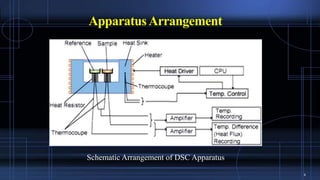
Schematic Arrangement of DSC Apparatus
4
ApparatusArrangement
Principle
 When a sample undergoes a physical transformation such as a phase transition, more or less heat will
need to flow to it than to the reference (typically an empty sample pan) to maintain both at the same
temp. Whether more of less heat must flow to the sample depends on whether the process is
exothermic or endothermic.
 For e.g.as a solid sample melts to a liquid it will require more heat flowing to the sample to increase its
temp. At the same rate as the reference. This is due to the absorption of heat by the sample as it
undergoes the endothermic phase transition from solid to liquid.
 Likewise, as the sample undergoes exothermic processes (such as crystallization) less heat is required
to raise the sample temp.
 By observing the difference in heat flow between the sample and reference, DSC is able to measure the
amount of heat absorbs or release during such transition.
5
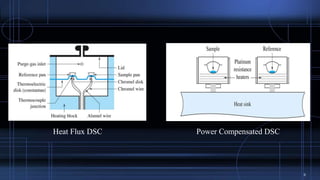
Heat Flux DSC Power Compensated DSC
6
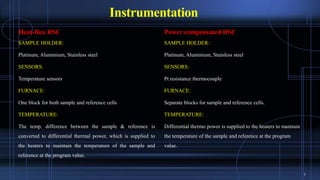
Instrumentation
Heat-flux DSC
SAMPLE HOLDER:
Platinum, Aluminium, Stainless steel
SENSORS:
Temperature sensors
FURNACE:
One block for both sample and reference cells
TEMPERATURE:
The temp. difference between the sample & reference is
converted to differential thermal power, which is supplied to
the heaters to maintain the temperature of the sample and
reference at the program value.
Power compensated DSC
SAMPLE HOLDER:
Platinum, Aluminium, Stainless steel
SENSORS:
Pt resistance thermocouple
FURNACE:
Separate blocks for sample and reference cells.
TEMPERATURE:
Differential thermo power is supplied to the heaters to maintain
the temperature of the sample and reference at the program
value.
7
DSC Curve
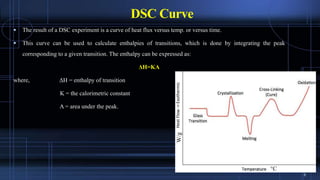
 The result of a DSC experiment is a curve of heat flux versus temp. or versus time.
 This curve can be used to calculate enthalpies of transitions, which is done by integrating the peak
corresponding to a given transition. The enthalpy can be expressed as:
ΔH=KA
where, ΔH = enthalpy of transition
K = the calorimetric constant
A = area under the peak.
8
°C
W/g
FACTORSAFFECTING DSC CURVE
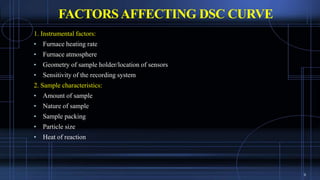
1. Instrumental factors:
• Furnace heating rate
• Furnace atmosphere
• Geometry of sample holder/location of sensors
• Sensitivity of the recording system
2. Sample characteristics:
• Amount of sample
• Nature of sample
• Sample packing
• Particle size
• Heat of reaction
9
Advantages & Limitations
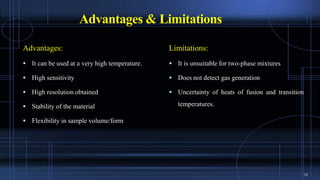
Advantages:
 It can be used at a very high temperature.
 High sensitivity
 High resolution obtained
 Stability of the material
 Flexibility in sample volume/form
Limitations:
 It is unsuitable for two-phase mixtures
 Does not detect gas generation
 Uncertainty of heats of fusion and transition
temperatures.
10
Applications
 Oxidative stability
 Crystallinity
 Drug analysis
 Heat capacity
 Purity
11
12

DSC | DIFFERENTIAL SCANNING CALORIMETRY

  • 1.
  • 2.
    Introduction  During thepast few years, the methods of thermal analysis have been widely accepted in analytical chemistry.  The term thermal analysis incorporates those techniques in which some physical parameter of the system is determined and/or recorded as a function of temperature.  Thermal analysis has been used to determine the physical and chemical properties of polymers, drugs and geological materials.  A calorimeter measures the heat into or out of a sample.  A differential calorimeter measures the heat of sample relative to a reference. 2
  • 3.
    Introduction  A differentialscanning calorimeter does all of the above and heats the sample with a linear temperature ramp (developed by E. S. Watson and M. J. O'Neill in 1962).  DSC is a technique in which the difference in the amount of heat required to increase the temperature of a sample and reference are measured as function of temperature.  Both the sample and reference are maintained at nearly the same temperature throughout the experiment.  Only a few mg of material are required to run the analysis.  DSC is the most often used thermal analysis method, primarily because of its speed, simplicity, and availability. 3
  • 4.
    Schematic Arrangement ofDSC Apparatus 4 ApparatusArrangement
  • 5.
    Principle  When asample undergoes a physical transformation such as a phase transition, more or less heat will need to flow to it than to the reference (typically an empty sample pan) to maintain both at the same temp. Whether more of less heat must flow to the sample depends on whether the process is exothermic or endothermic.  For e.g.as a solid sample melts to a liquid it will require more heat flowing to the sample to increase its temp. At the same rate as the reference. This is due to the absorption of heat by the sample as it undergoes the endothermic phase transition from solid to liquid.  Likewise, as the sample undergoes exothermic processes (such as crystallization) less heat is required to raise the sample temp.  By observing the difference in heat flow between the sample and reference, DSC is able to measure the amount of heat absorbs or release during such transition. 5
  • 6.
    Heat Flux DSCPower Compensated DSC 6
  • 7.
    Instrumentation Heat-flux DSC SAMPLE HOLDER: Platinum,Aluminium, Stainless steel SENSORS: Temperature sensors FURNACE: One block for both sample and reference cells TEMPERATURE: The temp. difference between the sample & reference is converted to differential thermal power, which is supplied to the heaters to maintain the temperature of the sample and reference at the program value. Power compensated DSC SAMPLE HOLDER: Platinum, Aluminium, Stainless steel SENSORS: Pt resistance thermocouple FURNACE: Separate blocks for sample and reference cells. TEMPERATURE: Differential thermo power is supplied to the heaters to maintain the temperature of the sample and reference at the program value. 7
  • 8.
    DSC Curve  Theresult of a DSC experiment is a curve of heat flux versus temp. or versus time.  This curve can be used to calculate enthalpies of transitions, which is done by integrating the peak corresponding to a given transition. The enthalpy can be expressed as: ΔH=KA where, ΔH = enthalpy of transition K = the calorimetric constant A = area under the peak. 8 °C W/g
  • 9.
    FACTORSAFFECTING DSC CURVE 1.Instrumental factors: • Furnace heating rate • Furnace atmosphere • Geometry of sample holder/location of sensors • Sensitivity of the recording system 2. Sample characteristics: • Amount of sample • Nature of sample • Sample packing • Particle size • Heat of reaction 9
  • 10.
    Advantages & Limitations Advantages: It can be used at a very high temperature.  High sensitivity  High resolution obtained  Stability of the material  Flexibility in sample volume/form Limitations:  It is unsuitable for two-phase mixtures  Does not detect gas generation  Uncertainty of heats of fusion and transition temperatures. 10
  • 11.
    Applications  Oxidative stability Crystallinity  Drug analysis  Heat capacity  Purity 11
  • 12.