DIFFERENTIAL
SCANNING
CALORIMETRY
SUBMITTED BY:
MAHESHWARI
III PHARM D
NANDHA COLLEGE OF PHARMACY ERODE-
52
INTRODUCTION
• Differential scanning calorimetry is a technique
for measuring the energy necessary to establish
a nearly zero temperature difference between a
substance and an inert reference material ,as the
two specimens are subjected to identical
temperature regimes in an environment heated or
cooled at a controlled rate.
• DSC is the most often used thermal analysis
method primarily because of its speed ,
simplicity and availability.
• DSC measures the heat absorbed or liberated
during the various transitions in the sample
due to temperature treatment.
• This technique is used to study what happens
to polymers or samples upon heating.
DSC ANALYSER
PRINCIPLE
• The sample and reference are maintained at the same temperature, even during a
thermal event in the sample
• The energy required to maintain zero temperature difference between the sample
and the reference is measured
• During a thermal event in the sample, the system will transfer heat to or fro from
the sample pan to maintain the same temperature in reference and sample pans
• Sample and an inert reference heated separately , with the power supply to the
sample heater variable so that temperature difference can be maintained at zero
even when endothermic or exothermic changes occurs. The difference in power
supplied to the 2 heaters is monitored as the analytical signal[ E]▲
WHATDOES DSC MEASURES ?
•It measure the amount of energy absorbed or released by a
sample as it is heated , cooled or held at a constant temperature
•DSC also performs precise temperature measurements .
USES OFDSC
Melting point
Crystallisation
Glass transition
Polymorphism
Purity
Specific heat
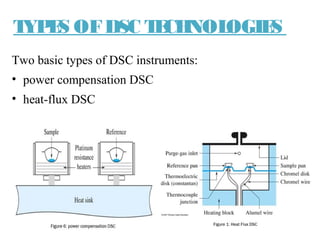
Two basic types of DSC instruments:
• power compensation DSC
• heat-flux DSC
TYPES OFDSC TECHNOLOGIES
DSC INSTRUMENTS
HEAT FLUX DSC
• Sample holder: platinum,
aluminium and stainless
steel
• Sensors:Temperature
sensors.
Usually thermocouples which
are same for both sample
and reference.
• Furnace: one block for both
reference and sample cell.
POWER COMPENSATION DSC
• Sample holder : platinum,
aluminium and stainless
steel pans
• Sensors: platinum
resistance thermocouple
Seperate sensors and
heaters for both reference
and sample.
• Furnace: seperate block for
both reference and sample
cell.
• Temperature: The
temperature difference
between the sample and
reference is converted to
differential thermal power,
which is supplied o the
heaters to maintain the
temperature of sample and
reference at the program
value.
• Temperature: differential
thermal power is supplied
to the heaters to maintain
the temperature of the
sample and reference at the
program value .
Heat Flux DSC
• The sample and the reference cells are heated at a constant rate and
thermocouples are used to detect the temperature difference between
sample side and the reference side using single large mass furnace
• The large single furnace which acts as an infinite heat sink to provide or
absorb heat from the sample.
• The dynamic sample chamber is the environment of the sample pan
compartments and the purge gas.
• Nitrogen is the most common gas , but alternate inert gas is helium or
argon
• When using an oxidative atmosphere air or oxygen are the gases of
choice
• The heat flux DSC is based on the change in the temperature between
the sample and the reference.
PowerCompensation DSC
• Introduced in the early1960s.
• It was developed by Perkin Elmer USA. It directly measures heat flow between
sample side and reference side using two separate , low mass furnaces.
• This individual furnaces use different amount of power to maintain a constant
change of temperature between sample and the reference and the advantages
here include faster heating and cooling , and better resolution.
• This type of cell , with two individually heated with platinum heater monitors
the difference between the sample and reference .
• Platinum resistance thermometers track the temperature variations for the
sample and reference cells.
• Holes in the compartment lids allows the purge gas to enter and contact the
sample and reference .
Sample Preparation
• Accurately-weigh samples (~3-20 mg)
• Small sample pans (0.1 mL) of inert or treated metals (Al, Pt, Ni, etc.)
• Several pan configurations, e.g., open, pinhole, or hermetically-sealed (airtight)
pans
• The same material and configuration should be used for the sample and the
reference
• Material should completely cover the bottom of the pan to ensure good thermal
contact
• Avoid overfilling the pan to minimize thermal lag from the bulk of the material to
the sensor.
• Small sample masses and low heating rates increase resolution
Sample shape
• Cut the sample to uniform shape . do not crush the sample . if the
sample to be taken is pellet cross section is to be taken .
• If the sample spread uniformly over the bottom of the sample pan
Sample size
• Smaller sample will increase the resolution but will decrease the
sensitivity
• Larger sample will decrease the resolution but will increase the
sensitivity
• Sample size depend on size of material being measured
• If the sample is :-
• Extremely reactive in nature – very small sample (less than 1 mg) are to
be taken.
• Pure organics or pharmaceuticals- 1 to 5 mg
• Polymers approximately 10 mg
• Composite materials – 15- 20 mg
REFERENCE MATERIAL:
• An inert material like alumina is generally used. An empty pan with lid is also
used if the sample weight is small.
• With sample weight it is necessary to use reference material , because the total
weight of the sample and its container should be approximately the same as the
total weight of the reference and its containers .
• The reference material should be selected so that it posses similar thermal
characteristics to the sample .
•Most widely used reference material is alpha alumina
Keiselguhr is another reference material normally used when sample has a
fibrous nature
PURGE GAS
• Sample may react with the air and may oxidize or burn . the
problem is overcome by using inert gases .
• Inert gases are used in controlling moisture in surrounding
atmosphere . commonly used inert gases are helium
nitrogen argon etc.
• Inert gas should ensure even heating and helps to sweep
away off gases that might be released during sublimation or
decomposition
• NITROGEN: most commonly used .It increases the
sensitivity of the experiment . typical flow rate 50 ml/min
• HELIUM: it has high thermal conductivity . it increases
the resolution of the peak. The upper temp limit for this gas
is up to 350 degree celsius. Flow rate is 25 ml/min
• AIR OR OXYGEN: used to view oxidative effect of the
sample . flow rate is 50ml/min
Heating rate
•Faster heating rate will increase sensitivity but
will decrease the resolution .
• Slow heating will increase the resolution . good
starting point is 10 degree celsius.
DSC Curve
• The result of a DSC experiment is a curve of heat flux
versus temperature or versus time. There are two
different conventions: exothermic reactions in the
sample shown with a positive or negative peak,
depending on the kind of technology used in the
experiment.
• This curve can be used to calculate enthalpies of
transitions, which is done by integrating the peak
corresponding to a given transition. The enthalpy of
transition can be expressed using equation: ΔH = KA
• Where ΔH is the enthalpy of transition,
• K is the calorimetric constant,
• A is the area under the peak.
• The calorimetric constant varies from
instrument to instrument, and can be
determined by analyzing a well-characterized
material of known enthalpies of transition.
• Area under the peak is directly proportional to
heat absorbed or evolved by the reaction,
• Height of the peak is directly proportional to
rate of the reaction
Factors affecting DSC curve
Two types of factors effect the DSC curve:-
1-Instrumental factors
a- Furnace heating rate
b- Recording or chart speed
c- Furnace atmosphere
d- Geometry of sample holder/location of sensors
e- Sensitivity of the recoding system
f-Composition of sample containers
2-Sample characteristics
a- Amount of sample
b- Nature of sample
c- Sample packing
d- Solubility of evolved gases in the sample
e- Particle size
f- Heat of reaction
g- Thermal conductivity
APPLICATIONS
Determination of Heat Capacity
• DSC plot can be used to determine heat capacity.
Suppose a polymer is being heated. When we start
heating two pans, the computer will plot the
difference in heat output of the two heaters against
temperature that is plot of heat absorbed by the
polymer against temperature. The plot will look like
this at first.
• The heat flow is heat (q) supplied per unit time (t),
whereas,
• The heating rate is temperature increase (ΔT) per unit
time (t)
• By dividing heat flow (q/t) by the heating rate (ΔT/t). It
ends up with heat supplied divided by the temperature
increase, which is called heat capacity.
When a certain amount of heat is transferred to the sample, its temperature
increases by a certain amount, and the amount of heat it takes to get a certain
temperature increase is called the heat capacity, or Cp, it can be figured up from
the DSC plot
APPLICATIONS
• Protein stability and folding
• Liquid biopharmaceuticals formulations
• Process development
• Protein engineering
• Rank order binding
• Anti body domain studies
• Characterisation of membranes , lipids, nucleic acid
and micellar systems
• Assessment of the effects of structural change on a
molecules stability
• Measurement of ultra – light molecular interactions
DSC in pharmaceutical industry
• Purity determination of sample directly
• Detection of polymorphism
• Quantification of polymorph
• Detection of meta stable polymorph
• Detection of isomerism
• Stability / compatibility studies
• Percentage crystallinity determination
• Lyophilisation studies
• Finger printing of wax
• Amorphous content in excipient
• Choosing better solvent
LIMITATIONS
• DSC generally unsuitable for two-phase mixtures
• Difficulties in test cell preparation in avoiding
evaporation of volatile Solvents
• DSC is generally only used for thermal screening
of isolated intermediates and products
• Does not detect gas generation
• Uncertainty of heats of fusion and transition
temperatures
Mahi

Mahi

  • 1.
  • 2.
    INTRODUCTION • Differential scanningcalorimetry is a technique for measuring the energy necessary to establish a nearly zero temperature difference between a substance and an inert reference material ,as the two specimens are subjected to identical temperature regimes in an environment heated or cooled at a controlled rate. • DSC is the most often used thermal analysis method primarily because of its speed , simplicity and availability.
  • 3.
    • DSC measuresthe heat absorbed or liberated during the various transitions in the sample due to temperature treatment. • This technique is used to study what happens to polymers or samples upon heating. DSC ANALYSER
  • 4.
    PRINCIPLE • The sampleand reference are maintained at the same temperature, even during a thermal event in the sample • The energy required to maintain zero temperature difference between the sample and the reference is measured • During a thermal event in the sample, the system will transfer heat to or fro from the sample pan to maintain the same temperature in reference and sample pans • Sample and an inert reference heated separately , with the power supply to the sample heater variable so that temperature difference can be maintained at zero even when endothermic or exothermic changes occurs. The difference in power supplied to the 2 heaters is monitored as the analytical signal[ E]▲
  • 5.
    WHATDOES DSC MEASURES? •It measure the amount of energy absorbed or released by a sample as it is heated , cooled or held at a constant temperature •DSC also performs precise temperature measurements . USES OFDSC Melting point Crystallisation Glass transition Polymorphism Purity Specific heat
  • 6.
    Two basic typesof DSC instruments: • power compensation DSC • heat-flux DSC TYPES OFDSC TECHNOLOGIES
  • 7.
    DSC INSTRUMENTS HEAT FLUXDSC • Sample holder: platinum, aluminium and stainless steel • Sensors:Temperature sensors. Usually thermocouples which are same for both sample and reference. • Furnace: one block for both reference and sample cell. POWER COMPENSATION DSC • Sample holder : platinum, aluminium and stainless steel pans • Sensors: platinum resistance thermocouple Seperate sensors and heaters for both reference and sample. • Furnace: seperate block for both reference and sample cell.
  • 8.
    • Temperature: The temperaturedifference between the sample and reference is converted to differential thermal power, which is supplied o the heaters to maintain the temperature of sample and reference at the program value. • Temperature: differential thermal power is supplied to the heaters to maintain the temperature of the sample and reference at the program value .
  • 9.
    Heat Flux DSC •The sample and the reference cells are heated at a constant rate and thermocouples are used to detect the temperature difference between sample side and the reference side using single large mass furnace • The large single furnace which acts as an infinite heat sink to provide or absorb heat from the sample. • The dynamic sample chamber is the environment of the sample pan compartments and the purge gas. • Nitrogen is the most common gas , but alternate inert gas is helium or argon • When using an oxidative atmosphere air or oxygen are the gases of choice • The heat flux DSC is based on the change in the temperature between the sample and the reference.
  • 10.
    PowerCompensation DSC • Introducedin the early1960s. • It was developed by Perkin Elmer USA. It directly measures heat flow between sample side and reference side using two separate , low mass furnaces. • This individual furnaces use different amount of power to maintain a constant change of temperature between sample and the reference and the advantages here include faster heating and cooling , and better resolution. • This type of cell , with two individually heated with platinum heater monitors the difference between the sample and reference . • Platinum resistance thermometers track the temperature variations for the sample and reference cells. • Holes in the compartment lids allows the purge gas to enter and contact the sample and reference .
  • 13.
    Sample Preparation • Accurately-weighsamples (~3-20 mg) • Small sample pans (0.1 mL) of inert or treated metals (Al, Pt, Ni, etc.) • Several pan configurations, e.g., open, pinhole, or hermetically-sealed (airtight) pans • The same material and configuration should be used for the sample and the reference • Material should completely cover the bottom of the pan to ensure good thermal contact • Avoid overfilling the pan to minimize thermal lag from the bulk of the material to the sensor. • Small sample masses and low heating rates increase resolution
  • 14.
    Sample shape • Cutthe sample to uniform shape . do not crush the sample . if the sample to be taken is pellet cross section is to be taken . • If the sample spread uniformly over the bottom of the sample pan Sample size • Smaller sample will increase the resolution but will decrease the sensitivity • Larger sample will decrease the resolution but will increase the sensitivity • Sample size depend on size of material being measured • If the sample is :- • Extremely reactive in nature – very small sample (less than 1 mg) are to be taken. • Pure organics or pharmaceuticals- 1 to 5 mg • Polymers approximately 10 mg • Composite materials – 15- 20 mg
  • 15.
    REFERENCE MATERIAL: • Aninert material like alumina is generally used. An empty pan with lid is also used if the sample weight is small. • With sample weight it is necessary to use reference material , because the total weight of the sample and its container should be approximately the same as the total weight of the reference and its containers . • The reference material should be selected so that it posses similar thermal characteristics to the sample . •Most widely used reference material is alpha alumina Keiselguhr is another reference material normally used when sample has a fibrous nature
  • 16.
    PURGE GAS • Samplemay react with the air and may oxidize or burn . the problem is overcome by using inert gases . • Inert gases are used in controlling moisture in surrounding atmosphere . commonly used inert gases are helium nitrogen argon etc. • Inert gas should ensure even heating and helps to sweep away off gases that might be released during sublimation or decomposition • NITROGEN: most commonly used .It increases the sensitivity of the experiment . typical flow rate 50 ml/min • HELIUM: it has high thermal conductivity . it increases the resolution of the peak. The upper temp limit for this gas is up to 350 degree celsius. Flow rate is 25 ml/min • AIR OR OXYGEN: used to view oxidative effect of the sample . flow rate is 50ml/min
  • 17.
    Heating rate •Faster heatingrate will increase sensitivity but will decrease the resolution . • Slow heating will increase the resolution . good starting point is 10 degree celsius.
  • 18.
    DSC Curve • Theresult of a DSC experiment is a curve of heat flux versus temperature or versus time. There are two different conventions: exothermic reactions in the sample shown with a positive or negative peak, depending on the kind of technology used in the experiment. • This curve can be used to calculate enthalpies of transitions, which is done by integrating the peak corresponding to a given transition. The enthalpy of transition can be expressed using equation: ΔH = KA • Where ΔH is the enthalpy of transition, • K is the calorimetric constant, • A is the area under the peak.
  • 19.
    • The calorimetricconstant varies from instrument to instrument, and can be determined by analyzing a well-characterized material of known enthalpies of transition. • Area under the peak is directly proportional to heat absorbed or evolved by the reaction, • Height of the peak is directly proportional to rate of the reaction
  • 21.
    Factors affecting DSCcurve Two types of factors effect the DSC curve:- 1-Instrumental factors a- Furnace heating rate b- Recording or chart speed c- Furnace atmosphere d- Geometry of sample holder/location of sensors e- Sensitivity of the recoding system f-Composition of sample containers
  • 22.
    2-Sample characteristics a- Amountof sample b- Nature of sample c- Sample packing d- Solubility of evolved gases in the sample e- Particle size f- Heat of reaction g- Thermal conductivity
  • 23.
  • 24.
    Determination of HeatCapacity • DSC plot can be used to determine heat capacity. Suppose a polymer is being heated. When we start heating two pans, the computer will plot the difference in heat output of the two heaters against temperature that is plot of heat absorbed by the polymer against temperature. The plot will look like this at first.
  • 25.
    • The heatflow is heat (q) supplied per unit time (t), whereas, • The heating rate is temperature increase (ΔT) per unit time (t)
  • 26.
    • By dividingheat flow (q/t) by the heating rate (ΔT/t). It ends up with heat supplied divided by the temperature increase, which is called heat capacity. When a certain amount of heat is transferred to the sample, its temperature increases by a certain amount, and the amount of heat it takes to get a certain temperature increase is called the heat capacity, or Cp, it can be figured up from the DSC plot
  • 27.
    APPLICATIONS • Protein stabilityand folding • Liquid biopharmaceuticals formulations • Process development • Protein engineering • Rank order binding • Anti body domain studies • Characterisation of membranes , lipids, nucleic acid and micellar systems • Assessment of the effects of structural change on a molecules stability • Measurement of ultra – light molecular interactions
  • 28.
    DSC in pharmaceuticalindustry • Purity determination of sample directly • Detection of polymorphism • Quantification of polymorph • Detection of meta stable polymorph • Detection of isomerism • Stability / compatibility studies • Percentage crystallinity determination • Lyophilisation studies • Finger printing of wax • Amorphous content in excipient • Choosing better solvent
  • 29.
    LIMITATIONS • DSC generallyunsuitable for two-phase mixtures • Difficulties in test cell preparation in avoiding evaporation of volatile Solvents • DSC is generally only used for thermal screening of isolated intermediates and products • Does not detect gas generation • Uncertainty of heats of fusion and transition temperatures

Editor's Notes

  • #5 Power compensated DSC and heat flux DSC provide the same information but are fundamentally different.
  • #10 Ag heating block dissipates heat to the sample and reference via the constantan disc.
  • #14 Because DSC measures the difference in heat flow between a sample and reference, the baseline stabilizes faster if the difference in heat capacity between the sample and reference is kept small by adding weight (same material as pan) to the reference pan so that it is similar in total weight to the sample pan. Aluminum pans can be used in most experiments, unless the sample reacts with aluminum or the temperature is to exceed 600 °C. Purity determination 1-3 mg; melting 5-10 mg; Tg or weak transitions up to 20 mg; highly endo/exothermic responses less than 5 mg