Thermal Analysis
and
DSC
By: Saurabh Sharma
Assistant Professor
Gayatri college of Pharmacy
Thermal analysis
• Thermal analysis is a branch of materials science where the properties of materials
are studied as they change with temperature.
• Several methods are commonly used – these are distinguished from one another by
the property which is measured.
Thermal analysis is defined as “series of techniques for measuring the temperature
dependency of a physical property of a certain substance while varying the
temperature of the substance according to a specific program.”
• Physical properties include mass, temperature, enthalpy, dimension, dynamic
characteristics, and others, and depending on the physical properties to be
measured, the techniques of thermal analysis
Conventionally thermal analysis has been mainly employed in measurements for
research and development, but in recent times it is used in many practical
applications, as the testing standards on the basis of thermal analysis have been
established, for example, in quality control in the production field, process control,
and material acceptance inspection.
• It is also applied in wide fields, including polymer, glass, ceramics, metal, explosives,
semiconductors, medicines, and foods.
Different thermal analysis techniques
– Differential scanning calorimetry (DSC),
– Thermogravimetric analysis (TGA),
– Differential thermal analysis (DTA)
Differential scanning calorimetry (DSC)
Differential Scanning Calorimetry (DSC) relies on the measurement of the difference
between the heat flow vs. temperature relation of the sample and the heat flow vs.
temperature relation of a standard.
This technique is used to study what happens to polymers/samples upon heating
It is used to study thermal transitions of a polymer/sample (the changes that take
place on heating)
For example:
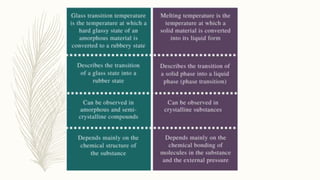
The melting of a crystalline polymer
The glass transition
The crystallization
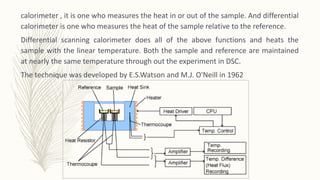
calorimeter , it is one who measures the heat in or out of the sample. And differential
calorimeter is one who measures the heat of the sample relative to the reference.
Differential scanning calorimeter does all of the above functions and heats the
sample with the linear temperature. Both the sample and reference are maintained
at nearly the same temperature through out the experiment in DSC.
The technique was developed by E.S.Watson and M.J. O'Neill in 1962
Principle
– It is a technique in which the energy necessary to establish a zero temperature
difference between the sample & reference material is measured as a function of
temperature.
– Here, sample & reference material are heated by separate heaters in such a way that
their temp are kept equal while these temp. are increased or decreased linearly.
– During heating two types of reactions can be take place one is the endothermic and
the other is the exothermic.
– If sample absorbs some amount of heat during phase transition then reaction is said
to be endothermic. In endothermic reaction more energy needed to maintain zero
temperature difference between sample & reference.
– E.g. Melting, boiling, sublimation, vaporization
Exothermic reaction:
if sample released some amount of heat during phase transition, then reaction is said to
be exothermic.
In exothermic reaction, less energy needed to maintain zero temp difference between
sample & reference.
E.g crystallization, degradation, polymerization
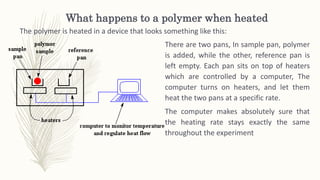
What happens to a polymer when heated
The polymer is heated in a device that looks something like this:
There are two pans, In sample pan, polymer
is added, while the other, reference pan is
left empty. Each pan sits on top of heaters
which are controlled by a computer, The
computer turns on heaters, and let them
heat the two pans at a specific rate.
The computer makes absolutely sure that
the heating rate stays exactly the same
throughout the experiment
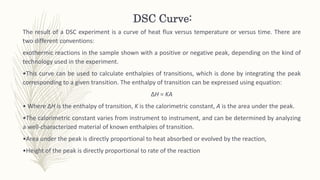
DSC Curve:
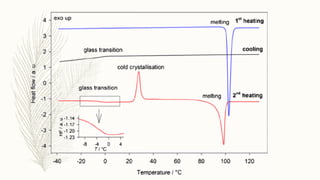
The result of a DSC experiment is a curve of heat flux versus temperature or versus time. There are
two different conventions:
exothermic reactions in the sample shown with a positive or negative peak, depending on the kind of
technology used in the experiment.
•This curve can be used to calculate enthalpies of transitions, which is done by integrating the peak
corresponding to a given transition. The enthalpy of transition can be expressed using equation:
ΔH = KA
• Where ΔH is the enthalpy of transition, K is the calorimetric constant, A is the area under the peak.
•The calorimetric constant varies from instrument to instrument, and can be determined by analyzing
a well-characterized material of known enthalpies of transition.
•Area under the peak is directly proportional to heat absorbed or evolved by the reaction,
•Height of the peak is directly proportional to rate of the reaction
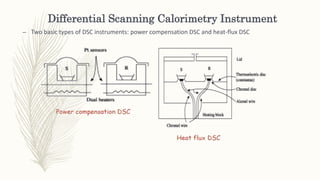
Differential Scanning Calorimetry Instrument
– Two basic types of DSC instruments: power compensation DSC and heat-flux DSC
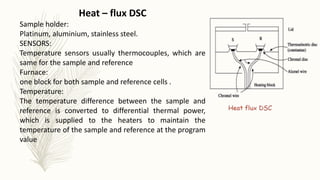
Heat – flux DSC
Sample holder:
Platinum, aluminium, stainless steel.
SENSORS:
Temperature sensors usually thermocouples, which are
same for the sample and reference
Furnace:
one block for both sample and reference cells .
Temperature:
The temperature difference between the sample and
reference is converted to differential thermal power,
which is supplied to the heaters to maintain the
temperature of the sample and reference at the program
value
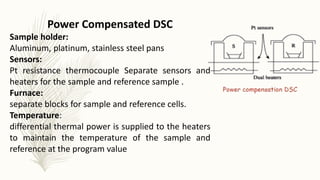
Power Compensated DSC
Sample holder:
Aluminum, platinum, stainless steel pans
Sensors:
Pt resistance thermocouple Separate sensors and
heaters for the sample and reference sample .
Furnace:
separate blocks for sample and reference cells.
Temperature:
differential thermal power is supplied to the heaters
to maintain the temperature of the sample and
reference at the program value
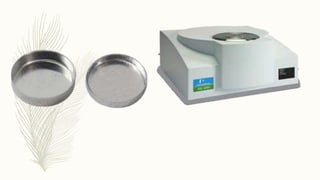
Accurately-weigh samples (~3-20 mg)
• Small sample pans (0.1 mL) of inert or treated metals (Al, Pt, Ni, etc.) are used for
sample preparation.
• Several pan configurations, e.g., open, pinhole, or hermetically-sealed (airtight) pans
• The same material and configuration should be used for the sample and the
reference
• Material should completely cover the bottom of the pan to ensure good thermal
contact,
• Avoid overfilling the pan to minimize thermal lag from the bulk of the material to the
sensor
Sample Preparation
Factors affecting DSC curve
Two types of factors effect the DSC curve
1. Instrumental factors
a- Furnace heating rate
b- Recording or chart speed
c- Furnace atmosphere
d- Geometry of sample holder/location of sensors
e- Sensitivity of the recoding system
f-Composition of sample containers
2. Sample characteristics
a- Amount of sample
b- Nature of sample
c- Sample packing
d- Solubility of evolved gases in the sample
e- Particle size
f- Heat of reaction
g- Thermal conductivity

Dsc

  • 1.
    Thermal Analysis and DSC By: SaurabhSharma Assistant Professor Gayatri college of Pharmacy
  • 2.
    Thermal analysis • Thermalanalysis is a branch of materials science where the properties of materials are studied as they change with temperature. • Several methods are commonly used – these are distinguished from one another by the property which is measured. Thermal analysis is defined as “series of techniques for measuring the temperature dependency of a physical property of a certain substance while varying the temperature of the substance according to a specific program.” • Physical properties include mass, temperature, enthalpy, dimension, dynamic characteristics, and others, and depending on the physical properties to be measured, the techniques of thermal analysis
  • 3.
    Conventionally thermal analysishas been mainly employed in measurements for research and development, but in recent times it is used in many practical applications, as the testing standards on the basis of thermal analysis have been established, for example, in quality control in the production field, process control, and material acceptance inspection. • It is also applied in wide fields, including polymer, glass, ceramics, metal, explosives, semiconductors, medicines, and foods. Different thermal analysis techniques – Differential scanning calorimetry (DSC), – Thermogravimetric analysis (TGA), – Differential thermal analysis (DTA)
  • 4.
    Differential scanning calorimetry(DSC) Differential Scanning Calorimetry (DSC) relies on the measurement of the difference between the heat flow vs. temperature relation of the sample and the heat flow vs. temperature relation of a standard. This technique is used to study what happens to polymers/samples upon heating It is used to study thermal transitions of a polymer/sample (the changes that take place on heating) For example: The melting of a crystalline polymer The glass transition The crystallization
  • 5.
    calorimeter , itis one who measures the heat in or out of the sample. And differential calorimeter is one who measures the heat of the sample relative to the reference. Differential scanning calorimeter does all of the above functions and heats the sample with the linear temperature. Both the sample and reference are maintained at nearly the same temperature through out the experiment in DSC. The technique was developed by E.S.Watson and M.J. O'Neill in 1962
  • 7.
    Principle – It isa technique in which the energy necessary to establish a zero temperature difference between the sample & reference material is measured as a function of temperature. – Here, sample & reference material are heated by separate heaters in such a way that their temp are kept equal while these temp. are increased or decreased linearly. – During heating two types of reactions can be take place one is the endothermic and the other is the exothermic. – If sample absorbs some amount of heat during phase transition then reaction is said to be endothermic. In endothermic reaction more energy needed to maintain zero temperature difference between sample & reference. – E.g. Melting, boiling, sublimation, vaporization
  • 8.
    Exothermic reaction: if samplereleased some amount of heat during phase transition, then reaction is said to be exothermic. In exothermic reaction, less energy needed to maintain zero temp difference between sample & reference. E.g crystallization, degradation, polymerization
  • 9.
    What happens toa polymer when heated The polymer is heated in a device that looks something like this: There are two pans, In sample pan, polymer is added, while the other, reference pan is left empty. Each pan sits on top of heaters which are controlled by a computer, The computer turns on heaters, and let them heat the two pans at a specific rate. The computer makes absolutely sure that the heating rate stays exactly the same throughout the experiment
  • 10.
    DSC Curve: The resultof a DSC experiment is a curve of heat flux versus temperature or versus time. There are two different conventions: exothermic reactions in the sample shown with a positive or negative peak, depending on the kind of technology used in the experiment. •This curve can be used to calculate enthalpies of transitions, which is done by integrating the peak corresponding to a given transition. The enthalpy of transition can be expressed using equation: ΔH = KA • Where ΔH is the enthalpy of transition, K is the calorimetric constant, A is the area under the peak. •The calorimetric constant varies from instrument to instrument, and can be determined by analyzing a well-characterized material of known enthalpies of transition. •Area under the peak is directly proportional to heat absorbed or evolved by the reaction, •Height of the peak is directly proportional to rate of the reaction
  • 13.
    Differential Scanning CalorimetryInstrument – Two basic types of DSC instruments: power compensation DSC and heat-flux DSC
  • 14.
    Heat – fluxDSC Sample holder: Platinum, aluminium, stainless steel. SENSORS: Temperature sensors usually thermocouples, which are same for the sample and reference Furnace: one block for both sample and reference cells . Temperature: The temperature difference between the sample and reference is converted to differential thermal power, which is supplied to the heaters to maintain the temperature of the sample and reference at the program value
  • 15.
    Power Compensated DSC Sampleholder: Aluminum, platinum, stainless steel pans Sensors: Pt resistance thermocouple Separate sensors and heaters for the sample and reference sample . Furnace: separate blocks for sample and reference cells. Temperature: differential thermal power is supplied to the heaters to maintain the temperature of the sample and reference at the program value
  • 16.
    Accurately-weigh samples (~3-20mg) • Small sample pans (0.1 mL) of inert or treated metals (Al, Pt, Ni, etc.) are used for sample preparation. • Several pan configurations, e.g., open, pinhole, or hermetically-sealed (airtight) pans • The same material and configuration should be used for the sample and the reference • Material should completely cover the bottom of the pan to ensure good thermal contact, • Avoid overfilling the pan to minimize thermal lag from the bulk of the material to the sensor Sample Preparation
  • 17.
    Factors affecting DSCcurve Two types of factors effect the DSC curve 1. Instrumental factors a- Furnace heating rate b- Recording or chart speed c- Furnace atmosphere d- Geometry of sample holder/location of sensors e- Sensitivity of the recoding system f-Composition of sample containers 2. Sample characteristics a- Amount of sample b- Nature of sample c- Sample packing d- Solubility of evolved gases in the sample e- Particle size f- Heat of reaction g- Thermal conductivity