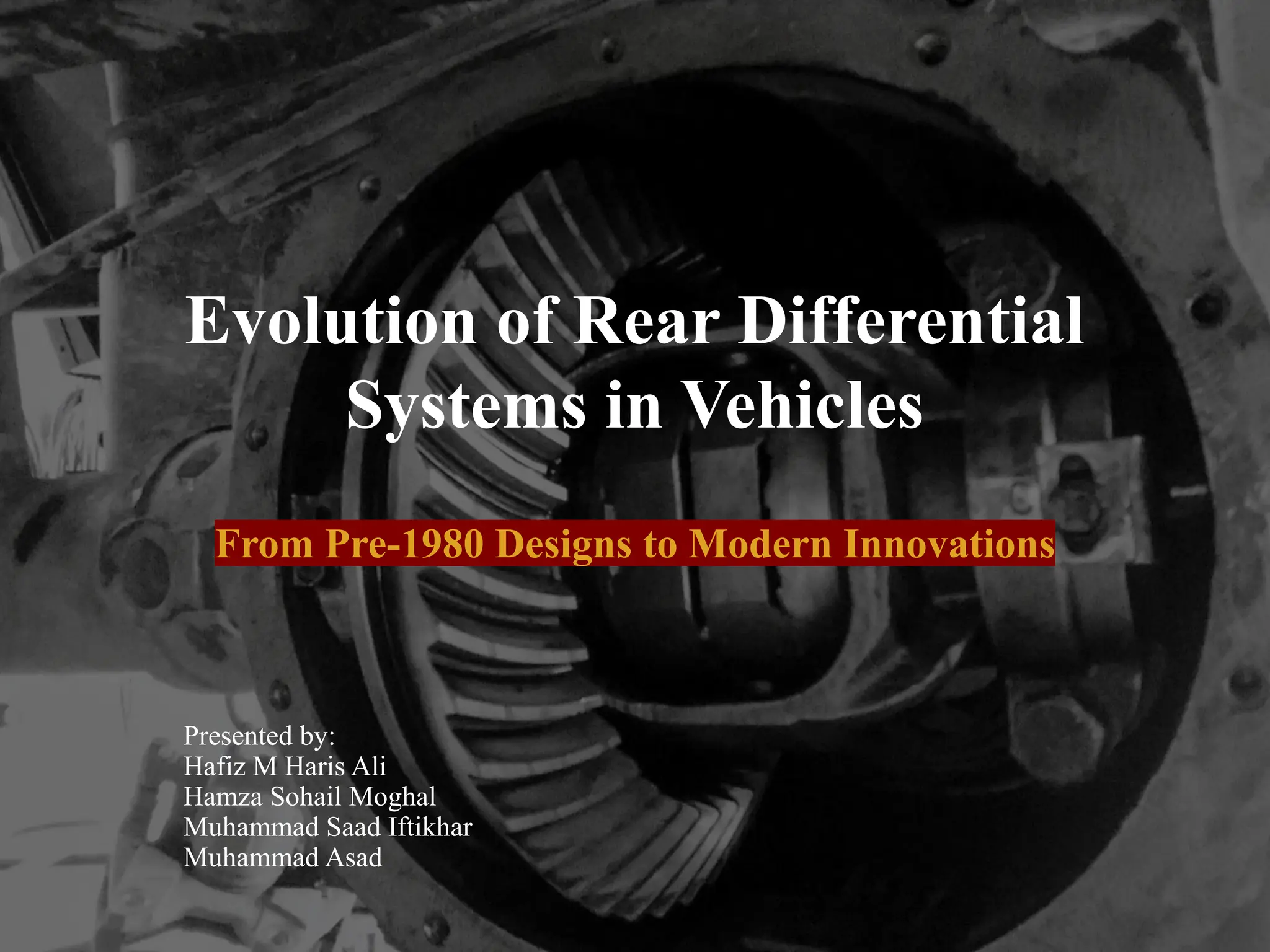
Evolution of Rear Differential
Systems in Vehicles
From Pre-1980 Designs to Modern Innovations
Presented by:
Hafiz M Haris Ali
Hamza Sohail Moghal
Muhammad Saad Iftikhar
Muhammad Asad
CONTENTS
1. Introduction
2. Parts Of Differential System
3. Working Of Differential
4. Pre-1980 Rear Differential Systems
5. Developments Post-1980
6. Other Functions Of Differential
7. Case Study
8. Conclusion
9. Reference
Introduction
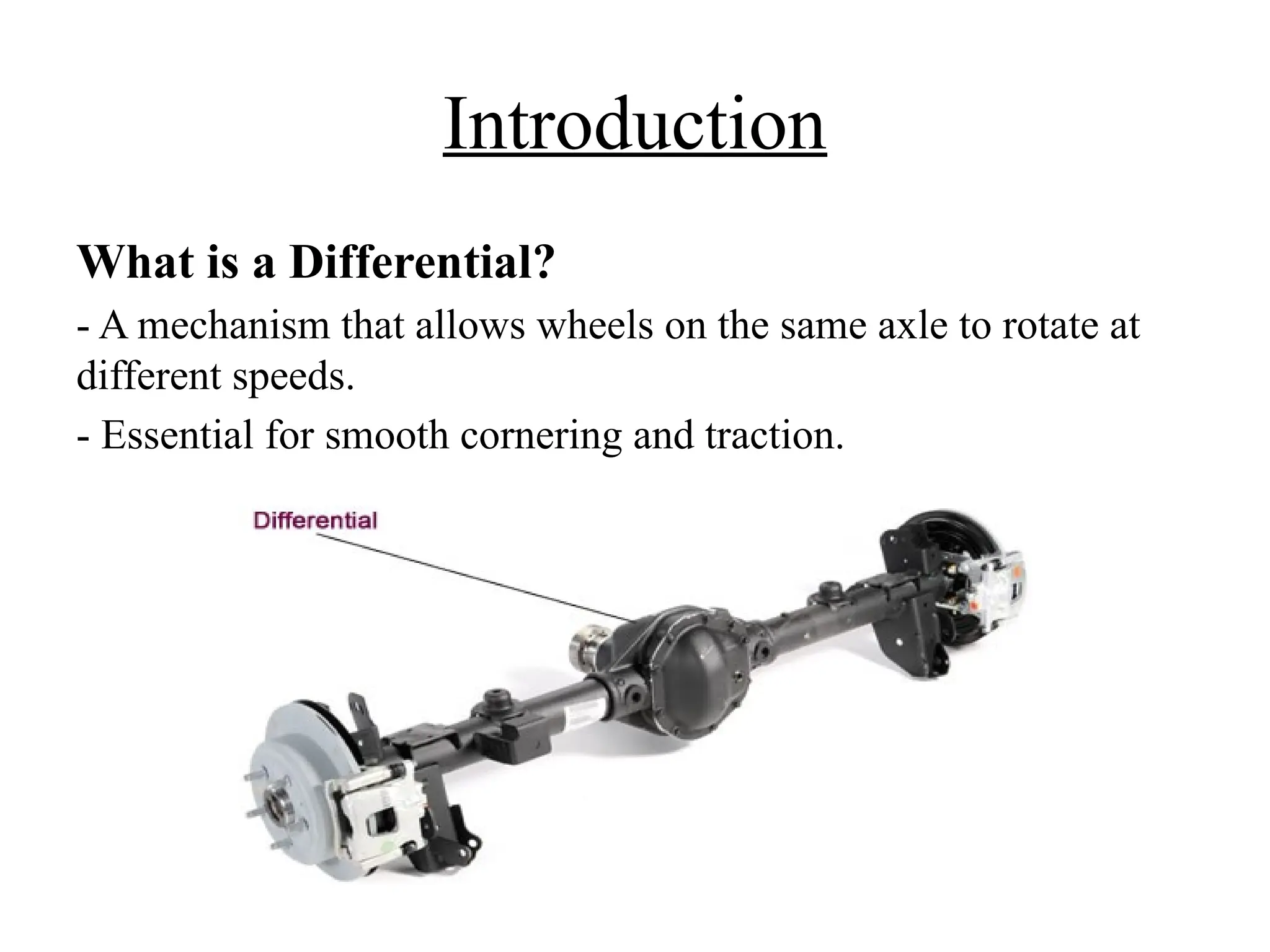
What is a Differential?
- A mechanism that allows wheels on the same axle to rotate at
different speeds.
- Essential for smooth cornering and traction.
Parts of Differential
4
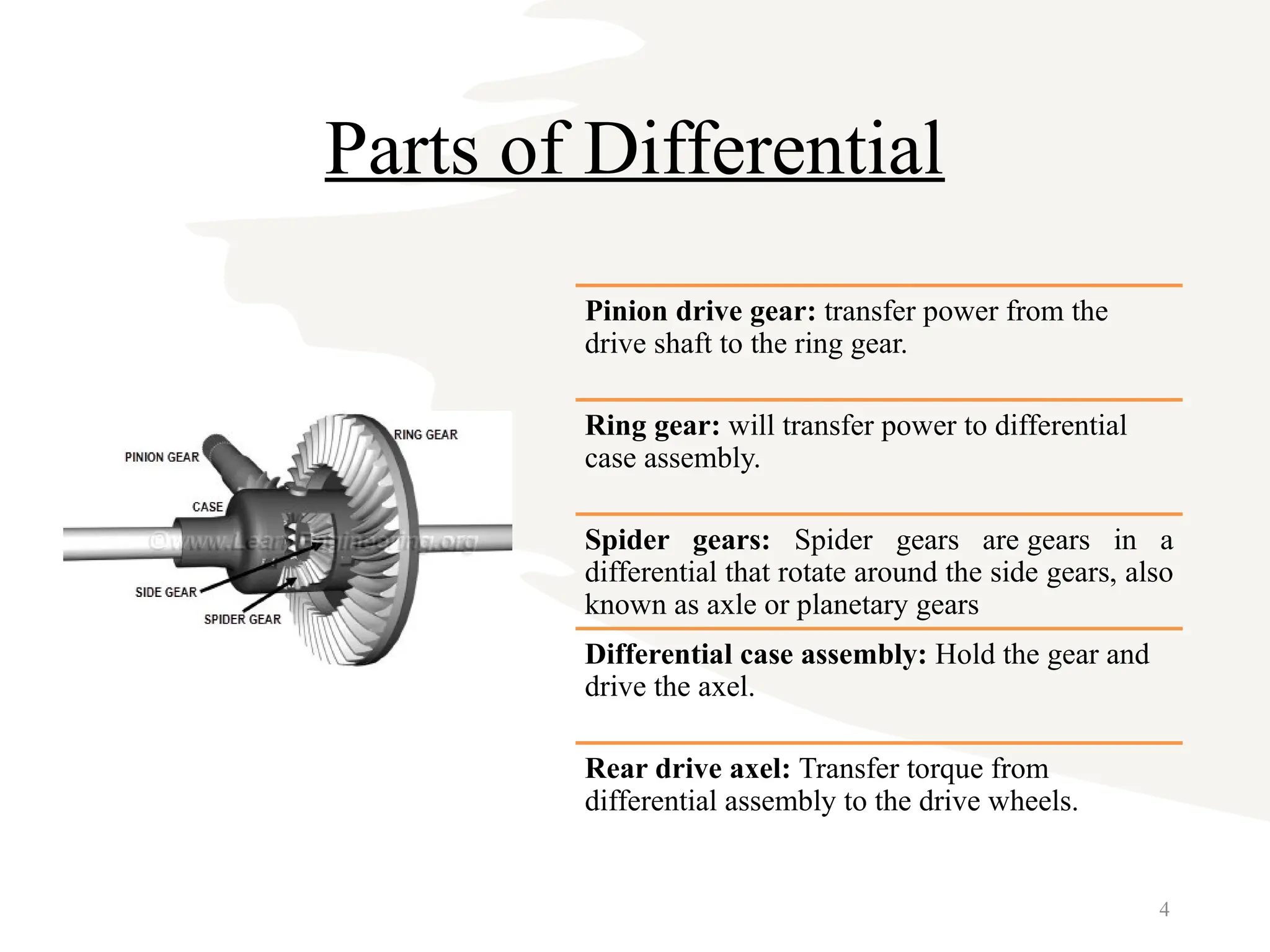
Pinion drive gear: transfer power from the
drive shaft to the ring gear.
Ring gear: will transfer power to differential
case assembly.
Spider gears: Spider gears are gears in a
differential that rotate around the side gears, also
known as axle or planetary gears
Differential case assembly: Hold the gear and
drive the axel.
Rear drive axel: Transfer torque from
differential assembly to the drive wheels.
Working Of Differential
3
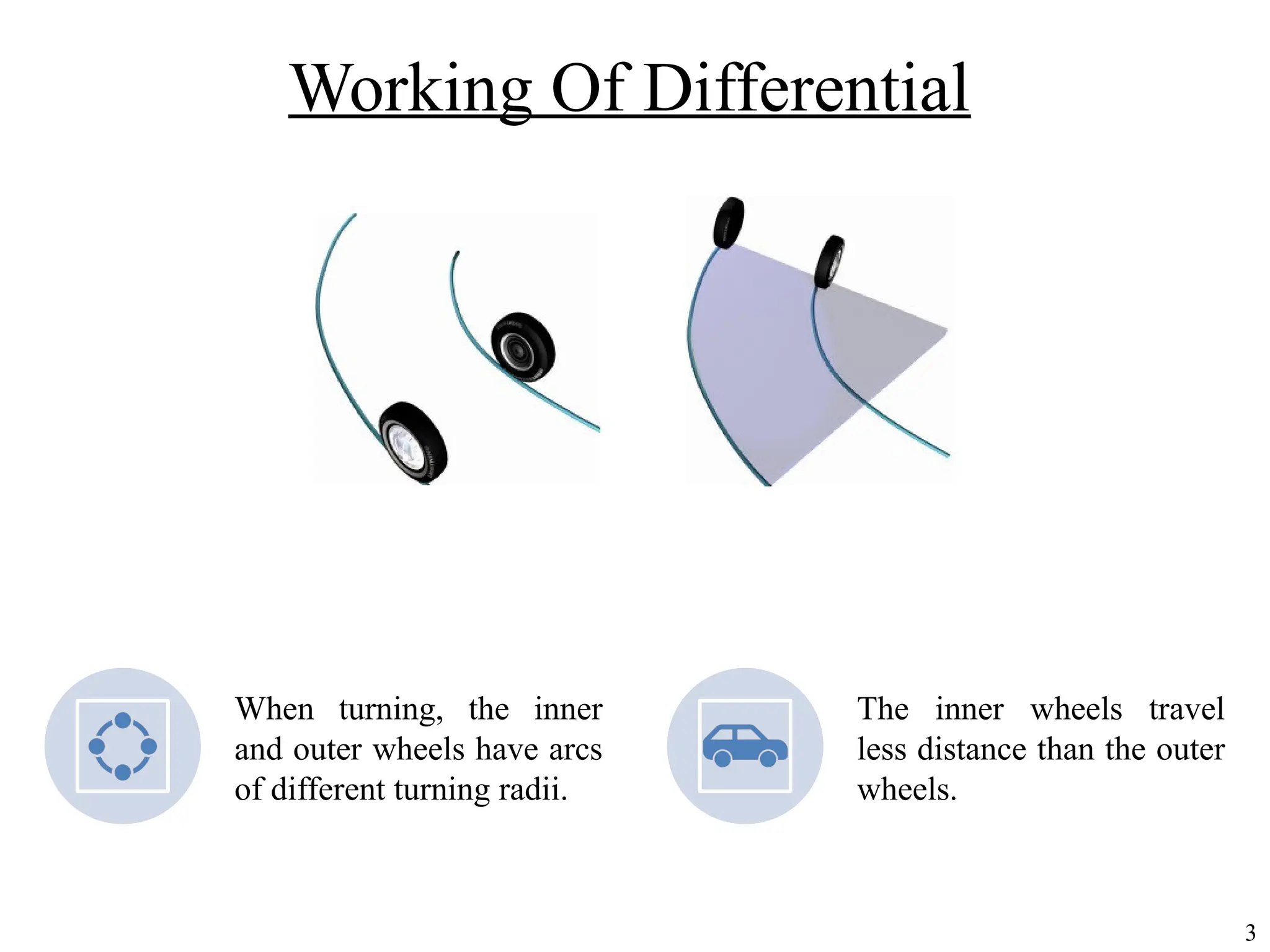
When turning, the inner
and outer wheels have arcs
of different turning radii.
The inner wheels travel
less distance than the outer
wheels.
Pre-1980 Rear Differential Systems
• Key Features:
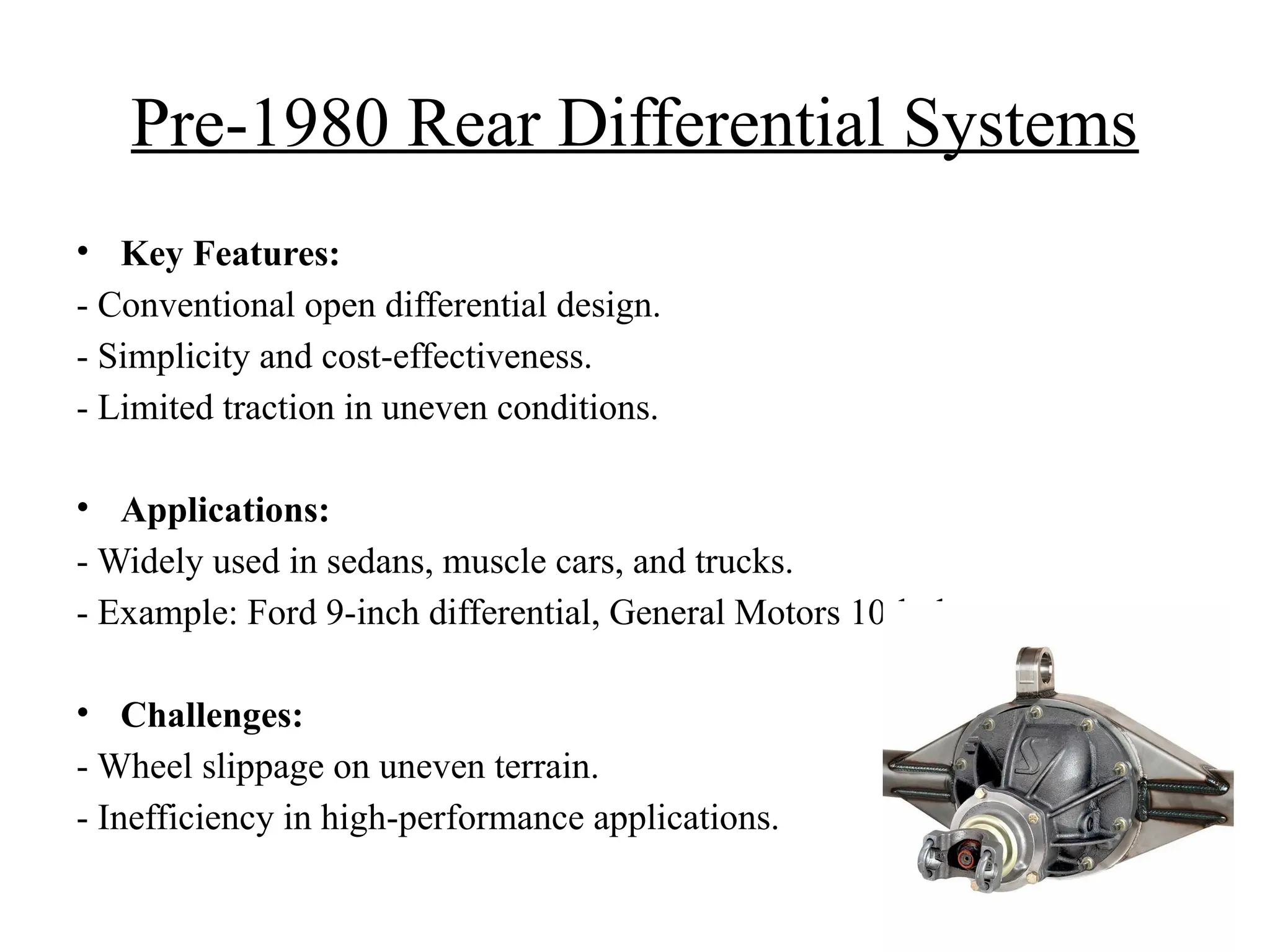
- Conventional open differential design.
- Simplicity and cost-effectiveness.
- Limited traction in uneven conditions.
• Applications:
- Widely used in sedans, muscle cars, and trucks.
- Example: Ford 9-inch differential, General Motors 10-bolt.
• Challenges:
- Wheel slippage on uneven terrain.
- Inefficiency in high-performance applications.
Developments Post-1980
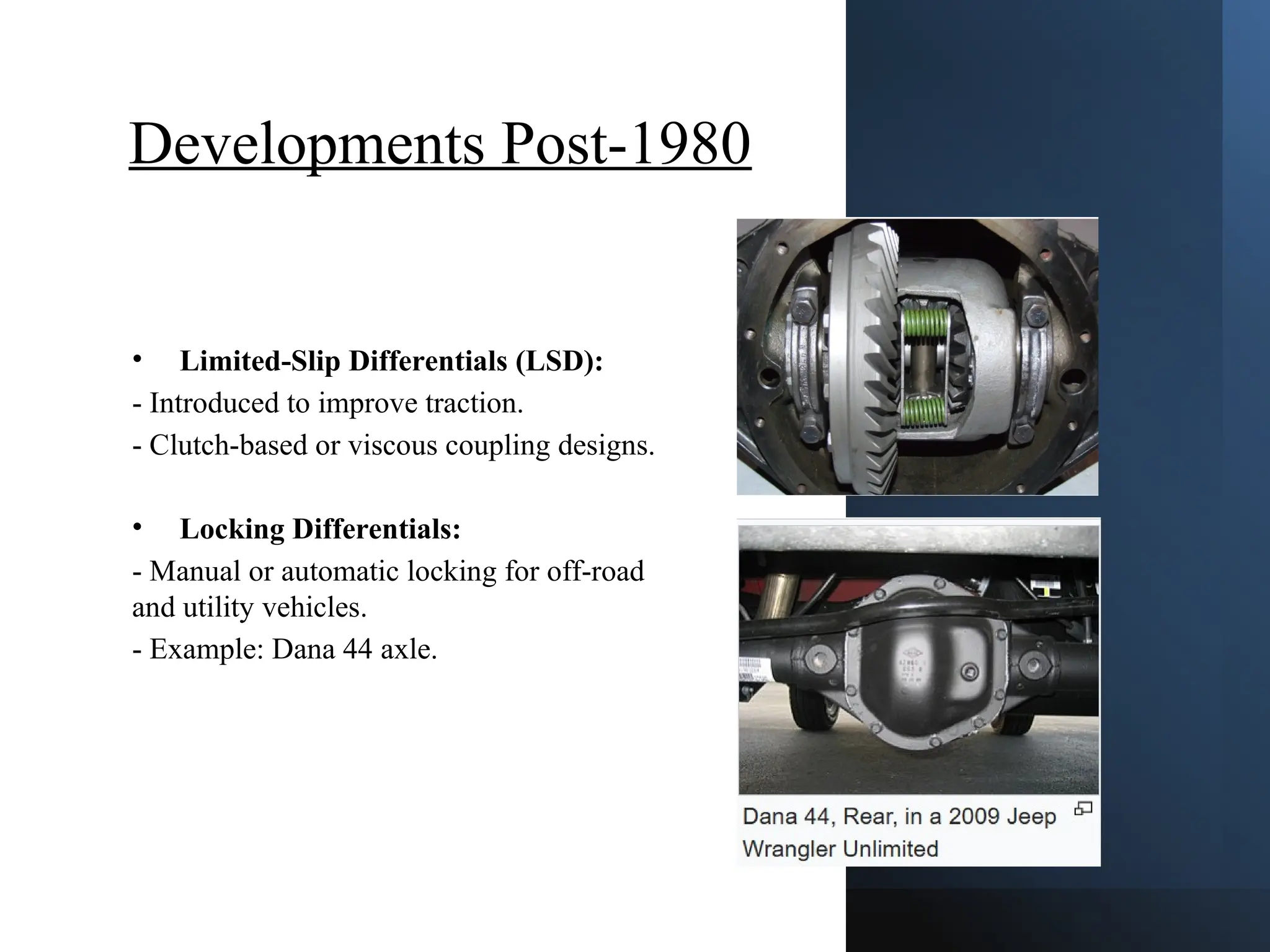
• Limited-Slip Differentials (LSD):
- Introduced to improve traction.
- Clutch-based or viscous coupling designs.
• Locking Differentials:
- Manual or automatic locking for off-road
and utility vehicles.
- Example: Dana 44 axle.
Latest Innovations in Rear Differentials
• Electronic Limited-Slip Differentials (eLSD):
- Electronically controlled to provide precise torque distribution.
- Example: BMW M Series, Audi Quattro systems.
• Torque Vectoring Differentials:
- Used in performance and electric vehicles.
- Individually controls wheel torque for enhanced handling.
- Example: Tesla, Porsche Taycan.
• Integration with Electric Drivetrains:
- Differentials integrated with hub motors or inverters.
- Example: Rivian R1T.
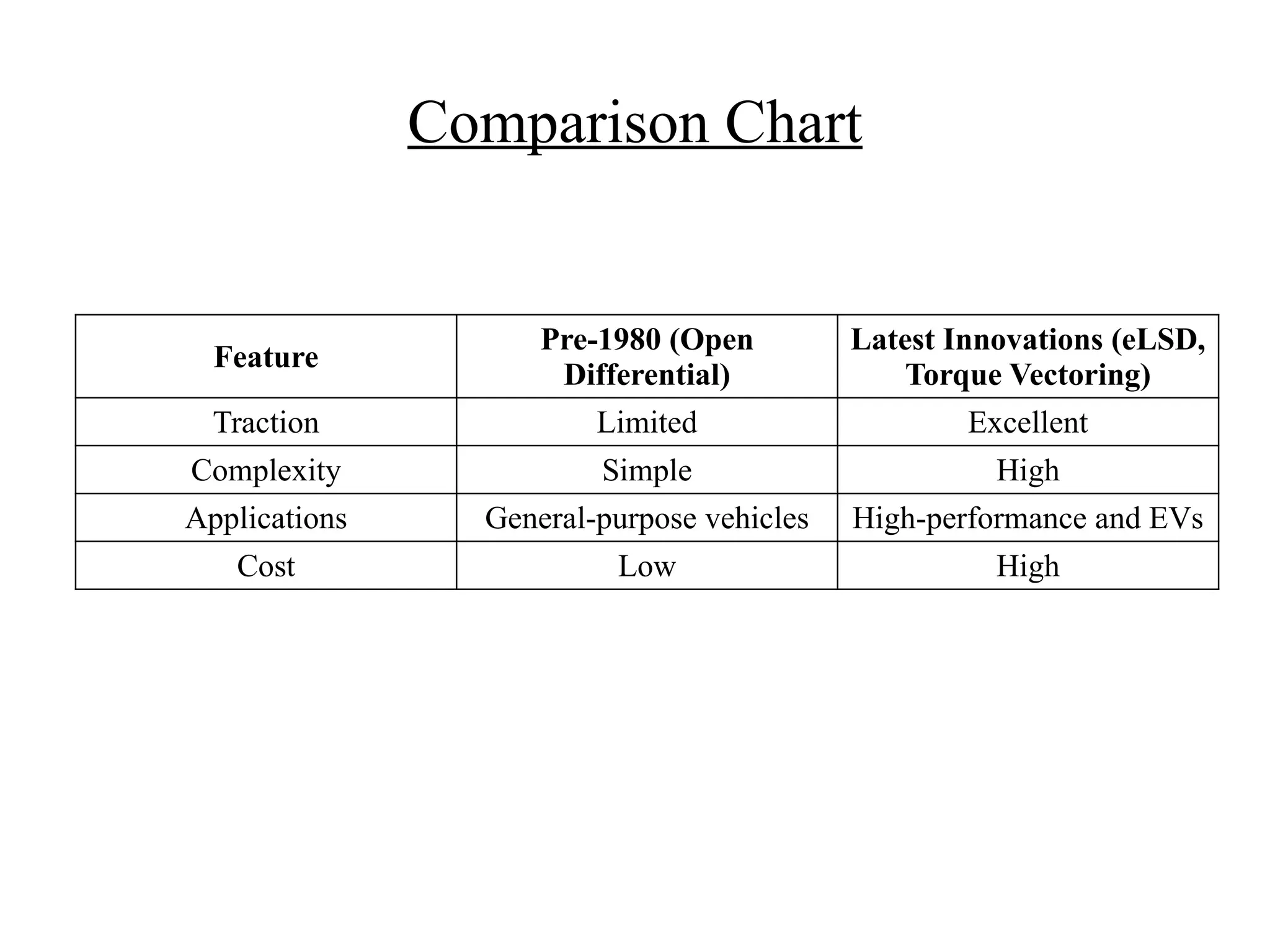
Comparison Chart
Feature
Pre-1980 (Open
Differential)
Latest Innovations (eLSD,
Torque Vectoring)
Traction Limited Excellent
Complexity Simple High
Applications General-purpose vehicles High-performance and EVs
Cost Low High
Other Functions Of
Differential
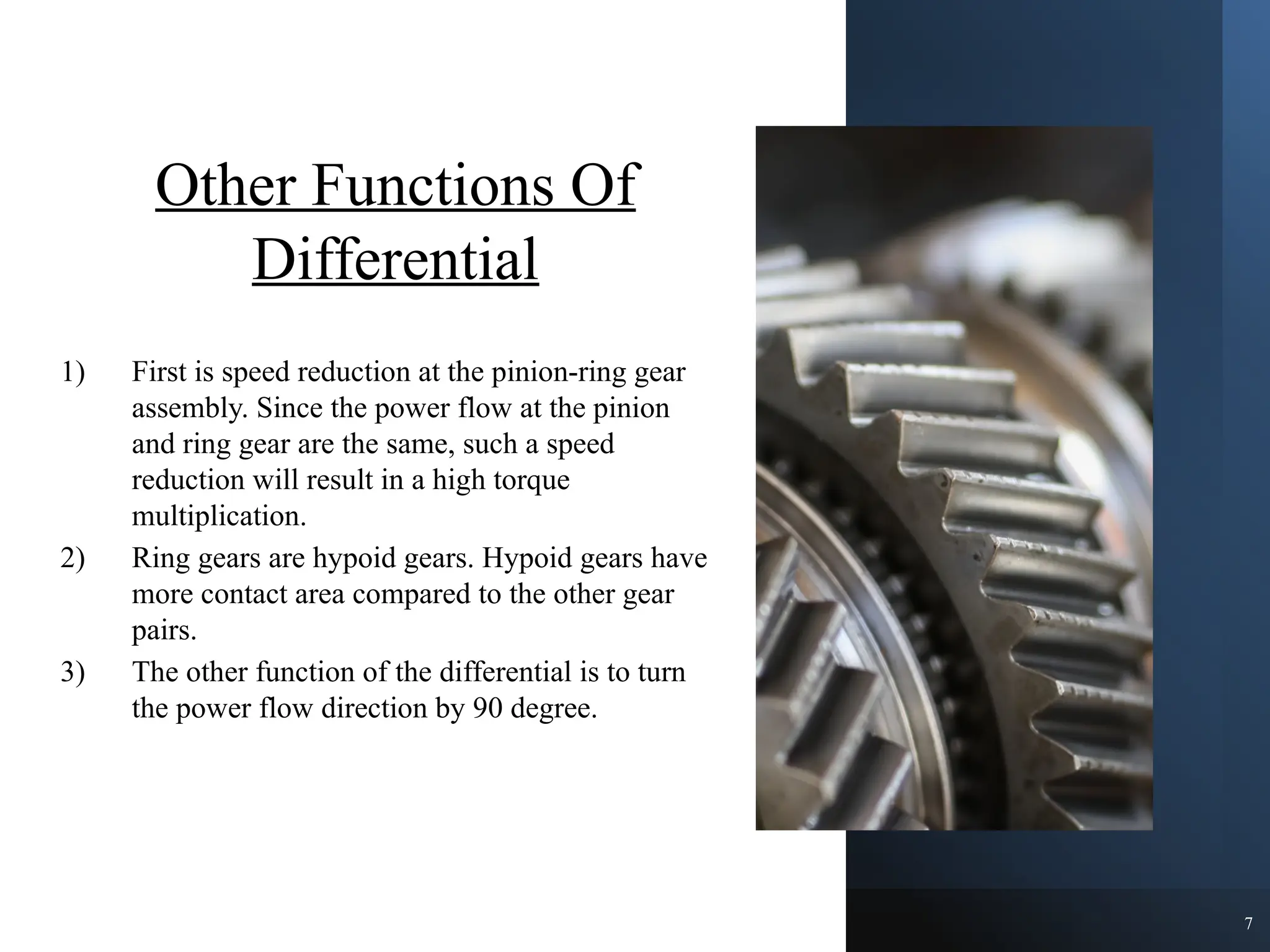
1) First is speed reduction at the pinion-ring gear
assembly. Since the power flow at the pinion
and ring gear are the same, such a speed
reduction will result in a high torque
multiplication.
2) Ring gears are hypoid gears. Hypoid gears have
more contact area compared to the other gear
pairs.
3) The other function of the differential is to turn
the power flow direction by 90 degree.
7
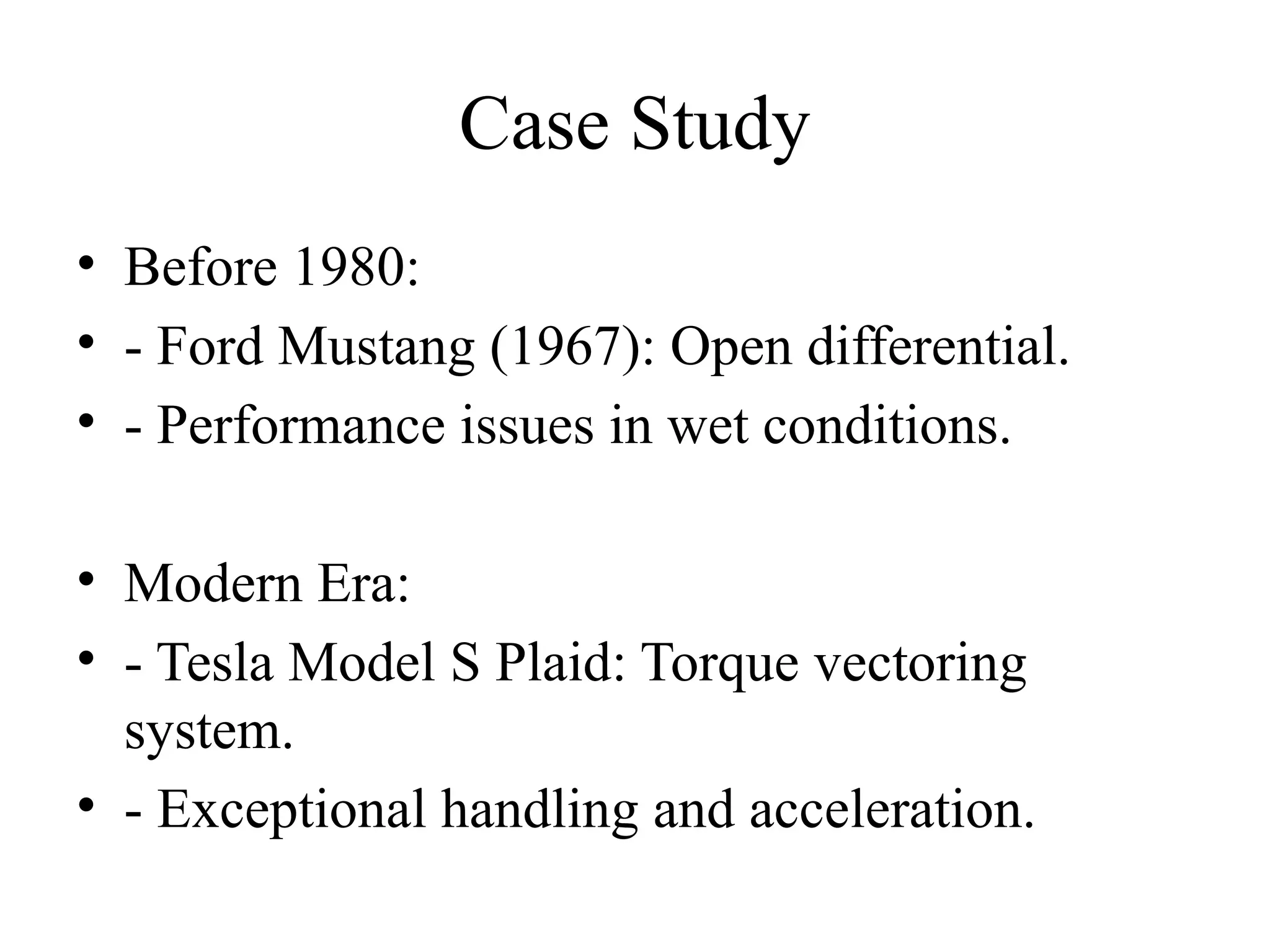
Case Study
• Before 1980:
• - Ford Mustang (1967): Open differential.
• - Performance issues in wet conditions.
• Modern Era:
• - Tesla Model S Plaid: Torque vectoring
system.
• - Exceptional handling and acceleration.
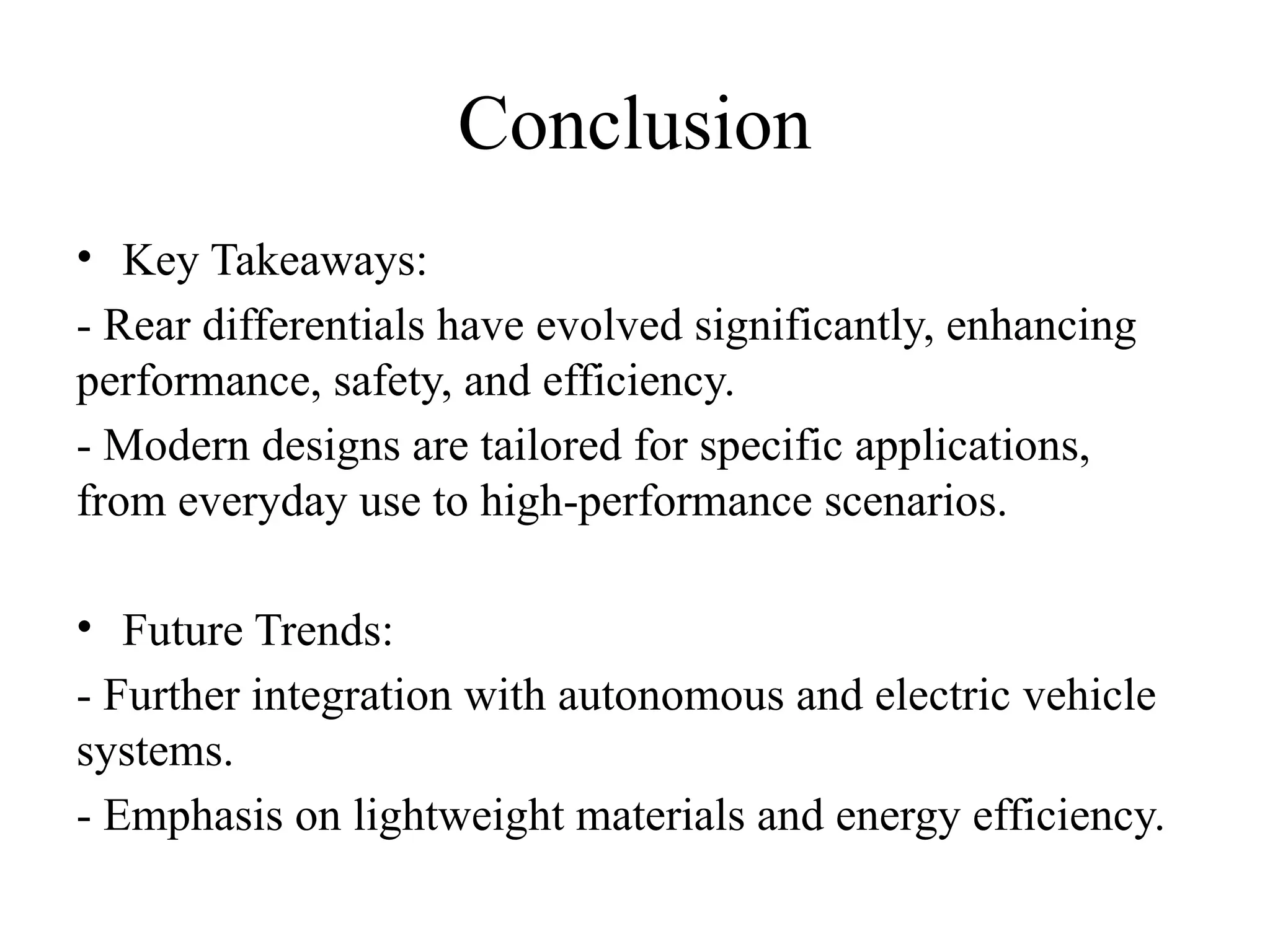
Conclusion
• Key Takeaways:
- Rear differentials have evolved significantly, enhancing
performance, safety, and efficiency.
- Modern designs are tailored for specific applications,
from everyday use to high-performance scenarios.
• Future Trends:
- Further integration with autonomous and electric vehicle
systems.
- Emphasis on lightweight materials and energy efficiency.
Q&A
• Thank you for your attention!
• Feel free to ask any questions.

Evolution_of_Rear_Differential_Systems[1] - Copy.pptx

  • 1.
    Evolution of RearDifferential Systems in Vehicles From Pre-1980 Designs to Modern Innovations Presented by: Hafiz M Haris Ali Hamza Sohail Moghal Muhammad Saad Iftikhar Muhammad Asad
  • 2.
    CONTENTS 1. Introduction 2. PartsOf Differential System 3. Working Of Differential 4. Pre-1980 Rear Differential Systems 5. Developments Post-1980 6. Other Functions Of Differential 7. Case Study 8. Conclusion 9. Reference
  • 3.
    Introduction What is aDifferential? - A mechanism that allows wheels on the same axle to rotate at different speeds. - Essential for smooth cornering and traction.
  • 4.
    Parts of Differential 4 Piniondrive gear: transfer power from the drive shaft to the ring gear. Ring gear: will transfer power to differential case assembly. Spider gears: Spider gears are gears in a differential that rotate around the side gears, also known as axle or planetary gears Differential case assembly: Hold the gear and drive the axel. Rear drive axel: Transfer torque from differential assembly to the drive wheels.
  • 5.
    Working Of Differential 3 Whenturning, the inner and outer wheels have arcs of different turning radii. The inner wheels travel less distance than the outer wheels.
  • 6.
    Pre-1980 Rear DifferentialSystems • Key Features: - Conventional open differential design. - Simplicity and cost-effectiveness. - Limited traction in uneven conditions. • Applications: - Widely used in sedans, muscle cars, and trucks. - Example: Ford 9-inch differential, General Motors 10-bolt. • Challenges: - Wheel slippage on uneven terrain. - Inefficiency in high-performance applications.
  • 7.
    Developments Post-1980 • Limited-SlipDifferentials (LSD): - Introduced to improve traction. - Clutch-based or viscous coupling designs. • Locking Differentials: - Manual or automatic locking for off-road and utility vehicles. - Example: Dana 44 axle.
  • 8.
    Latest Innovations inRear Differentials • Electronic Limited-Slip Differentials (eLSD): - Electronically controlled to provide precise torque distribution. - Example: BMW M Series, Audi Quattro systems. • Torque Vectoring Differentials: - Used in performance and electric vehicles. - Individually controls wheel torque for enhanced handling. - Example: Tesla, Porsche Taycan. • Integration with Electric Drivetrains: - Differentials integrated with hub motors or inverters. - Example: Rivian R1T.
  • 9.
    Comparison Chart Feature Pre-1980 (Open Differential) LatestInnovations (eLSD, Torque Vectoring) Traction Limited Excellent Complexity Simple High Applications General-purpose vehicles High-performance and EVs Cost Low High
  • 10.
    Other Functions Of Differential 1)First is speed reduction at the pinion-ring gear assembly. Since the power flow at the pinion and ring gear are the same, such a speed reduction will result in a high torque multiplication. 2) Ring gears are hypoid gears. Hypoid gears have more contact area compared to the other gear pairs. 3) The other function of the differential is to turn the power flow direction by 90 degree. 7
  • 11.
    Case Study • Before1980: • - Ford Mustang (1967): Open differential. • - Performance issues in wet conditions. • Modern Era: • - Tesla Model S Plaid: Torque vectoring system. • - Exceptional handling and acceleration.
  • 12.
    Conclusion • Key Takeaways: -Rear differentials have evolved significantly, enhancing performance, safety, and efficiency. - Modern designs are tailored for specific applications, from everyday use to high-performance scenarios. • Future Trends: - Further integration with autonomous and electric vehicle systems. - Emphasis on lightweight materials and energy efficiency.
  • 13.
    Q&A • Thank youfor your attention! • Feel free to ask any questions.