MANUFACTURING
PROCESSES USED IN
MAKING AN ENGINE
-SIDDHARTH SHARMA(2012B1AB198H)
-MUKESH REDDY (2012B1AB746H)
-SANCHAY BAPAT(
-HEMANTH VARMA(
-MITHILESH MUNDHADA(
HOW TO MANUFACTURE AN
ENGINE??
Components covered in this presentation :
1. Engine Block
2. Pistons
3. Crank shafts
4. Gears
ENGINE BLOCK
•Main structure which gives space for cylinders
•traditionally used raw material is cast iron alloys
•presently aluminium alloys are used because of its
low weight
319 aluminium alloy contains
85.8 - 91.5 % of aluminium
5.5 - 6.5 % of silicon
3 - 4 % of copper
0.35% of nickel
0.25% of titanium
0.5% of manganese
1% of iron, 0.1% of magnesium, and 1% of zinc.
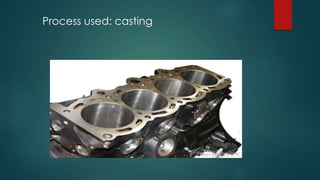
Process used: casting
CRANK SHAFTS
•converts the force created by the engine's pistons
moving up and down into a force that moves the
wheels in a circular motion so the car can go forward
•A pressure of 200 bar acting on a 4.00 inch diameter
piston produces a force of 36,442 pounds.
•steel alloys are the solution to the problem
Medium-carbon steel alloys, composed of
predominantly the element iron and contain a small
percentage of carbon.
•Main processes : casting , forging , turning, drilling
GEARS
•Used in transmitting power and motion
•High tensile strength to prevent failure
against static loads
•High endurance strength to withstand dynamic
loads
•Low coefficient of friction
•Good manufacturability
•Processes used - Gear forming , Form milling,
Broaching
PISTONS
•Used for compressing the gases through upward and
downward movement
•Commonly used materials for pistons are cast iron,
cast steel, forged steel, cast aluminium alloys and
forged aluminium alloy. Advantages
of Aluminium over cast iron: High thermal conductivity
(approx 3 times that of cast iron).
•Processes – forging , cutting , drilling , milling , finishing
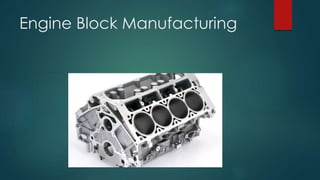
Engine Block Manufacturing
Properties
 Strength
 Modulus of Elasticity
 Abrasion Resistance
 Corrosion Resistance
 Low Density
 Thermal Expansion
 Thermal Conductivity
Types of Materials
 Gray Cast Iron Alloys
 Compacted Graphite Cast Iron
 Aluminum Alloy
 Magnesium Alloy
Gray Cast
Iron Alloy
Compacted
Graphite cast
Al-Alloy
A356-T6
Mg-Alloy
AMC-SC1
Tensile Strength 160-320 MPa 300-600 MPa 215 MPa 117 MPa
Modulus of Elasticity 96-110 MPa 170-190 MPa 74.5 MPa
Casting
1.Green Sand Molding
 Zircon Sand(ZrSio4),Clay and Water
 Molds made up of sections called CORES
 Mold is compacted by squeezing and jolting
 Also has 17 other cores
 Molten Alloy is poured into it from bottom
 Heat Treatment
 Grinding
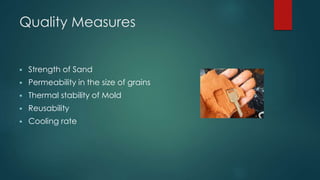
Quality Measures
 Strength of Sand
 Permeability in the size of grains
 Thermal stability of Mold
 Reusability
 Cooling rate
GEAR MANUFACTURING
 Gears are among the most important of all machine
elements because of their capability for transmitting
motion and power.
 Two principal methods of gear manufacturing include Œ:
- gear forming and
- gear generation.
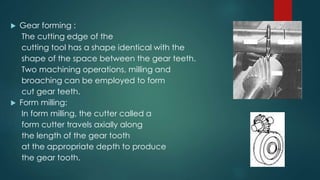
 Gear forming :
The cutting edge of the
cutting tool has a shape identical with the
shape of the space between the gear teeth.
Two machining operations, milling and
broaching can be employed to form
cut gear teeth.
 Form milling:
In form milling, the cutter called a
form cutter travels axially along
the length of the gear tooth
at the appropriate depth to produce
the gear tooth.
 Broaching:
Broaching can also be used to produce gear teeth
and is particularly applicable to internal teeth. The
process is rapid and produces fine surface finish with
high dimensional accuracy.
 Gear generation:
- The tooth flanks are obtained (generated) as an outline
of the subsequent positions of the cutter.
- Two machining processes are employed, shaping and
milling.
 Gear hobbing:
- machining process in which gear teeth are progressively
generated by a series of cuts with a helical cutting tool
(hob).
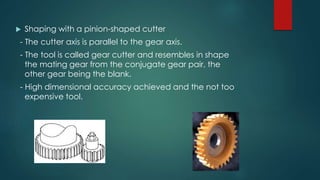
 Shaping with a pinion-shaped cutter
- The cutter axis is parallel to the gear axis.
- The tool is called gear cutter and resembles in shape
the mating gear from the conjugate gear pair, the
other gear being the blank.
- High dimensional accuracy achieved and the not too
expensive tool.
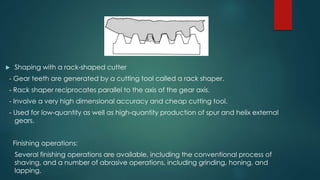
 Shaping with a rack-shaped cutter
- Gear teeth are generated by a cutting tool called a rack shaper.
- Rack shaper reciprocates parallel to the axis of the gear axis.
- Involve a very high dimensional accuracy and cheap cutting tool.
- Used for low-quantity as well as high-quantity production of spur and helix external
gears.
Finishing operations:
Several finishing operations are available, including the conventional process of
shaving, and a number of abrasive operations, including grinding, honing, and
lapping.
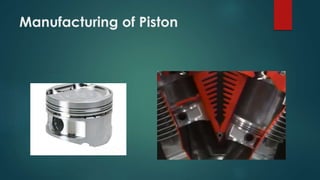
Manufacturing of Piston
Manufacturing of Piston –
THE ROD
• An Aluminium rod is cut into smaller
pieces called slugs by a Rotary saw
Forging
 Preheated Punch Press punches a preheated slug forging it into the
basic shape of a piston
 This process generates a lot of heat, so the piston must be air cooled
for one hour.
Cutting/Drilling
 A lathe is then used to cut excess metal from the basic form ,
impresses three rings ,taking it closer to its finished shape.
 Tiny holes are then drilled into the sides, to create the oil passages
for the piston.
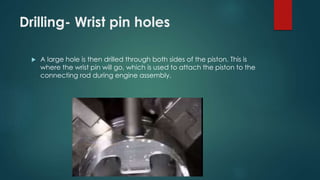
Drilling- Wrist pin holes
 A large hole is then drilled through both sides of the piston. This is
where the wrist pin will go, which is used to attach the piston to the
connecting rod during engine assembly.
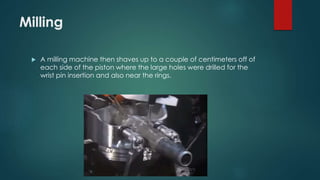
Milling
 A milling machine then shaves up to a couple of centimeters off of
each side of the piston where the large holes were drilled for the
wrist pin insertion and also near the rings.
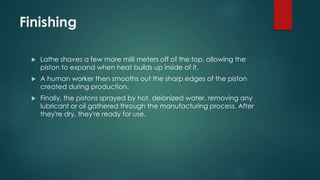
Finishing
 Lathe shaves a few more milli meters off of the top, allowing the
piston to expand when heat builds up inside of it.
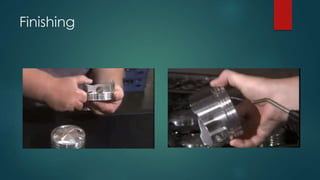
 A human worker then smooths out the sharp edges of the piston
created during production.
 Finally, the pistons sprayed by hot, deionized water, removing any
lubricant or oil gathered through the manufacturing process. After
they're dry, they're ready for use.
Finishing
Manufacturing of Cam -Shafts
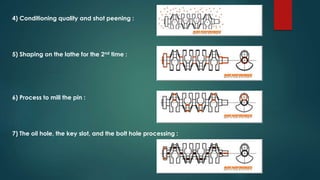
Manufacturing Process Explained Graphically
1) Shaping on the lathe :
2) Process to mill the pin :
1) The process to mill the weight :
4) Conditioning quality and shot peening :
5) Shaping on the lathe for the 2nd time :
6) Process to mill the pin :
7) The oil hole, the key slot, and the bolt hole processing :
8) The pin and the journal polishing process :
9) The dynamic balance adjustment process.
10) The pin and the journal wrapping process.
11) The surface treatment process.
12) The final wrapping, bend correction, and inspection process.
Tooling Required
To produce a crankshaft there are few main tools required:
1) Lathe machine.
2) Shaper.
3) Precision Drills.
4) Milling machine.
Manufacturing of Camshaft
METHODS OF MANUFACTURING:
1. CASTING: More chances of casting defects such as shrinkage defect, porosity, crack, insufficient
pouring.
2. FORGING:
• used for certain high loaded diesel engines.
• produced on computer-controlled forging systems with integrated heat treatment or machined
from steel bar.
3. MACHINING:
A detailed description of the processes for mass manufacturing is as follows:
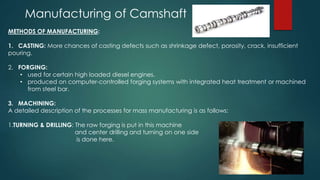
1.TURNING & DRILLING: The raw forging is put in this machine
and center drilling and turning on one side
is done here.
2. TURNING: Here the turning of the journals takes place. Also,
Grooving and Parting operation is performed on the left side of
the shaft.
3. DRILLING: This machine drills the hole which is used as reference for
further operations.
4. GRINDING JOURNALS: Here grinding and finish
grinding of the journals takes place.
Carborundum wheels are used for grinding
5. GRINDING ON FACE: An angular grinding wheel is used for the face
grinding operation. At this stage, inspection is done after every 10
components using gauges
6. LAPPING: To give superfinish in microns, lapping is done using lapping
paper on the Cams and the Oil seal area.
7. SLITTING: This machine makes a slit in the right side of the shaft to fit in
the engine. The cutter used is a Saw cutter and pneumatic deburring is
done here.
8. AIR & WATER CLEANING: This is the Washing Machine where water and
air jets are used to clean the component of dust, oil, chips etc.
9. INSPECTION: This is a Measuring Machine used to check for
tolerances - Runouts and Diameters of journals. The machine then declares the
component as OK, NG, or BAD.

Manufacturing of-engine

  • 1.
    MANUFACTURING PROCESSES USED IN MAKINGAN ENGINE -SIDDHARTH SHARMA(2012B1AB198H) -MUKESH REDDY (2012B1AB746H) -SANCHAY BAPAT( -HEMANTH VARMA( -MITHILESH MUNDHADA(
  • 3.
    HOW TO MANUFACTUREAN ENGINE?? Components covered in this presentation : 1. Engine Block 2. Pistons 3. Crank shafts 4. Gears
  • 4.
    ENGINE BLOCK •Main structurewhich gives space for cylinders •traditionally used raw material is cast iron alloys •presently aluminium alloys are used because of its low weight 319 aluminium alloy contains 85.8 - 91.5 % of aluminium 5.5 - 6.5 % of silicon 3 - 4 % of copper 0.35% of nickel 0.25% of titanium 0.5% of manganese 1% of iron, 0.1% of magnesium, and 1% of zinc.
  • 5.
  • 6.
    CRANK SHAFTS •converts theforce created by the engine's pistons moving up and down into a force that moves the wheels in a circular motion so the car can go forward •A pressure of 200 bar acting on a 4.00 inch diameter piston produces a force of 36,442 pounds. •steel alloys are the solution to the problem Medium-carbon steel alloys, composed of predominantly the element iron and contain a small percentage of carbon. •Main processes : casting , forging , turning, drilling
  • 7.
    GEARS •Used in transmittingpower and motion •High tensile strength to prevent failure against static loads •High endurance strength to withstand dynamic loads •Low coefficient of friction •Good manufacturability •Processes used - Gear forming , Form milling, Broaching
  • 8.
    PISTONS •Used for compressingthe gases through upward and downward movement •Commonly used materials for pistons are cast iron, cast steel, forged steel, cast aluminium alloys and forged aluminium alloy. Advantages of Aluminium over cast iron: High thermal conductivity (approx 3 times that of cast iron). •Processes – forging , cutting , drilling , milling , finishing
  • 9.
  • 10.
    Properties  Strength  Modulusof Elasticity  Abrasion Resistance  Corrosion Resistance  Low Density  Thermal Expansion  Thermal Conductivity
  • 11.
    Types of Materials Gray Cast Iron Alloys  Compacted Graphite Cast Iron  Aluminum Alloy  Magnesium Alloy Gray Cast Iron Alloy Compacted Graphite cast Al-Alloy A356-T6 Mg-Alloy AMC-SC1 Tensile Strength 160-320 MPa 300-600 MPa 215 MPa 117 MPa Modulus of Elasticity 96-110 MPa 170-190 MPa 74.5 MPa
  • 12.
    Casting 1.Green Sand Molding Zircon Sand(ZrSio4),Clay and Water  Molds made up of sections called CORES  Mold is compacted by squeezing and jolting  Also has 17 other cores  Molten Alloy is poured into it from bottom  Heat Treatment  Grinding
  • 13.
    Quality Measures  Strengthof Sand  Permeability in the size of grains  Thermal stability of Mold  Reusability  Cooling rate
  • 14.
    GEAR MANUFACTURING  Gearsare among the most important of all machine elements because of their capability for transmitting motion and power.  Two principal methods of gear manufacturing include Œ: - gear forming and - gear generation.
  • 15.
     Gear forming: The cutting edge of the cutting tool has a shape identical with the shape of the space between the gear teeth. Two machining operations, milling and broaching can be employed to form cut gear teeth.  Form milling: In form milling, the cutter called a form cutter travels axially along the length of the gear tooth at the appropriate depth to produce the gear tooth.
  • 16.
     Broaching: Broaching canalso be used to produce gear teeth and is particularly applicable to internal teeth. The process is rapid and produces fine surface finish with high dimensional accuracy.
  • 17.
     Gear generation: -The tooth flanks are obtained (generated) as an outline of the subsequent positions of the cutter. - Two machining processes are employed, shaping and milling.  Gear hobbing: - machining process in which gear teeth are progressively generated by a series of cuts with a helical cutting tool (hob).
  • 18.
     Shaping witha pinion-shaped cutter - The cutter axis is parallel to the gear axis. - The tool is called gear cutter and resembles in shape the mating gear from the conjugate gear pair, the other gear being the blank. - High dimensional accuracy achieved and the not too expensive tool.
  • 19.
     Shaping witha rack-shaped cutter - Gear teeth are generated by a cutting tool called a rack shaper. - Rack shaper reciprocates parallel to the axis of the gear axis. - Involve a very high dimensional accuracy and cheap cutting tool. - Used for low-quantity as well as high-quantity production of spur and helix external gears. Finishing operations: Several finishing operations are available, including the conventional process of shaving, and a number of abrasive operations, including grinding, honing, and lapping.
  • 20.
  • 21.
    Manufacturing of Piston– THE ROD • An Aluminium rod is cut into smaller pieces called slugs by a Rotary saw
  • 22.
    Forging  Preheated PunchPress punches a preheated slug forging it into the basic shape of a piston  This process generates a lot of heat, so the piston must be air cooled for one hour.
  • 23.
    Cutting/Drilling  A latheis then used to cut excess metal from the basic form , impresses three rings ,taking it closer to its finished shape.  Tiny holes are then drilled into the sides, to create the oil passages for the piston.
  • 24.
    Drilling- Wrist pinholes  A large hole is then drilled through both sides of the piston. This is where the wrist pin will go, which is used to attach the piston to the connecting rod during engine assembly.
  • 25.
    Milling  A millingmachine then shaves up to a couple of centimeters off of each side of the piston where the large holes were drilled for the wrist pin insertion and also near the rings.
  • 26.
    Finishing  Lathe shavesa few more milli meters off of the top, allowing the piston to expand when heat builds up inside of it.  A human worker then smooths out the sharp edges of the piston created during production.  Finally, the pistons sprayed by hot, deionized water, removing any lubricant or oil gathered through the manufacturing process. After they're dry, they're ready for use.
  • 27.
  • 28.
    Manufacturing of Cam-Shafts Manufacturing Process Explained Graphically 1) Shaping on the lathe : 2) Process to mill the pin : 1) The process to mill the weight :
  • 29.
    4) Conditioning qualityand shot peening : 5) Shaping on the lathe for the 2nd time : 6) Process to mill the pin : 7) The oil hole, the key slot, and the bolt hole processing :
  • 30.
    8) The pinand the journal polishing process : 9) The dynamic balance adjustment process. 10) The pin and the journal wrapping process. 11) The surface treatment process. 12) The final wrapping, bend correction, and inspection process. Tooling Required To produce a crankshaft there are few main tools required: 1) Lathe machine. 2) Shaper. 3) Precision Drills. 4) Milling machine.
  • 31.
    Manufacturing of Camshaft METHODSOF MANUFACTURING: 1. CASTING: More chances of casting defects such as shrinkage defect, porosity, crack, insufficient pouring. 2. FORGING: • used for certain high loaded diesel engines. • produced on computer-controlled forging systems with integrated heat treatment or machined from steel bar. 3. MACHINING: A detailed description of the processes for mass manufacturing is as follows: 1.TURNING & DRILLING: The raw forging is put in this machine and center drilling and turning on one side is done here.
  • 32.
    2. TURNING: Herethe turning of the journals takes place. Also, Grooving and Parting operation is performed on the left side of the shaft. 3. DRILLING: This machine drills the hole which is used as reference for further operations. 4. GRINDING JOURNALS: Here grinding and finish grinding of the journals takes place. Carborundum wheels are used for grinding 5. GRINDING ON FACE: An angular grinding wheel is used for the face grinding operation. At this stage, inspection is done after every 10 components using gauges
  • 33.
    6. LAPPING: Togive superfinish in microns, lapping is done using lapping paper on the Cams and the Oil seal area. 7. SLITTING: This machine makes a slit in the right side of the shaft to fit in the engine. The cutter used is a Saw cutter and pneumatic deburring is done here. 8. AIR & WATER CLEANING: This is the Washing Machine where water and air jets are used to clean the component of dust, oil, chips etc. 9. INSPECTION: This is a Measuring Machine used to check for tolerances - Runouts and Diameters of journals. The machine then declares the component as OK, NG, or BAD.