ENGINE CONSTRUCTION AND
OPERATION
What is engines ?
 Engine is the device which covert one
form of energy into other form.
Types of engines
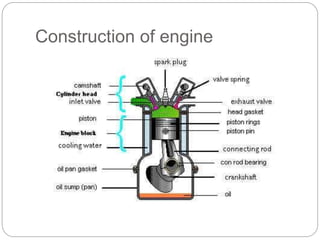
Construction of engine
Camshaft
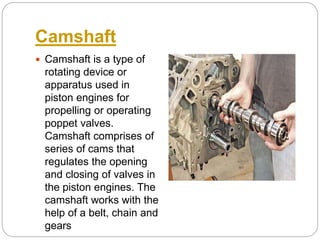
 Camshaft is a type of
rotating device or
apparatus used in
piston engines for
propelling or operating
poppet valves.
Camshaft comprises of
series of cams that
regulates the opening
and closing of valves in
the piston engines. The
camshaft works with the
help of a belt, chain and
gears
Crankshaft:
 Crankshaft is a device,
which converts the up
and down movement of
the piston into rotatory
motion.Crankshaft is
further connected to
flywheel, clutch, main
shaft of the
transmission, torque
converter and belt
pulley.
 The Crankshaft made
from Carbon Steel,
Nickel Chrome or
Connecting Rod:
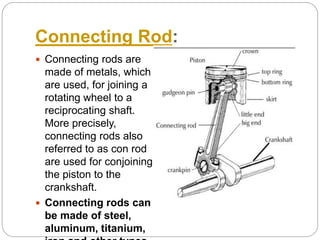
 Connecting rods are
made of metals, which
are used, for joining a
rotating wheel to a
reciprocating shaft.
More precisely,
connecting rods also
referred to as con rod
are used for conjoining
the piston to the
crankshaft.
 Connecting rods can
be made of steel,
aluminum, titanium,
Crank Case:
 A crankcase is a metallic cover that holds
together the crankshaft and its attachments. It is
the largest cavity within an engine that protects
the crankshaft, connecting rods and other
components from foreign objects. Automotive
crankcases are filled with air and oil, while
Magnesium, Cast Iron, Aluminum and alloys are
some common materials used to make
crankcases.
Cylinder Heads:
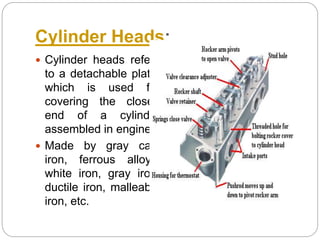
 Cylinder heads refers
to a detachable plate,
which is used for
covering the closed
end of a cylinder
assembled in engine.
 Made by gray cast
iron, ferrous alloys,
white iron, gray iron,
ductile iron, malleable
iron, etc.
Engine Valve:
 Automobile engine valves are devices that
regulate the flow of air and fuel mixture into the
cylinder and assist in expelling exhaust gases
after fuel combustion. They are indispensable to
the system of coordinated opening and closing of
valves, known as valve train. Engine valves are
made from varied materials such as Structural
Ceramics, Steels, Superalloys and Titanium
alloys. Valve materials are selected based on the
temperatures and pressures the valves are to
endure.
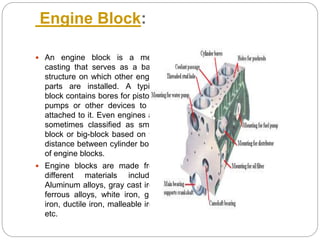
Engine Block:
 An engine block is a metal
casting that serves as a basic
structure on which other engine
parts are installed. A typical
block contains bores for pistons,
pumps or other devices to be
attached to it. Even engines are
sometimes classified as small-
block or big-block based on the
distance between cylinder bores
of engine blocks.
 Engine blocks are made from
different materials including
Aluminum alloys, gray cast iron,
ferrous alloys, white iron, gray
iron, ductile iron, malleable iron,
etc.
Piston:
 Piston is a cylindrical plug which is used for
moving up and down the cylinder according to the
position of the crankshaft in its rotation. Piston
has multiple uses and functions. In the case of
four-stroke engine the piston is pulled or pushed
with the help of crankshaft while in the case of
compression stroke, piston is pushed with the
powerful explosion of mixture of air and fuel.
 Piston is made by aluminum alloy
Push Rods:
 Push rods are thin metallic tubes with rounded
ends that move through the holes within a
cylinder block and head, to actuate
the rocker arms. Pushrods are found in valve-in-
head type engines and are essential for the
motion of engine valves.
 Some commonly used materials for
manufacturing pushrods are Titanium, Aluminum,
Chrome Moly and Tempered Chrome Moly.

Nomenclature
 Cylinder bore (d)
 Piston area (A)
 Stroke (L)
 Dead centre
i)TDC
ii)BDC
 Displacement or swept volume
 Cubic capacity or engine capacity
 Compression ratio (r)
Four stroke spark ignition engine
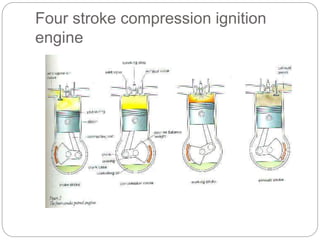
Four stroke compression ignition
engine
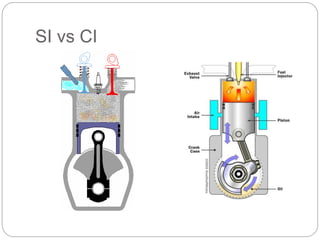
SI vs CI
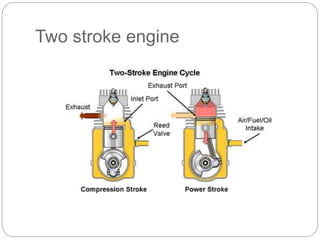
Two stroke engine
4 stroke vs 2 stroke
UNIT I - ENGINE CONSTRUCTION AND OPERATION.pptx

UNIT I - ENGINE CONSTRUCTION AND OPERATION.pptx

  • 1.
  • 2.
    What is engines?  Engine is the device which covert one form of energy into other form.
  • 3.
  • 4.
  • 5.
    Camshaft  Camshaft isa type of rotating device or apparatus used in piston engines for propelling or operating poppet valves. Camshaft comprises of series of cams that regulates the opening and closing of valves in the piston engines. The camshaft works with the help of a belt, chain and gears
  • 6.
    Crankshaft:  Crankshaft isa device, which converts the up and down movement of the piston into rotatory motion.Crankshaft is further connected to flywheel, clutch, main shaft of the transmission, torque converter and belt pulley.  The Crankshaft made from Carbon Steel, Nickel Chrome or
  • 7.
    Connecting Rod:  Connectingrods are made of metals, which are used, for joining a rotating wheel to a reciprocating shaft. More precisely, connecting rods also referred to as con rod are used for conjoining the piston to the crankshaft.  Connecting rods can be made of steel, aluminum, titanium,
  • 8.
    Crank Case:  Acrankcase is a metallic cover that holds together the crankshaft and its attachments. It is the largest cavity within an engine that protects the crankshaft, connecting rods and other components from foreign objects. Automotive crankcases are filled with air and oil, while Magnesium, Cast Iron, Aluminum and alloys are some common materials used to make crankcases.
  • 9.
    Cylinder Heads:  Cylinderheads refers to a detachable plate, which is used for covering the closed end of a cylinder assembled in engine.  Made by gray cast iron, ferrous alloys, white iron, gray iron, ductile iron, malleable iron, etc.
  • 10.
    Engine Valve:  Automobileengine valves are devices that regulate the flow of air and fuel mixture into the cylinder and assist in expelling exhaust gases after fuel combustion. They are indispensable to the system of coordinated opening and closing of valves, known as valve train. Engine valves are made from varied materials such as Structural Ceramics, Steels, Superalloys and Titanium alloys. Valve materials are selected based on the temperatures and pressures the valves are to endure.
  • 11.
    Engine Block:  Anengine block is a metal casting that serves as a basic structure on which other engine parts are installed. A typical block contains bores for pistons, pumps or other devices to be attached to it. Even engines are sometimes classified as small- block or big-block based on the distance between cylinder bores of engine blocks.  Engine blocks are made from different materials including Aluminum alloys, gray cast iron, ferrous alloys, white iron, gray iron, ductile iron, malleable iron, etc.
  • 12.
    Piston:  Piston isa cylindrical plug which is used for moving up and down the cylinder according to the position of the crankshaft in its rotation. Piston has multiple uses and functions. In the case of four-stroke engine the piston is pulled or pushed with the help of crankshaft while in the case of compression stroke, piston is pushed with the powerful explosion of mixture of air and fuel.  Piston is made by aluminum alloy
  • 13.
    Push Rods:  Pushrods are thin metallic tubes with rounded ends that move through the holes within a cylinder block and head, to actuate the rocker arms. Pushrods are found in valve-in- head type engines and are essential for the motion of engine valves.  Some commonly used materials for manufacturing pushrods are Titanium, Aluminum, Chrome Moly and Tempered Chrome Moly. 
  • 14.
    Nomenclature  Cylinder bore(d)  Piston area (A)  Stroke (L)  Dead centre i)TDC ii)BDC  Displacement or swept volume  Cubic capacity or engine capacity  Compression ratio (r)
  • 15.
    Four stroke sparkignition engine
  • 16.
    Four stroke compressionignition engine
  • 17.
  • 18.
  • 19.
    4 stroke vs2 stroke