DICOM FORMAT
 BY:LOKENDER YADAV
What is DICOM?
 The standard for Digital Imaging and
Communications in Medicine.
 Developed by the National Electrical
Manufacturers Association (NEMA) in conjunction
with the American College of Radiology (ACR).
 Covers most image formats for all of medicine.
 Specification for messaging and communication
between imaging machines.
A little history
 The first version was ACR-NEMA, released in 1985.
 Its goal in developing a standard was
 To enable users to retrieve images and
associated information from digital imaging
equipment in a standard format using point-to-
point connection.
 To hide differences same across multiple image
equipment manufacturers.
 To handle developing network and image standarts,
a new standart, DICOM, was proposed in 1981.
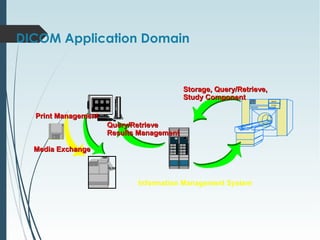
DICOM Application Domain
MAGN
ETOM
Information Management System
Storage, Query/Retrieve,Storage, Query/Retrieve,
Study ComponentStudy Component
Query/RetrieveQuery/Retrieve
Results ManagementResults Management
Print ManagementPrint Management
Media ExchangeMedia Exchange
LiteBox
Summary of DICOM Features
 NETWORK PROTOCOL
●
DICOM incorporates negotiation to permit peers
to agree on the functions to be performed
 MESSAGE ENCODING
●
DICOM defines 24 data types (V2.0 had 4)
●
DICOM message encoding includes JPEG
compression (17 varients)
●
DICOM supports multiple character repertoires
Summary of DICOM Features
 OBJECT DATA MODEL
●
DICOM is based on a completely specified data
model
●
DICOM includes a robust UID mechanism
 DATA DICTIONARY
●
DICOM includes a large number of new data
elements
 SERVICE CLASSES
●
DICOM defines classes of service for specific
applications (e.g. image management, printing)
and conformance levels
DICOM Objects
 Things such as images, reports, and patients are all
objects and are called information objects.
 Two kinds of objects in DICOM:
 Composite objects (Old objects inherited from NEMA).
 Normalized objects (New objects defined in DICOM).
 All objects and their format constitutes Data Dictionary.
 DICOM uses UIDs to identify information objects, such as
the images, reports, or transfer syntaxes.
 The form of the UID conforms to an international
standard.
 1.2.840.10008 is the root and the same for every DICOM
UID.
 Example: UID for the DICOM explicit VR little endian
transfer syntax is 1.2.840.10008.1.2.1
DICOM Service Classes
 Composite
●
Verification
●
Storage
●
Query/Retrieve
●
Study Content Notification
 Normalized
●
Patient Management
●
Study Management
●
Results Management
●
Basic Print Management
DICOM Service Elements
 Complex services are built using service elements,
called DICOM message service elements, or DIMSEs.
 There are both composite and normalized services for
composite and normalized information objects.
 There are 5 DIMSEs that are used for composite
information objects (called DIMSE-C) and 6 that are
used for normalized information objects (called DIMSE-
N).
 Two categories of DIMSEs:
 operations (such as "store")
 notifications (such as "event report”)
DIMSE-C Services
 DIMSE-C services:
 Operations:
 C-Store
 C-Get
 C-Move
 C-Find
 C-Echo
 No notification services
DIMSE-C Services
The C-STORE service is invoked by a DIMSE-service-user to
request the storage of Composite SOP Instance information
by a DIMSE-service-user.
The C-FIND service is invoked by a DIMSE-service-user to
match a series of Attribute strings against the Attributes of
the set of SOP Instances managed by a DIMSE-service-user.
The C-FIND service returns for each match a list of requested
Attributes and their values.
The C-GET service is invoked by a DIMSE-service-user to
fetch the information for one or more information objects
from a DIMSE-service-user, based upon the Attributes
supplied by the invoking DIMSE-service-user.
DIMSE-C Services
The C-MOVE service is invoked by a DIMSE-
service-user to move the information for one or
more Composite SOP Instances from a DIMSE-
service-user, to a third party DIMSE-service-user,
based upon the Attributes supplied by the
invoking DIMSE-service-user.
The C-ECHO service is invoked by a DIMSE-
service-user to verify end-to-end
communications with a DIMSE-service-user.
DIMSE-N Services
 DIMSE-N services:
 Operations:
 N-Get
 N-Set
 N-Action
 N-Create
 N-Delete
 Notifications:
 N-Event-Report
DIMSE-N Services
 N-EVENT-REPORT service is invoked by a DIMSE-
service-user to report an event about a SOP Instance
to a DIMSE-service-user.
N-GET service is invoked by a DIMSE-service-user to
request the retrieval of information from a DIMSE-
service-user.
N-SET service is invoked by a DIMSE-service-user to
request the modification of information by a DIMSE-
service-user.
DIMSE-N Services
N-ACTION service is invoked by a DIMSE-service-
user to request a DIMSE-service-user to perform an
action.
N-CREATE service is invoked by a DIMSE-service-
user to request a DIMSE-service-user to create an
instance of a information object.
N-DELETE service is invoked by a DIMSE-service-
user to request a DIMSE-service-user to delete an
instance of a information object.
DICOM Service-Object Pair (SOP)
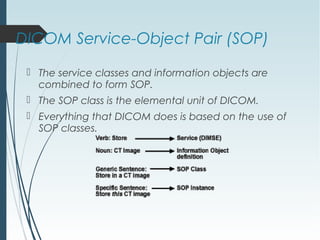
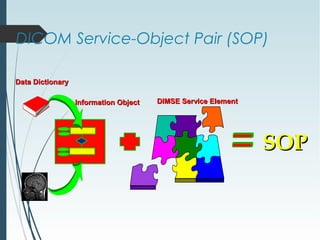
 The service classes and information objects are
combined to form SOP.
 The SOP class is the elemental unit of DICOM.
 Everything that DICOM does is based on the use of
SOP classes.
DICOM Service-Object Pair (SOP)
SOPSOP
Data DictionaryData Dictionary
Information ObjectInformation Object DIMSE Service ElementDIMSE Service Element
DICOM File Format (Overview)
A single DICOM file contains:
 A header (which stores information about
the patient's name, the type of scan, image
dimensions, etc)
 Image data (in compressed (bitmap) or
uncompressed form (jpeg, gif...))
DICOM File Header
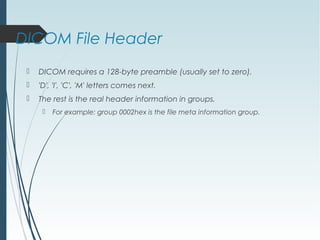
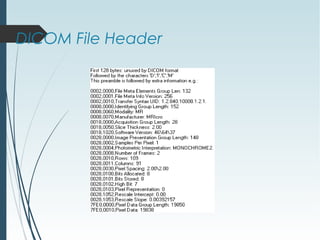
 DICOM requires a 128-byte preamble (usually set to zero).
 'D', 'I', 'C', 'M' letters comes next.
 The rest is the real header information in groups.
 For example: group 0002hex is the file meta information group.
DICOM File Header
DICOM File Header
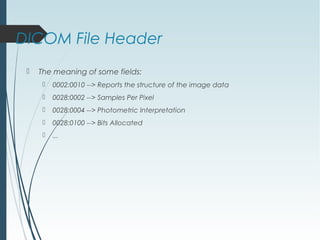
 The meaning of some fields:
 0002:0010 --> Reports the structure of the image data
 0028:0002 --> Samples Per Pixel
 0028:0004 --> Photometric Interpretation
 0028:0100 --> Bits Allocated
 ...
Association Services
 Before everything, Association establishment
must be done.
 During Association establishment, A DIMSE-
service-user exchanges initialization
information.
The initialization information includes:
 Application context
 DIMSE-specific user information
 DIMSE service information
 Presentation and session requirements
Association Services
 A-ASSOCIATE Service is invoked by a DIMSE-
service-user with related parameters to establish
an Association with another DIMSE-service-user.
 Association release is done using A-RELEASE and
A-ABORT services.

Dicom

  • 1.
  • 2.
    What is DICOM? The standard for Digital Imaging and Communications in Medicine.  Developed by the National Electrical Manufacturers Association (NEMA) in conjunction with the American College of Radiology (ACR).  Covers most image formats for all of medicine.  Specification for messaging and communication between imaging machines.
  • 3.
    A little history The first version was ACR-NEMA, released in 1985.  Its goal in developing a standard was  To enable users to retrieve images and associated information from digital imaging equipment in a standard format using point-to- point connection.  To hide differences same across multiple image equipment manufacturers.  To handle developing network and image standarts, a new standart, DICOM, was proposed in 1981.
  • 4.
    DICOM Application Domain MAGN ETOM InformationManagement System Storage, Query/Retrieve,Storage, Query/Retrieve, Study ComponentStudy Component Query/RetrieveQuery/Retrieve Results ManagementResults Management Print ManagementPrint Management Media ExchangeMedia Exchange LiteBox
  • 5.
    Summary of DICOMFeatures  NETWORK PROTOCOL ● DICOM incorporates negotiation to permit peers to agree on the functions to be performed  MESSAGE ENCODING ● DICOM defines 24 data types (V2.0 had 4) ● DICOM message encoding includes JPEG compression (17 varients) ● DICOM supports multiple character repertoires
  • 6.
    Summary of DICOMFeatures  OBJECT DATA MODEL ● DICOM is based on a completely specified data model ● DICOM includes a robust UID mechanism  DATA DICTIONARY ● DICOM includes a large number of new data elements  SERVICE CLASSES ● DICOM defines classes of service for specific applications (e.g. image management, printing) and conformance levels
  • 7.
    DICOM Objects  Thingssuch as images, reports, and patients are all objects and are called information objects.  Two kinds of objects in DICOM:  Composite objects (Old objects inherited from NEMA).  Normalized objects (New objects defined in DICOM).  All objects and their format constitutes Data Dictionary.  DICOM uses UIDs to identify information objects, such as the images, reports, or transfer syntaxes.  The form of the UID conforms to an international standard.  1.2.840.10008 is the root and the same for every DICOM UID.  Example: UID for the DICOM explicit VR little endian transfer syntax is 1.2.840.10008.1.2.1
  • 8.
    DICOM Service Classes Composite ● Verification ● Storage ● Query/Retrieve ● Study Content Notification  Normalized ● Patient Management ● Study Management ● Results Management ● Basic Print Management
  • 9.
    DICOM Service Elements Complex services are built using service elements, called DICOM message service elements, or DIMSEs.  There are both composite and normalized services for composite and normalized information objects.  There are 5 DIMSEs that are used for composite information objects (called DIMSE-C) and 6 that are used for normalized information objects (called DIMSE- N).  Two categories of DIMSEs:  operations (such as "store")  notifications (such as "event report”)
  • 10.
    DIMSE-C Services  DIMSE-Cservices:  Operations:  C-Store  C-Get  C-Move  C-Find  C-Echo  No notification services
  • 11.
    DIMSE-C Services The C-STOREservice is invoked by a DIMSE-service-user to request the storage of Composite SOP Instance information by a DIMSE-service-user. The C-FIND service is invoked by a DIMSE-service-user to match a series of Attribute strings against the Attributes of the set of SOP Instances managed by a DIMSE-service-user. The C-FIND service returns for each match a list of requested Attributes and their values. The C-GET service is invoked by a DIMSE-service-user to fetch the information for one or more information objects from a DIMSE-service-user, based upon the Attributes supplied by the invoking DIMSE-service-user.
  • 12.
    DIMSE-C Services The C-MOVEservice is invoked by a DIMSE- service-user to move the information for one or more Composite SOP Instances from a DIMSE- service-user, to a third party DIMSE-service-user, based upon the Attributes supplied by the invoking DIMSE-service-user. The C-ECHO service is invoked by a DIMSE- service-user to verify end-to-end communications with a DIMSE-service-user.
  • 13.
    DIMSE-N Services  DIMSE-Nservices:  Operations:  N-Get  N-Set  N-Action  N-Create  N-Delete  Notifications:  N-Event-Report
  • 14.
    DIMSE-N Services  N-EVENT-REPORTservice is invoked by a DIMSE- service-user to report an event about a SOP Instance to a DIMSE-service-user. N-GET service is invoked by a DIMSE-service-user to request the retrieval of information from a DIMSE- service-user. N-SET service is invoked by a DIMSE-service-user to request the modification of information by a DIMSE- service-user.
  • 15.
    DIMSE-N Services N-ACTION serviceis invoked by a DIMSE-service- user to request a DIMSE-service-user to perform an action. N-CREATE service is invoked by a DIMSE-service- user to request a DIMSE-service-user to create an instance of a information object. N-DELETE service is invoked by a DIMSE-service- user to request a DIMSE-service-user to delete an instance of a information object.
  • 16.
    DICOM Service-Object Pair(SOP)  The service classes and information objects are combined to form SOP.  The SOP class is the elemental unit of DICOM.  Everything that DICOM does is based on the use of SOP classes.
  • 17.
    DICOM Service-Object Pair(SOP) SOPSOP Data DictionaryData Dictionary Information ObjectInformation Object DIMSE Service ElementDIMSE Service Element
  • 18.
    DICOM File Format(Overview) A single DICOM file contains:  A header (which stores information about the patient's name, the type of scan, image dimensions, etc)  Image data (in compressed (bitmap) or uncompressed form (jpeg, gif...))
  • 19.
    DICOM File Header DICOM requires a 128-byte preamble (usually set to zero).  'D', 'I', 'C', 'M' letters comes next.  The rest is the real header information in groups.  For example: group 0002hex is the file meta information group.
  • 20.
  • 21.
    DICOM File Header The meaning of some fields:  0002:0010 --> Reports the structure of the image data  0028:0002 --> Samples Per Pixel  0028:0004 --> Photometric Interpretation  0028:0100 --> Bits Allocated  ...
  • 22.
    Association Services  Beforeeverything, Association establishment must be done.  During Association establishment, A DIMSE- service-user exchanges initialization information. The initialization information includes:  Application context  DIMSE-specific user information  DIMSE service information  Presentation and session requirements
  • 23.
    Association Services  A-ASSOCIATEService is invoked by a DIMSE- service-user with related parameters to establish an Association with another DIMSE-service-user.  Association release is done using A-RELEASE and A-ABORT services.