PACS
SYSTEM
Presented by
OUTLINES
• What is PACS?
• History of PACS
• Before and after PACS
• PACS architecture
• PACS integration with RIS
• PACS and DICOM
• Advantages and disadvantages
• Within the radiology department there are two key elements
that form the information infrastructure. First is the radiology
information system (RIS) and The second key element is the
imaging network , most often called the picture archive and
communication system (PACS).
WHAT IS PACS?
• PACS is an acronym for Picture Archiving and Communication System:
i. Picture-referring to radiographic images and radiology reports
ii. Archiving-referring to the film file or film jacket component of storing
images
iii. Communications-referencing multiple viewers of images and reports at
virtually unlimited viewing sites called workstations.
iv. System-fostering the concept that a complex coordinated network makes it
all possible
DEFINITION
•PACS (picture archiving and communication system) is
a medical imaging technology used primarily in
healthcare organizations to securely store and digitally
transmit electronic images and clinically-relevant
reports.
HISTORICAL DEVELOPMENT
• Concept began with Albert Jutras in Canada in the 1950s.
• Early PACS systems were developed by the military to send images
between Veterans Administration hospitals in the 1980s.
• Development was encouraged and supported by the U.S. government.
• Early process involved scanning radiographs into the computer and
sending them from computer to computer.
• Images were then stored in PACS.
• Computed and digital radiography followed.
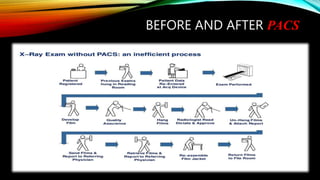
BEFORE AND AFTER PACS
CONT…
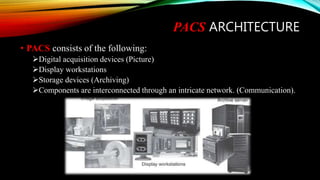
PACS ARCHITECTURE
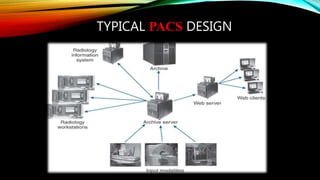
• PACS consists of the following:
Digital acquisition devices (Picture)
Display workstations
Storage devices (Archiving)
Components are interconnected through an intricate network. (Communication).
TYPICAL PACS DESIGN
CONT…
• Digital acquisition devices:
Ultrasound
Computed Tomography (CT)
Magnetic Resonance Imaging (MRI)
Nuclear medicine
Computed radiography
Mammography
CONT…
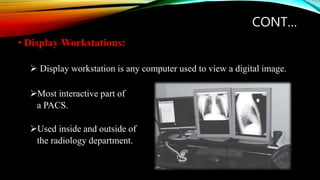
• Display Workstations:
 Display workstation is any computer used to view a digital image.
Most interactive part of
a PACS.
Used inside and outside of
the radiology department.
CONT…
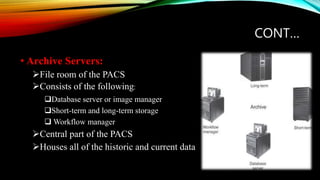
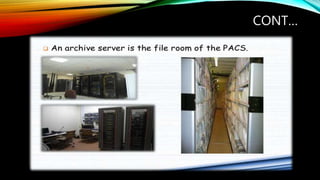
• Archive Servers:
File room of the PACS
Consists of the following:
Database server or image manager
Short-term and long-term storage
 Workflow manager
Central part of the PACS
Houses all of the historic and current data
CONT…
CONT…
PACS INTEGRATION WITH RIS
• Integration with other information systems (RIS & HIS) and
display of relevant data on desktop are critical for success of
PACS.
• A radiology information system (RIS) is a networked software
system for managing medical imagery and associated data. A
RIS is especially useful for tracking radiology imaging orders
and billing information, and is often used in conjunction
with PACS and VNAs (vendor neutral archive) to manage
image archives, record-keeping and billing.
CONT…
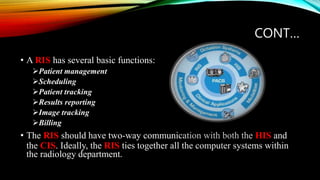
• A RIS has several basic functions:
Patient management
Scheduling
Patient tracking
Results reporting
Image tracking
Billing
• The RIS should have two-way communication with both the HIS and
the CIS. Ideally, the RIS ties together all the computer systems within
the radiology department.
PACS AND DICOM
• DICOM (Digital Imaging and Communications in Medicine) is
a standard protocol for the management and transmission of
medical images and related data and is used in many healthcare
facilities.
• In the 1980s, the first generation of PACS faced a major
obstacle in the lack of a recognized standard for electronic
images across vendors. This made it virtually impossible to
send images over a network from one vendor’s electronic
system to another.
CONT…
• In 1985 , DICOM was originally developed by the National
Electrical Manufacturers Association (NEMA) and the
American College of Radiology (ACR).
• Its mission is to ensure the interoperability of systems used to
produce, store, share, display, send, query, process, retrieve and
print medical images, as well as to manage related workflows.
ADVANTAGES
Hard copy replacement
Remote access
PACS breaks down the physical & time barriers associated with
traditional film.
Images can be archived and transported on portable media; USB
drive and Apple’s iPhone.
Improves productivity by allowing multiple clinicians to view the
same image from different locations.
Rapid retrieval of digital images for interpretation and comparison
with previous studies.
Radiologists can view an image back and forth like a movie,
known as “stack mode”.
DISADVANTAGES
• implementing a PACS is an expensive project.
• Most of staff will need introduction & additional trainings to
work with PACS software.
• Computer engineer availability required, to serve daily faults
and problems.
• No archive can guarantee a total fault – tolerance as a result
images can be lost or deleted.
THANK YOU

Pacs system

  • 1.
  • 2.
    OUTLINES • What isPACS? • History of PACS • Before and after PACS • PACS architecture • PACS integration with RIS • PACS and DICOM • Advantages and disadvantages
  • 3.
    • Within theradiology department there are two key elements that form the information infrastructure. First is the radiology information system (RIS) and The second key element is the imaging network , most often called the picture archive and communication system (PACS).
  • 4.
    WHAT IS PACS? •PACS is an acronym for Picture Archiving and Communication System: i. Picture-referring to radiographic images and radiology reports ii. Archiving-referring to the film file or film jacket component of storing images iii. Communications-referencing multiple viewers of images and reports at virtually unlimited viewing sites called workstations. iv. System-fostering the concept that a complex coordinated network makes it all possible
  • 5.
    DEFINITION •PACS (picture archivingand communication system) is a medical imaging technology used primarily in healthcare organizations to securely store and digitally transmit electronic images and clinically-relevant reports.
  • 6.
    HISTORICAL DEVELOPMENT • Conceptbegan with Albert Jutras in Canada in the 1950s. • Early PACS systems were developed by the military to send images between Veterans Administration hospitals in the 1980s. • Development was encouraged and supported by the U.S. government. • Early process involved scanning radiographs into the computer and sending them from computer to computer. • Images were then stored in PACS. • Computed and digital radiography followed.
  • 7.
  • 8.
  • 9.
    PACS ARCHITECTURE • PACSconsists of the following: Digital acquisition devices (Picture) Display workstations Storage devices (Archiving) Components are interconnected through an intricate network. (Communication).
  • 10.
  • 11.
    CONT… • Digital acquisitiondevices: Ultrasound Computed Tomography (CT) Magnetic Resonance Imaging (MRI) Nuclear medicine Computed radiography Mammography
  • 12.
    CONT… • Display Workstations: Display workstation is any computer used to view a digital image. Most interactive part of a PACS. Used inside and outside of the radiology department.
  • 13.
    CONT… • Archive Servers: Fileroom of the PACS Consists of the following: Database server or image manager Short-term and long-term storage  Workflow manager Central part of the PACS Houses all of the historic and current data
  • 14.
  • 15.
  • 16.
    PACS INTEGRATION WITHRIS • Integration with other information systems (RIS & HIS) and display of relevant data on desktop are critical for success of PACS. • A radiology information system (RIS) is a networked software system for managing medical imagery and associated data. A RIS is especially useful for tracking radiology imaging orders and billing information, and is often used in conjunction with PACS and VNAs (vendor neutral archive) to manage image archives, record-keeping and billing.
  • 17.
    CONT… • A RIShas several basic functions: Patient management Scheduling Patient tracking Results reporting Image tracking Billing • The RIS should have two-way communication with both the HIS and the CIS. Ideally, the RIS ties together all the computer systems within the radiology department.
  • 18.
    PACS AND DICOM •DICOM (Digital Imaging and Communications in Medicine) is a standard protocol for the management and transmission of medical images and related data and is used in many healthcare facilities. • In the 1980s, the first generation of PACS faced a major obstacle in the lack of a recognized standard for electronic images across vendors. This made it virtually impossible to send images over a network from one vendor’s electronic system to another.
  • 19.
    CONT… • In 1985, DICOM was originally developed by the National Electrical Manufacturers Association (NEMA) and the American College of Radiology (ACR). • Its mission is to ensure the interoperability of systems used to produce, store, share, display, send, query, process, retrieve and print medical images, as well as to manage related workflows.
  • 21.
    ADVANTAGES Hard copy replacement Remoteaccess PACS breaks down the physical & time barriers associated with traditional film. Images can be archived and transported on portable media; USB drive and Apple’s iPhone. Improves productivity by allowing multiple clinicians to view the same image from different locations. Rapid retrieval of digital images for interpretation and comparison with previous studies. Radiologists can view an image back and forth like a movie, known as “stack mode”.
  • 22.
    DISADVANTAGES • implementing aPACS is an expensive project. • Most of staff will need introduction & additional trainings to work with PACS software. • Computer engineer availability required, to serve daily faults and problems. • No archive can guarantee a total fault – tolerance as a result images can be lost or deleted.
  • 23.