Acute Diarrhea
By: Dr. Noshirwan P. Gazder
Defenition
• Passage of three or more stools in a day, of consistency softer than
usual for the child, or one watery stool is defined as “Diarrhea”.
• Diarrhea is one of the leading causes of morbidity and mortality in
children.
• There are 3-4 episodes of diarrhea per child per year.
• Maximum incidence is in the 1st year of life.
• Major transmission is fecal/oral or by ingestion of contaminated food
or water.
Factors Increasing Susceptibility To Diarrhea
• Exposure to unsanitary conditions.
• Ingestion of contaminated food or water.
• Lack of breastfeeding.
• Malnutrition.
• Measles.
• Level of Maternal Education.
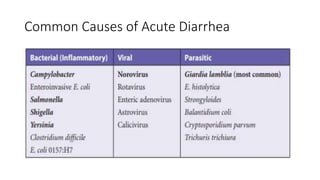
Common Causes of Acute Diarrhea
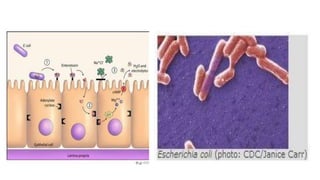
Enterotoxigenic E. Coli
• Diarrhea results from action of toxins released by the bacteria on
intestinal mucosa.
• Toxins are heat labile (LT) and heat stable (ST).
• The LT toxins bind to the epithelial surface of enterocytes, causing
accumulation of cyclic AMP causing massive secretion of sodium and
chloride in the gut lumen.
• The ST toxin activates guanylate cyclase, which increases secretory
activity of the gut.
Entero-Inasive (Shigella & Salmonella)
• These cause invasion of enterocytes and results in necrosis and ulcer
formation leading to diarrhea with blood and mucus in the stool.
• It presents as fever, abdominal cramps and tenesmus and small
volume of bloody mucoid stools with many pus cells.
Rota Virus
• It invades intestinal cells and alters their functioning and
reproduction.
• The exact mechanism in Rota virus is not known. But towards the end
of the illness it causes shedding of mucosal cells with loss of
disaccharides.
• It manifests as osmotic diarrhea due to failure of digestion of lactose
and other disacharrides.
• Recovery occurs when the mucosal surface regenerates.
Vibrio Cholerae
• They adhere to and multiply on the mucosa of small intestine and
produce heat labile enterotoxin, which attaches to a receptor (GM1
ganglioside) on gut epithelium.
• It activates adenylate cyclase to produce increased amount of cyclic
AMP, which causes decreased absorption of sodium and chloride
resulting in water and electrolyte loss.
Giardia Lamlia
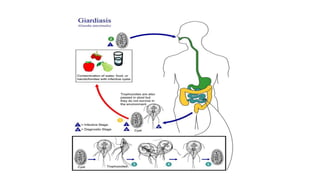
• Pear shaped, flagellated trophozoite with ventral sucking discs.
• Spread via the oro-fecal route.
• Humans ingest cysts which form trophozoites in the duodenum.
• Trophozoites attach to the duodenal wall but do not invade and
interferes with absorption of fat and protein.
Effects of Diarrhea
1. Loss of Water:
• Loss of skin turgor.
• Weak or absent pulse.
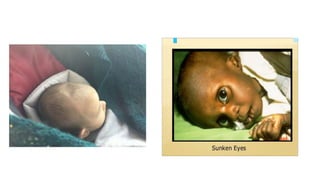
• Sunken eyes.
• Sunken fontanelles.
• Dry Mucous membranes.
• Anuria.
2. Loss of Nutrients:
• Hypoglycemia, convulsions or
coma.
• Weight loss or marasmus.
3. Loss of bicarbonate:
• Vomitting and retching.
• Deep and sighing respiration.
• Irritability (Increased O2 demand
of brain)
4. Loss of Potassium:
• Abdominal distention.
• Paralytic ileus.
• Sustained Shock.
Clinical Features
• Onset is sudden with diarrhea and vomitting.
• Stools are large in volume, watery in consistency.
• Dehydration develops rapidly due to loss of body water and
electrolytes in stools and vomitting.
• Acute diarrhea is usually a self-limited disease. Vomitting and fever
usually resolve quickly but diarrhea persists for 3-4 days then
gradually diminishes over another 4-5 days.
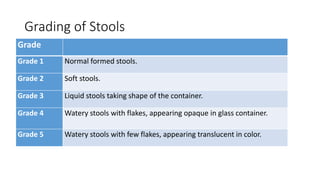
Grading of Stools
Grade
Grade 1 Normal formed stools.
Grade 2 Soft stools.
Grade 3 Liquid stools taking shape of the container.
Grade 4 Watery stools with flakes, appearing opaque in glass container.
Grade 5 Watery stools with few flakes, appearing translucent in color.
Complications
• Dehydation and Shock.
• Metabolic acidosis.
• Convulsions or Coma.
• Malnutrition. (long standing diarrhea)
• Acute Renal shutdown.
• Super-added infections.
• Death.
Evaluation of the Patient
-History:
• Loose motions.(duration, frequency, grade, color of stool, blood in stool)
• If the child has vomitting.(duration, frequency, relation with food, quantity,
color of vomitus, blood in vomitus)
• If the child has a fever.( duration, low or high grade)
• Abdominal pain or distention.
• Any history of seizures.
• Urine passed or not within 6 hours, and in how much quantity.
• Any associated symptoms such as cough, rash or urinary complains.
• BIND.
Examination
• General behaviour ( drowsy, irritable)
• Anthroprometry and General physical examination.
• Mucous membranes (normal, dry or parched)
• Skin turgor (normal, goes back slowly, goes back very slowly)
• Eyes (Shiny with tears, not sunken, sunken)
• Anterior fontanelle ( open, closed, depressed)
• Abdomen (normal, distended, any mass palpable,bowel sounds)
• CNS and respiratory system examination to find any associated
abnormality.
Investigations
• CBC.
• Stool examination for pH, Giardia cysts or entamoeba, Bioassay for
E.coli, Culture and Sensitivity.
• Serum electrolytes.
• Blood culture. (salmonellosis or shigellosis)
• X-ray chest. (pneumonia)
Management
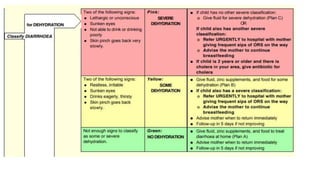
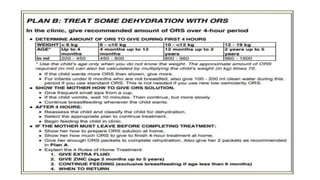
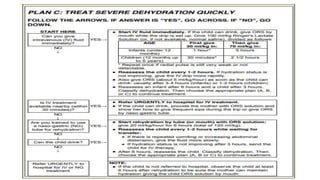
• Before starting therapy, we assess degree and type of dehydration.
• If the child has diarrhea we Ask, For how long and if there is blood in
the stool
• We will then Look at the child's general condition. Is the child:
Lethargic or unconscious or restless and irritable
• Look for sunken eyes.
• Offer the child fluid, Is the child not able to drink or drinking poorly or
is the child drinking eagerly.
• Pinch the skin of the abdomen, does it go back slowly or very slowly
(longer than 2 seconds).
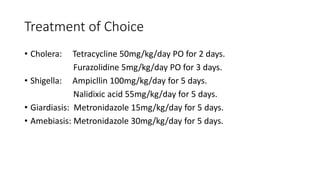
Treatment of Choice
• Cholera: Tetracycline 50mg/kg/day PO for 2 days.
Furazolidine 5mg/kg/day PO for 3 days.
• Shigella: Ampicllin 100mg/kg/day for 5 days.
Nalidixic acid 55mg/kg/day for 5 days.
• Giardiasis: Metronidazole 15mg/kg/day for 5 days.
• Amebiasis: Metronidazole 30mg/kg/day for 5 days.
Thank You

Acute Diarrhea

  • 1.
    Acute Diarrhea By: Dr.Noshirwan P. Gazder
  • 2.
    Defenition • Passage ofthree or more stools in a day, of consistency softer than usual for the child, or one watery stool is defined as “Diarrhea”.
  • 3.
    • Diarrhea isone of the leading causes of morbidity and mortality in children. • There are 3-4 episodes of diarrhea per child per year. • Maximum incidence is in the 1st year of life. • Major transmission is fecal/oral or by ingestion of contaminated food or water.
  • 4.
    Factors Increasing SusceptibilityTo Diarrhea • Exposure to unsanitary conditions. • Ingestion of contaminated food or water. • Lack of breastfeeding. • Malnutrition. • Measles. • Level of Maternal Education.
  • 5.
    Common Causes ofAcute Diarrhea
  • 6.
    Enterotoxigenic E. Coli •Diarrhea results from action of toxins released by the bacteria on intestinal mucosa. • Toxins are heat labile (LT) and heat stable (ST). • The LT toxins bind to the epithelial surface of enterocytes, causing accumulation of cyclic AMP causing massive secretion of sodium and chloride in the gut lumen. • The ST toxin activates guanylate cyclase, which increases secretory activity of the gut.
  • 8.
    Entero-Inasive (Shigella &Salmonella) • These cause invasion of enterocytes and results in necrosis and ulcer formation leading to diarrhea with blood and mucus in the stool. • It presents as fever, abdominal cramps and tenesmus and small volume of bloody mucoid stools with many pus cells.
  • 9.
    Rota Virus • Itinvades intestinal cells and alters their functioning and reproduction. • The exact mechanism in Rota virus is not known. But towards the end of the illness it causes shedding of mucosal cells with loss of disaccharides. • It manifests as osmotic diarrhea due to failure of digestion of lactose and other disacharrides. • Recovery occurs when the mucosal surface regenerates.
  • 10.
    Vibrio Cholerae • Theyadhere to and multiply on the mucosa of small intestine and produce heat labile enterotoxin, which attaches to a receptor (GM1 ganglioside) on gut epithelium. • It activates adenylate cyclase to produce increased amount of cyclic AMP, which causes decreased absorption of sodium and chloride resulting in water and electrolyte loss.
  • 11.
    Giardia Lamlia • Pearshaped, flagellated trophozoite with ventral sucking discs. • Spread via the oro-fecal route. • Humans ingest cysts which form trophozoites in the duodenum. • Trophozoites attach to the duodenal wall but do not invade and interferes with absorption of fat and protein.
  • 13.
    Effects of Diarrhea 1.Loss of Water: • Loss of skin turgor. • Weak or absent pulse. • Sunken eyes. • Sunken fontanelles. • Dry Mucous membranes. • Anuria. 2. Loss of Nutrients: • Hypoglycemia, convulsions or coma. • Weight loss or marasmus.
  • 15.
    3. Loss ofbicarbonate: • Vomitting and retching. • Deep and sighing respiration. • Irritability (Increased O2 demand of brain) 4. Loss of Potassium: • Abdominal distention. • Paralytic ileus. • Sustained Shock.
  • 16.
    Clinical Features • Onsetis sudden with diarrhea and vomitting. • Stools are large in volume, watery in consistency. • Dehydration develops rapidly due to loss of body water and electrolytes in stools and vomitting. • Acute diarrhea is usually a self-limited disease. Vomitting and fever usually resolve quickly but diarrhea persists for 3-4 days then gradually diminishes over another 4-5 days.
  • 17.
    Grading of Stools Grade Grade1 Normal formed stools. Grade 2 Soft stools. Grade 3 Liquid stools taking shape of the container. Grade 4 Watery stools with flakes, appearing opaque in glass container. Grade 5 Watery stools with few flakes, appearing translucent in color.
  • 18.
    Complications • Dehydation andShock. • Metabolic acidosis. • Convulsions or Coma. • Malnutrition. (long standing diarrhea) • Acute Renal shutdown. • Super-added infections. • Death.
  • 19.
    Evaluation of thePatient -History: • Loose motions.(duration, frequency, grade, color of stool, blood in stool) • If the child has vomitting.(duration, frequency, relation with food, quantity, color of vomitus, blood in vomitus) • If the child has a fever.( duration, low or high grade) • Abdominal pain or distention. • Any history of seizures. • Urine passed or not within 6 hours, and in how much quantity. • Any associated symptoms such as cough, rash or urinary complains. • BIND.
  • 20.
    Examination • General behaviour( drowsy, irritable) • Anthroprometry and General physical examination. • Mucous membranes (normal, dry or parched) • Skin turgor (normal, goes back slowly, goes back very slowly) • Eyes (Shiny with tears, not sunken, sunken) • Anterior fontanelle ( open, closed, depressed) • Abdomen (normal, distended, any mass palpable,bowel sounds) • CNS and respiratory system examination to find any associated abnormality.
  • 21.
    Investigations • CBC. • Stoolexamination for pH, Giardia cysts or entamoeba, Bioassay for E.coli, Culture and Sensitivity. • Serum electrolytes. • Blood culture. (salmonellosis or shigellosis) • X-ray chest. (pneumonia)
  • 22.
    Management • Before startingtherapy, we assess degree and type of dehydration. • If the child has diarrhea we Ask, For how long and if there is blood in the stool • We will then Look at the child's general condition. Is the child: Lethargic or unconscious or restless and irritable • Look for sunken eyes. • Offer the child fluid, Is the child not able to drink or drinking poorly or is the child drinking eagerly. • Pinch the skin of the abdomen, does it go back slowly or very slowly (longer than 2 seconds).
  • 27.
    Treatment of Choice •Cholera: Tetracycline 50mg/kg/day PO for 2 days. Furazolidine 5mg/kg/day PO for 3 days. • Shigella: Ampicllin 100mg/kg/day for 5 days. Nalidixic acid 55mg/kg/day for 5 days. • Giardiasis: Metronidazole 15mg/kg/day for 5 days. • Amebiasis: Metronidazole 30mg/kg/day for 5 days.
  • 28.