Nursing Management of patient with
hemodialysis
Presented by
Karana ram
MSc.(n) 1st year
Introduction
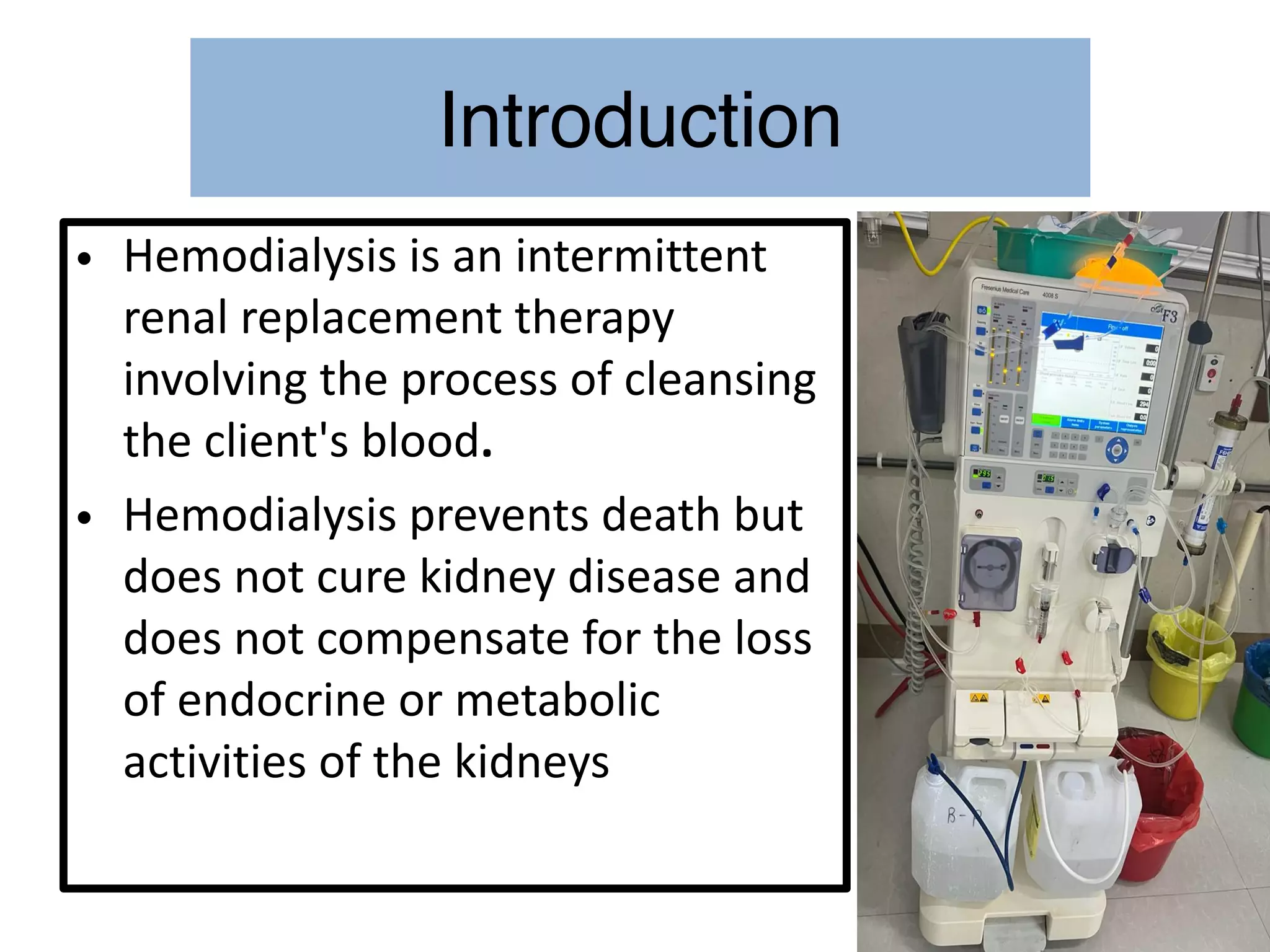
• Hemodialysis is an intermittent
renal replacement therapy
involving the process of cleansing
the client's blood.
• Hemodialysis prevents death but
does not cure kidney disease and
does not compensate for the loss
of endocrine or metabolic
activities of the kidneys
Indication
• Hyperkalaemia
• Acute renal failure
• Chronic renal failure
• Fluid overload
• Drugs toxicity
• Increase serum creatinine level
Principles of hemodialysis
• The client's blood flows into the dialyzer the
movement of substances occurs from the
blood to the dialysate by semipermiable
membrane .
• Dialysis mainly work on three principal.
• Osmosis
• Diffusion
• Ultrafiltration
Equipment needed during hemodialysis
• Dialysis machine
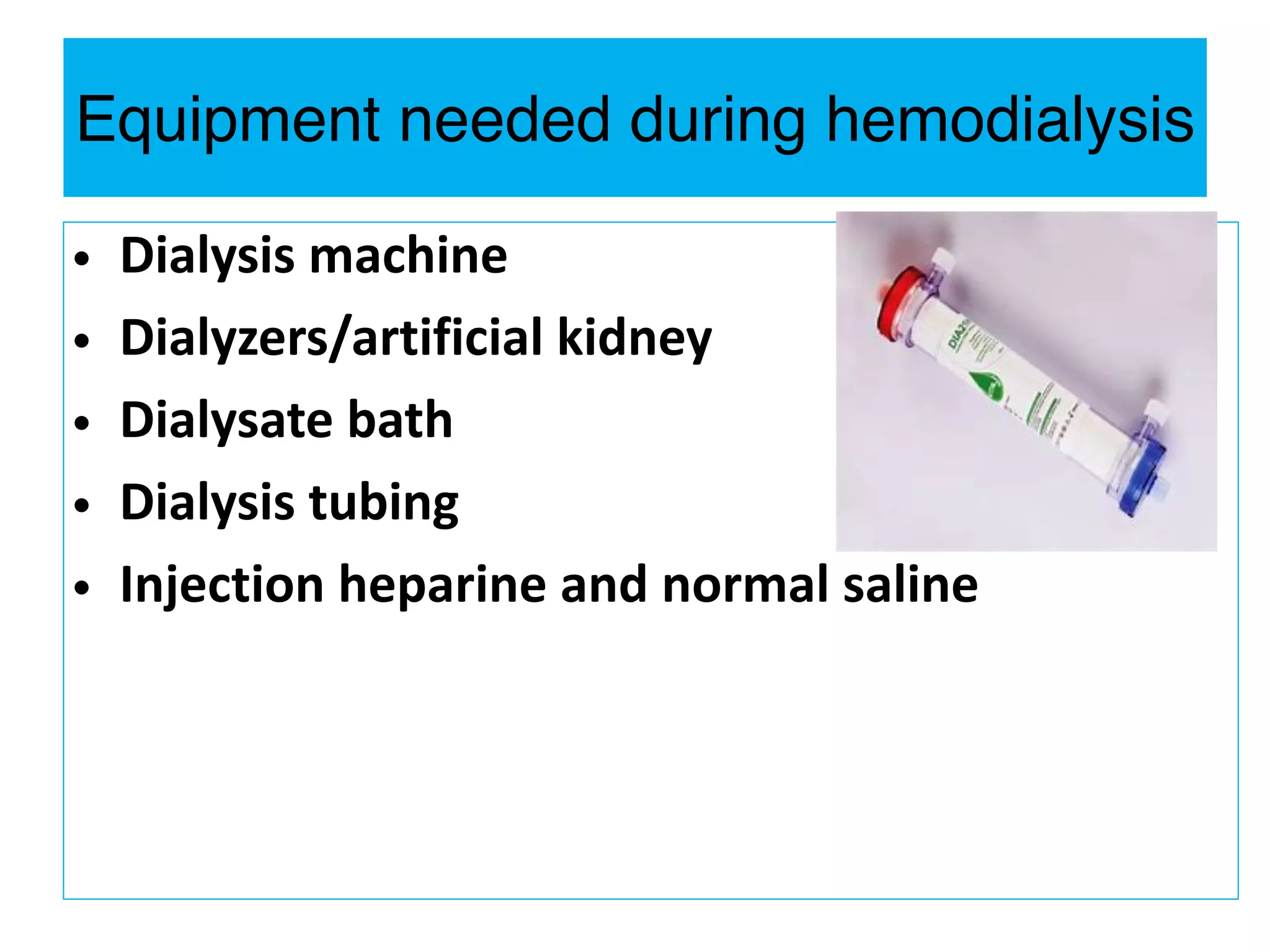
• Dialyzers/artificial kidney
• Dialysate bath
• Dialysis tubing
• Injection heparine and normal saline
Functions of hemodialysis
• Cleans the blood of accumulated waste
products
• Removes the products of protein metabolism
such as urea, creatinine, and uric acid from the
blood
• Removes excess body fluids
• Maintains or restores the buffer system of the
body
• Corrects electrolyte levels in the body
Access for Hemodialysis
Subclavian and femoral catheters
External arteriovenous shunt
Internal arteriovenous fistula
Internal arterioveins graft
Subclavian and femoral catheters
• Immediate access to the
patient's circulation for
acute hemodialysis is
achieved by inserting a
double-lumen, noncuffed,
largebore catheter into the
subclavian, internal jugular,
or femoral vein by the
physician
Nursing intervention during Subclavian
vein catheter
• The catheter is usually filled with heparin and
capped to maintain patency between dialysis
treatments.
• The catheter should not be uncapped except
for dialysis treatments.
• The catheter may be left in place for up to 6
weeks if no complications occur
Nursing intervention during Femoral vein
catheter
• Assess the extremity for circulation, temperature,
and pulses..
• Use an IV infusion pump or controller with
microdrip tubing if a heparin infusion through the
catheter to maintain patency is prescribed.
• The client with a femoral vein catheter should not
sit up more than 45 degrees or lean forward,
because the catheter may kink and occludes
External arteriovenous shunt-
• Two Silastic cannulas are
surgically inserted into an artery
and vein in the forearm or leg to
form an external blood path.
• The cannulas are connected to
form a U shape; blood flows
from the client's artery through
the shunt into the vein
Advantages-
•The external arteriovenous shunt can be
used immediately following its creation.
• No venipuncture is necessary for dialysis.
Disadvantagesa
•Disconnection or dislodgment of the
external shunt
• Risk of hemorrhage, infection, or clotting
• Potential for skin erosion around the
catheter site
Interventions
• Wrap a dressing completely around the shunt and
keep it dry and intact
• Teach the client that the shunt extremity should not
be used for monitoring BP,drawing blood, placing IV
lines, or administering injections.
• Monitor skin integrity around the insertion site.
• Notify the PHCP immediately if signs of clotting,
hemorrhage, or infection occur.
Internal arteriovenous fistula
• A permanent access of choice
for the client with CKD
requiring dialysis.
• The fistula is created surgically
by anastomosis of a large artery
and large vein in the arm.
Advantages
• fistula is internal, the risk of clotting and
bleeding is low
• The fistula has a decreased incidence of
infection, because it is internal and is not
exposed.
• Once healing has occurred, no external
dressing is required
• The fistula allows freedom of movement.
Disadvantages
• The fistula cannot be used immediately after
insertion, so planning ahead for an alternative
access for dialysis is important.
• Infiltration of the needles during dialysis can occur
and cause hematomas.
• An aneurysm can form in the fistula:
• Heart failure can occur from the increased blood
flow in the venous system.
• Arterial steal syndrome can develop in a client
with in internal arteriovenous fistula.
Internal arterioveins graft
• The procedure involves the
anastomosis of an artery to a
vein, using an artificial graft.
• The graft can be used 2 weeks
after insertion
• It used when patient blood
vessels not properly
engorged.
Nursing intervention for Arteriovenous
Fistula or Graft
• Teach the client with an arteriovenous fistula to
perform hand-flexing exercises such as ball
squeezing (if prescribed) to promote graft maturity.
• Avoid taking BP or performing venipuncture for
intravenous access or lab draws to protect the
integrity of the fistula.
• Palpate pulses below the fistula or graft, and
monitor for hand swelling as an indication of
ischemia
Contd,,,,
• Note the temperature and capillary refill of the
extremity.
• Monitor for clotting.and infection
• To ensure patency, palpate for a thrill or
auscultate for a bruit over the fistula or graft.
Notify the doctor if a thrill or bruit is absent
• Monitor lung and heart sounds for signs of
heart failure.
Complication of hemodialysis
• Hypotensions
• Dialysis encephalopathy
• Disequlibrium syndrome
• Hepatitis
• Sepsis
• Shock
• Air embolism
Nursing management
• The nurse in the dialysis unit has an
important role in monitoring,
supporting, assessing, and educating
the patient.
1.Before dialysis
2 During dialysis
3. After dialysis
Before dialysis
• Assess weight before the procedure.
• Cheack the patient PT/INR and viral marker
before the hemodialysis.
• Assess vascular access site for a palpable
pulsation or vibration and an audible bruit.
• Withhold antihypertensives and other
medications that can affect the BP or result in
hypotension until after hemodialysis
treatment
Contd,,,
• Assess vital signs, including blood pressure
including standing and sitting , respirations,
temperature, heart rate and lung sounds
• Withhold antihypertensives and other medications
that can affect the BP or result in hypotension until
after hemodialysis treatment.
• Prepare the dialysis machine and tubing.
• Set the ultra-filtrations rate which is calculated on
the bases of the weight
During dialysis
• Periodically monitor the vital signs blood
pressure ,temperature, respiration or pulse
• Monitor for hypovolemia during dialysis,
which Can occur from blood loss or excess
fluid and electrolyte removal
• Monitored the blood glucose level to the
client.
• Administer heparin to prevent clotting of
blood.
Contd,,,
• Moniter the alarm of the machine.
• Obsereve the access site for any bleeding
• During dialysis, the patient, the dialyzer, and
the dialysate bath require constant
monitoring because numerous complications
are possible, including clotting of the dialysis
tubing or dialyzer, ,cramping,or vomiting,
blood leaks, air embolism and access
complication.
Post dialysis nursing care
• Disconnect the tubing after allowing complete
return of blood to the patient's body.
• Remove the cannula and apply pressure
dressing.
• Monitor BUN, serum creatinine, serum
electrolyte, and hematocrit levels between
and after dialysis treatments.
Contd,,,
• Assess for Dialysis disequilibrium syndrome,
Headache, Altered level of consciousness,
Hypotension
• If a transfusion is given during dialysis, monitor
for possible transfusion reaction.
• Assess and document vital signs, weight, and
vascular access site condition.
Patient education
• Provide the psychological support to the patient and
family member.
• Restriction of fluid is also part of the dietary
prescription because fluid accumulation may occur,
leading to weight gain, heart failure, and pulmonary
edema
• Diet is important for patients on hemodialysis , Goals
of nutritional therapy are to minimize uremic
symptoms and fluid and electrolyte imbalances; to
maintain good nutritional status through adequate,
calorie, vitamin, and mineral intake
summary
• In this seminar we have discussed about the
nursing management of patient with
hemodialysis, We have also learnt about the
introduction ,indication and principal of
hemodialysis, what are the equipment needed
in the hemodialysis,function and access of
hemodialysis, and what are the complication of
hemodialysis and nursing management of
hemodialysis.
conclusion
• Haemodialysis is used for clients with acute or
chronic renal failure, fluid and electrolyte and
• imbalances etc. It is usually the treatment of
choice, when toxic agents such as
barbiturates,
• after an overdose needed to be removed from
the body quickly, in this process the clients
• toxin-laden blood is diverted into dialyzer,
cleaned and returned to the client
Research Article
• Validation of the nursing interventions and
activities for patients on hemodialytic therapy
• Abstract
• Objective: To validate interventions and nursing
activities proposed by the Nursing Interventions
Classification for patients with acute renal failure or
acute chronic renal disease in hemodialysis therapy
with the Excess Fluid Volume and Risk for
Imbalanced Fluid Volume nursing diagnoses.
Methods: Validation of content with 19 expert nurses from a
university hospital. The data collection was made from
September to November 2011 through instruments that
contained the interventions and nursing activities in study. The
data analysis considered the average of scores obtained in the
validation process.
Results: The Fluid Management was validated as a priority
intervention (mean ≥ 0.8), with eight main activities for the
Excess Fluid Volume nursing diagnosis and eight for the Risk
for Imbalanced Fluid Volume nursing diagnosis.
Conclusion: The validated intervation of the Fluid
Management enables the monitoring of the hydric balance and
facilitates the prevention of complications, which are
important activities in the nursing care of the patients in
hemodialysis therapy
Bibliography
• Brunner and Suddarth; Textbook of Medical Surgical Nursing
13th Edition Volume II. New Delhi; Wolters Kluwer Publication
page no. 1548-1553.
• Lippincott Williams & Wikins Hand book of Dialysis ,Wolters
Kluwers Publications ,Fifth Edition, 2015 ,Pg no:392 -400.
• ssLewis. Medical Surgical Nursing Assessment and
Management of clinical problems.2015. New Delhi. Elsevier.
2nd Edition. Volume II
• .Joyce M. Black, Jane Hokanson Hawks. Medical Surgical
Nursing Clinical Management of Positive Outcomes.2015. New
Delhi. Reed Elsevier India Private Limited. Volume II
hemodialysis.pdf

hemodialysis.pdf

  • 1.
    Nursing Management ofpatient with hemodialysis Presented by Karana ram MSc.(n) 1st year
  • 2.
    Introduction • Hemodialysis isan intermittent renal replacement therapy involving the process of cleansing the client's blood. • Hemodialysis prevents death but does not cure kidney disease and does not compensate for the loss of endocrine or metabolic activities of the kidneys
  • 3.
    Indication • Hyperkalaemia • Acuterenal failure • Chronic renal failure • Fluid overload • Drugs toxicity • Increase serum creatinine level
  • 4.
    Principles of hemodialysis •The client's blood flows into the dialyzer the movement of substances occurs from the blood to the dialysate by semipermiable membrane . • Dialysis mainly work on three principal. • Osmosis • Diffusion • Ultrafiltration
  • 5.
    Equipment needed duringhemodialysis • Dialysis machine • Dialyzers/artificial kidney • Dialysate bath • Dialysis tubing • Injection heparine and normal saline
  • 6.
    Functions of hemodialysis •Cleans the blood of accumulated waste products • Removes the products of protein metabolism such as urea, creatinine, and uric acid from the blood • Removes excess body fluids • Maintains or restores the buffer system of the body • Corrects electrolyte levels in the body
  • 7.
    Access for Hemodialysis Subclavianand femoral catheters External arteriovenous shunt Internal arteriovenous fistula Internal arterioveins graft
  • 8.
    Subclavian and femoralcatheters • Immediate access to the patient's circulation for acute hemodialysis is achieved by inserting a double-lumen, noncuffed, largebore catheter into the subclavian, internal jugular, or femoral vein by the physician
  • 9.
    Nursing intervention duringSubclavian vein catheter • The catheter is usually filled with heparin and capped to maintain patency between dialysis treatments. • The catheter should not be uncapped except for dialysis treatments. • The catheter may be left in place for up to 6 weeks if no complications occur
  • 10.
    Nursing intervention duringFemoral vein catheter • Assess the extremity for circulation, temperature, and pulses.. • Use an IV infusion pump or controller with microdrip tubing if a heparin infusion through the catheter to maintain patency is prescribed. • The client with a femoral vein catheter should not sit up more than 45 degrees or lean forward, because the catheter may kink and occludes
  • 11.
    External arteriovenous shunt- •Two Silastic cannulas are surgically inserted into an artery and vein in the forearm or leg to form an external blood path. • The cannulas are connected to form a U shape; blood flows from the client's artery through the shunt into the vein
  • 12.
    Advantages- •The external arteriovenousshunt can be used immediately following its creation. • No venipuncture is necessary for dialysis. Disadvantagesa •Disconnection or dislodgment of the external shunt • Risk of hemorrhage, infection, or clotting • Potential for skin erosion around the catheter site
  • 13.
    Interventions • Wrap adressing completely around the shunt and keep it dry and intact • Teach the client that the shunt extremity should not be used for monitoring BP,drawing blood, placing IV lines, or administering injections. • Monitor skin integrity around the insertion site. • Notify the PHCP immediately if signs of clotting, hemorrhage, or infection occur.
  • 14.
    Internal arteriovenous fistula •A permanent access of choice for the client with CKD requiring dialysis. • The fistula is created surgically by anastomosis of a large artery and large vein in the arm.
  • 15.
    Advantages • fistula isinternal, the risk of clotting and bleeding is low • The fistula has a decreased incidence of infection, because it is internal and is not exposed. • Once healing has occurred, no external dressing is required • The fistula allows freedom of movement.
  • 16.
    Disadvantages • The fistulacannot be used immediately after insertion, so planning ahead for an alternative access for dialysis is important. • Infiltration of the needles during dialysis can occur and cause hematomas. • An aneurysm can form in the fistula: • Heart failure can occur from the increased blood flow in the venous system. • Arterial steal syndrome can develop in a client with in internal arteriovenous fistula.
  • 17.
    Internal arterioveins graft •The procedure involves the anastomosis of an artery to a vein, using an artificial graft. • The graft can be used 2 weeks after insertion • It used when patient blood vessels not properly engorged.
  • 18.
    Nursing intervention forArteriovenous Fistula or Graft • Teach the client with an arteriovenous fistula to perform hand-flexing exercises such as ball squeezing (if prescribed) to promote graft maturity. • Avoid taking BP or performing venipuncture for intravenous access or lab draws to protect the integrity of the fistula. • Palpate pulses below the fistula or graft, and monitor for hand swelling as an indication of ischemia
  • 19.
    Contd,,,, • Note thetemperature and capillary refill of the extremity. • Monitor for clotting.and infection • To ensure patency, palpate for a thrill or auscultate for a bruit over the fistula or graft. Notify the doctor if a thrill or bruit is absent • Monitor lung and heart sounds for signs of heart failure.
  • 20.
    Complication of hemodialysis •Hypotensions • Dialysis encephalopathy • Disequlibrium syndrome • Hepatitis • Sepsis • Shock • Air embolism
  • 21.
    Nursing management • Thenurse in the dialysis unit has an important role in monitoring, supporting, assessing, and educating the patient. 1.Before dialysis 2 During dialysis 3. After dialysis
  • 22.
    Before dialysis • Assessweight before the procedure. • Cheack the patient PT/INR and viral marker before the hemodialysis. • Assess vascular access site for a palpable pulsation or vibration and an audible bruit. • Withhold antihypertensives and other medications that can affect the BP or result in hypotension until after hemodialysis treatment
  • 23.
    Contd,,, • Assess vitalsigns, including blood pressure including standing and sitting , respirations, temperature, heart rate and lung sounds • Withhold antihypertensives and other medications that can affect the BP or result in hypotension until after hemodialysis treatment. • Prepare the dialysis machine and tubing. • Set the ultra-filtrations rate which is calculated on the bases of the weight
  • 24.
    During dialysis • Periodicallymonitor the vital signs blood pressure ,temperature, respiration or pulse • Monitor for hypovolemia during dialysis, which Can occur from blood loss or excess fluid and electrolyte removal • Monitored the blood glucose level to the client. • Administer heparin to prevent clotting of blood.
  • 25.
    Contd,,, • Moniter thealarm of the machine. • Obsereve the access site for any bleeding • During dialysis, the patient, the dialyzer, and the dialysate bath require constant monitoring because numerous complications are possible, including clotting of the dialysis tubing or dialyzer, ,cramping,or vomiting, blood leaks, air embolism and access complication.
  • 26.
    Post dialysis nursingcare • Disconnect the tubing after allowing complete return of blood to the patient's body. • Remove the cannula and apply pressure dressing. • Monitor BUN, serum creatinine, serum electrolyte, and hematocrit levels between and after dialysis treatments.
  • 27.
    Contd,,, • Assess forDialysis disequilibrium syndrome, Headache, Altered level of consciousness, Hypotension • If a transfusion is given during dialysis, monitor for possible transfusion reaction. • Assess and document vital signs, weight, and vascular access site condition.
  • 28.
    Patient education • Providethe psychological support to the patient and family member. • Restriction of fluid is also part of the dietary prescription because fluid accumulation may occur, leading to weight gain, heart failure, and pulmonary edema • Diet is important for patients on hemodialysis , Goals of nutritional therapy are to minimize uremic symptoms and fluid and electrolyte imbalances; to maintain good nutritional status through adequate, calorie, vitamin, and mineral intake
  • 29.
    summary • In thisseminar we have discussed about the nursing management of patient with hemodialysis, We have also learnt about the introduction ,indication and principal of hemodialysis, what are the equipment needed in the hemodialysis,function and access of hemodialysis, and what are the complication of hemodialysis and nursing management of hemodialysis.
  • 30.
    conclusion • Haemodialysis isused for clients with acute or chronic renal failure, fluid and electrolyte and • imbalances etc. It is usually the treatment of choice, when toxic agents such as barbiturates, • after an overdose needed to be removed from the body quickly, in this process the clients • toxin-laden blood is diverted into dialyzer, cleaned and returned to the client
  • 31.
    Research Article • Validationof the nursing interventions and activities for patients on hemodialytic therapy • Abstract • Objective: To validate interventions and nursing activities proposed by the Nursing Interventions Classification for patients with acute renal failure or acute chronic renal disease in hemodialysis therapy with the Excess Fluid Volume and Risk for Imbalanced Fluid Volume nursing diagnoses.
  • 32.
    Methods: Validation ofcontent with 19 expert nurses from a university hospital. The data collection was made from September to November 2011 through instruments that contained the interventions and nursing activities in study. The data analysis considered the average of scores obtained in the validation process. Results: The Fluid Management was validated as a priority intervention (mean ≥ 0.8), with eight main activities for the Excess Fluid Volume nursing diagnosis and eight for the Risk for Imbalanced Fluid Volume nursing diagnosis. Conclusion: The validated intervation of the Fluid Management enables the monitoring of the hydric balance and facilitates the prevention of complications, which are important activities in the nursing care of the patients in hemodialysis therapy
  • 33.
    Bibliography • Brunner andSuddarth; Textbook of Medical Surgical Nursing 13th Edition Volume II. New Delhi; Wolters Kluwer Publication page no. 1548-1553. • Lippincott Williams & Wikins Hand book of Dialysis ,Wolters Kluwers Publications ,Fifth Edition, 2015 ,Pg no:392 -400. • ssLewis. Medical Surgical Nursing Assessment and Management of clinical problems.2015. New Delhi. Elsevier. 2nd Edition. Volume II • .Joyce M. Black, Jane Hokanson Hawks. Medical Surgical Nursing Clinical Management of Positive Outcomes.2015. New Delhi. Reed Elsevier India Private Limited. Volume II