Presented By :- Kiran Bhardwaj
M.Sc Nursing 2nd year
CON, ILBS
 Dialysis Comes from greek words namely “ Dia” and
“Lysis” meaning splitting or separating materials through
a membrane.
 Dialysis is used to remove fluid and uremic waste
products from the body when the kidneys cannot to do
so. Hemodiaysis is the most commonly used method of
dialysis.
 It is used for patients who are acutely ill and require
short-term diaysis and for patients with ESRD who
require long-term or permanent therapy. The need for
dialysis may be acute or chronic.
 Hemodialysis
 Peritoneal Dialysis
 Hemodialysis is a process of cleaning the blood of
accumulated waste products by using an artificial kidney.
 In hemodialysis ,the blood, laden with toxins and
nitrogenous wastes, is diverted from the patient to a
machine, a dialyzer, in which the blood is cleansed and
then returned to the patient.
 Hemodialysis was one of the most common procedures
performed in hospitals now a days.
 It was the fifth most common procedure for patients
aged 45–64 years.
 Over 1 million people worldwide are alive on dialysis or
with a functioning graft .
 Incidence of CKD has doubled in the last 15 years. In
contrast to high-income countries, patients with ESRD
have to pay for dialysis and transplantation themselves.
 AEIOU
 Acidosis, especially if severe (pH<7.2 and refractory to
HCO3 or unstable to give HCO3 due to volume overload)
or symptomatic(arrhythmias).
 Electrolytes, especially potassium with EKG changes.
Temporize with Ca, bicarb,Na.
 Ingestions, especially those that cause renal failure such
as salicylates or ethylene glycol.
 Overload i.e. volume overload causing pulmonary
edema. Temporize with nitrates and mega doses of lasix
push slowly to avoid ototoxicity.
 Uremia i.e. confusion, pericardiatis, seizures, platelet
dysfunction with severe bleeding.
 Lack of vascular access-usually some years on
hemodiaysis.
 Cardiovascular instability in hemodiaysis with recurrent
large weight gains, fluid overload, symptomatic
hypotension, angina etc.
 Long distance from hemodiaysis unit and unwillingness
to tolerate.
 Dialysis works on the principles of the osmosis of
solute and ultrafiltration of fluid across a semi-
permeable membrane.
 Diffusion is a property of substances in water;
substances in water tend to move from an area of high
concentration to an area of low concentration.
 Blood flows by one side of a semi-permeable membrane,
and a dialysate, or special dialysis fluid, flows by the
opposite side.
 A semipermeable membrane is a thin layer of material that
contains holes of various sizes, or pores. Smaller solutes and
fluid pass through the membrane, but the membrane blocks
the passage of larger substances (for example, red blood
cells, large proteins).
 Ultrafiltration is a variety of membrane filtration in which
forces like pressure or concentration gradients lead to a
separation through a semipermeable membrane.
 Conventional hemodialysis,
 Daily hemodialysis
 Nocturnal hemodialysis.
 CRRT
 SLED
 Conventional hemodialysis is usually done three times
per week, for about 3–4 hours for each treatment,
during which the patient's blood is drawn out through a
tube at a rate of 200–400 mL/min.
 The tube is connected to a 15, 16, or 17 gauge needle
inserted in the dialysis fistula or graft, or connected to
one port of a dialysis catheter
 Daily hemodialysis is typically used by those patients
who do their own dialysis at home. It is less stressful
(more gentle) but does require more frequent access.
This is simple with catheters, but more problematic with
fistulas or grafts.
 The "buttonhole technique" can be used for fistulas
requiring frequent access. Daily hemodialysis is usually
done for 2 hours six days a week.
 The procedure of nocturnal hemodialysis is similar to
conventional hemodialysis except it is performed three
to six nights a week and between six and ten hours per
session while the patient sleeps.
 CRRTIs an extracorporeal blood purification therapy intended to
substitute for impaired renal function over an extended period of
time and applied for or aimed at being applied for 24 hours a day.
 The concept behind continuous renal replacement techniques is to
dialyse patients in a more physiologic way, slowly, over 24. hours,
just like the kidney
 CRRT is performed mostly as convective therapy across a high-flux
membrane, and using industry-prepared substitution fluid in bags.
 CRRT is indicated in any patient who meets criteria for
hemodialysis therapy but cannot tolerate intermittent dialysis
due to hemodynamic instability. CRRT is better tolerated by
hemodynamically unstable patients because fluid volume,
electrolytes and pH are adjusted slowly and steadily over a 24
hour period rather than a3– 4 hour period.
 This pattern more closely mimics the native kidney and
prevents abrupt shifts in fluid, electrolyte and acid-base
balance.
 Hemodynamic stability
 Avoid hypotension complicating hemodialysis
 Avoids the rapid shifts in volume & osmolarity
 Easy to regulate fluid volume
 Volume removal is continuous
 Adjust fluid removal rate on an hourly basis
 Avoids the accumulation of waste products
 Lack of rapid fluid and solute removal
 GFR equivalent of 5 - 20 ml/min
 Limited role in overdose setting
 Filter clotting– Take down the entire system
Primary methods are used to gain access to the
blood:
 An intravenous catheter
 An arteriovenous fistula (AV)
 A synthetic graft.
 Arteriovenous shunt
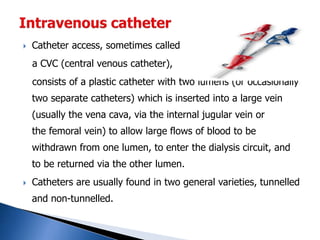
 Catheter access, sometimes called
a CVC (central venous catheter),
consists of a plastic catheter with two lumens (or occasionally
two separate catheters) which is inserted into a large vein
(usually the vena cava, via the internal jugular vein or
the femoral vein) to allow large flows of blood to be
withdrawn from one lumen, to enter the dialysis circuit, and
to be returned via the other lumen.
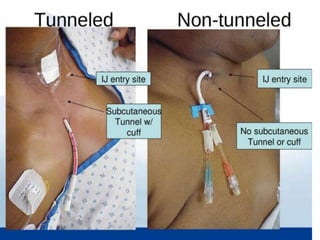
 Catheters are usually found in two general varieties, tunnelled
and non-tunnelled.
 Non- tunnelled catheter is for short-term access (up to
about 10 days, but often for one dialysis session only),
and the catheter emerges from the skin at the site of
entry into the vein.
 Tunnelled catheter access involves a longer catheter, which
is tunnelled under the skin from the point of insertion in the
vein to an exit site some distance away.
 It is usually placed in the internal jugular vein in the neck and
the exit site is usually on the chest wall.
 The tunnel acts as a barrier to invading microbes, and as
such, tunnelled catheters are designed for short- to medium-
term access (weeks to months only), because infection is still
a frequent problem.
 AV (arteriovenous) fistulas are recognized as the
preferred access method.
 To create a fistula, a vascular surgeon joins
an artery and a vein together through anastomosis.
Since this bypasses the capillaries, blood flows rapidly
through the fistula.
 Usually the anastomosis is made at the wrist between
the radial artery and the cephalic vein
 A fistula will take a number of weeks to mature, on
average perhaps 6-8 weeks.
 One can feel this by placing one's finger over a mature
fistula. This is called feeling for "thrill" .One can also
listen through a stethoscope for the sound of the blood
"whooshing" through the fistula, a sound called bruit.
 Lower risk of infection
 Lower tendency to clot
 Lower hospitalization rates (lower complication rates
,lower morbidity and mortality)
 Allows for greater blood flow
 Long-term patency (improved performance with time)
 Less cost of implantation and maintenance
 Slow maturation and failure of maturation
 More difficult to needle.
 Increase in size with age and aneurysm formation.
 Cosmetic appearance of dilated veins.
 AV (arteriovenous) grafts are much like fistulas in most
respects, except that an artificial vessel is used to join
the artery and vein.
 The graft usually is made of a synthetic material,
often PTFE (Polytetrafluoroethylene).
 They mature faster than fistulas, and may be ready for
use several weeks after formation (some newer grafts
may be used even sooner).
 Arteriovenous shunt is
a U shaped plastic
tube inserted between
an artery and a vein (usually between the radial artery
and cephalic vein), bypassing the capillary network, a for
merly common means of arterio-venous Access.
 It allow high blood flow so that large amount of blood
can pass through the dialyser.
PARTS OF
HEMODIALYSIS
MACHINE
 An extensive water purification system is absolutely critical for
hemodialysis. Since dialysis patients are exposed to vast
quantities of water, which is mixed with dialysate concentrate
to form the dialysate, even trace mineral contaminants or
bacterial endotoxins can filter into the patient's blood.
 Because the damaged kidneys cannot perform their intended
function of removing impurities, ions introduced into the
bloodstream via water can build up to hazardous levels,
causing numerous symptoms or death.
 water is run through a tank containing activated charcoal
to adsorb organic contaminants.
 Primary purification is then done by forcing water through a
membrane with very tiny pores, a so-called reverse osmosis
membrane. This lets the water pass, but holds back even very
small solutes such as electrolytes.
 Final removal of leftover electrolytes is done by passing the
water through a tank with ion-exchange resins, which remove
any leftover anions or cations and replace them with hydroxyl
and hydrogen ions, respectively, leaving ultrapure water.
 The dialyzer is the piece of equipment that actually filters the
blood. Almost all dialyzers in use today are of the hollow-fiber
variety. A cylindrical bundle of hollow fibers, whose walls are
composed of semi-permeable membrane.
 Blood is pumped via the blood ports through this bundle of
very thin capillary-like tubes, and the dialysate is pumped
through the space surrounding the fibers. Pressure gradients
are applied when necessary to move fluid from the blood to
the dialysate compartment.
 Dialyzer membranes come with different pore sizes. Those
with smaller pore size are called "low-flux" and those with
larger pore sizes are called "high-flux."
 Dialyzer membranes used to be made primarily of cellulose
(derived from cotton linter). The surface of such membranes
was not very biocompatible, because exposed hydroxyl
groups would activate complement in the blood passing by
the membrane. So modified cellulose membrane can used.
 Another group of membranes is made from synthetic
materials, using polymers such
as polyarylethersulfone, polyamide, polyvinylpyrrolidone,
polycarbonate, and polyacrylonitrile.
 These synthetic membranes activate complement to a
lesser degree than unsubstituted cellulose membranes.
Synthetic membranes can be made in either low- or
high-flux configuration, but most are high-flux.
 Part A :- It contain sodium chloride, Potassium chloride,
Magnesium chloride, Glacial acetic acid, Glucose
monohydrate.
 Part B:- Hydrogen carbonate Powder dissolve in 9.5 L
purified water to produce 10 L actual volume of part B to
be prepared freshly.
Ionic composition of part B after dilution-
 Sodium = 58.5 mmol/L
 Chloride = 24.5 mmol/L
 Hydrocarbonate = 34 mmol/L
 TECHNIQUE OF HEMODIALYSIS
 Fluid shifts
 Access-related
 Anticoagulation-related
 First-use syndrome
 Cardiovascular
 Electrolyte imbalance
 Headache
 Nausea with or without vomiting
 Dizziness
 Muscle cramp
 Blurred vision
 Tremors
 Restlessness
 Agitation
 Alteration of consciousness
 Seizure
 Coma
 Inj Optineuron
 Inj Erythropoietin
 Inj Levocarnitine
 Inj L-carnitine is an essential cofactor in fatty acid and
energy metabolism. Intravenous levocarnitine, for one of the
following indications, will only be covered for those ESRD
patients
 who have been on dialysis for a minimum of three months.
 Patients must have documented carnitine deficiency, defined
as a plasma free carnitine level <40 micromol/L
along with signs and symptoms of:
 Erythropoietin-resistant anemia (persistent hematocrit < 30%
with treatment) that has not responded to standard
erythropoietin dosage (that which is considered clinically
appropriate to treat the particular patient) with iron
replacement
 Hypotension on hemodialysis that interferes with delivery of
the intended dialysis despite application of usual measures
deemed appropriate (e.g., fluid management). Such episodes
of hypotension must have occurred during at least 2 dialysis
treatments in a 30-day period.
 Brand Names: Carnitor, Carnitine
 Dosage Forms & Strengths-
 Tablets-330mg, 500mg
 Capsule- 250mg
 Injectable - 200mg/mL
 Oral solution- 1g/10mL
Indicated for ESRD in patients on hemodialysis
 Initial dose: 10-20 mg/kg IV bolus infused over 2-3 minutes;
administer into venous return line after dialysis session
 Levocarnitine and muscle metabolism in patients with
end-stage renal disease.
 Goral S1.
 Levocarnitine is a molecule required in mammalian energy
metabolism.
 It removes the potentially toxic acyl groups from the cell
helping to maintain normal metabolic functions.
 In addition, it facilitates the transport of long-chain fatty
acids across the mitochondrial membrane for beta oxidation
and subsequent energy production in skeletal muscle and
myocardium.
 It has been shown in numerous studies that levocarnitine
metabolism is abnormal in patients with end-stage renal disease.
 Significant dialytic loss of levocarnitine has been reported in
addition to dietary changes undertaken in this population, which
may decrease dietary levocarnitine intake.
 Recent studies have shown that levocarnitine administration to
hemodialysis patients has improved exercise performance,
intradialytic muscle cramps and hypotension episodes, and overall
well-being.
 Ongoing and future studies will help to formulate more definite
recommendations on the dose and the duration of levocarnitine
therapy in dialysis patients.
Nursing
Responsibilities
in hemodiaysis
 Prepare the patient emotionally and physically.
 Check the consent properly.
 Weight the patient.
 Check the laboratory values like Complete blood count,
serum electrolyte, Blood urea nitrogen and coagulation
profile, All Viral Marker
 Check vital signs of patient.
 Instruct patient to empty bladder.
 Check the catheter site or fistula properly.
 Document all finding properly.
 Aspetic technique must be practiced to connect dialyser to the
patient.
 Observation of the patient includes checking pulse and B.P every
half hour and respiration every hour.
 Observe for hypothermia, cardiac irregularity ,twitching ,headache,
pruritus, etc.
 Observation of the machine includes a sudden break in the circuit,
high venous pressure(due to kinking), low venous pressure, low
arterial pressure, failure of the blood pump etc.
 Watch for disequilibrium syndrome, hypersensitivity reaction,
seizure and air embolism.
 Carefully terminate the dialysis.
 Check the vital signs of patient carefully.
 Document the procedure and vital signs properly.
 Document all finding carefully( total UF and net UF)
 Look for complications e.g. hypotension, hypoglycemia,
and bleeding from site, EKG changes etc.
 Explain the dietary management of patient on
hemodiaysis includes restrictions such as adjustment of
protein,
 Remove any restrictive clothing or jewelry from the arm.
 To prevent injuries, place an armband on the patient or a sign
over the bed that says no BP measurements, venipunctures,
or injections on the affected side.
 Perform hand hygiene before you assess or touch the
vascular access. Position the patient's arm so the vascular
access is easily visualized.
 After dialysis, assess the vascular access for any bleeding or
hemorrhage.
 Palpate the vascular access atleast every 8 hrly to feel for a
thrill or vibration and bruit with stethoscope that indicates
arterial and venous blood flow and patency.
 Check the patient's circulation by palpating his pulses distal to
the vascular access; observing capillary refill in his fingers;
and assessing him for numbness, tingling, altered sensation,
coldness, and pallor in the affected extremity.
 Assess the vascular access for signs and symptoms of
infection such as redness, warmth, tenderness, purulent
drainage, open sores, or swelling.
 Peritoneal dialysis is a type of dialysis that uses
the peritoneum in a person's abdomen as the membrane
through which fluid and dissolved substances are exchanged
with the blood.
 It is used to remove excess fluid, correct electrolyte
problems, and remove toxins in those with kidney failure.
 Peritoneal dialysis has better outcomes than hemodialysis
during the first couple of years. Other benefits include greater
flexibility and better tolerability in those with significant heart
disease.
 Peritoneal dialysis is a process of instillation of dialysate
into the peritoneal cavity, allowing time for substance
exchange and then removal of the dialysate
 Acute and chronic renal failure.
 In patients with severe cardio-vascular disease or with
bleeding tendencies, for those with poor vascular access
which makes them inappropriate for hemodialysis.
 For small children and the elderly.
 Patients with severe hemodynamic instability on
hemodialysis
 Peritonitis
 Recent abdominal or chest surgery or trauma.
 Bowel distention
 Respiratory insufficiency
 severe gastroesophageal reflux disease.
 Abdominal wall cellulitis Presence of colostomy, ileostomy,
nephrostomy, or ileal conduit
 Severe diverticular disease of the colon
 Severe neurologic disease, movement disorder, or severe arthritis
preventing self care.
 The technique for peritoneal dialysis involves preparing the patient
and setting up the equipment, inserting the catheter, instilling the
dialysate, monitoring the patient and removing the dialysate.
 The catheter insertion may be done in operating room or at the
bedside under local or general anesthesia. The preferred site for
insertion is about 3 to 5 cm below the umbilicus, an area which is
relatively avascular and has less fascial resistance
 The dialysate is usually allowed to run into the peritoneal cavity by
gravity flow, although an electronic drip regulator may be used.
 The dialysate is warmed to prevent chilling the patient and to
dilate the peritoneal blood vessels, thus facilitating substance
exchange.
 Two litre is usually instilled in adults, although smaller amount
may be needed at first until the patient adjusts. Dwell time is
the period during which the dialysate is left in the cavity.
 Equilibrium between the maximum change happening within
the first 5 minutes. Therefore, the solution is typically left in
place 30 to 45 minutes and then allowed to flow out through
the catheter by gravity flow.
 Perforation of the bowel
 Puncture of abdominal aorta
 Oedema of the anterior abdominal wall
 Pain
 Pleural effusion
 Peritonitis
 Hypernatraemia, Hypokalaemia & Hyperglycemia
 Dialysis disequilibrim
 Pulmonary complication
 Measure and record intake and output, including all body fluids,
such as wound drainage, nasogastric output, and diarrhea.
 Maintain record of inflow and outflow volumes and individual and
cumulative fluid balance.
 Assess hb and hct and replace blood components, as indicated.
 Adhere to schedule for draining dialysate from abdomen.
 Monitor vital signs. watch and report any signs of pericarditis
(pleuritic chest pain, tachycardia, pericardial friction, rub),
inadequate renal perfusion (hypotension), and acidosis.
 Inspect mucous membranes, evaluate skin turgor, peripheral
pulses, capillary refill
 Monitor laboratory studies as
indicated: Serum sodium and glucose levels;
 Maintain proper electrolyte balance. Serum potassium levels.
Watch for symptoms of hyperkalemia
 Maintain nutritional status. Provide a high-calorie, low-protein,
low-sodium, and low-potassium diet, with vitamin
supplements
SUMMARY
Dialysis seminar by Kiran Bhardwaj

Dialysis seminar by Kiran Bhardwaj

  • 1.
    Presented By :-Kiran Bhardwaj M.Sc Nursing 2nd year CON, ILBS
  • 2.
     Dialysis Comesfrom greek words namely “ Dia” and “Lysis” meaning splitting or separating materials through a membrane.  Dialysis is used to remove fluid and uremic waste products from the body when the kidneys cannot to do so. Hemodiaysis is the most commonly used method of dialysis.
  • 3.
     It isused for patients who are acutely ill and require short-term diaysis and for patients with ESRD who require long-term or permanent therapy. The need for dialysis may be acute or chronic.
  • 4.
  • 6.
     Hemodialysis isa process of cleaning the blood of accumulated waste products by using an artificial kidney.  In hemodialysis ,the blood, laden with toxins and nitrogenous wastes, is diverted from the patient to a machine, a dialyzer, in which the blood is cleansed and then returned to the patient.
  • 7.
     Hemodialysis wasone of the most common procedures performed in hospitals now a days.  It was the fifth most common procedure for patients aged 45–64 years.  Over 1 million people worldwide are alive on dialysis or with a functioning graft .  Incidence of CKD has doubled in the last 15 years. In contrast to high-income countries, patients with ESRD have to pay for dialysis and transplantation themselves.
  • 8.
     AEIOU  Acidosis,especially if severe (pH<7.2 and refractory to HCO3 or unstable to give HCO3 due to volume overload) or symptomatic(arrhythmias).  Electrolytes, especially potassium with EKG changes. Temporize with Ca, bicarb,Na.  Ingestions, especially those that cause renal failure such as salicylates or ethylene glycol.
  • 9.
     Overload i.e.volume overload causing pulmonary edema. Temporize with nitrates and mega doses of lasix push slowly to avoid ototoxicity.  Uremia i.e. confusion, pericardiatis, seizures, platelet dysfunction with severe bleeding.
  • 11.
     Lack ofvascular access-usually some years on hemodiaysis.  Cardiovascular instability in hemodiaysis with recurrent large weight gains, fluid overload, symptomatic hypotension, angina etc.  Long distance from hemodiaysis unit and unwillingness to tolerate.
  • 12.
     Dialysis workson the principles of the osmosis of solute and ultrafiltration of fluid across a semi- permeable membrane.  Diffusion is a property of substances in water; substances in water tend to move from an area of high concentration to an area of low concentration.
  • 13.
     Blood flowsby one side of a semi-permeable membrane, and a dialysate, or special dialysis fluid, flows by the opposite side.  A semipermeable membrane is a thin layer of material that contains holes of various sizes, or pores. Smaller solutes and fluid pass through the membrane, but the membrane blocks the passage of larger substances (for example, red blood cells, large proteins).
  • 15.
     Ultrafiltration isa variety of membrane filtration in which forces like pressure or concentration gradients lead to a separation through a semipermeable membrane.
  • 16.
     Conventional hemodialysis, Daily hemodialysis  Nocturnal hemodialysis.  CRRT  SLED
  • 17.
     Conventional hemodialysisis usually done three times per week, for about 3–4 hours for each treatment, during which the patient's blood is drawn out through a tube at a rate of 200–400 mL/min.  The tube is connected to a 15, 16, or 17 gauge needle inserted in the dialysis fistula or graft, or connected to one port of a dialysis catheter
  • 18.
     Daily hemodialysisis typically used by those patients who do their own dialysis at home. It is less stressful (more gentle) but does require more frequent access. This is simple with catheters, but more problematic with fistulas or grafts.  The "buttonhole technique" can be used for fistulas requiring frequent access. Daily hemodialysis is usually done for 2 hours six days a week.
  • 19.
     The procedureof nocturnal hemodialysis is similar to conventional hemodialysis except it is performed three to six nights a week and between six and ten hours per session while the patient sleeps.
  • 20.
     CRRTIs anextracorporeal blood purification therapy intended to substitute for impaired renal function over an extended period of time and applied for or aimed at being applied for 24 hours a day.  The concept behind continuous renal replacement techniques is to dialyse patients in a more physiologic way, slowly, over 24. hours, just like the kidney  CRRT is performed mostly as convective therapy across a high-flux membrane, and using industry-prepared substitution fluid in bags.
  • 22.
     CRRT isindicated in any patient who meets criteria for hemodialysis therapy but cannot tolerate intermittent dialysis due to hemodynamic instability. CRRT is better tolerated by hemodynamically unstable patients because fluid volume, electrolytes and pH are adjusted slowly and steadily over a 24 hour period rather than a3– 4 hour period.  This pattern more closely mimics the native kidney and prevents abrupt shifts in fluid, electrolyte and acid-base balance.
  • 23.
     Hemodynamic stability Avoid hypotension complicating hemodialysis  Avoids the rapid shifts in volume & osmolarity  Easy to regulate fluid volume  Volume removal is continuous  Adjust fluid removal rate on an hourly basis  Avoids the accumulation of waste products
  • 24.
     Lack ofrapid fluid and solute removal  GFR equivalent of 5 - 20 ml/min  Limited role in overdose setting  Filter clotting– Take down the entire system
  • 25.
    Primary methods areused to gain access to the blood:  An intravenous catheter  An arteriovenous fistula (AV)  A synthetic graft.  Arteriovenous shunt
  • 26.
     Catheter access,sometimes called a CVC (central venous catheter), consists of a plastic catheter with two lumens (or occasionally two separate catheters) which is inserted into a large vein (usually the vena cava, via the internal jugular vein or the femoral vein) to allow large flows of blood to be withdrawn from one lumen, to enter the dialysis circuit, and to be returned via the other lumen.  Catheters are usually found in two general varieties, tunnelled and non-tunnelled.
  • 28.
     Non- tunnelledcatheter is for short-term access (up to about 10 days, but often for one dialysis session only), and the catheter emerges from the skin at the site of entry into the vein.
  • 29.
     Tunnelled catheteraccess involves a longer catheter, which is tunnelled under the skin from the point of insertion in the vein to an exit site some distance away.  It is usually placed in the internal jugular vein in the neck and the exit site is usually on the chest wall.  The tunnel acts as a barrier to invading microbes, and as such, tunnelled catheters are designed for short- to medium- term access (weeks to months only), because infection is still a frequent problem.
  • 30.
     AV (arteriovenous)fistulas are recognized as the preferred access method.  To create a fistula, a vascular surgeon joins an artery and a vein together through anastomosis. Since this bypasses the capillaries, blood flows rapidly through the fistula.  Usually the anastomosis is made at the wrist between the radial artery and the cephalic vein
  • 32.
     A fistulawill take a number of weeks to mature, on average perhaps 6-8 weeks.  One can feel this by placing one's finger over a mature fistula. This is called feeling for "thrill" .One can also listen through a stethoscope for the sound of the blood "whooshing" through the fistula, a sound called bruit.
  • 36.
     Lower riskof infection  Lower tendency to clot  Lower hospitalization rates (lower complication rates ,lower morbidity and mortality)  Allows for greater blood flow  Long-term patency (improved performance with time)  Less cost of implantation and maintenance
  • 37.
     Slow maturationand failure of maturation  More difficult to needle.  Increase in size with age and aneurysm formation.  Cosmetic appearance of dilated veins.
  • 42.
     AV (arteriovenous)grafts are much like fistulas in most respects, except that an artificial vessel is used to join the artery and vein.  The graft usually is made of a synthetic material, often PTFE (Polytetrafluoroethylene).  They mature faster than fistulas, and may be ready for use several weeks after formation (some newer grafts may be used even sooner).
  • 44.
     Arteriovenous shuntis a U shaped plastic tube inserted between an artery and a vein (usually between the radial artery and cephalic vein), bypassing the capillary network, a for merly common means of arterio-venous Access.  It allow high blood flow so that large amount of blood can pass through the dialyser.
  • 45.
  • 47.
     An extensivewater purification system is absolutely critical for hemodialysis. Since dialysis patients are exposed to vast quantities of water, which is mixed with dialysate concentrate to form the dialysate, even trace mineral contaminants or bacterial endotoxins can filter into the patient's blood.  Because the damaged kidneys cannot perform their intended function of removing impurities, ions introduced into the bloodstream via water can build up to hazardous levels, causing numerous symptoms or death.
  • 48.
     water isrun through a tank containing activated charcoal to adsorb organic contaminants.  Primary purification is then done by forcing water through a membrane with very tiny pores, a so-called reverse osmosis membrane. This lets the water pass, but holds back even very small solutes such as electrolytes.  Final removal of leftover electrolytes is done by passing the water through a tank with ion-exchange resins, which remove any leftover anions or cations and replace them with hydroxyl and hydrogen ions, respectively, leaving ultrapure water.
  • 49.
     The dialyzeris the piece of equipment that actually filters the blood. Almost all dialyzers in use today are of the hollow-fiber variety. A cylindrical bundle of hollow fibers, whose walls are composed of semi-permeable membrane.  Blood is pumped via the blood ports through this bundle of very thin capillary-like tubes, and the dialysate is pumped through the space surrounding the fibers. Pressure gradients are applied when necessary to move fluid from the blood to the dialysate compartment.
  • 50.
     Dialyzer membranescome with different pore sizes. Those with smaller pore size are called "low-flux" and those with larger pore sizes are called "high-flux."  Dialyzer membranes used to be made primarily of cellulose (derived from cotton linter). The surface of such membranes was not very biocompatible, because exposed hydroxyl groups would activate complement in the blood passing by the membrane. So modified cellulose membrane can used.
  • 52.
     Another groupof membranes is made from synthetic materials, using polymers such as polyarylethersulfone, polyamide, polyvinylpyrrolidone, polycarbonate, and polyacrylonitrile.  These synthetic membranes activate complement to a lesser degree than unsubstituted cellulose membranes. Synthetic membranes can be made in either low- or high-flux configuration, but most are high-flux.
  • 53.
     Part A:- It contain sodium chloride, Potassium chloride, Magnesium chloride, Glacial acetic acid, Glucose monohydrate.  Part B:- Hydrogen carbonate Powder dissolve in 9.5 L purified water to produce 10 L actual volume of part B to be prepared freshly. Ionic composition of part B after dilution-  Sodium = 58.5 mmol/L  Chloride = 24.5 mmol/L  Hydrocarbonate = 34 mmol/L
  • 54.
     TECHNIQUE OFHEMODIALYSIS
  • 55.
     Fluid shifts Access-related  Anticoagulation-related  First-use syndrome  Cardiovascular  Electrolyte imbalance
  • 56.
     Headache  Nauseawith or without vomiting  Dizziness  Muscle cramp  Blurred vision  Tremors  Restlessness  Agitation  Alteration of consciousness  Seizure  Coma
  • 57.
     Inj Optineuron Inj Erythropoietin  Inj Levocarnitine
  • 58.
     Inj L-carnitineis an essential cofactor in fatty acid and energy metabolism. Intravenous levocarnitine, for one of the following indications, will only be covered for those ESRD patients  who have been on dialysis for a minimum of three months.  Patients must have documented carnitine deficiency, defined as a plasma free carnitine level <40 micromol/L along with signs and symptoms of:
  • 59.
     Erythropoietin-resistant anemia(persistent hematocrit < 30% with treatment) that has not responded to standard erythropoietin dosage (that which is considered clinically appropriate to treat the particular patient) with iron replacement  Hypotension on hemodialysis that interferes with delivery of the intended dialysis despite application of usual measures deemed appropriate (e.g., fluid management). Such episodes of hypotension must have occurred during at least 2 dialysis treatments in a 30-day period.
  • 60.
     Brand Names:Carnitor, Carnitine  Dosage Forms & Strengths-  Tablets-330mg, 500mg  Capsule- 250mg  Injectable - 200mg/mL  Oral solution- 1g/10mL Indicated for ESRD in patients on hemodialysis  Initial dose: 10-20 mg/kg IV bolus infused over 2-3 minutes; administer into venous return line after dialysis session
  • 61.
     Levocarnitine andmuscle metabolism in patients with end-stage renal disease.  Goral S1.  Levocarnitine is a molecule required in mammalian energy metabolism.  It removes the potentially toxic acyl groups from the cell helping to maintain normal metabolic functions.  In addition, it facilitates the transport of long-chain fatty acids across the mitochondrial membrane for beta oxidation and subsequent energy production in skeletal muscle and myocardium.
  • 62.
     It hasbeen shown in numerous studies that levocarnitine metabolism is abnormal in patients with end-stage renal disease.  Significant dialytic loss of levocarnitine has been reported in addition to dietary changes undertaken in this population, which may decrease dietary levocarnitine intake.  Recent studies have shown that levocarnitine administration to hemodialysis patients has improved exercise performance, intradialytic muscle cramps and hypotension episodes, and overall well-being.  Ongoing and future studies will help to formulate more definite recommendations on the dose and the duration of levocarnitine therapy in dialysis patients.
  • 63.
  • 64.
     Prepare thepatient emotionally and physically.  Check the consent properly.  Weight the patient.  Check the laboratory values like Complete blood count, serum electrolyte, Blood urea nitrogen and coagulation profile, All Viral Marker  Check vital signs of patient.  Instruct patient to empty bladder.  Check the catheter site or fistula properly.  Document all finding properly.
  • 65.
     Aspetic techniquemust be practiced to connect dialyser to the patient.  Observation of the patient includes checking pulse and B.P every half hour and respiration every hour.  Observe for hypothermia, cardiac irregularity ,twitching ,headache, pruritus, etc.  Observation of the machine includes a sudden break in the circuit, high venous pressure(due to kinking), low venous pressure, low arterial pressure, failure of the blood pump etc.  Watch for disequilibrium syndrome, hypersensitivity reaction, seizure and air embolism.  Carefully terminate the dialysis.
  • 66.
     Check thevital signs of patient carefully.  Document the procedure and vital signs properly.  Document all finding carefully( total UF and net UF)  Look for complications e.g. hypotension, hypoglycemia, and bleeding from site, EKG changes etc.  Explain the dietary management of patient on hemodiaysis includes restrictions such as adjustment of protein,
  • 67.
     Remove anyrestrictive clothing or jewelry from the arm.  To prevent injuries, place an armband on the patient or a sign over the bed that says no BP measurements, venipunctures, or injections on the affected side.  Perform hand hygiene before you assess or touch the vascular access. Position the patient's arm so the vascular access is easily visualized.  After dialysis, assess the vascular access for any bleeding or hemorrhage.
  • 68.
     Palpate thevascular access atleast every 8 hrly to feel for a thrill or vibration and bruit with stethoscope that indicates arterial and venous blood flow and patency.  Check the patient's circulation by palpating his pulses distal to the vascular access; observing capillary refill in his fingers; and assessing him for numbness, tingling, altered sensation, coldness, and pallor in the affected extremity.  Assess the vascular access for signs and symptoms of infection such as redness, warmth, tenderness, purulent drainage, open sores, or swelling.
  • 70.
     Peritoneal dialysisis a type of dialysis that uses the peritoneum in a person's abdomen as the membrane through which fluid and dissolved substances are exchanged with the blood.  It is used to remove excess fluid, correct electrolyte problems, and remove toxins in those with kidney failure.  Peritoneal dialysis has better outcomes than hemodialysis during the first couple of years. Other benefits include greater flexibility and better tolerability in those with significant heart disease.
  • 71.
     Peritoneal dialysisis a process of instillation of dialysate into the peritoneal cavity, allowing time for substance exchange and then removal of the dialysate
  • 72.
     Acute andchronic renal failure.  In patients with severe cardio-vascular disease or with bleeding tendencies, for those with poor vascular access which makes them inappropriate for hemodialysis.  For small children and the elderly.  Patients with severe hemodynamic instability on hemodialysis
  • 73.
     Peritonitis  Recentabdominal or chest surgery or trauma.  Bowel distention  Respiratory insufficiency  severe gastroesophageal reflux disease.  Abdominal wall cellulitis Presence of colostomy, ileostomy, nephrostomy, or ileal conduit  Severe diverticular disease of the colon  Severe neurologic disease, movement disorder, or severe arthritis preventing self care.
  • 74.
     The techniquefor peritoneal dialysis involves preparing the patient and setting up the equipment, inserting the catheter, instilling the dialysate, monitoring the patient and removing the dialysate.  The catheter insertion may be done in operating room or at the bedside under local or general anesthesia. The preferred site for insertion is about 3 to 5 cm below the umbilicus, an area which is relatively avascular and has less fascial resistance  The dialysate is usually allowed to run into the peritoneal cavity by gravity flow, although an electronic drip regulator may be used.
  • 75.
     The dialysateis warmed to prevent chilling the patient and to dilate the peritoneal blood vessels, thus facilitating substance exchange.  Two litre is usually instilled in adults, although smaller amount may be needed at first until the patient adjusts. Dwell time is the period during which the dialysate is left in the cavity.  Equilibrium between the maximum change happening within the first 5 minutes. Therefore, the solution is typically left in place 30 to 45 minutes and then allowed to flow out through the catheter by gravity flow.
  • 77.
     Perforation ofthe bowel  Puncture of abdominal aorta  Oedema of the anterior abdominal wall  Pain  Pleural effusion  Peritonitis  Hypernatraemia, Hypokalaemia & Hyperglycemia  Dialysis disequilibrim  Pulmonary complication
  • 78.
     Measure andrecord intake and output, including all body fluids, such as wound drainage, nasogastric output, and diarrhea.  Maintain record of inflow and outflow volumes and individual and cumulative fluid balance.  Assess hb and hct and replace blood components, as indicated.  Adhere to schedule for draining dialysate from abdomen.  Monitor vital signs. watch and report any signs of pericarditis (pleuritic chest pain, tachycardia, pericardial friction, rub), inadequate renal perfusion (hypotension), and acidosis.
  • 79.
     Inspect mucousmembranes, evaluate skin turgor, peripheral pulses, capillary refill  Monitor laboratory studies as indicated: Serum sodium and glucose levels;  Maintain proper electrolyte balance. Serum potassium levels. Watch for symptoms of hyperkalemia  Maintain nutritional status. Provide a high-calorie, low-protein, low-sodium, and low-potassium diet, with vitamin supplements
  • 80.