DIAGNOSTIC
ULTRASOUND
MAAJID MOHI UD DIN MALIK
LECTURER COPMS ADESH UNIVERSITY
BATHINDA PUNJAB
MAAJIDMALIKOFFICIAL@GMAIL.COM
CONTENTS
 INTRODUCTION
 PRINCIPLE OF ULTRASOUND
 GENERATION AND DETECTION OF ULTRASOUD
 MAIN IMAGING MODES
 ULTRASOUND MACHINE
 TRANSDUCER PROBES
 WORKING PROCEDURE OF ULTRASOUND
 APPLICATIONS
 BENEFITS
 LIMITATIONS
MAAJIDMALIKOFFICIAL@GMAIL.COM
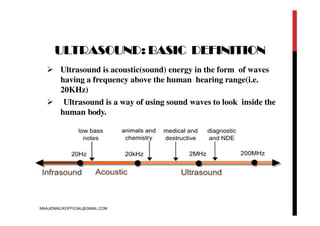
ULTRASOUND: BASIC DEFINITION
 Ultrasound is acoustic(sound) energy in the form of waves
having a frequency above the human hearing range(i.e.
20KHz)
 Ultrasound is a way of using sound waves to look inside the
human body.
MAAJIDMALIKOFFICIAL@GMAIL.COM
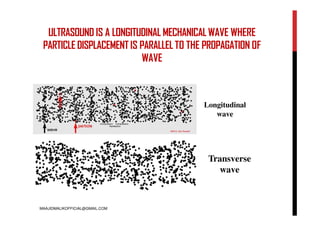
ULTRASOUND IS A LONGITUDINAL MECHANICAL WAVE WHERE
PARTICLE DISPLACEMENT IS PARALLEL TO THE PROPAGATION OF
WAVE
Longitudinal
wave
Transverse
wave
MAAJIDMALIKOFFICIAL@GMAIL.COM
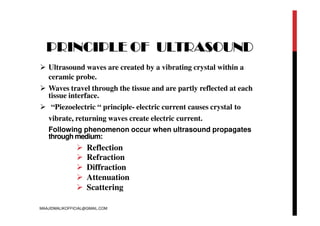
PRINCIPLE OF ULTRASOUND
 Ultrasound waves are created by a vibrating crystal within a
ceramic probe.
 Waves travel through the tissue and are partly reflected at each
tissue interface.
 “Piezoelectric “ principle- electric current causes crystal to
vibrate, returning waves create electric current.
Following phenomenon occur when ultrasound propagates
through medium:
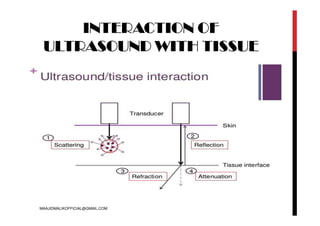
 Reflection
 Refraction
 Diffraction
 Attenuation
 Scattering
MAAJIDMALIKOFFICIAL@GMAIL.COM
GENERATION OF ULTRASOUND
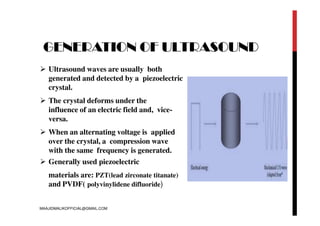
 Ultrasound waves are usually both
generated and detected by a piezoelectric
crystal.
 The crystal deforms under the
influence of an electric field and, vice-
versa.
 When an alternating voltage is applied
over the crystal, a compression wave
with the same frequency is generated.
 Generally used piezoelectric
materials are: PZT(lead zirconate titanate)
and PVDF( polyvinylidene difluoride)
MAAJIDMALIKOFFICIAL@GMAIL.COM
INTERACTION OF
ULTRASOUND WITH TISSUE
MAAJIDMALIKOFFICIAL@GMAIL.COM
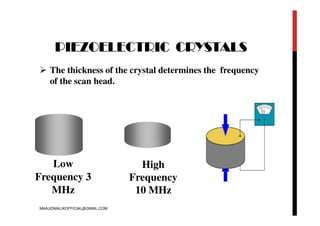
PIEZOELECTRIC CRYSTALS
 The thickness of the crystal determines the frequency
of the scan head.
Low
Frequency 3
MHz
High
Frequency
10 MHz
MAAJIDMALIKOFFICIAL@GMAIL.COM
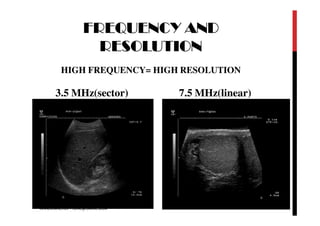
FREQUENCY AND
RESOLUTION
HIGH FREQUENCY= HIGH RESOLUTION
3.5 MHz(sector) 7.5 MHz(linear)
MAAJIDMALIKOFFICIAL@GMAIL.COM
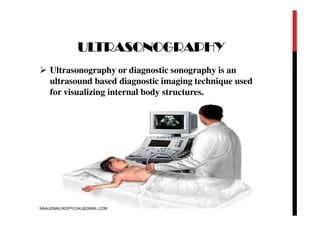
ULTRASONOGRAPHY
 Ultrasonography or diagnostic sonography is an
ultrasound based diagnostic imaging technique used
for visualizing internal body structures.
MAAJIDMALIKOFFICIAL@GMAIL.COM
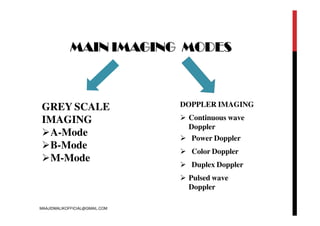
MAIN IMAGING MODES
GREY SCALE
IMAGING
A-Mode
B-Mode
M-Mode
DOPPLER IMAGING
 Continuous wave
Doppler
 Power Doppler
 Color Doppler
 Duplex Doppler
 Pulsed wave
Doppler
MAAJIDMALIKOFFICIAL@GMAIL.COM
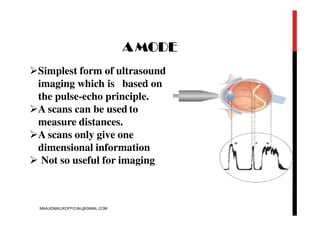
AMODE
Simplest form of ultrasound
imaging which is based on
the pulse-echo principle.
A scans can be used to
measure distances.
A scans only give one
dimensional information
 Not so useful for imaging
MAAJIDMALIKOFFICIAL@GMAIL.COM
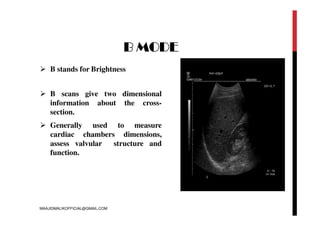
B MODE
 B stands for Brightness
 B scans give two dimensional
information about the cross-
section.
 Generally used to measure
cardiac chambers dimensions,
assess valvular structure and
function.
MAAJIDMALIKOFFICIAL@GMAIL.COM
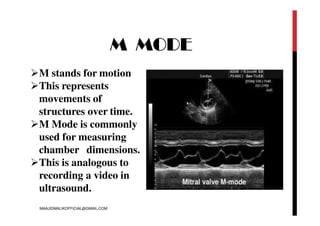
M MODE
M stands for motion
This represents
movements of
structures over time.
M Mode is commonly
used for measuring
chamber dimensions.
This is analogous to
recording a video in
ultrasound.
MAAJIDMALIKOFFICIAL@GMAIL.COM
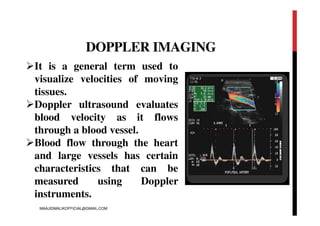
DOPPLER IMAGING
It is a general term used to
visualize velocities of moving
tissues.
Doppler ultrasound evaluates
blood velocity as it flows
through a blood vessel.
Blood flow through the heart
and large vessels has certain
characteristics that can be
measured using Doppler
instruments.
MAAJIDMALIKOFFICIAL@GMAIL.COM
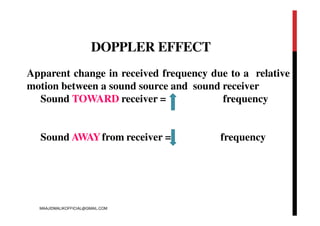
DOPPLER EFFECT
Apparent change in received frequency due to a relative
motion between a sound source and sound receiver
Sound TOWARD receiver = frequency
Sound AWAYfrom receiver = frequency
MAAJIDMALIKOFFICIAL@GMAIL.COM
WHAT DEFINES A GOOD
DOPPLER
 No background noise
 Clear audible signal
 Accurate display of velocities
MAAJIDMALIKOFFICIAL@GMAIL.COM
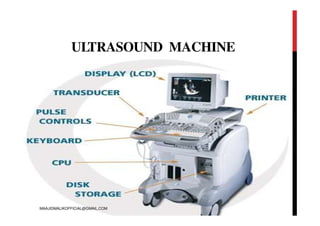
ULTRASOUND MACHINE
MAAJIDMALIKOFFICIAL@GMAIL.COM
APPLICATIONS
Applications available on the ultrasound system
 Abdominal
 Cardiac
 Gynecological
 Intraoperative
 Musculoskeletal
 Neonatal head
 Obstetrical
 Pediatric
 Transcranial and Trans esophageal
 Vascular
MAAJIDMALIKOFFICIAL@GMAIL.COM
GENERAL COMPONENTS OF
MACHINE
System control
panel
 System monitor
 PC
 E box
System power
supply
MAAJIDMALIKOFFICIAL@GMAIL.COM
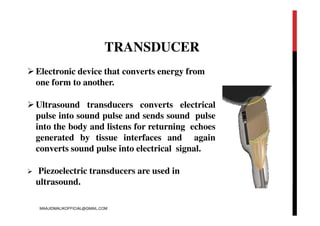
TRANSDUCER
Electronic device that converts energy from
one form to another.
Ultrasound transducers converts electrical
pulse into sound pulse and sends sound pulse
into the body and listens for returning echoes
generated by tissue interfaces and again
converts sound pulse into electrical signal.
 Piezoelectric transducers are used in
ultrasound.
MAAJIDMALIKOFFICIAL@GMAIL.COM
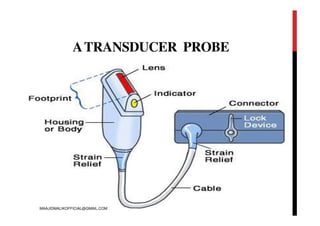
ATRANSDUCER PROBE
MAAJIDMALIKOFFICIAL@GMAIL.COM
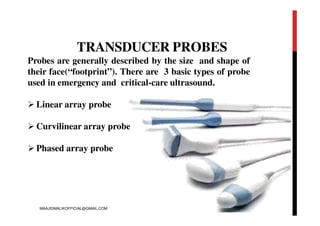
TRANSDUCER PROBES
Probes are generally described by the size and shape of
their face(“footprint”). There are 3 basic types of probe
used in emergency and critical-care ultrasound.
 Linear array probe
 Curvilinear array probe
 Phased array probe
MAAJIDMALIKOFFICIAL@GMAIL.COM
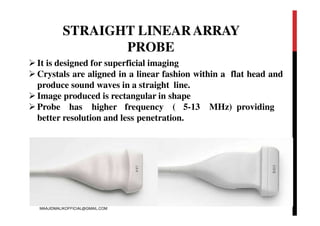
STRAIGHT LINEARARRAY
PROBE
It is designed for superficial imaging
Crystals are aligned in a linear fashion within a flat head and
produce sound waves in a straight line.
Image produced is rectangular in shape
Probe has higher frequency ( 5-13 MHz) providing
better resolution and less penetration.
MAAJIDMALIKOFFICIAL@GMAIL.COM
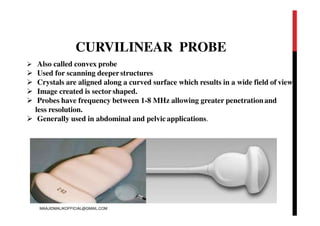
CURVILINEAR PROBE
 Also called convex probe
 Used for scanning deeperstructures
 Crystals are aligned along a curved surface which results in a wide field of view
 Image created is sector shaped.
 Probes have frequency between 1-8 MHz allowing greater penetrationand
less resolution.
 Generally used in abdominal and pelvic applications.
MAAJIDMALIKOFFICIAL@GMAIL.COM
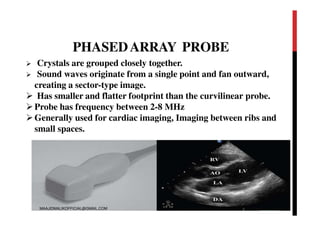
PHASEDARRAY PROBE
 Crystals are grouped closely together.
 Sound waves originate from a single point and fan outward,
creating a sector-type image.
 Has smaller and flatter footprint than the curvilinear probe.
Probe has frequency between 2-8 MHz
Generally used for cardiac imaging, Imaging between ribs and
small spaces.
MAAJIDMALIKOFFICIAL@GMAIL.COM
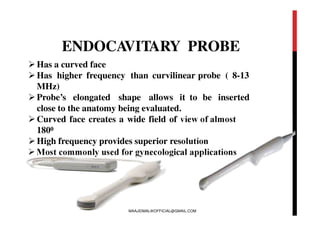
ENDOCA
VITARY PROBE
Has a curved face
Has higher frequency than curvilinear probe ( 8-13
MHz)
Probe’s elongated shape allows it to be inserted
close to the anatomy being evaluated.
Curved face creates a wide field of view of almost
1800
High frequency provides superior resolution
Most commonly used for gynecological applications
MAAJIDMALIKOFFICIAL@GMAIL.COM
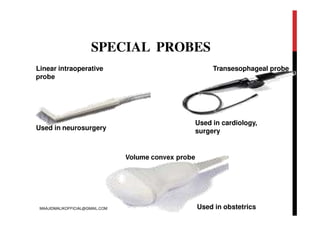
SPECIAL PROBES
Linear intraoperative
probe
Volume convex probe
Used in neurosurgery
Used in obstetrics
Transesophageal probe
Used in cardiology,
surgery
MAAJIDMALIKOFFICIAL@GMAIL.COM
APPLICATIONS
 Obstetrics and Gynecology
1. Measuring the size of the fetus
2. Monitoring the baby for various procedures
 Cardiology
1. Seeing the inside of the heart to identify abnormal functions
2. Measuring blood flow through the heart and major blood
vessels
 Urology
1. Measuring blood flow through the kidney
2. Locating kidney stones
3. Detecting prostate cancer at early stage
MAAJIDMALIKOFFICIAL@GMAIL.COM
BENEFITS
 Images muscle, soft tissues very well
 Renders “live images” where most desirable section is selected
 Shows structure of organs
 No long-term side-effects
 Widely available and comparatively flexible
 Highly portable
 Relatively inexpensive
 Spatial resolution is better in high frequency ultrasound
scanners
MAAJIDMALIKOFFICIAL@GMAIL.COM
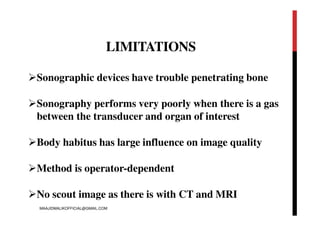
LIMITATIONS
Sonographic devices have trouble penetrating bone
Sonography performs very poorly when there is a gas
between the transducer and organ of interest
Body habitus has large influence on image quality
Method is operator-dependent
No scout image as there is with CT and MRI
MAAJIDMALIKOFFICIAL@GMAIL.COM

DIAGNOSTIC ULTRASOUND-3.pdf

  • 1.
    DIAGNOSTIC ULTRASOUND MAAJID MOHI UDDIN MALIK LECTURER COPMS ADESH UNIVERSITY BATHINDA PUNJAB MAAJIDMALIKOFFICIAL@GMAIL.COM
  • 2.
    CONTENTS  INTRODUCTION  PRINCIPLEOF ULTRASOUND  GENERATION AND DETECTION OF ULTRASOUD  MAIN IMAGING MODES  ULTRASOUND MACHINE  TRANSDUCER PROBES  WORKING PROCEDURE OF ULTRASOUND  APPLICATIONS  BENEFITS  LIMITATIONS MAAJIDMALIKOFFICIAL@GMAIL.COM
  • 3.
    ULTRASOUND: BASIC DEFINITION Ultrasound is acoustic(sound) energy in the form of waves having a frequency above the human hearing range(i.e. 20KHz)  Ultrasound is a way of using sound waves to look inside the human body. MAAJIDMALIKOFFICIAL@GMAIL.COM
  • 4.
    ULTRASOUND IS ALONGITUDINAL MECHANICAL WAVE WHERE PARTICLE DISPLACEMENT IS PARALLEL TO THE PROPAGATION OF WAVE Longitudinal wave Transverse wave MAAJIDMALIKOFFICIAL@GMAIL.COM
  • 5.
    PRINCIPLE OF ULTRASOUND Ultrasound waves are created by a vibrating crystal within a ceramic probe.  Waves travel through the tissue and are partly reflected at each tissue interface.  “Piezoelectric “ principle- electric current causes crystal to vibrate, returning waves create electric current. Following phenomenon occur when ultrasound propagates through medium:  Reflection  Refraction  Diffraction  Attenuation  Scattering MAAJIDMALIKOFFICIAL@GMAIL.COM
  • 6.
    GENERATION OF ULTRASOUND Ultrasound waves are usually both generated and detected by a piezoelectric crystal.  The crystal deforms under the influence of an electric field and, vice- versa.  When an alternating voltage is applied over the crystal, a compression wave with the same frequency is generated.  Generally used piezoelectric materials are: PZT(lead zirconate titanate) and PVDF( polyvinylidene difluoride) MAAJIDMALIKOFFICIAL@GMAIL.COM
  • 7.
    INTERACTION OF ULTRASOUND WITHTISSUE MAAJIDMALIKOFFICIAL@GMAIL.COM
  • 8.
    PIEZOELECTRIC CRYSTALS  Thethickness of the crystal determines the frequency of the scan head. Low Frequency 3 MHz High Frequency 10 MHz MAAJIDMALIKOFFICIAL@GMAIL.COM
  • 9.
    FREQUENCY AND RESOLUTION HIGH FREQUENCY=HIGH RESOLUTION 3.5 MHz(sector) 7.5 MHz(linear) MAAJIDMALIKOFFICIAL@GMAIL.COM
  • 10.
    ULTRASONOGRAPHY  Ultrasonography ordiagnostic sonography is an ultrasound based diagnostic imaging technique used for visualizing internal body structures. MAAJIDMALIKOFFICIAL@GMAIL.COM
  • 11.
    MAIN IMAGING MODES GREYSCALE IMAGING A-Mode B-Mode M-Mode DOPPLER IMAGING  Continuous wave Doppler  Power Doppler  Color Doppler  Duplex Doppler  Pulsed wave Doppler MAAJIDMALIKOFFICIAL@GMAIL.COM
  • 12.
    AMODE Simplest form ofultrasound imaging which is based on the pulse-echo principle. A scans can be used to measure distances. A scans only give one dimensional information  Not so useful for imaging MAAJIDMALIKOFFICIAL@GMAIL.COM
  • 13.
    B MODE  Bstands for Brightness  B scans give two dimensional information about the cross- section.  Generally used to measure cardiac chambers dimensions, assess valvular structure and function. MAAJIDMALIKOFFICIAL@GMAIL.COM
  • 14.
    M MODE M standsfor motion This represents movements of structures over time. M Mode is commonly used for measuring chamber dimensions. This is analogous to recording a video in ultrasound. MAAJIDMALIKOFFICIAL@GMAIL.COM
  • 15.
    DOPPLER IMAGING It isa general term used to visualize velocities of moving tissues. Doppler ultrasound evaluates blood velocity as it flows through a blood vessel. Blood flow through the heart and large vessels has certain characteristics that can be measured using Doppler instruments. MAAJIDMALIKOFFICIAL@GMAIL.COM
  • 16.
    DOPPLER EFFECT Apparent changein received frequency due to a relative motion between a sound source and sound receiver Sound TOWARD receiver = frequency Sound AWAYfrom receiver = frequency MAAJIDMALIKOFFICIAL@GMAIL.COM
  • 17.
    WHAT DEFINES AGOOD DOPPLER  No background noise  Clear audible signal  Accurate display of velocities MAAJIDMALIKOFFICIAL@GMAIL.COM
  • 18.
  • 19.
    APPLICATIONS Applications available onthe ultrasound system  Abdominal  Cardiac  Gynecological  Intraoperative  Musculoskeletal  Neonatal head  Obstetrical  Pediatric  Transcranial and Trans esophageal  Vascular MAAJIDMALIKOFFICIAL@GMAIL.COM
  • 20.
    GENERAL COMPONENTS OF MACHINE Systemcontrol panel  System monitor  PC  E box System power supply MAAJIDMALIKOFFICIAL@GMAIL.COM
  • 21.
    TRANSDUCER Electronic device thatconverts energy from one form to another. Ultrasound transducers converts electrical pulse into sound pulse and sends sound pulse into the body and listens for returning echoes generated by tissue interfaces and again converts sound pulse into electrical signal.  Piezoelectric transducers are used in ultrasound. MAAJIDMALIKOFFICIAL@GMAIL.COM
  • 22.
  • 23.
    TRANSDUCER PROBES Probes aregenerally described by the size and shape of their face(“footprint”). There are 3 basic types of probe used in emergency and critical-care ultrasound.  Linear array probe  Curvilinear array probe  Phased array probe MAAJIDMALIKOFFICIAL@GMAIL.COM
  • 24.
    STRAIGHT LINEARARRAY PROBE It isdesigned for superficial imaging Crystals are aligned in a linear fashion within a flat head and produce sound waves in a straight line. Image produced is rectangular in shape Probe has higher frequency ( 5-13 MHz) providing better resolution and less penetration. MAAJIDMALIKOFFICIAL@GMAIL.COM
  • 25.
    CURVILINEAR PROBE  Alsocalled convex probe  Used for scanning deeperstructures  Crystals are aligned along a curved surface which results in a wide field of view  Image created is sector shaped.  Probes have frequency between 1-8 MHz allowing greater penetrationand less resolution.  Generally used in abdominal and pelvic applications. MAAJIDMALIKOFFICIAL@GMAIL.COM
  • 26.
    PHASEDARRAY PROBE  Crystalsare grouped closely together.  Sound waves originate from a single point and fan outward, creating a sector-type image.  Has smaller and flatter footprint than the curvilinear probe. Probe has frequency between 2-8 MHz Generally used for cardiac imaging, Imaging between ribs and small spaces. MAAJIDMALIKOFFICIAL@GMAIL.COM
  • 27.
    ENDOCA VITARY PROBE Has acurved face Has higher frequency than curvilinear probe ( 8-13 MHz) Probe’s elongated shape allows it to be inserted close to the anatomy being evaluated. Curved face creates a wide field of view of almost 1800 High frequency provides superior resolution Most commonly used for gynecological applications MAAJIDMALIKOFFICIAL@GMAIL.COM
  • 28.
    SPECIAL PROBES Linear intraoperative probe Volumeconvex probe Used in neurosurgery Used in obstetrics Transesophageal probe Used in cardiology, surgery MAAJIDMALIKOFFICIAL@GMAIL.COM
  • 29.
    APPLICATIONS  Obstetrics andGynecology 1. Measuring the size of the fetus 2. Monitoring the baby for various procedures  Cardiology 1. Seeing the inside of the heart to identify abnormal functions 2. Measuring blood flow through the heart and major blood vessels  Urology 1. Measuring blood flow through the kidney 2. Locating kidney stones 3. Detecting prostate cancer at early stage MAAJIDMALIKOFFICIAL@GMAIL.COM
  • 30.
    BENEFITS  Images muscle,soft tissues very well  Renders “live images” where most desirable section is selected  Shows structure of organs  No long-term side-effects  Widely available and comparatively flexible  Highly portable  Relatively inexpensive  Spatial resolution is better in high frequency ultrasound scanners MAAJIDMALIKOFFICIAL@GMAIL.COM
  • 31.
    LIMITATIONS Sonographic devices havetrouble penetrating bone Sonography performs very poorly when there is a gas between the transducer and organ of interest Body habitus has large influence on image quality Method is operator-dependent No scout image as there is with CT and MRI MAAJIDMALIKOFFICIAL@GMAIL.COM
  • 32.
  • 33.