CHEST RADIOGRAPHY
• Indications
• Pneumothorax
• Hemothorax
• Hemopneumothorax
• Lung collapse
• Tuberculosis
• Pneumonia
• Pleural effusion
• Fractured ribs
Views
1. PA (Erect) – Basic view
2. AP (Supine) – Alternate view
3. Lateral View – Additional (Foreign Body)
4. Lordotic View – Right lung’s mid lobe
5. Apicogram – Special View for Apex of lung
*To check Air-Fluid Level
• *PA(Erect)
• *Semi recumbent
• *Lateral Decubitus
• *Dorsal Decubitus
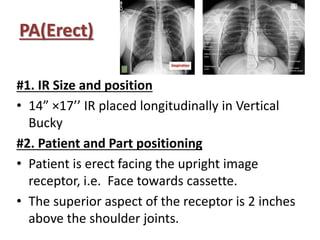
PA(Erect)
#1. IR Size and position
• 14” ×17’’ IR placed longitudinally in Vertical
Bucky
#2. Patient and Part positioning
• Patient is erect facing the upright image
receptor, i.e. Face towards cassette.
• The superior aspect of the receptor is 2 inches
above the shoulder joints.
• The chin is raised as to be out of the image
field.
• Dorsal aspect of both hands placed on the
Iliac Crest
• Both elbows partially flexed rolling anterior; to
keep scapula away from lung field.
• Shoulders are depressed to move the clavicles
below the lung apices
• Feet slightly apart to maintain standing
balance
• Ensure that mid-sagittal plane should coincide
with midline of IR & perpendicular to IR
• Instruct patient that X-Ray will be done in
arrested inspiration
#3. Collimation and Central Ray
• Central Ray (CR) should be horizontal and
pointed on T-7 (at the level of inferior angle of
scapula)
• Collimated from C-7 to L-1 to allow proper
visualisation of the upper airways
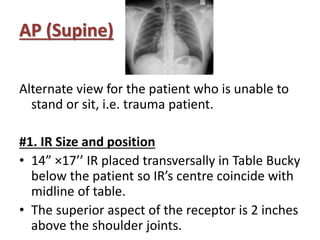
AP (Supine)
Alternate view for the patient who is unable to
stand or sit, i.e. trauma patient.
#1. IR Size and position
• 14” ×17’’ IR placed transversally in Table Bucky
below the patient so IR’s centre coincide with
midline of table.
• The superior aspect of the receptor is 2 inches
above the shoulder joints.
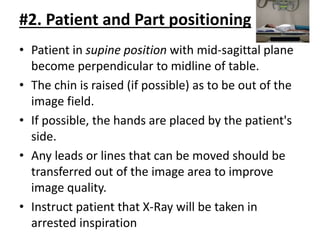
#2. Patient and Part positioning
• Patient in supine position with mid-sagittal plane
become perpendicular to midline of table.
• The chin is raised (if possible) as to be out of the
image field.
• If possible, the hands are placed by the patient's
side.
• Any leads or lines that can be moved should be
transferred out of the image area to improve
image quality.
• Instruct patient that X-Ray will be taken in
arrested inspiration
#3. Collimation and Central Ray
• Central Ray (CR) should be Vertical and pointed
on sternal notch
• Collimated from C-7 to L-1 to allow proper
visualization of the upper airways
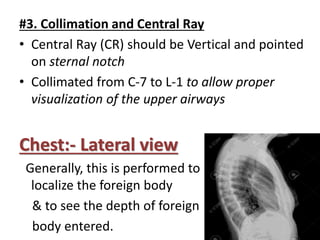
Chest:- Lateral view
Generally, this is performed to
localize the foreign body
& to see the depth of foreign
body entered.
#1.IR Size and position
• 14” ×17’’ IR placed longitudinally in Vertical
Bucky
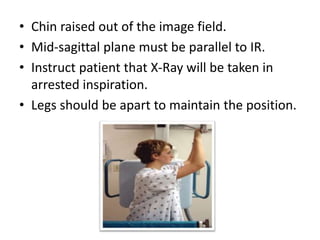
#2. Patient and Part positioning
• standing upright
• Right side in touch with IR (if Right lateral),
Left side in touch with IR (if Left lateral)
• Arms should placed on head or holding onto
handles
• Chin raised out of the image field.
• Mid-sagittal plane must be parallel to IR.
• Instruct patient that X-Ray will be taken in
arrested inspiration.
• Legs should be apart to maintain the position.
#3. CR and Collimation
• Central ray should be horizontal and pointed on
inferior angle of scapula.
• Collimated from C-7 to L-1
Lordotic view
This view is done to see the middle lobe of Right
lung
#1. IR Size and Position
• 14’’ ×17’’ IR placed longitdinally in vertical bucky.
#2. Patient and part position
• The patient is standing with feet
approximately 10-12 inches away from
the IR, with back arched until upper back,
shoulders and head are against the IR
• The shoulders and elbows are rolled
anteriorly
• The angle formed between the
midcoronal body plane and image
receptor should be approximately 45
degrees
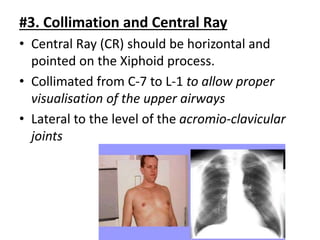
#3. Collimation and Central Ray
• Central Ray (CR) should be horizontal and
pointed on the Xiphoid process.
• Collimated from C-7 to L-1 to allow proper
visualisation of the upper airways
• Lateral to the level of the acromio-clavicular
joints
Apicogram: Special view
This view is performed to see the apex of lungs
clearly.
#1. IR size and position
• 14’’ ×17’’ IR placed longitudinally in vertical bucky
#2. Patient and part position
• Patient in same positin as in lordotic view.
• Both clavicles goes up to make apices of lung
visible
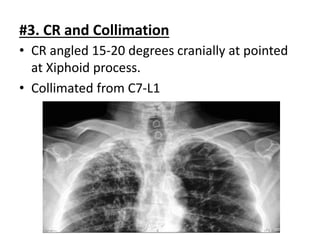
#3. CR and Collimation
• CR angled 15-20 degrees cranially at pointed
at Xiphoid process.
• Collimated from C7-L1
Lateral Decubitus View
Patient and Part position
• The patient is laying either left lateral or
right lateral.
• The IR is placed horizontally posterior to
the patient .
• Patient's hands should be raised to avoid
superimposing on the region of
interest, legs may be flexed for balance
• Rotation of shoulders or pelvis should be
minimised
• X-ray is taken in full inspiration
CR and collimation
• Horizontal CR at xiphoid process on mid-
sagittal plane
• Collimate superior to the apex and inferior to
the T-12
Dorsal Decubitus View
Patient and Part position
• the patient is supine
• the detector is placed landscape of at the
patient's left or right hand side running
parallel to the long axis of the chest
• patient's hands should be raised to avoid
superimposing on the region of interest; legs
may be flexed for balance
• x-ray is taken in full inspiration
CR and Collimation
• Horizontal CR on mid coronal plane at
level of T-7
• Collimate superior to the apex and
inferior to the T-12
Chest radiography ppt

Chest radiography ppt

  • 1.
    CHEST RADIOGRAPHY • Indications •Pneumothorax • Hemothorax • Hemopneumothorax • Lung collapse • Tuberculosis • Pneumonia • Pleural effusion • Fractured ribs
  • 2.
    Views 1. PA (Erect)– Basic view 2. AP (Supine) – Alternate view 3. Lateral View – Additional (Foreign Body) 4. Lordotic View – Right lung’s mid lobe 5. Apicogram – Special View for Apex of lung *To check Air-Fluid Level • *PA(Erect) • *Semi recumbent • *Lateral Decubitus • *Dorsal Decubitus
  • 3.
    PA(Erect) #1. IR Sizeand position • 14” ×17’’ IR placed longitudinally in Vertical Bucky #2. Patient and Part positioning • Patient is erect facing the upright image receptor, i.e. Face towards cassette. • The superior aspect of the receptor is 2 inches above the shoulder joints.
  • 4.
    • The chinis raised as to be out of the image field. • Dorsal aspect of both hands placed on the Iliac Crest • Both elbows partially flexed rolling anterior; to keep scapula away from lung field. • Shoulders are depressed to move the clavicles below the lung apices • Feet slightly apart to maintain standing balance
  • 5.
    • Ensure thatmid-sagittal plane should coincide with midline of IR & perpendicular to IR • Instruct patient that X-Ray will be done in arrested inspiration #3. Collimation and Central Ray • Central Ray (CR) should be horizontal and pointed on T-7 (at the level of inferior angle of scapula) • Collimated from C-7 to L-1 to allow proper visualisation of the upper airways
  • 6.
    AP (Supine) Alternate viewfor the patient who is unable to stand or sit, i.e. trauma patient. #1. IR Size and position • 14” ×17’’ IR placed transversally in Table Bucky below the patient so IR’s centre coincide with midline of table. • The superior aspect of the receptor is 2 inches above the shoulder joints.
  • 7.
    #2. Patient andPart positioning • Patient in supine position with mid-sagittal plane become perpendicular to midline of table. • The chin is raised (if possible) as to be out of the image field. • If possible, the hands are placed by the patient's side. • Any leads or lines that can be moved should be transferred out of the image area to improve image quality. • Instruct patient that X-Ray will be taken in arrested inspiration
  • 8.
    #3. Collimation andCentral Ray • Central Ray (CR) should be Vertical and pointed on sternal notch • Collimated from C-7 to L-1 to allow proper visualization of the upper airways Chest:- Lateral view Generally, this is performed to localize the foreign body & to see the depth of foreign body entered.
  • 9.
    #1.IR Size andposition • 14” ×17’’ IR placed longitudinally in Vertical Bucky #2. Patient and Part positioning • standing upright • Right side in touch with IR (if Right lateral), Left side in touch with IR (if Left lateral) • Arms should placed on head or holding onto handles
  • 10.
    • Chin raisedout of the image field. • Mid-sagittal plane must be parallel to IR. • Instruct patient that X-Ray will be taken in arrested inspiration. • Legs should be apart to maintain the position.
  • 11.
    #3. CR andCollimation • Central ray should be horizontal and pointed on inferior angle of scapula. • Collimated from C-7 to L-1 Lordotic view This view is done to see the middle lobe of Right lung #1. IR Size and Position • 14’’ ×17’’ IR placed longitdinally in vertical bucky.
  • 12.
    #2. Patient andpart position • The patient is standing with feet approximately 10-12 inches away from the IR, with back arched until upper back, shoulders and head are against the IR • The shoulders and elbows are rolled anteriorly • The angle formed between the midcoronal body plane and image receptor should be approximately 45 degrees
  • 13.
    #3. Collimation andCentral Ray • Central Ray (CR) should be horizontal and pointed on the Xiphoid process. • Collimated from C-7 to L-1 to allow proper visualisation of the upper airways • Lateral to the level of the acromio-clavicular joints
  • 14.
    Apicogram: Special view Thisview is performed to see the apex of lungs clearly. #1. IR size and position • 14’’ ×17’’ IR placed longitudinally in vertical bucky #2. Patient and part position • Patient in same positin as in lordotic view. • Both clavicles goes up to make apices of lung visible
  • 15.
    #3. CR andCollimation • CR angled 15-20 degrees cranially at pointed at Xiphoid process. • Collimated from C7-L1
  • 16.
    Lateral Decubitus View Patientand Part position • The patient is laying either left lateral or right lateral. • The IR is placed horizontally posterior to the patient . • Patient's hands should be raised to avoid superimposing on the region of interest, legs may be flexed for balance
  • 17.
    • Rotation ofshoulders or pelvis should be minimised • X-ray is taken in full inspiration CR and collimation • Horizontal CR at xiphoid process on mid- sagittal plane • Collimate superior to the apex and inferior to the T-12
  • 18.
    Dorsal Decubitus View Patientand Part position • the patient is supine • the detector is placed landscape of at the patient's left or right hand side running parallel to the long axis of the chest • patient's hands should be raised to avoid superimposing on the region of interest; legs may be flexed for balance
  • 19.
    • x-ray istaken in full inspiration CR and Collimation • Horizontal CR on mid coronal plane at level of T-7 • Collimate superior to the apex and inferior to the T-12