BIOLOGICAL EFFECTS OF
ULTRASOUND
1
CONTENTS
• INTRODUCTION
• TYPES OF BIOLOGICAL EFFECTS OF ULTRASOUND
• THERMAL EFFECTS
• NON THERMAL EFFECTS
• TYPES OF CAVITATION
• STABLE CAVITATION
• INERTIAL CAVITATION
• OTHER BIOLOGICAL EFFECTS
• THERMAL ABLATION
• SONOPORATION
2
INTRODUCTION
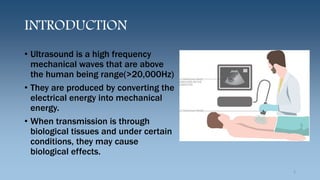
• Ultrasound is a high frequency
mechanical waves that are above
the human being range(>20,000Hz)
• They are produced by converting the
electrical energy into mechanical
energy.
• When transmission is through
biological tissues and under certain
conditions, they may cause
biological effects.
3
TYPES
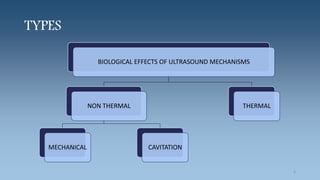
BIOLOGICAL EFFECTS OF ULTRASOUND MECHANISMS
NON THERMAL
MECHANICAL CAVITATION
THERMAL
4
THERMAL EFFECTS
• Thermal effects result from the passage of ultrasound waveforms,
with transformation of acoustic energy into heat.
• This constitutes the major potential adverse effect of obstetric
ultrasound, with several reports existing of the deleterious effects
of heat on embryos/fetuses in the animal model.
• This seems to occur when temperature rises 1.5°C above
physiological levels.
• Thermal effects depend on the type of tissue exposed, the
duration of exposure, ultrasound mode, and the distance between
tissue and emission source.
5
NON THERMAL EFFECTS
MECHANICAL
• Mechanical effects result from the alternating
pressures that are generated.
• The main effect occurs because of the
interaction between ultrasound waves and gas
bubbles present in tissues.
6
NON THERMAL EFFECTS(Contd..)
CAVITATION
• Sound waves generate movement
in and around gas bubbles, which
can affect the surrounding tissues
and lead to cavitation.
• These bubbles generally of a
micron 10 -6 m diameter.
• The bubbles increases and
decreases in pressure
alternatively.
7
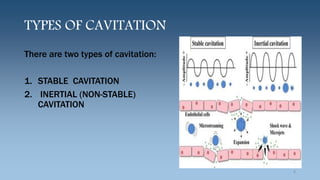
TYPES OF CAVITATION
There are two types of cavitation:
1. STABLE CAVITATION
2. INERTIAL (NON-STABLE)
CAVITATION
8
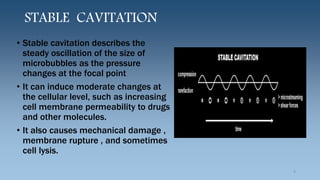
STABLE CAVITATION
• Stable cavitation describes the
steady oscillation of the size of
microbubbles as the pressure
changes at the focal point
• It can induce moderate changes at
the cellular level, such as increasing
cell membrane permeability to drugs
and other molecules.
• It also causes mechanical damage ,
membrane rupture , and sometimes
cell lysis.
9
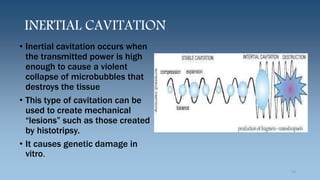
INERTIAL CAVITATION
• Inertial cavitation occurs when
the transmitted power is high
enough to cause a violent
collapse of microbubbles that
destroys the tissue
• This type of cavitation can be
used to create mechanical
“lesions” such as those created
by histotripsy.
• It causes genetic damage in
vitro.
10
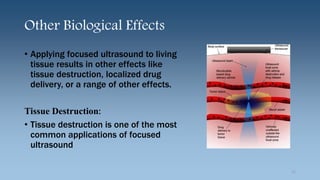
Other Biological Effects
• Applying focused ultrasound to living
tissue results in other effects like
tissue destruction, localized drug
delivery, or a range of other effects.
Tissue Destruction:
• Tissue destruction is one of the most
common applications of focused
ultrasound
11
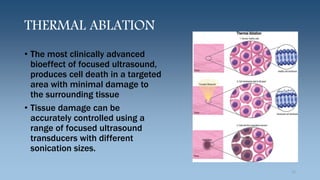
THERMAL ABLATION
• The most clinically advanced
bioeffect of focused ultrasound,
produces cell death in a targeted
area with minimal damage to
the surrounding tissue
• Tissue damage can be
accurately controlled using a
range of focused ultrasound
transducers with different
sonication sizes.
12
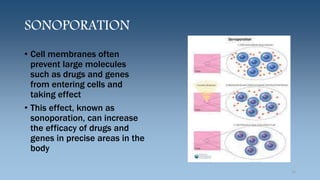
SONOPORATION
• Cell membranes often
prevent large molecules
such as drugs and genes
from entering cells and
taking effect
• This effect, known as
sonoporation, can increase
the efficacy of drugs and
genes in precise areas in the
body
13
REFERENCES
• https://www.glowm.com/article/heading/vol-5--surveillance-of-
fetal-wellbeing--effects-of-ultrasound-on-biological-tissues-and-
cells/id/411403#
• Bioeffects_Paper_July_2015.pdf
• https://www.slideshare.net/muthuu978/ultrasound-therapy
• https://www.slideshare.net/shatham/bioeffect-of-ultra-sound
14
THANK YOU
15

Ultrasound effects

  • 1.
  • 2.
    CONTENTS • INTRODUCTION • TYPESOF BIOLOGICAL EFFECTS OF ULTRASOUND • THERMAL EFFECTS • NON THERMAL EFFECTS • TYPES OF CAVITATION • STABLE CAVITATION • INERTIAL CAVITATION • OTHER BIOLOGICAL EFFECTS • THERMAL ABLATION • SONOPORATION 2
  • 3.
    INTRODUCTION • Ultrasound isa high frequency mechanical waves that are above the human being range(>20,000Hz) • They are produced by converting the electrical energy into mechanical energy. • When transmission is through biological tissues and under certain conditions, they may cause biological effects. 3
  • 4.
    TYPES BIOLOGICAL EFFECTS OFULTRASOUND MECHANISMS NON THERMAL MECHANICAL CAVITATION THERMAL 4
  • 5.
    THERMAL EFFECTS • Thermaleffects result from the passage of ultrasound waveforms, with transformation of acoustic energy into heat. • This constitutes the major potential adverse effect of obstetric ultrasound, with several reports existing of the deleterious effects of heat on embryos/fetuses in the animal model. • This seems to occur when temperature rises 1.5°C above physiological levels. • Thermal effects depend on the type of tissue exposed, the duration of exposure, ultrasound mode, and the distance between tissue and emission source. 5
  • 6.
    NON THERMAL EFFECTS MECHANICAL •Mechanical effects result from the alternating pressures that are generated. • The main effect occurs because of the interaction between ultrasound waves and gas bubbles present in tissues. 6
  • 7.
    NON THERMAL EFFECTS(Contd..) CAVITATION •Sound waves generate movement in and around gas bubbles, which can affect the surrounding tissues and lead to cavitation. • These bubbles generally of a micron 10 -6 m diameter. • The bubbles increases and decreases in pressure alternatively. 7
  • 8.
    TYPES OF CAVITATION Thereare two types of cavitation: 1. STABLE CAVITATION 2. INERTIAL (NON-STABLE) CAVITATION 8
  • 9.
    STABLE CAVITATION • Stablecavitation describes the steady oscillation of the size of microbubbles as the pressure changes at the focal point • It can induce moderate changes at the cellular level, such as increasing cell membrane permeability to drugs and other molecules. • It also causes mechanical damage , membrane rupture , and sometimes cell lysis. 9
  • 10.
    INERTIAL CAVITATION • Inertialcavitation occurs when the transmitted power is high enough to cause a violent collapse of microbubbles that destroys the tissue • This type of cavitation can be used to create mechanical “lesions” such as those created by histotripsy. • It causes genetic damage in vitro. 10
  • 11.
    Other Biological Effects •Applying focused ultrasound to living tissue results in other effects like tissue destruction, localized drug delivery, or a range of other effects. Tissue Destruction: • Tissue destruction is one of the most common applications of focused ultrasound 11
  • 12.
    THERMAL ABLATION • Themost clinically advanced bioeffect of focused ultrasound, produces cell death in a targeted area with minimal damage to the surrounding tissue • Tissue damage can be accurately controlled using a range of focused ultrasound transducers with different sonication sizes. 12
  • 13.
    SONOPORATION • Cell membranesoften prevent large molecules such as drugs and genes from entering cells and taking effect • This effect, known as sonoporation, can increase the efficacy of drugs and genes in precise areas in the body 13
  • 14.
  • 15.