Advances in healing of diabetic ulcersJ. Palmer Branch, DPM	Comprehensive Foot and  Ankle, LLC www.comprehensivefootandankle.netDrCuboid@aol.com 	Lilburn, GA (770-921-8800)	 Cumming, GA (770-886-6833)1
Overview – Key questions-    Why do we care? / What is the problem? 	- Demographics	- Costs- Healthcare expenses		- Personal costs / debilitationWhy are diabetic patients at risk for foot ulcers?
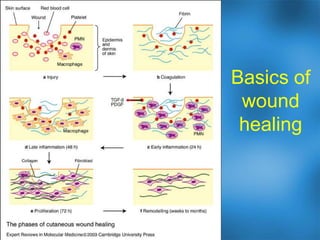
What happens in the normal healing process?
Why do diabetic patients not heal as well as non-diabetics?
How do you examine the wound for potential problems?-    What can be done to enhance / expedite the healing process?	- What types of advanced treatments and products are available?	- When should advanced treatments be used?- 	How can recurrent diabetic ulcers be prevented?2
Overview – Additional commentsRecent advances in treatments for diabetic foot wounds have:Allowed the ability to heal limbs previously thought to be unsalvageable  (e.g. Interventional arteriography / arterial stenting)Enhanced the  variety of treatment options to better individualize care for each situation and wound.Provided a better recognition of the wound healing process.Reduced the healing time Reduces risk of infection – less  window of opportunity Can reduce overall treatment cost3
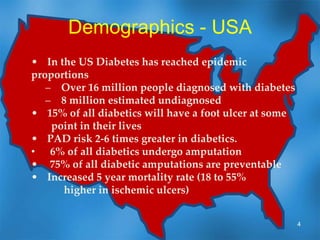
Demographics - USAIn the US Diabetes has reached epidemic proportionsOver 16 million people diagnosed with diabetes8 million estimated undiagnosed15% of all diabetics will have a foot ulcer at some 	point in their livesPAD risk 2-6 times greater in diabetics.6% of all diabetics undergo amputation75% of all diabetic amputations are preventableIncreased 5 year mortality rate (18 to 55%  higher in ischemic ulcers)4
Costs of diabetic limb amputationCosts – average cost per amputation over $40,000 (Surgeon procedure fees only $750 – 1200)Estimated Cost - diabetic amputations in US $1 billion (2007)Medical cost factors:Hospitalization		- Home nursingSurgical procedures	- Skilled nursing facilitiesProsthetic limbs		- Recurrent problemsOther cost factorsLost wages – short-term and long-termLost income tax revenues to federal / state / local governmentDependence on public assistance – Medicaid, Social SecurityDepression, despondency, disruption of family.5
Cardiac disease and foot ulcersIncreased cardiac workload after partial foot or leg amputation – should not be quick to do this.Cardiovascular disease has been found to be increased by amputation alone in populations not controlled for diabetics.Modnay & Peles -21.9 % vs. 12.1% over a 21-year time period in lower extremity traumatic amputees in military veterans Question not answered well in literature: Is the increase in mortality from cardiac disease due to inactivity vs. the cardiac strain or some combination of factors?6
Risk factors for impaired wound healingPAD (peripheral arterial disease) – 2-6 times more prevalent in DM.Neuropathy – lack of protective sensation, motor imbalanceImmunocompromised status Structural problems – focal pressure sitesContractures of toes, bunion  deformitiesEquinus contractures – tightness of the Achilles tendonCharcot joint / arthropathyOther health factors7
PAD and wound healingThe threshold circulation necessary for wound healing in the diabetic foot is systolic toe pressure 30-45mm Hg or ankle pressure 50-80mm Hg  (ABI  0.40 – 0.66)Arteriosclerosis in diabetics can cause noncompressibleartertiesleading to falsely elevated pressures on lower extremity arterial Doppler evaluation.TcPO2 of 30mm Hg also mentioned frequently as a threshold value for wound healing. 8
Consider not only the quantity of blood getting to the wound, but also the quality of the blood.	Evaluate for systemic factors		anemia (CBC with differential)hypovolemia		malnutrition (albumin/prealbumin, total protein)		hyperglycemia9
Causes of ulcers - NeurologicLoss of protective sensation (LOPS) Motor imbalances – Dropfoot and other motor function 	alterationAutonomic neuropathyCharcot Arthropathy / Charcot Joint10
Venous UlcersVenous		- Lack of return of venous blood to the heart		- Fluid buildup / edema in the legs		- Skin necroses due to underlyling venous pressure 		and  buildup of waste products – produces an 		ulceration.		- Stasis dermatitis often noted in chronic cases		- Compression a key to treatment11
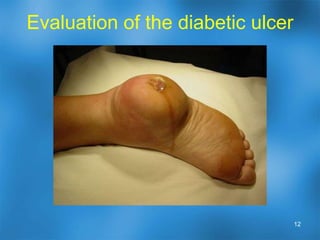
Evaluation of the diabetic ulcer12
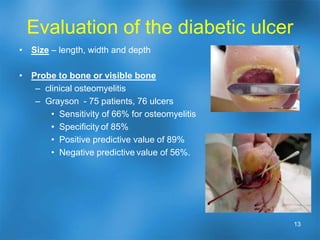
Evaluation of the diabetic ulcerSize – length, width and depthProbe to bone or visible bone clinical osteomyelitisGrayson  - 75 patients, 76 ulcersSensitivity of 66% for osteomyelitisSpecificityof 85%Positive predictive value of 89%Negative predictivevalue of 56%.13
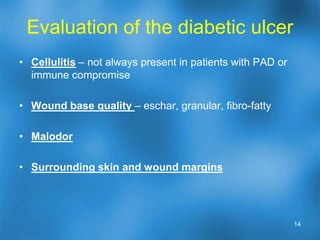
Evaluation of the diabetic ulcerCellulitis – not always present in patients with PAD or immune compromiseWound base quality – eschar, granular, fibro-fattyMalodorSurrounding skin and wound margins14
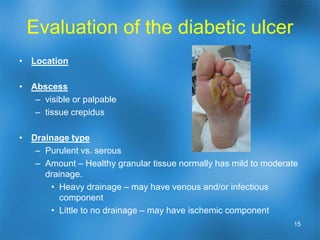
Evaluation of the diabetic ulcerLocationAbscessvisible or palpabletissue crepidusDrainage typePurulent vs. serous Amount – Healthy granular tissue normally has mild to moderate drainage.Heavy drainage – may have venous and/or infectious componentLittle to no drainage – may have ischemic component15
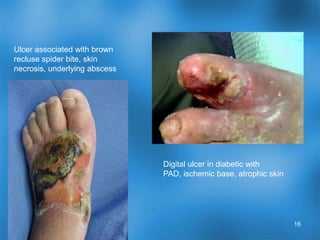
16Ulcer associated with brown recluse spider bite, skin necrosis, underlying abscessDigital ulcer in diabetic with PAD, ischemic base, atrophic skin
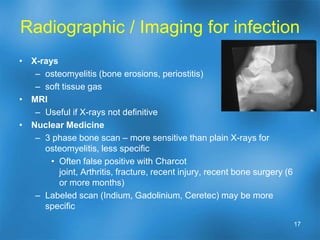
Radiographic / Imaging for infectionX-raysosteomyelitis (bone erosions, periostitis) soft tissue gasMRIUseful if X-rays not definitiveNuclear Medicine3 phase bone scan – more sensitive than plain X-rays for osteomyelitis, less specificOften false positive with Charcot joint, Arthritis, fracture, recent injury, recent bone surgery (6 or more months)Labeled scan (Indium, Gadolinium, Ceretec) may be more specific17
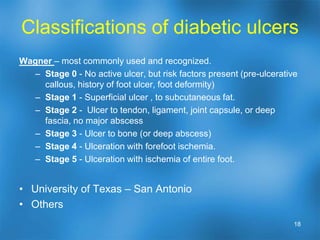
Classifications of diabetic ulcersWagner – most commonly used and recognized.Stage 0 - No active ulcer, but risk factors present (pre-ulcerative callous, history of foot ulcer, foot deformity)Stage 1 - Superficial ulcer , to subcutaneous fat.Stage 2 -  Ulcer to tendon, ligament, joint capsule, or deep fascia, no major abscessStage 3 -Ulcer to bone (or deep abscess)Stage 4 - Ulceration with forefoot ischemia. Stage 5 - Ulceration with ischemia of entire foot.University of Texas – San AntonioOthers18
Basics of wound healing
General principles of good wound careKISS principle (Keep It Simple, Stupid)Be sure to not overlook the obviousEvaluate and treat infection if present fullyRemoval of nonviable and infected tissue when possibleIn osteomyelitis, all infected bone should be removedSee if the wound will rapidly respond to simple, basic treatments.If it isn’ t broken, don’t fix it.Continue basic treatments and regular observation.20
Treatments / wound careTraditional productsSaline, betadine, gauze, etc.Pressure reliefBraces (e.g. Podus boots)PillowsAmbulatory bracing21
Other wound care productsChemical debridersUnna boots, multi-layered compression wrapsLeg compression pumpsMay be helpful with venous ulcersDebriding / wound lavage instrumentsPulse lavageUltrasonic and hydrosurgicaldebriders22
PAD – treatmentsMedical treatment for PADPlavix– inhibits platelet aggregation Pletal – inhibits platelet aggregation and provides vasodilationContraindicated in CHF.Trental– enhances platelet flexibility, full effects 90-120 daysTopical Nitroglycerin (nitroglycerin ointment, Nitrodur patches)Provideslocalizedvasodilation- increases wound perfusion.
Helpful particularly in cases where limb perfusion cannot be enhanced by vascular intervention.
Have to be cautious of hypotension particularly in elderly and/or those with cardiac disease– apply thin layer.23
Surgical procedures - traditional Incision and drainage / surgical debridement“The solution to pollution is dilution”.Removal of infected / nonviable tissue.All infected bone in osteomyelitis should be removed.Amputation levelsBKA/ AKA – goal is to avoidSymes, Chopart’s, Transmetatarsal, LisFranc’sDigital – partial or completeSurgical Wound closure / coverageFlaps (Advancement, rotational)Skin GraftsOther complex wound24
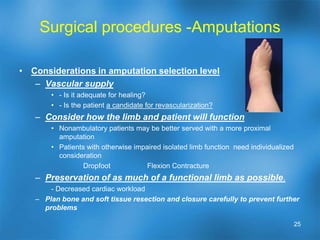
Surgical procedures -AmputationsConsiderations in amputation selection levelVascular supply- Is it adequate for healing?- Is the patient a candidate for revascularization?Consider how the limb and patient will functionNonambulatory patients may be better served with a more proximal amputation Patients with otherwise impaired isolated limb function  need individualized consideration Dropfoot		Flexion ContracturePreservation of as much of a functional limb as possible.- Decreased cardiac workloadPlan bone and soft tissue resection and closure carefully to prevent further problems25
Advanced treatments and products26
Newer wound dressingsAdvanced wound dressings – more absorbent, hydrating, and/or antimicrobial than gauzeAlginates– very absorbent (e.g. Fibracol)Hydrogels – maintain optimal wound hydration, Silver – antimicrobial vs. MRSA contamination / colonizationSilver alginates – e.g. Acticoat rope Silver Hydrogels – e.g. Silvasorb, Aquacel Ag Silver sheet dressings – e.g. ActicoatHoneyCollagen dressings (Promogran) – release collagen into wound base which is helpful in wound healing.27
Topical - Growth Factors Stimulate the healing process Dermagraft– Vicryl sheet with Fibroblasts Apligraf – similar product – bilayered absorbable mesh with keratinocyteson one layer, fibroblasts on the other.Regranex – Topical gel with smaller amounts of growth factors.  Procuren - Older product Future Stem cell-derived products, Additional bilayered skin equivalents28
New surgical products - scaffoldsGraftJacket, AllodermFreeze-dried human dermis
Provides a collagen scaffold for ingrowth of granulation tissueBrigido  - Compared single application of GraftJacket to sharp debridement, weekly dressing changes - 85.7% healed with GraftJacket at 12 weeks vs. 28.6% healed at 12 weeks without. Integra – dermal replacement, bilayered – allows for ingrowth of new skinOasis – Porcine intestinal subucosaPegasus (OrthoAdapt) – equine pericardiumRejection a possibility 29
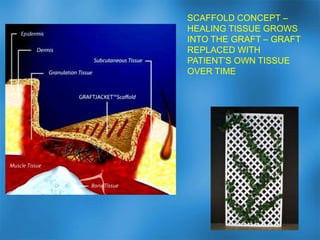
SCAFFOLD CONCEPT – HEALING TISSUE GROWS INTO THE GRAFT – GRAFT REPLACED WITH PATIENT’S OWN TISSUE OVER TIME
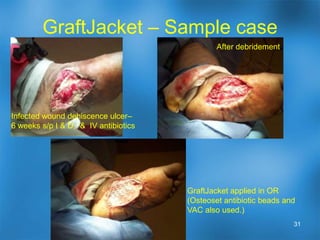
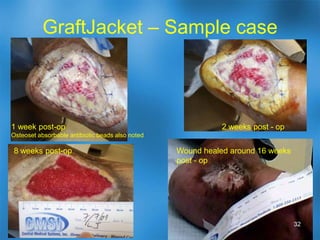
GraftJacket – Sample caseAfter debridementInfected wound dehiscence ulcer– 6 weeks s/p I & D,  &  IV antibioticsGraftJacket applied in OR (Osteoset antibiotic beads and VAC also used.)31
GraftJacket – Sample case1 week post-op Osteoset absorbable antibiotic beads also noted2 weeks post - op8 weeks post-opWound healed around 16 weeks post - op32
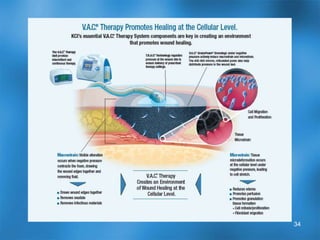
Advanced treatments and productsNegative pressure therapy – suction devicesEliminates wound exudateWaste products from tissue can be toxic to healing
Prevents macerationCan reduce wound volume by suction effectEnhances capillary ingrowthDaily dressing changes not necessary –1-2 times a week.Classic article – Morykwas and Argenta, 1997.Also frequently used with split-thickness skin grafts and freeze-dried dermis graftsto enhance adherence of the graft to the wound base.33
Business Template34
Hyperbaric OxygenMechanisms of action: wound healing is enhanced by increased fibroblast proliferation, increased collagen production, increased capillary angiogenesis, and release of growth.100% oxygen in a pressurized full-body treatment chamberUsually pressurization should be at least 1.4 atmabs (usually 2 – 2.5 atm abs)Can enhance wound healing, particularly in debilitated patientsEffects on the oxygen saturation of the blood may be more important that local effects on the wound.Useful in infections – antimicrobial effects, particularly in anaerobic infections (bacteriostatic), osteomyelitis 35
Advanced Treatments – When to useIf the wound is not responding well to traditional careSheehan- 203 patients (prospective, randomized) studyMedian healing percentage at 4 weeks – was 53%		-If > 53% healed @ 4 weeks, then 58% chance of 			full wound healing at 12 weeks		 -If < 53% healed, then only 9% were healed at 12 weeks. Conclusion – if not 53% healed at 4 weeks, then additional  care needed.Anticipated difficulty in healing / high complication potential	Size/ depthAnatomicLocation Patient risk factorsCost-Effectiveness Considerations:	Is the potential cost of not doing something more aggressive going to be more expensive than the cost of the advanced therapy?36
Questions to ask when considering advanced and / or new treatmentsAre there other treatable reasons the ulcer is not healing?Infection – adeqaute medical and surgical treatmentVascular supply – is it adequate or can it be improved?Patient factors - (overall health, noncompliance, etc.)Pressure relief – offload the wound siteWould additional consults  be appropriate? Is there adequate evidence based medicine that the treatment or product is effective, particularly for the situation?37
Selection of appropriate advanced therapyHow can the healing process be best enhanced for the ulcer?Applying medical expertise and judgment to each situation Medicine is often more an art than a science. Know what each product can do – particular indications and benefits of each device or treatment.Are there any reasons why advanced treatments cannot be used in the situation?38
The Healed Diabetic Foot – What next? 	Crane M, Branch P. Clin Pod Med Surg. 	v. 15, n 1, Jan 1998, p. 155-74.39
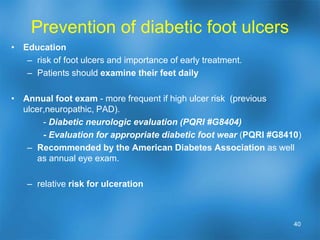
Prevention of diabetic foot ulcersEducation risk of foot ulcers and importance of early treatment.Patients should examine their feet dailyAnnual foot exam -more frequent if high ulcer risk  (previous ulcer,neuropathic, PAD).		- Diabetic neurologic evaluation (PQRI #G8404)		- Evaluation for appropriate diabetic foot wear (PQRI #G8410)Recommended by the American Diabetes Associationas well as annual eye exam.relative risk for ulceration40
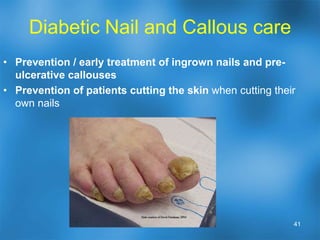
Diabetic Nail and Callous carePrevention / early treatment of ingrown nails and pre-ulcerative callousesPrevention of patients cutting the skin when cutting their own nails41
PAD – Follow-upFollow-up for progressive PAD Clinical examArterial ultrasoundEnsure maintenance of adequate vascular status.Particularly important after vascular intervention (stenting, bypass, etc.) to examine for patency of the treated arteries.42
Protective devices for foot ulcer preventionCustom BracesAFO (Ankle – Foot Orthosis)Dropfoot bracesRigid AFO for severe flatfoot or other deformitiesPatellar Tendon brace – shifts some pressure to patellar tendonProtective shoesExtra Depth shoes with custom molded protective foam insoles to balance pressureCustom Molded shoes – made from a plaster mold of the patient’s foot		Commonly used in severe foot deformities – e.g. Charcot Rocker-	bottom foot43
Diabetic shoes - CharacteristicsMedicare Therapeutic Shoe Bill covers protective shoes for diabetics annually.Also covered by many private insurers and Medicaid providersExtra-depth shoes vs. True Custom-molded shoesDocumented successCDC has proven that they reduce the incidence of foot amputationIn patients with a history of foot ulcers, 80% without diabetic shoes, 20% with properly fitted protective diabetic shoes.At minimum are cost-neutralShould be professionally fitted by individuals with proper training(DPM, C Ped, CO) 44
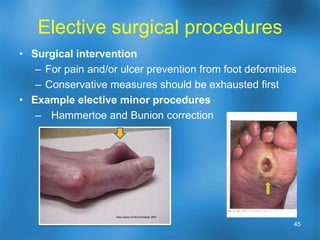
Elective surgical proceduresSurgical interventionFor pain and/or ulcer prevention from foot deformities Conservative measures should be exhausted firstExample elective minor procedures	Hammertoe and Bunion correction45

Advances in healing of diabetic foot ulcers

  • 1.
    Advances in healingof diabetic ulcersJ. Palmer Branch, DPM Comprehensive Foot and Ankle, LLC www.comprehensivefootandankle.netDrCuboid@aol.com Lilburn, GA (770-921-8800) Cumming, GA (770-886-6833)1
  • 2.
    Overview – Keyquestions- Why do we care? / What is the problem? - Demographics - Costs- Healthcare expenses - Personal costs / debilitationWhy are diabetic patients at risk for foot ulcers?
  • 3.
    What happens inthe normal healing process?
  • 4.
    Why do diabeticpatients not heal as well as non-diabetics?
  • 5.
    How do youexamine the wound for potential problems?- What can be done to enhance / expedite the healing process? - What types of advanced treatments and products are available? - When should advanced treatments be used?- How can recurrent diabetic ulcers be prevented?2
  • 6.
    Overview – AdditionalcommentsRecent advances in treatments for diabetic foot wounds have:Allowed the ability to heal limbs previously thought to be unsalvageable (e.g. Interventional arteriography / arterial stenting)Enhanced the variety of treatment options to better individualize care for each situation and wound.Provided a better recognition of the wound healing process.Reduced the healing time Reduces risk of infection – less window of opportunity Can reduce overall treatment cost3
  • 7.
    Demographics - USAInthe US Diabetes has reached epidemic proportionsOver 16 million people diagnosed with diabetes8 million estimated undiagnosed15% of all diabetics will have a foot ulcer at some point in their livesPAD risk 2-6 times greater in diabetics.6% of all diabetics undergo amputation75% of all diabetic amputations are preventableIncreased 5 year mortality rate (18 to 55% higher in ischemic ulcers)4
  • 8.
    Costs of diabeticlimb amputationCosts – average cost per amputation over $40,000 (Surgeon procedure fees only $750 – 1200)Estimated Cost - diabetic amputations in US $1 billion (2007)Medical cost factors:Hospitalization - Home nursingSurgical procedures - Skilled nursing facilitiesProsthetic limbs - Recurrent problemsOther cost factorsLost wages – short-term and long-termLost income tax revenues to federal / state / local governmentDependence on public assistance – Medicaid, Social SecurityDepression, despondency, disruption of family.5

  • 9.
    Cardiac disease andfoot ulcersIncreased cardiac workload after partial foot or leg amputation – should not be quick to do this.Cardiovascular disease has been found to be increased by amputation alone in populations not controlled for diabetics.Modnay & Peles -21.9 % vs. 12.1% over a 21-year time period in lower extremity traumatic amputees in military veterans Question not answered well in literature: Is the increase in mortality from cardiac disease due to inactivity vs. the cardiac strain or some combination of factors?6
  • 10.
    Risk factors forimpaired wound healingPAD (peripheral arterial disease) – 2-6 times more prevalent in DM.Neuropathy – lack of protective sensation, motor imbalanceImmunocompromised status Structural problems – focal pressure sitesContractures of toes, bunion deformitiesEquinus contractures – tightness of the Achilles tendonCharcot joint / arthropathyOther health factors7
  • 11.
    PAD and woundhealingThe threshold circulation necessary for wound healing in the diabetic foot is systolic toe pressure 30-45mm Hg or ankle pressure 50-80mm Hg (ABI 0.40 – 0.66)Arteriosclerosis in diabetics can cause noncompressibleartertiesleading to falsely elevated pressures on lower extremity arterial Doppler evaluation.TcPO2 of 30mm Hg also mentioned frequently as a threshold value for wound healing. 8
  • 12.
    Consider not onlythe quantity of blood getting to the wound, but also the quality of the blood. Evaluate for systemic factors anemia (CBC with differential)hypovolemia malnutrition (albumin/prealbumin, total protein) hyperglycemia9
  • 13.
    Causes of ulcers- NeurologicLoss of protective sensation (LOPS) Motor imbalances – Dropfoot and other motor function alterationAutonomic neuropathyCharcot Arthropathy / Charcot Joint10
  • 14.
    Venous UlcersVenous - Lackof return of venous blood to the heart - Fluid buildup / edema in the legs - Skin necroses due to underlyling venous pressure and buildup of waste products – produces an ulceration. - Stasis dermatitis often noted in chronic cases - Compression a key to treatment11
  • 15.
    Evaluation of thediabetic ulcer12
  • 16.
    Evaluation of thediabetic ulcerSize – length, width and depthProbe to bone or visible bone clinical osteomyelitisGrayson - 75 patients, 76 ulcersSensitivity of 66% for osteomyelitisSpecificityof 85%Positive predictive value of 89%Negative predictivevalue of 56%.13
  • 17.
    Evaluation of thediabetic ulcerCellulitis – not always present in patients with PAD or immune compromiseWound base quality – eschar, granular, fibro-fattyMalodorSurrounding skin and wound margins14
  • 18.
    Evaluation of thediabetic ulcerLocationAbscessvisible or palpabletissue crepidusDrainage typePurulent vs. serous Amount – Healthy granular tissue normally has mild to moderate drainage.Heavy drainage – may have venous and/or infectious componentLittle to no drainage – may have ischemic component15
  • 19.
    16Ulcer associated withbrown recluse spider bite, skin necrosis, underlying abscessDigital ulcer in diabetic with PAD, ischemic base, atrophic skin
  • 20.
    Radiographic / Imagingfor infectionX-raysosteomyelitis (bone erosions, periostitis) soft tissue gasMRIUseful if X-rays not definitiveNuclear Medicine3 phase bone scan – more sensitive than plain X-rays for osteomyelitis, less specificOften false positive with Charcot joint, Arthritis, fracture, recent injury, recent bone surgery (6 or more months)Labeled scan (Indium, Gadolinium, Ceretec) may be more specific17
  • 21.
    Classifications of diabeticulcersWagner – most commonly used and recognized.Stage 0 - No active ulcer, but risk factors present (pre-ulcerative callous, history of foot ulcer, foot deformity)Stage 1 - Superficial ulcer , to subcutaneous fat.Stage 2 - Ulcer to tendon, ligament, joint capsule, or deep fascia, no major abscessStage 3 -Ulcer to bone (or deep abscess)Stage 4 - Ulceration with forefoot ischemia. Stage 5 - Ulceration with ischemia of entire foot.University of Texas – San AntonioOthers18
  • 22.
  • 23.
    General principles ofgood wound careKISS principle (Keep It Simple, Stupid)Be sure to not overlook the obviousEvaluate and treat infection if present fullyRemoval of nonviable and infected tissue when possibleIn osteomyelitis, all infected bone should be removedSee if the wound will rapidly respond to simple, basic treatments.If it isn’ t broken, don’t fix it.Continue basic treatments and regular observation.20
  • 24.
    Treatments / woundcareTraditional productsSaline, betadine, gauze, etc.Pressure reliefBraces (e.g. Podus boots)PillowsAmbulatory bracing21
  • 25.
    Other wound careproductsChemical debridersUnna boots, multi-layered compression wrapsLeg compression pumpsMay be helpful with venous ulcersDebriding / wound lavage instrumentsPulse lavageUltrasonic and hydrosurgicaldebriders22
  • 26.
    PAD – treatmentsMedicaltreatment for PADPlavix– inhibits platelet aggregation Pletal – inhibits platelet aggregation and provides vasodilationContraindicated in CHF.Trental– enhances platelet flexibility, full effects 90-120 daysTopical Nitroglycerin (nitroglycerin ointment, Nitrodur patches)Provideslocalizedvasodilation- increases wound perfusion.
  • 27.
    Helpful particularly incases where limb perfusion cannot be enhanced by vascular intervention.
  • 28.
    Have to becautious of hypotension particularly in elderly and/or those with cardiac disease– apply thin layer.23
  • 29.
    Surgical procedures -traditional Incision and drainage / surgical debridement“The solution to pollution is dilution”.Removal of infected / nonviable tissue.All infected bone in osteomyelitis should be removed.Amputation levelsBKA/ AKA – goal is to avoidSymes, Chopart’s, Transmetatarsal, LisFranc’sDigital – partial or completeSurgical Wound closure / coverageFlaps (Advancement, rotational)Skin GraftsOther complex wound24
  • 30.
    Surgical procedures -AmputationsConsiderationsin amputation selection levelVascular supply- Is it adequate for healing?- Is the patient a candidate for revascularization?Consider how the limb and patient will functionNonambulatory patients may be better served with a more proximal amputation Patients with otherwise impaired isolated limb function need individualized consideration Dropfoot Flexion ContracturePreservation of as much of a functional limb as possible.- Decreased cardiac workloadPlan bone and soft tissue resection and closure carefully to prevent further problems25
  • 31.
  • 32.
    Newer wound dressingsAdvancedwound dressings – more absorbent, hydrating, and/or antimicrobial than gauzeAlginates– very absorbent (e.g. Fibracol)Hydrogels – maintain optimal wound hydration, Silver – antimicrobial vs. MRSA contamination / colonizationSilver alginates – e.g. Acticoat rope Silver Hydrogels – e.g. Silvasorb, Aquacel Ag Silver sheet dressings – e.g. ActicoatHoneyCollagen dressings (Promogran) – release collagen into wound base which is helpful in wound healing.27
  • 33.
    Topical - GrowthFactors Stimulate the healing process Dermagraft– Vicryl sheet with Fibroblasts Apligraf – similar product – bilayered absorbable mesh with keratinocyteson one layer, fibroblasts on the other.Regranex – Topical gel with smaller amounts of growth factors.  Procuren - Older product Future Stem cell-derived products, Additional bilayered skin equivalents28
  • 34.
    New surgical products- scaffoldsGraftJacket, AllodermFreeze-dried human dermis
  • 35.
    Provides a collagenscaffold for ingrowth of granulation tissueBrigido - Compared single application of GraftJacket to sharp debridement, weekly dressing changes - 85.7% healed with GraftJacket at 12 weeks vs. 28.6% healed at 12 weeks without. Integra – dermal replacement, bilayered – allows for ingrowth of new skinOasis – Porcine intestinal subucosaPegasus (OrthoAdapt) – equine pericardiumRejection a possibility 29
  • 36.
    SCAFFOLD CONCEPT –HEALING TISSUE GROWS INTO THE GRAFT – GRAFT REPLACED WITH PATIENT’S OWN TISSUE OVER TIME
  • 37.
    GraftJacket – SamplecaseAfter debridementInfected wound dehiscence ulcer– 6 weeks s/p I & D, & IV antibioticsGraftJacket applied in OR (Osteoset antibiotic beads and VAC also used.)31
  • 38.
    GraftJacket – Samplecase1 week post-op Osteoset absorbable antibiotic beads also noted2 weeks post - op8 weeks post-opWound healed around 16 weeks post - op32
  • 39.
    Advanced treatments andproductsNegative pressure therapy – suction devicesEliminates wound exudateWaste products from tissue can be toxic to healing
  • 40.
    Prevents macerationCan reducewound volume by suction effectEnhances capillary ingrowthDaily dressing changes not necessary –1-2 times a week.Classic article – Morykwas and Argenta, 1997.Also frequently used with split-thickness skin grafts and freeze-dried dermis graftsto enhance adherence of the graft to the wound base.33
  • 41.
  • 42.
    Hyperbaric OxygenMechanisms ofaction: wound healing is enhanced by increased fibroblast proliferation, increased collagen production, increased capillary angiogenesis, and release of growth.100% oxygen in a pressurized full-body treatment chamberUsually pressurization should be at least 1.4 atmabs (usually 2 – 2.5 atm abs)Can enhance wound healing, particularly in debilitated patientsEffects on the oxygen saturation of the blood may be more important that local effects on the wound.Useful in infections – antimicrobial effects, particularly in anaerobic infections (bacteriostatic), osteomyelitis 35
  • 43.
    Advanced Treatments –When to useIf the wound is not responding well to traditional careSheehan- 203 patients (prospective, randomized) studyMedian healing percentage at 4 weeks – was 53% -If > 53% healed @ 4 weeks, then 58% chance of full wound healing at 12 weeks -If < 53% healed, then only 9% were healed at 12 weeks. Conclusion – if not 53% healed at 4 weeks, then additional care needed.Anticipated difficulty in healing / high complication potential Size/ depthAnatomicLocation Patient risk factorsCost-Effectiveness Considerations: Is the potential cost of not doing something more aggressive going to be more expensive than the cost of the advanced therapy?36
  • 44.
    Questions to askwhen considering advanced and / or new treatmentsAre there other treatable reasons the ulcer is not healing?Infection – adeqaute medical and surgical treatmentVascular supply – is it adequate or can it be improved?Patient factors - (overall health, noncompliance, etc.)Pressure relief – offload the wound siteWould additional consults be appropriate? Is there adequate evidence based medicine that the treatment or product is effective, particularly for the situation?37
  • 45.
    Selection of appropriateadvanced therapyHow can the healing process be best enhanced for the ulcer?Applying medical expertise and judgment to each situation Medicine is often more an art than a science. Know what each product can do – particular indications and benefits of each device or treatment.Are there any reasons why advanced treatments cannot be used in the situation?38
  • 46.
    The Healed DiabeticFoot – What next? Crane M, Branch P. Clin Pod Med Surg. v. 15, n 1, Jan 1998, p. 155-74.39
  • 47.
    Prevention of diabeticfoot ulcersEducation risk of foot ulcers and importance of early treatment.Patients should examine their feet dailyAnnual foot exam -more frequent if high ulcer risk (previous ulcer,neuropathic, PAD). - Diabetic neurologic evaluation (PQRI #G8404) - Evaluation for appropriate diabetic foot wear (PQRI #G8410)Recommended by the American Diabetes Associationas well as annual eye exam.relative risk for ulceration40
  • 48.
    Diabetic Nail andCallous carePrevention / early treatment of ingrown nails and pre-ulcerative callousesPrevention of patients cutting the skin when cutting their own nails41
  • 49.
    PAD – Follow-upFollow-upfor progressive PAD Clinical examArterial ultrasoundEnsure maintenance of adequate vascular status.Particularly important after vascular intervention (stenting, bypass, etc.) to examine for patency of the treated arteries.42
  • 50.
    Protective devices forfoot ulcer preventionCustom BracesAFO (Ankle – Foot Orthosis)Dropfoot bracesRigid AFO for severe flatfoot or other deformitiesPatellar Tendon brace – shifts some pressure to patellar tendonProtective shoesExtra Depth shoes with custom molded protective foam insoles to balance pressureCustom Molded shoes – made from a plaster mold of the patient’s foot Commonly used in severe foot deformities – e.g. Charcot Rocker- bottom foot43
  • 51.
    Diabetic shoes -CharacteristicsMedicare Therapeutic Shoe Bill covers protective shoes for diabetics annually.Also covered by many private insurers and Medicaid providersExtra-depth shoes vs. True Custom-molded shoesDocumented successCDC has proven that they reduce the incidence of foot amputationIn patients with a history of foot ulcers, 80% without diabetic shoes, 20% with properly fitted protective diabetic shoes.At minimum are cost-neutralShould be professionally fitted by individuals with proper training(DPM, C Ped, CO) 44
  • 52.
    Elective surgical proceduresSurgicalinterventionFor pain and/or ulcer prevention from foot deformities Conservative measures should be exhausted firstExample elective minor procedures Hammertoe and Bunion correction45