Diabetic foot ulcer
Definition
Diabetic foot ulcer
A non healing or poorly healing, break in the skin, below the ankle in an
individual with diabetes, critical in the natural history of the diabetic foot.
Risk factors
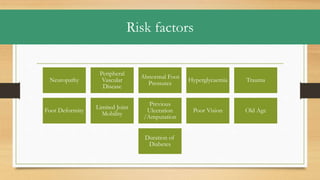
Neuropathy
Peripheral
Vascular
Disease
Abnormal Foot
Pressures
Hyperglycaemia Trauma
Foot Deformity
Limited Joint
Mobility
Previous
Ulceration
/Amputation
Poor Vision Old Age
Duration of
Diabetes
Etiology
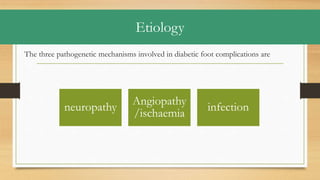
The three pathogenetic mechanisms involved in diabetic foot complications are
neuropathy
Angiopathy
/ischaemia
infection
Pathophysiology
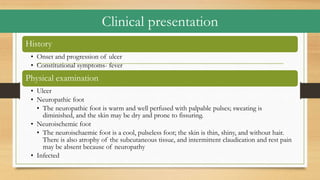
Clinical presentation
History
• Onset and progression of ulcer
• Constitutional symptoms- fever
Physical examination
• Ulcer
• Neuropathic foot
• The neuropathic foot is warm and well perfused with palpable pulses; sweating is
diminished, and the skin may be dry and prone to fissuring.
• Neuroischemic foot
• The neuroischaemic foot is a cool, pulseless foot; the skin is thin, shiny, and without hair.
There is also atrophy of the subcutaneous tissue, and intermittent claudication and rest pain
may be absent because of neuropathy
• Infected
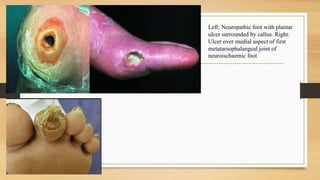
Left: Neuropathic foot with plantar
ulcer surrounded by callus. Right:
Ulcer over medial aspect of first
metatarsophalangeal joint of
neuroischaemic foot
Ulcer examination
• Location, size, depth, margins, colour, odour, base, floor
• type of discharge
• attempts made to express pus
• type of ulcer (neuropathic, ischemic or neuro-ischemic) needs to be determined.
• probed to look for extension into bone, sinus tract, joint and tendon sheath. Probe
hitting bone signifies possible underlying osteomyelitis. When bone is exposed, the
patient is assumed to have osteomyelitis until proven otherwise.
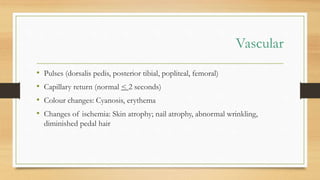
Vascular
• Pulses (dorsalis pedis, posterior tibial, popliteal, femoral)
• Capillary return (normal < 2 seconds)
• Colour changes: Cyanosis, erythema
• Changes of ischemia: Skin atrophy; nail atrophy, abnormal wrinkling,
diminished pedal hair
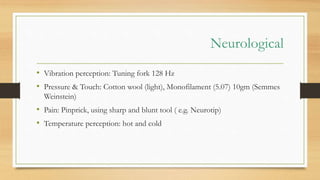
Neurological
• Vibration perception: Tuning fork 128 Hz
• Pressure & Touch: Cotton wool (light), Monofilament (5.07) 10gm (Semmes
Weinstein)
• Pain: Pinprick, using sharp and blunt tool ( e.g. Neurotip)
• Temperature perception: hot and cold
Musculoskeletal deformities
• Attitude and posture of lower extremities and foot
• Orthopedic deformities – Hammertoes / Bunions / Charcot deformities /
amputations / prominent metatarsal heads
• Limited joint mobility – active and passive movements
• Tendo - Achilles contractures
Evaluation of the skin and nails of the foot
• Skin appearance: color, texture, turgor, quality, and dry skin
• Calluses, heel fissures, cracking of skin due to reduced sweating inautonomic
neuropathy
• Nail appearance: Onychomycosis, dystrophic, atrophy, hypertrophy,paronychia
• Presence of hair
• Ulceration, gangrene, infection
• Interdigital lesions
• Tinea pedis
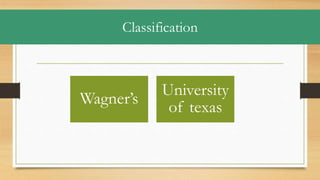
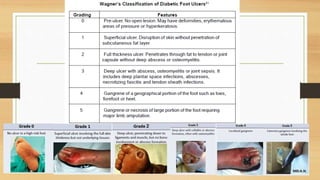
Classification
Wagner’s
University
of texas
Stages
Stage A: No infection or
ischemia
Stage B: Infection present
Stage C: Ischemia present
Stage D: Infection and ischemia
present
Grading
Grade 0: Epithelialized wound
Grade 1: Superficial wound
Grade 2: Wound penetrates to
tendon or capsule
Grade 3: Wound penetrates to
bone or joint
Workup
Biochemical
• Fasting or random blood sugar (FBS, RBS)
• Glycohemoglobin (HbA1C)
• Full blood count (FBC)
• Erythrocyte sedimentation rates (ESR)
• CRP
• Wound and blood cultures(C&S)
Imaging
Vascular investigations
Neurological investigations
Assessment of plantar foot pressure
Imaging
• Plain radiograph of the foot
• AP, lateral, and oblique of foot and ankle
• MRI
• best for differentiating abscess from soft tissue swelling
• Bone scan
•useful to differentiate between
•soft tissue infection
•osteomyelitis
•Charcot arthropathy
Vascular
to evaluate the extent of occlusive vascular disease and in the assessment of healing potential especially when clinical examination suggests lower
extremity ischaemia
• Doppler segmental artery pressures
• Ankle-brachial indices (ABI)
• Normal value 1.1, <0.9 abnormal
• Toe pressure measurements
• In general, 85%-100% of foot lesions will heal when toe pressures are >40mmHg and less than 10% will heal if<20mmHg
• Transcutaneous oxygen tension (TcPO2)
• <10mmHg correlates with non-healing, >30mmHg correlates with healing
Any abnormal results of the above investigations in the presence of a non-healing foot ulcer warrant a vascular assessment. Determination of
distal run-off and perfusion can be assessed by arteriography, digital subtraction angiography (DSA)or magnetic resonance angiography (MRA)
Management
• Operative
• Debridement
• Surgical management to reduce or remove bony prominences and/or improve soft tissue cover
• Non-operative
• Wound care
• Reduction of plantar pressure
• Others
• Infection
• Vascular management of ischemia
• Medical management of comorbids
• Reduce risk of recurrence
Debridement
• Surgical debridement
• Indications : grade 3 or greater ulcers
• Infected wound
Wound care
goals of wound care and dressings
• provide moist environment
• absorb exudate
• act as a barrier
• off-load pressure at ulcer
Vascular management of ischemia
Vascular supply to the affected limb should be assessed early and if impaired,
vascular reconstruction surgery (if feasible) should be performed prior to
definitive surgical management
Surgical management to reduce or remove
bony prominences
• A structurally deformed foot may give rise to high-pressure areas causing
ulcers that do not heal with off loading treatment or therapeutic footwear.
• Such deformities are treated surgically to effect healing and to prevent
recurrence.
• Examples are correction of hammertoes, excision of exostoses, bunions and
tendo-achilles lengthening
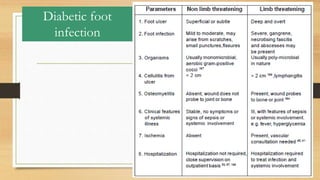
Diabetic foot
infection
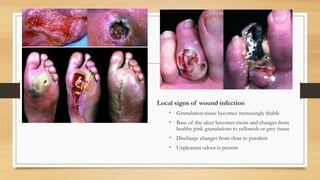
Local signs of wound infection
• Granulation tissue becomes increasingly friable
• Base of the ulcer becomes moist and changes from
healthy pink granulations to yellowish or grey tissue
• Discharge changes from clear to purulent
• Unpleasant odour is present
Non limb threatening
• These patients are initially managed as outpatients and hospitalized only when no
improvement is noted after 48-72 hours or the condition deteriorates.
• Antibiotic therapy is commenced and if ulcer is present. The ulcer is cleansed and debrided.
• Ulcer management is then followed as previously outlined.
• Correction of hyperglycemia and stabilization of other co-morbidities are carried out
simultaneously.
• The response to treatment is then re-evaluated after 48-72 hours and necessary action may
need to be taken.
• Aspects of prevention, patient education, podiatric care and orthotic treatment are also
carried out.
Limb threatening
• Surgical treatment
• debridement of wounds, incision & drainage of abscesses, necrotising fascitis and
amputations of gangrenous tissues
• tissues taken deep from the wound are sent for aerobic and anaerobic cultures
• osteomyelitic bones are removed and sent for microbiological culture and histology
• Wound care
• Antibiotics
• Medical management of comorbidities
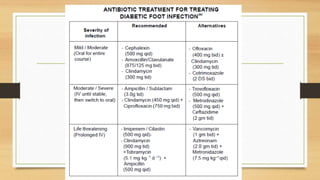
Antibiotic
• Start with an empiric regime that covers important and common
pathogens, taking into account infection severity, while awaiting culture
results
• The empiric therapy for severe infections should be broad-spectrum and
given intravenously whereas minor infections can be treated with narrower
spectrum antibiotics.
• Mild and moderate non-limb threatening infections are usually
monomicrobial, with Staph. Aureus, Staph. Epidermidis and Streptococci
being the most common infecting organisms.
• These patients are given gram- positive coverage but keeping in mind gram-
negative organisms may also be involved.
• Severe limb and life threatening infections are poly-microbial in nature, which
includes gram-positive and negative organisms, anaerobic organisms and
enterococci.
• Pseudomonas species are often isolated from wounds that have been soaked or treated with wet
dressings.
• Enterococci are commonly cultured from patients who have previously received cephalosporin
therapy.
• Anaerobes are found in wounds with necrosis, deep tissue involvement or a feculent odour.
• MRSA are often acquired during a previous hospitalization.
• Empiric intravenous broad- spectrum antibiotics therapy in these patients should
cover common isolates of the above organisms and then adjusted according to
culture and sensitivity results. Recurrent infections, despite ongoing antibiotic
therapy, should have repeated deep tissue cultures done to exclude super infection.
If MRSA is isolated, this should be treated early and appropriately.
Duration of antibiotic treatment –
• 1-2 weeks course for mild to moderate infections
• more than 2 weeks for more serious infections
• For osteomyelitis, if infected bone is not removed, antibiotics are given for 6
- 8weeks, depending on culture results
• If all infected bone is removed, a shorter course (1-2 weeks) of antibiotics, as
for soft tissue infection, maybe adequate.
• Maintaining effectiveness of therapy through parameters including, the patient’s
• clinical response,
• temperature,
• WBC count,
• ESR
• other inflammatory markers,
• blood sugar control
• other metabolic parameters,
• signs of wound healing and inflammation.
• If there is vascular impairment, the antibiotics may not be able to reach the infected site. Hence, vascular
reconstructive procedures may have to be undertaken to improve blood flow to infected tissues.
Prevention
• Education
• Foot care
• Therapeutic shoes
• Reduction of plantar pressure
• Surgery
• Multidisciplinary Team Approach

diabetic foot ulcer classification management .pptx

  • 1.
  • 2.
    Definition Diabetic foot ulcer Anon healing or poorly healing, break in the skin, below the ankle in an individual with diabetes, critical in the natural history of the diabetic foot.
  • 3.
    Risk factors Neuropathy Peripheral Vascular Disease Abnormal Foot Pressures HyperglycaemiaTrauma Foot Deformity Limited Joint Mobility Previous Ulceration /Amputation Poor Vision Old Age Duration of Diabetes
  • 4.
    Etiology The three pathogeneticmechanisms involved in diabetic foot complications are neuropathy Angiopathy /ischaemia infection
  • 5.
  • 6.
    Clinical presentation History • Onsetand progression of ulcer • Constitutional symptoms- fever Physical examination • Ulcer • Neuropathic foot • The neuropathic foot is warm and well perfused with palpable pulses; sweating is diminished, and the skin may be dry and prone to fissuring. • Neuroischemic foot • The neuroischaemic foot is a cool, pulseless foot; the skin is thin, shiny, and without hair. There is also atrophy of the subcutaneous tissue, and intermittent claudication and rest pain may be absent because of neuropathy • Infected
  • 7.
    Left: Neuropathic footwith plantar ulcer surrounded by callus. Right: Ulcer over medial aspect of first metatarsophalangeal joint of neuroischaemic foot
  • 8.
    Ulcer examination • Location,size, depth, margins, colour, odour, base, floor • type of discharge • attempts made to express pus • type of ulcer (neuropathic, ischemic or neuro-ischemic) needs to be determined. • probed to look for extension into bone, sinus tract, joint and tendon sheath. Probe hitting bone signifies possible underlying osteomyelitis. When bone is exposed, the patient is assumed to have osteomyelitis until proven otherwise.
  • 9.
    Vascular • Pulses (dorsalispedis, posterior tibial, popliteal, femoral) • Capillary return (normal < 2 seconds) • Colour changes: Cyanosis, erythema • Changes of ischemia: Skin atrophy; nail atrophy, abnormal wrinkling, diminished pedal hair
  • 10.
    Neurological • Vibration perception:Tuning fork 128 Hz • Pressure & Touch: Cotton wool (light), Monofilament (5.07) 10gm (Semmes Weinstein) • Pain: Pinprick, using sharp and blunt tool ( e.g. Neurotip) • Temperature perception: hot and cold
  • 11.
    Musculoskeletal deformities • Attitudeand posture of lower extremities and foot • Orthopedic deformities – Hammertoes / Bunions / Charcot deformities / amputations / prominent metatarsal heads • Limited joint mobility – active and passive movements • Tendo - Achilles contractures
  • 12.
    Evaluation of theskin and nails of the foot • Skin appearance: color, texture, turgor, quality, and dry skin • Calluses, heel fissures, cracking of skin due to reduced sweating inautonomic neuropathy • Nail appearance: Onychomycosis, dystrophic, atrophy, hypertrophy,paronychia • Presence of hair • Ulceration, gangrene, infection • Interdigital lesions • Tinea pedis
  • 13.
  • 15.
    Stages Stage A: Noinfection or ischemia Stage B: Infection present Stage C: Ischemia present Stage D: Infection and ischemia present Grading Grade 0: Epithelialized wound Grade 1: Superficial wound Grade 2: Wound penetrates to tendon or capsule Grade 3: Wound penetrates to bone or joint
  • 16.
    Workup Biochemical • Fasting orrandom blood sugar (FBS, RBS) • Glycohemoglobin (HbA1C) • Full blood count (FBC) • Erythrocyte sedimentation rates (ESR) • CRP • Wound and blood cultures(C&S) Imaging Vascular investigations Neurological investigations Assessment of plantar foot pressure
  • 17.
    Imaging • Plain radiographof the foot • AP, lateral, and oblique of foot and ankle • MRI • best for differentiating abscess from soft tissue swelling • Bone scan •useful to differentiate between •soft tissue infection •osteomyelitis •Charcot arthropathy
  • 18.
    Vascular to evaluate theextent of occlusive vascular disease and in the assessment of healing potential especially when clinical examination suggests lower extremity ischaemia • Doppler segmental artery pressures • Ankle-brachial indices (ABI) • Normal value 1.1, <0.9 abnormal • Toe pressure measurements • In general, 85%-100% of foot lesions will heal when toe pressures are >40mmHg and less than 10% will heal if<20mmHg • Transcutaneous oxygen tension (TcPO2) • <10mmHg correlates with non-healing, >30mmHg correlates with healing Any abnormal results of the above investigations in the presence of a non-healing foot ulcer warrant a vascular assessment. Determination of distal run-off and perfusion can be assessed by arteriography, digital subtraction angiography (DSA)or magnetic resonance angiography (MRA)
  • 19.
    Management • Operative • Debridement •Surgical management to reduce or remove bony prominences and/or improve soft tissue cover • Non-operative • Wound care • Reduction of plantar pressure • Others • Infection • Vascular management of ischemia • Medical management of comorbids • Reduce risk of recurrence
  • 20.
    Debridement • Surgical debridement •Indications : grade 3 or greater ulcers • Infected wound
  • 21.
    Wound care goals ofwound care and dressings • provide moist environment • absorb exudate • act as a barrier • off-load pressure at ulcer
  • 22.
    Vascular management ofischemia Vascular supply to the affected limb should be assessed early and if impaired, vascular reconstruction surgery (if feasible) should be performed prior to definitive surgical management
  • 23.
    Surgical management toreduce or remove bony prominences • A structurally deformed foot may give rise to high-pressure areas causing ulcers that do not heal with off loading treatment or therapeutic footwear. • Such deformities are treated surgically to effect healing and to prevent recurrence. • Examples are correction of hammertoes, excision of exostoses, bunions and tendo-achilles lengthening
  • 24.
  • 25.
    Local signs ofwound infection • Granulation tissue becomes increasingly friable • Base of the ulcer becomes moist and changes from healthy pink granulations to yellowish or grey tissue • Discharge changes from clear to purulent • Unpleasant odour is present
  • 26.
    Non limb threatening •These patients are initially managed as outpatients and hospitalized only when no improvement is noted after 48-72 hours or the condition deteriorates. • Antibiotic therapy is commenced and if ulcer is present. The ulcer is cleansed and debrided. • Ulcer management is then followed as previously outlined. • Correction of hyperglycemia and stabilization of other co-morbidities are carried out simultaneously. • The response to treatment is then re-evaluated after 48-72 hours and necessary action may need to be taken. • Aspects of prevention, patient education, podiatric care and orthotic treatment are also carried out.
  • 27.
    Limb threatening • Surgicaltreatment • debridement of wounds, incision & drainage of abscesses, necrotising fascitis and amputations of gangrenous tissues • tissues taken deep from the wound are sent for aerobic and anaerobic cultures • osteomyelitic bones are removed and sent for microbiological culture and histology • Wound care • Antibiotics • Medical management of comorbidities
  • 28.
    Antibiotic • Start withan empiric regime that covers important and common pathogens, taking into account infection severity, while awaiting culture results • The empiric therapy for severe infections should be broad-spectrum and given intravenously whereas minor infections can be treated with narrower spectrum antibiotics.
  • 29.
    • Mild andmoderate non-limb threatening infections are usually monomicrobial, with Staph. Aureus, Staph. Epidermidis and Streptococci being the most common infecting organisms. • These patients are given gram- positive coverage but keeping in mind gram- negative organisms may also be involved.
  • 30.
    • Severe limband life threatening infections are poly-microbial in nature, which includes gram-positive and negative organisms, anaerobic organisms and enterococci. • Pseudomonas species are often isolated from wounds that have been soaked or treated with wet dressings. • Enterococci are commonly cultured from patients who have previously received cephalosporin therapy. • Anaerobes are found in wounds with necrosis, deep tissue involvement or a feculent odour. • MRSA are often acquired during a previous hospitalization. • Empiric intravenous broad- spectrum antibiotics therapy in these patients should cover common isolates of the above organisms and then adjusted according to culture and sensitivity results. Recurrent infections, despite ongoing antibiotic therapy, should have repeated deep tissue cultures done to exclude super infection. If MRSA is isolated, this should be treated early and appropriately.
  • 31.
    Duration of antibiotictreatment – • 1-2 weeks course for mild to moderate infections • more than 2 weeks for more serious infections • For osteomyelitis, if infected bone is not removed, antibiotics are given for 6 - 8weeks, depending on culture results • If all infected bone is removed, a shorter course (1-2 weeks) of antibiotics, as for soft tissue infection, maybe adequate.
  • 32.
    • Maintaining effectivenessof therapy through parameters including, the patient’s • clinical response, • temperature, • WBC count, • ESR • other inflammatory markers, • blood sugar control • other metabolic parameters, • signs of wound healing and inflammation. • If there is vascular impairment, the antibiotics may not be able to reach the infected site. Hence, vascular reconstructive procedures may have to be undertaken to improve blood flow to infected tissues.
  • 34.
    Prevention • Education • Footcare • Therapeutic shoes • Reduction of plantar pressure • Surgery • Multidisciplinary Team Approach