Subset construction algorithm
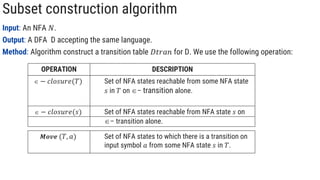
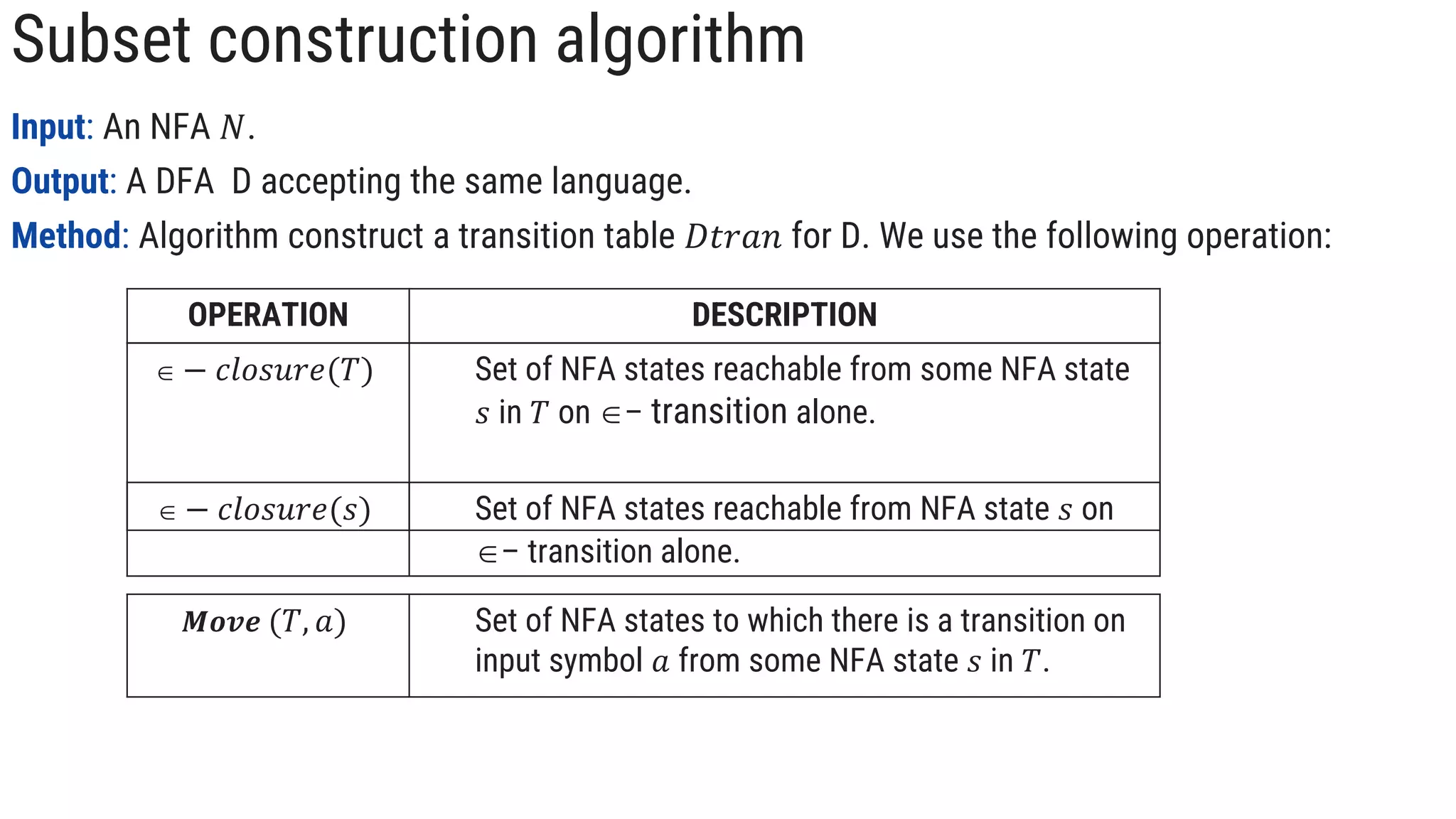
Input: An NFA 𝑁.
Output: A DFA D accepting the same language.
Method: Algorithm construct a transition table 𝐷𝑡𝑟𝑎𝑛 for D. We use the following operation:
OPERATION DESCRIPTION
 − 𝑐𝑙𝑜𝑠𝑢𝑟𝑒(𝑠) Set of NFA states reachable from NFA state 𝑠 on
– transition alone.
 − 𝑐𝑙𝑜𝑠𝑢𝑟𝑒(𝑇) Set of NFA states reachable from some NFA state
𝑠 in 𝑇 on – transition alone.
𝑴𝒐𝒗𝒆 (𝑇, 𝑎) Set of NFA states to which there is a transition on
input symbol 𝑎 from some NFA state 𝑠 in 𝑇.
Subset construction algorithm
initially  − 𝑐𝑙𝑜𝑠𝑢𝑟𝑒(𝑠0) be the only state in 𝐷𝑠𝑡𝑎𝑡𝑒𝑠 and it is unmarked;
while there is unmarked states T in 𝐷𝑠𝑡𝑎𝑡𝑒𝑠 do begin
mark 𝑇;
for each input symbol 𝑎 do begin
𝑈 = 𝜖 − 𝑐𝑙𝑜𝑠𝑢𝑟𝑒 𝑚𝑜𝑣𝑒 𝑇, 𝑎 ;
if 𝑈 is not in 𝐷𝑠𝑡𝑎𝑡𝑒𝑠 then
add 𝑈 as unmarked state to 𝐷𝑠𝑡𝑎𝑡𝑒𝑠;
𝐷𝑡𝑟𝑎𝑛[ 𝑇, 𝑎 ] = 𝑈
end
end
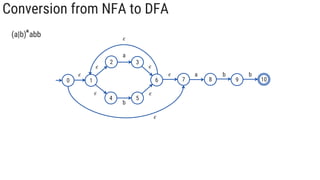
Conversion from NFA to DFA
1
(a|b)*abb
2
5
3
4
6 7 8 9
0 10
𝜖
a
b
𝜖 a b b
𝜖
𝜖 𝜖
𝜖
𝜖
𝜖
Conversion from NFA to DFA
1
2
5
3
4
6 7 8 9
0
𝜖
a
b
𝜖 a b b
𝜖
𝜖 𝜖
𝜖
𝜖
𝜖
10
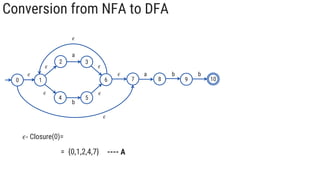
{0, 1, 7, 2, 4}
---- A
𝜖- Closure(0)=
= {0,1,2,4,7}
Conversion from NFA to DFA
1
2
5
3
4
6 7 8 9
0
𝜖
a
b
𝜖 a b b
𝜖
𝜖 𝜖
𝜖
𝜖
𝜖
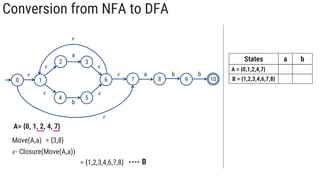
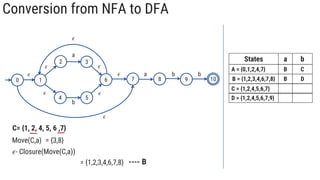
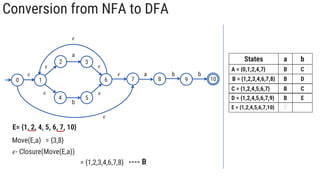
A= {0, 1, 2, 4, 7}
Move(A,a) = {3,8}
𝜖- Closure(Move(A,a)) = {3, 6, 7, 1, 2, 4, 8}
---- B
= {1,2,3,4,6,7,8}
10
States a b
A = {0,1,2,4,7} B
B = {1,2,3,4,6,7,8}
Conversion from NFA to DFA
1
2
5
3
4
6 7 8
0
𝜖
a
b
𝜖 a b b
𝜖
𝜖 𝜖
𝜖
𝜖
𝜖
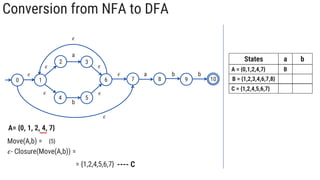
A= {0, 1, 2, 4, 7}
Move(A,b) = {5}
𝜖- Closure(Move(A,b)) = {5, 6, 7, 1, 2, 4}
---- C
= {1,2,4,5,6,7}
{5}
10
9
States a b
A = {0,1,2,4,7} B C
B = {1,2,3,4,6,7,8}
C = {1,2,4,5,6,7}
Conversion from NFA to DFA
1
2
5
3
4
6 7 8
0
𝜖
a
b
𝜖 a b
𝜖
𝜖 𝜖
𝜖
𝜖
𝜖
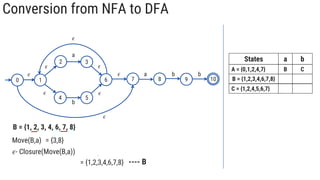
B = {1, 2, 3, 4, 6, 7, 8}
Move(B,a) = {3,8}
𝜖- Closure(Move(B,a)) = {3, 6, 7, 1, 2, 4, 8}
---- B
= {1,2,3,4,6,7,8}
b
10
9
States a b
A = {0,1,2,4,7} B C
B = {1,2,3,4,6,7,8} B
C = {1,2,4,5,6,7}
Conversion from NFA to DFA
1
2
5
3
4
6 7 8
0
𝜖
a
b
𝜖 a b
𝜖
𝜖 𝜖
𝜖
𝜖
𝜖
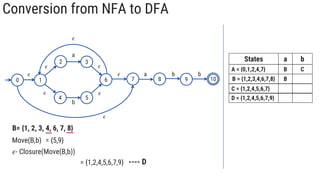
B= {1, 2, 3, 4, 6, 7, 8}
Move(B,b) = {5,9}
𝜖- Closure(Move(B,b)) = {5, 6, 7, 1, 2, 4, 9}
---- D
= {1,2,4,5,6,7,9}
b
10
9
States a b
A = {0,1,2,4,7} B C
B = {1,2,3,4,6,7,8} B D
C = {1,2,4,5,6,7}
D = {1,2,4,5,6,7,9}
Conversion from NFA to DFA
1
2
5
3
4
6 7 8
0
𝜖
a
b
𝜖 a b
𝜖
𝜖 𝜖
𝜖
𝜖
𝜖
Move(C,a) = {3,8}
𝜖- Closure(Move(C,a)) = {3, 6, 7, 1, 2, 4, 8}
---- B
= {1,2,3,4,6,7,8}
C= {1, 2, 4, 5, 6 ,7}
b
10
9
States a b
A = {0,1,2,4,7} B C
B = {1,2,3,4,6,7,8} B D
C = {1,2,4,5,6,7} B
D = {1,2,4,5,6,7,9}
Conversion from NFA to DFA
1
2
5
3
4
6 7 8
0
𝜖
a
b
𝜖 a b b
𝜖
𝜖 𝜖
𝜖
𝜖
𝜖
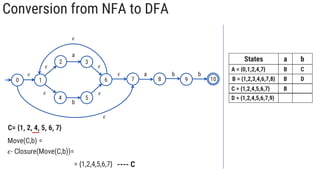
Move(C,b) = {5}
𝜖- Closure(Move(C,b))= {5, 6, 7, 1, 2, 4}
---- C
= {1,2,4,5,6,7}
C= {1, 2, 4, 5, 6, 7}
10
9
States a b
A = {0,1,2,4,7} B C
B = {1,2,3,4,6,7,8} B D
C = {1,2,4,5,6,7} B C
D = {1,2,4,5,6,7,9}
Conversion from NFA to DFA
1
2
5
3
4
6 7 8
0
𝜖
a
b
𝜖 a b b
𝜖
𝜖 𝜖
𝜖
𝜖
𝜖
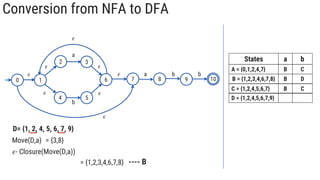
Move(D,a) = {3,8}
𝜖- Closure(Move(D,a)) = {3, 6, 7, 1, 2, 4, 8}
---- B
= {1,2,3,4,6,7,8}
D= {1, 2, 4, 5, 6, 7, 9}
10
9
States a b
A = {0,1,2,4,7} B C
B = {1,2,3,4,6,7,8} B D
C = {1,2,4,5,6,7} B C
D = {1,2,4,5,6,7,9} B
Conversion from NFA to DFA
1
2
5
3
4
6 7 8
0
𝜖
a
b
𝜖 a b b
𝜖
𝜖 𝜖
𝜖
𝜖
𝜖
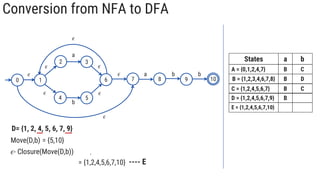
Move(D,b) = {5,10}
𝜖- Closure(Move(D,b)) = {5, 6, 7, 1, 2, 4, 10}
---- E
= {1,2,4,5,6,7,10}
D= {1, 2, 4, 5, 6, 7, 9}
10
9
States a b
A = {0,1,2,4,7} B C
B = {1,2,3,4,6,7,8} B D
C = {1,2,4,5,6,7} B C
D = {1,2,4,5,6,7,9} B E
E = {1,2,4,5,6,7,10}
Conversion from NFA to DFA
1
2
5
3
4
6 7 8
0
𝜖
a
b
𝜖 a b b
𝜖
𝜖 𝜖
𝜖
𝜖
𝜖
Move(E,a) = {3,8}
𝜖- Closure(Move(E,a)) = {3, 6, 7, 1, 2, 4, 8}
---- B
= {1,2,3,4,6,7,8}
E= {1, 2, 4, 5, 6, 7, 10}
10
9
States a b
A = {0,1,2,4,7} B C
B = {1,2,3,4,6,7,8} B D
C = {1,2,4,5,6,7} B C
D = {1,2,4,5,6,7,9} B E
E = {1,2,4,5,6,7,10} B
Conversion from NFA to DFA
1
2
5
3
4
6 7 8
0
𝜖
a
b
𝜖 a b b
𝜖
𝜖 𝜖
𝜖
𝜖
𝜖
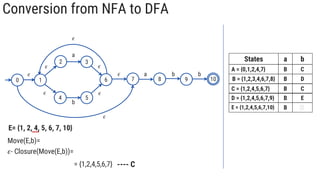
Move(E,b)= {5}
𝜖- Closure(Move(E,b))= {5,6,7,1,2,4}
---- C
= {1,2,4,5,6,7}
States a b
A = {0,1,2,4,7} B C
B = {1,2,3,4,6,7,8} B D
C = {1,2,4,5,6,7} B C
E= {1, 2, 4, 5, 6, 7, 10}
D = {1,2,4,5,6,7,9} B E
E = {1,2,4,5,6,7,10} B C
10
9
Conversion from NFA to DFA
A
B
C
a
b
a
b
a
D
E
b
a
b
b
a
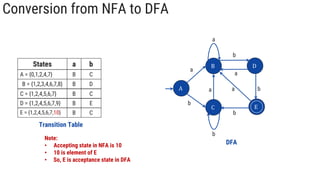
Transition Table
DFA
Note:
• Accepting state in NFA is 10
• 10 is element of E
• So, E is acceptance state in DFA
States a b
A = {0,1,2,4,7} B C
B = {1,2,3,4,6,7,8} B D
C = {1,2,4,5,6,7} B C
D = {1,2,4,5,6,7,9} B E
E = {1,2,4,5,6,7,10} B C
DFA optimization
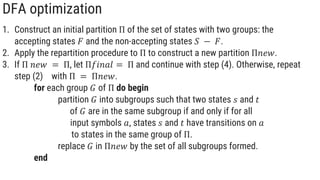
1. Construct an initial partition Π of the set of states with two groups: the
accepting states 𝐹 and the non-accepting states 𝑆 − 𝐹.
2. Apply the repartition procedure to Π to construct a new partition Π𝑛𝑒𝑤.
3. If Π 𝑛𝑒𝑤 = Π, let Π𝑓𝑖𝑛𝑎𝑙 = Π and continue with step (4). Otherwise, repeat
step (2) with Π = Π𝑛𝑒𝑤.
for each group 𝐺 of Π do begin
partition 𝐺 into subgroups such that two states 𝑠 and 𝑡
of 𝐺 are in the same subgroup if and only if for all
input symbols 𝑎, states 𝑠 and 𝑡 have transitions on 𝑎
to states in the same group of Π.
replace 𝐺 in Π𝑛𝑒𝑤 by the set of all subgroups formed.
end
DFA optimization
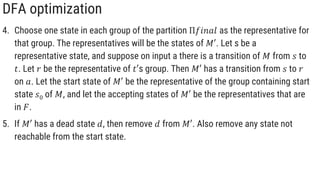
4. Choose one state in each group of the partition Π𝑓𝑖𝑛𝑎𝑙 as the representative for
that group. The representatives will be the states of 𝑀′. Let s be a
representative state, and suppose on input a there is a transition of 𝑀 from 𝑠 to
𝑡. Let 𝑟 be the representative of 𝑡′s group. Then 𝑀′ has a transition from 𝑠 to 𝑟
on 𝑎. Let the start state of 𝑀′ be the representative of the group containing start
state 𝑠0 of 𝑀, and let the accepting states of 𝑀′ be the representatives that are
in 𝐹.
5. If 𝑀′ has a dead state 𝑑, then remove 𝑑 from 𝑀′. Also remove any state not
reachable from the start state.
DFA optimization
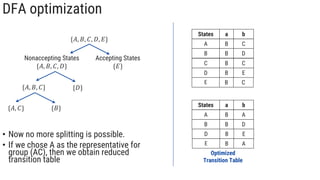
• Now no more splitting is possible.
• If we chose A as the representative for
group (AC), then we obtain reduced
transition table
A B C
B B D
C B C
D B E
E B C
States a b
{𝐴, 𝐵, 𝐶, 𝐷, 𝐸}
Nonaccepting States
{𝐴, 𝐵, 𝐶, 𝐷}
Accepting States
{𝐸}
{𝐴, 𝐵, 𝐶} {𝐷}
{𝐵}
A B A
B B D
D B E
E B A
States a b
Optimized
Transition Table
{𝐴, 𝐶}
Rules to compute nullable, firstpos, lastpos
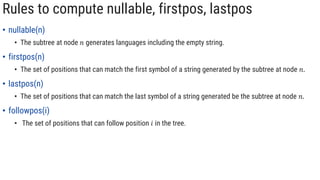
• nullable(n)
• The subtree at node 𝑛 generates languages including the empty string.
• firstpos(n)
• The set of positions that can match the first symbol of a string generated by the subtree at node 𝑛.
• lastpos(n)
• The set of positions that can match the last symbol of a string generated be the subtree at node 𝑛.
• followpos(i)
• The set of positions that can follow position 𝑖 in the tree.
Rules to compute nullable, firstpos, lastpos
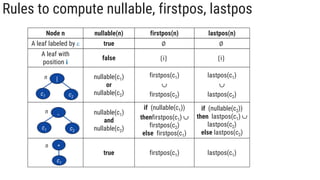
Node n nullable(n) firstpos(n) lastpos(n)
A leaf labeled by  true ∅ ∅
A leaf with
position 𝐢
false {i} {i}
nullable(c1)
or
nullable(c2)
firstpos(c1)

firstpos(c2)
lastpos(c1)

lastpos(c2)
nullable(c1)
and
nullable(c2)
if (nullable(c1))
thenfirstpos(c1) 
firstpos(c2)
else firstpos(c1)
if (nullable(c2))
then lastpos(c1) 
lastpos(c2)
else lastpos(c2)
true firstpos(c1) lastpos(c1)
|
n
c1 c2
n
∗
n
.
c1 c2
c1
Rules to compute followpos
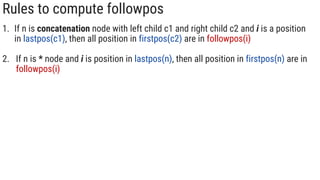
1. If n is concatenation node with left child c1 and right child c2 and i is a position
in lastpos(c1), then all position in firstpos(c2) are in followpos(i)
2. If n is * node and i is position in lastpos(n), then all position in firstpos(n) are in
followpos(i)
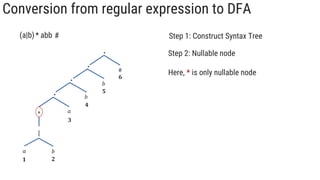
Conversion from regular expression to DFA
𝑎 𝑏
|
∗
.
𝟏 𝟐
𝑎
.
.
.
𝑏
𝑏
#
(a|b)* abb
𝟒
𝟑
𝟓
𝟔
#
Step 2: Nullable node
Here, * is only nullable node
Step 1: Construct Syntax Tree
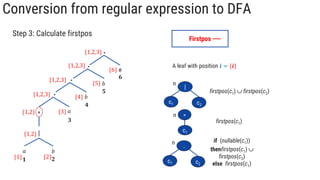
Conversion from regular expression to DFA
𝑎 𝑏
|
∗
.
{1} {2}
{1,2}
{1,2} 𝑎
{3}
{1,2,3}
.
{4}
{1,2,3}
.
{5}
{1,2,3}
.
{6}
{1,2,3}
𝑏
𝑏
#
Step 3: Calculate firstpos
Firstpos
A leaf with position 𝒊 = {𝒊}
|
n
c1 c2
firstpos(c1)  firstpos(c2)
∗
n
c1
firstpos(c1)
.
n
c1 c2
𝟏 𝟐
𝟒
𝟑
𝟓
𝟔
if (nullable(c1))
thenfirstpos(c1) 
firstpos(c2)
else firstpos(c1)
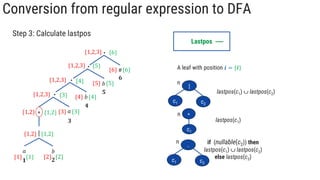
Conversion from regular expression to DFA
𝑎 𝑏
|
∗
.
{1} {1} {2} {2}
{1,2} {1,2}
{1,2} {1,2} 𝑎
{3} {3}
{1,2,3} {3}
.
{4} {4}
{1,2,3} {4}
.
{5} {5}
{1,2,3} {5}
.
{6} {6}
{1,2,3} {6}
𝑏
𝑏
#
Step 3: Calculate lastpos
𝟏 𝟐
𝟒
𝟑
𝟓
𝟔
Lastpos
A leaf with position 𝒊 = {𝒊}
|
n
c1 c2
if (nullable(c2)) then
lastpos(c1)  lastpos(c2)
else lastpos(c2)
∗
n
c1
lastpos(c1)
.
n
c1 c2
lastpos(c1)  lastpos(c2)
Conversion from regular expression to DFA
Position followpos
𝑎 𝑏
|
∗
.
{1} {1} {2} {2}
{1,2} {1,2}
{1,2} {1,2} 𝑎
{3} {3}
{1,2,3} {3}
.
{4} {4}
{1,2,3} {4}
.
{5} {5}
{1,2,3} {5}
.
{6} {6}
{1,2,3} {6}
𝑏
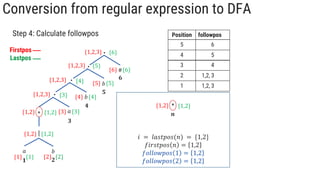
𝑏
#
Step 4: Calculate followpos
𝟏 𝟐
𝟒
𝟑
𝟓
𝟔
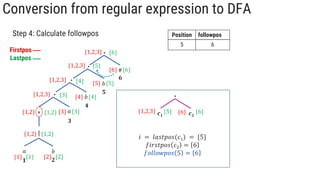
5 6
{1,2,3} {5}
.
{6} {6}
𝒄𝟏 𝒄𝟐
𝑖 = 𝑙𝑎𝑠𝑡𝑝𝑜𝑠(𝑐1) = {5}
𝑓𝑖𝑟𝑠𝑡𝑝𝑜𝑠 𝑐2 = 6
𝑓𝑜𝑙𝑙𝑜𝑤𝑝𝑜𝑠 5 = 6
Firstpos
Lastpos
Conversion from regular expression to DFA
Position followpos
𝑎 𝑏
|
∗
.
{1} {1} {2} {2}
{1,2} {1,2}
{1,2} {1,2} 𝑎
{3} {3}
{1,2,3} {3}
.
{4} {4}
{1,2,3} {4}
.
{5} {5}
{1,2,3} {5}
.
{6} {6}
{1,2,3} {6}
𝑏
𝑏
#
Step 4: Calculate followpos
𝟏 𝟐
𝟒
𝟑
𝟓
𝟔
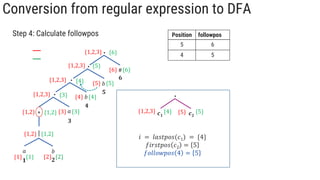
5 6
{1,2,3} {4}
.
{5} {5}
𝒄𝟏 𝒄𝟐
𝑖 = 𝑙𝑎𝑠𝑡𝑝𝑜𝑠(𝑐1) = {4}
𝑓𝑖𝑟𝑠𝑡𝑝𝑜𝑠 𝑐2 = 5
𝑓𝑜𝑙𝑙𝑜𝑤𝑝𝑜𝑠 4 = 5
4 5
Conversion from regular expression to DFA
Position followpos
𝑎 𝑏
|
∗
.
{1} {1} {2} {2}
{1,2} {1,2}
{1,2} {1,2} 𝑎
{3} {3}
{1,2,3} {3}
.
{4} {4}
{1,2,3} {4}
.
{5} {5}
{1,2,3} {5}
.
{6} {6}
{1,2,3} {6}
𝑏
𝑏
#
Step 4: Calculate followpos
𝟏 𝟐
𝟒
𝟑
𝟓
𝟔
5 6
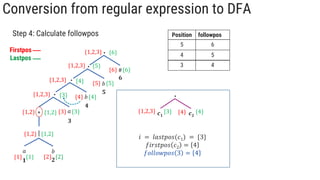
{1,2,3} {3}
.
{4} {4}
𝒄𝟏 𝒄𝟐
𝑖 = 𝑙𝑎𝑠𝑡𝑝𝑜𝑠(𝑐1) = {3}
𝑓𝑖𝑟𝑠𝑡𝑝𝑜𝑠 𝑐2 = 4
𝑓𝑜𝑙𝑙𝑜𝑤𝑝𝑜𝑠 3 = 4
4 5
3 4
Firstpos
Lastpos
Conversion from regular expression to DFA
Position followpos
𝑎 𝑏
|
∗
.
{1} {1} {2} {2}
{1,2} {1,2}
{1,2} {1,2} 𝑎
{3} {3}
{1,2,3} {3}
.
{4} {4}
{1,2,3} {4}
.
{5} {5}
{1,2,3} {5}
.
{6} {6}
{1,2,3} {6}
𝑏
𝑏
#
Step 4: Calculate followpos
𝟏 𝟐
𝟒
𝟑
𝟓
𝟔
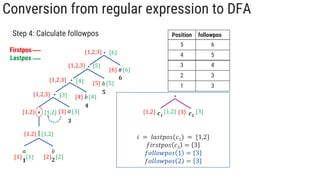
5 6
{1,2} {1,2}
.
{3} {3}
𝒄𝟏 𝒄𝟐
4 5
3 4
2 3
1 3
Firstpos
Lastpos
𝑖 = 𝑙𝑎𝑠𝑡𝑝𝑜𝑠(𝑐1) = {1,2}
𝑓𝑖𝑟𝑠𝑡𝑝𝑜𝑠 𝑐2 = 3
𝑓𝑜𝑙𝑙𝑜𝑤𝑝𝑜𝑠 1 = 3
𝑓𝑜𝑙𝑙𝑜𝑤𝑝𝑜𝑠 2 = 3
Conversion from regular expression to DFA
Position followpos
𝑎 𝑏
|
∗
.
{1} {1} {2} {2}
{1,2} {1,2}
{1,2} {1,2} 𝑎
{3} {3}
{1,2,3} {3}
.
{4} {4}
{1,2,3} {4}
.
{5} {5}
{1,2,3} {5}
.
{6} {6}
{1,2,3} {6}
𝑏
𝑏
#
Step 4: Calculate followpos
𝟏 𝟐
𝟒
𝟑
𝟓
𝟔
5 6
𝒏
4 5
3 4
2 3
1 3
{1,2} {1,2}
*
1,2,
1,2,
Firstpos
Lastpos
𝑖 = 𝑙𝑎𝑠𝑡𝑝𝑜𝑠(𝑛) = {1,2}
𝑓𝑖𝑟𝑠𝑡𝑝𝑜𝑠 𝑛 = 1,2
𝑓𝑜𝑙𝑙𝑜𝑤𝑝𝑜𝑠 1 = 1,2
𝑓𝑜𝑙𝑙𝑜𝑤𝑝𝑜𝑠 2 = 1,2
Conversion from regular expression to DFA
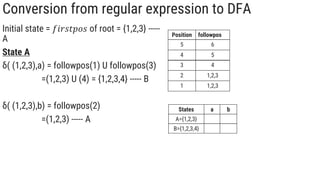
Initial state = 𝑓𝑖𝑟𝑠𝑡𝑝𝑜𝑠 of root = {1,2,3} -----
A
State A
δ( (1,2,3),a) = followpos(1) U followpos(3)
=(1,2,3) U (4) = {1,2,3,4} ----- B
δ( (1,2,3),b) = followpos(2)
=(1,2,3) ----- A
Position followpos
5 6
4 5
3 4
2 1,2,3
1 1,2,3
States a b
A={1,2,3} B A
B={1,2,3,4}
Conversion from regular expression to DFA
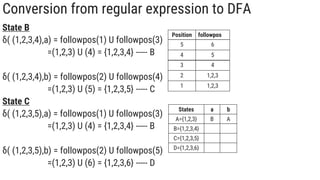
State B
δ( (1,2,3,4),a) = followpos(1) U followpos(3)
=(1,2,3) U (4) = {1,2,3,4} ----- B
δ( (1,2,3,4),b) = followpos(2) U followpos(4)
=(1,2,3) U (5) = {1,2,3,5} ----- C
State C
δ( (1,2,3,5),a) = followpos(1) U followpos(3)
=(1,2,3) U (4) = {1,2,3,4} ----- B
δ( (1,2,3,5),b) = followpos(2) U followpos(5)
=(1,2,3) U (6) = {1,2,3,6} ----- D
Position followpos
5 6
4 5
3 4
2 1,2,3
1 1,2,3
States a b
A={1,2,3} B A
B={1,2,3,4} B C
C={1,2,3,5} B D
D={1,2,3,6}
Conversion from regular expression to DFA
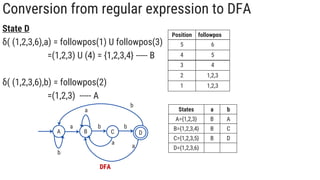
State D
δ( (1,2,3,6),a) = followpos(1) U followpos(3)
=(1,2,3) U (4) = {1,2,3,4} ----- B
δ( (1,2,3,6),b) = followpos(2)
=(1,2,3) ----- A
Position followpos
5 6
4 5
3 4
2 1,2,3
1 1,2,3
States a b
A={1,2,3} B A
B={1,2,3,4} B C
C={1,2,3,5} B D
D={1,2,3,6} B A
A B C D
a b b
b
a
a
b
a
DFA

4-Regular expression to Deterministic Finite Automata (Direct method)-05-05-2023.pptx

  • 1.
    Subset construction algorithm Input:An NFA 𝑁. Output: A DFA D accepting the same language. Method: Algorithm construct a transition table 𝐷𝑡𝑟𝑎𝑛 for D. We use the following operation: OPERATION DESCRIPTION  − 𝑐𝑙𝑜𝑠𝑢𝑟𝑒(𝑠) Set of NFA states reachable from NFA state 𝑠 on – transition alone.  − 𝑐𝑙𝑜𝑠𝑢𝑟𝑒(𝑇) Set of NFA states reachable from some NFA state 𝑠 in 𝑇 on – transition alone. 𝑴𝒐𝒗𝒆 (𝑇, 𝑎) Set of NFA states to which there is a transition on input symbol 𝑎 from some NFA state 𝑠 in 𝑇.
  • 2.
    Subset construction algorithm initially − 𝑐𝑙𝑜𝑠𝑢𝑟𝑒(𝑠0) be the only state in 𝐷𝑠𝑡𝑎𝑡𝑒𝑠 and it is unmarked; while there is unmarked states T in 𝐷𝑠𝑡𝑎𝑡𝑒𝑠 do begin mark 𝑇; for each input symbol 𝑎 do begin 𝑈 = 𝜖 − 𝑐𝑙𝑜𝑠𝑢𝑟𝑒 𝑚𝑜𝑣𝑒 𝑇, 𝑎 ; if 𝑈 is not in 𝐷𝑠𝑡𝑎𝑡𝑒𝑠 then add 𝑈 as unmarked state to 𝐷𝑠𝑡𝑎𝑡𝑒𝑠; 𝐷𝑡𝑟𝑎𝑛[ 𝑇, 𝑎 ] = 𝑈 end end
  • 3.
    Conversion from NFAto DFA 1 (a|b)*abb 2 5 3 4 6 7 8 9 0 10 𝜖 a b 𝜖 a b b 𝜖 𝜖 𝜖 𝜖 𝜖 𝜖
  • 4.
    Conversion from NFAto DFA 1 2 5 3 4 6 7 8 9 0 𝜖 a b 𝜖 a b b 𝜖 𝜖 𝜖 𝜖 𝜖 𝜖 10 {0, 1, 7, 2, 4} ---- A 𝜖- Closure(0)= = {0,1,2,4,7}
  • 5.
    Conversion from NFAto DFA 1 2 5 3 4 6 7 8 9 0 𝜖 a b 𝜖 a b b 𝜖 𝜖 𝜖 𝜖 𝜖 𝜖 A= {0, 1, 2, 4, 7} Move(A,a) = {3,8} 𝜖- Closure(Move(A,a)) = {3, 6, 7, 1, 2, 4, 8} ---- B = {1,2,3,4,6,7,8} 10 States a b A = {0,1,2,4,7} B B = {1,2,3,4,6,7,8}
  • 6.
    Conversion from NFAto DFA 1 2 5 3 4 6 7 8 0 𝜖 a b 𝜖 a b b 𝜖 𝜖 𝜖 𝜖 𝜖 𝜖 A= {0, 1, 2, 4, 7} Move(A,b) = {5} 𝜖- Closure(Move(A,b)) = {5, 6, 7, 1, 2, 4} ---- C = {1,2,4,5,6,7} {5} 10 9 States a b A = {0,1,2,4,7} B C B = {1,2,3,4,6,7,8} C = {1,2,4,5,6,7}
  • 7.
    Conversion from NFAto DFA 1 2 5 3 4 6 7 8 0 𝜖 a b 𝜖 a b 𝜖 𝜖 𝜖 𝜖 𝜖 𝜖 B = {1, 2, 3, 4, 6, 7, 8} Move(B,a) = {3,8} 𝜖- Closure(Move(B,a)) = {3, 6, 7, 1, 2, 4, 8} ---- B = {1,2,3,4,6,7,8} b 10 9 States a b A = {0,1,2,4,7} B C B = {1,2,3,4,6,7,8} B C = {1,2,4,5,6,7}
  • 8.
    Conversion from NFAto DFA 1 2 5 3 4 6 7 8 0 𝜖 a b 𝜖 a b 𝜖 𝜖 𝜖 𝜖 𝜖 𝜖 B= {1, 2, 3, 4, 6, 7, 8} Move(B,b) = {5,9} 𝜖- Closure(Move(B,b)) = {5, 6, 7, 1, 2, 4, 9} ---- D = {1,2,4,5,6,7,9} b 10 9 States a b A = {0,1,2,4,7} B C B = {1,2,3,4,6,7,8} B D C = {1,2,4,5,6,7} D = {1,2,4,5,6,7,9}
  • 9.
    Conversion from NFAto DFA 1 2 5 3 4 6 7 8 0 𝜖 a b 𝜖 a b 𝜖 𝜖 𝜖 𝜖 𝜖 𝜖 Move(C,a) = {3,8} 𝜖- Closure(Move(C,a)) = {3, 6, 7, 1, 2, 4, 8} ---- B = {1,2,3,4,6,7,8} C= {1, 2, 4, 5, 6 ,7} b 10 9 States a b A = {0,1,2,4,7} B C B = {1,2,3,4,6,7,8} B D C = {1,2,4,5,6,7} B D = {1,2,4,5,6,7,9}
  • 10.
    Conversion from NFAto DFA 1 2 5 3 4 6 7 8 0 𝜖 a b 𝜖 a b b 𝜖 𝜖 𝜖 𝜖 𝜖 𝜖 Move(C,b) = {5} 𝜖- Closure(Move(C,b))= {5, 6, 7, 1, 2, 4} ---- C = {1,2,4,5,6,7} C= {1, 2, 4, 5, 6, 7} 10 9 States a b A = {0,1,2,4,7} B C B = {1,2,3,4,6,7,8} B D C = {1,2,4,5,6,7} B C D = {1,2,4,5,6,7,9}
  • 11.
    Conversion from NFAto DFA 1 2 5 3 4 6 7 8 0 𝜖 a b 𝜖 a b b 𝜖 𝜖 𝜖 𝜖 𝜖 𝜖 Move(D,a) = {3,8} 𝜖- Closure(Move(D,a)) = {3, 6, 7, 1, 2, 4, 8} ---- B = {1,2,3,4,6,7,8} D= {1, 2, 4, 5, 6, 7, 9} 10 9 States a b A = {0,1,2,4,7} B C B = {1,2,3,4,6,7,8} B D C = {1,2,4,5,6,7} B C D = {1,2,4,5,6,7,9} B
  • 12.
    Conversion from NFAto DFA 1 2 5 3 4 6 7 8 0 𝜖 a b 𝜖 a b b 𝜖 𝜖 𝜖 𝜖 𝜖 𝜖 Move(D,b) = {5,10} 𝜖- Closure(Move(D,b)) = {5, 6, 7, 1, 2, 4, 10} ---- E = {1,2,4,5,6,7,10} D= {1, 2, 4, 5, 6, 7, 9} 10 9 States a b A = {0,1,2,4,7} B C B = {1,2,3,4,6,7,8} B D C = {1,2,4,5,6,7} B C D = {1,2,4,5,6,7,9} B E E = {1,2,4,5,6,7,10}
  • 13.
    Conversion from NFAto DFA 1 2 5 3 4 6 7 8 0 𝜖 a b 𝜖 a b b 𝜖 𝜖 𝜖 𝜖 𝜖 𝜖 Move(E,a) = {3,8} 𝜖- Closure(Move(E,a)) = {3, 6, 7, 1, 2, 4, 8} ---- B = {1,2,3,4,6,7,8} E= {1, 2, 4, 5, 6, 7, 10} 10 9 States a b A = {0,1,2,4,7} B C B = {1,2,3,4,6,7,8} B D C = {1,2,4,5,6,7} B C D = {1,2,4,5,6,7,9} B E E = {1,2,4,5,6,7,10} B
  • 14.
    Conversion from NFAto DFA 1 2 5 3 4 6 7 8 0 𝜖 a b 𝜖 a b b 𝜖 𝜖 𝜖 𝜖 𝜖 𝜖 Move(E,b)= {5} 𝜖- Closure(Move(E,b))= {5,6,7,1,2,4} ---- C = {1,2,4,5,6,7} States a b A = {0,1,2,4,7} B C B = {1,2,3,4,6,7,8} B D C = {1,2,4,5,6,7} B C E= {1, 2, 4, 5, 6, 7, 10} D = {1,2,4,5,6,7,9} B E E = {1,2,4,5,6,7,10} B C 10 9
  • 15.
    Conversion from NFAto DFA A B C a b a b a D E b a b b a Transition Table DFA Note: • Accepting state in NFA is 10 • 10 is element of E • So, E is acceptance state in DFA States a b A = {0,1,2,4,7} B C B = {1,2,3,4,6,7,8} B D C = {1,2,4,5,6,7} B C D = {1,2,4,5,6,7,9} B E E = {1,2,4,5,6,7,10} B C
  • 16.
    DFA optimization 1. Constructan initial partition Π of the set of states with two groups: the accepting states 𝐹 and the non-accepting states 𝑆 − 𝐹. 2. Apply the repartition procedure to Π to construct a new partition Π𝑛𝑒𝑤. 3. If Π 𝑛𝑒𝑤 = Π, let Π𝑓𝑖𝑛𝑎𝑙 = Π and continue with step (4). Otherwise, repeat step (2) with Π = Π𝑛𝑒𝑤. for each group 𝐺 of Π do begin partition 𝐺 into subgroups such that two states 𝑠 and 𝑡 of 𝐺 are in the same subgroup if and only if for all input symbols 𝑎, states 𝑠 and 𝑡 have transitions on 𝑎 to states in the same group of Π. replace 𝐺 in Π𝑛𝑒𝑤 by the set of all subgroups formed. end
  • 17.
    DFA optimization 4. Chooseone state in each group of the partition Π𝑓𝑖𝑛𝑎𝑙 as the representative for that group. The representatives will be the states of 𝑀′. Let s be a representative state, and suppose on input a there is a transition of 𝑀 from 𝑠 to 𝑡. Let 𝑟 be the representative of 𝑡′s group. Then 𝑀′ has a transition from 𝑠 to 𝑟 on 𝑎. Let the start state of 𝑀′ be the representative of the group containing start state 𝑠0 of 𝑀, and let the accepting states of 𝑀′ be the representatives that are in 𝐹. 5. If 𝑀′ has a dead state 𝑑, then remove 𝑑 from 𝑀′. Also remove any state not reachable from the start state.
  • 18.
    DFA optimization • Nowno more splitting is possible. • If we chose A as the representative for group (AC), then we obtain reduced transition table A B C B B D C B C D B E E B C States a b {𝐴, 𝐵, 𝐶, 𝐷, 𝐸} Nonaccepting States {𝐴, 𝐵, 𝐶, 𝐷} Accepting States {𝐸} {𝐴, 𝐵, 𝐶} {𝐷} {𝐵} A B A B B D D B E E B A States a b Optimized Transition Table {𝐴, 𝐶}
  • 19.
    Rules to computenullable, firstpos, lastpos • nullable(n) • The subtree at node 𝑛 generates languages including the empty string. • firstpos(n) • The set of positions that can match the first symbol of a string generated by the subtree at node 𝑛. • lastpos(n) • The set of positions that can match the last symbol of a string generated be the subtree at node 𝑛. • followpos(i) • The set of positions that can follow position 𝑖 in the tree.
  • 20.
    Rules to computenullable, firstpos, lastpos Node n nullable(n) firstpos(n) lastpos(n) A leaf labeled by  true ∅ ∅ A leaf with position 𝐢 false {i} {i} nullable(c1) or nullable(c2) firstpos(c1)  firstpos(c2) lastpos(c1)  lastpos(c2) nullable(c1) and nullable(c2) if (nullable(c1)) thenfirstpos(c1)  firstpos(c2) else firstpos(c1) if (nullable(c2)) then lastpos(c1)  lastpos(c2) else lastpos(c2) true firstpos(c1) lastpos(c1) | n c1 c2 n ∗ n . c1 c2 c1
  • 21.
    Rules to computefollowpos 1. If n is concatenation node with left child c1 and right child c2 and i is a position in lastpos(c1), then all position in firstpos(c2) are in followpos(i) 2. If n is * node and i is position in lastpos(n), then all position in firstpos(n) are in followpos(i)
  • 22.
    Conversion from regularexpression to DFA 𝑎 𝑏 | ∗ . 𝟏 𝟐 𝑎 . . . 𝑏 𝑏 # (a|b)* abb 𝟒 𝟑 𝟓 𝟔 # Step 2: Nullable node Here, * is only nullable node Step 1: Construct Syntax Tree
  • 23.
    Conversion from regularexpression to DFA 𝑎 𝑏 | ∗ . {1} {2} {1,2} {1,2} 𝑎 {3} {1,2,3} . {4} {1,2,3} . {5} {1,2,3} . {6} {1,2,3} 𝑏 𝑏 # Step 3: Calculate firstpos Firstpos A leaf with position 𝒊 = {𝒊} | n c1 c2 firstpos(c1)  firstpos(c2) ∗ n c1 firstpos(c1) . n c1 c2 𝟏 𝟐 𝟒 𝟑 𝟓 𝟔 if (nullable(c1)) thenfirstpos(c1)  firstpos(c2) else firstpos(c1)
  • 24.
    Conversion from regularexpression to DFA 𝑎 𝑏 | ∗ . {1} {1} {2} {2} {1,2} {1,2} {1,2} {1,2} 𝑎 {3} {3} {1,2,3} {3} . {4} {4} {1,2,3} {4} . {5} {5} {1,2,3} {5} . {6} {6} {1,2,3} {6} 𝑏 𝑏 # Step 3: Calculate lastpos 𝟏 𝟐 𝟒 𝟑 𝟓 𝟔 Lastpos A leaf with position 𝒊 = {𝒊} | n c1 c2 if (nullable(c2)) then lastpos(c1)  lastpos(c2) else lastpos(c2) ∗ n c1 lastpos(c1) . n c1 c2 lastpos(c1)  lastpos(c2)
  • 25.
    Conversion from regularexpression to DFA Position followpos 𝑎 𝑏 | ∗ . {1} {1} {2} {2} {1,2} {1,2} {1,2} {1,2} 𝑎 {3} {3} {1,2,3} {3} . {4} {4} {1,2,3} {4} . {5} {5} {1,2,3} {5} . {6} {6} {1,2,3} {6} 𝑏 𝑏 # Step 4: Calculate followpos 𝟏 𝟐 𝟒 𝟑 𝟓 𝟔 5 6 {1,2,3} {5} . {6} {6} 𝒄𝟏 𝒄𝟐 𝑖 = 𝑙𝑎𝑠𝑡𝑝𝑜𝑠(𝑐1) = {5} 𝑓𝑖𝑟𝑠𝑡𝑝𝑜𝑠 𝑐2 = 6 𝑓𝑜𝑙𝑙𝑜𝑤𝑝𝑜𝑠 5 = 6 Firstpos Lastpos
  • 26.
    Conversion from regularexpression to DFA Position followpos 𝑎 𝑏 | ∗ . {1} {1} {2} {2} {1,2} {1,2} {1,2} {1,2} 𝑎 {3} {3} {1,2,3} {3} . {4} {4} {1,2,3} {4} . {5} {5} {1,2,3} {5} . {6} {6} {1,2,3} {6} 𝑏 𝑏 # Step 4: Calculate followpos 𝟏 𝟐 𝟒 𝟑 𝟓 𝟔 5 6 {1,2,3} {4} . {5} {5} 𝒄𝟏 𝒄𝟐 𝑖 = 𝑙𝑎𝑠𝑡𝑝𝑜𝑠(𝑐1) = {4} 𝑓𝑖𝑟𝑠𝑡𝑝𝑜𝑠 𝑐2 = 5 𝑓𝑜𝑙𝑙𝑜𝑤𝑝𝑜𝑠 4 = 5 4 5
  • 27.
    Conversion from regularexpression to DFA Position followpos 𝑎 𝑏 | ∗ . {1} {1} {2} {2} {1,2} {1,2} {1,2} {1,2} 𝑎 {3} {3} {1,2,3} {3} . {4} {4} {1,2,3} {4} . {5} {5} {1,2,3} {5} . {6} {6} {1,2,3} {6} 𝑏 𝑏 # Step 4: Calculate followpos 𝟏 𝟐 𝟒 𝟑 𝟓 𝟔 5 6 {1,2,3} {3} . {4} {4} 𝒄𝟏 𝒄𝟐 𝑖 = 𝑙𝑎𝑠𝑡𝑝𝑜𝑠(𝑐1) = {3} 𝑓𝑖𝑟𝑠𝑡𝑝𝑜𝑠 𝑐2 = 4 𝑓𝑜𝑙𝑙𝑜𝑤𝑝𝑜𝑠 3 = 4 4 5 3 4 Firstpos Lastpos
  • 28.
    Conversion from regularexpression to DFA Position followpos 𝑎 𝑏 | ∗ . {1} {1} {2} {2} {1,2} {1,2} {1,2} {1,2} 𝑎 {3} {3} {1,2,3} {3} . {4} {4} {1,2,3} {4} . {5} {5} {1,2,3} {5} . {6} {6} {1,2,3} {6} 𝑏 𝑏 # Step 4: Calculate followpos 𝟏 𝟐 𝟒 𝟑 𝟓 𝟔 5 6 {1,2} {1,2} . {3} {3} 𝒄𝟏 𝒄𝟐 4 5 3 4 2 3 1 3 Firstpos Lastpos 𝑖 = 𝑙𝑎𝑠𝑡𝑝𝑜𝑠(𝑐1) = {1,2} 𝑓𝑖𝑟𝑠𝑡𝑝𝑜𝑠 𝑐2 = 3 𝑓𝑜𝑙𝑙𝑜𝑤𝑝𝑜𝑠 1 = 3 𝑓𝑜𝑙𝑙𝑜𝑤𝑝𝑜𝑠 2 = 3
  • 29.
    Conversion from regularexpression to DFA Position followpos 𝑎 𝑏 | ∗ . {1} {1} {2} {2} {1,2} {1,2} {1,2} {1,2} 𝑎 {3} {3} {1,2,3} {3} . {4} {4} {1,2,3} {4} . {5} {5} {1,2,3} {5} . {6} {6} {1,2,3} {6} 𝑏 𝑏 # Step 4: Calculate followpos 𝟏 𝟐 𝟒 𝟑 𝟓 𝟔 5 6 𝒏 4 5 3 4 2 3 1 3 {1,2} {1,2} * 1,2, 1,2, Firstpos Lastpos 𝑖 = 𝑙𝑎𝑠𝑡𝑝𝑜𝑠(𝑛) = {1,2} 𝑓𝑖𝑟𝑠𝑡𝑝𝑜𝑠 𝑛 = 1,2 𝑓𝑜𝑙𝑙𝑜𝑤𝑝𝑜𝑠 1 = 1,2 𝑓𝑜𝑙𝑙𝑜𝑤𝑝𝑜𝑠 2 = 1,2
  • 30.
    Conversion from regularexpression to DFA Initial state = 𝑓𝑖𝑟𝑠𝑡𝑝𝑜𝑠 of root = {1,2,3} ----- A State A δ( (1,2,3),a) = followpos(1) U followpos(3) =(1,2,3) U (4) = {1,2,3,4} ----- B δ( (1,2,3),b) = followpos(2) =(1,2,3) ----- A Position followpos 5 6 4 5 3 4 2 1,2,3 1 1,2,3 States a b A={1,2,3} B A B={1,2,3,4}
  • 31.
    Conversion from regularexpression to DFA State B δ( (1,2,3,4),a) = followpos(1) U followpos(3) =(1,2,3) U (4) = {1,2,3,4} ----- B δ( (1,2,3,4),b) = followpos(2) U followpos(4) =(1,2,3) U (5) = {1,2,3,5} ----- C State C δ( (1,2,3,5),a) = followpos(1) U followpos(3) =(1,2,3) U (4) = {1,2,3,4} ----- B δ( (1,2,3,5),b) = followpos(2) U followpos(5) =(1,2,3) U (6) = {1,2,3,6} ----- D Position followpos 5 6 4 5 3 4 2 1,2,3 1 1,2,3 States a b A={1,2,3} B A B={1,2,3,4} B C C={1,2,3,5} B D D={1,2,3,6}
  • 32.
    Conversion from regularexpression to DFA State D δ( (1,2,3,6),a) = followpos(1) U followpos(3) =(1,2,3) U (4) = {1,2,3,4} ----- B δ( (1,2,3,6),b) = followpos(2) =(1,2,3) ----- A Position followpos 5 6 4 5 3 4 2 1,2,3 1 1,2,3 States a b A={1,2,3} B A B={1,2,3,4} B C C={1,2,3,5} B D D={1,2,3,6} B A A B C D a b b b a a b a DFA