1
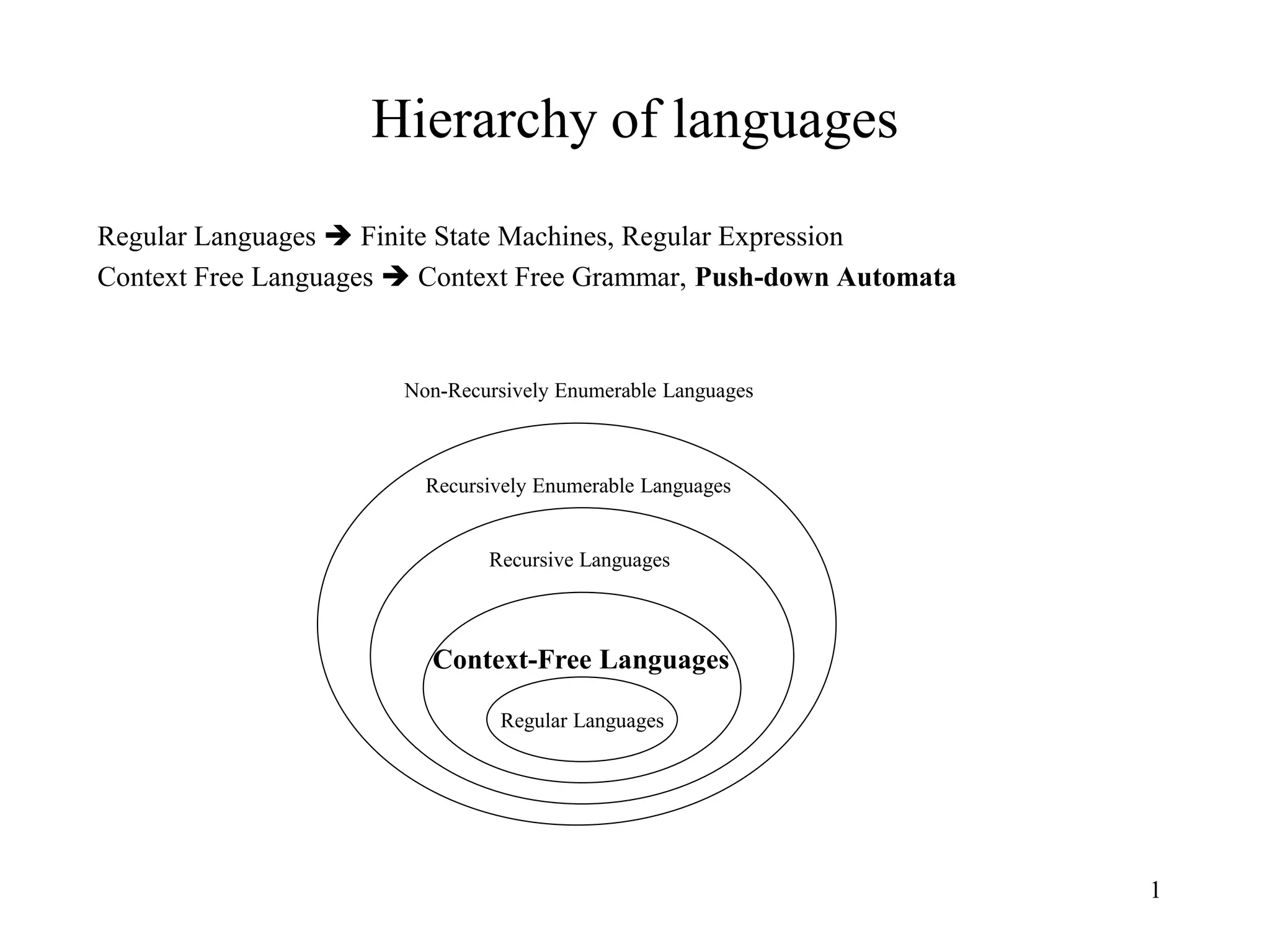
Hierarchy of languages
Regular Languages  Finite State Machines, Regular Expression
Context Free Languages  Context Free Grammar, Push-down Automata
Regular Languages
Context-Free Languages
Recursive Languages
Recursively Enumerable Languages
Non-Recursively Enumerable Languages
2
Pushdown Automata (PDA)
• Informally:
– A PDA is an NFA-ε with a stack.
– Transitions are modified to accommodate stack operations.
• Questions:
– What is a stack?
– How does a stack help?
• A DFA can “remember” only a finite amount of information, whereas a PDA can
“remember” an infinite amount of (certain types of) information, in one memory-stack
3
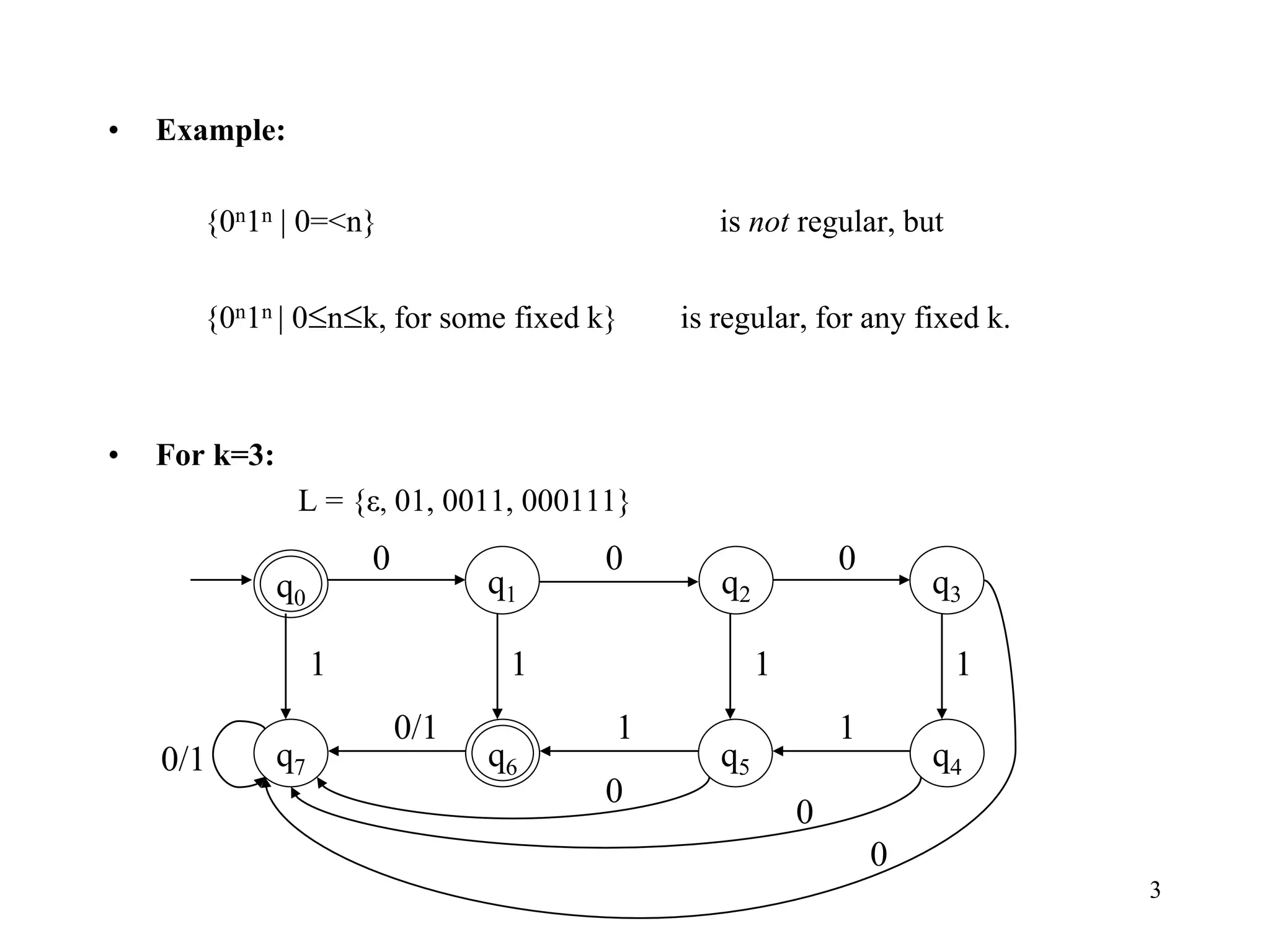
• Example:
{0n1n | 0=<n} is not regular, but
{0n1n | 0nk, for some fixed k} is regular, for any fixed k.
• For k=3:
L = {ε, 01, 0011, 000111}
0/1
q0
q7
0
q1
11
q2
1
q5
0
q3
11
q4
0
1
0
0
0/1 q6
0
4
• In a DFA, each state remembers a finite amount of information.
• To get {0n1n | 0n} with a DFA would require an infinite number of states
using the preceding technique.
• An infinite stack solves the problem for {0n1n | 0n} as follows:
– Read all 0’s and place them on a stack
– Read all 1’s and match with the corresponding 0’s on the stack
• Only need two states to do this in a PDA
• Similarly for {0n1m0n+m | n,m0}
5
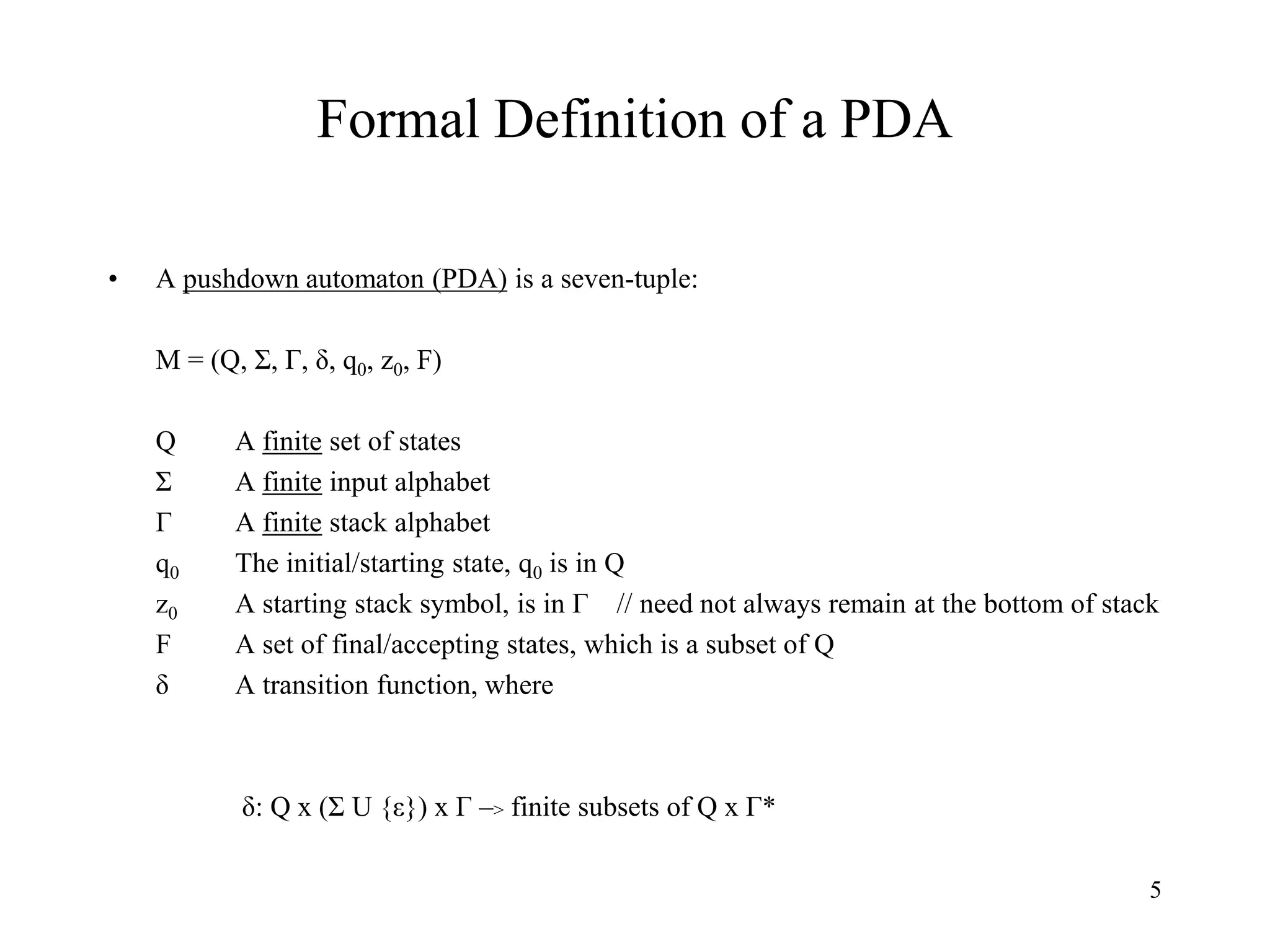
Formal Definition of a PDA
• A pushdown automaton (PDA) is a seven-tuple:
M = (Q, Σ, Г, δ, q0, z0, F)
Q A finite set of states
Σ A finite input alphabet
Г A finite stack alphabet
q0 The initial/starting state, q0 is in Q
z0 A starting stack symbol, is in Г // need not always remain at the bottom of stack
F A set of final/accepting states, which is a subset of Q
δ A transition function, where
δ: Q x (Σ U {ε}) x Г –> finite subsets of Q x Г*
6
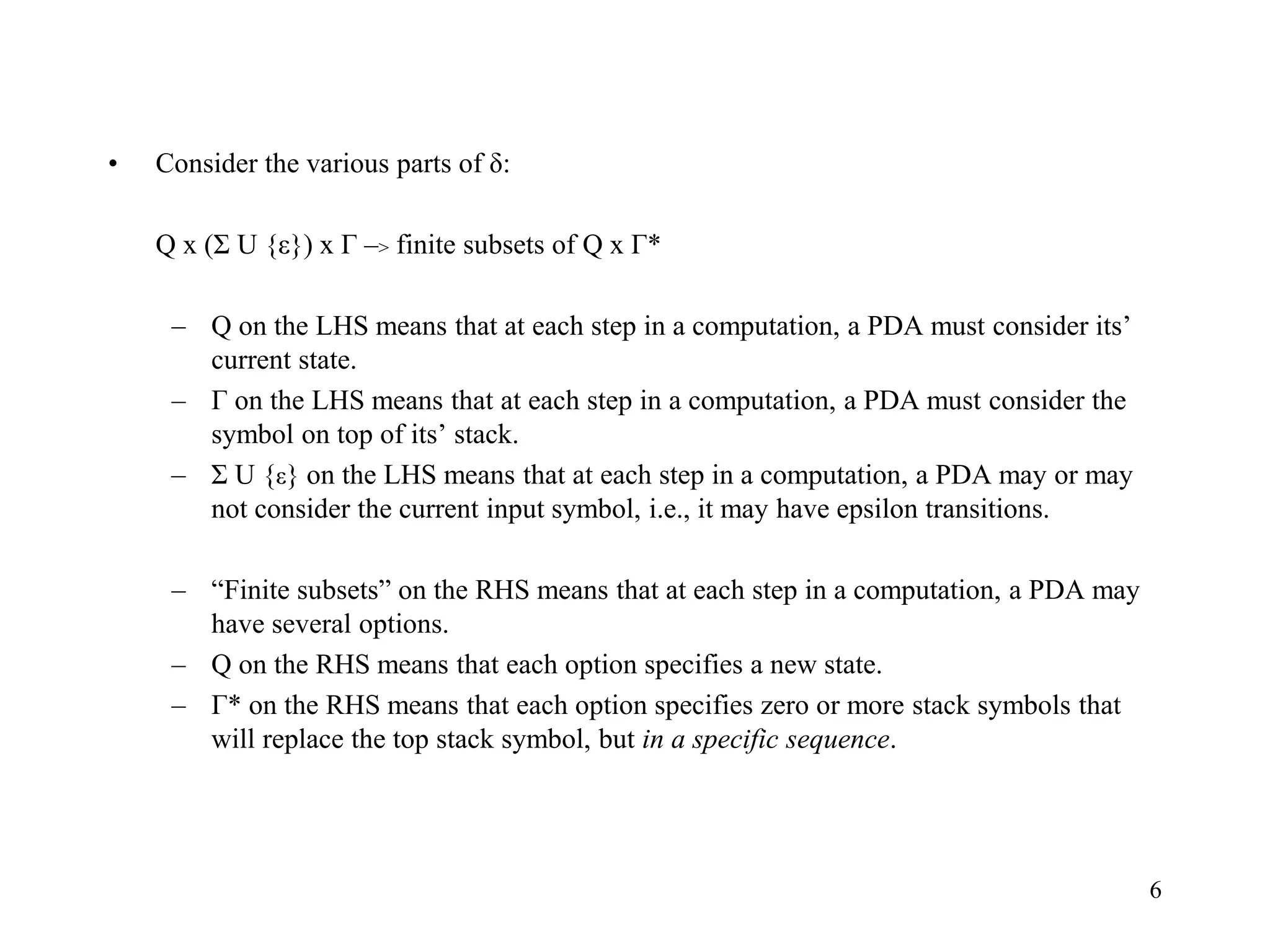
• Consider the various parts of δ:
Q x (Σ U {ε}) x Г –> finite subsets of Q x Г*
– Q on the LHS means that at each step in a computation, a PDA must consider its’
current state.
– Г on the LHS means that at each step in a computation, a PDA must consider the
symbol on top of its’ stack.
– Σ U {ε} on the LHS means that at each step in a computation, a PDA may or may
not consider the current input symbol, i.e., it may have epsilon transitions.
– “Finite subsets” on the RHS means that at each step in a computation, a PDA may
have several options.
– Q on the RHS means that each option specifies a new state.
– Г* on the RHS means that each option specifies zero or more stack symbols that
will replace the top stack symbol, but in a specific sequence.
7
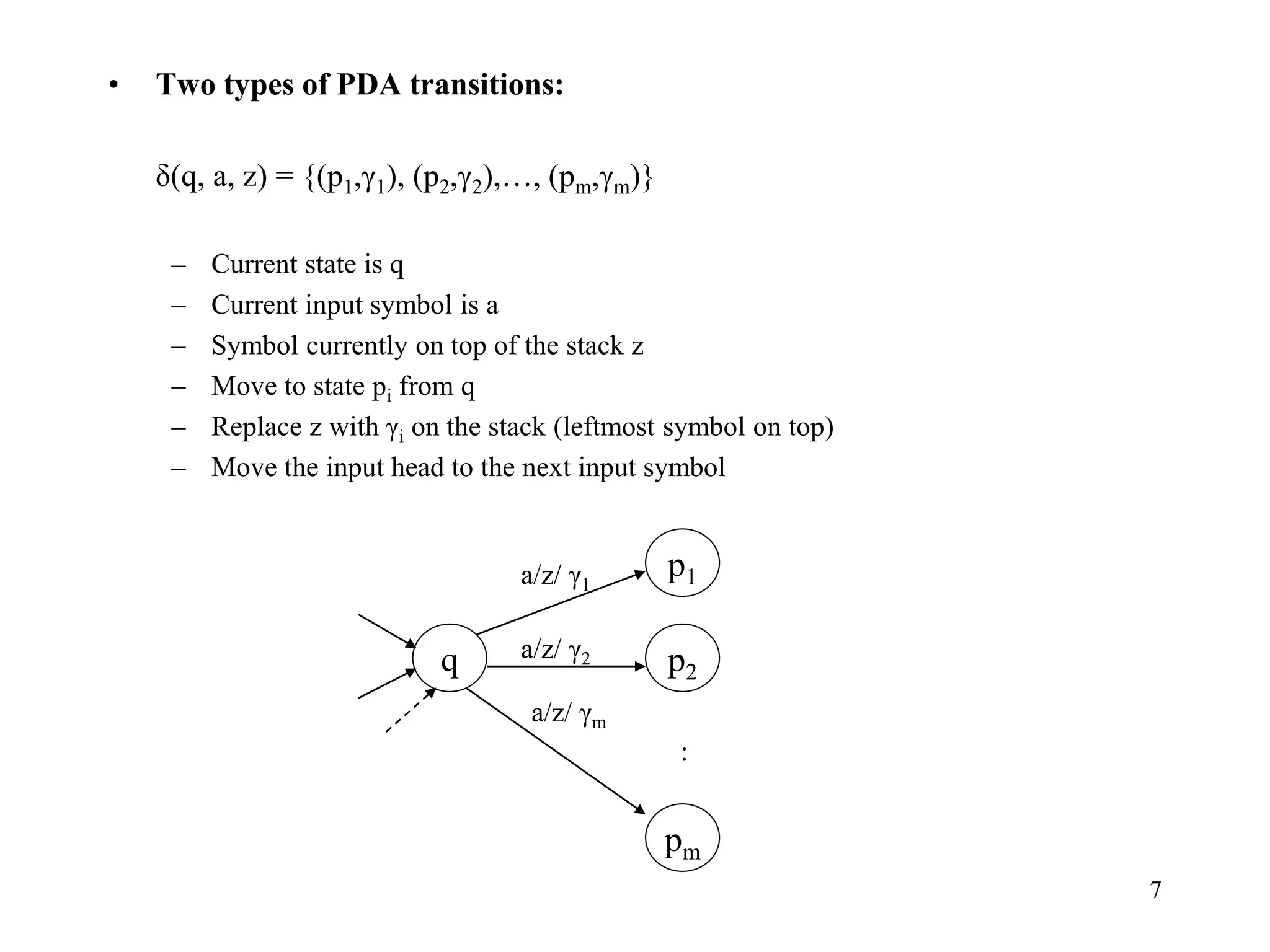
• Two types of PDA transitions:
δ(q, a, z) = {(p1,γ1), (p2,γ2),…, (pm,γm)}
– Current state is q
– Current input symbol is a
– Symbol currently on top of the stack z
– Move to state pi from q
– Replace z with γi on the stack (leftmost symbol on top)
– Move the input head to the next input symbol
:
q
p1
p2
pm
a/z/ γ1
a/z/ γ2
a/z/ γm
8
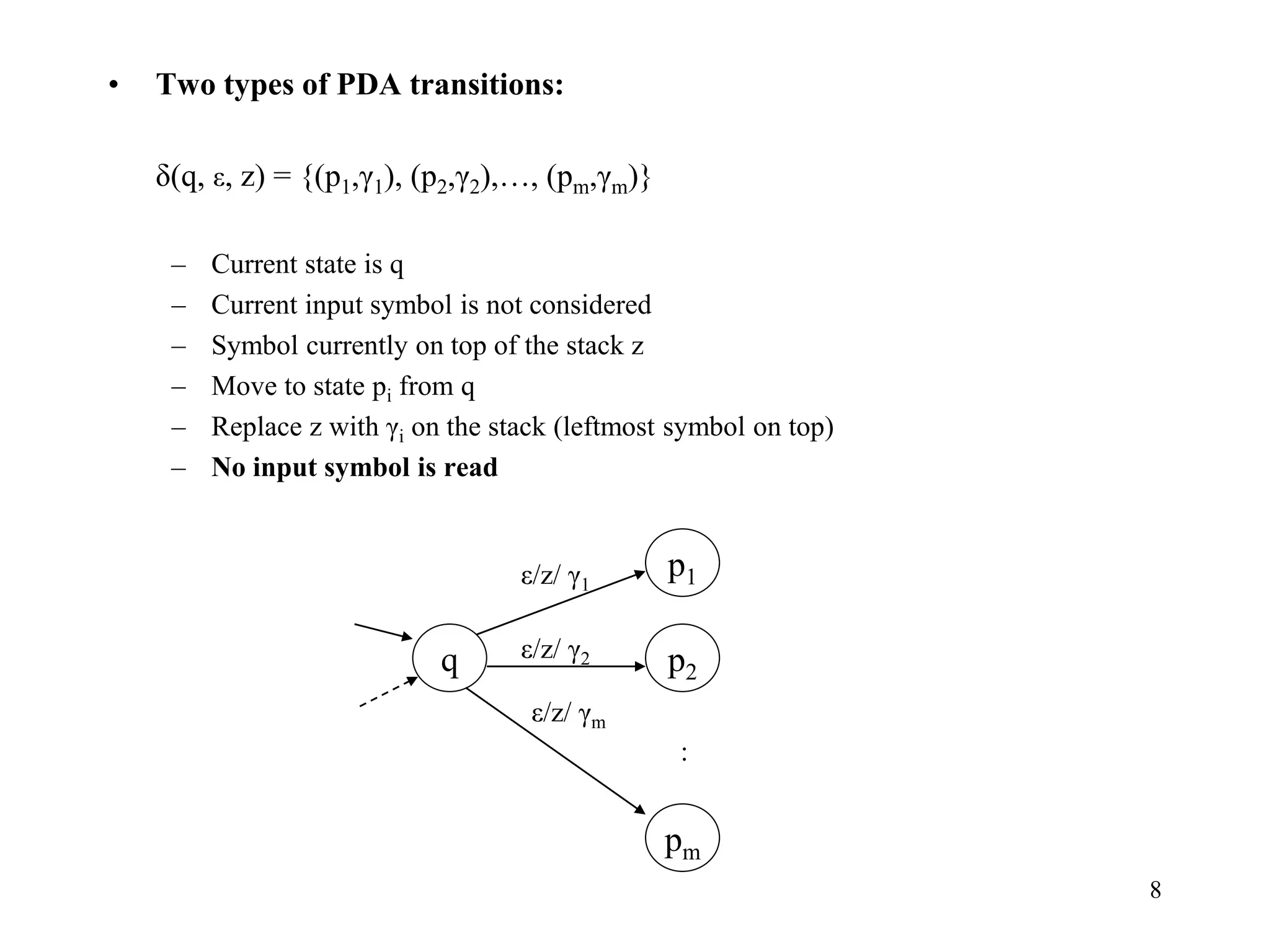
• Two types of PDA transitions:
δ(q, ε, z) = {(p1,γ1), (p2,γ2),…, (pm,γm)}
– Current state is q
– Current input symbol is not considered
– Symbol currently on top of the stack z
– Move to state pi from q
– Replace z with γi on the stack (leftmost symbol on top)
– No input symbol is read
:
q
p1
p2
pm
ε/z/ γ1
ε/z/ γ2
ε/z/ γm
9
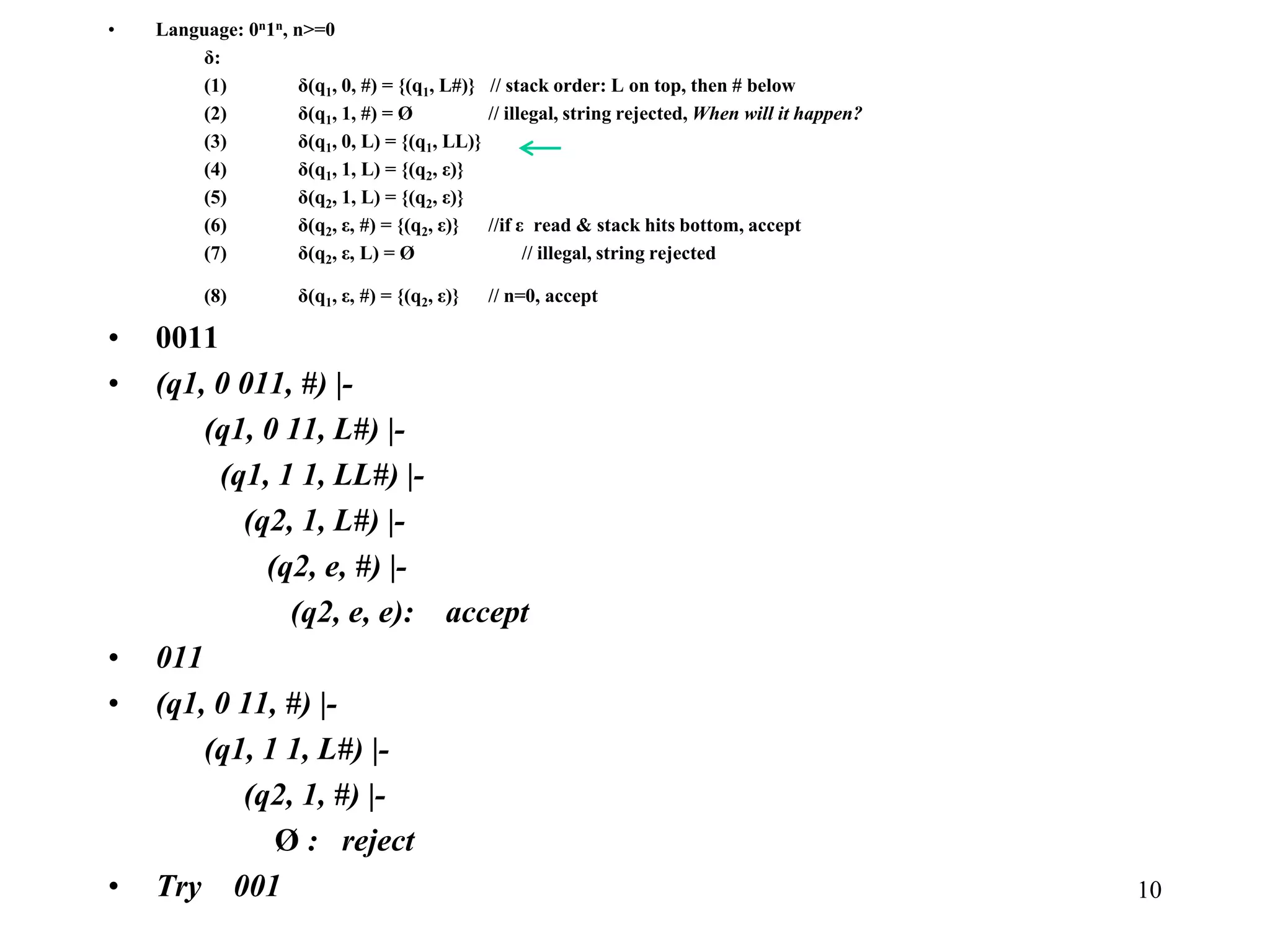
• Example: 0n1n, n>=0
M = ({q1, q2}, {0, 1}, {L, #}, δ, q1, #, Ø)
δ:
(1) δ(q1, 0, #) = {(q1, L#)} // stack order: L on top, then # below
(2) δ(q1, 1, #) = Ø // illegal, string rejected, When will it happen?
(3) δ(q1, 0, L) = {(q1, LL)}
(4) δ(q1, 1, L) = {(q2, ε)}
(5) δ(q2, 1, L) = {(q2, ε)}
(6) δ(q2, ε, #) = {(q2, ε)} //if ε read & stack hits bottom, accept
(7) δ(q2, ε, L) = Ø // illegal, string rejected
(8) δ(q1, ε, #) = {(q2, ε)} // n=0, accept
• Goal: (acceptance)
– Read the entire input string
– Terminate with an empty stack
• Informally, a string is accepted if there exists a computation that uses up all the
input and leaves the stack empty.
• How many rules should be there in delta?
10
• Language: 0n1n, n>=0
δ:
(1) δ(q1, 0, #) = {(q1, L#)} // stack order: L on top, then # below
(2) δ(q1, 1, #) = Ø // illegal, string rejected, When will it happen?
(3) δ(q1, 0, L) = {(q1, LL)}
(4) δ(q1, 1, L) = {(q2, ε)}
(5) δ(q2, 1, L) = {(q2, ε)}
(6) δ(q2, ε, #) = {(q2, ε)} //if ε read & stack hits bottom, accept
(7) δ(q2, ε, L) = Ø // illegal, string rejected
(8) δ(q1, ε, #) = {(q2, ε)} // n=0, accept
• 0011
• (q1, 0 011, #) |-
(q1, 0 11, L#) |-
(q1, 1 1, LL#) |-
(q2, 1, L#) |-
(q2, e, #) |-
(q2, e, e): accept
• 011
• (q1, 0 11, #) |-
(q1, 1 1, L#) |-
(q2, 1, #) |-
Ø : reject
• Try 001
11
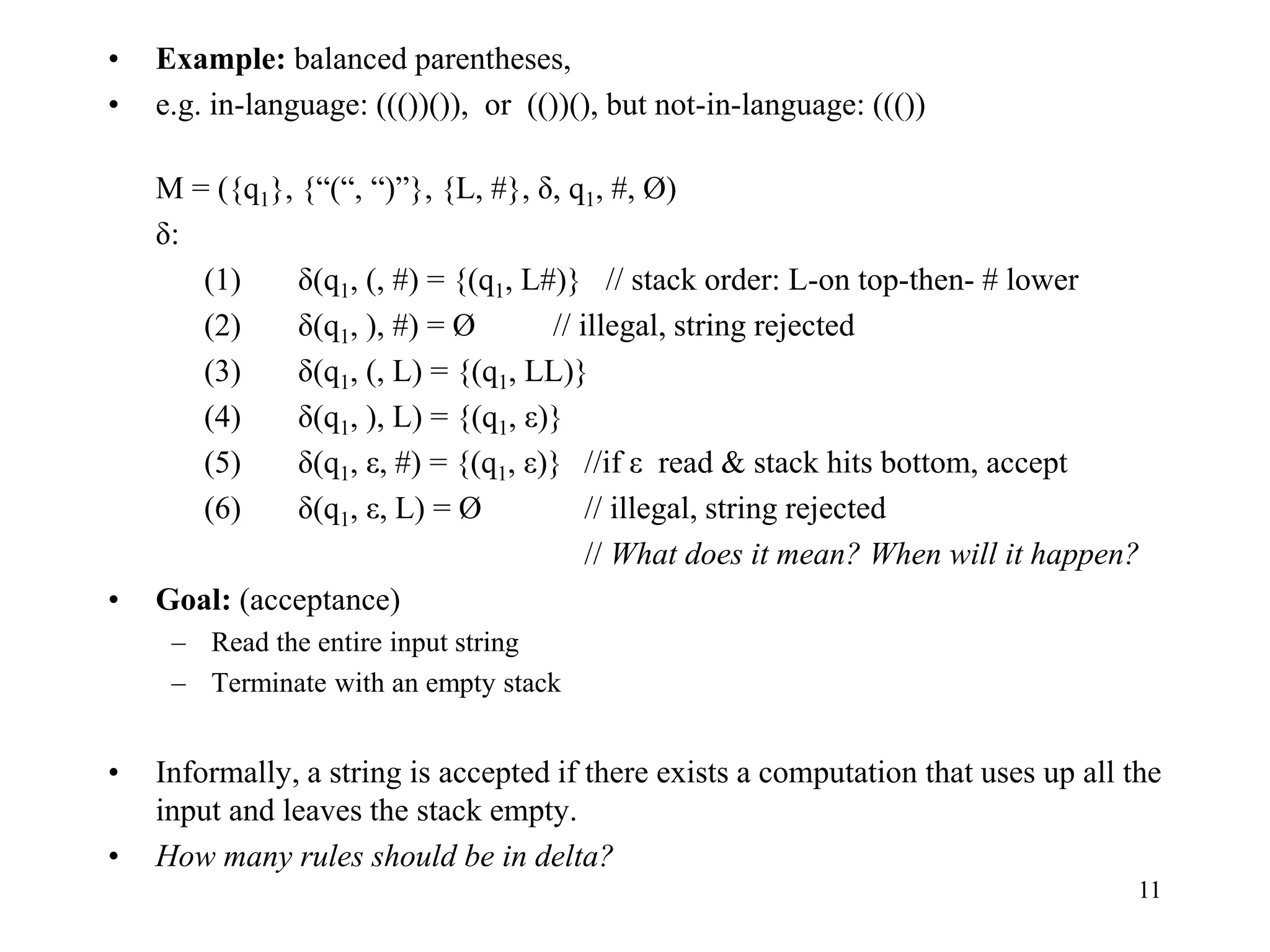
• Example: balanced parentheses,
• e.g. in-language: ((())()), or (())(), but not-in-language: ((())
M = ({q1}, {“(“, “)”}, {L, #}, δ, q1, #, Ø)
δ:
(1) δ(q1, (, #) = {(q1, L#)} // stack order: L-on top-then- # lower
(2) δ(q1, ), #) = Ø // illegal, string rejected
(3) δ(q1, (, L) = {(q1, LL)}
(4) δ(q1, ), L) = {(q1, ε)}
(5) δ(q1, ε, #) = {(q1, ε)} //if ε read & stack hits bottom, accept
(6) δ(q1, ε, L) = Ø // illegal, string rejected
// What does it mean? When will it happen?
• Goal: (acceptance)
– Read the entire input string
– Terminate with an empty stack
• Informally, a string is accepted if there exists a computation that uses up all the
input and leaves the stack empty.
• How many rules should be in delta?
12
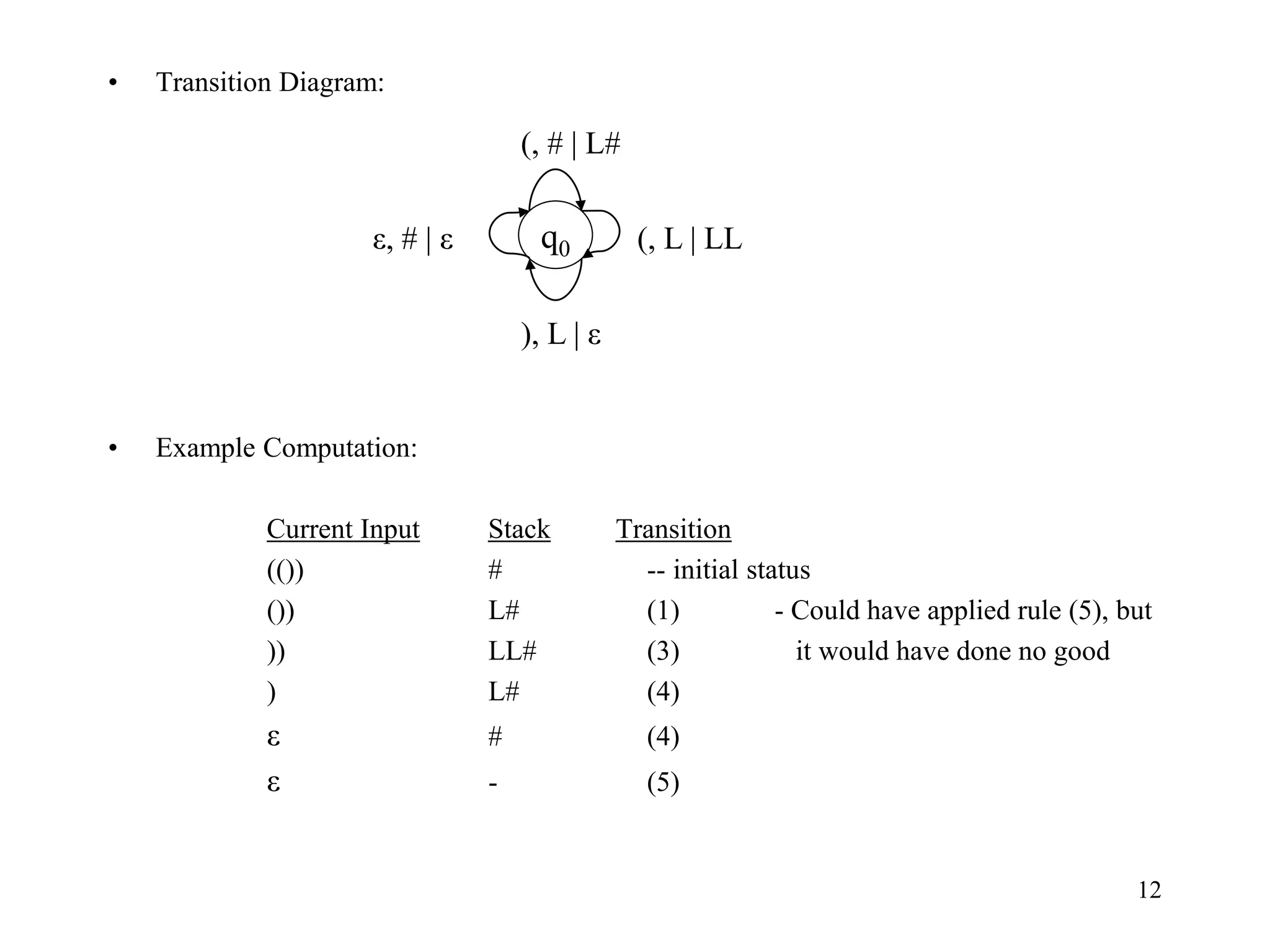
• Transition Diagram:
• Example Computation:
Current Input Stack Transition
(()) # -- initial status
()) L# (1) - Could have applied rule (5), but
)) LL# (3) it would have done no good
) L# (4)
ε # (4)
ε - (5)
q0
(, # | L#
ε, # | ε (, L | LL
), L | ε
13
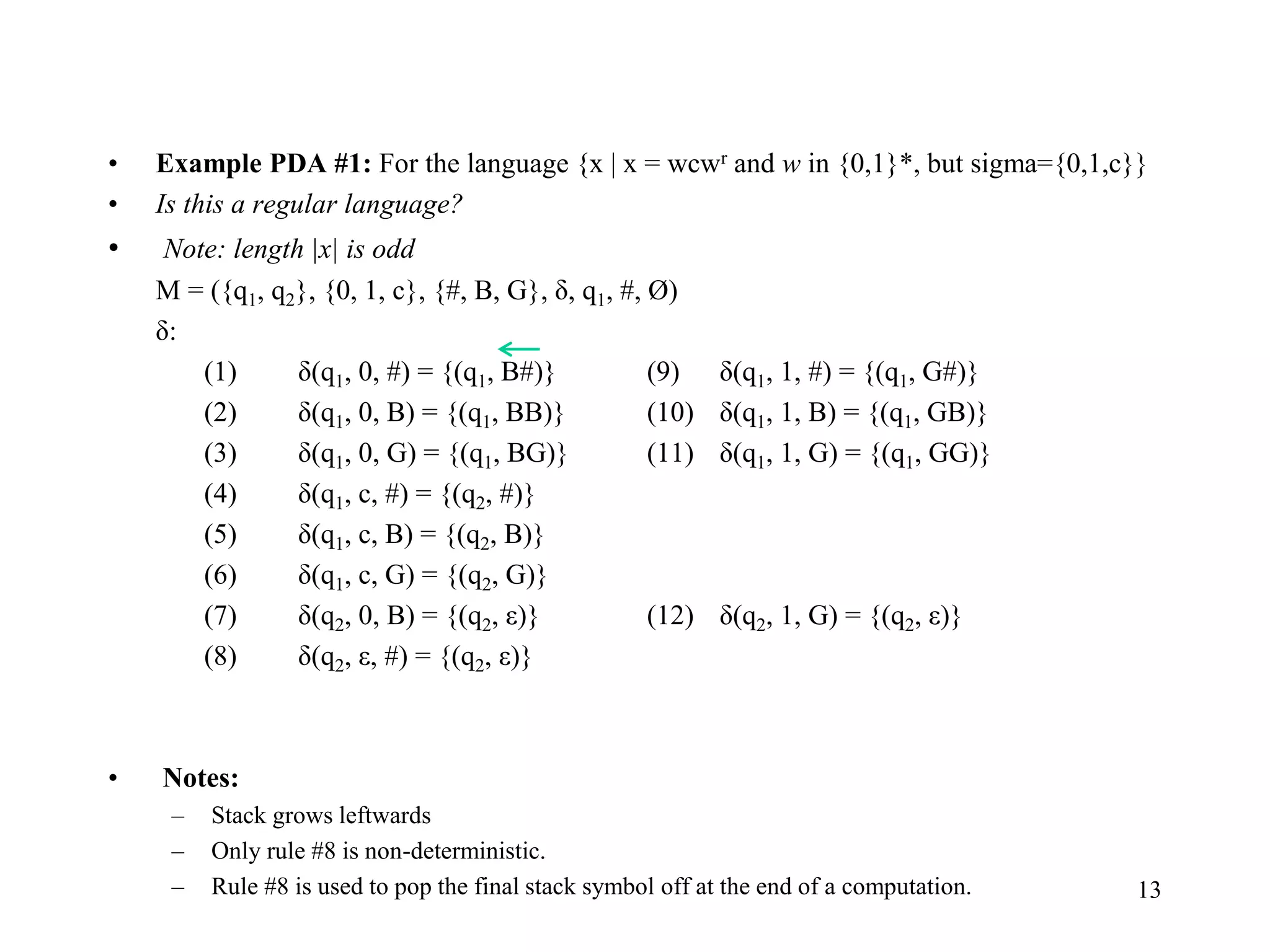
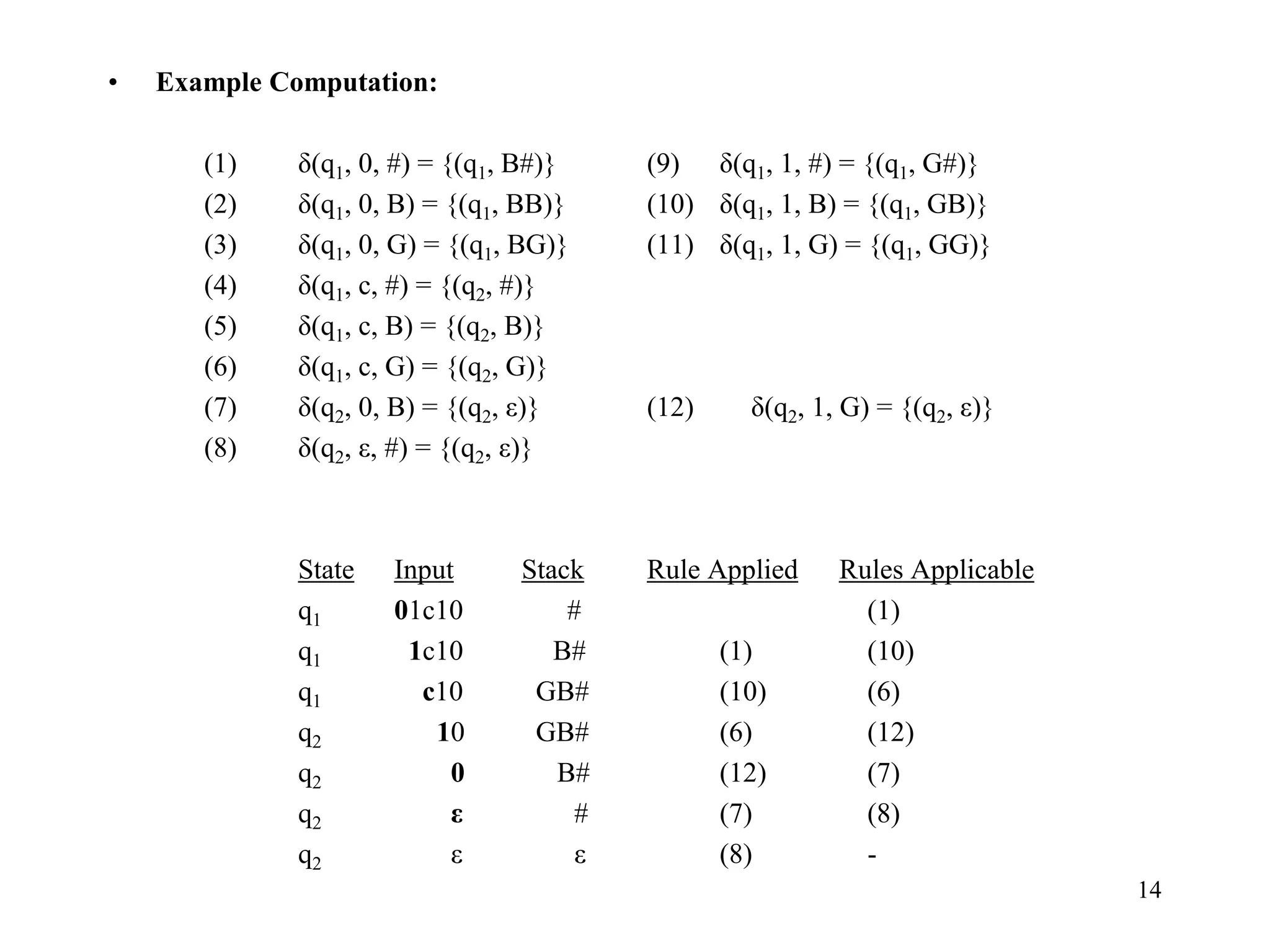
• Example PDA #1: For the language {x | x = wcwr and w in {0,1}*, but sigma={0,1,c}}
• Is this a regular language?
• Note: length |x| is odd
M = ({q1, q2}, {0, 1, c}, {#, B, G}, δ, q1, #, Ø)
δ:
(1) δ(q1, 0, #) = {(q1, B#)} (9) δ(q1, 1, #) = {(q1, G#)}
(2) δ(q1, 0, B) = {(q1, BB)} (10) δ(q1, 1, B) = {(q1, GB)}
(3) δ(q1, 0, G) = {(q1, BG)} (11) δ(q1, 1, G) = {(q1, GG)}
(4) δ(q1, c, #) = {(q2, #)}
(5) δ(q1, c, B) = {(q2, B)}
(6) δ(q1, c, G) = {(q2, G)}
(7) δ(q2, 0, B) = {(q2, ε)} (12) δ(q2, 1, G) = {(q2, ε)}
(8) δ(q2, ε, #) = {(q2, ε)}
• Notes:
– Stack grows leftwards
– Only rule #8 is non-deterministic.
– Rule #8 is used to pop the final stack symbol off at the end of a computation.
14
• Example Computation:
(1) δ(q1, 0, #) = {(q1, B#)} (9) δ(q1, 1, #) = {(q1, G#)}
(2) δ(q1, 0, B) = {(q1, BB)} (10) δ(q1, 1, B) = {(q1, GB)}
(3) δ(q1, 0, G) = {(q1, BG)} (11) δ(q1, 1, G) = {(q1, GG)}
(4) δ(q1, c, #) = {(q2, #)}
(5) δ(q1, c, B) = {(q2, B)}
(6) δ(q1, c, G) = {(q2, G)}
(7) δ(q2, 0, B) = {(q2, ε)} (12) δ(q2, 1, G) = {(q2, ε)}
(8) δ(q2, ε, #) = {(q2, ε)}
State Input Stack Rule Applied Rules Applicable
q1 01c10 # (1)
q1 1c10 B# (1) (10)
q1 c10 GB# (10) (6)
q2 10 GB# (6) (12)
q2 0 B# (12) (7)
q2 ε # (7) (8)
q2 ε ε (8) -
15
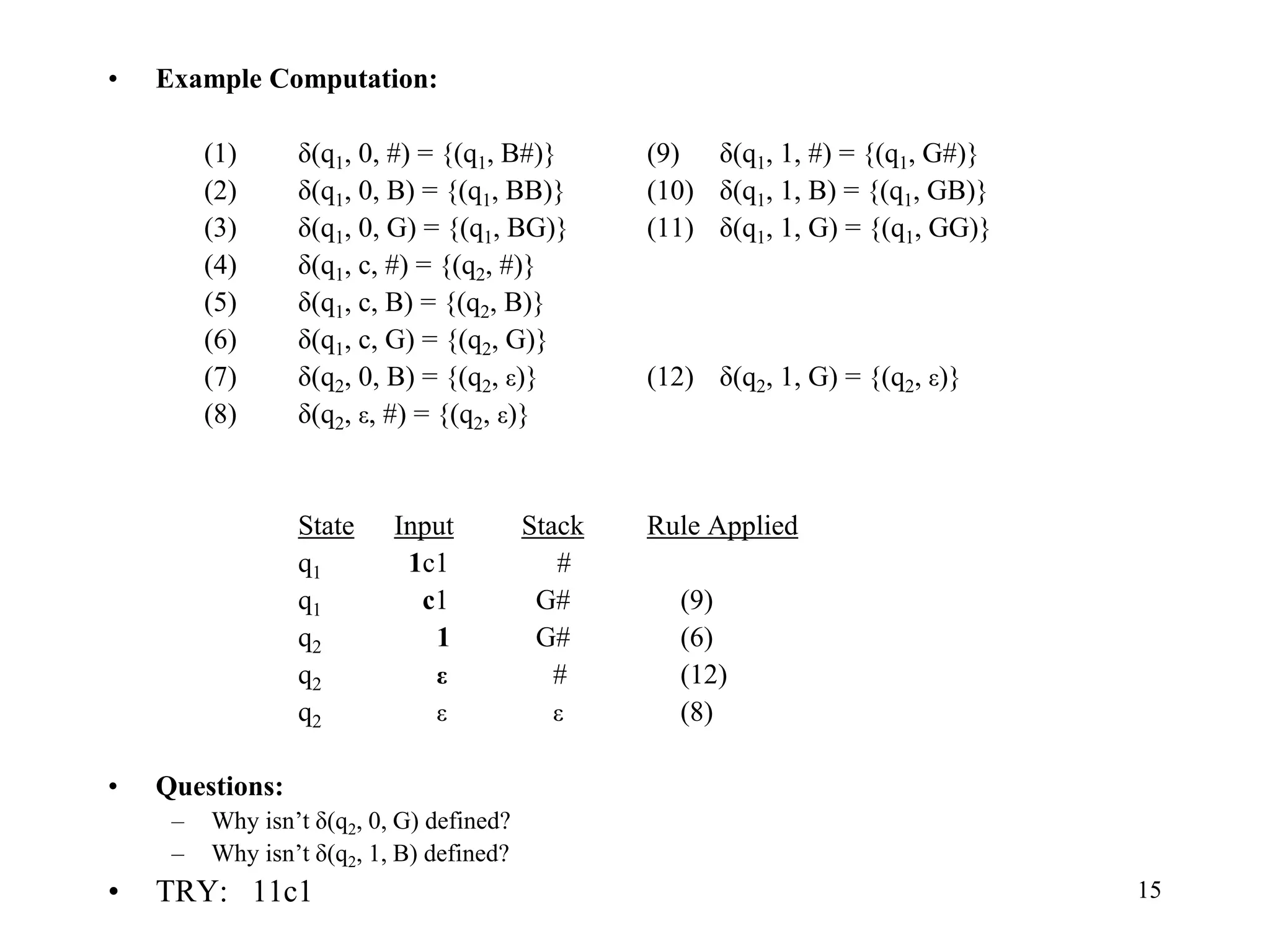
• Example Computation:
(1) δ(q1, 0, #) = {(q1, B#)} (9) δ(q1, 1, #) = {(q1, G#)}
(2) δ(q1, 0, B) = {(q1, BB)} (10) δ(q1, 1, B) = {(q1, GB)}
(3) δ(q1, 0, G) = {(q1, BG)} (11) δ(q1, 1, G) = {(q1, GG)}
(4) δ(q1, c, #) = {(q2, #)}
(5) δ(q1, c, B) = {(q2, B)}
(6) δ(q1, c, G) = {(q2, G)}
(7) δ(q2, 0, B) = {(q2, ε)} (12) δ(q2, 1, G) = {(q2, ε)}
(8) δ(q2, ε, #) = {(q2, ε)}
State Input Stack Rule Applied
q1 1c1 #
q1 c1 G# (9)
q2 1 G# (6)
q2 ε # (12)
q2 ε ε (8)
• Questions:
– Why isn’t δ(q2, 0, G) defined?
– Why isn’t δ(q2, 1, B) defined?
• TRY: 11c1
16
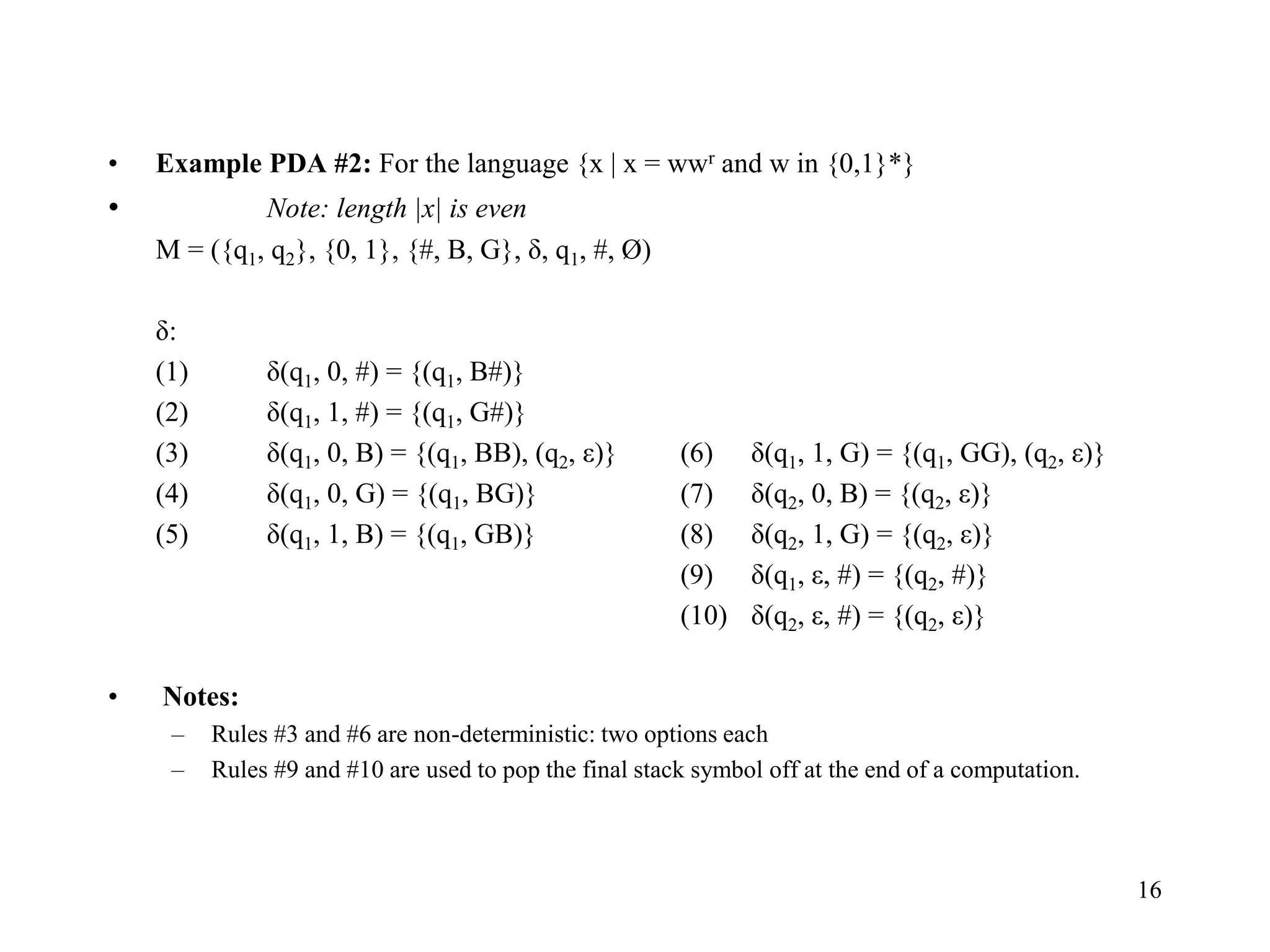
• Example PDA #2: For the language {x | x = wwr and w in {0,1}*}
• Note: length |x| is even
M = ({q1, q2}, {0, 1}, {#, B, G}, δ, q1, #, Ø)
δ:
(1) δ(q1, 0, #) = {(q1, B#)}
(2) δ(q1, 1, #) = {(q1, G#)}
(3) δ(q1, 0, B) = {(q1, BB), (q2, ε)} (6) δ(q1, 1, G) = {(q1, GG), (q2, ε)}
(4) δ(q1, 0, G) = {(q1, BG)} (7) δ(q2, 0, B) = {(q2, ε)}
(5) δ(q1, 1, B) = {(q1, GB)} (8) δ(q2, 1, G) = {(q2, ε)}
(9) δ(q1, ε, #) = {(q2, #)}
(10) δ(q2, ε, #) = {(q2, ε)}
• Notes:
– Rules #3 and #6 are non-deterministic: two options each
– Rules #9 and #10 are used to pop the final stack symbol off at the end of a computation.
17
• Example Computation:
(1) δ(q1, 0, #) = {(q1, B#)} (6) δ(q1, 1, G) = {(q1, GG), (q2, ε)}
(2) δ(q1, 1, #) = {(q1, G#)} (7) δ(q2, 0, B) = {(q2, ε)}
(3) δ(q1, 0, B) = {(q1, BB), (q2, ε)} (8) δ(q2, 1, G) = {(q2, ε)}
(4) δ(q1, 0, G) = {(q1, BG)} (9) δ(q1, ε, #) = {(q2, ε)}
(5) δ(q1, 1, B) = {(q1, GB)} (10) δ(q2, ε, #) = {(q2, ε)}
State Input Stack Rule Applied Rules Applicable
q1 000000 # (1), (9)
q1 00000 B# (1) (3), both options
q1 0000 BB# (3) option #1 (3), both options
q1 000 BBB# (3) option #1 (3), both options
q2 00 BB# (3)option #2 (7)
q2 0 B# (7) (7)
q2 ε # (7) (10)
q2 ε ε (10)
• Questions:
– What is rule #10 used for?
– What is rule #9 used for?
– Why do rules #3 and #6 have options?
– Why don’t rules #4 and #5 have similar options? [transition not possible if the previous input
symbol was different]
18
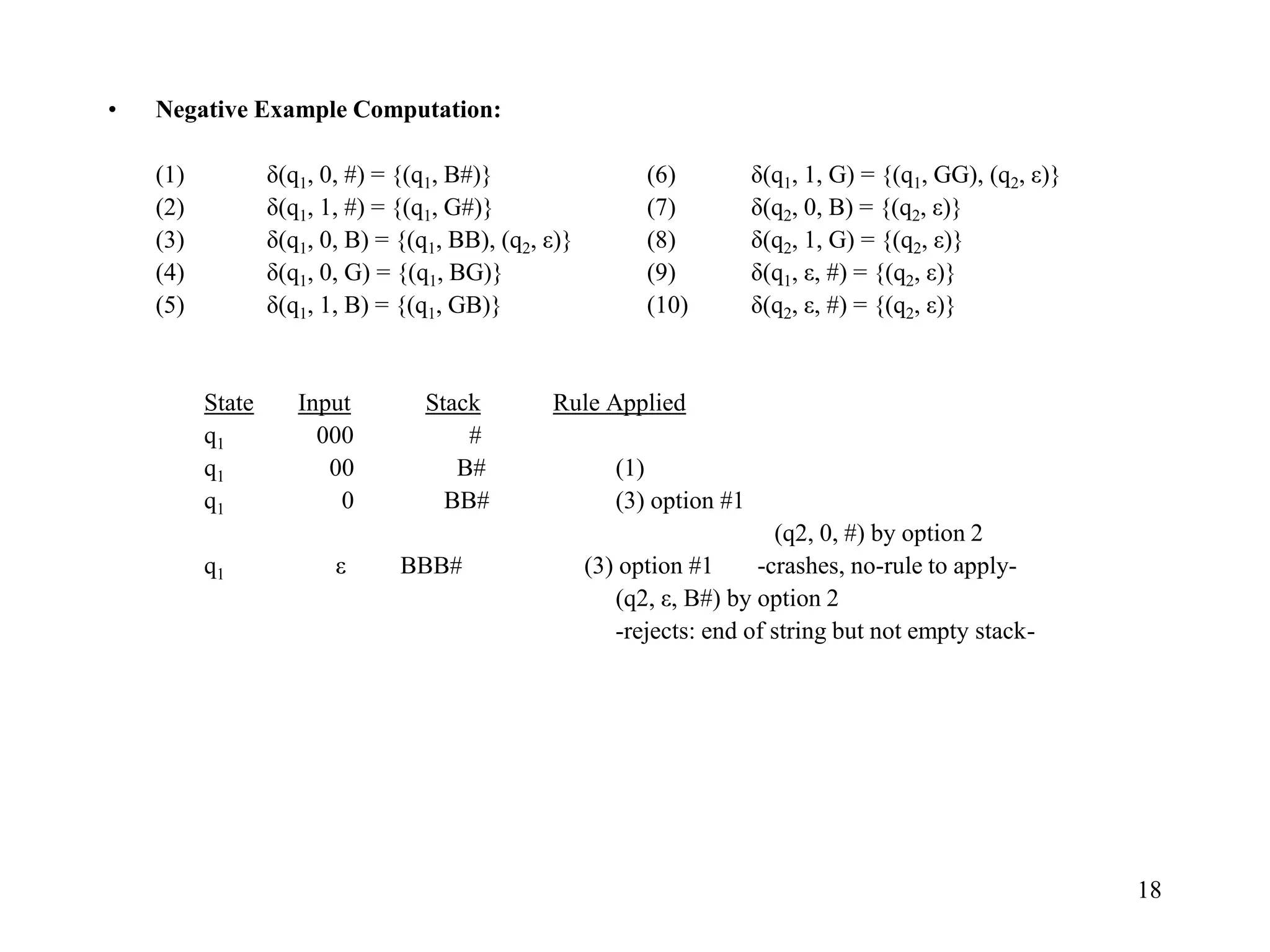
• Negative Example Computation:
(1) δ(q1, 0, #) = {(q1, B#)} (6) δ(q1, 1, G) = {(q1, GG), (q2, ε)}
(2) δ(q1, 1, #) = {(q1, G#)} (7) δ(q2, 0, B) = {(q2, ε)}
(3) δ(q1, 0, B) = {(q1, BB), (q2, ε)} (8) δ(q2, 1, G) = {(q2, ε)}
(4) δ(q1, 0, G) = {(q1, BG)} (9) δ(q1, ε, #) = {(q2, ε)}
(5) δ(q1, 1, B) = {(q1, GB)} (10) δ(q2, ε, #) = {(q2, ε)}
State Input Stack Rule Applied
q1 000 #
q1 00 B# (1)
q1 0 BB# (3) option #1
(q2, 0, #) by option 2
q1 ε BBB# (3) option #1 -crashes, no-rule to apply-
(q2, ε, B#) by option 2
-rejects: end of string but not empty stack-
19
• Example Computation:
(1) δ(q1, 0, #) = {(q1, B#)} (6) δ(q1, 1, G) = {(q1, GG), (q2, ε)}
(2) δ(q1, 1, #) = {(q1, G#)} (7) δ(q2, 0, B) = {(q2, ε)}
(3) δ(q1, 0, B) = {(q1, BB), (q2, ε)} (8) δ(q2, 1, G) = {(q2, ε)}
(4) δ(q1, 0, G) = {(q1, BG)} (9) δ(q1, ε, #) = {(q2, ε)}
(5) δ(q1, 1, B) = {(q1, GB)} (10) δ(q2, ε, #) = {(q2, ε)}
State Input Stack Rule Applied
q1 010010 #
q1 10010 B# (1) From (1) and (9)
q1 0010 GB# (5)
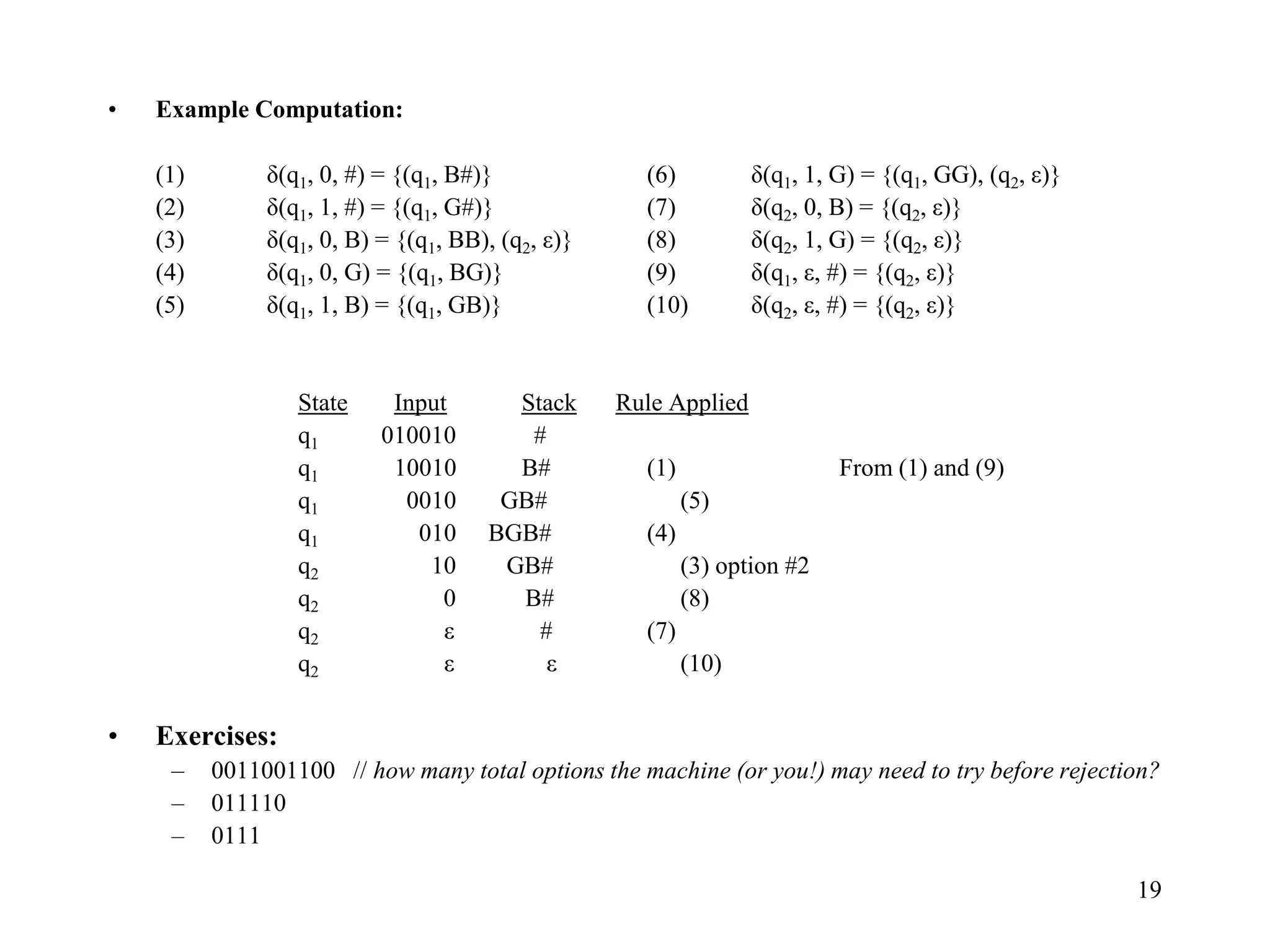
q1 010 BGB# (4)
q2 10 GB# (3) option #2
q2 0 B# (8)
q2 ε # (7)
q2 ε ε (10)
• Exercises:
– 0011001100 // how many total options the machine (or you!) may need to try before rejection?
– 011110
– 0111
20
Formal Definitions for PDAs
• Let M = (Q, Σ, Г, δ, q0, z0, F) be a PDA.
• Definition: An instantaneous description (ID) is a triple (q, w, γ), where q is in Q, w is
in Σ* and γ is in Г*.
– q is the current state
– w is the unused input
– γ is the current stack contents
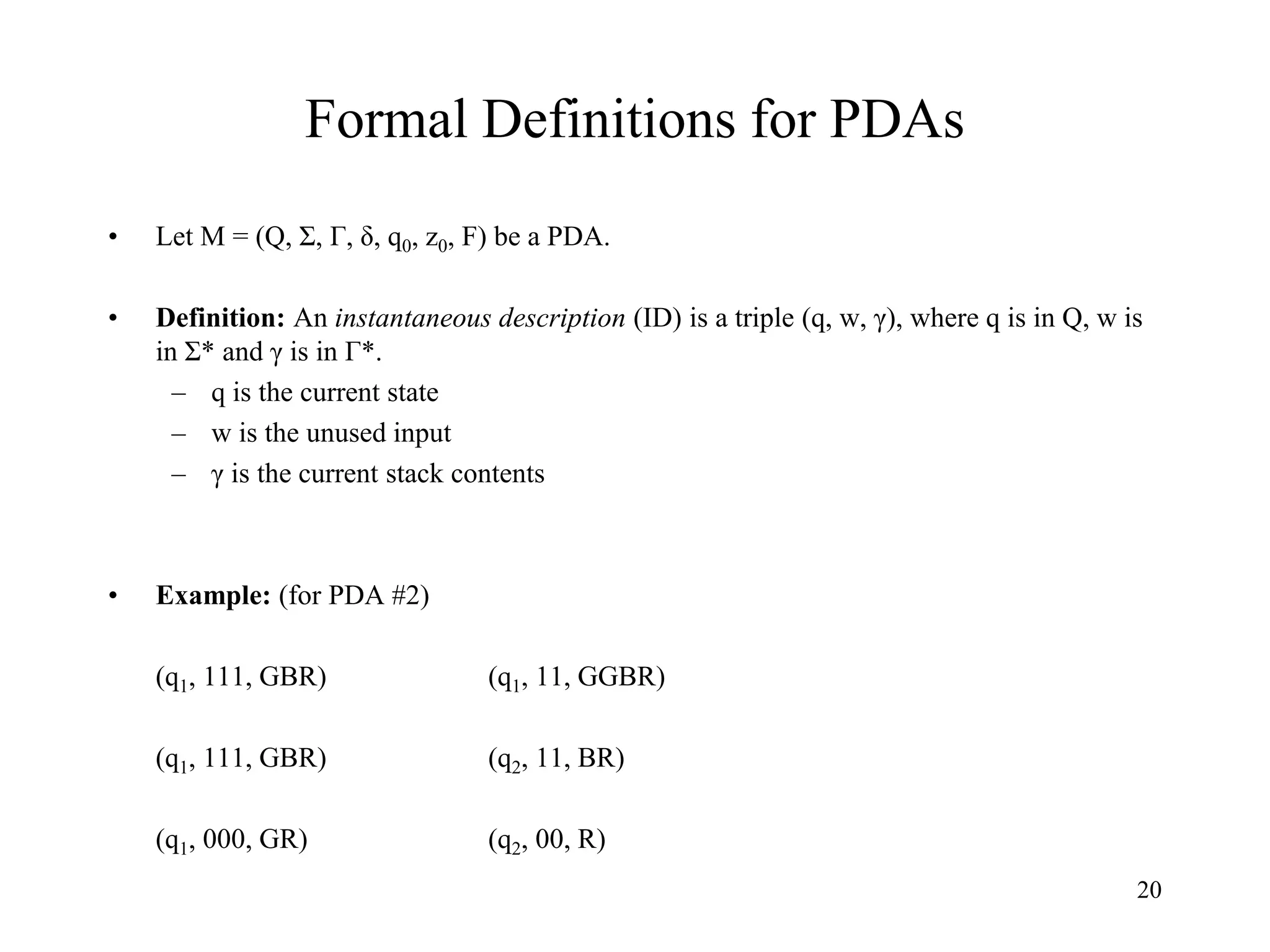
• Example: (for PDA #2)
(q1, 111, GBR) (q1, 11, GGBR)
(q1, 111, GBR) (q2, 11, BR)
(q1, 000, GR) (q2, 00, R)
21
• Let M = (Q, Σ, Г, δ, q0, z0, F) be a PDA.
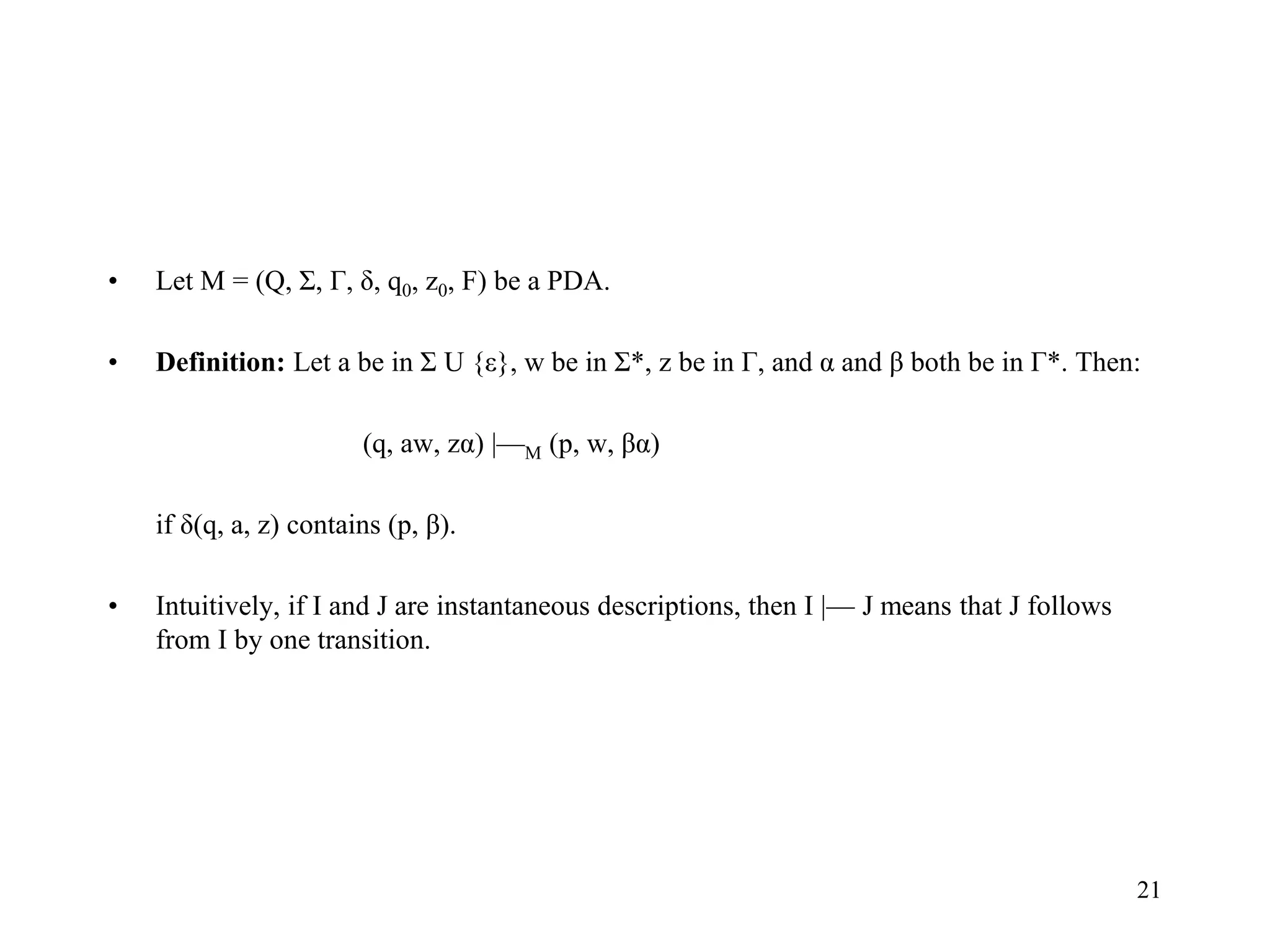
• Definition: Let a be in Σ U {ε}, w be in Σ*, z be in Г, and α and β both be in Г*. Then:
(q, aw, zα) |—M (p, w, βα)
if δ(q, a, z) contains (p, β).
• Intuitively, if I and J are instantaneous descriptions, then I |— J means that J follows
from I by one transition.
22
• Examples: (PDA #2)
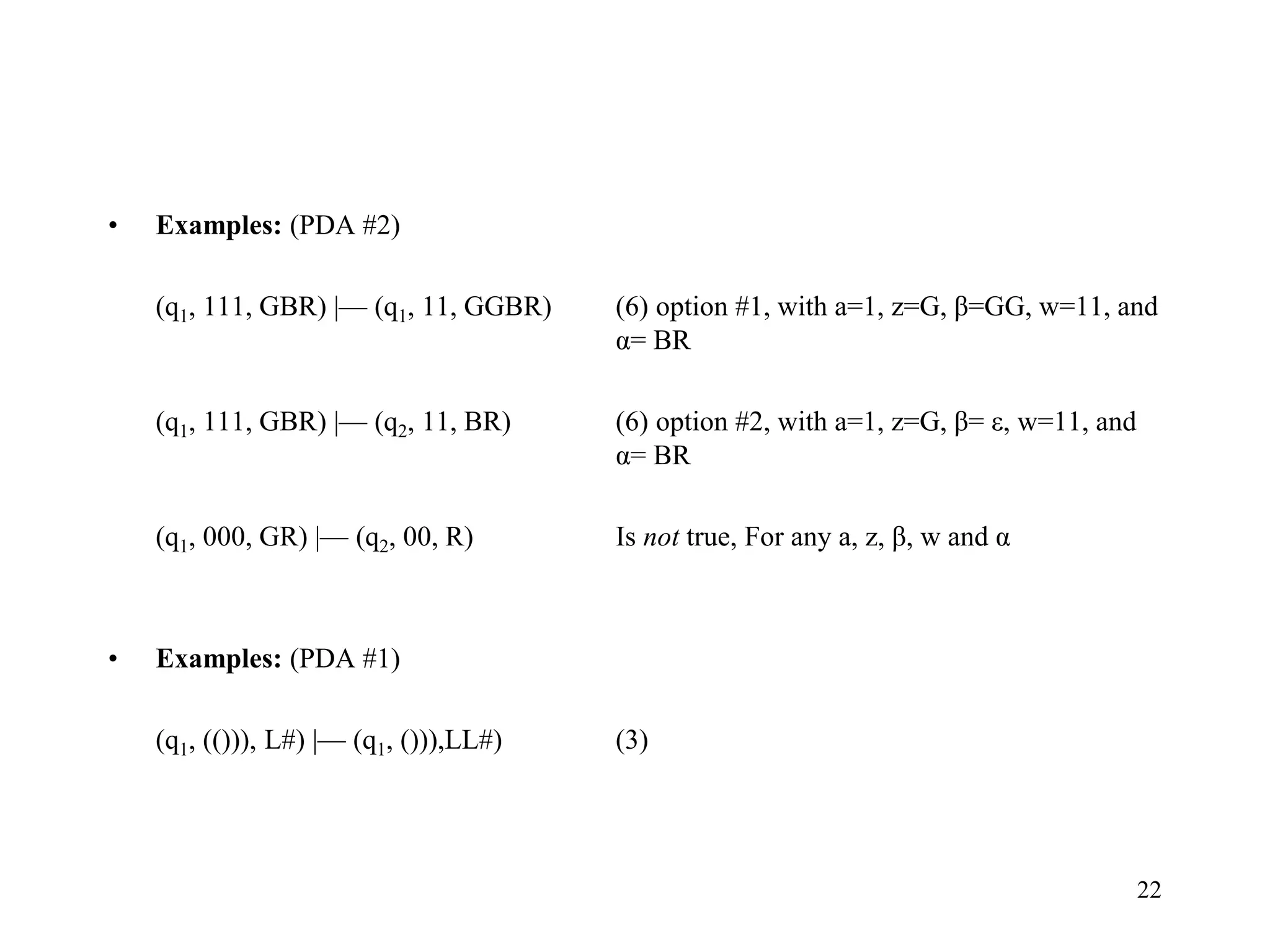
(q1, 111, GBR) |— (q1, 11, GGBR) (6) option #1, with a=1, z=G, β=GG, w=11, and
α= BR
(q1, 111, GBR) |— (q2, 11, BR) (6) option #2, with a=1, z=G, β= ε, w=11, and
α= BR
(q1, 000, GR) |— (q2, 00, R) Is not true, For any a, z, β, w and α
• Examples: (PDA #1)
(q1, (())), L#) |— (q1, ())),LL#) (3)
23
• Definition: |—* is the reflexive and transitive closure of |—.
– I |—* I for each instantaneous description I
– If I |— J and J |—* K then I |—* K
• Intuitively, if I and J are instantaneous descriptions, then I |—* J means that J follows
from I by zero or more transitions.
24
• Definition: Let M = (Q, Σ, Г, δ, q0, z0, F) be a PDA. The language accepted by empty
stack, denoted LE(M), is the set
{w | (q0, w, z0) |—* (p, ε, ε) for some p in Q}
• Definition: Let M = (Q, Σ, Г, δ, q0, z0, F) be a PDA. The language accepted by final
state, denoted LF(M), is the set
{w | (q0, w, z0) |—* (p, ε, γ) for some p in F and γ in Г*}
• Definition: Let M = (Q, Σ, Г, δ, q0, z0, F) be a PDA. The language accepted by empty
stack and final state, denoted L(M), is the set
{w | (q0, w, z0) |—* (p, ε, ε) for some p in F}
25
• Lemma 1: Let L = LE(M1) for some PDA M1. Then there exits a PDA M2 such that L =
LF(M2).
• Lemma 2: Let L = LF(M1) for some PDA M1. Then there exits a PDA M2 such that L =
LE(M2).
• Theorem: Let L be a language. Then there exits a PDA M1 such that L = LF(M1) if and
only if there exists a PDA M2 such that L = LE(M2).
• Corollary: The PDAs that accept by empty stack and the PDAs that accept by final state
define the same class of languages.
• Note: Similar lemmas and theorems could be stated for PDAs that accept by both final
state and empty stack.
Back to CFG again:
PDA equivalent to CFG
26
27
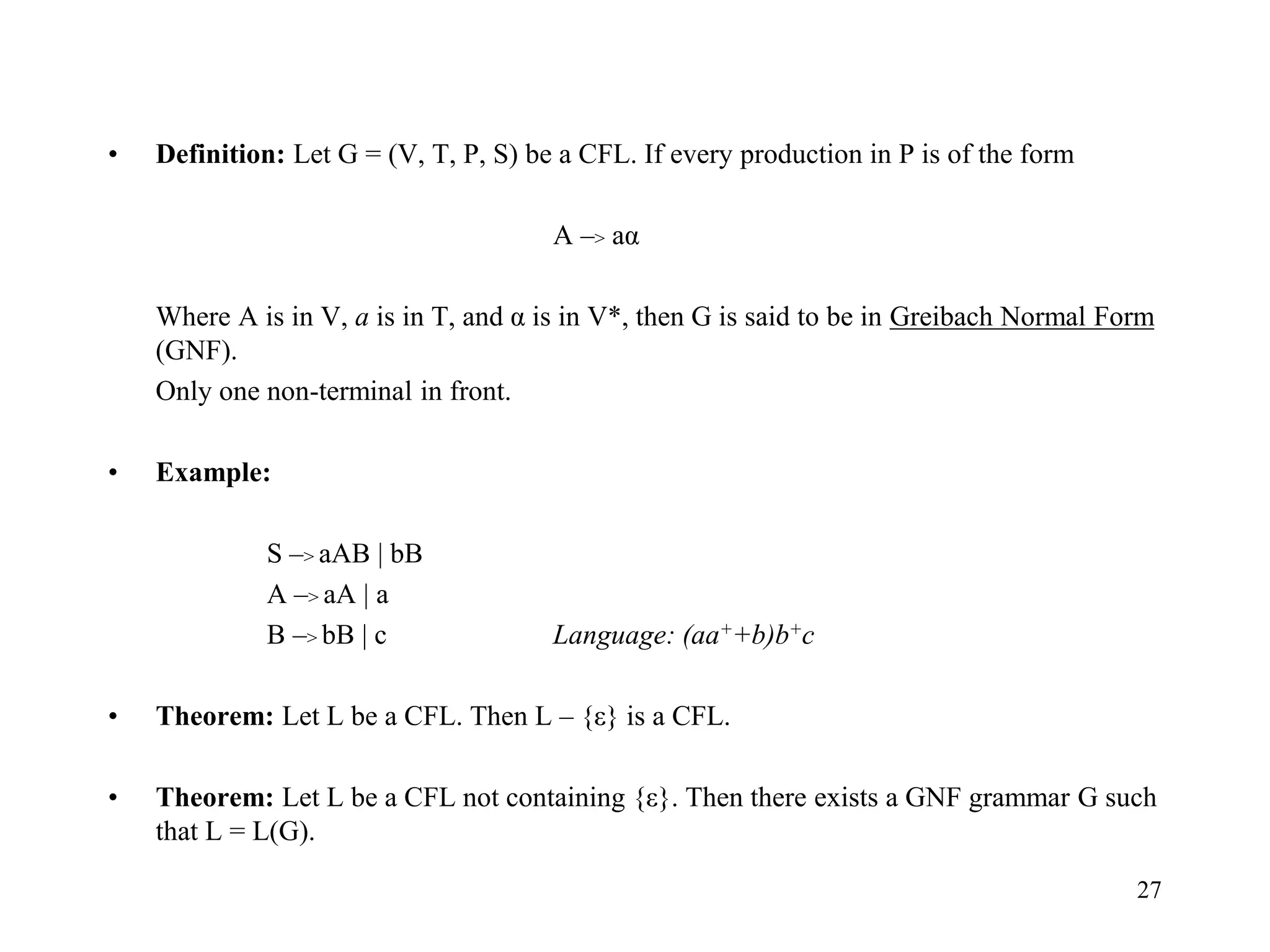
• Definition: Let G = (V, T, P, S) be a CFL. If every production in P is of the form
A –> aα
Where A is in V, a is in T, and α is in V*, then G is said to be in Greibach Normal Form
(GNF).
Only one non-terminal in front.
• Example:
S –> aAB | bB
A –> aA | a
B –> bB | c Language: (aa++b)b+c
• Theorem: Let L be a CFL. Then L – {ε} is a CFL.
• Theorem: Let L be a CFL not containing {ε}. Then there exists a GNF grammar G such
that L = L(G).
28
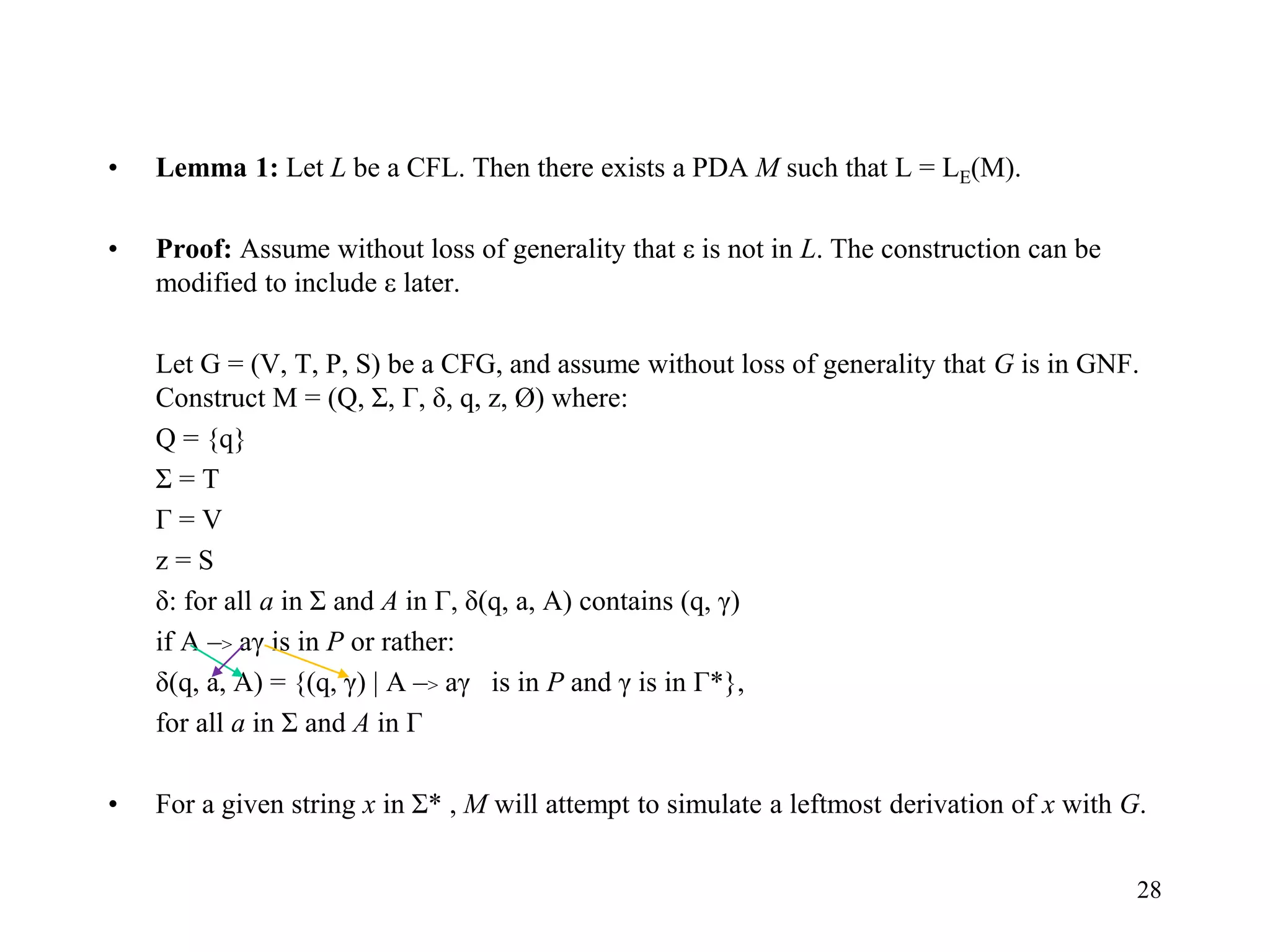
• Lemma 1: Let L be a CFL. Then there exists a PDA M such that L = LE(M).
• Proof: Assume without loss of generality that ε is not in L. The construction can be
modified to include ε later.
Let G = (V, T, P, S) be a CFG, and assume without loss of generality that G is in GNF.
Construct M = (Q, Σ, Г, δ, q, z, Ø) where:
Q = {q}
Σ = T
Г = V
z = S
δ: for all a in Σ and A in Г, δ(q, a, A) contains (q, γ)
if A –> aγ is in P or rather:
δ(q, a, A) = {(q, γ) | A –> aγ is in P and γ is in Г*},
for all a in Σ and A in Г
• For a given string x in Σ* , M will attempt to simulate a leftmost derivation of x with G.
29
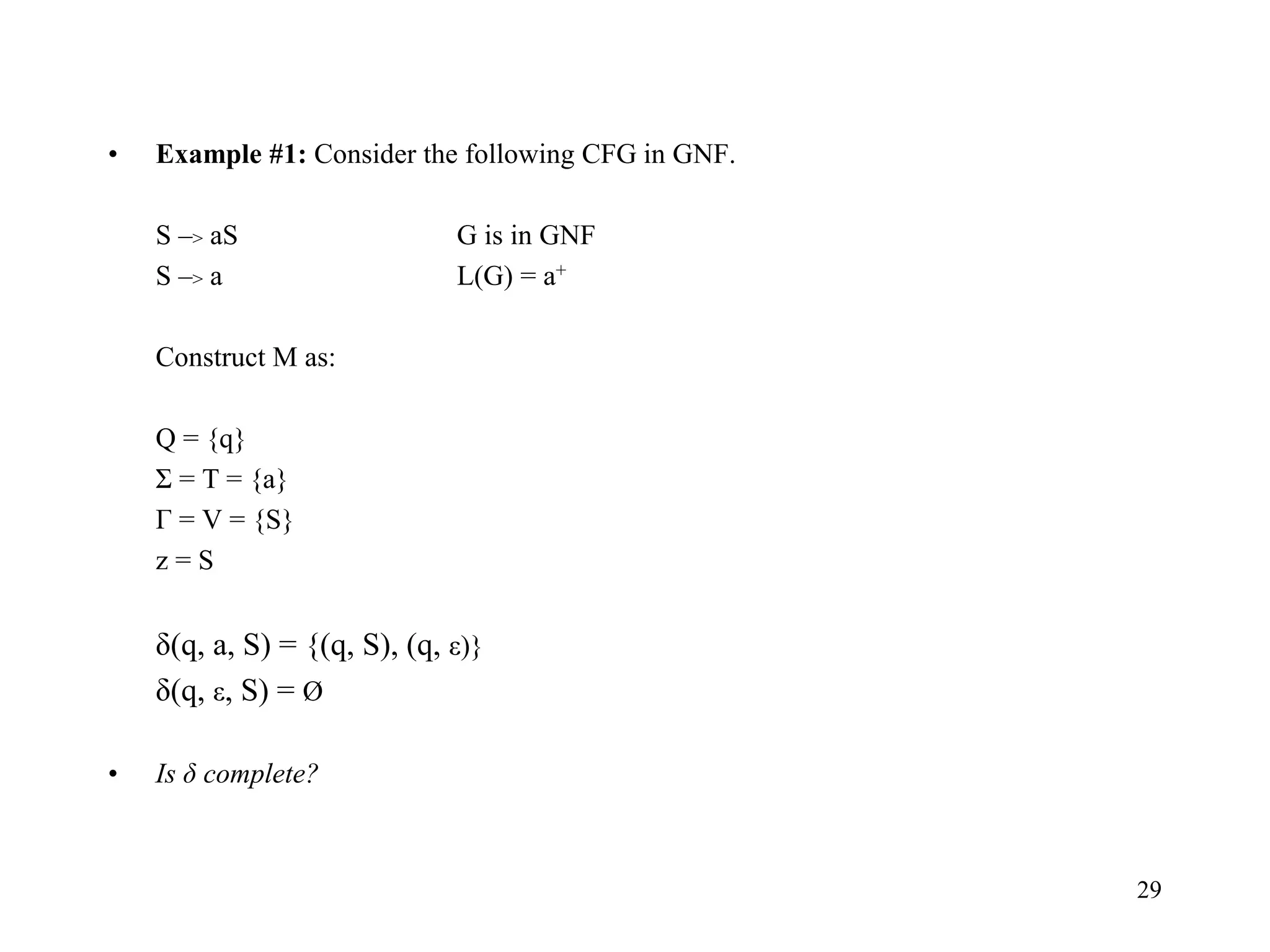
• Example #1: Consider the following CFG in GNF.
S –> aS G is in GNF
S –> a L(G) = a+
Construct M as:
Q = {q}
Σ = T = {a}
Г = V = {S}
z = S
δ(q, a, S) = {(q, S), (q, ε)}
δ(q, ε, S) = Ø
• Is δ complete?
30
• Example #2: Consider the following CFG in GNF.
(1) S –> aA
(2) S –> aB
(3) A –> aA G is in GNF
(4) A –> aB L(G) = a+ b+ // This looks ok to me, one, two or more a’s in the start
(5) B –> bB
(6) B –> b [Can you write a simpler equivalent CFG? Will it be GNF?]
Construct M as:
Q = {q}
Σ = T = {a, b}
Г = V = {S, A, B}
z = S
(1) δ(q, a, S) = {(q, A), (q, B)} From productions #1 and 2, S->aA, S->aB
(2) δ(q, a, A) = {(q, A), (q, B)} From productions #3 and 4, A->aA, A->aB
(3) δ(q, a, B) = Ø
(4) δ(q, b, S) = Ø
(5) δ(q, b, A) = Ø
(6) δ(q, b, B) = {(q, B), (q, ε)} From productions #5 and 6, B->bB, B->b
(7) δ(q, ε, S) = Ø
(8) δ(q, ε, A) = Ø
(9) δ(q, ε, B) = Ø Is δ complete?
31
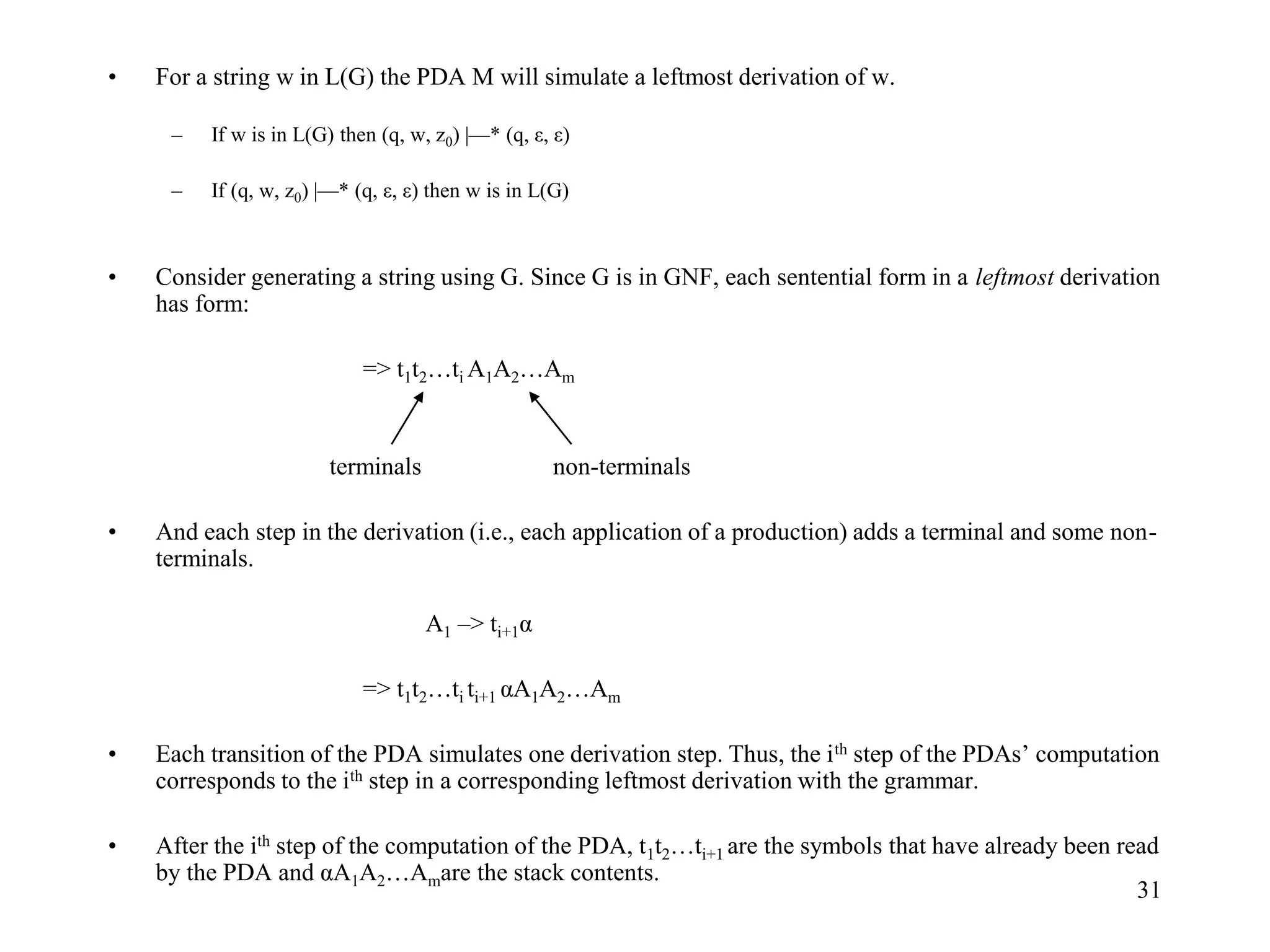
• For a string w in L(G) the PDA M will simulate a leftmost derivation of w.
– If w is in L(G) then (q, w, z0) |—* (q, ε, ε)
– If (q, w, z0) |—* (q, ε, ε) then w is in L(G)
• Consider generating a string using G. Since G is in GNF, each sentential form in a leftmost derivation
has form:
=> t1t2…ti A1A2…Am
terminals non-terminals
• And each step in the derivation (i.e., each application of a production) adds a terminal and some non-
terminals.
A1 –> ti+1α
=> t1t2…ti ti+1 αA1A2…Am
• Each transition of the PDA simulates one derivation step. Thus, the ith step of the PDAs’ computation
corresponds to the ith step in a corresponding leftmost derivation with the grammar.
• After the ith step of the computation of the PDA, t1t2…ti+1 are the symbols that have already been read
by the PDA and αA1A2…Amare the stack contents.
32
• For each leftmost derivation of a string generated by the grammar, there is an equivalent
accepting computation of that string by the PDA.
• Each sentential form in the leftmost derivation corresponds to an instantaneous
description in the PDA’s corresponding computation.
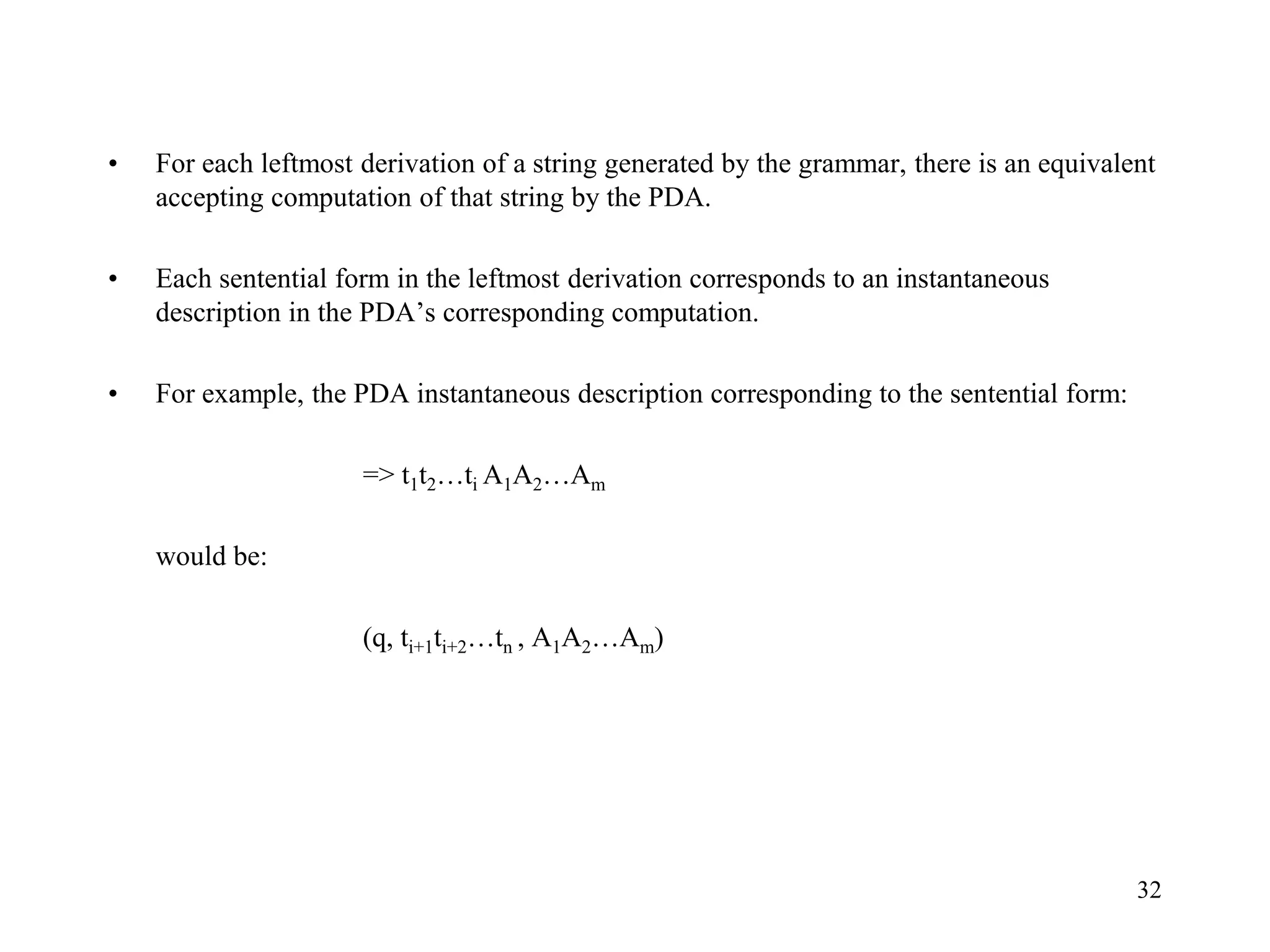
• For example, the PDA instantaneous description corresponding to the sentential form:
=> t1t2…ti A1A2…Am
would be:
(q, ti+1ti+2…tn , A1A2…Am)
33
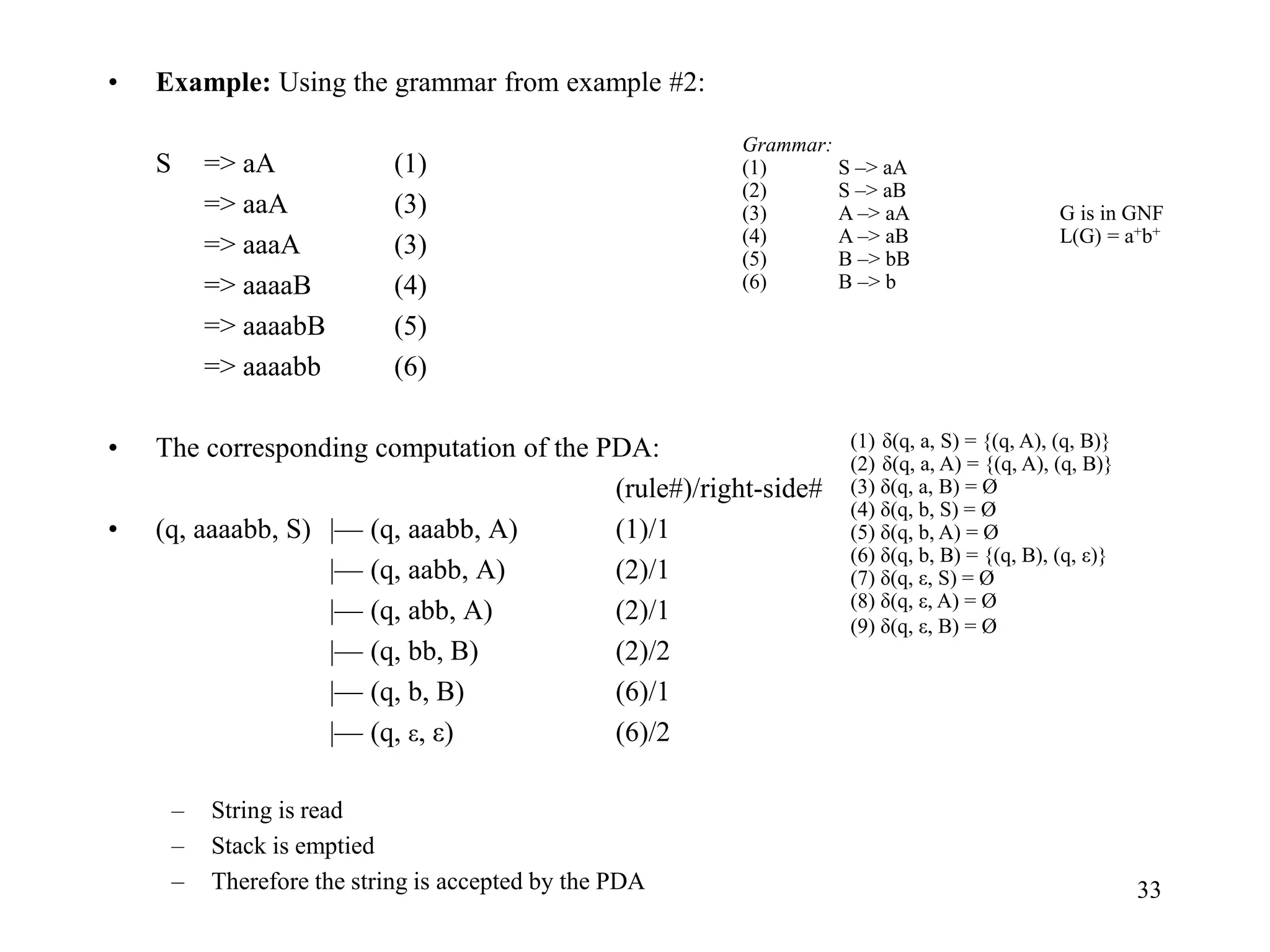
• Example: Using the grammar from example #2:
S => aA (1)
=> aaA (3)
=> aaaA (3)
=> aaaaB (4)
=> aaaabB (5)
=> aaaabb (6)
• The corresponding computation of the PDA:
(rule#)/right-side#
• (q, aaaabb, S) |— (q, aaabb, A) (1)/1
|— (q, aabb, A) (2)/1
|— (q, abb, A) (2)/1
|— (q, bb, B) (2)/2
|— (q, b, B) (6)/1
|— (q, ε, ε) (6)/2
– String is read
– Stack is emptied
– Therefore the string is accepted by the PDA
Grammar:
(1) S –> aA
(2) S –> aB
(3) A –> aA G is in GNF
(4) A –> aB L(G) = a+b+
(5) B –> bB
(6) B –> b
(1) δ(q, a, S) = {(q, A), (q, B)}
(2) δ(q, a, A) = {(q, A), (q, B)}
(3) δ(q, a, B) = Ø
(4) δ(q, b, S) = Ø
(5) δ(q, b, A) = Ø
(6) δ(q, b, B) = {(q, B), (q, ε)}
(7) δ(q, ε, S) = Ø
(8) δ(q, ε, A) = Ø
(9) δ(q, ε, B) = Ø
34
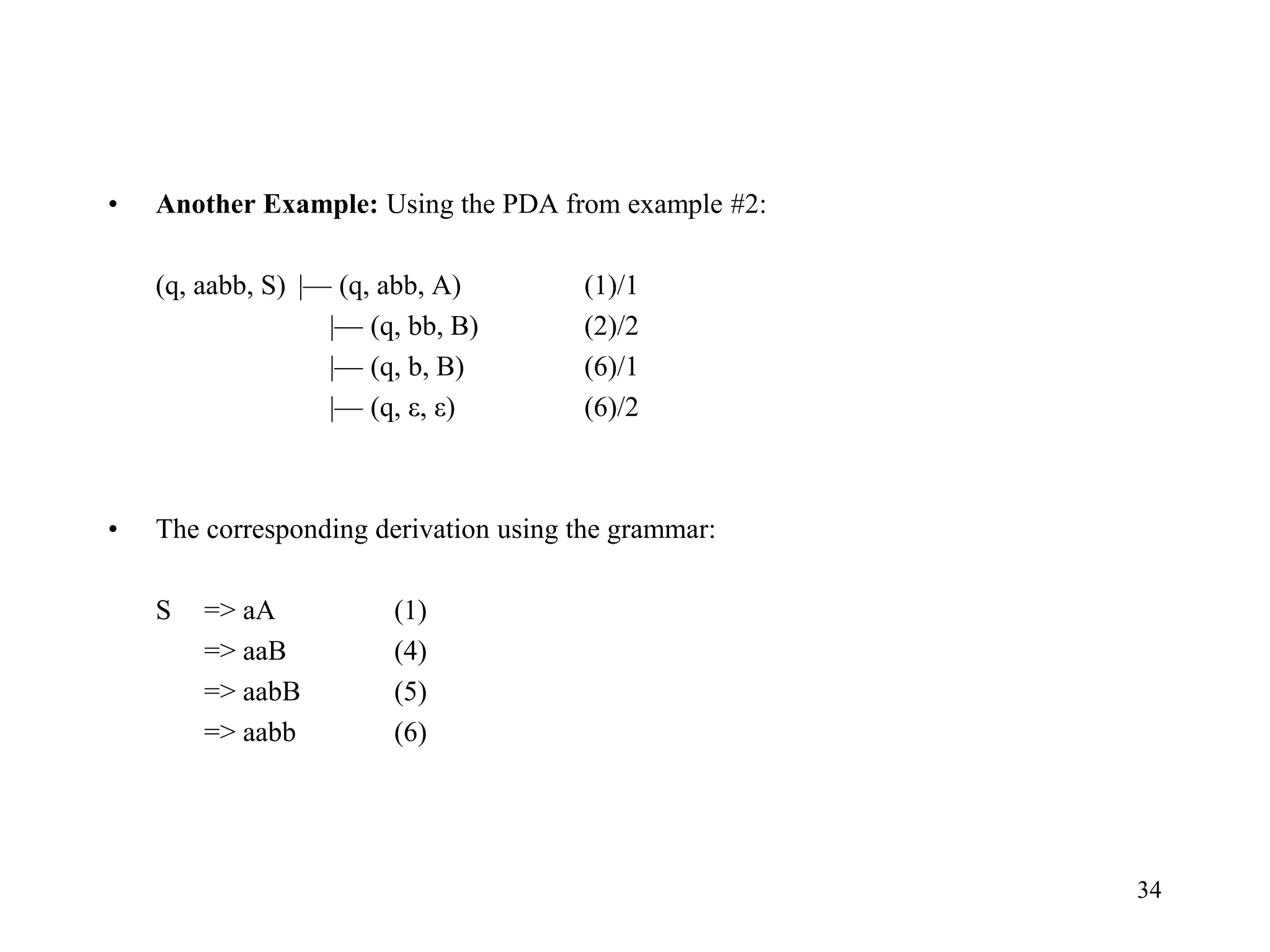
• Another Example: Using the PDA from example #2:
(q, aabb, S) |— (q, abb, A) (1)/1
|— (q, bb, B) (2)/2
|— (q, b, B) (6)/1
|— (q, ε, ε) (6)/2
• The corresponding derivation using the grammar:
S => aA (1)
=> aaB (4)
=> aabB (5)
=> aabb (6)
35
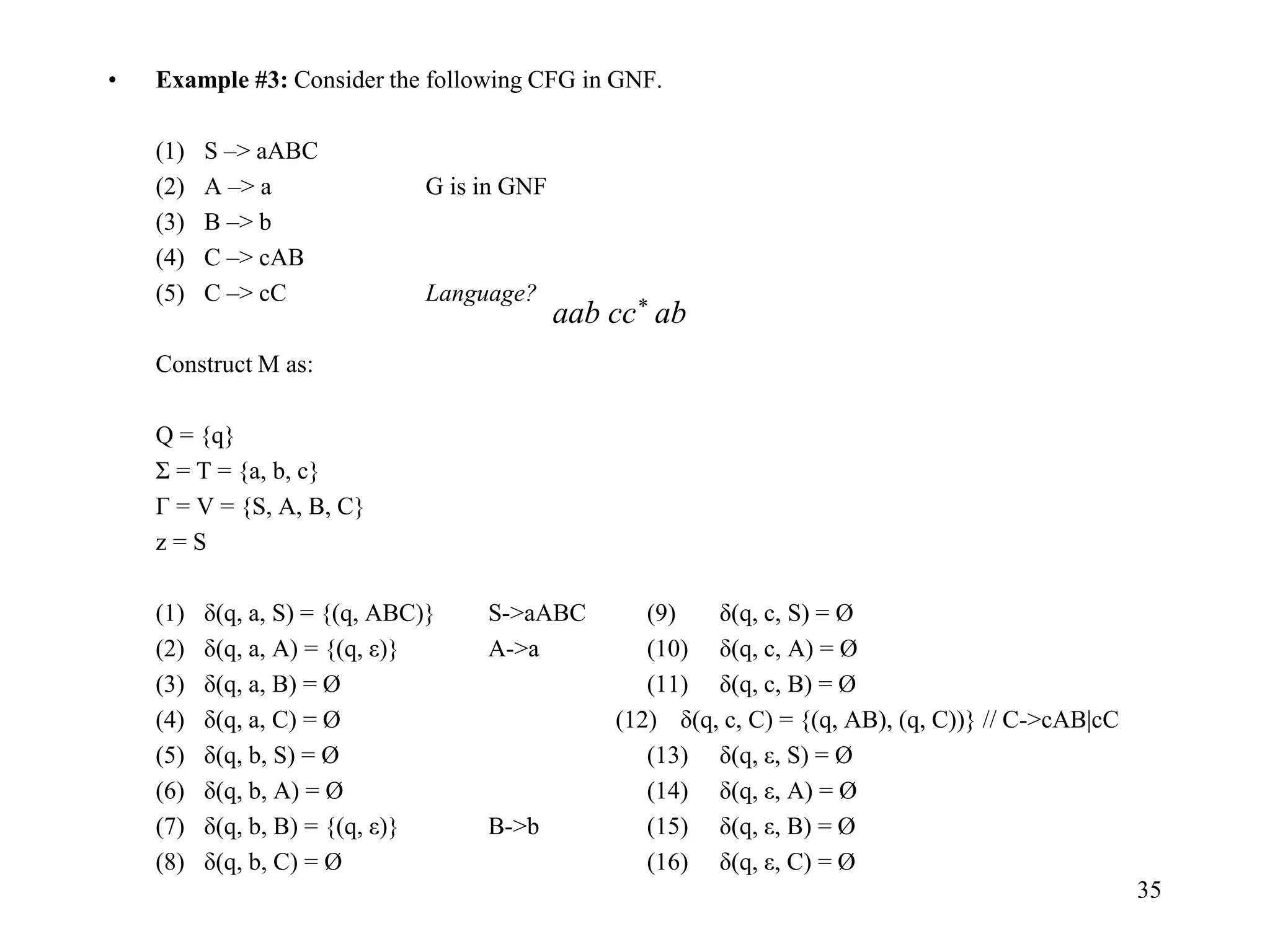
• Example #3: Consider the following CFG in GNF.
(1) S –> aABC
(2) A –> a G is in GNF
(3) B –> b
(4) C –> cAB
(5) C –> cC Language?
Construct M as:
Q = {q}
Σ = T = {a, b, c}
Г = V = {S, A, B, C}
z = S
(1) δ(q, a, S) = {(q, ABC)} S->aABC (9) δ(q, c, S) = Ø
(2) δ(q, a, A) = {(q, ε)} A->a (10) δ(q, c, A) = Ø
(3) δ(q, a, B) = Ø (11) δ(q, c, B) = Ø
(4) δ(q, a, C) = Ø (12) δ(q, c, C) = {(q, AB), (q, C))} // C->cAB|cC
(5) δ(q, b, S) = Ø (13) δ(q, ε, S) = Ø
(6) δ(q, b, A) = Ø (14) δ(q, ε, A) = Ø
(7) δ(q, b, B) = {(q, ε)} B->b (15) δ(q, ε, B) = Ø
(8) δ(q, b, C) = Ø (16) δ(q, ε, C) = Ø
aab cc* ab
36
• Notes:
– Recall that the grammar G was required to be in GNF before the construction could be applied.
– As a result, it was assumed at the start that ε was not in the context-free language L.
– What if ε is in L? You need to add ε back.
• Suppose ε is in L:
1) First, let L’ = L – {ε}
Fact: If L is a CFL, then L’ = L – {ε} is a CFL.
By an earlier theorem, there is GNF grammar G such that L’ = L(G).
2) Construct a PDA M such that L’ = LE(M)
How do we modify M to accept ε?
Add δ(q, ε, S) = {(q, ε)}? NO!!
37
• Counter Example:
Consider L = {ε, b, ab, aab, aaab, …}= ε + a*b Then L’ = {b, ab, aab, aaab, …} = a*b
• The GNF CFG for L’:
P:
(1) S –> aS
(2) S –> b
• The PDA M Accepting L’:
Q = {q}
Σ = T = {a, b}
Г = V = {S}
z = S
δ(q, a, S) = {(q, S)}
δ(q, b, S) = {(q, ε)}
δ(q, ε, S) = Ø
How to add ε to L’ now?
38
δ(q, a, S) = {(q, S)}
δ(q, b, S) = {(q, ε)}
δ(q, ε, S) = Ø
• If δ(q, ε, S) = {(q, ε)} is added then:
L(M) = {ε, a, aa, aaa, …, b, ab, aab, aaab, …}, wrong!
It is like, S -> aS | b | ε
which is wrong!
Correct grammar should be:
(0) S1 -> ε | S, with new starting non-terminal S1
(1) S –> aS
(2) S –> b
For PDA, add a new Stack-bottom symbol S1, with new transitions:
δ(q, ε, S1) = {(q, ε), (q, S)}, where S was the previous stack-bottom of M
Alternatively, add a new start state q’ with transitions:
δ(q’, ε, S) = {(q’, ε), (q, S)}
39
• Lemma 1: Let L be a CFL. Then there exists a PDA M such that L = LE(M).
• Lemma 2: Let M be a PDA. Then there exists a CFG grammar G such that LE(M) =
L(G).
– Can you prove it?
– First step would be to transform an arbitrary PDA to a single state PDA!
• Theorem: Let L be a language. Then there exists a CFG G such that L = L(G) iff there
exists a PDA M such that L = LE(M).
• Corollary: The PDAs define the CFLs.
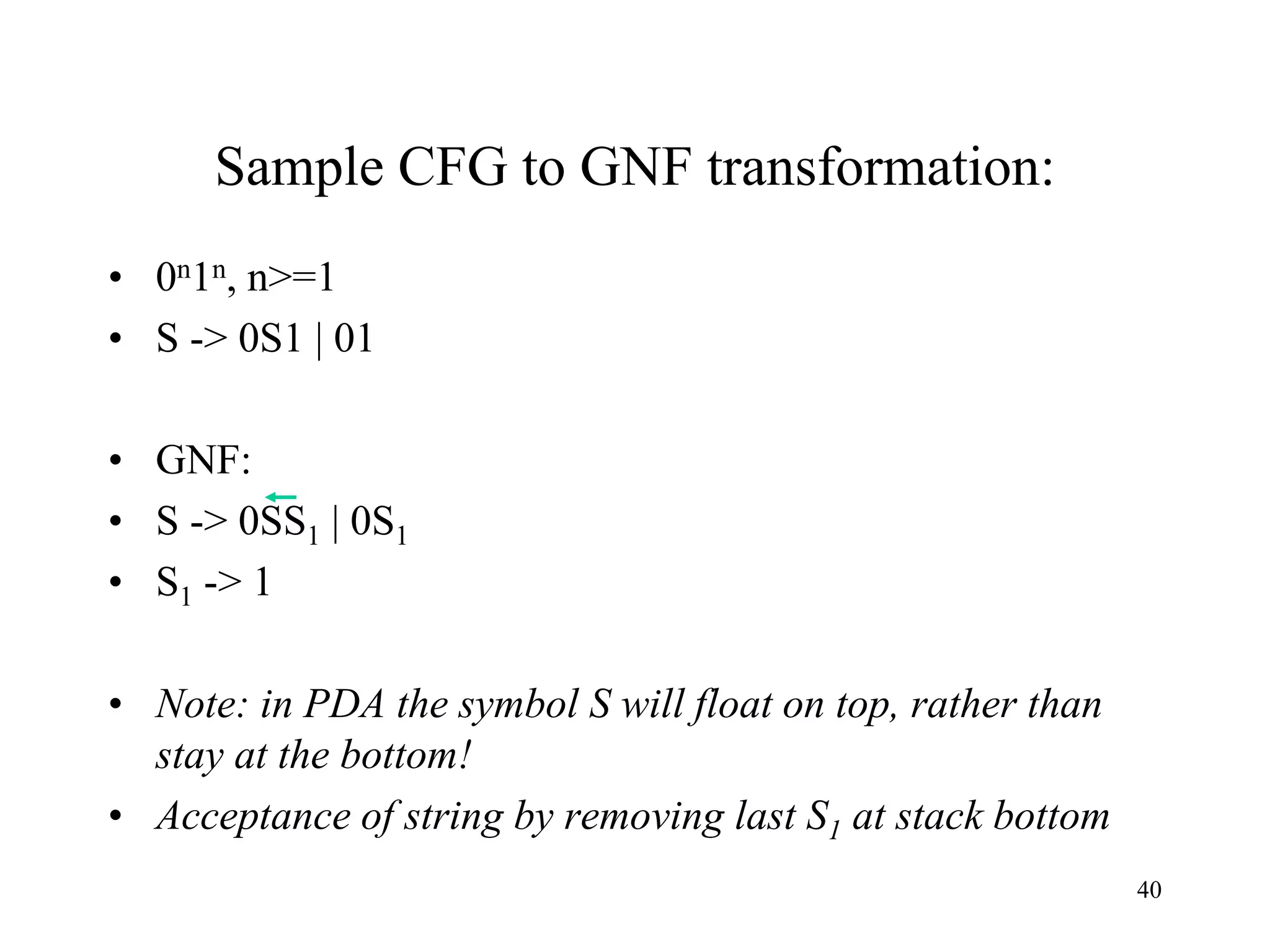
Sample CFG to GNF transformation:
• 0n1n, n>=1
• S -> 0S1 | 01
• GNF:
• S -> 0SS1 | 0S1
• S1 -> 1
• Note: in PDA the symbol S will float on top, rather than
stay at the bottom!
• Acceptance of string by removing last S1 at stack bottom
40
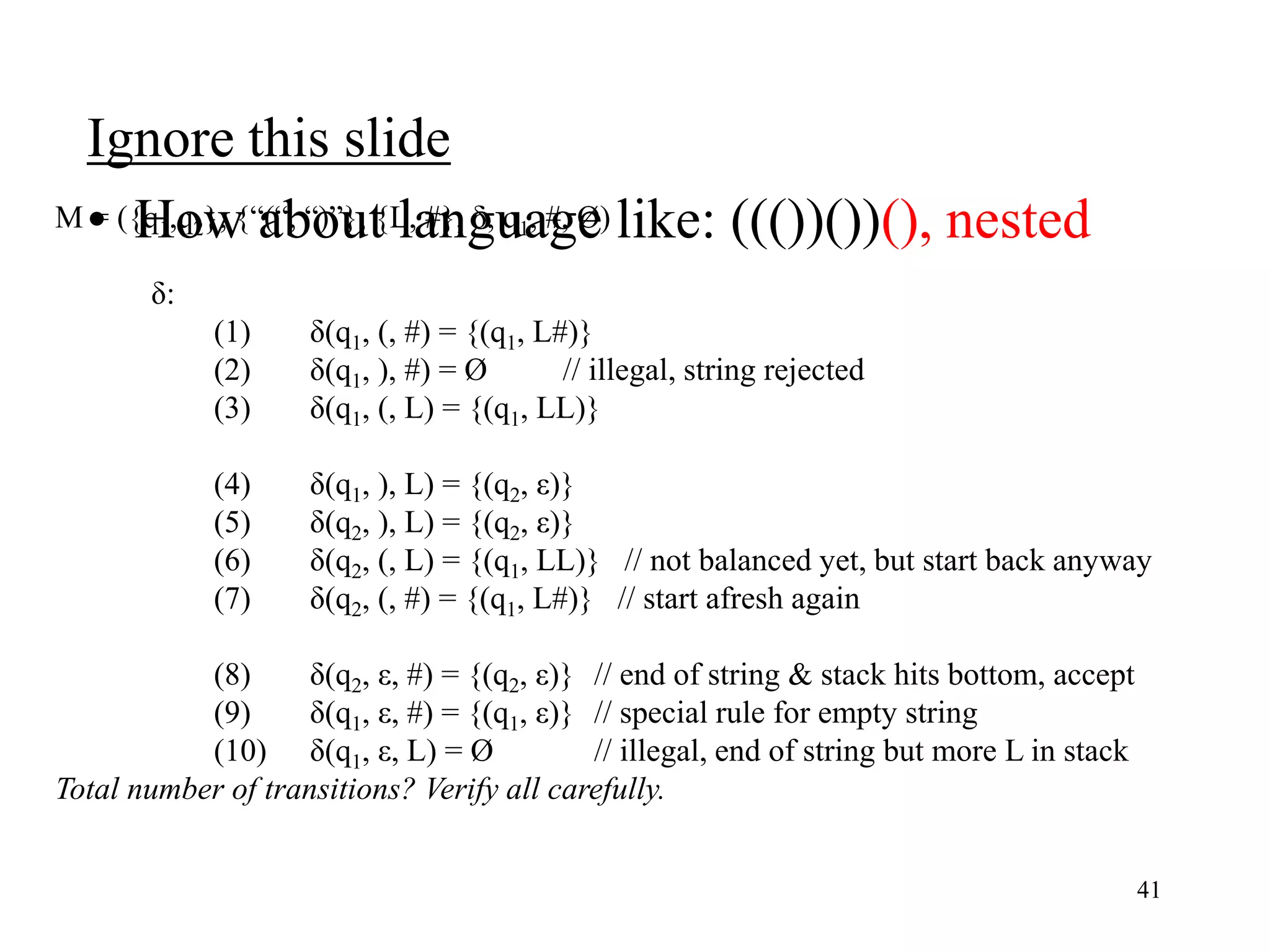
Ignore this slide
• How about language like: ((())())(), nested
41
M = ({q1,q2}, {“(“, “)”}, {L, #}, δ, q1, #, Ø)
δ:
(1) δ(q1, (, #) = {(q1, L#)}
(2) δ(q1, ), #) = Ø // illegal, string rejected
(3) δ(q1, (, L) = {(q1, LL)}
(4) δ(q1, ), L) = {(q2, ε)}
(5) δ(q2, ), L) = {(q2, ε)}
(6) δ(q2, (, L) = {(q1, LL)} // not balanced yet, but start back anyway
(7) δ(q2, (, #) = {(q1, L#)} // start afresh again
(8) δ(q2, ε, #) = {(q2, ε)} // end of string & stack hits bottom, accept
(9) δ(q1, ε, #) = {(q1, ε)} // special rule for empty string
(10) δ(q1, ε, L) = Ø // illegal, end of string but more L in stack
Total number of transitions? Verify all carefully.

Pushdown automata

  • 1.
    1 Hierarchy of languages RegularLanguages  Finite State Machines, Regular Expression Context Free Languages  Context Free Grammar, Push-down Automata Regular Languages Context-Free Languages Recursive Languages Recursively Enumerable Languages Non-Recursively Enumerable Languages
  • 2.
    2 Pushdown Automata (PDA) •Informally: – A PDA is an NFA-ε with a stack. – Transitions are modified to accommodate stack operations. • Questions: – What is a stack? – How does a stack help? • A DFA can “remember” only a finite amount of information, whereas a PDA can “remember” an infinite amount of (certain types of) information, in one memory-stack
  • 3.
    3 • Example: {0n1n |0=<n} is not regular, but {0n1n | 0nk, for some fixed k} is regular, for any fixed k. • For k=3: L = {ε, 01, 0011, 000111} 0/1 q0 q7 0 q1 11 q2 1 q5 0 q3 11 q4 0 1 0 0 0/1 q6 0
  • 4.
    4 • In aDFA, each state remembers a finite amount of information. • To get {0n1n | 0n} with a DFA would require an infinite number of states using the preceding technique. • An infinite stack solves the problem for {0n1n | 0n} as follows: – Read all 0’s and place them on a stack – Read all 1’s and match with the corresponding 0’s on the stack • Only need two states to do this in a PDA • Similarly for {0n1m0n+m | n,m0}
  • 5.
    5 Formal Definition ofa PDA • A pushdown automaton (PDA) is a seven-tuple: M = (Q, Σ, Г, δ, q0, z0, F) Q A finite set of states Σ A finite input alphabet Г A finite stack alphabet q0 The initial/starting state, q0 is in Q z0 A starting stack symbol, is in Г // need not always remain at the bottom of stack F A set of final/accepting states, which is a subset of Q δ A transition function, where δ: Q x (Σ U {ε}) x Г –> finite subsets of Q x Г*
  • 6.
    6 • Consider thevarious parts of δ: Q x (Σ U {ε}) x Г –> finite subsets of Q x Г* – Q on the LHS means that at each step in a computation, a PDA must consider its’ current state. – Г on the LHS means that at each step in a computation, a PDA must consider the symbol on top of its’ stack. – Σ U {ε} on the LHS means that at each step in a computation, a PDA may or may not consider the current input symbol, i.e., it may have epsilon transitions. – “Finite subsets” on the RHS means that at each step in a computation, a PDA may have several options. – Q on the RHS means that each option specifies a new state. – Г* on the RHS means that each option specifies zero or more stack symbols that will replace the top stack symbol, but in a specific sequence.
  • 7.
    7 • Two typesof PDA transitions: δ(q, a, z) = {(p1,γ1), (p2,γ2),…, (pm,γm)} – Current state is q – Current input symbol is a – Symbol currently on top of the stack z – Move to state pi from q – Replace z with γi on the stack (leftmost symbol on top) – Move the input head to the next input symbol : q p1 p2 pm a/z/ γ1 a/z/ γ2 a/z/ γm
  • 8.
    8 • Two typesof PDA transitions: δ(q, ε, z) = {(p1,γ1), (p2,γ2),…, (pm,γm)} – Current state is q – Current input symbol is not considered – Symbol currently on top of the stack z – Move to state pi from q – Replace z with γi on the stack (leftmost symbol on top) – No input symbol is read : q p1 p2 pm ε/z/ γ1 ε/z/ γ2 ε/z/ γm
  • 9.
    9 • Example: 0n1n,n>=0 M = ({q1, q2}, {0, 1}, {L, #}, δ, q1, #, Ø) δ: (1) δ(q1, 0, #) = {(q1, L#)} // stack order: L on top, then # below (2) δ(q1, 1, #) = Ø // illegal, string rejected, When will it happen? (3) δ(q1, 0, L) = {(q1, LL)} (4) δ(q1, 1, L) = {(q2, ε)} (5) δ(q2, 1, L) = {(q2, ε)} (6) δ(q2, ε, #) = {(q2, ε)} //if ε read & stack hits bottom, accept (7) δ(q2, ε, L) = Ø // illegal, string rejected (8) δ(q1, ε, #) = {(q2, ε)} // n=0, accept • Goal: (acceptance) – Read the entire input string – Terminate with an empty stack • Informally, a string is accepted if there exists a computation that uses up all the input and leaves the stack empty. • How many rules should be there in delta?
  • 10.
    10 • Language: 0n1n,n>=0 δ: (1) δ(q1, 0, #) = {(q1, L#)} // stack order: L on top, then # below (2) δ(q1, 1, #) = Ø // illegal, string rejected, When will it happen? (3) δ(q1, 0, L) = {(q1, LL)} (4) δ(q1, 1, L) = {(q2, ε)} (5) δ(q2, 1, L) = {(q2, ε)} (6) δ(q2, ε, #) = {(q2, ε)} //if ε read & stack hits bottom, accept (7) δ(q2, ε, L) = Ø // illegal, string rejected (8) δ(q1, ε, #) = {(q2, ε)} // n=0, accept • 0011 • (q1, 0 011, #) |- (q1, 0 11, L#) |- (q1, 1 1, LL#) |- (q2, 1, L#) |- (q2, e, #) |- (q2, e, e): accept • 011 • (q1, 0 11, #) |- (q1, 1 1, L#) |- (q2, 1, #) |- Ø : reject • Try 001
  • 11.
    11 • Example: balancedparentheses, • e.g. in-language: ((())()), or (())(), but not-in-language: ((()) M = ({q1}, {“(“, “)”}, {L, #}, δ, q1, #, Ø) δ: (1) δ(q1, (, #) = {(q1, L#)} // stack order: L-on top-then- # lower (2) δ(q1, ), #) = Ø // illegal, string rejected (3) δ(q1, (, L) = {(q1, LL)} (4) δ(q1, ), L) = {(q1, ε)} (5) δ(q1, ε, #) = {(q1, ε)} //if ε read & stack hits bottom, accept (6) δ(q1, ε, L) = Ø // illegal, string rejected // What does it mean? When will it happen? • Goal: (acceptance) – Read the entire input string – Terminate with an empty stack • Informally, a string is accepted if there exists a computation that uses up all the input and leaves the stack empty. • How many rules should be in delta?
  • 12.
    12 • Transition Diagram: •Example Computation: Current Input Stack Transition (()) # -- initial status ()) L# (1) - Could have applied rule (5), but )) LL# (3) it would have done no good ) L# (4) ε # (4) ε - (5) q0 (, # | L# ε, # | ε (, L | LL ), L | ε
  • 13.
    13 • Example PDA#1: For the language {x | x = wcwr and w in {0,1}*, but sigma={0,1,c}} • Is this a regular language? • Note: length |x| is odd M = ({q1, q2}, {0, 1, c}, {#, B, G}, δ, q1, #, Ø) δ: (1) δ(q1, 0, #) = {(q1, B#)} (9) δ(q1, 1, #) = {(q1, G#)} (2) δ(q1, 0, B) = {(q1, BB)} (10) δ(q1, 1, B) = {(q1, GB)} (3) δ(q1, 0, G) = {(q1, BG)} (11) δ(q1, 1, G) = {(q1, GG)} (4) δ(q1, c, #) = {(q2, #)} (5) δ(q1, c, B) = {(q2, B)} (6) δ(q1, c, G) = {(q2, G)} (7) δ(q2, 0, B) = {(q2, ε)} (12) δ(q2, 1, G) = {(q2, ε)} (8) δ(q2, ε, #) = {(q2, ε)} • Notes: – Stack grows leftwards – Only rule #8 is non-deterministic. – Rule #8 is used to pop the final stack symbol off at the end of a computation.
  • 14.
    14 • Example Computation: (1)δ(q1, 0, #) = {(q1, B#)} (9) δ(q1, 1, #) = {(q1, G#)} (2) δ(q1, 0, B) = {(q1, BB)} (10) δ(q1, 1, B) = {(q1, GB)} (3) δ(q1, 0, G) = {(q1, BG)} (11) δ(q1, 1, G) = {(q1, GG)} (4) δ(q1, c, #) = {(q2, #)} (5) δ(q1, c, B) = {(q2, B)} (6) δ(q1, c, G) = {(q2, G)} (7) δ(q2, 0, B) = {(q2, ε)} (12) δ(q2, 1, G) = {(q2, ε)} (8) δ(q2, ε, #) = {(q2, ε)} State Input Stack Rule Applied Rules Applicable q1 01c10 # (1) q1 1c10 B# (1) (10) q1 c10 GB# (10) (6) q2 10 GB# (6) (12) q2 0 B# (12) (7) q2 ε # (7) (8) q2 ε ε (8) -
  • 15.
    15 • Example Computation: (1)δ(q1, 0, #) = {(q1, B#)} (9) δ(q1, 1, #) = {(q1, G#)} (2) δ(q1, 0, B) = {(q1, BB)} (10) δ(q1, 1, B) = {(q1, GB)} (3) δ(q1, 0, G) = {(q1, BG)} (11) δ(q1, 1, G) = {(q1, GG)} (4) δ(q1, c, #) = {(q2, #)} (5) δ(q1, c, B) = {(q2, B)} (6) δ(q1, c, G) = {(q2, G)} (7) δ(q2, 0, B) = {(q2, ε)} (12) δ(q2, 1, G) = {(q2, ε)} (8) δ(q2, ε, #) = {(q2, ε)} State Input Stack Rule Applied q1 1c1 # q1 c1 G# (9) q2 1 G# (6) q2 ε # (12) q2 ε ε (8) • Questions: – Why isn’t δ(q2, 0, G) defined? – Why isn’t δ(q2, 1, B) defined? • TRY: 11c1
  • 16.
    16 • Example PDA#2: For the language {x | x = wwr and w in {0,1}*} • Note: length |x| is even M = ({q1, q2}, {0, 1}, {#, B, G}, δ, q1, #, Ø) δ: (1) δ(q1, 0, #) = {(q1, B#)} (2) δ(q1, 1, #) = {(q1, G#)} (3) δ(q1, 0, B) = {(q1, BB), (q2, ε)} (6) δ(q1, 1, G) = {(q1, GG), (q2, ε)} (4) δ(q1, 0, G) = {(q1, BG)} (7) δ(q2, 0, B) = {(q2, ε)} (5) δ(q1, 1, B) = {(q1, GB)} (8) δ(q2, 1, G) = {(q2, ε)} (9) δ(q1, ε, #) = {(q2, #)} (10) δ(q2, ε, #) = {(q2, ε)} • Notes: – Rules #3 and #6 are non-deterministic: two options each – Rules #9 and #10 are used to pop the final stack symbol off at the end of a computation.
  • 17.
    17 • Example Computation: (1)δ(q1, 0, #) = {(q1, B#)} (6) δ(q1, 1, G) = {(q1, GG), (q2, ε)} (2) δ(q1, 1, #) = {(q1, G#)} (7) δ(q2, 0, B) = {(q2, ε)} (3) δ(q1, 0, B) = {(q1, BB), (q2, ε)} (8) δ(q2, 1, G) = {(q2, ε)} (4) δ(q1, 0, G) = {(q1, BG)} (9) δ(q1, ε, #) = {(q2, ε)} (5) δ(q1, 1, B) = {(q1, GB)} (10) δ(q2, ε, #) = {(q2, ε)} State Input Stack Rule Applied Rules Applicable q1 000000 # (1), (9) q1 00000 B# (1) (3), both options q1 0000 BB# (3) option #1 (3), both options q1 000 BBB# (3) option #1 (3), both options q2 00 BB# (3)option #2 (7) q2 0 B# (7) (7) q2 ε # (7) (10) q2 ε ε (10) • Questions: – What is rule #10 used for? – What is rule #9 used for? – Why do rules #3 and #6 have options? – Why don’t rules #4 and #5 have similar options? [transition not possible if the previous input symbol was different]
  • 18.
    18 • Negative ExampleComputation: (1) δ(q1, 0, #) = {(q1, B#)} (6) δ(q1, 1, G) = {(q1, GG), (q2, ε)} (2) δ(q1, 1, #) = {(q1, G#)} (7) δ(q2, 0, B) = {(q2, ε)} (3) δ(q1, 0, B) = {(q1, BB), (q2, ε)} (8) δ(q2, 1, G) = {(q2, ε)} (4) δ(q1, 0, G) = {(q1, BG)} (9) δ(q1, ε, #) = {(q2, ε)} (5) δ(q1, 1, B) = {(q1, GB)} (10) δ(q2, ε, #) = {(q2, ε)} State Input Stack Rule Applied q1 000 # q1 00 B# (1) q1 0 BB# (3) option #1 (q2, 0, #) by option 2 q1 ε BBB# (3) option #1 -crashes, no-rule to apply- (q2, ε, B#) by option 2 -rejects: end of string but not empty stack-
  • 19.
    19 • Example Computation: (1)δ(q1, 0, #) = {(q1, B#)} (6) δ(q1, 1, G) = {(q1, GG), (q2, ε)} (2) δ(q1, 1, #) = {(q1, G#)} (7) δ(q2, 0, B) = {(q2, ε)} (3) δ(q1, 0, B) = {(q1, BB), (q2, ε)} (8) δ(q2, 1, G) = {(q2, ε)} (4) δ(q1, 0, G) = {(q1, BG)} (9) δ(q1, ε, #) = {(q2, ε)} (5) δ(q1, 1, B) = {(q1, GB)} (10) δ(q2, ε, #) = {(q2, ε)} State Input Stack Rule Applied q1 010010 # q1 10010 B# (1) From (1) and (9) q1 0010 GB# (5) q1 010 BGB# (4) q2 10 GB# (3) option #2 q2 0 B# (8) q2 ε # (7) q2 ε ε (10) • Exercises: – 0011001100 // how many total options the machine (or you!) may need to try before rejection? – 011110 – 0111
  • 20.
    20 Formal Definitions forPDAs • Let M = (Q, Σ, Г, δ, q0, z0, F) be a PDA. • Definition: An instantaneous description (ID) is a triple (q, w, γ), where q is in Q, w is in Σ* and γ is in Г*. – q is the current state – w is the unused input – γ is the current stack contents • Example: (for PDA #2) (q1, 111, GBR) (q1, 11, GGBR) (q1, 111, GBR) (q2, 11, BR) (q1, 000, GR) (q2, 00, R)
  • 21.
    21 • Let M= (Q, Σ, Г, δ, q0, z0, F) be a PDA. • Definition: Let a be in Σ U {ε}, w be in Σ*, z be in Г, and α and β both be in Г*. Then: (q, aw, zα) |—M (p, w, βα) if δ(q, a, z) contains (p, β). • Intuitively, if I and J are instantaneous descriptions, then I |— J means that J follows from I by one transition.
  • 22.
    22 • Examples: (PDA#2) (q1, 111, GBR) |— (q1, 11, GGBR) (6) option #1, with a=1, z=G, β=GG, w=11, and α= BR (q1, 111, GBR) |— (q2, 11, BR) (6) option #2, with a=1, z=G, β= ε, w=11, and α= BR (q1, 000, GR) |— (q2, 00, R) Is not true, For any a, z, β, w and α • Examples: (PDA #1) (q1, (())), L#) |— (q1, ())),LL#) (3)
  • 23.
    23 • Definition: |—*is the reflexive and transitive closure of |—. – I |—* I for each instantaneous description I – If I |— J and J |—* K then I |—* K • Intuitively, if I and J are instantaneous descriptions, then I |—* J means that J follows from I by zero or more transitions.
  • 24.
    24 • Definition: LetM = (Q, Σ, Г, δ, q0, z0, F) be a PDA. The language accepted by empty stack, denoted LE(M), is the set {w | (q0, w, z0) |—* (p, ε, ε) for some p in Q} • Definition: Let M = (Q, Σ, Г, δ, q0, z0, F) be a PDA. The language accepted by final state, denoted LF(M), is the set {w | (q0, w, z0) |—* (p, ε, γ) for some p in F and γ in Г*} • Definition: Let M = (Q, Σ, Г, δ, q0, z0, F) be a PDA. The language accepted by empty stack and final state, denoted L(M), is the set {w | (q0, w, z0) |—* (p, ε, ε) for some p in F}
  • 25.
    25 • Lemma 1:Let L = LE(M1) for some PDA M1. Then there exits a PDA M2 such that L = LF(M2). • Lemma 2: Let L = LF(M1) for some PDA M1. Then there exits a PDA M2 such that L = LE(M2). • Theorem: Let L be a language. Then there exits a PDA M1 such that L = LF(M1) if and only if there exists a PDA M2 such that L = LE(M2). • Corollary: The PDAs that accept by empty stack and the PDAs that accept by final state define the same class of languages. • Note: Similar lemmas and theorems could be stated for PDAs that accept by both final state and empty stack.
  • 26.
    Back to CFGagain: PDA equivalent to CFG 26
  • 27.
    27 • Definition: LetG = (V, T, P, S) be a CFL. If every production in P is of the form A –> aα Where A is in V, a is in T, and α is in V*, then G is said to be in Greibach Normal Form (GNF). Only one non-terminal in front. • Example: S –> aAB | bB A –> aA | a B –> bB | c Language: (aa++b)b+c • Theorem: Let L be a CFL. Then L – {ε} is a CFL. • Theorem: Let L be a CFL not containing {ε}. Then there exists a GNF grammar G such that L = L(G).
  • 28.
    28 • Lemma 1:Let L be a CFL. Then there exists a PDA M such that L = LE(M). • Proof: Assume without loss of generality that ε is not in L. The construction can be modified to include ε later. Let G = (V, T, P, S) be a CFG, and assume without loss of generality that G is in GNF. Construct M = (Q, Σ, Г, δ, q, z, Ø) where: Q = {q} Σ = T Г = V z = S δ: for all a in Σ and A in Г, δ(q, a, A) contains (q, γ) if A –> aγ is in P or rather: δ(q, a, A) = {(q, γ) | A –> aγ is in P and γ is in Г*}, for all a in Σ and A in Г • For a given string x in Σ* , M will attempt to simulate a leftmost derivation of x with G.
  • 29.
    29 • Example #1:Consider the following CFG in GNF. S –> aS G is in GNF S –> a L(G) = a+ Construct M as: Q = {q} Σ = T = {a} Г = V = {S} z = S δ(q, a, S) = {(q, S), (q, ε)} δ(q, ε, S) = Ø • Is δ complete?
  • 30.
    30 • Example #2:Consider the following CFG in GNF. (1) S –> aA (2) S –> aB (3) A –> aA G is in GNF (4) A –> aB L(G) = a+ b+ // This looks ok to me, one, two or more a’s in the start (5) B –> bB (6) B –> b [Can you write a simpler equivalent CFG? Will it be GNF?] Construct M as: Q = {q} Σ = T = {a, b} Г = V = {S, A, B} z = S (1) δ(q, a, S) = {(q, A), (q, B)} From productions #1 and 2, S->aA, S->aB (2) δ(q, a, A) = {(q, A), (q, B)} From productions #3 and 4, A->aA, A->aB (3) δ(q, a, B) = Ø (4) δ(q, b, S) = Ø (5) δ(q, b, A) = Ø (6) δ(q, b, B) = {(q, B), (q, ε)} From productions #5 and 6, B->bB, B->b (7) δ(q, ε, S) = Ø (8) δ(q, ε, A) = Ø (9) δ(q, ε, B) = Ø Is δ complete?
  • 31.
    31 • For astring w in L(G) the PDA M will simulate a leftmost derivation of w. – If w is in L(G) then (q, w, z0) |—* (q, ε, ε) – If (q, w, z0) |—* (q, ε, ε) then w is in L(G) • Consider generating a string using G. Since G is in GNF, each sentential form in a leftmost derivation has form: => t1t2…ti A1A2…Am terminals non-terminals • And each step in the derivation (i.e., each application of a production) adds a terminal and some non- terminals. A1 –> ti+1α => t1t2…ti ti+1 αA1A2…Am • Each transition of the PDA simulates one derivation step. Thus, the ith step of the PDAs’ computation corresponds to the ith step in a corresponding leftmost derivation with the grammar. • After the ith step of the computation of the PDA, t1t2…ti+1 are the symbols that have already been read by the PDA and αA1A2…Amare the stack contents.
  • 32.
    32 • For eachleftmost derivation of a string generated by the grammar, there is an equivalent accepting computation of that string by the PDA. • Each sentential form in the leftmost derivation corresponds to an instantaneous description in the PDA’s corresponding computation. • For example, the PDA instantaneous description corresponding to the sentential form: => t1t2…ti A1A2…Am would be: (q, ti+1ti+2…tn , A1A2…Am)
  • 33.
    33 • Example: Usingthe grammar from example #2: S => aA (1) => aaA (3) => aaaA (3) => aaaaB (4) => aaaabB (5) => aaaabb (6) • The corresponding computation of the PDA: (rule#)/right-side# • (q, aaaabb, S) |— (q, aaabb, A) (1)/1 |— (q, aabb, A) (2)/1 |— (q, abb, A) (2)/1 |— (q, bb, B) (2)/2 |— (q, b, B) (6)/1 |— (q, ε, ε) (6)/2 – String is read – Stack is emptied – Therefore the string is accepted by the PDA Grammar: (1) S –> aA (2) S –> aB (3) A –> aA G is in GNF (4) A –> aB L(G) = a+b+ (5) B –> bB (6) B –> b (1) δ(q, a, S) = {(q, A), (q, B)} (2) δ(q, a, A) = {(q, A), (q, B)} (3) δ(q, a, B) = Ø (4) δ(q, b, S) = Ø (5) δ(q, b, A) = Ø (6) δ(q, b, B) = {(q, B), (q, ε)} (7) δ(q, ε, S) = Ø (8) δ(q, ε, A) = Ø (9) δ(q, ε, B) = Ø
  • 34.
    34 • Another Example:Using the PDA from example #2: (q, aabb, S) |— (q, abb, A) (1)/1 |— (q, bb, B) (2)/2 |— (q, b, B) (6)/1 |— (q, ε, ε) (6)/2 • The corresponding derivation using the grammar: S => aA (1) => aaB (4) => aabB (5) => aabb (6)
  • 35.
    35 • Example #3:Consider the following CFG in GNF. (1) S –> aABC (2) A –> a G is in GNF (3) B –> b (4) C –> cAB (5) C –> cC Language? Construct M as: Q = {q} Σ = T = {a, b, c} Г = V = {S, A, B, C} z = S (1) δ(q, a, S) = {(q, ABC)} S->aABC (9) δ(q, c, S) = Ø (2) δ(q, a, A) = {(q, ε)} A->a (10) δ(q, c, A) = Ø (3) δ(q, a, B) = Ø (11) δ(q, c, B) = Ø (4) δ(q, a, C) = Ø (12) δ(q, c, C) = {(q, AB), (q, C))} // C->cAB|cC (5) δ(q, b, S) = Ø (13) δ(q, ε, S) = Ø (6) δ(q, b, A) = Ø (14) δ(q, ε, A) = Ø (7) δ(q, b, B) = {(q, ε)} B->b (15) δ(q, ε, B) = Ø (8) δ(q, b, C) = Ø (16) δ(q, ε, C) = Ø aab cc* ab
  • 36.
    36 • Notes: – Recallthat the grammar G was required to be in GNF before the construction could be applied. – As a result, it was assumed at the start that ε was not in the context-free language L. – What if ε is in L? You need to add ε back. • Suppose ε is in L: 1) First, let L’ = L – {ε} Fact: If L is a CFL, then L’ = L – {ε} is a CFL. By an earlier theorem, there is GNF grammar G such that L’ = L(G). 2) Construct a PDA M such that L’ = LE(M) How do we modify M to accept ε? Add δ(q, ε, S) = {(q, ε)}? NO!!
  • 37.
    37 • Counter Example: ConsiderL = {ε, b, ab, aab, aaab, …}= ε + a*b Then L’ = {b, ab, aab, aaab, …} = a*b • The GNF CFG for L’: P: (1) S –> aS (2) S –> b • The PDA M Accepting L’: Q = {q} Σ = T = {a, b} Г = V = {S} z = S δ(q, a, S) = {(q, S)} δ(q, b, S) = {(q, ε)} δ(q, ε, S) = Ø How to add ε to L’ now?
  • 38.
    38 δ(q, a, S)= {(q, S)} δ(q, b, S) = {(q, ε)} δ(q, ε, S) = Ø • If δ(q, ε, S) = {(q, ε)} is added then: L(M) = {ε, a, aa, aaa, …, b, ab, aab, aaab, …}, wrong! It is like, S -> aS | b | ε which is wrong! Correct grammar should be: (0) S1 -> ε | S, with new starting non-terminal S1 (1) S –> aS (2) S –> b For PDA, add a new Stack-bottom symbol S1, with new transitions: δ(q, ε, S1) = {(q, ε), (q, S)}, where S was the previous stack-bottom of M Alternatively, add a new start state q’ with transitions: δ(q’, ε, S) = {(q’, ε), (q, S)}
  • 39.
    39 • Lemma 1:Let L be a CFL. Then there exists a PDA M such that L = LE(M). • Lemma 2: Let M be a PDA. Then there exists a CFG grammar G such that LE(M) = L(G). – Can you prove it? – First step would be to transform an arbitrary PDA to a single state PDA! • Theorem: Let L be a language. Then there exists a CFG G such that L = L(G) iff there exists a PDA M such that L = LE(M). • Corollary: The PDAs define the CFLs.
  • 40.
    Sample CFG toGNF transformation: • 0n1n, n>=1 • S -> 0S1 | 01 • GNF: • S -> 0SS1 | 0S1 • S1 -> 1 • Note: in PDA the symbol S will float on top, rather than stay at the bottom! • Acceptance of string by removing last S1 at stack bottom 40
  • 41.
    Ignore this slide •How about language like: ((())())(), nested 41 M = ({q1,q2}, {“(“, “)”}, {L, #}, δ, q1, #, Ø) δ: (1) δ(q1, (, #) = {(q1, L#)} (2) δ(q1, ), #) = Ø // illegal, string rejected (3) δ(q1, (, L) = {(q1, LL)} (4) δ(q1, ), L) = {(q2, ε)} (5) δ(q2, ), L) = {(q2, ε)} (6) δ(q2, (, L) = {(q1, LL)} // not balanced yet, but start back anyway (7) δ(q2, (, #) = {(q1, L#)} // start afresh again (8) δ(q2, ε, #) = {(q2, ε)} // end of string & stack hits bottom, accept (9) δ(q1, ε, #) = {(q1, ε)} // special rule for empty string (10) δ(q1, ε, L) = Ø // illegal, end of string but more L in stack Total number of transitions? Verify all carefully.