RESEARCH TOOLS
DR. VIKRAMJIT SINGH
Types
RESEARCH TOOLS
DR. VIKRAMJIT SINGH
Types
QUESTIONNAIRE
1
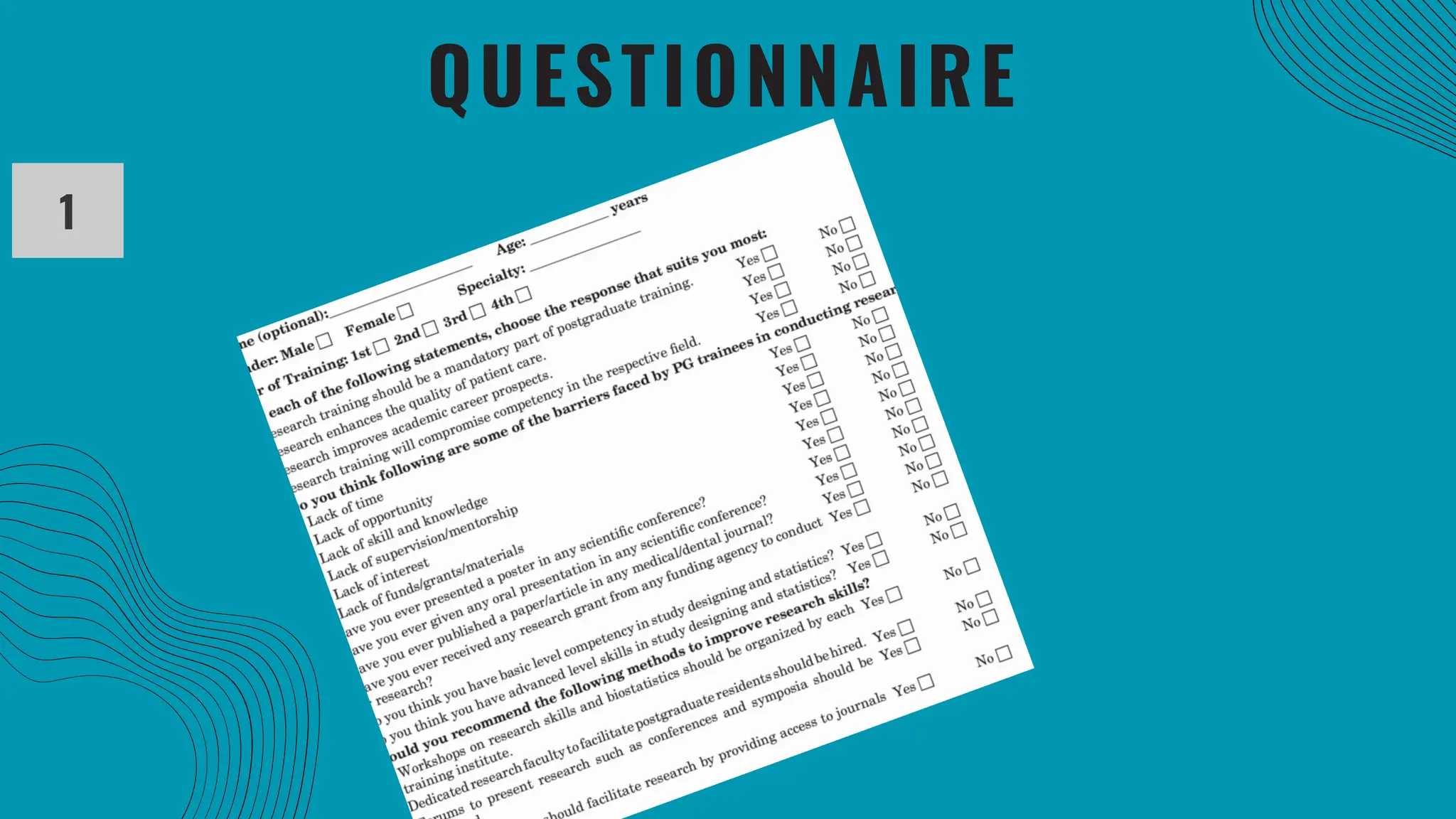
A questionnaire is a structured research tool
commonly used in surveys to collect data from
individuals. It consists of a set of questions
designed to gather information about a specific
topic.
QUESTIONNAIRE
1
OBSERVATION
2 Observation is both a research tool and a research
technique commonly used in various fields, such as
social sciences, psychology, anthropology, and
education, to gather data about behavior, events,
and phenomena.
As a research tool, observation involves the
systematic collection and recording of data through
direct visual, auditory, or other sensory means.
OBSERVATION (OS)
2 Researchers use observation to study and document
specific behaviors, events, or processes.
Observation Techniques:
Structured Observation
Unstructured Observation
Participant Observation
Non-Participant observation
Naturalistic Observation
Controlled Observation
RATING SCALE
3 The rating scale is a closed-ended survey question used
to represent respondent feedback in a comparative form
for specific particular features/products/services. It is
one of the most established question types for online and
offline surveys where survey respondents are expected to
rate an attribute or feature. The rating scale is a variant
of the popular multiple-choice question, which is widely
used to gather the information that provides relative
information about a specific topic.
RATING SCALE
3 Researchers use a rating scale in research when they
intend to associate a qualitative observation measure
with the various aspects of a product or feature.
Generally, this scale is used to evaluate the performance
of a product or service, employee skills, customer service
performances, customer-first strategy, processes followed
for a particular goal, etc. A rating scale survey question
can be compared to a checkbox question, but a rating
scale provides more information than merely Yes/No.
RATING SCALE
3.1
Likert Scale:
A Likert scale is one of the most widely used rating
scales.
Respondents are presented with a statement or
question, and they indicate their level of agreement
or disagreement on a scale, typically ranging from
"Strongly Disagree" to "Strongly Agree."
Likert scales can have varying numbers of response
options, such as 5-point, 7-point, or even 10-point
scales.
RATING SCALE
3
Other Types:
Numerical Rating Scale
Graphical / Visual/ Pictorial Rating
Scale
Gutmann Scale
CHECK LIST
Checklist are collection of statements and items from
which we need to select responses.
4
INTERVIEW SCHEDULES
5
Interview schedules are tools for conducting a Interview
technique in research.
The schedule consists of questions and diection
for administration and recording which varies or depend
on which type of interview we are going to conduct- It
can be a structure interview or a totally unstructured
interview.
ACHIEVEMENT TEST
6
Achievement Test-
One of the basic research tool used in research whenver
we are trying to collect data on the awareness and skills
ability of the participants. This tests can be a teacher
made test or a fully standardised achivement test passing
through rigrous process of item analysis(item -difficulty,
item -discrimination analysis, distractor analysis)
reliability and validity processs.
INVENTORIES
7
Inventories are just like questionnaires with self
reflection type question on different abilites,
interst or any other variable of concern in the
study.
Ex- “ I like to attend Mathematics
Classes...........“
“ I love meeting with my freinds ....“
TEST BATTERY
8
Test battery are either a long form of a test
divided into several sections or several test
combined in a single form.
Generally it is prepared to assess broad areas
of individual domain like - Intelligence test
battery, Scholastic Area test battery etc.
FOCUS GROUP DISCUSSION
9
Focus Group Discussion is basically a technique for data
collection. While conducting Focus Group Discussion(FGD)
we need a tool consisting of various questions for initiate
discussion and lead towards arriving a conclusion.
It may also consists of direction for the moderators/
investigators on conducting the FGD , mediation
strategies as well as leading and closing questions so
that FGD can be used to answer the research question.
ONLINE TOOLS
10
in the time of technological advancement we have vast
collection of online tools availabe for collecting data
from the target subjects.
Platforms and Website like Kobo Collect, Survey Monket,
Survey Planet as well as even Google Forms can helps us
for collecting data in easiest possible way with numerous
advantages in data management and analysis too.
ANECDOTAL NOTES/
DIARIES/JOURNAL ENTRIES
11
The first hand anecdotal notes, journal entries etc. can be
also the meaningful resource for data collection with real
time feedback and personal reflection ability. These are
better tools as youare free to write in whatever possible way
you want to represent the situation under investigation.
PSYCHOLOGICAL TEST
12
Psychological test like - Attitude scale, Aptitude scale, Interest
Inventory etc. have got significant importance in terms of data
collection and interpretation in a research process. This
research tool can take up various forms like - Rating scales,
Guttmann Scale, Questionnaire, Inventories, Checklist etc.
PROJECTIVE TOOLS
13
Influcnced by the projective methods of research
investigation, projective tools are collection of tools to study
the study variable by exploring the unconcious mind process
as advocated in Freud Method of data collection . Many tools
for Understanding individual personality and attitude etc. are
based on projective methods.
THANK'S FOR
WATCHING

Types of Research Tool By Dr. Vikramjit Singh

  • 1.
  • 2.
  • 3.
    QUESTIONNAIRE 1 A questionnaire isa structured research tool commonly used in surveys to collect data from individuals. It consists of a set of questions designed to gather information about a specific topic.
  • 4.
  • 5.
    OBSERVATION 2 Observation isboth a research tool and a research technique commonly used in various fields, such as social sciences, psychology, anthropology, and education, to gather data about behavior, events, and phenomena. As a research tool, observation involves the systematic collection and recording of data through direct visual, auditory, or other sensory means.
  • 6.
    OBSERVATION (OS) 2 Researchersuse observation to study and document specific behaviors, events, or processes. Observation Techniques: Structured Observation Unstructured Observation Participant Observation Non-Participant observation Naturalistic Observation Controlled Observation
  • 7.
    RATING SCALE 3 Therating scale is a closed-ended survey question used to represent respondent feedback in a comparative form for specific particular features/products/services. It is one of the most established question types for online and offline surveys where survey respondents are expected to rate an attribute or feature. The rating scale is a variant of the popular multiple-choice question, which is widely used to gather the information that provides relative information about a specific topic.
  • 8.
    RATING SCALE 3 Researchersuse a rating scale in research when they intend to associate a qualitative observation measure with the various aspects of a product or feature. Generally, this scale is used to evaluate the performance of a product or service, employee skills, customer service performances, customer-first strategy, processes followed for a particular goal, etc. A rating scale survey question can be compared to a checkbox question, but a rating scale provides more information than merely Yes/No.
  • 9.
    RATING SCALE 3.1 Likert Scale: ALikert scale is one of the most widely used rating scales. Respondents are presented with a statement or question, and they indicate their level of agreement or disagreement on a scale, typically ranging from "Strongly Disagree" to "Strongly Agree." Likert scales can have varying numbers of response options, such as 5-point, 7-point, or even 10-point scales.
  • 10.
    RATING SCALE 3 Other Types: NumericalRating Scale Graphical / Visual/ Pictorial Rating Scale Gutmann Scale
  • 11.
    CHECK LIST Checklist arecollection of statements and items from which we need to select responses. 4
  • 12.
    INTERVIEW SCHEDULES 5 Interview schedulesare tools for conducting a Interview technique in research. The schedule consists of questions and diection for administration and recording which varies or depend on which type of interview we are going to conduct- It can be a structure interview or a totally unstructured interview.
  • 13.
    ACHIEVEMENT TEST 6 Achievement Test- Oneof the basic research tool used in research whenver we are trying to collect data on the awareness and skills ability of the participants. This tests can be a teacher made test or a fully standardised achivement test passing through rigrous process of item analysis(item -difficulty, item -discrimination analysis, distractor analysis) reliability and validity processs.
  • 14.
    INVENTORIES 7 Inventories are justlike questionnaires with self reflection type question on different abilites, interst or any other variable of concern in the study. Ex- “ I like to attend Mathematics Classes...........“ “ I love meeting with my freinds ....“
  • 15.
    TEST BATTERY 8 Test batteryare either a long form of a test divided into several sections or several test combined in a single form. Generally it is prepared to assess broad areas of individual domain like - Intelligence test battery, Scholastic Area test battery etc.
  • 16.
    FOCUS GROUP DISCUSSION 9 FocusGroup Discussion is basically a technique for data collection. While conducting Focus Group Discussion(FGD) we need a tool consisting of various questions for initiate discussion and lead towards arriving a conclusion. It may also consists of direction for the moderators/ investigators on conducting the FGD , mediation strategies as well as leading and closing questions so that FGD can be used to answer the research question.
  • 17.
    ONLINE TOOLS 10 in thetime of technological advancement we have vast collection of online tools availabe for collecting data from the target subjects. Platforms and Website like Kobo Collect, Survey Monket, Survey Planet as well as even Google Forms can helps us for collecting data in easiest possible way with numerous advantages in data management and analysis too.
  • 18.
    ANECDOTAL NOTES/ DIARIES/JOURNAL ENTRIES 11 Thefirst hand anecdotal notes, journal entries etc. can be also the meaningful resource for data collection with real time feedback and personal reflection ability. These are better tools as youare free to write in whatever possible way you want to represent the situation under investigation.
  • 19.
    PSYCHOLOGICAL TEST 12 Psychological testlike - Attitude scale, Aptitude scale, Interest Inventory etc. have got significant importance in terms of data collection and interpretation in a research process. This research tool can take up various forms like - Rating scales, Guttmann Scale, Questionnaire, Inventories, Checklist etc.
  • 20.
    PROJECTIVE TOOLS 13 Influcnced bythe projective methods of research investigation, projective tools are collection of tools to study the study variable by exploring the unconcious mind process as advocated in Freud Method of data collection . Many tools for Understanding individual personality and attitude etc. are based on projective methods.
  • 21.