
Variable
Variable
• A variable is any characteristics, number,
or quantity that can be measured or counted.
• A variable may also be called a data item.
• Age, sex, business income and expenses,
country of birth, capital expenditure, class grades,
eye colour and vehicle type are examples of
variables.
• It is called a variable because the value may
vary between data units in a population, and may
change in value over time.
Variable
For example;
• 'income' is a variable that can vary between
data units in a population (i.e. the people or
businesses being studied may not have the same
incomes) and can also vary over time for each
data unit (i.e. income can go up or down).
Variable
Definition:
A variable is a label or name that
represents a concept or characteristic that
varies (e.g., gender, weight, achievement,
attitudes toward inclusion, etc.)
Concept of Variable
Conceptual Definition of the Variable
• Conceptual (i.e., constitutive) definition
uses words or concepts to define a variable
Achievement: what one has learned
from formal instruction
Aptitude: one's capability for
performing a particular task or skill
Concept of Variable
Operational Definition of the Variable
• Operational definition is an indication
of the meaning of a variable through the
specification of the manner by which it is
measured, categorized, or controlled
1. Weschler IQ score
2. Income levels below and above
$45,000 per year
3. Use of holistic or phonetic language
instruction
Types of Variable
Types of Variable
Types of Variable
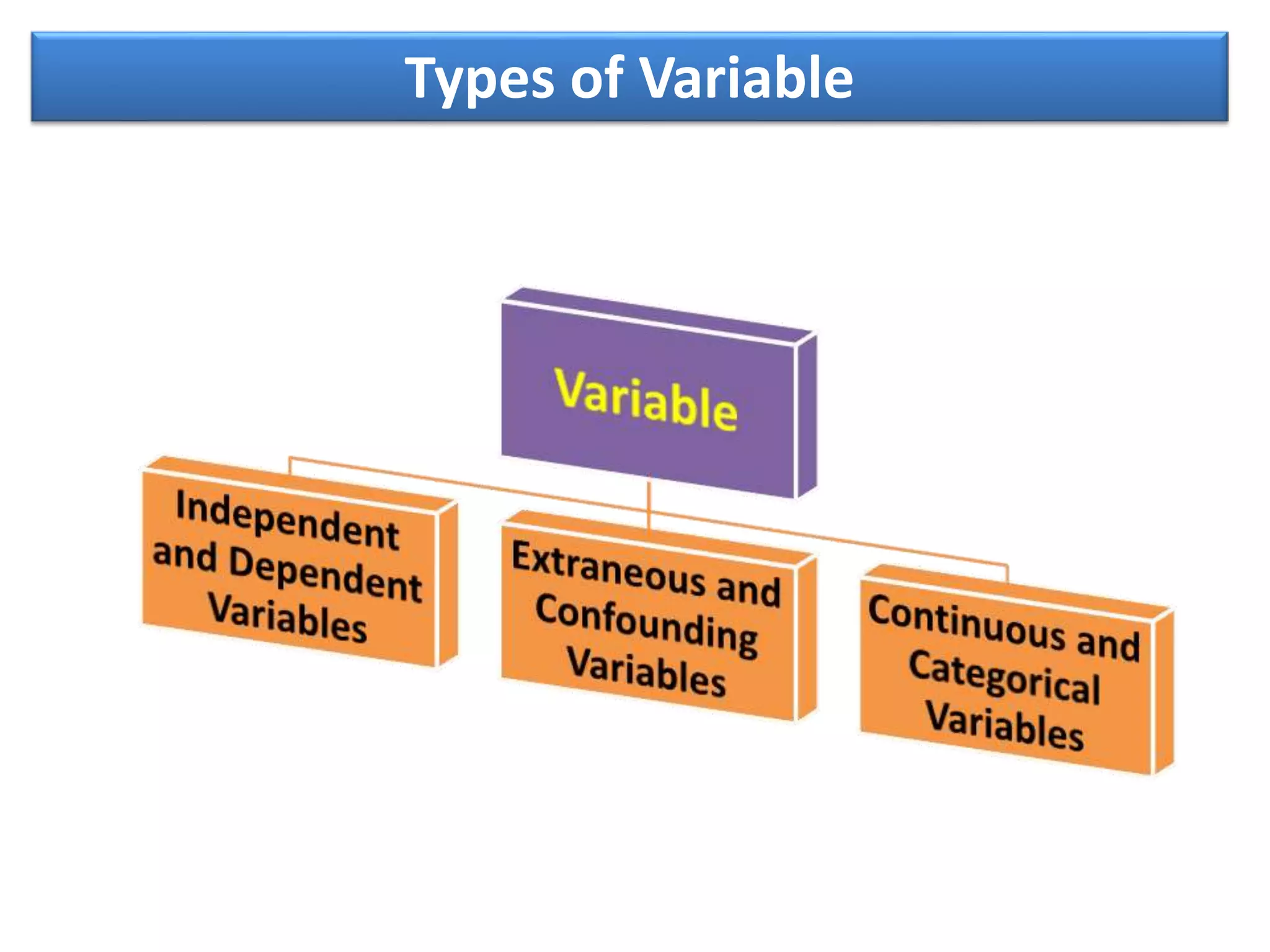
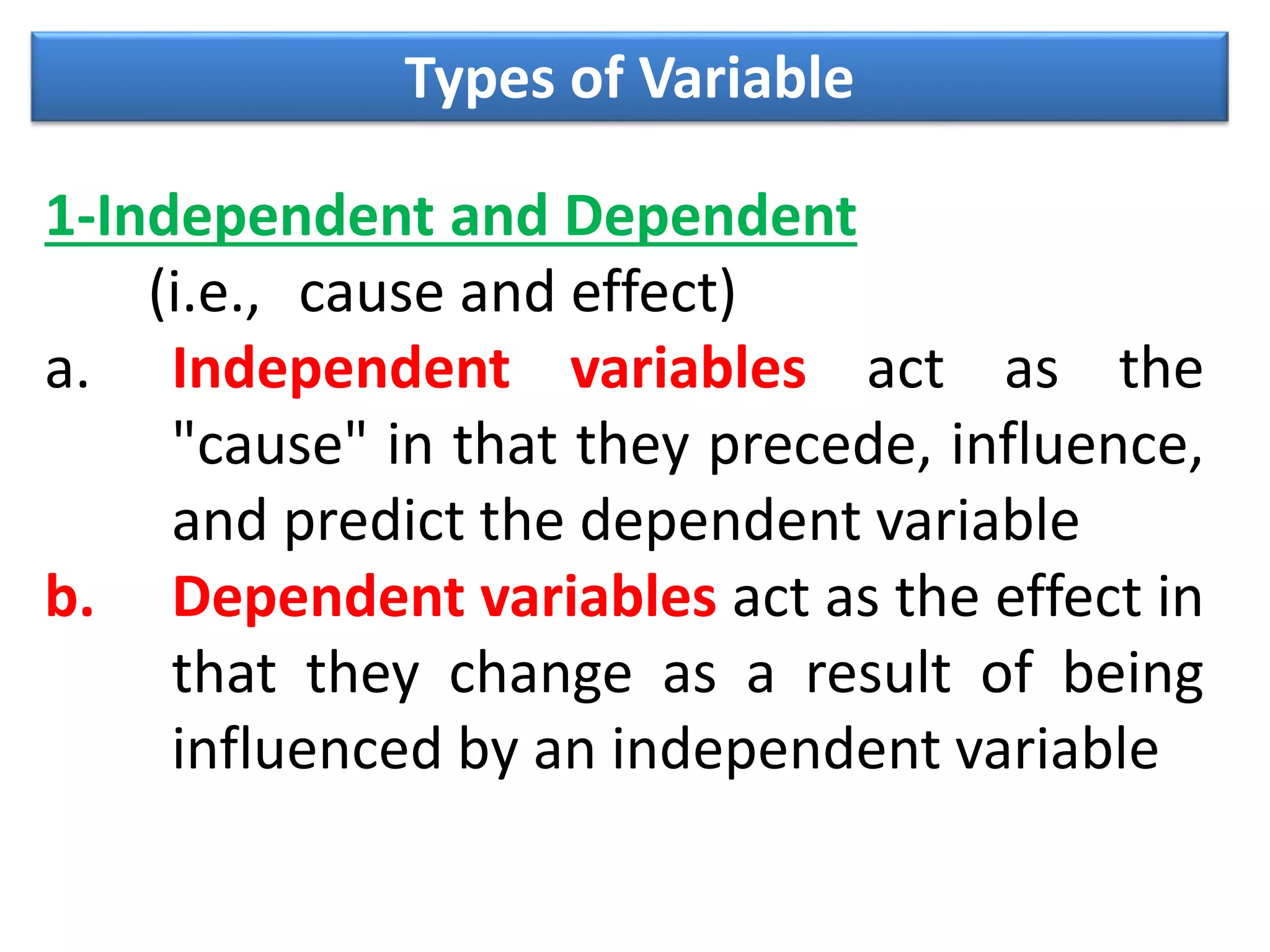
1-Independent and Dependent
(i.e., cause and effect)
a. Independent variables act as the
"cause" in that they precede, influence,
and predict the dependent variable
b. Dependent variables act as the effect in
that they change as a result of being
influenced by an independent variable
Types of Variable
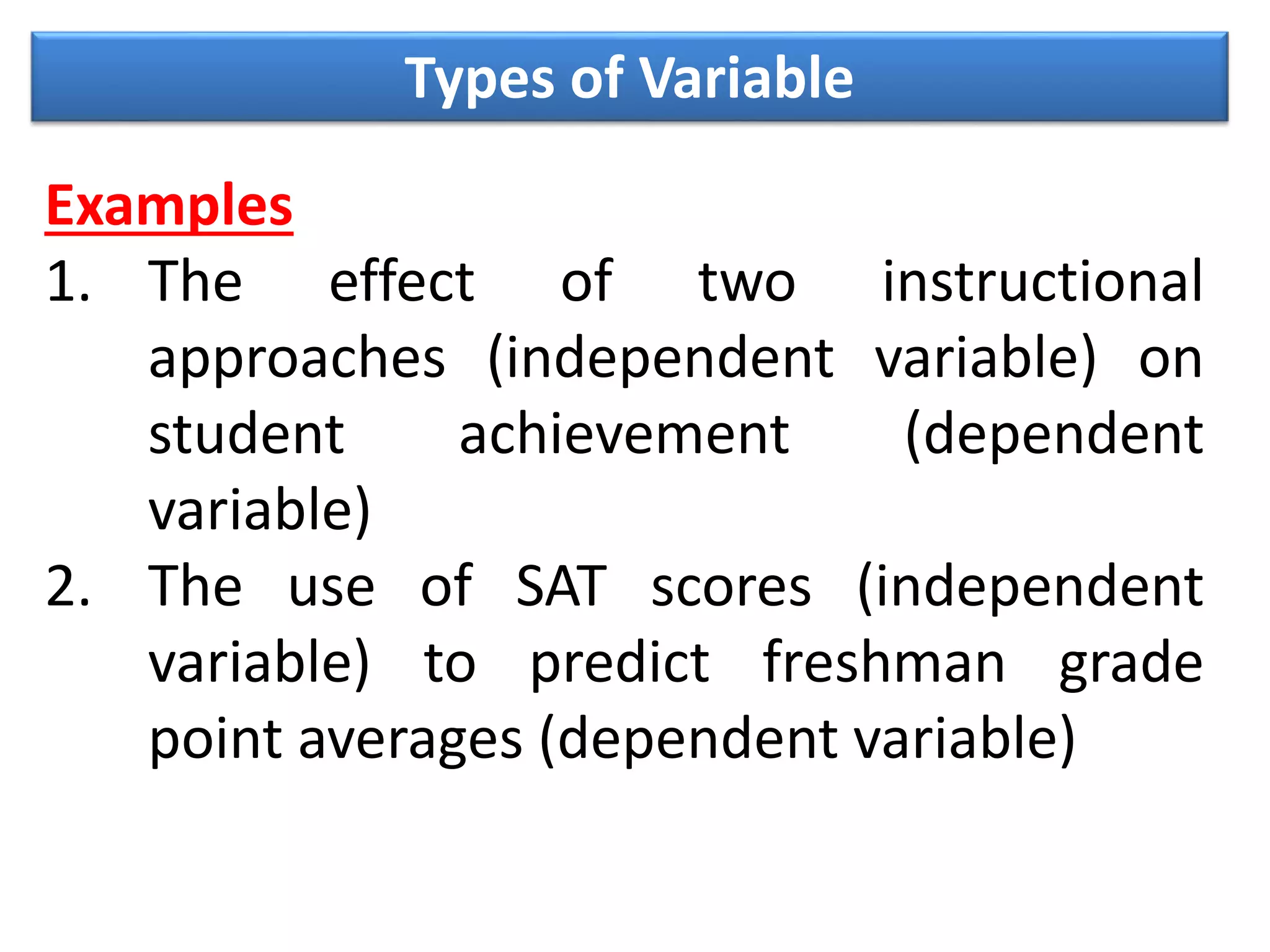
Examples
1. The effect of two instructional
approaches (independent variable) on
student achievement (dependent
variable)
2. The use of SAT scores (independent
variable) to predict freshman grade
point averages (dependent variable)
Types of Variable
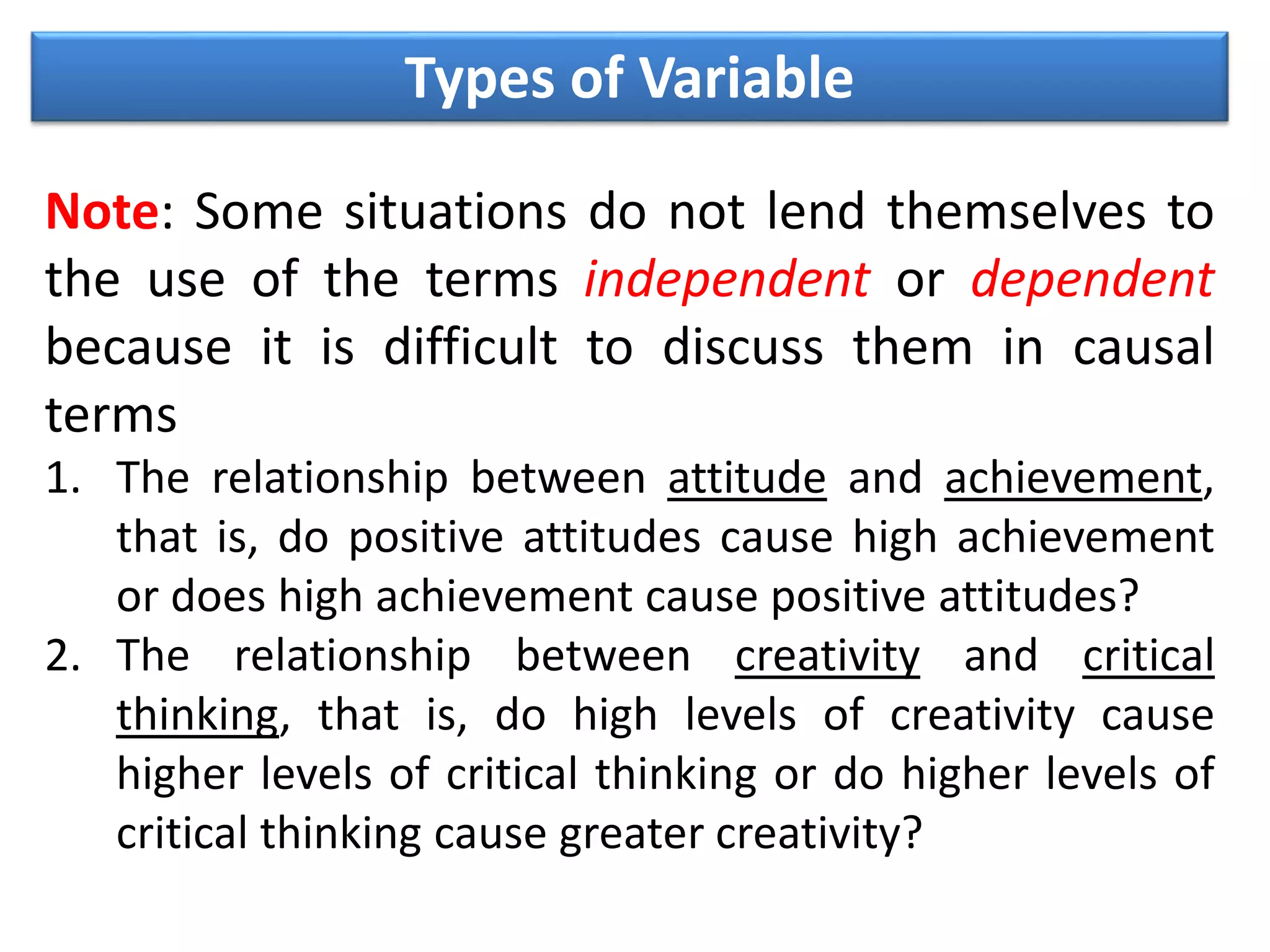
Note: Some situations do not lend themselves to
the use of the terms independent or dependent
because it is difficult to discuss them in causal
terms
1. The relationship between attitude and achievement,
that is, do positive attitudes cause high achievement
or does high achievement cause positive attitudes?
2. The relationship between creativity and critical
thinking, that is, do high levels of creativity cause
higher levels of critical thinking or do higher levels of
critical thinking cause greater creativity?
Types of Variable
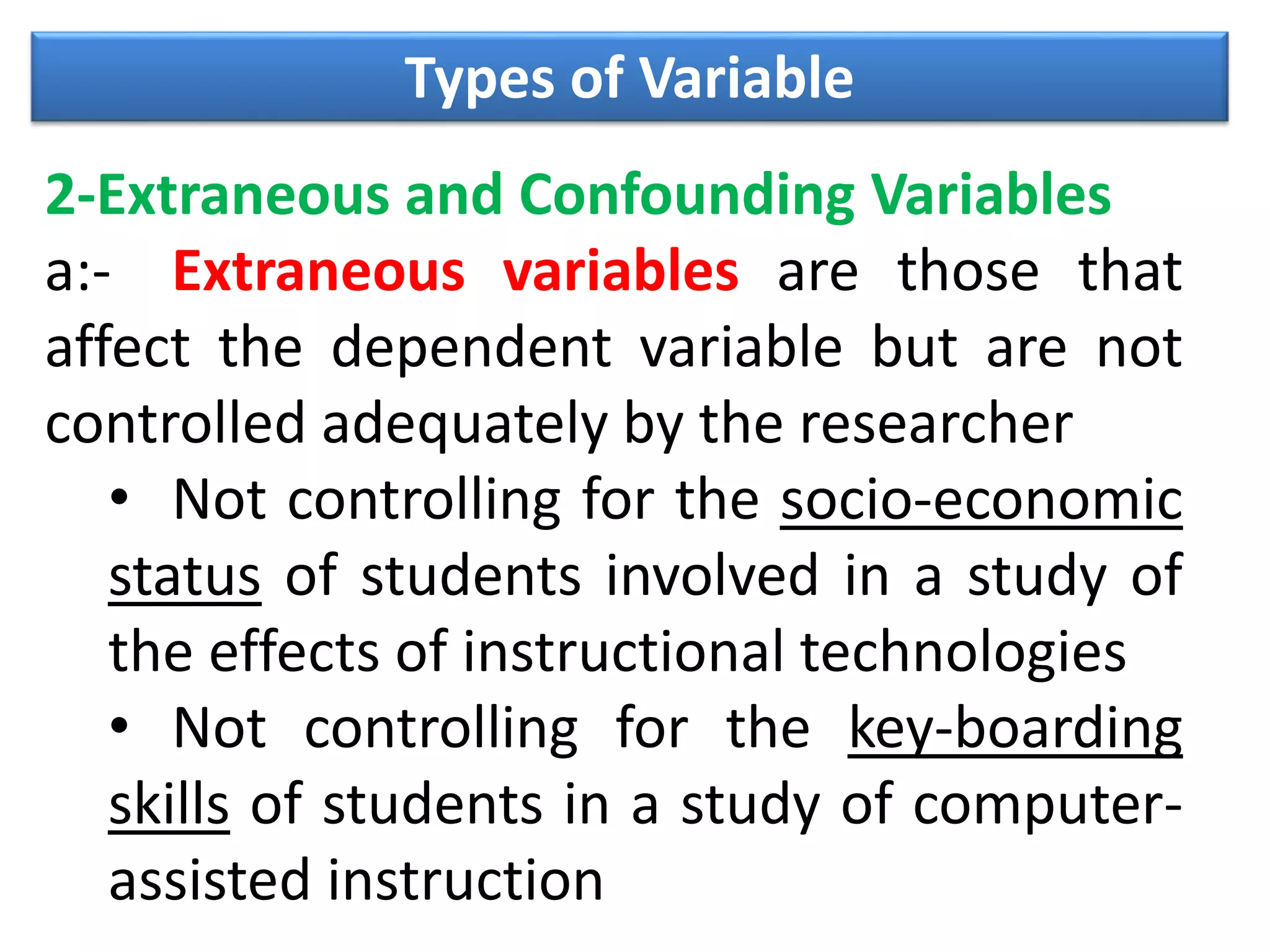
2-Extraneous and Confounding Variables
a:- Extraneous variables are those that
affect the dependent variable but are not
controlled adequately by the researcher
• Not controlling for the socio-economic
status of students involved in a study of
the effects of instructional technologies
• Not controlling for the key-boarding
skills of students in a study of computer-
assisted instruction
Types of Variable
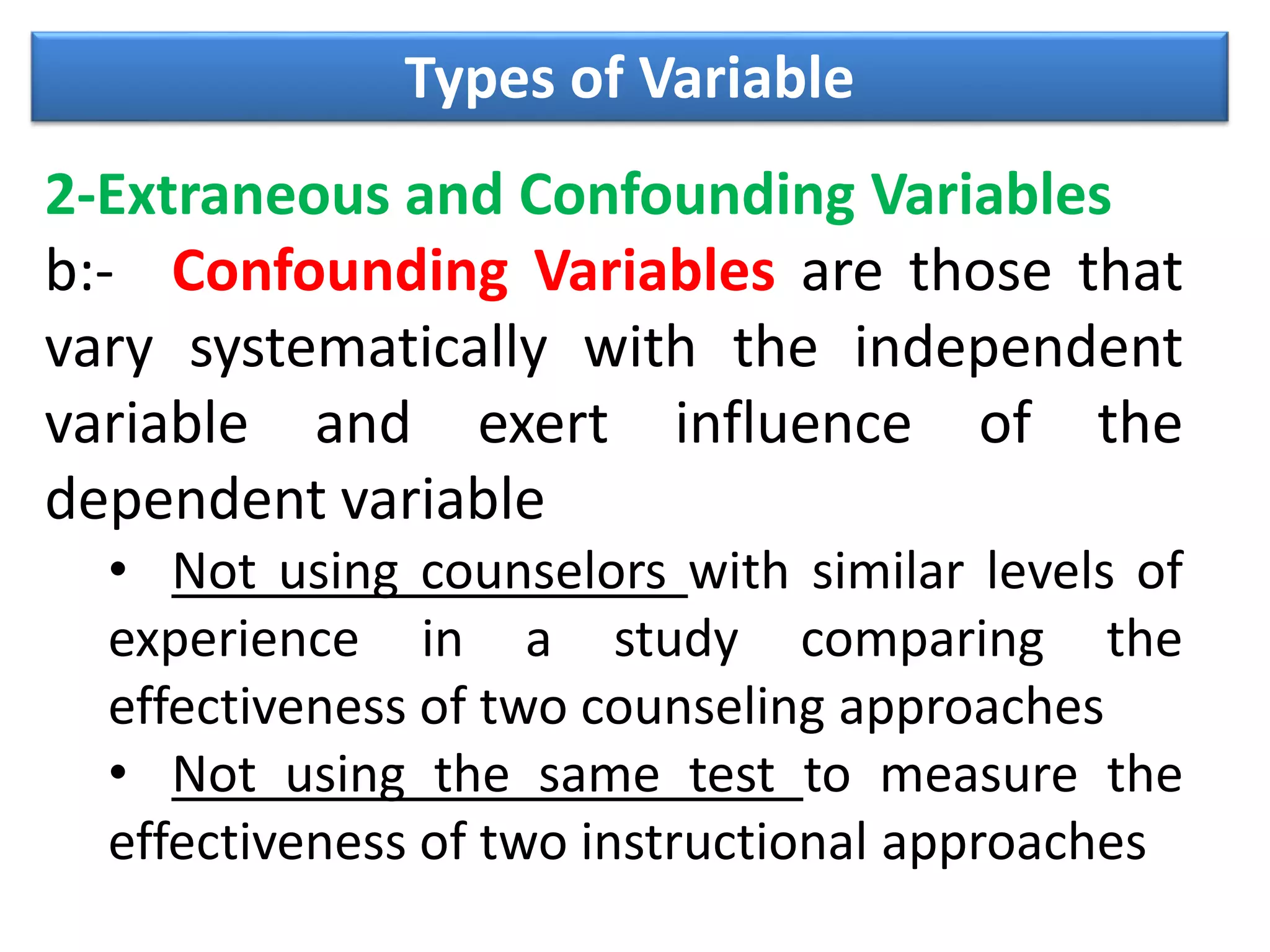
2-Extraneous and Confounding Variables
b:- Confounding Variables are those that
vary systematically with the independent
variable and exert influence of the
dependent variable
• Not using counselors with similar levels of
experience in a study comparing the
effectiveness of two counseling approaches
• Not using the same test to measure the
effectiveness of two instructional approaches
Types of Variable
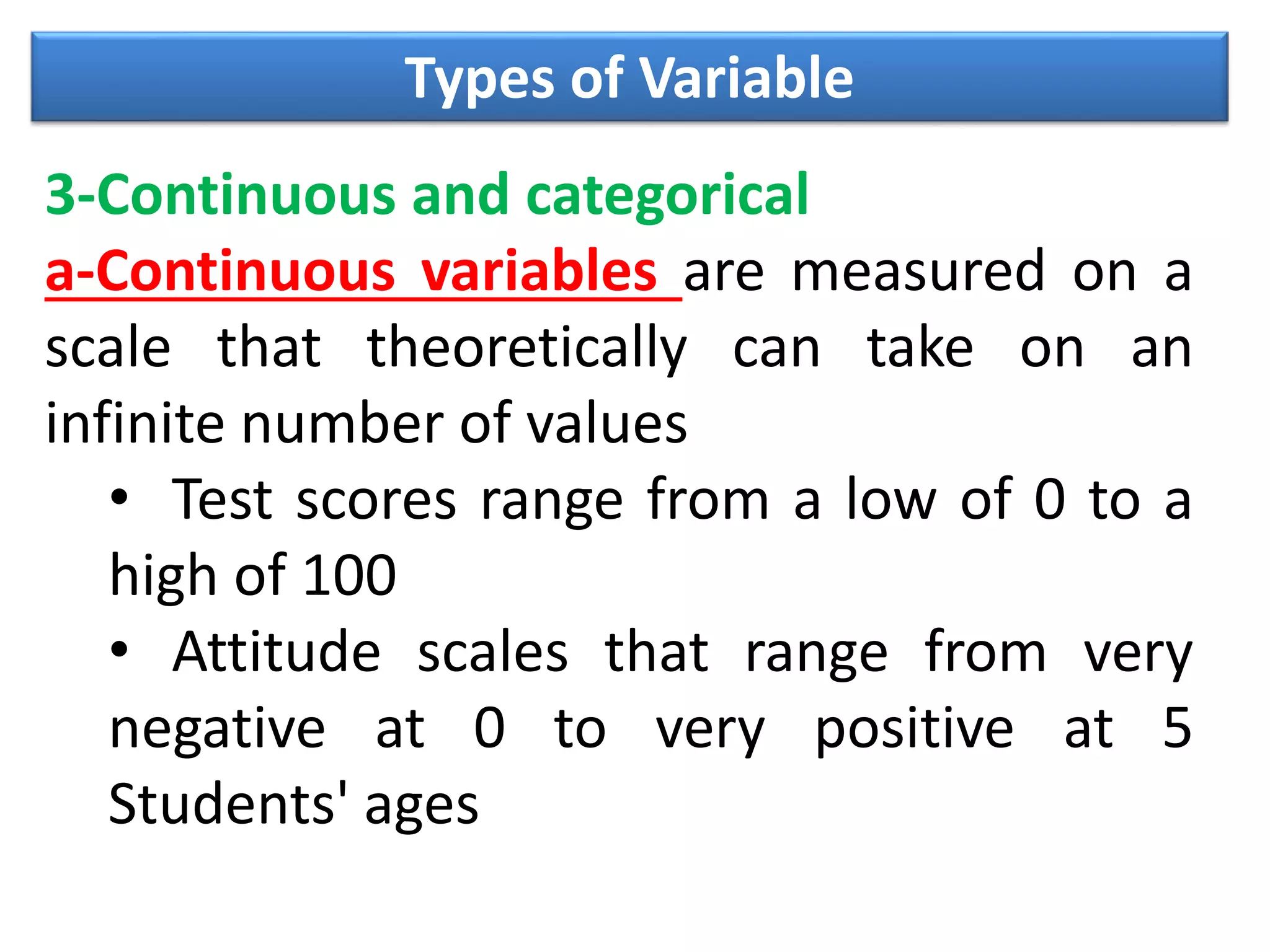
3-Continuous and categorical
a-Continuous variables are measured on a
scale that theoretically can take on an
infinite number of values
• Test scores range from a low of 0 to a
high of 100
• Attitude scales that range from very
negative at 0 to very positive at 5
Students' ages
Types of Variable
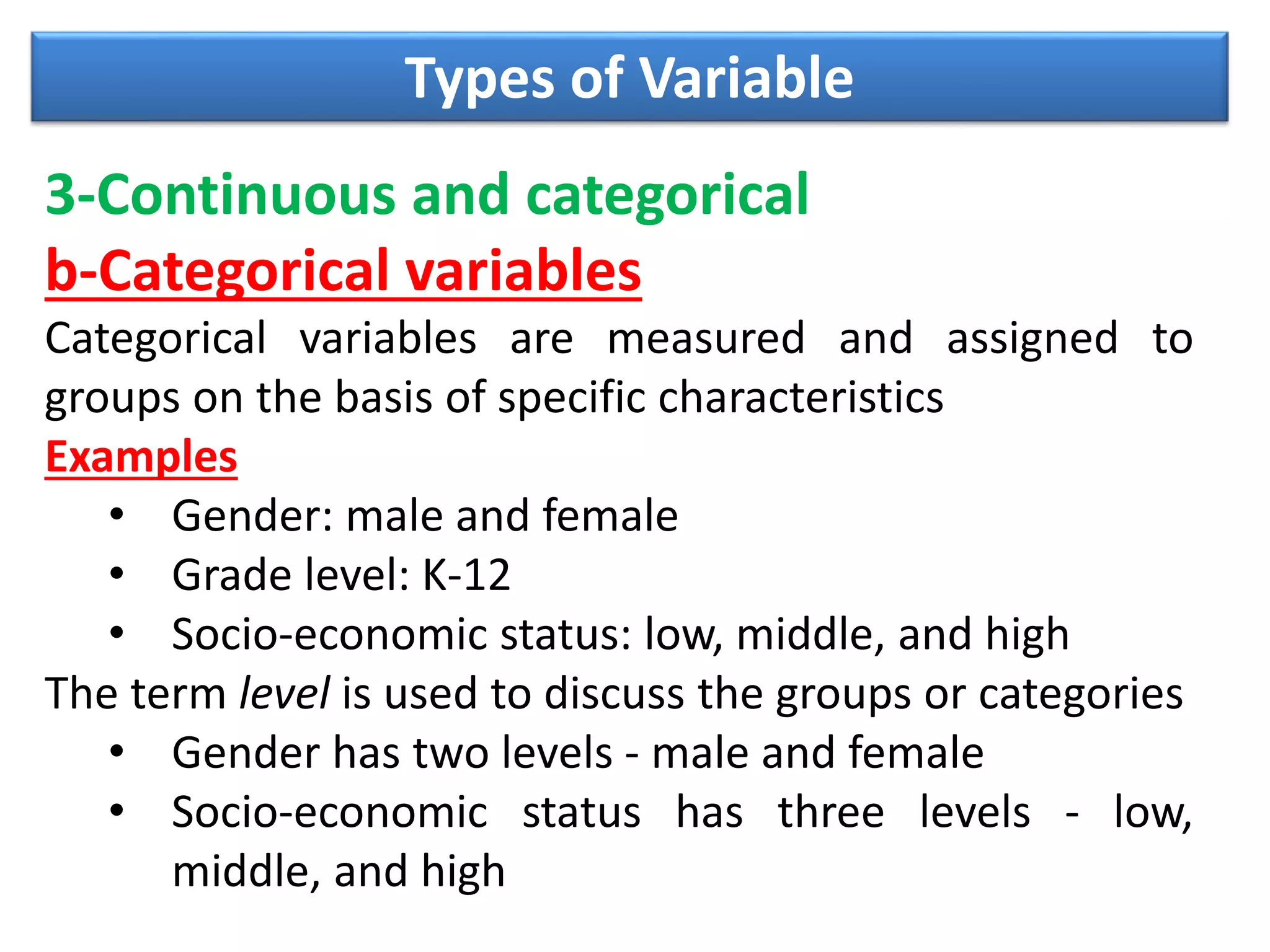
3-Continuous and categorical
b-Categorical variables
Categorical variables are measured and assigned to
groups on the basis of specific characteristics
Examples
• Gender: male and female
• Grade level: K-12
• Socio-economic status: low, middle, and high
The term level is used to discuss the groups or categories
• Gender has two levels - male and female
• Socio-economic status has three levels - low,
middle, and high
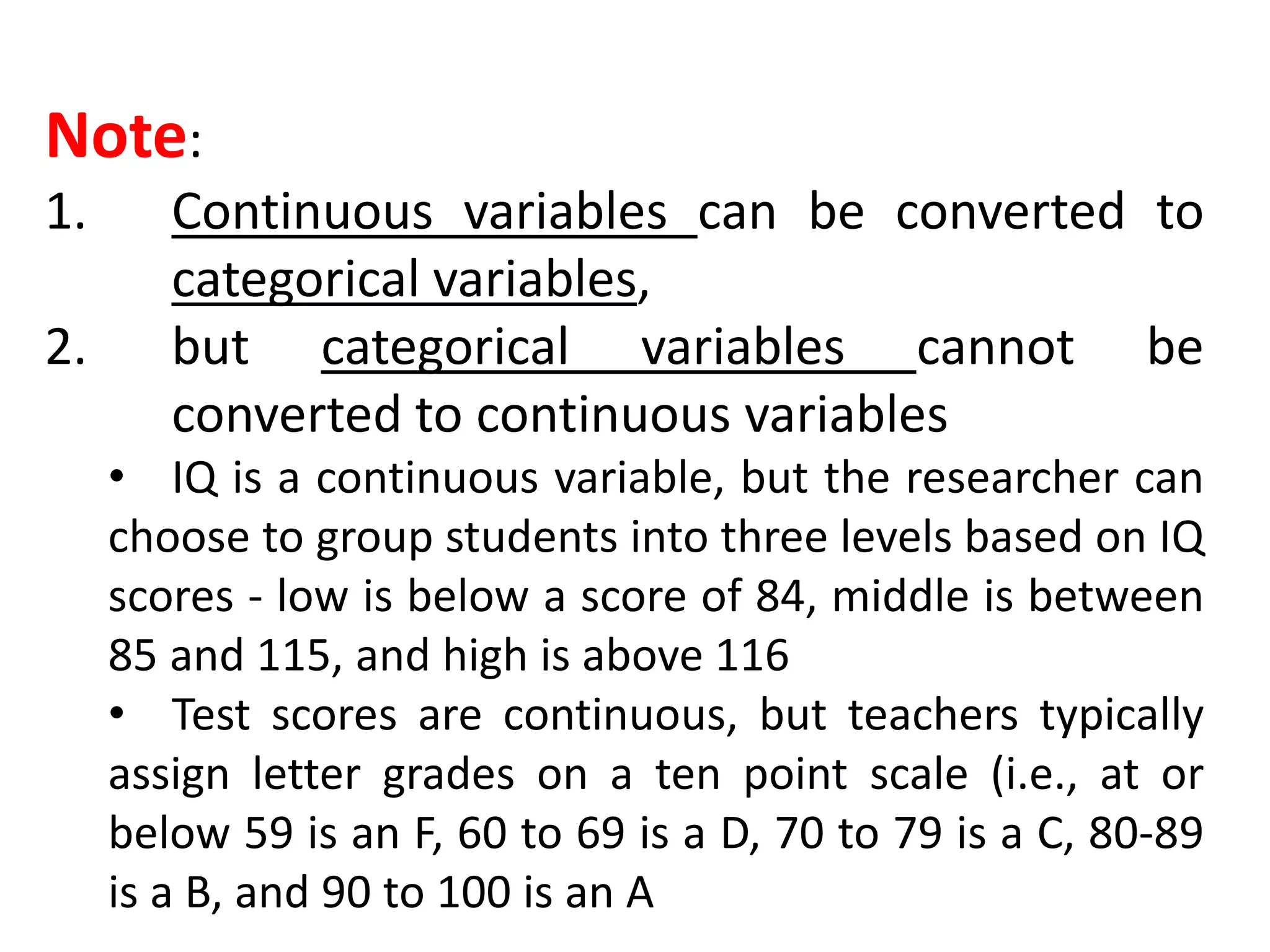
Note:
1. Continuous variables can be converted to
categorical variables,
2. but categorical variables cannot be
converted to continuous variables
• IQ is a continuous variable, but the researcher can
choose to group students into three levels based on IQ
scores - low is below a score of 84, middle is between
85 and 115, and high is above 116
• Test scores are continuous, but teachers typically
assign letter grades on a ten point scale (i.e., at or
below 59 is an F, 60 to 69 is a D, 70 to 79 is a C, 80-89
is a B, and 90 to 100 is an A
Thank You

Variable

  • 1.
  • 2.
    Variable • A variableis any characteristics, number, or quantity that can be measured or counted. • A variable may also be called a data item. • Age, sex, business income and expenses, country of birth, capital expenditure, class grades, eye colour and vehicle type are examples of variables. • It is called a variable because the value may vary between data units in a population, and may change in value over time.
  • 3.
    Variable For example; • 'income'is a variable that can vary between data units in a population (i.e. the people or businesses being studied may not have the same incomes) and can also vary over time for each data unit (i.e. income can go up or down).
  • 4.
    Variable Definition: A variable isa label or name that represents a concept or characteristic that varies (e.g., gender, weight, achievement, attitudes toward inclusion, etc.)
  • 5.
    Concept of Variable ConceptualDefinition of the Variable • Conceptual (i.e., constitutive) definition uses words or concepts to define a variable Achievement: what one has learned from formal instruction Aptitude: one's capability for performing a particular task or skill
  • 6.
    Concept of Variable OperationalDefinition of the Variable • Operational definition is an indication of the meaning of a variable through the specification of the manner by which it is measured, categorized, or controlled 1. Weschler IQ score 2. Income levels below and above $45,000 per year 3. Use of holistic or phonetic language instruction
  • 7.
  • 8.
  • 9.
    Types of Variable 1-Independentand Dependent (i.e., cause and effect) a. Independent variables act as the "cause" in that they precede, influence, and predict the dependent variable b. Dependent variables act as the effect in that they change as a result of being influenced by an independent variable
  • 10.
    Types of Variable Examples 1.The effect of two instructional approaches (independent variable) on student achievement (dependent variable) 2. The use of SAT scores (independent variable) to predict freshman grade point averages (dependent variable)
  • 11.
    Types of Variable Note:Some situations do not lend themselves to the use of the terms independent or dependent because it is difficult to discuss them in causal terms 1. The relationship between attitude and achievement, that is, do positive attitudes cause high achievement or does high achievement cause positive attitudes? 2. The relationship between creativity and critical thinking, that is, do high levels of creativity cause higher levels of critical thinking or do higher levels of critical thinking cause greater creativity?
  • 12.
    Types of Variable 2-Extraneousand Confounding Variables a:- Extraneous variables are those that affect the dependent variable but are not controlled adequately by the researcher • Not controlling for the socio-economic status of students involved in a study of the effects of instructional technologies • Not controlling for the key-boarding skills of students in a study of computer- assisted instruction
  • 13.
    Types of Variable 2-Extraneousand Confounding Variables b:- Confounding Variables are those that vary systematically with the independent variable and exert influence of the dependent variable • Not using counselors with similar levels of experience in a study comparing the effectiveness of two counseling approaches • Not using the same test to measure the effectiveness of two instructional approaches
  • 14.
    Types of Variable 3-Continuousand categorical a-Continuous variables are measured on a scale that theoretically can take on an infinite number of values • Test scores range from a low of 0 to a high of 100 • Attitude scales that range from very negative at 0 to very positive at 5 Students' ages
  • 15.
    Types of Variable 3-Continuousand categorical b-Categorical variables Categorical variables are measured and assigned to groups on the basis of specific characteristics Examples • Gender: male and female • Grade level: K-12 • Socio-economic status: low, middle, and high The term level is used to discuss the groups or categories • Gender has two levels - male and female • Socio-economic status has three levels - low, middle, and high
  • 16.
    Note: 1. Continuous variablescan be converted to categorical variables, 2. but categorical variables cannot be converted to continuous variables • IQ is a continuous variable, but the researcher can choose to group students into three levels based on IQ scores - low is below a score of 84, middle is between 85 and 115, and high is above 116 • Test scores are continuous, but teachers typically assign letter grades on a ten point scale (i.e., at or below 59 is an F, 60 to 69 is a D, 70 to 79 is a C, 80-89 is a B, and 90 to 100 is an A
  • 17.