Developing students’
employability skills through
social media and technology
Sue Beckingham SFHEA
@suebecks
Sheffield Hallam Uni
This presentation will demonstrate the importance of
embedding the use of social media and technology
within the curriculum to develop a range of
graduate attributes and employability skills.
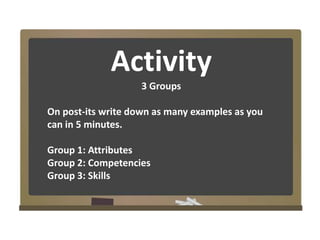
Activity
3 Groups
On post-its write down as many examples as you
can in 5 minutes.
Group 1: Attributes
Group 2: Competencies
Group 3: Skills
Attributes – Competencies – Skills
The activity began with much discussion:
- around the definition
- the importance of context
- overlaps between the categories
The consensus was that this continues to be grey area.
It raises the questions:
- What ‘skills’ are employers looking for graduates to demonstrate?
- How are we helping students to develop and articulate these?
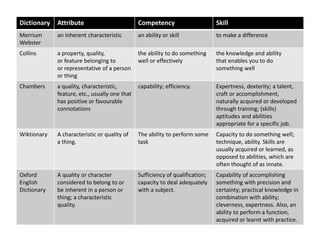
Dictionary Attribute Competency Skill
Merrium
Webster
an inherent characteristic an ability or skill to make a difference
Collins a property, quality,
or feature belonging to
or representative of a person
or thing
the ability to do something
well or effectively
the knowledge and ability
that enables you to do
something well
Chambers a quality, characteristic,
feature, etc., usually one that
has positive or favourable
connotations
capability; efficiency. Expertness, dexterity; a talent,
craft or accomplishment,
naturally acquired or developed
through training; (skills)
aptitudes and abilities
appropriate for a specific job.
Wiktionary A characteristic or quality of
a thing.
The ability to perform some
task
Capacity to do something well;
technique, ability. Skills are
usually acquired or learned, as
opposed to abilities, which are
often thought of as innate.
Oxford
English
Dictionary
A quality or character
considered to belong to or
be inherent in a person or
thing; a characteristic
quality.
Sufficiency of qualification;
capacity to deal adequately
with a subject.
Capability of accomplishing
something with precision and
certainty; practical knowledge in
combination with ability;
cleverness, expertness. Also, an
ability to perform a function,
acquired or learnt with practice.
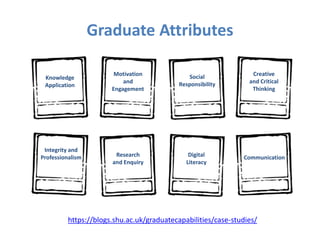
Graduate Attributes
https://blogs.shu.ac.uk/graduatecapabilities/case-studies/
Knowledge
Application
Creative
and Critical
Thinking
Social
Responsibility
Motivation
and
Engagement
Integrity and
Professionalism Research
and Enquiry
Digital
Literacy
Communication
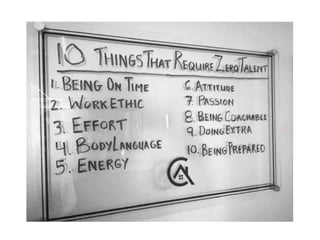
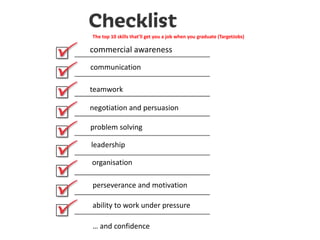
… and confidence
commercial awareness
communication
teamwork
negotiation and persuasion
problem solving
leadership
organisation
perseverance and motivation
ability to work under pressure
The top 10 skills that'll get you a job when you graduate (TargetJobs)
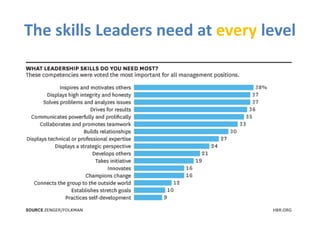
The skills Leaders need at every level
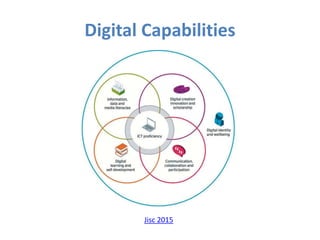
Digital Capabilities
Jisc 2015
“Many businesses report worrying
weaknesses in graduates’ basic skills
and general readiness for employment,
ranging from 17% reporting
shortcoming in graduate applicants’ use
of English to nearly half (46%) voicing
concerns over graduates’ levels of
business and customer awareness.”
CBI/Pearson Education and Skills Survey 2015
Why this is important...
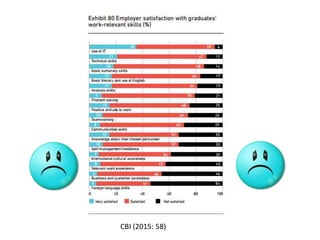
CBI (2015: 58)
As Educators we need to provide authentic learning
experiences to develop confident face to face and
digital communication and collaboration skills
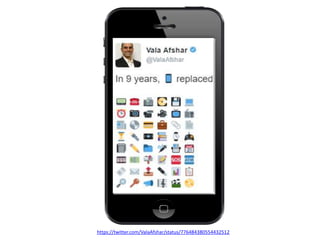
https://twitter.com/ValaAfshar/status/776484380554432512
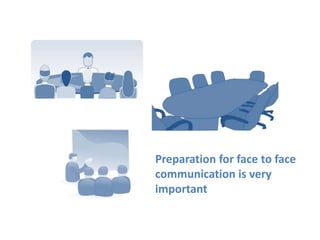
Preparation for face to face
communication is very
important
Preparation for face to
face interviews is very
important
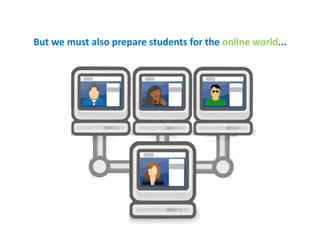
But we must also prepare students for the online world...
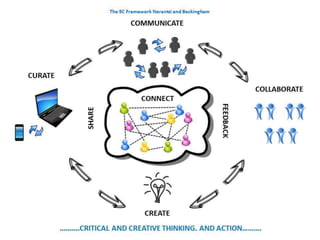
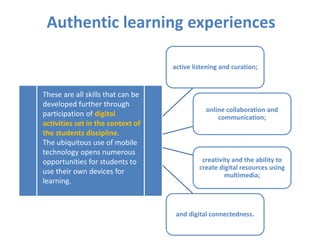
Authentic learning experiences
active listening and curation;
online collaboration and
communication;
creativity and the ability to
create digital resources using
multimedia;
and digital connectedness.
Encourage students to
learn how to use the
affordances of digital
spaces in a
professional context.
(The 5C Framework
Nerantzi and Beckingham 2015)
Authentic learning experiences
active listening and curation;
online collaboration and
communication;
creativity and the ability to
create digital resources using
multimedia;
and digital connectedness.
These are all skills that can be
developed further through
participation of digital
activities set in the context of
the students discipline.
The ubiquitous use of mobile
technology opens numerous
opportunities for students to
use their own devices for
learning.
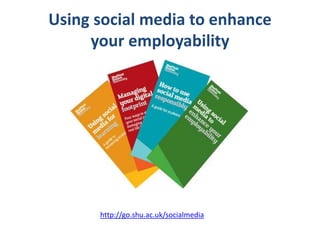
http://go.shu.ac.uk/socialmedia
Using social media to enhance
your employability
We need to provide learning spaces
with adequate power sockets
Professional social networking: Ways to engage
with employers through social media
using social media
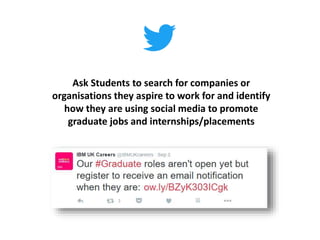
Ask Students to search for companies or
organisations they aspire to work for and identify
how they are using social media to promote
graduate jobs and internships/placements
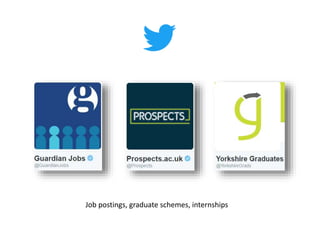
Job postings, graduate schemes, internships
https://www.facebook.com/guardianjobs
https://www.facebook.com/graduateprospects
https://www.facebook.com/YorkshireGraduates
https://www.facebook.com/graduaterecruitmentbureau
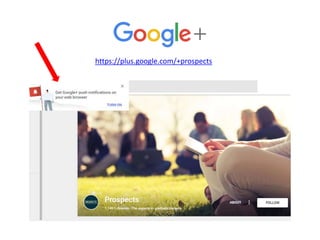
https://plus.google.com/+prospects
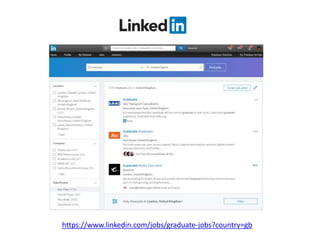
https://www.linkedin.com/jobs/graduate-jobs?country=gb
https://students.linkedin.com/uk
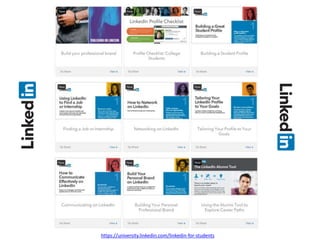
https://university.linkedin.com/linkedin-for-students
Enhancing your digital footprint
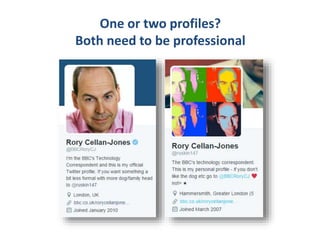
One or two profiles?
Both need to be professional
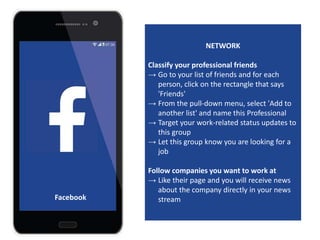
NETWORK
Classify your professional friends
→ Go to your list of friends and for each
person, click on the rectangle that says
'Friends'
→ From the pull-down menu, select 'Add to
another list' and name this Professional
→ Target your work-related status updates to
this group
→ Let this group know you are looking for a
job
Follow companies you want to work at
→ Like their page and you will receive news
about the company directly in your news
streamFacebook
→ Search for people, groups, companies
and jobs
→ Find common interest groups and
contribute to the discussions
→ Follow companies
→ Make use of LinkedIn resources for
students
https://students.linkedin.com/
LinkedIn
BLOG
→ Writing a blog can demonstrate
your communication skills: writing,
audio or video
→ knowledge in your field or niche; and
your passion and enthusiasm.
Blog tools: Tumblr, WordPress and
Blogger
Tumblr
'HOW TO' VIDEO DEMOS
VIDEO CVs
suggested length: 1-3 mins.
x untidy background
x shuffling papers
x reading notes
x poor lighting
 dress smartly
 look to the camera
 speak clearly
 include contact info
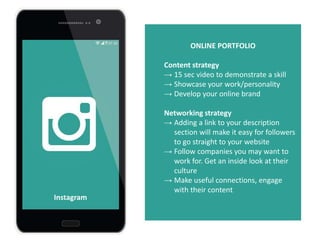
ONLINE PORTFOLIO
Content strategy
→ 15 sec video to demonstrate a skill
→ Showcase your work/personality
→ Develop your online brand
Networking strategy
→ Adding a link to your description
section will make it easy for followers
to go straight to your website
→ Follow companies you may want to
work for. Get an inside look at their
culture
→ Make useful connections, engage
with their content
Instagram
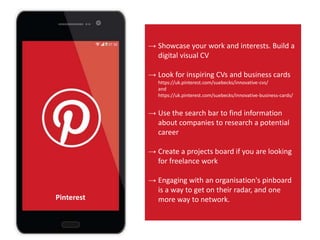
→ Showcase your work and interests. Build a
digital visual CV
→ Look for inspiring CVs and business cards
https://uk.pinterest.com/suebecks/innovative-cvs/
and
https://uk.pinterest.com/suebecks/innovative-business-cards/
→ Use the search bar to find information
about companies to research a potential
career
→ Create a projects board if you are looking
for freelance work
→ Engaging with an organisation's pinboard
is a way to get on their radar, and one
more way to network.Pinterest
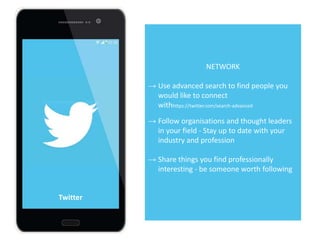
NETWORK
→ Use advanced search to find people you
would like to connect
withhttps://twitter.com/search-advanced
→ Follow organisations and thought leaders
in your field - Stay up to date with your
industry and profession
→ Share things you find professionally
interesting - be someone worth following
Twitter
Discussion
How have you used social
media and technology to
develop employability skills?
Resources
• Social Media Leaflets
http://go.shu.ac.uk/socialmedia
• Sheffield Hallam University Social Media Blog
https://blogs.shu.ac.uk/socialmedia/
• Social Media for Learning Blog
https://socialmediaforlearning.com/
• LinkedIn for Students
https://university.linkedin.com/linkedin-for-
students
References
Beckingham, S. (2015). What does it mean to be a digital lifewide learner? The Journal of Technology Enhanced Learning,
Innovation and Change, 1 (1). Available at: http://research.shu.ac.uk/ds/telic/index.php/telic/article/view/14
Beckingham, S., Purvis, A. and Rodger, H. (2014). The SHU Social Media CoLab: developing a social media strategy through open
dialogue and collaborative guidance. In: Proceedings of the European Conference on Social Media. Sonning, Wokingham,
Academic Conferences and Publishing International Limited. Available at: http://shura.shu.ac.uk/8323/
CBI (2015) Inspiring Growth: CBI/Pearson Education and Skills Survey 2015
http://news.cbi.org.uk/business-issues/education-and-skills/gateway-to-growth-cbi-pearson-education-and-skills-survey-2015/
Harvard Business Review (2014) The skills leaders need at every level. https://hbr.org/2014/07/the-skills-leaders-need-at-every-
level
Jisc. (2015) Building digital capability: the six elements defined.
http://repository.jisc.ac.uk/6239/1/Digital_capabilities_six_elements.pdf
Nerantzi, C. and Beckingham, S. (2015). BYOD4L : learning to use own smart devices for learning and teaching through the 5C
framework. In: Middleton, A. (ed.) Smart learning : teaching and learning with smartphones and tablets in post-compulsory
education. MELSIG, Sheffield Hallam University, 108-127. Available at: http://shura.shu.ac.uk/9616/
Sheffield Hallam University. SHU Graduate Attributes. https://blogs.shu.ac.uk/graduatecapabilities/case-studies/
Sheffield Hallam University. Using social media to enhance employability
https://students.shu.ac.uk/lits/it/documents/pdf/SocialMediaEmployability.pdf
Target Jobs. The top 10 skills that get you a job when you graduate. https://targetjobs.co.uk/careers-advice/career-
planning/273051-the-top-10-skills-thatll-get-you-a-job-when-you-graduate
World Economic Forum (2016) The 10 skills you need to thrive in the fourth industrial revolution.
https://www.weforum.org/agenda/2016/01/the-10-skills-you-need-to-thrive-in-the-fourth-industrial-revolution/
Abstract
This session will demonstrate the importance of embedding the use of social media and technology within the curriculum to
develop a range of graduate attributes and employability skills. Examples will be shared of how students can develop:
• authentic learning experiences to develop confident digital communication and collaboration skills
• ways to engage with employers through social media through professional social networking
• students' digital capabilities (Jisc 2015) awareness of the importance of lifelong learning and becoming a digital lifewide
learner (Beckingham 2015) employability skills which include social skills such as communication and teamwork which
increasingly in the workplace is also taking place online.
It is important that the constant evolution of social media is understood (Beckingham, Purvis and Rodger 2015), and that students
are given authentic learning experiences to allow them to learn how to use the affordances of these digital spaces in a
professional context. Active listening and curation; online collaboration and communication; creativity and the ability to create
digital resources using multimedia; and digital connectedness, are all skills that can be developed further through participation of
digital activities set in the context of the students discipline. The ubiquitous use of mobile technology opens numerous
opportunities for students to use their own devices for learning Nerantzi and Beckingham (2015).
Why is this important?
The annual survey produced by the CBI (Confederation of British Industry) considers employers' requirements for graduate skills
and highlight the dissatisfaction that employers feel over graduates' preparedness for the workplace. Over half of businesses (55%)
were not confident there will be enough people available in the future with the necessary skills to fill their high-skilled jobs (CBI
2015:6) and noted that "Businesses look first and foremost for graduates with the right attitudes and aptitudes to enable them to
be effective in the workplace – nearly nine in ten employers (89%) value these above factors such as degree subject (62%)." (CBI
2015:56).
Key areas of concern in this report were communication and team working skills. In today's digital age these skills need to be
demonstrated confidently both face to face and online. Increasingly the first contact an employer makes with a prospective
candidate is online. Particular attention should therefore also be given to the development of a professional online presence.
Participants will also have the opportunity to share and discuss their own use of social media and technology to develop
employability skills.

Developing students’ employability skills through social media

  • 1.
    Developing students’ employability skillsthrough social media and technology Sue Beckingham SFHEA @suebecks Sheffield Hallam Uni
  • 2.
    This presentation willdemonstrate the importance of embedding the use of social media and technology within the curriculum to develop a range of graduate attributes and employability skills.
  • 3.
    Activity 3 Groups On post-itswrite down as many examples as you can in 5 minutes. Group 1: Attributes Group 2: Competencies Group 3: Skills
  • 4.
    Attributes – Competencies– Skills The activity began with much discussion: - around the definition - the importance of context - overlaps between the categories The consensus was that this continues to be grey area. It raises the questions: - What ‘skills’ are employers looking for graduates to demonstrate? - How are we helping students to develop and articulate these?
  • 5.
    Dictionary Attribute CompetencySkill Merrium Webster an inherent characteristic an ability or skill to make a difference Collins a property, quality, or feature belonging to or representative of a person or thing the ability to do something well or effectively the knowledge and ability that enables you to do something well Chambers a quality, characteristic, feature, etc., usually one that has positive or favourable connotations capability; efficiency. Expertness, dexterity; a talent, craft or accomplishment, naturally acquired or developed through training; (skills) aptitudes and abilities appropriate for a specific job. Wiktionary A characteristic or quality of a thing. The ability to perform some task Capacity to do something well; technique, ability. Skills are usually acquired or learned, as opposed to abilities, which are often thought of as innate. Oxford English Dictionary A quality or character considered to belong to or be inherent in a person or thing; a characteristic quality. Sufficiency of qualification; capacity to deal adequately with a subject. Capability of accomplishing something with precision and certainty; practical knowledge in combination with ability; cleverness, expertness. Also, an ability to perform a function, acquired or learnt with practice.
  • 7.
  • 8.
    … and confidence commercialawareness communication teamwork negotiation and persuasion problem solving leadership organisation perseverance and motivation ability to work under pressure The top 10 skills that'll get you a job when you graduate (TargetJobs)
  • 9.
    The skills Leadersneed at every level
  • 11.
  • 12.
    “Many businesses reportworrying weaknesses in graduates’ basic skills and general readiness for employment, ranging from 17% reporting shortcoming in graduate applicants’ use of English to nearly half (46%) voicing concerns over graduates’ levels of business and customer awareness.” CBI/Pearson Education and Skills Survey 2015 Why this is important...
  • 13.
  • 14.
    As Educators weneed to provide authentic learning experiences to develop confident face to face and digital communication and collaboration skills
  • 15.
  • 17.
    Preparation for faceto face communication is very important
  • 18.
    Preparation for faceto face interviews is very important
  • 19.
    But we mustalso prepare students for the online world...
  • 20.
    Authentic learning experiences activelistening and curation; online collaboration and communication; creativity and the ability to create digital resources using multimedia; and digital connectedness. Encourage students to learn how to use the affordances of digital spaces in a professional context. (The 5C Framework Nerantzi and Beckingham 2015)
  • 21.
    Authentic learning experiences activelistening and curation; online collaboration and communication; creativity and the ability to create digital resources using multimedia; and digital connectedness. These are all skills that can be developed further through participation of digital activities set in the context of the students discipline. The ubiquitous use of mobile technology opens numerous opportunities for students to use their own devices for learning.
  • 22.
  • 23.
    We need toprovide learning spaces with adequate power sockets
  • 24.
    Professional social networking:Ways to engage with employers through social media
  • 25.
  • 26.
    Ask Students tosearch for companies or organisations they aspire to work for and identify how they are using social media to promote graduate jobs and internships/placements
  • 27.
    Job postings, graduateschemes, internships
  • 28.
  • 29.
  • 30.
  • 31.
  • 32.
  • 33.
  • 34.
    One or twoprofiles? Both need to be professional
  • 35.
    NETWORK Classify your professionalfriends → Go to your list of friends and for each person, click on the rectangle that says 'Friends' → From the pull-down menu, select 'Add to another list' and name this Professional → Target your work-related status updates to this group → Let this group know you are looking for a job Follow companies you want to work at → Like their page and you will receive news about the company directly in your news streamFacebook
  • 36.
    → Search forpeople, groups, companies and jobs → Find common interest groups and contribute to the discussions → Follow companies → Make use of LinkedIn resources for students https://students.linkedin.com/ LinkedIn
  • 37.
    BLOG → Writing ablog can demonstrate your communication skills: writing, audio or video → knowledge in your field or niche; and your passion and enthusiasm. Blog tools: Tumblr, WordPress and Blogger Tumblr
  • 38.
    'HOW TO' VIDEODEMOS VIDEO CVs suggested length: 1-3 mins. x untidy background x shuffling papers x reading notes x poor lighting  dress smartly  look to the camera  speak clearly  include contact info
  • 39.
    ONLINE PORTFOLIO Content strategy →15 sec video to demonstrate a skill → Showcase your work/personality → Develop your online brand Networking strategy → Adding a link to your description section will make it easy for followers to go straight to your website → Follow companies you may want to work for. Get an inside look at their culture → Make useful connections, engage with their content Instagram
  • 40.
    → Showcase yourwork and interests. Build a digital visual CV → Look for inspiring CVs and business cards https://uk.pinterest.com/suebecks/innovative-cvs/ and https://uk.pinterest.com/suebecks/innovative-business-cards/ → Use the search bar to find information about companies to research a potential career → Create a projects board if you are looking for freelance work → Engaging with an organisation's pinboard is a way to get on their radar, and one more way to network.Pinterest
  • 41.
    NETWORK → Use advancedsearch to find people you would like to connect withhttps://twitter.com/search-advanced → Follow organisations and thought leaders in your field - Stay up to date with your industry and profession → Share things you find professionally interesting - be someone worth following Twitter
  • 43.
    Discussion How have youused social media and technology to develop employability skills?
  • 44.
    Resources • Social MediaLeaflets http://go.shu.ac.uk/socialmedia • Sheffield Hallam University Social Media Blog https://blogs.shu.ac.uk/socialmedia/ • Social Media for Learning Blog https://socialmediaforlearning.com/ • LinkedIn for Students https://university.linkedin.com/linkedin-for- students
  • 45.
    References Beckingham, S. (2015).What does it mean to be a digital lifewide learner? The Journal of Technology Enhanced Learning, Innovation and Change, 1 (1). Available at: http://research.shu.ac.uk/ds/telic/index.php/telic/article/view/14 Beckingham, S., Purvis, A. and Rodger, H. (2014). The SHU Social Media CoLab: developing a social media strategy through open dialogue and collaborative guidance. In: Proceedings of the European Conference on Social Media. Sonning, Wokingham, Academic Conferences and Publishing International Limited. Available at: http://shura.shu.ac.uk/8323/ CBI (2015) Inspiring Growth: CBI/Pearson Education and Skills Survey 2015 http://news.cbi.org.uk/business-issues/education-and-skills/gateway-to-growth-cbi-pearson-education-and-skills-survey-2015/ Harvard Business Review (2014) The skills leaders need at every level. https://hbr.org/2014/07/the-skills-leaders-need-at-every- level Jisc. (2015) Building digital capability: the six elements defined. http://repository.jisc.ac.uk/6239/1/Digital_capabilities_six_elements.pdf Nerantzi, C. and Beckingham, S. (2015). BYOD4L : learning to use own smart devices for learning and teaching through the 5C framework. In: Middleton, A. (ed.) Smart learning : teaching and learning with smartphones and tablets in post-compulsory education. MELSIG, Sheffield Hallam University, 108-127. Available at: http://shura.shu.ac.uk/9616/ Sheffield Hallam University. SHU Graduate Attributes. https://blogs.shu.ac.uk/graduatecapabilities/case-studies/ Sheffield Hallam University. Using social media to enhance employability https://students.shu.ac.uk/lits/it/documents/pdf/SocialMediaEmployability.pdf Target Jobs. The top 10 skills that get you a job when you graduate. https://targetjobs.co.uk/careers-advice/career- planning/273051-the-top-10-skills-thatll-get-you-a-job-when-you-graduate World Economic Forum (2016) The 10 skills you need to thrive in the fourth industrial revolution. https://www.weforum.org/agenda/2016/01/the-10-skills-you-need-to-thrive-in-the-fourth-industrial-revolution/
  • 46.
    Abstract This session willdemonstrate the importance of embedding the use of social media and technology within the curriculum to develop a range of graduate attributes and employability skills. Examples will be shared of how students can develop: • authentic learning experiences to develop confident digital communication and collaboration skills • ways to engage with employers through social media through professional social networking • students' digital capabilities (Jisc 2015) awareness of the importance of lifelong learning and becoming a digital lifewide learner (Beckingham 2015) employability skills which include social skills such as communication and teamwork which increasingly in the workplace is also taking place online. It is important that the constant evolution of social media is understood (Beckingham, Purvis and Rodger 2015), and that students are given authentic learning experiences to allow them to learn how to use the affordances of these digital spaces in a professional context. Active listening and curation; online collaboration and communication; creativity and the ability to create digital resources using multimedia; and digital connectedness, are all skills that can be developed further through participation of digital activities set in the context of the students discipline. The ubiquitous use of mobile technology opens numerous opportunities for students to use their own devices for learning Nerantzi and Beckingham (2015). Why is this important? The annual survey produced by the CBI (Confederation of British Industry) considers employers' requirements for graduate skills and highlight the dissatisfaction that employers feel over graduates' preparedness for the workplace. Over half of businesses (55%) were not confident there will be enough people available in the future with the necessary skills to fill their high-skilled jobs (CBI 2015:6) and noted that "Businesses look first and foremost for graduates with the right attitudes and aptitudes to enable them to be effective in the workplace – nearly nine in ten employers (89%) value these above factors such as degree subject (62%)." (CBI 2015:56). Key areas of concern in this report were communication and team working skills. In today's digital age these skills need to be demonstrated confidently both face to face and online. Increasingly the first contact an employer makes with a prospective candidate is online. Particular attention should therefore also be given to the development of a professional online presence. Participants will also have the opportunity to share and discuss their own use of social media and technology to develop employability skills.

Editor's Notes

  • #17 Used in the cross institutional open online course https://byod4learning.wordpress.com/