Building a professional digital
profile
By Lisa Harris and Chira Tochia
24th April 2017
@lisaharris @chiratochia
Who we are
• Lisa Harris : Director Web Science Institute and Digital Educator.
Connect @lisaharris / L.J.Harris@soton.ac.uk
• Chira Tochia: PhD student Web Science and Digital Educator. Connect
@chiratochia / cnt1g15@soton.ac.uk
Plan
• What are digital literacies and why are they important?
• Online identity - managing the personal v the professional
• What employers are looking for
• For questions / input to activities please use this shared googledoc
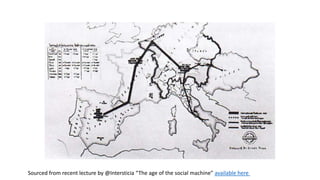
Sourced from recent lecture by @Intersticia “The age of the social machine” available here
Digital Literacy
• “Digital literacy is the ability to locate, organise, understand,
evaluate, and analyse information using digital technology. It
involves a working knowledge of current tools and an
understanding of how they can be used”
• “The active management of online activities such as
collaboration, networking , content creation and curation in
order to “stand out from the crowd” in today’s job market”
• “an ability to respond positively to change”
• “How we can best live, learn and work in an increasingly digital
society”
Managing our digital footprint
• effective learning in a world where we are increasingly swamped with data.
• showcasing our knowledge and building our networks to “stand out from the
crowd” – enhancing employment prospects or a setting up a new business
• promoting “digital citizenship” – for example by behaving responsibly online
or raising awareness of and supporting good causes.
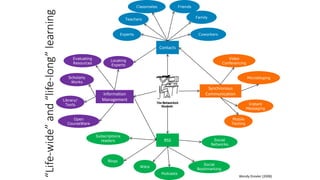
“Life-wide”and“life-long”learning Contacts
Experts
Teachers
Classmates Friends
Family
Coworkers
Synchronous
Communication
Mobile
Texting
Video
Conferencing
Microbloging
Instant
Messaging
RSS
Wikis
Blogs
Subscriptions
readers
Podcasts
Social
Bookmarking
Social
Networks
Information
ManagementLibrary/
Texts
Open
CourseWare
Evaluating
Resources
Scholarly
Works
Locating
Experts
Wendy Drexler (2008)
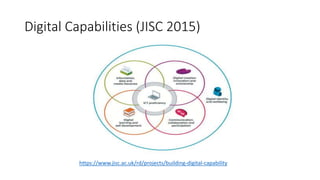
Digital Capabilities (JISC 2015)
https://www.jisc.ac.uk/rd/projects/building-digital-capability
Online Identity
Finding me online:
Twitter
LinkedIn
Slideshare
Web Science Institute
Innovation in HE blog
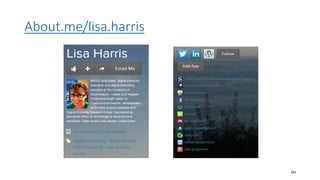
About.me/lisa.harris
10
The many faces of You!
Onkvisit and Shaw (1987) identify at least four components similar to that of Sirgy’s (1982) findings
on the self:
(1) actual or objective self —the way a person actually is
(2) self-image —the way a person sees them self
(3) ideal self (self-actualization) —the way they would like to be
(4) social self— the way they think others regard them
Onkvisit, S., and Shaw, J., 1987. Self-concept and Image Congruence: Some Research and Managerial Implications. Journal of Consumer Marketing, 4 (1), 13 – 23.
Sirgy, J., 1982. Self-Concept in Consumer Behavior: A Critical Review. Journal of Consumer Research, 9, 287-300.
Single or multiple digital identities?
• A single identity is easily identifiable as us across all platforms.
• Multiple identities may be used for different contexts (such as
professional and personal) or on different platforms - some of which
may be anonymous
• Whichever we choose, we make active choices over what we:
• create, post and share,
• contribute to communities and social networks,
• like and comment on,
• respond and reply to or repost/retweet
• Some views on this topic from other Southampton students
Give before you receive
• Developing a ‘digital footprint’ which demonstrates our skills is not an overnight
task. Chris Brogan talks about ‘paying it forward’ – meaning we should give
before we receive.
• Long term benefit comes from focusing on the value we bring to our network, not
what we take from it.
• Don’t connect with someone on LinkedIn just when you need a recommendation.
Share useful information with your network, and you will benefit when you need
help in return.
• Watch the discussion on paying it forward with Southampton PhD students here
Privacy…or lack of…
https://myaccount.google.com/
to control, protect and secure your account
https://myaccount.google.com/privacy#ads
to see what information Google thinks it knows about you from your
browsing habits – fun to see what they have guessed at
Useful tips here to clean up search results for your name
Beware the “filter bubble” - searching your name in your own browser will
NOT give you an accurate view of how other people see these results.
Google filters and personalises results according to past search behaviour, so
a search from your own machine is likely to disproportionally favour your
own sites.
Exercise
• What approach do you take to managing your digital identity? Why?
The challenge
A standard CV is no longer sufficient to stand out from the crowd in a global and
rapidly evolving job market.
“We are currently preparing students for jobs that
don’t yet exist, using technologies that haven’t
been invented, in order to solve problems we
don’t even know are problems yet.”
- Karl Fisch, “Did You Know”
http://www.youtube.com/watch?v=YmwwrGV_aiE
Recruitment in a digital world
According to a 2016 study by Jobvite:
• 96% of recruiters use social media in the hiring process
• 80% had been positively influenced by a candidate’s professional
social network profile
• 78% had been negatively influenced towards a candidate’s
inappropriate use of social media
• More input here from Southampton students on employer
expectations
Employer branding
• The best candidates might not be actively looking for a new job (up to
90% of the workforce at any time)
• Social media can identify the best talent , encourage conversation and
build relationships between prospective employees/employers
• Enables recruiters to promote their company as “a great place to
work”
Top Tips
• Edit your headline (and photo)
• Update regularly
• Use “calls to action”
• Request recommendations
• Post material
• Connect with each other
Exercise
• In what ways will you enhance your professional digital profile after
this session?
• Divide your ideas up into “quick wins” and longer term plans.
More Resources
• Learning in the Network Age MOOC starts 24/4 for 2 weeks
• Power of Social Media MOOC starts 8/5 for 2 weeks
• Digital Literacies and Employability (a free online course by Dr Cristina
Costa, University of Strathclyde. Starts 2nd May for 3 weeks)
• Satire from The Onion, (but with more than a grain of truth!)

Building a professional digital profile

  • 1.
    Building a professionaldigital profile By Lisa Harris and Chira Tochia 24th April 2017 @lisaharris @chiratochia
  • 2.
    Who we are •Lisa Harris : Director Web Science Institute and Digital Educator. Connect @lisaharris / L.J.Harris@soton.ac.uk • Chira Tochia: PhD student Web Science and Digital Educator. Connect @chiratochia / cnt1g15@soton.ac.uk
  • 3.
    Plan • What aredigital literacies and why are they important? • Online identity - managing the personal v the professional • What employers are looking for • For questions / input to activities please use this shared googledoc
  • 4.
    Sourced from recentlecture by @Intersticia “The age of the social machine” available here
  • 5.
    Digital Literacy • “Digitalliteracy is the ability to locate, organise, understand, evaluate, and analyse information using digital technology. It involves a working knowledge of current tools and an understanding of how they can be used” • “The active management of online activities such as collaboration, networking , content creation and curation in order to “stand out from the crowd” in today’s job market” • “an ability to respond positively to change” • “How we can best live, learn and work in an increasingly digital society”
  • 6.
    Managing our digitalfootprint • effective learning in a world where we are increasingly swamped with data. • showcasing our knowledge and building our networks to “stand out from the crowd” – enhancing employment prospects or a setting up a new business • promoting “digital citizenship” – for example by behaving responsibly online or raising awareness of and supporting good causes.
  • 7.
  • 8.
    Digital Capabilities (JISC2015) https://www.jisc.ac.uk/rd/projects/building-digital-capability
  • 9.
    Online Identity Finding meonline: Twitter LinkedIn Slideshare Web Science Institute Innovation in HE blog
  • 10.
  • 11.
    The many facesof You! Onkvisit and Shaw (1987) identify at least four components similar to that of Sirgy’s (1982) findings on the self: (1) actual or objective self —the way a person actually is (2) self-image —the way a person sees them self (3) ideal self (self-actualization) —the way they would like to be (4) social self— the way they think others regard them Onkvisit, S., and Shaw, J., 1987. Self-concept and Image Congruence: Some Research and Managerial Implications. Journal of Consumer Marketing, 4 (1), 13 – 23. Sirgy, J., 1982. Self-Concept in Consumer Behavior: A Critical Review. Journal of Consumer Research, 9, 287-300.
  • 12.
    Single or multipledigital identities? • A single identity is easily identifiable as us across all platforms. • Multiple identities may be used for different contexts (such as professional and personal) or on different platforms - some of which may be anonymous • Whichever we choose, we make active choices over what we: • create, post and share, • contribute to communities and social networks, • like and comment on, • respond and reply to or repost/retweet • Some views on this topic from other Southampton students
  • 13.
    Give before youreceive • Developing a ‘digital footprint’ which demonstrates our skills is not an overnight task. Chris Brogan talks about ‘paying it forward’ – meaning we should give before we receive. • Long term benefit comes from focusing on the value we bring to our network, not what we take from it. • Don’t connect with someone on LinkedIn just when you need a recommendation. Share useful information with your network, and you will benefit when you need help in return. • Watch the discussion on paying it forward with Southampton PhD students here
  • 14.
    Privacy…or lack of… https://myaccount.google.com/ tocontrol, protect and secure your account https://myaccount.google.com/privacy#ads to see what information Google thinks it knows about you from your browsing habits – fun to see what they have guessed at Useful tips here to clean up search results for your name Beware the “filter bubble” - searching your name in your own browser will NOT give you an accurate view of how other people see these results. Google filters and personalises results according to past search behaviour, so a search from your own machine is likely to disproportionally favour your own sites.
  • 15.
    Exercise • What approachdo you take to managing your digital identity? Why?
  • 16.
    The challenge A standardCV is no longer sufficient to stand out from the crowd in a global and rapidly evolving job market. “We are currently preparing students for jobs that don’t yet exist, using technologies that haven’t been invented, in order to solve problems we don’t even know are problems yet.” - Karl Fisch, “Did You Know” http://www.youtube.com/watch?v=YmwwrGV_aiE
  • 18.
    Recruitment in adigital world According to a 2016 study by Jobvite: • 96% of recruiters use social media in the hiring process • 80% had been positively influenced by a candidate’s professional social network profile • 78% had been negatively influenced towards a candidate’s inappropriate use of social media • More input here from Southampton students on employer expectations
  • 19.
    Employer branding • Thebest candidates might not be actively looking for a new job (up to 90% of the workforce at any time) • Social media can identify the best talent , encourage conversation and build relationships between prospective employees/employers • Enables recruiters to promote their company as “a great place to work”
  • 20.
    Top Tips • Edityour headline (and photo) • Update regularly • Use “calls to action” • Request recommendations • Post material • Connect with each other
  • 21.
    Exercise • In whatways will you enhance your professional digital profile after this session? • Divide your ideas up into “quick wins” and longer term plans.
  • 22.
    More Resources • Learningin the Network Age MOOC starts 24/4 for 2 weeks • Power of Social Media MOOC starts 8/5 for 2 weeks • Digital Literacies and Employability (a free online course by Dr Cristina Costa, University of Strathclyde. Starts 2nd May for 3 weeks) • Satire from The Onion, (but with more than a grain of truth!)

Editor's Notes

  • #12 Think carefully about your digital footprint
  • #21 Edit your headline – this (and your photo) is what people see first, its how people find you better in the search engine, it doesn’t have to be your job title (freelancers for example) Update regularly – you never know who is watching when – you could be headhunted, and you don’t want to be working out what you did in a role years ago for a job with a looming deadline Use “calls to action” - tell visitors what to do, point them in the direction of your web site, tell them if you’re available for work, how best to contact you. Don’t assume they will know the best next step without being prompted. Request recommendations – A great way to clear up reference details on your CV and a quick way for future employees to see what kind of person you are from someone else Post material – from your own personal sites, articles you feel passionately about (make sure you’ve read them) – position yourself as an expert in the field or as an advocate Connect with each other – some of my best connections have been people I went to uni with and also who they’re connected to as well