
Delivery of 21st Century
Skills: Focusing on the
Fundamentals
FADZLIATON ZAINUDIN
EDUCATIONAL TECHNOLOGY DIVISION
MINISTRY OF EDUCATION MALAYSIA
36th APEC e-Learning Training Program
10 – 19 July 2016
Seoul, Korea
Developing Digital Competency Standards (DCS)
as a Tool to Measure Students’ Digital Skills
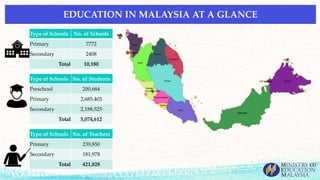
Type of Schools No. of Schools
Primary 7772
Secondary 2408
Total 10,180
Type of Schools No. of Students
Preschool 200,684
Primary 2,685,403
Secondary 2,188,525
Total 5,074,612
Type of Schools No. of Teachers
Primary 239,850
Secondary 181,978
Total 421,828
EDUCATION IN MALAYSIA AT A GLANCE
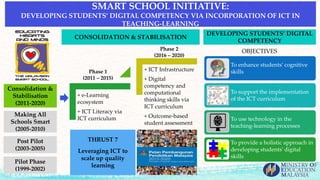
SMART SCHOOL INITIATIVE:
DEVELOPING STUDENTS’ DIGITAL COMPETENCY VIA INCORPORATION OF ICT IN
TEACHING-LEARNING
+ e-Learning
ecosystem
+ ICT Literacy via
ICT curriculum
+ ICT Infrastructure
+ Digital
competency and
computational
thinking skills via
ICT curriculum
+ Outcome-based
student assessment
DEVELOPING STUDENTS’ DIGITAL
COMPETENCY
CONSOLIDATION & STABILISATION
Phase 2
(2016 – 2020)
Phase 1
(2011 – 2015)
Pilot Phase
(1999-2002)
Post Pilot
(2003-2005)
Making All
Schools Smart
(2005-2010)
Consolidation &
Stabilisation
(2011-2020)
THRUST 7
Leveraging ICT to
scale up quality
learning
To enhance students’ cognitive
skills
To support the implementation
of the ICT curriculum
To use technology in the
teaching-learning processes
To provide a holistic approach in
developing students’ digital
skills
OBJECTIVES
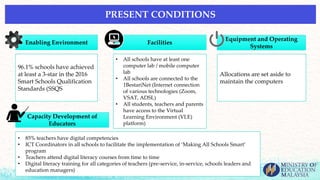
PRESENT CONDITIONS
96.1% schools have achieved
at least a 3-star in the 2016
Smart Schools Qualification
Standards (SSQS
Enabling Environment Facilities
• All schools have at least one
computer lab / mobile computer
lab
• All schools are connected to the
1BestariNet (Internet connection
of various technologies (Zoom,
VSAT, ADSL)
• All students, teachers and parents
have access to the Virtual
Learning Environment (VLE)
platform)
Equipment and Operating
Systems
Allocations are set aside to
maintain the computers
Capacity Development of
Educators
• 85% teachers have digital competencies
• ICT Coordinators in all schools to facilitate the implementation of ‘Making All Schools Smart’
program
• Teachers attend digital literacy courses from time to time
• Digital literacy training for all categories of teachers (pre-service, in-service, schools leaders and
education managers)
A diagnostic tool to facilitate
continuous improvement of ICT
integration in schools
Human Capital
ICT Usage
Applications
ICT Infrastructure
School Resource Center
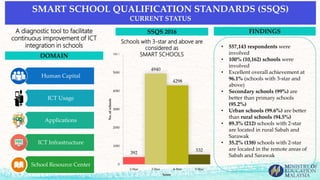
SMART SCHOOL QUALIFICATION STANDARDS (SSQS)
CURRENT STATUS
392
4940
4298
532
0
1000
2000
3000
4000
5000
6000
2-Star 3-Star 4-Star 5-Star
No.ofschools
Score
DOMAIN
• 557,143 respondents were
involved
• 100% (10,162) schools were
involved
• Excellent overall achievement at
96.1% (schools with 3-star and
above)
• Secondary schools (99%) are
better than primary schools
(95.2%)
• Urban schools (99.6%) are better
than rural schools (94.5%)
• 89.3% (212) schools with 2-star
are located in rural Sabah and
Sarawak
• 35.2% (138) schools with 2-star
are located in the remote areas of
Sabah and Sarawak
FINDINGSSSQS 2016
Schools with 3-star and above are
considered as
SMART SCHOOLS
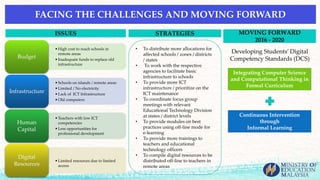
FACING THE CHALLENGES AND MOVING FORWARD
MOVING FORWARD
2016 - 2020
ISSUES STRATEGIES
•High cost to reach schools in
remote areas
•Inadequate funds to replace old
infrastructure
Budget
•Schools on islands / remote areas
•Limited / No electricity
•Lack of ICT Infrastructure
•Old computers
Infrastructure
•Teachers with low ICT
competencies
•Less opportunities for
professional development
Human
Capital
•Limited resources due to limited
access
Digital
Resources
• To distribute more allocations for
affected schools / zones / districts
/ states
• To work with the respective
agencies to facilitate basic
infrastructure to schools
• To provide more ICT
infrastructure / prioritize on the
ICT maintenance
• To coordinate focus group
meetings with relevant
Educational Technology Division
at states / district levels
• To provide modules on best
practices using off-line mode for
e-learning
• To provide more trainings to
teachers and educational
technology officers
• To compile digital resources to be
distributed off-line to teachers in
remote areas
Developing Students’ Digital
Competency Standards (DCS)
Integrating Computer Science
and Computational Thinking in
Formal Curriculum
Continuous Intervention
through
Informal Learning
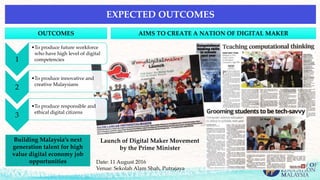
1
•To produce future workforce
who have high level of digital
competencies
2
•To produce innovative and
creative Malaysians
3
•To produce responsible and
ethical digital citizens
EXPECTED OUTCOMES
OUTCOMES AIMS TO CREATE A NATION OF DIGITAL MAKER
Launch of Digital Maker Movement
by the Prime Minister
Date: 11 August 2016
Venue: Sekolah Alam Shah, Putrajaya
Building Malaysia’s next
generation talent for high
value digital economy job
opportunities
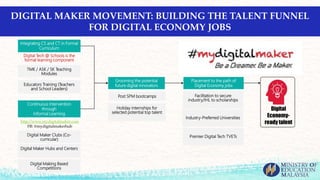
DIGITAL MAKER MOVEMENT: BUILDING THE TALENT FUNNEL
FOR DIGITAL ECONOMY JOBS
Digital Tech @ Schools is the
formal learning component
Integrating CS and CT in Formal
Curriculum
TMK / ASK / SK Teaching
Modules
Educators Training (Teachers
and School Leaders)
Continuous Intervention
through
Informal Learning
Digital Maker Clubs (Co-
curricular)
Digital Maker Hubs and Centers
Digital Making Based
Competitions
Grooming the potential
future digital innovators
Post SPM bootcamps Facilitation to secure
industry/IHL to scholarships
Holiday internships for
selected potential top talent
Industry-Preferred Universities
Premier Digital Tech TVETs
Placement to the path of
Digital Economy jobs
http://www.mydigitalmaker.com
FB: @mydigitalmakerhub
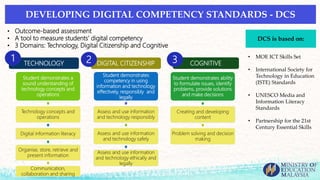
Student demonstrates a
sound understanding of
technology concepts and
operations
Technology concepts and
operations
Digital information literacy
Organise, store, retrieve and
present information
Communication,
collaboration and sharing
Student demonstrates
competency in using
information and technology
effectively, responsibly and
legally
Assess and use information
and technology responsibly
Assess and use information
and technology safely
Assess and use information
and technology ethically and
legally
Student demonstrates ability
to formulate issues, identify
problems, provide solutions
and make decisions
Creating and developing
content
Problem solving and decision
making
TECHNOLOGY DIGITAL CITIZENSHIP COGNITIVE
1 2 3
DEVELOPING DIGITAL COMPETENCY STANDARDS - DCS
• Outcome-based assessment
• A tool to measure students’ digital competency
• 3 Domains: Technology, Digital Citizenship and Cognitive
DCS is based on:
• MOE ICT Skills Set
• International Society for
Technology in Education
(ISTE) Standards
• UNESCO Media and
Information Literacy
Standards
• Partnership for the 21st
Century Essential Skills
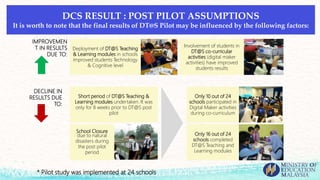
DCS RESULT : POST PILOT ASSUMPTIONS
It is worth to note that the final results of DT@S Pilot may be influenced by the following factors:
School Closure
due to natural
disasters during
the post pilot
period
DECLINE IN
RESULTS DUE
TO:
Deployment of DT@S Teaching
& Learning modules in schools
improved students Technology
& Cognitive level
Involvement of students in
DT@S co-curricular
activities (digital maker
activities) have improved
students results
IMPROVEMEN
T IN RESULTS
DUE TO:
Short period of DT@S Teaching &
Learning modules undertaken. It was
only for 8 weeks prior to DT@S post
pilot
Only 10 out of 24
schools participated in
Digital Maker activities
during co-curriculum
Only 16 out of 24
schools completed
DT@S Teaching and
Learning modules
* Pilot study was implemented at 24 schools
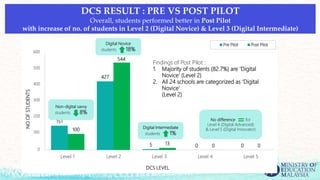
DCS RESULT : PRE VS POST PILOT
Overall, students performed better in Post Pilot
with increase of no. of students in Level 2 (Digital Novice) & Level 3 (Digital Intermediate)
151
427
5 0 0
100
544
13 0 0
0
100
200
300
400
500
600
Level 1 Level 2 Level 3 Level 4 Level 5
NOOFSTUDENTS
DCS LEVEL
Pre Pilot Post Pilot
Non-digital savvy
students 8%
Digital Novice
students 18%
Digital Intermediate
students 1%
No difference for
Level 4 (Digital Advanced)
& Level 5 (Digital Innovator)
Findings of Post Pilot :
1. Majority of students (82.7%) are ‘Digital
Novice’ (Level 2)
2. All 24 schools are categorized as ‘Digital
Novice’
(Level 2)
DCS RESULT : PRE VS POST PILOT
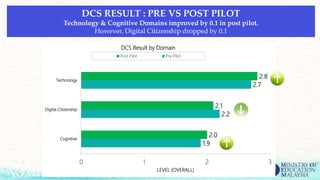
Technology & Cognitive Domains improved by 0.1 in post pilot.
However, Digital Citizenship dropped by 0.1
1.9
2.2
2.7
2.0
2.1
2.8
0 1 2 3
Cognitive
Digital Citizenship
Technology
LEVEL (OVERALL)
DCS Result by Domain
Post Pilot Pre Pilot
DCS RESULT : PRE VS POST PILOT
Rural VS Urban
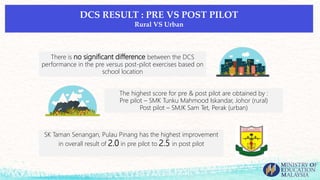
There is no significant difference between the DCS
performance in the pre versus post-pilot exercises based on
school location
The highest score for pre & post pilot are obtained by :
Pre pilot – SMK Tunku Mahmood Iskandar, Johor (rural)
Post pilot – SMJK Sam Tet, Perak (urban)
SK Taman Senangan, Pulau Pinang has the highest improvement
in overall result of 2.0 in pre pilot to 2.5 in post pilot
DCS RESULT : PRE VS POST PILOT
Female VS Male
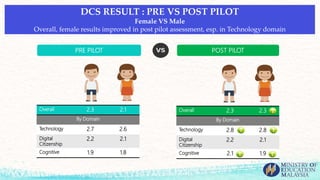
Overall, female results improved in post pilot assessment, esp. in Technology domain
PRE PILOT POST PILOT
Overall 2.3 2.1
By Domain
Technology 2.7 2.6
Digital
Citizenship
2.2 2.1
Cognitive 1.9 1.8
Overall 2.3 2.3
By Domain
Technology 2.8 2.8
Digital
Citizenship
2.2 2.1
Cognitive 2.1 1.9
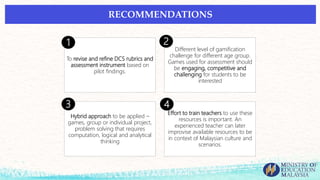
To revise and refine DCS rubrics and
assessment instrument based on
pilot findings.
Different level of gamification
challenge for different age group.
Games used for assessment should
be engaging, competitive and
challenging for students to be
interested
Hybrid approach to be applied –
games, group or individual project,
problem solving that requires
computation, logical and analytical
thinking
Effort to train teachers to use these
resources is important. An
experienced teacher can later
improvise available resources to be
in context of Malaysian culture and
scenarios.
1 2
3 4
RECOMMENDATIONS
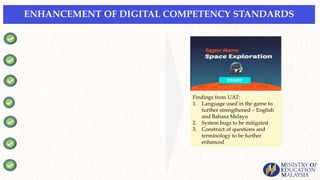
ENHANCEMENT OF DIGITAL COMPETENCY STANDARDS
Findings from UAT:
1. Language used in the game to
further strengthened – English
and Bahasa Melayu
2. System bugs to be mitigated
3. Construct of questions and
terminology to be further
enhanced
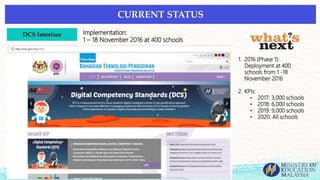
CURRENT STATUS
DCS Interface Implementation:
1 – 18 November 2016 at 400 schools
1. 2016 (Phase 1):
Deployment at 400
schools from 1 -18
November 2016
2. KPIs:
• 2017: 3,000 schools
• 2018: 6,000 schools
• 2019: 9,000 schools
• 2020: All schools
Thank You

Developing Digital Competency Standards (DCS) as a Tool to Measure Students’ Digital Skills

  • 1.
    Delivery of 21stCentury Skills: Focusing on the Fundamentals FADZLIATON ZAINUDIN EDUCATIONAL TECHNOLOGY DIVISION MINISTRY OF EDUCATION MALAYSIA 36th APEC e-Learning Training Program 10 – 19 July 2016 Seoul, Korea Developing Digital Competency Standards (DCS) as a Tool to Measure Students’ Digital Skills
  • 2.
    Type of SchoolsNo. of Schools Primary 7772 Secondary 2408 Total 10,180 Type of Schools No. of Students Preschool 200,684 Primary 2,685,403 Secondary 2,188,525 Total 5,074,612 Type of Schools No. of Teachers Primary 239,850 Secondary 181,978 Total 421,828 EDUCATION IN MALAYSIA AT A GLANCE
  • 3.
    SMART SCHOOL INITIATIVE: DEVELOPINGSTUDENTS’ DIGITAL COMPETENCY VIA INCORPORATION OF ICT IN TEACHING-LEARNING + e-Learning ecosystem + ICT Literacy via ICT curriculum + ICT Infrastructure + Digital competency and computational thinking skills via ICT curriculum + Outcome-based student assessment DEVELOPING STUDENTS’ DIGITAL COMPETENCY CONSOLIDATION & STABILISATION Phase 2 (2016 – 2020) Phase 1 (2011 – 2015) Pilot Phase (1999-2002) Post Pilot (2003-2005) Making All Schools Smart (2005-2010) Consolidation & Stabilisation (2011-2020) THRUST 7 Leveraging ICT to scale up quality learning To enhance students’ cognitive skills To support the implementation of the ICT curriculum To use technology in the teaching-learning processes To provide a holistic approach in developing students’ digital skills OBJECTIVES
  • 4.
    PRESENT CONDITIONS 96.1% schoolshave achieved at least a 3-star in the 2016 Smart Schools Qualification Standards (SSQS Enabling Environment Facilities • All schools have at least one computer lab / mobile computer lab • All schools are connected to the 1BestariNet (Internet connection of various technologies (Zoom, VSAT, ADSL) • All students, teachers and parents have access to the Virtual Learning Environment (VLE) platform) Equipment and Operating Systems Allocations are set aside to maintain the computers Capacity Development of Educators • 85% teachers have digital competencies • ICT Coordinators in all schools to facilitate the implementation of ‘Making All Schools Smart’ program • Teachers attend digital literacy courses from time to time • Digital literacy training for all categories of teachers (pre-service, in-service, schools leaders and education managers)
  • 5.
    A diagnostic toolto facilitate continuous improvement of ICT integration in schools Human Capital ICT Usage Applications ICT Infrastructure School Resource Center SMART SCHOOL QUALIFICATION STANDARDS (SSQS) CURRENT STATUS 392 4940 4298 532 0 1000 2000 3000 4000 5000 6000 2-Star 3-Star 4-Star 5-Star No.ofschools Score DOMAIN • 557,143 respondents were involved • 100% (10,162) schools were involved • Excellent overall achievement at 96.1% (schools with 3-star and above) • Secondary schools (99%) are better than primary schools (95.2%) • Urban schools (99.6%) are better than rural schools (94.5%) • 89.3% (212) schools with 2-star are located in rural Sabah and Sarawak • 35.2% (138) schools with 2-star are located in the remote areas of Sabah and Sarawak FINDINGSSSQS 2016 Schools with 3-star and above are considered as SMART SCHOOLS
  • 6.
    FACING THE CHALLENGESAND MOVING FORWARD MOVING FORWARD 2016 - 2020 ISSUES STRATEGIES •High cost to reach schools in remote areas •Inadequate funds to replace old infrastructure Budget •Schools on islands / remote areas •Limited / No electricity •Lack of ICT Infrastructure •Old computers Infrastructure •Teachers with low ICT competencies •Less opportunities for professional development Human Capital •Limited resources due to limited access Digital Resources • To distribute more allocations for affected schools / zones / districts / states • To work with the respective agencies to facilitate basic infrastructure to schools • To provide more ICT infrastructure / prioritize on the ICT maintenance • To coordinate focus group meetings with relevant Educational Technology Division at states / district levels • To provide modules on best practices using off-line mode for e-learning • To provide more trainings to teachers and educational technology officers • To compile digital resources to be distributed off-line to teachers in remote areas Developing Students’ Digital Competency Standards (DCS) Integrating Computer Science and Computational Thinking in Formal Curriculum Continuous Intervention through Informal Learning
  • 7.
    1 •To produce futureworkforce who have high level of digital competencies 2 •To produce innovative and creative Malaysians 3 •To produce responsible and ethical digital citizens EXPECTED OUTCOMES OUTCOMES AIMS TO CREATE A NATION OF DIGITAL MAKER Launch of Digital Maker Movement by the Prime Minister Date: 11 August 2016 Venue: Sekolah Alam Shah, Putrajaya Building Malaysia’s next generation talent for high value digital economy job opportunities
  • 8.
    DIGITAL MAKER MOVEMENT:BUILDING THE TALENT FUNNEL FOR DIGITAL ECONOMY JOBS Digital Tech @ Schools is the formal learning component Integrating CS and CT in Formal Curriculum TMK / ASK / SK Teaching Modules Educators Training (Teachers and School Leaders) Continuous Intervention through Informal Learning Digital Maker Clubs (Co- curricular) Digital Maker Hubs and Centers Digital Making Based Competitions Grooming the potential future digital innovators Post SPM bootcamps Facilitation to secure industry/IHL to scholarships Holiday internships for selected potential top talent Industry-Preferred Universities Premier Digital Tech TVETs Placement to the path of Digital Economy jobs http://www.mydigitalmaker.com FB: @mydigitalmakerhub
  • 9.
    Student demonstrates a soundunderstanding of technology concepts and operations Technology concepts and operations Digital information literacy Organise, store, retrieve and present information Communication, collaboration and sharing Student demonstrates competency in using information and technology effectively, responsibly and legally Assess and use information and technology responsibly Assess and use information and technology safely Assess and use information and technology ethically and legally Student demonstrates ability to formulate issues, identify problems, provide solutions and make decisions Creating and developing content Problem solving and decision making TECHNOLOGY DIGITAL CITIZENSHIP COGNITIVE 1 2 3 DEVELOPING DIGITAL COMPETENCY STANDARDS - DCS • Outcome-based assessment • A tool to measure students’ digital competency • 3 Domains: Technology, Digital Citizenship and Cognitive DCS is based on: • MOE ICT Skills Set • International Society for Technology in Education (ISTE) Standards • UNESCO Media and Information Literacy Standards • Partnership for the 21st Century Essential Skills
  • 10.
    DCS RESULT :POST PILOT ASSUMPTIONS It is worth to note that the final results of DT@S Pilot may be influenced by the following factors: School Closure due to natural disasters during the post pilot period DECLINE IN RESULTS DUE TO: Deployment of DT@S Teaching & Learning modules in schools improved students Technology & Cognitive level Involvement of students in DT@S co-curricular activities (digital maker activities) have improved students results IMPROVEMEN T IN RESULTS DUE TO: Short period of DT@S Teaching & Learning modules undertaken. It was only for 8 weeks prior to DT@S post pilot Only 10 out of 24 schools participated in Digital Maker activities during co-curriculum Only 16 out of 24 schools completed DT@S Teaching and Learning modules * Pilot study was implemented at 24 schools
  • 11.
    DCS RESULT :PRE VS POST PILOT Overall, students performed better in Post Pilot with increase of no. of students in Level 2 (Digital Novice) & Level 3 (Digital Intermediate) 151 427 5 0 0 100 544 13 0 0 0 100 200 300 400 500 600 Level 1 Level 2 Level 3 Level 4 Level 5 NOOFSTUDENTS DCS LEVEL Pre Pilot Post Pilot Non-digital savvy students 8% Digital Novice students 18% Digital Intermediate students 1% No difference for Level 4 (Digital Advanced) & Level 5 (Digital Innovator) Findings of Post Pilot : 1. Majority of students (82.7%) are ‘Digital Novice’ (Level 2) 2. All 24 schools are categorized as ‘Digital Novice’ (Level 2)
  • 12.
    DCS RESULT :PRE VS POST PILOT Technology & Cognitive Domains improved by 0.1 in post pilot. However, Digital Citizenship dropped by 0.1 1.9 2.2 2.7 2.0 2.1 2.8 0 1 2 3 Cognitive Digital Citizenship Technology LEVEL (OVERALL) DCS Result by Domain Post Pilot Pre Pilot
  • 13.
    DCS RESULT :PRE VS POST PILOT Rural VS Urban There is no significant difference between the DCS performance in the pre versus post-pilot exercises based on school location The highest score for pre & post pilot are obtained by : Pre pilot – SMK Tunku Mahmood Iskandar, Johor (rural) Post pilot – SMJK Sam Tet, Perak (urban) SK Taman Senangan, Pulau Pinang has the highest improvement in overall result of 2.0 in pre pilot to 2.5 in post pilot
  • 14.
    DCS RESULT :PRE VS POST PILOT Female VS Male Overall, female results improved in post pilot assessment, esp. in Technology domain PRE PILOT POST PILOT Overall 2.3 2.1 By Domain Technology 2.7 2.6 Digital Citizenship 2.2 2.1 Cognitive 1.9 1.8 Overall 2.3 2.3 By Domain Technology 2.8 2.8 Digital Citizenship 2.2 2.1 Cognitive 2.1 1.9
  • 15.
    To revise andrefine DCS rubrics and assessment instrument based on pilot findings. Different level of gamification challenge for different age group. Games used for assessment should be engaging, competitive and challenging for students to be interested Hybrid approach to be applied – games, group or individual project, problem solving that requires computation, logical and analytical thinking Effort to train teachers to use these resources is important. An experienced teacher can later improvise available resources to be in context of Malaysian culture and scenarios. 1 2 3 4 RECOMMENDATIONS
  • 16.
    ENHANCEMENT OF DIGITALCOMPETENCY STANDARDS Findings from UAT: 1. Language used in the game to further strengthened – English and Bahasa Melayu 2. System bugs to be mitigated 3. Construct of questions and terminology to be further enhanced
  • 17.
    CURRENT STATUS DCS InterfaceImplementation: 1 – 18 November 2016 at 400 schools 1. 2016 (Phase 1): Deployment at 400 schools from 1 -18 November 2016 2. KPIs: • 2017: 3,000 schools • 2018: 6,000 schools • 2019: 9,000 schools • 2020: All schools
  • 18.

Editor's Notes

  • #9 Replace mydigitalmaker with logo MK: Have added bootcamp story to this slide.
  • #11 10 schools participated in Digital Maker activities: 1) SK Putrajaya Presint 14 2) SMK Bandar Sunway 3) SK Cyberjaya 4) SAM Rawang 5) SM Sultan Abdul Halim 6) SMK Sultan Tajul Ariffin 7) SK Bayan Lepas 2 8) SK Seri Bayu 9) SM Sains Tuanku Jaafar 10) SK Bandar Maharani 16 schools participated in T&L: 1. SK Bayan Lepas 2              2. SK Taman Senangan       3. SM Sains Tuanku Jaafar                 4. SJKT FES Serdang             5. SK Cyberjaya      6. SMK Bandar Sunway      7. SMK Putrajaya Presint 16(1)        8. SK Putrajaya Presint 14(1)            9. SMK Tajul Ariffin              10. SK Seri Bayu       11. SM Sultan Abdul Halim  12. Kolej Sultan Abdul Hamid             13. SMJK Keat Hwa                 14. SMK Dang Anum    15. SK Chinchin