Digital competence and policy
Geir Ottestad, European Commisson
NJDL and the research community
• Deep knowledge
• Drilling:
• concepts
• practices
• (local) policies
Researchers POW
3
IWB
iPad Interaction
Children´s narratives
Digital Comp in ITE
Blogs
Flipped Classroom
Discussions in LMS
Professional digital competence
Digital Writing
Digital Storytelling
Digital ECEC
Evidence
• Connected practices
• Character
• Citizenship
• Communication
• Critical thinking
• Collaboration
• Creativity and imagination
• (Fullan 2013)
4
Questioning pedagogical practices
Questioning policies
Questioning schools?
5
Education as
vehicle for
employment
6
Education as
system of
intrinsic value
7
Valid
Education as
vehicle for
employment
8
Education as
system of
intrinsic value
Digital competence in Norway
• Highly digitalised society, also in schools
• Centralised school system
• Competence based curricula, with an infusion of
ICT
• Still realtively little use of ICT in classrooms
Norway: why so slow?
• Local authorities?
• Procedure oriented teachers?
• Lack of local support for leaders?
• Lack of common understandings:
• sectorised policy, silo based policies and policy
decisions
• - No effort to align forces for a common goal
Digital competence, EU
• In comparison:
• No common educational jurisdiction
• Huge diversity in perspectives and instruments
• Huge diveristiy in curricula
• … cultures
• Huge diversity in uptake: DK-RO
13
Tied to the crisis
• Policies to support national actions
• Address common challenges
15
ET 2020 - Framework for
collaboration on education
• Relevant and high-quality skills and competences, focusing
on learning outcomes, for employability, innovation and
active citizenship
• Inclusive education, equality, non- discrimination and
promotion of civic competences
• Open and innovative education and training, including
by fully embracing the digital era
• Strong support for educators
• Transparency and recognition of skills and qualifications to
facilitate learning and labour mobility
• Sustainable investment, performance and efficiency of
education and training systems 16
Some objectives
• Promoting the use of ICT as a driver for systemic
change to increase quality and relevance of
education at all levels
• • Boosting availability and quality of open and
digital educational resources and pedagogies at all
education levels, in cooperation with European
open source communities
• • Addressing the development of digital skills and
competences at all levels of learning in response
to the digital revolution
17
ICT in education indicator
• Ongoing work since 2011
• How to compare Member States
• How to link to policies
18
Former model
Uptake
Students'
digital
competence
Proposed model
Uptake
Students'
digital
competence
Teachers'
use
Credible indicator
Data sources should:
• encompass as many Member States as possible;
• be up-to-date;
• repeated regularly;
• cover as many different grades and school types as possible;
• include information on students' use and attitudes towards digital
technologies at school
• provide some sort of measure of students' digital skills or competences
• ideally include some measure or report of students' learning outcomes;
• include information from teachers on use and attitudes toward digital
technologies at school;
• include school-level information, i.e. from principals or administrators;
• provide context information at the national level
21
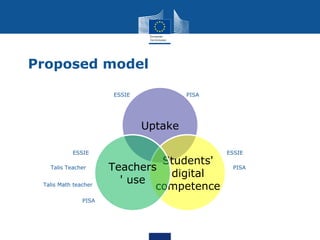
Proposed model
Uptake
Students'
digital
competence
Teachers
' use
ESSIE
PISA
ESSIE
Talis Teacher
Talis Math teacher
PISA
PISA
ESSIE
UPTAKE IN SCHOOLS
PISA 2012 Index of ICT use at schools (9 items, documented in OECD 2015, Students Computers and Learning, p.51):
Q10 (IC10). How often do you use a computer for the following activities at school?
a) Browse the Internet for schoolwork
b) Use school computers for group work and communication with other students
c) Do individual homework on a school computer
d) Use e-mail at school
e) Download, upload or browse material from the school’s website
f) Chat on line at school
g) Practice and drilling, such as for foreign-language learning or mathematics
h) Post work on the school’s website
i) Play simulations at school
PISA 2015 An optional inclusion of the ICT familiarity is anticipated, and would most likely provide similar items as in PISA
2012.
Talis 2013
Prinicpal
Is school’s capacity to provide quality instruction currently hindered by
e) Shortage or inadequacy of computers for instruction TC2G31E
f) Insufficient Internet access TC2G31F
g) Shortage or inadequacy of computer software for instruction TC2G31G
What structures and activities are included in this induction programme?:
e) Networking/virtual communities TC2G35E
ESSIE 2016
Instruments
for students,
teachers and
school heads.
Either a composite indicator from the school head questionnaire, described as this in the report on p. 51 (full set
of items to comprehensive to include in this table):
"The notion of the digitally equipped school emerges from an analysis of survey data in five areas:
• Equipment provision: numbers of desktop and laptop computers, e-readers, mobile phones, interactive
whiteboards,
digital cameras and data projectors;
• The proportion of fully operational equipment;
• Broadband speed (above or below 10mbps) and type of broadband access (ADSL, cable etc.);
• Maintenance and support;
• Indicators of connectedness: a website, email addresses for teachers and students, a local area network, a
virtual learning environment, or none of these.
Cluster analysis was carried out on these data; three school profiles emerged that can be summarised as
follows:
• Type 1: Highly digitally equipped schools, characterised by relatively high equipment levels, fast broadband
and relatively high connectedness
• Type 2: Partially digitally equipped schools, with lower than type 1 equipment levels, slow (less than 10mbps)
or no broadband37, and some connectedness
Risks
• Mismatch of cycles
• Loss of comparability
• White holes across survey populations
• Unforeseen changes in survey design
24
25
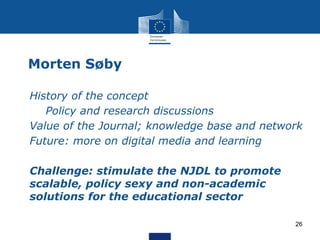
Morten Søby
• History of the concept
• Policy and research discussions
• Value of the Journal; knowledge base and network
• Future: more on digital media and learning
• Challenge: stimulate the NJDL to promote
scalable, policy sexy and non-academic
solutions for the educational sector
26
Francesc Pedró
• Pedagogies need to change;
• Low teacher uptake
• Labour market demands (skills, digital
competence)
• Societal saturation of digital media
27
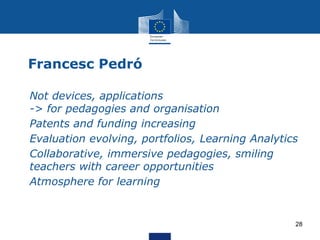
Francesc Pedró
• Not devices, applications
-> for pedagogies and organisation
• Patents and funding increasing
• Evaluation evolving, portfolios, Learning Analytics
• Collaborative, immersive pedagogies, smiling
teachers with career opportunities
• Atmosphere for learning
28
Francesc Pedró
• From training of teachers to coaching
• «iPhone equation»
29
• Challenge: use Unesco powers to introduce
effective dissemination models for ICT
uptake from developing countries
30
Riina Vuorikari
• PISA 2012 Students Computer and Learning -
dissatisfactory media messages (even if the report
is much more reflected and nuanced)
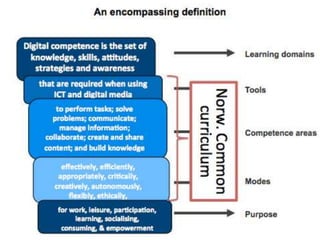
• Digital Competence is one of 8 key competences,
transversal in nature. Broad in content.
31
Riina Vuorikari
• We need to reflect on the use of ICT.
• Need frameworks for structuring use
• Framework for digital competence
• Framework for digitally competent educational
organisations
• Synthesises of existing frameworks
• Competences, broken down in dimensions and
also proficiency levels (1-3)
32
Riina Vuorikari
• DIGCOMP framework used in
• EU: eCV, DESI Digital skills, ESSIE study..
• National: Basque, Navarra, Flanders, Italy, UK,
Malta, Slovenia…
• Used both for online testing development and as
reference for planning and curricula development
33
34
Riina Vuorikari
• Digitally competent organisations, coming as a
framework
• Compared national tools and frameworks
• Slant towards learning analytics?
35
Riina Vuorikari
• Digitally competent organisations also as a self-
assessment tool
• Challenge: Increase the educational
relevance of the DIGCOMP, by making a
tailor-made and verified version put to test
in real educational systems.
36
Ola Erstad
• Reflections on concept developments and the
challenges.
37
Ola Erstad
• The Knowledge Promotion did put students´
learning first BUT it is challenged by
standardisation paradigm
• Look for the children´s own practices!
• In the knowledge society: What is knowledge?
What is competences?
• What is education for the society?
38
Ola Erstad
• Norwegian History Lesson:
• Curriculum
• Programme for Digital Competence
• 2011 Framework
• Lack research and knowledge base
• Momentum lost
39
Ola Erstad
• NJDL has discussed a variety of literacies
• Complexity is promoted, personal, skills, media
systems, social interaction etc
• Developments in themes, but also valid points
from 2006.
• Connect policy - research - practices
• Assessment and ITE are still challenges
• ECEC running up (COST, OECD)
• Connect to 21st Century Skills!
40
Ola Erstad
Gjennom kapitlet om den digitalt kompetente skolen
legger Erstad stor vekt på å se innføring og bruk av IKT i et
helhetlig organisatorisk perspektiv. Han peker dermed også på
nødvendigheten av at man fjerner seg fra det han kaller teknologisk
determinisme.
41
Challenges
• Is the practice field running wildly ahead of
the research?
• As the Grand Father and Czar of Digital
Competence in Norway:
• Reclaim the upper hand in the Norwegian
policy debate!
42

Geir Ottestad

  • 1.
    Digital competence andpolicy Geir Ottestad, European Commisson
  • 2.
    NJDL and theresearch community • Deep knowledge • Drilling: • concepts • practices • (local) policies
  • 3.
    Researchers POW 3 IWB iPad Interaction Children´snarratives Digital Comp in ITE Blogs Flipped Classroom Discussions in LMS Professional digital competence Digital Writing Digital Storytelling Digital ECEC
  • 4.
    Evidence • Connected practices •Character • Citizenship • Communication • Critical thinking • Collaboration • Creativity and imagination • (Fullan 2013) 4
  • 5.
    Questioning pedagogical practices Questioningpolicies Questioning schools? 5
  • 6.
  • 7.
  • 8.
  • 10.
    Digital competence inNorway • Highly digitalised society, also in schools • Centralised school system • Competence based curricula, with an infusion of ICT • Still realtively little use of ICT in classrooms
  • 11.
    Norway: why soslow? • Local authorities? • Procedure oriented teachers? • Lack of local support for leaders? • Lack of common understandings: • sectorised policy, silo based policies and policy decisions • - No effort to align forces for a common goal
  • 12.
    Digital competence, EU •In comparison: • No common educational jurisdiction • Huge diversity in perspectives and instruments • Huge diveristiy in curricula • … cultures • Huge diversity in uptake: DK-RO
  • 13.
  • 15.
    Tied to thecrisis • Policies to support national actions • Address common challenges 15
  • 16.
    ET 2020 -Framework for collaboration on education • Relevant and high-quality skills and competences, focusing on learning outcomes, for employability, innovation and active citizenship • Inclusive education, equality, non- discrimination and promotion of civic competences • Open and innovative education and training, including by fully embracing the digital era • Strong support for educators • Transparency and recognition of skills and qualifications to facilitate learning and labour mobility • Sustainable investment, performance and efficiency of education and training systems 16
  • 17.
    Some objectives • Promotingthe use of ICT as a driver for systemic change to increase quality and relevance of education at all levels • • Boosting availability and quality of open and digital educational resources and pedagogies at all education levels, in cooperation with European open source communities • • Addressing the development of digital skills and competences at all levels of learning in response to the digital revolution 17
  • 18.
    ICT in educationindicator • Ongoing work since 2011 • How to compare Member States • How to link to policies 18
  • 19.
  • 20.
  • 21.
    Credible indicator Data sourcesshould: • encompass as many Member States as possible; • be up-to-date; • repeated regularly; • cover as many different grades and school types as possible; • include information on students' use and attitudes towards digital technologies at school • provide some sort of measure of students' digital skills or competences • ideally include some measure or report of students' learning outcomes; • include information from teachers on use and attitudes toward digital technologies at school; • include school-level information, i.e. from principals or administrators; • provide context information at the national level 21
  • 22.
  • 23.
    UPTAKE IN SCHOOLS PISA2012 Index of ICT use at schools (9 items, documented in OECD 2015, Students Computers and Learning, p.51): Q10 (IC10). How often do you use a computer for the following activities at school? a) Browse the Internet for schoolwork b) Use school computers for group work and communication with other students c) Do individual homework on a school computer d) Use e-mail at school e) Download, upload or browse material from the school’s website f) Chat on line at school g) Practice and drilling, such as for foreign-language learning or mathematics h) Post work on the school’s website i) Play simulations at school PISA 2015 An optional inclusion of the ICT familiarity is anticipated, and would most likely provide similar items as in PISA 2012. Talis 2013 Prinicpal Is school’s capacity to provide quality instruction currently hindered by e) Shortage or inadequacy of computers for instruction TC2G31E f) Insufficient Internet access TC2G31F g) Shortage or inadequacy of computer software for instruction TC2G31G What structures and activities are included in this induction programme?: e) Networking/virtual communities TC2G35E ESSIE 2016 Instruments for students, teachers and school heads. Either a composite indicator from the school head questionnaire, described as this in the report on p. 51 (full set of items to comprehensive to include in this table): "The notion of the digitally equipped school emerges from an analysis of survey data in five areas: • Equipment provision: numbers of desktop and laptop computers, e-readers, mobile phones, interactive whiteboards, digital cameras and data projectors; • The proportion of fully operational equipment; • Broadband speed (above or below 10mbps) and type of broadband access (ADSL, cable etc.); • Maintenance and support; • Indicators of connectedness: a website, email addresses for teachers and students, a local area network, a virtual learning environment, or none of these. Cluster analysis was carried out on these data; three school profiles emerged that can be summarised as follows: • Type 1: Highly digitally equipped schools, characterised by relatively high equipment levels, fast broadband and relatively high connectedness • Type 2: Partially digitally equipped schools, with lower than type 1 equipment levels, slow (less than 10mbps) or no broadband37, and some connectedness
  • 24.
    Risks • Mismatch ofcycles • Loss of comparability • White holes across survey populations • Unforeseen changes in survey design 24
  • 25.
  • 26.
    Morten Søby • Historyof the concept • Policy and research discussions • Value of the Journal; knowledge base and network • Future: more on digital media and learning • Challenge: stimulate the NJDL to promote scalable, policy sexy and non-academic solutions for the educational sector 26
  • 27.
    Francesc Pedró • Pedagogiesneed to change; • Low teacher uptake • Labour market demands (skills, digital competence) • Societal saturation of digital media 27
  • 28.
    Francesc Pedró • Notdevices, applications -> for pedagogies and organisation • Patents and funding increasing • Evaluation evolving, portfolios, Learning Analytics • Collaborative, immersive pedagogies, smiling teachers with career opportunities • Atmosphere for learning 28
  • 29.
    Francesc Pedró • Fromtraining of teachers to coaching • «iPhone equation» 29
  • 30.
    • Challenge: useUnesco powers to introduce effective dissemination models for ICT uptake from developing countries 30
  • 31.
    Riina Vuorikari • PISA2012 Students Computer and Learning - dissatisfactory media messages (even if the report is much more reflected and nuanced) • Digital Competence is one of 8 key competences, transversal in nature. Broad in content. 31
  • 32.
    Riina Vuorikari • Weneed to reflect on the use of ICT. • Need frameworks for structuring use • Framework for digital competence • Framework for digitally competent educational organisations • Synthesises of existing frameworks • Competences, broken down in dimensions and also proficiency levels (1-3) 32
  • 33.
    Riina Vuorikari • DIGCOMPframework used in • EU: eCV, DESI Digital skills, ESSIE study.. • National: Basque, Navarra, Flanders, Italy, UK, Malta, Slovenia… • Used both for online testing development and as reference for planning and curricula development 33
  • 34.
  • 35.
    Riina Vuorikari • Digitallycompetent organisations, coming as a framework • Compared national tools and frameworks • Slant towards learning analytics? 35
  • 36.
    Riina Vuorikari • Digitallycompetent organisations also as a self- assessment tool • Challenge: Increase the educational relevance of the DIGCOMP, by making a tailor-made and verified version put to test in real educational systems. 36
  • 37.
    Ola Erstad • Reflectionson concept developments and the challenges. 37
  • 38.
    Ola Erstad • TheKnowledge Promotion did put students´ learning first BUT it is challenged by standardisation paradigm • Look for the children´s own practices! • In the knowledge society: What is knowledge? What is competences? • What is education for the society? 38
  • 39.
    Ola Erstad • NorwegianHistory Lesson: • Curriculum • Programme for Digital Competence • 2011 Framework • Lack research and knowledge base • Momentum lost 39
  • 40.
    Ola Erstad • NJDLhas discussed a variety of literacies • Complexity is promoted, personal, skills, media systems, social interaction etc • Developments in themes, but also valid points from 2006. • Connect policy - research - practices • Assessment and ITE are still challenges • ECEC running up (COST, OECD) • Connect to 21st Century Skills! 40
  • 41.
    Ola Erstad Gjennom kapitletom den digitalt kompetente skolen legger Erstad stor vekt på å se innføring og bruk av IKT i et helhetlig organisatorisk perspektiv. Han peker dermed også på nødvendigheten av at man fjerner seg fra det han kaller teknologisk determinisme. 41
  • 42.
    Challenges • Is thepractice field running wildly ahead of the research? • As the Grand Father and Czar of Digital Competence in Norway: • Reclaim the upper hand in the Norwegian policy debate! 42

Editor's Notes

  • #4 the detailed descriptions of practices and causality
  • #5  Character education — honesty, self-regulation and responsibility, perseverance, empathy for contributing to the safety and benefit of others, self-confidence, personal health and well- being, career and life skills.   Citizenship — global knowledge, sensitivity to and respect for other cultures, active involvement in addressing issues of human and environmental sustainability.   Communication — communicate effectively orally, in writing and with a variety of digital tools; listening skills.   Critical thinking and problem solving — think critically to design and manage projects, solve problems, make effective decisions using a variety of digital tools and resources.   Collaboration — work in teams, learn from and contribute to the learning of others, social networking skills, empathy in working with diverse others.   Creativity and imagination — economic and social entrepreneurialism, considering and pursuing novel ideas, and leadership for action. (Fullan, 2013)
  • #7 Lets be a bit more philosophical. We can look upon the role of education as a systems that fulfils societal needs for future employment. All kinds of questions is raised in this sense of aligning the educational system to the labour markets needs, and one strives to forecast skills need for the near and distant future. Or we can look at edu as a system that has an intrinsic value in fostering our young people into society, fulfilling personal growth, instilling and reflecting societal values etc etc. Skills - Bildung
  • #9 So, how do we make policies that frame both perspectives?
  • #14 So, should we all look to Denmark?
  • #15 No, the perspective has to be european. Danish solutions are danish in context, and might be hard to import for others.
  • #17 Mainstreaming innovative and active pedagogies such as inter- disciplinary teaching and collaborative methods, to enhance the development of relevant and high-level skills and competences while fostering inclusive education, including for disadvantaged and learners with disabilities • Fostering participatory education governance by stimulating engagement of learners, educators, parents and the broader local community such as civil society groups, social partners and business • Increasing synergies between education, research and innovation activities, with a sustainable growth perspective, building on developments in HE, with a new focus on VET and schools • Promoting the use of ICT as a driver for systemic change to increase quality and relevance of education at all levels • Boosting availability and quality of open and digital educational resources and pedagogies at all education levels, in cooperation with European open source communities • Addressing the development of digital skills and competences at all levels of learning in response to the digital revolution
  • #43 Unified, simple language, so sexy for policy makers that they cannot resist…