Innovative Practice and
Teaching
 Educates, Inspires & Apply
Prepared by:
Abdullah Lin,
17 July 2018
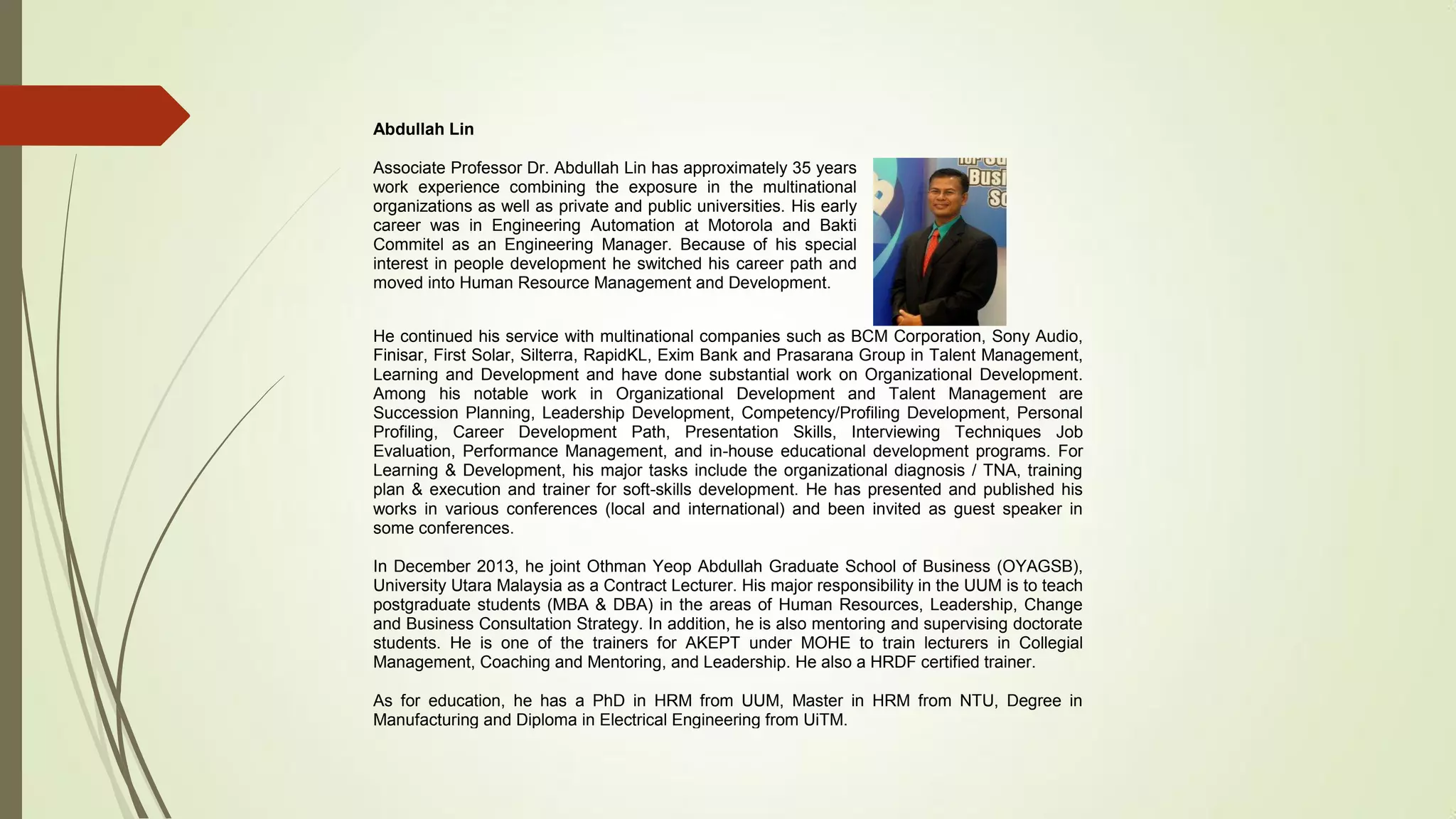
Abdullah Lin
Associate Professor Dr. Abdullah Lin has approximately 35 years
work experience combining the exposure in the multinational
organizations as well as private and public universities. His early
career was in Engineering Automation at Motorola and Bakti
Commitel as an Engineering Manager. Because of his special
interest in people development he switched his career path and
moved into Human Resource Management and Development.
He continued his service with multinational companies such as BCM Corporation, Sony Audio,
Finisar, First Solar, Silterra, RapidKL, Exim Bank and Prasarana Group in Talent Management,
Learning and Development and have done substantial work on Organizational Development.
Among his notable work in Organizational Development and Talent Management are
Succession Planning, Leadership Development, Competency/Profiling Development, Personal
Profiling, Career Development Path, Presentation Skills, Interviewing Techniques Job
Evaluation, Performance Management, and in-house educational development programs. For
Learning & Development, his major tasks include the organizational diagnosis / TNA, training
plan & execution and trainer for soft-skills development. He has presented and published his
works in various conferences (local and international) and been invited as guest speaker in
some conferences.
In December 2013, he joint Othman Yeop Abdullah Graduate School of Business (OYAGSB),
University Utara Malaysia as a Contract Lecturer. His major responsibility in the UUM is to teach
postgraduate students (MBA & DBA) in the areas of Human Resources, Leadership, Change
and Business Consultation Strategy. In addition, he is also mentoring and supervising doctorate
students. He is one of the trainers for AKEPT under MOHE to train lecturers in Collegial
Management, Coaching and Mentoring, and Leadership. He also a HRDF certified trainer.
As for education, he has a PhD in HRM from UUM, Master in HRM from NTU, Degree in
Manufacturing and Diploma in Electrical Engineering from UiTM.
Contents
 Purpose of Presentation
 My Target
 Paradigm Shift of Teaching
 What is Innovative Practice?
 Innovative Practice and Teaching
 Bringing Practice to Teaching
 Metaphor to transformational learning
 How I did, do and will do
 Some Important skills for leader
 What I need to do to achieve the goals?
 Conclusion
Purpose of presentation
 Share my views and experiences on creativity and
innovation in learning at higher education
 Explain my framework – How I do?
 Present actions carried out
 Moving Forwards – New strategy to implement
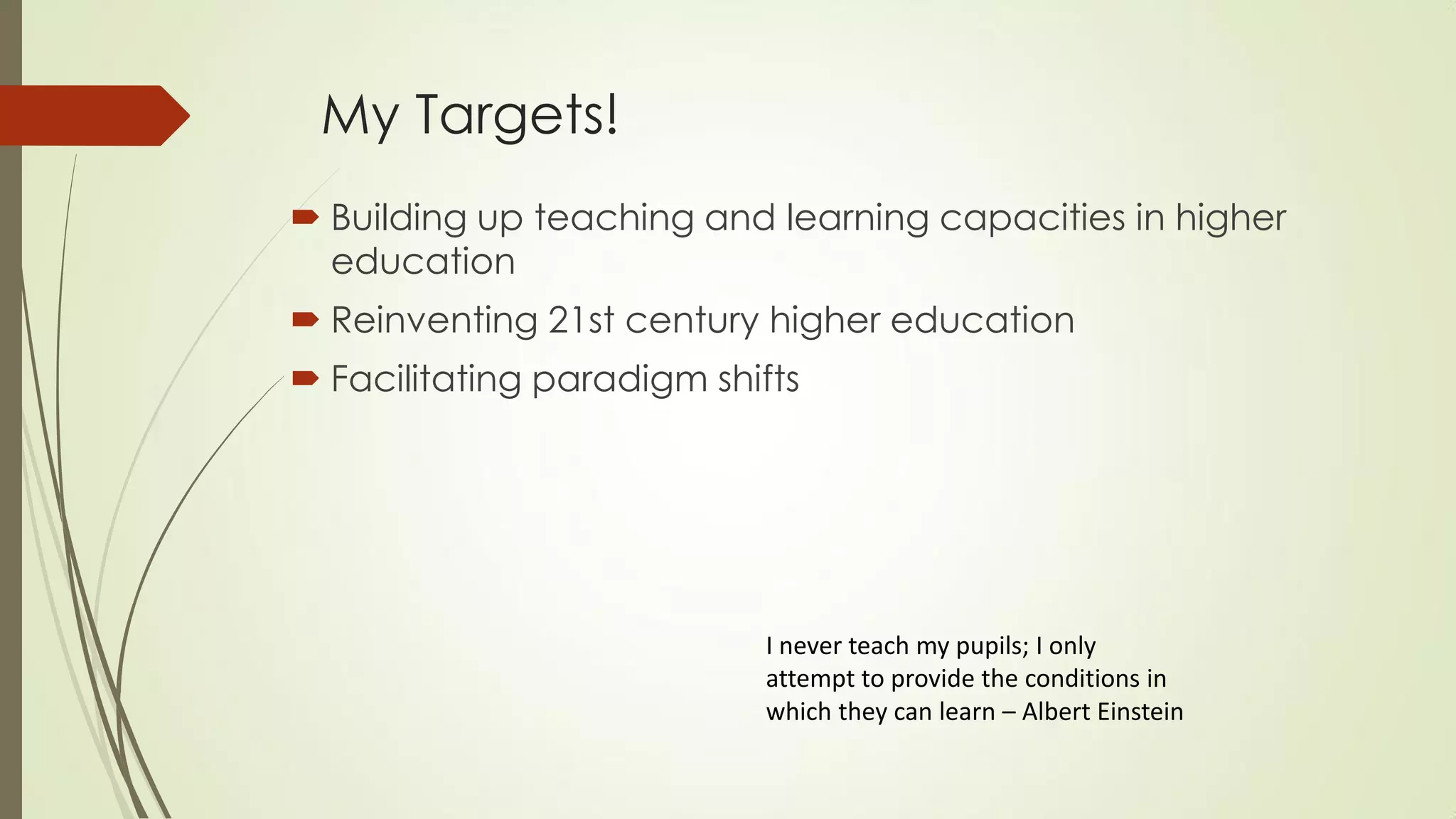
My Targets!
 Building up teaching and learning capacities in higher
education
 Reinventing 21st century higher education
 Facilitating paradigm shifts
I never teach my pupils; I only
attempt to provide the conditions in
which they can learn – Albert Einstein
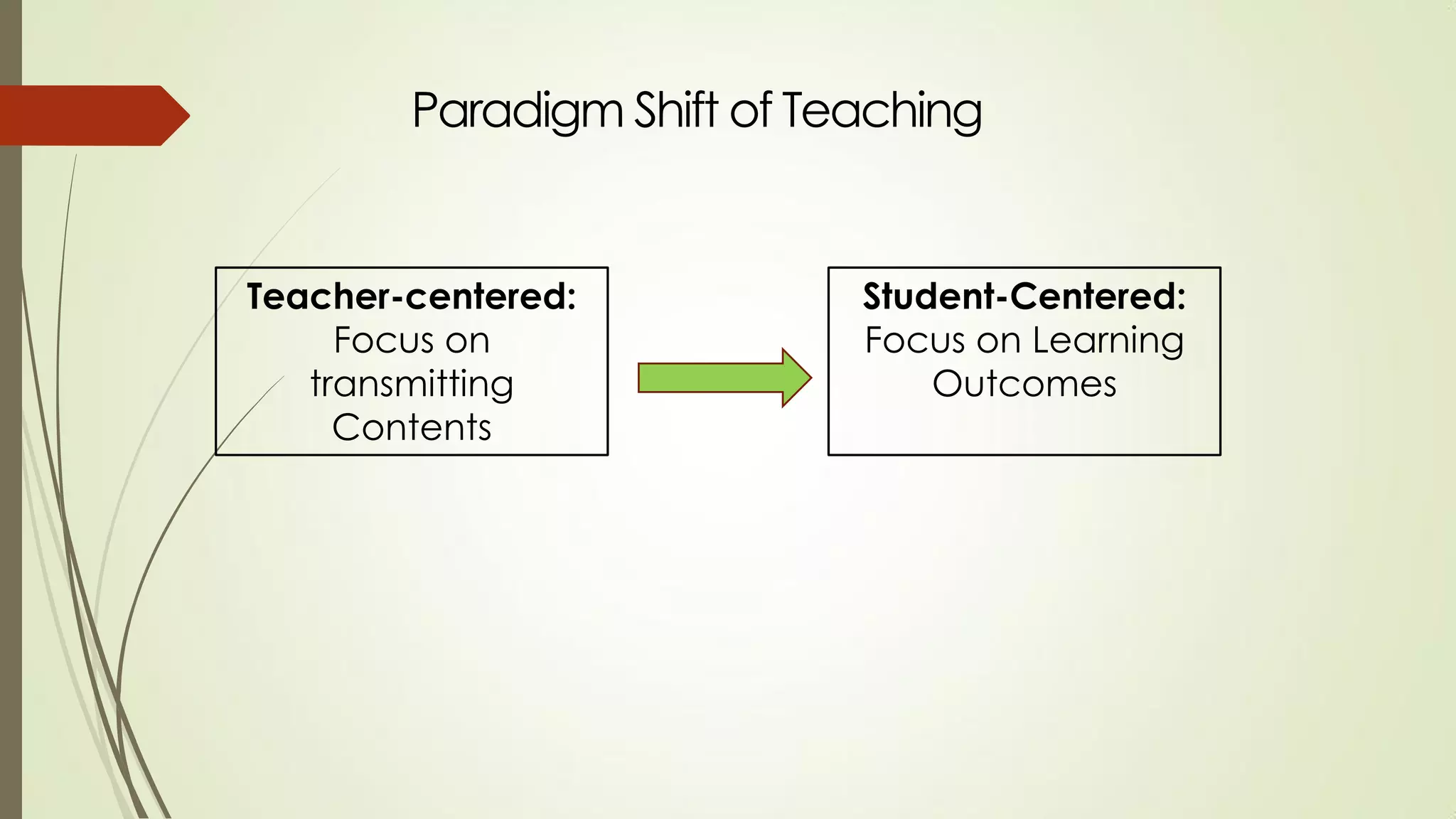
Paradigm Shift of Teaching
Teacher-centered:
Focus on
transmitting
Contents
Student-Centered:
Focus on Learning
Outcomes
Synonyms:
New, Novel, Unusual, Unexpected, Out of Box, Off beat, Unbeaten,
Different, Creative, Ahead of the curve, Different, Creative, Original,
Advanced, Unique, Technology based, Imaginative, Inventive,
Inspired, Ingenious, Fertile, Resourceful, Pioneering, state-of-the-art
What is innovative?
What is Innovative Practice?
The practice with the new mindset or new way with
value in it. In education context, it is referred to the
creative teaching by teacher/educator.
- Curran & Peterson, University of Iowa, USA.
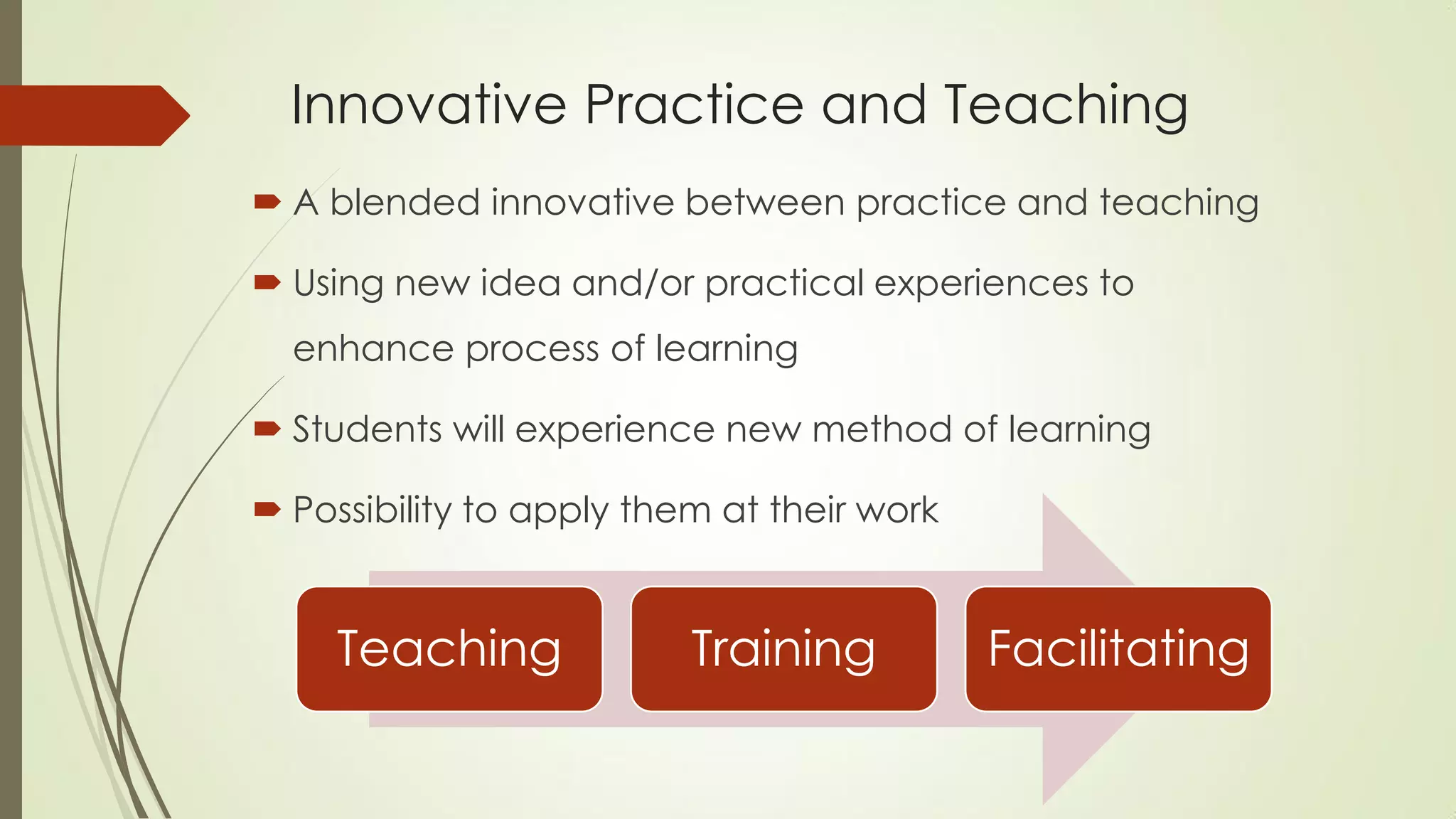
Innovative Practice and Teaching
 A blended innovative between practice and teaching
 Using new idea and/or practical experiences to
enhance process of learning
 Students will experience new method of learning
 Possibility to apply them at their work
Teaching Training Facilitating
Bringing Innovative Practicetoteaching
1
0
These practices include, but not limited to :
1. Student-centered classroom – i.e. more to students’ participation
2. Case-based Learning
3. Experiential Learning
4. Project Based Learning (PBL) – instructional approach involves confronting
students with problems from practice
5. Use of technology to promote learning such as Mobile
Application - Padlets, forum, on-line learning, etc.
 Going beyond the boundaries
 Thinking out of the box
 Stepping out of the comfort zone
 Going through the eye of the needle
 Emphasizes active, interactive and collaborative
learning making it more student-centered.
Metaphors related to
transformational learning include …
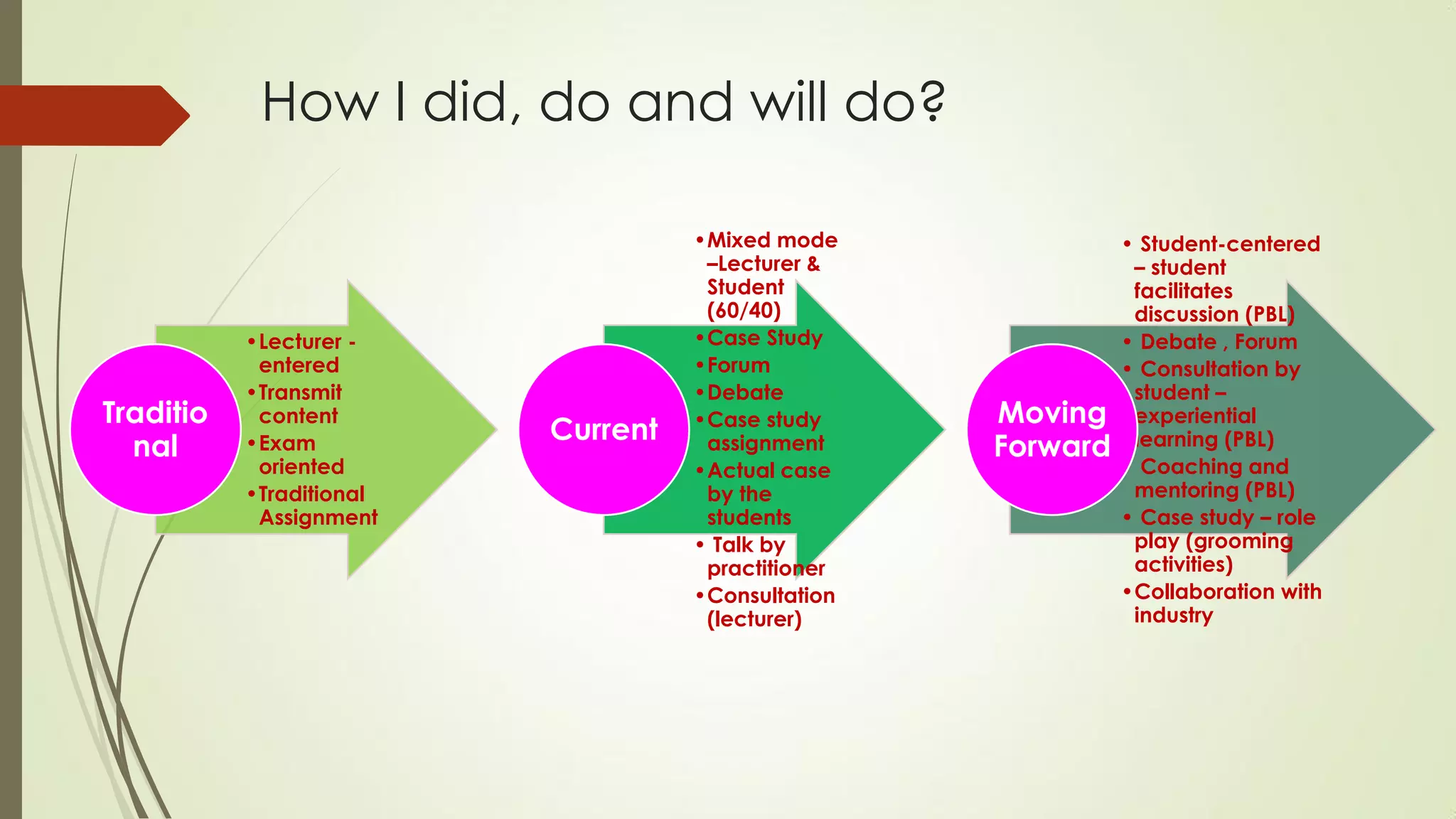
How I did, do and will do?
•Lecturer -
entered
•Transmit
content
•Exam
oriented
•Traditional
Assignment
Traditio
nal
•Mixed mode
–Lecturer &
Student
(60/40)
•Case Study
•Forum
•Debate
•Case study
assignment
•Actual case
by the
students
• Talk by
practitioner
•Consultation
(lecturer)
Current
• Student-centered
– student
facilitates
discussion (PBL)
• Debate , Forum
• Consultation by
student –
experiential
learning (PBL)
• Coaching and
mentoring (PBL)
• Case study – role
play (grooming
activities)
•Collaboration with
industry
Moving
Forward
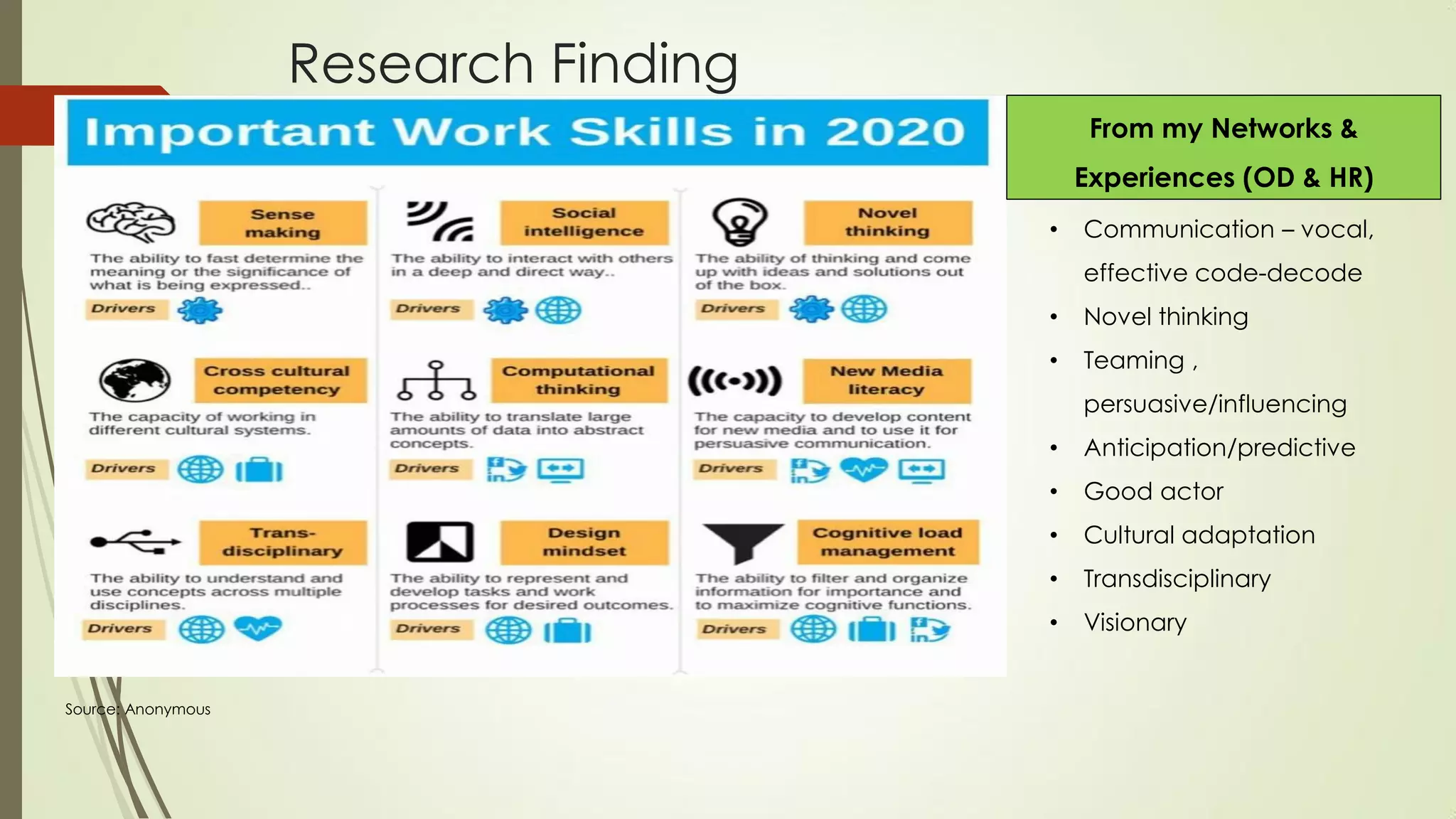
Research Finding
Source: Anonymous
• Communication – vocal,
effective code-decode
• Novel thinking
• Teaming ,
persuasive/influencing
• Anticipation/predictive
• Good actor
• Cultural adaptation
• Transdisciplinary
• Visionary
From my Networks &
Experiences (OD & HR)
What do I need in order to achieve my
goals?
 Challenge yourself & learner – what is your objectives
(teaching and learning?)
 Go beyond standard – reflect, create and innovate
 Case Study, Student’s Experiences, Action research
 Debate, Forum, Role Play (ie. Drama, etc.)
 Consultation
 Experiential learnings – using experience to enhance
learning. Connect theory to practical – actual cases
Conclusion:
Four conditions for supporting innovative teaching and
learning practices
1. Experimenting
2. Reflecting on experience
3. Support generative conversations
4. Foresee practical application
Thank You
Q & A

Innovative practice and teaching

  • 1.
    Innovative Practice and Teaching Educates, Inspires & Apply Prepared by: Abdullah Lin, 17 July 2018
  • 2.
    Abdullah Lin Associate ProfessorDr. Abdullah Lin has approximately 35 years work experience combining the exposure in the multinational organizations as well as private and public universities. His early career was in Engineering Automation at Motorola and Bakti Commitel as an Engineering Manager. Because of his special interest in people development he switched his career path and moved into Human Resource Management and Development. He continued his service with multinational companies such as BCM Corporation, Sony Audio, Finisar, First Solar, Silterra, RapidKL, Exim Bank and Prasarana Group in Talent Management, Learning and Development and have done substantial work on Organizational Development. Among his notable work in Organizational Development and Talent Management are Succession Planning, Leadership Development, Competency/Profiling Development, Personal Profiling, Career Development Path, Presentation Skills, Interviewing Techniques Job Evaluation, Performance Management, and in-house educational development programs. For Learning & Development, his major tasks include the organizational diagnosis / TNA, training plan & execution and trainer for soft-skills development. He has presented and published his works in various conferences (local and international) and been invited as guest speaker in some conferences. In December 2013, he joint Othman Yeop Abdullah Graduate School of Business (OYAGSB), University Utara Malaysia as a Contract Lecturer. His major responsibility in the UUM is to teach postgraduate students (MBA & DBA) in the areas of Human Resources, Leadership, Change and Business Consultation Strategy. In addition, he is also mentoring and supervising doctorate students. He is one of the trainers for AKEPT under MOHE to train lecturers in Collegial Management, Coaching and Mentoring, and Leadership. He also a HRDF certified trainer. As for education, he has a PhD in HRM from UUM, Master in HRM from NTU, Degree in Manufacturing and Diploma in Electrical Engineering from UiTM.
  • 3.
    Contents  Purpose ofPresentation  My Target  Paradigm Shift of Teaching  What is Innovative Practice?  Innovative Practice and Teaching  Bringing Practice to Teaching  Metaphor to transformational learning  How I did, do and will do  Some Important skills for leader  What I need to do to achieve the goals?  Conclusion
  • 4.
    Purpose of presentation Share my views and experiences on creativity and innovation in learning at higher education  Explain my framework – How I do?  Present actions carried out  Moving Forwards – New strategy to implement
  • 5.
    My Targets!  Buildingup teaching and learning capacities in higher education  Reinventing 21st century higher education  Facilitating paradigm shifts I never teach my pupils; I only attempt to provide the conditions in which they can learn – Albert Einstein
  • 6.
    Paradigm Shift ofTeaching Teacher-centered: Focus on transmitting Contents Student-Centered: Focus on Learning Outcomes
  • 7.
    Synonyms: New, Novel, Unusual,Unexpected, Out of Box, Off beat, Unbeaten, Different, Creative, Ahead of the curve, Different, Creative, Original, Advanced, Unique, Technology based, Imaginative, Inventive, Inspired, Ingenious, Fertile, Resourceful, Pioneering, state-of-the-art What is innovative?
  • 8.
    What is InnovativePractice? The practice with the new mindset or new way with value in it. In education context, it is referred to the creative teaching by teacher/educator. - Curran & Peterson, University of Iowa, USA.
  • 9.
    Innovative Practice andTeaching  A blended innovative between practice and teaching  Using new idea and/or practical experiences to enhance process of learning  Students will experience new method of learning  Possibility to apply them at their work Teaching Training Facilitating
  • 10.
    Bringing Innovative Practicetoteaching 1 0 Thesepractices include, but not limited to : 1. Student-centered classroom – i.e. more to students’ participation 2. Case-based Learning 3. Experiential Learning 4. Project Based Learning (PBL) – instructional approach involves confronting students with problems from practice 5. Use of technology to promote learning such as Mobile Application - Padlets, forum, on-line learning, etc.
  • 11.
     Going beyondthe boundaries  Thinking out of the box  Stepping out of the comfort zone  Going through the eye of the needle  Emphasizes active, interactive and collaborative learning making it more student-centered. Metaphors related to transformational learning include …
  • 12.
    How I did,do and will do? •Lecturer - entered •Transmit content •Exam oriented •Traditional Assignment Traditio nal •Mixed mode –Lecturer & Student (60/40) •Case Study •Forum •Debate •Case study assignment •Actual case by the students • Talk by practitioner •Consultation (lecturer) Current • Student-centered – student facilitates discussion (PBL) • Debate , Forum • Consultation by student – experiential learning (PBL) • Coaching and mentoring (PBL) • Case study – role play (grooming activities) •Collaboration with industry Moving Forward
  • 13.
    Research Finding Source: Anonymous •Communication – vocal, effective code-decode • Novel thinking • Teaming , persuasive/influencing • Anticipation/predictive • Good actor • Cultural adaptation • Transdisciplinary • Visionary From my Networks & Experiences (OD & HR)
  • 14.
    What do Ineed in order to achieve my goals?  Challenge yourself & learner – what is your objectives (teaching and learning?)  Go beyond standard – reflect, create and innovate  Case Study, Student’s Experiences, Action research  Debate, Forum, Role Play (ie. Drama, etc.)  Consultation  Experiential learnings – using experience to enhance learning. Connect theory to practical – actual cases
  • 15.
    Conclusion: Four conditions forsupporting innovative teaching and learning practices 1. Experimenting 2. Reflecting on experience 3. Support generative conversations 4. Foresee practical application
  • 16.