1
MT65: On the Way to a Smart Factory
Manufacturing Innovation with IoT Solutions
2
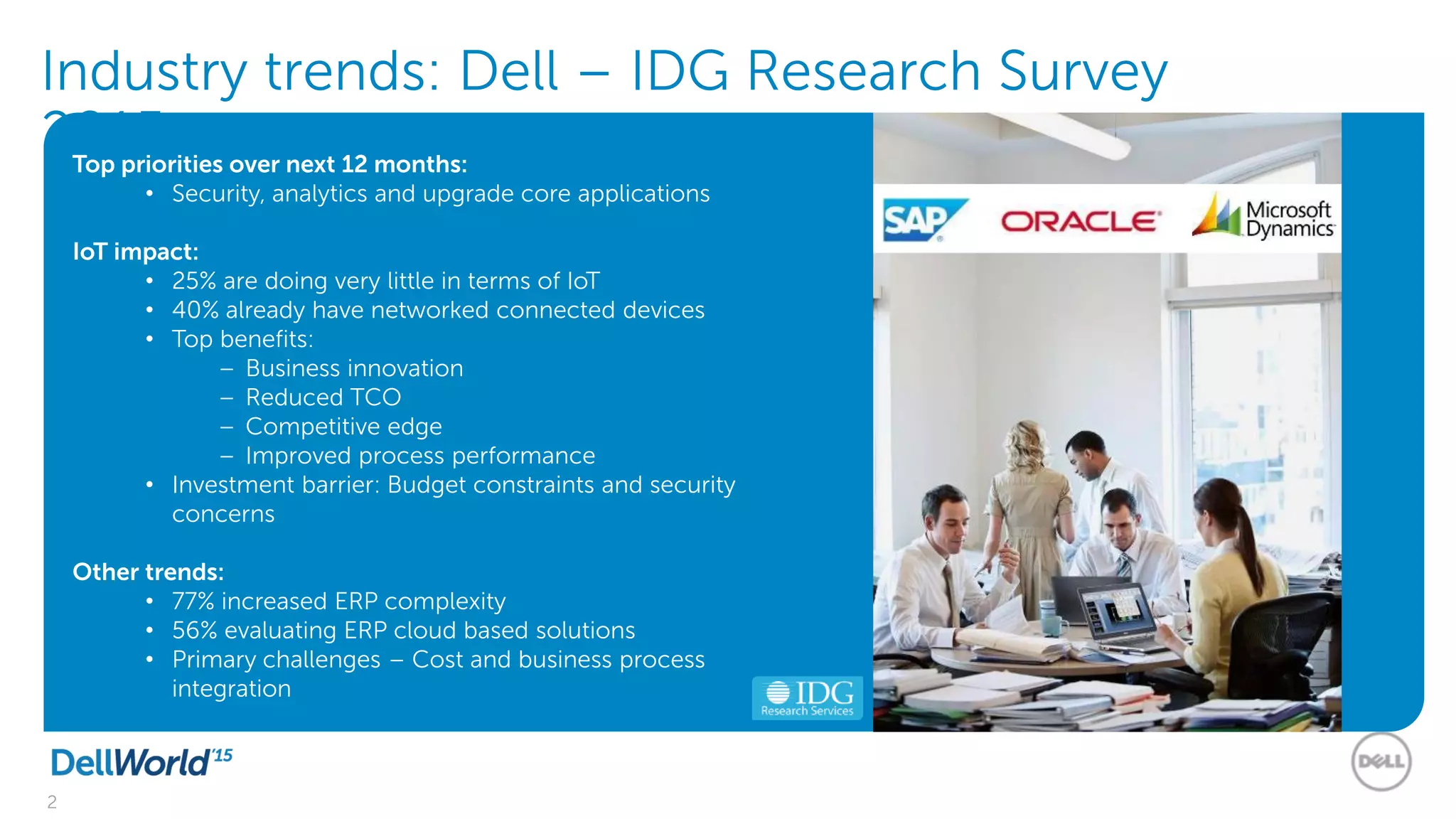
Industry trends: Dell – IDG Research Survey
2015Top priorities over next 12 months:
• Security, analytics and upgrade core applications
IoT impact:
• 25% are doing very little in terms of IoT
• 40% already have networked connected devices
• Top benefits:
– Business innovation
– Reduced TCO
– Competitive edge
– Improved process performance
• Investment barrier: Budget constraints and security
concerns
Other trends:
• 77% increased ERP complexity
• 56% evaluating ERP cloud based solutions
• Primary challenges – Cost and business process
integration
3
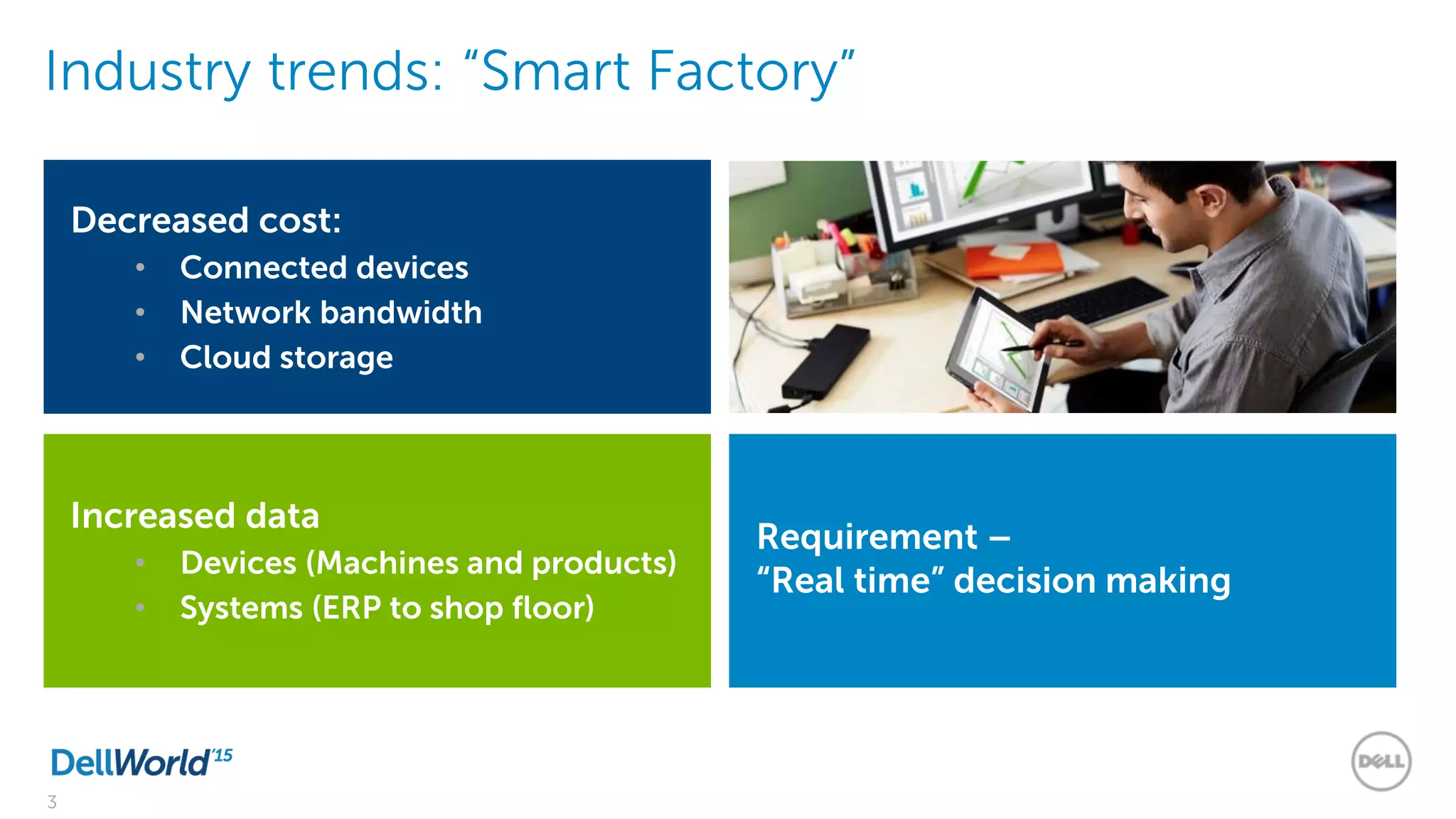
Industry trends: “Smart Factory”
Decreased cost:
• Connected devices
• Network bandwidth
• Cloud storage
Increased data
• Devices (Machines and products)
• Systems (ERP to shop floor)
Requirement –
“Real time” decision making
4
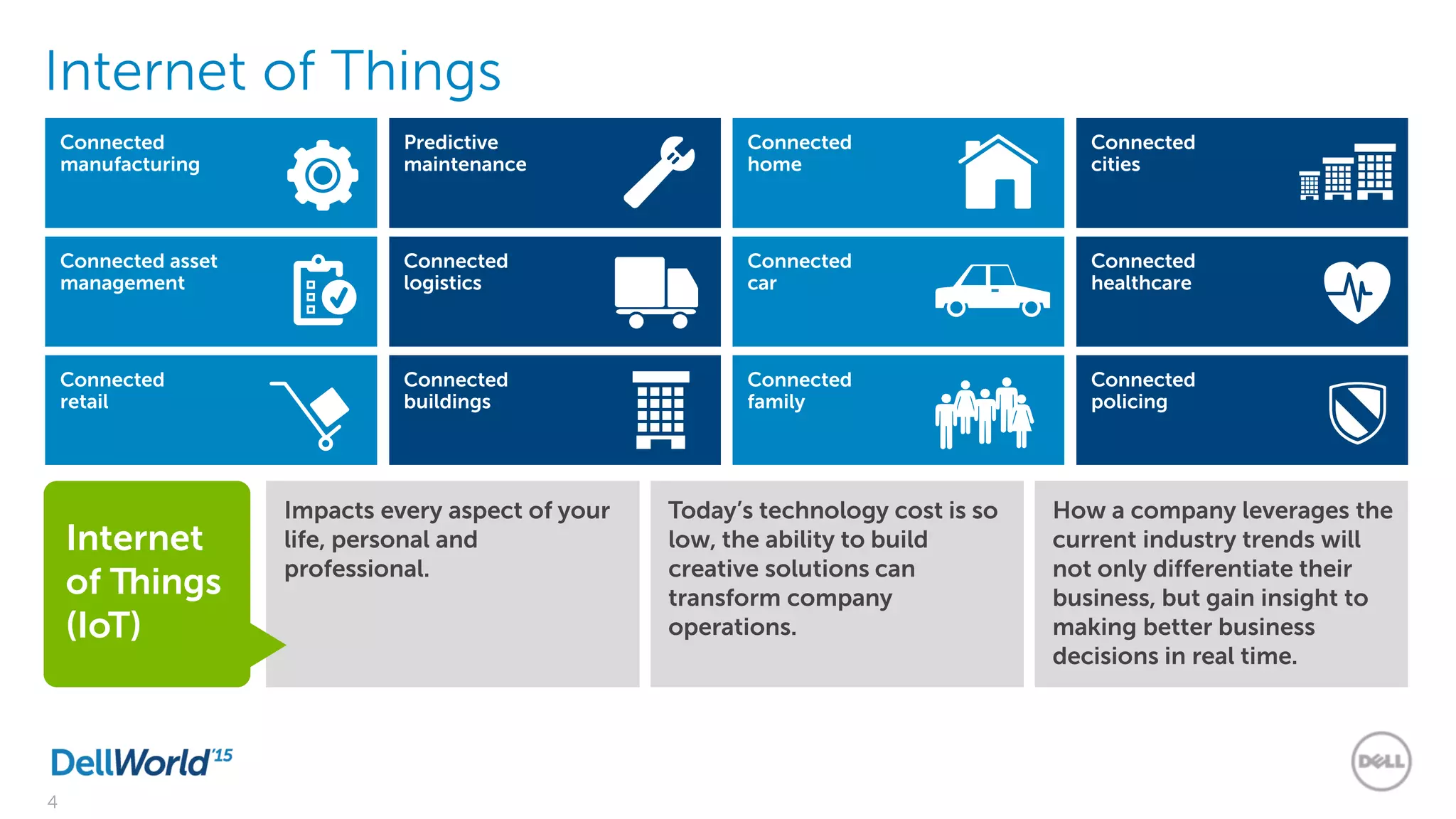
Internet of Things
Impacts every aspect of your
life, personal and
professional.
Today’s technology cost is so
low, the ability to build
creative solutions can
transform company
operations.
How a company leverages the
current industry trends will
not only differentiate their
business, but gain insight to
making better business
decisions in real time.
Internet
of Things
(IoT)
Connected
manufacturing
Connected asset
management
Connected
retail
Predictive
maintenance
Connected
logistics
Connected
buildings
Connected
home
Connected
car
Connected
family
Connected
cities
Connected
healthcare
Connected
policing
5
Internet of Things
Internet
of Things
(IoT)
Private and public networks10’s of billions of connected things
High-performance computer
infrastructure
Things Sensors Transport Connector Application
layer
In-memory database layer
Libraries
Sensors alone do not
transform operations. They
have existed for years, along with
various software packages to
collect and analyze.
Data points without
connectivity do not transform
business operations. Networks
need to be designed to handle this
increased traffic while managing
the security requirements.
The key is to combine sensors,
networks and high computing
to empower decision making
from operators to executives
Internet
of Things
(IoT)
6
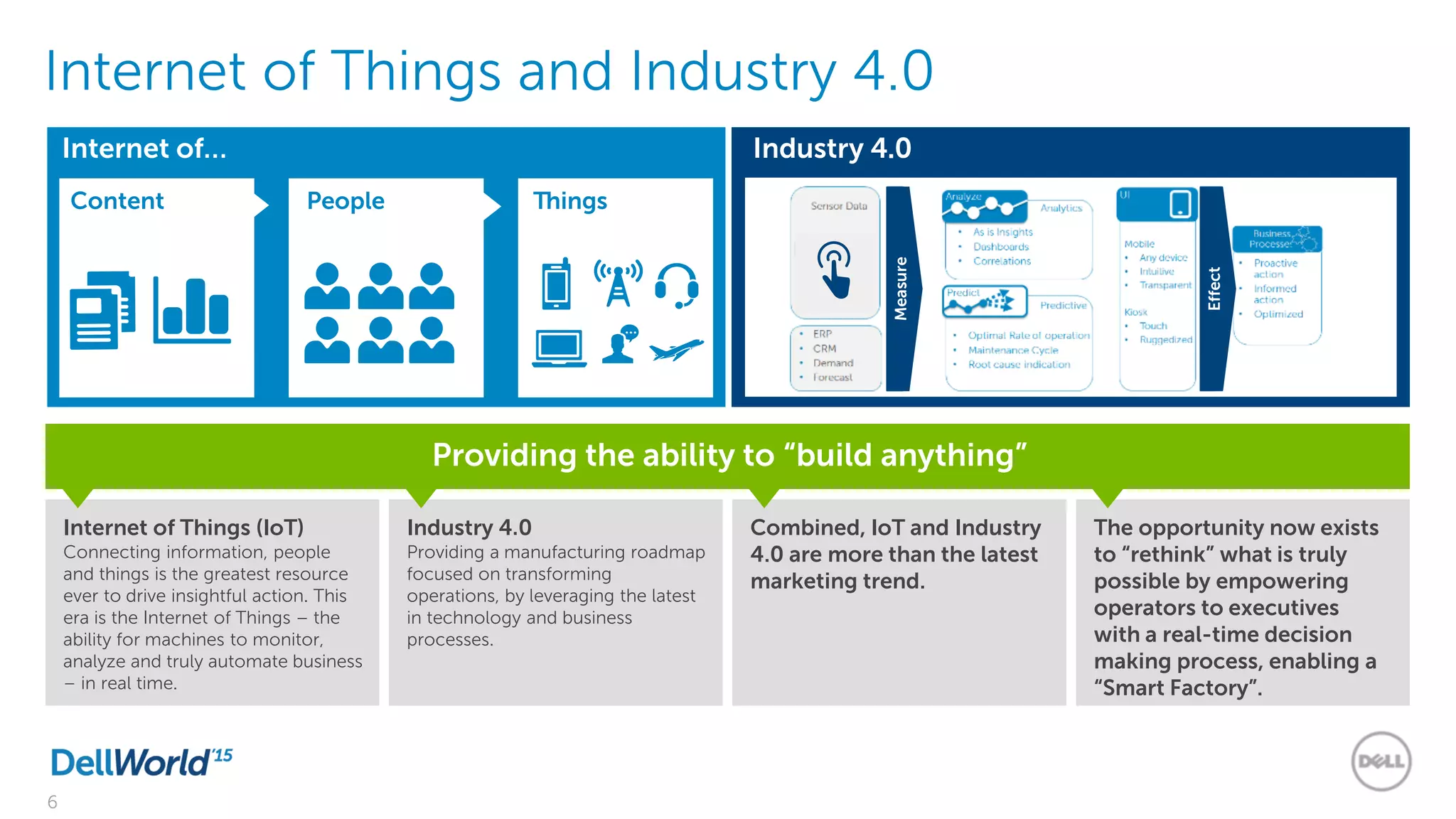
Internet of… Industry 4.0
Internet of Things and Industry 4.0
Internet of Things (IoT)
Connecting information, people
and things is the greatest resource
ever to drive insightful action. This
era is the Internet of Things – the
ability for machines to monitor,
analyze and truly automate business
– in real time.
Industry 4.0
Providing a manufacturing roadmap
focused on transforming
operations, by leveraging the latest
in technology and business
processes.
Combined, IoT and Industry
4.0 are more than the latest
marketing trend.
The opportunity now exists
to “rethink” what is truly
possible by empowering
operators to executives
with a real-time decision
making process, enabling a
“Smart Factory”.
Providing the ability to “build anything”
Content People Things
Measure
Effect
7
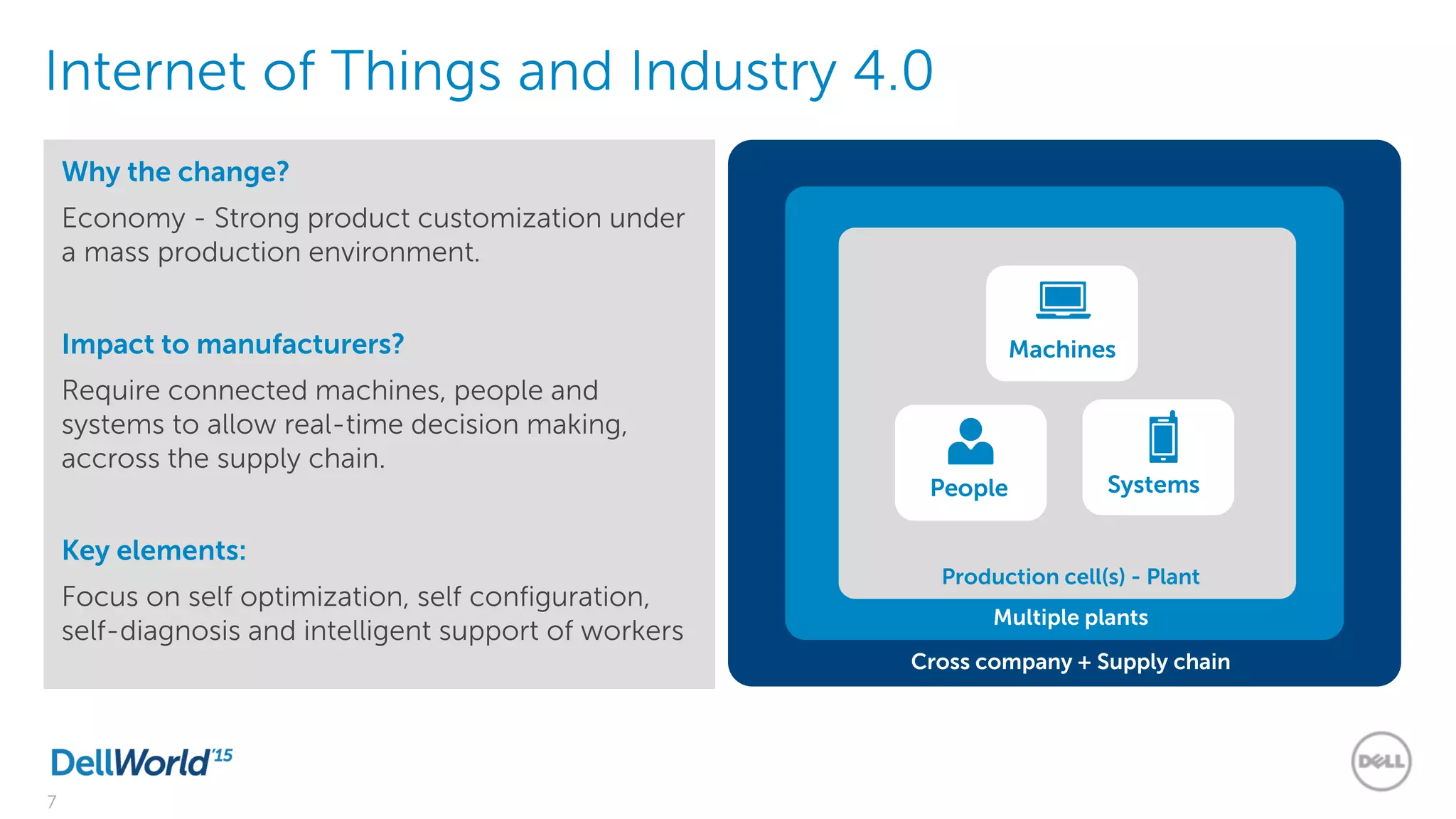
Internet of Things and Industry 4.0
Why the change?
Economy - Strong product customization under
a mass production environment.
Impact to manufacturers?
Require connected machines, people and
systems to allow real-time decision making,
accross the supply chain.
Key elements:
Focus on self optimization, self configuration,
self-diagnosis and intelligent support of workers
Cross company + Supply chain
Multiple plants
Production cell(s) - Plant
Machines
People Systems
8
Challenge
TreeHouse has several shop floor information systems
unevenly deployed across SAP and non-SAP footprints. The
corporate initiative is to use a single set of consistently
calculated operational metrics such as Overall Equipment
Effectiveness (OEE), schedule adherence and attainment and
quality. The challenge was to find a solution agnostic for
whether the location is live on SAP or which shop floor
systems are deployed and provide increased confidence
reported metrics.
Products involved
• SAP Manufacturing Integration & Intelligence (SAP MII – 12.2)
• SAP ERP (ECC 6.0)
• Time Tracking Software, 3rd party ERP system and shop floor
systems
Project highlights and benefits
• Enabler to operational improvement: facilitates actionable
meetings of timely information with personnel who can drive
improvement
• Rapid template deployment: application can be configured to
each plant thus avoiding need for new custom development
and maintenance hassles
• Flexible platform for future functionality: ongoing plans to
add additional reporting and data capture features
• Platform independent: application is built on GPL open source
query plugins eliminating the need for specific browser/java
versions
Shop Floor
Transformation
Food industry
Customer project:
Combined implementation
SAP ERP and SAP MII
9
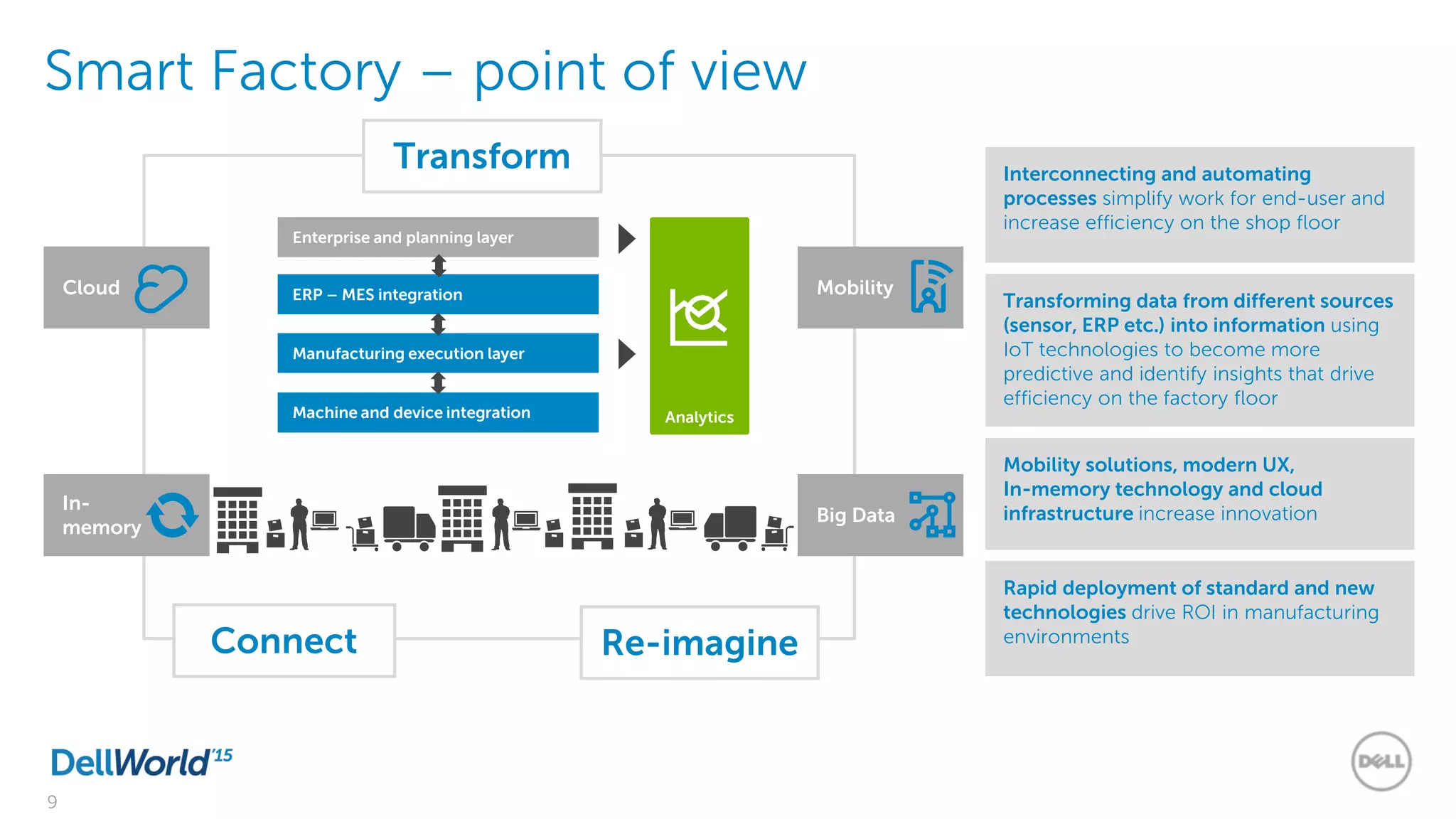
Smart Factory – point of view
ERP – MES integration
Manufacturing execution layer
Enterprise and planning layer
Machine and device integration Analytics
Mobility
Big Data
In-
memory
Cloud
Connect
Transform
Re-imagine
Interconnecting and automating
processes simplify work for end-user and
increase efficiency on the shop floor
Transforming data from different sources
(sensor, ERP etc.) into information using
IoT technologies to become more
predictive and identify insights that drive
efficiency on the factory floor
Mobility solutions, modern UX,
In-memory technology and cloud
infrastructure increase innovation
Rapid deployment of standard and new
technologies drive ROI in manufacturing
environments
10
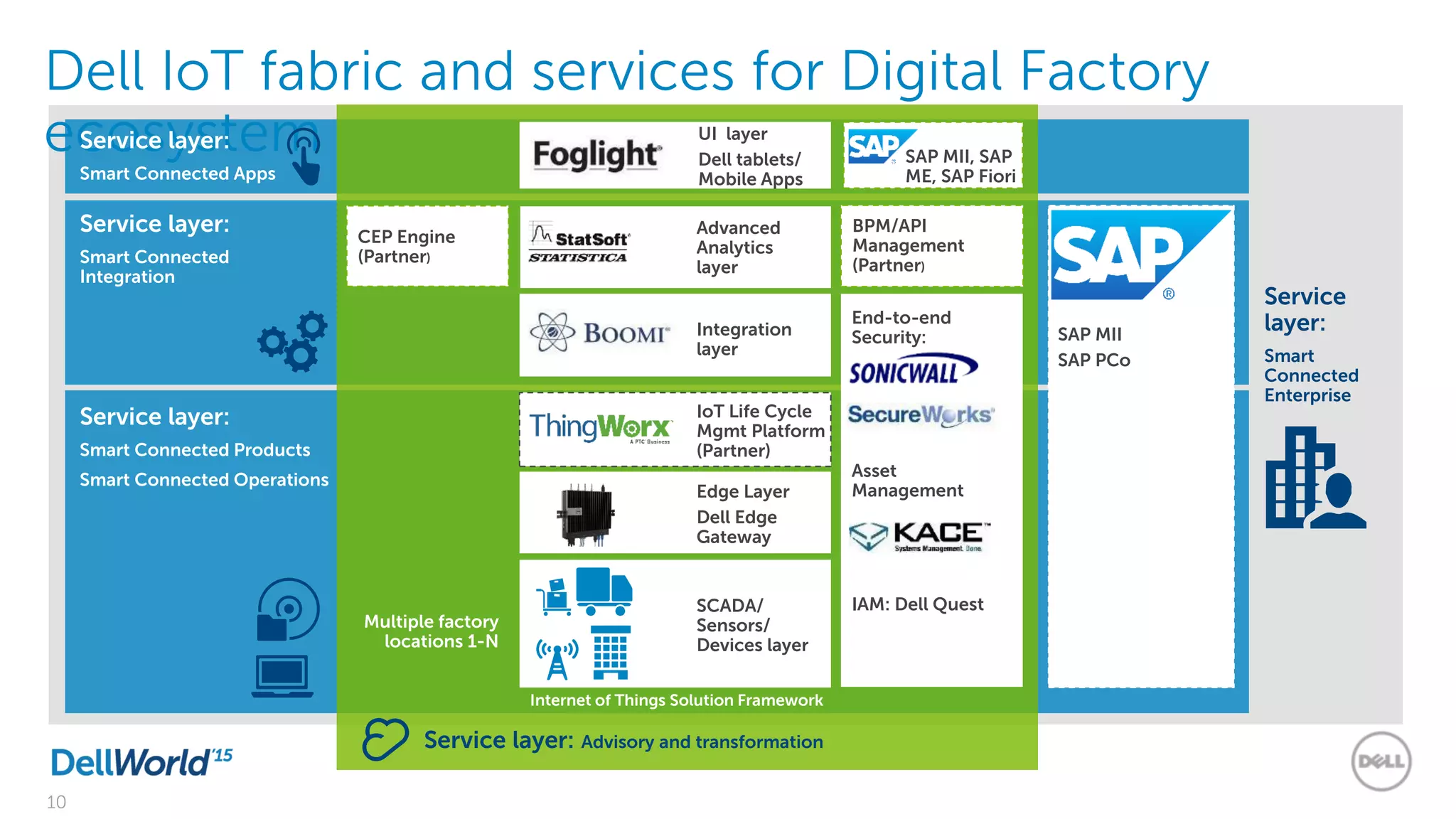
Internet of Things Solution Framework
Dell IoT fabric and services for Digital Factory
ecosystem
SCADA/
Sensors/
Devices layer
Edge Layer
Dell Edge
Gateway
Advanced
Analytics
layer
UI layer
Dell tablets/
Mobile Apps
IoT Life Cycle
Mgmt Platform
(Partner)
CEP Engine
(Partner)
BPM/API
Management
(Partner)
Service layer:
Smart Connected Products
Smart Connected Operations
Service layer:
Smart Connected
Integration
Service
layer:
Smart
Connected
Enterprise
Service layer: Advisory and transformation
Multiple factory
locations 1-N
Service layer:
Smart Connected Apps
SAP MII, SAP
ME, SAP Fiori
SAP MII
SAP PCo
End-to-end
Security:
Asset
Management
IAM: Dell Quest
Integration
layer
11
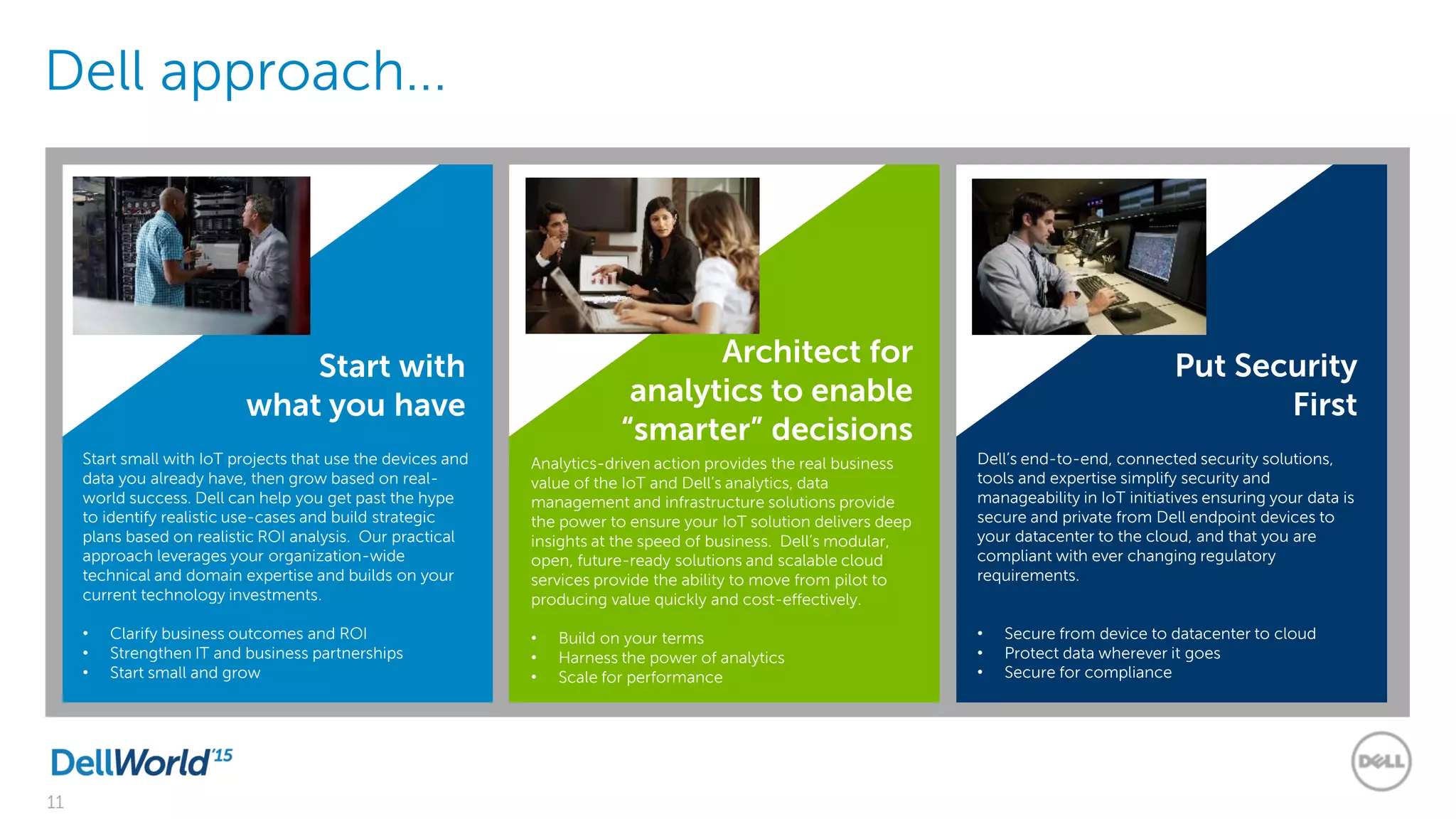
Dell approach...
Start with
what you have
Architect for
analytics to enable
“smarter” decisions
Put Security
First
Start small with IoT projects that use the devices and
data you already have, then grow based on real-
world success. Dell can help you get past the hype
to identify realistic use-cases and build strategic
plans based on realistic ROI analysis. Our practical
approach leverages your organization-wide
technical and domain expertise and builds on your
current technology investments.
• Clarify business outcomes and ROI
• Strengthen IT and business partnerships
• Start small and grow
Analytics-driven action provides the real business
value of the IoT and Dell’s analytics, data
management and infrastructure solutions provide
the power to ensure your IoT solution delivers deep
insights at the speed of business. Dell’s modular,
open, future-ready solutions and scalable cloud
services provide the ability to move from pilot to
producing value quickly and cost-effectively.
• Build on your terms
• Harness the power of analytics
• Scale for performance
Dell’s end-to-end, connected security solutions,
tools and expertise simplify security and
manageability in IoT initiatives ensuring your data is
secure and private from Dell endpoint devices to
your datacenter to the cloud, and that you are
compliant with ever changing regulatory
requirements.
• Secure from device to datacenter to cloud
• Protect data wherever it goes
• Secure for compliance
12 Photo copyright is owned by the customer
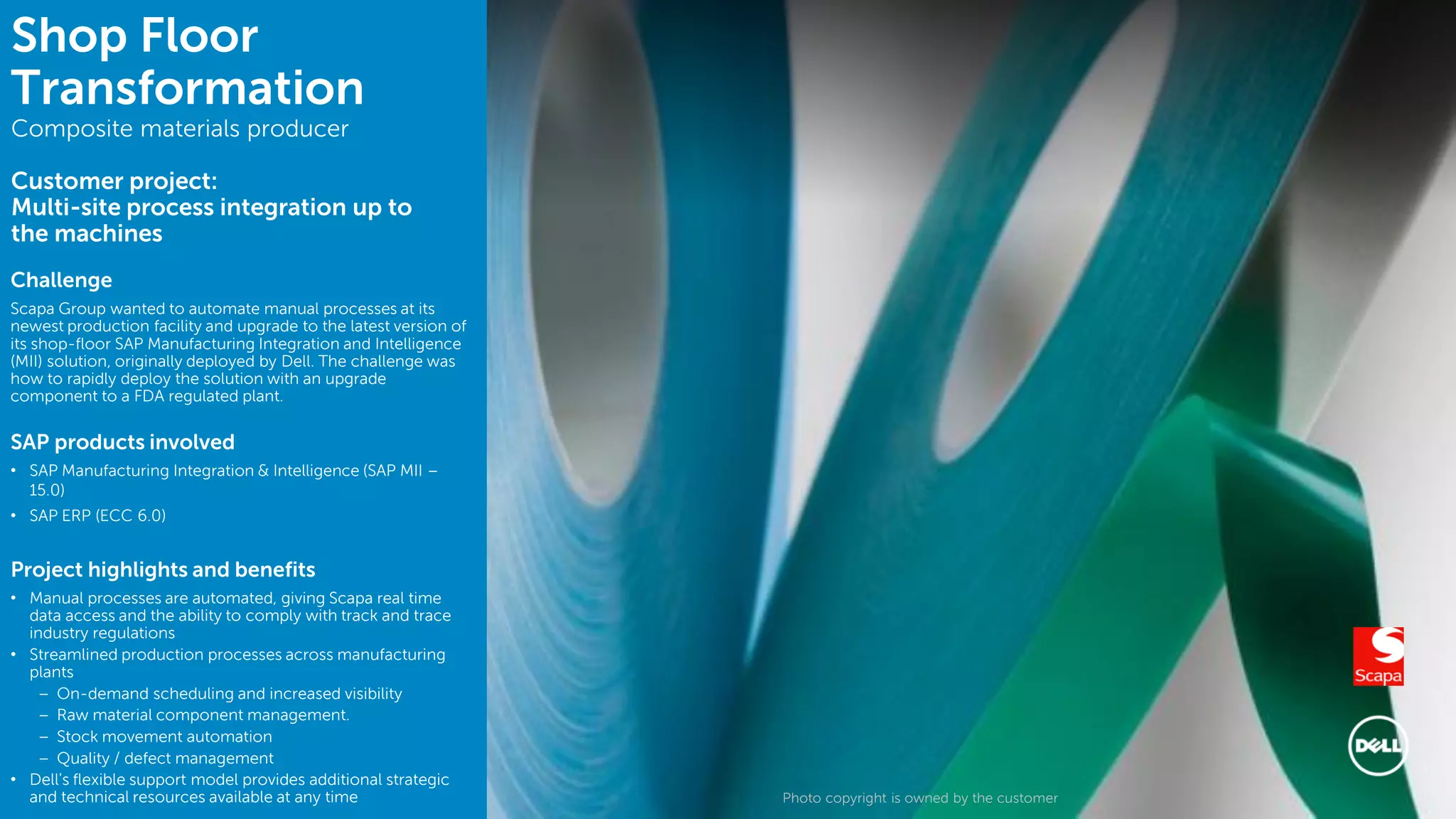
Shop Floor
Transformation
Composite materials producer
Customer project:
Multi-site process integration up to
the machines
Challenge
Scapa Group wanted to automate manual processes at its
newest production facility and upgrade to the latest version of
its shop-floor SAP Manufacturing Integration and Intelligence
(MII) solution, originally deployed by Dell. The challenge was
how to rapidly deploy the solution with an upgrade
component to a FDA regulated plant.
SAP products involved
• SAP Manufacturing Integration & Intelligence (SAP MII –
15.0)
• SAP ERP (ECC 6.0)
Project highlights and benefits
• Manual processes are automated, giving Scapa real time
data access and the ability to comply with track and trace
industry regulations
• Streamlined production processes across manufacturing
plants
– On-demand scheduling and increased visibility
– Raw material component management.
– Stock movement automation
– Quality / defect management
• Dell’s flexible support model provides additional strategic
and technical resources available at any time
13
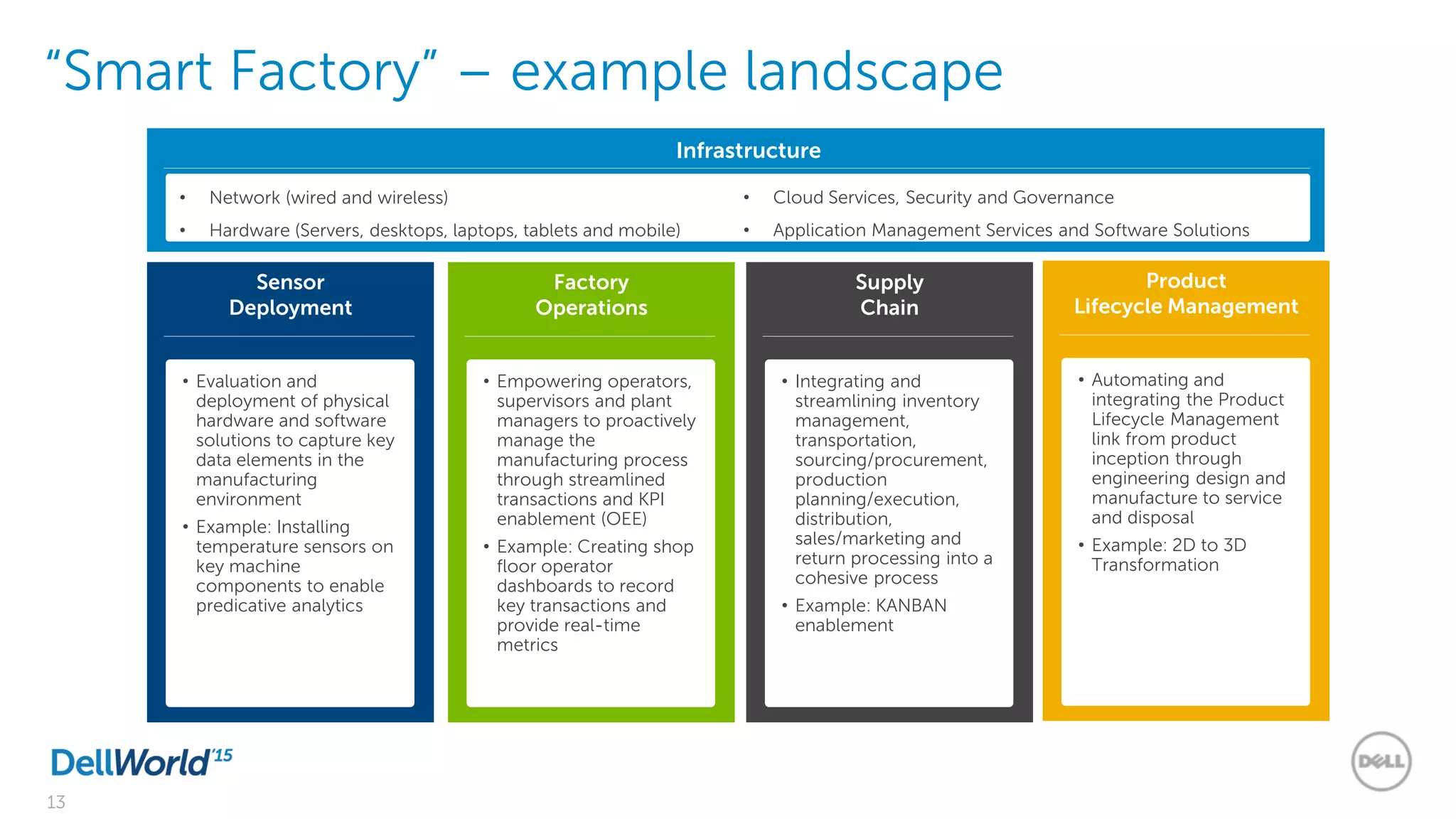
“Smart Factory” – example landscape
Resolve implementation issues
in specific areas
Infrastructure
• Network (wired and wireless)
• Hardware (Servers, desktops, laptops, tablets and mobile)
• Cloud Services, Security and Governance
• Application Management Services and Software Solutions
• Evaluation and
deployment of physical
hardware and software
solutions to capture key
data elements in the
manufacturing
environment
• Example: Installing
temperature sensors on
key machine
components to enable
predicative analytics
Sensor
Deployment
• Empowering operators,
supervisors and plant
managers to proactively
manage the
manufacturing process
through streamlined
transactions and KPI
enablement (OEE)
• Example: Creating shop
floor operator
dashboards to record
key transactions and
provide real-time
metrics
Factory
Operations
• Integrating and
streamlining inventory
management,
transportation,
sourcing/procurement,
production
planning/execution,
distribution,
sales/marketing and
return processing into a
cohesive process
• Example: KANBAN
enablement
Supply
Chain
• Automating and
integrating the Product
Lifecycle Management
link from product
inception through
engineering design and
manufacture to service
and disposal
• Example: 2D to 3D
Transformation
Product
Lifecycle Management
14
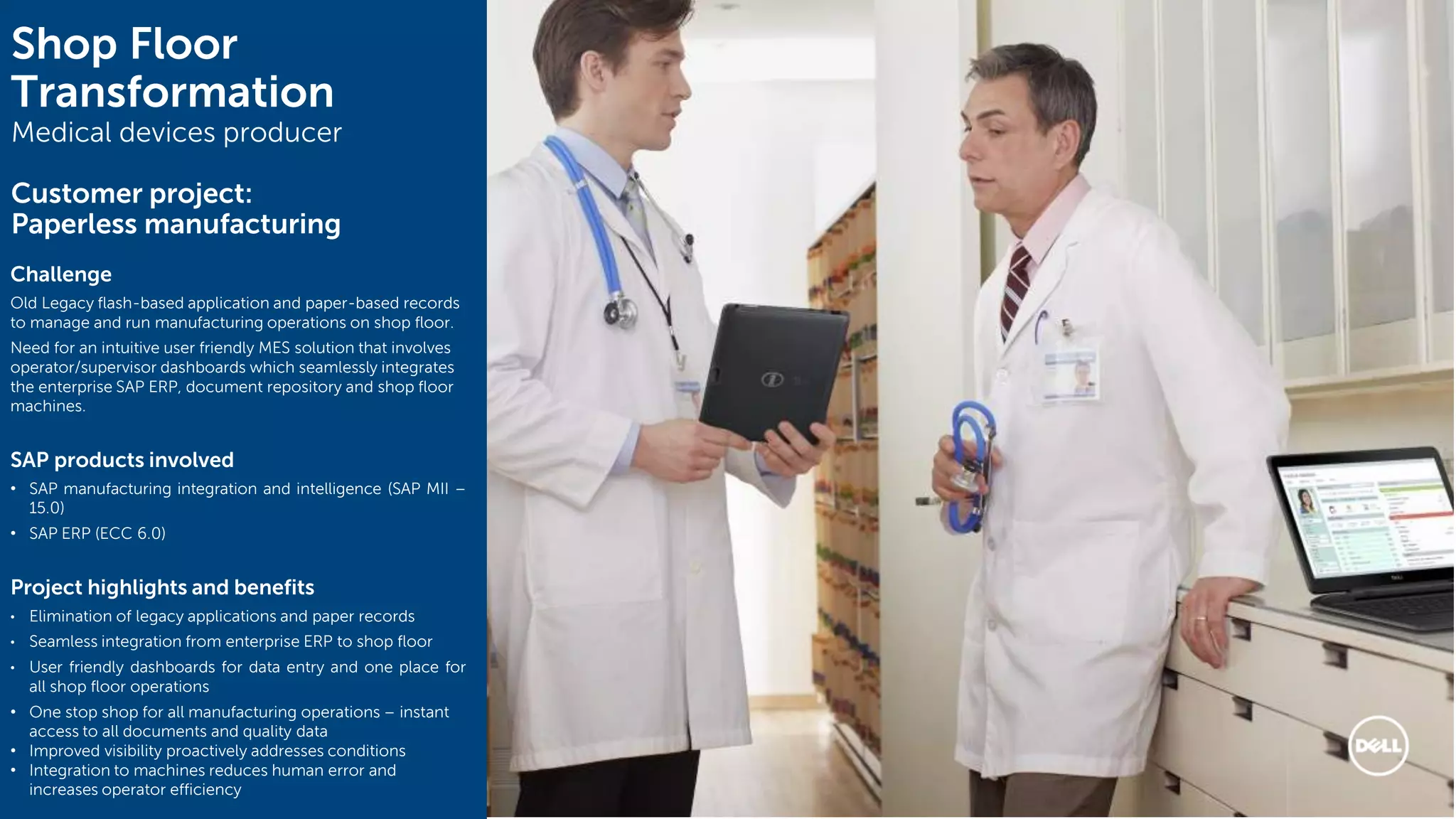
Shop Floor
Transformation
Medical devices producer
Customer project:
Paperless manufacturing
Challenge
Old Legacy flash-based application and paper-based records
to manage and run manufacturing operations on shop floor.
Need for an intuitive user friendly MES solution that involves
operator/supervisor dashboards which seamlessly integrates
the enterprise SAP ERP, document repository and shop floor
machines.
SAP products involved
• SAP manufacturing integration and intelligence (SAP MII –
15.0)
• SAP ERP (ECC 6.0)
Project highlights and benefits
• Elimination of legacy applications and paper records
• Seamless integration from enterprise ERP to shop floor
• User friendly dashboards for data entry and one place for
all shop floor operations
• One stop shop for all manufacturing operations – instant
access to all documents and quality data
• Improved visibility proactively addresses conditions
• Integration to machines reduces human error and
increases operator efficiency
15
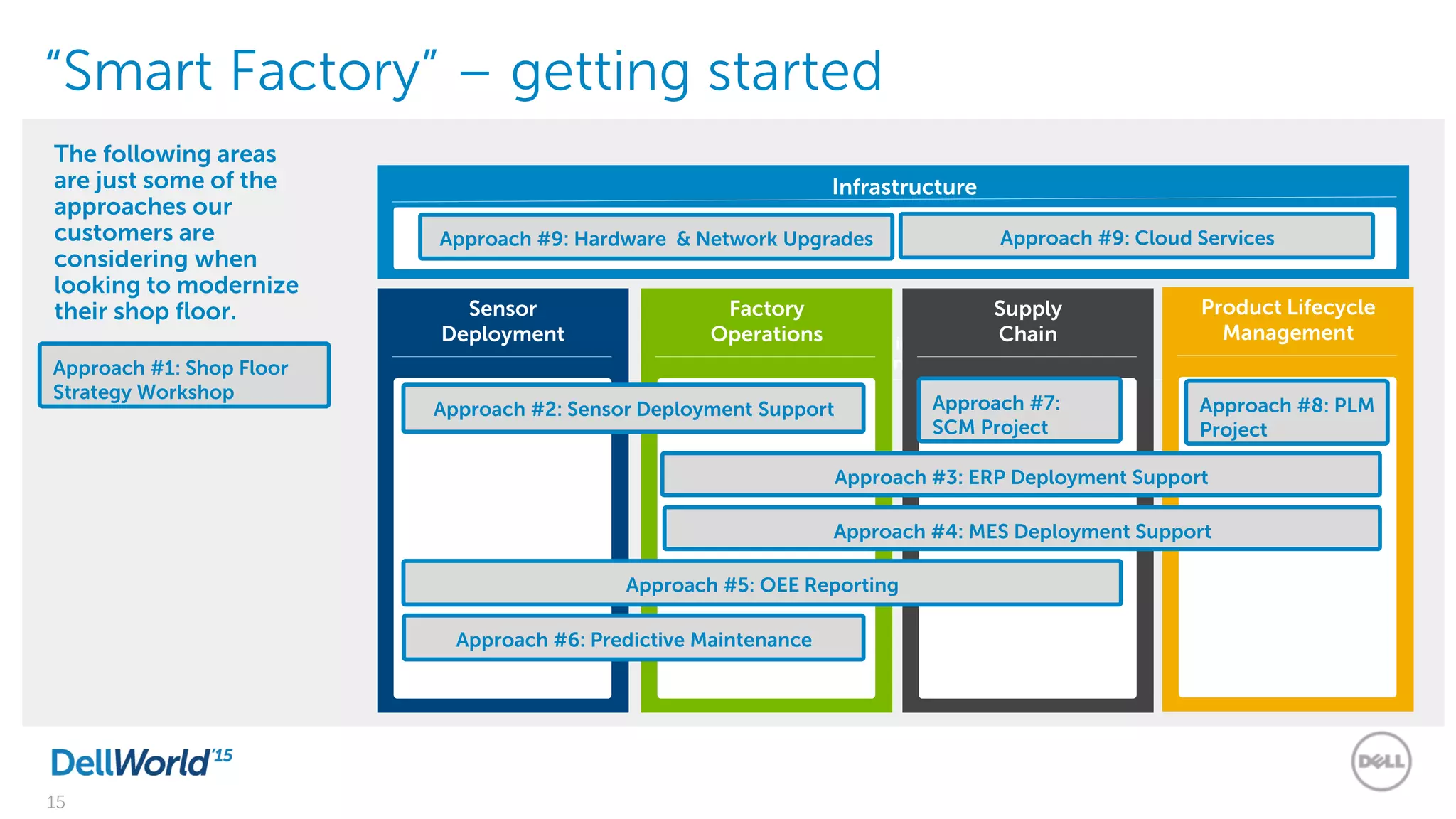
“Smart Factory” – getting started
Resolve implementation issues
in specific areas
Infrastructure
Sensor
Deployment
Factory
Operations
Supply
Chain
Product Lifecycle
Management
Approach #1: Shop Floor
Strategy Workshop
Approach #2: Sensor Deployment Support
Approach #3: ERP Deployment Support
Approach #4: MES Deployment Support
Approach #5: OEE Reporting
Approach #6: Predictive Maintenance
The following areas
are just some of the
approaches our
customers are
considering when
looking to modernize
their shop floor.
Approach #9: Hardware & Network Upgrades Approach #9: Cloud Services
Approach #7:
SCM Project
Approach #8: PLM
Project
Your questions?
Thank You!

On The Way To Smart Factory

  • 1.
    1 MT65: On theWay to a Smart Factory Manufacturing Innovation with IoT Solutions
  • 2.
    2 Industry trends: Dell– IDG Research Survey 2015Top priorities over next 12 months: • Security, analytics and upgrade core applications IoT impact: • 25% are doing very little in terms of IoT • 40% already have networked connected devices • Top benefits: – Business innovation – Reduced TCO – Competitive edge – Improved process performance • Investment barrier: Budget constraints and security concerns Other trends: • 77% increased ERP complexity • 56% evaluating ERP cloud based solutions • Primary challenges – Cost and business process integration
  • 3.
    3 Industry trends: “SmartFactory” Decreased cost: • Connected devices • Network bandwidth • Cloud storage Increased data • Devices (Machines and products) • Systems (ERP to shop floor) Requirement – “Real time” decision making
  • 4.
    4 Internet of Things Impactsevery aspect of your life, personal and professional. Today’s technology cost is so low, the ability to build creative solutions can transform company operations. How a company leverages the current industry trends will not only differentiate their business, but gain insight to making better business decisions in real time. Internet of Things (IoT) Connected manufacturing Connected asset management Connected retail Predictive maintenance Connected logistics Connected buildings Connected home Connected car Connected family Connected cities Connected healthcare Connected policing
  • 5.
    5 Internet of Things Internet ofThings (IoT) Private and public networks10’s of billions of connected things High-performance computer infrastructure Things Sensors Transport Connector Application layer In-memory database layer Libraries Sensors alone do not transform operations. They have existed for years, along with various software packages to collect and analyze. Data points without connectivity do not transform business operations. Networks need to be designed to handle this increased traffic while managing the security requirements. The key is to combine sensors, networks and high computing to empower decision making from operators to executives Internet of Things (IoT)
  • 6.
    6 Internet of… Industry4.0 Internet of Things and Industry 4.0 Internet of Things (IoT) Connecting information, people and things is the greatest resource ever to drive insightful action. This era is the Internet of Things – the ability for machines to monitor, analyze and truly automate business – in real time. Industry 4.0 Providing a manufacturing roadmap focused on transforming operations, by leveraging the latest in technology and business processes. Combined, IoT and Industry 4.0 are more than the latest marketing trend. The opportunity now exists to “rethink” what is truly possible by empowering operators to executives with a real-time decision making process, enabling a “Smart Factory”. Providing the ability to “build anything” Content People Things Measure Effect
  • 7.
    7 Internet of Thingsand Industry 4.0 Why the change? Economy - Strong product customization under a mass production environment. Impact to manufacturers? Require connected machines, people and systems to allow real-time decision making, accross the supply chain. Key elements: Focus on self optimization, self configuration, self-diagnosis and intelligent support of workers Cross company + Supply chain Multiple plants Production cell(s) - Plant Machines People Systems
  • 8.
    8 Challenge TreeHouse has severalshop floor information systems unevenly deployed across SAP and non-SAP footprints. The corporate initiative is to use a single set of consistently calculated operational metrics such as Overall Equipment Effectiveness (OEE), schedule adherence and attainment and quality. The challenge was to find a solution agnostic for whether the location is live on SAP or which shop floor systems are deployed and provide increased confidence reported metrics. Products involved • SAP Manufacturing Integration & Intelligence (SAP MII – 12.2) • SAP ERP (ECC 6.0) • Time Tracking Software, 3rd party ERP system and shop floor systems Project highlights and benefits • Enabler to operational improvement: facilitates actionable meetings of timely information with personnel who can drive improvement • Rapid template deployment: application can be configured to each plant thus avoiding need for new custom development and maintenance hassles • Flexible platform for future functionality: ongoing plans to add additional reporting and data capture features • Platform independent: application is built on GPL open source query plugins eliminating the need for specific browser/java versions Shop Floor Transformation Food industry Customer project: Combined implementation SAP ERP and SAP MII
  • 9.
    9 Smart Factory –point of view ERP – MES integration Manufacturing execution layer Enterprise and planning layer Machine and device integration Analytics Mobility Big Data In- memory Cloud Connect Transform Re-imagine Interconnecting and automating processes simplify work for end-user and increase efficiency on the shop floor Transforming data from different sources (sensor, ERP etc.) into information using IoT technologies to become more predictive and identify insights that drive efficiency on the factory floor Mobility solutions, modern UX, In-memory technology and cloud infrastructure increase innovation Rapid deployment of standard and new technologies drive ROI in manufacturing environments
  • 10.
    10 Internet of ThingsSolution Framework Dell IoT fabric and services for Digital Factory ecosystem SCADA/ Sensors/ Devices layer Edge Layer Dell Edge Gateway Advanced Analytics layer UI layer Dell tablets/ Mobile Apps IoT Life Cycle Mgmt Platform (Partner) CEP Engine (Partner) BPM/API Management (Partner) Service layer: Smart Connected Products Smart Connected Operations Service layer: Smart Connected Integration Service layer: Smart Connected Enterprise Service layer: Advisory and transformation Multiple factory locations 1-N Service layer: Smart Connected Apps SAP MII, SAP ME, SAP Fiori SAP MII SAP PCo End-to-end Security: Asset Management IAM: Dell Quest Integration layer
  • 11.
    11 Dell approach... Start with whatyou have Architect for analytics to enable “smarter” decisions Put Security First Start small with IoT projects that use the devices and data you already have, then grow based on real- world success. Dell can help you get past the hype to identify realistic use-cases and build strategic plans based on realistic ROI analysis. Our practical approach leverages your organization-wide technical and domain expertise and builds on your current technology investments. • Clarify business outcomes and ROI • Strengthen IT and business partnerships • Start small and grow Analytics-driven action provides the real business value of the IoT and Dell’s analytics, data management and infrastructure solutions provide the power to ensure your IoT solution delivers deep insights at the speed of business. Dell’s modular, open, future-ready solutions and scalable cloud services provide the ability to move from pilot to producing value quickly and cost-effectively. • Build on your terms • Harness the power of analytics • Scale for performance Dell’s end-to-end, connected security solutions, tools and expertise simplify security and manageability in IoT initiatives ensuring your data is secure and private from Dell endpoint devices to your datacenter to the cloud, and that you are compliant with ever changing regulatory requirements. • Secure from device to datacenter to cloud • Protect data wherever it goes • Secure for compliance
  • 12.
    12 Photo copyrightis owned by the customer Shop Floor Transformation Composite materials producer Customer project: Multi-site process integration up to the machines Challenge Scapa Group wanted to automate manual processes at its newest production facility and upgrade to the latest version of its shop-floor SAP Manufacturing Integration and Intelligence (MII) solution, originally deployed by Dell. The challenge was how to rapidly deploy the solution with an upgrade component to a FDA regulated plant. SAP products involved • SAP Manufacturing Integration & Intelligence (SAP MII – 15.0) • SAP ERP (ECC 6.0) Project highlights and benefits • Manual processes are automated, giving Scapa real time data access and the ability to comply with track and trace industry regulations • Streamlined production processes across manufacturing plants – On-demand scheduling and increased visibility – Raw material component management. – Stock movement automation – Quality / defect management • Dell’s flexible support model provides additional strategic and technical resources available at any time
  • 13.
    13 “Smart Factory” –example landscape Resolve implementation issues in specific areas Infrastructure • Network (wired and wireless) • Hardware (Servers, desktops, laptops, tablets and mobile) • Cloud Services, Security and Governance • Application Management Services and Software Solutions • Evaluation and deployment of physical hardware and software solutions to capture key data elements in the manufacturing environment • Example: Installing temperature sensors on key machine components to enable predicative analytics Sensor Deployment • Empowering operators, supervisors and plant managers to proactively manage the manufacturing process through streamlined transactions and KPI enablement (OEE) • Example: Creating shop floor operator dashboards to record key transactions and provide real-time metrics Factory Operations • Integrating and streamlining inventory management, transportation, sourcing/procurement, production planning/execution, distribution, sales/marketing and return processing into a cohesive process • Example: KANBAN enablement Supply Chain • Automating and integrating the Product Lifecycle Management link from product inception through engineering design and manufacture to service and disposal • Example: 2D to 3D Transformation Product Lifecycle Management
  • 14.
    14 Shop Floor Transformation Medical devicesproducer Customer project: Paperless manufacturing Challenge Old Legacy flash-based application and paper-based records to manage and run manufacturing operations on shop floor. Need for an intuitive user friendly MES solution that involves operator/supervisor dashboards which seamlessly integrates the enterprise SAP ERP, document repository and shop floor machines. SAP products involved • SAP manufacturing integration and intelligence (SAP MII – 15.0) • SAP ERP (ECC 6.0) Project highlights and benefits • Elimination of legacy applications and paper records • Seamless integration from enterprise ERP to shop floor • User friendly dashboards for data entry and one place for all shop floor operations • One stop shop for all manufacturing operations – instant access to all documents and quality data • Improved visibility proactively addresses conditions • Integration to machines reduces human error and increases operator efficiency
  • 15.
    15 “Smart Factory” –getting started Resolve implementation issues in specific areas Infrastructure Sensor Deployment Factory Operations Supply Chain Product Lifecycle Management Approach #1: Shop Floor Strategy Workshop Approach #2: Sensor Deployment Support Approach #3: ERP Deployment Support Approach #4: MES Deployment Support Approach #5: OEE Reporting Approach #6: Predictive Maintenance The following areas are just some of the approaches our customers are considering when looking to modernize their shop floor. Approach #9: Hardware & Network Upgrades Approach #9: Cloud Services Approach #7: SCM Project Approach #8: PLM Project
  • 16.
  • 17.