MI


                                                       S    IA
           NI


                                                    AY
            ST


                R                                       L
                    Y                               A
                        OF                      M
                             E D U C AT I O N


Educational Planning and Research Division
                   2008
© Copyright @ 2008
                                                   Ministry of Education


                                                 ISBN 978-983-9522-21-1


                                                     All rights reserved.
   No part of the material protected by this copyright notice may be reproduced in any form or any means, electronic or
  mechanical, including photocopying, recording or by any other information storages and retrieval system, without written
                                         permission from the Ministry of Education.


                                                                                         Cataloguing - in -- Publication-Data


Malaysia, Educational Planning and Research Division.
    Education in Malaysia: A Journey to Excellence / prepared
    by the Educational Planning and Research Division. Ministry
    of Education Malaysia.
    Includes index
    ISBN 978-983-9522-21-1
    1. Education- Malaysia                 I. Ministry of Education Malaysia
    II. Faridah, Abu Hassan
    379.595


Ministry of Education
Level B - 4, Block E8,
Government Complex Parcel E
Federal Government Administrative Centre
62604 Putrajaya
MALAYSIA
Tel   : +603-8884 6522
Fax : +603-8884 6579
Web : www.moe.gov.my/bppdp


Typeset by
Ampang Press Sdn. Bhd.
6 & 8, Jalan 6/91,
Tmn. Shamelin Perkasa
Batu 3 1/2 Jln. Cheras,
56000 Kuala Lumpur
Tel    : +603-9284 9448 (7 lines)
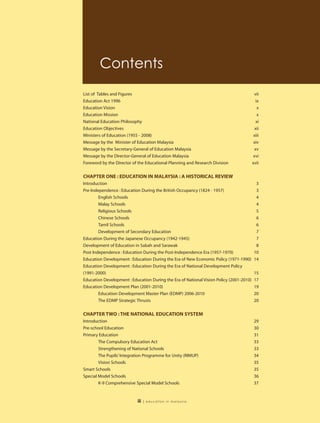
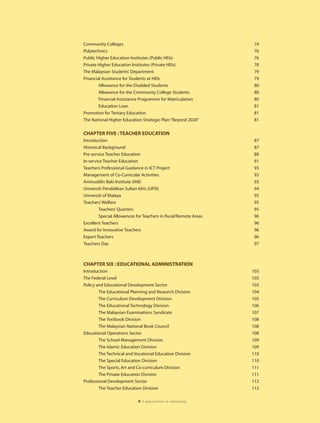
Contents
List of Tables and Figures                                                                vii
Education Act 1996                                                                          ix
Education Vision                                                                             x
Education Mission                                                                            x
National Education Philosophy                                                               xi
Education Objectives                                                                       xii
Ministers of Education (1955 - 2008)                                                      xiii
Message by the Minister of Education Malaysia                                             xiv
Message by the Secretary-General of Education Malaysia                                    xv
Message by the Director-General of Education Malaysia                                    xvi
Foreword by the Director of the Educational Planning and Research Division               xvii


CHAPTER ONE : EDUCATION IN MALAYSIA : A HISTORICAL REVIEW
Introduction                                                                               3
Pre-Independence : Education During the British Occupancy (1824 - 1957)                    3
        English Schools                                                                    4
        Malay Schools                                                                      4
        Religious Schools                                                                  5
        Chinese Schools                                                                    6
        Tamil Schools                                                                      6
        Development of Secondary Education                                                 7
Education During the Japanese Occupancy (1942-1945)                                        7
Development of Education in Sabah and Sarawak                                              8
Post Independence : Education During the Post-Independence Era (1957-1970)                10
Education Development : Education During the Era of New Economic Policy (1971-1990)       14
Education Development : Education During the Era of National Development Policy
(1991-2000)                                                                               15
Education Development : Education During the Era of National Vision Policy (2001-2010)    17
Education Development Plan (2001-2010)                                                    19
        Education Development Master Plan (EDMP) 2006-2010                                20
        The EDMP Strategic Thrusts                                                        20

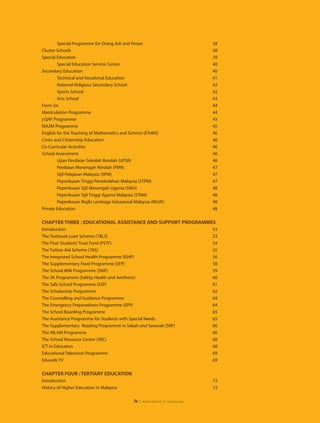
CHAPTER TWO : THE NATIONAL EDUCATION SYSTEM
Introduction                                                                              29
Pre-school Education                                                                      30
Primary Education                                                                         31
        The Compulsory Education Act                                                      33
        Strengthening of National Schools                                                 33
        The Pupils’ Integration Programme for Unity (RIMUP)                               34
        Vision Schools                                                                    35
Smart Schools                                                                             35
Special Model Schools                                                                     36
        K-9 Comprehensive Special Model Schools                                           37


                           iii   | education in malaysia
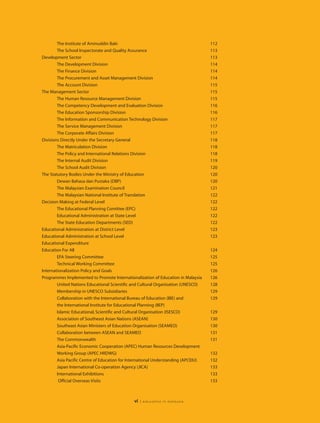
Special Programme for Orang Asli and Penan                           38
Cluster Schools                                                              38
Special Education                                                            39
        Special Education Service Centre                                     40
Secondary Education                                                          40
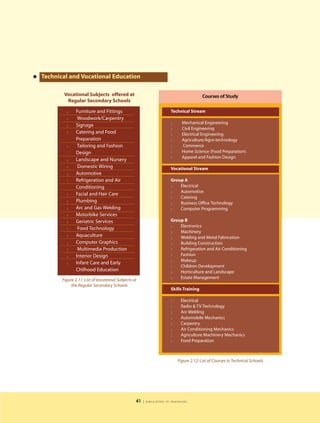
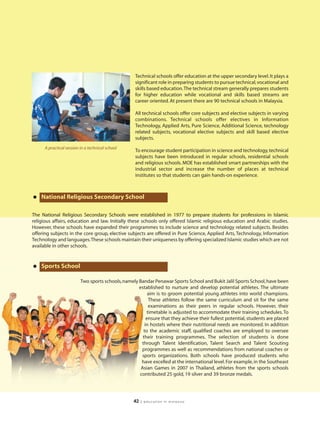
        Technical and Vocational Education                                   41
        National Religious Secondary School                                  42
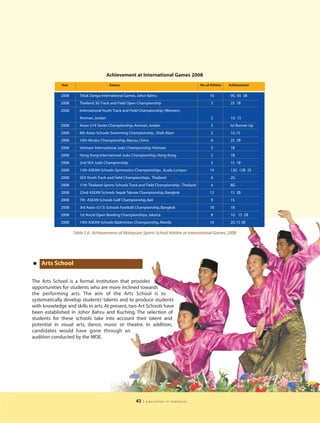
        Sports School                                                        42
        Arts School                                                          43
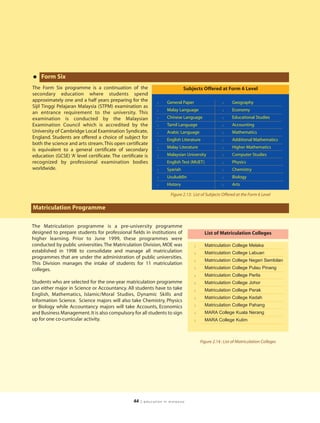
Form Six                                                                     44
Matriculation Programme                                                      44
j-QAF Programme                                                              45
KIA2M Programme                                                              45
English for the Teaching of Mathematics and Science (ETeMS)                  46
Civics and Citizenship Education                                             46
Co-Curricular Activities                                                     46
School Assessment                                                            46
        Ujian Penilaian Sekolah Rendah (UPSR)                                46
        Penilaian Menengah Rendah (PMR)                                      47
        Sijil Pelajaran Malaysia (SPM)                                       47
        Peperiksaan Tinggi Persekolahan Malaysia (STPM)                      47
        Peperiksaan Sijil Menengah Ugama (SMU)                               48
        Peperiksaan Sijil Tinggi Agama Malaysia (STAM)                       48
        Peperiksaan Majlis Lembaga Vokasional Malaysia (MLVK)                48
Private Education                                                            48

CHAPTER THREE : EDUCATIONAL ASSISTANCE AND SUPPORT PROGRAMMES
Introduction                                                                 53
The Textbook Loan Scheme (TBLS)                                              53
The Poor Students’ Trust Fund (PSTF)                                         54
The Tuition Aid Scheme (TAS)                                                 55
The Integrated School Health Programme (ISHP)                                56
The Supplementary Food Programme (SFP)                                       58
The School Milk Programme (SMP)                                              59
The 3K Programme (Safety, Health and Aesthetic)                              60
The Safe School Programme (SSP)                                              61
The Scholarship Programme                                                    62
The Counselling and Guidance Programme                                       64
The Emergency Preparedness Programme (EPP)                                   64
The School Boarding Programme                                                65
The Assistance Programme for Students with Special Needs                     65
The Supplementary Reading Programme in Sabah and Sarawak (SRP)               66
The NILAM Programme                                                          66
The School Resource Centre (SRC)                                             68
ICT in Education                                                             68
Educational Television Programme                                             69
Eduweb TV                                                                    69


CHAPTER FOUR : TERTIARY EDUCATION
Introduction                                                                 73
History of Higher Education in Malaysia                                      73

                                              iv   | education in malaysia
Community Colleges                                               74
Polytechnics                                                     76
Public Higher Education Institutes (Public HEIs)                 76
Private Higher Education Institutes (Private HEIs)               78
The Malaysian Students’ Department                               79
Financial Assistance for Students at HEIs                        79
        Allowance for the Disabled Students                      80
        Allowance for the Community College Students             80
        Financial Assistance Programme for Matriculation         80
        Education Loan                                           81
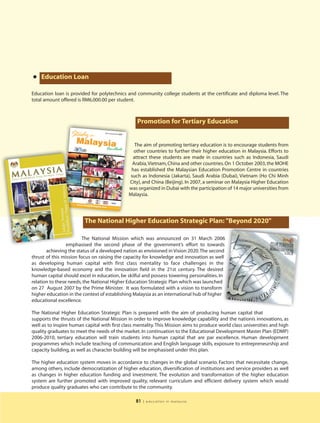
Promotion for Tertiary Education                                 81
The National Higher Education Strategic Plan:“Beyond 2020”       81

CHAPTER FIVE : TEACHER EDUCATION
Introduction                                                     87
Historical Background                                            87
Pre-service Teacher Education                                    88
In-service Teacher Education                                     91
Teachers Professional Guidance in ICT Project                    93
Management of Co-Curricular Activities                           93
Aminuddin Baki Institute (IAB)                                   93
Universiti Pendidikan Sultan Idris (UPSI)                        94
Universiti of Malaya                                             95
Teachers’ Welfare                                                95
         Teachers’ Quarters                                      95
         Special Allowences for Teachers in Rural/Remote Areas   96
Excellent Teachers                                               96
Award for Innovative Teachers                                    96
Expert Teachers                                                  96
Teachers Day                                                     97


CHAPTER SIX : EDUCATIONAL ADMINISTRATION
Introduction                                                     103
The Federal Level                                                103
Policy and Educational Development Sector                        103
        The Educational Planning and Research Division           104
        The Curriculum Development Division                      105
        The Educational Technology Division                      106
        The Malaysian Examinations Syndicate                     107
        The Textbook Division                                    108
        The Malaysian National Book Council                      108
Educational Operations Sector                                    108
        The School Management Division                           109
        The Islamic Education Division                           109
        The Technical and Vocational Education Division          110
        The Special Education Division                           110
        The Sports, Art and Co-curriculum Division               111
        The Private Education Division                           111
Professional Development Sector                                  112
        The Teacher Education Division                           112

                            v   | education in malaysia
The Institute of Aminuddin Baki                                             112
        The School Inspectorate and Quality Assurance                               113
Development Sector                                                                  113
        The Development Division                                                    114
        The Finance Division                                                        114
        The Procurement and Asset Management Division                               114
        The Account Division                                                        115
The Management Sector                                                               115
        The Human Resource Management Division                                      115
        The Competency Development and Evaluation Division                          116
        The Education Sponsorship Division                                          116
        The Information and Communication Technology Division                       117
        The Service Management Division                                             117
        The Corporate Affairs Division                                              117
Divisions Directly Under the Secretary General                                      118
        The Matriculation Division                                                  118
        The Policy and International Relations Division                             118
        The Internal Audit Division                                                 119
        The School Audit Division                                                   120
The Statutory Bodies Under the Ministry of Education                                120
        Dewan Bahasa dan Pustaka (DBP)                                              120
        The Malaysian Examination Council                                           121
        The Malaysian National Institute of Translation                             122
Decision Making at Federal Level                                                    122
        The Educational Planning Comittee (EPC)                                     122
        Educational Administration at State Level                                   122
        The State Education Departments (SED)                                       122
Educational Administration at District Level                                        123
Educational Administration at School Level                                          123
Educational Expenditure
Education For All                                                                   124
        EFA Steering Committee                                                      125
        Technical Working Committee                                                 125
Internationalization Policy and Goals                                               126
Programmes Implemented to Promote Internationalization of Education in Malaysia     126
        United Nations Educational Scientific and Cultural Organisation (UNESCO)    128
        Membership in UNESCO Subsidiaries                                           129
        Collaboration with the International Bureau of Education (IBE) and          129
        the International Institute for Educational Planning (IIEP)
        Islamic Educational, Scientific and Cultural Organisation (ISESCO)          129
        Association of Southeast Asian Nations (ASEAN)                              130
        Southeast Asian Ministers of Education Organisation (SEAMEO)                130
        Collaboration between ASEAN and SEAMEO                                      131
        The Commonwealth                                                            131
        Asia-Pacific Economic Cooperation (APEC) Human Resources Development
        Working Group (APEC HRDWG)                                                  132
        Asia Pacific Centre of Education for International Understanding (APCEIU)   132
        Japan International Co-operation Agency (JICA)                              133
        International Exhibitions                                                   133
         Official Overseas Visits                                                   133


                                              vi   | education in malaysia
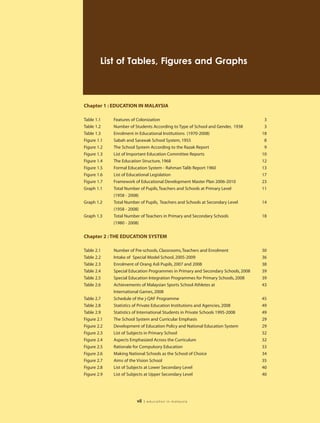
List of Tables, Figures and Graphs


Chapter 1 : EDUCATION IN MALAYSIA

Table 1.1    Features of Colonization                                               3
Table 1.2    Number of Students According to Type of School and Gender, 1938        3
Table 1.3    Enrolment in Educational Institutions (1970-2008)                     18
Figure 1.1   Sabah and Sarawak School System, 1955                                  8
Figure 1.2   The School System According to the Razak Report                        9
Figure 1.3   List of Important Education Committee Reports                         10
Figure 1.4   The Education Structure, 1968                                         12
Figure 1.5   Formal Education System - Rahman Talib Report 1960                    13
Figure 1.6   List of Educational Legislation                                       17
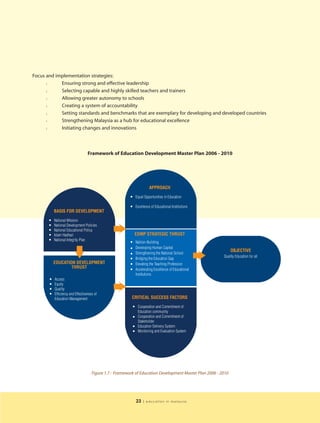
Figure 1.7   Framework of Educational Development Master Plan 2006-2010            23
Graph 1.1    Total Number of Pupils, Teachers and Schools at Primary Level         11
             (1958 - 2008)
Graph 1.2    Total Number of Pupils, Teachers and Schools at Secondary Level       14
             (1958 - 2008)
Graph 1.3    Total Number of Teachers in Primary and Secondary Schools             18
             (1980 - 2008)


Chapter 2 : THE EDUCATION SYSTEM

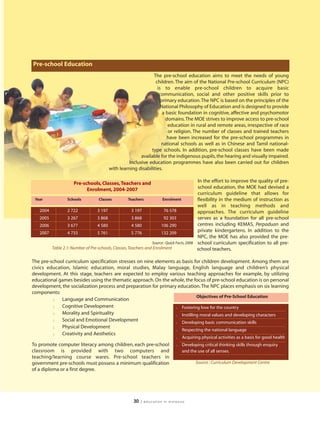
Table 2.1    Number of Pre-schools, Classrooms, Teachers and Enrolment             30
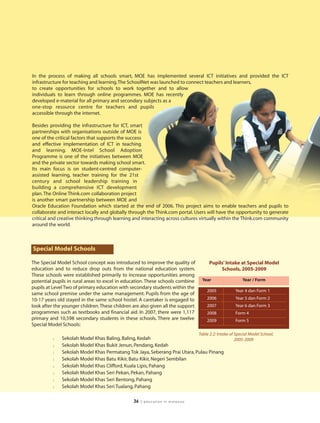
Table 2.2    Intake of Special Model School, 2005-2009                             36
Table 2.3    Enrolment of Orang Asli Pupils, 2007 and 2008                         38
Table 2.4    Special Education Programmes in Primary and Secondary Schools, 2008   39
Table 2.5    Special Education Integration Programmes for Primary Schools, 2008    39
Table 2.6    Achievements of Malaysian Sports School Athletes at                   43
             International Games, 2008
Table 2.7    Schedule of the j-QAF Programme                                       45
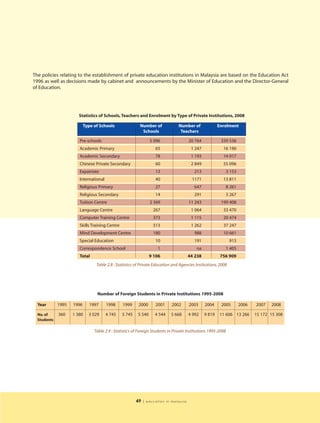
Table 2.8    Statistics of Private Education Institutions and Agencies, 2008       49
Table 2.9    Statistics of International Students in Private Schools 1995-2008     49
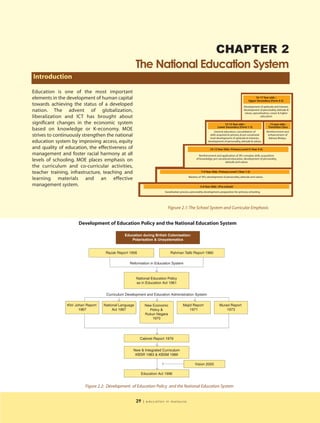
Figure 2.1   The School System and Curricular Emphasis                             29
Figure 2.2   Development of Education Policy and National Education System         29
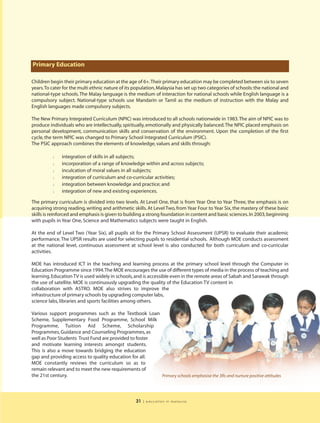
Figure 2.3   List of Subjects in Primary School                                    32
Figure 2.4   Aspects Emphasized Across the Curriculum                              32
Figure 2.5   Rationale for Compulsory Education                                    33
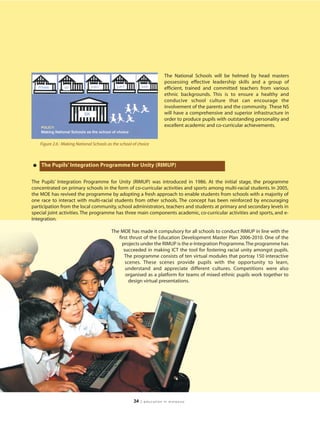
Figure 2.6   Making National Schools as the School of Choice                       34
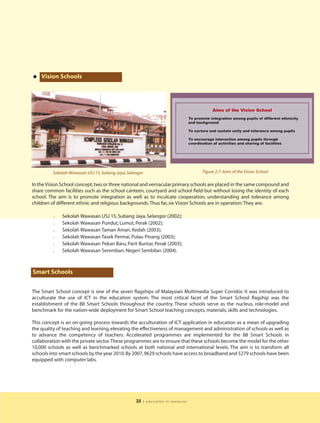
Figure 2.7   Aims of the Vision School                                             35
Figure 2.8   List of Subjects at Lower Secondary Level                             40
Figure 2.9   List of Subjects at Upper Secondary Level                             40


                        vii   | education in malaysia
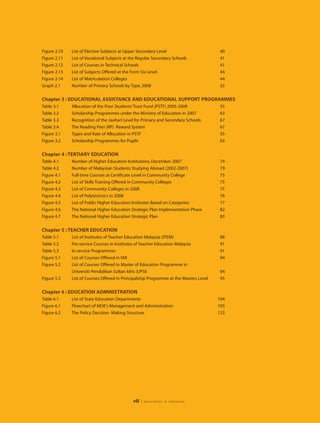
Figure 2.10   List of Elective Subjects at Upper Secondary Level                        40
Figure 2.11   List of Vocational Subjects at the Regular Secondary Schools              41
Figure 2.12   List of Courses in Technical Schools                                      41
Figure 2.13   List of Subjects Offered at the Form Six Level                            44
Figure 2.14   List of Matriculation Colleges                                            44
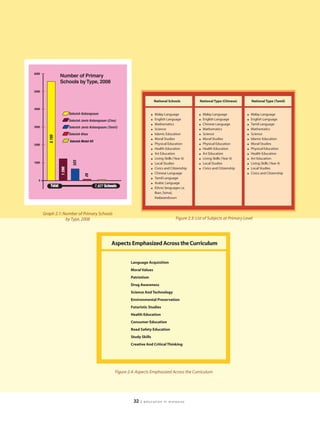
Graph 2.1     Number of Primary Schools by Type, 2008                                   32


Chapter 3 : EDUCATIONAL ASSISTANCE AND EDUCATIONAL SUPPORT PROGRAMMES
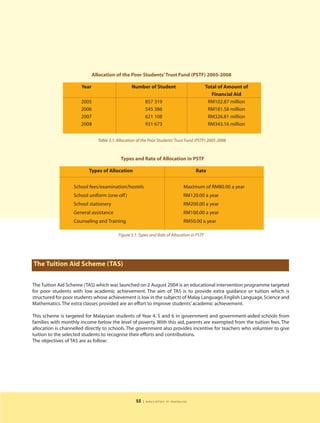
Table 3.1     Allocation of the Poor Students’ Trust Fund (PSTF) 2005-2008              55
Table 3.2     Scholarship Programmes under the Ministry of Education in 2007            63
Table 3.3     Recognition of the Jauhari Level for Primary and Secondary Schools        67
Table 3.4     The Reading Peer (RP) Reward System                                       67
Figure 3.1    Types and Rate of Allocation in PSTF                                      55
Figure 3.2    Scholarship Programmes for Pupils                                         63

Chapter 4 : TERTIARY EDUCATION
Table 4.1     Number of Higher Education Institutions, December 2007                    74
Table 4.2     Number of Malaysian Students Studying Abroad (2002-2007)                  79
Figure 4.1    Full-time Courses at Certificate Level in Community College               75
Figure 4.2    List of Skills Training Offered in Community Colleges                     75
Figure 4.3    List of Community Colleges in 2008                                        75
Figure 4.4    List of Polytechnics in 2008                                              76
Figure 4.5    List of Public Higher Education Institutes Based on Categories            77
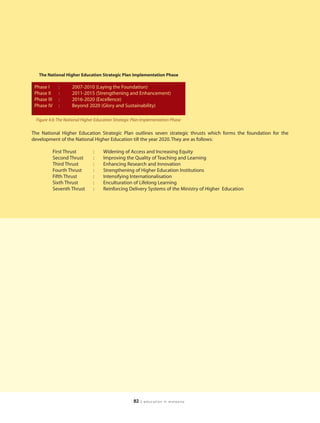
Figure 4.6    The National Higher Education Strategic Plan Implementation Phase         82
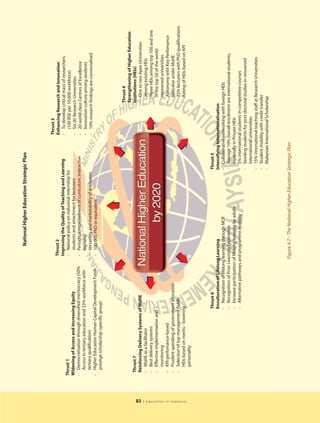
Figure 4.7    The National Higher Education Strategic Plan                              83


Chapter 5 : TEACHER EDUCATION
Table 5.1     List of Institutes of Teacher Education Malaysia (ITEM)                   88
Table 5.2     Pre-service Courses in Institutes of Teacher Education Malaysia           91
Table 5.3     In-service Programmes                                                     91
Figure 5.1    List of Courses Offered in IAB                                            94
Figure 5.2    List of Courses Offered in Master of Education Programme in
              Universiti Pendidikan Sultan Idris (UPSI)                                 94
Figure 5.3    List of Courses Offered in Principalship Programme at the Masters Level   95

Chapter 6 : EDUCATION ADMINISTRATION
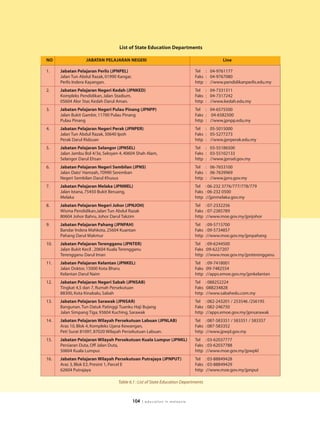
Table 6.1     List of State Education Departments                                       104
Figure 6.1    Flowchart of MOE’s Management and Administration                          103
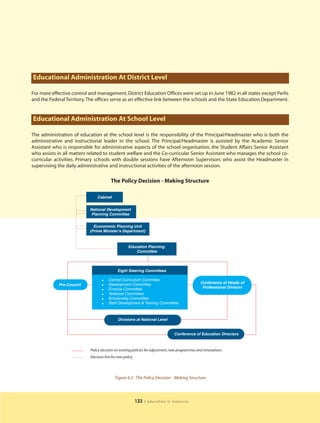
Figure 6.2    The Policy Decision- Making Structure                                     123


                                              viii   | education in malaysia
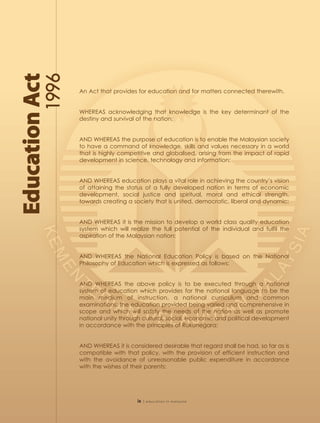
An Act that provides for education and for matters connected therewith.


WHEREAS acknowledging that knowledge is the key determinant of the
destiny and survival of the nation:


AND WHEREAS the purpose of education is to enable the Malaysian society
to have a command of knowledge, skills and values necessary in a world
that is highly competitive and globalised, arising from the impact of rapid
development in science, technology and information:


AND WHEREAS education plays a vital role in achieving the country’s vision
of attaining the status of a fully developed nation in terms of economic
development, social justice and spiritual, moral and ethical strength,
towards creating a society that is united, democratic, liberal and dynamic:


AND WHEREAS it is the mission to develop a world class quality education
system which will realize the full potential of the individual and fulfil the
aspiration of the Malaysian nation:


AND WHEREAS the National Education Policy is based on the National
Philosophy of Education which is expressed as follows:


AND WHEREAS the above policy is to be executed through a national
system of education which provides for the national language to be the
main medium of instruction, a national curriculum and common
examinations; the education provided being varied and comprehensive in
scope and which will satisfy the needs of the nation as well as promote
national unity through cultural, social, economic and political development
in accordance with the principles of Rukunegara:


AND WHEREAS it is considered desirable that regard shall be had, so far as is
compatible with that policy, with the provision of efficient instruction and
with the avoidance of unreasonable public expenditure in accordance
with the wishes of their parents:


                     ix   | education in malaysia
x   | education in malaysia
“ Education in Malaysia is an on-going effort
towards further developing the potential of
individuals in a holistic and integrated manner, so
as to produce individuals who are intellectually,
spiritually, emotionally and physically balanced
and harmonious, based on a firm belief in and
devotion to God. Such an effort is designed to
produce       Malaysian       citizens   who    are
knowledgeable and competent, who possess high
moral standards, and who are responsible and
capable of achieving a high level of personal well-
being as well as being able to contribute to the
harmony and betterment of the family, the society
and the nation at large.“


              xi   | education in malaysia
The objectives of national education are:

  l   To produce a loyal and united Malaysian nation;

  l   To produce faithful, well-mannered, knowledgeable,
       competent and prosperous individuals;

  l   To produce the nation’s human resource for
      development needs; and

  l   To provide educational opportunities for all
      Malaysians.

The National Education Policy, the Education Vision, the
Education Mission and Education Objectives are derived
from the National Education Philosophy, which constitutes
the basis for all education activities and programmes. In
other words, the National Education Philosophy is
translated into action and implementation particularly the
implementation of the National Education Policy.


                xii   | education in malaysia
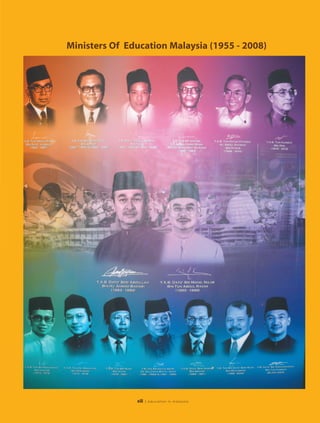
Ministers Of Education Malaysia (1955 - 2008)


               xiii   | education in malaysia
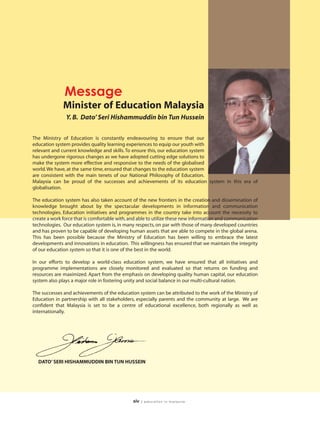
Message
              Minister of Education Malaysia
               Y. B. Dato’ Seri Hishammuddin bin Tun Hussein

The Ministry of Education is constantly endeavouring to ensure that our
education system provides quality learning experiences to equip our youth with
relevant and current knowledge and skills. To ensure this, our education system
has undergone rigorous changes as we have adopted cutting edge solutions to
make the system more effective and responsive to the needs of the globalised
world. We have, at the same time, ensured that changes to the education system
are consistent with the main tenets of our National Philosophy of Education.
Malaysia can be proud of the successes and achievements of its education system in this era of
globalisation.

The education system has also taken account of the new frontiers in the creation and dissemination of
knowledge brought about by the spectacular developments in information and communication
technologies. Education initiatives and programmes in the country take into account the necessity to
create a work force that is comfortable with, and able to utilize these new information and communication
technologies. Our education system is, in many respects, on par with those of many developed countries
and has proven to be capable of developing human assets that are able to compete in the global arena.
This has been possible because the Ministry of Education has been willing to embrace the latest
developments and innovations in education. This willingness has ensured that we maintain the integrity
of our education system so that it is one of the best in the world.

In our efforts to develop a world-class education system, we have ensured that all initiatives and
programme implementations are closely monitored and evaluated so that returns on funding and
resources are maximized. Apart from the emphasis on developing quality human capital, our education
system also plays a major role in fostering unity and social balance in our multi-cultural nation.

The successes and achievements of the education system can be attributed to the work of the Ministry of
Education in partnership with all stakeholders, especially parents and the community at large. We are
confident that Malaysia is set to be a centre of educational excellence, both regionally as well as
internationally.


  DATO’ SERI HISHAMMUDDIN BIN TUN HUSSEIN


                                              xiv   | education in malaysia
Message
             Secretary-General of Education
                   Y. Bhg. Tan Sri Dr. Zulkurnain bin Haji Awang

I offer my congratulations to the Educational Planning and Research Division,
Ministry of Education, Malaysia for having successfully published this book. I also
extend my deepest appreciation for the opportunity to pen a few words in this
book.

This new edition of Education in Malaysia is intended to provide a comprehensive overview of the national education
system. It contains a wealth of accurate and current information relating to the developments and innovations that have
been implemented as part of our continuing efforts to improve the system. I am confident that the book will be a
convenient and useful reference for information relating to the various divisions and agencies of the Ministry of
Education Malaysia for education specialists at home and abroad.

Education is vital to the development of a country. A stable and flexible education system facilitates the citizens of the
nation in their efforts to generate knowledge and wealth and to improve the quality of life for their people. Awareness of
this critical role of education has strengthened our determination to ensure that our education system is capable of
realizing national goals for nation building.

In the era of globalisation the world is borderless. The Ministry of Education Malaysia accepts this new reality and has
planned strategically and systematically to face the challenges pitted against us by this brave, new world. Our efforts to
improve our education system are geared towards ensuring that the younger generations in this country are equipped
with the knowledge, skills and competencies that will enable them to cope with the challenges posed by globalisation.

Information relating to our efforts to ensure that our education system is competitive and capable of providing quality
instruction can be found in this book. I am confident that this publication can become an important reference resource
for all those who are interested in learning more about our education system.


TAN SRI DR. ZULKURNAIN BIN HAJI AWANG


                                                  xv   | education in malaysia
Message
               Director-General of Education
                 Y. Bhg. Dato’ Hj. Alimuddin bin Hj. Mohd. Dom

The Ministry of Education is committed to developing the competitiveness of
the national education system for the international arena.This challenge requires
all officers of the ministry dedicate themselves toward the goal of creating a
quality education system that equips our youth with the attitudes, skills and
competencies they require in the 21st century.

Quality education is critical to the development of quality human capital. Quality human capital that is
knowledgeable, competent and competitive can contribute to the peace and prosperity of the nation. An
important part of our responsibility for the national education system is to ensure that the Malaysian education
system is able to respond to the demands imposed by the challenges of globalisation.We have expended much
effort on planning and preparing a variety of innovative initiatives and programmes that are designed to bring
about the wholesome development of our learners so that they can contribute significantly to national
development. We have also made great strides in ensuring equity and access to quality education for all our
people.

Change brought about by rapid technological developments is a hallmark of our times. The Ministry of
Education has attempted to harness the latest developments in education to ensure that we provide effective
and enjoyable learning experiences for our students. Our curricular changes and innovations are designed to
foreground the role of our schools as agents of social transformation, preparing our students to confront the
challenges of the 21st century while simultaneously fostering national unity, patriotism and a shared national
destiny. In response to the recent surge in new information and communication technologies, the Ministry of
Education has committed itself to the preparation and implementation of programmes that are intended to
equip our learners with the skills and competencies that will allow them to master these new technologies and
exploit their development potential for the nation.

This effort is just one part of a wider spectrum of programmes and initiatives that are detailed in the Education
Development Master Plan 2006-2010. The master plan maps out the development emphases for the national
education system. Continuous monitoring is an integral part of the plan and is designed to ensure that staged
targets are achieved on schedule. By the will of Allah SWT and the diligent work of all, we are confident that we
will achieve the objectives of the Education Development Master Plan and make our education system one of
the best in world.


DATO’ HAJI ALIMUDDIN BIN HAJI MOHD. DOM


                                                xvi   | education in malaysia
Foreword
   Director
   Educational Planning and Research
                             Division
                                   Dr. Amir bin Salleh @ Mohd Saleh


Praise be to Allah. His blessings had enable Educational Planning and Research
Division to once again successfully publish “Education in Malaysia”
                                                                  .

The current publication focuses on the latest developments and changes in Malaysian education. It deals
with all important aspects of the education structure as well as the management system in all
organisations and agencies under the Ministry of Education. The book highlights the Ministry’s
achievements in adapting and improving its education system in order to meet the challenges of
globalisation and address the rapid changes brought about by the development of information and
communication technologies. It is important to note that these developments have been attained while
taking account of the aspirations of the National Philosophy of Education.

The Educational Planning and Research Division wishes to acknowledge the cooperation of the various
agencies of the Ministry of Education in the publication of this book. We wish to thank all officers in the
Ministry of Education who have contributed their ideas and suggestions. We hope that this cooperation
will continue and be further enhanced in the future.

Finally, it is our hope that this publication will prove to be a useful reference for information pertaining to
the Malaysian education system.


DR. AMIR BIN SALLEH @ MOHD SALEH


                                                  xvii   | education in malaysia
“This country must seriously enhance the production and supply
        of information, knowledge and wisdom and assure their
                                  accessibility to all our people”

                     Y.A.B. Dato’ Seri Dr. Mahathir bin Mohamad
                               Former Prime Minister of Malaysia
CHAPTER 1
                                          Education in Malaysia : A Historical Review
Introduction
Informal education in Malaysia began since the Malacca Sultanate. For decades, the education in Malaysia went through
a series of transformation according to local needs. There was no significant change in the provision of education during
the occupancy of the Portuguese and Dutch. However, the arrival of the English in 1786 brought a new era in education
for the Malays until it was disrupted by the invasion of the Japanese in 1941. After the fall of the Japanese in 1945, the
English again played a significant role in the development of education until Malaya achieved its independence from the
British on 31st August 1957.

Since independence, education in Malaysia has undergone tremendous changes and development. From a diverse and
fragmented system of education based upon communal needs, it has evolved into an education system that strives to
build a united nation according to the Malaysian mould. Malaysia aims to produce a competitive society that is strong,
united and resilient in facing challenges and adversity.

                                                         Features of Colonization
   No.         Colonist                Period                    Features

    1           Portuguese              1511-1641                l   Based in Malacca
                                        (130 years)              l   Language and cultural influence
                                                                 l   Limited impact on education

    2           Dutch                   1641-1824                l   Based in Malacca
                                        (183 years)              l   Limited influence, focus was on Betawi (Jakarta)
                                                                 l   No impact on education

    3           English                 1824-1942                l   Significant influence on development of education
                                        1945-1957                l   Development of English, Malay, Chinese, Tamil and religious education
                                        (130 years)              l   Did not promote ethnic unity

    4           Japanese                1942-1945                l   Significant influence on relationship between ethnic groups
                                        (3 1/2 years)            l   School curriculum promoted Japanese culture and values

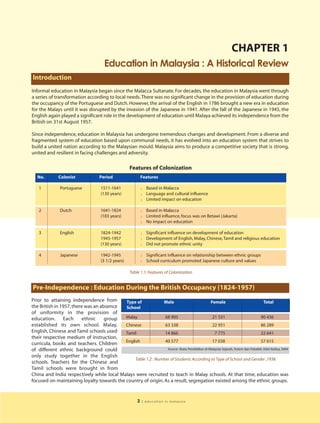
                                                         Table 1.1: Features of Colonization


Pre-Independence : Education During the British Occupancy (1824-1957)
Prior to attaining independence from       Type of             Male                           Female                                 Total
the British in 1957, there was an absence  School
of uniformity in the provision of
education. Each          ethnic     group  Malay                68 905                         21 531                             90 436
established its own school. Malay,         Chinese              63 338                         22 951                             86 289
English, Chinese and Tamil schools used    Tamil                14 866                           7 775                            22 641
their respective medium of instruction,
                                           English              40 577                         17 038                             57 615
curricula, books and teachers. Children
of different ethnic background could                             Source : Buku Pendidikan di Malaysia: Sejarah, Sistem dan Falsafah. Edisi Kedua, 2004

only study together in the English
                                                Table 1.2 : Number of Students According to Type of School and Gender ,1938
schools. Teachers for the Chinese and
Tamil schools were brought in from
China and India respectively while local Malays were recruited to teach in Malay schools. At that time, education was
focused on maintaining loyalty towards the country of origin. As a result, segregation existed among the ethnic groups.


                                                             3   | education in malaysia
•   English Schools

The establishment of English schools in Malaya was led by the British government, individuals
and Christian missionaries. The missionaries felt that it was an opportunity to spread
Christianity among the locals. The curriculum emphasized preparing students for the
Cambridge Overseas School Certificate. Students who obtained good results in the
School Certificate examination were given the opportunity to further their
education at the diploma level at Kings Edward Medical College VII (1912) in
Singapore, Raffles College (1919) or at degree level at the University of
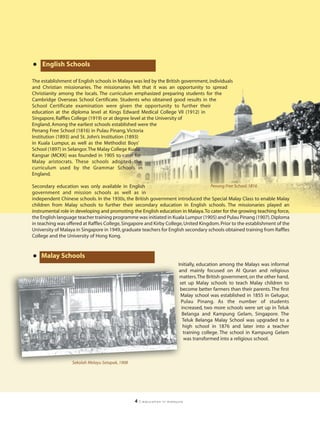
England. Among the earliest schools established were the
Penang Free School (1816) in Pulau Pinang, Victoria
Institution (1893) and St. John’s Institution (1893)
in Kuala Lumpur, as well as the Methodist Boys’
School (1897) in Selangor.The Malay College Kuala
Kangsar (MCKK) was founded in 1905 to cater for
Malay aristocrats. These schools adopted the
curriculum used by the Grammar Schools in
England.

Secondary education was only available in English                                    Penang Free School, 1816
government and mission schools as well as in
independent Chinese schools. In the 1930s, the British government introduced the Special Malay Class to enable Malay
children from Malay schools to further their secondary education in English schools. The missionaries played an
instrumental role in developing and promoting the English education in Malaya. To cater for the growing teaching force,
the English language teacher training programme was initiated in Kuala Lumpur (1905) and Pulau Pinang (1907). Diploma
in teaching was offered at Raffles College, Singapore and Kirby College, United Kingdom. Prior to the establishment of the
University of Malaya in Singapore in 1949, graduate teachers for English secondary schools obtained training from Raffles
College and the University of Hong Kong.


• Malay Schools
                                                                          Initially, education among the Malays was informal
                                                                          and mainly focused on Al Quran and religious
                                                                           matters.The British government, on the other hand,
                                                                           set up Malay schools to teach Malay children to
                                                                           become better farmers than their parents. The first
                                                                           Malay school was established in 1855 in Gelugur,
                                                                            Pulau Pinang. As the number of students
                                                                            increased, two more schools were set up in Teluk
                                                                            Belanga and Kampung Gelam, Singapore. The
                                                                             Teluk Belanga Malay School was upgraded to a
                                                                             high school in 1876 and later into a teacher
                                                                             training college. The school in Kampung Gelam
                                                                              was transformed into a religious school.


                   Sekolah Melayu Setapak, 1908


                                                  4   | education in malaysia
As the Malay community was not keen on co-ed
schools, the British government established the first
Malay Girls’ School in Teluk Belanga. The curriculum
emphasized on reading, writing, arithmetics,
geography and physical education. Later elements of
basic living skills such as farming and weaving were
introduced at the request of the Malay community.
Statistics show that there were 16 Malay schools with
569 students in 1872. In 1892, the number of Malay
schools increased to 189 with a total of 7,218 students.
The Sultan Idris Training College (1922) and the Malay
Women’s Training College (1935) were established to
train teachers.
                                                                          Maktab Perguruan Perempuan Melayu Melaka, 1935


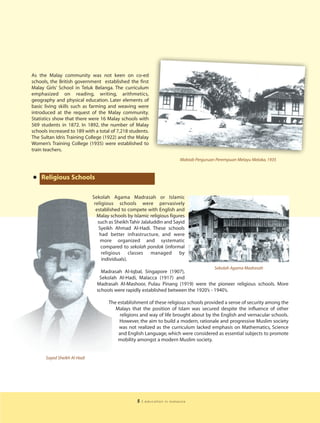
• Religious Schools
                             Sekolah Agama Madrasah or Islamic
                              religious schools were pervasively
                               established to compete with English and
                               Malay schools by Islamic religious figures
                                such as Sheikh Tahir Jalaluddin and Sayid
                                Syeikh Ahmad Al-Hadi. These schools
                                 had better infrastructure, and were
                                 more organized and systematic
                                 compared to sekolah pondok (informal
                                  religious classes managed by
                                  individuals).
                                                                                          Sekolah Agama Madrasah
                                 Madrasah Al-Iqbal, Singapore (1907),
                                Sekolah Al-Hadi, Malacca (1917) and
                               Madrasah Al-Mashoor, Pulau Pinang (1919) were the pioneer religious schools. More
                               schools were rapidly established between the 1920’s - 1940’s.

                                    The establishment of these religious schools provided a sense of security among the
                                       Malays that the position of Islam was secured despite the influence of other
                                         religions and way of life brought about by the English and vernacular schools.
                                         However, the aim to build a modern, rationale and progressive Muslim society
                                         was not realized as the curriculum lacked emphasis on Mathematics, Science
                                        and English Language, which were considered as essential subjects to promote
                                        mobility amongst a modern Muslim society.


      Sayed Sheikh Al-Hadi


                                                  5   | education in malaysia
• Chinese Schools
The Chinese were brought to Malaya from mainland China to
work at the tin mines in urban areas. Chinese schools were
established and financed by this community until the 1920’s.
The curriculum, textbooks and teachers were brought in from
China.The first Chinese school was set up in Malacca in 1816 by
a group of missionaries from London.

In the early 20th century, the Chinese schools were very much
influenced by the reformation movement in mainland China.
Kang Yu Wei, a Chinese scholar, introduced a modern and
more systematic curriculum in the Chinese schools in Malaya
and Singapore. This curriculum included subjects such as
History, Geography, Science, Mathematics, Ethics, Writing, Physical Education
and Music. Schooling was divided into six years of primary, three years of Junior Middle and three years of
Senior Middle school. The new curriculum provided an avenue for the British to interfere in the administration of Chinese
schools.

The British government introduced the School Registration Ordinance to control the administration and expansion of
Chinese schools. In 1924, some Chinese schools received financial aid from the British government, and by 1938, a total of 684
Chinese schools received this financial aid.


• Tamil Schools
The Indians were brought into Malaya to work in estates and plantations.The development and growth of Tamil schools was
thus closely linked to the opening of rubber estates, coffee, sugar-cane and coconut plantations in Penang, Malacca and
Johore.The textbooks and teachers were brought in from India while the curriculum was adapted from the Indian curriculum.
However, since the Tamil schools were initially built by the Indian workers without any aid or assistance from the British
                                                            government or their employers, these schools failed to function
                                                            effectively as they lacked proper resources. Most pupils
                                                            remained in the plantation and worked as labourers.

                                                               In 1923, the Labour Enactment introduced by the British
                                                               government enforced that it is compulsory for each estate to
                                                               open a school when there was more than 10 Indian children
                                                               aged 7-14 years. In addition, the British government provided
                                                               some financial assistance to schools that showed progress and
                                                               opened free Tamil schools for the children of public works
                                                               department and railway workers.

                                                               Since then, most Tamil schools were financed either by the
                                                               British government, the estate management, the local Indian
                    SJK(T) Kinrara, 1947                      community or the Christian missionaries. However, due to the
                                                              poor development of Tamil schools, some parents opted to send
their children to English schools as they had better facilities and resources. By 1930, there were four types of Tamil schools
namely, government schools, estate schools, Indian community private schools and the Christian missionary private schools.


                                                  6   | education in malaysia
• Development of Secondary Education
The British government provided free secondary education in English, missionary and Chinese schools while the Malay and
the Tamil schools were confined to primary education. Students who wanted to further their education had no choice but to
attend English schools. Students from Malay schools had to attend a Special Malay Class upon completion of Year 3 or Year 4
as a requirement for entry. The policy of the British government was to produce an educated Malayan civil service.
Nevertheless, the higher ranking positions were reserved for and filled by the Europeans.

Several tertiary education institutions were established during this period. The first institution of higher education, in fields
other than teaching, was not established until 1905 when the King Edward VII College of Medicine was founded in Singapore.
The second institution was the Raffles College which was also established in Singapore in 1928. These two colleges were
amalgamated to constitute the former University of Malaya in Singapore. The Public Works Department set up a technical
school in 1925. It was taken over by the Education Department in 1931 and later became a Technical College in 1946. A year
later, it was renamed the College of Agriculture, Serdang.

The upsurge of nationalism and the desire for self-government resulted in the setting up of two committees, popularly
known as the Barnes (1950) and Fenn-Wu (1951), to look into problems of and recommend improvements to Malay and
Chinese education. As an outcome of the deliberations of these two committees, the Education Ordinance of 1952 was
passed but it did not produce the desired changes in the system. As a result, a special committee was set up in 1956 to work
out a policy based upon the decision to make Malay the national language whilst preserving the languages and culture of
the other domiciled races of the Federation of Malaya. The recommendations of this committee contained in the report of
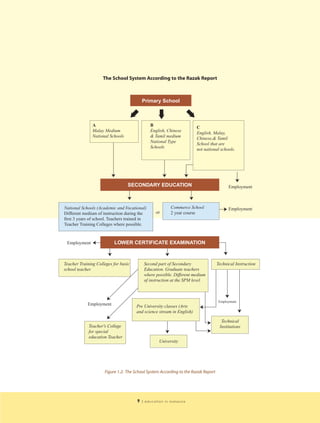
the Education Committee 1956, commonly referred to as the Razak Report, formed the basis of the Education Ordinance of
1957, which laid the foundation for the educational policy.


Education during the Japanese Occupancy (1942-1945)

Malaya was occupied by the Japanese from 1941-1945. The Japanese army continued the vernacular schools but added the
Japanese language into the curriculum. The Japanese established the Nippon-Go school which emphasized on the culture
and values of the Japanese.

Education at the secondary level was replaced with the establishment of technical schools and technical colleges which
emphasized on the learning of telecommunication, fishery, agriculture and civil engineering. School facilities were also used
as base for the Japanese army. This had hampered the education progress.

Local teachers were given training in the teaching of the Japanese language. In their effort to acculturate Japanese values
among the locals, Japanese classes were offered in associations and clubs. A special section was reserved for the Japanese
language in the local newspapers.There were no clear educational objectives during the occupation, merely as a tool to assist
the Japanese administer the country.


                                                     7   | education in malaysia
Development of Education in Sabah and Sarawak

The British government did not give due emphasis on the development of vernacular schools for the natives of Sabah and
Sarawak. Efforts to build schools in remote areas were initiated by the Christian missionaries. Before the 20th century, schools
that taught the Quran was established by Muslims from the Bajau, Sulu, Illanum, Kedayan, Brunei, Tidong and Bisaya ethnics.
Sekolah Jesselton, the first Malay school was built in 1915 by the families of various ethnic leaders. St. Joseph School Kuching
(1833) was the first school to be built in Sarawak, followed by the Chinese school (1872) in Paku and Pekan Bau. The
Woodhead Report (1955) recommended that emphasis be made on the:
      l    importance of primary education;
      l    need to improve primary and secondary education;
      l    provision for primary and secondary education, and
      l    need to establish a teaching service in North Borneo.

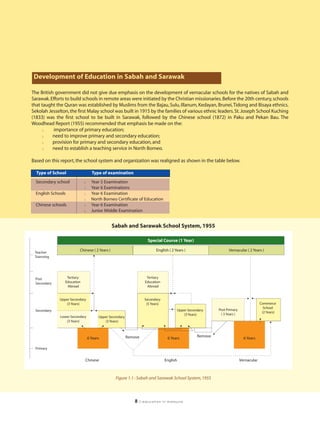
Based on this report, the school system and organization was realigned as shown in the table below.

  Type of School                   Type of examination
  Secondary school           l     Year 5 Examination
                             l     Year 6 Examinations
  English Schools            l     Year 6 Examination
                             l     North Borneo Certificate of Education
  Chinese schools            l     Year 6 Examination
                             l     Junior Middle Examination


                                               Sabah and Sarawak School System, 1955

                                                                     Special Course (1 Year)

                         Chinese ( 2 Years )                              English ( 2 Years )                    Vernacular ( 2 Years )
 Teacher
 Trainning


 Post             Tertiary                                           Tertiary
 Secondary       Education                                          Education
                  Abroad                                             Abroad


              Upper Secondary                                      Secondary
                 (3 Years)                                          (5 Years)                                                          Commerce
                                                                                                                                         School
 Secondary                                                                             Upper Secondary     Post Primary
                                                                                                                                        (2 Years)
                                                                                          (3 Years)         ( 3 Years )
              Lower Secondary          Upper Secondary
                 (3 Years)                (3 Years)


                                                         Remove                                   Remove
                                 6 Years                                         6 Years                                    6 Years

 Primary


                             Chinese                                            English                                   Vernacular


                                                Figure 1.1 : Sabah and Sarawak School System, 1955


                                                             8   | education in malaysia
The School System According to the Razak Report


                                           Primary School


               A                               B                       C
               Malay Medium                    English, Chinese        English, Malay,
               National Schools                & Tamil medium          Chinese,& Tamil
                                               National Type           School that are
                                               Schools                 not national schools.


                                  SECONDARY EDUCATION                                    Employment


National Schools (Academic and Vocational)                Commerce School                Employment
Different medium of instruction during the        or      2 year course
first 3 years of school. Teachers trained in
Teacher Training Colleges where possible.


 Employment               LOWER CERTIFICATE EXAMINATION


Teacher Training Colleges for basic         Second part of Secondary               Technical Instruction
school teacher.                             Education. Graduate teachers
                                            where possible. Different medium
                                            of instruction at the SPM level.


                                                                                    Employment
            Employment                Pre University classes (Arts
                                      and science stream in English)

                                                                                     Technical
             Teacher's College                                                      Institutions
             for special
             education Teacher
                                                    University


                     Figure 1.2: The School System According to the Razak Report


                                       9   | education in malaysia
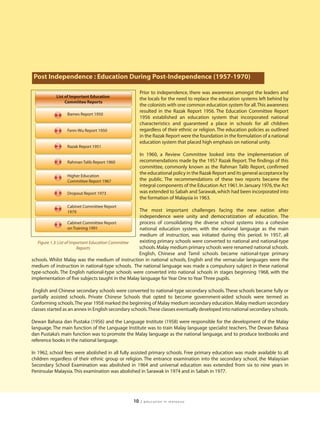
Post Independence : Education During Post-Independence (1957-1970)

                                                      Prior to independence, there was awareness amongst the leaders and
           List of Important Education
                                                      the locals for the need to replace the education systems left behind by
                Committee Reports
                                                      the colonists with one common education system for all.This awareness
                                                      resulted in the Razak Report 1956. The Education Committee Report
                 Barnes Report 1950
                                                      1956 established an education system that incorporated national
                                                      characteristics and guaranteed a place in schools for all children
                 Fenn-Wu Report 1950                  regardless of their ethnic or religion. The education policies as outlined
                                                      in the Razak Report were the foundation in the formulation of a national
                                                      education system that placed high emphasis on national unity.
                 Razak Report 1951
                                                      In 1960, a Review Committee looked into the implementation of
                 Rahman Talib Report 1960             recommendations made by the 1957 Razak Report. The findings of this
                                                      committee, commonly known as the Rahman Talib Report, confirmed
                 Higher Education
                                                      the educational policy in the Razak Report and its general acceptance by
                 Committee Report 1967                the public. The recommendations of these two reports became the
                                                      integral components of the Education Act 1961. In January 1976, the Act
                 Dropout Report 1973                  was extended to Sabah and Sarawak, which had been incorporated into
                                                      the formation of Malaysia in 1963.
                 Cabinet Committee Report
                 1979                                The most important challenges facing the new nation after
                                                     independence were unity and democratization of education. The
                     Cabinet Committee Report        process of consolidating the diverse school systems into a cohesive
                     on Training 1991                national education system, with the national language as the main
                                                     medium of instruction, was initiated during this period. In 1957, all
   Figure 1.3: List of Important Education Committee existing primary schools were converted to national and national-type
                          Reports                    schools. Malay medium primary schools were renamed national schools.
                                                     English, Chinese and Tamil schools became national-type primary
schools. Whilst Malay was the medium of instruction in national schools, English and the vernacular languages were the
medium of instruction in national-type schools. The national language was made a compulsory subject in these national
type-schools. The English national-type schools were converted into national schools in stages beginning 1968, with the
implementation of five subjects taught in the Malay language for Year One to Year Three pupils.

 English and Chinese secondary schools were converted to national-type secondary schools. These schools became fully or
partially assisted schools. Private Chinese Schools that opted to become government-aided schools were termed as
Conforming schools.The year 1958 marked the beginning of Malay medium secondary education. Malay medium secondary
classes started as an annex in English secondary schools.These classes eventually developed into national secondary schools.

Dewan Bahasa dan Pustaka (1956) and the Language Institute (1958) were responsible for the development of the Malay
language. The main function of the Language Institute was to train Malay language specialist teachers. The Dewan Bahasa
dan Pustaka’s main function was to promote the Malay language as the national language, and to produce textbooks and
reference books in the national language.

In 1962, school fees were abolished in all fully assisted primary schools. Free primary education was made available to all
children regardless of their ethnic group or religion. The entrance examination into the secondary school, the Malaysian
Secondary School Examination was abolished in 1964 and universal education was extended from six to nine years in
Peninsular Malaysia. This examination was abolished in Sarawak in 1974 and in Sabah in 1977.


                                                 10   | education in malaysia
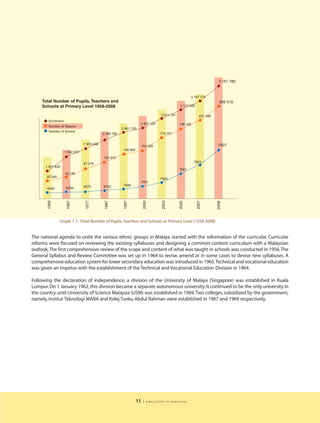
Graph 1.1: Total Number of Pupils, Teachers and Schools at Primary Level (1958-2008)


The national agenda to unite the various ethnic groups in Malaya started with the reformation of the curricular. Curricular
reforms were focused on reviewing the existing syllabuses and designing a common content curriculum with a Malaysian
outlook.The first comprehensive review of the scope and content of what was taught in schools was conducted in 1956.The
General Syllabus and Review Committee was set up in 1964 to revise, amend or in some cases to devise new syllabuses. A
comprehensive education system for lower secondary education was introduced in 1965.Technical and vocational education
was given an impetus with the establishment of the Technical and Vocational Education Division in 1964.

Following the declaration of independence, a division of the University of Malaya (Singapore) was established in Kuala
Lumpur. On 1 January 1962, this division became a separate autonomous university. It continued to be the only university in
the country until University of Science Malaysia (USM) was established in 1969.Two colleges, subsidized by the government,
namely, Institut Teknologi MARA and Kolej Tunku Abdul Rahman were established in 1967 and 1969 respectively.


                                                      11   | education in malaysia
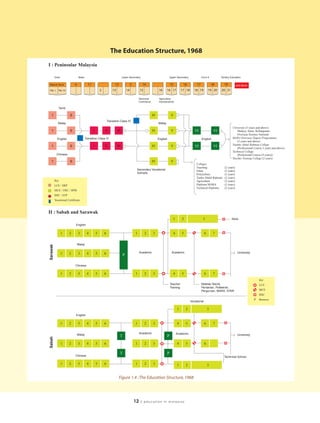
The Education Structure, 1968
I : Peninsular Malaysia

          Gred                 Basic                                         Lower Secondary                               Upper Secondary              Form 6           Tertiary Education


Masuk Terus                6             11                         12                3          14                        15          16          17              18       19          and above

Per. I       Per. IV                                  2           13             14            15              16      16 17          17 18      18 19         19 20     20 21

                                                                                              Technical         Agriculture
                                                                                              Commerce          Homescience

             Tamil

   1                   6                                                                                  IV                V
                                                              Transition Class IV
             Malay                                                                                             Malay
                                                                                                                                                                                   University (3 years and above)
   1                   6                      I           II           III                                IV                V                    VI                 VI                 Malaya, Sains, Kebangsaan,
                                                                                                                                                                                       Overseas Science National
            English                    Transition Class IV                                                     English                                  English                    MARA Overseas Degree Programmes
                                                                                                                                                                                       (3 years and above)
   1                   6                      I           II           III                                IV                V                    VI                 VI             Tuanku Abdul Rahman College
                                                                                                                                                                                       (Professional Course 3 years and above)
                                                                                                                                                                                   Technical College
           Chinese                                                                                                                                                                     (Profesional Course (4 years))
                                                                                                                                                                                   Teacher Traning College (2 years)
   1                   6                                                                                  IV                V
                                                                                                                                                  Colleges
                                                                                                                                                  Teaching                  (2 years)
                                                                                           Secondary Vocational                                   Islam                     (2 years)
                                                                                           Schools                                                Polytechnic               (2 years)
                                                                                                                                                  Tunku Abdul Rahman        (2 years)
          Key                                                                                                                                     Agriculture               (2 years)
          LCE / SRP                                                                                                                               Diploma MARA              (2 years)
                                                                                                                                                  Technical Diploma         (2 years)
          MCE / OSC / SPM
          HSC / STP
          Vocational Certificate


II : Sabah and Sarawak
                                                                                                                             1        2                  3                        Work

                            English

                 1     2       3        4         5       6                               1         2     3                  4        5                    6        7


                               Malay
Sarawak


                 1     2       3        4         5       6                                    Academic                     Academic                                                     University
                                                                             P

                            Chinese

                 1     2       3        4         5       6                               1         2     3                  4        5                    6        7
                                                                                                                                                                                                        Key
                                                                                                                           Teacher                      Maktab Teknik,                                  LCE
                                                                                                                           Training                     Pertanian, Politeknik,
                                                                                                                                                        Perguruan, MARA, STAR                           MCE
                                                                                                                                                                                                        HSC
                                                                                                                                                                                                        Remove
                                                                                                                                              Vocational

                                                                                                                                 1        2                    3
                            English

                 1     2       3        4         5       6                               1         2     3                      4        5                6        7


                               Malay                                                           Academic                          Academic
                                                                         T                                             P                                                                 University
Sabah


                 1     2       3        4         5       6                               1         2     3                      4        5                6

                                                                         T                                             P
                            Chinese                                                                                                                                         Technical School

                 1     2       3        4         5       6                               1         2     3                      1        2                    3


                                                                         Figure 1.4 : The Education Structure, 1968


                                                                                          12   | education in malaysia
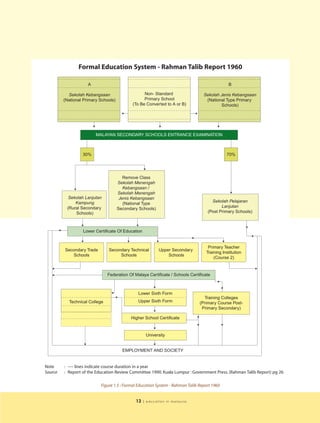
Formal Education System - Rahman Talib Report 1960

                     A                                                                        B

           Sekolah Kebangsaan                      Non- Standard                 Sekolah Jenis Kebangsaan
         (National Primary Schools)                Primary School                 (National Type Primary
                                             (To Be Converted to A or B)                 Schools)


                         MALAYAN SECONDARY SCHOOLS ENTRANCE EXAMINATION


                  30%                                                                        70%


                                         Remove Class
                                      Sekolah Menengah
                                         Kebangsaan /
                                      Sekolah Menengah
           Sekolah Lanjutan            Jenis Kebangsaan
              Kampung                                                                Sekolah Pelajaran
                                         (National Type
          (Rural Secondary                                                                Lanjutan
                                      Secondary Schools)
              Schools)                                                             (Post Primary Schools)


                  Lower Certificate Of Education


                                                                                   Primary Teacher
         Secondary Trade       Secondary Technical         Upper Secondary
                                                                                  Training Institution
            Schools                 Schools                    Schools
                                                                                      (Course 2)


                               Federation Of Malaya Certificate / Schools Certificate


                                               Lower Sixth Form
                                                                                 Training Colleges
           Technical College                   Upper Sixth Form                (Primary Course Post-
                                                                                Primary Secondary)

                                            Higher School Certificate


                                                    University


                                        EMPLOYMENT AND SOCIETY


Note     : ---- lines indicate course duration in a year
Source   : Report of the Education Review Committee 1990. Kuala Lumpur : Government Press. (Rahman Talib Report) pg 26

                           Figure 1.5 : Formal Education System - Rahman Talib Report 1960


                                              13   | education in malaysia
Educational Development During the Era of New Economic Policy ( 1971-1990 )

                                                                                                           Social and economic issues shaped the
                                                                                                           development of education from 1971 to
                                                                                                           1990.Racial harmony and efforts to curb
                                                                                                           economic imbalances in the society
                                                                                                           were crucial to sustain development,
                                                                                                           stability and progress. This was the
                                                                                                           period of the New Economic Policy
                                                                                                           (NEP) that is a socio-economic policy to
                                                                                                           achieve       national    unity     and
                                                                                                           development. The focus was on
                                                                                                           eradicating poverty and restructuring
                                                                                                           the Malaysian society to eliminate the
                                                                                                           identification of race with economic
                                                                                                           function and geographical location.
                                                                                                           Improving the income of the poor
                                                                                                           especially in rural areas, bridging
                                                                                                           disparities between races and location,
                                                                                                           increasing production and creating
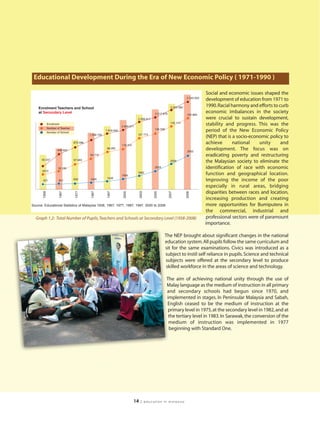
Source: Educational Statistics of Malaysia 1938, 1967, 1977, 1987, 1997, 2000 to 2008                      more opportunities for Bumiputera in
                                                                                                           the commercial, industrial and
  Graph 1.2: Total Number of Pupils, Teachers and Schools at Secondary Level (1958-2008)                   professional sectors were of paramount
                                                                                                           importance.

                                                                                    The NEP brought about significant changes in the national
                                                                                    education system. All pupils follow the same curriculum and
                                                                                    sit for the same examinations. Civics was introduced as a
                                                                                    subject to instil self reliance in pupils. Science and technical
                                                                                    subjects were offered at the secondary level to produce
                                                                                     skilled workforce in the areas of science and technology.

                                                                                        The aim of achieving national unity through the use of
                                                                                        Malay language as the medium of instruction in all primary
                                                                                        and secondary schools had begun since 1970, and
                                                                                        implemented in stages. In Peninsular Malaysia and Sabah,
                                                                                        English ceased to be the medium of instruction at the
                                                                                         primary level in 1975, at the secondary level in 1982, and at
                                                                                         the tertiary level in 1983. In Sarawak, the conversion of the
                                                                                         medium of instruction was implemented in 1977
                                                                                         beginning with Standard One.


                                                                14   | education in malaysia
Today Malay language is the medium of instruction in all national schools and a compulsory subject in Chinese and Tamil
schools. English is taught as a second language in all schools. In 1980, the Sijil Pelajaran Malaysia (SPM) examination was
conducted in Malay language. In 1970, English ceased to be the medium of instruction for teacher training at the primary
level.

The provision of education, which was more focused in urban centres, was extended to the rural areas. More schools were
built in the rural areas hence providing greater access for rural children, especially the economically disadvantaged. In
addition, the government introduced support programmes such as the fully residential schools, science schools, rural school
hostels, the textbook loan scheme and educational television programmes. The government also expanded the provision of
scholarships, the school meal programme and the health programmes.

In 1974, a Cabinet Committee was formed to study the implementation of the national education system. The focus of this
committee was to ensure that the education system was able to produce citizens who are united, progressive, disciplined and
talented in diverse fields as required to achieve the national mission. As a result of the Cabinet Committee Report, the New
Integrated Primary School Curriculum was formulated in 1983 and the New Integrated Secondary School Curriculum was
formulated in 1989. The National Education Philosophy was also formulated in 1988 to guide and strengthen the nation’s
education system. Higher education was also expanded during this period with the establishment of three universities
namely National University of Malaysia (1970), University of Agriculture Malaysia (1971) and University of Technology
Malaysia (1972).


Educational Development During the Era of National Development Policy ( 1991-2000 )


Drastic changes in education took place in the last decade of the 20th century. The vast development of ICT hasten the
globalization era. In concurrence with the demands of globalization and the information and technology era,Vision 2020 was
launched by Dato’ Seri Dr. Mahathir Mohamad in 1991 to aspire Malaysians towards achieving the status of a developed
nation by the year 2020. In line with the vision 2020, MOE outlined an education system to realise the vision. Education
legislation was amended in order to be relevant to current needs. The 1961 Education Act was replaced with the 1996
Education Act. One of the major amendments made was to include preschool into the National Education System. The
enactment of the 1996 Private Higher Education Act was also amended to allow the establishments of more private higher
education institutes. The MOE formulated four new acts to encourage a more systematic development of higher education.
The acts are:

     i.   1996 National Higher Education Council Act - to allow the establishment of a council that will determine the policy
          and manage development of higher education.

     ii. 1996 National Accreditation Board Act - quality assurance, especially for the private higher education programmes.

     iii. 1996 University and College University Act (Amendment) - grants more financial and management autonomy to
          public universities.

     iv. 1996 National Higher Education Fund Cooperation Act - provides student loans and funds in order to increase access
         to higher education.


                                                   15   | education in malaysia
One of the major moves at this time was to increase access to higher education by setting up more public universities, college
universities, matriculation colleges, community colleges, private colleges and universities as well as branch campus of
overseas universities. University of Malaysia Sarawak (UNIMAS) was established in 1992, followed by University of Malaysia
Sabah (UMS) in 1997. Maktab Perguruan Sultan Idris was upgraded to Universiti Pendidikan Sultan Idris (UPSI) in 1997. The
Malaysian Teaching Diploma Programme was also introduced to replace the Teaching Certificate Programme for pre-service
teachers at Teachers Colleges.

Measures were also taken to improve leadership qualities amongst school heads. Institut Aminuddin Baki (IAB) was entrusted
with the task to provide leadership and management training to school heads and administrators. Another significant
change was the introduction of the open concept for SPM and STPM examinations in 2000.


                                                           Maktab Perguruan Sultan Idris (MPSI), established in 1922, upgraded to
                                                           Universiti Perguruan Sultan Idris (UPSI) in 1997.


                                                  16   | education in malaysia
Education Development During the Era of National Vision Policy (2001 - 2010)


                                                       Globalization, liberalization and the vast development of ICT has
          Education Legislation                        influenced the development of the national education system. The
                                                       challenge for the nation is to produce human capitals that are
   1    Education Ordinance, 1952                      knowledgeable, competent and globally competitive.

                                                       The National Educational Policy was formulated based on the
   2    Education Ordinance, 1957                      Education Ordinance of 1957 which was later amended through the
                                                       Razak Report (1956), the Rahman Talib Report (1960) and the Cabinet
                                                       Committee Report (1979). To promote unity amongst the Malaysians,
   3    Education Act, 1961
                                                       the education system was extended to 11 years of schooling with
                                                       Malay language as the medium of instruction, a uniformed national
   4    National Language Act 1963 / 67                curriculum and a standardised national assessment. Steps were taken
        (Revised - 1971)                               to amend the Education Act in order to strengthen the national
                                                       education system as shown in Figure 1.6.
   5    Universities and Colleges
        Act 1971
                                                       Steps were taken to provide quality infrastructure as well as to
                                                       increase the number of education facilities in all education
   6    Ungku Omar Polytechnic Act 1974                institutions, as an effort to accommodate the increase of enrolment. In
                                                       2008, there are 7,627 primary schools, 2,062 secondary schools, 24
   7    Malaysia's Examination Council Act 1980        polytechnics, 27 teachers’ education institutes and 21 public
                                                       universities across the nation.

   8    Education Act, 1996                            Developing competency and efficiency amongst leaders, teachers
                                                       and education officers was also an important agenda during this
        Private Higher Education                       period of time. Empowerment and learning organization concepts
   9
        Institution Act 1996                           were widely instilled and encouraged. Allocations were made to
                                                       promote continuous human resource development. Programmes
        Universities and Colleges Act                  such as in service training on developing management, leadership
   10
        (Amendment) 1996
                                                       and research skills were carried out at all levels of the ministry as an
                                                       effort to implement a competent and efficient education
   11 National Acreditation Board Act 1996             management system capable of providing quality and relevant
                                                       education to the nation.
        National Higher Education
   12
        Fund Board 1997

        National Council on Higher Education
   13
        Act 1996

        MARA Institution of Technology Act
   14
        (Amendment) 2000

        National Higer Educational
   15
        Finance Board (Amendment) 2000

        Educational Act (Amendment) 2002 -
   16
        Section 29A

        Education Regulations
   17
        (Compulsory Education) 2002.

    Figure 1.6: List of Educational Legislation
                                                  17   | education in malaysia
Enrolment in Educational Institutions, (1970-2008)

Tahun      Primary                Secondary                 Teacher           Polytechnics       College
           School                 School                    Training                             and
                                                            Colleges                             University

1970        1 421 489              478 610                     2 927              455                 17 423
1980        2 008 973            1 083 818                    13 247             3 024                41 447
1990        2 447 206            1 376 337                    23 006             9 404                92 053
2000        2 907 123            1 998 744                    23 740            43 248              229 131
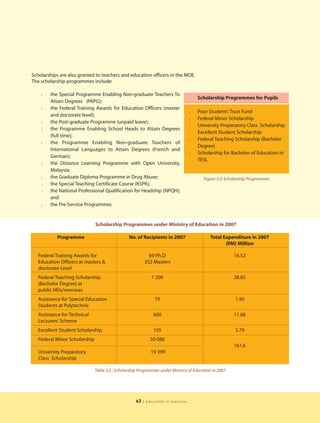
2003        3 071 121            2 098 817                    24 587            49 135              317 714
2005        3 137 280            2 217 879                    28 755            64 303              348 229
2007        3 167 775            2 253 383                    30 937            83 848              371 186
2008        3 151 780            2 243 693                    33 744            84 250              408 750
Source :Educational Statistics of Malaysia 1970-2008, Educational Statistics of Malaysia 1977, 1987, 1997, 2000 and
2007
                            Table 1.3: Enrolment in Educational Institutions (1970 - 2008)


                                Source: Educational Statistics of Malaysia.

               Graph 1.3: Total Number of Teachers in Primary and Secondary Schools
                                           (1980 - 2008)


                                             18   | education in malaysia
Education Development Plan 2001 - 2010

                                                          The Education Blueprint

                                                          The Education Development Plan for Malaysia (2001 -2010) also
                                                          referred to as the Blueprint takes into account the goals and
                                                          aspirations of the National Vision Policy to build a resilient nation,
                                                          encourage the creation of a just society, maintain sustainable
                                                          economic growth, develop global competitiveness, build a
                                                          knowledge-based economy (K-economy), strengthen human
                                                           resource development and maintain sustainable environmental
                                                           development. The Blueprint aims to ensure that all citizens have
                                                           the opportunity to twelve years of education in terms of access,
                                                           equity and quality. Thus the MOE aims to gradually restructure
                                                           the national education system from 11 years of schooling to 12
                                                            years similar to that of many developed nations.

                                                           The Blueprint also outlines goals and strategies to further
                                                           develop the potentials of individuals in a holistic and integrated
                                                           manner so as to produce individual who are intellectually,
                                                           spiritually, emotionally and physically balanced in line with the
                                                           NEP. The plan is inclusive of strategies to nurture creativity and
                                                           innovativeness amongst students; enhance learning cultures;
                                                           develop a science and technology culture; encourage life long
                                                            learning; and to provide an efficient, effective and quality
                                                            education system.

The Blueprint focuses on the development of pre-school, primary, secondary and tertiary education which will be
strengthened through the development of support programmes, funding, management and integration of information
and communication technology (ICT). The Blueprint is used as a framework for preparing action plans for education
development, which encompass the expansion and strengthening of existing programmes as well as the replacements
of non-relevant programmes with new programmes that are more realistic to current and future needs. The Education
Development Plan was developed based on four thrusts:
      l      to increase access to education;
      l      to increase equity to education;
      l      to increase quality of education; and
      l      to increase the competency and efficiency level of the educational management.

To implement the programmes in the Blueprint, the Federal Government continuously increased funds allocation for
MOE. In 1997, a total of RM12 billion that is 20 percent of the federal expenditure was allocated to the MOE, and over the
next 11 years, MOE’s expenditure has increased to RM22.14 billion. Although the budget for MOE has been increasing, it
is still not sufficient to sustain the actual amount needed to fully develop the National Education System to that of a
developed nation. The MOE constantly encourages the involvement of NGOs, the private sectors and individuals
providing financial support, apart from offering competitive fees to international students studying in Malaysian schools
or education institutes. The private sectors involvement in tertiary education is very encouraging. Smart partnership,
incentives, twinning programmes and cost sharing in training and R&D has helped the government towards achieving
the educational goals.

Education managers were given adequate training in financial management to build up their competency and efficiency
in managing funds. They were empowered to manage education finance to facilitate the implementation of education
programmes. Emphasize were also placed on supervision and monitoring of expenditure of all educational programmes.


                                                 19   | education in malaysia
Education Development Master Plan (EDMP) 2006-2010

                                   The Education Development Master Plan (EDMP) was launched on 16 January 2007
                                   to promote the education agenda under the 9th Malaysian Plan (9MP). THE EDMP
                                   outlines six thrusts that mirror the objectives of the National Mission. The MOE has
                                    developed the EDMP 2006-2010 as a comprehensive education planning document
                                    based on three main aspects i.e. infrastructure, content and human resource.

                                    The aim of the EDMP is to provide quality education for all. To ensure this goal is
                                    achieved, two main approaches have been identified under the Ninth Malaysia Plan:

                     l       Complete tasks specified under the previous five-year plan, ensure access to education for
             all and to provide equal opportunities for all students.

      l      Further develop the potential of schools in their respective clusters of educational institutions, enabling
             teachers and students to promote the schools and the national education system at the international level.


The EDMP Strategic Thrusts

Six strategic thrusts have been identified to strengthen the national education system:

First Thrust : Nation Building

The MOE aspires to produce citizens who passes local, global and patriotic outlook, who value and treasure the cultural
heritage and arts from the formative school years. The desire to build a nation can be achieved by strengthening the
Malay language, improving students’ discipline, fully implementing the
Student Integration Plan for Unity (RIMUP) including co-curricular and
sports activities to develop the identity and by cultivating positive traits
and courtesy among students.
Focus and implementation strategies:
      l        Strengthening the national language as the basis for unity
               and knowledge
      l        Strengthening unity and national integration
      l        Cultivating love for arts, heritage and national culture
      l        Promoting a clear understanding of Islam Hadhari


                                               20   | education in malaysia
Second Thrust: Developing Human Capital

The MOE focuses on the development of positive value systems,
discipline and character building of students. This thrust aspires to
produce students competent in science and technology, innovative,
creative and marketable. The MOE will provide a holistic assessment
and evaluation system, mould students’ discipline and emphasise
on cleanliness, health and safety. Focus and implementation
strategies:

  l       Providing more educational choices for parents and
          students
  l       Enhancing capacity and mastery of knowledge
  l       Developing skills and students’ personality
  l       Strengthening evaluation and assessment system to
          become more holistic
  l       Enhancing co-curriculum and sports programmes
  l       Strengthening students’ discipline
  l       Enhancing disciplinary complaint system service
  l       Strengthening curriculum
  l       Enhancing MOE’s smart partnership with various agencies


Third Thrust: Strengthening the National School

The MOE aims to strengthen the national schools (primary and secondary) as the ‘school of choice’. In this regard, national
schools will be well equipped with sufficient and quality education facilities including clean water, electricity supply and
                     ICT infrastructure. These schools will have sufficient trained teachers according to options as well as
                              adequate numbers of supporting staff. Focus and implementation strategies:
                                         l Expanding Pre-School Programme

                                                                  l Strengthening the leadership of the principal/head

                                                                    and quality of teachers
                                                                     l Reinforcing the school culture

                                                                      l Reinforcing the curriculum

                                                                       l Reinforcing co-curricular and sports activities

                                                                         l Improving the support system

                                                                          l  Improving academic performance of the
                                                                            National Schools
                                                                            l Improving the infrastructure and performance

                                                                of the National Schools


                                                  21   | education in malaysia
Fourth Thrust: Bridging the Education Gap

The MOE aims to bridge the education gap in terms of the provision of physical and
non-physical amenities, students’ achievements and drop-out rate. Hence, the MOE
will continue to develop infrastructure and educational facilities especially in the
rural areas of Sabah and Sarawak. These schools will be provided with the required
infrastructure as stipulated under the Ninth Malaysia Plan.The MOE will also increase
aid for poor students, students with special needs and minority group, bridge the
digital gap and emplace trained teachers according to subject specialisations in
rural and remote areas. Focus and implementation strategies:
  l       Developing infrastructure and educational facilities in rural and remote
          areas
  l       Increasing the participation rate and reducing the risks of drop-out
  l       Increasing the number of trained teachers according to options in remote areas
  l       Improving the distribution systems of the support programme for poor students,
          students with special needs and students from minority groups


                                                        Fifth Thrust: Elevating the Teaching Profession

                                                       Efforts to elevate the teaching profession are aimed at making it
                                                       a respected profession in line with the responsibility of
                                                       moulding future generations. The MOE has upgraded teacher
                                                       training colleges to teacher education institutes to raise the
                                                       qualification of teachers to degree level. The MOE will also
                                                       improve the systems for teacher selection, services, placements
                                                       and welfare. Focus and implementation strategies:
                                                      l Implementing a stringent selection system for teacher

                                                     candidates
                                                    l Strengthening teacher training

                                                   l Strengthening the teaching career

                                                  l Improving the working environment and wellbeing of teachers

      l   Strengthening human resource planning and management
Sixth Thrust: Accelerating Excellence of Educational
Institutions

The effort to accelerate excellence in educational institutions is
planned through the establishment of cluster schools based on their
niche in academic, co-curricular and sports activities. Selected
schools in these clusters will be benchmarked and showcased at
the international level in line with efforts to develop a
quality and world-class education system.

Three hundred outstanding educational institutions
within their respective clusters have been identified
and selected based on main and supporting elements.


                                                22   | education in malaysia
Focus and implementation strategies:
      l     Ensuring strong and effective leadership
      l     Selecting capable and highly skilled teachers and trainers
      l     Allowing greater autonomy to schools
      l     Creating a system of accountability
      l     Setting standards and benchmarks that are exemplary for developing and developed countries
      l     Strengthening Malaysia as a hub for educational excellence
      l     Initiating changes and innovations


                                 Framework of Education Development Master Plan 2006 - 2010


                                                                    APPROACH
                                                          Equal Opportunities in Education

                                                          Excellence of Educational Institutions
         BASIS FOR DEVELOPMENT
         National Mission
         National Development Policies
         National Educational Policy
         Islam Hadhari                                    EDMP STRATEGIC THRUST
         National Integrity Plan
                                                          Natiion-Building
                                                          Developing Human Capital
                                                                                                              OBJECTIVE
                                                          Strengthening the National School
                                                                                                        Quality Education for all
                                                          Bridging the Education Gap
         EDUCATION DEVELOPMENT                            Elevating the Teaching Profession
                 THRUST                                   Accelerating Excellence of Educational
                                                          Institutions
         Access
         Equity
         Quality
         Efficiency and Effectiveness of
         Education Management                           CRITICAL SUCCESS FACTORS
                                                           Cooperation and Commitment of
                                                           Education community
                                                           Cooperation and Commitment of
                                                           Stakeholder
                                                           Education Delivery System
                                                           Monitoring and Evaluation System


                                    Figure 1.7 : Framework of Education Development Master Plan 2006 - 2010


                                                           23   | education in malaysia
“A nation may grow and prosper as a result of economic miracles and new
 technologies achievements, but this prosperity is hollow and meaningless
       if it is not supported by a solid value-based foundation. Therefore, in
  education, it is imperative that we nurture and strengthen our value base
    while we seek economic advancement and technological supremacy.”


                                             Dato’ Aishah bt. Abu Samah
                                    Director-General of Education Malaysia
                                                               (1991-1993)
27   | education in malaysia
CHAPTER 2
                                                  The National Education System
Introduction

Education is one of the most important
elements in the development of human capital                                                                                                  16-17 Year olds :
                                                                                                                                         Upper Secondary (Form 4-5)
towards achieving the status of a developed                                                                                          Development of aptitude and interest,
nation. The advent of globalization,                                                                                                 development of personality, attitude &
                                                                                                                                      values, specialisation, career & higher
liberalization and ICT has brought about                                                                                                            education

significant changes in the economic system                                                                          13-15 Year olds :                      13 year olds :
                                                                                                               Lower Secondary (Form 1-3)                 Transition Class
based on knowledge or K-economy. MOE                                                                       General education, consolidation of           Reinforcement and
strives to continuously strengthen the national                                                        skills acquired at primary & pre-vocational
                                                                                                        level development of aptitude & interests,
                                                                                                                                                          enhancement of
                                                                                                                                                          Bahasa Melayu
education system by improving access, equity                                                          development of personality, attitude & values.

and quality of education, the effectiveness of                                                          10-12 Year Olds : Primary Level II (Year 4-6)
management and foster racial harmony at all                                                   Reinforcement and application of 3R's complex skills, acquisition
levels of schooling. MOE places emphasis on                                                 of knowledge, pre-vocational education, development of personality,
                                                                                                                    attitude and values
the curriculum and co-curricular activities,
teacher training, infrastructure, teaching and                                                  7-9 Year Olds : Primary Level I (Year 1-3)
                                                                                      Mastery of 3R's, development of personality, attitude and values
learning materials and an effective
management system.                                                                              5-6 Year Olds : (Pre-school)
                                                                  Socialisation process, personality development, preparation for primary schooling


                                                                    Figrure 2.1: The School System and Curricular Emphasis


                     Development of Education Policy and the National Education System


                                                        New Economic
                                                          Policy &
                                                        Rukun Negara
                                                            1970


                        Figure 2.2: Development of Education Policy and the National Education System


                                                  29   | education in malaysia
Pre-school Education
                                                                The pre-school education aims to meet the needs of young
                                                                 children. The aim of the National Pre-school Curriculum (NPC)
                                                                  is to enable pre-school children to acquire basic
                                                                   communication, social and other positive skills prior to
                                                                    primary education. The NPC is based on the principles of the
                                                                    National Philosophy of Education and is designed to provide
                                                                     a basic foundation in cognitive, affective and psychomotor
                                                                       domains. The MOE strives to improve access to pre-school
                                                                        education in rural and remote areas, irrespective of race
                                                                        or religion. The number of classes and trained teachers
                                                                       have been increased for the pre-school programmes in
                                                                    national schools as well as in Chinese and Tamil national-
                                                               type schools. In addition, pre-school classes have been made
                                                          available for the indigenous pupils, the hearing and visually impaired.
                                                    Inclusive education programmes have also been carried out for children
                                          with learning disabilities.

                     Pre-schools, Classes, Teachers and                                       In the effort to improve the quality of pre-
                           Enrolment, 2004-2007                                               school education, the MOE had devised a
                                                                                              curriculum guideline that allows for
 Year             Schools          Classes         Teachers            Enrolment              flexibility in the medium of instruction as
                                                                                              well as in teaching methods and
   2004           2 722           3 197              3 197              76 578                approaches. The curriculum guideline
   2005           3 267           3 868              3 868              92 303                serves as a foundation for all pre-school
   2006           3 677           4 580              4 580            106 290                 centres including KEMAS, Perpaduan and
   2007           4 733           5 761              5 776            132 209
                                                                                              private kindergartens. In addition to the
                                                                                              NPC, the MOE has also provided the pre-
                                                                 Source : Quick Facts, 2008   school curriculum specification to all pre-
          Table 2.1: Number of Pre-schools, Classes, Teachers and Enrolment                   school teachers.

The pre-school curriculum specification stresses on nine elements as basis for children development. Among them are
civics education, Islamic education, moral studies, Malay language, English language and children’s physical
development. At this stage, teachers are expected to employ various teaching approaches for example, by utilizing
educational games besides using the thematic approach. On the whole, the focus of pre-school education is on personal
development, the socialization process and preparation for primary education. The NPC places emphasis on six learning
components:
                                                                              Objectives of Pre-School Education
         l   Language and Communication
         l   Cognitive Development                                l  Fostering love for the country
         l   Morality and Spirituality                            l  Instilling moral values and developing characters
         l   Social and Emotional Development                     l  Developing basic communication skills
         l   Physical Development
                                                                  l  Respecting the national language
         l   Creativity and Aesthetics
                                                                                l   Acquiring physical activities as a basis for good health
To promote computer literacy among children, each pre-school                    l   Developing critical thinking skills through enquiry
classroom is provided with two computers and                                        and the use of all senses.
teaching/learning course wares. Pre-school teachers in
government pre-schools must possess a minimum qualification                                   Source : Curriculum Development Centre
of a diploma or a first degree.


                                                      30   | education in malaysia
Primary Education

Children begin their primary education at the age of 6+.Their primary education may be completed between six to seven
years.To cater for the multi ethnic nature of its population, Malaysia has set up two categories of schools: the national and
national-type schools. The Malay language is the medium of interaction for national schools while English language is a
compulsory subject. National-type schools use Mandarin or Tamil as the medium of instruction with the Malay and
English languages made compulsory subjects.

The New Primary Integrated Curriculum (NPIC) was introduced to all schools nationwide in 1983. The aim of NPIC was to
produce individuals who are intellectually, spiritually, emotionally and physically balanced. The NPIC placed emphasis on
personal development, communication skills and conservation of the environment. Upon the completion of the first
cycle, the term NPIC was changed to Primary School Integrated Curriculum (PSIC).
The PSIC approach combines the elements of knowledge, values and skills through:

          l   integration of skills in all subjects;
          l   incorporation of a range of knowledge within and across subjects;
          l   inculcation of moral values in all subjects;
          l   integration of curriculum and co-curricular activities;
          l   integration between knowledge and practice; and
          l   integration of new and existing experiences.

The primary curriculum is divided into two levels. At Level One, that is from Year One to Year Three, the emphasis is on
acquiring strong reading, writing and arithmetic skills. At Level Two, from Year Four to Year Six, the mastery of these basic
skills is reinforced and emphasis is given to building a strong foundation in content and basic sciences. In 2003, beginning
with pupils in Year One, Science and Mathematics subjects were taught in English.

At the end of Level Two (Year Six), all pupils sit for the Primary School Assessment (UPSR) to evaluate their academic
performance. The UPSR results are used for selecting pupils to residential schools. Although MOE conducts assessment
at the national level, continuous assessment at school level is also conducted for both curriculum and co-curricular
activities.

MOE has introduced ICT in the teaching and learning process at the primary school level through the Computer in
Education Programme since 1994.The MOE encourages the use of different types of media in the process of teaching and
learning. Education TV is used widely in schools, and is accessible even in the remote areas of Sabah and Sarawak through
the use of satellite. MOE is continuously upgrading the quality of the Education TV content in
collaboration with ASTRO. MOE also strives to improve the
infrastructure of primary schools by upgrading computer labs,
science labs, libraries and sports facilities among others.

Various support programmes such as the Textbook Loan
Scheme, Supplementary Food Programme, School Milk
Programme, Tuition Aid Scheme, Scholarship
Programmes, Guidance and Counseling Programmes, as
well as Poor Students Trust Fund are provided to foster
and motivate learning interests amongst students.
This is also a move towards bridging the education
gap and providing access to quality education for all.
MOE constantly reviews the curriculum so as to
remain relevant and to meet the new requirements of
the 21st century.                                       Primary schools emphasise the 3Rs and nurture positive attitudes


                                                  31   | education in malaysia
5 785


                   Sekolah Model K9
                     523
           1 290


                             28


Graph 2.1: Number of Primary Schools
            by Type, 2008                                                Figure 2.3: List of Subjects at Primary Level


                                      Aspects Emphasized Across the Curriculum


                                               Language Acquisition
                                               Moral Values
                                               Patriotism
                                               Drug Awareness
                                               Science And Technology
                                               Environmental Preservation
                                               Futuristic Studies
                                               Health Education
                                               Consumer Education
                                               Road Safety Education
                                               Study Skills
                                               Creative And Critical Thinking


                                       Figure 2.4: Aspects Emphasized Across the Curriculum


                                                32   | education in malaysia
• The Compulsory Education Act
   RATIONALE FOR COMPULSORY EDUCATION

     To increase awareness among parents and the                        The Compulsory Education Act was enforced on
     society on the importance of education
                                                                        1 January 2003 to ensure that all children complete
                                                                        primary education in six years but may complete it in five
     To ensure all children receive primary education
                                                                        to seven years. The intent was to reduce illiteracy and
                                                                        dropouts especially in rural areas. Under the Compulsory
     To reduce illiteracy                                               Education Act [Section 29A Education Act (Amendment)
                                                                        2002], every child who has reached the age of six in
     To curb dropouts from the school system                            January of the current year must be enrolled in school and
                                                                        receive formal primary school education. The Compulsory
     To improve transition rates from Year One onwards
                                                                        Education Act stipulates that a fine of RM5000.00 or jail for
                                                                        a period of not exceeding six months or both can be
     To reduce wastage in the education system
                                                                        imposed upon parents who fail to abide to this Act.
                                                                        However, the Minister of Education has the authority to
        Figure 2.5: Rationale for Compulsory Education
                                                                        give exemption to any child who is not able to adhere to
                                                                        this Act due to legitimate reasons.


• Strengthening of National Schools
                                             The National Schools (NS) forms the best foundation for cultivating racial
                                             solidarity. The strengthening of NS policy is to ensure that all primary schools
                                             with Malay language as the medium of instruction become the school of choice
                                             for all Malaysians. The objective of the policy is to enhance and reinforce unity
                                             among the multi-racial students whereby the sense of patriotism, tolerance and
                                             cooperation is instilled among students at an early stage.

                                             Excellence of academic, co-curricular activities and discipline are the pulling
                                             factors to making NS as the school of choice. In the effort to strengthen NS,
                                                 various subjects have been introduced to provide a more holistic approach
                                                       to education which reflects the multi-racial society of Malaysia. In
                                                           addition, MOE is upgrading the infrastructure in schools by
                                                             providing better co-curricular, sports and ICT facilities.


                                                        33   | education in malaysia
The National Schools will be helmed by head masters
                                                                        possessing effective leadership skills and a group of
                                                                        efficient, trained and committed teachers from various
                                                                        ethnic backgrounds. This is to ensure a healthy and
                                                                        conducive school culture that can encourage the
                                                                        involvement of the parents and the community. These NS
                                                                        will have a comprehensive and superior infrastructure in
                                                                        order to produce pupils with outstanding personality and
                                                                        excellent academic and co-curricular achievements.


    Figure 2.6 : Making National Schools as the school of choice


• The Pupils’ Integration Programme for Unity (RIMUP)
The Pupils’ Integration Programme for Unity (RIMUP) was introduced in 1986. At the initial stage, the programme
concentrated on primary schools in the form of co-curricular activities and sports among multi-racial students. In 2005,
the MOE has revived the programme by adopting a fresh approach to enable students from schools with a majority of
one race to interact with multi-racial students from other schools. The concept has been reinforced by encouraging
participation from the local community, school administrators, teachers and students at primary and secondary levels in
special joint activities. The programme has three main components academic, co-curricular activities and sports, and e-
Integration.

                                           The MOE has made it compulsory for all schools to conduct RIMUP in line with the
                                              first thrust of the Education Development Master Plan 2006-2010. One of the
                                                projects under the RIMUP is the e-Integration Programme.The programme has
                                                 succeeded in making ICT the tool for fostering racial unity amongst pupils.
                                                 The programme consists of ten virtual modules that portray 150 interactive
                                                  scenes. These scenes provide pupils with the opportunity to learn,
                                                  understand and appreciate different cultures. Competitions were also
                                                  organised as a platform for teams of mixed ethnic pupils work together to
                                                    design virtual presentations.


                                                       34   | education in malaysia
• Vision Schools

                                                                                              Aims of the Vision School
                                                                             
 To promote integration among pupils of different ethnicity
                                                                               and background

                                                                                 To nurture and sustain unity and tolerance among pupils

                                                                                 To encourage interaction among pupils through
                                                                                 coordination of activities and sharing of facilities


         Sekolah Wawasan USJ 15, Subang Jaya, Selangor                                  Figure 2.7: Aims of the Vision School

In the Vision School concept, two or three national and vernacular primary schools are placed in the same compound and
share common facilities such as the school canteen, courtyard and school field but without losing the identity of each
school. The aim is to promote integration as well as to inculcate cooperation, understanding and tolerance among
children of different ethnic and religious backgrounds. Thus far, six Vision Schools are in operation. They are;

         l    Sekolah Wawasan USJ 15, Subang Jaya, Selangor (2002);
         l    Sekolah Wawasan Pundut, Lumut, Perak (2002);
         l    Sekolah Wawasan Taman Aman, Kedah (2003);
         l    Sekolah Wawasan Tasek Permai, Pulau Pinang (2003);
         l    Sekolah Wawasan Pekan Baru, Parit Buntar, Perak (2003);
         l    Sekolah Wawasan Seremban, Negeri Sembilan (2004).


Smart Schools


The Smart School concept is one of the seven flagships of Malaysiaís Multimedia Super Corridor. It was introduced to
acculturate the use of ICT in the education system. The most critical facet of the Smart School flagship was the
establishment of the 88 Smart Schools throughout the country. These schools serve as the nucleus, role-model and
benchmark for the nation-wide deployment for Smart School teaching concepts, materials, skills and technologies.

This concept is an on-going process towards the acculturation of ICT application in education as a mean of upgrading
the quality of teaching and learning, elevating the effectiveness of management and administration of schools as well as
to advance the competency of teachers. Accelerated programmes are implemented for the 88 Smart Schools in
collaboration with the private sector.These programmes are to ensure that these schools become the model for the other
10,000 schools as well as benchmarked schools at both national and international levels. The aim is to transform all
schools into smart schools by the year 2010. By 2007, 9629 schools have access to broadband and 5279 schools have been
equipped with computer labs.


                                                  35   | education in malaysia
In the process of making all schools smart, MOE has implemented several ICT initiatives and provided the ICT
infrastructure for teaching and learning.The SchoolNet was launched to connect teachers and learners,
to create opportunities for schools to work together and to allow
individuals to learn through online programmes. MOE has recently
developed e-material for all primary and secondary subjects as a
one-stop resource centre for teachers and pupils
accessible through the internet.

Besides providing the infrastructure for ICT, smart
partnerships with organisations outside of MOE is
one of the critical factors that supports the success
and effective implementation of ICT in teaching
and learning. MOE-Intel School Adoption
Programme is one of the initiatives between MOE
and the private sector towards making school smart.
Its main focus is on student-centred computer-
assisted learning, teacher training for the 21st
century and school leadership training in
building a comprehensive ICT development
plan. The Online Think.com collaboration project
is another smart partnership between MOE and
Oracle Education Foundation which started at the end of 2006. This project aims to enable teachers and pupils to
collaborate and interact locally and globally through the Think.com portal. Users will have the opportunity to generate
critical and creative thinking through learning and interacting across cultures virtually within the Think.com community
around the world.


Special Model Schools

The Special Model School concept was introduced to improve the quality of             Pupils’ Intake at Special Model
education and to reduce drop outs from the national education system.                      Schools, 2005-2009
These schools were established primarily to increase opportunities among
potential pupils in rural areas to excel in education. These schools combine      Year                   Year / Form
pupils at Level Two of primary education with secondary students within the
                                                                                     2005            Year 4 dan Form 1
same school premise under the same management. Pupils from the age of
10-17 years old stayed in the same school hostel. A caretaker is engaged to          2006            Year 5 dan Form 2
look after the younger children. These children are also given all the support       2007            Year 6 dan Form 3
programmes such as textbooks and financial aid. In 2007, there were 1,117            2008            Form 4
primary and 10,598 secondary students in these schools. There are twelve             2009            Form 5
Special Model Schools:
                                                                                 Table 2.2: Intake of Special Model School,
          l   Sekolah Model Khas Baling, Baling, Kedah                                                2005-2009
          l   Sekolah Model Khas Bukit Jenun, Pendang, Kedah
          l   Sekolah Model Khas Permatang Tok Jaya, Seberang Prai Utara, Pulau Pinang
          l   Sekolah Model Khas Batu Kikir, Batu Kikir, Negeri Sembilan
          l   Sekolah Model Khas Clifford, Kuala Lipis, Pahang
          l   Sekolah Model Khas Seri Pekan, Pekan, Pahang
          l   Sekolah Model Khas Seri Bentong, Pahang
          l   Sekolah Model Khas Seri Tualang, Pahang

                                                36   | education in malaysia
l   Sekolah Model Khas Redang Panjang, Perak
         l   Sekolah Model Khas Chalok, Setiu, Terengganu
         l   Sekolah Model Khas Meru, Klang, Selangor
         l   Sekolah Model Khas Komprehensif K-9, Paloh Hinai, Pekan, Pahang


• K-9 Comprehensive Special Model Schools
                                                                         The K-9 Comprehensive Special Model School is MOE’s
                                                                         initiative to provide access to education as well as to
                                                                         curb absenteeism and dropout among the indigenous
                                                                         and Penan children. It is part of the effort to bridge the
                                                                         education gap among Malaysian from various ethnic,
                                                                         culture and socioeconomic status. The first K-9
                                                                         Comprehensive Special Model School was SK Bandar
                                                                         Dua, Paloh Hinai, Pekan, Pahang. The school was
                                                                         remodeled to provide space for eight classrooms, boys’
                                                                         and girls’ hostels, rooms for wardens and a guest room.
                                                                         Other amenities provided include a computer lab and
                                                                         an access centre.

         Sekolah Kebangsaan Bandar 2, Paloh Hinai,
         K-9 Comprehensive Special Model School


The enrolment of the school comprises of pupils
within the neighborhood, indigenous pupils from
remote areas who live in the school hostel, indigenous
students who excel in their education and pupils with
special needs. SK Long Bedian in Miri and SK Lemoi in
Cameron Highlands have been identified as K-9
Comprehensive Special Model School for the Penan
and indigenous people respectively.


                                                                        Orang Asli pupils at Sekolah Model Khas Komprehensif K-9


                                                     37   | education in malaysia
Special Programme for Orang Asli and Penan
                         Enrolment of Orang Asli Pupils in 2007 and 2008
 Level                        Primary                                        Secondary

 Year           No. of      Male        Female       Total         No. of     Male       Female   Total
                School      Pupils      Pupils                     School     Pupils     Pupils
 2007              93        8 800       8 503       17 303          102      4 367    5 233      9 600
 2008            655        14 097      13 923       28 020          334      4 139    5 220      9 359

                           Table 2.3: Enrolment of Orang Asli Pupils, 2007 and 2008

                                                            The Special Programme for the Orang Asli and Penan was designed
                                                            to deal with the problem of dropout among indigenous pupils. The
                                                            Curriculum for Orang Asli and Penan schools, introduced in 2007,
                                                            was designed to produce knowledgeable, conversant and skilled
                                                            Orang Asli pupils who are proud of their heritage and tradition, and
                                                            are able to assimilate in the society at large. Curriculum
                                                            Development Division (CDD) also provides teaching materials for the
                                                            Malay Language and Mathematics subjects and conducted
                                                            orientation programmes for the teachers. The MOE has provided
                                                            various support programmes in the form of school uniform, pocket
                                                            money, supplementary food, tuition classes and transportation to
                                                            increase their participation in schools and to raise their academic
                                                            achievement standards. This programme was first introduced in 39
              Orang Asli and Penan pupils
                                                            indigenous schools in 1999 and extended to 55 other schools in
                                                            2001. The total number of Orang Asli students as of 31 January 2008


Cluster Schools

The MOE aims to develop cluster schools as models for other institutions within the same cluster. It is hoped that cluster
schools will become the premise for pioneering new approaches and innovations in the education system. Students of
these excellent institutions are expected to excel in academic and co-curricular activities and possess outstanding
personality, leadership skills, high team spirit, creative thinking skills, and are patriotic, globally oriented and competitive.
The selection of cluster schools is based on these groups of institutions:

          l     Primary Schools - National Schools, Chinese and Tamil National-Type schools, Orang Asli schools;
          l     Secondary Schools - regular day schools, residential schools, religious schools, technical schools, premier
                schools, 100-year schools, special model schools and schools in the Putrajaya and Cyberjaya vicinity;
          l     Special Education Schools (Primary, Secondary and Vocational);
          l     International and private schools; and
          l     Post secondary institutions such as the Matriculation College and Institutes of Teacher Education

The principal, headmasters and teachers from cluster schools are expected to set examples and share their experiences
with counterparts in other institutions. Their accountability is outlined by a set of Key Performance Indicators (KPIs)
relating to human resource development, physical development, financial management, professionalism among staff
member, and school achievements (academic, co-curricular activities and aptitude).


                                                      38   | education in malaysia
The cluster schools are expected to bring about positive impact to the national education system through:
          l   excellence in co-curricular activities programmes;
          l   exemplary career guidance programmes;
          l   outstanding all-rounded students (5.8% of 5.2 million students);
          l   acceptance of students from cluster schools at world renowned universities;
          l   government and private sector sponsorships;
          l   international acknowledgements;
          l   as benchmarks for other schools, both local and foreign;
          l   quality leadership; and
          l   excellent teachers.


Special Education

The MOE provides education opportunities for pupils with special needs such as those with visual, hearing and learning
impairments. Pupils categorised as learning impaired are those who experience minor cognitive problem, behavioural
problem, Autism, Down Syndrome, Attention Deficit Disorder (ADD), Attention Deficit Hyperactivity Disorder (ADHD) and
Dyslexia. MOE has taken the inclusive learning approach and as far as possible, learning difficulties in special education
children are addressed within the mainstream school system and technical/vocational schools. In addition, there are
special schools for the visual and hearing impaired children. MOE provides the same access to quality education to
children with special needs so that they can enjoy the quality of life similar to normal children. Similar to the regular
stream, emphasis is given to emotional, physical, spiritual and intellectual development so that they are able to further
their education to a higher level and are able to be independent.

The curriculum used is an adaptation of the National Curriculum and a special curriculum developed by the Special
Education Department. The National Vocational Council has also developed an industrial training curriculum for these
children.

    Special Education Programmes in Primary and Secondary Schools, 2008                            Special education pupils who are able to
                                                                                                   follow the National Curriculum are
 School                     Programmes                   No. of          Total         No. of     eligible to sit for all national
                                                        Teacher        Enrolment      Classes     examinations. Pupils who opt for the
                  Hearing     Visual      Learning
                                                                                                  alternative curriculum would have to
                 Impaired    Impaired    Difficulties                                             undergo industrial training to fulfil
                                                                                                  requirements towards obtaining a
 Primary             26         8            1             866           2 488              397   Malaysian Skills Certificate. Pupils who
 Secondary           3          2            1             189               746            80    choose the special curriculum will go
                                                                                                  through school based assessment and
                                                                                                  are awarded a School Certificate as well
   Table 2.4: Special Education Programmes in Primary and Secondary Schools, 2008                 as a special vocational certificate.

   Special Education Integration Programmes for Primary Schools, 2008

 Areas                       Programmes          Enrolment         Teachers        Classes

 Hearing Impaired                 36               587                206            128
 Visual Impaired                  15               155                 84             57
 Learning Difficulties           849              16 942             3 759          2 769
 Dyslexia                         35               263                 49             44
 Pre-school                      125               492                130            126

  Table 2.5: Special Education Integration Programmes for Primary Schools, 2008


                                                             39   | education in malaysia
Special Education Service Centres

The Special Education Department has established six service centres to provide expertise and guidance to parents and
children with special needs. These centres provide audiology services, sign language classes, speech therapy classes,
counselling for parents, early intervention programmes, hearing aid repair services and conducts various other activities
to foster the children’s development.


Secondary Education

Education at the secondary level is provided for students between the ages of 12+ to 17+ years. The secondary school
system is divided into two levels. The lower secondary level takes a period of three years. The curriculum at this level is
aimed at providing general education so as to expose students to various fields. At the end of this level, students sit for
the Lower Secondary Assessment which is used as a basis to determine their stream that they will enrol in upon entering
upper secondary. The upper secondary level takes two years to complete and is more specialized. Among the disciplines
offered are arts, science, vocational, technical, religious studies and sports. At the end of this level, students sit for the Sijil
Pelajaran Malaysia (SPM) examination. Upon completing the examination, students have a choice to further their studies
or enter the job market.

   Subjects Offered at the Lower                  Subjects Offered at Upper               Elective Subjects Offered at Upper
         Secondary Level                              Secondary Level                               Secondary Level
    l     Malay Language                         Core Subjects                              l   Biology
    l     English Language                       l   Malay Language                         l   Chemistry
    l    Islamic Studies                         l   English Language                       l   Physics
    l    Moral Education                         l   Islamic Studies                        l   Additional Science
    l    Science                                 l   Moral Education                        l   Additional Mathematics
    l    Geography                               l   Science                                l   English for Science and Technology
    l    History                                 l   Mathematics                            l   Al-Quran and As-Sunnah Education
    l    Living Skills                           l   History                                l   Syariah Islamiah Education
    l    Arts Education                          l   Civics and Citizenship                 l   Tasawwur Islam
    l    Music                                       Education                              l   Higher Arabic
    l    Physical Education                      Compulsory Subjects                        l   Basic Economics
    l    Health Education                        l   Physical Education                     l   Accounts
    l    Civics and Citizenship                  l   Health Education                       l   Commerce
                                                 Additional Subjects                        l   Geography
    Figure 2.8: List of Subjects at Lower        l   Chinese language                       l   Information and Communication
              Secondary Level
                                                 l   Tamil language                             Technology
                                                 l   Kadazandusun Language                  l   Invention
                                                 l   Arabic language                        l   Malay Literature
                                                     (Communication)                        l   Literature in English
                                                 l   Japanese                               l   Visual Arts Education
                                                 l   French                                 l   Music Education
                                                 l   German                                 l   Sport Science

                                                 Figure 2.9: List of Subjects at Upper    Figure 2.10: List of Elective Subjects at Upper
                                                           Secondary Level                               Secondary Level


                                                    40   | education in malaysia
• Technical and Vocational Education
           Vocational Subjects offered at                                                Courses of Study
            Regular Secondary Schools

            l    Furniture and Fittings                                Technical Stream
            l     Woodwork/Carpentry
                                                                       l     Mechanical Engineering
            l    Signage
                                                                       l     Civil Engineering
            l    Catering and Food                                     l     Electrical Engineering
                 Preparation                                           l     Agriculture/Agro-technology
            l     Tailoring and Fashion                                l     Commerce
                 Design                                                l     Home Science (Food Preparation)
                                                                       l     Apparel and Fashion Design
            l    Landscape and Nursery
            l     Domestic Wiring                                      Vocational Stream
            l    Automotive
            l    Refrigeration and Air                                 Group A
                 Conditioning                                          l   Electrical
                                                                       l   Automotive
            l    Facial and Hair Care
                                                                       l   Catering
            l    Plumbing                                              l   Business Office Technology
            l    Arc and Gas Welding                                   l   Computer Programming
            l    Motorbike Services
            l    Geriatric Services                                    Group B
                                                                       l   Electronics
            l     Food Technology
                                                                       l   Machinery
            l    Aquaculture                                           l   Welding and Metal Fabrication
            l    Computer Graphics                                     l   Building Construction
            l     Multimedia Production                                l   Refrigeration and Air Conditioning
            l    Interior Design                                       l   Fashion
                                                                       l   Makeup
            l    Infant Care and Early
                                                                       l   Children Development
                 Chilhood Education                                    l   Horticulture and Landscape
                                                                       l   Estate Management
          Figure 2.11: List of Vocational Subjects at
               the Regular Secondary Schools
                                                                       Skills Training

                                                                       l     Electrical
                                                                       l     Radio & TV Technology
                                                                       l     Arc Welding
                                                                       l     Automobile Mechanics
                                                                       l     Carpentry
                                                                       l     Air Conditioning Mechanics
                                                                       l     Agriculture Machinery Mechanics
                                                                       l     Food Preparation


                                                                           Figure 2.12: List of Courses in Technical Schools


                                                    41   | education in malaysia
Technical schools offer education at the upper secondary level. It plays a
                                                    significant role in preparing students to pursue technical, vocational and
                                                    skills based education.The technical stream generally prepares students
                                                    for higher education while vocational and skills based streams are
                                                    career oriented. At present there are 90 technical schools in Malaysia.

                                                    All technical schools offer core subjects and elective subjects in varying
                                                    combinations. Technical schools offer electives in Information
                                                    Technology, Applied Arts, Pure Science, Additional Science, technology
                                                    related subjects, vocational elective subjects and skill based elective
                                                    subjects.
      A practical session in a technical school
                                                    To encourage student participation in science and technology, technical
                                                    subjects have been introduced in regular schools, residential schools
                                                    and religious schools. MOE has established smart partnerships with the
                                                    industrial sector and increase the number of places at technical
                                                    institutes so that students can gain hands-on experience.


• National Religious Secondary School
The National Religious Secondary Schools were established in 1977 to prepare students for professions in Islamic
religious affairs, education and law. Initially these schools only offered Islamic religious education and Arabic studies.
However, these schools have expanded their programmes to include science and technology related subjects. Besides
offering subjects in the core group, elective subjects are offered in Pure Science, Applied Arts, Technology, Information
Technology and languages.These schools maintain their uniqueness by offering specialized Islamic studies which are not
available in other schools.


• Sports School
                          Two sports schools, namely Bandar Penawar Sports School and Bukit Jalil Sports School, have been
                                                     established to nurture and develop potential athletes. The ultimate
                                                          aim is to groom potential young athletes into world champions.
                                                          These athletes follow the same curriculum and sit for the same
                                                          examinations as their peers in regular schools. However, their
                                                         timetable is adjusted to accommodate their training schedules. To
                                                         ensure that they achieve their fullest potential, students are placed
                                                        in hostels where their nutritional needs are monitored. In addition
                                                       to the academic staff, qualified coaches are employed to oversee
                                                       their training programmes. The selection of students is done
                                                      through Talent Identification, Talent Search and Talent Scouting
                                                      programmes as well as recommendations from national coaches or
                                                      sports organizations. Both schools have produced students who
                                                      have excelled at the international level. For example, in the Southeast
                                                      Asian Games in 2007 in Thailand, athletes from the sports schools
                                                     contributed 25 gold, 19 silver and 39 bronze medals.


                                                   42   | education in malaysia
Achievement at International Games 2008
             Year                       Games                                                 No. of Athlete   Achievement


             2008      Teluk Danga International Games, Johor Bahru                                 16         9G 8S 3B
             2008      Thailand 3G Track and Field Open Championship                                 5         2S 1B
             2008      International Youth Track and Field Championship (Women),
                       Amman, Jordan                                                                 2         1G 1S
             2008      Asian U14 Series Championship, Amman, Jordan                                  3         Ist Runner Up
             2008      8th Asian Schools Swimming Championship , Shah Alam                           2         1G 1S
             2008      10th Wushu Championship, Macau, China                                         6         2S 3B
             2008      Vietnam International Judo Championship, Vietnam                              3         1B
             2008      Hong Kong International Judo Championship, Hong Kong                          2         1B
             2008      2nd SEA Judo Championship                                                     3         1S 1B
             2008      13th ASEAN Schools Gymnastics Championships , Kuala Lumpur                   14         13G 12B 2S
             2008      SEA Youth Track and Field Championships, Thailand                             6         2G
             2008      11th Thailand Sports Schools Track and Field Championship , Thailand          6         8G
             2008      22nd ASEAN Schools Sepak Takraw Championship, Bangkok                        12         1S 2B
             2008      7th ASEAN Schools Golf Championship, Bali                                     9         1S
             2008      3rd Asian (U15) Schools Football Championship, Bangkok                       18         1B
             2008      1st Ancol Open Bowling Championships, Jakarta                                 8         1G 1S 2B
             2008      14th ASEAN Schools Badminton Championship, Manila                            16         2G 1S 3B

                    Table 2.6 : Achievements of Malaysian Sports School Athlete at International Games, 2008


• Arts School
The Arts School is a formal institution that provides
opportunities for students who are more inclined towards
the performing arts. The aim of the Arts School is to
systematically develop students’ talents and to produce students
with knowledge and skills in arts. At present, two Art Schools have
been established in Johor Bahru and Kuching. The selection of
students for these schools take into account their talent and
potential in visual arts, dance, music or theatre. In addition,
candidates would have gone through an
audition conducted by the MOE.


                                                       43   | education in malaysia
• Form Six
The Form Six programme is a continuation of the                                Subjects Offered at Form 6 Level
secondary education where students spend
approximately one and a half years preparing for the           l     General Paper                   l     Geography
Sijil Tinggi Pelajaran Malaysia (STPM) examination as
                                                               l     Malay Language                  l     Economy
an entrance requirement to the university. This
examination is conducted by the Malaysian                      l     Chinese Language                l     Educational Studies
Examination Council which is accredited by the                 l     Tamil Language                  l     Accounting
University of Cambridge Local Examination Syndicate,           l     Arabic Language                 l     Mathematics
England. Students are offered a choice of subject for          l     English Literature              l     Additional Mathematics
both the science and arts stream. This open certificate
                                                               l     Malay Literature                l     Higher Mathematics
is equivalent to a general certificate of secondary
education (GCSE) ‘A’ level certificate. The certificate is     l     Malaysian University            l     Computer Studies
recognized by professional examination bodies                        English Test (MUET)             l     Physics
worldwide.                                                     l     Syariah                         l     Chemistry
                                                               l     Usuluddin                       l     Biology
                                                               l     History                         l     Arts

                                                                      Figure 2.13: List of Subjects Offered at the Form 6 Level

Matriculation Programme

The Matriculation programme is a pre-university programme
designed to prepare students for professional fields in institutions of                    List of Matriculation Colleges
higher learning. Prior to June 1999, these programmes were
conducted by public universities. The Matriculation Division, MOE was                l     Matriculation College Melaka
established in 1998 to consolidate and manage all matriculation                      l     Matriculation College Labuan
programmes that are under the administration of public universities.
                                                                                     l     Matriculation College Negeri Sembilan
This Division manages the intake of students for 11 matriculation
colleges.                                                                            l     Matriculation College Pulau Pinang
                                                                                     l     Matriculation College Perlis
Students who are selected for the one-year matriculation programme                   l     Matriculation College Johor
can either major in Science or Accountancy. All students have to take                l     Matriculation College Perak
English, Mathematics, Islamic/Moral Studies, Dynamic Skills and
                                                                                     l     Matriculation College Kedah
Information Science. Science majors will also take Chemistry, Physics
or Biology while Accountancy majors will take Accounts, Economics                    l     Matriculation College Pahang
and Business Management. It is also compulsory for all students to sign              l     MARA College Kuala Nerang
up for one co-curricular activity.                                                   l     MARA College Kulim


                                                                                         Figure 2.14 : List of Matriculation Colleges


                                                  44   | education in malaysia
j-QAF Programme

                                                     The programme was launched in 2005 in the effort to elevate Islamic
                                                     education at primary school level. j-QAF stands for the Malay language
                                                     in Arabic transcript (Jawi), the Quran (Q), the Arabic Language (A) and
                                                     the Fardhu Ain - Islamic obligatory duties (F). The objective of j-QAF is
                                                     to ensure that all Muslim pupils, including those with special needs,
                                                     have a good command of Jawi, are proficient in Al-Quran studies,
                                                     understand Arabic and practice Fardhu Ain before they continue their
                                                     secondary studies.

                                              The difference between j-QAF and the regular Islamic subject is that it
                                              places more emphasis on practical experience. It provides an
opportunity for students to practice what they learn. The MOE has launched a parallel project to train teachers to
implement the programme.

                                                   Schedule of j-QAF Programme
                          Model                          First 6 Months                   Second 6 Months

                   Remedial Jawi Class               60 minutes per week             30 minutes per week
                                                     (2 periods X 30 minutes)        (1 period X 30 minutes)
                   6 Months Khatam Al-Quran          140 minutes per week            90 minutes per week
                                                     (4 periods X 30 minutes)        (3 periods X 30 minutes)
                   Tasmik Al-Quran Model             Implemented after the school time table
                   Communication Arabic Language     60 minutes per week             60 minutes per week
                                                     (2 periods X 30 minutes)        (2 periods X 30 minutes)
                   Bestari Solat Camp                4 times per year
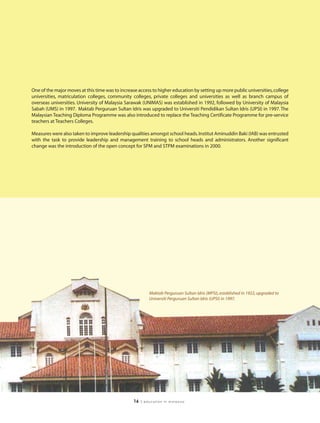
                                                                       Source: Islamic and Moral Education Division (JAPIM)

                                          Table 2.7 : Schedule of the j-QAF Programme


KIA2M Programme

                                                             The KIA2M programme is an early reading and writing
                                                             intervention programme to address the problem of illiteracy
                                                             among Year 1 students.The aim of KIA2M is to ensure that all Year
                                                             1 students are able to read and write in the Malay language. It is
                                                             compulsory for all national schools to run this programme for
                                                             three to six months.


                                                    45   | education in malaysia
English for the Teaching of Mathematics and Science (ETeMS)

Developments and advances in science and technology had led to the implementation of ETeMS. ETeMS was
implemented in 2003 to provide students with early exposure to master these disciplines in English. This is due to the
rapid advancements of these disciplines and the predominant availability of references in English. Globalization,
liberalisation and advancement of the internet had made English as a necessary tool to acquire knowledge, express ideas
and communicate effectively.

ETeMS was implemented for Year 1, Form 1 and Lower 6 students in 2003. To ensure a smooth transition and successful
implementation of this policy, MOE has taken steps to provide many support programmes such as teacher training,
intervention classes, provision of ICT facilities, teaching coursewares and additional textbooks. The MOE constantly
monitors the progress of ETeMS and provides continuous support according to current needs.


Civics and Citizenship Education

Civics and Citizenship Education is a core subject which was introduced in stages in all primary and secondary schools.
This subject hopes to develop pupils to become patriotic citizens, who are able to cooperate and work as a team,
understand and are tolerant towards other cultures, able to solve conflicts without violence, love and protect the
environment and contribute towards the development of citizenship and the nation. MOE hopes that this subject is
taught through hands-on and is student-centred. To motivate pupils interest, involvement and interaction among
schools, community as well as the student leaders are encouraged. Teachers of this subject are trained at the state level
by master trainers who are experts in the field.


Co-Curricular Activities

Co-curricular activities are regarded as an integral part of the school curriculum as they provide opportunities for
students to interact, develop social skills, encourage team building, camaraderie, tolerance and leadership qualities
through play and activities.There are three types of co-curricular activities, namely uniformed bodies, societies and sports
clubs. It is compulsory for students to participate in at least one uniformed body, a society and a sports club. These
uniformed bodies, societies and clubs meet at least once a week. Competitions at school, district and state levels are held
to encourage the development of creativity, motivation and leadership among students.


School Assessment

Assessment is part and parcel of the teaching and learning process. Formative assessment can be conducted to
determine and assess students’ achievements at any point in time while summative assessment is conducted at the end
of the learning period or school term.


• Ujian Penilaian Sekolah Rendah (UPSR)
Ujian Penilaian Sekolah Rendah (UPSR) or the Primary School Assesment Test is a national examination taken by all
Standard 6 (12-year old) students in Malaysia.The subjects tested in UPSR are Malay Language, English, Mathematics and
Science.

                                                 46   | education in malaysia
• Penilaian Menengah Rendah (PMR)
Penilaian Menengah Rendah (PMR) is a Malaysian public examination taken by all Form 3 students. It was formerly known
as Lower Certificate of Education (LCE) and Sijil Rendah Pelajaran (SRP). The examination is conducted at the end of the
third year of secondary schooling. Although all students are promoted to Form 4 in the following year, the results of the
PMR examination are used to place students either in science, arts or technical streams at the upper secondary level. The
results of the PMR examination are also used as basis for placement in residential and technical schools, the Royal Military
College as well as other educational programmes offered by the MOE.


• Sijil Pelajaran Malaysia (SPM)
The Sijil Pelajaran Malaysia (SPM), or the Malaysian
Certificate of Education, is a national examination taken by
all fifth form students in Malaysia. It is set and examined by
the Malaysian Examinations Syndicate (Lembaga
Peperiksaan Malaysia). The SPM is equivalent to the British
General Certificate of Seconday Education (GCSE), and
provides the opportunity for Malaysians to continue their
studies to pre-university level.

The subjects offered in the SPM Open Certification conform
to the subject groupings, that is, the Core Group and the
Elective Group in the Integrated Secondary School
Curriculum. All six subjects in the Core Group are
compulsory for all students. Students have the flexibility to choose subjects in the Elective Group based on their interests,
abilities and aptitudes. The MOE has designed two specialised packages of subjects to be offered in the examination.

Essentially, the SPM Open Certification examination differs from the earlier system in two aspects, namely, flexibility in the
choice of subjects and in the certification method. Certificates awarded will only certify achievements in subjects passed
and candidates must at least obtain a pass in the Malay Language. Unlike the earlier system, there will be no overall
aggregate and classification of candidates into Grade One to Three. The examination will continue to be centrally
administered at the end of secondary schooling and be a requirement for further education or entry into the job market.


• Peperiksaan Tinggi Persekolahan Malaysia (STPM)
Peperiksaan Tinggi Persekolahan Malaysia (STPM) or the Malaysian Higher Education Certificate is taken by students who
continue their education at the Sixth form. This examination is taken at the end of Upper Six level and used as
requirement to local and private universities.


                                                   47   | education in malaysia
• Peperiksaan Sijil Menengah Ugama (SMU)
In the Malaysian education system, there are students who opt for the religious stream which focuses on Islamic studies
and the Arabic language. This alternative stream is offered mostly at Islamic Religious Secondary Schools, though some
selected secondary schools do offer similar option.


• Peperiksaan Tinggi Agama Malaysia (STAM)
Peperiksaan Sijil Tinggi Agama Malaysia (STAM) or Malaysian Higher Religious Examination was introduced in 2000 as a
result of collaboration between the Ministry of Education Malaysia and Al-Azhar Al-Sharif University of Egypt. The
purpose of the examination was to ensure students from the State and Private Religious Schools undergo a common
examination system that is accepted at both local and international levels.


• Peperiksaan Majlis Lembaga Vokasional Malaysia (MLVK)
Vocational training at vocational training centres is an alternative for students who are less academically inclined to
further their studies at the secondary level. After two years of training in these centres, all trainees will be assessed by the
National Vocational Council (MLVK). MLVK Certificate is accepted nation-wide and trainees who are successful in
obtaining the certificate are able to work in their respective fields. MLVK Certificate is accepted and can be used as an
entry qualification into tertiary education such as polytechnics and universities.


Private Education

The progress and historical development of private education in Malaysia is linked to educational reforms in the national
school system. Private education began in the 1950s as an avenue for dropouts from the national school system to
continue with their studies and obtain school certificates. In the early 1970s, the focus shifted to the provision of pre-
university courses.Today, the types of private education institutions registered with the Ministry of Education are as given
below :
          l   Kindergartens
          l   Primary Schools
          l   Secondary Schools
          l   Primary Religious Schools
          l   Secondary Religious Schools
          l   Independent Chinese Schools
          l   International Schools
          l   Expatriate Schools
          l   Special Schools
          l   Tuition Centers
          l   Language Institutions, and
          l   Computer Training Centers
          l   Skills/Commerce Training Centers
          l   Postal/Correspondence Skills


                                                  48   | education in malaysia
The policies relating to the establishment of private education institutions in Malaysia are based on the Education Act
1996 as well as decisions made by cabinet and announcements by the Minister of Education and the Director-General
of Education.


                       Statistics of Schools, Teachers and Enrolment by Type of Private Institutions, 2008

                           Type of Schools                Number of             Number of               Enrolment
                                                           Schools               Teachers

                       Pre-schools                               5 096                 20 764            339 536
                       Academic Primary                            65                   1 247             16 190
                       Academic Secondary                          78                   1 193             14 017
                       Chinese Private Secondary                   60                   2 849             55 096
                       Expatriate                                  13                    213               3 153
                       International                               40                   1171              13 811
                       Religious Primary                           27                    647               8 261
                       Religious Secondary                         14                    291               3 267
                       Tuition Centre                            2 369                 11 243            199 408
                       Language Centre                            267                   1 064             33 470
                       Computer Training Centre                   373                   1 115             20 474
                       Skills Training Centre                     513                   1 262             37 247
                       Mind Development Centre                    180                    988              10 661
                       Special Education                           10                    191                   913
                       Correspondence School                         1                     na              1 405
                       Total                                     9 106                 44 238            756 909
                                 Table 2.8 : Statistics of Private Education and Agencies Institutions, 2008


                                 Number of Foreign Students in Private Institutions 1995-2008

  Year       1995   1996      1997     1998     1999     2000      2001     2002       2003     2004     2005        2006   2007   2008

  No. of     360    1 380    3 029     4 745    5 745    5 540     4 544    5 668      4 992    9 819    11 606 13 266      15 172 15 308
  Students

                                Table 2.9 : Statistics of Foreign Students in Private Institutions 1995-2008


                                                        49   | education in malaysia
Health, poverty and academic well-being are intrinsically interlinked. If left
 neglected and not addressed it would result in a vicious circle that would
                                    paralyse all efforts towards progress.


                      Tun Dato’ Seri (Dr) Haji Hamdan bin Sheikh Tahir
                              Director-General of Education Malaysia
                                                          (1966-1976)
CHAPTER 3
                 Educational Assistance and Support Programmes
Introduction

The aim of educational assistance and support programmes is to prepare students mentally and physically, to excel in the
field of curricular and co-curricular activities and to decrease the dropout rate among students from low income families.
Among the programmes available are the School Boarding Programme, the Textbook Loan Scheme, the School Health
Programme, the Nutrition and Health Programme which include the Supplementary Food Programme and the School
Milk Programme, the Counselling and Guidance Programme, the Scholarship Programme, the Educational Assistance for
Students With Special Needs, the Poor Students’ Trust Fund and the Tuition Aid Scheme.

The objectives of the Ministry of Education (MOE) in establishing the Educational Assistance and Support Programmes
are:
     i.   To provide programmes and schemes that assist students to prepare for schooling;
     ii. To minimise the dropout rate;
     iii. To improve academic excellence especially among students from low income families;
     iv. To ensure equal education opportunities for all especially among students from low income families; and
     v. To ensure the management of education support programmes is efficient and effective.


The Textbook Loan Scheme (TBLS)

The Textbook Loan Scheme (TBLS) was implemented nationwide since 1975. The scheme cover all levels of education
from the primary to the upper secondary education in government schools and government aided schools. The aim of
the scheme is to lessen the financial burden of parents from the lower income group and ultimately ensure access to
education for every child. In 1983, this scheme was extended to People’s Religious Schools (SMAR).

Beginning 2008, the MOE has made a provision to give free textbooks to every student regardless of socioeconomic
status.

The Textbook Division has introduced innovations in
teaching and learning materials by producing CD-ROM
alongside the textbooks produced.The CD-ROMs include
texts, graphic illustrations, animation, audio, video,
interactive multimedia and interactive activities which
include simulations, computer games and interactive
assessment. The CD-ROMs are also equipped with
electronic notebook known as e-journal as a
communication tool. Besides ensuring the textbook
packages produced are of high quality and concurrent
with the curriculum, efforts have also been made to
ensure the suitability for the target groups and able to
achieve the teaching and learning objectives. Students
are given the opportunity to use the CD-ROM in their
Malay language, English language, as well as Science
and Mathematics classes.


                                                 53   | education in malaysia
The Poor Students' Trust Fund (PSTF)

The MOE has set up the Poor Students Trust Fund on 11 April 2003 under Section 10 of the Finance Procedure Act 1957.
This is in line with the implementation of the Compulsory Education Policy in 2003 (Section 29A Education Act 1996 [Act
550]).

The PSTF was set up to provide financial aid specifically to poor Malaysian children in government and government-
aided schools regardless of race and religion. This is in accordance with the Compulsory Education Policy to improve
students’ academic excellence.

Criteria for Eligibility:
          l    Malaysian students.
          l    Students in government and government-aided schools.
          l    Family income below the level of poverty i.e. RM530.00 and below for Peninsular Malaysia; RM585.00 and
               below for Sarawak; and RM685.00 and below for Sabah and the Federal Territory of Labuan.
          l    Students at risk of dropout.

Types and Rate of Allocation

Beginning 2006, the types and rate of allocation are as follow:
         l   Primary School Students
             Schooling Aid: RM200.00 per year
             General Aid: RM500.00 per year (RM50.00 per month/10 months)

         l    Secondary School Students
              Schooling Aid: RM300.00 per year
              General Aid: RM600.00 per year (RM60.00 per month/10 months)

Types and Provision of Aid

         l    The Schooling Aid includes school paraphernalia such as school uniform and stationery provided to
              students before the start of a new school session. This aid is channelled to the District Education Offices to
              be distributed to students in their respective schools.

         l    The General Aid is the school allowance given to students for a period of 10 months and is allocated twice
              a year through the District Education Offices or schools.

         l    The Emergency Aid is the financial aid provided to students who face tragedies such as natural disasters
              and fire which affect the family’s income. Application for the aid is submitted through schools with the
              endorsement from the State/District Education Departments.The aid is granted in five to 10 days from the
              date when the letter of application is received.


                                                54   | education in malaysia
Allocation of the Poor Students’ Trust Fund (PSTF) 2005-2008

                      Year                       Number of Student                           Total of Amount of
                                                                                                Financial Aid
                      2005                                857 319                             RM102.87 million
                      2006                                545 386                             RM181.58 million
                      2007                                621 108                             RM326.81 million
                      2008                                931 673                             RM343.16 million


                               Table 3.1: Allocation of the Poor Students’ Trust Fund (PSTF) 2005-2008


                                           Types and Rate of Allocation in PSTF

                          Types of Allocation                                        Rate


                   School fees/examination/hostels                            Maximum of RM80.00 a year
                   School uniform (one-off )                                  RM120.00 a year
                   School stationery                                          RM200.00 a year
                   General assistance                                         RM100.00 a year
                   Counseling and Training                                    RM50.00 a year

                                          Figure 3.1: Types and Rate of Allocation in PSTF


The Tuition Aid Scheme (TAS)

The Tuition Aid Scheme (TAS) which was launched on 2 August 2004 is an educational intervention programme targeted
for poor students with low academic achievement. The aim of TAS is to provide extra guidance or tuition which is
structured for poor students whose achievement is low in the subjects of Malay Language, English Language, Science and
Mathematics. The extra classes provided are an effort to improve students’ academic achievement.

This scheme is targeted for Malaysian students of Year 4, 5 and 6 in government and government-aided schools from
families with monthly income below the level of poverty. With this aid, parents are exempted from the tuition fees. The
allocation is channelled directly to schools. The government also provides incentive for teachers who volunteer to give
tuition to the selected students to recognise their efforts and contributions.
The objectives of TAS are as follow:


                                                    55   | education in malaysia
i.     To increase student-teacher contact hour
     ii.    To increase the students’ level of motivation and confidence as
            well as to enhance their knowledge and basic skills
     iii.   To improve students’ academic achievement
     v.     To bridge the gap of academic achievement among students
     v.     To increase the enrolment rate of poor students at tertiary level.

Criteria for Eligibility

            l   Malaysian students.
            l   Students in Year 4, 5 and 6 in government and government-
                aided schools.
            l   Family income below poverty level i.e. RM530.00 and below for
                Peninsular Malaysia; RM585.00 and below for Sarawak; and
                RM685.00 and below for Sabah and the Federal Territory of Labuan.
            l   Students who are refered to by the subject teachers.


The Integrated School Health Programme (ISHP)

The Integrated School Health Programme (ISHP) is implemented with the assistance of the Ministry of Health. The aim of
this programme is to provide various health services to students in primary and secondary schools. This noble effort is
based on the rationale:

            l   To coordinate the various health programmes into an integrated programme.
            l   To create a flexible, innovative and creative system to fulfil the school needs.
            l   To create a health programme which can foster a sense of belonging and commitment among the school
                community.
            l   To create an integrated health programme which has an impact that can be evaluated.
            l   To foster understanding and cooperation between the school and local community in overcoming health
                issues.
            l   To encourage good health practices through planned and direct efforts.

The six thrusts of Integrated School Health Programme (ISHP) towards creating an integrated approach among the public
sector, private sector and community are as follow:

     i.     School Health Policy
            Among the safety policies that can be formulated in school are:
            l  policy for clean and nutritious food in school canteen;
            l  policy for substance abuse (cigarettes and drugs);
            l  policy for first aid;
            l  policy for school safety;
            l  policy for disease control;
            l  policy for school physical environment;


                                                   56   | education in malaysia
l   policy for school social environment;
          l   policy for health education; and
          l   policy for the role of school community and society.

    ii.   School Physical Environment
          A healthy physical environment promotes healthy practices and evades accidents in school. Among the
          activities that can be implemented in school are to ensure sufficient basic facilities and continuous clean, safe
          and healthy environment.

    iii. School Social Environment
         A healthy and safe social environment helps to shape attitude and practices of the school community in
         moulding character and resilience.

    iv.   Community Involvement
          Community involvement is cooperation among school, parents and society in raising the health standards of
          the school.

    v.    Health Skills
          Health skills are defined as efforts to promote healthy life style in school. Among the activities that can be
          implemented are personal hygiene, dental hygiene, physical exercise, healthy diet, the study of human anatomy
          and physiology.


    vi. School Health Services
        The school health services comprise of promotions on health and nutrition, health care, medical referral and
        placement in special ward by medical doctors and dentists, nursing personnel and teachers to achieve
        optimum health.

The services provided under the ISHP include dental and medical treatment, prevention and control of contagious
diseases and free medical kit to schools.Through this programme, schools are able to identify students who need medical
treatment such as vaccination, eye treatment, dental treatment, and prevention and control of contagious diseases
programme. A medical officer from the neighbourhood health clinic will make visits and scheduled examinations on
students. The implementation of Enhancing Students’ Health Programme (Program Peningkatan Kesihatan Murid) in
schools has increased collaboration between the MOE and the Ministry of Health. This programme aims to nurture
positive habits and attitude among students in everyday life towards a healthy and quality lifestyle.


                                                 57   | education in malaysia
The Supplementary Food Programme

                                                                             The aim of Supplementary Food Programme
                                                                             (SFP) is to increase the nutritional value of food
                                                                             consumed by pupils to ensure they receive a
                                                                             well-balanced diet for their physical growth,
                                                                             mental health and general well-being. It is
                                                                             hoped that pupils are more focused on the
                                                                             teaching and learning process through this
                                                                             programme. In 2006, the MOE has spent
                                                                             RM167.6 million for the benefit of 706,712 pupils
                                                                             under this programme.

                                                                             This programme was introduced in 1976 as part
                                                                             of the Food Preparation and Nutrition
                                                                             Programme (Rancangan Amalan Makanan dan
                                                                             Pemakanan) under the Prime Minister’s
                                                                             Department (JPM). This programme was a
                                                                             community development programme focussing
                                                                             on health, agriculture and education. The initial
                                                                             implementation of this programme was
                                                                             targeted for students in primary schools and
                                                                             rural areas.

In the early 1980’s, the programme was expanded nationwide when the MOE undertook the management of the
programme. Since the 1990s, the main criterion to select pupils under this programme is the family socio-economic
status.

Selection Criterion
         l    Primary school students from rural areas and whose family income per month is RM400 or less i.e. per
              capita income of RM80.00.

Rate of Allocation
         l    The rate allocated by the MOE beginning 1 March 2007 is RM1.80 per day for students in Peninsular
              Malaysia and RM2.05 per day for students in Sabah, the Federal Territories and Sarawak. This rate is
              calculated based on the market rate of raw materials excluding the cost of service, transportation and
              drinks. The programme is implemented for 190 schooling days in a year.

Implementation Strategies
       l   The SFP Committee is given the responsibility to select food suppliers, whose duties include the
           management of raw materials, preparation and service of food, cleaning of kitchen utensils and tools, and
           service location.The schools will choose five or ten menus from a list of 20 menus prepared by the Ministry
           of Health. These menus are rotated every week or every two weeks based on local flavour, seasonality of
           raw materials and budget allocation. In Peninsular Malaysia, 95% of the food preparation process is
           handled by the school canteens where students receive food a few minutes before recess time.


                                              58   | education in malaysia
The School Milk Programme (SMP)


The School Milk Programme (SMP) runs simultaneously with the Supplementary Food Scheme. The programme is
targeted for poor students whose family income is below the poverty level. Besides, to ensure students receive a well-
balanced diet in school, the programme is also aimed at increasing the quality of health and nutritional value of food for
primary students for better physical growth, mental health and general well-being.The SMP also encourages students to
consume milk early in their life. In 2006, the MOE spent RM20.6 million for 556,979 students under this programme. The
selection criteria for students under this programme are primary school students, especially from rural families, with a
family income of RM400.00 and below.

The SMP was a collaborative programme between the MOE and milk producers under the concept of Malaysia
Incorporated launched in 1983. This program has expanded nationwide beginning 1985 with the exclusion of the state
of Sabah as it has its own milk programme.

The two schemes under this programme are:

    i.    Paid Milk Scheme which involves participation from primary school students either on voluntary basis or
          with/without government subsidy; and

    ii.   Free Milk Scheme which supplies milk to selected students. The milk is sponsored by milk companies which
          collaborate with the MOE and/or non-government organisations (NGO’s) either privately or on voluntary basis.


                                                 59   | education in malaysia
The objectives of the programmes are as follow:

    i.     To encourage milk drinking habit among primary school students under the Paid Milk Scheme.

    ii.    To provide milk to selected students from low socio-economic background who are at risk of malnutrition
           through the Free Milk Scheme .

    iii.   To increase the efficiency of planning, execution, and evaluation of programme with cooperation from other
           government agencies under the concept of Malaysia Incorporated.

    iv.    To decrease public sector expenditure through the involvement of private sector agencies.

    v.     To increase knowledge, skill and practice especially on food, nutrition, health, and other learning aspects in
           general.

    vi.    To increase the development of community and food industry which involves the production, processes and
           supply of milk.


 The 3K Programme (Safety, Health and Aesthetics)


The 3K Programme started in 1991 with the aim to strengthen the school system focusing on school safety, health and
                                                       aesthetic. The 3K initiatives conducted by the School Division
                                                        include the School Safety Programme, the Cleanliness and
                                                         Health Programme as well as the School Aesthetic
                                                         Programme. The programme is perceived as capable in
                                                         making schools realise the significance of aesthetics in
                                                          education which contributes to a conducive teaching and
                                                          learning environment. Safety, cleanliness, health and
                                                           aesthetics are contributing factors to providing a rich
                                                           learning environment. In addition, projects under this
                                                            programme have enabled schools to foster close
                                                            relationship with Parent-Teacher Associations and local
                                                             communities.


                                                60   | education in malaysia
The Safe School Programme (SSP)


Safe school is defined as a school environment which is free from internal and external threats and where the school
community feels a sense of security. In a safe school, each individual should be free from race and gender discrimination,
have positive attitude towards others, value individual differences, act and be fair, be cooperative and helpful, practise
good behaviour and morality, avoid violent behaviour, abhor physical, mental and emotional abuse, and report all
negative incidents.

The change in education environment has created a need to identify methods, strategies and models which have the
abilities to increase the safety of students and teachers. A planned and reliable safe school policy will increase school
security. The development of the Safe School Policy in schools is a collective responsibility of the parents, schools and
society. The Safe School Committee comprises of school representatives, parents, government agencies and NGOs. The
school administration is responsible in safeguarding the school and formulating safety regulations. Schools must also
provide safety training for students and teachers to avoid, control and reduce negative incidents among students. Parents
must ensure safety practices are taught at home to enhance the values instilled through the teaching and learning
process. The society can manifest the practise of safety by being disciplined, responsible, knowledgeable and resilient.

The objectives of the SSP are as follow:

     i.    To enhance understanding of procedures on safety, emergency, accidents and disasters issues.
     ii.   To increase full and total comprehension on safety issues in the planning and implementation of school
           activities.


                                                 61   | education in malaysia
iii.  To create healthy, safe and pleasant environment in
                                                                   school.
                                                             iv. To ensure individual rights in school are protected.
                                                             v. To increase the quality of teaching and learning.
                                                             vi. To prepare guidelines for action taken relating to safety
                                                                   issues.
                                                             vii. To create a conducive environment for mental and
                                                                   emotional health.
                                                             viii. To create a more focused school community towards
                                                                   learning and work.
                                                             ix. To motivate students to contribute positively.

                                                             It is the aspiration of the MOE that the Safe School concept is
                                                             implemented in all schools in the country. The
                                                             implementation of the Safe School Policy will create learning
                                                             institutions which are free from physical, mental and
                                                             emotional interferences.


The Scholarship Programme

The Scholarship Division is responsible for coordinating the MOE scholarship programmes. The division manages the
scholarship fund for selected students at primary, secondary and selected tertiary levels. The MOE also provides
scholarships to qualified teachers who wish to further their studies at bachelor, master’s and doctorate level in local or
foreign universities.

This programme is in relation to the aspiration of the MOE in elevating the teaching profession. Besides the In-service
Training Programme, the Scholarship Division also provides for students in the Pre-Service Programmes, i.e. programmes
which involve providing scholarships to students at first degree level such as the Federal Teaching Scholarship at public
institutions of higher learning, Bachelor of Education in Teaching of English as a Second Language (B. Ed.TESL) Twinning
Programme and Programme For Excellent Students Abroad. The programmes are open to SPM holders to pursue a
bachelor degree in English language (TESL) and critical Science and Mathematics courses in local or foreign universities.
In 2008, 500 B. Ed. (TESL) Twinning Programme students and 154 students in the Programme For Excellent Students
Abroad were sent to universities in Australia, New Zealand and United Kingdom.

Types of Scholarship

The MOE is sensitive to the problems of less fortunate students who have the potentials to excel academically. In view of
this, scholarships are granted to students with excellent academic achievement from poor family background with an
income below RM1000.00 per month. At primary and secondary levels, the students are granted with Federal Minor
Scholarship and University Preparatory Class Scholarship.

The scholarship programmes include:
         l    the Poor Students’ Trust Fund;
         l    the Federal Minor Scholarship and University Preparatory Class Scholarship;
         l    the Excellent Student Scholarship;
         l    the Federal Teaching Scholarship (Bachelor Degree); and
         l    the B. Ed. TESL Scholarship.


                                                62   | education in malaysia
Scholarships are also granted to teachers and education officers in the MOE.
The scholarship programmes include:

    l   the Special Programme Enabling Non-graduate Teachers To
                                                                                        Scholarship Programmes for Pupils
        Attain Degrees (PKPG);
    l   the Federal Training Awards for Education Officers (master
                                                                                    l   Poor Students’ Trust Fund
        and doctorate level);
                                                                                    l   Federal Minor Scholarship
    l   the Post-graduate Programme (unpaid leave);
                                                                                    l   University Preparatory Class Scholarship
    l   the Programme Enabling School Heads to Attain Degrees
                                                                                    l   Excellent Student Scholarship
        (full time);
                                                                                    l   Federal Teaching Scholarship (Bachelor
    l   the Programme Enabling Non-graduate Teachers of
                                                                                        Degree)
        International Languages to Attain Degrees (French and
                                                                                    l   Scholarship for Bachelor of Education in
        German);
                                                                                        TESL
    l   the Distance Learning Programme with Open University,
        Malaysia;
    l   the Graduate Diploma Programme in Drug Abuse;                                     Figure 3.2: Scholarship Programmes
    l   the Special Teaching Certificate Course (KSPK);
    l   the National Professional Qualification for Headship (NPQH);
        and
    l   the Pre-Service Programmes.


                               Scholarship Programmes under Ministry of Education in 2007

            Programme                            No. of Recipients in 2007                   Total Expenditure in 2007
                                                                                                    (RM) Million

   Federal Training Awards for                               69 Ph.D                                     16.52
   Education Officers at masters &                         352 Masters
   doctorate Level
   Federal Teaching Scholarship                               1 200                                      38.85
   (Bachelor Degree) at
   public HEIs/overseas
   Assistance for Special Education                             79                                        1.40
   Students at Polytechnic
   Assistance for Technical                                    600                                       11.88
   Lecturers’ Scheme
   Excellent Student Scholarship                               105                                        3.79
   Federal Minor Scholarship                                 50 088
                                                                                                         161.6
   University Preparatory                                     19 399
   Class Scholarship

                               Table 3.2 : Scholarship Programmes under Ministry of Education in 2007


                                                     63   | education in malaysia
The Counselling and Guidance Programme


The aim of the Counselling and Guidance Programme is to expand the
counselling service and career guidance for the benefits of students. The MOE
has made a provision that every primary and secondary school must set up a
Counselling and Guidance Unit headed by a full-time counsellor. The counselling
and guidance services in schools are primarily concerned with safeguarding students’
welfare, providing counselling and career guidance, and organising motivational talks and
courses. Some of the programmes organised are short courses for peer counsellors, leadership
camps, courses to develop social skills and self-reliance. Invitational talks on career and higher education opportunities
are among important services rendered to school leavers.


The Emergency Preparedness Programme (EPP)

                                           The Emergency Preparedness Programme (EPP) was launched in August 2006
                                           in commemoration of the tsunami disaster that hit SK Seri Kuala in Kuala
                                           Muda, Kedah. The EPP is a collaborative programme between the MOE and
                                           UNICEF. UNICEF has allotted RM647,500 to the MOE under this program. The
                                           aim of the EPP is to equip primary school teachers with knowledge on how to
                                           prevail over natural disasters such as flood, tsunami, earthquakes, haze and
                                           landslides.

                                           The objectives of the programme are:
                                           i.   to prepare teachers with knowledge and skills on how to face natural
                                                disaster through workshops and educational visits; and
                                           ii. to foster cooperation between teachers and NGOs to produce School
                                                Emergency Preparedness Natural Disaster Manual and School
                                                Emergency Preparedness Action Plan.

                                            The participants of the programme comprise of primary school teachers,
                                            education officers from the Curriculum Development Division, the Teacher
                                            Education Division, the Educational Technology Division and the Technology
                                            Division of Miri. This programme also involved the cooperation from State
                                            Education Department, District Education Office, The Royal Malaysia Police,
                                            The Ministry of Health, SMART Team, MERCY and the Red Crescent Society,
                                            Malaysia.


The activities under the programme were:
          l    a workshop for Natural Disasters Awareness;
          l    a workshop for the writing of the School Emergency Preparedness Natural Disaster Manual;
          l    educational visits to Adelaide and Melbourne, Australia; and
          l    a course on Disaster Prevention In Schools in Kobe, Japan (in-service training in cooperation with JICA,
               Japan).


                                                64   | education in malaysia
The School Boarding Programme

School hostels are built to provide convenient
accommodation for students especially to those who live
in rural and remote areas and whose family earn less than
RM1000 per month. The aim is to bridge the gap of
quality education between students who live in the rural
and urban areas.

At present, there are three types of hostels i.e. daily school
hostel, centralised school hostel and fully residential
school hostel. Day school hostels are built to provide
accommodation for selected students of the schools
while centralised school hostels are specifically built to
provide accommodation to students from a cluster of
neighbouring schools. Fully residential school hostels are
provided to students who excel academically from rural areas and from low income families.

Factors which determine entry into the day school hostel and centralised school hostel are the distance of students’
homes from school and the socioeconomic status of the parents or guardians. Priority is given to students from low
income families. Besides getting good accommodation, pupils also receive nutritious food for their physical and mental
growth. Hostel facilities are also available in special education schools i.e. three in secondary special education schools
and 18 in primary special education schools. In 2008, there are 54 fully residential school hostels nation wide.


The Assistance Programme for Students with Special Needs


                                       The MOE is always concerned with the requirements of students with special
                                        needs. One of the steps taken by the MOE is to ease the financial burden of
                                         parents of students with special needs by providing financial assistance of
                                         RM25.00 per month. To qualify for this programme, the students must come
                                         from families with income of less than RM1000.00 per month.

                                         Students with special needs who stay in school hostels are also eligible to
                                        receive full aid such as free food and accommodation. The MOE also provides
                                             education allowance of RM300.00 per month for students with special
                                                 needs who are pursuing further education in polytechnics. Other aids
                                                     include tuition fees as well as free food and accommodation.


                                                 65   | education in malaysia
The Supplementary Reading Programme in Sabah and Sarawak (SRP)

                                                        The Supplementary Reading Programme in Sabah and Sarawak
                                                        (SRP) is a collaborative effort between the MOE and UNICEF. The
                                                        aim of this programme is to increase the quality of teaching and
                                                        learning in primary schools located on islands and remote areas
                                                        of Sabah and Sarawak.

                                                        The objectives of the programme are:

                                                        i. to supply additional and interesting teaching and learning
                                                        materials; and
                                                        ii. to inculcate good reading habit among students through the
                                                        supply of teaching and learning materials to schools.

                                                       This programme is currently targeted at 25 schools in Sabah
which mainly comprise of island schools. Five schools which are from the interior areas in Sarawak are also selected to
participate in the programme.

The materials provided to the schools are story books and pre-set computers. An allocation amounting RM195,000 was
obtained from the UNICEF in 2008 for the provision of reading materials, training of teachers in using the materials,
organising reading camps for the project schools and to carry out evaluation research on the programme.


The NILAM Programme

Nadi Ilmu Amalan Membaca (NILAM) is a reading programme established to recognise and award good reading habits
among pupils in school. This programme emerged from the combination or integration of all activities to inculcate the
love for knowledge in schools. The programme started in 1999 for Level 1 (primary school) and Form
1/Remove Class (secondary school). Since 2005, efforts have been made
to instil reading culture among pupils.The NILAM Programme includes
plans to inculcate reading habit continuously through systematic
management of reading activities in schools. This reading
programme is continuously monitored throughout the year.

The aim of the NILAM programme is to inculcate good reading
habits among pupils in Malaysia. The objectives of this
programme are:

    i.    to produce pupils who are avid readers of quality
          materials from various fields; and
    ii.   to encourage school to continuously generate creative
          and innovative ideas in instilling good reading habits
          among pupils.


                                              66   | education in malaysia
The NILAM programme is divided into two levels:                         Recognition of the Jauhari Level for Primary and
    i. Level One - Jauhari                                                            Secondary Schools

The objective of this level is to develop interest in reading and                 Score                        Recognition
reading skill that is inculcated as a habit. This level requires
pupils to participate in activities which encourage reading                                  Primary School
planned by the School Resource Centre (SRC) throughout the               90-179 books                              Bronze
year. Pupils’ involvement at this level starts when they are able        180-269 books                              Silver
to master the basic reading skill i.e. in the middle of Year 1. The
                                                                         270-359 books                              Gold
SRC will loan one book for a period of two weeks to promote
reading activities in school.                                            360 books and above                 Nilam (Sapphire)
                                                                                           Secondary School
Pupils are rewarded and given due recognition in accordance
                                                                         72-143 books                              Bronze
with their level of achievement. The recognition is noted in
pupils’ Record Book, School Leaving Certificate and School               144-215 books                              Silver
Testimonial. These can be used as part of the selection criteria         216-287 books                              Gold
into residential school or during the application of scholarship.        288 books and above                 Nilam (Sapphire)

     ii.   Level Two - Reading Peer (RP)                                  Table 3.3: Recognition of the Jauhari Level for Primary and
                                                                                              Secondary Schools
The objective of this level is to increase pupils’ participation and
usage of materials in promoting reading activities. This level places    The Reading Peer (RP) Reward System
emphasis on pupils’ ability to guide and attract others’ interest in
reading. Pupils who have read 100 books in the Jauhari Level are            Score                      Recognition
eligible to enter this level. The level requires pupils to do reading      100-199                         Bronze
activities with their peers in school with guidance from teachers or
                                                                           200-299                          Silver
facilitators. The progress of these activities is tracked formally (in
events/competitions) or informally (e.g.: during social work/in class).    300-399                          Gold
Pupils are trained in workshops and demonstration sessions. At this     400 and above               Nilam (Sapphire)
level, pupils are given a score based the number of activities they
participate in such as storytelling, book talks, borrowing of books,     Table 3.4: The Reading Peer (RP) Reward System
elocution, drama and discussion. All RP activities are recorded in
Reading Peer Book Record and are reviewed and assessed by facilitators.

Implementation Strategies

The implementation of the NILAM programme at the state level is done by the State Education Department while the
secretariat of the programme is the State Education Resource Centre. Activities that are carried out include programme
placement, supervision, evaluation and reporting for the purpose of programme modification or improvement.

The details on the types of activity and implementation strategies; the role of the school community; the involvement of
parents; the types of reading materials; the specification of reading materials; the reading record; the process of
monitoring and evaluation; and the various school-based activities are stipulated in the NILAM programme manual.

The National NILAM Award

This objective of the National NILAM Award (Tokoh NILAM Kebangsaan) is to give recognition to a pupil who has read
the highest number of books. The award is presented annually and is under the jurisdiction of the Educational
Technology Division which acts as the secretariat for the Main Committee of the Reading Programme. The methods of
evaluation used are guided interviews and supervised written test by a panel of professional judges.


                                                   67   | education in malaysia
The School Resource Centre (SRC)

The School Resource Centre (SRC) is a place that provides reference resources and collections of reading materials to the
school community and a conducive learning environment for self-learning. Besides the school administrators, the Media
and Library Teachers are responsible in the management of the SRC. The Educational Technology Division is responsible
for monitoring the role of the SRC and ensuring the effectiveness of the SRC in the teaching and learning processes.
Objectives of the School Resource Centre (SRC):
         l     To achieve academic excellence
         l     To inculcate learning habits
         l     To produce teaching and learning materials
         l     To provide learning experience
         l     To ensure use of the facilities at the optimum level
         l     To teach information skills


ICT in Education

The Computer in Education Programme started in 1999 in 332 schools in the country. The initial objective was to expose
pupils to basic computer literacy. In 2002, the Computer Literacy Programme was implemented for Form 1 and 2
                                students. After five years, the programme was reviewed and ICT in Education
                                 Programme was introduced in secondary schools in 2007.

                                   With the advancement of ICT in education, the MOE has provided all the technology
                                   requirements such as application system and ICT infrastructure to create an effective
                                     and efficient management system. Realising ICT as an enabler in the management
                                       of education information, the MOE has strengthened various systems and
                                        databases through data mining, integrating information systems from all
                                         agencies in the MOE and upgrading ICT infrastructure in concurrent with the
                                          needs of e-government and e-management.

                                           The MOE has outlined three main ICT policies in education which are:
                                           i. ICT literacy for students;
                                           ii. ICT as a curriculum and teaching and learning tool; and
                                           iii. ICT for the improvement of productivity, and the effectiveness and
                                                  efficiency of management system.

                                            The MOE has provided sufficient and the latest ICT infrastructure, and info
                                            structure equipped with networking facilities to all levels of organisation to
                                            widen its use in teaching and learning, and education management. ICT in
                                            education aims at increasing the development of ICT infrastructure,
                                            enhancing access and equity for ICT facilities in urban and rural areas,
                                            developing and expanding ICT-based curriculum, and enhancing students’
                                           motivation towards learning.The MOE places emphasis on the integration of
                                          ICT in teaching and learning process such as in the subjects of Mathematics
                                        and Science in addition to increasing the performance in education
                                       management. Various efforts have been made to equip students, teachers and
                                        personnel with ICT knowledge and skills. The utilisation of ICT has increased
the efficiency of the MOE and the growth of research and development in education.

ICT in Teaching and Learning

The MOE has made initiatives in the use of ICT in teaching and learning through projects such as the Smart School
Project, School Access Centres and Making School Smart Programme. In addition, various pilot projects have been

                                                68   | education in malaysia
implemented to keep abreast with the innovations of ICT. Among the projects are the Strengthening ICT in Schools
Programme, the SchoolNet Project in ASEAN Setting, the Technical Integration for Smart Brigade Programme, the
Refurbish Computer Pilot Project and the Open Resource System Pilot Project.


Educational Television Programme

In line with the evolution of technology, the Educational Technology Division (ETD) has broadcasted all educational television
programmes using the ASTRO channel. This endeavour enables viewers to watch quality and international programmes.

Monitoring activities done by the ETD on educational television programmes on the ASTRO channel has shown positive
results. The programmes broadcast are found to be relevant with the topics and objectives of teaching and learning.
Pupils are interested to watch the programmes and have shown good response. Subjects such as Malay language,
English language, Science and Mathematics have been aired through television. However, in remote areas such as in
Sabah and Sarawak, the radio is still one of the main and effective teaching and learning tools used in the classroom.

Every year the Educational Television Sector produces a variety of programmes which encompass programmes based on
the primary and secondary school curriculum.Two new channels have also been included under this programme i.e.Tech
TV and Discovery Travel and Adventure. At present, educational television programmes are being telecast through TV9
channel. Among the types of programmes broadcast are as follow:

     i.    Programmes Based on the Curriculum
           The programmes comprise school subjects for primary and secondary schools such as Malay Language, English
           Language, Technical and Vocational, Islamic Education, Mathematics, Science, History, Geography and Moral
           Education.

     ii.   Programmes Acquired from Private Sector
           The programmes are purchased from local or international companies such as Science and Technology
           Application Principles by Bill Nye .

     iii. Collaborative Programmes
          The programmes are produced in cooperation between ETD and production companies. Among the various
          topics produced for educational purposes are career guidance, information technology and pedagogy (to
          enhance the process of teaching and learning).

     iv.   Lensa TVP Programme
           The programme highlights current affairs in the education sector around the country

     v.    Bicara TVP and Laman Muda Programme
           These are educational talk shows which are telecast live from Studio 1, ETD.

     iv.   Special Programme
           This programme is broadcast through the ASTRO channel via satellite to enable schools around the country
           including those in remote areas to receive clear transmission of the programmes.


Eduweb TV
Web TV Project of MOE is a project implemented to bridge the educational gap between the rural and urban areas as
well as the remote areas. Teachers are able to preview and watch the selected television programmes; then use them in
their teaching and learning process irrespective of the schools’ location and the schedule of the programme. Students
throughout the nation are able to access educational learning aids which are hosted into the data centre. The public is
also given information on the development as well as various opportunities in national education.


                                                   69   | education in malaysia
Health, poverty and academic well-being are intrinsically interlinked.
If left neglected and not addressed it would result in a vicious circle that
                             would paralyse all efforts towards progress.

                    Tun Dato’ Seri (Dr) Haji Hamdan bin Sheikh Tahir
                            Director-General of Education Malaysia
                                                        (1966-1976)
Chapter 4
                                                                                 Tertiary Education
Introduction

In Malaysia, the National Education System consists of pre-school education, primary education, secondary education,
upper secondary (Form Six) education and matriculation colleges as well as tertiary education. Tertiary education is the
continuity of the upper secondary school education which includes Community Colleges, Polytechnics, public Higher
Education Institutions (HEIs) and private HEIs. The restructuring of the Cabinet on the 27 March 2004 has resulted in the
Ministry of Education being divided into two: Ministry of Education (MOE) and Ministry of Higher Education Malaysia
(MOHE). The administration of public HEIs, polytechnics and community colleges are being placed under the purview of
the MOHE.

Tertiary education is considered a catalyst in the government’s effort to supply human resource with first-class mentality
to fulfil the need of the workforce from various sectors and occupational fields. These graduates are expected to be of
high moral values, competitive, physically, emotionally, spiritually and intellectually balanced, highly knowledgeable and
skilful to meet the country’s needs. The aim of tertiary education is to develop students’ critical, creative and innovative
thinking to enable them to contribute towards the nation’s progress and ready to compete in the international arena.

The MOHE has prepared the National Higher Education Strategic Plan 2007-2010: Beyond the Year 2020 to meet the
demands of the higher education transformation requirement in producing human capital equipped with first class
mentality and making Malaysia an excellent hub for international higher learning. The plan focuses on the role and
function of public and private HEIs, polytechnic, community college and other relevant training providers. To achieve
these goals, some transformational steps are taken. This revolves around ensuring the democratization of higher
education; facilitating students’ mobility and improving the quality of teaching and learning; building critical mass
researchers and continuing the effort to produce academics worthy of Nobel Laureates; creating one or two autonomous
apex universities; intensifying internationalisation of higher education; enculturation of lifelong learning; activating
critical mass researchers and teachers; and reinforcing the delivery system of MOHE.


History of Higher Education In Malaysia

                                                   Higher education in Malaysia started with the formation of University
                                                   Malaya (UM) in 1961, followed by the Science University Malaysia
                                                   (USM) and Tunku Abdul Rahman College in 1969. Since then, the
                                                   number of public HEIs has increased in the 1970s, 1980s and 1990s.
                                                   Until 2007, the country has 20 public HEIs with 382,997 students
                                                   enrolment. Meanwhile, Ungku Omar Polytechnic was the first
                                                   polytechnic formed in Malaysia in 1969 and currently (2008), there are
                                                   27 polytechnics around the country. The formation of community
                                                   colleges since 2001 has marked a new development in the history of
                                                   higher education. Their aims are to encourage lifelong learning and to
                                                   provide training opportunities to local communities. Initially, there
                                                   were 10 community colleges which have since increased to 37 of them
                                                   in 2007. The enrolment of students in polytechnics and community
                                                   colleges stands at 84,250 and 13,758 students respectively in 2007.

                                                  The private sector has also played an important role in providing
                                                  education in the country. Initially, private education was only limited to
                                                  pre-school, primary school and secondary school. The role of private
education in providing tertiary education started in the 1950s with the formation of some institutions such as The Goon
Institute, The Stamford College and The Kadir Adabi College.

                                                  73   | education in malaysia
The Number of Higher Education Institutions in 2007                 However, this scenario changed in the 1970s
                                                                           when      private    education       developers
                 Institutions                                    Number    introduced and offered pre-university courses.
                                                                           Private education continued to thrive in the
 Public Higher Education Institutions                               20
                                                                           1980s when educational institutions started
 Private Higher Education Institutions                             36      offering overseas courses at certificate,
 Polytechnics                                                       24     diploma and professional qualification levels.
 Community Colleges                                                 37     Subsequent development was more obvious
                                                                           in the 1990s where many private HEIs offered
 Private Colleges                                                  488     their own certificates and diploma
 Total                                                             605     programmes. The number of private tertiary
       Source: Ministry of Higher Education Malaysia                       institutions increased to 521 in 2007 where 17
                                                                           were given university status, 15 were given
        Table 4.1 : Number of Higher Education Institutions, December 2007 university colleges status, four foreign branch
                                                                           university campuses, while the rest are private
colleges. The role of private HEIs has gone through various changes and is an important alternative for students to gain
quality tertiary education in Malaysia.

In efforts to provide quality higher education, the Malaysian Qualification Framework (MQF) was introduced at the end
of 2007. The main feature of MQF is to promote student mobility from one education program to another through the
transfer and standardisation of course credit. The implementation of MQF will simplify course certification at the
international level.


Community Colleges

The aims of community colleges are to provide dynamic and quality education as well as training by:
    l   Organizing and creating alternative path for post secondary;
    l   Organizing and preparing lifelong learning with knowledgeable community development (K-communities);
    l   Providing training for up-skilling and re-skilling for local workforce needs;
    l   Providing strategic networking to encourage socio-economic activities among local customers and
        stakeholders; and
    l   Providing community-centred facilities and services.

Initially, there were ten community colleges in June
2001. In 2008, there are 37 community colleges and
19 branches of community colleges throughout the
country. The total enrolment in these colleges is over
15,000 students at certification levels. Under the
Ninth Malaysia Plan (9th MP), 25 more community
colleges will be built and 30 colleges will be opened
on rented premises. Community colleges offer full
time as well as short term courses that focus on skills
training. Since February 2007, community colleges
have begun offering courses at diploma level
through the collaborations with private companies.
These courses are conducted through work-based
learning (WBL).
                                                                                Kuantan Community College


                                                 74   | education in malaysia
Full-Time Courses at Certificate Level in                                         List of Community Colleges in 2008
                 Community College
                                                                           1.    Kolej Komuniti Arau                           Perlis
   l     Creative Multimedia (Animation)                                   2.    Kolej Komuniti Bandar Baru Darulaman          Kedah
   l     Creative Multimedia (Advertising)                                 3.    Kolej Komuniti Sungai Petani                  Kedah
   l     Integrated Technology in Manufacturing                            4.    Kolej Komuniti Kepala Batas                   Pulau Pinang
   l     Automotive                                                        5.    Kolej Komuniti Bayan Baru                     Pulau Pinang
   l     Draughtsmanship                                                   6.    Kolej Komuniti Chenderoh                      Perak
   l     Building Maintenance                                              7.    Kolej Komuniti Gerik                          Perak
                                                                           8.    Kolej Komuniti Sungai Siput                   Perak
   l     Electrical Technology
                                                                           9.    Kolej Komuniti Pasir Salak                    Perak
   l     Computer Support System
                                                                           10.   Kolej Komuniti Teluk Intan                    Perak
   l     Hotel and Catering
                                                                           11.   Kolej Komuniti Sabak Bernam                   Selangor
   l     Fashion and Design                                                12.   Kolej Komuniti Hulu Selangor                  Selangor
   l     Food Processing and Quality Control                               13.   Kolej Komuniti Selayang                       Selangor
   l     Information Technology                                            14.   Kolej Komuniti Kuala Langat                   Selangor
   l     Business and Accounting                                           15.   Kolej Komuniti Hulu Langat                    Selangor
   l     Air Conditioning                                                  16.   Kolej Komuniti Jempol                         Negeri Sembilan
   l     Tourism                                                           17.   Kolej Komuniti Jelebu                         Negeri Sembilan
   l     Interior Design                                                   18.   Kolej Komuniti Alor Gajah                     Melaka
   l     Landscape and Nursery                                             19.   Kolej Komuniti Selandar                       Melaka
                                                                           20.   Kolej Komuniti Bukit Beruang                  Melaka
   l     Bakery and Confectionary
                                                                           21.   Kolej Komuniti Jasin                          Melaka
   l     Beauty and Hair Saloon
                                                                           22.   Kolej Komuniti Ledang                         Johor
   l     Ceramic Industry
                                                                           23.   Kolej Komuniti Segamat                        Johor
       Figure 4.1: Full-Time Courses at Certificate Level in               24.   Kolej Komuniti Segamat 2                      Johor
                       Community Colleges                                  25.   Kolej Komuniti Bandar Penawar                 Johor
                                                                           26.   Kolej Komuniti Tebrau                         Johor
                                                                           27.   Kolej Komuniti Rompin                         Pahang
                                                                           28.   Kolej Komuniti Bentong                        Pahang
                                                                           29.   Kolej Komuniti Mentakab                       Pahang
 List of Skills Training Offered in Community Colleges                     30.   Kolej Komuniti Kuantan                        Pahang
   l     Radiography                                                       31.   Kolej Komuniti Paya Besar                     Pahang
                                                                           32.   Kolej Komuniti Kuala Terengganu               Terengganu
   l     Occupational Therapist
                                                                           33.   Kolej Komuniti Tawau                          Sabah
   l     Physiotherapist
                                                                           34.   Kolej Komuniti Kuching                        Sarawak
   l     Medical Laboratory Technician                                     35.   Kolej Komuniti Mas Gading                     Sarawak
   l     Dental technician                                                 36.   Kolej Komuniti Kulim                          Kedah
   l     Health Assistant                                                  37.   Kolej Komuniti Langkawi                       Kedah
   l     Pharmaceutical Assistant                                                                       Source : Ministry of Higher Education Malaysia
   l     Dental Nurse
   l     Dental Surgical Nurse                                                        Figure 4.3: List of Community Colleges in 2008
   l     Community Nurse

Figure 4.2: List of Skills Training Offered in Community Colleges


                                                               75   | education in malaysia
Polytechnics

                      List of Polytechnics in 2008                                   Polytechnic education was introduced in Malaysia
                                                                                     through the Colombo Plan in 1969 which resulted
 1.    Politeknik Ungku Omar                                  Perak                  in the formation of the first polytechnic, the Ungku
 2.    Politeknik Sultan Ahmad Shah                           Pahang                 Omar (PUO) Polytechnic in Ipoh, Perak. Polytechnic
 3.    Politeknik Sultan Abdul Halim Mu’adzam Shah            Kedah                  education was emphasized under the Cabinet
 4.    Politeknik Kota Bharu                                  Kelantan               Committee Report (1979) and the National
 5.    Politeknik Kuching                                     Sarawak                Industrial Master Plan (1985-1995). As of 2008,
 6.    Politeknik Port Dickson                                Negeri Sembilan        there are 27 polytechnics with an enrolment of
 7.    Politeknik Kota Kinabalu                               Sabah                  84,250 students. The polytechnics now offer 31
 8.    Politeknik Sultan Salahuddin Abdul Aziz Shah           Selangor               courses at certificate level and 45 courses at
 9.    Politeknik Johor Bahru                                 Johor                  diploma level in the field of engineering, business
 10.   Politeknik Seberang Perai                              Pulau Pinang           and hospitality. In 2007, the polytechnics have
 11.   Politeknik Kota Melaka                                 Melaka                 produced 30,120 graduates at certificate and
 12.   Politeknik Kota Kuala Terengganu                       Terengganu             diploma levels. Under the 9th MP, seven more
 13.   Politeknik Dungun                                      Terengganu             polytechnics will be built. This is in line with
 14.   Politeknik Merlimau                                    Melaka                 polytechnic’s mission to produce quality semi-
 15.   Politeknik Sultan Azlan Shah                           Perak                  professional workforce to fulfil the needs of the
 16.   Politeknik Sultanah Bahiyah                            Kedah                  public and private sectors of the nation, whilst
 17.   Politeknik Sultan Idris Shah                           Selangor               helping the country realise Vision 2020.
 18.   Politeknik Tuanku Syed Sirajuddin                      Perlis
 19.   Politeknik Muadzam Shah                                Pahang
                                                                                     Smart partnership and collaborative programmes
 20.   Politeknik Mukah                                       Sarawak
                                                                                     with local corporations and overseas institutions
                                                                                     of higher learning are made in efforts to make
 21.   Politeknik Balik Pulau                                 Pulau Pinang
                                                                                     courses offered at Malaysian polytechnics more
 22.   Politeknik Jeli                                        Kelantan
                                                                                     competitive internationally. In July 2006, the
                                    Source : Ministry of Higher Education Malaysia
                                                                                     course in Diploma in Aviation Maintenance was
                   Figure 4.4: List of Polytechnics in 2008                          introduced in collaboration with Malaysia Airlines.


Public Higher Education Institutes (Public HEIs)

The formation of public HEIs has given way to a new dimension and opportunities to more students to acquire tertiary
education and prepare them for the job market. The curriculum in public universities has to meet the need of the job
market and industry, especially language mastery, communication skills and competencies in science and technology
plus the acquisition of knowledge and the latest technology. Co-curricular activities are given due attention and
emphasis as an effort to build a balanced human capital and quality workforce.

Currently, there are 20 public universities throughout the country which are formed under University and College
University Act (AUKU) 1971. The universities are categorized into three groups which are:
      i. research universities (four) give emphasis to the research discipline;
      ii. focused universities (12) which focus on the technical, education, management and defence disciplines; and
      iii. comprehensive universities (four) which offer various courses and field of studies.

In 2006, two public HEIs were listed among the best 200 universities in the world as reported in The Times Higher
Education Supplement. The public HEIs were the National University of Malaysia (UKM) which ranked at 185 and the
University Malaya (UM) which ranked at 192. In efforts to improve the ranking of universities in Malaysia, research


                                                         76   | education in malaysia
List of Public Higher Education Institutes                         universities are formed to focus on research and
                                                                               innovation activities where the ratio of graduate
Research Universities                                                          students to post-graduate students is 50:50.
  l   Universiti Malaya (UM)                                                   Meanwhile, for focused universities, the ratio of
  l   Universiti Sains Malaysia (USM)                                          graduate students to post-graduate students is 70:30.
  l   Universiti Kebangsaan Malaysia (UKM)                                     Comprehensive universities offer education in
  l   Universiti Putra Malaysia (UPM)                                          various fields and levels. Emphasis are given on
                                                                               providing programmes that offer ‘hands-on’
Comprehensive Universities                                                     experience and increasing the number of post-
  l  Universiti Teknologi MARA (UiTM)                                          graduate programmes.
  l  Universiti Islam Antarabangsa Malaysia (UIAM)
  l  Universiti Malaysia Sabah (UMS)                                           There has been an increase in student enrolment in
  l  Universiti Malaysia Sarawak (UNIMAS)                                      public HEIs. This increase relates closely to the 1,384
Focused Universities
                                                                               types of academic courses which are offered in public
  l   Universiti Utara Malaysia (UUM)
                                                                               HEIs that comprise courses at certificate, diploma,
                                                                               graduate and post graduate levels. The enrolment for
  l   Universiti Pendidikan Sultan Idris (UPSI)
                                                                               first degree in the science and technical fields has
  l   Universiti Teknologi Malaysia (UTM)
                                                                               increased compared to other disciplines. This is an
  l   Universiti Sains Islam Malaysia (USIM)
                                                                               encouraging achievement and in line with the
  l   Universiti Darul Iman Malaysia (UDM)
                                                                               objectives of MOHE to improve the enrolment of
  l   Universiti Teknikal Malaysia Melaka (UteM)
                                                                               students in science and technical to 60% by 2010.
  l   Universiti Tun Hussein Onn Malaysia (UTHM)
                                                                               Similar improvement is also seen at all levels of post-
  l   Universiti Malaysia Perlis(UNIMAP)
                                                                               graduate which includes PhD., masters and post-
  l   Universiti Malaysia Pahang (UMP)
                                                                               degree diploma.
  l   Universiti Malaysia Kelantan (UMK)
  l   Universiti Pertahanan Nasional Malaysia (UPNM)
                                                                               The trend in the Malaysian higher education
  l   Universiti Malaysia Terengganu (UMT)
                                                                               enrolment shows that there are more female
Figure 4.5: List of Public Higher Education Institutes Based on Categories     students than male students. In 2006, there were
Source: Ministry of Higher Education Malaysia                                  204,189 (62%) female students in public HEIs out of
                                                                               the total enrolment of 331,025 students. The high
                                                                               female enrolment is evident at the diploma (58%) and
                                                                               bachelor’s degree (64%) level. Meanwhile, male
                                                                               students form a higher percentage of enrolment in
                                                                               PhD. courses (61%) compared to female students.

                                                                               Public HEIs also offer long-distance programmes to
                                                                               give access to students who do not have the
                                                                               opportunity to attend classes on a full-time basis.
                                                                               These long-distance programmes offer courses at
                                                                               diploma, degree and masters levels. Collaborative
                                                                               programmes between public and private HEIs as well
                                                                               as universities abroad also provide opportunity for
                         Universiti Sains Malaysia                             students to acquire tertiary education.

On average, 90% of the public HEIs expenditure is provided through government grant to fund the annual operating cost
while 10% is acquired from the students’ tuition fees. The government encourages the public HEIs to generate their own
funds by receiving commission from the products of their research. For this reason, the public HEIs are allowed to
establish holding companies to market or commercialize their research findings.

In 2007, the total expenditure for operational cost of public HEIs was more than RM6 billion and this expenditure will
continue to increase following the establishment of new universities and the establishment of four research universities.


                                                          77   | education in malaysia
Private Higher Education Institutions (Private HEIs)

                                                The development of private higher education in Malaysia started in the
                                                 1950s as alternative educational institutions to cater students who did
                                                  not succeed to secure a place in public HEIs. Some programmes in the
                                                  private HEIs, especially at diploma level, have received recognition
                                                  from overseas universities as an entrance qualification in the
                                                  universities’ final year programmes through credit transfer. Twinning
                                                 programmes in business, engineering, communication and
                                                 information technology have been established between the local
                                                private HEIs with universities abroad such as in United Kingdom (UK),
                                                 United States of America (USA), Australia, New Zealand and France.
        University Tenaga National (Uniten)
                                                 There are also some private HEIs which have forged collaborative
                                                 efforts with some local universities in carrying out programmes at
diploma and degree level.

Due to the tremendous growth of private education, the Private Education Department (formerly the Teacher and School
Registration Division) was established in 1995. This department was responsible for:

    l    handling matters regarding the private education institutions from kindergarten to university level;
    l    managing education courses, registration, supervision, monitoring and information gathering;
    l    managing applications to update education courses and private HEIs registration; and
    l    providing more opportunities to pursue tertiary education.

After the establishment of MOHE in 2004, the management of Private Higher Education Sector is responsible for the
private HEIs in all aspects related to higher education. The implementation of the Act 555 has made it possible for some
private universities and branch campuses of foreign universities to be
established in Malaysian shores. These programmes provide private
HEIs with opportunities to conduct degree courses that are offered by
overseas universities in Malaysia. This development shows that trust
and recognition are given to the country’s private education
system. Until 2007, there are 33 universities/university colleges,
four overseas university franchise campuses and 488 colleges that
offer a variety of academic and training programmes.

The democratization of higher education in the second half of the
1990s has given way to the establishment of bumiputera private HEIs
which consist of 180 institutions. Four bumiputera private HEIs were
given university and university college status (UNITAR, KUTPM, Twintech University College and Cosmopolitan University
College). Almost all bumiputera private HEIs conduct courses as franchise of public HEIs. In addition, 34 bumiputera
private HEIs were chosen as the ‘sister’ college or collegiate of UiTM and conduct courses at diploma level.


                                               78   | education in malaysia
The Malaysian Students Department

The Malaysian Students’ Department (MSD) provides assistance and support in terms of counselling, course work, and
medical services to Malaysian students who are studying abroad. Currently, there are 11 MSDs located in UK (London),
Egypt (Cairo), Indonesia (Jakarta), Australia (Sydney), USA (Washington D.C., Los Angeles, and Chicago), Canada (Ottawa),
New Zealand (Wellington), Jordan (Amman) and Saudi Arabia (Jeddah).
                                The Number of Malaysian Students Studying Abroad (2002-2007)

 Bil           Negara                   2002               2003            2004       2005       2006           2007

  1.          USA                       7 359              7 611           5 519      6 411     6 142           5 281
  2.          Arab Saudi                  127               125              125       132        138            125
  3.          Australia                15 700           15 448            15 434     15 909    14 918         13 010
  4.          Canada                      231               231              196       230        238            312
  5.          Indonesia                 1 337              1 225           1 607      2 444     3 630           4 565
  6.          Jordan                      361               361              310       444        490            655
  7.          Egypt                     4 664              4 330           5 768      6 256     5 780           6 896
  8.          New Zealand                 995               918            1 011      1 338     1 297           1 574
  9.          UK & Ireland             11 970           11 860            11 041     15 189    12 569             10
 10.          Others                                                      22 688      2 568       722         11 007

Table 4.2 : Number of Malaysian Students Studying Abroad (2002-2007)
Source : Ministry of Higher Education Malaysia

Financial Assistance for Students at HEIs

Financial assistance is provided for students to further their studies at the tertiary level. This assistance is currently
provided by various organizations such as the Public Service Department (PSD), Majlis Amanah Rakyat (MARA), the Tunku
Abdul Rahman Foundation, PETRONAS, the Malaysia Telekom Foundation, the Tenaga Nasional Foundation, Khazanah
Nasional, as well as state foundations and state governments. The National Higher Education Fund Corporation (NHEFC)
is the biggest education financial body for public and private HEIs students. Currently, the Employment Provident Fund
(EPF) is the largest financier to NHEFC.

In tandem with the increase in student enrolment in HEIs, the number of NHEFC borrowers has also increased. In 1997,
11,279 students received a total of RM206.24 million in education loans from NHEFC. In 2006, a total of 130,323 students
had taken loans from NHEFC amounting to RM2.729 billion. The number of applicants has increased annually. Currently,
the total amount of funds allocated to NHEFC is RM19 billion while the total cumulative loan disbursed is more than
RM13 billion.

The amount of loans needed continue to increase exponentially and as of December 2007, the amount committed by
NHEFC comes to a total of RM22.2 billion and projected sum of loan to be disbursed is RM70.0 billion by 2020. The NHEFC
has provided loans to 1,110,091 students since 1997.

The NHEFC also provides the following financial assistances:
    l  Allowance for the disabled students
    l  Allowance for community college students
    l  Financial assistance programme for matriculation students
    l  Education Loan.


                                                      79   | education in malaysia
• Allowance for the Disabled Students
Special allowance is given to disabled students in higher education institutions under the jurisdiction of MOHE. The
amount of the allowance is RM300.00 per month. The criteria for the special allowance are as follow:

    l   Disabled students who are registered with the Social Welfare Department
    l   Disabled students who receive education loan
    l   Disabled students who are attending courses approved by Malaysia Qualification Agency (MQA) and Public
        Service Department (PSD)


• Allowance for Community College Students
This allowance is given to community college students at the certificate and diploma level for the duration of four
semesters at the certificate level and a further three semesters at the diploma level.

The fixed rate of financial assistance given is RM250.00 per month and the maximum amount of financial assistance is
RM6,000.00 for certificate courses (4 semesters) and an additional of RM4,500.00 for diploma courses (3 semesters) in
community colleges.


• Financial Assistance Programme for Matriculation
The financial assistance for matriculation students started on the semester of 2005/2006. The matriculation students
involved are from:

    l   Universiti Islam Antarabangsa (UIA);
    l   Universiti Teknologi Mara (UiTM);
    l   Universiti Malaya;
    l   Kolej Universiti Islam Malaysia (KUIM);
    l   Universiti Putra Malaysia (UPM); and
    l   Universiti Pertahanan Nasional Malaysia (UPNM).

This programme includes:

    l   Pocket Money        -        RM1,000.00 per semester
    l   Study Fees          -        RM350.00 per semester
    l   Lodging Fees        -        RM300.00 per semester
    l   Travelling expenses for students from Sabah and Sarawak


                                              80   | education in malaysia
• Education Loan
Education loan is provided for polytechnics and community college students at the certificate and diploma level. The
total amount offered is RM6,000.00 per student.


                                                  Promotion for Tertiary Education


                                                 The aim of promoting tertiary education is to encourage students from
                                                other countries to further their higher education in Malaysia. Efforts to
                                                attract these students are made in countries such as Indonesia, Saudi
                                                Arabia,Vietnam, China and other countries. On 1 October 2003, the MOHE
                                               has established the Malaysian Education Promotion Centre in countries
                                               such as Indonesia (Jakarta), Saudi Arabia (Dubai), Vietnam (Ho Chi Minh
                                              City), and China (Beijing). In 2007, a seminar on Malaysia Higher Education
                                              was organized in Dubai with the participation of 14 major universities from
                                              Malaysia.


                         The National Higher Education Strategic Plan: "Beyond 2020"

                         The National Mission which was announced on 31 March 2006
                 emphasised the second phase of the government’s effort to towards
       achieving the status of a developed nation as envisioned in Vision 2020.The second
thrust of this mission focus on raising the capacity for knowledge and innovation as well
as developing human capital with first class mentality to face challenges in the
knowledge-based economy and the innovation field in the 21st century. The desired
human capital should excel in education, be skilful and possess towering personalities. In
relation to these needs, the National Higher Education Strategic Plan which was launched
on 27 August 2007 by the Prime Minister. It was formulated with a vision to transform
higher education in the context of establishing Malaysia as an international hub of higher
educational excellence.

The National Higher Education Strategic Plan is prepared with the aim of producing human capital that
supports the thrusts of the National Mission in order to improve knowledge capability and the nationís innovations, as
well as to inspire human capital with first class mentality. This Mission aims to produce world class universities and high
quality graduates to meet the needs of the market. In continuation to the Educational Development Master Plan (EDMP)
2006-2010, tertiary education will train students into human capital that are par excellence. Human development
programmes which include teaching of communication and English language skills, exposure to entrepreneurship and
capacity building, as well as character building will be emphasised under this plan.

The higher education system moves in accordance to changes in the global scenario. Factors that necessitate change,
among others, include democratization of higher education, diversification of institutions and service providers as well
as changes in higher education funding and investment. The evolution and transformation of the higher education
system are further promoted with improved quality, relevant curriculum and efficient delivery system which would
produce quality graduates who can contribute to the community.

                                                 81   | education in malaysia
The National Higher Education Strategic Plan Implementation Phase

 Phase I       :     2007-2010 (Laying the Foundation)
 Phase II      :     2011-2015 (Strengthening and Enhancement)
 Phase III     :     2016-2020 (Excellence)
 Phase IV      :     Beyond 2020 (Glory and Sustainability)

  Figure 4.6: The National Higher Education Strategic Plan Implementation Phase

The National Higher Education Strategic Plan outlines seven strategic thrusts which forms the foundation for the
development of the National Higher Education till the year 2020. They are as follows:

             First Thrust       :    Widening of Access and Increasing Equity
             Second Thrust      :    Improving the Quality of Teaching and Learning
             Third Thrust       :    Enhancing Research and Innovation
             Fourth Thrust      :    Strengthening of Higher Education Institutions
             Fifth Thrust       :    Intensifying Internationalisation
             Sixth Thrust       :    Enculturation of Lifelong Learning
             Seventh Thrust     :    Reinforcing Delivery Systems of the Ministry of Higher Education


                                                     82   | education in malaysia
National Higher Education Strategic Plan


                                                                                                                                                    Thrust 3
                                                                                       Thrust 2                                                     Enhancing Research and Innovation
                                                                                       Improving the Quality of Teaching and Learning               - To develop critical mass of researchers
                          Thrust 1                                                     - National policy on industrial internship for                 (100 RSE per 10,000 workforce)
                          Widening of Access and Increasing Equity                       students and attachment for lecturers                      - Six (6) Research Universities
                          - Democratisation through diversified meritocracy (50%       - Periodical improvement of curriculum, interactive          - 20 world class Centres of Excellence
                            Access in tertiary education and 33% workforce with          learning                                                   - Innovation culture among students
                            tertiary qualification)                                    - Versatility and marketability of graduates                 - 10% research findings are comercialised
                          - Higher Education Human Capital Development Fund-           - 100, 000 PhD or equivalent
                            prestige scholarship (specific group)


                                                                                                                                                                    Thrust 4
                                                                                                                                                                    Strengthening of Higher Education
                           Thrust 7                                                                                                                                 Institutions (HEIs)


83
                           Reinforcing Delivery Systems of MoHE                                                                                                     - One to two Apex Universities
                           - MoHE as a facilitator                                                                                                                     among existing HEIs
                           - Best delivery systems                                                                                                                  - Three HEIs among top 100 and one
                           - Effective implementation and                                                                                                              in the top 50 of the world
                             monitoring                                                                                                                                renowned universities
                           - KPI-perfomance-based                                                                                                                   - Autonomy with Key Perfomance
                           - Prudent spending of government allocation                                                                                                 Indicator under MoHE
                           - Selection of top management Public                                                                                                     - 75% lecturers with PhD qualifications
                             HEIs based on merits - towering                                                                                                        - Rating of HEIs based on KPI


| education in malaysia
                             personality


                                                           Thrust 6                                                                Thrust 5
                                                           Enculturation of Lifelong Learning                                      Intensifying Internationalisation
                                                           - Recognition of lifelong learning through MQF                          - Collaborative networking with foreign HEIs
                                                           - Recognition of Prior Learning Experience                              - Average 10% overall enrolment are international students,
                                                           - Increase participation of lifelong learning by adults                    especially in Private HEIs
                                                           - Alternative pathways and programme mobility                           - 5% international students in competitive courses
                                                                                                                                   - Sending students for post doctoral studies in renowned
                                                                                                                                      international universities
                                                                                                                                   - 15% international teaching staff at Research Universities
                                                                                                                                   - Student mobility with credit transfer
                                                                                                                                   - Malaysian International Scholarship


                                                                                     Figure 4.7 : The National Higher Education Strategic Plan
It is our desire not only to produce quality teachers but to ensure that
they remain in service and continue to contribute with excellence to the
                                               National Education System

                      Y.B. Dato’ Seri Hishammuddin bin Tun Hussein
                                      Minister of Education Malaysia
CHAPTER 5
                                                                                 Teacher Education
Introduction


The Teacher Education Division (TED) is the main teacher training agency of the Ministry of Education (MOE). It is
responsible for the training of both primary and secondary school teachers in the country through its 27 institutes of
teacher education. While the main focus is on the preparation of pre-service teachers, these institutes also offer short
courses for in-service teachers. In addition to the 27 institutes, the TED has also set up the English Language Teaching
Centre (ELTC), a specialist institution for the training of in-service English language teachers. ELTC offers training courses
for both in-service English teachers and administrators at national and regional levels. The TED will be setting up six in-
service centres to meet the growing demand for continuous professional development of teachers.

These training institutions provide a comprehensive range of courses at certificate, diploma and basic degree levels.
These courses are founded on the principles enshrined in the National Philosophy of Education and the Philosophy of
Teacher Education and are aimed at producing teachers who are knowledgeable, who possess high moral values, are
competent users of technology and are ethical, responsible, resilient, context-sensitive and context-adaptive
professionals. It is hoped that teachers with these outstanding personal and professional attributes will become effective
and efficient providers of education.


Historical Background

The first national teacher training initiative started in 1878 with
the founding of the Singapore Malay Teachers College in
Singapore. Then, in 1900 the Malacca Malay College was formed
with an intake of 24 trainees.The TED has therefore been involved
in teacher training for more than 80 years. By 1990, the TED has a
total of 31 teacher training colleges (TTCs) under its purview.
With the relocation of some colleges, the TED has now 28
institutions of teacher education.

In the early years, basic pre-service teacher training was provided
only at the certificate level. It was only in the 1990s that a
twinning programme was started with the collaboration of five
United Kingdom institutions for the training of English language
teachers at degree level. In 1996, the basic certificate level
programme was upgraded to diploma level. The salary scheme of
all serving certificate level teachers was readjusted to the pay International Languages Teacher Education Training
scheme of diploma teachers. On 13 July 2005, the Cabinet approved                    Institute (ILITE)
the upgrading of TTCs to Institutes of Teacher Education Malaysia
(ITEM). With the change in status, ITEM are now able to conduct
basic degree level teacher training courses and will eventually be conferring degrees of their own.


                                                  87   | education in malaysia
List of Institutes of Teacher Education Malaysia (ITEM)

              No.        Teacher Education Institute (TEI)                                           State

              1          Institut Perguruan Temenggong Ibrahim                                       Johor
              2          Institut Perguruan Sultan Abdul Halim                                       Kedah
              3          Institut Perguruan Kota Bharu                                               Kelantan
              4          Institut Perguruan Perempuan Melayu Melaka                                  Melaka
              5          Institut Perguruan Raja Melewar                                             Negeri Sembilan
              6          Institut Perguruan Tengku Ampuan Afzan                                      Pahang
              7          Institut Perguruan Ipoh                                                     Perak
              8          Institut Perguruan Persekutuan Pulau Pinang                                 Pulau Pinang
              9          Institut Perguruan Gaya                                                     Sabah
              10         Institut Perguruan Tawau                                                    Sabah
              11         Institut Perguruan Kent                                                     Sabah
              12         Institut Perguruan Keningau                                                 Sabah
              13         Institut Perguruan Miri Sarawak                                             Sarawak
              14         Institut Perguruan Rajang                                                   Sarawak
              15         Institut Perguruan Batu Lintang                                             Sarawak
              16         Institut Perguruan Kuala Terengganu                                         Terengganu
              17         Institut Perguruan Sultan Mizan                                             Terengganu
              18         Institut Perguruan Bahasa-bahasa Antarabangsa                               Kuala Lumpur
              19         Institut Perguruan Islam                                                    Selangor
              20         Institut Perguruan Darulaman                                                Kedah
              21         Institut Perguruan Bahasa Melayu Malaysia                                   Kuala Lumpur
              22         Institut Perguruan Ilmu Khas                                                Kuala Lumpur
              23         Institut Perguruan Teknik                                                   Kuala Lumpur
              24         Institut Perguruan Tuanku Bainun                                            Pulau Pinang
              25         Institut Perguruan Tun Hussein Onn                                          Johor
              26         Institut Perguruan Tun Abdul Razak                                          Sarawak
              27         Institut Perguruan Perlis                                                   Perlis

                               Source : Teacher Education Division, Ministry of Education Malaysia
                                   Table 5.1 : Institutes of Teacher Education Malaysia (ITEM)


Pre-service Teacher Education

Pre-service courses are open to GCE ‘O’ level equivalent MCE school leavers and also to university graduates. The basic
academic requirements and duration of study are dependent on the courses offered. The pre-service courses which are
offered by the TED and conducted by the ITEM are: the Post-Graduate Teacher Training Course; the Degree Programme
for MCE-level school leavers and the Malaysian Teaching Diploma Course.


                                                     88   | education in malaysia
A. The Post-Graduate Teacher Training Programme
The courses under this programme which have been implemented since 2006 are:

     i.  The full-time post-graduate Teacher Training Course
    ii.  The full- time j-QAF post-graduate teacher training course for primary school teachers for the teaching of Jawi,
         Al-Quran, Fardu ‘Ain and the Arabic language.
    iii. The post-graduate teacher training course for government-aided religious schools
    iv. The post-graduate teacher training course for Acheh teachers. (This is a Government-to-Government initiative
         by the Ministry of Education, Malaysia to help develop a pool of teachers to replace those who perished in the
         tsunami which devastated parts of Indonesia in 2006).
    v. The degree-level Special Education Teacher Training Course

B. Teacher Training Programmes for SPM/MCE School Leavers

There are four courses available for GCE ‘O’ equivalent SPM-level school-leavers. These are:

     i. Bachelor of Education Programme (B.Ed.)
        The first intake of 1500 students for the Bachelor of Education programme was in July 2004.The training period
        is five-and-a-half years, inclusive of a one-and-a-half year Foundation Course. As of July 2007, a total of 6117
        students have completed the Foundation Course and 3532 students have begun the four-year First Degree
        programme in the 27 ITEM.

     ii. Bachelor of Education (B.Ed.TESL) Programme
         The B.Ed TESL programme is a collaboration between the Ministry of Education (MOE) and local as well as
         foreign institutes of higher education, The candidates for this course are those with excellent results in the
         Malaysian Certificate of Examination. This is a long-term collaborative venture and the first intake for this six-
         year programme was in 2002. The last intake was in 2006. Trainees on this six-year programme undergo a two-
         year Foundation Course and upon successful completion, begin a four-year degree programme. Seven local
         institutions of higher education and three foreign institutions are involved in this programme.The foreign
         partners in this link programme are the University College of St. Mark and St. John (United Kingdom);
         Queensland University of Technology, Macquarie University (Australia);Victoria University of Wellington and the
         University of Auckland (New Zealand).

    iii. The Teacher Training Programme for Excellent Students (Overseas) Programme
         The candidates for this programme are selected from amongst students who excelled in the (‘O’ Level
         equivalent) SPM examinations. They pursue a first degree in one of the following disciplines: physics, chemistry,
         biology, English, and Special Education (in Clinical Psychology, Occupational Therapy, Speech pathology and
         Audiology).They are sent to established universities in the United Kingdom and New Zealand. Upon completion
         of their degree, these graduates will return home to pursue a one-year Post-Graduate Teacher Training Course
         in local institutions before being appointed as teachers.

     iv. Teaching of Foreign Language Overseas Link - Programme

          There are two programmes involved, as follows :
          a) Bachelor of Arts in the Science of Language and Information (French as a Foreign Language) Programme
          This is a link-programme established by the MOE with the University of French-Comte, France. A total of 15
          students are selected annually for a two-year preparatory course at the International Languages Institute
          Teacher Education Institute (ILITE), following which they enrol on a four-year programme. They spend three
          years at the French-Comte University and the final year at the International Languages Teacher Education
          Institute (ILITE) to obtain this degree.

                                                 89   | education in malaysia
b) Bachelor of Education in German Language and Linguistics Programme
   This six-year programme includes a two-year foundation programme and a four-year degree course. Students
   on this programme spend one year of the foundation course studying German at the ILITE and another year at
   the Goethe Institute in Germany. They then spend a further three years at the University of Malaya and a final
   year at ILITE before being awarded their degrees.

v. Malaysian Diploma in Teaching Programme
   The two courses under this programme aim to equip future teachers with pedagogical skills and content
   knowledge. These courses are:

   a) The In-service Course for Government-Aided Religious School Teachers
   b) The Pre-school Teacher Training course for “TABIKA KEMAS” teachers (sponsored by the Ministry of Rural-
   Urban Development) and for “TABIKA PERPADUAN” teachers sponsored by the Department of National
   Integration and Unity.

   The table below summarizes the information presented above.


                       Pre-service Courses in Institutes of Teacher Education Malaysia

   No   Level                              Programme                                       Duration     Target

   1                   B.Ed.(TESL) twinning programmes                                                  School
                       with local and foreign higher education institutions of                          leavers with
        Degree         higher education                                                                 SPM leavers
                       Bachelor of Education (International Languages) Programme            5.5 years   qualifications
                       Teaching of a Foreign Language Overseas Link - Programme

   2                  Full Time Post Graduate Teacher Training
                      Course for Primary and Secondary Teachers                             1 years     First Degree
        Post Graduate Post Graduate Teacher Trainig Course for Primary School                           Holders
                      Teachers (school-based training mode)                                 1.5 years   (minimum)
                      Post Graduate j-QAF Teaches Training Course
                                                                                                        School
   3    Diploma        Full Time Malaysian Teaching Diploma Course                                      Leavers

                       Malaysian Diploma in Teaching Course                                 3 years     Having SPM
                       (using the School-based Training Mode)                                           qualifications


                        Table 5.2: Pre-service Courses in Institutes of Teacher Education Malaysia


                                             90   | education in malaysia
In-service Teacher Education

In-service training is very important for the personal and professional development of teachers. It provides them the
opportunity to be informed about the latest developments in education in general and in particular, their areas of
specialization. It enables teachers to be updated and upskilled so that they are better able to discharge their professional
duties in line with current developments. It keeps teachers informed of government goals, concerns and initiatives for
education. It also creates awareness of the ensuing demands on them as well as the impact these will have at the
chalkface.

In-service Training Centres

i)   English Language Teaching Centre (ELTC)

With the ever growing demand and need to produce a high quality teaching force, the TED has set up with the approval
of the Cabinet, a specialist centre in 2002 to upgrade serving English language teachers in terms of pedagogical content
knowledge and skills. ELTC offers a range of short and long-term customised in-service courses for teachers and officers
as well as consultancy services for the MOE and countries in the region. ELTC also sets standards for the teaching of
English in the classroom and in ITEM. It is set to be the point of reference for English language teaching in the country.

ii) In-service Teacher Training Centres

Six (6) in-service centres have been proposed in six different geographical zones to provide needs-based training to
teachers within the zone. Courses provided are of very short duration.

In-service Training programmes

Various in-service programmes employing a variety of suitable and effective training modes to raise the professional
competence of teachers and improve students’ academic performance have been implemented. These include the
following:

a)   Teachers’ Professional Improvement Programme (short courses)
b)   Teachers’ Professional Improvement Programme (long courses)
c)   Teachers’ Academic Improvement Programme
d)    Rural School Teachers’ Out-Reach Programme

                                                 91   | education in malaysia
In-service Courses

    No.      Level                               Programme                         Duration      Target

    1     Academic          A degree programme for non-gradute/Teacher           3 years
          Improvement       Training College-trained teachers
                            A degree programme in the teaching of on             1-3 years       In-service
                            International Language (French, Japanese and German)                 Teachers

    2.    Professional      Enhancing learning through effective co-curricular   Long Term and
          Improvement       planning and implementation                          Short Term

                                          Table 5.3: In-service Programmes

i. Short-term professional development programmes for teachers include:

l   In-service Courses for Smart School Teachers - These courses were implemented in 2006 by all ITEM throughout
    the nation. Subjects include Malay Language, Islamic Education, Living Skills, History and Local Studies

l   English for the Teaching Mathematics and Science Courses first conceptualised and introduced by the English
    Language Teaching Centre, Malaysia (ELTC). The Teacher Education Division is responsible for improving the
    proficiency of Maths and Science teachers who have to deliver the curriculum in English.

l   The Smart School Course - The course for Smart Schools was introduced in 1998 and offered to teachers who
    have basic computer skills The main aim of this course is to enhance teaching and learning using ICT tools and
    skills.

ii. Long-term professional development programmes for teachers include the various one-year Specialist
    Teaching Certificate courses and the 14-week professional development courses.

iii. Academic qualification enhancement programmes for teachers include:

l   A Degree Programme for Non-Graduate Teachers:
    Candidates for Science, Information Technology, Interactive Multimedia, Engineering and TESL Degree
    programmes attend 14-week foundation courses at various ITEM. Upon successful completion, they follow a
    three-year degree programme with a 1 + 3 structure. The first year of the degree is done in the ITEM and the
    remaining two years, in the twinning university.

l   A Distance Learning Degree Programme by Open University Malaysia (OUM): This programme was introduced
    to overcome the shortage of graduate secondary school teachers especially in critical subjects.

iv. Out-reach programmes for rural school teachers include:

l   Professional Enhancement Projects for Rural School Teachers using the “Persiangan Salinatan” Model: The
    purpose of this project is to encourage and motivate teachers to develop a context-adaptive indigenous
    pedagogy. Emphasis is given to the development of numeracy, literacy, science, English and the use of ICT.

l   The Orang Asli and Penan (Indigenous Peoples) School Adoption Programme: The aim is to help the Orang Asli
    (indigenous) and Penan pupils acquire basic literacy and numeracy. A variety of approaches, strategies, and
    modules are used to enable them to acquire these basic skills.


                                           92   | education in malaysia
Teachers' Professional Guidance in ICT Project

The main aim of this project is to enable teachers to use ICT in their teaching and learning in the classroom.The teaching
and learning materials produced by teachers will be uploaded onto the MOE’s website to be shared and used by other
teachers.


 Management of Co-curricular Activities

The TED through the 27 ITEM provides teachers the theoretical
underpinnings on which co-curricular activities are based. It also
provides them opportunities to acquire the knowledge and skills to
plan and manage co-curricular activities in schools. In fact, the co-
curriculum is a core component of the pre-service teacher training
curriculum and underscores the aim of the MOE to:

i.   Provide opportunities for future teachers to enhance their physical
     and emotional well-being and also hone their leadership qualities
     through active participation in co-curricular activities; and

ii. Gain knowledge and skills for managing co-curricular activities in schools.


 Aminuddin Baki Institute (IAB)

Introduction

The Aminuddin Baki Institute (IAB) is an MS ISO 9001:2000 certified MOE staff training agency which provides training in
educational leadership and management. It conducts courses for officers from State Education Departments, District
Education Offices, Principals, Head Teachers, Senior Assistants as well as support staff. IAB also conducts on-demand
education-related courses for international clientele. It also conducts and provides consultancy services for staff
development programmes locally and abroad.

Training Programmes
More specifically, among the course conducted by IAB are the following:

      l   National Professional Qualification for Headship (NPQH)
          This course consists of three main components namely lecture, practicum and attachment. During the
          practicum, candidates are placed in schools for two weeks. During the attachment, candidates select eight
          leadership and management domains and prepare three portfolios. The domains are curriculum management,
          co-curriculum management, student welfare management, financial management, office management and
          administration, physical environment management, human resource development and management, and rural
          development management.The year-long course has two phases comprising theoretical input for six months at
          IAB and a six-month-long practicum in a school. Qualified candidates are enrolled at Universiti Pendidikan
          Sultan Idris for their first degree.They may then pursue a post-graduate degree in Principalship at the University
          of Malaya.

      l   School Leadership and Management Course
          This four-week course was first introduced in 1985 for newly appointed headmasters and principals.


                                                  93   | education in malaysia
l   Special Degree Programme for Headmasters
                                                                                              List of Courses Offered in IAB
            This degree programme is designed to improve the academic and
            professional standards of headmasters and MOE officers. It is in line
            with the policy to have 50% graduate teachers in primary schools by           l   Staff Development
            2010. This programme, started in 2005, involves eight public higher           l   Finance Management
            education institutions namely, Universiti Pendidikan Sultan Idris; the        l   Organisational Counselling
            National University of Malaysia; the International Islamic University of      l   Quality Management and MS
                                                                                              ISO 900
            Malaysia; University of Malaysia, Sabah; University of Technology,
                                                                                          l   Management in TESL
            Malaysia; University of Northern Malaysia; MARA University of
                                                                                          l   Management in Community
            Technology and the Tun Hussein Onn University. In 2006, a total of 473
                                                                                              Education
            headmasters were selected to follow this programme. They are
                                                                                          l   Management in Evaluation of
            expected to get their first degree in leadership and management by                Educational Programme
            2009. It is compulsory for these headmasters to attend intensive              l   Strategic Management
            lectures for three years. There are four lecture modules a year and each      l   Management in Peer Group
            lecture module lasts four weeks. Besides attending lectures, they have            Counselling
            to fulfil their usual responsibilities at school.                             l   Management in Human
                                                                                              Resource
    l       Short-Term Courses                                                            l   Management in Parenting
            These courses are designed based on the operational needs of the                  Education
            school leaders and managers. The main aim is to groom a second                l   Workshop in Writing of Cases in
            echelon of educational leaders. Short-term courses vary from one to               Educational Management
            two weeks in duration. These courses focus on writing, research,
            evaluation, fitness, language as well as curriculum and institution
                                                                                         Figure 5.1: List of Courses Offered in IAB
            management.

Other institutions which implement teacher education programme are:                           Courses Offered in Master of
    i. University Pendidikan Sultan Idris                                                       Education Programme
    ii. University of Malaya
                                                                                          l    Studies in Malay Language
•       Universiti Pendidikan Sultan Idris (UPSI)                                         l

                                                                                          l
                                                                                               Studies in Malay Literature
                                                                                               Studies in TESL
                                                                                          l    Curriculum management and
                                      Universiti Pendidikan Sultan Idris (UPSI) has a          Development
                                      long history of involvement in teacher              l    Testing and Evaluation in
                                      education. It was founded by R.O.Windstedt               Education
                                      in 1917 as the Sultan Idris Teaching College.       l    Pedagogy
                                      Then, in 1959 the name was changed to               l    Educational Psychology
                                      Sultan Idris Teacher Training College and it        l    Educational technology
                                      only trained Malay teachers for primary             l    Guidance and Counselling
                                      schools. In 1997, it was upgraded and is now        l    Information technology
                                      a full-fledged university.                          l    Mathematics
                                                                                          l    Educational Science: Physics,
                                                                                               Chemistry and Biology
                                                                                          l    Science
                                                                                          l    Business Management and
                                                                                               Accountancy
                                                                                          l    Arts
                                                                                          l    Music
                                                                                          l    Sports Science

                                                                                        Figure 5.2: List of Courses Offered in Master
                                                                                           of Education Programme in Universiti
                                                                                               Pendidikan Sultan Idris (UPSI)

                                                   94   | education in malaysia
•     University of Malaya

                                   In 1999, the National Principalship Centre of the University of Malaya started its Masters
                                   programme on Principalship. This centre which is now known as the National
                                   Principalship Institute conducts this masters course as a full-time, 12- month and 42-
                                   credit programme.


                                                Courses Offered in Principalship Programme at the Master Level

                                    l   School Management                                l   Legal Aspects in Eucation Management
                                    l   School Leadership                                l   ICT for School Management
                                    l   Research and Statistics                          l   Instruction and Supervision
                                    l   Human Resource Management in Education           l   Project Management
                                    l   Management of Individuals’ Development           l   Issues in Education and School
                                    l   School Finance and Account Management                Management

                                           Figure 5.3: List of Courses Offered in Principalship Programme at the Masters Level


Teachers' Welfare

Teachers are provided with staff quarters in remote, rural and urban areas. New housing complexes are continually being
built and existing ones renovated. Where possible, new staff housing is sited near schools. Teachers can also make use
of loan facilities to buy personal computers.


•    Teachers’ Quarters

Government housing for teachers has been built using a
number of housing development packages. These
include :

l   Privatisation of teachers’ quarters project
l   Turnkey pilot project (phase 2)
l   Turnkey project (phase 2A)
l   Direct purchase of teachers’ quarters project
l   Limited tender teachers’ quarters building
    project (Miri)
l   Public Works Department teachers’ quarters
    building project


                                                    95   | education in malaysia
• Special Allowance for Teachers in Rural/Remote Areas
The MOE decided that a total of 872 teachers in remote areas throughout the
nation are entitled to receive a special rural allowance which varies from
RM500, RM1000 and RM1500 depending on the location.


• Excellent Teachers
     l   The Appointment of Super Principals (JUSA C & DG 54)
         In its efforts to enhance the teaching profession, the MOE has created Premier Grade C and DG 54 posts for
         school principals.

     l   Quota-based Posts for Excellent Teachers
         The MOE has also created the post of Excellent Teacher at the DG32, DG44 and DG 48 grades. The rationale for
         the excellent teacher post is to raise teacher performance and enhance credibility. Excellent teachers are role
         models who inspire other teachers to improve their performance and teaching quality.


• Award for Innovative Teachers
The Innovative Teacher Award was first introduced for the purpose of encouraging as well as acknowledging teachers’
efforts in producing innovations that help to improve the teaching and learning processes in classrooms. This award is
divided into three categories namely, primary school (individual), secondary school (individual) and group. In addition, a
special award is also be given to the winner from among these three categories. The winner of this Innovative Teacher
Award is announced during the national level Teacher’s Day Celebrations.


• Expert Teachers
Expert teachers are those who are recognized as specialists in specific subjects and are active in co-curricular activities.
The selection is based on the evaluation and recommendation of the School Inspectorate. These expert teachers are
placed on a higher salary scale and are expected to assist teachers in their own specialist area.


                                                 96   | education in malaysia
Teachers' Day

16 May has been gazetted as Teacher’s Day to commemorate the
date in 1956 when the Federal Legislative Council accepted the
Report of the Education Committee and recognized it as laying
the foundation of the National Education Policy.

The objective of Teachers’ Day are as follows:
    i.     To highlight teachers’ roles in nation-building and
           national development.
    ii.    To create awareness of the important role of teachers in
           Malaysian society among parents, students and the
           wider public.
    iii.   To encourage unity and harmony among teachers.
    iv.    To enhance the teaching profession.
    v.     To improve teachers’ efficacy through conferences, seminars and other events conducted on Teacher’s Day.


                                                 97   | education in malaysia
The challenges of future education organizations require objectives,
perspectives, vision and commitment. The effectiveness is best measured
                    and controlled by local initiatives and accountability.

                             Dato’ Seri Dr. Abdul Shukor bin Abdullah
                             Director-General of Education Malaysia
                                                         (1998-2001)
Y. B. Dato’ Seri Hishammuddin Tun Hussein
                                                     Minister of Education Malaysia


                     Y. B. Dr. Ir. Wee Ka Siong                                                Y. B. Dato’ Razali Ismail
                   Deputy Minister of Education I                                           Deputy Minister of Education II


                Y. Bhg. Tan Sri Dr. Zulkurnain Haji Awang                        Y. Bhg. Dato’ Hj. Alimuddin Hj. Mohd Dom
                     Secretary - General Of Education                                   Director- General of Education


                  Y.Bhg. Datuk Haji Kamaruzaman                                  Y. Bhg. Datuk Fatimah Md. Deni
                           Hj. Mohd Noor                                             Deputy Secretary - General
                     Deputy Secretary - General                                       (General Development)
                       (General Management)


 Y. Bhg. Dato’ Hjh. Noor Rezan                         Y. Bhg. Dr. Haili Dolhan                         Y. Bhg. Datin Asariah
         Bapoo Hashim                                 Deputy Director - General                           Mior Shaharuddin
    Deputy Director - General                       (General Policy & Educational                     Deputy Director - General
(General Education Operations)                              Development)                          (General Professional Development)


                                               100     | education in malaysia
2OO8
                                                                                                           MINISTER OF EDUCATION
                                                                                                     Y.B. Dato' Seri Hishammuddin Tun Hussein


                                                            DEPUTY MINISTER I                                                                               DEPUTY MINISTER I
                                                             Y.B. Dr. Ir. Wee Ka Siong                       SECRETARY-GENERAL                               Y.B. Dato' Razali Ismail
                                                                                                                PTD TURUS III
                                                                                                        Tan Sri Dr. Zulkurnain Haji Awang
                                                                                                                                                                   DIRECTOR-GENERAL
                                                                                                                                                                     PPPS TURUS III
                                                                                                                                                          Dato' Haji Alimuddin Haji Mohd Dom


                                                      DEPUTY SECRETARY-        DEPUTY SECRETARY-
                                                           GENERAL                  GENERAL                                                                                     HUMAN RESOURCE
                                                     (General Development)    (General Management)


101
                                                                                                                                                                                MANAGEMENT UNIT
                                                         PTD Utama A              PTD Utama A
                                                                                                                                                                                    PTD M54
                          DIRECTOR GENERAL
                             Dewan Bahasa                Undersecretary          Undersecretary
                                                                                Human Resource              Director                              DEPUTY DIRECTOR -        DEPUTY DIRECTOR -        DEPUTY DIRECTOR -
                              dan Pustaka                 Development                                                                                                          GENERAL
                            Utama B Terbuka                                       Management              Matriculation                                 GENERAL                                         GENERAL
                                                          PTD Utama B             PTD Utama C           Utama C (Terbuka)                          (General Policy &       (General Education
                                                                                                                                                                              Operations)          (General Professional
                                                                                                                                                Educational Development)                              Development)
                                                                                                                                                     PPPS Utama A            PPPS Utama A
                           CHIEF EXECUTIVE                                                                                                                                                            PPPS Utama A
                              Malaysian                  Undersecretary         Undersecretary            Undersecretary
                          Examination Council               Finance              Competency            Policy & International                                                 Director Public
                             PPPS Utama C                                                                                                        Director Educational
                                                          PTD Utama C           Development &                Relations                                                            School             Director Teacher
                                                                                  Evaluation                                                     Planning & Research
                                                                                                           PTD Utama C                              PPPS Utama B              Management                Education


| education in malaysia
                                                                                 PTD Utama C                                                                                  PPPS Utama A            PPPS Utama B
                                MANAGING
                                 DIRECTOR                Undersecretary                                   Undersecretary
                          Institute of Translation       Procurement &          Undersecretary             Internal Audit
                                  Malaysia              Asset Management          Psycology &                                                     Director Curriculum            Director
                            Utama C (Terbuka)                                                                 JA W54                                 Development            Islamic Education        Rector Teacher
                                                          PTD Utama C             Counselling
                                                                                                                                                     PPPS Utama B             PPPS Utama B         Education Institutes
                                                                               Utama C (Terbuka)                                                                                                     MSIA (IPG) HQ
                                                        Chief Accountant                                  Undersecretary
                                                            Accounts             Undersecretary                                                                             Director Technical &
                                                                                                           School Audit                                Director                                         Director
                                                           AKT Khas C              Education                                                                               Vocational Education
                                                                                                             JA W54                                  Educational                                     Aminuddin Baki
                                                                                  Sponsorship                                                                                  PPPS Utama B
                                                                                                                                                     Technology                                         Institute
                                                                                    PTD M54
                                                                                                                                                     PPS Utama C                                      PPPS Utama B
                                                                                 Undersecretary                Legal
                                                                                                              Advisor                                                        Director Special
                                                                                 Information &                                                    Director Malaysian
                                                                                                              PU L52                                                            Education           Chief Inspectorate
                                                                                Communications                                                       Examination              PPPS Utama C           Inspectorate &
                                                                                   Technology                                                         Syndicate                                     Quality Assurance
                                                                                   PTM Khas C                                                       PPPS Utama B                                      PPPS Utama B
                                                                                                                                                                           Director Residential
                                                                                 Undersecretary                                                                             & Cluster School
                                                                                                                                                        Director              Management
                                                                              Service Management
                                                                                                                                                       Text Book              PPPS Utama C
                                                                                    PTD M54
                                                                                                                                                     PPPS Utama C
                                                                                                                                                                             Director Sports,
                                                                                                                                                                           Arts & Co-curriculum
                                                                                 Undersecretary                                                    Director National          PPPS Utama C
                                                                                Corporate Affairs                                                    Book Council
                                                                                   PTD M54                                                             Malaysia
                                                                                                                                                      PPPS DG52
                                                                                                                                                                             Director Private
                                                                                                                                                                                Education
                                                                                                                                                                               PPPS DG52
CHAPTER 6
                                                               Educational Administration
Introduction

The structure and organisation of educational administration in Malaysia is centralised and its administrative structure
has four distinct hierarchical levels namely, federal, state, district and school.The institutions representing these levels are
the Ministry of Education (MOE), the State Education Departments (SED), the District Education Offices (DEO) and the
schools. On the 1 March 2008, the structure was realigned according to its various functions.


The Federal Level

At the federal level, the Ministry of Education is responsible for the effective
implementation of the education policy and the administration of the entire
education system. The head of the ministry is the Minister who is a member
of the Cabinet and assisted by two Deputy Ministers. The Secretary-
General of Education, who is responsible for all administrative affairs, is
assisted by a Deputy for Development Sector and a Deputy for
Management Sector.The Director-General of Education is responsible for
all professional matters and is assisted by a Deputy for Policy and
Educational Development Sector, a Deputy for Education Operations
Sector and a Deputy for Professional Development Sector.

Based on the new restructuring, there are 36 divisions at the federal
level functioning under five sectors. Sixteen main divisions are directly
under the responsibility of the Director-General, while the other 15
divisions and three agencies are under the responsibility of the
Secretary-General.


Policy and Educational Development Sector

There are six divisions operating under this sector. The                            Minister of Education, Malaysia
divisions are :
                                                                                   MINISTRY OF EDUCATION, MALAYSIA
      1. The Educational Planning and Research Division
      2. The Curriculum Development Division
      3. The Educational Technology Division
                                                                                    STATE EDUCATION DEPARTMENT
      4. The Malaysian Examination Syndicate
      5. The Textbook Division
      6. The Malaysian National Book Council
                                                                                     DISTRICT EDUCATION OFFICES


                                                                                              SCHOOLS


                                                                     Figure 6.1 : Flowchart of MOE’s Management and Administration


                                                   103   | education in malaysia
List of State Education Departments

NO                 JABATAN PELAJARAN NEGERI                                                Line

1.    Jabatan Pelajaran Perlis (JPNPEL)                                       Tel : 04-9761177
      Jalan Tun Abdul Razak, 01990 Kangar,                                    Faks : 04-9767080
      Perlis Indera Kayangan.                                                 http : //www.pendidikanperlis.edu.my
2.    Jabatan Pelajaran Negeri Kedah (JPNKED)                                 Tel : 04-7331311
      Kompleks Pendidikan, Jalan Stadium,                                     Faks : 04-7317242
      05604 Alor Star, Kedah Darul Aman.                                      http : //www.kedah.edu.my
3.    Jabatan Pelajaran Negeri Pulau Pinang (JPNPP)                           Tel : 04-6575500
      Jalan Bukit Gambir, 11700 Pulau Pinang                                  Faks : 04-6582500
      Pulau Pinang                                                            http : //www.jpnpp.edu.my
4.    Jabatan Pelajaran Negeri Perak (JPNPER)                                 Tel : 05-5015000
      Jalan Tun Abdul Razak, 30640 Ipoh                                       Faks : 05-5277273
      Perak Darul Ridzuan                                                     http : //www.jpnperak.edu.my
5.    Jabatan Pelajaran Selangor (JPNSEL)                                     Tel : 03-55186500
      Jalan Jambu Bol 4/3e, Seksyen 4, 40604 Shah Alam,                       Faks : 03-55102133
      Selangor Darul Ehsan                                                    http : //www.jpnsel.gov.my
6.    Jabatan Pelajaran Negeri Sembilan (JPNS)                                Tel : 06-7653100
      Jalan Dato' Hamzah, 70990 Seremban                                      Faks : 06-7639969
      Negeri Sembilan Darul Khusus                                            http : //www.jpns.gov.my
7.    Jabatan Pelajaran Melaka (JPNMEL)                                       Tel : 06-232 3776/777/778/779
      Jalan Istana, 75450 Bukit Beruang,                                      Faks : 06-232 0500
      Melaka                                                                  http ://jpnmelaka.gov.my
8.    Jabatan Pelajaran Negeri Johor (JPNJOH)                                 Tel : 07-2332256
      Wisma Pendidikan,Jalan Tun Abdul Razak                                  Faks : 07-2385789
      80604 Johor Bahru, Johor Darul Takzim                                   http ://www.moe.gov.my/jpnjohor
9.    Jabatan Pelajaran Pahang (JPNPAH)                                       Tel : 09-5715700
      Bandar Indera Mahkota, 25604 Kuantan                                    Faks : 09-5734857
      Pahang Darul Makmur                                                     http ://www.moe.gov.my/jpnpahang
10.   Jabatan Pelajaran Terengganu (JPNTER)                                   Tel : 09-6244500
      Jalan Bukit Kecil , 20604 Kuala Terengganu                              Faks :09-6227207
      Terengganu Darul Iman                                                   http ://www.moe.gov.my/jpnterengganu
11.   Jabatan Pelajaran Kelantan (JPNKEL)                                     Tel : 09-7418001
      Jalan Doktor, 15000 Kota Bharu                                          Faks :09-7482554
      Kelantan Darul Naim                                                     http ://apps.emoe.gov.my/jpnkelantan
12.   Jabatan Pelajaran Negeri Sabah (JPNSAB)                                 Tel : 088252224
      Tingkat 4,5 dan 7, Rumah Persekutuan                                    Faks :088234828
      88300, Kota Kinabalu, Sabah                                             http ://www.sabahedu.com.my
13.   Jabatan Pelajaran Sarawak (JPNSAR)                                      Tel : 082-243201 / 253546 /256195
      Bangunan. Tun Datuk Patinggi Tuanku Haji Bujang                         Faks : 082-246750
      Jalan Simpang Tiga, 93604 Kuching, Sarawak                              http ://apps.emoe.gov.my/jpnsarawak
14.   Jabatan Pelajaran Wilayah Persekutuan Labuan (JPNLAB)                   Tel : 087-583351 / 583351 / 583357
      Aras 10, Blok 4, Kompleks Ujana Kewangan,                               Faks : 087-583352
      Peti Surat 81097, 87020 Wilayah Persekutuan Labuan.                     http ://www.jpwpl.gov.my
15.   Jabatan Pelajaran Wilayah Persekutuan Kuala Lumpur (JPNKL)              Tel : 03-62037777
      Persiaran Duta, Off Jalan Duta,                                         Faks : 03-62037788
      50604 Kuala Lumpur.                                                     http ://www.moe.gov.my/jpwpkl
16.   Jabatan Pelajaran Wilayah Persekutuan Putrajaya (JPNPUT)                Tel : 03-88849428
      Aras 3, Blok E2, Presint 1, Parcel E                                    Faks : 03-88849429
      62604 Putrajaya                                                         http ://www.moe.gov.my/jpnput

                                    Table 6.1 : List of State Education Departments


                                             104   | education in malaysia
• The Educational Planning and Research Division
The Educational Planning and Research Division (EPRD) was established in 1963. Its main function was to plan, conduct
research, evaluate and collect educational data. In 1970, the EPRD was appointed as the Secretariat to the Educational
Planning Committee. With this appointment, the EPRD became the main planning and coordinating committee of the
MOE. Its role as the leading agency in educational policy planning, research, evaluation, data management and
documentation was further emphasised in the Cabinet Committee Report 1979.

The main functions of the EPRD are in the areas of educational macro planning, policy research, policy analysis and
evaluation. The division also monitors the implementation of educational policies and programmes. The development
and management of the Educational Management Information System (EMIS) is another important function of the
division. The Documentation Centre which serves as the primary educational resource centre and depository for
documents and publications of the ministry is managed by this division. The division also functions as the Parliamentary
Secretariat to the MOE. There are seven sectors and one unit in EPRD which are:

     1.   Macro Planning Sector
     2.   Policy Planning Sector
     3.   Policy Research and Evaluation Sector
     4.   Educational Data Sector
     5.   Projection Sector
     6.   Documentation Sector
     7.   Quality Sector
     8.   Administration Unit

Functions of the division:

1.   To plan, formulate, monitor and analyse the development and implementation of educational programmes and
     infrastructure.

2.   To plan and coordinate educational programmes, prepare reports and secure financial assistance from external aid
     and regional cooperation.

3.   To plan, formulate and monitor the implementation of education policies.

4.   To provide and coordinate information on education in assisting parliamentary affairs for the MOE.

5.   To conduct educational research and evaluation as well as comparative research at the international level.

6.   To manage, provide and coordinate the collection of data and education information using education information
     application systems such as Education Management Information System (EMIS), Executive Information System (EIS),
     Geographical Information System (GIS) and Religious Schools Data Base (MASSA).

7.   To manage and coordinate the development in the collection of educational information and resources and acts as
     a centre of information and data in the MOE.

8.   To provide, analyse and coordinate the projections for enrolment and class, placement of teachers in primary and
     secondary schools as well as matriculation colleges based on type of school, level and state.

9.   To provide consultation and expertise in relation to education laws, rules and policies, planning of education
     development, research, evaluation and management of education data and information.


                                                  105   | education in malaysia
• The Curriculum Development Division
The Curriculum Development Division was first established as a unit in 1973 under the Educational Planning and
Research Division. In 1974, its responsibility was widened and the unit became known as the Curriculum Development
Centre responsible for the formulation and development of pre-school, primary and secondary school curricula based on
the National Education Philosophy. In 2008, the centre was restructed as the Curriculum Development Division.

Functions of the division:
    1. To design and develop school curriculum.
    2. To train and monitor teachers in the implementation of school curriculum.
    3. To design and disseminate curriculum support materials.
    4. To conduct research for the development and evaluation of curriculum.


• The Educational Technology Division
The Educational Technology Division (ETD) was first established in 1949 as an Audio-Visual Section. In 1956, this section
was placed under the Teacher Training Division and in 1963, it was managed by the School Division. Educational Radio
first began in 1946 as educational radio broadcast under the Ministry of Information. In 1972, the Audio-Visual Section
and the Educational Radio became the Educational Media Services Division. In the same year, educational television was
also introduced.

In 1989, this division was renamed the Educational Technology Division which comprises six sections, namely, the Training
and Audio-Visual Materials Section, Educational Radio, Educational Television, Evaluation and Research, Engineering and
the Educational Resource Centre Section. ETD’s roles have expanded in line with the needs and development of
education. Now, ETD roles are no longer restricted to educational media services, but also in assisting the management
of School Resource Centres. ETD and its network that comprises of the State Educational Technology Division and Teacher
Activity Centres are responsible in converting all schools in the country into smart schools.

Functions of the division:

     1.   To monitor, evaluate and analyse educational policies related to the use of educational technology in
          enhancing the teaching and learning process.
     2.   To provide support and assistance to encourage the use of educational technology.
     3.   To design, produce and disseminate teaching and learning materials (printed media, radio, television, CD-ROM,
          and multimedia).
     4.   To plan, monitor, coordinate and evaluate the implementation of:
          l     school resource centres;
          l     the reading programmes; and
          l     the Smart School and Making Schools Smart programmes.


                                               106   | education in malaysia
• The Malaysian Examination Syndicate
The Malaysian Examination Syndicate was established as the Examinations Unit in the ministry on 3 May 1956. Its role was
to implement a common system of examinations for all schools in line with the recommendations of the Razak Report.
In 1957, the unit was known as the Malaysian Examination Syndicate. Initially, the Examinations Syndicate conducted
entrance examinations for admission to secondary schools (MSSEE), the Lower Certificate of Education Examination (LCE)
and examinations on behalf of the Cambridge Local Examinations Syndicate. In 1978, the syndicate took over the
responsibilities in conducting the Malaysia Certificate of Education Examinations (MCE) from the Cambridge Local
Examinations Syndicate. Today, it is responsible for organising and conducting all public examinations for schools from
primary to upper secondary levels. The syndicate also administers external examinations on behalf of foreign examining
bodies.

Functions of the division:
    1 To formulate policies and regulations on educational tests and measurement based on the National Philosophy
         of Education and the curriculum objectives.
     2   To formulate specification for various forms of educational tests and measurement, methods of administration,
         forms of reporting and quality control of all tests.
     3   To develop testing and measurement instruments as well as methods of marking and evaluating students’
         performance based on the curriculum.
     4   To coordinate, produce, print and distribute tests.
     5   To conduct and monitor both public and external examinations.
     6   To process data and registration of candidates, issue examination results and certificates and analyze
         examination statistics.
     7   To upgrade the quality of educational tests and measurement as well as monitor educational standards
         through research.
     8   To provide service, advice and consultancy in the field of educational testing and measurement.
     9   To grant approval to educational institutions to have/hold examinations, to conduct observations on the
         examinations and to enforce examinations regulations, guides and directives.


                                                107   | education in malaysia
• The Textbook Division
The division first began as the Textbook Bureau on 15 May 1967 under the Educational Planning and Research Division
(EPRD). In 1969, this bureau became part of the School Division. It came under the jurisdiction of the EPRD again for
another two years. On 7 February 1972, it became a separate Division responsible for monitoring and coordinating the
use, purchase and sale of textbooks besides ensuring the quality of textbooks used in schools. In 1975, the management
and implementation of the Textbook Loan Scheme came under its jurisdiction. On 15 July 1988, the Bureau was officially
renamed as the Textbook Division.

Functions of the division:
    1. To manage policy matters relating to publishing.
    2. To manage textbook procurement.
    3. To manage the Textbook Loan Scheme and the 'open market' needs.
    4. To manage activities on textbook awareness.
    5. To manage research and development programmes on textbook.


• The Malaysian National Book Council
The Malaysian National Book Council, formerly known as the Majlis Kemajuan Buku Kebangsaan Malaysia, was established
in 1968. Since 1981, the council conduct activities to promote reading habits and to monitor the development of the
book industry in the country in concurrent with the National Book Policy. As a professional body, the council acts as a
national advisor for the book industry.

Functions of the council:
    1. To coordinate all activities regarding the development and progress of the book industry.
    2. To initiate discussions between the Malaysian government and international publishers concerning the
       distribution of books and copyrights.
    3. To organise Kuala Lumpur International Book Fair and the National Book Award.


Education Operations Sector

There are seven divisions operating under this sector. The divisions are :
    1. The Regular School Management Division
    2. The Islamic Education Division
    3. The Technical and Vocational Education Division
    4. The Special Education Division
    5. The Residential and Cluster School Management Division
    6. The Sports, Arts and Co-curriculum Division
    7. The Private Education Division


                                                108   | education in malaysia
• The Regular School Management Division
The School Management Division is responsible for implementing educational policies through the planning,
formulation, coordination and monitoring of various school programmes and the management of teachers and students.
This division is headed by a Director and two Deputy Directors.

Primarily, the division sets guidelines on the management of schools which are implemented with the cooperation of
sixteen State Education Departments and 130 District Education Offices. It handles the requirement, placement and
transfer of teachers as well as the administration of schools, students’ discipline, welfare, health, nutrition, and counselling
in schools.

Functions of the division:

     1.   To plan, coordinate and monitor programmes related to school affairs.

     2.   To implement policies and manage programmes related to teacher affairs such as teacher requirement,
          placement, transfer and enhancement of teachers’ professionalism.

     3.   To implement policies, plan, coordinate and manage programmes related to students affairs such as enrolment
          and placement of students, development of students’ personality through co-curricular activities, student
          welfare, student exchange programme and student integration.


• The Islamic Education Division
This division started as the Religious Education Unit in 1961 under the School Division. The division was responsible in
providing support to People Religious Schools (Sekolah Agama Rakyat) and the teachers. In 1973, the Unit was upgraded
to become a Religious Education Division headed by a Director. In 1983, the name of Religious Education Division was
changed to Islamic Education Division. In 1995, the role and task of the Division was increased with the addition of the
Moral subject under its supervision. With that, Islamic Education Division was upgraded to the Islamic and Moral
Education Department (JAPIM). In March 2008, after the re-structuring process of the MOE, JAPIM was changed to Islamic
Education Division and it was placed under the purview of the Education Operations Sector.

Functions of the division:

     1.   To formulate the policy for Islamic Education and Arabic Language.
     2.   To coordinate the placement and transfer of Islamic Education teachers.
     3.   To coordinate programmes to improve the teaching and learning and the promotion of Islamic Education
          teachers.
     4.   To monitor the achievement of National Religious Secondary Schools (SMKA) and supervise the State Religious
          Schools (SAN) and People’s Religious Schools (SAR).
     5.   To develop the curriculum for Islamic Education (core and elective) and Arabic Language.
     6.   To monitor religious activities (dakwah) in schools.


                                                   109   | education in malaysia
• The Technical and Vocational Education Division
The role of the division is to ensure the continuity and success of technical and vocational education in the country
through the implementation of a comprehensive curriculum of the technical schools. Its duties include research,
planning, implementation, coordination, supervision and monitoring of the development of the national technical and
vocational education. It aspires to raise the quality and quantity of science and technology students in line with the
National Education Philosophy which aims to produce skilful and competent human resources to meet industrial and
commercial demands.

The sectors under this division are the Technical and Vocational Management Sector; the Academic Management Sector;
the Technical and Vocational Research and Development Sector; and the Technical and Vocational Education Staff
Development Sector.

Functions of the division:

     1.   To formulate the policies and goals of technical and vocational development.
     2.   To ensure the implementation and coordination of technical and vocational education institutions.
     3.   To plan, devise and evaluate the effectiveness of technical and vocational curriculum.
     4.   To provide services in planning, evaluating, implementing, supervising and monitoring of the technical and
          vocational education development.


• The Special Education Division
The Special Education Division which was established in 1995, is responsible in providing education for children with
special needs. Its main objectives are to provide relevant education opportunities and facilities for students with special
educational needs; to provide opportunities for students to develop their talent and potential; to prepare sufficient and
up-to-date teaching and learning materials and to ensure sufficient teachers are trained in special education. It aims at
providing education services to expand the existing potential of students with special needs to the maximum in ensuring
a meaningful quality of life for the future.

The division manages schools for children with special needs. These schools are widely known as special schools. The
division also coordinates inclusive education programmes in the main stream schools. It also conducts research and
develops curriculum for special education. The education emphasises physical, emotional, spiritual and intellectual
development. It aims at providing these children with the foundation for higher education and enabling them to be
independent and build a career.

Functions of the division:
    1. To plan and manage all primary and secondary schools for children with special needs.
    2. To plan and coordinate integration and inclusive programmes for schools with children with special needs.
    3. To plan, coordinate and evaluate policies and regulations from the aspect of balanced education opportunity,
         help service and support for students with special educational needs and vocational special education policy.
    4. To develop curriculum, activities and matters related to special education affairs.
    5. To plan, research and evaluate special education.
    6. To develop training and staff development programmes.
    7. To coordinate Special Remedial Education Programme.


                                               110   | education in malaysia
• The Sports, Art and Co-curriculum Division
The division was formerly known as the Physical Education and Sports Department which was established in 2003 to
manage sports programmes such as Sports for All and Sports for Excellence as well as to develop the potential of the
students in sports. In 2008, the role of the Sports, Art and Co-curriculum Division’s has expanded and is currently
responsible for the policy, planning and implementation of sports, co-curriculum and arts development programmes and
activities in all government schools. The division is also responsible for the development and operation of the Sports
Schools and Arts School in every state. In addition, it is responsible for identifying and selecting students who have the
potentials to be placed in the sports school and arts school in order to further develop their capability and potential in
the area of sports, arts and academic.

At present, there are two sports schools in Malaysia, which are the Bukit Jalil Sports School in Kuala Lumpur and the
Bandar Penawar Sports School in Johor; and two Arts Schools namely, Johor Arts School and Sarawak Arts School. The
primary function of the Sports Schools and the Arts Schools is to nurture and develop potential young athletes, artists
and performers and inculcate a lifelong interest in sports, arts and various co-curriculum activities.

Functions of the division:
    1. To enhance students’ participation and excellence in sports, arts and co-curricular activities.
    2. To enhance knowledge and training in sports and games amongst teachers and sports officials.
    3. To enhance students’ participation towards sports excellence at the international level.
    4. To enhance students’ ability and potential in sports and academic.


• The Private Education Division
This division was formerly known as the Private Education Department until it was restructured in 2007 and became a
division.

Functions of the division:
    1. To manage the establishment and registration of all the private education institutions from pre-school to
         secondary education level, including expatriates and international schools.
    2. To monitor and supervise the private education institutions to ensure that they adhere to the policy and
         provision of law.
    3. To supervise the registration of teachers in private educational institutions.
    4. To develop the legislations concerning data and information management of all the institutions.
    5. To conduct research to formulate policies concerning private education.
    6. To promote private education overseas.


                                                111   | education in malaysia
Professional Development Sector

There are three divisions operating under this sector. The divisions are :
    1. The Teacher Education Division
    2. The Aminuddin Baki Institute
    3. The School Inspectorate and Quality Assurance


• The Teacher Education Division
The Teacher Education Division is responsible for organising pre-service and in-service teacher education programmes
to produce professional, competent and dedicated teachers in line with the National Education Philosophy and Teacher
Education Philosophy. The division is headed by a Director and two Deputy Directors who led the Pre-service Training
Sector and the In-service Training Sector. There are nine units under this division, which are the Institutes of Teacher
Education Management Unit, the Policy Unit, the Planning Unit, the In-service Training Unit, the Students’ Affair Unit, the
Teacher Selection and Placement Unit, the Curriculum Unit, the Assessment and Examination Unit, the Information and
Communication Technology Unit, and the Research and Development Unit. At present, the division oversees 27 Institutes
of Teacher Education and the English Language Teaching Centre (ELTC).

Functions of the division:
    1. To plan and design the teacher education curriculum.
    2. To prepare the projection of teacher requirement and intake.
    3. To manage the intake and placement of teacher trainees.
    4. To conduct assessment and evaluation of teacher education programmes.
    5. To monitor co-curricular activities and matters pertaining to teacher trainees.
    6. To manage in-service training programmes.
    7. To manage the development of information and communication technology in Institutes of Teacher Education.
    8. To promote research and development in teacher education.
    9. To promote professional development in education by providing financial allocation and services.


• Aminuddin Baki Institute
The goal of the MOE is to upgrade the quality of education as well as the effectiveness and efficiency of the educational
delivery system through the development of personnel in educational management and leadership at all levels. In the
earlier stage, the Malaysian Education Staff Training Institute (MESTI) was part of the Teacher Training Division in the MOE.
The establishment of MESTI was based on the Report of The Cabinet Committee Review of the Implementation of
Educational Policy 1979. At the end of 1984, MESTI changed its name in line with its function as a training institution in
educational management for the entire MOE. It was renamed the National Institute of Educational Management (NIEM).
As a result of this change, NIEM was no longer a part of the Teacher Training Division but was conferred the status of a
separate division within the MOE.


                                                112   | education in malaysia
On 14 March 1988, the NIEM was renamed as Aminuddin Baki Institute (IAB) in memory and honour the late Aminuddin
Baki who was the Chief Education Advisor for the Federation of Malaya (Malaysian Director-General of Education). IAB
continued to play a key role as a training institute under the leadership of several directors. Its main objective is to
enhance and further strengthen the expertise in the field of educational management whilst ensuring a strong national
educational foundation that is forthrightly entrenched on the successful implementation and appreciation of universal
good values and norms.

Functions of the division:
    1. To plan and formulate programmes and develop best practices in educational leadership and management.
    2. To implement various staff development programmes for educational managers.
    3. To develop teacher profesionalisme in educational leadership and management.


• The School Inspectorate and Quality Assurance
The School Inspectorate and Quality Assurance, as a separate independent department, is directly responsible to the
Minister. It was established with the appointment of the Chief Inspector in 1957. The School Inspectorate is responsible
to ensure that the standards of the teaching and learning are developed and maintained. This is done through
inspections and visits to schools. Normal inspections, full inspections, follow-up inspections, as well as thematic and
special inspections are conducted regularly in schools.

Functions of the School Inspectorate and Quality Assurance:
    1. To formulate the policy and plan the operational activities of the School Inspectorate.
    2. To develop the National Education Standard as the benchmark to quality education.
    3. To ensure that educational institutions adhere to the education policies.
    4. To ensure that the selection for National Most Promising School Award, Education Minister’s Quality Award and
         Excellent Teacher Programme is fulfilled.
    5. To ensure that the inspection guidelines for educational institutions are implemented efficiently and
         effectively.
    6. To ensure that the school inpectors provide professional guidance and advice to teachers and schools.
    7. To prepare formal reports on school inspections to the Minister of Education.


Development Sector

There are four divisions operating under this sector. The divisions are :
    1. The Development Division
    2. The Finance Division
    3. The Procurement and Asset Management Division
    4. The Accounts Division


                                                 113   | education in malaysia
• The Development Division
The Development Division (DD) was established in 1997 and was known as the Development and Supply Division. On 1
October 1995, this division was restructured and given a new name, The Development, Privatization and Supply Division.
It was later known as the Development and Procurement Division (DPD) on 21 October 2003. However, on 16 July 2007,
once again the DPD has been restructured. As a result two separate divisions were established namely Development
Division (DD) and Procurement and Asset Management Division (PAMD).

The Development Division (DD) is responsible for developing educational infrastructures and coordinating the
implementation of physical projects under the MOE.

Functions of the division:
    1. To plan, process and control the development expenditure as well as monitor the progress of the projects.
    2. To plan and manage the development expenditure for the division.
    3. To coordinate the implementation of all educational development projects with the Ministry of Finance, State
         Education Department, Department of Public Works, as well as private consultants and other divisions in the
         MOE.
    4. To produce physical and financial progress report for all development projects in the MOE.


• The Finance Division
The Finance Division is responsible for the optimum allocation of financial resources for the MOE expenditure
programmes through annual budget estimates. It subsequently monitors the financial performance of the programmes.
The division is responsible for preparing the annual estimates of education expenditure. It plays an important role in
ensuring all financial and accounting procedures set by the government are adhered to. Besides coordinating special
allowances, it also manages the schemes for vehicle and computer loans for education officers.


• The Procurement and Asset Management Division
The Procurement and Asset Management Division was established on 16 July 2007.

Functions of the division:
    1. To plan, manage and implement the procurement of supplies and services to fulfil the needs of the MOE.
    2. To provide optimum level of supplies and services with quality towards fulfilling the education policies.
    3. To plan and manage assets and maintenance programmes/activities.
    4. To monitor and evaluate the procurement of supplies, services, asset and infrastructure maintenance
         programmes/activities.


                                              114   | education in malaysia
• The Accounts Division
The Accounts Division was set up on 15 October 2007 and started its operations on 1January 2008. Formerly, the division
operated under the Finance Division as a branch. It functions as an accounting department for the MOE, headed by the
Chief Accountant.

The functions of the division:
     1. To mobilise the programmes and activities in the aspects or finance and accounts management.
     2. To provide support service of finance management to all divisions of the MOE, through the accounting system.
     3. To provide accounting service to ensure accuracy and efficiency of all transactions.


The Management Sector

There are seven divisions functioning under this sector. The divisions are as follow:

     1.   The Human Resource Management Division
     2.   The Competency Development and Evaluation Division
     3.   The Psychology and Counselling Division
     4.   The Education Sponsorship Division
     5.   The Information and Communication Technology Division
     6.   The Service Management Division
     7.   The Corporate Affairs Division


• The Human Resource Management Division
The Human Resource Management Division (HRMD) was formerly known as the Organisational Development and
Services Division. It is entrusted to provide a strong organisational structure and to manage human resources in the MOE.
The division is responsible for the planning of human resource needs of the MOE which include personnel, service, rules
and disciplinary actions, wages, allowances, promotion and liaison with the Teachers’ Union. Management of non-
teaching staff serving in the MOE is also under the purview of this division.


                                                 115   | education in malaysia
• The Competency Development and Evaluation Division
The Competency Development and Evaluation Division was established in January 2007 to develop an assessment
system and administer a comprehensive assessment instrument that meets the international standard. It aims to produce
competent personnel in line with the aspirations of the MOE.

Functions of the division:
     1.   To prepare for and monitor the Efficiency Level Assessment of MOE’s personnel.
     2.   To determine the standard value as a complement to Efficiency Level Assessment component.
     3.   To prepare the examination specifications and course curriculum.
     4.   To appoint the panel for examination and assessment.
     5.   To verify and certify the Efficiency Level Assessment results.
     6.   To investigate appeals of the Efficiency Level Assessment results.


• The Education Sponsorship Division
Previously, Sponsor and Scholarship Section was under the management of Higher Education Division. On 1 January
1979, Scholarship Division was established to centralize all the needs related to the management of sponsorship and
scholarship. However, in 2008, the Scholarship Division has been transformed to Education Sponsorship Division in line
with the restructuring process of the MOE.

Functions of the division:
    1. To administer the disbursement of scholarships to education officers and students in local and foreign
         universities (in-service and pre-service).
    2. To provide education loan to education officers.
    3. To monitor the repayment of loans and breach of contract.
    4. To manage matters regarding the services and finance of training posts.


                                                116   | education in malaysia
• The Information and Communication Technology Division
The Information and Communication Technology Division is responsible for planning, developing and maintaining ICT
infrastructure for the use of the divisions under the MOE. To ensure prudent and coordinated usage of ICT and the
security of the MOE’s ICT assets, the division is also responsible for the formulation of relevant policies and guidelines. It
is also the secretariat for the MOE’s Information and Computerisation Committee. Its main objectives are to provide an
integrated management information system, a secure and reliable ICT infrastructure, as well as a highly-competent ICT
personnel.

Functions of the division:
    1. To provide computerised processing service and manage the computer centre of the MOE.
    2. To develop internet-based applications.
    3. To develop application systems such as Scholarship Integrated Information System, Personnel Information
         System Database, Financial Management Information System and Selection System for admission to local
         universities, teacher training institutes, boarding schools and, technical and vocational schools.


•   The Service Management Division

The Service Management Division is responsible for managing matters in relation to the post and service of the MOE top
management level and coordinating the nomination for awards and titles at state and federal levels. It also handles the
application of education officers who wish to go abroad and manages the physical security of MOE buildings and office
space.


•   The Corporate Affairs Division

The Corporate Affairs Division serves as the secretariat for regular meetings of the MOE high ranking officials on general
administrative matters.The division plays a role in inspiring the corporate image of the MOE through public relations and
media activities.

Functions of the division:

     1.   To plan and organise quality enhancement programmes for MOE.
     2.   To provide consultation services for quality enhancement programmes to members of the organization.
     3.   To plan and organise the implementation of MOE’s corporate image enhancement programmes with
          stakeholders, clients and mass media.
     4.   To manage all the matters pertaining to customers’ service, public complaints management and Public
          Complaints Bureau (BPA).
     5.   To promote the MOE’s policies, programmes, and activities towards establishing a positive image through
          strategic and effective promotional management and publicity.
     6.   To manage and organize the MOE’s publications for promotion and source of information.


                                                  117   | education in malaysia
Divisions Directly Under The Secretary General

•   The Matriculation Division

The Matriculation Division was set up on 10 March 1999 to standardise all matriculation programmes organised by the
local universities.The matriculation programme is the preparatory programme for SPM holders to further their education
to tertiary level in the field of science, technology and accountancy in local institutions of higher learning. To ensure
uniformity, students will have the same curriculum of the programme at all matriculation colleges and private institutions
of higher learning.

The objectives of this division are to produce more matriculation graduates for the first degree programme in the
professional sector and to increase their knowledge and skills to fulfil the requirements in various sectors.

Functions of the division:

     1.   To manage and monitor the matriculation student intake, placement and the welfare of the students.
     2.   To plan and coordinate the implementation of academic programmes.
     3.   To administer the matriculation assessment and examinations.
     4.   To manage the intake, placement and service of the teachers and staff.
     5.   To coordinate the budget allocation, trust fund and scholarships for the students.
     6.   To monitor the development and maintenance of the infrastructure and facilities in Matriculation Colleges.


•   The Policy and International Relations Division

The MOE has become increasingly involved in the nation’s efforts to internationalize education by establishing closer
bilateral relations with other countries in the field of education. The Policy and International Relations Division is
responsible for activities involving regional and international cooperation among nations in the field of education. This
division handles all bilateral and multilateral agreements between Malaysia and other countries concerning education.
The division has also played a prominent role in enhancing Malaysia’s image in regional and international organizations.

The functions of the division:

     1.   To plan, organize and coordinate bilateral and multilateral cooperation between Malaysia and other countries.
     2.   To plan, organize and enhance Malaysia’s participation and cooperation in international bilateral and
          multilateral programmes and activities.
     3.   To coordinate agreements based on MOUs on education between Malaysia and other countries.
     4.   To act as a focal point for the MOE in the planning and coordinating of international and regional programmes
          and activities by UNESCO, APEC, ASEAN, SEAMEO and others.
     5.   To organize and coordinate applications for financial support, expertise and fellowship from regional and
          international organizations and institutions.
     6.   To act as the Secretariat for National Commission for UNESCO Malaysia, organize and coordinate programmes,
          and establish cooperation with National Commission for UNESCO in other countries.


                                               118   | education in malaysia
7.   To coordinate Ministers and Senior Officials of other countries’ visits to Malaysia.
     8.   To coordinate visits by the Ministers and Senior Officials of the MOE to other countries.
     9.   To organise and coordinate administrative and financial management of the Office of the Permanent
          Delegation of Malaysia to UNESCO in Paris;
     10. To organise on matters related to the Cabinet for the MOE.
     11. To organise Senior Official Meetings of the MOE.


•   The Internal Audit Division

The Internal Audit Division (IAD) is an independent division directly under the Secretary-General.The main role of the IAD
is to assist the management to identify flaws in its financial management especially in compliance with the prevailing
financial laws, regulations and procedures. This division is also responsible for providing assurance and consultancy
services to the management on the control system and governance process of the MOE. In addition, the division
conducts objective and analytical examinations of a programme or activity to determine whether the programme or
activity is managed in an economical, efficient and effective manner.

This division is also responsible to increase the accountability and the financial management of the responsibility
centres, and to provide support services such as workshops specially on ‘Terms of Control’ , expenditure, trust account
and asset management.

Functions of the division:

     1.   To examine and evaluate system and procedures in organisations to ensure efficiency in internal audit.
     2.   To ensure that the organizations abide to the policy, laws and regulations.

     3.   To examine and evaluate the operations in the organizations in terms of efficiency, effectiveness, economic and
          relevance.
     4.   To follow-up the audit report/observation highlighted by the National Audit Department.
     5.   To propose improved processes and procedures in order to enhance the organization operation and to
          increase the accountability of financial management.
     6.   To submit the Internal Audit Report to the Financial Management and Account Committee.
     7.   To prepare and submit the Annual Audit Plan and Annual Audit Report to the Secretary-General for approval.
     8.   To provide information to the Financial Management Advisory Division.


                                                  119   | education in malaysia
•   The School Audit Division

Education Rules (Accounts and Audit) 2002 under Section 130 of the Education Act 1996 (Act 550) requires all
government schools, government-aided schools which receives financial aid and Islamic Education Schools to produce
their annual Financial Statement for the year ended 31 December to the School Audit Division before 31st March the
following year for audit purpose.

In order to comply with this ruling, the School Audit Division conducts three audit approaches:-
     l    Financial Audit
     l    Compliance Audit
     l    Programmes Audit on Financial Aid

The School Audit Division has 19 State School Audits throughout Malaysia (except Sarawak) and the headquarters is in
Kuala Lumpur.

Functions of the division:

    1.    To examine and certify financial statements of all government and government-aided schools.
    2.    To ascertain that the management and financial controls in the schools are properly implemented and comply
          with the financial regulations and procedures.
    3.    To comment on the financial position of the school.
    4.    To ensure government-assisted programs are utilised effectively.

The audit reports are submitted to the Heads of Responsibility Centres and school managers, while the consolidated
annual schools’ audit report is submitted to the Minister of Education.


The Statutory Bodies Under The Ministry of Education

• Dewan Bahasa dan Pustaka (DBP)
The Dewan Bahasa dan Pustaka (DBP) was established on 22 June 1965, with its original name, the Balai Pustaka. As a
result of the Malay Language and Literature Congress III which was held in Singapore and Johore Bahru on 16-21
September 1956, the Government had agreed to adopt the resolution of the congress which proposed the change of
name from 'Balai Pustaka' to 'Dewan Bahasa dan Pustaka'.

In 1959, through the Dewan Bahasa dan Pustaka Ordinance, DBP changed its status to a statutory body. DBP is governed
and controlled by the DBP Board of Control. All the DBP Branches and Regional offices also undertake the same role of
achieving the objectives of DBP. The main objective of the DBP is to ensure extensive use of the national language for all
purposes.


                                               120   | education in malaysia
Functions of the DBP:

    1.   To build and develop the national language in all fields including science and technology.
    2.   To develop literary talents particularly in the national language.
    3.   To publish or provide assistance in the publishing of books, magazines, periodicals and other literary forms in
         the national language and other languages.
    4.   To standardize spelling and pronunciation.


•   The Malaysian Examinations Council

The Malaysian Examinations Council (MEC) is a statutory body, established on 1 February 1980 under the Malaysian Law
and Examinations Council Act 225. The main objective of its establishment is to conduct specific examinations and all
matters crucial or related to such examinations.

Functions of the council:

    1.   To prepare the regulations and schemes of examination.

    2.   To study, revise and design the examination syllabus.

    3.   To set and prepare question papers and examination materials.

    4.   To coordinate the registration of candidates.

    5.   To coordinate the administration of the examination and the marking of answer scripts.

    6.   To process and check examination results.

    7.   To set standards for papers and subjects as well as release of results.

    8.   To investigate appeals of examination results.

    9.   To train the secretariat and personnel in MEC.

    10. To conduct research on the candidates’ performance and other matters related to examinations.


                                                121   | education in malaysia
• The Malaysian National Institute of Translation
The Malaysian National Institute of Translation (MNIT) was established in September 1993. It is a translation organisation
which offers translation and interpretation services in various languages at the national and international level. The
purpose of MNIT is to facilitate the development of a national translation industry. The institute deals with matters
relating to translation and interpretation. It is guided by the corporate philosophy of creating a scientific and progressive
society, striving to enrich the repository of knowledge and promoting the competetiveness of the nation in regional
economics.


Decision Making at Federal Level

Decision making at the Ministry of Education is performed through a system of committees. These committees are
established to facilitate inter-division and intra-division decision making.


The Educational Planning Committee (EPC)

The Educational Planning Committee ((EPC) is chaired by the Minister of Education. It is the highest decision making body
on education at the federal level. The secretariat of this committee is the Educational Planning and Research Division.
There are steering committees with specific terms of reference assigned to formulate policy guidelines as well as to
coordinate and monitor the implementation of educational policies. Apart from these committees, there are several other
forums which discuss educational policy, planning and implementation issues.


Educational Administration At State Level

The implementation of the educational policies and planning set at the federal level is carried out by 16 State Education
Departments, Ministry Of Education.


The State Education Departments (SED)

The State Education Department (SED) coordinates and monitors the implementation of national education
programmes, projects and activities besides providing feedback to the central agency for overall planning. The
administration of education at the state level is the responsibility of the State Director of Education.


                                                 122   | education in malaysia
Educational Administration At District Level

For more effective control and management, District Education Offices were set up in June 1982 in all states except Perlis
and the Federal Territory. The offices serve as an effective link between the schools and the State Education Department.


Educational Administration At School Level

The administration of education at the school level is the responsibility of the Principal/Headmaster who is both the
administrative and instructional leader in the school. The Principal/Headmaster is assisted by the Academic Senior
Assistant who is responsible for administrative aspects of the school organisation, the Student Affairs Senior Assistant
who assists in all matters related to student welfare and the Co-curricular Senior Assistant who manages the school co-
curricular activities. Primary schools with double sessions have Afternoon Supervisors who assist the Headmaster in
supervising the daily administrative and instructional activities of the afternoon session.

                                     The Policy Decision - Making Structure


                                       Figure 6.2 : The Policy Decision - Making Structure


                                                 123   | education in malaysia
Education For All (EFA)

Education for All (EFA) is a global commitment and initiative to provide education to all children, youths and adults, and
it is consistent with the aspiration that everyone has a right to education. During the 1990 World Conference on
Education for All in Jomtien, Thailand, 155 nations, 150 Government and Non-government organization representatives,
the general public, donors and the media pledged to provide basic education for all children and to improve literacy
among adults.

During the 2000 World Education Forum held in Dakar, Senegal, 1100 participants representing Government and Non-
government organizations, the general public, donors and the media reaffirmed their commitment to achieving EFA
goals by the 2015, focusing on six key areas. The six key areas are as follow:

Key Area 1   Expanding and improving comprehensive early childhood care and education, especially for the most
             vulnerable and disadvantaged children.

Key Area 2   Ensuring that by 2015 all children, particularly girls, children in difficult circumstances and those belonging
             to ethnic minorities, have access to and complete free and compulsory primary education of good quality

Key Area 3   Ensuring that the learning needs of all young people and adults are met through equitable access to
             appropriate learning and life skills programmes.

Key Area 4   Achieving a 50 per cent improvement in levels of adult literacy by 2015, especially for women, and equitable
             access to basic and continuing education for all adults

Key Area 5   Eliminating gender disparities in primary and secondary education by 2005, and achieving gender equality
             in education by 2015, with a focus on ensuring that girls have full and equal access to basic education of
             good quality.

Key Area 6   Improving all aspects of the quality of education and striving for excellence so that recognized and
             measurable learning outcomes are achieved by all, especially in literacy, numeracy and essential life skills.


In the 2000 forum, members countries agreed to commit to the Dakar Framework for Action on EFA. The Framework for
Action includes a Mid-Decade Assessment (MDA) to evaluate each nation’s progress towards the six goals of EFA. The
inputs from the assessment provide direction to UNESCO in planning follow-up actions in ensuring that all member
nations achieve the EFA goals by 2015 or sooner.

The Ministry of Education Malaysia (MOE) has implemented and monitored the progress of EFA and prepared the Mid-
Decade Assessment Report (MDAR). This initiative is conducted through the EFA Steering Commitee and EFA Working
Committee established at the MOE.


                                               124   | education in malaysia
EFA Steering Committee

The EFA Steering Committee is co-chaired by the Secretary-General of
Education and the Director-General of Education.The members comprise of:
    i      Ministry of Education (MOE)
    ii. Economic Planning Unit
    iii. Ministry of Finance
    iv. Ministry of Higher Education
    v. Ministry of Human Resources
    vi. Ministry of Entrepreneur and Cooperative Development
    vii. Ministry of Woman, Family and Community Development
    viii. Ministry of Rural and Regional Development
    ix. Ministry of Youth and Sports
    x. Ministry of Health
    xi. Ministry of Defense
    xii. Ministry of Information
    xiii. Department of Registration
    xiv. Department of Statistics
    xv. Department of Social Welfare
    xvi. State Religious Department
    xvii. NGOs
    xviii. International agencies / organizations


Technical Working Committee

The Technical Working Committee comprises six committees responsible for each of the EFA Goals and a Technical
Committee on EFA data and indicators. These Working Committees are made up of representatives from various
ministries that are concerned with the six goals.The Working Committee and the Chair for the committees are as follows:

    i.     Goal 1 - Curriculum Development Division
    ii.    Goal 2 - Public Schools Management Division
    iii.   Goal 3 - Department of Technical & Vocational Education
    iv.    Goal 4 - Aminuddin Baki Institute
    v.     Goal 5 - Educational Planning and Research Division
    vi.    Goal 6 - Enforcement Division
    vii.   Technical Working Committee (data and indicators) - Educational Planning and Research Division

The policy of providing 11 years basic education, with automatic promotion at all levels, was introduced in 1992 to
increase access and equity in education and to reduce the dropout rate among students.To ensure EFA goals are met, the
MOE introduced compulsory primary education in 2003 and expanded educational oppurtunities of at least six years of
primary education to all Malaysian.The implementation of compulsory education was accompanied by an increase in the
participation level at primary schools in Malaysia from 92.6% in 2000 to 96.4% in 2005. The provision of free textbooks
and the elimination of special fees for all students in primary and secondary government and vernacular schools in 2008
are among the efforts to ensure that EFA Goals are achieved.


                                                125   | education in malaysia
In 2006, the MOE introduced the Educational Development Master Plan (EDMP). The EDMP is a comprehensive plan
outlining the focus, key strategies and plans for an education relevant to current and future needs. The EDMP seeks to
overcome all gaps and shortfalls in education.The MOE aims to ensure all schools and students have equal opportunities
to excel regardless of the location, socioeconomic background and achievement levels of the students. Among the efforts
carried out by MOE to ensure the achievement of the EFA goals are:

    l    the development of education infrastructures and facilities in rural areas of Sabah and Sarawak;
    l    the efforts to increase student enrolment and reduce incidences of dropout among students; and
    l    the provision of aid through the Supplementary Food Program, School Milk Program, Poor Students’Trust Fund
         (KWAPM), Tuition Voucher Scheme, scholarships, hostel facilities, and the Special Education Allowance for
         students with special needs.

Education does not end after the eleventh year of basic education.The Government encourages life long and continuous
learning. This is evident in the numerous opportunities that have been provided through the establishment of various
institutions that offer a myriad of programmes and facilities for Malaysians to pursue education and skills training.


Internalization Policy and Goals

Internationalization is a strategic initiative that is intended to realize Malaysia’s aspirations of becoming a hub for
educational excellence. This policy has two objectives. The first objective is to increase and improve the quality of the
national education system in order to enhance the competitiveness of Malaysian education products in this globalised
world.The second objective is to raise the profile of selected Malaysian education institutions, programmes and activities
as well as Malaysian education experts in the international arena so as to make them a point of reference for foreign
countries and international agencies in specific areas of education.

One of the reforms needed in education has been the need to develop and promote internationalization throughout the
education system especially in areas of the curriculum and other related aspects. Internationalization is interpreted and
promoted by MOE through its various efforts and activities. However, this has not been an easy task as there are different
concepts on how these international projects should be implemented. These different concepts are reflected by the
different levels of involvement and different approaches used towards the idea of internationalization.


Programmes Implemented to Promote Internationalization
of Education in Malaysia
Initiatives that promote internationalization of education in Malaysia are actively being planned and implemented by the
respective divisions in the MOE.

l   Memorandum of Understanding (MOU) in the Field of Education between Malaysia and Other Countries

    MOE has been intensifying efforts to develop and strengthen bilateral cooperation in the field of education with
    several countries all over the world. The bilateral links are mutually bound by the signing of MoUs that delineates
    areas of cooperation which would mutually benefit both Malaysia and its affiliated counterparts. The MoUs have
    been taken to indicate MOE Malaysia’s endeavour to increase partnerships at the international arena.Through these
    partnerships, the schools, teachers and students in Malaysia have gained invaluable and enriching experiences that
    have in many ways developed their personalities and a sense of identity as well.

    Since 1982, Malaysia has signed 17 MoUs in the field of education with various countries including Brunei, Australia,
    New Zealand, Canada, Indonesia, Cambodia, Ireland, Germany, Vietnam, China, Iran, Libya, Guinea, Jordan, Yemen,

                                               126   | education in malaysia
Singapore and Thailand. Malaysia, being represented by the MOE Malaysia, has embarked upon a vital mission to
    establish links with other countries to not only promote educational programmes but also to learn from others
    through educational activities that would be of mutual benefit to both Malaysia as well as its affiliates. The MOE
    views internationalization from two perspectives, namely home and abroad. However, both the home and abroad
    programmes have the same common understanding i.e. internationalisation with the purpose of integrating an
    international, intercultural cum global dimension both through curricula and co-curricular programmes at the
    secondary and primary level.

    This function when operationalized based on the MOU’s will provide opportunities for Malaysia to form
    collaborations and establish networking on various cooperation. Some of the areas include:

    3
         Exchange programmes for teachers, students and education officers with affiliated countries;
    3    Attachment programmes;
    3    Joint conference / seminars;
    3    Study visits;
    3    Exchange of scholarships;
    3
         International competitions; and
    3    Other forms of educational cooperation.

    The Joint Working Group (JWG) Meeting that is held between Malaysia and the countries that it has signed a MoU
    with is one of the most pertinent aspects of the MoU.The JWG Meeting which is regularly held every 12 to 18 month
    serves as an essential platform that paves the way for bilateral discussions. These discussions include the exchange
    of information and deliberations on the latest educational development in both countries as well as future
    collaborations that can well benefit the teachers and students of the countries involved. The internationalization
    process takes place rapidly through these meetings as the meetings opens up opportunities for both countries to
    understand each other’s needs and capabilities. Through mutual exchange of knowledge and expertise, Malaysian
    education officers, teachers and students learn to value their own potential as well as respect others. All of the above
    efforts ensure continuous recognition and transparency between education systems through planned cooperation
    activities operationalized via international agreements. Some of the bilateral activities that have been implemented are:

    3    Provision of consultancy services and expertise in educational planning, research and assessment through
         courses for education officers from abroad as well as attachment programmes;
    3    Provision of management, leadership, assessment and ICT, courses for middle management education officers;
    3    Provision of training for training for 100 teachers from Acheh as part of the Tsunami Aid Programme for
         Indonesia;
    3    Placement of 59 students from Southern Thailand in two residential Federal Religious Secondary Schools in
         Malaysia; and
    3
         Training of 10 Malaysian teachers in Beijing, Republic of China in Chinese language teaching methodology

l   School Linkages

    The MOE has taken earnest steps to promote school linkages between Malaysian schools and their counterparts
    across the world. Currently, there are over 70 schools in Malaysia that has established links with various schools all
    over the world. numerous activities have been carried out between schools that not only provide interesting
    activities for the students, but also create a significant bond between them. Some students have been fortunate
    enough to be able to visit the other schools. However, in some cases, they welcome their friends over and embark
    upon various activities that enrich their knowledge of people from other parts of the world. These activities have in
    many ways created internationalization opportunities; the opportunities to learn from others about their culture,
    language, food, niche areas and even history. The Policy and International Relations Division and the Schools
    Division of the MOE work together to promote the linking up of schools in Malaysia with their foreign counterparts.
    The Malaysian School International Link Programme (MSILP) is the MOE’s initiative that offers students more


                                                 127   | education in malaysia
effective and enjoyable learning experiences that enable them to develop a broader and deeper understanding of
      the world. Some of the activities that have been implemented as part of the programme are:

      3   Cultural performance;
      3   Student Exchange Programme (Japan, China, Indonesia);
      3   Student and teacher overseas visits;
      3   Scouts Jamborees;
      3   Audio and video conferencing; and
      3   Sharing of experiences and online communication between smart schools and overseas schools.

      Schools which are involved in this programme include smart schools (ICT), cluster schools (cultural activities, hockey,
      cricket, and scouting), special education schools as well as several international schools.

l     Multilateral Cooperation

      The Ministry of Education Malaysia is actively involved in various international education organizations. Its
      participation in these activities between 2001 and 2007 has been extremely beneficial. Malaysia is an active
      member of international organisations such as UNESCO, ISESCO, SEAMEO, ASEAN, COMMONWEALTH, APEC, APCEIU
      and JICA.


    United Nations Educational Scientific and Cultural Organisation (UNESCO)

                                        United Nations Educational Scientific and Cultural Organisation (UNESCO) is one of
                                        the 18 specialised agencies of the United Nations. It is established in London on 16
                                        November 1946 and comprised of 193 Member States and six Associated Members.
                                        UNESCO’s mission is to enhance and promote international intellectual cooperation
                                        and develop cooperation through technical assistance and ethical action to further
                                        universal respect for justice, rule of law, human rights and fundamental freedom
                                        without distinction of race, sex, language, or religion in accordance with the Charter of
                                        the United Nations through education, science, social science, communication and
                                        culture.

                                    The MOE Malaysia represents the Government of Malaysia at UNESCO. Malaysia has
                                    benefited greatly from her membership in UNESCO through active participation in
                                    international and regional conferences and workshops fully sponsored by UNESCO, the
                                    funding of projects under the participation programme and the provision of free
                                    technical and consultancy services in all areas of UNESCO’s fields of competence.
                                    Malaysian participation in conferences, seminars, meetings and workshops has not
                                    only enriched their knowledge and enhanced their skills but has also enabled them to
                                    network among themselves and with their colleagues in the Member States in areas of
                                    their competence.

                                    A number of workshops and activities related to education were organised under the
                                    auspices of UNESCO between from 2005 and 2007. They include:

                                    l       UNESCO Workshop: Issues on Communication and Information (1st and 2nd
                                            Series) (2005 and 2006);


                                                    128   | education in malaysia
l     UNESCO Asia-Pacific Conference in Preparation for the World Conference on Arts Education (Korea, 2006);
l     17th Session of IHP Intergovernmental Council UNESCO (Paris, 2006);
l     Workshop on UNESCO School Net Tele-collaboration and Evaluation Activities (Thailand, 2006);
l     East and South East Asia Education for All Mid-Decade Assessment Capacity Building Workshop (Thailand, 2006);
l     3rd Session of the IOC Intergovernmental Coordination Group for Indian Ocean Tsunami Warning and Mitigation
      System (Bali, 2006);
l     3rd Meeting of the Asia Pacific Information Network (APIN) (Kuala Lumpur, 2007); and
l     Training / Seminar for UNESCO New Officials (Kuala Lumpur, 2007).

    Membership in UNESCO Subsidiaries

Malaysia joined UNESCO in 1958. Since then, Malaysia has participated not only as an observer, but also as a member in
many of the subsidiary organs of UNESCO, especially in the International Bureau of Education (IBE) and the International
Hydrological Programme (IHP) in 1968. Some of the activities that the Ministry has been involved in are as follows:

l      Intergovernmental Council of the International Programme for Development of Communication (IPDC) (2001- 2005)
l      Intergovernmental Council of the Management of Social Transformation Programme (MOSTI) (2005 – 2006)
l      Council of The Intergovernmental Oceanographic Commission (IOC) (2003 – 2007)
l      Council of The International Bureau of Education (IBE) (2003 – 2007)
l      Intergovernmental Council of the International Hydrological Programme (IHP)(2003 – 2007)
l      Intergovernmental Council for The Information For All Programme (IFAP)(2005 – 2009)


    Collaboration with the International Bureau of Education (IBE) and
    the International Institute of Educational Planning (IIEP)

                                                    The MOE Malaysia was invited by IBE to participate in the
                                                    seminar/workshop on Learning How to Live Together in Bosnia at the
                                                    end of 2007. The theme of this seminar is consistent with the First
                                                    Thrust of the Educational Development Master Plan (EDMP) 2006-
                                                    2010.

                                                    Collaborative links between the MOE and the IIEP have been forged to
                                                    facilitate the Ministry’s efforts to implement School-based Assessment.
                                                    The MOE participated in several courses and seminars related to
                                                    educational assessment, organized by the IIEP, in 2008.

    Islamic Educational, Scientific and Cultural Organisation (ISESCO)
                             Islamic Educational, Scientific and Cultural Organisation (ISESCO) is a specialized international
                             organization working within the framework of the Organization of the Islamic Conference,
                             specializing in the fields of education, science, culture and communication.

                             The MOE Malaysia has participated in the following ISESCO conferences:

                             l The Cultural Encounter of Public Education Student Candidates in the Islamic Countries for

       the Students Research Contest on Makkah Al-Mukarramah (2005)
l      Training Session on Educational Administration of ISESCO in IAB, Malaysia (2006)
l      Regional Training Session for Staff of National Commissions and Focal Points in ISESCO English Speaking Member
       States (2007)


                                                  129   | education in malaysia
Association of Southeast Asian Nations (ASEAN)
                    The Association of Southeast Asian Nations or ASEAN was established on 8 August 1967 in Bangkok.
                    Presently there 10 members of ASEAN includes Indonesia, Malaysia, Philippines, Singapore, Thailand,
                    Brunei Darussalam, Vietnam, Lao PDR, Myanmar and Cambodia

                    The ASEAN Vision 2020 adopted by ASEAN leaders on the 30th anniversary of ASEAN, agreed on a
                    shared vision of ASEAN as a concert of Southeast Asian nations, outwards looking, living in peace,
                    stability and prosperity, bonded together in partnership in a dynamic development and in a
                    community of caring society.

MOE Malaysia is the focal point of ASEAN Senior Officials Meeting on Education (SOM-ED), whereby the Secretary General
of MOE Malaysia holds the Chair of the SOM-ED.

The vision of a cohesive and integrated ASEAN has been realised through good working relationships between Malaysia
and other ASEAN countries such as Singapore, Indonesia, Brunei, Philippines, Vietnam, Cambodia, Laos as well as
Myanmar. This cohesive effort has been especially evident in the internationalisation of education within the region.

The following are some of the activities that have been carried out:

l   Involvement and interaction among youths from within the ASEAN region
l   Establishment of, and access to an online repository for teaching and learning materials from ASEAN member
    countries
l   Identification of education centres of excellence and universities in niche areas
l   Developing the ASEAN Qualifications Framework to establish common quality standards within the region
l   Credit transfers as well as fostering mobility of students and academicians within ASEAN
l   Forums to facilitate the development of core values in education that guide the development of an ASEAN
    workforce that is creative, critical and dynamic

Southeast Asian Ministers of Education Organisation (SEAMEO)

                    The Southeast Asian Ministers of Education Organisation (SEAMEO) was established on 30
                    November 1965 as a chartered international organization with the purpose to promote cooperation
                    in education, science and culture in the Southeast Asian region for a better quality of life. South East
                    Asia Ministers of Education Organisation (SEAMEO) consists of 11 member countries which include,
                    Brunei Darussalam, Cambodia, Indonesia, Lao PDR, Malaysia, Myanmar Philippines, Singapore,
                    Thailand, Timor Leste and Socialist Republic of Vietnam.

                                              The recent 43rd SEAMEO Council Conference (SEAMEC) was held in Kuala
                                              Lumpur on 15 March 2008. It was during this meeting that the Minister of
                                              Education, Malaysia was elected as the President of 43rd SEAMEC.With the
                                              Minister of Education of Malaysia elected as President of SEAMEC, the
                                              Chair of the High Officials of SEAMEO was accorded to The Secretary
                                              General of MOE Malaysia. Both Chairs will be held by Malaysia until the
                                              44th SEAMEC which will be convened early 2009.

                                              The MOE Malaysia has also participated in the yearly regular programmes
                                              organized by the SEAMEO Centres of Excellence such as SEAMEO
                                              Innotech, SEAMEO Voctech SEAMEO RECSAM. In addition, several
                                              conferences organized by SEAMEO Secretariat and SEAMEO Centres saw
                                              active participation by students, teachers and officials of MOE Malaysia
                                              such as :


                                               130   | education in malaysia
l   Transition For Youth Success : Creating Pathways For Work And Life 25 – 27 November 2008, SEAMEO INNOTECH,
    PHILIPPINES
l   VTE Research And Networking 2008- An International Conference Of Senior Administrators, Policy Makers,
    Researchers And Other Practitioners, 7- 8 July 2008,Surabaya, Indonesia
l   43rd RELC International Seminar On Language Teaching In A Multi Lingual World :Challenges And Opportunities, 21
    - 23 April 2008, Singapore

Besides participating in conferences, Malaysia has also provided assistance to several less developed SEAMEO countries
in curriculum design and development as well as the development of instructional materials.


Collaboration between ASEAN and SEAMEO

                                             The High Official Meeting of SEAMEO and The ASEAN SOM ED have been held
                                             back to back prior to the convening of the SEAMEC and ASED. These two
                                             events are held annually, again on a rotational basis by the member countries.
                                             A joint statement between ASEAN and SEAMEC will be issued after each
                                             meeting held.

                                             In this respect, common areas of cooperation in education is further enhanced
                                             through the decisions made through both meetings. On future cooperation in
                                             education, the ministers agreed that the focus should be on implementing
                                             EFA by 2015 and that future cooperation under East Asia Summit (EAS) would
                                             be undertaken through the relevant SEAMEO Centres under the coordination
                                             of the SEAMEO Secretariat in close cooperation with the ASEAN Secretariat.
The vision of a cohesive and integrated ASEAN has been realised through good working relationships between Malaysia and
other ASEAN countries such as Singapore, Indonesia, Brunei, Philippines, Vietnam, Cambodia, Laos as well as Myanmar. This
cohesive effort has been especially evident in the internationalisation of education within the region.

The following are some of the activities that have been carried out:
l    Involvement and interaction among youths from within the ASEAN region
l    Establishment of, and access to an online repository for teaching and learning materials from ASEAN member countries
l    Identification of education centres of excellence and universities in niche areas
l    Developing the ASEAN Qualifications Framework to establish common quality standards within the region
l    Credit transfers as well as fostering mobility of students and academicians within ASEAN
l    Forums to facilitate the development of core values in education that guide the development of an ASEAN workforce
     that is creative, critical and dynamic

The Commonwealth

                       The Commonwealth is an association of 53 independent states consulting and cooperating in the
                       common interest of their peoples and in the promotion of international understanding. The
                       Commonwealth Secretariat is the main intergovernmental agency of the Commonwealth,
                       facilitating consultation and co-operation among member governments and countries.

                        The Conference of Commonwealth Education Ministers (CCEM), held every three years, is the most
                        significant meeting in the Commonwealth education calendar. The conference is held to discuss
                        issues of mutual concern and interest; to discuss challenges faced in the Commonwealth around
a given theme; and to identify priority areas for action for the next three years. Since 2005, the MOE Malaysia has been an
active participant at the conferences organized by the CCEM in Edinburgh, Scotland (15th CCEM) and Capetown, South
Africa (16th CCEM). Representatives from the MOE Malaysia also attended the workshop on Gender Analysis of Classroom
and Schooling Processes in Secondary Schools: Drawing Policy Implications in Seychelles in 2007. Malaysia has been
given the honour of hosting the 17th CCEM in 2009.


                                                 131   | education in malaysia
Asia-Pacific Economic Cooperation (APEC) Human Resources
Development Working Group (HRDWG)

                          Asia-Pacific Economic Cooperation (APEC) is the premier forum for facilitating economic
                          growth, cooperation, trade and investment in the Asia Pacific Region. The Human Resources
                          Development Working Group (HRDWG) was established in 1990 and is driven by its goal of
                          promoting the well-being of all people in the region through economic growth and
                          development. One of the eleven working groups within APEC, the HRDWG has three sub-
                          networks which focus separately on education (Education Network: EDNET), capacity building
                          (Capacity Building Network: CBN) and labour and social protection (Labour and Social
                          Protection Network: LSPN).

Besides attending the annual APEC HRDWG meetings, MOE participated
in the APEC Youth Forum for Sustainable Development – Strengthening
Co-operation Among the Youth in Asia - Pacific Region (2006) organized
under the auspices of the APEC HRDWG. Since 2002, APEC has allocated
funding to the MOE Malaysia for the organization of the following four
seminars:

l   APEC Seminar of the Best Practices in the Teaching and Learning of
    Science and Mathematics in Primary School (2003)
l   APEC Seminar of the Best Practices and Innovations in the Teaching
    and Learning of Science and Mathematics in Primary School (2004)
l   International Colloquium on Education Assessment : East Meets
    West (2005)
l   APEC Conference on Evaluation as a Tool in Educational Planning : Best Practices in Evaluation of Educational
    Programmes (2007)

The MOE has also been involved in the APEC Learning Community Builder Conferences (ALCoB) Project organized by the
Institute of APEC Collaborative Education (IACE) South Korea since 2003. The following are some of the outcomes of this
project:

l   ICT Model School Network with schools in Korea
l   Cultural and knowledge exchange through the development of websites, teleconferencing and home stays. SMK
    Victoria was the winner of the teleconferencing competition of the APEC ICT Model School Network (2006).
l   The APEC e-learning Programme, sponsored by the Institute for APEC Collaborative Education (IACE), offers
    representatives from participating countries access to the latest developments in the theory and practice of e-
    learning.Training programmes and collaborative and individual studies have also been carried out in several phases.
    Officers from the Ministry of Education participated in the 7th Phase in September 2007.

Asia-Pacific Centre of Educational for International Understanding (APCEIU)
Asia-Pacific Centre of Education for International Understanding (APCEIU) is established in 2000 in Korea as a UNESCO
Category II Institute for the promotion of education for international understanding towards a culture of peace in the
region. Member countries are committed to infusing a set of agreed values in their education systems in order to foster
International Understanding. The MOE Malaysia was involved in the following situational analysis studies:
l    Survey Education for International Understanding (2007)
l    Current Situation of EIU in Education in Malaysia, presented at the Consultation Meeting on Development of EIU
     Policy in Korea in September 2007.


                                              132   | education in malaysia
Japan International Co-operation Agency (JICA)

Founded in 1974, the Japan International Co-operation Agency (JICA) is an implementation agency for technical
assistance, focusing on system building, organisation strengthening and human resource development that enables
developing countries to pursue their own sustainable social economic development. Some of the programmes
conducted under JICA are as follow:

l      The Disaster Prevention In Schools course in Kobe, Japan was an in-service course conducted in collaboration with
       JICA, Japan.
l      Japan ASEAN Youth Friendship Programme was a short term course for youth conducted with the aim to encourage
       Malaysian youth to emulate and learn the word ‘ethics’ and the positive attitudes of the Japanese.

    International Exhibitions

The MOE has participated in several international education exhibitions. Participation in these exhibitions is intended to
highlight Malaysia’s achievements in education and its progress in women’s rights since the country achieved its
independence 50 years ago. The exhibitions include the following:

l      50 years of Malaysia’s Education & Accomplishment in Paris (2007)
l      The Successes and Progress of Malaysian Women, in Paris (2006)
l      ICT Conference and Exhibition in conjunction with 43rd SEAMEO Council Conference and 3rd ASED Meeting (2008)


    Official Overseas Visits

                                               The Minister of Education visited several countries between 2005, 2007
                                               and 2008 in order to foster bilateral relationships in the field of education.
                                               The Minister visited the United Kingdom, Ireland, France, Switzerland,
                                               South Africa, Brunei, Vietnam, Singapore, Indonesia and the Republic of
                                               China. The international community’s recognition of Malaysia’s education
                                               system was signalled in the appointment of the Minister of Education as
                                               the deputy president of SEAMEO (Southeast Asian Ministers of Education
                                               Organization) at the 42nd SEAMEO Conference by SEAMEC (SEAMEO
                                               Council Conference) in March 2007 in Bali, Indonesia. Further recognition
                                               was achieved when Malaysia obtained the largest number of votes among
                                               countries in the Asia Pacific region to be elected to the UNESCO Executive
                                               Board for the period 2008 - 2011 at the 34th UNESCO General Conference.
                                               With the above appointment, the Minister of Education chairs the seat of
                                               the president of SEAMEO which prompts him to visit the regional SEAMEO
                                               Centres and the neighbouring SEAMEO Member countries.


                                                 133   | education in malaysia
References
Basic School Information January 2008. Ministry of Education, Malaysia.

Educational Development in Malaysia and Oman: Two Success Stories 2008. Ministry of Education,
    Malaysia and Sultanate of Oman, Ministry of Education.

Education in Malaysia 2001. A Journey to Excellence. Ministry of Education, Malaysia.

Laporan Tahunan 2006. Kementerian Pelajaran Malaysia

Laporan Tahunan 2007. Kementerian Pelajaran Malaysia.

Maklumat Pendidikan Khas 2006. Jabatan Pendidikan Khas. Kementerian Pelajaran Malaysia.

Manual Prosedur Kerja. Pengurusan Biasiswa Kecil Persekutuan dan Biasiswa Kelas Persediaan
    Universiti. Bahagian Biasiswa Kementerian Pelajaran Malaysia.

Panduan Eksekutif Sekolah Menengah Agama. Jabatan Pendidikan Islam dan Moral. Kementerian
    Pelajaran Malaysia.

Panduan Pengurusan Sekolah Berkesan (2006). Bahagian Sekolah Kementerian Pelajaran Malaysia.

Pelan Induk Pembangunan Pendidikan (PIPP) 2006-2010. Kementerian Pelajaran Malaysia.

Pelan Strategik Pengajian Tinggi Negara: Melangkaui 2020, Kementerian Pengajian Tinggi Malaysia.

Pendidikan di Malaysia (2004).: Sejarah, Sistem dan Falsafah. Sufean Hussin. Dewan Bahasa dan
     Pustaka.

Pendidikan di Malaysia (2005).: Memartabatkan Kecemerlangan Pendidikan Negara. Kementerian
     Pelajaran Malaysia.

Pendidikan di Malaysia (2007). Memartabatkan Kecemerlangan Pendidikan Negara. Kementerian
     Pelajaran Malaysia.

Pengajian Malaysia (2004).: Kenegaraan dan Kewarganegaraan. Edisi Kedua. Nazaruddin Hj. Mohd, et
    all. Prentice Hall.

Perangkaan Pendidikan Malaysia 2007. Kementerian Pelajaran Malaysia.

Portal Pendidikan Utusan.

Program Nilam. Konsep dan Panduan Pelaksanaan di Sekolah. Bahagian Teknologi Pendidikan.
     Kementerian Pelajaran Malaysia.

Quick Facts 2007. Educational Planning and Research Division, Ministry of Education Malaysia.

Quick Facts 2008. Educational Planning and Research Division, Ministry of Education Malaysia.

Rancangan Malaysia Kesembilan, 2006-2010. Jabatan Penerangan Malaysia.

Written report, information and statistics from respective divisions in the Ministry of Education,
     Malaysia.

www.moe.gov.my/bppdp (Website of Educational Planning and Research Division, Ministry of
   Education, Malaysia).

Education in Malaysia

  • 1.
    MI S IA NI AY ST R L Y A OF M E D U C AT I O N Educational Planning and Research Division 2008
  • 2.
    © Copyright @2008 Ministry of Education ISBN 978-983-9522-21-1 All rights reserved. No part of the material protected by this copyright notice may be reproduced in any form or any means, electronic or mechanical, including photocopying, recording or by any other information storages and retrieval system, without written permission from the Ministry of Education. Cataloguing - in -- Publication-Data Malaysia, Educational Planning and Research Division. Education in Malaysia: A Journey to Excellence / prepared by the Educational Planning and Research Division. Ministry of Education Malaysia. Includes index ISBN 978-983-9522-21-1 1. Education- Malaysia I. Ministry of Education Malaysia II. Faridah, Abu Hassan 379.595 Ministry of Education Level B - 4, Block E8, Government Complex Parcel E Federal Government Administrative Centre 62604 Putrajaya MALAYSIA Tel : +603-8884 6522 Fax : +603-8884 6579 Web : www.moe.gov.my/bppdp Typeset by Ampang Press Sdn. Bhd. 6 & 8, Jalan 6/91, Tmn. Shamelin Perkasa Batu 3 1/2 Jln. Cheras, 56000 Kuala Lumpur Tel : +603-9284 9448 (7 lines)
  • 3.
    Contents List of Tablesand Figures vii Education Act 1996 ix Education Vision x Education Mission x National Education Philosophy xi Education Objectives xii Ministers of Education (1955 - 2008) xiii Message by the Minister of Education Malaysia xiv Message by the Secretary-General of Education Malaysia xv Message by the Director-General of Education Malaysia xvi Foreword by the Director of the Educational Planning and Research Division xvii CHAPTER ONE : EDUCATION IN MALAYSIA : A HISTORICAL REVIEW Introduction 3 Pre-Independence : Education During the British Occupancy (1824 - 1957) 3 English Schools 4 Malay Schools 4 Religious Schools 5 Chinese Schools 6 Tamil Schools 6 Development of Secondary Education 7 Education During the Japanese Occupancy (1942-1945) 7 Development of Education in Sabah and Sarawak 8 Post Independence : Education During the Post-Independence Era (1957-1970) 10 Education Development : Education During the Era of New Economic Policy (1971-1990) 14 Education Development : Education During the Era of National Development Policy (1991-2000) 15 Education Development : Education During the Era of National Vision Policy (2001-2010) 17 Education Development Plan (2001-2010) 19 Education Development Master Plan (EDMP) 2006-2010 20 The EDMP Strategic Thrusts 20 CHAPTER TWO : THE NATIONAL EDUCATION SYSTEM Introduction 29 Pre-school Education 30 Primary Education 31 The Compulsory Education Act 33 Strengthening of National Schools 33 The Pupils’ Integration Programme for Unity (RIMUP) 34 Vision Schools 35 Smart Schools 35 Special Model Schools 36 K-9 Comprehensive Special Model Schools 37 iii | education in malaysia
  • 4.
    Special Programme forOrang Asli and Penan 38 Cluster Schools 38 Special Education 39 Special Education Service Centre 40 Secondary Education 40 Technical and Vocational Education 41 National Religious Secondary School 42 Sports School 42 Arts School 43 Form Six 44 Matriculation Programme 44 j-QAF Programme 45 KIA2M Programme 45 English for the Teaching of Mathematics and Science (ETeMS) 46 Civics and Citizenship Education 46 Co-Curricular Activities 46 School Assessment 46 Ujian Penilaian Sekolah Rendah (UPSR) 46 Penilaian Menengah Rendah (PMR) 47 Sijil Pelajaran Malaysia (SPM) 47 Peperiksaan Tinggi Persekolahan Malaysia (STPM) 47 Peperiksaan Sijil Menengah Ugama (SMU) 48 Peperiksaan Sijil Tinggi Agama Malaysia (STAM) 48 Peperiksaan Majlis Lembaga Vokasional Malaysia (MLVK) 48 Private Education 48 CHAPTER THREE : EDUCATIONAL ASSISTANCE AND SUPPORT PROGRAMMES Introduction 53 The Textbook Loan Scheme (TBLS) 53 The Poor Students’ Trust Fund (PSTF) 54 The Tuition Aid Scheme (TAS) 55 The Integrated School Health Programme (ISHP) 56 The Supplementary Food Programme (SFP) 58 The School Milk Programme (SMP) 59 The 3K Programme (Safety, Health and Aesthetic) 60 The Safe School Programme (SSP) 61 The Scholarship Programme 62 The Counselling and Guidance Programme 64 The Emergency Preparedness Programme (EPP) 64 The School Boarding Programme 65 The Assistance Programme for Students with Special Needs 65 The Supplementary Reading Programme in Sabah and Sarawak (SRP) 66 The NILAM Programme 66 The School Resource Centre (SRC) 68 ICT in Education 68 Educational Television Programme 69 Eduweb TV 69 CHAPTER FOUR : TERTIARY EDUCATION Introduction 73 History of Higher Education in Malaysia 73 iv | education in malaysia
  • 5.
    Community Colleges 74 Polytechnics 76 Public Higher Education Institutes (Public HEIs) 76 Private Higher Education Institutes (Private HEIs) 78 The Malaysian Students’ Department 79 Financial Assistance for Students at HEIs 79 Allowance for the Disabled Students 80 Allowance for the Community College Students 80 Financial Assistance Programme for Matriculation 80 Education Loan 81 Promotion for Tertiary Education 81 The National Higher Education Strategic Plan:“Beyond 2020” 81 CHAPTER FIVE : TEACHER EDUCATION Introduction 87 Historical Background 87 Pre-service Teacher Education 88 In-service Teacher Education 91 Teachers Professional Guidance in ICT Project 93 Management of Co-Curricular Activities 93 Aminuddin Baki Institute (IAB) 93 Universiti Pendidikan Sultan Idris (UPSI) 94 Universiti of Malaya 95 Teachers’ Welfare 95 Teachers’ Quarters 95 Special Allowences for Teachers in Rural/Remote Areas 96 Excellent Teachers 96 Award for Innovative Teachers 96 Expert Teachers 96 Teachers Day 97 CHAPTER SIX : EDUCATIONAL ADMINISTRATION Introduction 103 The Federal Level 103 Policy and Educational Development Sector 103 The Educational Planning and Research Division 104 The Curriculum Development Division 105 The Educational Technology Division 106 The Malaysian Examinations Syndicate 107 The Textbook Division 108 The Malaysian National Book Council 108 Educational Operations Sector 108 The School Management Division 109 The Islamic Education Division 109 The Technical and Vocational Education Division 110 The Special Education Division 110 The Sports, Art and Co-curriculum Division 111 The Private Education Division 111 Professional Development Sector 112 The Teacher Education Division 112 v | education in malaysia
  • 6.
    The Institute ofAminuddin Baki 112 The School Inspectorate and Quality Assurance 113 Development Sector 113 The Development Division 114 The Finance Division 114 The Procurement and Asset Management Division 114 The Account Division 115 The Management Sector 115 The Human Resource Management Division 115 The Competency Development and Evaluation Division 116 The Education Sponsorship Division 116 The Information and Communication Technology Division 117 The Service Management Division 117 The Corporate Affairs Division 117 Divisions Directly Under the Secretary General 118 The Matriculation Division 118 The Policy and International Relations Division 118 The Internal Audit Division 119 The School Audit Division 120 The Statutory Bodies Under the Ministry of Education 120 Dewan Bahasa dan Pustaka (DBP) 120 The Malaysian Examination Council 121 The Malaysian National Institute of Translation 122 Decision Making at Federal Level 122 The Educational Planning Comittee (EPC) 122 Educational Administration at State Level 122 The State Education Departments (SED) 122 Educational Administration at District Level 123 Educational Administration at School Level 123 Educational Expenditure Education For All 124 EFA Steering Committee 125 Technical Working Committee 125 Internationalization Policy and Goals 126 Programmes Implemented to Promote Internationalization of Education in Malaysia 126 United Nations Educational Scientific and Cultural Organisation (UNESCO) 128 Membership in UNESCO Subsidiaries 129 Collaboration with the International Bureau of Education (IBE) and 129 the International Institute for Educational Planning (IIEP) Islamic Educational, Scientific and Cultural Organisation (ISESCO) 129 Association of Southeast Asian Nations (ASEAN) 130 Southeast Asian Ministers of Education Organisation (SEAMEO) 130 Collaboration between ASEAN and SEAMEO 131 The Commonwealth 131 Asia-Pacific Economic Cooperation (APEC) Human Resources Development Working Group (APEC HRDWG) 132 Asia Pacific Centre of Education for International Understanding (APCEIU) 132 Japan International Co-operation Agency (JICA) 133 International Exhibitions 133 Official Overseas Visits 133 vi | education in malaysia
  • 7.
    List of Tables,Figures and Graphs Chapter 1 : EDUCATION IN MALAYSIA Table 1.1 Features of Colonization 3 Table 1.2 Number of Students According to Type of School and Gender, 1938 3 Table 1.3 Enrolment in Educational Institutions (1970-2008) 18 Figure 1.1 Sabah and Sarawak School System, 1955 8 Figure 1.2 The School System According to the Razak Report 9 Figure 1.3 List of Important Education Committee Reports 10 Figure 1.4 The Education Structure, 1968 12 Figure 1.5 Formal Education System - Rahman Talib Report 1960 13 Figure 1.6 List of Educational Legislation 17 Figure 1.7 Framework of Educational Development Master Plan 2006-2010 23 Graph 1.1 Total Number of Pupils, Teachers and Schools at Primary Level 11 (1958 - 2008) Graph 1.2 Total Number of Pupils, Teachers and Schools at Secondary Level 14 (1958 - 2008) Graph 1.3 Total Number of Teachers in Primary and Secondary Schools 18 (1980 - 2008) Chapter 2 : THE EDUCATION SYSTEM Table 2.1 Number of Pre-schools, Classrooms, Teachers and Enrolment 30 Table 2.2 Intake of Special Model School, 2005-2009 36 Table 2.3 Enrolment of Orang Asli Pupils, 2007 and 2008 38 Table 2.4 Special Education Programmes in Primary and Secondary Schools, 2008 39 Table 2.5 Special Education Integration Programmes for Primary Schools, 2008 39 Table 2.6 Achievements of Malaysian Sports School Athletes at 43 International Games, 2008 Table 2.7 Schedule of the j-QAF Programme 45 Table 2.8 Statistics of Private Education Institutions and Agencies, 2008 49 Table 2.9 Statistics of International Students in Private Schools 1995-2008 49 Figure 2.1 The School System and Curricular Emphasis 29 Figure 2.2 Development of Education Policy and National Education System 29 Figure 2.3 List of Subjects in Primary School 32 Figure 2.4 Aspects Emphasized Across the Curriculum 32 Figure 2.5 Rationale for Compulsory Education 33 Figure 2.6 Making National Schools as the School of Choice 34 Figure 2.7 Aims of the Vision School 35 Figure 2.8 List of Subjects at Lower Secondary Level 40 Figure 2.9 List of Subjects at Upper Secondary Level 40 vii | education in malaysia
  • 8.
    Figure 2.10 List of Elective Subjects at Upper Secondary Level 40 Figure 2.11 List of Vocational Subjects at the Regular Secondary Schools 41 Figure 2.12 List of Courses in Technical Schools 41 Figure 2.13 List of Subjects Offered at the Form Six Level 44 Figure 2.14 List of Matriculation Colleges 44 Graph 2.1 Number of Primary Schools by Type, 2008 32 Chapter 3 : EDUCATIONAL ASSISTANCE AND EDUCATIONAL SUPPORT PROGRAMMES Table 3.1 Allocation of the Poor Students’ Trust Fund (PSTF) 2005-2008 55 Table 3.2 Scholarship Programmes under the Ministry of Education in 2007 63 Table 3.3 Recognition of the Jauhari Level for Primary and Secondary Schools 67 Table 3.4 The Reading Peer (RP) Reward System 67 Figure 3.1 Types and Rate of Allocation in PSTF 55 Figure 3.2 Scholarship Programmes for Pupils 63 Chapter 4 : TERTIARY EDUCATION Table 4.1 Number of Higher Education Institutions, December 2007 74 Table 4.2 Number of Malaysian Students Studying Abroad (2002-2007) 79 Figure 4.1 Full-time Courses at Certificate Level in Community College 75 Figure 4.2 List of Skills Training Offered in Community Colleges 75 Figure 4.3 List of Community Colleges in 2008 75 Figure 4.4 List of Polytechnics in 2008 76 Figure 4.5 List of Public Higher Education Institutes Based on Categories 77 Figure 4.6 The National Higher Education Strategic Plan Implementation Phase 82 Figure 4.7 The National Higher Education Strategic Plan 83 Chapter 5 : TEACHER EDUCATION Table 5.1 List of Institutes of Teacher Education Malaysia (ITEM) 88 Table 5.2 Pre-service Courses in Institutes of Teacher Education Malaysia 91 Table 5.3 In-service Programmes 91 Figure 5.1 List of Courses Offered in IAB 94 Figure 5.2 List of Courses Offered in Master of Education Programme in Universiti Pendidikan Sultan Idris (UPSI) 94 Figure 5.3 List of Courses Offered in Principalship Programme at the Masters Level 95 Chapter 6 : EDUCATION ADMINISTRATION Table 6.1 List of State Education Departments 104 Figure 6.1 Flowchart of MOE’s Management and Administration 103 Figure 6.2 The Policy Decision- Making Structure 123 viii | education in malaysia
  • 9.
    An Act thatprovides for education and for matters connected therewith. WHEREAS acknowledging that knowledge is the key determinant of the destiny and survival of the nation: AND WHEREAS the purpose of education is to enable the Malaysian society to have a command of knowledge, skills and values necessary in a world that is highly competitive and globalised, arising from the impact of rapid development in science, technology and information: AND WHEREAS education plays a vital role in achieving the country’s vision of attaining the status of a fully developed nation in terms of economic development, social justice and spiritual, moral and ethical strength, towards creating a society that is united, democratic, liberal and dynamic: AND WHEREAS it is the mission to develop a world class quality education system which will realize the full potential of the individual and fulfil the aspiration of the Malaysian nation: AND WHEREAS the National Education Policy is based on the National Philosophy of Education which is expressed as follows: AND WHEREAS the above policy is to be executed through a national system of education which provides for the national language to be the main medium of instruction, a national curriculum and common examinations; the education provided being varied and comprehensive in scope and which will satisfy the needs of the nation as well as promote national unity through cultural, social, economic and political development in accordance with the principles of Rukunegara: AND WHEREAS it is considered desirable that regard shall be had, so far as is compatible with that policy, with the provision of efficient instruction and with the avoidance of unreasonable public expenditure in accordance with the wishes of their parents: ix | education in malaysia
  • 10.
    x | education in malaysia
  • 11.
    “ Education inMalaysia is an on-going effort towards further developing the potential of individuals in a holistic and integrated manner, so as to produce individuals who are intellectually, spiritually, emotionally and physically balanced and harmonious, based on a firm belief in and devotion to God. Such an effort is designed to produce Malaysian citizens who are knowledgeable and competent, who possess high moral standards, and who are responsible and capable of achieving a high level of personal well- being as well as being able to contribute to the harmony and betterment of the family, the society and the nation at large.“ xi | education in malaysia
  • 12.
    The objectives ofnational education are: l To produce a loyal and united Malaysian nation; l To produce faithful, well-mannered, knowledgeable, competent and prosperous individuals; l To produce the nation’s human resource for development needs; and l To provide educational opportunities for all Malaysians. The National Education Policy, the Education Vision, the Education Mission and Education Objectives are derived from the National Education Philosophy, which constitutes the basis for all education activities and programmes. In other words, the National Education Philosophy is translated into action and implementation particularly the implementation of the National Education Policy. xii | education in malaysia
  • 13.
    Ministers Of EducationMalaysia (1955 - 2008) xiii | education in malaysia
  • 14.
    Message Minister of Education Malaysia Y. B. Dato’ Seri Hishammuddin bin Tun Hussein The Ministry of Education is constantly endeavouring to ensure that our education system provides quality learning experiences to equip our youth with relevant and current knowledge and skills. To ensure this, our education system has undergone rigorous changes as we have adopted cutting edge solutions to make the system more effective and responsive to the needs of the globalised world. We have, at the same time, ensured that changes to the education system are consistent with the main tenets of our National Philosophy of Education. Malaysia can be proud of the successes and achievements of its education system in this era of globalisation. The education system has also taken account of the new frontiers in the creation and dissemination of knowledge brought about by the spectacular developments in information and communication technologies. Education initiatives and programmes in the country take into account the necessity to create a work force that is comfortable with, and able to utilize these new information and communication technologies. Our education system is, in many respects, on par with those of many developed countries and has proven to be capable of developing human assets that are able to compete in the global arena. This has been possible because the Ministry of Education has been willing to embrace the latest developments and innovations in education. This willingness has ensured that we maintain the integrity of our education system so that it is one of the best in the world. In our efforts to develop a world-class education system, we have ensured that all initiatives and programme implementations are closely monitored and evaluated so that returns on funding and resources are maximized. Apart from the emphasis on developing quality human capital, our education system also plays a major role in fostering unity and social balance in our multi-cultural nation. The successes and achievements of the education system can be attributed to the work of the Ministry of Education in partnership with all stakeholders, especially parents and the community at large. We are confident that Malaysia is set to be a centre of educational excellence, both regionally as well as internationally. DATO’ SERI HISHAMMUDDIN BIN TUN HUSSEIN xiv | education in malaysia
  • 15.
    Message Secretary-General of Education Y. Bhg. Tan Sri Dr. Zulkurnain bin Haji Awang I offer my congratulations to the Educational Planning and Research Division, Ministry of Education, Malaysia for having successfully published this book. I also extend my deepest appreciation for the opportunity to pen a few words in this book. This new edition of Education in Malaysia is intended to provide a comprehensive overview of the national education system. It contains a wealth of accurate and current information relating to the developments and innovations that have been implemented as part of our continuing efforts to improve the system. I am confident that the book will be a convenient and useful reference for information relating to the various divisions and agencies of the Ministry of Education Malaysia for education specialists at home and abroad. Education is vital to the development of a country. A stable and flexible education system facilitates the citizens of the nation in their efforts to generate knowledge and wealth and to improve the quality of life for their people. Awareness of this critical role of education has strengthened our determination to ensure that our education system is capable of realizing national goals for nation building. In the era of globalisation the world is borderless. The Ministry of Education Malaysia accepts this new reality and has planned strategically and systematically to face the challenges pitted against us by this brave, new world. Our efforts to improve our education system are geared towards ensuring that the younger generations in this country are equipped with the knowledge, skills and competencies that will enable them to cope with the challenges posed by globalisation. Information relating to our efforts to ensure that our education system is competitive and capable of providing quality instruction can be found in this book. I am confident that this publication can become an important reference resource for all those who are interested in learning more about our education system. TAN SRI DR. ZULKURNAIN BIN HAJI AWANG xv | education in malaysia
  • 16.
    Message Director-General of Education Y. Bhg. Dato’ Hj. Alimuddin bin Hj. Mohd. Dom The Ministry of Education is committed to developing the competitiveness of the national education system for the international arena.This challenge requires all officers of the ministry dedicate themselves toward the goal of creating a quality education system that equips our youth with the attitudes, skills and competencies they require in the 21st century. Quality education is critical to the development of quality human capital. Quality human capital that is knowledgeable, competent and competitive can contribute to the peace and prosperity of the nation. An important part of our responsibility for the national education system is to ensure that the Malaysian education system is able to respond to the demands imposed by the challenges of globalisation.We have expended much effort on planning and preparing a variety of innovative initiatives and programmes that are designed to bring about the wholesome development of our learners so that they can contribute significantly to national development. We have also made great strides in ensuring equity and access to quality education for all our people. Change brought about by rapid technological developments is a hallmark of our times. The Ministry of Education has attempted to harness the latest developments in education to ensure that we provide effective and enjoyable learning experiences for our students. Our curricular changes and innovations are designed to foreground the role of our schools as agents of social transformation, preparing our students to confront the challenges of the 21st century while simultaneously fostering national unity, patriotism and a shared national destiny. In response to the recent surge in new information and communication technologies, the Ministry of Education has committed itself to the preparation and implementation of programmes that are intended to equip our learners with the skills and competencies that will allow them to master these new technologies and exploit their development potential for the nation. This effort is just one part of a wider spectrum of programmes and initiatives that are detailed in the Education Development Master Plan 2006-2010. The master plan maps out the development emphases for the national education system. Continuous monitoring is an integral part of the plan and is designed to ensure that staged targets are achieved on schedule. By the will of Allah SWT and the diligent work of all, we are confident that we will achieve the objectives of the Education Development Master Plan and make our education system one of the best in world. DATO’ HAJI ALIMUDDIN BIN HAJI MOHD. DOM xvi | education in malaysia
  • 17.
    Foreword Director Educational Planning and Research Division Dr. Amir bin Salleh @ Mohd Saleh Praise be to Allah. His blessings had enable Educational Planning and Research Division to once again successfully publish “Education in Malaysia” . The current publication focuses on the latest developments and changes in Malaysian education. It deals with all important aspects of the education structure as well as the management system in all organisations and agencies under the Ministry of Education. The book highlights the Ministry’s achievements in adapting and improving its education system in order to meet the challenges of globalisation and address the rapid changes brought about by the development of information and communication technologies. It is important to note that these developments have been attained while taking account of the aspirations of the National Philosophy of Education. The Educational Planning and Research Division wishes to acknowledge the cooperation of the various agencies of the Ministry of Education in the publication of this book. We wish to thank all officers in the Ministry of Education who have contributed their ideas and suggestions. We hope that this cooperation will continue and be further enhanced in the future. Finally, it is our hope that this publication will prove to be a useful reference for information pertaining to the Malaysian education system. DR. AMIR BIN SALLEH @ MOHD SALEH xvii | education in malaysia
  • 19.
    “This country mustseriously enhance the production and supply of information, knowledge and wisdom and assure their accessibility to all our people” Y.A.B. Dato’ Seri Dr. Mahathir bin Mohamad Former Prime Minister of Malaysia
  • 21.
    CHAPTER 1 Education in Malaysia : A Historical Review Introduction Informal education in Malaysia began since the Malacca Sultanate. For decades, the education in Malaysia went through a series of transformation according to local needs. There was no significant change in the provision of education during the occupancy of the Portuguese and Dutch. However, the arrival of the English in 1786 brought a new era in education for the Malays until it was disrupted by the invasion of the Japanese in 1941. After the fall of the Japanese in 1945, the English again played a significant role in the development of education until Malaya achieved its independence from the British on 31st August 1957. Since independence, education in Malaysia has undergone tremendous changes and development. From a diverse and fragmented system of education based upon communal needs, it has evolved into an education system that strives to build a united nation according to the Malaysian mould. Malaysia aims to produce a competitive society that is strong, united and resilient in facing challenges and adversity. Features of Colonization No. Colonist Period Features 1 Portuguese 1511-1641 l Based in Malacca (130 years) l Language and cultural influence l Limited impact on education 2 Dutch 1641-1824 l Based in Malacca (183 years) l Limited influence, focus was on Betawi (Jakarta) l No impact on education 3 English 1824-1942 l Significant influence on development of education 1945-1957 l Development of English, Malay, Chinese, Tamil and religious education (130 years) l Did not promote ethnic unity 4 Japanese 1942-1945 l Significant influence on relationship between ethnic groups (3 1/2 years) l School curriculum promoted Japanese culture and values Table 1.1: Features of Colonization Pre-Independence : Education During the British Occupancy (1824-1957) Prior to attaining independence from Type of Male Female Total the British in 1957, there was an absence School of uniformity in the provision of education. Each ethnic group Malay 68 905 21 531 90 436 established its own school. Malay, Chinese 63 338 22 951 86 289 English, Chinese and Tamil schools used Tamil 14 866 7 775 22 641 their respective medium of instruction, English 40 577 17 038 57 615 curricula, books and teachers. Children of different ethnic background could Source : Buku Pendidikan di Malaysia: Sejarah, Sistem dan Falsafah. Edisi Kedua, 2004 only study together in the English Table 1.2 : Number of Students According to Type of School and Gender ,1938 schools. Teachers for the Chinese and Tamil schools were brought in from China and India respectively while local Malays were recruited to teach in Malay schools. At that time, education was focused on maintaining loyalty towards the country of origin. As a result, segregation existed among the ethnic groups. 3 | education in malaysia
  • 22.
    English Schools The establishment of English schools in Malaya was led by the British government, individuals and Christian missionaries. The missionaries felt that it was an opportunity to spread Christianity among the locals. The curriculum emphasized preparing students for the Cambridge Overseas School Certificate. Students who obtained good results in the School Certificate examination were given the opportunity to further their education at the diploma level at Kings Edward Medical College VII (1912) in Singapore, Raffles College (1919) or at degree level at the University of England. Among the earliest schools established were the Penang Free School (1816) in Pulau Pinang, Victoria Institution (1893) and St. John’s Institution (1893) in Kuala Lumpur, as well as the Methodist Boys’ School (1897) in Selangor.The Malay College Kuala Kangsar (MCKK) was founded in 1905 to cater for Malay aristocrats. These schools adopted the curriculum used by the Grammar Schools in England. Secondary education was only available in English Penang Free School, 1816 government and mission schools as well as in independent Chinese schools. In the 1930s, the British government introduced the Special Malay Class to enable Malay children from Malay schools to further their secondary education in English schools. The missionaries played an instrumental role in developing and promoting the English education in Malaya. To cater for the growing teaching force, the English language teacher training programme was initiated in Kuala Lumpur (1905) and Pulau Pinang (1907). Diploma in teaching was offered at Raffles College, Singapore and Kirby College, United Kingdom. Prior to the establishment of the University of Malaya in Singapore in 1949, graduate teachers for English secondary schools obtained training from Raffles College and the University of Hong Kong. • Malay Schools Initially, education among the Malays was informal and mainly focused on Al Quran and religious matters.The British government, on the other hand, set up Malay schools to teach Malay children to become better farmers than their parents. The first Malay school was established in 1855 in Gelugur, Pulau Pinang. As the number of students increased, two more schools were set up in Teluk Belanga and Kampung Gelam, Singapore. The Teluk Belanga Malay School was upgraded to a high school in 1876 and later into a teacher training college. The school in Kampung Gelam was transformed into a religious school. Sekolah Melayu Setapak, 1908 4 | education in malaysia
  • 23.
    As the Malaycommunity was not keen on co-ed schools, the British government established the first Malay Girls’ School in Teluk Belanga. The curriculum emphasized on reading, writing, arithmetics, geography and physical education. Later elements of basic living skills such as farming and weaving were introduced at the request of the Malay community. Statistics show that there were 16 Malay schools with 569 students in 1872. In 1892, the number of Malay schools increased to 189 with a total of 7,218 students. The Sultan Idris Training College (1922) and the Malay Women’s Training College (1935) were established to train teachers. Maktab Perguruan Perempuan Melayu Melaka, 1935 • Religious Schools Sekolah Agama Madrasah or Islamic religious schools were pervasively established to compete with English and Malay schools by Islamic religious figures such as Sheikh Tahir Jalaluddin and Sayid Syeikh Ahmad Al-Hadi. These schools had better infrastructure, and were more organized and systematic compared to sekolah pondok (informal religious classes managed by individuals). Sekolah Agama Madrasah Madrasah Al-Iqbal, Singapore (1907), Sekolah Al-Hadi, Malacca (1917) and Madrasah Al-Mashoor, Pulau Pinang (1919) were the pioneer religious schools. More schools were rapidly established between the 1920’s - 1940’s. The establishment of these religious schools provided a sense of security among the Malays that the position of Islam was secured despite the influence of other religions and way of life brought about by the English and vernacular schools. However, the aim to build a modern, rationale and progressive Muslim society was not realized as the curriculum lacked emphasis on Mathematics, Science and English Language, which were considered as essential subjects to promote mobility amongst a modern Muslim society. Sayed Sheikh Al-Hadi 5 | education in malaysia
  • 24.
    • Chinese Schools TheChinese were brought to Malaya from mainland China to work at the tin mines in urban areas. Chinese schools were established and financed by this community until the 1920’s. The curriculum, textbooks and teachers were brought in from China.The first Chinese school was set up in Malacca in 1816 by a group of missionaries from London. In the early 20th century, the Chinese schools were very much influenced by the reformation movement in mainland China. Kang Yu Wei, a Chinese scholar, introduced a modern and more systematic curriculum in the Chinese schools in Malaya and Singapore. This curriculum included subjects such as History, Geography, Science, Mathematics, Ethics, Writing, Physical Education and Music. Schooling was divided into six years of primary, three years of Junior Middle and three years of Senior Middle school. The new curriculum provided an avenue for the British to interfere in the administration of Chinese schools. The British government introduced the School Registration Ordinance to control the administration and expansion of Chinese schools. In 1924, some Chinese schools received financial aid from the British government, and by 1938, a total of 684 Chinese schools received this financial aid. • Tamil Schools The Indians were brought into Malaya to work in estates and plantations.The development and growth of Tamil schools was thus closely linked to the opening of rubber estates, coffee, sugar-cane and coconut plantations in Penang, Malacca and Johore.The textbooks and teachers were brought in from India while the curriculum was adapted from the Indian curriculum. However, since the Tamil schools were initially built by the Indian workers without any aid or assistance from the British government or their employers, these schools failed to function effectively as they lacked proper resources. Most pupils remained in the plantation and worked as labourers. In 1923, the Labour Enactment introduced by the British government enforced that it is compulsory for each estate to open a school when there was more than 10 Indian children aged 7-14 years. In addition, the British government provided some financial assistance to schools that showed progress and opened free Tamil schools for the children of public works department and railway workers. Since then, most Tamil schools were financed either by the British government, the estate management, the local Indian SJK(T) Kinrara, 1947 community or the Christian missionaries. However, due to the poor development of Tamil schools, some parents opted to send their children to English schools as they had better facilities and resources. By 1930, there were four types of Tamil schools namely, government schools, estate schools, Indian community private schools and the Christian missionary private schools. 6 | education in malaysia
  • 25.
    • Development ofSecondary Education The British government provided free secondary education in English, missionary and Chinese schools while the Malay and the Tamil schools were confined to primary education. Students who wanted to further their education had no choice but to attend English schools. Students from Malay schools had to attend a Special Malay Class upon completion of Year 3 or Year 4 as a requirement for entry. The policy of the British government was to produce an educated Malayan civil service. Nevertheless, the higher ranking positions were reserved for and filled by the Europeans. Several tertiary education institutions were established during this period. The first institution of higher education, in fields other than teaching, was not established until 1905 when the King Edward VII College of Medicine was founded in Singapore. The second institution was the Raffles College which was also established in Singapore in 1928. These two colleges were amalgamated to constitute the former University of Malaya in Singapore. The Public Works Department set up a technical school in 1925. It was taken over by the Education Department in 1931 and later became a Technical College in 1946. A year later, it was renamed the College of Agriculture, Serdang. The upsurge of nationalism and the desire for self-government resulted in the setting up of two committees, popularly known as the Barnes (1950) and Fenn-Wu (1951), to look into problems of and recommend improvements to Malay and Chinese education. As an outcome of the deliberations of these two committees, the Education Ordinance of 1952 was passed but it did not produce the desired changes in the system. As a result, a special committee was set up in 1956 to work out a policy based upon the decision to make Malay the national language whilst preserving the languages and culture of the other domiciled races of the Federation of Malaya. The recommendations of this committee contained in the report of the Education Committee 1956, commonly referred to as the Razak Report, formed the basis of the Education Ordinance of 1957, which laid the foundation for the educational policy. Education during the Japanese Occupancy (1942-1945) Malaya was occupied by the Japanese from 1941-1945. The Japanese army continued the vernacular schools but added the Japanese language into the curriculum. The Japanese established the Nippon-Go school which emphasized on the culture and values of the Japanese. Education at the secondary level was replaced with the establishment of technical schools and technical colleges which emphasized on the learning of telecommunication, fishery, agriculture and civil engineering. School facilities were also used as base for the Japanese army. This had hampered the education progress. Local teachers were given training in the teaching of the Japanese language. In their effort to acculturate Japanese values among the locals, Japanese classes were offered in associations and clubs. A special section was reserved for the Japanese language in the local newspapers.There were no clear educational objectives during the occupation, merely as a tool to assist the Japanese administer the country. 7 | education in malaysia
  • 26.
    Development of Educationin Sabah and Sarawak The British government did not give due emphasis on the development of vernacular schools for the natives of Sabah and Sarawak. Efforts to build schools in remote areas were initiated by the Christian missionaries. Before the 20th century, schools that taught the Quran was established by Muslims from the Bajau, Sulu, Illanum, Kedayan, Brunei, Tidong and Bisaya ethnics. Sekolah Jesselton, the first Malay school was built in 1915 by the families of various ethnic leaders. St. Joseph School Kuching (1833) was the first school to be built in Sarawak, followed by the Chinese school (1872) in Paku and Pekan Bau. The Woodhead Report (1955) recommended that emphasis be made on the: l importance of primary education; l need to improve primary and secondary education; l provision for primary and secondary education, and l need to establish a teaching service in North Borneo. Based on this report, the school system and organization was realigned as shown in the table below. Type of School Type of examination Secondary school l Year 5 Examination l Year 6 Examinations English Schools l Year 6 Examination l North Borneo Certificate of Education Chinese schools l Year 6 Examination l Junior Middle Examination Sabah and Sarawak School System, 1955 Special Course (1 Year) Chinese ( 2 Years ) English ( 2 Years ) Vernacular ( 2 Years ) Teacher Trainning Post Tertiary Tertiary Secondary Education Education Abroad Abroad Upper Secondary Secondary (3 Years) (5 Years) Commerce School Secondary Upper Secondary Post Primary (2 Years) (3 Years) ( 3 Years ) Lower Secondary Upper Secondary (3 Years) (3 Years) Remove Remove 6 Years 6 Years 6 Years Primary Chinese English Vernacular Figure 1.1 : Sabah and Sarawak School System, 1955 8 | education in malaysia
  • 27.
    The School SystemAccording to the Razak Report Primary School A B C Malay Medium English, Chinese English, Malay, National Schools & Tamil medium Chinese,& Tamil National Type School that are Schools not national schools. SECONDARY EDUCATION Employment National Schools (Academic and Vocational) Commerce School Employment Different medium of instruction during the or 2 year course first 3 years of school. Teachers trained in Teacher Training Colleges where possible. Employment LOWER CERTIFICATE EXAMINATION Teacher Training Colleges for basic Second part of Secondary Technical Instruction school teacher. Education. Graduate teachers where possible. Different medium of instruction at the SPM level. Employment Employment Pre University classes (Arts and science stream in English) Technical Teacher's College Institutions for special education Teacher University Figure 1.2: The School System According to the Razak Report 9 | education in malaysia
  • 28.
    Post Independence :Education During Post-Independence (1957-1970) Prior to independence, there was awareness amongst the leaders and List of Important Education the locals for the need to replace the education systems left behind by Committee Reports the colonists with one common education system for all.This awareness resulted in the Razak Report 1956. The Education Committee Report Barnes Report 1950 1956 established an education system that incorporated national characteristics and guaranteed a place in schools for all children Fenn-Wu Report 1950 regardless of their ethnic or religion. The education policies as outlined in the Razak Report were the foundation in the formulation of a national education system that placed high emphasis on national unity. Razak Report 1951 In 1960, a Review Committee looked into the implementation of Rahman Talib Report 1960 recommendations made by the 1957 Razak Report. The findings of this committee, commonly known as the Rahman Talib Report, confirmed Higher Education the educational policy in the Razak Report and its general acceptance by Committee Report 1967 the public. The recommendations of these two reports became the integral components of the Education Act 1961. In January 1976, the Act Dropout Report 1973 was extended to Sabah and Sarawak, which had been incorporated into the formation of Malaysia in 1963. Cabinet Committee Report 1979 The most important challenges facing the new nation after independence were unity and democratization of education. The Cabinet Committee Report process of consolidating the diverse school systems into a cohesive on Training 1991 national education system, with the national language as the main medium of instruction, was initiated during this period. In 1957, all Figure 1.3: List of Important Education Committee existing primary schools were converted to national and national-type Reports schools. Malay medium primary schools were renamed national schools. English, Chinese and Tamil schools became national-type primary schools. Whilst Malay was the medium of instruction in national schools, English and the vernacular languages were the medium of instruction in national-type schools. The national language was made a compulsory subject in these national type-schools. The English national-type schools were converted into national schools in stages beginning 1968, with the implementation of five subjects taught in the Malay language for Year One to Year Three pupils. English and Chinese secondary schools were converted to national-type secondary schools. These schools became fully or partially assisted schools. Private Chinese Schools that opted to become government-aided schools were termed as Conforming schools.The year 1958 marked the beginning of Malay medium secondary education. Malay medium secondary classes started as an annex in English secondary schools.These classes eventually developed into national secondary schools. Dewan Bahasa dan Pustaka (1956) and the Language Institute (1958) were responsible for the development of the Malay language. The main function of the Language Institute was to train Malay language specialist teachers. The Dewan Bahasa dan Pustaka’s main function was to promote the Malay language as the national language, and to produce textbooks and reference books in the national language. In 1962, school fees were abolished in all fully assisted primary schools. Free primary education was made available to all children regardless of their ethnic group or religion. The entrance examination into the secondary school, the Malaysian Secondary School Examination was abolished in 1964 and universal education was extended from six to nine years in Peninsular Malaysia. This examination was abolished in Sarawak in 1974 and in Sabah in 1977. 10 | education in malaysia
  • 29.
    Graph 1.1: TotalNumber of Pupils, Teachers and Schools at Primary Level (1958-2008) The national agenda to unite the various ethnic groups in Malaya started with the reformation of the curricular. Curricular reforms were focused on reviewing the existing syllabuses and designing a common content curriculum with a Malaysian outlook.The first comprehensive review of the scope and content of what was taught in schools was conducted in 1956.The General Syllabus and Review Committee was set up in 1964 to revise, amend or in some cases to devise new syllabuses. A comprehensive education system for lower secondary education was introduced in 1965.Technical and vocational education was given an impetus with the establishment of the Technical and Vocational Education Division in 1964. Following the declaration of independence, a division of the University of Malaya (Singapore) was established in Kuala Lumpur. On 1 January 1962, this division became a separate autonomous university. It continued to be the only university in the country until University of Science Malaysia (USM) was established in 1969.Two colleges, subsidized by the government, namely, Institut Teknologi MARA and Kolej Tunku Abdul Rahman were established in 1967 and 1969 respectively. 11 | education in malaysia
  • 30.
    The Education Structure,1968 I : Peninsular Malaysia Gred Basic Lower Secondary Upper Secondary Form 6 Tertiary Education Masuk Terus 6 11 12 3 14 15 16 17 18 19 and above Per. I Per. IV 2 13 14 15 16 16 17 17 18 18 19 19 20 20 21 Technical Agriculture Commerce Homescience Tamil 1 6 IV V Transition Class IV Malay Malay University (3 years and above) 1 6 I II III IV V VI VI Malaya, Sains, Kebangsaan, Overseas Science National English Transition Class IV English English MARA Overseas Degree Programmes (3 years and above) 1 6 I II III IV V VI VI Tuanku Abdul Rahman College (Professional Course 3 years and above) Technical College Chinese (Profesional Course (4 years)) Teacher Traning College (2 years) 1 6 IV V Colleges Teaching (2 years) Secondary Vocational Islam (2 years) Schools Polytechnic (2 years) Tunku Abdul Rahman (2 years) Key Agriculture (2 years) LCE / SRP Diploma MARA (2 years) Technical Diploma (2 years) MCE / OSC / SPM HSC / STP Vocational Certificate II : Sabah and Sarawak 1 2 3 Work English 1 2 3 4 5 6 1 2 3 4 5 6 7 Malay Sarawak 1 2 3 4 5 6 Academic Academic University P Chinese 1 2 3 4 5 6 1 2 3 4 5 6 7 Key Teacher Maktab Teknik, LCE Training Pertanian, Politeknik, Perguruan, MARA, STAR MCE HSC Remove Vocational 1 2 3 English 1 2 3 4 5 6 1 2 3 4 5 6 7 Malay Academic Academic T P University Sabah 1 2 3 4 5 6 1 2 3 4 5 6 T P Chinese Technical School 1 2 3 4 5 6 1 2 3 1 2 3 Figure 1.4 : The Education Structure, 1968 12 | education in malaysia
  • 31.
    Formal Education System- Rahman Talib Report 1960 A B Sekolah Kebangsaan Non- Standard Sekolah Jenis Kebangsaan (National Primary Schools) Primary School (National Type Primary (To Be Converted to A or B) Schools) MALAYAN SECONDARY SCHOOLS ENTRANCE EXAMINATION 30% 70% Remove Class Sekolah Menengah Kebangsaan / Sekolah Menengah Sekolah Lanjutan Jenis Kebangsaan Kampung Sekolah Pelajaran (National Type (Rural Secondary Lanjutan Secondary Schools) Schools) (Post Primary Schools) Lower Certificate Of Education Primary Teacher Secondary Trade Secondary Technical Upper Secondary Training Institution Schools Schools Schools (Course 2) Federation Of Malaya Certificate / Schools Certificate Lower Sixth Form Training Colleges Technical College Upper Sixth Form (Primary Course Post- Primary Secondary) Higher School Certificate University EMPLOYMENT AND SOCIETY Note : ---- lines indicate course duration in a year Source : Report of the Education Review Committee 1990. Kuala Lumpur : Government Press. (Rahman Talib Report) pg 26 Figure 1.5 : Formal Education System - Rahman Talib Report 1960 13 | education in malaysia
  • 32.
    Educational Development Duringthe Era of New Economic Policy ( 1971-1990 ) Social and economic issues shaped the development of education from 1971 to 1990.Racial harmony and efforts to curb economic imbalances in the society were crucial to sustain development, stability and progress. This was the period of the New Economic Policy (NEP) that is a socio-economic policy to achieve national unity and development. The focus was on eradicating poverty and restructuring the Malaysian society to eliminate the identification of race with economic function and geographical location. Improving the income of the poor especially in rural areas, bridging disparities between races and location, increasing production and creating Source: Educational Statistics of Malaysia 1938, 1967, 1977, 1987, 1997, 2000 to 2008 more opportunities for Bumiputera in the commercial, industrial and Graph 1.2: Total Number of Pupils, Teachers and Schools at Secondary Level (1958-2008) professional sectors were of paramount importance. The NEP brought about significant changes in the national education system. All pupils follow the same curriculum and sit for the same examinations. Civics was introduced as a subject to instil self reliance in pupils. Science and technical subjects were offered at the secondary level to produce skilled workforce in the areas of science and technology. The aim of achieving national unity through the use of Malay language as the medium of instruction in all primary and secondary schools had begun since 1970, and implemented in stages. In Peninsular Malaysia and Sabah, English ceased to be the medium of instruction at the primary level in 1975, at the secondary level in 1982, and at the tertiary level in 1983. In Sarawak, the conversion of the medium of instruction was implemented in 1977 beginning with Standard One. 14 | education in malaysia
  • 33.
    Today Malay languageis the medium of instruction in all national schools and a compulsory subject in Chinese and Tamil schools. English is taught as a second language in all schools. In 1980, the Sijil Pelajaran Malaysia (SPM) examination was conducted in Malay language. In 1970, English ceased to be the medium of instruction for teacher training at the primary level. The provision of education, which was more focused in urban centres, was extended to the rural areas. More schools were built in the rural areas hence providing greater access for rural children, especially the economically disadvantaged. In addition, the government introduced support programmes such as the fully residential schools, science schools, rural school hostels, the textbook loan scheme and educational television programmes. The government also expanded the provision of scholarships, the school meal programme and the health programmes. In 1974, a Cabinet Committee was formed to study the implementation of the national education system. The focus of this committee was to ensure that the education system was able to produce citizens who are united, progressive, disciplined and talented in diverse fields as required to achieve the national mission. As a result of the Cabinet Committee Report, the New Integrated Primary School Curriculum was formulated in 1983 and the New Integrated Secondary School Curriculum was formulated in 1989. The National Education Philosophy was also formulated in 1988 to guide and strengthen the nation’s education system. Higher education was also expanded during this period with the establishment of three universities namely National University of Malaysia (1970), University of Agriculture Malaysia (1971) and University of Technology Malaysia (1972). Educational Development During the Era of National Development Policy ( 1991-2000 ) Drastic changes in education took place in the last decade of the 20th century. The vast development of ICT hasten the globalization era. In concurrence with the demands of globalization and the information and technology era,Vision 2020 was launched by Dato’ Seri Dr. Mahathir Mohamad in 1991 to aspire Malaysians towards achieving the status of a developed nation by the year 2020. In line with the vision 2020, MOE outlined an education system to realise the vision. Education legislation was amended in order to be relevant to current needs. The 1961 Education Act was replaced with the 1996 Education Act. One of the major amendments made was to include preschool into the National Education System. The enactment of the 1996 Private Higher Education Act was also amended to allow the establishments of more private higher education institutes. The MOE formulated four new acts to encourage a more systematic development of higher education. The acts are: i. 1996 National Higher Education Council Act - to allow the establishment of a council that will determine the policy and manage development of higher education. ii. 1996 National Accreditation Board Act - quality assurance, especially for the private higher education programmes. iii. 1996 University and College University Act (Amendment) - grants more financial and management autonomy to public universities. iv. 1996 National Higher Education Fund Cooperation Act - provides student loans and funds in order to increase access to higher education. 15 | education in malaysia
  • 34.
    One of themajor moves at this time was to increase access to higher education by setting up more public universities, college universities, matriculation colleges, community colleges, private colleges and universities as well as branch campus of overseas universities. University of Malaysia Sarawak (UNIMAS) was established in 1992, followed by University of Malaysia Sabah (UMS) in 1997. Maktab Perguruan Sultan Idris was upgraded to Universiti Pendidikan Sultan Idris (UPSI) in 1997. The Malaysian Teaching Diploma Programme was also introduced to replace the Teaching Certificate Programme for pre-service teachers at Teachers Colleges. Measures were also taken to improve leadership qualities amongst school heads. Institut Aminuddin Baki (IAB) was entrusted with the task to provide leadership and management training to school heads and administrators. Another significant change was the introduction of the open concept for SPM and STPM examinations in 2000. Maktab Perguruan Sultan Idris (MPSI), established in 1922, upgraded to Universiti Perguruan Sultan Idris (UPSI) in 1997. 16 | education in malaysia
  • 35.
    Education Development Duringthe Era of National Vision Policy (2001 - 2010) Globalization, liberalization and the vast development of ICT has Education Legislation influenced the development of the national education system. The challenge for the nation is to produce human capitals that are 1 Education Ordinance, 1952 knowledgeable, competent and globally competitive. The National Educational Policy was formulated based on the 2 Education Ordinance, 1957 Education Ordinance of 1957 which was later amended through the Razak Report (1956), the Rahman Talib Report (1960) and the Cabinet Committee Report (1979). To promote unity amongst the Malaysians, 3 Education Act, 1961 the education system was extended to 11 years of schooling with Malay language as the medium of instruction, a uniformed national 4 National Language Act 1963 / 67 curriculum and a standardised national assessment. Steps were taken (Revised - 1971) to amend the Education Act in order to strengthen the national education system as shown in Figure 1.6. 5 Universities and Colleges Act 1971 Steps were taken to provide quality infrastructure as well as to increase the number of education facilities in all education 6 Ungku Omar Polytechnic Act 1974 institutions, as an effort to accommodate the increase of enrolment. In 2008, there are 7,627 primary schools, 2,062 secondary schools, 24 7 Malaysia's Examination Council Act 1980 polytechnics, 27 teachers’ education institutes and 21 public universities across the nation. 8 Education Act, 1996 Developing competency and efficiency amongst leaders, teachers and education officers was also an important agenda during this Private Higher Education period of time. Empowerment and learning organization concepts 9 Institution Act 1996 were widely instilled and encouraged. Allocations were made to promote continuous human resource development. Programmes Universities and Colleges Act such as in service training on developing management, leadership 10 (Amendment) 1996 and research skills were carried out at all levels of the ministry as an effort to implement a competent and efficient education 11 National Acreditation Board Act 1996 management system capable of providing quality and relevant education to the nation. National Higher Education 12 Fund Board 1997 National Council on Higher Education 13 Act 1996 MARA Institution of Technology Act 14 (Amendment) 2000 National Higer Educational 15 Finance Board (Amendment) 2000 Educational Act (Amendment) 2002 - 16 Section 29A Education Regulations 17 (Compulsory Education) 2002. Figure 1.6: List of Educational Legislation 17 | education in malaysia
  • 36.
    Enrolment in EducationalInstitutions, (1970-2008) Tahun Primary Secondary Teacher Polytechnics College School School Training and Colleges University 1970 1 421 489 478 610 2 927 455 17 423 1980 2 008 973 1 083 818 13 247 3 024 41 447 1990 2 447 206 1 376 337 23 006 9 404 92 053 2000 2 907 123 1 998 744 23 740 43 248 229 131 2003 3 071 121 2 098 817 24 587 49 135 317 714 2005 3 137 280 2 217 879 28 755 64 303 348 229 2007 3 167 775 2 253 383 30 937 83 848 371 186 2008 3 151 780 2 243 693 33 744 84 250 408 750 Source :Educational Statistics of Malaysia 1970-2008, Educational Statistics of Malaysia 1977, 1987, 1997, 2000 and 2007 Table 1.3: Enrolment in Educational Institutions (1970 - 2008) Source: Educational Statistics of Malaysia. Graph 1.3: Total Number of Teachers in Primary and Secondary Schools (1980 - 2008) 18 | education in malaysia
  • 37.
    Education Development Plan2001 - 2010 The Education Blueprint The Education Development Plan for Malaysia (2001 -2010) also referred to as the Blueprint takes into account the goals and aspirations of the National Vision Policy to build a resilient nation, encourage the creation of a just society, maintain sustainable economic growth, develop global competitiveness, build a knowledge-based economy (K-economy), strengthen human resource development and maintain sustainable environmental development. The Blueprint aims to ensure that all citizens have the opportunity to twelve years of education in terms of access, equity and quality. Thus the MOE aims to gradually restructure the national education system from 11 years of schooling to 12 years similar to that of many developed nations. The Blueprint also outlines goals and strategies to further develop the potentials of individuals in a holistic and integrated manner so as to produce individual who are intellectually, spiritually, emotionally and physically balanced in line with the NEP. The plan is inclusive of strategies to nurture creativity and innovativeness amongst students; enhance learning cultures; develop a science and technology culture; encourage life long learning; and to provide an efficient, effective and quality education system. The Blueprint focuses on the development of pre-school, primary, secondary and tertiary education which will be strengthened through the development of support programmes, funding, management and integration of information and communication technology (ICT). The Blueprint is used as a framework for preparing action plans for education development, which encompass the expansion and strengthening of existing programmes as well as the replacements of non-relevant programmes with new programmes that are more realistic to current and future needs. The Education Development Plan was developed based on four thrusts: l to increase access to education; l to increase equity to education; l to increase quality of education; and l to increase the competency and efficiency level of the educational management. To implement the programmes in the Blueprint, the Federal Government continuously increased funds allocation for MOE. In 1997, a total of RM12 billion that is 20 percent of the federal expenditure was allocated to the MOE, and over the next 11 years, MOE’s expenditure has increased to RM22.14 billion. Although the budget for MOE has been increasing, it is still not sufficient to sustain the actual amount needed to fully develop the National Education System to that of a developed nation. The MOE constantly encourages the involvement of NGOs, the private sectors and individuals providing financial support, apart from offering competitive fees to international students studying in Malaysian schools or education institutes. The private sectors involvement in tertiary education is very encouraging. Smart partnership, incentives, twinning programmes and cost sharing in training and R&D has helped the government towards achieving the educational goals. Education managers were given adequate training in financial management to build up their competency and efficiency in managing funds. They were empowered to manage education finance to facilitate the implementation of education programmes. Emphasize were also placed on supervision and monitoring of expenditure of all educational programmes. 19 | education in malaysia
  • 38.
    Education Development MasterPlan (EDMP) 2006-2010 The Education Development Master Plan (EDMP) was launched on 16 January 2007 to promote the education agenda under the 9th Malaysian Plan (9MP). THE EDMP outlines six thrusts that mirror the objectives of the National Mission. The MOE has developed the EDMP 2006-2010 as a comprehensive education planning document based on three main aspects i.e. infrastructure, content and human resource. The aim of the EDMP is to provide quality education for all. To ensure this goal is achieved, two main approaches have been identified under the Ninth Malaysia Plan: l Complete tasks specified under the previous five-year plan, ensure access to education for all and to provide equal opportunities for all students. l Further develop the potential of schools in their respective clusters of educational institutions, enabling teachers and students to promote the schools and the national education system at the international level. The EDMP Strategic Thrusts Six strategic thrusts have been identified to strengthen the national education system: First Thrust : Nation Building The MOE aspires to produce citizens who passes local, global and patriotic outlook, who value and treasure the cultural heritage and arts from the formative school years. The desire to build a nation can be achieved by strengthening the Malay language, improving students’ discipline, fully implementing the Student Integration Plan for Unity (RIMUP) including co-curricular and sports activities to develop the identity and by cultivating positive traits and courtesy among students. Focus and implementation strategies: l Strengthening the national language as the basis for unity and knowledge l Strengthening unity and national integration l Cultivating love for arts, heritage and national culture l Promoting a clear understanding of Islam Hadhari 20 | education in malaysia
  • 39.
    Second Thrust: DevelopingHuman Capital The MOE focuses on the development of positive value systems, discipline and character building of students. This thrust aspires to produce students competent in science and technology, innovative, creative and marketable. The MOE will provide a holistic assessment and evaluation system, mould students’ discipline and emphasise on cleanliness, health and safety. Focus and implementation strategies: l Providing more educational choices for parents and students l Enhancing capacity and mastery of knowledge l Developing skills and students’ personality l Strengthening evaluation and assessment system to become more holistic l Enhancing co-curriculum and sports programmes l Strengthening students’ discipline l Enhancing disciplinary complaint system service l Strengthening curriculum l Enhancing MOE’s smart partnership with various agencies Third Thrust: Strengthening the National School The MOE aims to strengthen the national schools (primary and secondary) as the ‘school of choice’. In this regard, national schools will be well equipped with sufficient and quality education facilities including clean water, electricity supply and ICT infrastructure. These schools will have sufficient trained teachers according to options as well as adequate numbers of supporting staff. Focus and implementation strategies: l Expanding Pre-School Programme l Strengthening the leadership of the principal/head and quality of teachers l Reinforcing the school culture l Reinforcing the curriculum l Reinforcing co-curricular and sports activities l Improving the support system l Improving academic performance of the National Schools l Improving the infrastructure and performance of the National Schools 21 | education in malaysia
  • 40.
    Fourth Thrust: Bridgingthe Education Gap The MOE aims to bridge the education gap in terms of the provision of physical and non-physical amenities, students’ achievements and drop-out rate. Hence, the MOE will continue to develop infrastructure and educational facilities especially in the rural areas of Sabah and Sarawak. These schools will be provided with the required infrastructure as stipulated under the Ninth Malaysia Plan.The MOE will also increase aid for poor students, students with special needs and minority group, bridge the digital gap and emplace trained teachers according to subject specialisations in rural and remote areas. Focus and implementation strategies: l Developing infrastructure and educational facilities in rural and remote areas l Increasing the participation rate and reducing the risks of drop-out l Increasing the number of trained teachers according to options in remote areas l Improving the distribution systems of the support programme for poor students, students with special needs and students from minority groups Fifth Thrust: Elevating the Teaching Profession Efforts to elevate the teaching profession are aimed at making it a respected profession in line with the responsibility of moulding future generations. The MOE has upgraded teacher training colleges to teacher education institutes to raise the qualification of teachers to degree level. The MOE will also improve the systems for teacher selection, services, placements and welfare. Focus and implementation strategies: l Implementing a stringent selection system for teacher candidates l Strengthening teacher training l Strengthening the teaching career l Improving the working environment and wellbeing of teachers l Strengthening human resource planning and management Sixth Thrust: Accelerating Excellence of Educational Institutions The effort to accelerate excellence in educational institutions is planned through the establishment of cluster schools based on their niche in academic, co-curricular and sports activities. Selected schools in these clusters will be benchmarked and showcased at the international level in line with efforts to develop a quality and world-class education system. Three hundred outstanding educational institutions within their respective clusters have been identified and selected based on main and supporting elements. 22 | education in malaysia
  • 41.
    Focus and implementationstrategies: l Ensuring strong and effective leadership l Selecting capable and highly skilled teachers and trainers l Allowing greater autonomy to schools l Creating a system of accountability l Setting standards and benchmarks that are exemplary for developing and developed countries l Strengthening Malaysia as a hub for educational excellence l Initiating changes and innovations Framework of Education Development Master Plan 2006 - 2010 APPROACH Equal Opportunities in Education Excellence of Educational Institutions BASIS FOR DEVELOPMENT National Mission National Development Policies National Educational Policy Islam Hadhari EDMP STRATEGIC THRUST National Integrity Plan Natiion-Building Developing Human Capital OBJECTIVE Strengthening the National School Quality Education for all Bridging the Education Gap EDUCATION DEVELOPMENT Elevating the Teaching Profession THRUST Accelerating Excellence of Educational Institutions Access Equity Quality Efficiency and Effectiveness of Education Management CRITICAL SUCCESS FACTORS Cooperation and Commitment of Education community Cooperation and Commitment of Stakeholder Education Delivery System Monitoring and Evaluation System Figure 1.7 : Framework of Education Development Master Plan 2006 - 2010 23 | education in malaysia
  • 43.
    “A nation maygrow and prosper as a result of economic miracles and new technologies achievements, but this prosperity is hollow and meaningless if it is not supported by a solid value-based foundation. Therefore, in education, it is imperative that we nurture and strengthen our value base while we seek economic advancement and technological supremacy.” Dato’ Aishah bt. Abu Samah Director-General of Education Malaysia (1991-1993)
  • 45.
    27 | education in malaysia
  • 47.
    CHAPTER 2 The National Education System Introduction Education is one of the most important elements in the development of human capital 16-17 Year olds : Upper Secondary (Form 4-5) towards achieving the status of a developed Development of aptitude and interest, nation. The advent of globalization, development of personality, attitude & values, specialisation, career & higher liberalization and ICT has brought about education significant changes in the economic system 13-15 Year olds : 13 year olds : Lower Secondary (Form 1-3) Transition Class based on knowledge or K-economy. MOE General education, consolidation of Reinforcement and strives to continuously strengthen the national skills acquired at primary & pre-vocational level development of aptitude & interests, enhancement of Bahasa Melayu education system by improving access, equity development of personality, attitude & values. and quality of education, the effectiveness of 10-12 Year Olds : Primary Level II (Year 4-6) management and foster racial harmony at all Reinforcement and application of 3R's complex skills, acquisition levels of schooling. MOE places emphasis on of knowledge, pre-vocational education, development of personality, attitude and values the curriculum and co-curricular activities, teacher training, infrastructure, teaching and 7-9 Year Olds : Primary Level I (Year 1-3) Mastery of 3R's, development of personality, attitude and values learning materials and an effective management system. 5-6 Year Olds : (Pre-school) Socialisation process, personality development, preparation for primary schooling Figrure 2.1: The School System and Curricular Emphasis Development of Education Policy and the National Education System New Economic Policy & Rukun Negara 1970 Figure 2.2: Development of Education Policy and the National Education System 29 | education in malaysia
  • 48.
    Pre-school Education The pre-school education aims to meet the needs of young children. The aim of the National Pre-school Curriculum (NPC) is to enable pre-school children to acquire basic communication, social and other positive skills prior to primary education. The NPC is based on the principles of the National Philosophy of Education and is designed to provide a basic foundation in cognitive, affective and psychomotor domains. The MOE strives to improve access to pre-school education in rural and remote areas, irrespective of race or religion. The number of classes and trained teachers have been increased for the pre-school programmes in national schools as well as in Chinese and Tamil national- type schools. In addition, pre-school classes have been made available for the indigenous pupils, the hearing and visually impaired. Inclusive education programmes have also been carried out for children with learning disabilities. Pre-schools, Classes, Teachers and In the effort to improve the quality of pre- Enrolment, 2004-2007 school education, the MOE had devised a curriculum guideline that allows for Year Schools Classes Teachers Enrolment flexibility in the medium of instruction as well as in teaching methods and 2004 2 722 3 197 3 197 76 578 approaches. The curriculum guideline 2005 3 267 3 868 3 868 92 303 serves as a foundation for all pre-school 2006 3 677 4 580 4 580 106 290 centres including KEMAS, Perpaduan and 2007 4 733 5 761 5 776 132 209 private kindergartens. In addition to the NPC, the MOE has also provided the pre- Source : Quick Facts, 2008 school curriculum specification to all pre- Table 2.1: Number of Pre-schools, Classes, Teachers and Enrolment school teachers. The pre-school curriculum specification stresses on nine elements as basis for children development. Among them are civics education, Islamic education, moral studies, Malay language, English language and children’s physical development. At this stage, teachers are expected to employ various teaching approaches for example, by utilizing educational games besides using the thematic approach. On the whole, the focus of pre-school education is on personal development, the socialization process and preparation for primary education. The NPC places emphasis on six learning components: Objectives of Pre-School Education l Language and Communication l Cognitive Development l Fostering love for the country l Morality and Spirituality l Instilling moral values and developing characters l Social and Emotional Development l Developing basic communication skills l Physical Development l Respecting the national language l Creativity and Aesthetics l Acquiring physical activities as a basis for good health To promote computer literacy among children, each pre-school l Developing critical thinking skills through enquiry classroom is provided with two computers and and the use of all senses. teaching/learning course wares. Pre-school teachers in government pre-schools must possess a minimum qualification Source : Curriculum Development Centre of a diploma or a first degree. 30 | education in malaysia
  • 49.
    Primary Education Children begintheir primary education at the age of 6+.Their primary education may be completed between six to seven years.To cater for the multi ethnic nature of its population, Malaysia has set up two categories of schools: the national and national-type schools. The Malay language is the medium of interaction for national schools while English language is a compulsory subject. National-type schools use Mandarin or Tamil as the medium of instruction with the Malay and English languages made compulsory subjects. The New Primary Integrated Curriculum (NPIC) was introduced to all schools nationwide in 1983. The aim of NPIC was to produce individuals who are intellectually, spiritually, emotionally and physically balanced. The NPIC placed emphasis on personal development, communication skills and conservation of the environment. Upon the completion of the first cycle, the term NPIC was changed to Primary School Integrated Curriculum (PSIC). The PSIC approach combines the elements of knowledge, values and skills through: l integration of skills in all subjects; l incorporation of a range of knowledge within and across subjects; l inculcation of moral values in all subjects; l integration of curriculum and co-curricular activities; l integration between knowledge and practice; and l integration of new and existing experiences. The primary curriculum is divided into two levels. At Level One, that is from Year One to Year Three, the emphasis is on acquiring strong reading, writing and arithmetic skills. At Level Two, from Year Four to Year Six, the mastery of these basic skills is reinforced and emphasis is given to building a strong foundation in content and basic sciences. In 2003, beginning with pupils in Year One, Science and Mathematics subjects were taught in English. At the end of Level Two (Year Six), all pupils sit for the Primary School Assessment (UPSR) to evaluate their academic performance. The UPSR results are used for selecting pupils to residential schools. Although MOE conducts assessment at the national level, continuous assessment at school level is also conducted for both curriculum and co-curricular activities. MOE has introduced ICT in the teaching and learning process at the primary school level through the Computer in Education Programme since 1994.The MOE encourages the use of different types of media in the process of teaching and learning. Education TV is used widely in schools, and is accessible even in the remote areas of Sabah and Sarawak through the use of satellite. MOE is continuously upgrading the quality of the Education TV content in collaboration with ASTRO. MOE also strives to improve the infrastructure of primary schools by upgrading computer labs, science labs, libraries and sports facilities among others. Various support programmes such as the Textbook Loan Scheme, Supplementary Food Programme, School Milk Programme, Tuition Aid Scheme, Scholarship Programmes, Guidance and Counseling Programmes, as well as Poor Students Trust Fund are provided to foster and motivate learning interests amongst students. This is also a move towards bridging the education gap and providing access to quality education for all. MOE constantly reviews the curriculum so as to remain relevant and to meet the new requirements of the 21st century. Primary schools emphasise the 3Rs and nurture positive attitudes 31 | education in malaysia
  • 50.
    5 785 Sekolah Model K9 523 1 290 28 Graph 2.1: Number of Primary Schools by Type, 2008 Figure 2.3: List of Subjects at Primary Level Aspects Emphasized Across the Curriculum Language Acquisition Moral Values Patriotism Drug Awareness Science And Technology Environmental Preservation Futuristic Studies Health Education Consumer Education Road Safety Education Study Skills Creative And Critical Thinking Figure 2.4: Aspects Emphasized Across the Curriculum 32 | education in malaysia
  • 51.
    • The CompulsoryEducation Act RATIONALE FOR COMPULSORY EDUCATION To increase awareness among parents and the The Compulsory Education Act was enforced on society on the importance of education 1 January 2003 to ensure that all children complete primary education in six years but may complete it in five To ensure all children receive primary education to seven years. The intent was to reduce illiteracy and dropouts especially in rural areas. Under the Compulsory To reduce illiteracy Education Act [Section 29A Education Act (Amendment) 2002], every child who has reached the age of six in To curb dropouts from the school system January of the current year must be enrolled in school and receive formal primary school education. The Compulsory To improve transition rates from Year One onwards Education Act stipulates that a fine of RM5000.00 or jail for a period of not exceeding six months or both can be To reduce wastage in the education system imposed upon parents who fail to abide to this Act. However, the Minister of Education has the authority to Figure 2.5: Rationale for Compulsory Education give exemption to any child who is not able to adhere to this Act due to legitimate reasons. • Strengthening of National Schools The National Schools (NS) forms the best foundation for cultivating racial solidarity. The strengthening of NS policy is to ensure that all primary schools with Malay language as the medium of instruction become the school of choice for all Malaysians. The objective of the policy is to enhance and reinforce unity among the multi-racial students whereby the sense of patriotism, tolerance and cooperation is instilled among students at an early stage. Excellence of academic, co-curricular activities and discipline are the pulling factors to making NS as the school of choice. In the effort to strengthen NS, various subjects have been introduced to provide a more holistic approach to education which reflects the multi-racial society of Malaysia. In addition, MOE is upgrading the infrastructure in schools by providing better co-curricular, sports and ICT facilities. 33 | education in malaysia
  • 52.
    The National Schoolswill be helmed by head masters possessing effective leadership skills and a group of efficient, trained and committed teachers from various ethnic backgrounds. This is to ensure a healthy and conducive school culture that can encourage the involvement of the parents and the community. These NS will have a comprehensive and superior infrastructure in order to produce pupils with outstanding personality and excellent academic and co-curricular achievements. Figure 2.6 : Making National Schools as the school of choice • The Pupils’ Integration Programme for Unity (RIMUP) The Pupils’ Integration Programme for Unity (RIMUP) was introduced in 1986. At the initial stage, the programme concentrated on primary schools in the form of co-curricular activities and sports among multi-racial students. In 2005, the MOE has revived the programme by adopting a fresh approach to enable students from schools with a majority of one race to interact with multi-racial students from other schools. The concept has been reinforced by encouraging participation from the local community, school administrators, teachers and students at primary and secondary levels in special joint activities. The programme has three main components academic, co-curricular activities and sports, and e- Integration. The MOE has made it compulsory for all schools to conduct RIMUP in line with the first thrust of the Education Development Master Plan 2006-2010. One of the projects under the RIMUP is the e-Integration Programme.The programme has succeeded in making ICT the tool for fostering racial unity amongst pupils. The programme consists of ten virtual modules that portray 150 interactive scenes. These scenes provide pupils with the opportunity to learn, understand and appreciate different cultures. Competitions were also organised as a platform for teams of mixed ethnic pupils work together to design virtual presentations. 34 | education in malaysia
  • 53.
    • Vision Schools Aims of the Vision School To promote integration among pupils of different ethnicity and background To nurture and sustain unity and tolerance among pupils To encourage interaction among pupils through coordination of activities and sharing of facilities Sekolah Wawasan USJ 15, Subang Jaya, Selangor Figure 2.7: Aims of the Vision School In the Vision School concept, two or three national and vernacular primary schools are placed in the same compound and share common facilities such as the school canteen, courtyard and school field but without losing the identity of each school. The aim is to promote integration as well as to inculcate cooperation, understanding and tolerance among children of different ethnic and religious backgrounds. Thus far, six Vision Schools are in operation. They are; l Sekolah Wawasan USJ 15, Subang Jaya, Selangor (2002); l Sekolah Wawasan Pundut, Lumut, Perak (2002); l Sekolah Wawasan Taman Aman, Kedah (2003); l Sekolah Wawasan Tasek Permai, Pulau Pinang (2003); l Sekolah Wawasan Pekan Baru, Parit Buntar, Perak (2003); l Sekolah Wawasan Seremban, Negeri Sembilan (2004). Smart Schools The Smart School concept is one of the seven flagships of Malaysiaís Multimedia Super Corridor. It was introduced to acculturate the use of ICT in the education system. The most critical facet of the Smart School flagship was the establishment of the 88 Smart Schools throughout the country. These schools serve as the nucleus, role-model and benchmark for the nation-wide deployment for Smart School teaching concepts, materials, skills and technologies. This concept is an on-going process towards the acculturation of ICT application in education as a mean of upgrading the quality of teaching and learning, elevating the effectiveness of management and administration of schools as well as to advance the competency of teachers. Accelerated programmes are implemented for the 88 Smart Schools in collaboration with the private sector.These programmes are to ensure that these schools become the model for the other 10,000 schools as well as benchmarked schools at both national and international levels. The aim is to transform all schools into smart schools by the year 2010. By 2007, 9629 schools have access to broadband and 5279 schools have been equipped with computer labs. 35 | education in malaysia
  • 54.
    In the processof making all schools smart, MOE has implemented several ICT initiatives and provided the ICT infrastructure for teaching and learning.The SchoolNet was launched to connect teachers and learners, to create opportunities for schools to work together and to allow individuals to learn through online programmes. MOE has recently developed e-material for all primary and secondary subjects as a one-stop resource centre for teachers and pupils accessible through the internet. Besides providing the infrastructure for ICT, smart partnerships with organisations outside of MOE is one of the critical factors that supports the success and effective implementation of ICT in teaching and learning. MOE-Intel School Adoption Programme is one of the initiatives between MOE and the private sector towards making school smart. Its main focus is on student-centred computer- assisted learning, teacher training for the 21st century and school leadership training in building a comprehensive ICT development plan. The Online Think.com collaboration project is another smart partnership between MOE and Oracle Education Foundation which started at the end of 2006. This project aims to enable teachers and pupils to collaborate and interact locally and globally through the Think.com portal. Users will have the opportunity to generate critical and creative thinking through learning and interacting across cultures virtually within the Think.com community around the world. Special Model Schools The Special Model School concept was introduced to improve the quality of Pupils’ Intake at Special Model education and to reduce drop outs from the national education system. Schools, 2005-2009 These schools were established primarily to increase opportunities among potential pupils in rural areas to excel in education. These schools combine Year Year / Form pupils at Level Two of primary education with secondary students within the 2005 Year 4 dan Form 1 same school premise under the same management. Pupils from the age of 10-17 years old stayed in the same school hostel. A caretaker is engaged to 2006 Year 5 dan Form 2 look after the younger children. These children are also given all the support 2007 Year 6 dan Form 3 programmes such as textbooks and financial aid. In 2007, there were 1,117 2008 Form 4 primary and 10,598 secondary students in these schools. There are twelve 2009 Form 5 Special Model Schools: Table 2.2: Intake of Special Model School, l Sekolah Model Khas Baling, Baling, Kedah 2005-2009 l Sekolah Model Khas Bukit Jenun, Pendang, Kedah l Sekolah Model Khas Permatang Tok Jaya, Seberang Prai Utara, Pulau Pinang l Sekolah Model Khas Batu Kikir, Batu Kikir, Negeri Sembilan l Sekolah Model Khas Clifford, Kuala Lipis, Pahang l Sekolah Model Khas Seri Pekan, Pekan, Pahang l Sekolah Model Khas Seri Bentong, Pahang l Sekolah Model Khas Seri Tualang, Pahang 36 | education in malaysia
  • 55.
    l Sekolah Model Khas Redang Panjang, Perak l Sekolah Model Khas Chalok, Setiu, Terengganu l Sekolah Model Khas Meru, Klang, Selangor l Sekolah Model Khas Komprehensif K-9, Paloh Hinai, Pekan, Pahang • K-9 Comprehensive Special Model Schools The K-9 Comprehensive Special Model School is MOE’s initiative to provide access to education as well as to curb absenteeism and dropout among the indigenous and Penan children. It is part of the effort to bridge the education gap among Malaysian from various ethnic, culture and socioeconomic status. The first K-9 Comprehensive Special Model School was SK Bandar Dua, Paloh Hinai, Pekan, Pahang. The school was remodeled to provide space for eight classrooms, boys’ and girls’ hostels, rooms for wardens and a guest room. Other amenities provided include a computer lab and an access centre. Sekolah Kebangsaan Bandar 2, Paloh Hinai, K-9 Comprehensive Special Model School The enrolment of the school comprises of pupils within the neighborhood, indigenous pupils from remote areas who live in the school hostel, indigenous students who excel in their education and pupils with special needs. SK Long Bedian in Miri and SK Lemoi in Cameron Highlands have been identified as K-9 Comprehensive Special Model School for the Penan and indigenous people respectively. Orang Asli pupils at Sekolah Model Khas Komprehensif K-9 37 | education in malaysia
  • 56.
    Special Programme forOrang Asli and Penan Enrolment of Orang Asli Pupils in 2007 and 2008 Level Primary Secondary Year No. of Male Female Total No. of Male Female Total School Pupils Pupils School Pupils Pupils 2007 93 8 800 8 503 17 303 102 4 367 5 233 9 600 2008 655 14 097 13 923 28 020 334 4 139 5 220 9 359 Table 2.3: Enrolment of Orang Asli Pupils, 2007 and 2008 The Special Programme for the Orang Asli and Penan was designed to deal with the problem of dropout among indigenous pupils. The Curriculum for Orang Asli and Penan schools, introduced in 2007, was designed to produce knowledgeable, conversant and skilled Orang Asli pupils who are proud of their heritage and tradition, and are able to assimilate in the society at large. Curriculum Development Division (CDD) also provides teaching materials for the Malay Language and Mathematics subjects and conducted orientation programmes for the teachers. The MOE has provided various support programmes in the form of school uniform, pocket money, supplementary food, tuition classes and transportation to increase their participation in schools and to raise their academic achievement standards. This programme was first introduced in 39 Orang Asli and Penan pupils indigenous schools in 1999 and extended to 55 other schools in 2001. The total number of Orang Asli students as of 31 January 2008 Cluster Schools The MOE aims to develop cluster schools as models for other institutions within the same cluster. It is hoped that cluster schools will become the premise for pioneering new approaches and innovations in the education system. Students of these excellent institutions are expected to excel in academic and co-curricular activities and possess outstanding personality, leadership skills, high team spirit, creative thinking skills, and are patriotic, globally oriented and competitive. The selection of cluster schools is based on these groups of institutions: l Primary Schools - National Schools, Chinese and Tamil National-Type schools, Orang Asli schools; l Secondary Schools - regular day schools, residential schools, religious schools, technical schools, premier schools, 100-year schools, special model schools and schools in the Putrajaya and Cyberjaya vicinity; l Special Education Schools (Primary, Secondary and Vocational); l International and private schools; and l Post secondary institutions such as the Matriculation College and Institutes of Teacher Education The principal, headmasters and teachers from cluster schools are expected to set examples and share their experiences with counterparts in other institutions. Their accountability is outlined by a set of Key Performance Indicators (KPIs) relating to human resource development, physical development, financial management, professionalism among staff member, and school achievements (academic, co-curricular activities and aptitude). 38 | education in malaysia
  • 57.
    The cluster schoolsare expected to bring about positive impact to the national education system through: l excellence in co-curricular activities programmes; l exemplary career guidance programmes; l outstanding all-rounded students (5.8% of 5.2 million students); l acceptance of students from cluster schools at world renowned universities; l government and private sector sponsorships; l international acknowledgements; l as benchmarks for other schools, both local and foreign; l quality leadership; and l excellent teachers. Special Education The MOE provides education opportunities for pupils with special needs such as those with visual, hearing and learning impairments. Pupils categorised as learning impaired are those who experience minor cognitive problem, behavioural problem, Autism, Down Syndrome, Attention Deficit Disorder (ADD), Attention Deficit Hyperactivity Disorder (ADHD) and Dyslexia. MOE has taken the inclusive learning approach and as far as possible, learning difficulties in special education children are addressed within the mainstream school system and technical/vocational schools. In addition, there are special schools for the visual and hearing impaired children. MOE provides the same access to quality education to children with special needs so that they can enjoy the quality of life similar to normal children. Similar to the regular stream, emphasis is given to emotional, physical, spiritual and intellectual development so that they are able to further their education to a higher level and are able to be independent. The curriculum used is an adaptation of the National Curriculum and a special curriculum developed by the Special Education Department. The National Vocational Council has also developed an industrial training curriculum for these children. Special Education Programmes in Primary and Secondary Schools, 2008 Special education pupils who are able to follow the National Curriculum are School Programmes No. of Total No. of eligible to sit for all national Teacher Enrolment Classes examinations. Pupils who opt for the Hearing Visual Learning alternative curriculum would have to Impaired Impaired Difficulties undergo industrial training to fulfil requirements towards obtaining a Primary 26 8 1 866 2 488 397 Malaysian Skills Certificate. Pupils who Secondary 3 2 1 189 746 80 choose the special curriculum will go through school based assessment and are awarded a School Certificate as well Table 2.4: Special Education Programmes in Primary and Secondary Schools, 2008 as a special vocational certificate. Special Education Integration Programmes for Primary Schools, 2008 Areas Programmes Enrolment Teachers Classes Hearing Impaired 36 587 206 128 Visual Impaired 15 155 84 57 Learning Difficulties 849 16 942 3 759 2 769 Dyslexia 35 263 49 44 Pre-school 125 492 130 126 Table 2.5: Special Education Integration Programmes for Primary Schools, 2008 39 | education in malaysia
  • 58.
    Special Education ServiceCentres The Special Education Department has established six service centres to provide expertise and guidance to parents and children with special needs. These centres provide audiology services, sign language classes, speech therapy classes, counselling for parents, early intervention programmes, hearing aid repair services and conducts various other activities to foster the children’s development. Secondary Education Education at the secondary level is provided for students between the ages of 12+ to 17+ years. The secondary school system is divided into two levels. The lower secondary level takes a period of three years. The curriculum at this level is aimed at providing general education so as to expose students to various fields. At the end of this level, students sit for the Lower Secondary Assessment which is used as a basis to determine their stream that they will enrol in upon entering upper secondary. The upper secondary level takes two years to complete and is more specialized. Among the disciplines offered are arts, science, vocational, technical, religious studies and sports. At the end of this level, students sit for the Sijil Pelajaran Malaysia (SPM) examination. Upon completing the examination, students have a choice to further their studies or enter the job market. Subjects Offered at the Lower Subjects Offered at Upper Elective Subjects Offered at Upper Secondary Level Secondary Level Secondary Level l Malay Language Core Subjects l Biology l English Language l Malay Language l Chemistry l Islamic Studies l English Language l Physics l Moral Education l Islamic Studies l Additional Science l Science l Moral Education l Additional Mathematics l Geography l Science l English for Science and Technology l History l Mathematics l Al-Quran and As-Sunnah Education l Living Skills l History l Syariah Islamiah Education l Arts Education l Civics and Citizenship l Tasawwur Islam l Music Education l Higher Arabic l Physical Education Compulsory Subjects l Basic Economics l Health Education l Physical Education l Accounts l Civics and Citizenship l Health Education l Commerce Additional Subjects l Geography Figure 2.8: List of Subjects at Lower l Chinese language l Information and Communication Secondary Level l Tamil language Technology l Kadazandusun Language l Invention l Arabic language l Malay Literature (Communication) l Literature in English l Japanese l Visual Arts Education l French l Music Education l German l Sport Science Figure 2.9: List of Subjects at Upper Figure 2.10: List of Elective Subjects at Upper Secondary Level Secondary Level 40 | education in malaysia
  • 59.
    • Technical andVocational Education Vocational Subjects offered at Courses of Study Regular Secondary Schools l Furniture and Fittings Technical Stream l Woodwork/Carpentry l Mechanical Engineering l Signage l Civil Engineering l Catering and Food l Electrical Engineering Preparation l Agriculture/Agro-technology l Tailoring and Fashion l Commerce Design l Home Science (Food Preparation) l Apparel and Fashion Design l Landscape and Nursery l Domestic Wiring Vocational Stream l Automotive l Refrigeration and Air Group A Conditioning l Electrical l Automotive l Facial and Hair Care l Catering l Plumbing l Business Office Technology l Arc and Gas Welding l Computer Programming l Motorbike Services l Geriatric Services Group B l Electronics l Food Technology l Machinery l Aquaculture l Welding and Metal Fabrication l Computer Graphics l Building Construction l Multimedia Production l Refrigeration and Air Conditioning l Interior Design l Fashion l Makeup l Infant Care and Early l Children Development Chilhood Education l Horticulture and Landscape l Estate Management Figure 2.11: List of Vocational Subjects at the Regular Secondary Schools Skills Training l Electrical l Radio & TV Technology l Arc Welding l Automobile Mechanics l Carpentry l Air Conditioning Mechanics l Agriculture Machinery Mechanics l Food Preparation Figure 2.12: List of Courses in Technical Schools 41 | education in malaysia
  • 60.
    Technical schools offereducation at the upper secondary level. It plays a significant role in preparing students to pursue technical, vocational and skills based education.The technical stream generally prepares students for higher education while vocational and skills based streams are career oriented. At present there are 90 technical schools in Malaysia. All technical schools offer core subjects and elective subjects in varying combinations. Technical schools offer electives in Information Technology, Applied Arts, Pure Science, Additional Science, technology related subjects, vocational elective subjects and skill based elective subjects. A practical session in a technical school To encourage student participation in science and technology, technical subjects have been introduced in regular schools, residential schools and religious schools. MOE has established smart partnerships with the industrial sector and increase the number of places at technical institutes so that students can gain hands-on experience. • National Religious Secondary School The National Religious Secondary Schools were established in 1977 to prepare students for professions in Islamic religious affairs, education and law. Initially these schools only offered Islamic religious education and Arabic studies. However, these schools have expanded their programmes to include science and technology related subjects. Besides offering subjects in the core group, elective subjects are offered in Pure Science, Applied Arts, Technology, Information Technology and languages.These schools maintain their uniqueness by offering specialized Islamic studies which are not available in other schools. • Sports School Two sports schools, namely Bandar Penawar Sports School and Bukit Jalil Sports School, have been established to nurture and develop potential athletes. The ultimate aim is to groom potential young athletes into world champions. These athletes follow the same curriculum and sit for the same examinations as their peers in regular schools. However, their timetable is adjusted to accommodate their training schedules. To ensure that they achieve their fullest potential, students are placed in hostels where their nutritional needs are monitored. In addition to the academic staff, qualified coaches are employed to oversee their training programmes. The selection of students is done through Talent Identification, Talent Search and Talent Scouting programmes as well as recommendations from national coaches or sports organizations. Both schools have produced students who have excelled at the international level. For example, in the Southeast Asian Games in 2007 in Thailand, athletes from the sports schools contributed 25 gold, 19 silver and 39 bronze medals. 42 | education in malaysia
  • 61.
    Achievement at InternationalGames 2008 Year Games No. of Athlete Achievement 2008 Teluk Danga International Games, Johor Bahru 16 9G 8S 3B 2008 Thailand 3G Track and Field Open Championship 5 2S 1B 2008 International Youth Track and Field Championship (Women), Amman, Jordan 2 1G 1S 2008 Asian U14 Series Championship, Amman, Jordan 3 Ist Runner Up 2008 8th Asian Schools Swimming Championship , Shah Alam 2 1G 1S 2008 10th Wushu Championship, Macau, China 6 2S 3B 2008 Vietnam International Judo Championship, Vietnam 3 1B 2008 Hong Kong International Judo Championship, Hong Kong 2 1B 2008 2nd SEA Judo Championship 3 1S 1B 2008 13th ASEAN Schools Gymnastics Championships , Kuala Lumpur 14 13G 12B 2S 2008 SEA Youth Track and Field Championships, Thailand 6 2G 2008 11th Thailand Sports Schools Track and Field Championship , Thailand 6 8G 2008 22nd ASEAN Schools Sepak Takraw Championship, Bangkok 12 1S 2B 2008 7th ASEAN Schools Golf Championship, Bali 9 1S 2008 3rd Asian (U15) Schools Football Championship, Bangkok 18 1B 2008 1st Ancol Open Bowling Championships, Jakarta 8 1G 1S 2B 2008 14th ASEAN Schools Badminton Championship, Manila 16 2G 1S 3B Table 2.6 : Achievements of Malaysian Sports School Athlete at International Games, 2008 • Arts School The Arts School is a formal institution that provides opportunities for students who are more inclined towards the performing arts. The aim of the Arts School is to systematically develop students’ talents and to produce students with knowledge and skills in arts. At present, two Art Schools have been established in Johor Bahru and Kuching. The selection of students for these schools take into account their talent and potential in visual arts, dance, music or theatre. In addition, candidates would have gone through an audition conducted by the MOE. 43 | education in malaysia
  • 62.
    • Form Six TheForm Six programme is a continuation of the Subjects Offered at Form 6 Level secondary education where students spend approximately one and a half years preparing for the l General Paper l Geography Sijil Tinggi Pelajaran Malaysia (STPM) examination as l Malay Language l Economy an entrance requirement to the university. This examination is conducted by the Malaysian l Chinese Language l Educational Studies Examination Council which is accredited by the l Tamil Language l Accounting University of Cambridge Local Examination Syndicate, l Arabic Language l Mathematics England. Students are offered a choice of subject for l English Literature l Additional Mathematics both the science and arts stream. This open certificate l Malay Literature l Higher Mathematics is equivalent to a general certificate of secondary education (GCSE) ‘A’ level certificate. The certificate is l Malaysian University l Computer Studies recognized by professional examination bodies English Test (MUET) l Physics worldwide. l Syariah l Chemistry l Usuluddin l Biology l History l Arts Figure 2.13: List of Subjects Offered at the Form 6 Level Matriculation Programme The Matriculation programme is a pre-university programme designed to prepare students for professional fields in institutions of List of Matriculation Colleges higher learning. Prior to June 1999, these programmes were conducted by public universities. The Matriculation Division, MOE was l Matriculation College Melaka established in 1998 to consolidate and manage all matriculation l Matriculation College Labuan programmes that are under the administration of public universities. l Matriculation College Negeri Sembilan This Division manages the intake of students for 11 matriculation colleges. l Matriculation College Pulau Pinang l Matriculation College Perlis Students who are selected for the one-year matriculation programme l Matriculation College Johor can either major in Science or Accountancy. All students have to take l Matriculation College Perak English, Mathematics, Islamic/Moral Studies, Dynamic Skills and l Matriculation College Kedah Information Science. Science majors will also take Chemistry, Physics or Biology while Accountancy majors will take Accounts, Economics l Matriculation College Pahang and Business Management. It is also compulsory for all students to sign l MARA College Kuala Nerang up for one co-curricular activity. l MARA College Kulim Figure 2.14 : List of Matriculation Colleges 44 | education in malaysia
  • 63.
    j-QAF Programme The programme was launched in 2005 in the effort to elevate Islamic education at primary school level. j-QAF stands for the Malay language in Arabic transcript (Jawi), the Quran (Q), the Arabic Language (A) and the Fardhu Ain - Islamic obligatory duties (F). The objective of j-QAF is to ensure that all Muslim pupils, including those with special needs, have a good command of Jawi, are proficient in Al-Quran studies, understand Arabic and practice Fardhu Ain before they continue their secondary studies. The difference between j-QAF and the regular Islamic subject is that it places more emphasis on practical experience. It provides an opportunity for students to practice what they learn. The MOE has launched a parallel project to train teachers to implement the programme. Schedule of j-QAF Programme Model First 6 Months Second 6 Months Remedial Jawi Class 60 minutes per week 30 minutes per week (2 periods X 30 minutes) (1 period X 30 minutes) 6 Months Khatam Al-Quran 140 minutes per week 90 minutes per week (4 periods X 30 minutes) (3 periods X 30 minutes) Tasmik Al-Quran Model Implemented after the school time table Communication Arabic Language 60 minutes per week 60 minutes per week (2 periods X 30 minutes) (2 periods X 30 minutes) Bestari Solat Camp 4 times per year Source: Islamic and Moral Education Division (JAPIM) Table 2.7 : Schedule of the j-QAF Programme KIA2M Programme The KIA2M programme is an early reading and writing intervention programme to address the problem of illiteracy among Year 1 students.The aim of KIA2M is to ensure that all Year 1 students are able to read and write in the Malay language. It is compulsory for all national schools to run this programme for three to six months. 45 | education in malaysia
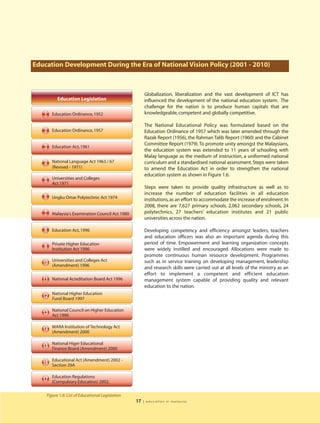
  • 64.
    English for theTeaching of Mathematics and Science (ETeMS) Developments and advances in science and technology had led to the implementation of ETeMS. ETeMS was implemented in 2003 to provide students with early exposure to master these disciplines in English. This is due to the rapid advancements of these disciplines and the predominant availability of references in English. Globalization, liberalisation and advancement of the internet had made English as a necessary tool to acquire knowledge, express ideas and communicate effectively. ETeMS was implemented for Year 1, Form 1 and Lower 6 students in 2003. To ensure a smooth transition and successful implementation of this policy, MOE has taken steps to provide many support programmes such as teacher training, intervention classes, provision of ICT facilities, teaching coursewares and additional textbooks. The MOE constantly monitors the progress of ETeMS and provides continuous support according to current needs. Civics and Citizenship Education Civics and Citizenship Education is a core subject which was introduced in stages in all primary and secondary schools. This subject hopes to develop pupils to become patriotic citizens, who are able to cooperate and work as a team, understand and are tolerant towards other cultures, able to solve conflicts without violence, love and protect the environment and contribute towards the development of citizenship and the nation. MOE hopes that this subject is taught through hands-on and is student-centred. To motivate pupils interest, involvement and interaction among schools, community as well as the student leaders are encouraged. Teachers of this subject are trained at the state level by master trainers who are experts in the field. Co-Curricular Activities Co-curricular activities are regarded as an integral part of the school curriculum as they provide opportunities for students to interact, develop social skills, encourage team building, camaraderie, tolerance and leadership qualities through play and activities.There are three types of co-curricular activities, namely uniformed bodies, societies and sports clubs. It is compulsory for students to participate in at least one uniformed body, a society and a sports club. These uniformed bodies, societies and clubs meet at least once a week. Competitions at school, district and state levels are held to encourage the development of creativity, motivation and leadership among students. School Assessment Assessment is part and parcel of the teaching and learning process. Formative assessment can be conducted to determine and assess students’ achievements at any point in time while summative assessment is conducted at the end of the learning period or school term. • Ujian Penilaian Sekolah Rendah (UPSR) Ujian Penilaian Sekolah Rendah (UPSR) or the Primary School Assesment Test is a national examination taken by all Standard 6 (12-year old) students in Malaysia.The subjects tested in UPSR are Malay Language, English, Mathematics and Science. 46 | education in malaysia
  • 65.
    • Penilaian MenengahRendah (PMR) Penilaian Menengah Rendah (PMR) is a Malaysian public examination taken by all Form 3 students. It was formerly known as Lower Certificate of Education (LCE) and Sijil Rendah Pelajaran (SRP). The examination is conducted at the end of the third year of secondary schooling. Although all students are promoted to Form 4 in the following year, the results of the PMR examination are used to place students either in science, arts or technical streams at the upper secondary level. The results of the PMR examination are also used as basis for placement in residential and technical schools, the Royal Military College as well as other educational programmes offered by the MOE. • Sijil Pelajaran Malaysia (SPM) The Sijil Pelajaran Malaysia (SPM), or the Malaysian Certificate of Education, is a national examination taken by all fifth form students in Malaysia. It is set and examined by the Malaysian Examinations Syndicate (Lembaga Peperiksaan Malaysia). The SPM is equivalent to the British General Certificate of Seconday Education (GCSE), and provides the opportunity for Malaysians to continue their studies to pre-university level. The subjects offered in the SPM Open Certification conform to the subject groupings, that is, the Core Group and the Elective Group in the Integrated Secondary School Curriculum. All six subjects in the Core Group are compulsory for all students. Students have the flexibility to choose subjects in the Elective Group based on their interests, abilities and aptitudes. The MOE has designed two specialised packages of subjects to be offered in the examination. Essentially, the SPM Open Certification examination differs from the earlier system in two aspects, namely, flexibility in the choice of subjects and in the certification method. Certificates awarded will only certify achievements in subjects passed and candidates must at least obtain a pass in the Malay Language. Unlike the earlier system, there will be no overall aggregate and classification of candidates into Grade One to Three. The examination will continue to be centrally administered at the end of secondary schooling and be a requirement for further education or entry into the job market. • Peperiksaan Tinggi Persekolahan Malaysia (STPM) Peperiksaan Tinggi Persekolahan Malaysia (STPM) or the Malaysian Higher Education Certificate is taken by students who continue their education at the Sixth form. This examination is taken at the end of Upper Six level and used as requirement to local and private universities. 47 | education in malaysia
  • 66.
    • Peperiksaan SijilMenengah Ugama (SMU) In the Malaysian education system, there are students who opt for the religious stream which focuses on Islamic studies and the Arabic language. This alternative stream is offered mostly at Islamic Religious Secondary Schools, though some selected secondary schools do offer similar option. • Peperiksaan Tinggi Agama Malaysia (STAM) Peperiksaan Sijil Tinggi Agama Malaysia (STAM) or Malaysian Higher Religious Examination was introduced in 2000 as a result of collaboration between the Ministry of Education Malaysia and Al-Azhar Al-Sharif University of Egypt. The purpose of the examination was to ensure students from the State and Private Religious Schools undergo a common examination system that is accepted at both local and international levels. • Peperiksaan Majlis Lembaga Vokasional Malaysia (MLVK) Vocational training at vocational training centres is an alternative for students who are less academically inclined to further their studies at the secondary level. After two years of training in these centres, all trainees will be assessed by the National Vocational Council (MLVK). MLVK Certificate is accepted nation-wide and trainees who are successful in obtaining the certificate are able to work in their respective fields. MLVK Certificate is accepted and can be used as an entry qualification into tertiary education such as polytechnics and universities. Private Education The progress and historical development of private education in Malaysia is linked to educational reforms in the national school system. Private education began in the 1950s as an avenue for dropouts from the national school system to continue with their studies and obtain school certificates. In the early 1970s, the focus shifted to the provision of pre- university courses.Today, the types of private education institutions registered with the Ministry of Education are as given below : l Kindergartens l Primary Schools l Secondary Schools l Primary Religious Schools l Secondary Religious Schools l Independent Chinese Schools l International Schools l Expatriate Schools l Special Schools l Tuition Centers l Language Institutions, and l Computer Training Centers l Skills/Commerce Training Centers l Postal/Correspondence Skills 48 | education in malaysia
  • 67.
    The policies relatingto the establishment of private education institutions in Malaysia are based on the Education Act 1996 as well as decisions made by cabinet and announcements by the Minister of Education and the Director-General of Education. Statistics of Schools, Teachers and Enrolment by Type of Private Institutions, 2008 Type of Schools Number of Number of Enrolment Schools Teachers Pre-schools 5 096 20 764 339 536 Academic Primary 65 1 247 16 190 Academic Secondary 78 1 193 14 017 Chinese Private Secondary 60 2 849 55 096 Expatriate 13 213 3 153 International 40 1171 13 811 Religious Primary 27 647 8 261 Religious Secondary 14 291 3 267 Tuition Centre 2 369 11 243 199 408 Language Centre 267 1 064 33 470 Computer Training Centre 373 1 115 20 474 Skills Training Centre 513 1 262 37 247 Mind Development Centre 180 988 10 661 Special Education 10 191 913 Correspondence School 1 na 1 405 Total 9 106 44 238 756 909 Table 2.8 : Statistics of Private Education and Agencies Institutions, 2008 Number of Foreign Students in Private Institutions 1995-2008 Year 1995 1996 1997 1998 1999 2000 2001 2002 2003 2004 2005 2006 2007 2008 No. of 360 1 380 3 029 4 745 5 745 5 540 4 544 5 668 4 992 9 819 11 606 13 266 15 172 15 308 Students Table 2.9 : Statistics of Foreign Students in Private Institutions 1995-2008 49 | education in malaysia
  • 69.
    Health, poverty andacademic well-being are intrinsically interlinked. If left neglected and not addressed it would result in a vicious circle that would paralyse all efforts towards progress. Tun Dato’ Seri (Dr) Haji Hamdan bin Sheikh Tahir Director-General of Education Malaysia (1966-1976)
  • 71.
    CHAPTER 3 Educational Assistance and Support Programmes Introduction The aim of educational assistance and support programmes is to prepare students mentally and physically, to excel in the field of curricular and co-curricular activities and to decrease the dropout rate among students from low income families. Among the programmes available are the School Boarding Programme, the Textbook Loan Scheme, the School Health Programme, the Nutrition and Health Programme which include the Supplementary Food Programme and the School Milk Programme, the Counselling and Guidance Programme, the Scholarship Programme, the Educational Assistance for Students With Special Needs, the Poor Students’ Trust Fund and the Tuition Aid Scheme. The objectives of the Ministry of Education (MOE) in establishing the Educational Assistance and Support Programmes are: i. To provide programmes and schemes that assist students to prepare for schooling; ii. To minimise the dropout rate; iii. To improve academic excellence especially among students from low income families; iv. To ensure equal education opportunities for all especially among students from low income families; and v. To ensure the management of education support programmes is efficient and effective. The Textbook Loan Scheme (TBLS) The Textbook Loan Scheme (TBLS) was implemented nationwide since 1975. The scheme cover all levels of education from the primary to the upper secondary education in government schools and government aided schools. The aim of the scheme is to lessen the financial burden of parents from the lower income group and ultimately ensure access to education for every child. In 1983, this scheme was extended to People’s Religious Schools (SMAR). Beginning 2008, the MOE has made a provision to give free textbooks to every student regardless of socioeconomic status. The Textbook Division has introduced innovations in teaching and learning materials by producing CD-ROM alongside the textbooks produced.The CD-ROMs include texts, graphic illustrations, animation, audio, video, interactive multimedia and interactive activities which include simulations, computer games and interactive assessment. The CD-ROMs are also equipped with electronic notebook known as e-journal as a communication tool. Besides ensuring the textbook packages produced are of high quality and concurrent with the curriculum, efforts have also been made to ensure the suitability for the target groups and able to achieve the teaching and learning objectives. Students are given the opportunity to use the CD-ROM in their Malay language, English language, as well as Science and Mathematics classes. 53 | education in malaysia
  • 72.
    The Poor Students'Trust Fund (PSTF) The MOE has set up the Poor Students Trust Fund on 11 April 2003 under Section 10 of the Finance Procedure Act 1957. This is in line with the implementation of the Compulsory Education Policy in 2003 (Section 29A Education Act 1996 [Act 550]). The PSTF was set up to provide financial aid specifically to poor Malaysian children in government and government- aided schools regardless of race and religion. This is in accordance with the Compulsory Education Policy to improve students’ academic excellence. Criteria for Eligibility: l Malaysian students. l Students in government and government-aided schools. l Family income below the level of poverty i.e. RM530.00 and below for Peninsular Malaysia; RM585.00 and below for Sarawak; and RM685.00 and below for Sabah and the Federal Territory of Labuan. l Students at risk of dropout. Types and Rate of Allocation Beginning 2006, the types and rate of allocation are as follow: l Primary School Students Schooling Aid: RM200.00 per year General Aid: RM500.00 per year (RM50.00 per month/10 months) l Secondary School Students Schooling Aid: RM300.00 per year General Aid: RM600.00 per year (RM60.00 per month/10 months) Types and Provision of Aid l The Schooling Aid includes school paraphernalia such as school uniform and stationery provided to students before the start of a new school session. This aid is channelled to the District Education Offices to be distributed to students in their respective schools. l The General Aid is the school allowance given to students for a period of 10 months and is allocated twice a year through the District Education Offices or schools. l The Emergency Aid is the financial aid provided to students who face tragedies such as natural disasters and fire which affect the family’s income. Application for the aid is submitted through schools with the endorsement from the State/District Education Departments.The aid is granted in five to 10 days from the date when the letter of application is received. 54 | education in malaysia
  • 73.
    Allocation of thePoor Students’ Trust Fund (PSTF) 2005-2008 Year Number of Student Total of Amount of Financial Aid 2005 857 319 RM102.87 million 2006 545 386 RM181.58 million 2007 621 108 RM326.81 million 2008 931 673 RM343.16 million Table 3.1: Allocation of the Poor Students’ Trust Fund (PSTF) 2005-2008 Types and Rate of Allocation in PSTF Types of Allocation Rate School fees/examination/hostels Maximum of RM80.00 a year School uniform (one-off ) RM120.00 a year School stationery RM200.00 a year General assistance RM100.00 a year Counseling and Training RM50.00 a year Figure 3.1: Types and Rate of Allocation in PSTF The Tuition Aid Scheme (TAS) The Tuition Aid Scheme (TAS) which was launched on 2 August 2004 is an educational intervention programme targeted for poor students with low academic achievement. The aim of TAS is to provide extra guidance or tuition which is structured for poor students whose achievement is low in the subjects of Malay Language, English Language, Science and Mathematics. The extra classes provided are an effort to improve students’ academic achievement. This scheme is targeted for Malaysian students of Year 4, 5 and 6 in government and government-aided schools from families with monthly income below the level of poverty. With this aid, parents are exempted from the tuition fees. The allocation is channelled directly to schools. The government also provides incentive for teachers who volunteer to give tuition to the selected students to recognise their efforts and contributions. The objectives of TAS are as follow: 55 | education in malaysia
  • 74.
    i. To increase student-teacher contact hour ii. To increase the students’ level of motivation and confidence as well as to enhance their knowledge and basic skills iii. To improve students’ academic achievement v. To bridge the gap of academic achievement among students v. To increase the enrolment rate of poor students at tertiary level. Criteria for Eligibility l Malaysian students. l Students in Year 4, 5 and 6 in government and government- aided schools. l Family income below poverty level i.e. RM530.00 and below for Peninsular Malaysia; RM585.00 and below for Sarawak; and RM685.00 and below for Sabah and the Federal Territory of Labuan. l Students who are refered to by the subject teachers. The Integrated School Health Programme (ISHP) The Integrated School Health Programme (ISHP) is implemented with the assistance of the Ministry of Health. The aim of this programme is to provide various health services to students in primary and secondary schools. This noble effort is based on the rationale: l To coordinate the various health programmes into an integrated programme. l To create a flexible, innovative and creative system to fulfil the school needs. l To create a health programme which can foster a sense of belonging and commitment among the school community. l To create an integrated health programme which has an impact that can be evaluated. l To foster understanding and cooperation between the school and local community in overcoming health issues. l To encourage good health practices through planned and direct efforts. The six thrusts of Integrated School Health Programme (ISHP) towards creating an integrated approach among the public sector, private sector and community are as follow: i. School Health Policy Among the safety policies that can be formulated in school are: l policy for clean and nutritious food in school canteen; l policy for substance abuse (cigarettes and drugs); l policy for first aid; l policy for school safety; l policy for disease control; l policy for school physical environment; 56 | education in malaysia
  • 75.
    l policy for school social environment; l policy for health education; and l policy for the role of school community and society. ii. School Physical Environment A healthy physical environment promotes healthy practices and evades accidents in school. Among the activities that can be implemented in school are to ensure sufficient basic facilities and continuous clean, safe and healthy environment. iii. School Social Environment A healthy and safe social environment helps to shape attitude and practices of the school community in moulding character and resilience. iv. Community Involvement Community involvement is cooperation among school, parents and society in raising the health standards of the school. v. Health Skills Health skills are defined as efforts to promote healthy life style in school. Among the activities that can be implemented are personal hygiene, dental hygiene, physical exercise, healthy diet, the study of human anatomy and physiology. vi. School Health Services The school health services comprise of promotions on health and nutrition, health care, medical referral and placement in special ward by medical doctors and dentists, nursing personnel and teachers to achieve optimum health. The services provided under the ISHP include dental and medical treatment, prevention and control of contagious diseases and free medical kit to schools.Through this programme, schools are able to identify students who need medical treatment such as vaccination, eye treatment, dental treatment, and prevention and control of contagious diseases programme. A medical officer from the neighbourhood health clinic will make visits and scheduled examinations on students. The implementation of Enhancing Students’ Health Programme (Program Peningkatan Kesihatan Murid) in schools has increased collaboration between the MOE and the Ministry of Health. This programme aims to nurture positive habits and attitude among students in everyday life towards a healthy and quality lifestyle. 57 | education in malaysia
  • 76.
    The Supplementary FoodProgramme The aim of Supplementary Food Programme (SFP) is to increase the nutritional value of food consumed by pupils to ensure they receive a well-balanced diet for their physical growth, mental health and general well-being. It is hoped that pupils are more focused on the teaching and learning process through this programme. In 2006, the MOE has spent RM167.6 million for the benefit of 706,712 pupils under this programme. This programme was introduced in 1976 as part of the Food Preparation and Nutrition Programme (Rancangan Amalan Makanan dan Pemakanan) under the Prime Minister’s Department (JPM). This programme was a community development programme focussing on health, agriculture and education. The initial implementation of this programme was targeted for students in primary schools and rural areas. In the early 1980’s, the programme was expanded nationwide when the MOE undertook the management of the programme. Since the 1990s, the main criterion to select pupils under this programme is the family socio-economic status. Selection Criterion l Primary school students from rural areas and whose family income per month is RM400 or less i.e. per capita income of RM80.00. Rate of Allocation l The rate allocated by the MOE beginning 1 March 2007 is RM1.80 per day for students in Peninsular Malaysia and RM2.05 per day for students in Sabah, the Federal Territories and Sarawak. This rate is calculated based on the market rate of raw materials excluding the cost of service, transportation and drinks. The programme is implemented for 190 schooling days in a year. Implementation Strategies l The SFP Committee is given the responsibility to select food suppliers, whose duties include the management of raw materials, preparation and service of food, cleaning of kitchen utensils and tools, and service location.The schools will choose five or ten menus from a list of 20 menus prepared by the Ministry of Health. These menus are rotated every week or every two weeks based on local flavour, seasonality of raw materials and budget allocation. In Peninsular Malaysia, 95% of the food preparation process is handled by the school canteens where students receive food a few minutes before recess time. 58 | education in malaysia
  • 77.
    The School MilkProgramme (SMP) The School Milk Programme (SMP) runs simultaneously with the Supplementary Food Scheme. The programme is targeted for poor students whose family income is below the poverty level. Besides, to ensure students receive a well- balanced diet in school, the programme is also aimed at increasing the quality of health and nutritional value of food for primary students for better physical growth, mental health and general well-being.The SMP also encourages students to consume milk early in their life. In 2006, the MOE spent RM20.6 million for 556,979 students under this programme. The selection criteria for students under this programme are primary school students, especially from rural families, with a family income of RM400.00 and below. The SMP was a collaborative programme between the MOE and milk producers under the concept of Malaysia Incorporated launched in 1983. This program has expanded nationwide beginning 1985 with the exclusion of the state of Sabah as it has its own milk programme. The two schemes under this programme are: i. Paid Milk Scheme which involves participation from primary school students either on voluntary basis or with/without government subsidy; and ii. Free Milk Scheme which supplies milk to selected students. The milk is sponsored by milk companies which collaborate with the MOE and/or non-government organisations (NGO’s) either privately or on voluntary basis. 59 | education in malaysia
  • 78.
    The objectives ofthe programmes are as follow: i. To encourage milk drinking habit among primary school students under the Paid Milk Scheme. ii. To provide milk to selected students from low socio-economic background who are at risk of malnutrition through the Free Milk Scheme . iii. To increase the efficiency of planning, execution, and evaluation of programme with cooperation from other government agencies under the concept of Malaysia Incorporated. iv. To decrease public sector expenditure through the involvement of private sector agencies. v. To increase knowledge, skill and practice especially on food, nutrition, health, and other learning aspects in general. vi. To increase the development of community and food industry which involves the production, processes and supply of milk. The 3K Programme (Safety, Health and Aesthetics) The 3K Programme started in 1991 with the aim to strengthen the school system focusing on school safety, health and aesthetic. The 3K initiatives conducted by the School Division include the School Safety Programme, the Cleanliness and Health Programme as well as the School Aesthetic Programme. The programme is perceived as capable in making schools realise the significance of aesthetics in education which contributes to a conducive teaching and learning environment. Safety, cleanliness, health and aesthetics are contributing factors to providing a rich learning environment. In addition, projects under this programme have enabled schools to foster close relationship with Parent-Teacher Associations and local communities. 60 | education in malaysia
  • 79.
    The Safe SchoolProgramme (SSP) Safe school is defined as a school environment which is free from internal and external threats and where the school community feels a sense of security. In a safe school, each individual should be free from race and gender discrimination, have positive attitude towards others, value individual differences, act and be fair, be cooperative and helpful, practise good behaviour and morality, avoid violent behaviour, abhor physical, mental and emotional abuse, and report all negative incidents. The change in education environment has created a need to identify methods, strategies and models which have the abilities to increase the safety of students and teachers. A planned and reliable safe school policy will increase school security. The development of the Safe School Policy in schools is a collective responsibility of the parents, schools and society. The Safe School Committee comprises of school representatives, parents, government agencies and NGOs. The school administration is responsible in safeguarding the school and formulating safety regulations. Schools must also provide safety training for students and teachers to avoid, control and reduce negative incidents among students. Parents must ensure safety practices are taught at home to enhance the values instilled through the teaching and learning process. The society can manifest the practise of safety by being disciplined, responsible, knowledgeable and resilient. The objectives of the SSP are as follow: i. To enhance understanding of procedures on safety, emergency, accidents and disasters issues. ii. To increase full and total comprehension on safety issues in the planning and implementation of school activities. 61 | education in malaysia
  • 80.
    iii. Tocreate healthy, safe and pleasant environment in school. iv. To ensure individual rights in school are protected. v. To increase the quality of teaching and learning. vi. To prepare guidelines for action taken relating to safety issues. vii. To create a conducive environment for mental and emotional health. viii. To create a more focused school community towards learning and work. ix. To motivate students to contribute positively. It is the aspiration of the MOE that the Safe School concept is implemented in all schools in the country. The implementation of the Safe School Policy will create learning institutions which are free from physical, mental and emotional interferences. The Scholarship Programme The Scholarship Division is responsible for coordinating the MOE scholarship programmes. The division manages the scholarship fund for selected students at primary, secondary and selected tertiary levels. The MOE also provides scholarships to qualified teachers who wish to further their studies at bachelor, master’s and doctorate level in local or foreign universities. This programme is in relation to the aspiration of the MOE in elevating the teaching profession. Besides the In-service Training Programme, the Scholarship Division also provides for students in the Pre-Service Programmes, i.e. programmes which involve providing scholarships to students at first degree level such as the Federal Teaching Scholarship at public institutions of higher learning, Bachelor of Education in Teaching of English as a Second Language (B. Ed.TESL) Twinning Programme and Programme For Excellent Students Abroad. The programmes are open to SPM holders to pursue a bachelor degree in English language (TESL) and critical Science and Mathematics courses in local or foreign universities. In 2008, 500 B. Ed. (TESL) Twinning Programme students and 154 students in the Programme For Excellent Students Abroad were sent to universities in Australia, New Zealand and United Kingdom. Types of Scholarship The MOE is sensitive to the problems of less fortunate students who have the potentials to excel academically. In view of this, scholarships are granted to students with excellent academic achievement from poor family background with an income below RM1000.00 per month. At primary and secondary levels, the students are granted with Federal Minor Scholarship and University Preparatory Class Scholarship. The scholarship programmes include: l the Poor Students’ Trust Fund; l the Federal Minor Scholarship and University Preparatory Class Scholarship; l the Excellent Student Scholarship; l the Federal Teaching Scholarship (Bachelor Degree); and l the B. Ed. TESL Scholarship. 62 | education in malaysia
  • 81.
    Scholarships are alsogranted to teachers and education officers in the MOE. The scholarship programmes include: l the Special Programme Enabling Non-graduate Teachers To Scholarship Programmes for Pupils Attain Degrees (PKPG); l the Federal Training Awards for Education Officers (master l Poor Students’ Trust Fund and doctorate level); l Federal Minor Scholarship l the Post-graduate Programme (unpaid leave); l University Preparatory Class Scholarship l the Programme Enabling School Heads to Attain Degrees l Excellent Student Scholarship (full time); l Federal Teaching Scholarship (Bachelor l the Programme Enabling Non-graduate Teachers of Degree) International Languages to Attain Degrees (French and l Scholarship for Bachelor of Education in German); TESL l the Distance Learning Programme with Open University, Malaysia; l the Graduate Diploma Programme in Drug Abuse; Figure 3.2: Scholarship Programmes l the Special Teaching Certificate Course (KSPK); l the National Professional Qualification for Headship (NPQH); and l the Pre-Service Programmes. Scholarship Programmes under Ministry of Education in 2007 Programme No. of Recipients in 2007 Total Expenditure in 2007 (RM) Million Federal Training Awards for 69 Ph.D 16.52 Education Officers at masters & 352 Masters doctorate Level Federal Teaching Scholarship 1 200 38.85 (Bachelor Degree) at public HEIs/overseas Assistance for Special Education 79 1.40 Students at Polytechnic Assistance for Technical 600 11.88 Lecturers’ Scheme Excellent Student Scholarship 105 3.79 Federal Minor Scholarship 50 088 161.6 University Preparatory 19 399 Class Scholarship Table 3.2 : Scholarship Programmes under Ministry of Education in 2007 63 | education in malaysia
  • 82.
    The Counselling andGuidance Programme The aim of the Counselling and Guidance Programme is to expand the counselling service and career guidance for the benefits of students. The MOE has made a provision that every primary and secondary school must set up a Counselling and Guidance Unit headed by a full-time counsellor. The counselling and guidance services in schools are primarily concerned with safeguarding students’ welfare, providing counselling and career guidance, and organising motivational talks and courses. Some of the programmes organised are short courses for peer counsellors, leadership camps, courses to develop social skills and self-reliance. Invitational talks on career and higher education opportunities are among important services rendered to school leavers. The Emergency Preparedness Programme (EPP) The Emergency Preparedness Programme (EPP) was launched in August 2006 in commemoration of the tsunami disaster that hit SK Seri Kuala in Kuala Muda, Kedah. The EPP is a collaborative programme between the MOE and UNICEF. UNICEF has allotted RM647,500 to the MOE under this program. The aim of the EPP is to equip primary school teachers with knowledge on how to prevail over natural disasters such as flood, tsunami, earthquakes, haze and landslides. The objectives of the programme are: i. to prepare teachers with knowledge and skills on how to face natural disaster through workshops and educational visits; and ii. to foster cooperation between teachers and NGOs to produce School Emergency Preparedness Natural Disaster Manual and School Emergency Preparedness Action Plan. The participants of the programme comprise of primary school teachers, education officers from the Curriculum Development Division, the Teacher Education Division, the Educational Technology Division and the Technology Division of Miri. This programme also involved the cooperation from State Education Department, District Education Office, The Royal Malaysia Police, The Ministry of Health, SMART Team, MERCY and the Red Crescent Society, Malaysia. The activities under the programme were: l a workshop for Natural Disasters Awareness; l a workshop for the writing of the School Emergency Preparedness Natural Disaster Manual; l educational visits to Adelaide and Melbourne, Australia; and l a course on Disaster Prevention In Schools in Kobe, Japan (in-service training in cooperation with JICA, Japan). 64 | education in malaysia
  • 83.
    The School BoardingProgramme School hostels are built to provide convenient accommodation for students especially to those who live in rural and remote areas and whose family earn less than RM1000 per month. The aim is to bridge the gap of quality education between students who live in the rural and urban areas. At present, there are three types of hostels i.e. daily school hostel, centralised school hostel and fully residential school hostel. Day school hostels are built to provide accommodation for selected students of the schools while centralised school hostels are specifically built to provide accommodation to students from a cluster of neighbouring schools. Fully residential school hostels are provided to students who excel academically from rural areas and from low income families. Factors which determine entry into the day school hostel and centralised school hostel are the distance of students’ homes from school and the socioeconomic status of the parents or guardians. Priority is given to students from low income families. Besides getting good accommodation, pupils also receive nutritious food for their physical and mental growth. Hostel facilities are also available in special education schools i.e. three in secondary special education schools and 18 in primary special education schools. In 2008, there are 54 fully residential school hostels nation wide. The Assistance Programme for Students with Special Needs The MOE is always concerned with the requirements of students with special needs. One of the steps taken by the MOE is to ease the financial burden of parents of students with special needs by providing financial assistance of RM25.00 per month. To qualify for this programme, the students must come from families with income of less than RM1000.00 per month. Students with special needs who stay in school hostels are also eligible to receive full aid such as free food and accommodation. The MOE also provides education allowance of RM300.00 per month for students with special needs who are pursuing further education in polytechnics. Other aids include tuition fees as well as free food and accommodation. 65 | education in malaysia
  • 84.
    The Supplementary ReadingProgramme in Sabah and Sarawak (SRP) The Supplementary Reading Programme in Sabah and Sarawak (SRP) is a collaborative effort between the MOE and UNICEF. The aim of this programme is to increase the quality of teaching and learning in primary schools located on islands and remote areas of Sabah and Sarawak. The objectives of the programme are: i. to supply additional and interesting teaching and learning materials; and ii. to inculcate good reading habit among students through the supply of teaching and learning materials to schools. This programme is currently targeted at 25 schools in Sabah which mainly comprise of island schools. Five schools which are from the interior areas in Sarawak are also selected to participate in the programme. The materials provided to the schools are story books and pre-set computers. An allocation amounting RM195,000 was obtained from the UNICEF in 2008 for the provision of reading materials, training of teachers in using the materials, organising reading camps for the project schools and to carry out evaluation research on the programme. The NILAM Programme Nadi Ilmu Amalan Membaca (NILAM) is a reading programme established to recognise and award good reading habits among pupils in school. This programme emerged from the combination or integration of all activities to inculcate the love for knowledge in schools. The programme started in 1999 for Level 1 (primary school) and Form 1/Remove Class (secondary school). Since 2005, efforts have been made to instil reading culture among pupils.The NILAM Programme includes plans to inculcate reading habit continuously through systematic management of reading activities in schools. This reading programme is continuously monitored throughout the year. The aim of the NILAM programme is to inculcate good reading habits among pupils in Malaysia. The objectives of this programme are: i. to produce pupils who are avid readers of quality materials from various fields; and ii. to encourage school to continuously generate creative and innovative ideas in instilling good reading habits among pupils. 66 | education in malaysia
  • 85.
    The NILAM programmeis divided into two levels: Recognition of the Jauhari Level for Primary and i. Level One - Jauhari Secondary Schools The objective of this level is to develop interest in reading and Score Recognition reading skill that is inculcated as a habit. This level requires pupils to participate in activities which encourage reading Primary School planned by the School Resource Centre (SRC) throughout the 90-179 books Bronze year. Pupils’ involvement at this level starts when they are able 180-269 books Silver to master the basic reading skill i.e. in the middle of Year 1. The 270-359 books Gold SRC will loan one book for a period of two weeks to promote reading activities in school. 360 books and above Nilam (Sapphire) Secondary School Pupils are rewarded and given due recognition in accordance 72-143 books Bronze with their level of achievement. The recognition is noted in pupils’ Record Book, School Leaving Certificate and School 144-215 books Silver Testimonial. These can be used as part of the selection criteria 216-287 books Gold into residential school or during the application of scholarship. 288 books and above Nilam (Sapphire) ii. Level Two - Reading Peer (RP) Table 3.3: Recognition of the Jauhari Level for Primary and Secondary Schools The objective of this level is to increase pupils’ participation and usage of materials in promoting reading activities. This level places The Reading Peer (RP) Reward System emphasis on pupils’ ability to guide and attract others’ interest in reading. Pupils who have read 100 books in the Jauhari Level are Score Recognition eligible to enter this level. The level requires pupils to do reading 100-199 Bronze activities with their peers in school with guidance from teachers or 200-299 Silver facilitators. The progress of these activities is tracked formally (in events/competitions) or informally (e.g.: during social work/in class). 300-399 Gold Pupils are trained in workshops and demonstration sessions. At this 400 and above Nilam (Sapphire) level, pupils are given a score based the number of activities they participate in such as storytelling, book talks, borrowing of books, Table 3.4: The Reading Peer (RP) Reward System elocution, drama and discussion. All RP activities are recorded in Reading Peer Book Record and are reviewed and assessed by facilitators. Implementation Strategies The implementation of the NILAM programme at the state level is done by the State Education Department while the secretariat of the programme is the State Education Resource Centre. Activities that are carried out include programme placement, supervision, evaluation and reporting for the purpose of programme modification or improvement. The details on the types of activity and implementation strategies; the role of the school community; the involvement of parents; the types of reading materials; the specification of reading materials; the reading record; the process of monitoring and evaluation; and the various school-based activities are stipulated in the NILAM programme manual. The National NILAM Award This objective of the National NILAM Award (Tokoh NILAM Kebangsaan) is to give recognition to a pupil who has read the highest number of books. The award is presented annually and is under the jurisdiction of the Educational Technology Division which acts as the secretariat for the Main Committee of the Reading Programme. The methods of evaluation used are guided interviews and supervised written test by a panel of professional judges. 67 | education in malaysia
  • 86.
    The School ResourceCentre (SRC) The School Resource Centre (SRC) is a place that provides reference resources and collections of reading materials to the school community and a conducive learning environment for self-learning. Besides the school administrators, the Media and Library Teachers are responsible in the management of the SRC. The Educational Technology Division is responsible for monitoring the role of the SRC and ensuring the effectiveness of the SRC in the teaching and learning processes. Objectives of the School Resource Centre (SRC): l To achieve academic excellence l To inculcate learning habits l To produce teaching and learning materials l To provide learning experience l To ensure use of the facilities at the optimum level l To teach information skills ICT in Education The Computer in Education Programme started in 1999 in 332 schools in the country. The initial objective was to expose pupils to basic computer literacy. In 2002, the Computer Literacy Programme was implemented for Form 1 and 2 students. After five years, the programme was reviewed and ICT in Education Programme was introduced in secondary schools in 2007. With the advancement of ICT in education, the MOE has provided all the technology requirements such as application system and ICT infrastructure to create an effective and efficient management system. Realising ICT as an enabler in the management of education information, the MOE has strengthened various systems and databases through data mining, integrating information systems from all agencies in the MOE and upgrading ICT infrastructure in concurrent with the needs of e-government and e-management. The MOE has outlined three main ICT policies in education which are: i. ICT literacy for students; ii. ICT as a curriculum and teaching and learning tool; and iii. ICT for the improvement of productivity, and the effectiveness and efficiency of management system. The MOE has provided sufficient and the latest ICT infrastructure, and info structure equipped with networking facilities to all levels of organisation to widen its use in teaching and learning, and education management. ICT in education aims at increasing the development of ICT infrastructure, enhancing access and equity for ICT facilities in urban and rural areas, developing and expanding ICT-based curriculum, and enhancing students’ motivation towards learning.The MOE places emphasis on the integration of ICT in teaching and learning process such as in the subjects of Mathematics and Science in addition to increasing the performance in education management. Various efforts have been made to equip students, teachers and personnel with ICT knowledge and skills. The utilisation of ICT has increased the efficiency of the MOE and the growth of research and development in education. ICT in Teaching and Learning The MOE has made initiatives in the use of ICT in teaching and learning through projects such as the Smart School Project, School Access Centres and Making School Smart Programme. In addition, various pilot projects have been 68 | education in malaysia
  • 87.
    implemented to keepabreast with the innovations of ICT. Among the projects are the Strengthening ICT in Schools Programme, the SchoolNet Project in ASEAN Setting, the Technical Integration for Smart Brigade Programme, the Refurbish Computer Pilot Project and the Open Resource System Pilot Project. Educational Television Programme In line with the evolution of technology, the Educational Technology Division (ETD) has broadcasted all educational television programmes using the ASTRO channel. This endeavour enables viewers to watch quality and international programmes. Monitoring activities done by the ETD on educational television programmes on the ASTRO channel has shown positive results. The programmes broadcast are found to be relevant with the topics and objectives of teaching and learning. Pupils are interested to watch the programmes and have shown good response. Subjects such as Malay language, English language, Science and Mathematics have been aired through television. However, in remote areas such as in Sabah and Sarawak, the radio is still one of the main and effective teaching and learning tools used in the classroom. Every year the Educational Television Sector produces a variety of programmes which encompass programmes based on the primary and secondary school curriculum.Two new channels have also been included under this programme i.e.Tech TV and Discovery Travel and Adventure. At present, educational television programmes are being telecast through TV9 channel. Among the types of programmes broadcast are as follow: i. Programmes Based on the Curriculum The programmes comprise school subjects for primary and secondary schools such as Malay Language, English Language, Technical and Vocational, Islamic Education, Mathematics, Science, History, Geography and Moral Education. ii. Programmes Acquired from Private Sector The programmes are purchased from local or international companies such as Science and Technology Application Principles by Bill Nye . iii. Collaborative Programmes The programmes are produced in cooperation between ETD and production companies. Among the various topics produced for educational purposes are career guidance, information technology and pedagogy (to enhance the process of teaching and learning). iv. Lensa TVP Programme The programme highlights current affairs in the education sector around the country v. Bicara TVP and Laman Muda Programme These are educational talk shows which are telecast live from Studio 1, ETD. iv. Special Programme This programme is broadcast through the ASTRO channel via satellite to enable schools around the country including those in remote areas to receive clear transmission of the programmes. Eduweb TV Web TV Project of MOE is a project implemented to bridge the educational gap between the rural and urban areas as well as the remote areas. Teachers are able to preview and watch the selected television programmes; then use them in their teaching and learning process irrespective of the schools’ location and the schedule of the programme. Students throughout the nation are able to access educational learning aids which are hosted into the data centre. The public is also given information on the development as well as various opportunities in national education. 69 | education in malaysia
  • 89.
    Health, poverty andacademic well-being are intrinsically interlinked. If left neglected and not addressed it would result in a vicious circle that would paralyse all efforts towards progress. Tun Dato’ Seri (Dr) Haji Hamdan bin Sheikh Tahir Director-General of Education Malaysia (1966-1976)
  • 91.
    Chapter 4 Tertiary Education Introduction In Malaysia, the National Education System consists of pre-school education, primary education, secondary education, upper secondary (Form Six) education and matriculation colleges as well as tertiary education. Tertiary education is the continuity of the upper secondary school education which includes Community Colleges, Polytechnics, public Higher Education Institutions (HEIs) and private HEIs. The restructuring of the Cabinet on the 27 March 2004 has resulted in the Ministry of Education being divided into two: Ministry of Education (MOE) and Ministry of Higher Education Malaysia (MOHE). The administration of public HEIs, polytechnics and community colleges are being placed under the purview of the MOHE. Tertiary education is considered a catalyst in the government’s effort to supply human resource with first-class mentality to fulfil the need of the workforce from various sectors and occupational fields. These graduates are expected to be of high moral values, competitive, physically, emotionally, spiritually and intellectually balanced, highly knowledgeable and skilful to meet the country’s needs. The aim of tertiary education is to develop students’ critical, creative and innovative thinking to enable them to contribute towards the nation’s progress and ready to compete in the international arena. The MOHE has prepared the National Higher Education Strategic Plan 2007-2010: Beyond the Year 2020 to meet the demands of the higher education transformation requirement in producing human capital equipped with first class mentality and making Malaysia an excellent hub for international higher learning. The plan focuses on the role and function of public and private HEIs, polytechnic, community college and other relevant training providers. To achieve these goals, some transformational steps are taken. This revolves around ensuring the democratization of higher education; facilitating students’ mobility and improving the quality of teaching and learning; building critical mass researchers and continuing the effort to produce academics worthy of Nobel Laureates; creating one or two autonomous apex universities; intensifying internationalisation of higher education; enculturation of lifelong learning; activating critical mass researchers and teachers; and reinforcing the delivery system of MOHE. History of Higher Education In Malaysia Higher education in Malaysia started with the formation of University Malaya (UM) in 1961, followed by the Science University Malaysia (USM) and Tunku Abdul Rahman College in 1969. Since then, the number of public HEIs has increased in the 1970s, 1980s and 1990s. Until 2007, the country has 20 public HEIs with 382,997 students enrolment. Meanwhile, Ungku Omar Polytechnic was the first polytechnic formed in Malaysia in 1969 and currently (2008), there are 27 polytechnics around the country. The formation of community colleges since 2001 has marked a new development in the history of higher education. Their aims are to encourage lifelong learning and to provide training opportunities to local communities. Initially, there were 10 community colleges which have since increased to 37 of them in 2007. The enrolment of students in polytechnics and community colleges stands at 84,250 and 13,758 students respectively in 2007. The private sector has also played an important role in providing education in the country. Initially, private education was only limited to pre-school, primary school and secondary school. The role of private education in providing tertiary education started in the 1950s with the formation of some institutions such as The Goon Institute, The Stamford College and The Kadir Adabi College. 73 | education in malaysia
  • 92.
    The Number ofHigher Education Institutions in 2007 However, this scenario changed in the 1970s when private education developers Institutions Number introduced and offered pre-university courses. Private education continued to thrive in the Public Higher Education Institutions 20 1980s when educational institutions started Private Higher Education Institutions 36 offering overseas courses at certificate, Polytechnics 24 diploma and professional qualification levels. Community Colleges 37 Subsequent development was more obvious in the 1990s where many private HEIs offered Private Colleges 488 their own certificates and diploma Total 605 programmes. The number of private tertiary Source: Ministry of Higher Education Malaysia institutions increased to 521 in 2007 where 17 were given university status, 15 were given Table 4.1 : Number of Higher Education Institutions, December 2007 university colleges status, four foreign branch university campuses, while the rest are private colleges. The role of private HEIs has gone through various changes and is an important alternative for students to gain quality tertiary education in Malaysia. In efforts to provide quality higher education, the Malaysian Qualification Framework (MQF) was introduced at the end of 2007. The main feature of MQF is to promote student mobility from one education program to another through the transfer and standardisation of course credit. The implementation of MQF will simplify course certification at the international level. Community Colleges The aims of community colleges are to provide dynamic and quality education as well as training by: l Organizing and creating alternative path for post secondary; l Organizing and preparing lifelong learning with knowledgeable community development (K-communities); l Providing training for up-skilling and re-skilling for local workforce needs; l Providing strategic networking to encourage socio-economic activities among local customers and stakeholders; and l Providing community-centred facilities and services. Initially, there were ten community colleges in June 2001. In 2008, there are 37 community colleges and 19 branches of community colleges throughout the country. The total enrolment in these colleges is over 15,000 students at certification levels. Under the Ninth Malaysia Plan (9th MP), 25 more community colleges will be built and 30 colleges will be opened on rented premises. Community colleges offer full time as well as short term courses that focus on skills training. Since February 2007, community colleges have begun offering courses at diploma level through the collaborations with private companies. These courses are conducted through work-based learning (WBL). Kuantan Community College 74 | education in malaysia
  • 93.
    Full-Time Courses atCertificate Level in List of Community Colleges in 2008 Community College 1. Kolej Komuniti Arau Perlis l Creative Multimedia (Animation) 2. Kolej Komuniti Bandar Baru Darulaman Kedah l Creative Multimedia (Advertising) 3. Kolej Komuniti Sungai Petani Kedah l Integrated Technology in Manufacturing 4. Kolej Komuniti Kepala Batas Pulau Pinang l Automotive 5. Kolej Komuniti Bayan Baru Pulau Pinang l Draughtsmanship 6. Kolej Komuniti Chenderoh Perak l Building Maintenance 7. Kolej Komuniti Gerik Perak 8. Kolej Komuniti Sungai Siput Perak l Electrical Technology 9. Kolej Komuniti Pasir Salak Perak l Computer Support System 10. Kolej Komuniti Teluk Intan Perak l Hotel and Catering 11. Kolej Komuniti Sabak Bernam Selangor l Fashion and Design 12. Kolej Komuniti Hulu Selangor Selangor l Food Processing and Quality Control 13. Kolej Komuniti Selayang Selangor l Information Technology 14. Kolej Komuniti Kuala Langat Selangor l Business and Accounting 15. Kolej Komuniti Hulu Langat Selangor l Air Conditioning 16. Kolej Komuniti Jempol Negeri Sembilan l Tourism 17. Kolej Komuniti Jelebu Negeri Sembilan l Interior Design 18. Kolej Komuniti Alor Gajah Melaka l Landscape and Nursery 19. Kolej Komuniti Selandar Melaka 20. Kolej Komuniti Bukit Beruang Melaka l Bakery and Confectionary 21. Kolej Komuniti Jasin Melaka l Beauty and Hair Saloon 22. Kolej Komuniti Ledang Johor l Ceramic Industry 23. Kolej Komuniti Segamat Johor Figure 4.1: Full-Time Courses at Certificate Level in 24. Kolej Komuniti Segamat 2 Johor Community Colleges 25. Kolej Komuniti Bandar Penawar Johor 26. Kolej Komuniti Tebrau Johor 27. Kolej Komuniti Rompin Pahang 28. Kolej Komuniti Bentong Pahang 29. Kolej Komuniti Mentakab Pahang List of Skills Training Offered in Community Colleges 30. Kolej Komuniti Kuantan Pahang l Radiography 31. Kolej Komuniti Paya Besar Pahang 32. Kolej Komuniti Kuala Terengganu Terengganu l Occupational Therapist 33. Kolej Komuniti Tawau Sabah l Physiotherapist 34. Kolej Komuniti Kuching Sarawak l Medical Laboratory Technician 35. Kolej Komuniti Mas Gading Sarawak l Dental technician 36. Kolej Komuniti Kulim Kedah l Health Assistant 37. Kolej Komuniti Langkawi Kedah l Pharmaceutical Assistant Source : Ministry of Higher Education Malaysia l Dental Nurse l Dental Surgical Nurse Figure 4.3: List of Community Colleges in 2008 l Community Nurse Figure 4.2: List of Skills Training Offered in Community Colleges 75 | education in malaysia
  • 94.
    Polytechnics List of Polytechnics in 2008 Polytechnic education was introduced in Malaysia through the Colombo Plan in 1969 which resulted 1. Politeknik Ungku Omar Perak in the formation of the first polytechnic, the Ungku 2. Politeknik Sultan Ahmad Shah Pahang Omar (PUO) Polytechnic in Ipoh, Perak. Polytechnic 3. Politeknik Sultan Abdul Halim Mu’adzam Shah Kedah education was emphasized under the Cabinet 4. Politeknik Kota Bharu Kelantan Committee Report (1979) and the National 5. Politeknik Kuching Sarawak Industrial Master Plan (1985-1995). As of 2008, 6. Politeknik Port Dickson Negeri Sembilan there are 27 polytechnics with an enrolment of 7. Politeknik Kota Kinabalu Sabah 84,250 students. The polytechnics now offer 31 8. Politeknik Sultan Salahuddin Abdul Aziz Shah Selangor courses at certificate level and 45 courses at 9. Politeknik Johor Bahru Johor diploma level in the field of engineering, business 10. Politeknik Seberang Perai Pulau Pinang and hospitality. In 2007, the polytechnics have 11. Politeknik Kota Melaka Melaka produced 30,120 graduates at certificate and 12. Politeknik Kota Kuala Terengganu Terengganu diploma levels. Under the 9th MP, seven more 13. Politeknik Dungun Terengganu polytechnics will be built. This is in line with 14. Politeknik Merlimau Melaka polytechnic’s mission to produce quality semi- 15. Politeknik Sultan Azlan Shah Perak professional workforce to fulfil the needs of the 16. Politeknik Sultanah Bahiyah Kedah public and private sectors of the nation, whilst 17. Politeknik Sultan Idris Shah Selangor helping the country realise Vision 2020. 18. Politeknik Tuanku Syed Sirajuddin Perlis 19. Politeknik Muadzam Shah Pahang Smart partnership and collaborative programmes 20. Politeknik Mukah Sarawak with local corporations and overseas institutions of higher learning are made in efforts to make 21. Politeknik Balik Pulau Pulau Pinang courses offered at Malaysian polytechnics more 22. Politeknik Jeli Kelantan competitive internationally. In July 2006, the Source : Ministry of Higher Education Malaysia course in Diploma in Aviation Maintenance was Figure 4.4: List of Polytechnics in 2008 introduced in collaboration with Malaysia Airlines. Public Higher Education Institutes (Public HEIs) The formation of public HEIs has given way to a new dimension and opportunities to more students to acquire tertiary education and prepare them for the job market. The curriculum in public universities has to meet the need of the job market and industry, especially language mastery, communication skills and competencies in science and technology plus the acquisition of knowledge and the latest technology. Co-curricular activities are given due attention and emphasis as an effort to build a balanced human capital and quality workforce. Currently, there are 20 public universities throughout the country which are formed under University and College University Act (AUKU) 1971. The universities are categorized into three groups which are: i. research universities (four) give emphasis to the research discipline; ii. focused universities (12) which focus on the technical, education, management and defence disciplines; and iii. comprehensive universities (four) which offer various courses and field of studies. In 2006, two public HEIs were listed among the best 200 universities in the world as reported in The Times Higher Education Supplement. The public HEIs were the National University of Malaysia (UKM) which ranked at 185 and the University Malaya (UM) which ranked at 192. In efforts to improve the ranking of universities in Malaysia, research 76 | education in malaysia
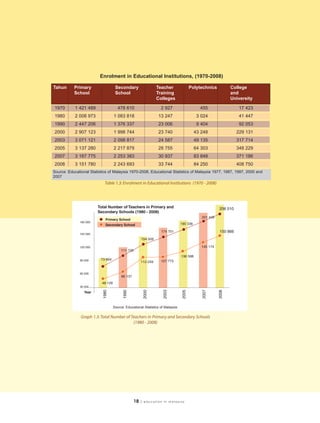
  • 95.
    List of PublicHigher Education Institutes universities are formed to focus on research and innovation activities where the ratio of graduate Research Universities students to post-graduate students is 50:50. l Universiti Malaya (UM) Meanwhile, for focused universities, the ratio of l Universiti Sains Malaysia (USM) graduate students to post-graduate students is 70:30. l Universiti Kebangsaan Malaysia (UKM) Comprehensive universities offer education in l Universiti Putra Malaysia (UPM) various fields and levels. Emphasis are given on providing programmes that offer ‘hands-on’ Comprehensive Universities experience and increasing the number of post- l Universiti Teknologi MARA (UiTM) graduate programmes. l Universiti Islam Antarabangsa Malaysia (UIAM) l Universiti Malaysia Sabah (UMS) There has been an increase in student enrolment in l Universiti Malaysia Sarawak (UNIMAS) public HEIs. This increase relates closely to the 1,384 Focused Universities types of academic courses which are offered in public l Universiti Utara Malaysia (UUM) HEIs that comprise courses at certificate, diploma, graduate and post graduate levels. The enrolment for l Universiti Pendidikan Sultan Idris (UPSI) first degree in the science and technical fields has l Universiti Teknologi Malaysia (UTM) increased compared to other disciplines. This is an l Universiti Sains Islam Malaysia (USIM) encouraging achievement and in line with the l Universiti Darul Iman Malaysia (UDM) objectives of MOHE to improve the enrolment of l Universiti Teknikal Malaysia Melaka (UteM) students in science and technical to 60% by 2010. l Universiti Tun Hussein Onn Malaysia (UTHM) Similar improvement is also seen at all levels of post- l Universiti Malaysia Perlis(UNIMAP) graduate which includes PhD., masters and post- l Universiti Malaysia Pahang (UMP) degree diploma. l Universiti Malaysia Kelantan (UMK) l Universiti Pertahanan Nasional Malaysia (UPNM) The trend in the Malaysian higher education l Universiti Malaysia Terengganu (UMT) enrolment shows that there are more female Figure 4.5: List of Public Higher Education Institutes Based on Categories students than male students. In 2006, there were Source: Ministry of Higher Education Malaysia 204,189 (62%) female students in public HEIs out of the total enrolment of 331,025 students. The high female enrolment is evident at the diploma (58%) and bachelor’s degree (64%) level. Meanwhile, male students form a higher percentage of enrolment in PhD. courses (61%) compared to female students. Public HEIs also offer long-distance programmes to give access to students who do not have the opportunity to attend classes on a full-time basis. These long-distance programmes offer courses at diploma, degree and masters levels. Collaborative programmes between public and private HEIs as well as universities abroad also provide opportunity for Universiti Sains Malaysia students to acquire tertiary education. On average, 90% of the public HEIs expenditure is provided through government grant to fund the annual operating cost while 10% is acquired from the students’ tuition fees. The government encourages the public HEIs to generate their own funds by receiving commission from the products of their research. For this reason, the public HEIs are allowed to establish holding companies to market or commercialize their research findings. In 2007, the total expenditure for operational cost of public HEIs was more than RM6 billion and this expenditure will continue to increase following the establishment of new universities and the establishment of four research universities. 77 | education in malaysia
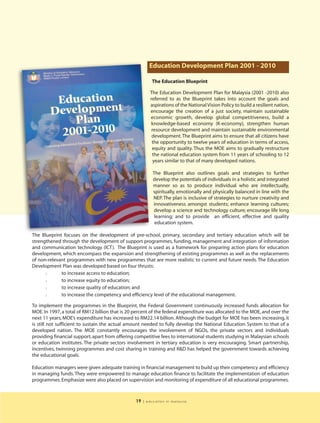
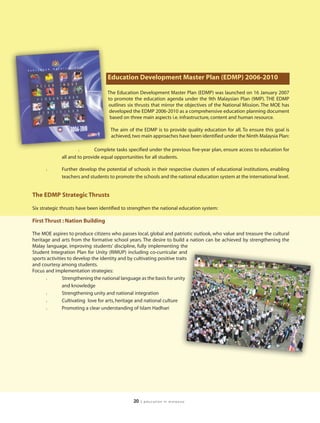
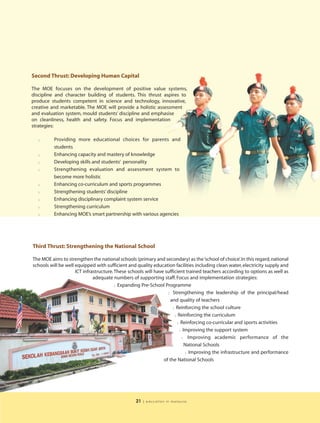
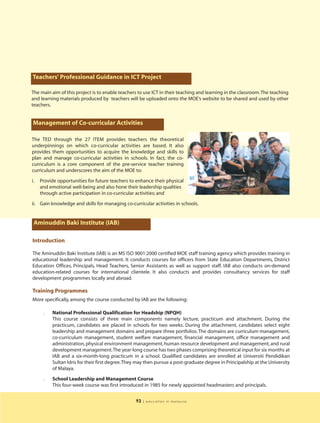
  • 96.
    Private Higher EducationInstitutions (Private HEIs) The development of private higher education in Malaysia started in the 1950s as alternative educational institutions to cater students who did not succeed to secure a place in public HEIs. Some programmes in the private HEIs, especially at diploma level, have received recognition from overseas universities as an entrance qualification in the universities’ final year programmes through credit transfer. Twinning programmes in business, engineering, communication and information technology have been established between the local private HEIs with universities abroad such as in United Kingdom (UK), United States of America (USA), Australia, New Zealand and France. University Tenaga National (Uniten) There are also some private HEIs which have forged collaborative efforts with some local universities in carrying out programmes at diploma and degree level. Due to the tremendous growth of private education, the Private Education Department (formerly the Teacher and School Registration Division) was established in 1995. This department was responsible for: l handling matters regarding the private education institutions from kindergarten to university level; l managing education courses, registration, supervision, monitoring and information gathering; l managing applications to update education courses and private HEIs registration; and l providing more opportunities to pursue tertiary education. After the establishment of MOHE in 2004, the management of Private Higher Education Sector is responsible for the private HEIs in all aspects related to higher education. The implementation of the Act 555 has made it possible for some private universities and branch campuses of foreign universities to be established in Malaysian shores. These programmes provide private HEIs with opportunities to conduct degree courses that are offered by overseas universities in Malaysia. This development shows that trust and recognition are given to the country’s private education system. Until 2007, there are 33 universities/university colleges, four overseas university franchise campuses and 488 colleges that offer a variety of academic and training programmes. The democratization of higher education in the second half of the 1990s has given way to the establishment of bumiputera private HEIs which consist of 180 institutions. Four bumiputera private HEIs were given university and university college status (UNITAR, KUTPM, Twintech University College and Cosmopolitan University College). Almost all bumiputera private HEIs conduct courses as franchise of public HEIs. In addition, 34 bumiputera private HEIs were chosen as the ‘sister’ college or collegiate of UiTM and conduct courses at diploma level. 78 | education in malaysia
  • 97.
    The Malaysian StudentsDepartment The Malaysian Students’ Department (MSD) provides assistance and support in terms of counselling, course work, and medical services to Malaysian students who are studying abroad. Currently, there are 11 MSDs located in UK (London), Egypt (Cairo), Indonesia (Jakarta), Australia (Sydney), USA (Washington D.C., Los Angeles, and Chicago), Canada (Ottawa), New Zealand (Wellington), Jordan (Amman) and Saudi Arabia (Jeddah). The Number of Malaysian Students Studying Abroad (2002-2007) Bil Negara 2002 2003 2004 2005 2006 2007 1. USA 7 359 7 611 5 519 6 411 6 142 5 281 2. Arab Saudi 127 125 125 132 138 125 3. Australia 15 700 15 448 15 434 15 909 14 918 13 010 4. Canada 231 231 196 230 238 312 5. Indonesia 1 337 1 225 1 607 2 444 3 630 4 565 6. Jordan 361 361 310 444 490 655 7. Egypt 4 664 4 330 5 768 6 256 5 780 6 896 8. New Zealand 995 918 1 011 1 338 1 297 1 574 9. UK & Ireland 11 970 11 860 11 041 15 189 12 569 10 10. Others 22 688 2 568 722 11 007 Table 4.2 : Number of Malaysian Students Studying Abroad (2002-2007) Source : Ministry of Higher Education Malaysia Financial Assistance for Students at HEIs Financial assistance is provided for students to further their studies at the tertiary level. This assistance is currently provided by various organizations such as the Public Service Department (PSD), Majlis Amanah Rakyat (MARA), the Tunku Abdul Rahman Foundation, PETRONAS, the Malaysia Telekom Foundation, the Tenaga Nasional Foundation, Khazanah Nasional, as well as state foundations and state governments. The National Higher Education Fund Corporation (NHEFC) is the biggest education financial body for public and private HEIs students. Currently, the Employment Provident Fund (EPF) is the largest financier to NHEFC. In tandem with the increase in student enrolment in HEIs, the number of NHEFC borrowers has also increased. In 1997, 11,279 students received a total of RM206.24 million in education loans from NHEFC. In 2006, a total of 130,323 students had taken loans from NHEFC amounting to RM2.729 billion. The number of applicants has increased annually. Currently, the total amount of funds allocated to NHEFC is RM19 billion while the total cumulative loan disbursed is more than RM13 billion. The amount of loans needed continue to increase exponentially and as of December 2007, the amount committed by NHEFC comes to a total of RM22.2 billion and projected sum of loan to be disbursed is RM70.0 billion by 2020. The NHEFC has provided loans to 1,110,091 students since 1997. The NHEFC also provides the following financial assistances: l Allowance for the disabled students l Allowance for community college students l Financial assistance programme for matriculation students l Education Loan. 79 | education in malaysia
  • 98.
    • Allowance forthe Disabled Students Special allowance is given to disabled students in higher education institutions under the jurisdiction of MOHE. The amount of the allowance is RM300.00 per month. The criteria for the special allowance are as follow: l Disabled students who are registered with the Social Welfare Department l Disabled students who receive education loan l Disabled students who are attending courses approved by Malaysia Qualification Agency (MQA) and Public Service Department (PSD) • Allowance for Community College Students This allowance is given to community college students at the certificate and diploma level for the duration of four semesters at the certificate level and a further three semesters at the diploma level. The fixed rate of financial assistance given is RM250.00 per month and the maximum amount of financial assistance is RM6,000.00 for certificate courses (4 semesters) and an additional of RM4,500.00 for diploma courses (3 semesters) in community colleges. • Financial Assistance Programme for Matriculation The financial assistance for matriculation students started on the semester of 2005/2006. The matriculation students involved are from: l Universiti Islam Antarabangsa (UIA); l Universiti Teknologi Mara (UiTM); l Universiti Malaya; l Kolej Universiti Islam Malaysia (KUIM); l Universiti Putra Malaysia (UPM); and l Universiti Pertahanan Nasional Malaysia (UPNM). This programme includes: l Pocket Money - RM1,000.00 per semester l Study Fees - RM350.00 per semester l Lodging Fees - RM300.00 per semester l Travelling expenses for students from Sabah and Sarawak 80 | education in malaysia
  • 99.
    • Education Loan Educationloan is provided for polytechnics and community college students at the certificate and diploma level. The total amount offered is RM6,000.00 per student. Promotion for Tertiary Education The aim of promoting tertiary education is to encourage students from other countries to further their higher education in Malaysia. Efforts to attract these students are made in countries such as Indonesia, Saudi Arabia,Vietnam, China and other countries. On 1 October 2003, the MOHE has established the Malaysian Education Promotion Centre in countries such as Indonesia (Jakarta), Saudi Arabia (Dubai), Vietnam (Ho Chi Minh City), and China (Beijing). In 2007, a seminar on Malaysia Higher Education was organized in Dubai with the participation of 14 major universities from Malaysia. The National Higher Education Strategic Plan: "Beyond 2020" The National Mission which was announced on 31 March 2006 emphasised the second phase of the government’s effort to towards achieving the status of a developed nation as envisioned in Vision 2020.The second thrust of this mission focus on raising the capacity for knowledge and innovation as well as developing human capital with first class mentality to face challenges in the knowledge-based economy and the innovation field in the 21st century. The desired human capital should excel in education, be skilful and possess towering personalities. In relation to these needs, the National Higher Education Strategic Plan which was launched on 27 August 2007 by the Prime Minister. It was formulated with a vision to transform higher education in the context of establishing Malaysia as an international hub of higher educational excellence. The National Higher Education Strategic Plan is prepared with the aim of producing human capital that supports the thrusts of the National Mission in order to improve knowledge capability and the nationís innovations, as well as to inspire human capital with first class mentality. This Mission aims to produce world class universities and high quality graduates to meet the needs of the market. In continuation to the Educational Development Master Plan (EDMP) 2006-2010, tertiary education will train students into human capital that are par excellence. Human development programmes which include teaching of communication and English language skills, exposure to entrepreneurship and capacity building, as well as character building will be emphasised under this plan. The higher education system moves in accordance to changes in the global scenario. Factors that necessitate change, among others, include democratization of higher education, diversification of institutions and service providers as well as changes in higher education funding and investment. The evolution and transformation of the higher education system are further promoted with improved quality, relevant curriculum and efficient delivery system which would produce quality graduates who can contribute to the community. 81 | education in malaysia
  • 100.
    The National HigherEducation Strategic Plan Implementation Phase Phase I : 2007-2010 (Laying the Foundation) Phase II : 2011-2015 (Strengthening and Enhancement) Phase III : 2016-2020 (Excellence) Phase IV : Beyond 2020 (Glory and Sustainability) Figure 4.6: The National Higher Education Strategic Plan Implementation Phase The National Higher Education Strategic Plan outlines seven strategic thrusts which forms the foundation for the development of the National Higher Education till the year 2020. They are as follows: First Thrust : Widening of Access and Increasing Equity Second Thrust : Improving the Quality of Teaching and Learning Third Thrust : Enhancing Research and Innovation Fourth Thrust : Strengthening of Higher Education Institutions Fifth Thrust : Intensifying Internationalisation Sixth Thrust : Enculturation of Lifelong Learning Seventh Thrust : Reinforcing Delivery Systems of the Ministry of Higher Education 82 | education in malaysia
  • 101.
    National Higher EducationStrategic Plan Thrust 3 Thrust 2 Enhancing Research and Innovation Improving the Quality of Teaching and Learning - To develop critical mass of researchers Thrust 1 - National policy on industrial internship for (100 RSE per 10,000 workforce) Widening of Access and Increasing Equity students and attachment for lecturers - Six (6) Research Universities - Democratisation through diversified meritocracy (50% - Periodical improvement of curriculum, interactive - 20 world class Centres of Excellence Access in tertiary education and 33% workforce with learning - Innovation culture among students tertiary qualification) - Versatility and marketability of graduates - 10% research findings are comercialised - Higher Education Human Capital Development Fund- - 100, 000 PhD or equivalent prestige scholarship (specific group) Thrust 4 Strengthening of Higher Education Thrust 7 Institutions (HEIs) 83 Reinforcing Delivery Systems of MoHE - One to two Apex Universities - MoHE as a facilitator among existing HEIs - Best delivery systems - Three HEIs among top 100 and one - Effective implementation and in the top 50 of the world monitoring renowned universities - KPI-perfomance-based - Autonomy with Key Perfomance - Prudent spending of government allocation Indicator under MoHE - Selection of top management Public - 75% lecturers with PhD qualifications HEIs based on merits - towering - Rating of HEIs based on KPI | education in malaysia personality Thrust 6 Thrust 5 Enculturation of Lifelong Learning Intensifying Internationalisation - Recognition of lifelong learning through MQF - Collaborative networking with foreign HEIs - Recognition of Prior Learning Experience - Average 10% overall enrolment are international students, - Increase participation of lifelong learning by adults especially in Private HEIs - Alternative pathways and programme mobility - 5% international students in competitive courses - Sending students for post doctoral studies in renowned international universities - 15% international teaching staff at Research Universities - Student mobility with credit transfer - Malaysian International Scholarship Figure 4.7 : The National Higher Education Strategic Plan
  • 103.
    It is ourdesire not only to produce quality teachers but to ensure that they remain in service and continue to contribute with excellence to the National Education System Y.B. Dato’ Seri Hishammuddin bin Tun Hussein Minister of Education Malaysia
  • 105.
    CHAPTER 5 Teacher Education Introduction The Teacher Education Division (TED) is the main teacher training agency of the Ministry of Education (MOE). It is responsible for the training of both primary and secondary school teachers in the country through its 27 institutes of teacher education. While the main focus is on the preparation of pre-service teachers, these institutes also offer short courses for in-service teachers. In addition to the 27 institutes, the TED has also set up the English Language Teaching Centre (ELTC), a specialist institution for the training of in-service English language teachers. ELTC offers training courses for both in-service English teachers and administrators at national and regional levels. The TED will be setting up six in- service centres to meet the growing demand for continuous professional development of teachers. These training institutions provide a comprehensive range of courses at certificate, diploma and basic degree levels. These courses are founded on the principles enshrined in the National Philosophy of Education and the Philosophy of Teacher Education and are aimed at producing teachers who are knowledgeable, who possess high moral values, are competent users of technology and are ethical, responsible, resilient, context-sensitive and context-adaptive professionals. It is hoped that teachers with these outstanding personal and professional attributes will become effective and efficient providers of education. Historical Background The first national teacher training initiative started in 1878 with the founding of the Singapore Malay Teachers College in Singapore. Then, in 1900 the Malacca Malay College was formed with an intake of 24 trainees.The TED has therefore been involved in teacher training for more than 80 years. By 1990, the TED has a total of 31 teacher training colleges (TTCs) under its purview. With the relocation of some colleges, the TED has now 28 institutions of teacher education. In the early years, basic pre-service teacher training was provided only at the certificate level. It was only in the 1990s that a twinning programme was started with the collaboration of five United Kingdom institutions for the training of English language teachers at degree level. In 1996, the basic certificate level programme was upgraded to diploma level. The salary scheme of all serving certificate level teachers was readjusted to the pay International Languages Teacher Education Training scheme of diploma teachers. On 13 July 2005, the Cabinet approved Institute (ILITE) the upgrading of TTCs to Institutes of Teacher Education Malaysia (ITEM). With the change in status, ITEM are now able to conduct basic degree level teacher training courses and will eventually be conferring degrees of their own. 87 | education in malaysia
  • 106.
    List of Institutesof Teacher Education Malaysia (ITEM) No. Teacher Education Institute (TEI) State 1 Institut Perguruan Temenggong Ibrahim Johor 2 Institut Perguruan Sultan Abdul Halim Kedah 3 Institut Perguruan Kota Bharu Kelantan 4 Institut Perguruan Perempuan Melayu Melaka Melaka 5 Institut Perguruan Raja Melewar Negeri Sembilan 6 Institut Perguruan Tengku Ampuan Afzan Pahang 7 Institut Perguruan Ipoh Perak 8 Institut Perguruan Persekutuan Pulau Pinang Pulau Pinang 9 Institut Perguruan Gaya Sabah 10 Institut Perguruan Tawau Sabah 11 Institut Perguruan Kent Sabah 12 Institut Perguruan Keningau Sabah 13 Institut Perguruan Miri Sarawak Sarawak 14 Institut Perguruan Rajang Sarawak 15 Institut Perguruan Batu Lintang Sarawak 16 Institut Perguruan Kuala Terengganu Terengganu 17 Institut Perguruan Sultan Mizan Terengganu 18 Institut Perguruan Bahasa-bahasa Antarabangsa Kuala Lumpur 19 Institut Perguruan Islam Selangor 20 Institut Perguruan Darulaman Kedah 21 Institut Perguruan Bahasa Melayu Malaysia Kuala Lumpur 22 Institut Perguruan Ilmu Khas Kuala Lumpur 23 Institut Perguruan Teknik Kuala Lumpur 24 Institut Perguruan Tuanku Bainun Pulau Pinang 25 Institut Perguruan Tun Hussein Onn Johor 26 Institut Perguruan Tun Abdul Razak Sarawak 27 Institut Perguruan Perlis Perlis Source : Teacher Education Division, Ministry of Education Malaysia Table 5.1 : Institutes of Teacher Education Malaysia (ITEM) Pre-service Teacher Education Pre-service courses are open to GCE ‘O’ level equivalent MCE school leavers and also to university graduates. The basic academic requirements and duration of study are dependent on the courses offered. The pre-service courses which are offered by the TED and conducted by the ITEM are: the Post-Graduate Teacher Training Course; the Degree Programme for MCE-level school leavers and the Malaysian Teaching Diploma Course. 88 | education in malaysia
  • 107.
    A. The Post-GraduateTeacher Training Programme The courses under this programme which have been implemented since 2006 are: i. The full-time post-graduate Teacher Training Course ii. The full- time j-QAF post-graduate teacher training course for primary school teachers for the teaching of Jawi, Al-Quran, Fardu ‘Ain and the Arabic language. iii. The post-graduate teacher training course for government-aided religious schools iv. The post-graduate teacher training course for Acheh teachers. (This is a Government-to-Government initiative by the Ministry of Education, Malaysia to help develop a pool of teachers to replace those who perished in the tsunami which devastated parts of Indonesia in 2006). v. The degree-level Special Education Teacher Training Course B. Teacher Training Programmes for SPM/MCE School Leavers There are four courses available for GCE ‘O’ equivalent SPM-level school-leavers. These are: i. Bachelor of Education Programme (B.Ed.) The first intake of 1500 students for the Bachelor of Education programme was in July 2004.The training period is five-and-a-half years, inclusive of a one-and-a-half year Foundation Course. As of July 2007, a total of 6117 students have completed the Foundation Course and 3532 students have begun the four-year First Degree programme in the 27 ITEM. ii. Bachelor of Education (B.Ed.TESL) Programme The B.Ed TESL programme is a collaboration between the Ministry of Education (MOE) and local as well as foreign institutes of higher education, The candidates for this course are those with excellent results in the Malaysian Certificate of Examination. This is a long-term collaborative venture and the first intake for this six- year programme was in 2002. The last intake was in 2006. Trainees on this six-year programme undergo a two- year Foundation Course and upon successful completion, begin a four-year degree programme. Seven local institutions of higher education and three foreign institutions are involved in this programme.The foreign partners in this link programme are the University College of St. Mark and St. John (United Kingdom); Queensland University of Technology, Macquarie University (Australia);Victoria University of Wellington and the University of Auckland (New Zealand). iii. The Teacher Training Programme for Excellent Students (Overseas) Programme The candidates for this programme are selected from amongst students who excelled in the (‘O’ Level equivalent) SPM examinations. They pursue a first degree in one of the following disciplines: physics, chemistry, biology, English, and Special Education (in Clinical Psychology, Occupational Therapy, Speech pathology and Audiology).They are sent to established universities in the United Kingdom and New Zealand. Upon completion of their degree, these graduates will return home to pursue a one-year Post-Graduate Teacher Training Course in local institutions before being appointed as teachers. iv. Teaching of Foreign Language Overseas Link - Programme There are two programmes involved, as follows : a) Bachelor of Arts in the Science of Language and Information (French as a Foreign Language) Programme This is a link-programme established by the MOE with the University of French-Comte, France. A total of 15 students are selected annually for a two-year preparatory course at the International Languages Institute Teacher Education Institute (ILITE), following which they enrol on a four-year programme. They spend three years at the French-Comte University and the final year at the International Languages Teacher Education Institute (ILITE) to obtain this degree. 89 | education in malaysia
  • 108.
    b) Bachelor ofEducation in German Language and Linguistics Programme This six-year programme includes a two-year foundation programme and a four-year degree course. Students on this programme spend one year of the foundation course studying German at the ILITE and another year at the Goethe Institute in Germany. They then spend a further three years at the University of Malaya and a final year at ILITE before being awarded their degrees. v. Malaysian Diploma in Teaching Programme The two courses under this programme aim to equip future teachers with pedagogical skills and content knowledge. These courses are: a) The In-service Course for Government-Aided Religious School Teachers b) The Pre-school Teacher Training course for “TABIKA KEMAS” teachers (sponsored by the Ministry of Rural- Urban Development) and for “TABIKA PERPADUAN” teachers sponsored by the Department of National Integration and Unity. The table below summarizes the information presented above. Pre-service Courses in Institutes of Teacher Education Malaysia No Level Programme Duration Target 1 B.Ed.(TESL) twinning programmes School with local and foreign higher education institutions of leavers with Degree higher education SPM leavers Bachelor of Education (International Languages) Programme 5.5 years qualifications Teaching of a Foreign Language Overseas Link - Programme 2 Full Time Post Graduate Teacher Training Course for Primary and Secondary Teachers 1 years First Degree Post Graduate Post Graduate Teacher Trainig Course for Primary School Holders Teachers (school-based training mode) 1.5 years (minimum) Post Graduate j-QAF Teaches Training Course School 3 Diploma Full Time Malaysian Teaching Diploma Course Leavers Malaysian Diploma in Teaching Course 3 years Having SPM (using the School-based Training Mode) qualifications Table 5.2: Pre-service Courses in Institutes of Teacher Education Malaysia 90 | education in malaysia
  • 109.
    In-service Teacher Education In-servicetraining is very important for the personal and professional development of teachers. It provides them the opportunity to be informed about the latest developments in education in general and in particular, their areas of specialization. It enables teachers to be updated and upskilled so that they are better able to discharge their professional duties in line with current developments. It keeps teachers informed of government goals, concerns and initiatives for education. It also creates awareness of the ensuing demands on them as well as the impact these will have at the chalkface. In-service Training Centres i) English Language Teaching Centre (ELTC) With the ever growing demand and need to produce a high quality teaching force, the TED has set up with the approval of the Cabinet, a specialist centre in 2002 to upgrade serving English language teachers in terms of pedagogical content knowledge and skills. ELTC offers a range of short and long-term customised in-service courses for teachers and officers as well as consultancy services for the MOE and countries in the region. ELTC also sets standards for the teaching of English in the classroom and in ITEM. It is set to be the point of reference for English language teaching in the country. ii) In-service Teacher Training Centres Six (6) in-service centres have been proposed in six different geographical zones to provide needs-based training to teachers within the zone. Courses provided are of very short duration. In-service Training programmes Various in-service programmes employing a variety of suitable and effective training modes to raise the professional competence of teachers and improve students’ academic performance have been implemented. These include the following: a) Teachers’ Professional Improvement Programme (short courses) b) Teachers’ Professional Improvement Programme (long courses) c) Teachers’ Academic Improvement Programme d) Rural School Teachers’ Out-Reach Programme 91 | education in malaysia
  • 110.
    In-service Courses No. Level Programme Duration Target 1 Academic A degree programme for non-gradute/Teacher 3 years Improvement Training College-trained teachers A degree programme in the teaching of on 1-3 years In-service International Language (French, Japanese and German) Teachers 2. Professional Enhancing learning through effective co-curricular Long Term and Improvement planning and implementation Short Term Table 5.3: In-service Programmes i. Short-term professional development programmes for teachers include: l In-service Courses for Smart School Teachers - These courses were implemented in 2006 by all ITEM throughout the nation. Subjects include Malay Language, Islamic Education, Living Skills, History and Local Studies l English for the Teaching Mathematics and Science Courses first conceptualised and introduced by the English Language Teaching Centre, Malaysia (ELTC). The Teacher Education Division is responsible for improving the proficiency of Maths and Science teachers who have to deliver the curriculum in English. l The Smart School Course - The course for Smart Schools was introduced in 1998 and offered to teachers who have basic computer skills The main aim of this course is to enhance teaching and learning using ICT tools and skills. ii. Long-term professional development programmes for teachers include the various one-year Specialist Teaching Certificate courses and the 14-week professional development courses. iii. Academic qualification enhancement programmes for teachers include: l A Degree Programme for Non-Graduate Teachers: Candidates for Science, Information Technology, Interactive Multimedia, Engineering and TESL Degree programmes attend 14-week foundation courses at various ITEM. Upon successful completion, they follow a three-year degree programme with a 1 + 3 structure. The first year of the degree is done in the ITEM and the remaining two years, in the twinning university. l A Distance Learning Degree Programme by Open University Malaysia (OUM): This programme was introduced to overcome the shortage of graduate secondary school teachers especially in critical subjects. iv. Out-reach programmes for rural school teachers include: l Professional Enhancement Projects for Rural School Teachers using the “Persiangan Salinatan” Model: The purpose of this project is to encourage and motivate teachers to develop a context-adaptive indigenous pedagogy. Emphasis is given to the development of numeracy, literacy, science, English and the use of ICT. l The Orang Asli and Penan (Indigenous Peoples) School Adoption Programme: The aim is to help the Orang Asli (indigenous) and Penan pupils acquire basic literacy and numeracy. A variety of approaches, strategies, and modules are used to enable them to acquire these basic skills. 92 | education in malaysia
  • 111.
    Teachers' Professional Guidancein ICT Project The main aim of this project is to enable teachers to use ICT in their teaching and learning in the classroom.The teaching and learning materials produced by teachers will be uploaded onto the MOE’s website to be shared and used by other teachers. Management of Co-curricular Activities The TED through the 27 ITEM provides teachers the theoretical underpinnings on which co-curricular activities are based. It also provides them opportunities to acquire the knowledge and skills to plan and manage co-curricular activities in schools. In fact, the co- curriculum is a core component of the pre-service teacher training curriculum and underscores the aim of the MOE to: i. Provide opportunities for future teachers to enhance their physical and emotional well-being and also hone their leadership qualities through active participation in co-curricular activities; and ii. Gain knowledge and skills for managing co-curricular activities in schools. Aminuddin Baki Institute (IAB) Introduction The Aminuddin Baki Institute (IAB) is an MS ISO 9001:2000 certified MOE staff training agency which provides training in educational leadership and management. It conducts courses for officers from State Education Departments, District Education Offices, Principals, Head Teachers, Senior Assistants as well as support staff. IAB also conducts on-demand education-related courses for international clientele. It also conducts and provides consultancy services for staff development programmes locally and abroad. Training Programmes More specifically, among the course conducted by IAB are the following: l National Professional Qualification for Headship (NPQH) This course consists of three main components namely lecture, practicum and attachment. During the practicum, candidates are placed in schools for two weeks. During the attachment, candidates select eight leadership and management domains and prepare three portfolios. The domains are curriculum management, co-curriculum management, student welfare management, financial management, office management and administration, physical environment management, human resource development and management, and rural development management.The year-long course has two phases comprising theoretical input for six months at IAB and a six-month-long practicum in a school. Qualified candidates are enrolled at Universiti Pendidikan Sultan Idris for their first degree.They may then pursue a post-graduate degree in Principalship at the University of Malaya. l School Leadership and Management Course This four-week course was first introduced in 1985 for newly appointed headmasters and principals. 93 | education in malaysia
  • 112.
    l Special Degree Programme for Headmasters List of Courses Offered in IAB This degree programme is designed to improve the academic and professional standards of headmasters and MOE officers. It is in line with the policy to have 50% graduate teachers in primary schools by l Staff Development 2010. This programme, started in 2005, involves eight public higher l Finance Management education institutions namely, Universiti Pendidikan Sultan Idris; the l Organisational Counselling National University of Malaysia; the International Islamic University of l Quality Management and MS ISO 900 Malaysia; University of Malaysia, Sabah; University of Technology, l Management in TESL Malaysia; University of Northern Malaysia; MARA University of l Management in Community Technology and the Tun Hussein Onn University. In 2006, a total of 473 Education headmasters were selected to follow this programme. They are l Management in Evaluation of expected to get their first degree in leadership and management by Educational Programme 2009. It is compulsory for these headmasters to attend intensive l Strategic Management lectures for three years. There are four lecture modules a year and each l Management in Peer Group lecture module lasts four weeks. Besides attending lectures, they have Counselling to fulfil their usual responsibilities at school. l Management in Human Resource l Short-Term Courses l Management in Parenting These courses are designed based on the operational needs of the Education school leaders and managers. The main aim is to groom a second l Workshop in Writing of Cases in echelon of educational leaders. Short-term courses vary from one to Educational Management two weeks in duration. These courses focus on writing, research, evaluation, fitness, language as well as curriculum and institution Figure 5.1: List of Courses Offered in IAB management. Other institutions which implement teacher education programme are: Courses Offered in Master of i. University Pendidikan Sultan Idris Education Programme ii. University of Malaya l Studies in Malay Language • Universiti Pendidikan Sultan Idris (UPSI) l l Studies in Malay Literature Studies in TESL l Curriculum management and Universiti Pendidikan Sultan Idris (UPSI) has a Development long history of involvement in teacher l Testing and Evaluation in education. It was founded by R.O.Windstedt Education in 1917 as the Sultan Idris Teaching College. l Pedagogy Then, in 1959 the name was changed to l Educational Psychology Sultan Idris Teacher Training College and it l Educational technology only trained Malay teachers for primary l Guidance and Counselling schools. In 1997, it was upgraded and is now l Information technology a full-fledged university. l Mathematics l Educational Science: Physics, Chemistry and Biology l Science l Business Management and Accountancy l Arts l Music l Sports Science Figure 5.2: List of Courses Offered in Master of Education Programme in Universiti Pendidikan Sultan Idris (UPSI) 94 | education in malaysia
  • 113.
    University of Malaya In 1999, the National Principalship Centre of the University of Malaya started its Masters programme on Principalship. This centre which is now known as the National Principalship Institute conducts this masters course as a full-time, 12- month and 42- credit programme. Courses Offered in Principalship Programme at the Master Level l School Management l Legal Aspects in Eucation Management l School Leadership l ICT for School Management l Research and Statistics l Instruction and Supervision l Human Resource Management in Education l Project Management l Management of Individuals’ Development l Issues in Education and School l School Finance and Account Management Management Figure 5.3: List of Courses Offered in Principalship Programme at the Masters Level Teachers' Welfare Teachers are provided with staff quarters in remote, rural and urban areas. New housing complexes are continually being built and existing ones renovated. Where possible, new staff housing is sited near schools. Teachers can also make use of loan facilities to buy personal computers. • Teachers’ Quarters Government housing for teachers has been built using a number of housing development packages. These include : l Privatisation of teachers’ quarters project l Turnkey pilot project (phase 2) l Turnkey project (phase 2A) l Direct purchase of teachers’ quarters project l Limited tender teachers’ quarters building project (Miri) l Public Works Department teachers’ quarters building project 95 | education in malaysia
  • 114.
    • Special Allowancefor Teachers in Rural/Remote Areas The MOE decided that a total of 872 teachers in remote areas throughout the nation are entitled to receive a special rural allowance which varies from RM500, RM1000 and RM1500 depending on the location. • Excellent Teachers l The Appointment of Super Principals (JUSA C & DG 54) In its efforts to enhance the teaching profession, the MOE has created Premier Grade C and DG 54 posts for school principals. l Quota-based Posts for Excellent Teachers The MOE has also created the post of Excellent Teacher at the DG32, DG44 and DG 48 grades. The rationale for the excellent teacher post is to raise teacher performance and enhance credibility. Excellent teachers are role models who inspire other teachers to improve their performance and teaching quality. • Award for Innovative Teachers The Innovative Teacher Award was first introduced for the purpose of encouraging as well as acknowledging teachers’ efforts in producing innovations that help to improve the teaching and learning processes in classrooms. This award is divided into three categories namely, primary school (individual), secondary school (individual) and group. In addition, a special award is also be given to the winner from among these three categories. The winner of this Innovative Teacher Award is announced during the national level Teacher’s Day Celebrations. • Expert Teachers Expert teachers are those who are recognized as specialists in specific subjects and are active in co-curricular activities. The selection is based on the evaluation and recommendation of the School Inspectorate. These expert teachers are placed on a higher salary scale and are expected to assist teachers in their own specialist area. 96 | education in malaysia
  • 115.
    Teachers' Day 16 Mayhas been gazetted as Teacher’s Day to commemorate the date in 1956 when the Federal Legislative Council accepted the Report of the Education Committee and recognized it as laying the foundation of the National Education Policy. The objective of Teachers’ Day are as follows: i. To highlight teachers’ roles in nation-building and national development. ii. To create awareness of the important role of teachers in Malaysian society among parents, students and the wider public. iii. To encourage unity and harmony among teachers. iv. To enhance the teaching profession. v. To improve teachers’ efficacy through conferences, seminars and other events conducted on Teacher’s Day. 97 | education in malaysia
  • 117.
    The challenges offuture education organizations require objectives, perspectives, vision and commitment. The effectiveness is best measured and controlled by local initiatives and accountability. Dato’ Seri Dr. Abdul Shukor bin Abdullah Director-General of Education Malaysia (1998-2001)
  • 118.
    Y. B. Dato’Seri Hishammuddin Tun Hussein Minister of Education Malaysia Y. B. Dr. Ir. Wee Ka Siong Y. B. Dato’ Razali Ismail Deputy Minister of Education I Deputy Minister of Education II Y. Bhg. Tan Sri Dr. Zulkurnain Haji Awang Y. Bhg. Dato’ Hj. Alimuddin Hj. Mohd Dom Secretary - General Of Education Director- General of Education Y.Bhg. Datuk Haji Kamaruzaman Y. Bhg. Datuk Fatimah Md. Deni Hj. Mohd Noor Deputy Secretary - General Deputy Secretary - General (General Development) (General Management) Y. Bhg. Dato’ Hjh. Noor Rezan Y. Bhg. Dr. Haili Dolhan Y. Bhg. Datin Asariah Bapoo Hashim Deputy Director - General Mior Shaharuddin Deputy Director - General (General Policy & Educational Deputy Director - General (General Education Operations) Development) (General Professional Development) 100 | education in malaysia
  • 119.
    2OO8 MINISTER OF EDUCATION Y.B. Dato' Seri Hishammuddin Tun Hussein DEPUTY MINISTER I DEPUTY MINISTER I Y.B. Dr. Ir. Wee Ka Siong SECRETARY-GENERAL Y.B. Dato' Razali Ismail PTD TURUS III Tan Sri Dr. Zulkurnain Haji Awang DIRECTOR-GENERAL PPPS TURUS III Dato' Haji Alimuddin Haji Mohd Dom DEPUTY SECRETARY- DEPUTY SECRETARY- GENERAL GENERAL HUMAN RESOURCE (General Development) (General Management) 101 MANAGEMENT UNIT PTD Utama A PTD Utama A PTD M54 DIRECTOR GENERAL Dewan Bahasa Undersecretary Undersecretary Human Resource Director DEPUTY DIRECTOR - DEPUTY DIRECTOR - DEPUTY DIRECTOR - dan Pustaka Development GENERAL Utama B Terbuka Management Matriculation GENERAL GENERAL PTD Utama B PTD Utama C Utama C (Terbuka) (General Policy & (General Education Operations) (General Professional Educational Development) Development) PPPS Utama A PPPS Utama A CHIEF EXECUTIVE PPPS Utama A Malaysian Undersecretary Undersecretary Undersecretary Examination Council Finance Competency Policy & International Director Public PPPS Utama C Director Educational PTD Utama C Development & Relations School Director Teacher Evaluation Planning & Research PTD Utama C PPPS Utama B Management Education | education in malaysia PTD Utama C PPPS Utama A PPPS Utama B MANAGING DIRECTOR Undersecretary Undersecretary Institute of Translation Procurement & Undersecretary Internal Audit Malaysia Asset Management Psycology & Director Curriculum Director Utama C (Terbuka) JA W54 Development Islamic Education Rector Teacher PTD Utama C Counselling PPPS Utama B PPPS Utama B Education Institutes Utama C (Terbuka) MSIA (IPG) HQ Chief Accountant Undersecretary Accounts Undersecretary Director Technical & School Audit Director Director AKT Khas C Education Vocational Education JA W54 Educational Aminuddin Baki Sponsorship PPPS Utama B Technology Institute PTD M54 PPS Utama C PPPS Utama B Undersecretary Legal Advisor Director Special Information & Director Malaysian PU L52 Education Chief Inspectorate Communications Examination PPPS Utama C Inspectorate & Technology Syndicate Quality Assurance PTM Khas C PPPS Utama B PPPS Utama B Director Residential Undersecretary & Cluster School Director Management Service Management Text Book PPPS Utama C PTD M54 PPPS Utama C Director Sports, Arts & Co-curriculum Undersecretary Director National PPPS Utama C Corporate Affairs Book Council PTD M54 Malaysia PPPS DG52 Director Private Education PPPS DG52
  • 121.
    CHAPTER 6 Educational Administration Introduction The structure and organisation of educational administration in Malaysia is centralised and its administrative structure has four distinct hierarchical levels namely, federal, state, district and school.The institutions representing these levels are the Ministry of Education (MOE), the State Education Departments (SED), the District Education Offices (DEO) and the schools. On the 1 March 2008, the structure was realigned according to its various functions. The Federal Level At the federal level, the Ministry of Education is responsible for the effective implementation of the education policy and the administration of the entire education system. The head of the ministry is the Minister who is a member of the Cabinet and assisted by two Deputy Ministers. The Secretary- General of Education, who is responsible for all administrative affairs, is assisted by a Deputy for Development Sector and a Deputy for Management Sector.The Director-General of Education is responsible for all professional matters and is assisted by a Deputy for Policy and Educational Development Sector, a Deputy for Education Operations Sector and a Deputy for Professional Development Sector. Based on the new restructuring, there are 36 divisions at the federal level functioning under five sectors. Sixteen main divisions are directly under the responsibility of the Director-General, while the other 15 divisions and three agencies are under the responsibility of the Secretary-General. Policy and Educational Development Sector There are six divisions operating under this sector. The Minister of Education, Malaysia divisions are : MINISTRY OF EDUCATION, MALAYSIA 1. The Educational Planning and Research Division 2. The Curriculum Development Division 3. The Educational Technology Division STATE EDUCATION DEPARTMENT 4. The Malaysian Examination Syndicate 5. The Textbook Division 6. The Malaysian National Book Council DISTRICT EDUCATION OFFICES SCHOOLS Figure 6.1 : Flowchart of MOE’s Management and Administration 103 | education in malaysia
  • 122.
    List of StateEducation Departments NO JABATAN PELAJARAN NEGERI Line 1. Jabatan Pelajaran Perlis (JPNPEL) Tel : 04-9761177 Jalan Tun Abdul Razak, 01990 Kangar, Faks : 04-9767080 Perlis Indera Kayangan. http : //www.pendidikanperlis.edu.my 2. Jabatan Pelajaran Negeri Kedah (JPNKED) Tel : 04-7331311 Kompleks Pendidikan, Jalan Stadium, Faks : 04-7317242 05604 Alor Star, Kedah Darul Aman. http : //www.kedah.edu.my 3. Jabatan Pelajaran Negeri Pulau Pinang (JPNPP) Tel : 04-6575500 Jalan Bukit Gambir, 11700 Pulau Pinang Faks : 04-6582500 Pulau Pinang http : //www.jpnpp.edu.my 4. Jabatan Pelajaran Negeri Perak (JPNPER) Tel : 05-5015000 Jalan Tun Abdul Razak, 30640 Ipoh Faks : 05-5277273 Perak Darul Ridzuan http : //www.jpnperak.edu.my 5. Jabatan Pelajaran Selangor (JPNSEL) Tel : 03-55186500 Jalan Jambu Bol 4/3e, Seksyen 4, 40604 Shah Alam, Faks : 03-55102133 Selangor Darul Ehsan http : //www.jpnsel.gov.my 6. Jabatan Pelajaran Negeri Sembilan (JPNS) Tel : 06-7653100 Jalan Dato' Hamzah, 70990 Seremban Faks : 06-7639969 Negeri Sembilan Darul Khusus http : //www.jpns.gov.my 7. Jabatan Pelajaran Melaka (JPNMEL) Tel : 06-232 3776/777/778/779 Jalan Istana, 75450 Bukit Beruang, Faks : 06-232 0500 Melaka http ://jpnmelaka.gov.my 8. Jabatan Pelajaran Negeri Johor (JPNJOH) Tel : 07-2332256 Wisma Pendidikan,Jalan Tun Abdul Razak Faks : 07-2385789 80604 Johor Bahru, Johor Darul Takzim http ://www.moe.gov.my/jpnjohor 9. Jabatan Pelajaran Pahang (JPNPAH) Tel : 09-5715700 Bandar Indera Mahkota, 25604 Kuantan Faks : 09-5734857 Pahang Darul Makmur http ://www.moe.gov.my/jpnpahang 10. Jabatan Pelajaran Terengganu (JPNTER) Tel : 09-6244500 Jalan Bukit Kecil , 20604 Kuala Terengganu Faks :09-6227207 Terengganu Darul Iman http ://www.moe.gov.my/jpnterengganu 11. Jabatan Pelajaran Kelantan (JPNKEL) Tel : 09-7418001 Jalan Doktor, 15000 Kota Bharu Faks :09-7482554 Kelantan Darul Naim http ://apps.emoe.gov.my/jpnkelantan 12. Jabatan Pelajaran Negeri Sabah (JPNSAB) Tel : 088252224 Tingkat 4,5 dan 7, Rumah Persekutuan Faks :088234828 88300, Kota Kinabalu, Sabah http ://www.sabahedu.com.my 13. Jabatan Pelajaran Sarawak (JPNSAR) Tel : 082-243201 / 253546 /256195 Bangunan. Tun Datuk Patinggi Tuanku Haji Bujang Faks : 082-246750 Jalan Simpang Tiga, 93604 Kuching, Sarawak http ://apps.emoe.gov.my/jpnsarawak 14. Jabatan Pelajaran Wilayah Persekutuan Labuan (JPNLAB) Tel : 087-583351 / 583351 / 583357 Aras 10, Blok 4, Kompleks Ujana Kewangan, Faks : 087-583352 Peti Surat 81097, 87020 Wilayah Persekutuan Labuan. http ://www.jpwpl.gov.my 15. Jabatan Pelajaran Wilayah Persekutuan Kuala Lumpur (JPNKL) Tel : 03-62037777 Persiaran Duta, Off Jalan Duta, Faks : 03-62037788 50604 Kuala Lumpur. http ://www.moe.gov.my/jpwpkl 16. Jabatan Pelajaran Wilayah Persekutuan Putrajaya (JPNPUT) Tel : 03-88849428 Aras 3, Blok E2, Presint 1, Parcel E Faks : 03-88849429 62604 Putrajaya http ://www.moe.gov.my/jpnput Table 6.1 : List of State Education Departments 104 | education in malaysia
  • 123.
    • The EducationalPlanning and Research Division The Educational Planning and Research Division (EPRD) was established in 1963. Its main function was to plan, conduct research, evaluate and collect educational data. In 1970, the EPRD was appointed as the Secretariat to the Educational Planning Committee. With this appointment, the EPRD became the main planning and coordinating committee of the MOE. Its role as the leading agency in educational policy planning, research, evaluation, data management and documentation was further emphasised in the Cabinet Committee Report 1979. The main functions of the EPRD are in the areas of educational macro planning, policy research, policy analysis and evaluation. The division also monitors the implementation of educational policies and programmes. The development and management of the Educational Management Information System (EMIS) is another important function of the division. The Documentation Centre which serves as the primary educational resource centre and depository for documents and publications of the ministry is managed by this division. The division also functions as the Parliamentary Secretariat to the MOE. There are seven sectors and one unit in EPRD which are: 1. Macro Planning Sector 2. Policy Planning Sector 3. Policy Research and Evaluation Sector 4. Educational Data Sector 5. Projection Sector 6. Documentation Sector 7. Quality Sector 8. Administration Unit Functions of the division: 1. To plan, formulate, monitor and analyse the development and implementation of educational programmes and infrastructure. 2. To plan and coordinate educational programmes, prepare reports and secure financial assistance from external aid and regional cooperation. 3. To plan, formulate and monitor the implementation of education policies. 4. To provide and coordinate information on education in assisting parliamentary affairs for the MOE. 5. To conduct educational research and evaluation as well as comparative research at the international level. 6. To manage, provide and coordinate the collection of data and education information using education information application systems such as Education Management Information System (EMIS), Executive Information System (EIS), Geographical Information System (GIS) and Religious Schools Data Base (MASSA). 7. To manage and coordinate the development in the collection of educational information and resources and acts as a centre of information and data in the MOE. 8. To provide, analyse and coordinate the projections for enrolment and class, placement of teachers in primary and secondary schools as well as matriculation colleges based on type of school, level and state. 9. To provide consultation and expertise in relation to education laws, rules and policies, planning of education development, research, evaluation and management of education data and information. 105 | education in malaysia
  • 124.
    • The CurriculumDevelopment Division The Curriculum Development Division was first established as a unit in 1973 under the Educational Planning and Research Division. In 1974, its responsibility was widened and the unit became known as the Curriculum Development Centre responsible for the formulation and development of pre-school, primary and secondary school curricula based on the National Education Philosophy. In 2008, the centre was restructed as the Curriculum Development Division. Functions of the division: 1. To design and develop school curriculum. 2. To train and monitor teachers in the implementation of school curriculum. 3. To design and disseminate curriculum support materials. 4. To conduct research for the development and evaluation of curriculum. • The Educational Technology Division The Educational Technology Division (ETD) was first established in 1949 as an Audio-Visual Section. In 1956, this section was placed under the Teacher Training Division and in 1963, it was managed by the School Division. Educational Radio first began in 1946 as educational radio broadcast under the Ministry of Information. In 1972, the Audio-Visual Section and the Educational Radio became the Educational Media Services Division. In the same year, educational television was also introduced. In 1989, this division was renamed the Educational Technology Division which comprises six sections, namely, the Training and Audio-Visual Materials Section, Educational Radio, Educational Television, Evaluation and Research, Engineering and the Educational Resource Centre Section. ETD’s roles have expanded in line with the needs and development of education. Now, ETD roles are no longer restricted to educational media services, but also in assisting the management of School Resource Centres. ETD and its network that comprises of the State Educational Technology Division and Teacher Activity Centres are responsible in converting all schools in the country into smart schools. Functions of the division: 1. To monitor, evaluate and analyse educational policies related to the use of educational technology in enhancing the teaching and learning process. 2. To provide support and assistance to encourage the use of educational technology. 3. To design, produce and disseminate teaching and learning materials (printed media, radio, television, CD-ROM, and multimedia). 4. To plan, monitor, coordinate and evaluate the implementation of: l school resource centres; l the reading programmes; and l the Smart School and Making Schools Smart programmes. 106 | education in malaysia
  • 125.
    • The MalaysianExamination Syndicate The Malaysian Examination Syndicate was established as the Examinations Unit in the ministry on 3 May 1956. Its role was to implement a common system of examinations for all schools in line with the recommendations of the Razak Report. In 1957, the unit was known as the Malaysian Examination Syndicate. Initially, the Examinations Syndicate conducted entrance examinations for admission to secondary schools (MSSEE), the Lower Certificate of Education Examination (LCE) and examinations on behalf of the Cambridge Local Examinations Syndicate. In 1978, the syndicate took over the responsibilities in conducting the Malaysia Certificate of Education Examinations (MCE) from the Cambridge Local Examinations Syndicate. Today, it is responsible for organising and conducting all public examinations for schools from primary to upper secondary levels. The syndicate also administers external examinations on behalf of foreign examining bodies. Functions of the division: 1 To formulate policies and regulations on educational tests and measurement based on the National Philosophy of Education and the curriculum objectives. 2 To formulate specification for various forms of educational tests and measurement, methods of administration, forms of reporting and quality control of all tests. 3 To develop testing and measurement instruments as well as methods of marking and evaluating students’ performance based on the curriculum. 4 To coordinate, produce, print and distribute tests. 5 To conduct and monitor both public and external examinations. 6 To process data and registration of candidates, issue examination results and certificates and analyze examination statistics. 7 To upgrade the quality of educational tests and measurement as well as monitor educational standards through research. 8 To provide service, advice and consultancy in the field of educational testing and measurement. 9 To grant approval to educational institutions to have/hold examinations, to conduct observations on the examinations and to enforce examinations regulations, guides and directives. 107 | education in malaysia
  • 126.
    • The TextbookDivision The division first began as the Textbook Bureau on 15 May 1967 under the Educational Planning and Research Division (EPRD). In 1969, this bureau became part of the School Division. It came under the jurisdiction of the EPRD again for another two years. On 7 February 1972, it became a separate Division responsible for monitoring and coordinating the use, purchase and sale of textbooks besides ensuring the quality of textbooks used in schools. In 1975, the management and implementation of the Textbook Loan Scheme came under its jurisdiction. On 15 July 1988, the Bureau was officially renamed as the Textbook Division. Functions of the division: 1. To manage policy matters relating to publishing. 2. To manage textbook procurement. 3. To manage the Textbook Loan Scheme and the 'open market' needs. 4. To manage activities on textbook awareness. 5. To manage research and development programmes on textbook. • The Malaysian National Book Council The Malaysian National Book Council, formerly known as the Majlis Kemajuan Buku Kebangsaan Malaysia, was established in 1968. Since 1981, the council conduct activities to promote reading habits and to monitor the development of the book industry in the country in concurrent with the National Book Policy. As a professional body, the council acts as a national advisor for the book industry. Functions of the council: 1. To coordinate all activities regarding the development and progress of the book industry. 2. To initiate discussions between the Malaysian government and international publishers concerning the distribution of books and copyrights. 3. To organise Kuala Lumpur International Book Fair and the National Book Award. Education Operations Sector There are seven divisions operating under this sector. The divisions are : 1. The Regular School Management Division 2. The Islamic Education Division 3. The Technical and Vocational Education Division 4. The Special Education Division 5. The Residential and Cluster School Management Division 6. The Sports, Arts and Co-curriculum Division 7. The Private Education Division 108 | education in malaysia
  • 127.
    • The RegularSchool Management Division The School Management Division is responsible for implementing educational policies through the planning, formulation, coordination and monitoring of various school programmes and the management of teachers and students. This division is headed by a Director and two Deputy Directors. Primarily, the division sets guidelines on the management of schools which are implemented with the cooperation of sixteen State Education Departments and 130 District Education Offices. It handles the requirement, placement and transfer of teachers as well as the administration of schools, students’ discipline, welfare, health, nutrition, and counselling in schools. Functions of the division: 1. To plan, coordinate and monitor programmes related to school affairs. 2. To implement policies and manage programmes related to teacher affairs such as teacher requirement, placement, transfer and enhancement of teachers’ professionalism. 3. To implement policies, plan, coordinate and manage programmes related to students affairs such as enrolment and placement of students, development of students’ personality through co-curricular activities, student welfare, student exchange programme and student integration. • The Islamic Education Division This division started as the Religious Education Unit in 1961 under the School Division. The division was responsible in providing support to People Religious Schools (Sekolah Agama Rakyat) and the teachers. In 1973, the Unit was upgraded to become a Religious Education Division headed by a Director. In 1983, the name of Religious Education Division was changed to Islamic Education Division. In 1995, the role and task of the Division was increased with the addition of the Moral subject under its supervision. With that, Islamic Education Division was upgraded to the Islamic and Moral Education Department (JAPIM). In March 2008, after the re-structuring process of the MOE, JAPIM was changed to Islamic Education Division and it was placed under the purview of the Education Operations Sector. Functions of the division: 1. To formulate the policy for Islamic Education and Arabic Language. 2. To coordinate the placement and transfer of Islamic Education teachers. 3. To coordinate programmes to improve the teaching and learning and the promotion of Islamic Education teachers. 4. To monitor the achievement of National Religious Secondary Schools (SMKA) and supervise the State Religious Schools (SAN) and People’s Religious Schools (SAR). 5. To develop the curriculum for Islamic Education (core and elective) and Arabic Language. 6. To monitor religious activities (dakwah) in schools. 109 | education in malaysia
  • 128.
    • The Technicaland Vocational Education Division The role of the division is to ensure the continuity and success of technical and vocational education in the country through the implementation of a comprehensive curriculum of the technical schools. Its duties include research, planning, implementation, coordination, supervision and monitoring of the development of the national technical and vocational education. It aspires to raise the quality and quantity of science and technology students in line with the National Education Philosophy which aims to produce skilful and competent human resources to meet industrial and commercial demands. The sectors under this division are the Technical and Vocational Management Sector; the Academic Management Sector; the Technical and Vocational Research and Development Sector; and the Technical and Vocational Education Staff Development Sector. Functions of the division: 1. To formulate the policies and goals of technical and vocational development. 2. To ensure the implementation and coordination of technical and vocational education institutions. 3. To plan, devise and evaluate the effectiveness of technical and vocational curriculum. 4. To provide services in planning, evaluating, implementing, supervising and monitoring of the technical and vocational education development. • The Special Education Division The Special Education Division which was established in 1995, is responsible in providing education for children with special needs. Its main objectives are to provide relevant education opportunities and facilities for students with special educational needs; to provide opportunities for students to develop their talent and potential; to prepare sufficient and up-to-date teaching and learning materials and to ensure sufficient teachers are trained in special education. It aims at providing education services to expand the existing potential of students with special needs to the maximum in ensuring a meaningful quality of life for the future. The division manages schools for children with special needs. These schools are widely known as special schools. The division also coordinates inclusive education programmes in the main stream schools. It also conducts research and develops curriculum for special education. The education emphasises physical, emotional, spiritual and intellectual development. It aims at providing these children with the foundation for higher education and enabling them to be independent and build a career. Functions of the division: 1. To plan and manage all primary and secondary schools for children with special needs. 2. To plan and coordinate integration and inclusive programmes for schools with children with special needs. 3. To plan, coordinate and evaluate policies and regulations from the aspect of balanced education opportunity, help service and support for students with special educational needs and vocational special education policy. 4. To develop curriculum, activities and matters related to special education affairs. 5. To plan, research and evaluate special education. 6. To develop training and staff development programmes. 7. To coordinate Special Remedial Education Programme. 110 | education in malaysia
  • 129.
    • The Sports,Art and Co-curriculum Division The division was formerly known as the Physical Education and Sports Department which was established in 2003 to manage sports programmes such as Sports for All and Sports for Excellence as well as to develop the potential of the students in sports. In 2008, the role of the Sports, Art and Co-curriculum Division’s has expanded and is currently responsible for the policy, planning and implementation of sports, co-curriculum and arts development programmes and activities in all government schools. The division is also responsible for the development and operation of the Sports Schools and Arts School in every state. In addition, it is responsible for identifying and selecting students who have the potentials to be placed in the sports school and arts school in order to further develop their capability and potential in the area of sports, arts and academic. At present, there are two sports schools in Malaysia, which are the Bukit Jalil Sports School in Kuala Lumpur and the Bandar Penawar Sports School in Johor; and two Arts Schools namely, Johor Arts School and Sarawak Arts School. The primary function of the Sports Schools and the Arts Schools is to nurture and develop potential young athletes, artists and performers and inculcate a lifelong interest in sports, arts and various co-curriculum activities. Functions of the division: 1. To enhance students’ participation and excellence in sports, arts and co-curricular activities. 2. To enhance knowledge and training in sports and games amongst teachers and sports officials. 3. To enhance students’ participation towards sports excellence at the international level. 4. To enhance students’ ability and potential in sports and academic. • The Private Education Division This division was formerly known as the Private Education Department until it was restructured in 2007 and became a division. Functions of the division: 1. To manage the establishment and registration of all the private education institutions from pre-school to secondary education level, including expatriates and international schools. 2. To monitor and supervise the private education institutions to ensure that they adhere to the policy and provision of law. 3. To supervise the registration of teachers in private educational institutions. 4. To develop the legislations concerning data and information management of all the institutions. 5. To conduct research to formulate policies concerning private education. 6. To promote private education overseas. 111 | education in malaysia
  • 130.
    Professional Development Sector Thereare three divisions operating under this sector. The divisions are : 1. The Teacher Education Division 2. The Aminuddin Baki Institute 3. The School Inspectorate and Quality Assurance • The Teacher Education Division The Teacher Education Division is responsible for organising pre-service and in-service teacher education programmes to produce professional, competent and dedicated teachers in line with the National Education Philosophy and Teacher Education Philosophy. The division is headed by a Director and two Deputy Directors who led the Pre-service Training Sector and the In-service Training Sector. There are nine units under this division, which are the Institutes of Teacher Education Management Unit, the Policy Unit, the Planning Unit, the In-service Training Unit, the Students’ Affair Unit, the Teacher Selection and Placement Unit, the Curriculum Unit, the Assessment and Examination Unit, the Information and Communication Technology Unit, and the Research and Development Unit. At present, the division oversees 27 Institutes of Teacher Education and the English Language Teaching Centre (ELTC). Functions of the division: 1. To plan and design the teacher education curriculum. 2. To prepare the projection of teacher requirement and intake. 3. To manage the intake and placement of teacher trainees. 4. To conduct assessment and evaluation of teacher education programmes. 5. To monitor co-curricular activities and matters pertaining to teacher trainees. 6. To manage in-service training programmes. 7. To manage the development of information and communication technology in Institutes of Teacher Education. 8. To promote research and development in teacher education. 9. To promote professional development in education by providing financial allocation and services. • Aminuddin Baki Institute The goal of the MOE is to upgrade the quality of education as well as the effectiveness and efficiency of the educational delivery system through the development of personnel in educational management and leadership at all levels. In the earlier stage, the Malaysian Education Staff Training Institute (MESTI) was part of the Teacher Training Division in the MOE. The establishment of MESTI was based on the Report of The Cabinet Committee Review of the Implementation of Educational Policy 1979. At the end of 1984, MESTI changed its name in line with its function as a training institution in educational management for the entire MOE. It was renamed the National Institute of Educational Management (NIEM). As a result of this change, NIEM was no longer a part of the Teacher Training Division but was conferred the status of a separate division within the MOE. 112 | education in malaysia
  • 131.
    On 14 March1988, the NIEM was renamed as Aminuddin Baki Institute (IAB) in memory and honour the late Aminuddin Baki who was the Chief Education Advisor for the Federation of Malaya (Malaysian Director-General of Education). IAB continued to play a key role as a training institute under the leadership of several directors. Its main objective is to enhance and further strengthen the expertise in the field of educational management whilst ensuring a strong national educational foundation that is forthrightly entrenched on the successful implementation and appreciation of universal good values and norms. Functions of the division: 1. To plan and formulate programmes and develop best practices in educational leadership and management. 2. To implement various staff development programmes for educational managers. 3. To develop teacher profesionalisme in educational leadership and management. • The School Inspectorate and Quality Assurance The School Inspectorate and Quality Assurance, as a separate independent department, is directly responsible to the Minister. It was established with the appointment of the Chief Inspector in 1957. The School Inspectorate is responsible to ensure that the standards of the teaching and learning are developed and maintained. This is done through inspections and visits to schools. Normal inspections, full inspections, follow-up inspections, as well as thematic and special inspections are conducted regularly in schools. Functions of the School Inspectorate and Quality Assurance: 1. To formulate the policy and plan the operational activities of the School Inspectorate. 2. To develop the National Education Standard as the benchmark to quality education. 3. To ensure that educational institutions adhere to the education policies. 4. To ensure that the selection for National Most Promising School Award, Education Minister’s Quality Award and Excellent Teacher Programme is fulfilled. 5. To ensure that the inspection guidelines for educational institutions are implemented efficiently and effectively. 6. To ensure that the school inpectors provide professional guidance and advice to teachers and schools. 7. To prepare formal reports on school inspections to the Minister of Education. Development Sector There are four divisions operating under this sector. The divisions are : 1. The Development Division 2. The Finance Division 3. The Procurement and Asset Management Division 4. The Accounts Division 113 | education in malaysia
  • 132.
    • The DevelopmentDivision The Development Division (DD) was established in 1997 and was known as the Development and Supply Division. On 1 October 1995, this division was restructured and given a new name, The Development, Privatization and Supply Division. It was later known as the Development and Procurement Division (DPD) on 21 October 2003. However, on 16 July 2007, once again the DPD has been restructured. As a result two separate divisions were established namely Development Division (DD) and Procurement and Asset Management Division (PAMD). The Development Division (DD) is responsible for developing educational infrastructures and coordinating the implementation of physical projects under the MOE. Functions of the division: 1. To plan, process and control the development expenditure as well as monitor the progress of the projects. 2. To plan and manage the development expenditure for the division. 3. To coordinate the implementation of all educational development projects with the Ministry of Finance, State Education Department, Department of Public Works, as well as private consultants and other divisions in the MOE. 4. To produce physical and financial progress report for all development projects in the MOE. • The Finance Division The Finance Division is responsible for the optimum allocation of financial resources for the MOE expenditure programmes through annual budget estimates. It subsequently monitors the financial performance of the programmes. The division is responsible for preparing the annual estimates of education expenditure. It plays an important role in ensuring all financial and accounting procedures set by the government are adhered to. Besides coordinating special allowances, it also manages the schemes for vehicle and computer loans for education officers. • The Procurement and Asset Management Division The Procurement and Asset Management Division was established on 16 July 2007. Functions of the division: 1. To plan, manage and implement the procurement of supplies and services to fulfil the needs of the MOE. 2. To provide optimum level of supplies and services with quality towards fulfilling the education policies. 3. To plan and manage assets and maintenance programmes/activities. 4. To monitor and evaluate the procurement of supplies, services, asset and infrastructure maintenance programmes/activities. 114 | education in malaysia
  • 133.
    • The AccountsDivision The Accounts Division was set up on 15 October 2007 and started its operations on 1January 2008. Formerly, the division operated under the Finance Division as a branch. It functions as an accounting department for the MOE, headed by the Chief Accountant. The functions of the division: 1. To mobilise the programmes and activities in the aspects or finance and accounts management. 2. To provide support service of finance management to all divisions of the MOE, through the accounting system. 3. To provide accounting service to ensure accuracy and efficiency of all transactions. The Management Sector There are seven divisions functioning under this sector. The divisions are as follow: 1. The Human Resource Management Division 2. The Competency Development and Evaluation Division 3. The Psychology and Counselling Division 4. The Education Sponsorship Division 5. The Information and Communication Technology Division 6. The Service Management Division 7. The Corporate Affairs Division • The Human Resource Management Division The Human Resource Management Division (HRMD) was formerly known as the Organisational Development and Services Division. It is entrusted to provide a strong organisational structure and to manage human resources in the MOE. The division is responsible for the planning of human resource needs of the MOE which include personnel, service, rules and disciplinary actions, wages, allowances, promotion and liaison with the Teachers’ Union. Management of non- teaching staff serving in the MOE is also under the purview of this division. 115 | education in malaysia
  • 134.
    • The CompetencyDevelopment and Evaluation Division The Competency Development and Evaluation Division was established in January 2007 to develop an assessment system and administer a comprehensive assessment instrument that meets the international standard. It aims to produce competent personnel in line with the aspirations of the MOE. Functions of the division: 1. To prepare for and monitor the Efficiency Level Assessment of MOE’s personnel. 2. To determine the standard value as a complement to Efficiency Level Assessment component. 3. To prepare the examination specifications and course curriculum. 4. To appoint the panel for examination and assessment. 5. To verify and certify the Efficiency Level Assessment results. 6. To investigate appeals of the Efficiency Level Assessment results. • The Education Sponsorship Division Previously, Sponsor and Scholarship Section was under the management of Higher Education Division. On 1 January 1979, Scholarship Division was established to centralize all the needs related to the management of sponsorship and scholarship. However, in 2008, the Scholarship Division has been transformed to Education Sponsorship Division in line with the restructuring process of the MOE. Functions of the division: 1. To administer the disbursement of scholarships to education officers and students in local and foreign universities (in-service and pre-service). 2. To provide education loan to education officers. 3. To monitor the repayment of loans and breach of contract. 4. To manage matters regarding the services and finance of training posts. 116 | education in malaysia
  • 135.
    • The Informationand Communication Technology Division The Information and Communication Technology Division is responsible for planning, developing and maintaining ICT infrastructure for the use of the divisions under the MOE. To ensure prudent and coordinated usage of ICT and the security of the MOE’s ICT assets, the division is also responsible for the formulation of relevant policies and guidelines. It is also the secretariat for the MOE’s Information and Computerisation Committee. Its main objectives are to provide an integrated management information system, a secure and reliable ICT infrastructure, as well as a highly-competent ICT personnel. Functions of the division: 1. To provide computerised processing service and manage the computer centre of the MOE. 2. To develop internet-based applications. 3. To develop application systems such as Scholarship Integrated Information System, Personnel Information System Database, Financial Management Information System and Selection System for admission to local universities, teacher training institutes, boarding schools and, technical and vocational schools. • The Service Management Division The Service Management Division is responsible for managing matters in relation to the post and service of the MOE top management level and coordinating the nomination for awards and titles at state and federal levels. It also handles the application of education officers who wish to go abroad and manages the physical security of MOE buildings and office space. • The Corporate Affairs Division The Corporate Affairs Division serves as the secretariat for regular meetings of the MOE high ranking officials on general administrative matters.The division plays a role in inspiring the corporate image of the MOE through public relations and media activities. Functions of the division: 1. To plan and organise quality enhancement programmes for MOE. 2. To provide consultation services for quality enhancement programmes to members of the organization. 3. To plan and organise the implementation of MOE’s corporate image enhancement programmes with stakeholders, clients and mass media. 4. To manage all the matters pertaining to customers’ service, public complaints management and Public Complaints Bureau (BPA). 5. To promote the MOE’s policies, programmes, and activities towards establishing a positive image through strategic and effective promotional management and publicity. 6. To manage and organize the MOE’s publications for promotion and source of information. 117 | education in malaysia
  • 136.
    Divisions Directly UnderThe Secretary General • The Matriculation Division The Matriculation Division was set up on 10 March 1999 to standardise all matriculation programmes organised by the local universities.The matriculation programme is the preparatory programme for SPM holders to further their education to tertiary level in the field of science, technology and accountancy in local institutions of higher learning. To ensure uniformity, students will have the same curriculum of the programme at all matriculation colleges and private institutions of higher learning. The objectives of this division are to produce more matriculation graduates for the first degree programme in the professional sector and to increase their knowledge and skills to fulfil the requirements in various sectors. Functions of the division: 1. To manage and monitor the matriculation student intake, placement and the welfare of the students. 2. To plan and coordinate the implementation of academic programmes. 3. To administer the matriculation assessment and examinations. 4. To manage the intake, placement and service of the teachers and staff. 5. To coordinate the budget allocation, trust fund and scholarships for the students. 6. To monitor the development and maintenance of the infrastructure and facilities in Matriculation Colleges. • The Policy and International Relations Division The MOE has become increasingly involved in the nation’s efforts to internationalize education by establishing closer bilateral relations with other countries in the field of education. The Policy and International Relations Division is responsible for activities involving regional and international cooperation among nations in the field of education. This division handles all bilateral and multilateral agreements between Malaysia and other countries concerning education. The division has also played a prominent role in enhancing Malaysia’s image in regional and international organizations. The functions of the division: 1. To plan, organize and coordinate bilateral and multilateral cooperation between Malaysia and other countries. 2. To plan, organize and enhance Malaysia’s participation and cooperation in international bilateral and multilateral programmes and activities. 3. To coordinate agreements based on MOUs on education between Malaysia and other countries. 4. To act as a focal point for the MOE in the planning and coordinating of international and regional programmes and activities by UNESCO, APEC, ASEAN, SEAMEO and others. 5. To organize and coordinate applications for financial support, expertise and fellowship from regional and international organizations and institutions. 6. To act as the Secretariat for National Commission for UNESCO Malaysia, organize and coordinate programmes, and establish cooperation with National Commission for UNESCO in other countries. 118 | education in malaysia
  • 137.
    7. To coordinate Ministers and Senior Officials of other countries’ visits to Malaysia. 8. To coordinate visits by the Ministers and Senior Officials of the MOE to other countries. 9. To organise and coordinate administrative and financial management of the Office of the Permanent Delegation of Malaysia to UNESCO in Paris; 10. To organise on matters related to the Cabinet for the MOE. 11. To organise Senior Official Meetings of the MOE. • The Internal Audit Division The Internal Audit Division (IAD) is an independent division directly under the Secretary-General.The main role of the IAD is to assist the management to identify flaws in its financial management especially in compliance with the prevailing financial laws, regulations and procedures. This division is also responsible for providing assurance and consultancy services to the management on the control system and governance process of the MOE. In addition, the division conducts objective and analytical examinations of a programme or activity to determine whether the programme or activity is managed in an economical, efficient and effective manner. This division is also responsible to increase the accountability and the financial management of the responsibility centres, and to provide support services such as workshops specially on ‘Terms of Control’ , expenditure, trust account and asset management. Functions of the division: 1. To examine and evaluate system and procedures in organisations to ensure efficiency in internal audit. 2. To ensure that the organizations abide to the policy, laws and regulations. 3. To examine and evaluate the operations in the organizations in terms of efficiency, effectiveness, economic and relevance. 4. To follow-up the audit report/observation highlighted by the National Audit Department. 5. To propose improved processes and procedures in order to enhance the organization operation and to increase the accountability of financial management. 6. To submit the Internal Audit Report to the Financial Management and Account Committee. 7. To prepare and submit the Annual Audit Plan and Annual Audit Report to the Secretary-General for approval. 8. To provide information to the Financial Management Advisory Division. 119 | education in malaysia
  • 138.
    The School Audit Division Education Rules (Accounts and Audit) 2002 under Section 130 of the Education Act 1996 (Act 550) requires all government schools, government-aided schools which receives financial aid and Islamic Education Schools to produce their annual Financial Statement for the year ended 31 December to the School Audit Division before 31st March the following year for audit purpose. In order to comply with this ruling, the School Audit Division conducts three audit approaches:- l Financial Audit l Compliance Audit l Programmes Audit on Financial Aid The School Audit Division has 19 State School Audits throughout Malaysia (except Sarawak) and the headquarters is in Kuala Lumpur. Functions of the division: 1. To examine and certify financial statements of all government and government-aided schools. 2. To ascertain that the management and financial controls in the schools are properly implemented and comply with the financial regulations and procedures. 3. To comment on the financial position of the school. 4. To ensure government-assisted programs are utilised effectively. The audit reports are submitted to the Heads of Responsibility Centres and school managers, while the consolidated annual schools’ audit report is submitted to the Minister of Education. The Statutory Bodies Under The Ministry of Education • Dewan Bahasa dan Pustaka (DBP) The Dewan Bahasa dan Pustaka (DBP) was established on 22 June 1965, with its original name, the Balai Pustaka. As a result of the Malay Language and Literature Congress III which was held in Singapore and Johore Bahru on 16-21 September 1956, the Government had agreed to adopt the resolution of the congress which proposed the change of name from 'Balai Pustaka' to 'Dewan Bahasa dan Pustaka'. In 1959, through the Dewan Bahasa dan Pustaka Ordinance, DBP changed its status to a statutory body. DBP is governed and controlled by the DBP Board of Control. All the DBP Branches and Regional offices also undertake the same role of achieving the objectives of DBP. The main objective of the DBP is to ensure extensive use of the national language for all purposes. 120 | education in malaysia
  • 139.
    Functions of theDBP: 1. To build and develop the national language in all fields including science and technology. 2. To develop literary talents particularly in the national language. 3. To publish or provide assistance in the publishing of books, magazines, periodicals and other literary forms in the national language and other languages. 4. To standardize spelling and pronunciation. • The Malaysian Examinations Council The Malaysian Examinations Council (MEC) is a statutory body, established on 1 February 1980 under the Malaysian Law and Examinations Council Act 225. The main objective of its establishment is to conduct specific examinations and all matters crucial or related to such examinations. Functions of the council: 1. To prepare the regulations and schemes of examination. 2. To study, revise and design the examination syllabus. 3. To set and prepare question papers and examination materials. 4. To coordinate the registration of candidates. 5. To coordinate the administration of the examination and the marking of answer scripts. 6. To process and check examination results. 7. To set standards for papers and subjects as well as release of results. 8. To investigate appeals of examination results. 9. To train the secretariat and personnel in MEC. 10. To conduct research on the candidates’ performance and other matters related to examinations. 121 | education in malaysia
  • 140.
    • The MalaysianNational Institute of Translation The Malaysian National Institute of Translation (MNIT) was established in September 1993. It is a translation organisation which offers translation and interpretation services in various languages at the national and international level. The purpose of MNIT is to facilitate the development of a national translation industry. The institute deals with matters relating to translation and interpretation. It is guided by the corporate philosophy of creating a scientific and progressive society, striving to enrich the repository of knowledge and promoting the competetiveness of the nation in regional economics. Decision Making at Federal Level Decision making at the Ministry of Education is performed through a system of committees. These committees are established to facilitate inter-division and intra-division decision making. The Educational Planning Committee (EPC) The Educational Planning Committee ((EPC) is chaired by the Minister of Education. It is the highest decision making body on education at the federal level. The secretariat of this committee is the Educational Planning and Research Division. There are steering committees with specific terms of reference assigned to formulate policy guidelines as well as to coordinate and monitor the implementation of educational policies. Apart from these committees, there are several other forums which discuss educational policy, planning and implementation issues. Educational Administration At State Level The implementation of the educational policies and planning set at the federal level is carried out by 16 State Education Departments, Ministry Of Education. The State Education Departments (SED) The State Education Department (SED) coordinates and monitors the implementation of national education programmes, projects and activities besides providing feedback to the central agency for overall planning. The administration of education at the state level is the responsibility of the State Director of Education. 122 | education in malaysia
  • 141.
    Educational Administration AtDistrict Level For more effective control and management, District Education Offices were set up in June 1982 in all states except Perlis and the Federal Territory. The offices serve as an effective link between the schools and the State Education Department. Educational Administration At School Level The administration of education at the school level is the responsibility of the Principal/Headmaster who is both the administrative and instructional leader in the school. The Principal/Headmaster is assisted by the Academic Senior Assistant who is responsible for administrative aspects of the school organisation, the Student Affairs Senior Assistant who assists in all matters related to student welfare and the Co-curricular Senior Assistant who manages the school co- curricular activities. Primary schools with double sessions have Afternoon Supervisors who assist the Headmaster in supervising the daily administrative and instructional activities of the afternoon session. The Policy Decision - Making Structure Figure 6.2 : The Policy Decision - Making Structure 123 | education in malaysia
  • 142.
    Education For All(EFA) Education for All (EFA) is a global commitment and initiative to provide education to all children, youths and adults, and it is consistent with the aspiration that everyone has a right to education. During the 1990 World Conference on Education for All in Jomtien, Thailand, 155 nations, 150 Government and Non-government organization representatives, the general public, donors and the media pledged to provide basic education for all children and to improve literacy among adults. During the 2000 World Education Forum held in Dakar, Senegal, 1100 participants representing Government and Non- government organizations, the general public, donors and the media reaffirmed their commitment to achieving EFA goals by the 2015, focusing on six key areas. The six key areas are as follow: Key Area 1 Expanding and improving comprehensive early childhood care and education, especially for the most vulnerable and disadvantaged children. Key Area 2 Ensuring that by 2015 all children, particularly girls, children in difficult circumstances and those belonging to ethnic minorities, have access to and complete free and compulsory primary education of good quality Key Area 3 Ensuring that the learning needs of all young people and adults are met through equitable access to appropriate learning and life skills programmes. Key Area 4 Achieving a 50 per cent improvement in levels of adult literacy by 2015, especially for women, and equitable access to basic and continuing education for all adults Key Area 5 Eliminating gender disparities in primary and secondary education by 2005, and achieving gender equality in education by 2015, with a focus on ensuring that girls have full and equal access to basic education of good quality. Key Area 6 Improving all aspects of the quality of education and striving for excellence so that recognized and measurable learning outcomes are achieved by all, especially in literacy, numeracy and essential life skills. In the 2000 forum, members countries agreed to commit to the Dakar Framework for Action on EFA. The Framework for Action includes a Mid-Decade Assessment (MDA) to evaluate each nation’s progress towards the six goals of EFA. The inputs from the assessment provide direction to UNESCO in planning follow-up actions in ensuring that all member nations achieve the EFA goals by 2015 or sooner. The Ministry of Education Malaysia (MOE) has implemented and monitored the progress of EFA and prepared the Mid- Decade Assessment Report (MDAR). This initiative is conducted through the EFA Steering Commitee and EFA Working Committee established at the MOE. 124 | education in malaysia
  • 143.
    EFA Steering Committee TheEFA Steering Committee is co-chaired by the Secretary-General of Education and the Director-General of Education.The members comprise of: i Ministry of Education (MOE) ii. Economic Planning Unit iii. Ministry of Finance iv. Ministry of Higher Education v. Ministry of Human Resources vi. Ministry of Entrepreneur and Cooperative Development vii. Ministry of Woman, Family and Community Development viii. Ministry of Rural and Regional Development ix. Ministry of Youth and Sports x. Ministry of Health xi. Ministry of Defense xii. Ministry of Information xiii. Department of Registration xiv. Department of Statistics xv. Department of Social Welfare xvi. State Religious Department xvii. NGOs xviii. International agencies / organizations Technical Working Committee The Technical Working Committee comprises six committees responsible for each of the EFA Goals and a Technical Committee on EFA data and indicators. These Working Committees are made up of representatives from various ministries that are concerned with the six goals.The Working Committee and the Chair for the committees are as follows: i. Goal 1 - Curriculum Development Division ii. Goal 2 - Public Schools Management Division iii. Goal 3 - Department of Technical & Vocational Education iv. Goal 4 - Aminuddin Baki Institute v. Goal 5 - Educational Planning and Research Division vi. Goal 6 - Enforcement Division vii. Technical Working Committee (data and indicators) - Educational Planning and Research Division The policy of providing 11 years basic education, with automatic promotion at all levels, was introduced in 1992 to increase access and equity in education and to reduce the dropout rate among students.To ensure EFA goals are met, the MOE introduced compulsory primary education in 2003 and expanded educational oppurtunities of at least six years of primary education to all Malaysian.The implementation of compulsory education was accompanied by an increase in the participation level at primary schools in Malaysia from 92.6% in 2000 to 96.4% in 2005. The provision of free textbooks and the elimination of special fees for all students in primary and secondary government and vernacular schools in 2008 are among the efforts to ensure that EFA Goals are achieved. 125 | education in malaysia
  • 144.
    In 2006, theMOE introduced the Educational Development Master Plan (EDMP). The EDMP is a comprehensive plan outlining the focus, key strategies and plans for an education relevant to current and future needs. The EDMP seeks to overcome all gaps and shortfalls in education.The MOE aims to ensure all schools and students have equal opportunities to excel regardless of the location, socioeconomic background and achievement levels of the students. Among the efforts carried out by MOE to ensure the achievement of the EFA goals are: l the development of education infrastructures and facilities in rural areas of Sabah and Sarawak; l the efforts to increase student enrolment and reduce incidences of dropout among students; and l the provision of aid through the Supplementary Food Program, School Milk Program, Poor Students’Trust Fund (KWAPM), Tuition Voucher Scheme, scholarships, hostel facilities, and the Special Education Allowance for students with special needs. Education does not end after the eleventh year of basic education.The Government encourages life long and continuous learning. This is evident in the numerous opportunities that have been provided through the establishment of various institutions that offer a myriad of programmes and facilities for Malaysians to pursue education and skills training. Internalization Policy and Goals Internationalization is a strategic initiative that is intended to realize Malaysia’s aspirations of becoming a hub for educational excellence. This policy has two objectives. The first objective is to increase and improve the quality of the national education system in order to enhance the competitiveness of Malaysian education products in this globalised world.The second objective is to raise the profile of selected Malaysian education institutions, programmes and activities as well as Malaysian education experts in the international arena so as to make them a point of reference for foreign countries and international agencies in specific areas of education. One of the reforms needed in education has been the need to develop and promote internationalization throughout the education system especially in areas of the curriculum and other related aspects. Internationalization is interpreted and promoted by MOE through its various efforts and activities. However, this has not been an easy task as there are different concepts on how these international projects should be implemented. These different concepts are reflected by the different levels of involvement and different approaches used towards the idea of internationalization. Programmes Implemented to Promote Internationalization of Education in Malaysia Initiatives that promote internationalization of education in Malaysia are actively being planned and implemented by the respective divisions in the MOE. l Memorandum of Understanding (MOU) in the Field of Education between Malaysia and Other Countries MOE has been intensifying efforts to develop and strengthen bilateral cooperation in the field of education with several countries all over the world. The bilateral links are mutually bound by the signing of MoUs that delineates areas of cooperation which would mutually benefit both Malaysia and its affiliated counterparts. The MoUs have been taken to indicate MOE Malaysia’s endeavour to increase partnerships at the international arena.Through these partnerships, the schools, teachers and students in Malaysia have gained invaluable and enriching experiences that have in many ways developed their personalities and a sense of identity as well. Since 1982, Malaysia has signed 17 MoUs in the field of education with various countries including Brunei, Australia, New Zealand, Canada, Indonesia, Cambodia, Ireland, Germany, Vietnam, China, Iran, Libya, Guinea, Jordan, Yemen, 126 | education in malaysia
  • 145.
    Singapore and Thailand.Malaysia, being represented by the MOE Malaysia, has embarked upon a vital mission to establish links with other countries to not only promote educational programmes but also to learn from others through educational activities that would be of mutual benefit to both Malaysia as well as its affiliates. The MOE views internationalization from two perspectives, namely home and abroad. However, both the home and abroad programmes have the same common understanding i.e. internationalisation with the purpose of integrating an international, intercultural cum global dimension both through curricula and co-curricular programmes at the secondary and primary level. This function when operationalized based on the MOU’s will provide opportunities for Malaysia to form collaborations and establish networking on various cooperation. Some of the areas include: 3 Exchange programmes for teachers, students and education officers with affiliated countries; 3 Attachment programmes; 3 Joint conference / seminars; 3 Study visits; 3 Exchange of scholarships; 3 International competitions; and 3 Other forms of educational cooperation. The Joint Working Group (JWG) Meeting that is held between Malaysia and the countries that it has signed a MoU with is one of the most pertinent aspects of the MoU.The JWG Meeting which is regularly held every 12 to 18 month serves as an essential platform that paves the way for bilateral discussions. These discussions include the exchange of information and deliberations on the latest educational development in both countries as well as future collaborations that can well benefit the teachers and students of the countries involved. The internationalization process takes place rapidly through these meetings as the meetings opens up opportunities for both countries to understand each other’s needs and capabilities. Through mutual exchange of knowledge and expertise, Malaysian education officers, teachers and students learn to value their own potential as well as respect others. All of the above efforts ensure continuous recognition and transparency between education systems through planned cooperation activities operationalized via international agreements. Some of the bilateral activities that have been implemented are: 3 Provision of consultancy services and expertise in educational planning, research and assessment through courses for education officers from abroad as well as attachment programmes; 3 Provision of management, leadership, assessment and ICT, courses for middle management education officers; 3 Provision of training for training for 100 teachers from Acheh as part of the Tsunami Aid Programme for Indonesia; 3 Placement of 59 students from Southern Thailand in two residential Federal Religious Secondary Schools in Malaysia; and 3 Training of 10 Malaysian teachers in Beijing, Republic of China in Chinese language teaching methodology l School Linkages The MOE has taken earnest steps to promote school linkages between Malaysian schools and their counterparts across the world. Currently, there are over 70 schools in Malaysia that has established links with various schools all over the world. numerous activities have been carried out between schools that not only provide interesting activities for the students, but also create a significant bond between them. Some students have been fortunate enough to be able to visit the other schools. However, in some cases, they welcome their friends over and embark upon various activities that enrich their knowledge of people from other parts of the world. These activities have in many ways created internationalization opportunities; the opportunities to learn from others about their culture, language, food, niche areas and even history. The Policy and International Relations Division and the Schools Division of the MOE work together to promote the linking up of schools in Malaysia with their foreign counterparts. The Malaysian School International Link Programme (MSILP) is the MOE’s initiative that offers students more 127 | education in malaysia
  • 146.
    effective and enjoyablelearning experiences that enable them to develop a broader and deeper understanding of the world. Some of the activities that have been implemented as part of the programme are: 3 Cultural performance; 3 Student Exchange Programme (Japan, China, Indonesia); 3 Student and teacher overseas visits; 3 Scouts Jamborees; 3 Audio and video conferencing; and 3 Sharing of experiences and online communication between smart schools and overseas schools. Schools which are involved in this programme include smart schools (ICT), cluster schools (cultural activities, hockey, cricket, and scouting), special education schools as well as several international schools. l Multilateral Cooperation The Ministry of Education Malaysia is actively involved in various international education organizations. Its participation in these activities between 2001 and 2007 has been extremely beneficial. Malaysia is an active member of international organisations such as UNESCO, ISESCO, SEAMEO, ASEAN, COMMONWEALTH, APEC, APCEIU and JICA. United Nations Educational Scientific and Cultural Organisation (UNESCO) United Nations Educational Scientific and Cultural Organisation (UNESCO) is one of the 18 specialised agencies of the United Nations. It is established in London on 16 November 1946 and comprised of 193 Member States and six Associated Members. UNESCO’s mission is to enhance and promote international intellectual cooperation and develop cooperation through technical assistance and ethical action to further universal respect for justice, rule of law, human rights and fundamental freedom without distinction of race, sex, language, or religion in accordance with the Charter of the United Nations through education, science, social science, communication and culture. The MOE Malaysia represents the Government of Malaysia at UNESCO. Malaysia has benefited greatly from her membership in UNESCO through active participation in international and regional conferences and workshops fully sponsored by UNESCO, the funding of projects under the participation programme and the provision of free technical and consultancy services in all areas of UNESCO’s fields of competence. Malaysian participation in conferences, seminars, meetings and workshops has not only enriched their knowledge and enhanced their skills but has also enabled them to network among themselves and with their colleagues in the Member States in areas of their competence. A number of workshops and activities related to education were organised under the auspices of UNESCO between from 2005 and 2007. They include: l UNESCO Workshop: Issues on Communication and Information (1st and 2nd Series) (2005 and 2006); 128 | education in malaysia
  • 147.
    l UNESCO Asia-Pacific Conference in Preparation for the World Conference on Arts Education (Korea, 2006); l 17th Session of IHP Intergovernmental Council UNESCO (Paris, 2006); l Workshop on UNESCO School Net Tele-collaboration and Evaluation Activities (Thailand, 2006); l East and South East Asia Education for All Mid-Decade Assessment Capacity Building Workshop (Thailand, 2006); l 3rd Session of the IOC Intergovernmental Coordination Group for Indian Ocean Tsunami Warning and Mitigation System (Bali, 2006); l 3rd Meeting of the Asia Pacific Information Network (APIN) (Kuala Lumpur, 2007); and l Training / Seminar for UNESCO New Officials (Kuala Lumpur, 2007). Membership in UNESCO Subsidiaries Malaysia joined UNESCO in 1958. Since then, Malaysia has participated not only as an observer, but also as a member in many of the subsidiary organs of UNESCO, especially in the International Bureau of Education (IBE) and the International Hydrological Programme (IHP) in 1968. Some of the activities that the Ministry has been involved in are as follows: l Intergovernmental Council of the International Programme for Development of Communication (IPDC) (2001- 2005) l Intergovernmental Council of the Management of Social Transformation Programme (MOSTI) (2005 – 2006) l Council of The Intergovernmental Oceanographic Commission (IOC) (2003 – 2007) l Council of The International Bureau of Education (IBE) (2003 – 2007) l Intergovernmental Council of the International Hydrological Programme (IHP)(2003 – 2007) l Intergovernmental Council for The Information For All Programme (IFAP)(2005 – 2009) Collaboration with the International Bureau of Education (IBE) and the International Institute of Educational Planning (IIEP) The MOE Malaysia was invited by IBE to participate in the seminar/workshop on Learning How to Live Together in Bosnia at the end of 2007. The theme of this seminar is consistent with the First Thrust of the Educational Development Master Plan (EDMP) 2006- 2010. Collaborative links between the MOE and the IIEP have been forged to facilitate the Ministry’s efforts to implement School-based Assessment. The MOE participated in several courses and seminars related to educational assessment, organized by the IIEP, in 2008. Islamic Educational, Scientific and Cultural Organisation (ISESCO) Islamic Educational, Scientific and Cultural Organisation (ISESCO) is a specialized international organization working within the framework of the Organization of the Islamic Conference, specializing in the fields of education, science, culture and communication. The MOE Malaysia has participated in the following ISESCO conferences: l The Cultural Encounter of Public Education Student Candidates in the Islamic Countries for the Students Research Contest on Makkah Al-Mukarramah (2005) l Training Session on Educational Administration of ISESCO in IAB, Malaysia (2006) l Regional Training Session for Staff of National Commissions and Focal Points in ISESCO English Speaking Member States (2007) 129 | education in malaysia
  • 148.
    Association of SoutheastAsian Nations (ASEAN) The Association of Southeast Asian Nations or ASEAN was established on 8 August 1967 in Bangkok. Presently there 10 members of ASEAN includes Indonesia, Malaysia, Philippines, Singapore, Thailand, Brunei Darussalam, Vietnam, Lao PDR, Myanmar and Cambodia The ASEAN Vision 2020 adopted by ASEAN leaders on the 30th anniversary of ASEAN, agreed on a shared vision of ASEAN as a concert of Southeast Asian nations, outwards looking, living in peace, stability and prosperity, bonded together in partnership in a dynamic development and in a community of caring society. MOE Malaysia is the focal point of ASEAN Senior Officials Meeting on Education (SOM-ED), whereby the Secretary General of MOE Malaysia holds the Chair of the SOM-ED. The vision of a cohesive and integrated ASEAN has been realised through good working relationships between Malaysia and other ASEAN countries such as Singapore, Indonesia, Brunei, Philippines, Vietnam, Cambodia, Laos as well as Myanmar. This cohesive effort has been especially evident in the internationalisation of education within the region. The following are some of the activities that have been carried out: l Involvement and interaction among youths from within the ASEAN region l Establishment of, and access to an online repository for teaching and learning materials from ASEAN member countries l Identification of education centres of excellence and universities in niche areas l Developing the ASEAN Qualifications Framework to establish common quality standards within the region l Credit transfers as well as fostering mobility of students and academicians within ASEAN l Forums to facilitate the development of core values in education that guide the development of an ASEAN workforce that is creative, critical and dynamic Southeast Asian Ministers of Education Organisation (SEAMEO) The Southeast Asian Ministers of Education Organisation (SEAMEO) was established on 30 November 1965 as a chartered international organization with the purpose to promote cooperation in education, science and culture in the Southeast Asian region for a better quality of life. South East Asia Ministers of Education Organisation (SEAMEO) consists of 11 member countries which include, Brunei Darussalam, Cambodia, Indonesia, Lao PDR, Malaysia, Myanmar Philippines, Singapore, Thailand, Timor Leste and Socialist Republic of Vietnam. The recent 43rd SEAMEO Council Conference (SEAMEC) was held in Kuala Lumpur on 15 March 2008. It was during this meeting that the Minister of Education, Malaysia was elected as the President of 43rd SEAMEC.With the Minister of Education of Malaysia elected as President of SEAMEC, the Chair of the High Officials of SEAMEO was accorded to The Secretary General of MOE Malaysia. Both Chairs will be held by Malaysia until the 44th SEAMEC which will be convened early 2009. The MOE Malaysia has also participated in the yearly regular programmes organized by the SEAMEO Centres of Excellence such as SEAMEO Innotech, SEAMEO Voctech SEAMEO RECSAM. In addition, several conferences organized by SEAMEO Secretariat and SEAMEO Centres saw active participation by students, teachers and officials of MOE Malaysia such as : 130 | education in malaysia
  • 149.
    l Transition For Youth Success : Creating Pathways For Work And Life 25 – 27 November 2008, SEAMEO INNOTECH, PHILIPPINES l VTE Research And Networking 2008- An International Conference Of Senior Administrators, Policy Makers, Researchers And Other Practitioners, 7- 8 July 2008,Surabaya, Indonesia l 43rd RELC International Seminar On Language Teaching In A Multi Lingual World :Challenges And Opportunities, 21 - 23 April 2008, Singapore Besides participating in conferences, Malaysia has also provided assistance to several less developed SEAMEO countries in curriculum design and development as well as the development of instructional materials. Collaboration between ASEAN and SEAMEO The High Official Meeting of SEAMEO and The ASEAN SOM ED have been held back to back prior to the convening of the SEAMEC and ASED. These two events are held annually, again on a rotational basis by the member countries. A joint statement between ASEAN and SEAMEC will be issued after each meeting held. In this respect, common areas of cooperation in education is further enhanced through the decisions made through both meetings. On future cooperation in education, the ministers agreed that the focus should be on implementing EFA by 2015 and that future cooperation under East Asia Summit (EAS) would be undertaken through the relevant SEAMEO Centres under the coordination of the SEAMEO Secretariat in close cooperation with the ASEAN Secretariat. The vision of a cohesive and integrated ASEAN has been realised through good working relationships between Malaysia and other ASEAN countries such as Singapore, Indonesia, Brunei, Philippines, Vietnam, Cambodia, Laos as well as Myanmar. This cohesive effort has been especially evident in the internationalisation of education within the region. The following are some of the activities that have been carried out: l Involvement and interaction among youths from within the ASEAN region l Establishment of, and access to an online repository for teaching and learning materials from ASEAN member countries l Identification of education centres of excellence and universities in niche areas l Developing the ASEAN Qualifications Framework to establish common quality standards within the region l Credit transfers as well as fostering mobility of students and academicians within ASEAN l Forums to facilitate the development of core values in education that guide the development of an ASEAN workforce that is creative, critical and dynamic The Commonwealth The Commonwealth is an association of 53 independent states consulting and cooperating in the common interest of their peoples and in the promotion of international understanding. The Commonwealth Secretariat is the main intergovernmental agency of the Commonwealth, facilitating consultation and co-operation among member governments and countries. The Conference of Commonwealth Education Ministers (CCEM), held every three years, is the most significant meeting in the Commonwealth education calendar. The conference is held to discuss issues of mutual concern and interest; to discuss challenges faced in the Commonwealth around a given theme; and to identify priority areas for action for the next three years. Since 2005, the MOE Malaysia has been an active participant at the conferences organized by the CCEM in Edinburgh, Scotland (15th CCEM) and Capetown, South Africa (16th CCEM). Representatives from the MOE Malaysia also attended the workshop on Gender Analysis of Classroom and Schooling Processes in Secondary Schools: Drawing Policy Implications in Seychelles in 2007. Malaysia has been given the honour of hosting the 17th CCEM in 2009. 131 | education in malaysia
  • 150.
    Asia-Pacific Economic Cooperation(APEC) Human Resources Development Working Group (HRDWG) Asia-Pacific Economic Cooperation (APEC) is the premier forum for facilitating economic growth, cooperation, trade and investment in the Asia Pacific Region. The Human Resources Development Working Group (HRDWG) was established in 1990 and is driven by its goal of promoting the well-being of all people in the region through economic growth and development. One of the eleven working groups within APEC, the HRDWG has three sub- networks which focus separately on education (Education Network: EDNET), capacity building (Capacity Building Network: CBN) and labour and social protection (Labour and Social Protection Network: LSPN). Besides attending the annual APEC HRDWG meetings, MOE participated in the APEC Youth Forum for Sustainable Development – Strengthening Co-operation Among the Youth in Asia - Pacific Region (2006) organized under the auspices of the APEC HRDWG. Since 2002, APEC has allocated funding to the MOE Malaysia for the organization of the following four seminars: l APEC Seminar of the Best Practices in the Teaching and Learning of Science and Mathematics in Primary School (2003) l APEC Seminar of the Best Practices and Innovations in the Teaching and Learning of Science and Mathematics in Primary School (2004) l International Colloquium on Education Assessment : East Meets West (2005) l APEC Conference on Evaluation as a Tool in Educational Planning : Best Practices in Evaluation of Educational Programmes (2007) The MOE has also been involved in the APEC Learning Community Builder Conferences (ALCoB) Project organized by the Institute of APEC Collaborative Education (IACE) South Korea since 2003. The following are some of the outcomes of this project: l ICT Model School Network with schools in Korea l Cultural and knowledge exchange through the development of websites, teleconferencing and home stays. SMK Victoria was the winner of the teleconferencing competition of the APEC ICT Model School Network (2006). l The APEC e-learning Programme, sponsored by the Institute for APEC Collaborative Education (IACE), offers representatives from participating countries access to the latest developments in the theory and practice of e- learning.Training programmes and collaborative and individual studies have also been carried out in several phases. Officers from the Ministry of Education participated in the 7th Phase in September 2007. Asia-Pacific Centre of Educational for International Understanding (APCEIU) Asia-Pacific Centre of Education for International Understanding (APCEIU) is established in 2000 in Korea as a UNESCO Category II Institute for the promotion of education for international understanding towards a culture of peace in the region. Member countries are committed to infusing a set of agreed values in their education systems in order to foster International Understanding. The MOE Malaysia was involved in the following situational analysis studies: l Survey Education for International Understanding (2007) l Current Situation of EIU in Education in Malaysia, presented at the Consultation Meeting on Development of EIU Policy in Korea in September 2007. 132 | education in malaysia
  • 151.
    Japan International Co-operationAgency (JICA) Founded in 1974, the Japan International Co-operation Agency (JICA) is an implementation agency for technical assistance, focusing on system building, organisation strengthening and human resource development that enables developing countries to pursue their own sustainable social economic development. Some of the programmes conducted under JICA are as follow: l The Disaster Prevention In Schools course in Kobe, Japan was an in-service course conducted in collaboration with JICA, Japan. l Japan ASEAN Youth Friendship Programme was a short term course for youth conducted with the aim to encourage Malaysian youth to emulate and learn the word ‘ethics’ and the positive attitudes of the Japanese. International Exhibitions The MOE has participated in several international education exhibitions. Participation in these exhibitions is intended to highlight Malaysia’s achievements in education and its progress in women’s rights since the country achieved its independence 50 years ago. The exhibitions include the following: l 50 years of Malaysia’s Education & Accomplishment in Paris (2007) l The Successes and Progress of Malaysian Women, in Paris (2006) l ICT Conference and Exhibition in conjunction with 43rd SEAMEO Council Conference and 3rd ASED Meeting (2008) Official Overseas Visits The Minister of Education visited several countries between 2005, 2007 and 2008 in order to foster bilateral relationships in the field of education. The Minister visited the United Kingdom, Ireland, France, Switzerland, South Africa, Brunei, Vietnam, Singapore, Indonesia and the Republic of China. The international community’s recognition of Malaysia’s education system was signalled in the appointment of the Minister of Education as the deputy president of SEAMEO (Southeast Asian Ministers of Education Organization) at the 42nd SEAMEO Conference by SEAMEC (SEAMEO Council Conference) in March 2007 in Bali, Indonesia. Further recognition was achieved when Malaysia obtained the largest number of votes among countries in the Asia Pacific region to be elected to the UNESCO Executive Board for the period 2008 - 2011 at the 34th UNESCO General Conference. With the above appointment, the Minister of Education chairs the seat of the president of SEAMEO which prompts him to visit the regional SEAMEO Centres and the neighbouring SEAMEO Member countries. 133 | education in malaysia
  • 152.
    References Basic School InformationJanuary 2008. Ministry of Education, Malaysia. Educational Development in Malaysia and Oman: Two Success Stories 2008. Ministry of Education, Malaysia and Sultanate of Oman, Ministry of Education. Education in Malaysia 2001. A Journey to Excellence. Ministry of Education, Malaysia. Laporan Tahunan 2006. Kementerian Pelajaran Malaysia Laporan Tahunan 2007. Kementerian Pelajaran Malaysia. Maklumat Pendidikan Khas 2006. Jabatan Pendidikan Khas. Kementerian Pelajaran Malaysia. Manual Prosedur Kerja. Pengurusan Biasiswa Kecil Persekutuan dan Biasiswa Kelas Persediaan Universiti. Bahagian Biasiswa Kementerian Pelajaran Malaysia. Panduan Eksekutif Sekolah Menengah Agama. Jabatan Pendidikan Islam dan Moral. Kementerian Pelajaran Malaysia. Panduan Pengurusan Sekolah Berkesan (2006). Bahagian Sekolah Kementerian Pelajaran Malaysia. Pelan Induk Pembangunan Pendidikan (PIPP) 2006-2010. Kementerian Pelajaran Malaysia. Pelan Strategik Pengajian Tinggi Negara: Melangkaui 2020, Kementerian Pengajian Tinggi Malaysia. Pendidikan di Malaysia (2004).: Sejarah, Sistem dan Falsafah. Sufean Hussin. Dewan Bahasa dan Pustaka. Pendidikan di Malaysia (2005).: Memartabatkan Kecemerlangan Pendidikan Negara. Kementerian Pelajaran Malaysia. Pendidikan di Malaysia (2007). Memartabatkan Kecemerlangan Pendidikan Negara. Kementerian Pelajaran Malaysia. Pengajian Malaysia (2004).: Kenegaraan dan Kewarganegaraan. Edisi Kedua. Nazaruddin Hj. Mohd, et all. Prentice Hall. Perangkaan Pendidikan Malaysia 2007. Kementerian Pelajaran Malaysia. Portal Pendidikan Utusan. Program Nilam. Konsep dan Panduan Pelaksanaan di Sekolah. Bahagian Teknologi Pendidikan. Kementerian Pelajaran Malaysia. Quick Facts 2007. Educational Planning and Research Division, Ministry of Education Malaysia. Quick Facts 2008. Educational Planning and Research Division, Ministry of Education Malaysia. Rancangan Malaysia Kesembilan, 2006-2010. Jabatan Penerangan Malaysia. Written report, information and statistics from respective divisions in the Ministry of Education, Malaysia. www.moe.gov.my/bppdp (Website of Educational Planning and Research Division, Ministry of Education, Malaysia).