Devansh Chaurasiya
https://www.linkedin.co m/in/devanshchaurasiya1/
MONTHLY
JOURNAL OF
INFORMATION
TECHNOLOGY
Digital Transformation
ation
ByDevansh Chaurasiya
https://www.linkedin.com/in/devanshchaurasiya1/
WHAT IS DIGITAL
TRANSFORMATION?
“Digital transformation is
an ongoing process of
changing the way we do
business. It is an
investment in skills, tools,
technologies and IT
infrastructure. Digital
transformation is a
cultural shift integrating
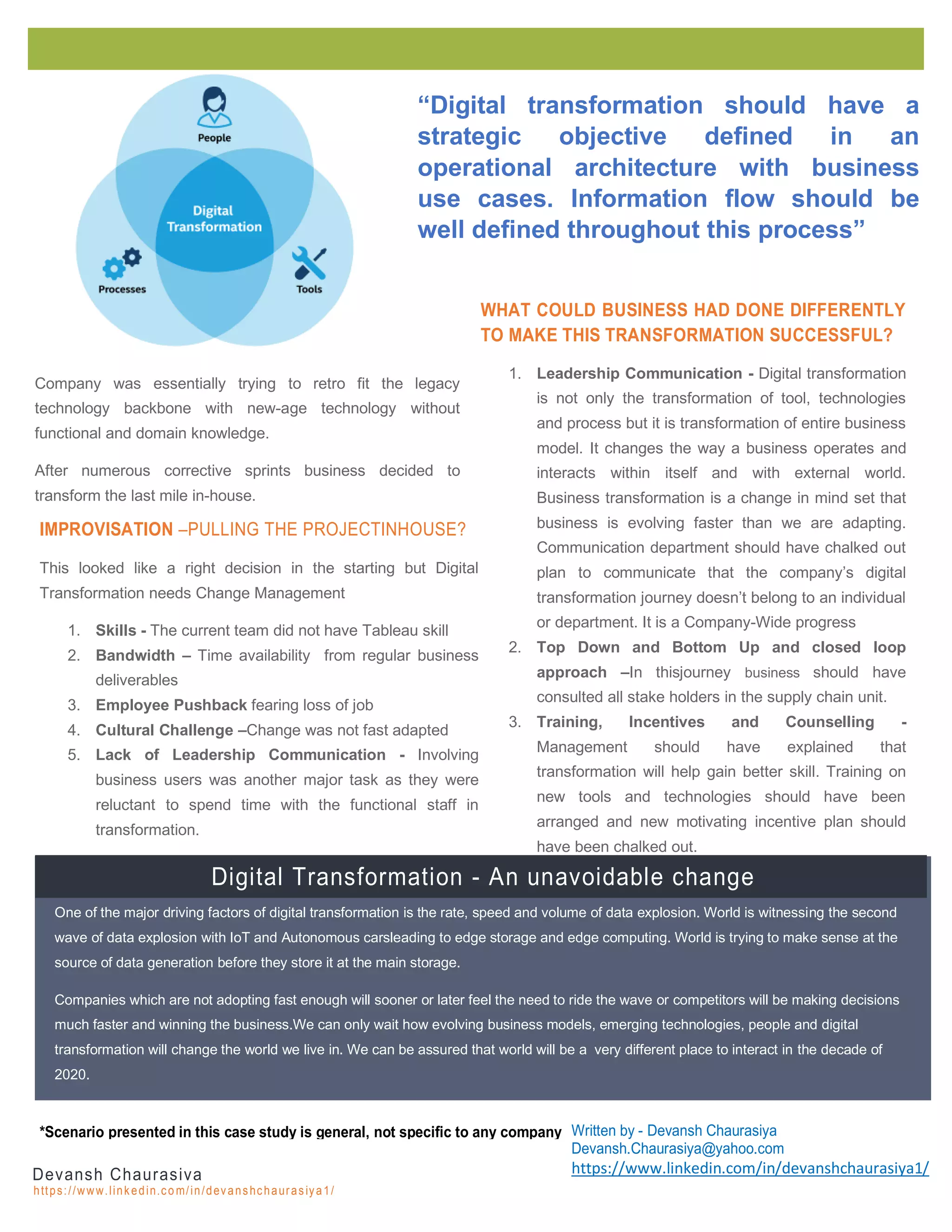
people, technology and
business together.”
-Devansh
A Case Study
A product manufacturing IT Major
needed to digitally transform itself to
accelerate its business activities,
processes, and its operating models.It
needed to leverage the digital tools and
technologies to drive higher revenue,
better margins and competitive edge.
Company had robust one of the best
supply chain capabilities based on
efficient and reliable third party logistics
system.
Company manufactured and assembled
its products in Asian countries and
distributed all over the world
Major expectation from digital
transformation was to detect and
minimize missing containers, damage
deliveries, reduce theft, higher recovery,
faster replacements, better compliance,
governance, forecast and predictionon
demand supply gap to increase
operational efficiency, driving higher
partner satisfaction and better customer
engagement.
IT major hired a consulting company for
digital transformation.
It did well to understand complex
logistics model, rigid legacy IT
infrastructure and started data migration,
ingestion and historical load from various
sources like Oracle, SQL, GT Nexus,
Teradata to AWS using a BDM ETL Tool.
After data migration, all legacy reports on
Business Objects, Excel, Access, VBA coded
dashboards were to be transformed on
Tableau.However, ineffective mapping
and untransformed data was the hurdle
to build theBusiness Intelligence.
Business reports were in columns and
rows. Consulting company pitched to
transform hundreds of columns and rows
into graphs.However,business needed to
see information in detail, likenot only
what percentage of containers were
missing but exactly which container was
missing to action upon.
This case study
What is digital transformation
A business case scenario
Challenges and solutions
Trends & New Software P.4
I S S U E
M O N T H
Y E A R
CHALLENGES IN
DIGITAL
TRANSFORMATION
1. Lack of complete
IT knowledge
2. No holistic vision
3. Resistance to
change
4. Cost factors
5. No ROI definition
6. Leadership support
7. Procrastination
Devansh Chaurasiya
https://www.linkedin.co m/in/devanshchaurasiya1/
Company was essentially trying to retro fit the legacy
technology backbone with new-age technology without
functional and domain knowledge.
After numerous corrective sprints business decided to
transform the last mile in-house.
IMPROVISATION –PULLING THE PROJECTINHOUSE?
This looked like a right decision in the starting but Digital
Transformation needs Change Management
1. Skills - The current team did not have Tableau skill
2. Bandwidth – Time availability from regular business
deliverables
3. Employee Pushback fearing loss of job
4. Cultural Challenge –Change was not fast adapted
5. Lack of Leadership Communication - Involving
business users was another major task as they were
reluctant to spend time with the functional staff in
transformation.
Digital Transformation - An unavoidable change
One of the major driving factors of digital transformation is the rate, speed and volume of data explosion. World is witnessing the second
wave of data explosion with IoT and Autonomous carsleading to edge storage and edge computing. World is trying to make sense at the
source of data generation before they store it at the main storage.
Companies which are not adopting fast enough will sooner or later feel the need to ride the wave or competitors will be making decisions
much faster and winning the business.We can only wait how evolving business models, emerging technologies, people and digital
transformation will change the world we live in. We can be assured that world will be a very different place to interact in the decade of
2020.
“Digital transformation should have a
strategic objective defined in an
operational architecture with business
use cases. Information flow should be
well defined throughout this process”
WHAT COULD BUSINESS HAD DONE DIFFERENTLY
TO MAKE THIS TRANSFORMATION SUCCESSFUL?
1. Leadership Communication - Digital transformation
is not only the transformation of tool, technologies
and process but it is transformation of entire business
model. It changes the way a business operates and
interacts within itself and with external world.
Business transformation is a change in mind set that
business is evolving faster than we are adapting.
Communication department should have chalked out
plan to communicate that the company’s digital
transformation journey doesn’t belong to an individual
or department. It is a Company-Wide progress
2. Top Down and Bottom Up and closed loop
approach –In thisjourney business should have
consulted all stake holders in the supply chain unit.
3. Training, Incentives and Counselling -
Management should have explained that
transformation will help gain better skill. Training on
new tools and technologies should have been
arranged and new motivating incentive plan should
have been chalked out.
Written by - Devansh Chaurasiya
Devansh.Chaurasiya@yahoo.com
https://www.linkedin.com/in/devanshchaurasiya1/
*Scenario presented in this case study is general, not specific to any company

Digital Transformation

  • 1.
    Devansh Chaurasiya https://www.linkedin.co m/in/devanshchaurasiya1/ MONTHLY JOURNALOF INFORMATION TECHNOLOGY Digital Transformation ation ByDevansh Chaurasiya https://www.linkedin.com/in/devanshchaurasiya1/ WHAT IS DIGITAL TRANSFORMATION? “Digital transformation is an ongoing process of changing the way we do business. It is an investment in skills, tools, technologies and IT infrastructure. Digital transformation is a cultural shift integrating people, technology and business together.” -Devansh A Case Study A product manufacturing IT Major needed to digitally transform itself to accelerate its business activities, processes, and its operating models.It needed to leverage the digital tools and technologies to drive higher revenue, better margins and competitive edge. Company had robust one of the best supply chain capabilities based on efficient and reliable third party logistics system. Company manufactured and assembled its products in Asian countries and distributed all over the world Major expectation from digital transformation was to detect and minimize missing containers, damage deliveries, reduce theft, higher recovery, faster replacements, better compliance, governance, forecast and predictionon demand supply gap to increase operational efficiency, driving higher partner satisfaction and better customer engagement. IT major hired a consulting company for digital transformation. It did well to understand complex logistics model, rigid legacy IT infrastructure and started data migration, ingestion and historical load from various sources like Oracle, SQL, GT Nexus, Teradata to AWS using a BDM ETL Tool. After data migration, all legacy reports on Business Objects, Excel, Access, VBA coded dashboards were to be transformed on Tableau.However, ineffective mapping and untransformed data was the hurdle to build theBusiness Intelligence. Business reports were in columns and rows. Consulting company pitched to transform hundreds of columns and rows into graphs.However,business needed to see information in detail, likenot only what percentage of containers were missing but exactly which container was missing to action upon. This case study What is digital transformation A business case scenario Challenges and solutions Trends & New Software P.4 I S S U E M O N T H Y E A R CHALLENGES IN DIGITAL TRANSFORMATION 1. Lack of complete IT knowledge 2. No holistic vision 3. Resistance to change 4. Cost factors 5. No ROI definition 6. Leadership support 7. Procrastination
  • 2.
    Devansh Chaurasiya https://www.linkedin.co m/in/devanshchaurasiya1/ Companywas essentially trying to retro fit the legacy technology backbone with new-age technology without functional and domain knowledge. After numerous corrective sprints business decided to transform the last mile in-house. IMPROVISATION –PULLING THE PROJECTINHOUSE? This looked like a right decision in the starting but Digital Transformation needs Change Management 1. Skills - The current team did not have Tableau skill 2. Bandwidth – Time availability from regular business deliverables 3. Employee Pushback fearing loss of job 4. Cultural Challenge –Change was not fast adapted 5. Lack of Leadership Communication - Involving business users was another major task as they were reluctant to spend time with the functional staff in transformation. Digital Transformation - An unavoidable change One of the major driving factors of digital transformation is the rate, speed and volume of data explosion. World is witnessing the second wave of data explosion with IoT and Autonomous carsleading to edge storage and edge computing. World is trying to make sense at the source of data generation before they store it at the main storage. Companies which are not adopting fast enough will sooner or later feel the need to ride the wave or competitors will be making decisions much faster and winning the business.We can only wait how evolving business models, emerging technologies, people and digital transformation will change the world we live in. We can be assured that world will be a very different place to interact in the decade of 2020. “Digital transformation should have a strategic objective defined in an operational architecture with business use cases. Information flow should be well defined throughout this process” WHAT COULD BUSINESS HAD DONE DIFFERENTLY TO MAKE THIS TRANSFORMATION SUCCESSFUL? 1. Leadership Communication - Digital transformation is not only the transformation of tool, technologies and process but it is transformation of entire business model. It changes the way a business operates and interacts within itself and with external world. Business transformation is a change in mind set that business is evolving faster than we are adapting. Communication department should have chalked out plan to communicate that the company’s digital transformation journey doesn’t belong to an individual or department. It is a Company-Wide progress 2. Top Down and Bottom Up and closed loop approach –In thisjourney business should have consulted all stake holders in the supply chain unit. 3. Training, Incentives and Counselling - Management should have explained that transformation will help gain better skill. Training on new tools and technologies should have been arranged and new motivating incentive plan should have been chalked out. Written by - Devansh Chaurasiya Devansh.Chaurasiya@yahoo.com https://www.linkedin.com/in/devanshchaurasiya1/ *Scenario presented in this case study is general, not specific to any company