Nik Sekhran
Director, Sustainable Development
United Nations Development Programme
Manila, September 2017
Integrated Approaches and SDG Accelerators
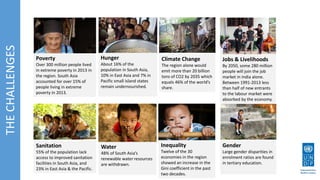
THECHALLENGES
Poverty
Over 300 million people lived
in extreme poverty in 2013 in
the region. South Asia
accounted for over 15% of
people living in extreme
poverty in 2013.
Water
48% of South Asia’s
renewable water resources
are withdrawn.
Climate Change
The region alone would
emit more than 20 billion
tons of CO2 by 2035 which
equals 46% of the world’s
share.
Gender
Large gender disparities in
enrolment ratios are found
in tertiary education.
Sanitation
55% of the population lack
access to improved sanitation
facilities in South Asia, and
23% in East Asia & the Pacific.
Inequality
Twelve of the 30
economies in the region
showed an increase in the
Gini coefficient in the past
two decades.
Jobs & Livelihoods
By 2050, some 280 million
people will join the job
market in India alone.
Between 1991-2013 less
than half of new entrants
to the labour market were
absorbed by the economy.
Hunger
About 16% of the
population in South Asia,
10% in East Asia and 7% in
Pacific small island states
remain undernourished.
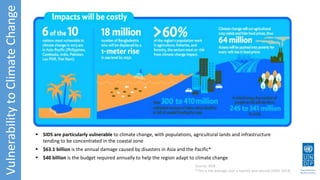
VulnerabilitytoClimateChange
 SIDS are particularly vulnerable to climate change, with populations, agricultural lands and infrastructure
tending to be concentrated in the coastal zone
 $63.1 billion is the annual damage caused by disasters in Asia and the Pacific*
 $40 billion is the budget required annually to help the region adapt to climate change
Source: ADB
*This is the average over a twenty year period (1995-2014)
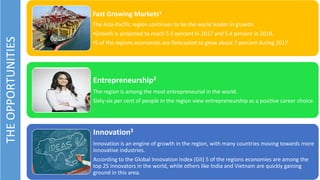
THEOPPORTUNITIES Fast Growing Markets1
The Asia-Pacific region continues to be the world leader in growth.
•Growth is projected to reach 5.5 percent in 2017 and 5.4 percent in 2018.
•5 of the regions economies are forecasted to grow about 7 percent during 2017.
Entrepreneurship2
The region is among the most entrepreneurial in the world.
Sixty-six per cent of people in the region view entrepreneurship as a positive career choice.
Innovation3
Innovation is an engine of growth in the region, with many countries moving towards more
innovative industries.
According to the Global Innovation Index (GII) 5 of the regions economies are among the
top 25 innovators in the world, while others like India and Vietnam are quickly gaining
ground in this area.
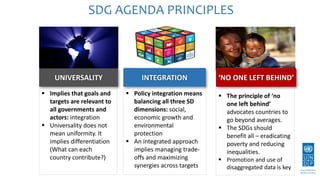
 Implies that goals and
targets are relevant to
all governments and
actors: integration
 Universality does not
mean uniformity. It
implies differentiation
(What can each
country contribute?)
 Policy integration means
balancing all three SD
dimensions: social,
economic growth and
environmental
protection
 An integrated approach
implies managing trade-
offs and maximizing
synergies across targets
 The principle of ‘no
one left behind’
advocates countries to
go beyond averages.
 The SDGs should
benefit all – eradicating
poverty and reducing
inequalities.
 Promotion and use of
disaggregated data is key
SDG AGENDA PRINCIPLES
‘NO ONE LEFT BEHIND’INTEGRATIONUNIVERSALITY
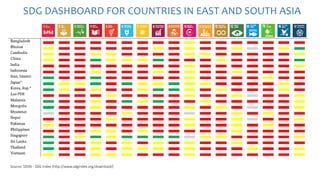
Source: SDSN - SDG Index (http://www.sdgindex.org/download/)
SDG DASHBOARD FOR COUNTRIES IN EAST AND SOUTH ASIA
 Landing the SDG
agenda at the national
and local levels:
integration into
national and sub-
national plans for
development; and into
budget allocations.
MAINSTREAMING
 Determining policy
areas that when
tackled can can directly
affect multiple
development priorities
and have a multiplier
effect across the SDGs.
 Support – skills and
experience - from
respective UN agencies
to countries, which
should be made
available at a low cost
in a timely manner.
POLICY SUPPORTACCELERATION
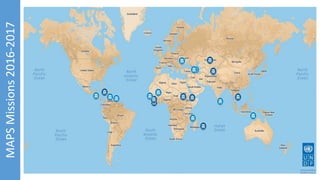
MAPSMissions2016-2017
I. Alignment: Assessing national priorities and the SDGs
II. Defining an Institutional Coordination Mechanism
III. From planning to action: Prioritizing SDG accelerators
IV. Integrating SDGs into budgets and financing the SDG agenda
V. Data, monitoring, and reporting
VI. Advocacy, resources and partnerships
A ROADMAP TOWARD SDG IMPLEMENTATIONELEMENTS OF A ROADMAP TOWARD
SDG IMPLEMENTATION
SDGACCELERATION
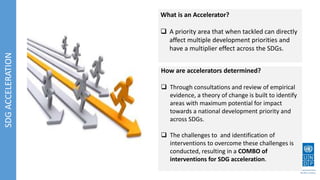
What is an Accelerator?
 A priority area that when tackled can directly
affect multiple development priorities and
have a multiplier effect across the SDGs.
How are accelerators determined?
 Through consultations and review of empirical
evidence, a theory of change is built to identify
areas with maximum potential for impact
towards a national development priority and
across SDGs.
 The challenges to and identification of
interventions to overcome these challenges is
conducted, resulting in a COMBO of
interventions for SDG acceleration.
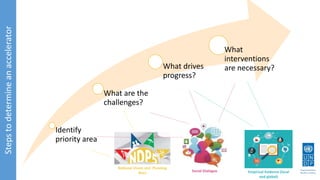
Stepstodetermineanaccelerator
Identify
priority area
What are the
challenges?
What drives
progress?
What
interventions
are necessary?
Social Dialogue
National Vision and Planning
Docs Empirical Evidence (local
and global)
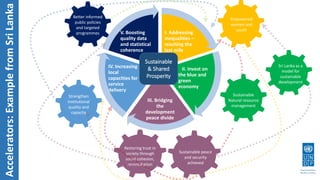
I. Addressing
inequalities –
reaching the
last mile
II. Invest on
the blue and
green
economy
III. Bridging
the
development
peace divide
IV. Increasing
local
capacities for
service
delivery
V. Boosting
quality data
and statistical
coherence
Strengthen
institutional
quality and
capacity
Restoring trust in
society through
social cohesion,
reconciliation
Sustainable
Natural resource
management
Empowered
women and
youth
Better informed
public policies
and targeted
programmes
Sustainable
& Shared
Prosperity
Accelerators:ExamplefromSriLanka
Sustainable peace
and security
achieved
Sri Lanka as a
model for
sustainable
development
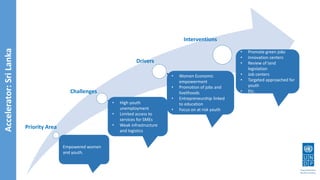
Accelerator:SriLanka
Identify
priority
area
What are the
challenges?
What drives
progress?
Empowered women
and youth.
• High youth
unemployment
• Limited access to
services for SMEs
• Weak infrastructure
and logistics
• Women Economic
empowerment
• Promotion of jobs and
livelihoods
• Entrepreneurship linked
to education
• Focus on at risk youth
• Promote green jobs
• Innovation centers
• Review of land
legislation
• Job centers
• Targeted approached for
youth
• Etc.
Priority Area
Challenges
Drivers
Interventions
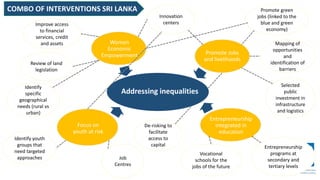
Review of land
legislation
Improve access
to financial
services, credit
and assets
Identify
specific
geographical
needs (rural vs
urban)
Entrepreneurship
programs at
secondary and
tertiary levels
Addressing inequalities
Women
Economic
Empowerment Promote Jobs
and livelihoods
Entrepreneurship
integrated in
education
Innovation
centers
COMBO OF INTERVENTIONS SRI LANKA
Focus on
youth at risk
Mapping of
opportunities
and
identification of
barriers
Promote green
jobs (linked to the
blue and green
economy)
De-risking to
facilitate
access to
capital
Identify youth
groups that
need targeted
approaches
Vocational
schools for the
jobs of the future
Selected
public
investment in
infrastructure
and logistics
Job
Centres
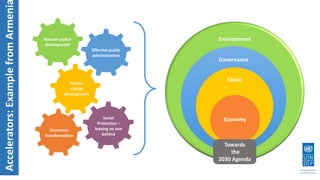
Accelerators:ExamplefromArmeni
Natural capital
development
Economic
transformation
Social
Protection –
leaving no one
behind
Human
capital
development
Effective public
administration
Environment
Governance
Social
Economy
Towards
the
2030 Agenda
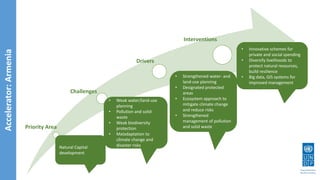
Accelerator:Armenia
Identify
priority area
What are the
challenges?
Natural Capital
development
• Weak water/land-use
planning
• Pollution and solid
waste
• Weak biodiversity
protection
• Maladaptation to
climate change and
disaster risks
• Strengthened water- and
land-use planning
• Designated protected
areas
• Ecosystem approach to
mitigate climate change
and reduce risks
• Strengthened
management of pollution
and solid waste
• Innovative schemes for
private and social spending
• Diversify livelihoods to
protect natural resources,
build resilience
• Big data, GIS systems for
improved management
Priority Area
Challenges
Drivers
Interventions
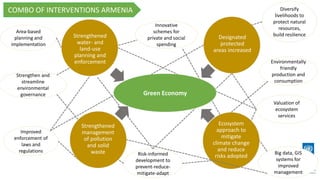
Diversify
livelihoods to
protect natural
resources,
build resilience
Area-based
planning and
implementation
Strengthen and
streamline
environmental
governance
Risk-informed
development to
prevent-reduce-
mitigate-adapt
Innovative
schemes for
private and social
spending
Environmentally
friendly
production and
consumption
Valuation of
ecosystem
services
Big data, GIS
systems for
improved
management
Improved
enforcement of
laws and
regulations
Strengthened
water- and
land-use
planning and
enforcement
Designated
protected
areas increased
Strengthened
management
of pollution
and solid
waste
Ecosystem
approach to
mitigate
climate change
and reduce
risks adopted
COMBO OF INTERVENTIONS ARMENIA
Green Economy
18© United Nations Development Programme
THANK YOU

Overview of Integrated Approaches and SDG Accelerators

  • 1.
    Nik Sekhran Director, SustainableDevelopment United Nations Development Programme Manila, September 2017 Integrated Approaches and SDG Accelerators
  • 2.
    THECHALLENGES Poverty Over 300 millionpeople lived in extreme poverty in 2013 in the region. South Asia accounted for over 15% of people living in extreme poverty in 2013. Water 48% of South Asia’s renewable water resources are withdrawn. Climate Change The region alone would emit more than 20 billion tons of CO2 by 2035 which equals 46% of the world’s share. Gender Large gender disparities in enrolment ratios are found in tertiary education. Sanitation 55% of the population lack access to improved sanitation facilities in South Asia, and 23% in East Asia & the Pacific. Inequality Twelve of the 30 economies in the region showed an increase in the Gini coefficient in the past two decades. Jobs & Livelihoods By 2050, some 280 million people will join the job market in India alone. Between 1991-2013 less than half of new entrants to the labour market were absorbed by the economy. Hunger About 16% of the population in South Asia, 10% in East Asia and 7% in Pacific small island states remain undernourished.
  • 3.
    VulnerabilitytoClimateChange  SIDS areparticularly vulnerable to climate change, with populations, agricultural lands and infrastructure tending to be concentrated in the coastal zone  $63.1 billion is the annual damage caused by disasters in Asia and the Pacific*  $40 billion is the budget required annually to help the region adapt to climate change Source: ADB *This is the average over a twenty year period (1995-2014)
  • 4.
    THEOPPORTUNITIES Fast GrowingMarkets1 The Asia-Pacific region continues to be the world leader in growth. •Growth is projected to reach 5.5 percent in 2017 and 5.4 percent in 2018. •5 of the regions economies are forecasted to grow about 7 percent during 2017. Entrepreneurship2 The region is among the most entrepreneurial in the world. Sixty-six per cent of people in the region view entrepreneurship as a positive career choice. Innovation3 Innovation is an engine of growth in the region, with many countries moving towards more innovative industries. According to the Global Innovation Index (GII) 5 of the regions economies are among the top 25 innovators in the world, while others like India and Vietnam are quickly gaining ground in this area.
  • 5.
     Implies thatgoals and targets are relevant to all governments and actors: integration  Universality does not mean uniformity. It implies differentiation (What can each country contribute?)  Policy integration means balancing all three SD dimensions: social, economic growth and environmental protection  An integrated approach implies managing trade- offs and maximizing synergies across targets  The principle of ‘no one left behind’ advocates countries to go beyond averages.  The SDGs should benefit all – eradicating poverty and reducing inequalities.  Promotion and use of disaggregated data is key SDG AGENDA PRINCIPLES ‘NO ONE LEFT BEHIND’INTEGRATIONUNIVERSALITY
  • 6.
    Source: SDSN -SDG Index (http://www.sdgindex.org/download/) SDG DASHBOARD FOR COUNTRIES IN EAST AND SOUTH ASIA
  • 7.
     Landing theSDG agenda at the national and local levels: integration into national and sub- national plans for development; and into budget allocations. MAINSTREAMING  Determining policy areas that when tackled can can directly affect multiple development priorities and have a multiplier effect across the SDGs.  Support – skills and experience - from respective UN agencies to countries, which should be made available at a low cost in a timely manner. POLICY SUPPORTACCELERATION
  • 8.
  • 9.
    I. Alignment: Assessingnational priorities and the SDGs II. Defining an Institutional Coordination Mechanism III. From planning to action: Prioritizing SDG accelerators IV. Integrating SDGs into budgets and financing the SDG agenda V. Data, monitoring, and reporting VI. Advocacy, resources and partnerships A ROADMAP TOWARD SDG IMPLEMENTATIONELEMENTS OF A ROADMAP TOWARD SDG IMPLEMENTATION
  • 10.
    SDGACCELERATION What is anAccelerator?  A priority area that when tackled can directly affect multiple development priorities and have a multiplier effect across the SDGs. How are accelerators determined?  Through consultations and review of empirical evidence, a theory of change is built to identify areas with maximum potential for impact towards a national development priority and across SDGs.  The challenges to and identification of interventions to overcome these challenges is conducted, resulting in a COMBO of interventions for SDG acceleration.
  • 11.
    Stepstodetermineanaccelerator Identify priority area What arethe challenges? What drives progress? What interventions are necessary? Social Dialogue National Vision and Planning Docs Empirical Evidence (local and global)
  • 12.
    I. Addressing inequalities – reachingthe last mile II. Invest on the blue and green economy III. Bridging the development peace divide IV. Increasing local capacities for service delivery V. Boosting quality data and statistical coherence Strengthen institutional quality and capacity Restoring trust in society through social cohesion, reconciliation Sustainable Natural resource management Empowered women and youth Better informed public policies and targeted programmes Sustainable & Shared Prosperity Accelerators:ExamplefromSriLanka Sustainable peace and security achieved Sri Lanka as a model for sustainable development
  • 13.
    Accelerator:SriLanka Identify priority area What are the challenges? Whatdrives progress? Empowered women and youth. • High youth unemployment • Limited access to services for SMEs • Weak infrastructure and logistics • Women Economic empowerment • Promotion of jobs and livelihoods • Entrepreneurship linked to education • Focus on at risk youth • Promote green jobs • Innovation centers • Review of land legislation • Job centers • Targeted approached for youth • Etc. Priority Area Challenges Drivers Interventions
  • 14.
    Review of land legislation Improveaccess to financial services, credit and assets Identify specific geographical needs (rural vs urban) Entrepreneurship programs at secondary and tertiary levels Addressing inequalities Women Economic Empowerment Promote Jobs and livelihoods Entrepreneurship integrated in education Innovation centers COMBO OF INTERVENTIONS SRI LANKA Focus on youth at risk Mapping of opportunities and identification of barriers Promote green jobs (linked to the blue and green economy) De-risking to facilitate access to capital Identify youth groups that need targeted approaches Vocational schools for the jobs of the future Selected public investment in infrastructure and logistics Job Centres
  • 15.
    Accelerators:ExamplefromArmeni Natural capital development Economic transformation Social Protection – leavingno one behind Human capital development Effective public administration Environment Governance Social Economy Towards the 2030 Agenda
  • 16.
    Accelerator:Armenia Identify priority area What arethe challenges? Natural Capital development • Weak water/land-use planning • Pollution and solid waste • Weak biodiversity protection • Maladaptation to climate change and disaster risks • Strengthened water- and land-use planning • Designated protected areas • Ecosystem approach to mitigate climate change and reduce risks • Strengthened management of pollution and solid waste • Innovative schemes for private and social spending • Diversify livelihoods to protect natural resources, build resilience • Big data, GIS systems for improved management Priority Area Challenges Drivers Interventions
  • 17.
    Diversify livelihoods to protect natural resources, buildresilience Area-based planning and implementation Strengthen and streamline environmental governance Risk-informed development to prevent-reduce- mitigate-adapt Innovative schemes for private and social spending Environmentally friendly production and consumption Valuation of ecosystem services Big data, GIS systems for improved management Improved enforcement of laws and regulations Strengthened water- and land-use planning and enforcement Designated protected areas increased Strengthened management of pollution and solid waste Ecosystem approach to mitigate climate change and reduce risks adopted COMBO OF INTERVENTIONS ARMENIA Green Economy
  • 18.
    18© United NationsDevelopment Programme THANK YOU