I n t e g r a t i n g A g r i c u l t u r e i n N a t i o n a l A d a p t a t i o n P l a n s
INTEGRATING CLIMATE
CHANGE ADAPTATION
INTO PLANNING AND
BUDGETING
Webinar, 11:00 CET
27 September 2017
Rohini Kohli and Glenn Hodes, UNDP
Outline
1. Integrating adaptation into planning
2. Integrating adaptation into budgeting
3. Key messages
1. INTEGRATING CLIMATE
CHANGE ADAPTATION
INTO PLANNING
What is the National Adaptation
Plan (NAP) Process?
• The national adaptation plan (NAP) process was established under
the UNFCCC Cancun Adaptation Framework (2010).
• Its objectives are to reduce vulnerability to the impacts of climate
change, and to facilitate the integration of climate change
adaptation, in a coherent manner, into relevant new and existing
policies, programmes and activities
• In plain-speak, National Adaptation Plans are a means of identifying
medium- and long-term adaptation needs and developing and
implementing strategies and programmes to address those needs
• Integration of climate change into ongoing planning and budgeting
processes is a key component of NAPs
Opportunities for 2030 Agenda
and NAP Alignment
 Institutional arrangements.
 Data coherence.
 Adaptation options as SDG catalysts
 Budget implications.
 Common messaging.
 Accessing climate finance
Adaptation
Impact
monitoring
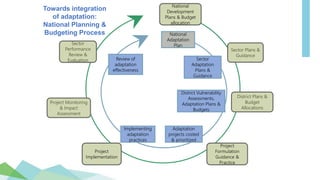
Towards integration
of adaptation:
National Planning &
Budgeting Process
National
Development
Plans & Budget
allocation
National
Adaptation
Plan
Sector
Adaptation
Plans &
Guidance
District Vulnerability
Assessments,
Adaptation Plans &
Budgets
Adaptation
projects costed
& prioritized
Implementing
adaptation
practices
Review of
adaptation
effectiveness
Sector
Performance
Review &
Evaluation
Project Monitoring
& Impact
Assessment
Project
Implementation
Project
Formulation
Guidance &
Practice
District Plans &
Budget
Allocations
Sector Plans &
Guidance
No
content
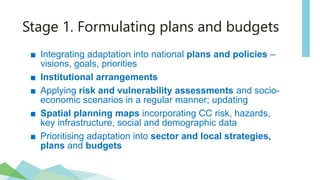
Stage 1. Formulating plans and budgets
■ Integrating adaptation into national plans and policies –
visions, goals, priorities
■ Institutional arrangements
■ Applying risk and vulnerability assessments and socio-
economic scenarios in a regular manner; updating
■ Spatial planning maps incorporating CC risk, hazards,
key infrastructure, social and demographic data
■ Prioritising adaptation into sector and local strategies,
plans and budgets
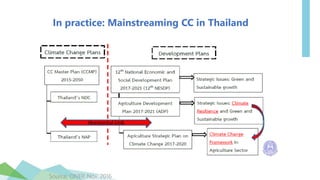
In practice: Mainstreaming CC in Thailand
Source: ONEP, Nov. 2016
Stage 2. Implementing adaptation plans
and policies
 Identifying adaptation options
 Integrated economic appraisal of projects & programmes
 Costing adaptation options and developing realistic financing
plans
 Prioritizing programmes using multi-criteria and economic
tools
 Developing centralized planning/screening guidelines for CC
& DRR for inclusion in official templates/performas
 Gender checklists and gender responsive criteria
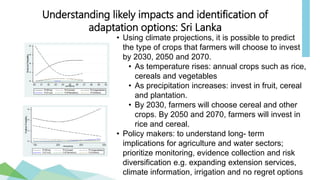
• Using climate projections, it is possible to predict
the type of crops that farmers will choose to invest
by 2030, 2050 and 2070.
• As temperature rises: annual crops such as rice,
cereals and vegetables
• As precipitation increases: invest in fruit, cereal
and plantation.
• By 2030, farmers will choose cereal and other
crops. By 2050 and 2070, farmers will invest in
rice and cereal.
• Policy makers: to understand long- term
implications for agriculture and water sectors;
prioritize monitoring, evidence collection and risk
diversification e.g. expanding extension services,
climate information, irrigation and no regret options
Understanding likely impacts and identification of
adaptation options: Sri Lanka
Stage 3. Monitoring and reviewing
■ Track national progress towards adaptation targets and
national development goals
■ Integrate adaptation into national M&E systems
■ Identify adaptation indicators and targets
■ National and international reporting on adaptation
■ Feed into systematic and iterative national adaptation
planning
■ MRV of support: finance, technology transfer, capacity
building
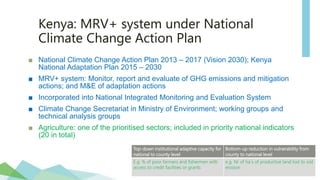
Kenya: MRV+ system under National
Climate Change Action Plan
■ National Climate Change Action Plan 2013 – 2017 (Vision 2030); Kenya
National Adaptation Plan 2015 – 2030
■ MRV+ system: Monitor, report and evaluate of GHG emissions and mitigation
actions; and M&E of adaptation actions
■ Incorporated into National Integrated Monitoring and Evaluation System
■ Climate Change Secretariat in Ministry of Environment; working groups and
technical analysis groups
■ Agriculture: one of the prioritised sectors; included in priority national indicators
(20 in total)
Top-down institutional adaptive capacity for
national to county level
Bottom-up reduction in vulnerability from
county to national level
E.g. % of poor farmers and fishermen with
access to credit facilities or grants
e.g. Nr of ha´s of productive land lost to soil
erosion
2. INTEGRATING CLIMATE
CHANGE ADAPTATION
INTO BUDGETING
Context
 Disconnect between CC policies & action plans and realistic financing
often creates an implementation gap.
 Integration of CC into budget cycle aims to help prioritize, direct,
manage, track, and evaluate climate funding.
 It plays a critical feedback mechanism in policy & planning cycles and
to achieving comprehensive risk management approaches to
development.
 Multiple benefits from systemic, integrated climate financing
frameworks and climate budgeting vs. parallel systems.
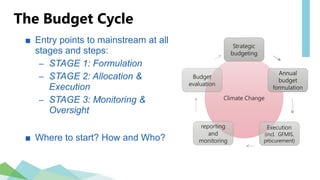
The Budget Cycle
■ Entry points to mainstream at all
stages and steps:
– STAGE 1: Formulation
– STAGE 2: Allocation &
Execution
– STAGE 3: Monitoring &
Oversight
■ Where to start? How and Who?
Climate Change
Strategic
budgeting
Annual
budget
formulation
Execution
(incl. GFMIS,
procurement)
reporting
and
monitoring
Budget
evaluation
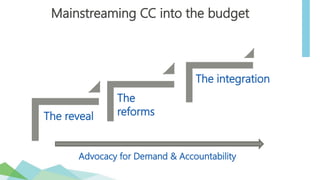
The reveal
The
reforms
The integration
Mainstreaming CC into the budget
Advocacy for Demand & Accountability
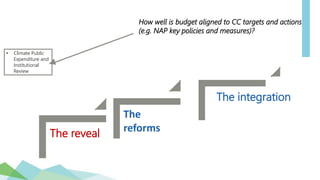
The reveal
The
reforms
The integration
• Climate Public
Expenditure and
Institutional
Review
How well is budget aligned to CC targets and actions
(e.g. NAP key policies and measures)?
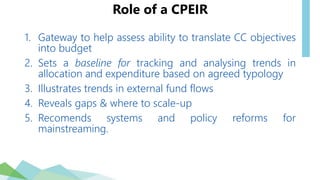
Role of a CPEIR
1. Gateway to help assess ability to translate CC objectives
into budget
2. Sets a baseline for tracking and analysing trends in
allocation and expenditure based on agreed typology
3. Illustrates trends in external fund flows
4. Reveals gaps & where to scale-up
5. Recomends systems and policy reforms for
mainstreaming.
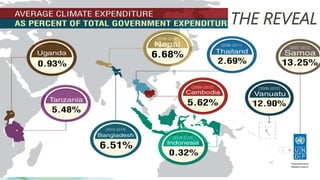
THE REVEAL
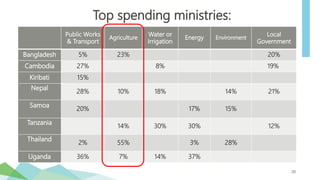
Top spending ministries:
20
Public Works
& Transport
Agriculture
Water or
Irrigation
Energy Environment
Local
Government
Bangladesh 5% 23% 20%
Cambodia 27% 8% 19%
Kiribati 15%
Nepal
28% 10% 18% 14% 21%
Samoa
20% 17% 15%
Tanzania
14% 30% 30% 12%
Thailand
2% 55% 3% 28%
Uganda 36% 7% 14% 37%
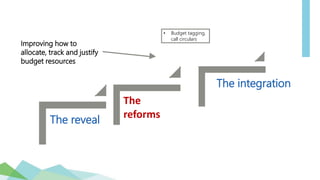
The reveal
The
reforms
The integration
• Budget tagging,
call circulars
Improving how to
allocate, track and justify
budget resources
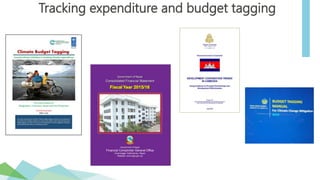
Tracking expenditure and budget tagging
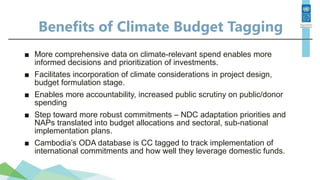
Benefits of Climate Budget Tagging
■ More comprehensive data on climate-relevant spend enables more
informed decisions and prioritization of investments.
■ Facilitates incorporation of climate considerations in project design,
budget formulation stage.
■ Enables more accountability, increased public scrutiny on public/donor
spending
■ Step toward more robust commitments – NDC adaptation priorities and
NAPs translated into budget allocations and sectoral, sub-national
implementation plans.
■ Cambodia’s ODA database is CC tagged to track implementation of
international commitments and how well they leverage domestic funds.
The reveal
The
reforms
The integration
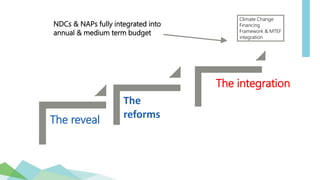
Climate Change
Financing
Framework & MTEF
integration
NDCs & NAPs fully integrated into
annual & medium term budget
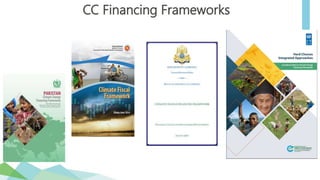
CC Financing Frameworks
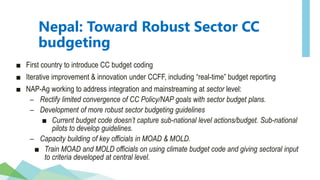
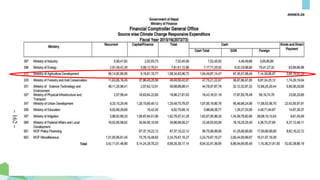
Nepal: Toward Robust Sector CC
budgeting
■ First country to introduce CC budget coding
■ Iterative improvement & innovation under CCFF, including “real-time” budget reporting
■ NAP-Ag working to address integration and mainstreaming at sector level:
– Rectify limited convergence of CC Policy/NAP goals with sector budget plans.
– Development of more robust sector budgeting guidelines
■ Current budget code doesn’t capture sub-national level actions/budget. Sub-national
pilots to develop guidelines.
– Capacity building of key officials in MOAD & MOLD.
■ Train MOAD and MOLD officials on using climate budget code and giving sectoral input
to criteria developed at central level.
The reveal
The
reforms
The integration
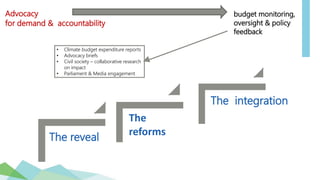
• Climate budget expenditure reports
• Advocacy briefs
• Civil society – collaborative research
on impact
• Parliament & Media engagement
budget monitoring,
oversight & policy
feedback
Advocacy
for demand & accountability
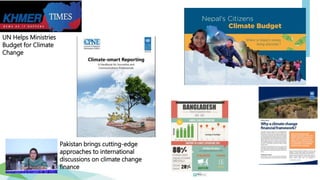
UN Helps Ministries
Budget for Climate
Change
Pakistan brings cutting-edge
approaches to international
discussions on climate change
finance
KEY MESSAGES
■ Climate change adaptation should be integrated into the full planning and
budgeting cycles, from inception, including at national, sectoral and local levels
■ Integration maximizes use of existing systems and ensures harmonization with
development priorities
■ Institutional arrangements and capacity development are important aspects of
risk informed planning, budgeting and monitoring systems and processes
■ A range of tools and approaches are available for integrating adaptation, which
are relevant at national, sectoral and local levels
■ Embedding adaptation into budget systems enables moving towards multi-year
budget plans that can generate more sustained and predictable resources to
implement medium- to long-term adaptation strategies
■ The National Adaptation Plan process provides an opportunity for countries to
strengthen their medium to long term comprehensive risk management
responses
fao.org/in-action/naps | adaptation-undp.org/naps-agriculture | international-climate-initiative.com
Thank You

NAP-Ag Webinar - Integrating Climate Change Risks into Planning and Budgeting

  • 1.
    I n te g r a t i n g A g r i c u l t u r e i n N a t i o n a l A d a p t a t i o n P l a n s INTEGRATING CLIMATE CHANGE ADAPTATION INTO PLANNING AND BUDGETING Webinar, 11:00 CET 27 September 2017 Rohini Kohli and Glenn Hodes, UNDP
  • 2.
    Outline 1. Integrating adaptationinto planning 2. Integrating adaptation into budgeting 3. Key messages
  • 3.
    1. INTEGRATING CLIMATE CHANGEADAPTATION INTO PLANNING
  • 4.
    What is theNational Adaptation Plan (NAP) Process? • The national adaptation plan (NAP) process was established under the UNFCCC Cancun Adaptation Framework (2010). • Its objectives are to reduce vulnerability to the impacts of climate change, and to facilitate the integration of climate change adaptation, in a coherent manner, into relevant new and existing policies, programmes and activities • In plain-speak, National Adaptation Plans are a means of identifying medium- and long-term adaptation needs and developing and implementing strategies and programmes to address those needs • Integration of climate change into ongoing planning and budgeting processes is a key component of NAPs
  • 5.
    Opportunities for 2030Agenda and NAP Alignment  Institutional arrangements.  Data coherence.  Adaptation options as SDG catalysts  Budget implications.  Common messaging.  Accessing climate finance
  • 6.
    Adaptation Impact monitoring Towards integration of adaptation: NationalPlanning & Budgeting Process National Development Plans & Budget allocation National Adaptation Plan Sector Adaptation Plans & Guidance District Vulnerability Assessments, Adaptation Plans & Budgets Adaptation projects costed & prioritized Implementing adaptation practices Review of adaptation effectiveness Sector Performance Review & Evaluation Project Monitoring & Impact Assessment Project Implementation Project Formulation Guidance & Practice District Plans & Budget Allocations Sector Plans & Guidance No content
  • 7.
    Stage 1. Formulatingplans and budgets ■ Integrating adaptation into national plans and policies – visions, goals, priorities ■ Institutional arrangements ■ Applying risk and vulnerability assessments and socio- economic scenarios in a regular manner; updating ■ Spatial planning maps incorporating CC risk, hazards, key infrastructure, social and demographic data ■ Prioritising adaptation into sector and local strategies, plans and budgets
  • 8.
    In practice: MainstreamingCC in Thailand Source: ONEP, Nov. 2016
  • 9.
    Stage 2. Implementingadaptation plans and policies  Identifying adaptation options  Integrated economic appraisal of projects & programmes  Costing adaptation options and developing realistic financing plans  Prioritizing programmes using multi-criteria and economic tools  Developing centralized planning/screening guidelines for CC & DRR for inclusion in official templates/performas  Gender checklists and gender responsive criteria
  • 10.
    • Using climateprojections, it is possible to predict the type of crops that farmers will choose to invest by 2030, 2050 and 2070. • As temperature rises: annual crops such as rice, cereals and vegetables • As precipitation increases: invest in fruit, cereal and plantation. • By 2030, farmers will choose cereal and other crops. By 2050 and 2070, farmers will invest in rice and cereal. • Policy makers: to understand long- term implications for agriculture and water sectors; prioritize monitoring, evidence collection and risk diversification e.g. expanding extension services, climate information, irrigation and no regret options Understanding likely impacts and identification of adaptation options: Sri Lanka
  • 11.
    Stage 3. Monitoringand reviewing ■ Track national progress towards adaptation targets and national development goals ■ Integrate adaptation into national M&E systems ■ Identify adaptation indicators and targets ■ National and international reporting on adaptation ■ Feed into systematic and iterative national adaptation planning ■ MRV of support: finance, technology transfer, capacity building
  • 12.
    Kenya: MRV+ systemunder National Climate Change Action Plan ■ National Climate Change Action Plan 2013 – 2017 (Vision 2030); Kenya National Adaptation Plan 2015 – 2030 ■ MRV+ system: Monitor, report and evaluate of GHG emissions and mitigation actions; and M&E of adaptation actions ■ Incorporated into National Integrated Monitoring and Evaluation System ■ Climate Change Secretariat in Ministry of Environment; working groups and technical analysis groups ■ Agriculture: one of the prioritised sectors; included in priority national indicators (20 in total) Top-down institutional adaptive capacity for national to county level Bottom-up reduction in vulnerability from county to national level E.g. % of poor farmers and fishermen with access to credit facilities or grants e.g. Nr of ha´s of productive land lost to soil erosion
  • 13.
    2. INTEGRATING CLIMATE CHANGEADAPTATION INTO BUDGETING
  • 14.
    Context  Disconnect betweenCC policies & action plans and realistic financing often creates an implementation gap.  Integration of CC into budget cycle aims to help prioritize, direct, manage, track, and evaluate climate funding.  It plays a critical feedback mechanism in policy & planning cycles and to achieving comprehensive risk management approaches to development.  Multiple benefits from systemic, integrated climate financing frameworks and climate budgeting vs. parallel systems.
  • 15.
    The Budget Cycle ■Entry points to mainstream at all stages and steps: – STAGE 1: Formulation – STAGE 2: Allocation & Execution – STAGE 3: Monitoring & Oversight ■ Where to start? How and Who? Climate Change Strategic budgeting Annual budget formulation Execution (incl. GFMIS, procurement) reporting and monitoring Budget evaluation
  • 16.
    The reveal The reforms The integration MainstreamingCC into the budget Advocacy for Demand & Accountability
  • 17.
    The reveal The reforms The integration •Climate Public Expenditure and Institutional Review How well is budget aligned to CC targets and actions (e.g. NAP key policies and measures)?
  • 18.
    Role of aCPEIR 1. Gateway to help assess ability to translate CC objectives into budget 2. Sets a baseline for tracking and analysing trends in allocation and expenditure based on agreed typology 3. Illustrates trends in external fund flows 4. Reveals gaps & where to scale-up 5. Recomends systems and policy reforms for mainstreaming.
  • 19.
  • 20.
    Top spending ministries: 20 PublicWorks & Transport Agriculture Water or Irrigation Energy Environment Local Government Bangladesh 5% 23% 20% Cambodia 27% 8% 19% Kiribati 15% Nepal 28% 10% 18% 14% 21% Samoa 20% 17% 15% Tanzania 14% 30% 30% 12% Thailand 2% 55% 3% 28% Uganda 36% 7% 14% 37%
  • 21.
    The reveal The reforms The integration •Budget tagging, call circulars Improving how to allocate, track and justify budget resources
  • 22.
  • 23.
    Benefits of ClimateBudget Tagging ■ More comprehensive data on climate-relevant spend enables more informed decisions and prioritization of investments. ■ Facilitates incorporation of climate considerations in project design, budget formulation stage. ■ Enables more accountability, increased public scrutiny on public/donor spending ■ Step toward more robust commitments – NDC adaptation priorities and NAPs translated into budget allocations and sectoral, sub-national implementation plans. ■ Cambodia’s ODA database is CC tagged to track implementation of international commitments and how well they leverage domestic funds.
  • 24.
    The reveal The reforms The integration ClimateChange Financing Framework & MTEF integration NDCs & NAPs fully integrated into annual & medium term budget
  • 25.
  • 26.
    Nepal: Toward RobustSector CC budgeting ■ First country to introduce CC budget coding ■ Iterative improvement & innovation under CCFF, including “real-time” budget reporting ■ NAP-Ag working to address integration and mainstreaming at sector level: – Rectify limited convergence of CC Policy/NAP goals with sector budget plans. – Development of more robust sector budgeting guidelines ■ Current budget code doesn’t capture sub-national level actions/budget. Sub-national pilots to develop guidelines. – Capacity building of key officials in MOAD & MOLD. ■ Train MOAD and MOLD officials on using climate budget code and giving sectoral input to criteria developed at central level.
  • 28.
    The reveal The reforms The integration •Climate budget expenditure reports • Advocacy briefs • Civil society – collaborative research on impact • Parliament & Media engagement budget monitoring, oversight & policy feedback Advocacy for demand & accountability
  • 29.
    UN Helps Ministries Budgetfor Climate Change Pakistan brings cutting-edge approaches to international discussions on climate change finance
  • 30.
  • 31.
    ■ Climate changeadaptation should be integrated into the full planning and budgeting cycles, from inception, including at national, sectoral and local levels ■ Integration maximizes use of existing systems and ensures harmonization with development priorities ■ Institutional arrangements and capacity development are important aspects of risk informed planning, budgeting and monitoring systems and processes ■ A range of tools and approaches are available for integrating adaptation, which are relevant at national, sectoral and local levels ■ Embedding adaptation into budget systems enables moving towards multi-year budget plans that can generate more sustained and predictable resources to implement medium- to long-term adaptation strategies ■ The National Adaptation Plan process provides an opportunity for countries to strengthen their medium to long term comprehensive risk management responses
  • 32.
    fao.org/in-action/naps | adaptation-undp.org/naps-agriculture| international-climate-initiative.com Thank You