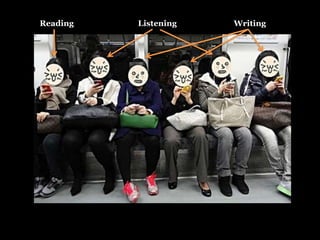
ListeningReading Writing
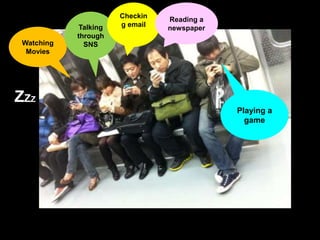
Watching
Movies
ZZZ
Talking
through
SNS
Checkin
g email
Reading a
newspaper
Playing a
game
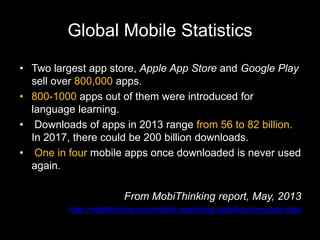
Global Mobile Statistics
• Two largest app store, Apple App Store and Google Play
sell over 800,000 apps.
• 800-1000 apps out of them were introduced for
language learning.
• Downloads of apps in 2013 range from 56 to 82 billion.
In 2017, there could be 200 billion downloads.
• One in four mobile apps once downloaded is never used
again.
From MobiThinking report, May, 2013
http://mobithinking.com/mobile-marketing-tools/latest-mobile-stats
Mobile-Assisted Language Learning
(MALL)
What is an effective mobile app
design for language learning?
What is effective mobile-
assisted language learning
(MALL)?
MALL
•CALL ? or MALL?
Some unique features distinguish MALL from other
types of computer-based learning. The success of
MALL depends on whether or not MALL curriculum
and material developers understand the nature of
mobile learning and make the most effective use
of MALL technology. (Kukulska-Hulme & Shield,
2008).
Anytime and anywhere
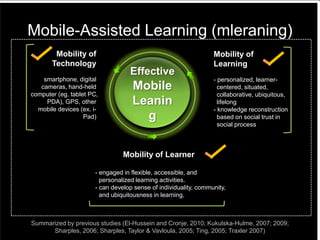
Mobile-Assisted Learning (mleraning)
Effective
Mobile
Leanin
g
Mobility of
Technology
smartphone, digital
cameras, hand-held
computer (eg. tablet PC,
PDA), GPS, other
mobile devices (ex. i-
Pad)
Mobility of Learner
- engaged in flexible, accessible, and
personalized learning activities.
- can develop sense of individuality, community,
and ubiquitousness in learning,
Mobility of
Learning
- personalized, learner-
centered, situated,
collaborative, ubiquitous,
lifelong
- knowledge reconstruction
based on social trust in
social process
Summarized by previous studies (El-Hussein and Cronje, 2010; Kukulska-Hulme, 2007; 2009;
Sharples, 2006; Sharples, Taylor & Vavloula, 2005; Ting, 2005; Traxler 2007)
Mobile-Assisted Language Learning
(MALL)
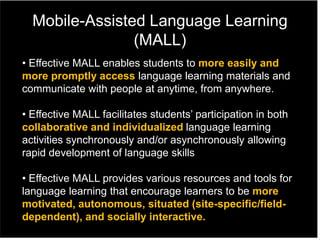
• Effective MALL enables students to more easily and
more promptly access language learning materials and
communicate with people at anytime, from anywhere.
• Effective MALL facilitates students‟ participation in both
collaborative and individualized language learning
activities synchronously and/or asynchronously allowing
rapid development of language skills
• Effective MALL provides various resources and tools for
language learning that encourage learners to be more
motivated, autonomous, situated (site-specific/field-
dependent), and socially interactive.
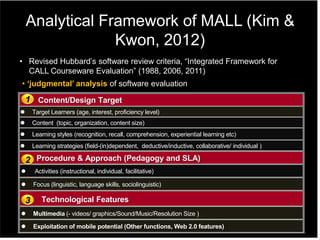
Analytical Framework of MALL (Kim &
Kwon, 2012)
Content/Design Target
 Target Learners (age, interest, proficiency level)
 Content (topic, organization, content size)
 Learning styles (recognition, recall, comprehension, experiential learning etc)
 Learning strategies (field-(in)dependent, deductive/inductive, collaborative/ individual )
Procedure & Approach (Pedagogy and SLA)
 Activities (instructional, individual, facilitative)
 Focus (linguistic, language skills, sociolinguistic)
Technological Features
 Multimedia (- videos/ graphics/Sound/Music/Resolution Size )
 Exploitation of mobile potential (Other functions, Web 2.0 features)
1
2
3
• ‘judgmental’ analysis of software evaluation
• Revised Hubbard‟s software review criteria, “Integrated Framework for
CALL Courseware Evaluation” (1988, 2006, 2011)
Analytical Framework of MALL (Kim &
Kwon, 2012)
Common features
• The majority of applications deals with short language data information
 vocabulary lists (42%) or short grammar lessons (12%)
• Most of them require cognitive language learning style
 This approach is very close to cognitive CALL (Kern &
Warschauer, 2000).
• ESL apps employ various modes and functions of multimedia for
personal, perceptual, and field-independent learning
• Their L2 approaches are not diverse and remain in the form-focused
instruction.
 Two dominant methods are audio-lingual and task (test)-based.
Analytical Framework of MALL (Kim &
Kwon, 2012)
Strengths
• provide a personal and learner-centered learning opportunity with
ubiquitously accessible and flexible resources and activities.
enhance L2 learners‟ motivation and autonomy in MALL
Weaknesses
• They are weak in realizing mobility as a more situated, field-
dependent, and collaborative learning opportunity.
• More active use of authentic context, socially interactive tasks, timely
and situated materials (ex. podcasting) is needed.
• The present apps facilitate personal learning, but do not effectively
assist personalized learning.
Mobile-Assisted Language Learning
(MALL)
• Judgmental vs. empirical evaluation
Are they the same or different?
– What apps do L2 learners actually
choose for MALL?
– What do they evaluate the current ESL
mobile apps?
The purpose of this study
This research intends to
• evaluate the Smartphone app content
and design with the empirical data from
L2 learners who have utilized mobile
apps for language learning
• to suggest implications for mobile app
design for effective MALL.
Research Questions
• What content and design of mobile
applications did the college EFL learners
select and use? And why?
• How did they study? What L2 activities and
approaches did they prefer and enjoy for
what purpose?
• What factors of the mobile apps affected
the students in continuing or quitting MALL?
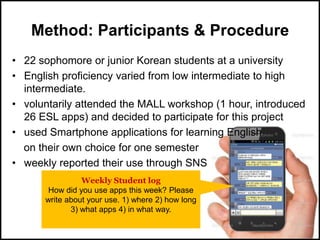
Method: Participants & Procedure
• 22 sophomore or junior Korean students at a university
• English proficiency varied from low intermediate to high
intermediate.
• voluntarily attended the MALL workshop (1 hour, introduced
26 ESL apps) and decided to participate for this project
• used Smartphone applications for learning English
on their own choice for one semester
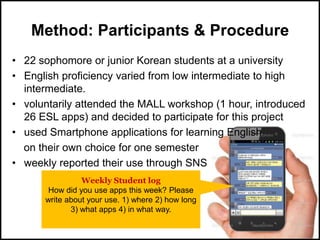
• weekly reported their use through SNS
Weekly Student log
How did you use apps this week? Please
write about your use. 1) where 2) how long
3) what apps 4) in what way.
Method: Participants & Procedure
• 22 sophomore or junior Korean students at a university
• English proficiency varied from low intermediate to high
intermediate.
• voluntarily attended the MALL workshop (1 hour, introduced
26 ESL apps) and decided to participate for this project
• used Smartphone applications for learning English
on their own choice for one semester
• weekly reported their use through SNS
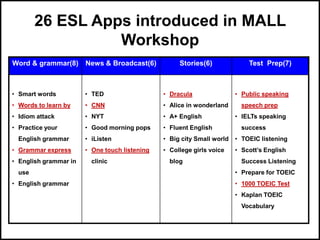
26 ESL Apps introduced in MALL
Workshop
Word & grammar(8) News & Broadcast(6) Stories(6) Test Prep(7)
• Smart words
• Words to learn by
• Idiom attack
• Practice your
English grammar
• Grammar express
• English grammar in
use
• English grammar
• TED
• CNN
• NYT
• Good morning pops
• iListen
• One touch listening
clinic
• Dracula
• Alice in wonderland
• A+ English
• Fluent English
• Big city Small world
• College girls voice
blog
• Public speaking
speech prep
• IELTs speaking
success
• TOEIC listening
• Scott’s English
Success Listening
• Prepare for TOEIC
• 1000 TOEIC Test
• Kaplan TOEIC
Vocabulary
Weekly Student log
How did you use apps this week? Please
write about your use. 1) where 2) how long
3) what apps 4) in what way.
Method: Participants & Procedure
• 22 sophomore or junior Korean students at a university
• English proficiency varied from low intermediate to high
intermediate.
• voluntarily attended the MALL workshop (1 hour, introduced
26 ESL apps) and decided to participate for this project
• used Smartphone applications for learning English
on their own choice for one semester
• weekly reported their use through SNS
• 22 sophomore or junior Korean students at a university
• English proficiency varied from low intermediate to high
intermediate.
• voluntarily attended the MALL workshop (1 hour, introduced
26 ESL apps) and decided to participate for this project
• used Smartphone applications for learning English
on their own choice for one semester
Method: Participants & Procedure
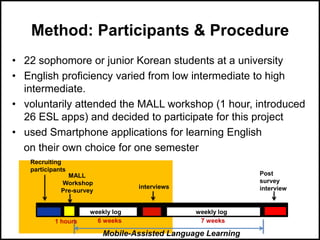
MALL
Workshop
Pre-survey
Recruiting
participants
weekly log weekly log
interviews
Post
survey
interview
6 weeks 7 weeks1 hours
Mobile-Assisted Language Learning
Method: Data collection
• pre-& post survey (X)
• weekly student logs (O)
• semi-structured interviews with
19 students (O)
Method: Data Analysis
• qualitative, triangulation across data sources and
individual students
• used the same analytical framework as
Kim and Kwon‟s „design and evaluation
criteria for mobile-based ESL apps‟ (2012)
Discussion 1: What content and design of
mobile applications did they select and use?
And why?
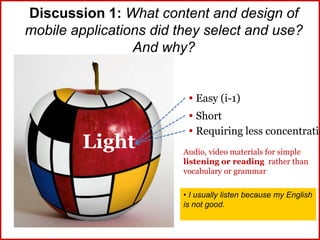
Light
 Easy (i-1)
 Short
 Requiring less concentratio
Audio, video materials for simple
listening or reading rather than
vocabulary or grammar
• I usually listen because my English
is not good.
Discussion 1: What content and design of
mobile applications did they select and use?
And why?
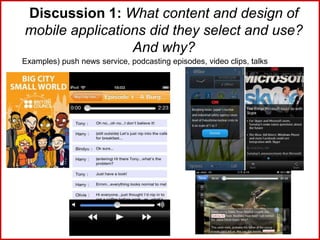
Examples) push news service, podcasting episodes, video clips, talks
Discussion 1: What content and design of
mobile applications did they select and use?
And why?
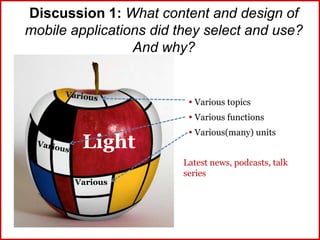
Light
 Various topics
 Various functions
 Various(many) units
Latest news, podcasts, talk
series
Various
Discussion 1: What content and design of
mobile applications did they select and use?
And why?
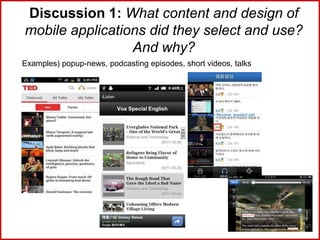
Examples) popup-news, podcasting episodes, short videos, talks
Discussion 1: What content and design of
mobile applications did they select and use?
And why?
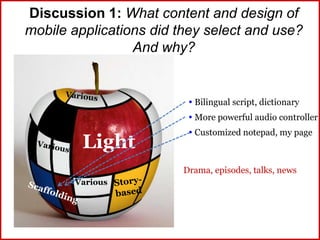
Light
 Bilingual script, dictionary
 More powerful audio controller
 Customized notepad, my page
Drama, episodes, talks, news
Various
Discussion 1: What content and design of
mobile applications did they select and use?
And why?
Examples) popup-news, podcasting episodes, short videos, talks
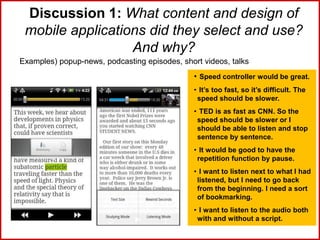
• Speed controller would be great.
• It’s too fast, so it’s difficult. The
speed should be slower.
• TED is as fast as CNN. So the
speed should be slower or I
should be able to listen and stop
sentence by sentence.
• It would be good to have the
repetition function by pause.
• I want to listen next to what I had
listened, but I need to go back
from the beginning. I need a sort
of bookmarking.
• I want to listen to the audio both
with and without a script.
Discussion 1: What content and design of
mobile applications did they select and use?
And why?
Examples) popup-news, podcasting episodes, short videos, talks
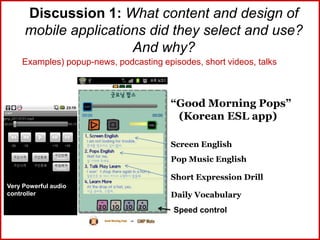
“Good Morning Pops”
(Korean ESL app)
Screen English
Pop Music English
Short Expression Drill
Daily Vocabulary
Speed control
Very Powerful audio
controller
Discussion 1: What content and design of
mobile applications did they select and use?
And why?
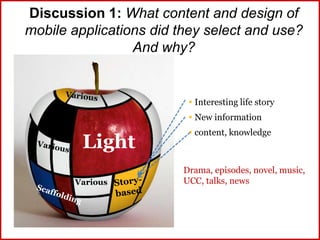
Light
 Interesting life story
 New information
 content, knowledge
Drama, episodes, novel, music,
UCC, talks, newsVarious
Discussion 1: What content and design of
mobile applications did they select and use?
And why?
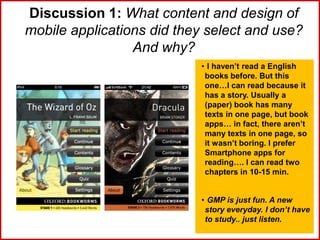
• I haven’t read a English
books before. But this
one…I can read because it
has a story. Usually a
(paper) book has many
texts in one page, but book
apps… in fact, there aren’t
many texts in one page, so
it wasn’t boring. I prefer
Smartphone apps for
reading…. I can read two
chapters in 10-15 min.
• GMP is just fun. A new
story everyday. I don’t have
to study.. just listen.
Discussion 2: How did they study? What L2
activities and approaches did they prefer and enjoy
for what purpose?
 input building,
fluency development
Many users were looking for
better audio control device
for repetition to focus more
on individual forms.
Discussion 2: How did they study? What L2
activities and approaches did they prefer and enjoy
for what purpose?
 input building,
fluency development
 Resistance to
collaboration or
communication for
language learning
•I did not use SNS in CNN apps
because I don’t think people will read
articles that I sent there.
• I don’t use ‘scrap’ or ‘favorite'
because I am not going to read them
again. It’s unnecessary.
• I don’t tag it to my FB because it is
open to all my friends. They should
see something unnecessary for them.
Discussion 2: How did they study? What L2
activities and approaches did they prefer and enjoy
for what purpose?
 input building,
fluency development
 Resistance to
collaboration or
communication for
language learning
 The virtue of MALL
=„extra‟ work‟ or
„saving time‟.
• I feel like I am doing something during wasting time (commuting time)
• I don’t intend to use apps for serious study..not the major purpose of my
English study..I am utilizing my little spare time
•It’s additional.. I feel it’s better anyway for me to do one more extra thing.
So I don’t feel any pressure.
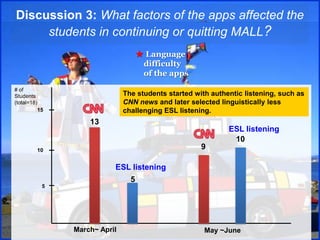
Discussion 3: What factors of the apps affected the
students in continuing or quitting MALL?
★L
ar ere n
★ Language
difficulty
of the apps
Life pattern
Discussion 3: What factors of the apps affected the
students in continuing or quitting MALL?
★ Language
difficulty
of the apps
March~ April May ~June
9
5
ESL listening
10
ESL listening
5
10
15
# of
Students
(total=18)
13
The students started with authentic listening, such as
CNN news and later selected linguistically less
challenging ESL listening.
Discussion 3: What factors of the apps affected the
students in continuing or quitting MALL?
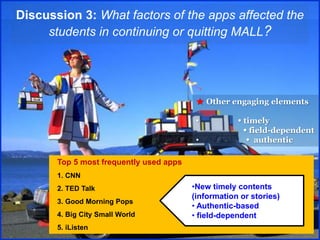
★ Other engaging elements
•  timely
 field-dependent
•  authentic
Top 5 most frequently used apps
1. CNN
2. TED Talk
3. Good Morning Pops
4. Big City Small World
5. iListen
•New timely contents
(information or stories)
• Authentic-based
• field-dependent
Discussion 3: What factors of the apps affected the
students in continuing or quitting MALL?
★L
ar ere n
Life pattern
★ Language
difficulty
of the apps
★ Other engaging elements
•  timely
 field-dependent
•  authentic
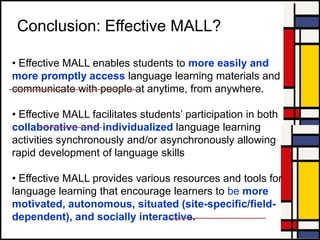
Conclusion: Effective MALL?
• Effective MALL enables students to more easily and
more promptly access language learning materials and
communicate with people at anytime, from anywhere.
• Effective MALL facilitates students‟ participation in both
collaborative and individualized language learning
activities synchronously and/or asynchronously allowing
rapid development of language skills
• Effective MALL provides various resources and tools for
language learning that encourage learners to be more
motivated, autonomous, situated (site-specific/field-
dependent), and socially interactive.
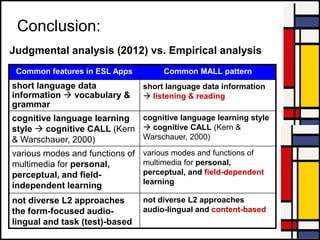
Conclusion:
Judgmental analysis (2012) vs. Empirical analysis
Common features in ESL Apps Common MALL pattern
short language data
information  vocabulary &
grammar
short language data information
 listening & reading
cognitive language learning
style  cognitive CALL (Kern
& Warschauer, 2000)
cognitive language learning style
 cognitive CALL (Kern &
Warschauer, 2000)
various modes and functions of
multimedia for personal,
perceptual, and field-
independent learning
various modes and functions of
multimedia for personal,
perceptual, and field-dependent
learning
not diverse L2 approaches
the form-focused audio-
lingual and task (test)-based
not diverse L2 approaches
audio-lingual and content-based
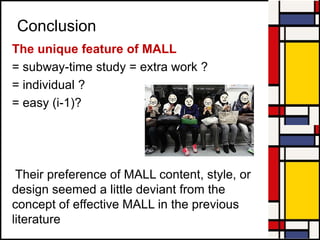
Conclusion
The unique feature of MALL
= subway-time study = extra work ?
= individual ?
= easy (i-1)?
Their preference of MALL content, style, or
design seemed a little deviant from the
concept of effective MALL in the previous
literature
Some implications for ESL app
content developers
• Satisfy ‘light‟ principles
• Add a sufficient scaffolding device
• Keep language difficulty i-1
• Provide field-dependent and updated
contents
• Suggest as many individual options as
possible
• Highlight meaning rather than language
Q & A
Thank You!
Heyoung Kim
englishnet@cau.ac.kr
Heyoung’s CALL Note
callheyoung

What to Consider for Effective Mobile-Assisted Language Learning: Design Implications from an Empirical Analysis

  • 2.
  • 3.
  • 5.
    Global Mobile Statistics •Two largest app store, Apple App Store and Google Play sell over 800,000 apps. • 800-1000 apps out of them were introduced for language learning. • Downloads of apps in 2013 range from 56 to 82 billion. In 2017, there could be 200 billion downloads. • One in four mobile apps once downloaded is never used again. From MobiThinking report, May, 2013 http://mobithinking.com/mobile-marketing-tools/latest-mobile-stats
  • 6.
    Mobile-Assisted Language Learning (MALL) Whatis an effective mobile app design for language learning? What is effective mobile- assisted language learning (MALL)?
  • 7.
    MALL •CALL ? orMALL? Some unique features distinguish MALL from other types of computer-based learning. The success of MALL depends on whether or not MALL curriculum and material developers understand the nature of mobile learning and make the most effective use of MALL technology. (Kukulska-Hulme & Shield, 2008). Anytime and anywhere
  • 8.
    Mobile-Assisted Learning (mleraning) Effective Mobile Leanin g Mobilityof Technology smartphone, digital cameras, hand-held computer (eg. tablet PC, PDA), GPS, other mobile devices (ex. i- Pad) Mobility of Learner - engaged in flexible, accessible, and personalized learning activities. - can develop sense of individuality, community, and ubiquitousness in learning, Mobility of Learning - personalized, learner- centered, situated, collaborative, ubiquitous, lifelong - knowledge reconstruction based on social trust in social process Summarized by previous studies (El-Hussein and Cronje, 2010; Kukulska-Hulme, 2007; 2009; Sharples, 2006; Sharples, Taylor & Vavloula, 2005; Ting, 2005; Traxler 2007)
  • 9.
    Mobile-Assisted Language Learning (MALL) •Effective MALL enables students to more easily and more promptly access language learning materials and communicate with people at anytime, from anywhere. • Effective MALL facilitates students‟ participation in both collaborative and individualized language learning activities synchronously and/or asynchronously allowing rapid development of language skills • Effective MALL provides various resources and tools for language learning that encourage learners to be more motivated, autonomous, situated (site-specific/field- dependent), and socially interactive.
  • 10.
    Analytical Framework ofMALL (Kim & Kwon, 2012) Content/Design Target  Target Learners (age, interest, proficiency level)  Content (topic, organization, content size)  Learning styles (recognition, recall, comprehension, experiential learning etc)  Learning strategies (field-(in)dependent, deductive/inductive, collaborative/ individual ) Procedure & Approach (Pedagogy and SLA)  Activities (instructional, individual, facilitative)  Focus (linguistic, language skills, sociolinguistic) Technological Features  Multimedia (- videos/ graphics/Sound/Music/Resolution Size )  Exploitation of mobile potential (Other functions, Web 2.0 features) 1 2 3 • ‘judgmental’ analysis of software evaluation • Revised Hubbard‟s software review criteria, “Integrated Framework for CALL Courseware Evaluation” (1988, 2006, 2011)
  • 11.
    Analytical Framework ofMALL (Kim & Kwon, 2012) Common features • The majority of applications deals with short language data information  vocabulary lists (42%) or short grammar lessons (12%) • Most of them require cognitive language learning style  This approach is very close to cognitive CALL (Kern & Warschauer, 2000). • ESL apps employ various modes and functions of multimedia for personal, perceptual, and field-independent learning • Their L2 approaches are not diverse and remain in the form-focused instruction.  Two dominant methods are audio-lingual and task (test)-based.
  • 12.
    Analytical Framework ofMALL (Kim & Kwon, 2012) Strengths • provide a personal and learner-centered learning opportunity with ubiquitously accessible and flexible resources and activities. enhance L2 learners‟ motivation and autonomy in MALL Weaknesses • They are weak in realizing mobility as a more situated, field- dependent, and collaborative learning opportunity. • More active use of authentic context, socially interactive tasks, timely and situated materials (ex. podcasting) is needed. • The present apps facilitate personal learning, but do not effectively assist personalized learning.
  • 13.
    Mobile-Assisted Language Learning (MALL) •Judgmental vs. empirical evaluation Are they the same or different? – What apps do L2 learners actually choose for MALL? – What do they evaluate the current ESL mobile apps?
  • 14.
    The purpose ofthis study This research intends to • evaluate the Smartphone app content and design with the empirical data from L2 learners who have utilized mobile apps for language learning • to suggest implications for mobile app design for effective MALL.
  • 15.
    Research Questions • Whatcontent and design of mobile applications did the college EFL learners select and use? And why? • How did they study? What L2 activities and approaches did they prefer and enjoy for what purpose? • What factors of the mobile apps affected the students in continuing or quitting MALL?
  • 16.
    Method: Participants &Procedure • 22 sophomore or junior Korean students at a university • English proficiency varied from low intermediate to high intermediate. • voluntarily attended the MALL workshop (1 hour, introduced 26 ESL apps) and decided to participate for this project • used Smartphone applications for learning English on their own choice for one semester • weekly reported their use through SNS
  • 17.
    Weekly Student log Howdid you use apps this week? Please write about your use. 1) where 2) how long 3) what apps 4) in what way. Method: Participants & Procedure • 22 sophomore or junior Korean students at a university • English proficiency varied from low intermediate to high intermediate. • voluntarily attended the MALL workshop (1 hour, introduced 26 ESL apps) and decided to participate for this project • used Smartphone applications for learning English on their own choice for one semester • weekly reported their use through SNS
  • 18.
    26 ESL Appsintroduced in MALL Workshop Word & grammar(8) News & Broadcast(6) Stories(6) Test Prep(7) • Smart words • Words to learn by • Idiom attack • Practice your English grammar • Grammar express • English grammar in use • English grammar • TED • CNN • NYT • Good morning pops • iListen • One touch listening clinic • Dracula • Alice in wonderland • A+ English • Fluent English • Big city Small world • College girls voice blog • Public speaking speech prep • IELTs speaking success • TOEIC listening • Scott’s English Success Listening • Prepare for TOEIC • 1000 TOEIC Test • Kaplan TOEIC Vocabulary
  • 19.
    Weekly Student log Howdid you use apps this week? Please write about your use. 1) where 2) how long 3) what apps 4) in what way. Method: Participants & Procedure • 22 sophomore or junior Korean students at a university • English proficiency varied from low intermediate to high intermediate. • voluntarily attended the MALL workshop (1 hour, introduced 26 ESL apps) and decided to participate for this project • used Smartphone applications for learning English on their own choice for one semester • weekly reported their use through SNS
  • 20.
    • 22 sophomoreor junior Korean students at a university • English proficiency varied from low intermediate to high intermediate. • voluntarily attended the MALL workshop (1 hour, introduced 26 ESL apps) and decided to participate for this project • used Smartphone applications for learning English on their own choice for one semester Method: Participants & Procedure MALL Workshop Pre-survey Recruiting participants weekly log weekly log interviews Post survey interview 6 weeks 7 weeks1 hours Mobile-Assisted Language Learning
  • 21.
    Method: Data collection •pre-& post survey (X) • weekly student logs (O) • semi-structured interviews with 19 students (O) Method: Data Analysis • qualitative, triangulation across data sources and individual students • used the same analytical framework as Kim and Kwon‟s „design and evaluation criteria for mobile-based ESL apps‟ (2012)
  • 23.
    Discussion 1: Whatcontent and design of mobile applications did they select and use? And why? Light  Easy (i-1)  Short  Requiring less concentratio Audio, video materials for simple listening or reading rather than vocabulary or grammar • I usually listen because my English is not good.
  • 24.
    Discussion 1: Whatcontent and design of mobile applications did they select and use? And why? Examples) push news service, podcasting episodes, video clips, talks
  • 25.
    Discussion 1: Whatcontent and design of mobile applications did they select and use? And why? Light  Various topics  Various functions  Various(many) units Latest news, podcasts, talk series Various
  • 26.
    Discussion 1: Whatcontent and design of mobile applications did they select and use? And why? Examples) popup-news, podcasting episodes, short videos, talks
  • 27.
    Discussion 1: Whatcontent and design of mobile applications did they select and use? And why? Light  Bilingual script, dictionary  More powerful audio controller  Customized notepad, my page Drama, episodes, talks, news Various
  • 28.
    Discussion 1: Whatcontent and design of mobile applications did they select and use? And why? Examples) popup-news, podcasting episodes, short videos, talks • Speed controller would be great. • It’s too fast, so it’s difficult. The speed should be slower. • TED is as fast as CNN. So the speed should be slower or I should be able to listen and stop sentence by sentence. • It would be good to have the repetition function by pause. • I want to listen next to what I had listened, but I need to go back from the beginning. I need a sort of bookmarking. • I want to listen to the audio both with and without a script.
  • 29.
    Discussion 1: Whatcontent and design of mobile applications did they select and use? And why? Examples) popup-news, podcasting episodes, short videos, talks “Good Morning Pops” (Korean ESL app) Screen English Pop Music English Short Expression Drill Daily Vocabulary Speed control Very Powerful audio controller
  • 30.
    Discussion 1: Whatcontent and design of mobile applications did they select and use? And why? Light  Interesting life story  New information  content, knowledge Drama, episodes, novel, music, UCC, talks, newsVarious
  • 31.
    Discussion 1: Whatcontent and design of mobile applications did they select and use? And why? • I haven’t read a English books before. But this one…I can read because it has a story. Usually a (paper) book has many texts in one page, but book apps… in fact, there aren’t many texts in one page, so it wasn’t boring. I prefer Smartphone apps for reading…. I can read two chapters in 10-15 min. • GMP is just fun. A new story everyday. I don’t have to study.. just listen.
  • 32.
    Discussion 2: Howdid they study? What L2 activities and approaches did they prefer and enjoy for what purpose?  input building, fluency development Many users were looking for better audio control device for repetition to focus more on individual forms.
  • 33.
    Discussion 2: Howdid they study? What L2 activities and approaches did they prefer and enjoy for what purpose?  input building, fluency development  Resistance to collaboration or communication for language learning •I did not use SNS in CNN apps because I don’t think people will read articles that I sent there. • I don’t use ‘scrap’ or ‘favorite' because I am not going to read them again. It’s unnecessary. • I don’t tag it to my FB because it is open to all my friends. They should see something unnecessary for them.
  • 34.
    Discussion 2: Howdid they study? What L2 activities and approaches did they prefer and enjoy for what purpose?  input building, fluency development  Resistance to collaboration or communication for language learning  The virtue of MALL =„extra‟ work‟ or „saving time‟. • I feel like I am doing something during wasting time (commuting time) • I don’t intend to use apps for serious study..not the major purpose of my English study..I am utilizing my little spare time •It’s additional.. I feel it’s better anyway for me to do one more extra thing. So I don’t feel any pressure.
  • 35.
    Discussion 3: Whatfactors of the apps affected the students in continuing or quitting MALL? ★L ar ere n ★ Language difficulty of the apps Life pattern
  • 36.
    Discussion 3: Whatfactors of the apps affected the students in continuing or quitting MALL? ★ Language difficulty of the apps March~ April May ~June 9 5 ESL listening 10 ESL listening 5 10 15 # of Students (total=18) 13 The students started with authentic listening, such as CNN news and later selected linguistically less challenging ESL listening.
  • 37.
    Discussion 3: Whatfactors of the apps affected the students in continuing or quitting MALL? ★ Other engaging elements •  timely  field-dependent •  authentic Top 5 most frequently used apps 1. CNN 2. TED Talk 3. Good Morning Pops 4. Big City Small World 5. iListen •New timely contents (information or stories) • Authentic-based • field-dependent
  • 38.
    Discussion 3: Whatfactors of the apps affected the students in continuing or quitting MALL? ★L ar ere n Life pattern ★ Language difficulty of the apps ★ Other engaging elements •  timely  field-dependent •  authentic
  • 39.
    Conclusion: Effective MALL? •Effective MALL enables students to more easily and more promptly access language learning materials and communicate with people at anytime, from anywhere. • Effective MALL facilitates students‟ participation in both collaborative and individualized language learning activities synchronously and/or asynchronously allowing rapid development of language skills • Effective MALL provides various resources and tools for language learning that encourage learners to be more motivated, autonomous, situated (site-specific/field- dependent), and socially interactive.
  • 40.
    Conclusion: Judgmental analysis (2012)vs. Empirical analysis Common features in ESL Apps Common MALL pattern short language data information  vocabulary & grammar short language data information  listening & reading cognitive language learning style  cognitive CALL (Kern & Warschauer, 2000) cognitive language learning style  cognitive CALL (Kern & Warschauer, 2000) various modes and functions of multimedia for personal, perceptual, and field- independent learning various modes and functions of multimedia for personal, perceptual, and field-dependent learning not diverse L2 approaches the form-focused audio- lingual and task (test)-based not diverse L2 approaches audio-lingual and content-based
  • 41.
    Conclusion The unique featureof MALL = subway-time study = extra work ? = individual ? = easy (i-1)? Their preference of MALL content, style, or design seemed a little deviant from the concept of effective MALL in the previous literature
  • 42.
    Some implications forESL app content developers • Satisfy ‘light‟ principles • Add a sufficient scaffolding device • Keep language difficulty i-1 • Provide field-dependent and updated contents • Suggest as many individual options as possible • Highlight meaning rather than language
  • 43.
  • 44.