“PROPERTIES OF HUMAN LANGUAGE”
&
“ANIMALS AND HUMAN LANGUAGE”
Lecture # 2
Instructor: Bibi Halima
Bibi.Halima@uow.edu.pk
Animals Lack Language:
A Controversy
Chimpanzees and Language
Experiment # 1 (Home-raised Chimpanzees)
In 1930s, Two scientists Luella and Winthrop Kellogg experimented by raising an
infant chimpanzee, Gua, together with their baby son
In 1940s, a chimpanzee named Viki was reared in the same fashion by another couple
(Catherine and Keith Hayes) in their own home as she was a human child. She was
given Speech Therapy which involved the Hayeses (her adoptees) manipulating her
lower jaw.
The nine months of non-stop parenting and scientific work did not make Gua to
produce human language but she was able to understand about a hundred words.
Besides, baby son started imitating Gua’s chimp noises and language retardations of
Donald was about to happen.
Spending five years with Viki as foster parents made her say four poorly articulated
versions of words like cup, mama, papa and up. This extremely limited success was at
first interpreted as evidence that apes were not capable of using human language.
Experiment # 2 (Washoe and American Sign
Language)
Experiment
A scientist couple,
Beatrix and Allen
Gardner, raised
Washoe like a human
child in a domestic
environment and
made to use/learn a
version of American
sign language.
Result
Washoe came to use signs
for than a hundred words
like airplane, baby, and
you etc. More
impressively, Washoe was
able to make and combine
these forms to produce
short expressions and
phrases.
Limitation
Washoe demonstrated
the aspect of
productivity and also
was capable of holding
rudimentary
conversations mainly
in the form of
question-answer
sequences.
Koko and Sign
Language
Limitations of Koko’s Sign language
Comparing Koko's sign language with that of human children is possible but difficult;
hearing human children are exposed from birth to the language in which they will
ultimately communicate, whereas Koko was a year old when the project began.
Age-dependent Acquisition
By the time children reach age
five, their vocabularies are
normally well over I ,000 words,
and in some cases as high as
5,000 by the time they reach age
six (Nelson, 1974). In contrast, at
age five Koko was emitting 500
to 600 signs
Cognition level
Koko was very
rarely able to ask
and answer WH.
questions
Articulation
Koko acquired non-
touch signs (signs in
which the hands do not
contact the body) more
slowly than touch signs
Experiment # 3 (Sarah and Lana)
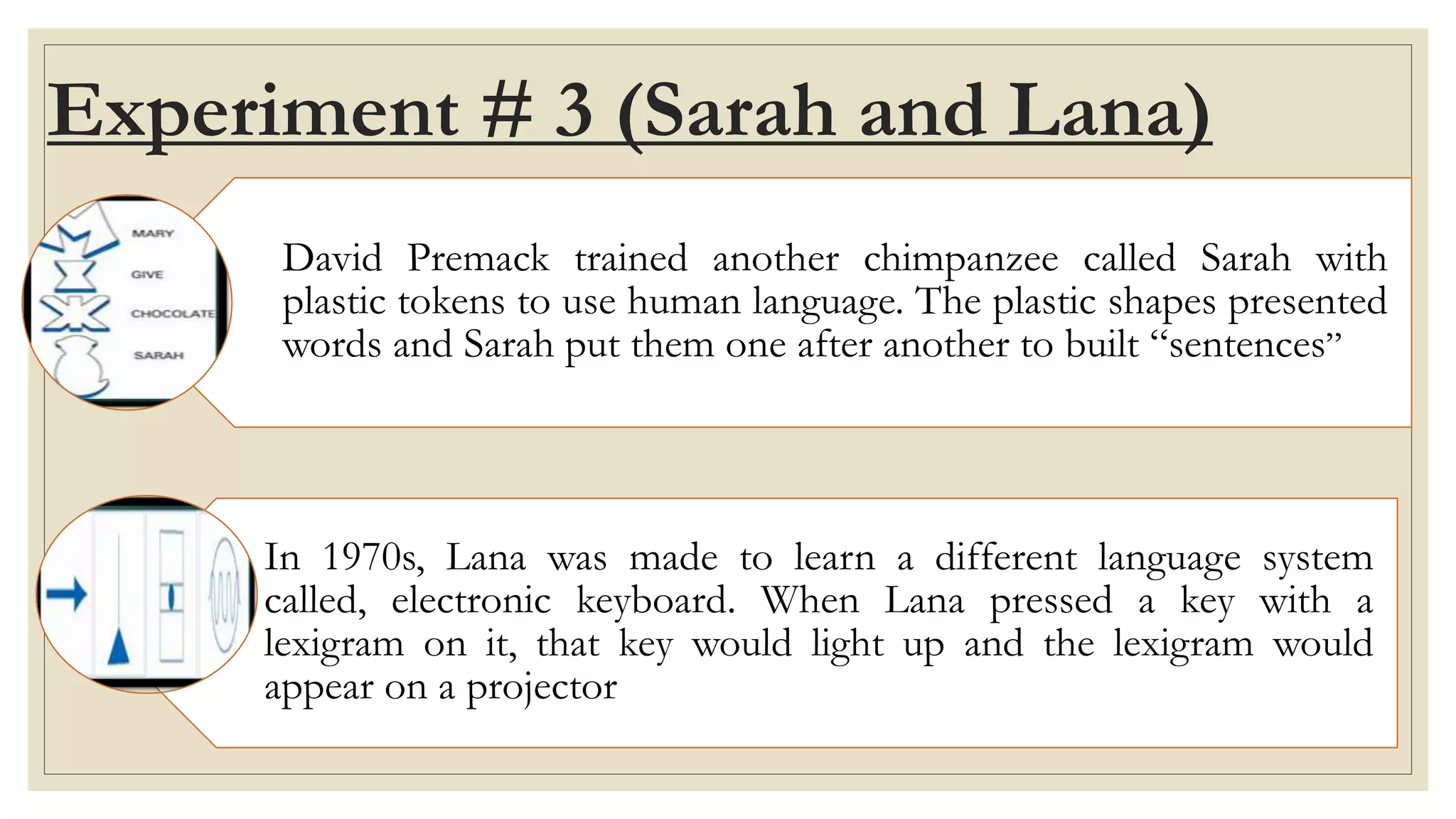
David Premack trained another chimpanzee called Sarah with
plastic tokens to use human language. The plastic shapes presented
words and Sarah put them one after another to built “sentences”
In 1970s, Lana was made to learn a different language system
called, electronic keyboard. When Lana pressed a key with a
lexigram on it, that key would light up and the lexigram would
appear on a projector
Plastic tokens used by
Sarah
Electronic Keyboard used by Lana
“Properties of Human
Language
Ask yourself!
1. Is it possible that a non-human creature may learn to communicate
with humans using language?
2. Can animals understand our language
3. Does human language have special properties that make it unique
and different than any other communication systems found in
nature?
“Properties of
Human Language
The properties of language make reference to those special
characteristics that can be only found in human language
1. Displacement
It allows languages users to talk about things and events not present
in immediate environment. Indeed, Displacement allows us to talk
about things and place whose existence we cannot even be sure of.
For this reason, in the world of humans, fictional nd mythical
creatures such as angels and demons too exist.
Whereas, animal communication is almost designed for THIS
moment, here and now. It cannot be used to relate events which
are far in place and time
2. Arbitrariness
Human language is symbolic, using a number of sounds (phonemes) and
characters (alphabets). These symbols are ambiguous, arbitrary and abstract. The
human linguistic form has no natural or iconic relationship with the object it
represents. This unclear connection between form and meaning is called
arbitrariness. Linguistics forms/symbols can have several or range of meaning.
Abstracts ideas too exist in
human language like the
linguistic form can exist in
thoughts but might not have a
physical or concrete existence
because human language is
arbitrary
Whereas, animal signaling show clear connection
between message conveyed and signal used. Usually
one signal has one meaning. For example, honey bee
perform round dance only when she wants to inform
that nectar is within 20 feet of the hive and the sickle
dance is performed to indicate that nectar is within
20-60 feet from the hive
3. Productivity
It refers to the creation of new expressions and novel utterances by
manipulating their linguistic resources to describe new objects and
situations because language is flexible.
Language evolves and
new words keep
becoming the part of
it. New words can be
invented easily
Multiple names can
be given to one
situation and a person
Writers may
discuss/write about
one idea but all of
them write in
unique way
Whereas, animal signals have a feature called
fixed reference or little flexibility which is
relating to a particular object or occasion.
They have very limited number of
combinations they can use to communicate.
For example, meowing is the ONLY
expression a cat has to use for referring to
multiple situations.
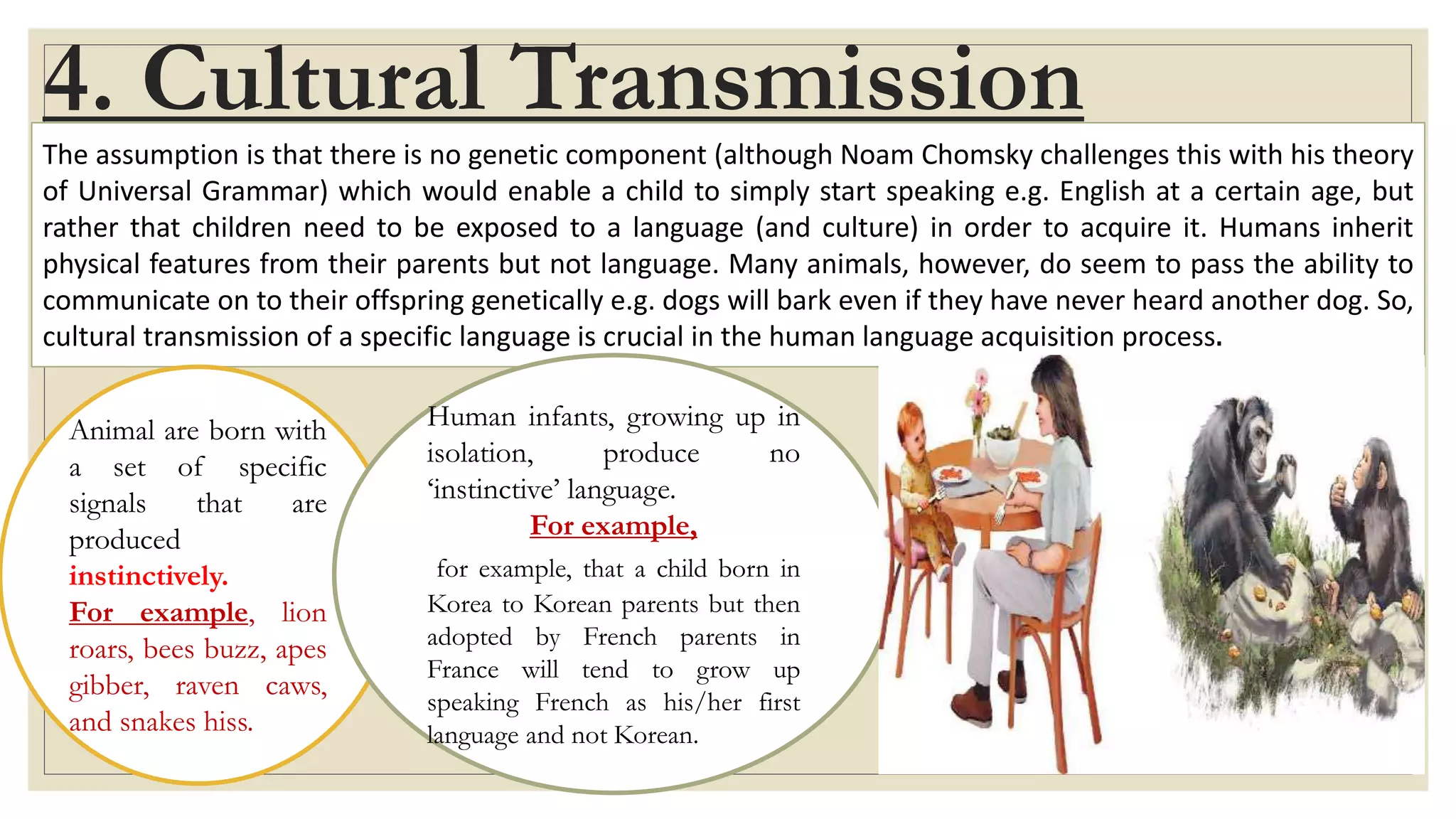
4. Cultural Transmission
The assumption is that there is no genetic component (although Noam Chomsky challenges this with his theory
of Universal Grammar) which would enable a child to simply start speaking e.g. English at a certain age, but
rather that children need to be exposed to a language (and culture) in order to acquire it. Humans inherit
physical features from their parents but not language. Many animals, however, do seem to pass the ability to
communicate on to their offspring genetically e.g. dogs will bark even if they have never heard another dog. So,
cultural transmission of a specific language is crucial in the human language acquisition process.
Animal are born with
a set of specific
signals that are
produced
instinctively.
For example, lion
roars, bees buzz, apes
gibber, raven caws,
and snakes hiss.
Human infants, growing up in
isolation, produce no
‘instinctive’ language.
For example,
for example, that a child born in
Korea to Korean parents but then
adopted by French parents in
France will tend to grow up
speaking French as his/her first
language and not Korean.
5. Duality/Double Articulation
Duality refers to two separate layers of language working together to provide us with a pool of sounds which
we can combine to communicate with one another. On the one hand, we have a limited number of discrete
sounds (e.g. the 44 phonemes in English) which in isolation have no inherent meaning e.g. b, i, or n. On the
other hand, we have a virtually unlimited number of distinct meanings which we can create by combining
these sounds in certain ways e.g. bin, or nib. Various other combinations such as *bni are not meaningful in
English, but could possibly be in other languages
Human language is organized
at 2 levels or layers
simultaneously:
At one level - distinct sounds
At another level - distinct
meanings
HUMANS
Duality is one of the most
economical features of human
language (with a limited set
of discrete sounds, we are
capable of producing a very
large number of sound
combinations (e.g. words)
5. Duality/Double Articulation
Animals’ communicative signals are fixed and cannot be
broken down into separate parts
For example, meow is not m + e + o + w
ANIMALS
Thanks
Home work: P. 21/ Answer study questions
Next class: Theories related to origin of language

Properties of human language

  • 1.
    “PROPERTIES OF HUMANLANGUAGE” & “ANIMALS AND HUMAN LANGUAGE” Lecture # 2 Instructor: Bibi Halima Bibi.Halima@uow.edu.pk
  • 2.
    Animals Lack Language: AControversy Chimpanzees and Language
  • 3.
    Experiment # 1(Home-raised Chimpanzees) In 1930s, Two scientists Luella and Winthrop Kellogg experimented by raising an infant chimpanzee, Gua, together with their baby son In 1940s, a chimpanzee named Viki was reared in the same fashion by another couple (Catherine and Keith Hayes) in their own home as she was a human child. She was given Speech Therapy which involved the Hayeses (her adoptees) manipulating her lower jaw. The nine months of non-stop parenting and scientific work did not make Gua to produce human language but she was able to understand about a hundred words. Besides, baby son started imitating Gua’s chimp noises and language retardations of Donald was about to happen. Spending five years with Viki as foster parents made her say four poorly articulated versions of words like cup, mama, papa and up. This extremely limited success was at first interpreted as evidence that apes were not capable of using human language.
  • 5.
    Experiment # 2(Washoe and American Sign Language) Experiment A scientist couple, Beatrix and Allen Gardner, raised Washoe like a human child in a domestic environment and made to use/learn a version of American sign language. Result Washoe came to use signs for than a hundred words like airplane, baby, and you etc. More impressively, Washoe was able to make and combine these forms to produce short expressions and phrases. Limitation Washoe demonstrated the aspect of productivity and also was capable of holding rudimentary conversations mainly in the form of question-answer sequences.
  • 6.
  • 8.
    Limitations of Koko’sSign language Comparing Koko's sign language with that of human children is possible but difficult; hearing human children are exposed from birth to the language in which they will ultimately communicate, whereas Koko was a year old when the project began. Age-dependent Acquisition By the time children reach age five, their vocabularies are normally well over I ,000 words, and in some cases as high as 5,000 by the time they reach age six (Nelson, 1974). In contrast, at age five Koko was emitting 500 to 600 signs Cognition level Koko was very rarely able to ask and answer WH. questions Articulation Koko acquired non- touch signs (signs in which the hands do not contact the body) more slowly than touch signs
  • 9.
    Experiment # 3(Sarah and Lana) David Premack trained another chimpanzee called Sarah with plastic tokens to use human language. The plastic shapes presented words and Sarah put them one after another to built “sentences” In 1970s, Lana was made to learn a different language system called, electronic keyboard. When Lana pressed a key with a lexigram on it, that key would light up and the lexigram would appear on a projector
  • 10.
    Plastic tokens usedby Sarah Electronic Keyboard used by Lana
  • 12.
    “Properties of Human Language Askyourself! 1. Is it possible that a non-human creature may learn to communicate with humans using language? 2. Can animals understand our language 3. Does human language have special properties that make it unique and different than any other communication systems found in nature?
  • 13.
    “Properties of Human Language Theproperties of language make reference to those special characteristics that can be only found in human language
  • 14.
    1. Displacement It allowslanguages users to talk about things and events not present in immediate environment. Indeed, Displacement allows us to talk about things and place whose existence we cannot even be sure of. For this reason, in the world of humans, fictional nd mythical creatures such as angels and demons too exist. Whereas, animal communication is almost designed for THIS moment, here and now. It cannot be used to relate events which are far in place and time
  • 15.
    2. Arbitrariness Human languageis symbolic, using a number of sounds (phonemes) and characters (alphabets). These symbols are ambiguous, arbitrary and abstract. The human linguistic form has no natural or iconic relationship with the object it represents. This unclear connection between form and meaning is called arbitrariness. Linguistics forms/symbols can have several or range of meaning. Abstracts ideas too exist in human language like the linguistic form can exist in thoughts but might not have a physical or concrete existence because human language is arbitrary
  • 16.
    Whereas, animal signalingshow clear connection between message conveyed and signal used. Usually one signal has one meaning. For example, honey bee perform round dance only when she wants to inform that nectar is within 20 feet of the hive and the sickle dance is performed to indicate that nectar is within 20-60 feet from the hive
  • 17.
    3. Productivity It refersto the creation of new expressions and novel utterances by manipulating their linguistic resources to describe new objects and situations because language is flexible. Language evolves and new words keep becoming the part of it. New words can be invented easily Multiple names can be given to one situation and a person Writers may discuss/write about one idea but all of them write in unique way
  • 18.
    Whereas, animal signalshave a feature called fixed reference or little flexibility which is relating to a particular object or occasion. They have very limited number of combinations they can use to communicate. For example, meowing is the ONLY expression a cat has to use for referring to multiple situations.
  • 19.
    4. Cultural Transmission Theassumption is that there is no genetic component (although Noam Chomsky challenges this with his theory of Universal Grammar) which would enable a child to simply start speaking e.g. English at a certain age, but rather that children need to be exposed to a language (and culture) in order to acquire it. Humans inherit physical features from their parents but not language. Many animals, however, do seem to pass the ability to communicate on to their offspring genetically e.g. dogs will bark even if they have never heard another dog. So, cultural transmission of a specific language is crucial in the human language acquisition process. Animal are born with a set of specific signals that are produced instinctively. For example, lion roars, bees buzz, apes gibber, raven caws, and snakes hiss. Human infants, growing up in isolation, produce no ‘instinctive’ language. For example, for example, that a child born in Korea to Korean parents but then adopted by French parents in France will tend to grow up speaking French as his/her first language and not Korean.
  • 20.
    5. Duality/Double Articulation Dualityrefers to two separate layers of language working together to provide us with a pool of sounds which we can combine to communicate with one another. On the one hand, we have a limited number of discrete sounds (e.g. the 44 phonemes in English) which in isolation have no inherent meaning e.g. b, i, or n. On the other hand, we have a virtually unlimited number of distinct meanings which we can create by combining these sounds in certain ways e.g. bin, or nib. Various other combinations such as *bni are not meaningful in English, but could possibly be in other languages Human language is organized at 2 levels or layers simultaneously: At one level - distinct sounds At another level - distinct meanings HUMANS Duality is one of the most economical features of human language (with a limited set of discrete sounds, we are capable of producing a very large number of sound combinations (e.g. words)
  • 21.
    5. Duality/Double Articulation Animals’communicative signals are fixed and cannot be broken down into separate parts For example, meow is not m + e + o + w ANIMALS
  • 22.
    Thanks Home work: P.21/ Answer study questions Next class: Theories related to origin of language