Peter Goodyear
Professor of Education & Co-Director, CoCo Research Centre
Faculty of Education & Social Work
University of Sydney
Senior Fellow, Australian Learning & Teaching Council
ARC Laureate Fellow
Blended Learning Summit
Sydney, Sept 18th
2013
Learning, technology
and design
defining architectures
for productive
networked learning
2
Overview
Developing educational design for learner autonomy
and life-long learning
Blended learning: what are we talking about?
The importance of helping students make connections: avoiding
fragmented and inert knowledge
Fostering the designerly aspects of teachers’ work
Teaching-as-design and why it’s becoming more necessary
Architectural approaches for tackling complex
design problems
Activity-centered analysis and design:
focusing on what students actually do
Approaches to capturing and sharing good design ideas
3
Overview
Developing educational design for learner autonomy
and life-long learning
Blended learning: what are we talking about?
The importance of helping students make connections:
avoiding fragmented and inert knowledge
Fostering the designerly aspects of teachers’ work
Teaching-as-design and why it’s becoming more necessary
Architectural approaches for tackling complex
design problems
Activity-centered analysis and design: focus on what students do
Approaches to capturing and sharing good design ideas
4
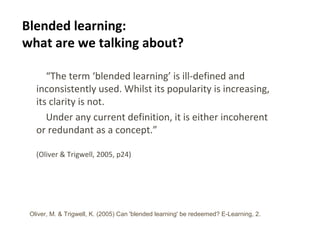
“The term ‘blended learning’ is ill-defined and
inconsistently used. Whilst its popularity is increasing,
its clarity is not.
Under any current definition, it is either incoherent
or redundant as a concept.”
(Oliver & Trigwell, 2005, p24)
Oliver, M. & Trigwell, K. (2005) Can 'blended learning' be redeemed? E-Learning, 2.
Blended learning:
what are we talking about?
5
Definitions: for systematic review
“Learning through a combination of online and face-to-
face experiences. In this study, cases where students
learned 25% or more but not all of the assessed content
over the Internet were categorized as blended learning”
(Means et al, 2013; emphasis added)
Means, B., Toyama, Y., Murphy, R. F. & Baki, M. (2013) The effectiveness of online and blended
learning: A meta-analysis of the empirical literature. Teachers College Record, 115, 1-47.
6
Systematic reviews of research on
blended learning
Online learning x F2F/traditional – on average, no
significant difference
Blended learning often comes out better than either
pure online or pure F2F/traditional
Confounded (?) by the fact that, in some/many
blended learning situations, students spend more time
on task, consult more resources and work with each
other more
Means, B., Toyama, Y., Murphy, R. F. & Baki, M. (2013) The effectiveness of online and blended
learning: A meta-analysis of the empirical literature. Teachers College Record, 115, 1-47.
7
A design-oriented, learning-centered view
‘Blended learning’ describes learning activities that
involve a systematic combination of co-present (face-
to-face) interactions and technologically-mediated
interactions between students, teachers and learning
resources.
Bliuc, A.-M., Ellis, R. & Goodyear, P. (2007) Research focus and methodological choices in studies into
students' experiences of blended learning in higher education The Internet and Higher Education, 10,
231-244.
8
Design for blended learning
Design for learning situations in which:
1. What the learner does involves an integrated combination of
technology-mediated and ‘other’ activities
2. Integrated – includes helping connect learning activities, episodes,
experiences & outcomes across time, space & media
3. There is significant complexity in designing and/or understanding
the learning situation
4. In part because of multiple, sometimes competing, learning
objectives – including helping students become more autonomous,
better at managing their own learning, skilled at reconfiguring their
environment to make learning (and other kinds of knowledge work)
more effective
9
Students’ experiences of blended learning….
Headline: students are rapidly becoming better at using technology to
improve the efficiency of strategic and surface approaches to learning
Ellis, R. & Goodyear, P. (2010) Students' experiences of e-learning in higher education: The ecology
of sustainable innovation, New York, RoutledgeFalmer.
Kennedy, G., Dalgarno, B., Bennett, S., Gray, K., Waycott, J., Judd, T., Bishop, A., Maton, K., Krause,
K.-L. & Chang, R. (2009) Educating the net generation. Melbourne, University of Melbourne.
But surely digital natives can get on with this
without us fussing over them?
10
HE Students’ experiences of blended learning
(UK & Australian data, 2005-10): Headlines
1. Over time, steadily increasing fluency with use of various ICT tools &
resources (email, IM, Google, social networking, ejournals), though
still some significant variation in abilities, confidence, practices
within years
2. High value being placed on: flexibility (time-space), bite-sizing, fast
task-orientation; podcasts for revision
3. Little or no data connecting practices with learning outcomes.
Little/nothing on new or more ambitious learning outcomes.
4. Some evidence of students captured by their media habits; little or no
data telling us that students are making well-informed
strategic/reflective decisions about how to tackle tasks, how to make
best use of various combinations of ICT-based and other study
activities, or links between these and learning outcomes.
11
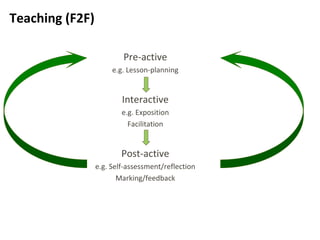
Teaching (F2F)
Pre-active
e.g. Lesson-planning
Interactive
e.g. Exposition
Facilitation
Post-active
e.g. Self-assessment/reflection
Marking/feedback
12
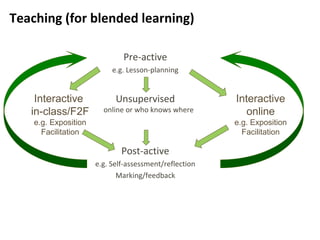
Teaching (for blended learning)
Pre-active
e.g. Lesson-planning
Unsupervised
online or who knows where
Post-active
e.g. Self-assessment/reflection
Marking/feedback
Interactive
in-class/F2F
e.g. Exposition
Facilitation
Interactive
online
e.g. Exposition
Facilitation
13
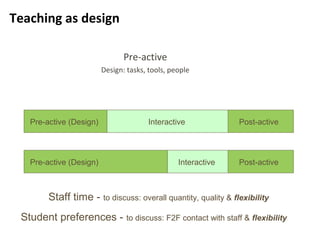
Teaching as design
Pre-active
Design: tasks, tools, people
Pre-active (Design)
Pre-active (Design)
Interactive
Interactive
Post-active
Post-active
Staff time - to discuss: overall quantity, quality & flexibility
Student preferences - to discuss: F2F contact with staff & flexibility
14
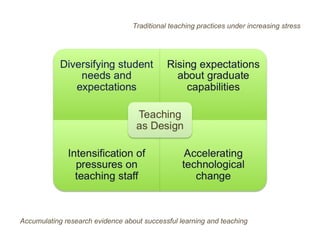
Traditional teaching practices under increasing stress
Accumulating research evidence about successful learning and teaching
15
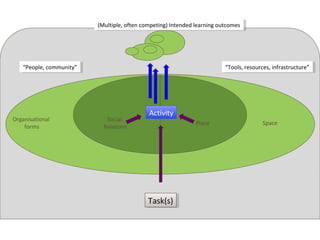
Organisational
forms
Social
Relations
SpacePlace
“People, community”“People, community” “Tools, resources, infrastructure”“Tools, resources, infrastructure”
Task(s)Task(s)
ActivityActivity
(Multiple, often competing) Intended learning outcomes(Multiple, often competing) Intended learning outcomes
16
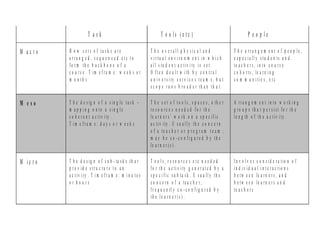
T a s k T o o l s ( e t c ) P e o p l e
M a c r o H o w s e t s o f t a s k s a r e
a r r a n g e d , s e q u e n c e d e t c t o
f o r m t h e b a c k b o n e o f a
c o u r s e . T i m e f r a m e : w e e k s o r
m o n t h s
T h e o v e r a l l p h y s i c a l a n d
v i r t u a l e n v i r o n m e n t i n w h i c h
a l l s t u d e n t a c t i v i ty i s s e t .
O f t e n d e a l t w i th b y c e n t r a l
u n i v e r s i ty s e r v i c e s t e a m s , b u t
s c o p e r u n s b r o a d e r t h a n t h a t .
T h e a r r a n g e m e n t o f p e o p l e ,
e s p e c i a l l y s t u d e n ts a n d
te a c h e r s , i n t o c o u r s e
c o h o r t s , le a r n i n g
c o m m u n i t i e s , e t c
M e s o T h e d e s i g n o f a s in g l e t a s k –
m a p p i n g o n t o a s i n g l e
c o h e r e n t a c t i v i ty .
T i m e f r a m e : d a y s o r w e e k s
T h e s e t o f t o o l s , s p a c e s , o t h e r
r e s o u r c e s n e e d e d f o r t h e
le a r n e r s ’ w o r k o n a s p e c i f i c
a c t i v i ty . U s u a l l y t h e c o n c e r n
o f a t e a c h e r o r p r o g r a m t e a m ;
m a y b e c o - c o n f i g u r e d b y t h e
le a r n e r ( s ) .
A r r a n g e m e n t i n t o w o r k i n g
g r o u p s t h a t p e r s i s t f o r t h e
l e n g t h o f t h e a c t i v i ty .
M i c r o T h e d e s i g n o f s u b - ta s k s t h a t
p r o v i d e s t r u c t u r e t o a n
a c t i v i ty . T i m e f r a m e : m i n u t e s
o r h o u r s
T o o l s , r e s o u r c e s e t c n e e d e d
f o r t h e a c ti v i ty g e n e r a t e d b y a
s p e c i f i c s u b ta s k . U s u a l l y t h e
c o n c e r n o f a te a c h e r ;
f r e q u e n t l y c o - c o n f i g u r e d b y
t h e l e a r n e r ( s ) .
I n v o l v e s c o n s i d e r a t i o n o f
i n d i v i d u a l i n t e r a c t i o n s
b e t w e e n le a r n e r s , a n d
b e t w e e n le a r n e r s a n d
te a c h e r s
17
Architectures for productive learning
Paradigm shift: from comparing the effectiveness of simple
treatments to designing and managing complex systems
(assemblages, environments, ecologies, networks …. )
Research-based evidence on learning, and (re)usable design
guidance, is very context-dependent
Not: X is better than Y. Rather: If you want to help achieve
A, B and C in situation S, then try X then Z
Integration of a complex of elements, with a good internal
logic, but recognising students will reconfigure what is
offered
18
Shareable knowledge for teaching-as-design:
design patterns and pattern languages
A pattern is a solution to a recurrent problem in a context.
A pattern "describes a problem which occurs over and over again in our
environment, and then describes the core of the solution to that problem, in
such a way that you can use this solution a million times over, without ever
doing it the same way twice” (Alexander et al., 1977, p.x).
Goodyear, P. & Retalis, S. (Eds.) (2010)
Technology-enhanced learning: Design patterns and pattern languages, Rotterdam, Sense Publishers.
19
Collaboration scripts
“Scripts aim at structuring collaborative processes by defining
sequences of activities, by creating roles within groups and by
constraining the mode of interaction among peers or between
groups.
Scripts originate from the fact that it is difficult to predict the
effects of collaborative learning by controlling external conditions
such as group composition or task features.
… the effects of collaborative learning depend on the quality of
interactions that take place among group members.”
Dillenbourg, P. & Tchounikine, P. (2007) Flexibility in macro-scripts for computer-supported collaborative
learning. Journal of Computer Assisted Learning, 23, 1-13.
20
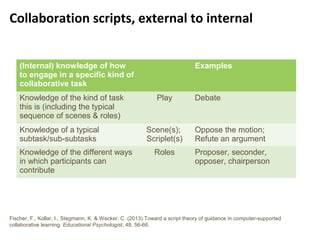
Collaboration scripts, external to internal
(Internal) knowledge of how
to engage in a specific kind of
collaborative task
Examples
Knowledge of the kind of task
this is (including the typical
sequence of scenes & roles)
Play Debate
Knowledge of a typical
subtask/sub-subtasks
Scene(s);
Scriplet(s)
Oppose the motion;
Refute an argument
Knowledge of the different ways
in which participants can
contribute
Roles Proposer, seconder,
opposer, chairperson
Fischer, F., Kollar, I., Stegmann, K. & Wecker, C. (2013) Toward a script theory of guidance in computer-supported
collaborative learning. Educational Psychologist, 48, 56-66.
21
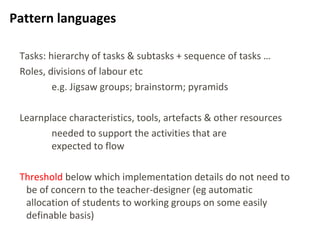
Pattern languages
Tasks: hierarchy of tasks & subtasks + sequence of tasks …
Roles, divisions of labour etc
e.g. Jigsaw groups; brainstorm; pyramids
Learnplace characteristics, tools, artefacts & other resources
needed to support the activities that are
expected to flow
Threshold below which implementation details do not need to
be of concern to the teacher-designer (eg automatic
allocation of students to working groups on some easily
definable basis)
22
Summing up
1. Innovations in digital technology + accelerating
interpenetration of the ‘material’ and ‘digital’ worlds mean that
learning activity will become spread more broadly across
heterogeneous places, tools, artefacts etc
2. Understanding learning activity; analysing learning
environments become much more complex
3. Design for blended learning: helping students manage &
integrate – connected learning; focus on what students do
4. Research: richer understanding of socio-technical, materiality,
affordance, etc; shifting the unit of analysis from the individual
to the extended mind
Clark, A. (2008) Supersizing the mind: Embodiment, action, and cognitive extension, Oxford, Oxford University Press.
Fenwick, T., Edwards, R. & Sawchuk, P. (2011) Emerging approaches to educational research: Tracing the
sociomaterial, Abingdon, Routledge.
Hodder, I. (2012) Entangled: An archaeology of the relationships between humans and things, Wiley-Blackwell.
23
If you have been, thanks for listening…
peter.goodyear@sydney.edu.au
http://coco.edfac.usyd.edu.au
http://sydney.edu.au/research/stl/
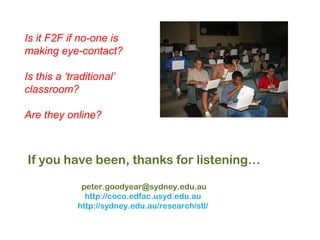
Is it F2F if no-one is
making eye-contact?
Is this a ‘traditional’
classroom?
Are they online?

Learning, technology and design - architectures for networked learning

  • 1.
    Peter Goodyear Professor ofEducation & Co-Director, CoCo Research Centre Faculty of Education & Social Work University of Sydney Senior Fellow, Australian Learning & Teaching Council ARC Laureate Fellow Blended Learning Summit Sydney, Sept 18th 2013 Learning, technology and design defining architectures for productive networked learning
  • 2.
    2 Overview Developing educational designfor learner autonomy and life-long learning Blended learning: what are we talking about? The importance of helping students make connections: avoiding fragmented and inert knowledge Fostering the designerly aspects of teachers’ work Teaching-as-design and why it’s becoming more necessary Architectural approaches for tackling complex design problems Activity-centered analysis and design: focusing on what students actually do Approaches to capturing and sharing good design ideas
  • 3.
    3 Overview Developing educational designfor learner autonomy and life-long learning Blended learning: what are we talking about? The importance of helping students make connections: avoiding fragmented and inert knowledge Fostering the designerly aspects of teachers’ work Teaching-as-design and why it’s becoming more necessary Architectural approaches for tackling complex design problems Activity-centered analysis and design: focus on what students do Approaches to capturing and sharing good design ideas
  • 4.
    4 “The term ‘blendedlearning’ is ill-defined and inconsistently used. Whilst its popularity is increasing, its clarity is not. Under any current definition, it is either incoherent or redundant as a concept.” (Oliver & Trigwell, 2005, p24) Oliver, M. & Trigwell, K. (2005) Can 'blended learning' be redeemed? E-Learning, 2. Blended learning: what are we talking about?
  • 5.
    5 Definitions: for systematicreview “Learning through a combination of online and face-to- face experiences. In this study, cases where students learned 25% or more but not all of the assessed content over the Internet were categorized as blended learning” (Means et al, 2013; emphasis added) Means, B., Toyama, Y., Murphy, R. F. & Baki, M. (2013) The effectiveness of online and blended learning: A meta-analysis of the empirical literature. Teachers College Record, 115, 1-47.
  • 6.
    6 Systematic reviews ofresearch on blended learning Online learning x F2F/traditional – on average, no significant difference Blended learning often comes out better than either pure online or pure F2F/traditional Confounded (?) by the fact that, in some/many blended learning situations, students spend more time on task, consult more resources and work with each other more Means, B., Toyama, Y., Murphy, R. F. & Baki, M. (2013) The effectiveness of online and blended learning: A meta-analysis of the empirical literature. Teachers College Record, 115, 1-47.
  • 7.
    7 A design-oriented, learning-centeredview ‘Blended learning’ describes learning activities that involve a systematic combination of co-present (face- to-face) interactions and technologically-mediated interactions between students, teachers and learning resources. Bliuc, A.-M., Ellis, R. & Goodyear, P. (2007) Research focus and methodological choices in studies into students' experiences of blended learning in higher education The Internet and Higher Education, 10, 231-244.
  • 8.
    8 Design for blendedlearning Design for learning situations in which: 1. What the learner does involves an integrated combination of technology-mediated and ‘other’ activities 2. Integrated – includes helping connect learning activities, episodes, experiences & outcomes across time, space & media 3. There is significant complexity in designing and/or understanding the learning situation 4. In part because of multiple, sometimes competing, learning objectives – including helping students become more autonomous, better at managing their own learning, skilled at reconfiguring their environment to make learning (and other kinds of knowledge work) more effective
  • 9.
    9 Students’ experiences ofblended learning…. Headline: students are rapidly becoming better at using technology to improve the efficiency of strategic and surface approaches to learning Ellis, R. & Goodyear, P. (2010) Students' experiences of e-learning in higher education: The ecology of sustainable innovation, New York, RoutledgeFalmer. Kennedy, G., Dalgarno, B., Bennett, S., Gray, K., Waycott, J., Judd, T., Bishop, A., Maton, K., Krause, K.-L. & Chang, R. (2009) Educating the net generation. Melbourne, University of Melbourne. But surely digital natives can get on with this without us fussing over them?
  • 10.
    10 HE Students’ experiencesof blended learning (UK & Australian data, 2005-10): Headlines 1. Over time, steadily increasing fluency with use of various ICT tools & resources (email, IM, Google, social networking, ejournals), though still some significant variation in abilities, confidence, practices within years 2. High value being placed on: flexibility (time-space), bite-sizing, fast task-orientation; podcasts for revision 3. Little or no data connecting practices with learning outcomes. Little/nothing on new or more ambitious learning outcomes. 4. Some evidence of students captured by their media habits; little or no data telling us that students are making well-informed strategic/reflective decisions about how to tackle tasks, how to make best use of various combinations of ICT-based and other study activities, or links between these and learning outcomes.
  • 11.
    11 Teaching (F2F) Pre-active e.g. Lesson-planning Interactive e.g.Exposition Facilitation Post-active e.g. Self-assessment/reflection Marking/feedback
  • 12.
    12 Teaching (for blendedlearning) Pre-active e.g. Lesson-planning Unsupervised online or who knows where Post-active e.g. Self-assessment/reflection Marking/feedback Interactive in-class/F2F e.g. Exposition Facilitation Interactive online e.g. Exposition Facilitation
  • 13.
    13 Teaching as design Pre-active Design:tasks, tools, people Pre-active (Design) Pre-active (Design) Interactive Interactive Post-active Post-active Staff time - to discuss: overall quantity, quality & flexibility Student preferences - to discuss: F2F contact with staff & flexibility
  • 14.
    14 Traditional teaching practicesunder increasing stress Accumulating research evidence about successful learning and teaching
  • 15.
    15 Organisational forms Social Relations SpacePlace “People, community”“People, community”“Tools, resources, infrastructure”“Tools, resources, infrastructure” Task(s)Task(s) ActivityActivity (Multiple, often competing) Intended learning outcomes(Multiple, often competing) Intended learning outcomes
  • 16.
    16 T a sk T o o l s ( e t c ) P e o p l e M a c r o H o w s e t s o f t a s k s a r e a r r a n g e d , s e q u e n c e d e t c t o f o r m t h e b a c k b o n e o f a c o u r s e . T i m e f r a m e : w e e k s o r m o n t h s T h e o v e r a l l p h y s i c a l a n d v i r t u a l e n v i r o n m e n t i n w h i c h a l l s t u d e n t a c t i v i ty i s s e t . O f t e n d e a l t w i th b y c e n t r a l u n i v e r s i ty s e r v i c e s t e a m s , b u t s c o p e r u n s b r o a d e r t h a n t h a t . T h e a r r a n g e m e n t o f p e o p l e , e s p e c i a l l y s t u d e n ts a n d te a c h e r s , i n t o c o u r s e c o h o r t s , le a r n i n g c o m m u n i t i e s , e t c M e s o T h e d e s i g n o f a s in g l e t a s k – m a p p i n g o n t o a s i n g l e c o h e r e n t a c t i v i ty . T i m e f r a m e : d a y s o r w e e k s T h e s e t o f t o o l s , s p a c e s , o t h e r r e s o u r c e s n e e d e d f o r t h e le a r n e r s ’ w o r k o n a s p e c i f i c a c t i v i ty . U s u a l l y t h e c o n c e r n o f a t e a c h e r o r p r o g r a m t e a m ; m a y b e c o - c o n f i g u r e d b y t h e le a r n e r ( s ) . A r r a n g e m e n t i n t o w o r k i n g g r o u p s t h a t p e r s i s t f o r t h e l e n g t h o f t h e a c t i v i ty . M i c r o T h e d e s i g n o f s u b - ta s k s t h a t p r o v i d e s t r u c t u r e t o a n a c t i v i ty . T i m e f r a m e : m i n u t e s o r h o u r s T o o l s , r e s o u r c e s e t c n e e d e d f o r t h e a c ti v i ty g e n e r a t e d b y a s p e c i f i c s u b ta s k . U s u a l l y t h e c o n c e r n o f a te a c h e r ; f r e q u e n t l y c o - c o n f i g u r e d b y t h e l e a r n e r ( s ) . I n v o l v e s c o n s i d e r a t i o n o f i n d i v i d u a l i n t e r a c t i o n s b e t w e e n le a r n e r s , a n d b e t w e e n le a r n e r s a n d te a c h e r s
  • 17.
    17 Architectures for productivelearning Paradigm shift: from comparing the effectiveness of simple treatments to designing and managing complex systems (assemblages, environments, ecologies, networks …. ) Research-based evidence on learning, and (re)usable design guidance, is very context-dependent Not: X is better than Y. Rather: If you want to help achieve A, B and C in situation S, then try X then Z Integration of a complex of elements, with a good internal logic, but recognising students will reconfigure what is offered
  • 18.
    18 Shareable knowledge forteaching-as-design: design patterns and pattern languages A pattern is a solution to a recurrent problem in a context. A pattern "describes a problem which occurs over and over again in our environment, and then describes the core of the solution to that problem, in such a way that you can use this solution a million times over, without ever doing it the same way twice” (Alexander et al., 1977, p.x). Goodyear, P. & Retalis, S. (Eds.) (2010) Technology-enhanced learning: Design patterns and pattern languages, Rotterdam, Sense Publishers.
  • 19.
    19 Collaboration scripts “Scripts aimat structuring collaborative processes by defining sequences of activities, by creating roles within groups and by constraining the mode of interaction among peers or between groups. Scripts originate from the fact that it is difficult to predict the effects of collaborative learning by controlling external conditions such as group composition or task features. … the effects of collaborative learning depend on the quality of interactions that take place among group members.” Dillenbourg, P. & Tchounikine, P. (2007) Flexibility in macro-scripts for computer-supported collaborative learning. Journal of Computer Assisted Learning, 23, 1-13.
  • 20.
    20 Collaboration scripts, externalto internal (Internal) knowledge of how to engage in a specific kind of collaborative task Examples Knowledge of the kind of task this is (including the typical sequence of scenes & roles) Play Debate Knowledge of a typical subtask/sub-subtasks Scene(s); Scriplet(s) Oppose the motion; Refute an argument Knowledge of the different ways in which participants can contribute Roles Proposer, seconder, opposer, chairperson Fischer, F., Kollar, I., Stegmann, K. & Wecker, C. (2013) Toward a script theory of guidance in computer-supported collaborative learning. Educational Psychologist, 48, 56-66.
  • 21.
    21 Pattern languages Tasks: hierarchyof tasks & subtasks + sequence of tasks … Roles, divisions of labour etc e.g. Jigsaw groups; brainstorm; pyramids Learnplace characteristics, tools, artefacts & other resources needed to support the activities that are expected to flow Threshold below which implementation details do not need to be of concern to the teacher-designer (eg automatic allocation of students to working groups on some easily definable basis)
  • 22.
    22 Summing up 1. Innovationsin digital technology + accelerating interpenetration of the ‘material’ and ‘digital’ worlds mean that learning activity will become spread more broadly across heterogeneous places, tools, artefacts etc 2. Understanding learning activity; analysing learning environments become much more complex 3. Design for blended learning: helping students manage & integrate – connected learning; focus on what students do 4. Research: richer understanding of socio-technical, materiality, affordance, etc; shifting the unit of analysis from the individual to the extended mind Clark, A. (2008) Supersizing the mind: Embodiment, action, and cognitive extension, Oxford, Oxford University Press. Fenwick, T., Edwards, R. & Sawchuk, P. (2011) Emerging approaches to educational research: Tracing the sociomaterial, Abingdon, Routledge. Hodder, I. (2012) Entangled: An archaeology of the relationships between humans and things, Wiley-Blackwell.
  • 23.
    23 If you havebeen, thanks for listening… peter.goodyear@sydney.edu.au http://coco.edfac.usyd.edu.au http://sydney.edu.au/research/stl/ Is it F2F if no-one is making eye-contact? Is this a ‘traditional’ classroom? Are they online?

Editor's Notes

  • #11 Sources for the JISC Learner experiences of e-learning studies Phase 1 studies (reporting 2006) Conole, G., de Laat, M., Dillon, T., & Darby, J. (2006). Student experiences of technologies: LXP final report. Bristol: JISC. Creanor, L., Trinder, K., Gowan, D., & Howells, C. (2006). LEX: the learner experience of e-learning, Final report. Bristol: JISC. http://www.jisc.ac.uk/whatwedo/programmes/elearning_pedagogy/elp_learneroutcomes.aspx Phase 2 studies (current) See symposium at 2008 Networked Learning conference http://www.networkedlearningconference.org.uk/abstracts/Beetham.htm Papers by Jefferies et al; Hardy et al; Thorpe et al; Childs & Espinoza-Ramos
  • #15 TaD can be seen as a credible strategy for dealing with the tensions that arise because of the interactions of these complex and powerful forces: Demands on the quality of our output are increasing (evidenced in employer statements; government statements; government scrutiny; own internal documents – reductions in output quality are not to be countenanced). Puts pressure on the quality of the learning experiences – how do we raise the quality of learning activities so that they align with higher level expectations of graduate capabiltiies? The diversity of needs and expectations of students coming in to HE still seems to be increasing (with massification & the growth of LLL) – how do we cater for diversity? The incursion of VLEs/LMSs isn’t the end of the story; tech change is not a solved problem; tech change is accelerating; how do we develop strategies in such a risky volatile environment? Performance pressures on teaching staff (eg research; T:S ratios) + global competition for talent. How do we organise teaching so that it is rewarding and sustainable? The combination of these four presents serious challenges to the sustainability of many existing teaching practices Also – we have accumulating evidence about good L&T that is having, at best, a slow and indirect influence on what teachers and learners do.
  • #16 Design focussed on the ‘activity system’ In Greeno ’s words, activity systems are “complex social organizations containing learners, teachers, curriculum materials, software tools and the physical environment” (2006, p79). In design terms, the situative view focuses attention on “characteristics of activity systems that can result in learners increasing their capabilities for participation in ways that are valued” (op. cit., p80). Learning comes to be understood as both an individual cognitive accomplishment and the ability to engage effectively in a valued social practice, appropriating the symbolic and material tools of a culture (Saljo, 1999). Greeno, J. (2006). Learning in activity. In K. Sawyer (Ed.), The Cambridge handbook of the learning sciences (pp. 79  96). Cambridge: Cambridge University Press. Saljo, R. (1999). Learning as the use of tools: a sociocultural perspective on the human-technology link. In K. Littleton & P. Light (Eds.), Learning with computers: analysing productive interaction (pp. 144  161). London: Routledge. Goodyear, P & Retalis, S (2010) Learning, technology and design, Ch 1 in Goodyear, P & Retalis, S (eds) Technology-enhanced learning: design patterns and pattern languages . Rotterdam: Sense Publishers.
  • #19 Sources: Alexander, C. (1979). The timeless way of building . New York: Oxford University Press. Alexander, C., Ishikawa, S., Silverstein, M., Jacobson, M., Fiksdahl-King, I., & Angel, S. (1977). A pattern language: towns, buildings, construction . New York: Oxford University Press. Alexander, C. (1999). The origins of pattern theory: the future of the theory and the generation of a living world. IEEE Software, 16 (5), 71-82.