Download as KEY, PPTX
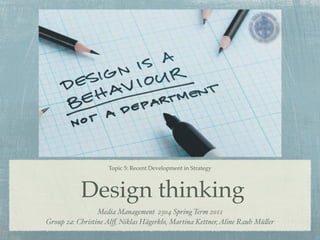


The document discusses design thinking as an approach that focuses less on objects and more on taking the user's perspective. It emphasizes identifying user needs and desires in order to design solutions that provide both customer and business value. Design thinking is described as an iterative process involving prototyping, testing, and implementation to collaborate with users. Key aspects of design thinking include empathy, integrative thinking, optimism, experimentation, and collaboration. An example of a language lab startup is provided that recognized a need for online language learning and designed a virtual city based on user needs through continual prototyping of new ideas.


