WHAT IS LEAN DESIGN?
                                                                                                   Bart Huthwaite
                                                                                          bart@barthuthwaite.com


Copyright 2012 by Bart Huthwaite. All rights reserved. No part of this material may be reproduced, stored in a retrieval system, or
transmitted in any form, or by any means without the express written permission of the Huthwaite Innovation Institute. LEAN Design
Innovation CUBE process patent pending.
HUTHWAITE INSTITUTE’S LEAN
DESIGN INNOVATORS
Onsite Coaching      Online Certification            Workshops
We will help you get        in LEAN Design          We will help you
started and lead you             Excellence    figure out where you
through the process                            are at and where you
                                                          need to go


             Visit barthuthwaite.com for m ore inform ation
THE AWAKENING
LEAN Design is the missing element
of the LEAN Journey


Design drives 80%
of a product or project success


Best strategy is to
avoid designing wastes in the first place


LEAN Design is urgently needed
at the headwaters of the Value Stream.
WHAT IS LEAN DESIGN?

Optimize value – minimize waste


LEAN Design encompasses both
the product and the process.

Thinking must be LEAN from the
start.

The entire product lifecycle must be
taken into mind.
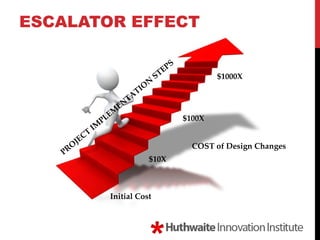
ESCALATOR EFFECT
  Design changes become more costly over time
                                                     P   S
                                              S   TE                 $1000X
                                          N
                                       O
                                   A TI
                               T
                            EN
                           M
                    P LE                                     $100X
                  IM
             CT
          JE
      P RO                                                     COST of Design Changes
                                           $10X


                       Initial Cost
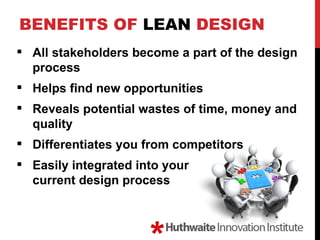
BENEFITS OF LEAN DESIGN
 All stakeholders become a part of the design
  process
 Helps find new opportunities
 Reveals potential wastes of time, money and
  quality
 Differentiates you from competitors
 Easily integrated into your
  current design process
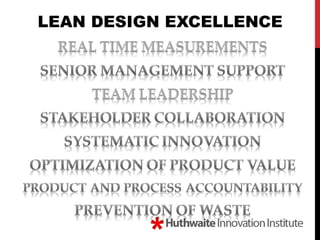
LEAN DESIGN EXCELLENCE
STAKEHOLDER
COLLABORATION

Do you involve stakeholders from each of the 4 domains right from the start?

Do you involve all of your stakeholders up front?
OPTIMIZATION OF VALUE


Do you have a process in place to anticipate future customer wants?
PREVENTION OF WASTE
Do you have a system to identify wastes at the start of a project?


               High Skill
               Precision
               Immaturity
               Variability
               Sensitivity
               C omplexity
               Danger
REAL-TIME MEASUREMENT


       Do you have a process to set up measurements of
       your product value strategy?

       Do you use these measurements on day 1, in the
       middle, and at the end of the project?
PRODUCT & PROCESS
ACCOUNTABILITY

Are your project teams accountable for both product development
process as well as product excellence?
SYSTEMATIC INNOVATION

Do your project teams understand the importance of iteration?

Do you use a systematic innovation process to explore and find solutions
well beyond the experience and knowledge of your product teams?


  it·er·a·tion

  noun   ˌi-tə-ˈrā-shən
  Definition of ITERATION
  1

  Iteration means the act of repeating a process usually with the
  aim of approaching a desired goal or target or result. Each
  repetition of the process is also called an "iteration," and the
  results of one iteration are used as the starting point for the next
  iteration.
TEAM LEADERSHIP

Do you have a process in place to build trust among project team
members and beyond?
SENIOR MANAGEMENT SUPPORT

 Does your Senior Management focus on the process to achieve
 innovation?

 Does this process provide sufficient time and resources?
REVIEW

The need for LEAN Design and why it works

The 8 dimensions of LEAN Design Excellence

Visit us online at Barthuthwaite.com

jennifer@barthuthwaite.com

(906) 847-6094

What is LEAN design?

  • 1.
    WHAT IS LEANDESIGN? Bart Huthwaite bart@barthuthwaite.com Copyright 2012 by Bart Huthwaite. All rights reserved. No part of this material may be reproduced, stored in a retrieval system, or transmitted in any form, or by any means without the express written permission of the Huthwaite Innovation Institute. LEAN Design Innovation CUBE process patent pending.
  • 2.
  • 3.
    Onsite Coaching Online Certification Workshops We will help you get in LEAN Design We will help you started and lead you Excellence figure out where you through the process are at and where you need to go Visit barthuthwaite.com for m ore inform ation
  • 4.
    THE AWAKENING LEAN Designis the missing element of the LEAN Journey Design drives 80% of a product or project success Best strategy is to avoid designing wastes in the first place LEAN Design is urgently needed at the headwaters of the Value Stream.
  • 5.
    WHAT IS LEANDESIGN? Optimize value – minimize waste LEAN Design encompasses both the product and the process. Thinking must be LEAN from the start. The entire product lifecycle must be taken into mind.
  • 6.
    ESCALATOR EFFECT Design changes become more costly over time P S S TE $1000X N O A TI T EN M P LE $100X IM CT JE P RO COST of Design Changes $10X Initial Cost
  • 7.
    BENEFITS OF LEANDESIGN  All stakeholders become a part of the design process  Helps find new opportunities  Reveals potential wastes of time, money and quality  Differentiates you from competitors  Easily integrated into your current design process
  • 8.
  • 9.
    STAKEHOLDER COLLABORATION Do you involvestakeholders from each of the 4 domains right from the start? Do you involve all of your stakeholders up front?
  • 10.
    OPTIMIZATION OF VALUE Doyou have a process in place to anticipate future customer wants?
  • 11.
    PREVENTION OF WASTE Doyou have a system to identify wastes at the start of a project? High Skill Precision Immaturity Variability Sensitivity C omplexity Danger
  • 12.
    REAL-TIME MEASUREMENT Do you have a process to set up measurements of your product value strategy? Do you use these measurements on day 1, in the middle, and at the end of the project?
  • 13.
    PRODUCT & PROCESS ACCOUNTABILITY Areyour project teams accountable for both product development process as well as product excellence?
  • 14.
    SYSTEMATIC INNOVATION Do yourproject teams understand the importance of iteration? Do you use a systematic innovation process to explore and find solutions well beyond the experience and knowledge of your product teams? it·er·a·tion noun ˌi-tə-ˈrā-shən Definition of ITERATION 1 Iteration means the act of repeating a process usually with the aim of approaching a desired goal or target or result. Each repetition of the process is also called an "iteration," and the results of one iteration are used as the starting point for the next iteration.
  • 15.
    TEAM LEADERSHIP Do youhave a process in place to build trust among project team members and beyond?
  • 16.
    SENIOR MANAGEMENT SUPPORT Does your Senior Management focus on the process to achieve innovation? Does this process provide sufficient time and resources?
  • 17.
    REVIEW The need forLEAN Design and why it works The 8 dimensions of LEAN Design Excellence Visit us online at Barthuthwaite.com jennifer@barthuthwaite.com (906) 847-6094

Editor's Notes

  • #2 Bart Huthwaite 06/19/12 Copyright 2008 Bart Huthwaite, Sr. Hello and welcome to the Huthwaite Innovation Institute’s Lean Design Certification Program. My name is Bart Huthwaite and I will be the leader for your course. Over the past 30 years, I have taught the concepts you will learn in this tutorial to hundreds of corporations, including General Electric, Microsoft, Raytheon, IBM, Ford Motor and many more. I am looking forward to sharing with you the principles of Lean Design and to certify you in LEAN.
  • #3 The methods you will learn here are not new. They have evolved over the past 30 years. They are now being used to retool global leaders to understand the importance of Lean Design. Our institute has worked with hundreds of companies. Our Lean Design Method is now being used by all of the companies you see here, as well as many others. Products, processes and services include aircraft, food, automobiles, healthcare and many others. You can use what you will learn literally for any product, process or service.
  • #5 Lean Design has been the missing element in the Lean Journey. Now we are discovering that Design drives 75 to 80% of its success. Many companies are doing an excellent job of removing wastes from their value streams. However, the best strategy is to avoid designing them into the process in the first place! Lean Design is urgently needed at the headwaters of the Value Stream. Except for a few companies, LEAN Design is the hidden golden nugget that has yet to be mined.
  • #6 LEAN Design must optimize Value and prevent Waste both in the product as well as in the process used to create that product. The thinking used for creating the product must be lean from the start. A product team must be thinking of their new product, process or service in a holistic way. That is, the team must be able to innovate the new product with its entire life cycle in mind. For example, creating a product that has good manufacturability but poor maintainability can be disastrous. Remember the automobile that required that the right from tire be removed to change the spark plugs?
  • #7 Lean Design focuses on the very early concept phase. Most design commitments are made in that early stage. “Getting it right” at the concept stage is extremely important if you are to meet cost, quality and delivery goals. The cost of changes as you move through your project multiples by a factor of ten. And your flexibility to make change shrinks relentlessly. Lean Design gives you a structured way to design that enables you to Optimize Value, while Preventing Waste. It helps you eliminate controversies later that can derail your entire project effort. Lean Design has both a people side and a technical side. Both have to work in tandem.
  • #8 Lean Design enables all stakeholders to be art of the design process. It gives a way to have stakeholders participate from Day One. Lean Design takes you to a higher level of thinking so that you can imagine opportunities and solutions you have never considered before. It makes potential downstream waste visible so that your team can find ways to avoid it. Example: Imagine going on a mountain climbing expedition to where no one has gone before. Lean Design is like a crystal ball that gives you a vision of what is to come, so that you can avoid it, or prepare for it.
  • #9 Coaching Notes: State – these are the eight dimensions of achieving LEAN Design Excellence Quickly read the list to the group. Define Value for Customers
  • #10 Coaching Notes: Explain in detail the meaning of each statement and how the team should explore them The meaning of each statement is below and the coach should explain and explore each one Most product development organization have only a few stakeholder information sessions and stakeholders are not involved upfront. In the LEAN Design methodology, Stakeholders are involved all along the way. Stakeholders from each domain (Design, Customer, Operations, and the Supply Chain) are included. Organize the team around an integrated strategy focused on the customer to overcome organizational silos. The stakeholders educate each other on the needs from the perspective of their area of responsibility – in other words – from the perspective of their domain. Stakeholders need to discuss and agree on the problems upfront so that there is clear understanding of the priority of the solving the problems.
  • #11 Coaching Notes: Explain in detail the meaning of each statement and how the team should explore them The leaders and team should agree on a higher level value strategy from the start of the project. A process to place anticipated future customer wants is needed. This process will be covered later. It is the tool of the three sharks – or understanding the marketplace, the competition, and the technology The sharks are the three forces of change Technology must be aligned with the value strategy of the corporation. Technology is one of the forces of change Measurement – the New LEAN Design Methodology is composed of six inter-related steps. The six steps encourage teams to keep the questions open as needed, but also to measure progress on a more frequent basis.
  • #12 Coaching Notes: Explain in detail the meaning of each statement and how the team should explore them The meaning of each statement is below and the coach should explain and explore each one There are 7 Creators of waste. High Skill, Precision, Immaturity, Variability, Sensitivity, Complexity, and Danger. Every innovation exercise should take time to identify the wastes. Teams will indentify examples of each one that fit their situation. The exercise of indentifying examples of wastes is done at the start of the project so that the Creators of Wastes can be minimized. Teams should also examine historical examples to uncover wastes in existing solutions. The Creators of waste are kept in mind at the start and throughout the project to practice Fire Prevention.
  • #13 Coaching Notes: Explain in detail the meaning of each statement and how the team should explore them The meaning of each statement is below and the facilitator should explain and explore each one The team must be asked and shown how to set-up measurements of the product value strategy. The same measurements can be used on day 1, in the middle, and at the end of the project. The team measures at the start of the project and through out Some values might be in conflict with others. As a solution maximizes one value, it might diminish a different value. This is why we measure all of the values concurrently Qualitative measures allow us to be directionally correct from the start of a project. We measure to learn what is known about the solution set and the problem environment. We do not measure to prove out or test the design to the n th detail.
  • #14 Coaching Notes: Explain in detail the meaning of each statement and how the team should explore them The meaning of each statement is below and the facilitator should explain and explore each one Teams should not only seek to improve the product design but also use continuous improvement on the product development process Continuous improvement is not a one-time occurrence. Teams must be diligent of continuous improvement throughout the project. It is best when the team owns the responsibility to improve the process, and doesn’t delegate this to management. The team has no incentive to improve the process, unless management asks for it.
  • #15 Coaching Notes: Explain in detail the meaning of each statement and how the team should explore them The meaning of each statement is below and the facilitator should explain and explore each one The exploration step encourages the team to look beyond the immediate experience in the members. It encourages them to use their other sights – Hindsight, Foresight, and Outsight In the LEAN Design Method the team will use 8 design techniques to ask the CAN WE questions to bring structure to the brain storming activity. The 8 ‘Can We’ questions are used as an innovation tactics on different elements on the design to provide a rich bed of innovation ideas. Without the tactics, the teams’ solution set will be too narrow. Iteration is essential for innovation excellence. We never find the best solution on the first, second, or even more tries. We must have a method to challenge us to search for solutions where we have never gone before. The LEAN Design method gives us a way to iterate more effectively and efficiently. Seamless integrate in the Product design – the innovation process should be integrated to the Product Design process at Nestlé Fast Trade-offs – Toyota and others practice describing trade-offs between design options. The LEAN Design methodology makes tradeoff integral to every discussion by allowing values to be compared to the creators of waste Multiple Levels of Innovation -
  • #16 Coaching Notes: Explain in detail the meaning of each statement and how the team should explore them The meaning of each statement is below and the facilitator should explain and explore each one Teams should not only seek to improve the product design but also use continuous improvement on the product development process Continuous improvement is not a one-time occurrence. Teams must be diligent of continuous improvement throughout the project. It is best when the team owns the responsibility to improve the process, and doesn’t delegate this to management. The team has no incentive to improve the process, unless management asks for it.
  • #17 Coaching Notes: Explain in detail the meaning of each statement and how the team should explore them The meaning of each statement is below and the facilitator should explain and explore each one Teams should not only seek to improve the product design but also use continuous improvement on the product development process Continuous improvement is not a one-time occurrence. Teams must be diligent of continuous improvement throughout the project. It is best when the team owns the responsibility to improve the process, and doesn’t delegate this to management. The team has no incentive to improve the process, unless management asks for it.
  • #18 Coaching Notes: Explain in detail the meaning of each statement and how the team should explore them The meaning of each statement is below and the facilitator should explain and explore each one Teams should not only seek to improve the product design but also use continuous improvement on the product development process Continuous improvement is not a one-time occurrence. Teams must be diligent of continuous improvement throughout the project. It is best when the team owns the responsibility to improve the process, and doesn’t delegate this to management. The team has no incentive to improve the process, unless management asks for it.