Chapter 20
Air Pollution Control
Limiting emissions into the air is both technically difficult and expensive. However,
since rain and deposition are the only air cleaning mechanisms available, and neither
is very efficient, good air quality depends on pollution prevention and on limiting
what goes into the air. The control of air emissions may be realized in a number of
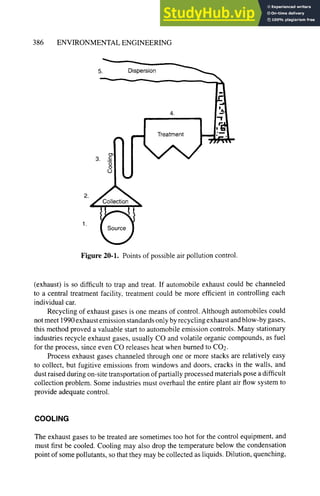
ways. Figure 20-1 shows five separate possibilities for control. Dispersion is discussed
in Chap. 18, and the four remaining control points are discussed individually in this
chapter.
SOURCE CORRECTION
Changing or eliminating a process that produces a polluting air effluent is often easier
than trying to trap the effluent. A process or product may be needed or necessary, but
could be changed to control emissions. For example, automobile exhaust has caused
high lead levels in urban air. Elimination of lead from gasoline, which was needed for
proper catalytic converter operation, has also resulted in reducing lead in urban air.
Similarly, removal of sulfur from coal and oil before the fuel is burned reduces the
amount of SO2 emitted into the air. In these cases, the source of air pollution has been
corrected.
Processes may also be modified in order to reduce air pollution. Odors from
municipal incinerators may be controlled by operating the incinerator at a high enough
temperature to effect more complete oxidation of odor-producing organic compounds.
The 1990 Clean Air Act mandates the use of oxygenated fuels in urban areas in order
to limit CO emissions from automobiles.
Strictly speaking, such measures as process change, raw material substitution, and
equipment modification to meet emission standards are known as controls. In contrast,
abatement is the term used for all devices and methods for decreasing the quantity
of pollutant reaching the atmosphere, once it has been generated by the source. For
simplicity, however, we will refer to all of the procedures as controls.
COLLECTION OF POLLUTANTS
Collection of pollutants for treatment is often the most serious problem in air pollu-
tion control. Automobile exhaust is a notorious polluter mainly because the effluent
385
386 ENVIRONMENTAL ENGINEERING
5. Dispersion
.c_
O
O
O
Collection
Source
Treatment
Figure 20-1. Points of possible air pollution control.
(exhaust) is so difficult to trap and treat. If automobile exhaust could be channeled
to a central treatment facility, treatment could be more efficient in controlling each
individual car.
Recycling of exhaust gases is one means of control. Although automobiles could
not meet 1990 exhaust emission standards only by recycling exhaust and blow-by gases,
this method proved a valuable start to automobile emission controls. Many stationary
industries recycle exhaust gases, usually CO and volatile organic compounds, as fuel
for the process, since even CO releases heat when burned to CO2.
Process exhaust gases channeled through one or more stacks are relatively easy
to collect, but fugitive emissions from windows and doors, cracks in the walls, and
dust raised during on-site transportation of partially processed materials pose a difficult
collection problem. Some industries must overhaul the entire plant air flow system to
provide adequate control.
COOLING
The exhaust gases to be treated are sometimes too hot for the control equipment, and
must first be cooled. Cooling may also drop the temperature below the condensation
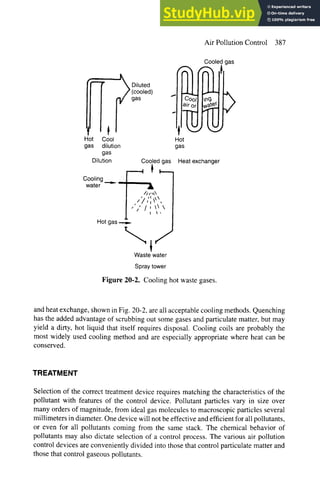
point of some pollutants, so that they may be collected as liquids. Dilution, quenching,
Air Pollution Control 387
Cooled
~ Diluted ,~
(cooled)
,as -
1 t ' '
Hot Cool Hot
gas dilution gas
gas
Dilution Cooledgas Heatexchanger
Cooling
water A
/)/," ~',
, I
,', /,~
I ~'
Hot gas
Waste water
Spraytower
Figure 20-2. Cooling hot waste gases.
gas
?
and heat exchange, shown in Fig. 20-2, are all acceptable cooling methods. Quenching
has the added advantage of scrubbing out some gases and particulate matter, but may
yield a dirty, hot liquid that itself requires disposal. Cooling coils are probably the
most widely used cooling method and are especially appropriate where heat can be
conserved.
TREATMENT
Selection of the correct treatment device requires matching the characteristics of the
pollutant with features of the control device. Pollutant particles vary in size over
many orders of magnitude, from ideal gas molecules to macroscopic particles several
millimeters in diameter. One device will not be effective and efficient for all pollutants,
or even for all pollutants coming from the same stack. The chemical behavior of
pollutants may also dictate selection of a control process. The various air pollution
control devices are conveniently divided into those that control particulate matter and
those that control gaseous pollutants.
388 ENVIRONMENTAL ENGINEERING
Inflow
or feed
r
Escaped
Collection collection
device 2 - "~-
1
I ollectedor
recovered
Figure20-3. Diagram of a collection device.
The effectiveness of a collection device is evaluated according to the recovery of
the pollutant, as in (see Fig. 20-3)
Xl
R = ~ x 100, (20.1)
x0
where
R = recovery of pollutant,
Y 1 -- mass flow of pollutant recovered (in kg/s), and
x0 = mass flow of pollutant produced (in kg/s).
If the mass flow of pollutant that escapes capture is designated X2,then
XO ~.~ Xl +X 2,
and
Xl
R = • 100. (20.2)
xj +x2
If the concentration of the pollutants and the rate of air flow are known, the recovery
may be expressed as
Q1C1
R = • 100, (20.3)
OoCo
where Q = air flow rate (in m3/s) and C = concentration of pollutant (in kg/m3),
and the subscripts refer to inflow and captured pollutant (see Fig. 20-3). When air
flow rates are not known, and only concentrations are measured, the recovery may be
shown to be
C1 (Co - C2)
R = • 100. (20.4)
C0(C1 - C2)
In air pollution terms, since the pollutants generated are to be separated from the air,
the recovery is called separation efficiency or collection efficiency.
Air Pollution Control 389
Cyclones
The cyclone is a popular, economical, and effective means of controlling particulates.
Cyclones alone are generally not adequate to meet stringent air pollution control regu-
lations, but serve as precleaners for control devices like fabric filters or electrostatic
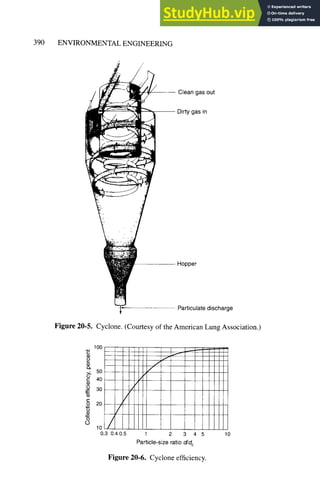
precipitators. Figure 20-4 shows a simple diagram of a cyclone, and Fig. 20-5 a more
detailed picture. Dirty air enters the cyclone off-center at the bottom; a violent swirl of
air is thus created in the cone of the cyclone and particles are accelerated centrifugally
outward toward the cyclone wall. Friction at the wall slows the particles and they slide
to the bottom, where they can be collected. Clean air exits at the center of the top of the
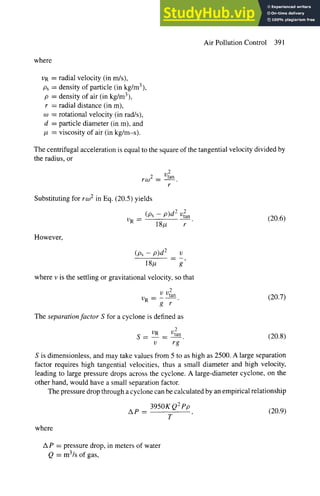
cone. As may be seen in Fig. 20-6, cyclones are reasonably efficient for large particle
collection, and are widely used as the first stage of dust removal.
Cyclones are sized on the basis of desired centrifugal acceleration. Consider a
particle moving radially, from the central axis of the cyclone to the outside wall. The
velocity of this movement, assuming laminar flow and spherical particles, is
(Ps - P)ro)2d2
1)R -- , (20.5)
18/~
Clean air _ _]} ~31eanair
Dirty L~ag s
air
Dirty
air
Dust
Dust
Cyclone Bag filter
It? lean air t Clean air
f ] 1
Wa~eer__l./,.,,,
.,,:i:=..,.
?,,l hill I I Pipe
9
--,,in,- ,, ,,, ,, ,5 /~I
?, ':,' .., ;.,
aDiirty ] Dirty Rod
9 air
Dust &water Dust
Wet scrubber Electrostatic precipitator
Figure20-4. Four methods of controlling (trapping) particulate matter from station-
ary sources.
390 ENVIRONMENTAL ENGINEERING
Clean gas out
Dirty gas in
Hopper
i" Particulate discharge
Figure 20-5. Cyclone. (Courtesy of the American LungAssociation.)
100
c-
(D
tO
c~
>~ 50
co
c 40
Q~
.o 30
CD
C
o 20
0
rO
10
/
/
/
/
/'
0.3 0.40.5
f
f
1 2 3 4 5
Particle-size ratio ~d c
Figure 20-6. Cyclone efficiency.
10
Air Pollution Control 391
where
13R = radial velocity (in m/s),
Ps = density of particle (in kg/m3),
p = density of air (in kg/m3),
r = radial distance (in m),
co = rotational velocity (in rad/s),
d = particle diameter (in m), and
/z = viscosity of air (in kg/m-s).
The centrifugal acceleration is equal to the square of the tangential velocity divided by
the radius, or
roo 2 = U2an
r
Substituting for rr.o2 in Eq. (20.5) yields
(Ps- P)d 2 V2an
VR = 18/, r
However,
(20.6)
(Ps - P)d 2 v
18g g
where v is the settling or gravitational velocity, so that
2
V Vtan
13R --
g r
The separation factor S for a cyclone is defined as
(20.7)
2
S- 13R ._ 10tan. (20.8)
v rg
S is dimensionless, and may take values from 5 to as high as 2500. A large separation
factor requires high tangential velocities, thus a small diameter and high velocity,
leading to large pressure drops across the cyclone. A large-diameter cyclone, on the
other hand, would have a small separation factor.
The pressure drop through a cyclone can be calculated by an empirical relationship
where
3950K Q2 pp
AP = , (20.9)
T
A P = pressure drop, in meters of water
Q = m3/s of gas,
392 ENVIRONMENTAL ENGINEERING
Table 20-1. Values of K for Calculating
Cyclone Pressure Drop
Cyclone diameter (in.) K
29
16
8
4
10-4
10-3
10-2
0.1
P = absolute pressure (in atm),
p = gas density (in kg/m3),
T = temperature (in K), and
K = proportionality factor, a function of cyclone diameter.
Approximate values of K are given in Table 20-1. Typical pressure drops in cyclones
are between 1 and 8 in. of water.
The collection efficiency of a cyclone can be estimated by using the concept of a
cut diameter, the particle diameter at which 50% of the particles are removed from the
gas stream by the cyclone. The cut diameter is
i 9~b ]1/2
dc -- 2rcNvi(p - Ps) ' (20.10)
where
# -- gas viscosity (in kg/m-h),
b = cyclone inlet width (in m),
N = effective number of outer turns in cyclone (usually about four),
Vi = inlet gas velocity (in m/s),
Ps = particle density (in kg/m3), and
p = gas density (in kg/m3), usually negligible compared to Ps.
Figure 20-6 shows how the cut diameter can be used to establish the collection
efficiency for particles of any diameter d. The number of turns N can also be
approximated as
7l"
N --- --(2L2 - L1) (20.11)
H
where
H = height of the inlet (in m),
L1 = length of cylinder (in m), and
L2 = length of cone (in m).
Air Pollution Control 393
EXAMPLE20.1. A cyclone has an inlet width of 10 cm and four effective turns (N = 4).
The gas temperature is 350 K and the inlet velocity is 10 m/s. The average parti-
cle diameter is 8 Ixm and the average density is 1.5 g/cm3. What is the collection
efficiency?
The viscosity of air at 350 K is 0.0748 kg/m-h. We can assume that p is negligible
compared to Ps"
[ 9(0.0748 kg/m-h)(0.1 m)]1/2
de= 2rr (4) (10 m/s) (3600 s/h) (1500 kg/m3)
= 7.04 x 10⁻⁶m - 7.04 Ixm.
Then, using Eq. (20.10)
d g
dc 7.04
= 1.14,
and from Fig. 20-6, the expected removal efficiency is about 55%.
Fabric Filters
Fabric filters used for controlling particulate matter (Figs. 20-4 and 20-7) operate like
a vacuum cleaner. Dirty gas is blown or sucked through a fabric filter bag. The fabric
bag collects the dust, which is removed periodically by shaking the bag. Fabric filters
can be very efficient collectors for even submicrometer-sized particles and are widely
(,,
/ _
Clean gas out
Filter bags
Dirty gas in
Hopper
Discharge
Figure 20-7. Industrial fabric filter apparatus.
Association.)
(Courtesy of American Lung
394 ENVIRONMENTAL ENGINEERING
used in industrial applications, although they may be sensitive to high temperatures
and humidity.
The basic mechanism of dust removal in fabric filters is thought to be similar to
the action of sand filters in water quality management, as discussed in Chap. 7. Dust
particles adhere to the fabric because of surface force that result in entrapment. Particles
are brought into contact with the fabric by impingement or Brownian diffusion. The
removal mechanism cannot be simply sieving, since fabric filters commonly have an
air space-to-fiber ratio of 1-to-1.
As particles adhere to the fabric, the removal efficiency increases, but so does the
pressure drop. The pressure drop is the sum of the pressure drop owing to the fabric
and the drop owing to the caked or adhered particles, and is expressed as
xf xp } (20.12)
where
A P = overall pressure drop in meters of water,
v = superficial gas velocity through the fabric (in m/s),
# -- gas viscosity (in P),
x = thickness of filter (f) and particle layer (p) (in m), and
K = filter (f) and particle layer (p) permeability.
The value of K must be obtained by experiment for each type of fabric and type of
dust to be collected.
Wet Collectors
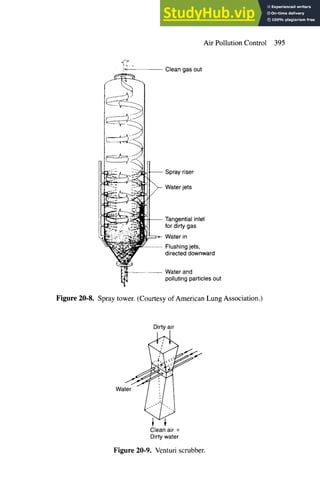
The spray tower or scrubber pictured in Figs. 20-4 and 20-8 can remove larger particles
effectively. More efficient scrubbers promote the contact between air and water by
violent action in a narrow throat section into which the water is introduced. Generally,
the more violent the encounter, hence the smaller the gas bubbles or water droplets, the
more effective the scrubbing. A venturi scrubber, as shown in Fig. 20-9, is a frequently
used high-energy wet collector. Gas flow is constricted through a venturi throat section
and water is introduced as high-pressure streams perpendicular to the gas flow. The
venturi scrubber is essentially 100% efficient in removing particles > 5 Ixm in diameter.
The pressure drop is estimated by an empirical equation
AP -- v2L x 10-6, (20.13)
where
A P = pressure drop across the venturi in centimeters of water,
v = gas velocity in the throat (in cm/s), and
L = water-to-gas volume ratio (in L/m3).
Air Pollution Control 395
Clean gas out
Spray riser
Water jets
Tangential inlet
for dirty gas
Water in
Flushing jets,
directed downward
Water and
polluting particles out
Figure 20-8. Spray tower. (Courtesy of American Lung Association.)
Dirty air
Water
Clean air +
Dirty water
Figure 20-9. Venturi scrubber.
396 ENVIRONMENTAL ENGINEERING
Although wet scrubbers are very efficient, and can trap gaseous pollutants as well as
very fine particulate matter, they have disadvantages as well. Scrubbers use a great
deal of water that either requires further treatment or has limited use after being used
to scrub dirty gas. In places like the Colorado Basin, where water supplies are limited,
use in a scrubber may have a very low priority among other uses for available water.
Moreover, scrubbers use energy and are expensive to construct as well as to operate.
Finally, scrubbers usually produce a visible plume of water vapor.
Electrostatic Precipitators
Electrostatic precipitators are widely used to trap fine particulate matter in applica-
tions where a large amount of gas needs treatment and where use of a wet scrubber
is not appropriate. Coal-burning electric generating plants, primary and secondary
smelters, and incinerators often use electrostatic precipitators. In an electrostatic pre-
cipitator, particles are removed when the dirty gas stream passes across high-voltage
wires, usually carrying a large negative DC voltage. The particles are electrically
charged on passage past these electrodes and then migrate through the electrostatic
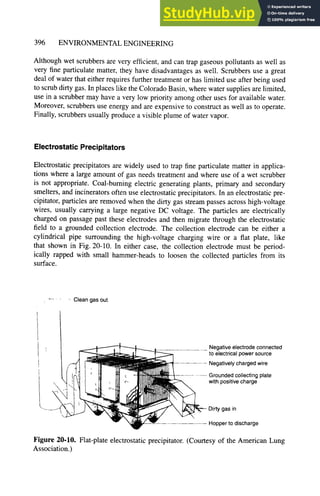
field to a grounded collection electrode. The collection electrode can be either a
cylindrical pipe surrounding the high-voltage charging wire or a flat plate, like
that shown in Fig. 20-10. In either case, the collection electrode must be period-
ically rapped with small hammer-heads to loosen the collected particles from its
surface.
..... Clean gas out
Negative electrode connected
to electrical power source
l Negatively charged wire
! Grounded collecting plate
t with positive charge
~- Dirty gas in
Hopper to discharge
Figure 20-10. Flat-plate electrostatic precipitator. (Courtesy of the American Lung
Association.)
Air Pollution Control 397
The collection efficiency of an electrostatic precipitator may be estimated by an
empirical equation
R--1-exp(-Avd)
Q , (20.14)
where
A = total area of the collecting surface of the collection electrodes (m2),
Q = flow rate of gas through the pipe (m3/s), and
Vd = drift velocity (m/s).
The drift velocity is the velocity of the particles toward the collecting electrode, and
may be calculated theoretically by equating the electrostatic force on the charged
particle in the electrical field with the drag force as the particle moves through the
gas. The drift velocity is analogous to the terminal settling velocity, as given, for
example, in Eq. (18.9), except that in the latter case the force acting in opposi-
tion to the drag force is gravitational rather than electrostatic. Drift velocity may be
estimated by
Vd= 0.5d, (20.15)
where d is the particle size (in Ism). Drift velocities are usually between 0.03 and
0.2 m/s.
As the dust layer builds up on the collecting electrode, the collection efficiency
may decrease, particularly if the collection electrode is the inside of a cylindrical pipe.
Moreover, some dust has a highly resistive surface, does not discharge against the
collection electrode, and sticks to the electrode. Heated or water-flushed electrodes
may solve this difficulty. Electrostatic precipitators are very efficient collectors of very
fine particles. However, the amount of dust collected is directly proportional to the
current drawn, so that the electrical energy used by an electrostatic precipitator can be
substantial, with resulting high operating cost.
Figure 20-11 shows the effectiveness of an electrostatic precipitator in controlling
emissions from a power plant. The large white boxes in the foreground are the elec-
trostatic precipitators. The one on the right, leading to the two stacks on the right, has
been turned off to show the effectiveness by comparison with the almost undetectable
emission from the stacks on the left.
Comparison of Particulate Control Devices
Figure 20-12 shows the approximate collection efficiencies, as functions of particle
size, for the devices discussed. Costs of collection also vary widely.
398 ENVIRONMENTAL ENGINEERING
100
90 i i
80
~ 7o
g 6o
~ ~o
20
10
0
P
Figure 20-11. Effectiveness of electrostatic precipitators on a coal-fired electric
generating plant. The electrostatic precipitator on the right has been turned off.
O.I 1.0 I 0.0 100.0
Particle diameter, microns
Figure 20-12. Comparison of removal efficiencies: (A) simple and (B) high-efficiency
cyclone; (C) electrostatic precipitator; (D)spray tower; (E)Venturi scrubber; and
(F) bag filter.
Air Pollution Control 399
HEPA Filters
Very hazardous or toxic particulate matter of diameter less than 1 txm must sometimes
be controlled to better than 99.9%. A single stage of high efficiency particle attenuation
(HEPA) micropore or glass frit filters, through which the precleaned gas is forced or
sucked by vacuum, can achieve this level of control, and four to six HEPA filter stages
in series can achieve 99.9999% control. HEPA filters are used to control emission of
radioactive particles.
CONTROL OF GASEOUS POLLUTANTS
Gaseous pollutants may be removed from the effluent stream by trapping them from
the stream, by changing them chemically, or by changing the process that produces
the pollutants.
The wet scrubbers discussed can remove pollutants by dissolving them in the
scrubber solution. SO2 and NO2 in power plant off-gases are often controlled in this
way. Packed scrubbers, spray towers packed with glass platelets or glass frit, carry
out such solution processes more efficiently than ordinary wet scrubbers; removal of
fluoride from aluminum smelter exhaust gases is an example of packed scrubber use.
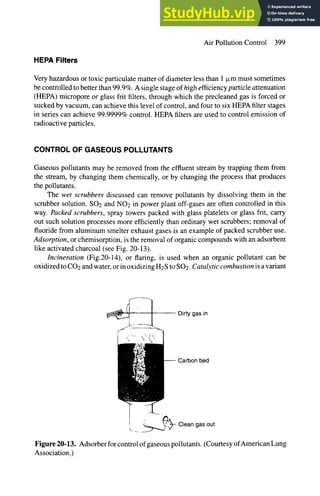
Adsorption, or chemisorption, is the removal of organic compounds with an adsorbent
like activated charcoal (see Fig. 20-13).
Incineration (Fig.20-14), or flaring, is used when an organic pollutant can be
oxidized toCO2 and water, orin oxidizing H2S to SO2. Catalytic combustion is a variant
Dirty gas in
Carbon bed
~L~ ~ -~
- Clean gas out
Figure 20-13. Adsorber for control of gaseous pollutants. (Courtesy of American Lung
Association.)
400 ENVIRONMENTAL ENGINEERING
Clean gas out
i
l"
-c--~:
~ ~i/"' / Burner ports
----/~ Burnerpiping
Dirty gas inlet
Figure 20-14. Incinerator for controlling gaseous pollutants. (Courtesy of American
Lung Association.)
of incineration in which the reaction is facilitated energetically and carried out at a lower
temperature by surface catalysis, and will be discussed further in connection with
mobile source control. Figure 20-15 compares incineration and catalytic combustion.
Control of Sulfur Dioxide
Sulfur dioxide (802) is both ubiquitous and a serious pollution hazard. The largest
single source in the United States, and probably in the industrialized world, is gener-
ation of electricity by burning oil or coal, both of which contain sulfur. Increasingly
strict standards for SO2 control have prompted the development of a number of options
and techniques for reducing SO2 emissions. Among these options are:
9 Change to low-sulfur fuel. Natural gas is exceedingly low in sulfur, while oil
burned for industrial heat and electric power generation contains between 0.5 and
3% sulfur, and coal between 0.3 and 4%. Low-sulfur fuel, however, is expensive
and the supply is uncertain.
Air Pollution Control 401
Temp. 1.
Fuel &air 1500~ ~ Clean gas
Dirty gas ~ ~ F
i | i
Incineration
Catalyst
Fuel & air
9~Clean gas
Dirty gas
Catalytic combustion
Figure 20-15. Comparison between incineration and catalytic combustion.
9 Desulfurization. Sulfur may be removed from heavy industrial oil by a number
of chemical methods similar to those used to lower the H2S content of crude oil.
In coal, sulfur may be either inorganically bound, as pyrite (FeS2), or organically
bound. Pyrite can be removed by pulverizing the coal and washing with a detergent
solution. Organically bound sulfur can be removed by washing with concentrated
acid. Preferred methods are coal gasification, which produces pipeline-quality
gas, or solvent extraction, which produces low-sulfur liquid fuel.
9 Tall stacks. Although the use of a tall stack does result in reduced ground-level
concentration of gaseous pollutants (see Eqs. 18.5 and 18.6), it is not considered to
be a pollution control measure. U.S. federal regulations do not sanction pollution
control by use of tall stacks alone.
9 Flue-gas desulfurization. The off-gases from combustion or other SO2-producing
processes are called flue gases. SO2 may be cleaned from flue gas by chemical
processes, some of which are discussed later in this chapter. The reaction of
SO2 to form sulfuric acid or other sulfates is the most frequently used flue-gas
desulfurization method. The method has two limitations: (1) the flue gas must be
cleaned of particulate matter before entering an acid-producing plant and (2) acid
formation is energetically favorable only for a fairly concentrated gas stream
(about 3%A 30,000 ppm--SO2). The reactions for acid formation are
SO2 + 89 ~ SO3
SO3 + H20 ~ H2SO4.
A double-contact acid plant can produce industrial grade 98% sulfuric acid. The
nonferrous smelting and refining industry has made the most use of this con-
trol method. Analogous reactions can be carried out to produce (NH4)2SO4, a
fertilizer, and gypsum, CaSO4.
The 502 in flue gas from fossil-fuel combustion is too dilute to permit trapping as
acid or commercial fertilizer or gypsum. Coal combustion off-gases are also too dirty.
402 ENVIRONMENTAL ENGINEERING
SO2 from fossil-fuel burning off-gas was first controlled by trapping as calcium sulfate
in a lime-limestone mixture. This mixture was produced by calcining limestone and
injecting lime into the scrubber and adding limestone to the boiler. Although the SO2
was absorbed as CaSO3 and CaSO4, the lime-limestone absorbing material created a
solid waste disposal problem of staggering proportions.
Flue-gas desulfurization methods that trap SO2 as sulfite instead of sulfate allow
regeneration of the absorbing material, and thus mitigate the solid waste disposal
problem. A typical method is single-alkali scrubbing, for which the reactions are
SO2-~-Na2SO3 + H20 --~ 2NaHSO3
2NaHSO3 --+ Na2SO3 + H20 + SO2.
The concentrated SO2 that is recovered from this process can be used industrially in
pulp and paper manufacture and sulfuric acid manufacture. Figure 20-16 is a diagram
for single-alkali scrubbing.
A modification of this system that is both more efficient and less wasteful is
double-alkali scrubbing, in which a primary scrubbing cycle dissolves the SO2 in a
sodium hydroxide solution, forming sodium bisulfite by the reaction
502-~-NaOH --+ NaHSO3.
Addition of lime in the second step regenerates the NaOH and produces calcium
sulfite.
Clean gas
lReheatI SO2
To SO2
recovery
l and
H2OI ! J " '1
' / ~lC~ ]
[~ | ]Separat~ 1
Absorber ] !
Evaporator
Flue gas| ~ | Na2SO3(s) ].... MakeupNa2SO3
I[ lSurge 1 1 l
tan, I
NaHSO3 m
soln. IV 9 9I
/ ]Dissolving ]
'~ ,,, [ tank ]
Figure 20-16. Simplified diagram for single-alkali scrubbing of flue gas with
regeneration.
Air Pollution Control 403
502 may also be removed from flue gas by dissolution in an aqueous solution of
sodium citrate by the reaction
SO2(g) + H20(I) ~ HSO3 + H+.
Citrate does not itself enter into the reaction but buffers the solution at about pH 4.5,
which the reaction requires. The citrate buffer is readily regenerated. Removal effi-
ciency of the citrate process is between 80 and 99%: much better than the 75%
achievable by alkali scrubbing.
Control of Nitrogen Oxides
Wet scrubbers absorb NO2 as well as 502, but are usually not installed primarily for
NO2 control. An effective method often used on fossil fuel burning power plants is
off-stoichiometric burning. This method controls NO formation by limiting the amount
of air (or oxygen) in the combustion process to just a bit more than is needed to burn
the hydrocarbon fuel in question. For example, the reaction for burning natural gas
CH4 -ff 02 -'> 202 + C02
competes favorably with the high-temperature combination of nitrogen in the air with
oxygen in the air to form NO (which eventually is oxidized to NO2)
N2 + 02 + 2NO.
The stoichiometric ratio of oxygen needed in natural gas combustion is
32 g of O2:16 g of CH4.
A slight excess of oxygen in the combustion air will cause virtually all of the oxygen to
combine with fuel rather than with nitrogen. In practice, off-stoichiometric combustion
is achieved by adjusting the air flow to the combustion chamber until any visible plume
disappears.
Control of Volatile Organic Compounds and Odors
Volatile organic compounds and odors are controlled by thorough destructive oxidation,
either by incineration or by catalytic combustion, since they are only slightly soluble
in aqueous scrubbing media. "Catalytic incinerators," which use a metal oxide or
mixed metal oxide catalyst and operate at 450~ and sometimes higher temperatures,
can achieve 95 to 99% destruction of volatile organic compounds, like chlorinated
hydrocarbons. These very efficient incinerators depend on catalysts that can with-
stand and function at high temperatures. Such catalysts were generally not available
before 1996.
404 ENVIRONMENTAL ENGINEERING
Control of Carbon Dioxide
Carbon dioxide is produced by oxidation of carbon compounds; that is, all combus-
tion, all respiration, and all slow oxidative decay of vegetable matter produce CO2.
The world's oceans absorb CO2 as carbonate, and plant photosynthesis removes CO2
from the air. However, these natural phenomena have not kept pace with the steadily
increasing concentration of CO2 in the air, even though increasing CO2 concentrations
increases the rate of photosynthesis somewhat in accordance with the Law of Mass
Action. Fossil fuel combustion for electrical production and for transportation appear
to be the greatest contributors to increased CO2 concentration.
CO2 could be scrubbed from power plant effluent gas by alkaline solution and
fixed as carbonate, but this relatively inefficient process would require large quantities
of scrubber solution and would produce very large amounts of carbonate. The cur-
rent approach to CO2 emission reduction is substitution of other electrical generating
sources for fossil fuel combustion. Nuclear, hydroelectric, solar, and wind genera-
tion do not produce CO2.although, like all energy conversion methods, all have some
adverse environmental impacts. Hydroelectric and wind generation are limited by the
finite number of physical locations where they can be implemented. Nuclear power
generation produces radioactive waste, even with reprocessing of fissile materials,
and solar power is relatively inefficient and requires a very large land area. Biomass
combustion produces CO2.
Energy conservation is an obvious method for reducing CO2. It produces no efflu-
ent at all, but significantly limiting CO2 emission by energy conservation alone would
require more than voluntary conservation and could result in considerable lifestyle and
social changes.
A discussion of non-fossil-fuel energy conversion methods is beyond the scope of
this text. However, we may expect to see increased utilization of such methods in the
coming century.
CONTROL OF MOVING SOURCES
Mobile sources pose special pollution control problems, and one such source, the auto-
mobile, has received particular attention in air pollution control. Pollution control for
other mobile sources, such as light-duty trucks, heavy trucks, and diesel engine-driven
vehicles, requires controls similar to those used for control of automobile emissions.
The important pollution control points in an automobile are shown in Fig. 20-17,
and are:
9evaporation of hydrocarbons (HC) from the fuel tank,
9evaporation of HC from the carburetor,
9emission of unburned gasoline and partly oxidized HC from the crankcase, and
9CO, HC and NO/NO2 from the exhaust.
Evaporative losses from the gas tank and carburetor often occur when the engine
has been turned off and hot gasoline in the carburetor evaporates. These vapors may be
Air Pollution Control 405
Air "~
Carburetor , I Fuel
[~'-~Fu-~el tank
~ e/~~j~t:xna,!st
CrankntaS
L ~ Tailpipe
Figure 20-17. Diagram of the internal combustion engine showing four major
emission points.
Vapo__,
r Activated
carboncanister
.,
Air__ ! I 1 ] Vapor+Air Purgeair
" ~ -.---"' 11 UlVapor
1 Fue,+A,r ue'!1
PCV~T1
J ill.
valve l~/I [ ~
l~'~Fuel tank
I IExhaust ~
Crankcase~l I I II~ ~ Tailpipe
vent u.,er
Catalytic
reactor
Figure 20-18. Internal combustion engine, showing methods of controlling emissions.
trapped in an activated-carbon canister, and can be purged periodically with air, and
then burned in the engine, as shown schematically in Fig. 20-18. The crankcase vent
can be closed off from the atmosphere, and the blowby gases recycled into the intake
manifold. The positive crankcase ventilation (PCV) valve is a small check valve that
prevents buildup of pressure in the crankcase.
The exhaust accounts for about 60% of the emitted hydrocarbons and almost all of
the NO, CO, and lead, and poses the most difficult control problem of mobile sources.
Exhaust emissions depend on the engine operation, as is shown in Table 20-2. During
acceleration, the combustion is efficient, CO and HC are low, and high compression
produces a lot of NO/NO2. On the other hand, deceleration results in low NO]NO2
and high HC because of the presence of unburned fuel in the exhaust. This variation in
emissions has prompted EPA to institute a standard acceleration-deceleration cycle for
406 ENVIRONMENTAL ENGINEERING
Table 20-2. Effect of Engine Operation on Exhaust Emissions,
Shown as Fraction of Emissions at Idle
CO HC NO/NO2
Idling 1.0 1.0 1.0
Accelerating 0.6 0.4 100
Cruising 0.6 0.3 66
Decelerating 0.6 11.4 1.0
measuring emissions. Testing proceeds from a cold start through acceleration, cruising
at constant speeds (on a dynamometer in order to load the engine), deceleration, and a
hot start.
Emission control techniques include engine tune-ups, engine modifications, exh-
aust gas recirculation, and catalytic reactors. A well-tuned engine is the first line of
defense for emission control.
A wide range of acceptable engine modifications is possible. Injection of water can
reduce NO emissions, and fuel injection (bypassing or eliminating the carburetor) can
reduce CO and HC emissions. Fuel injection is not compatible with water injection,
however, since water may clog the fuel injectors. The stratified charge engine operates
on a very lean air/fuel mixture, thus reducing CO and HC, but does not increase NO
appreciably. The two compartments of the engine (the "stratification") accomplish
this result: the first compartment receives and ignites the air/fuel mixture, and the
second compartment provides a broad flame for an efficient burn. Better than 90% CO
reduction can be achieved by this engine.
Recirculating the exhaust gas through the engine can achieve about 60% reduction
of CO and hydrocarbons. The only major modification to an ordinary engine required
by exhaust gas recirculation (EGR), in addition to the necessary fittings, is a system for
cooling the exhaust gas before recirculating it, to avoid heat deformation of the piston
surfaces. Exhaust gas recirculation, although it increased the rate of engine wear, was
a popular and acceptable emission control method until 1980, but present-day exhaust
emission standards require 90% CO control, which cannot be realized by this method.
New cars sold in the United States since 1983 have required the use of a catalytic
reactor ("catalytic converter") to meet exhaust emission standards, and the device
is now standard equipment on new cars. The modem three-stage catalytic converter
performs two functions: oxidation of CO and hydrocarbons to CO2 and water, and
reduction of NO to N2. A platinum-rhodium catalyst is used, and reduction of NO
is accomplished in the first stage by burning a fuel-rich mixture, thereby depleting
the oxygen at the catalyst. Air is then introduced in the second stage, and CO and
hydrocarbons are oxidized at a lower temperature. Catalytic converters are rendered
inoperable by inorganic lead compounds, so that cars using catalytic converters require
the use of unleaded gasoline. Catalytic converters require periodic maintenance.
Diesel engines produce the same three major pollutants as gasoline engines,
although in somewhat different proportions. In addition, diesel-powered heavy duty
vehicles produce annoying black soot, essentially unburned carbon. Control of diesel
Air Pollution Control 407
exhaust was not required in the United States until passage of the 1990 Clean Air Act
(nor is it required anywhere else in the world), and therefore little research on diesel
exhaust emission control has reached the stage of operational devices.
Drastic lowering of emissions to produce a virtually pollution-free engine would
require an external combustion engine, which can achieve better than 99% control of
all three major exhaust pollutants. However, although work began in 1968 on a mobile
external combustion engine, a working model has yet to be built. A working model
requires a working fuel "steam" that is not flammable but has a lower heat capacity
than water, and a linkage between the working fuel and the burning fuel that would
allow the rapid acceleration characteristic of an external combustion engine-powered
car.
Natural gas may be used to fuel cars, but the limited supply of natural gas serves a
number of competing uses. In addition to a steady supply, a changeover would require
a refueling system different from that used for gasoline. Electric cars are clean, but can
store only limited power and have limited range. Generation of the electricity to power
such cars also generates pollution, and the world's supply of battery materials would
be strained to provide for a changeover to electric cars. The "hybrid" gasoline/electric
automobiles introduced in 2001 use the engine to charge the electric motor. The 1990
Clean Air Act requires that cities in violation of the National Ambient Air Quality
Standards sell oxygenatedfuel during the winter months. Oxygenated fuel is gasoline
containing 10% ethanol (CH3CH2OH) and is intended to bring about somewhat more
efficient conversion of CO to CO2. Its efficacy in cleaning up urban air remains to be
seen.
CONTROL OF GLOBAL CLIMATE CHANGE
The two types of compounds involved in global climate change are those that produce
free halogen atoms by photochemical reaction, and thus deplete the stratospheric ozone
layer, and those that absorb energy in the near-infrared spectral region, which may
ultimately produce global temperature change. The first group is comprised mostly
of chlorofluorocarbons. Control of chlorofluorocarbon emission involves control of
leaks, as from refrigeration systems, and eliminating use of the substances. While
chlorofluorocarbon aerosol propellants are useful and convenient, they are not neces-
sary for most applications. Aerosol deodorant, cleaners, paint, hairspray, and so on
can be replaced by roll-on deodorant, wipe-on cleaners, rolled-on paint, hair mousse,
etc. In many applications, atomized liquids appear to work as well as aerosolized
liquids.
CONCLUSION
This chapter is devoted mainly to the description of air pollution control by "bolt-on"
devices, but these are usually the most expensive means of control. A general envi-
ronmental engineering truism is that the least expensive and most effective control
408 ENVIRONMENTAL ENGINEERING
point is always the farthest up the process line. Most effective control is achieved at
the beginning of the process or, better yet, by finding a less polluting alternative to
the process: mass transit as a substitute for cars, for example, and energy conserva-
tion instead of infinite expansion of generating capacity. Such considerations are good
engineering and economics practice, as well as sensible and enlightened.
PROBLEMS
20.1 Taking into account cost, ease of operation, and ultimate disposal of
residuals, what type of control device would you suggest for the following emissions?
a. Dust particles with diameters between 5 and 10 gm.
b. Gas containing 20% SO2 and 80% N2.
c. Gas containing 90% HC and 10% 02.
20.2 An industrial emission has the following characteristics: 80% N2, 15% 02,
5% CO. What type of air pollution control equipment would you recommend?
20.3 A whiskey distillery has hired you as a consultant to design air pollution
control equipment for a new facility, to be built upwind from a residential area. What
problems would you encounter and what would be your control strategy?
20.4 Dust has specific gravity of 1.2 and particle size analysis as follows:
Mean diameter (Ism) % of particles by weight
0.05 10
0.1 20
0.5 25
1.0 35
5.0 10
The dust is trapped by a cyclone with diameter 0.51 m, inlet width of 15 cm, and an
inlet length of 25 cm, operating at five effective turns and 2.0 m3/s air flow.
a. What is the removal efficiency?
b. What is the pressure drop at air temperature of 20~ and 1 atm?
c. What is the separation factor? Is this a high-efficiency cyclone?
20.5 A plate-type electrostatic precipitator is to remove particles having a diameter
of 0.5 txm at a flow rate of 2.0 m3/s. The 40 plates are 5 cm apart and 3 m high. Ideally,
how deep must the plates be to achieve removal?
20.6 Dust has particles with a drift velocity of 0.15 m/s. For a total air flow of
60 m3/s, what must be the number of 10 x 10 m2 collecting plates needed to achieve
90% removal?
20.7 Calculate the removal efficiencies for the dust described in Problem 20.4 for
a standard cyclone, an electrostatic precipitator, and a fabric filter, using the curves of
Fig. 20-12.
Air Pollution Control 409
20.8 Determine the efficiency of a cyclone of diameter 0.5 m, at a flow rate of
0.4 m3/s, and a gas temperature of 25~ The inlet width is 0.13 m2 and the area of the
entrance is 0.04 m2. The particles have a diameter of 10 gm and a density of 2 g/cm3.
20.9 An electrostatic precipitator has the following specifications: height -- 7.5 m,
length = 5 m, number of passages = 3, plate spacing -- 0.3 m. The flow rate is 18 m3/s
and the particle size is 0.35 Ism, and the particles have a drift velocity of 0.162 m/s.
Calculate the expected efficiency.
20.10 For Problem 20.9 above, what would be the increase in efficiency achieved
by doubling the length? by doubling the number of plates and reducing the flow rate
to 9 m3/s?
20.11 A copper smelter produces 500 tons of copper per day from ore that is
essentially CuS2. The sulfur dioxide produced in this process is trapped in a sulfuric
acid plant that produces 98% by weight sulfuric acid, which has a specific gravity of
2.3. If 75% of the SO2 produced is trapped by the acid plant, how many liters of 98%
H2SO4 are produced each day?
20.12 There are 168 h in a week, so that one 24-h day is 14.3% of a week.
Therefore, you could decrease your personal electricity consumption by 14.3% by
doing without electricity for one 24-h period each week. Try this for a week. What
activities did you have to curtail or change? You can do this in three 8-h periods or
six 4-h periods, but they should be spread out during the day to encompass heavy-use
hours as well as light-use hours (do not just take three 8-h periods when you are asleep).
If a fossil fuel power plant is 42% thermally efficient (that is, 42% of the heat generated
is converted to electricity), what is your personal percent decrease in CO2 emission?

Air Pollution Control

  • 1.
    Chapter 20 Air PollutionControl Limiting emissions into the air is both technically difficult and expensive. However, since rain and deposition are the only air cleaning mechanisms available, and neither is very efficient, good air quality depends on pollution prevention and on limiting what goes into the air. The control of air emissions may be realized in a number of ways. Figure 20-1 shows five separate possibilities for control. Dispersion is discussed in Chap. 18, and the four remaining control points are discussed individually in this chapter. SOURCE CORRECTION Changing or eliminating a process that produces a polluting air effluent is often easier than trying to trap the effluent. A process or product may be needed or necessary, but could be changed to control emissions. For example, automobile exhaust has caused high lead levels in urban air. Elimination of lead from gasoline, which was needed for proper catalytic converter operation, has also resulted in reducing lead in urban air. Similarly, removal of sulfur from coal and oil before the fuel is burned reduces the amount of SO2 emitted into the air. In these cases, the source of air pollution has been corrected. Processes may also be modified in order to reduce air pollution. Odors from municipal incinerators may be controlled by operating the incinerator at a high enough temperature to effect more complete oxidation of odor-producing organic compounds. The 1990 Clean Air Act mandates the use of oxygenated fuels in urban areas in order to limit CO emissions from automobiles. Strictly speaking, such measures as process change, raw material substitution, and equipment modification to meet emission standards are known as controls. In contrast, abatement is the term used for all devices and methods for decreasing the quantity of pollutant reaching the atmosphere, once it has been generated by the source. For simplicity, however, we will refer to all of the procedures as controls. COLLECTION OF POLLUTANTS Collection of pollutants for treatment is often the most serious problem in air pollu- tion control. Automobile exhaust is a notorious polluter mainly because the effluent 385
  • 2.
    386 ENVIRONMENTAL ENGINEERING 5.Dispersion .c_ O O O Collection Source Treatment Figure 20-1. Points of possible air pollution control. (exhaust) is so difficult to trap and treat. If automobile exhaust could be channeled to a central treatment facility, treatment could be more efficient in controlling each individual car. Recycling of exhaust gases is one means of control. Although automobiles could not meet 1990 exhaust emission standards only by recycling exhaust and blow-by gases, this method proved a valuable start to automobile emission controls. Many stationary industries recycle exhaust gases, usually CO and volatile organic compounds, as fuel for the process, since even CO releases heat when burned to CO2. Process exhaust gases channeled through one or more stacks are relatively easy to collect, but fugitive emissions from windows and doors, cracks in the walls, and dust raised during on-site transportation of partially processed materials pose a difficult collection problem. Some industries must overhaul the entire plant air flow system to provide adequate control. COOLING The exhaust gases to be treated are sometimes too hot for the control equipment, and must first be cooled. Cooling may also drop the temperature below the condensation point of some pollutants, so that they may be collected as liquids. Dilution, quenching,
  • 3.
    Air Pollution Control387 Cooled ~ Diluted ,~ (cooled) ,as - 1 t ' ' Hot Cool Hot gas dilution gas gas Dilution Cooledgas Heatexchanger Cooling water A /)/," ~', , I ,', /,~ I ~' Hot gas Waste water Spraytower Figure 20-2. Cooling hot waste gases. gas ? and heat exchange, shown in Fig. 20-2, are all acceptable cooling methods. Quenching has the added advantage of scrubbing out some gases and particulate matter, but may yield a dirty, hot liquid that itself requires disposal. Cooling coils are probably the most widely used cooling method and are especially appropriate where heat can be conserved. TREATMENT Selection of the correct treatment device requires matching the characteristics of the pollutant with features of the control device. Pollutant particles vary in size over many orders of magnitude, from ideal gas molecules to macroscopic particles several millimeters in diameter. One device will not be effective and efficient for all pollutants, or even for all pollutants coming from the same stack. The chemical behavior of pollutants may also dictate selection of a control process. The various air pollution control devices are conveniently divided into those that control particulate matter and those that control gaseous pollutants.
  • 4.
    388 ENVIRONMENTAL ENGINEERING Inflow orfeed r Escaped Collection collection device 2 - "~- 1 I ollectedor recovered Figure20-3. Diagram of a collection device. The effectiveness of a collection device is evaluated according to the recovery of the pollutant, as in (see Fig. 20-3) Xl R = ~ x 100, (20.1) x0 where R = recovery of pollutant, Y 1 -- mass flow of pollutant recovered (in kg/s), and x0 = mass flow of pollutant produced (in kg/s). If the mass flow of pollutant that escapes capture is designated X2,then XO ~.~ Xl +X 2, and Xl R = • 100. (20.2) xj +x2 If the concentration of the pollutants and the rate of air flow are known, the recovery may be expressed as Q1C1 R = • 100, (20.3) OoCo where Q = air flow rate (in m3/s) and C = concentration of pollutant (in kg/m3), and the subscripts refer to inflow and captured pollutant (see Fig. 20-3). When air flow rates are not known, and only concentrations are measured, the recovery may be shown to be C1 (Co - C2) R = • 100. (20.4) C0(C1 - C2) In air pollution terms, since the pollutants generated are to be separated from the air, the recovery is called separation efficiency or collection efficiency.
  • 5.
    Air Pollution Control389 Cyclones The cyclone is a popular, economical, and effective means of controlling particulates. Cyclones alone are generally not adequate to meet stringent air pollution control regu- lations, but serve as precleaners for control devices like fabric filters or electrostatic precipitators. Figure 20-4 shows a simple diagram of a cyclone, and Fig. 20-5 a more detailed picture. Dirty air enters the cyclone off-center at the bottom; a violent swirl of air is thus created in the cone of the cyclone and particles are accelerated centrifugally outward toward the cyclone wall. Friction at the wall slows the particles and they slide to the bottom, where they can be collected. Clean air exits at the center of the top of the cone. As may be seen in Fig. 20-6, cyclones are reasonably efficient for large particle collection, and are widely used as the first stage of dust removal. Cyclones are sized on the basis of desired centrifugal acceleration. Consider a particle moving radially, from the central axis of the cyclone to the outside wall. The velocity of this movement, assuming laminar flow and spherical particles, is (Ps - P)ro)2d2 1)R -- , (20.5) 18/~ Clean air _ _]} ~31eanair Dirty L~ag s air Dirty air Dust Dust Cyclone Bag filter It? lean air t Clean air f ] 1 Wa~eer__l./,.,,, .,,:i:=..,. ?,,l hill I I Pipe 9 --,,in,- ,, ,,, ,, ,5 /~I ?, ':,' .., ;., aDiirty ] Dirty Rod 9 air Dust &water Dust Wet scrubber Electrostatic precipitator Figure20-4. Four methods of controlling (trapping) particulate matter from station- ary sources.
  • 6.
    390 ENVIRONMENTAL ENGINEERING Cleangas out Dirty gas in Hopper i" Particulate discharge Figure 20-5. Cyclone. (Courtesy of the American LungAssociation.) 100 c- (D tO c~ >~ 50 co c 40 Q~ .o 30 CD C o 20 0 rO 10 / / / / /' 0.3 0.40.5 f f 1 2 3 4 5 Particle-size ratio ~d c Figure 20-6. Cyclone efficiency. 10
  • 7.
    Air Pollution Control391 where 13R = radial velocity (in m/s), Ps = density of particle (in kg/m3), p = density of air (in kg/m3), r = radial distance (in m), co = rotational velocity (in rad/s), d = particle diameter (in m), and /z = viscosity of air (in kg/m-s). The centrifugal acceleration is equal to the square of the tangential velocity divided by the radius, or roo 2 = U2an r Substituting for rr.o2 in Eq. (20.5) yields (Ps- P)d 2 V2an VR = 18/, r However, (20.6) (Ps - P)d 2 v 18g g where v is the settling or gravitational velocity, so that 2 V Vtan 13R -- g r The separation factor S for a cyclone is defined as (20.7) 2 S- 13R ._ 10tan. (20.8) v rg S is dimensionless, and may take values from 5 to as high as 2500. A large separation factor requires high tangential velocities, thus a small diameter and high velocity, leading to large pressure drops across the cyclone. A large-diameter cyclone, on the other hand, would have a small separation factor. The pressure drop through a cyclone can be calculated by an empirical relationship where 3950K Q2 pp AP = , (20.9) T A P = pressure drop, in meters of water Q = m3/s of gas,
  • 8.
    392 ENVIRONMENTAL ENGINEERING Table20-1. Values of K for Calculating Cyclone Pressure Drop Cyclone diameter (in.) K 29 16 8 4 10-4 10-3 10-2 0.1 P = absolute pressure (in atm), p = gas density (in kg/m3), T = temperature (in K), and K = proportionality factor, a function of cyclone diameter. Approximate values of K are given in Table 20-1. Typical pressure drops in cyclones are between 1 and 8 in. of water. The collection efficiency of a cyclone can be estimated by using the concept of a cut diameter, the particle diameter at which 50% of the particles are removed from the gas stream by the cyclone. The cut diameter is i 9~b ]1/2 dc -- 2rcNvi(p - Ps) ' (20.10) where # -- gas viscosity (in kg/m-h), b = cyclone inlet width (in m), N = effective number of outer turns in cyclone (usually about four), Vi = inlet gas velocity (in m/s), Ps = particle density (in kg/m3), and p = gas density (in kg/m3), usually negligible compared to Ps. Figure 20-6 shows how the cut diameter can be used to establish the collection efficiency for particles of any diameter d. The number of turns N can also be approximated as 7l" N --- --(2L2 - L1) (20.11) H where H = height of the inlet (in m), L1 = length of cylinder (in m), and L2 = length of cone (in m).
  • 9.
    Air Pollution Control393 EXAMPLE20.1. A cyclone has an inlet width of 10 cm and four effective turns (N = 4). The gas temperature is 350 K and the inlet velocity is 10 m/s. The average parti- cle diameter is 8 Ixm and the average density is 1.5 g/cm3. What is the collection efficiency? The viscosity of air at 350 K is 0.0748 kg/m-h. We can assume that p is negligible compared to Ps" [ 9(0.0748 kg/m-h)(0.1 m)]1/2 de= 2rr (4) (10 m/s) (3600 s/h) (1500 kg/m3) = 7.04 x 10⁻⁶m - 7.04 Ixm. Then, using Eq. (20.10) d g dc 7.04 = 1.14, and from Fig. 20-6, the expected removal efficiency is about 55%. Fabric Filters Fabric filters used for controlling particulate matter (Figs. 20-4 and 20-7) operate like a vacuum cleaner. Dirty gas is blown or sucked through a fabric filter bag. The fabric bag collects the dust, which is removed periodically by shaking the bag. Fabric filters can be very efficient collectors for even submicrometer-sized particles and are widely (,, / _ Clean gas out Filter bags Dirty gas in Hopper Discharge Figure 20-7. Industrial fabric filter apparatus. Association.) (Courtesy of American Lung
  • 10.
    394 ENVIRONMENTAL ENGINEERING usedin industrial applications, although they may be sensitive to high temperatures and humidity. The basic mechanism of dust removal in fabric filters is thought to be similar to the action of sand filters in water quality management, as discussed in Chap. 7. Dust particles adhere to the fabric because of surface force that result in entrapment. Particles are brought into contact with the fabric by impingement or Brownian diffusion. The removal mechanism cannot be simply sieving, since fabric filters commonly have an air space-to-fiber ratio of 1-to-1. As particles adhere to the fabric, the removal efficiency increases, but so does the pressure drop. The pressure drop is the sum of the pressure drop owing to the fabric and the drop owing to the caked or adhered particles, and is expressed as xf xp } (20.12) where A P = overall pressure drop in meters of water, v = superficial gas velocity through the fabric (in m/s), # -- gas viscosity (in P), x = thickness of filter (f) and particle layer (p) (in m), and K = filter (f) and particle layer (p) permeability. The value of K must be obtained by experiment for each type of fabric and type of dust to be collected. Wet Collectors The spray tower or scrubber pictured in Figs. 20-4 and 20-8 can remove larger particles effectively. More efficient scrubbers promote the contact between air and water by violent action in a narrow throat section into which the water is introduced. Generally, the more violent the encounter, hence the smaller the gas bubbles or water droplets, the more effective the scrubbing. A venturi scrubber, as shown in Fig. 20-9, is a frequently used high-energy wet collector. Gas flow is constricted through a venturi throat section and water is introduced as high-pressure streams perpendicular to the gas flow. The venturi scrubber is essentially 100% efficient in removing particles > 5 Ixm in diameter. The pressure drop is estimated by an empirical equation AP -- v2L x 10-6, (20.13) where A P = pressure drop across the venturi in centimeters of water, v = gas velocity in the throat (in cm/s), and L = water-to-gas volume ratio (in L/m3).
  • 11.
    Air Pollution Control395 Clean gas out Spray riser Water jets Tangential inlet for dirty gas Water in Flushing jets, directed downward Water and polluting particles out Figure 20-8. Spray tower. (Courtesy of American Lung Association.) Dirty air Water Clean air + Dirty water Figure 20-9. Venturi scrubber.
  • 12.
    396 ENVIRONMENTAL ENGINEERING Althoughwet scrubbers are very efficient, and can trap gaseous pollutants as well as very fine particulate matter, they have disadvantages as well. Scrubbers use a great deal of water that either requires further treatment or has limited use after being used to scrub dirty gas. In places like the Colorado Basin, where water supplies are limited, use in a scrubber may have a very low priority among other uses for available water. Moreover, scrubbers use energy and are expensive to construct as well as to operate. Finally, scrubbers usually produce a visible plume of water vapor. Electrostatic Precipitators Electrostatic precipitators are widely used to trap fine particulate matter in applica- tions where a large amount of gas needs treatment and where use of a wet scrubber is not appropriate. Coal-burning electric generating plants, primary and secondary smelters, and incinerators often use electrostatic precipitators. In an electrostatic pre- cipitator, particles are removed when the dirty gas stream passes across high-voltage wires, usually carrying a large negative DC voltage. The particles are electrically charged on passage past these electrodes and then migrate through the electrostatic field to a grounded collection electrode. The collection electrode can be either a cylindrical pipe surrounding the high-voltage charging wire or a flat plate, like that shown in Fig. 20-10. In either case, the collection electrode must be period- ically rapped with small hammer-heads to loosen the collected particles from its surface. ..... Clean gas out Negative electrode connected to electrical power source l Negatively charged wire ! Grounded collecting plate t with positive charge ~- Dirty gas in Hopper to discharge Figure 20-10. Flat-plate electrostatic precipitator. (Courtesy of the American Lung Association.)
  • 13.
    Air Pollution Control397 The collection efficiency of an electrostatic precipitator may be estimated by an empirical equation R--1-exp(-Avd) Q , (20.14) where A = total area of the collecting surface of the collection electrodes (m2), Q = flow rate of gas through the pipe (m3/s), and Vd = drift velocity (m/s). The drift velocity is the velocity of the particles toward the collecting electrode, and may be calculated theoretically by equating the electrostatic force on the charged particle in the electrical field with the drag force as the particle moves through the gas. The drift velocity is analogous to the terminal settling velocity, as given, for example, in Eq. (18.9), except that in the latter case the force acting in opposi- tion to the drag force is gravitational rather than electrostatic. Drift velocity may be estimated by Vd= 0.5d, (20.15) where d is the particle size (in Ism). Drift velocities are usually between 0.03 and 0.2 m/s. As the dust layer builds up on the collecting electrode, the collection efficiency may decrease, particularly if the collection electrode is the inside of a cylindrical pipe. Moreover, some dust has a highly resistive surface, does not discharge against the collection electrode, and sticks to the electrode. Heated or water-flushed electrodes may solve this difficulty. Electrostatic precipitators are very efficient collectors of very fine particles. However, the amount of dust collected is directly proportional to the current drawn, so that the electrical energy used by an electrostatic precipitator can be substantial, with resulting high operating cost. Figure 20-11 shows the effectiveness of an electrostatic precipitator in controlling emissions from a power plant. The large white boxes in the foreground are the elec- trostatic precipitators. The one on the right, leading to the two stacks on the right, has been turned off to show the effectiveness by comparison with the almost undetectable emission from the stacks on the left. Comparison of Particulate Control Devices Figure 20-12 shows the approximate collection efficiencies, as functions of particle size, for the devices discussed. Costs of collection also vary widely.
  • 14.
    398 ENVIRONMENTAL ENGINEERING 100 90i i 80 ~ 7o g 6o ~ ~o 20 10 0 P Figure 20-11. Effectiveness of electrostatic precipitators on a coal-fired electric generating plant. The electrostatic precipitator on the right has been turned off. O.I 1.0 I 0.0 100.0 Particle diameter, microns Figure 20-12. Comparison of removal efficiencies: (A) simple and (B) high-efficiency cyclone; (C) electrostatic precipitator; (D)spray tower; (E)Venturi scrubber; and (F) bag filter.
  • 15.
    Air Pollution Control399 HEPA Filters Very hazardous or toxic particulate matter of diameter less than 1 txm must sometimes be controlled to better than 99.9%. A single stage of high efficiency particle attenuation (HEPA) micropore or glass frit filters, through which the precleaned gas is forced or sucked by vacuum, can achieve this level of control, and four to six HEPA filter stages in series can achieve 99.9999% control. HEPA filters are used to control emission of radioactive particles. CONTROL OF GASEOUS POLLUTANTS Gaseous pollutants may be removed from the effluent stream by trapping them from the stream, by changing them chemically, or by changing the process that produces the pollutants. The wet scrubbers discussed can remove pollutants by dissolving them in the scrubber solution. SO2 and NO2 in power plant off-gases are often controlled in this way. Packed scrubbers, spray towers packed with glass platelets or glass frit, carry out such solution processes more efficiently than ordinary wet scrubbers; removal of fluoride from aluminum smelter exhaust gases is an example of packed scrubber use. Adsorption, or chemisorption, is the removal of organic compounds with an adsorbent like activated charcoal (see Fig. 20-13). Incineration (Fig.20-14), or flaring, is used when an organic pollutant can be oxidized toCO2 and water, orin oxidizing H2S to SO2. Catalytic combustion is a variant Dirty gas in Carbon bed ~L~ ~ -~ - Clean gas out Figure 20-13. Adsorber for control of gaseous pollutants. (Courtesy of American Lung Association.)
  • 16.
    400 ENVIRONMENTAL ENGINEERING Cleangas out i l" -c--~: ~ ~i/"' / Burner ports ----/~ Burnerpiping Dirty gas inlet Figure 20-14. Incinerator for controlling gaseous pollutants. (Courtesy of American Lung Association.) of incineration in which the reaction is facilitated energetically and carried out at a lower temperature by surface catalysis, and will be discussed further in connection with mobile source control. Figure 20-15 compares incineration and catalytic combustion. Control of Sulfur Dioxide Sulfur dioxide (802) is both ubiquitous and a serious pollution hazard. The largest single source in the United States, and probably in the industrialized world, is gener- ation of electricity by burning oil or coal, both of which contain sulfur. Increasingly strict standards for SO2 control have prompted the development of a number of options and techniques for reducing SO2 emissions. Among these options are: 9 Change to low-sulfur fuel. Natural gas is exceedingly low in sulfur, while oil burned for industrial heat and electric power generation contains between 0.5 and 3% sulfur, and coal between 0.3 and 4%. Low-sulfur fuel, however, is expensive and the supply is uncertain.
  • 17.
    Air Pollution Control401 Temp. 1. Fuel &air 1500~ ~ Clean gas Dirty gas ~ ~ F i | i Incineration Catalyst Fuel & air 9~Clean gas Dirty gas Catalytic combustion Figure 20-15. Comparison between incineration and catalytic combustion. 9 Desulfurization. Sulfur may be removed from heavy industrial oil by a number of chemical methods similar to those used to lower the H2S content of crude oil. In coal, sulfur may be either inorganically bound, as pyrite (FeS2), or organically bound. Pyrite can be removed by pulverizing the coal and washing with a detergent solution. Organically bound sulfur can be removed by washing with concentrated acid. Preferred methods are coal gasification, which produces pipeline-quality gas, or solvent extraction, which produces low-sulfur liquid fuel. 9 Tall stacks. Although the use of a tall stack does result in reduced ground-level concentration of gaseous pollutants (see Eqs. 18.5 and 18.6), it is not considered to be a pollution control measure. U.S. federal regulations do not sanction pollution control by use of tall stacks alone. 9 Flue-gas desulfurization. The off-gases from combustion or other SO2-producing processes are called flue gases. SO2 may be cleaned from flue gas by chemical processes, some of which are discussed later in this chapter. The reaction of SO2 to form sulfuric acid or other sulfates is the most frequently used flue-gas desulfurization method. The method has two limitations: (1) the flue gas must be cleaned of particulate matter before entering an acid-producing plant and (2) acid formation is energetically favorable only for a fairly concentrated gas stream (about 3%A 30,000 ppm--SO2). The reactions for acid formation are SO2 + 89 ~ SO3 SO3 + H20 ~ H2SO4. A double-contact acid plant can produce industrial grade 98% sulfuric acid. The nonferrous smelting and refining industry has made the most use of this con- trol method. Analogous reactions can be carried out to produce (NH4)2SO4, a fertilizer, and gypsum, CaSO4. The 502 in flue gas from fossil-fuel combustion is too dilute to permit trapping as acid or commercial fertilizer or gypsum. Coal combustion off-gases are also too dirty.
  • 18.
    402 ENVIRONMENTAL ENGINEERING SO2from fossil-fuel burning off-gas was first controlled by trapping as calcium sulfate in a lime-limestone mixture. This mixture was produced by calcining limestone and injecting lime into the scrubber and adding limestone to the boiler. Although the SO2 was absorbed as CaSO3 and CaSO4, the lime-limestone absorbing material created a solid waste disposal problem of staggering proportions. Flue-gas desulfurization methods that trap SO2 as sulfite instead of sulfate allow regeneration of the absorbing material, and thus mitigate the solid waste disposal problem. A typical method is single-alkali scrubbing, for which the reactions are SO2-~-Na2SO3 + H20 --~ 2NaHSO3 2NaHSO3 --+ Na2SO3 + H20 + SO2. The concentrated SO2 that is recovered from this process can be used industrially in pulp and paper manufacture and sulfuric acid manufacture. Figure 20-16 is a diagram for single-alkali scrubbing. A modification of this system that is both more efficient and less wasteful is double-alkali scrubbing, in which a primary scrubbing cycle dissolves the SO2 in a sodium hydroxide solution, forming sodium bisulfite by the reaction 502-~-NaOH --+ NaHSO3. Addition of lime in the second step regenerates the NaOH and produces calcium sulfite. Clean gas lReheatI SO2 To SO2 recovery l and H2OI ! J " '1 ' / ~lC~ ] [~ | ]Separat~ 1 Absorber ] ! Evaporator Flue gas| ~ | Na2SO3(s) ].... MakeupNa2SO3 I[ lSurge 1 1 l tan, I NaHSO3 m soln. IV 9 9I / ]Dissolving ] '~ ,,, [ tank ] Figure 20-16. Simplified diagram for single-alkali scrubbing of flue gas with regeneration.
  • 19.
    Air Pollution Control403 502 may also be removed from flue gas by dissolution in an aqueous solution of sodium citrate by the reaction SO2(g) + H20(I) ~ HSO3 + H+. Citrate does not itself enter into the reaction but buffers the solution at about pH 4.5, which the reaction requires. The citrate buffer is readily regenerated. Removal effi- ciency of the citrate process is between 80 and 99%: much better than the 75% achievable by alkali scrubbing. Control of Nitrogen Oxides Wet scrubbers absorb NO2 as well as 502, but are usually not installed primarily for NO2 control. An effective method often used on fossil fuel burning power plants is off-stoichiometric burning. This method controls NO formation by limiting the amount of air (or oxygen) in the combustion process to just a bit more than is needed to burn the hydrocarbon fuel in question. For example, the reaction for burning natural gas CH4 -ff 02 -'> 202 + C02 competes favorably with the high-temperature combination of nitrogen in the air with oxygen in the air to form NO (which eventually is oxidized to NO2) N2 + 02 + 2NO. The stoichiometric ratio of oxygen needed in natural gas combustion is 32 g of O2:16 g of CH4. A slight excess of oxygen in the combustion air will cause virtually all of the oxygen to combine with fuel rather than with nitrogen. In practice, off-stoichiometric combustion is achieved by adjusting the air flow to the combustion chamber until any visible plume disappears. Control of Volatile Organic Compounds and Odors Volatile organic compounds and odors are controlled by thorough destructive oxidation, either by incineration or by catalytic combustion, since they are only slightly soluble in aqueous scrubbing media. "Catalytic incinerators," which use a metal oxide or mixed metal oxide catalyst and operate at 450~ and sometimes higher temperatures, can achieve 95 to 99% destruction of volatile organic compounds, like chlorinated hydrocarbons. These very efficient incinerators depend on catalysts that can with- stand and function at high temperatures. Such catalysts were generally not available before 1996.
  • 20.
    404 ENVIRONMENTAL ENGINEERING Controlof Carbon Dioxide Carbon dioxide is produced by oxidation of carbon compounds; that is, all combus- tion, all respiration, and all slow oxidative decay of vegetable matter produce CO2. The world's oceans absorb CO2 as carbonate, and plant photosynthesis removes CO2 from the air. However, these natural phenomena have not kept pace with the steadily increasing concentration of CO2 in the air, even though increasing CO2 concentrations increases the rate of photosynthesis somewhat in accordance with the Law of Mass Action. Fossil fuel combustion for electrical production and for transportation appear to be the greatest contributors to increased CO2 concentration. CO2 could be scrubbed from power plant effluent gas by alkaline solution and fixed as carbonate, but this relatively inefficient process would require large quantities of scrubber solution and would produce very large amounts of carbonate. The cur- rent approach to CO2 emission reduction is substitution of other electrical generating sources for fossil fuel combustion. Nuclear, hydroelectric, solar, and wind genera- tion do not produce CO2.although, like all energy conversion methods, all have some adverse environmental impacts. Hydroelectric and wind generation are limited by the finite number of physical locations where they can be implemented. Nuclear power generation produces radioactive waste, even with reprocessing of fissile materials, and solar power is relatively inefficient and requires a very large land area. Biomass combustion produces CO2. Energy conservation is an obvious method for reducing CO2. It produces no efflu- ent at all, but significantly limiting CO2 emission by energy conservation alone would require more than voluntary conservation and could result in considerable lifestyle and social changes. A discussion of non-fossil-fuel energy conversion methods is beyond the scope of this text. However, we may expect to see increased utilization of such methods in the coming century. CONTROL OF MOVING SOURCES Mobile sources pose special pollution control problems, and one such source, the auto- mobile, has received particular attention in air pollution control. Pollution control for other mobile sources, such as light-duty trucks, heavy trucks, and diesel engine-driven vehicles, requires controls similar to those used for control of automobile emissions. The important pollution control points in an automobile are shown in Fig. 20-17, and are: 9evaporation of hydrocarbons (HC) from the fuel tank, 9evaporation of HC from the carburetor, 9emission of unburned gasoline and partly oxidized HC from the crankcase, and 9CO, HC and NO/NO2 from the exhaust. Evaporative losses from the gas tank and carburetor often occur when the engine has been turned off and hot gasoline in the carburetor evaporates. These vapors may be
  • 21.
    Air Pollution Control405 Air "~ Carburetor , I Fuel [~'-~Fu-~el tank ~ e/~~j~t:xna,!st CrankntaS L ~ Tailpipe Figure 20-17. Diagram of the internal combustion engine showing four major emission points. Vapo__, r Activated carboncanister ., Air__ ! I 1 ] Vapor+Air Purgeair " ~ -.---"' 11 UlVapor 1 Fue,+A,r ue'!1 PCV~T1 J ill. valve l~/I [ ~ l~'~Fuel tank I IExhaust ~ Crankcase~l I I II~ ~ Tailpipe vent u.,er Catalytic reactor Figure 20-18. Internal combustion engine, showing methods of controlling emissions. trapped in an activated-carbon canister, and can be purged periodically with air, and then burned in the engine, as shown schematically in Fig. 20-18. The crankcase vent can be closed off from the atmosphere, and the blowby gases recycled into the intake manifold. The positive crankcase ventilation (PCV) valve is a small check valve that prevents buildup of pressure in the crankcase. The exhaust accounts for about 60% of the emitted hydrocarbons and almost all of the NO, CO, and lead, and poses the most difficult control problem of mobile sources. Exhaust emissions depend on the engine operation, as is shown in Table 20-2. During acceleration, the combustion is efficient, CO and HC are low, and high compression produces a lot of NO/NO2. On the other hand, deceleration results in low NO]NO2 and high HC because of the presence of unburned fuel in the exhaust. This variation in emissions has prompted EPA to institute a standard acceleration-deceleration cycle for
  • 22.
    406 ENVIRONMENTAL ENGINEERING Table20-2. Effect of Engine Operation on Exhaust Emissions, Shown as Fraction of Emissions at Idle CO HC NO/NO2 Idling 1.0 1.0 1.0 Accelerating 0.6 0.4 100 Cruising 0.6 0.3 66 Decelerating 0.6 11.4 1.0 measuring emissions. Testing proceeds from a cold start through acceleration, cruising at constant speeds (on a dynamometer in order to load the engine), deceleration, and a hot start. Emission control techniques include engine tune-ups, engine modifications, exh- aust gas recirculation, and catalytic reactors. A well-tuned engine is the first line of defense for emission control. A wide range of acceptable engine modifications is possible. Injection of water can reduce NO emissions, and fuel injection (bypassing or eliminating the carburetor) can reduce CO and HC emissions. Fuel injection is not compatible with water injection, however, since water may clog the fuel injectors. The stratified charge engine operates on a very lean air/fuel mixture, thus reducing CO and HC, but does not increase NO appreciably. The two compartments of the engine (the "stratification") accomplish this result: the first compartment receives and ignites the air/fuel mixture, and the second compartment provides a broad flame for an efficient burn. Better than 90% CO reduction can be achieved by this engine. Recirculating the exhaust gas through the engine can achieve about 60% reduction of CO and hydrocarbons. The only major modification to an ordinary engine required by exhaust gas recirculation (EGR), in addition to the necessary fittings, is a system for cooling the exhaust gas before recirculating it, to avoid heat deformation of the piston surfaces. Exhaust gas recirculation, although it increased the rate of engine wear, was a popular and acceptable emission control method until 1980, but present-day exhaust emission standards require 90% CO control, which cannot be realized by this method. New cars sold in the United States since 1983 have required the use of a catalytic reactor ("catalytic converter") to meet exhaust emission standards, and the device is now standard equipment on new cars. The modem three-stage catalytic converter performs two functions: oxidation of CO and hydrocarbons to CO2 and water, and reduction of NO to N2. A platinum-rhodium catalyst is used, and reduction of NO is accomplished in the first stage by burning a fuel-rich mixture, thereby depleting the oxygen at the catalyst. Air is then introduced in the second stage, and CO and hydrocarbons are oxidized at a lower temperature. Catalytic converters are rendered inoperable by inorganic lead compounds, so that cars using catalytic converters require the use of unleaded gasoline. Catalytic converters require periodic maintenance. Diesel engines produce the same three major pollutants as gasoline engines, although in somewhat different proportions. In addition, diesel-powered heavy duty vehicles produce annoying black soot, essentially unburned carbon. Control of diesel
  • 23.
    Air Pollution Control407 exhaust was not required in the United States until passage of the 1990 Clean Air Act (nor is it required anywhere else in the world), and therefore little research on diesel exhaust emission control has reached the stage of operational devices. Drastic lowering of emissions to produce a virtually pollution-free engine would require an external combustion engine, which can achieve better than 99% control of all three major exhaust pollutants. However, although work began in 1968 on a mobile external combustion engine, a working model has yet to be built. A working model requires a working fuel "steam" that is not flammable but has a lower heat capacity than water, and a linkage between the working fuel and the burning fuel that would allow the rapid acceleration characteristic of an external combustion engine-powered car. Natural gas may be used to fuel cars, but the limited supply of natural gas serves a number of competing uses. In addition to a steady supply, a changeover would require a refueling system different from that used for gasoline. Electric cars are clean, but can store only limited power and have limited range. Generation of the electricity to power such cars also generates pollution, and the world's supply of battery materials would be strained to provide for a changeover to electric cars. The "hybrid" gasoline/electric automobiles introduced in 2001 use the engine to charge the electric motor. The 1990 Clean Air Act requires that cities in violation of the National Ambient Air Quality Standards sell oxygenatedfuel during the winter months. Oxygenated fuel is gasoline containing 10% ethanol (CH3CH2OH) and is intended to bring about somewhat more efficient conversion of CO to CO2. Its efficacy in cleaning up urban air remains to be seen. CONTROL OF GLOBAL CLIMATE CHANGE The two types of compounds involved in global climate change are those that produce free halogen atoms by photochemical reaction, and thus deplete the stratospheric ozone layer, and those that absorb energy in the near-infrared spectral region, which may ultimately produce global temperature change. The first group is comprised mostly of chlorofluorocarbons. Control of chlorofluorocarbon emission involves control of leaks, as from refrigeration systems, and eliminating use of the substances. While chlorofluorocarbon aerosol propellants are useful and convenient, they are not neces- sary for most applications. Aerosol deodorant, cleaners, paint, hairspray, and so on can be replaced by roll-on deodorant, wipe-on cleaners, rolled-on paint, hair mousse, etc. In many applications, atomized liquids appear to work as well as aerosolized liquids. CONCLUSION This chapter is devoted mainly to the description of air pollution control by "bolt-on" devices, but these are usually the most expensive means of control. A general envi- ronmental engineering truism is that the least expensive and most effective control
  • 24.
    408 ENVIRONMENTAL ENGINEERING pointis always the farthest up the process line. Most effective control is achieved at the beginning of the process or, better yet, by finding a less polluting alternative to the process: mass transit as a substitute for cars, for example, and energy conserva- tion instead of infinite expansion of generating capacity. Such considerations are good engineering and economics practice, as well as sensible and enlightened. PROBLEMS 20.1 Taking into account cost, ease of operation, and ultimate disposal of residuals, what type of control device would you suggest for the following emissions? a. Dust particles with diameters between 5 and 10 gm. b. Gas containing 20% SO2 and 80% N2. c. Gas containing 90% HC and 10% 02. 20.2 An industrial emission has the following characteristics: 80% N2, 15% 02, 5% CO. What type of air pollution control equipment would you recommend? 20.3 A whiskey distillery has hired you as a consultant to design air pollution control equipment for a new facility, to be built upwind from a residential area. What problems would you encounter and what would be your control strategy? 20.4 Dust has specific gravity of 1.2 and particle size analysis as follows: Mean diameter (Ism) % of particles by weight 0.05 10 0.1 20 0.5 25 1.0 35 5.0 10 The dust is trapped by a cyclone with diameter 0.51 m, inlet width of 15 cm, and an inlet length of 25 cm, operating at five effective turns and 2.0 m3/s air flow. a. What is the removal efficiency? b. What is the pressure drop at air temperature of 20~ and 1 atm? c. What is the separation factor? Is this a high-efficiency cyclone? 20.5 A plate-type electrostatic precipitator is to remove particles having a diameter of 0.5 txm at a flow rate of 2.0 m3/s. The 40 plates are 5 cm apart and 3 m high. Ideally, how deep must the plates be to achieve removal? 20.6 Dust has particles with a drift velocity of 0.15 m/s. For a total air flow of 60 m3/s, what must be the number of 10 x 10 m2 collecting plates needed to achieve 90% removal? 20.7 Calculate the removal efficiencies for the dust described in Problem 20.4 for a standard cyclone, an electrostatic precipitator, and a fabric filter, using the curves of Fig. 20-12.
  • 25.
    Air Pollution Control409 20.8 Determine the efficiency of a cyclone of diameter 0.5 m, at a flow rate of 0.4 m3/s, and a gas temperature of 25~ The inlet width is 0.13 m2 and the area of the entrance is 0.04 m2. The particles have a diameter of 10 gm and a density of 2 g/cm3. 20.9 An electrostatic precipitator has the following specifications: height -- 7.5 m, length = 5 m, number of passages = 3, plate spacing -- 0.3 m. The flow rate is 18 m3/s and the particle size is 0.35 Ism, and the particles have a drift velocity of 0.162 m/s. Calculate the expected efficiency. 20.10 For Problem 20.9 above, what would be the increase in efficiency achieved by doubling the length? by doubling the number of plates and reducing the flow rate to 9 m3/s? 20.11 A copper smelter produces 500 tons of copper per day from ore that is essentially CuS2. The sulfur dioxide produced in this process is trapped in a sulfuric acid plant that produces 98% by weight sulfuric acid, which has a specific gravity of 2.3. If 75% of the SO2 produced is trapped by the acid plant, how many liters of 98% H2SO4 are produced each day? 20.12 There are 168 h in a week, so that one 24-h day is 14.3% of a week. Therefore, you could decrease your personal electricity consumption by 14.3% by doing without electricity for one 24-h period each week. Try this for a week. What activities did you have to curtail or change? You can do this in three 8-h periods or six 4-h periods, but they should be spread out during the day to encompass heavy-use hours as well as light-use hours (do not just take three 8-h periods when you are asleep). If a fossil fuel power plant is 42% thermally efficient (that is, 42% of the heat generated is converted to electricity), what is your personal percent decrease in CO2 emission?