Prepared By
Shristi Soni
Our Focus:-
 Introduction
 Methods to control gaseous pollutant
 Control devices to control gaseous pollution
 Control devices for Particulate Pollution
 Conclusion
1. A substance in the air which causes harm to humans and environment
is known as pollutant.
2. Pollutants such as sulphur dioxide, hydrogen sulphide, and nitrogen dioxide
combine with moisture in the air to form acids that attack and damage library
material are known as gaseous pollutants.
3. Smoking, cooking, and off-gassing from unstable materials (cellulose nitrate film,
paint finishes, fire-retardant coatings, and adhesives) may also produce
harmful gaseous pollutants.
4. Particulate pollutants, such as soot, dirt, and dust abrade, soil, and disfigure
materials. Dust and dirt that have absorbed gaseous pollutants from the air
become sites for harmful chemical reactions when they settle on library
material. The pollution caused by this is known is particulate pollution.
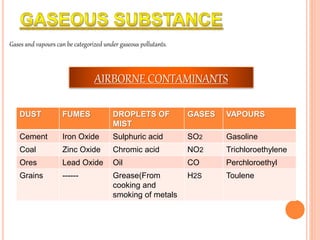
Gases and vapours can be categorized under gaseous pollutants.
DUST FUMES DROPLETS OF
MIST
GASES VAPOURS
Cement Iron Oxide Sulphuric acid SO2 Gasoline
Coal Zinc Oxide Chromic acid NO2 Trichloroethylene
Ores Lead Oxide Oil CO Perchloroethyl
Grains ------ Grease(From
cooking and
smoking of metals
H2S Toulene
AIRBORNE CONTAMINANTS
Adsorption involves the interaction between gaseous contaminants
and its surface of a solid adsorbent.
In this phenomenon molecules from a gas or liquid will be attached in
a physical way to a surface. The binding to the surface is usually
weak and reversible. The most common industrial adsorbents are
activated carbon, silica gel, and alumina, because they have enormous
surface areas per unit weight.
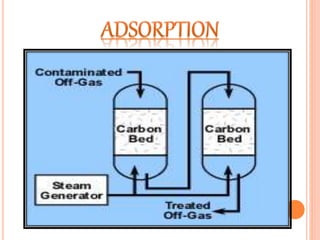
Activated carbon is the universal standard for purification and
removal of trace organic contaminants from liquid and vapour Carbon
adsorption uses activated carbon to control and/or recover gaseous
pollutant emissions. In carbon adsorption, the gas is attracted and
adheres to the porous surface of the activated carbon.
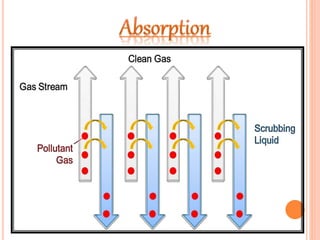
Gaseous contaminants that are soluble in aqueous liquids can be removed
in absorbers. This is one of the main mechanisms used for the removal of
acid gas compounds (e.g., sulphur dioxide, hydrogen chloride, and
hydrogen fluoride) and water soluble organic compounds (e.g., alcohols,
aldehydes, organic acids).The contaminant gas or vapour is absorbed from
the gas stream as it comes into contact with the liquid.
Biological treatment systems are termed either biological oxidation or
biofilter systems. Regardless of the term, the fundamental processes
involved is the collection of contaminants on the surface of a media
that contains viable microorganisms. The contaminant is metabolized by
the organism and carbon oxide and water vapour is re-emitted.
All absorption processes operate best when the gas and liquid
temperatures are low. Gas and vapour phase contaminants are most
soluble under cold conditions.
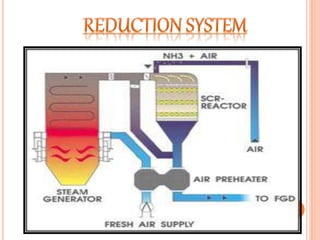
Reduction systems are used primarily for the destruction of NOx
compounds emitted from combustion processes. These systems include
selective noncatalytic reduction systems (SNCR) and selective catalytic
reduction systems (SCR).
In both types of systems, a chemically reduced form of nitrogen is
injected into the gas stream to react with the oxidized nitrogen
compounds, namely NO and NO2. The reactions
between the reduced and oxidized forms of nitrogen result in molecular
N2, the major constituent of clean air
SNCR and SCR systems are believed to be effective for NO and
NO2. It is important to note that in the
majority of combustion systems, 90% to 95% of the NOX in the
gas stream is present as NO, and the
remaining is present as NO2.
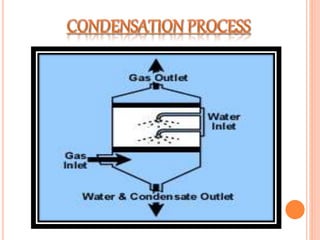
Condensation systems are used exclusively for the recovery of organic
compounds present at moderate to high concentrations in industrial
process effluent gas steams.
The most common type of condensers are those using cooling water in
direct contact or indirect contact vessels. Refrigeration and cryogenic
systems are used primarily for the high efficiency recovery of high
value contaminants. Condensation systems reduce the contaminant
concentration in the gas stream to a concentration equivalent to the
vapor pressure of the compound at the operating temperature of the
condenser.
Most condensers operate on systems with only a single contaminant
compound or a mixture of compounds that does not usually require
separation (i.e. gasoline).
CONTROL DEVICES FOR
GASEOUS
POLLUTANTS
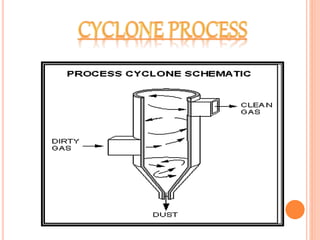
Cyclones operate to collect relatively large size particulate matter from a
gaseous stream through the use of centrifugal forces. Dust laden gas is
made to rotate in a decreasing diameter pathway forcing solids to the
outer edge of the gas stream for deposition into the bottom of the
cyclone. Efficiencies of 90% in particle sizes of 10 microns or greater
are possible.
Performance & Collection Efficiency
• Linear increases with: particle density, gas stream velocity, and
rotational passes
• Linear decrease with fluid viscosity
• Exponential increase with particle diameter
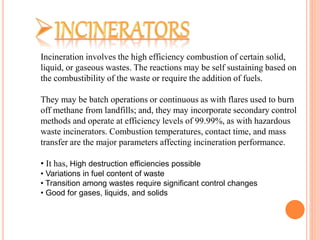
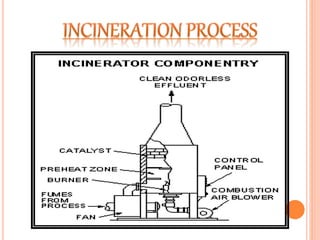
Incineration involves the high efficiency combustion of certain solid,
liquid, or gaseous wastes. The reactions may be self sustaining based on
the combustibility of the waste or require the addition of fuels.
They may be batch operations or continuous as with flares used to burn
off methane from landfills; and, they may incorporate secondary control
methods and operate at efficiency levels of 99.99%, as with hazardous
waste incinerators. Combustion temperatures, contact time, and mass
transfer are the major parameters affecting incineration performance.
• It has, High destruction efficiencies possible
• Variations in fuel content of waste
• Transition among wastes require significant control changes
• Good for gases, liquids, and solids
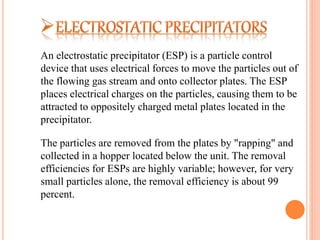
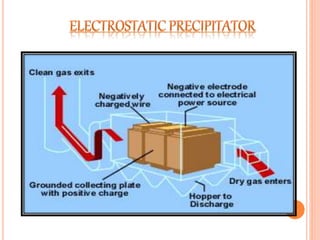
An electrostatic precipitator (ESP) is a particle control
device that uses electrical forces to move the particles out of
the flowing gas stream and onto collector plates. The ESP
places electrical charges on the particles, causing them to be
attracted to oppositely charged metal plates located in the
precipitator.
The particles are removed from the plates by "rapping" and
collected in a hopper located below the unit. The removal
efficiencies for ESPs are highly variable; however, for very
small particles alone, the removal efficiency is about 99
percent.
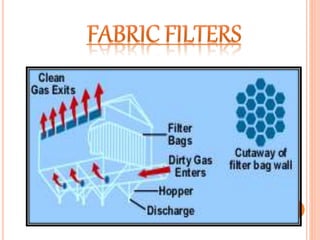
Fabric filters, or baghouses, remove dust from a gas stream by passing
the stream through a porous fabric. The fabric filter is efficient at
removing fine particles and can exceed efficiencies of 99 percent in most
applications.
The selection of the fiber material and fabric construction is important to
baghouse performance. The fiber material from which the fabric is made
must have adequate strength characteristics at the maximum gas
temperature expected and adequate chemical compatibility with both the
gas and the collected dust.
One disadvantage of the fabric filter is that high-temperature gases often
have to be cooled before contacting the filter medium.
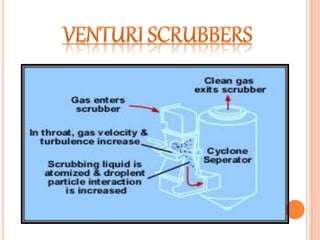
Venturi scrubbers use a liquid stream to remove solid particles. In the
venturi scrubber, gas laden with particulate matter passes through a short
tube with flared ends and a constricted middle. This constriction causes
the gas stream to speed up when the pressure is increased.
A water spray is directed into the gas stream either prior to or at the
constriction in the tube. The difference in velocity and pressure resulting
from the constriction causes the particles and water to mix and combine.
The reduced velocity at the expanded section of the throat allows the
droplets of water containing the particles to drop out of the gas stream.
Venturi scrubbers are effective in removing small particles, with removal
efficiencies of up to 99 percent.
One drawback of this device, however, is the production of wastewater.
The best control measure, of course, is prevention.
However, as long as there are fossil fuel emissions from
our coal-burning factories and gas-burning automobiles,
there will be air pollution.
The key to easing future impacts is control. The sources of
air pollution are many, although most authorities identify
sulphur dioxide, nitrogen dioxide, ozone and particulate
matter as the major pollutants. Identification of sources of
pollution offers opportunities for control

Effective Techniques to control gaseous & particulate pollution

  • 2.
  • 3.
    Our Focus:-  Introduction Methods to control gaseous pollutant  Control devices to control gaseous pollution  Control devices for Particulate Pollution  Conclusion
  • 4.
    1. A substancein the air which causes harm to humans and environment is known as pollutant. 2. Pollutants such as sulphur dioxide, hydrogen sulphide, and nitrogen dioxide combine with moisture in the air to form acids that attack and damage library material are known as gaseous pollutants. 3. Smoking, cooking, and off-gassing from unstable materials (cellulose nitrate film, paint finishes, fire-retardant coatings, and adhesives) may also produce harmful gaseous pollutants. 4. Particulate pollutants, such as soot, dirt, and dust abrade, soil, and disfigure materials. Dust and dirt that have absorbed gaseous pollutants from the air become sites for harmful chemical reactions when they settle on library material. The pollution caused by this is known is particulate pollution.
  • 5.
    Gases and vapourscan be categorized under gaseous pollutants. DUST FUMES DROPLETS OF MIST GASES VAPOURS Cement Iron Oxide Sulphuric acid SO2 Gasoline Coal Zinc Oxide Chromic acid NO2 Trichloroethylene Ores Lead Oxide Oil CO Perchloroethyl Grains ------ Grease(From cooking and smoking of metals H2S Toulene AIRBORNE CONTAMINANTS
  • 7.
    Adsorption involves theinteraction between gaseous contaminants and its surface of a solid adsorbent. In this phenomenon molecules from a gas or liquid will be attached in a physical way to a surface. The binding to the surface is usually weak and reversible. The most common industrial adsorbents are activated carbon, silica gel, and alumina, because they have enormous surface areas per unit weight. Activated carbon is the universal standard for purification and removal of trace organic contaminants from liquid and vapour Carbon adsorption uses activated carbon to control and/or recover gaseous pollutant emissions. In carbon adsorption, the gas is attracted and adheres to the porous surface of the activated carbon.
  • 9.
    Gaseous contaminants thatare soluble in aqueous liquids can be removed in absorbers. This is one of the main mechanisms used for the removal of acid gas compounds (e.g., sulphur dioxide, hydrogen chloride, and hydrogen fluoride) and water soluble organic compounds (e.g., alcohols, aldehydes, organic acids).The contaminant gas or vapour is absorbed from the gas stream as it comes into contact with the liquid. Biological treatment systems are termed either biological oxidation or biofilter systems. Regardless of the term, the fundamental processes involved is the collection of contaminants on the surface of a media that contains viable microorganisms. The contaminant is metabolized by the organism and carbon oxide and water vapour is re-emitted. All absorption processes operate best when the gas and liquid temperatures are low. Gas and vapour phase contaminants are most soluble under cold conditions.
  • 11.
    Reduction systems areused primarily for the destruction of NOx compounds emitted from combustion processes. These systems include selective noncatalytic reduction systems (SNCR) and selective catalytic reduction systems (SCR). In both types of systems, a chemically reduced form of nitrogen is injected into the gas stream to react with the oxidized nitrogen compounds, namely NO and NO2. The reactions between the reduced and oxidized forms of nitrogen result in molecular N2, the major constituent of clean air SNCR and SCR systems are believed to be effective for NO and NO2. It is important to note that in the majority of combustion systems, 90% to 95% of the NOX in the gas stream is present as NO, and the remaining is present as NO2.
  • 13.
    Condensation systems areused exclusively for the recovery of organic compounds present at moderate to high concentrations in industrial process effluent gas steams. The most common type of condensers are those using cooling water in direct contact or indirect contact vessels. Refrigeration and cryogenic systems are used primarily for the high efficiency recovery of high value contaminants. Condensation systems reduce the contaminant concentration in the gas stream to a concentration equivalent to the vapor pressure of the compound at the operating temperature of the condenser. Most condensers operate on systems with only a single contaminant compound or a mixture of compounds that does not usually require separation (i.e. gasoline).
  • 15.
  • 16.
    Cyclones operate tocollect relatively large size particulate matter from a gaseous stream through the use of centrifugal forces. Dust laden gas is made to rotate in a decreasing diameter pathway forcing solids to the outer edge of the gas stream for deposition into the bottom of the cyclone. Efficiencies of 90% in particle sizes of 10 microns or greater are possible. Performance & Collection Efficiency • Linear increases with: particle density, gas stream velocity, and rotational passes • Linear decrease with fluid viscosity • Exponential increase with particle diameter
  • 18.
    Incineration involves thehigh efficiency combustion of certain solid, liquid, or gaseous wastes. The reactions may be self sustaining based on the combustibility of the waste or require the addition of fuels. They may be batch operations or continuous as with flares used to burn off methane from landfills; and, they may incorporate secondary control methods and operate at efficiency levels of 99.99%, as with hazardous waste incinerators. Combustion temperatures, contact time, and mass transfer are the major parameters affecting incineration performance. • It has, High destruction efficiencies possible • Variations in fuel content of waste • Transition among wastes require significant control changes • Good for gases, liquids, and solids
  • 21.
    An electrostatic precipitator(ESP) is a particle control device that uses electrical forces to move the particles out of the flowing gas stream and onto collector plates. The ESP places electrical charges on the particles, causing them to be attracted to oppositely charged metal plates located in the precipitator. The particles are removed from the plates by "rapping" and collected in a hopper located below the unit. The removal efficiencies for ESPs are highly variable; however, for very small particles alone, the removal efficiency is about 99 percent.
  • 23.
    Fabric filters, orbaghouses, remove dust from a gas stream by passing the stream through a porous fabric. The fabric filter is efficient at removing fine particles and can exceed efficiencies of 99 percent in most applications. The selection of the fiber material and fabric construction is important to baghouse performance. The fiber material from which the fabric is made must have adequate strength characteristics at the maximum gas temperature expected and adequate chemical compatibility with both the gas and the collected dust. One disadvantage of the fabric filter is that high-temperature gases often have to be cooled before contacting the filter medium.
  • 25.
    Venturi scrubbers usea liquid stream to remove solid particles. In the venturi scrubber, gas laden with particulate matter passes through a short tube with flared ends and a constricted middle. This constriction causes the gas stream to speed up when the pressure is increased. A water spray is directed into the gas stream either prior to or at the constriction in the tube. The difference in velocity and pressure resulting from the constriction causes the particles and water to mix and combine. The reduced velocity at the expanded section of the throat allows the droplets of water containing the particles to drop out of the gas stream. Venturi scrubbers are effective in removing small particles, with removal efficiencies of up to 99 percent. One drawback of this device, however, is the production of wastewater.
  • 27.
    The best controlmeasure, of course, is prevention. However, as long as there are fossil fuel emissions from our coal-burning factories and gas-burning automobiles, there will be air pollution. The key to easing future impacts is control. The sources of air pollution are many, although most authorities identify sulphur dioxide, nitrogen dioxide, ozone and particulate matter as the major pollutants. Identification of sources of pollution offers opportunities for control