
Introduction workshop uxd minor
Workshop program Introduction design rationale (Hans) Using sources from literature (Rolf) Today’s assignment (all)
A design what? Design  – concerning the act of designing Rationale  1  :  an explanation of controlling principles of opinion, belief, practice, or phenomena  2  :  an underlying reason http://www.merriam-webster.com/dictionary
In simple terms… Your account of the reasoning behind your design solutions The steps you went through The design decisions you made The basis for those decisions
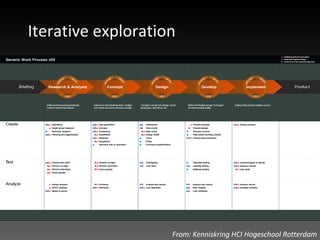
Iterative exploration From: Kenniskring HCI Hogeschool Rotterdam
Design never is a soletary effort “ Design is compromise.” Bill Buxton in ‘ Sketching User Experiences’
Sketching the experience Sketches, visualizations or prototypes serve to suggest, propose and question design ideas.  For you to explore To communicate to and share with others Ideas need to be scrutinized, criticized and challenged to improve:  “ criticizing your way to the solution”  Scott Jenson (2002) in  The Simplicity Shift
Documenting the design rationale An explicit design rationale will: Stimulate a clear reasoning, shared and understood by all ( e.g., engineers, client ) Prevent getting locked into your previous decisions ( e.g., with changing requirements )
A good design rationale Is captured while the design process is progressing Documents this design process Contains visual representations of the design, from the various phases of the design process Contains the main design decisions throughout the design process explicitly Contains the underpinnings of all design decisions, preferably  objectively and research based
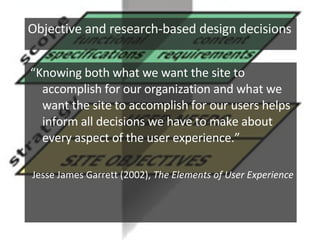
Objective and research-based design decisions “ Knowing both what we want the site to accomplish for our organization and what we want the site to accomplish for our users helps inform all decisions we have to make about every aspect of the user experience.” Jesse James Garrett (2002),  The Elements of User Experience
Objective and research-based design decisions Research can be research you conducted, or someone else has conducted Objectivity is provided by documenting your own research ( reproducibility ) and/or traceable ( trustworthy ) sources

0708 Design Rationale (Introduction)

  • 1.
  • 2.
    Workshop program Introductiondesign rationale (Hans) Using sources from literature (Rolf) Today’s assignment (all)
  • 3.
    A design what?Design – concerning the act of designing Rationale 1 :  an explanation of controlling principles of opinion, belief, practice, or phenomena 2 :  an underlying reason http://www.merriam-webster.com/dictionary
  • 4.
    In simple terms…Your account of the reasoning behind your design solutions The steps you went through The design decisions you made The basis for those decisions
  • 5.
    Iterative exploration From:Kenniskring HCI Hogeschool Rotterdam
  • 6.
    Design never isa soletary effort “ Design is compromise.” Bill Buxton in ‘ Sketching User Experiences’
  • 7.
    Sketching the experienceSketches, visualizations or prototypes serve to suggest, propose and question design ideas. For you to explore To communicate to and share with others Ideas need to be scrutinized, criticized and challenged to improve: “ criticizing your way to the solution” Scott Jenson (2002) in The Simplicity Shift
  • 8.
    Documenting the designrationale An explicit design rationale will: Stimulate a clear reasoning, shared and understood by all ( e.g., engineers, client ) Prevent getting locked into your previous decisions ( e.g., with changing requirements )
  • 9.
    A good designrationale Is captured while the design process is progressing Documents this design process Contains visual representations of the design, from the various phases of the design process Contains the main design decisions throughout the design process explicitly Contains the underpinnings of all design decisions, preferably objectively and research based
  • 10.
    Objective and research-baseddesign decisions “ Knowing both what we want the site to accomplish for our organization and what we want the site to accomplish for our users helps inform all decisions we have to make about every aspect of the user experience.” Jesse James Garrett (2002), The Elements of User Experience
  • 11.
    Objective and research-baseddesign decisions Research can be research you conducted, or someone else has conducted Objectivity is provided by documenting your own research ( reproducibility ) and/or traceable ( trustworthy ) sources