VOCABULARY
 Language & Mass Communication
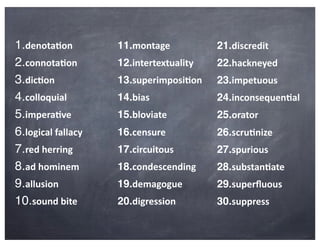
1.denota'on            11.montage	
 Ā        21.discredit	
 Ā 
2.connota'on           12.intertextuality   22.hackneyed
3.dic'on               13.superimposi'on    23.impetuous
4.colloquial           14.bias	
 Ā 	
 Ā       24.inconsequen'al	
 Ā 	
 Ā 
5.impera've            15.bloviate          25.orator
6.logical	
 Ā fallacy   16.censure           26.scru'nize
7.red	
 Ā herring       17.circuitous        27.spurious
8.ad	
 Ā hominem        18.condescending     28.substan'ate
9.allusion             19.demagogue         29.superfluous
10.sound	
 Ā bite       20.digression        30.suppress
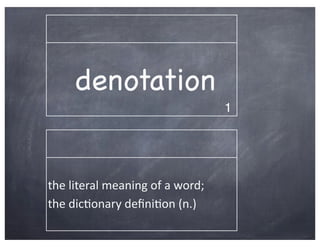
denotation
             1
denotation
                                                    1


the	
 Ā literal	
 Ā meaning	
 Ā of	
 Ā a	
 Ā word;	
 Ā 
the	
 Ā dic2onary	
  defini2on	
 Ā (n.)
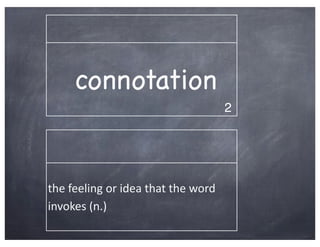
connotation
              2
connotation
                                                          2


the	
 Ā feeling	
 Ā or	
 Ā idea	
 Ā that	
 Ā the	
 Ā word	
 Ā 
invokes	
 Ā (n.)
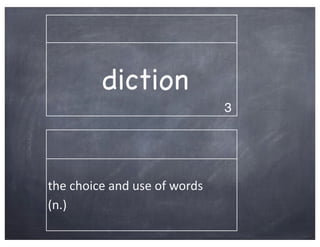
diction
          3
diction
                                                 3


the	
 Ā choice	
 Ā and	
 Ā use	
 Ā of	
 Ā words	
 Ā 
(n.)
colloquial
             4
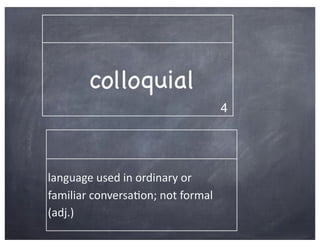
colloquial
                                                4


language	
 Ā used	
 Ā in	
 Ā ordinary	
 Ā or	
 Ā 
familiar	
 Ā conversa2on;	
 Ā not	
 Ā formal	
 Ā 
(adj.)
imperative
             5
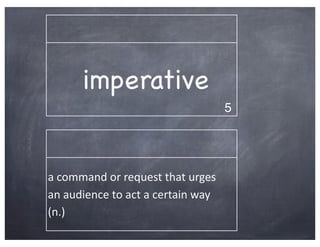
imperative
                                                         5


a	
 Ā command	
 Ā or	
 Ā request	
 Ā that	
 Ā urges	
 Ā 
an	
 Ā audience	
 Ā to	
 Ā act	
 Ā a	
 Ā certain	
 Ā way	
 Ā 
(n.)
logical fallacy
              6
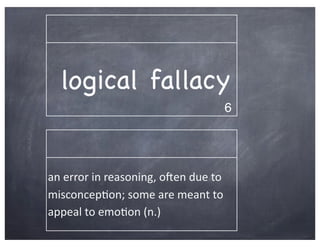
logical fallacy
                                                       6


an	
 Ā error	
 Ā in	
 Ā reasoning,	
 Ā o?en	
 Ā due	
 Ā to	
 Ā 
misconcep2on;	
 Ā some	
 Ā are	
 Ā meant	
 Ā to	
 Ā 
appeal	
 Ā to	
 Ā emo2on	
 Ā (n.)
red herring
          7
red herring
                                                      7


something	
 Ā that	
 Ā is	
 Ā intended	
 Ā to	
 Ā be	
 Ā 
misleading	
 Ā or	
 Ā distrac2ng	
 Ā (n.)
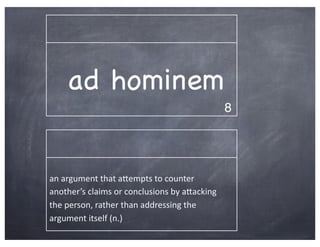
ad hominem
             8
ad hominem
                                                                 8


an	
 Ā argument	
 Ā that	
 Ā aBempts	
 Ā to	
 Ā counter	
 Ā 
another’s	
 Ā claims	
 Ā or	
 Ā conclusions	
 Ā by	
 Ā aBacking	
 Ā 
the	
 Ā person,	
 Ā rather	
 Ā than	
 Ā addressing	
 Ā the	
 Ā 
argument	
 Ā itself	
 Ā (n.)
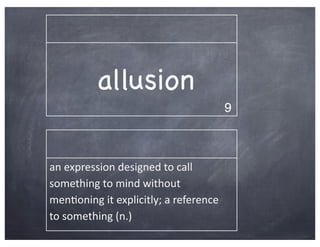
allusion
           9
allusion
                                                       9


an	
 Ā expression	
 Ā designed	
 Ā to	
 Ā call	
 Ā 
something	
 Ā to	
 Ā mind	
 Ā without	
 Ā 
men2oning	
 Ā it	
 Ā explicitly;	
 Ā a	
 Ā reference	
 Ā 
to	
 Ā something	
 Ā (n.)
sound bite
             10
sound bite
                                                     10


a	
 Ā short	
 Ā extract	
 Ā from	
 Ā a	
 Ā recorded	
 Ā 
interview,	
 Ā chosen	
 Ā for	
 Ā its	
 Ā 
pungency	
 Ā (n.)
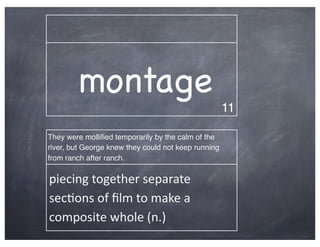
montage
          11
montage
                                                     11

They were mollified temporarily by the calm of the
river, but George knew they could not keep running
from ranch after ranch.

piecing	
 Ā together	
 Ā separate	
 Ā 
sec2ons	
 Ā of	
  film	
 Ā to	
 Ā make	
 Ā a	
 Ā 
composite	
 Ā whole	
 Ā (n.)
intertextuality
              12
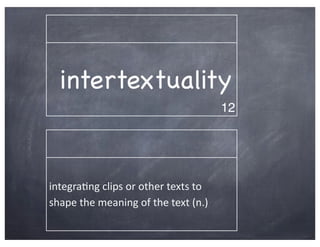
intertextuality
                                                        12


integra2ng	
 Ā clips	
 Ā or	
 Ā other	
 Ā texts	
 Ā to	
 Ā 
shape	
 Ā the	
 Ā meaning	
 Ā of	
 Ā the	
 Ā text	
 Ā (n.)
superimposition
             13
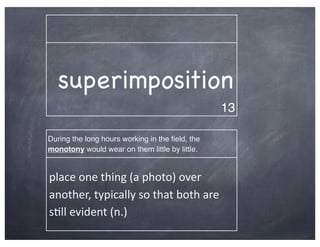
superimposition
                                                     13

During the long hours working in the field, the
monotony would wear on them little by little.

place	
 Ā one	
 Ā thing	
 Ā (a	
 Ā photo)	
 Ā over	
 Ā 
another,	
 Ā typically	
 Ā so	
 Ā that	
 Ā both	
 Ā are	
 Ā 
s2ll	
 Ā evident	
 Ā (n.)
bias
       14
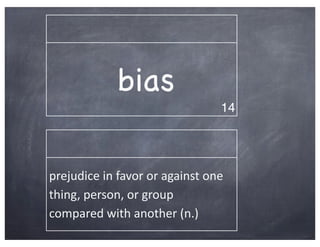
bias
                                                  14


prejudice	
 Ā in	
 Ā favor	
 Ā or	
 Ā against	
 Ā one	
 Ā 
thing,	
 Ā person,	
 Ā or	
 Ā group	
 Ā 
compared	
 Ā with	
 Ā another	
 Ā (n.)
bloviate
           15
bloviate
                                                  15


talk	
 Ā at	
 Ā length,	
 Ā usually	
 Ā in	
 Ā a	
 Ā 
inflated	
 Ā or	
 Ā empty;	
 Ā talk	
 Ā 
pompously	
 Ā (v.)
censure
          16
censure
                                             16


express	
 Ā severe	
 Ā disapproval	
 Ā of	
 Ā 
(v.)
circuitous
             17
circuitous
                                            17


indirect;	
 Ā taking	
 Ā the	
 Ā longest	
 Ā 
route	
 Ā (adj.)
condescending
            18
condescending
                                                      18

Each one of us should strive to be dynamic so that we
are growing and looking at the world differently.


possessing	
 Ā a	
 Ā feeling	
 Ā of	
 Ā superiority	
 Ā 
(adj.)
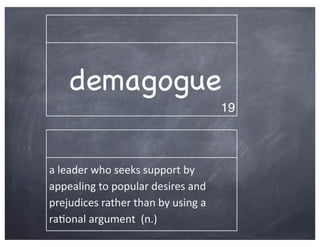
demagogue
        19
demagogue
                                                       19


a	
 Ā leader	
 Ā who	
 Ā seeks	
 Ā support	
 Ā by	
 Ā 
appealing	
 Ā to	
 Ā popular	
 Ā desires	
 Ā and	
 Ā 
prejudices	
 Ā rather	
 Ā than	
 Ā by	
 Ā using	
 Ā a	
 Ā 
ra2onal	
 Ā argument	
 Ā 	
 Ā (n.)
digression
             20
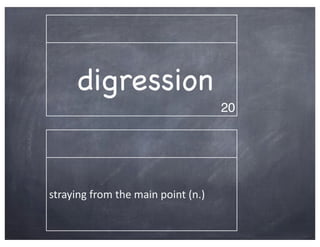
digression
                                                   20


straying	
 Ā from	
 Ā the	
 Ā main	
 Ā point	
 Ā (n.)
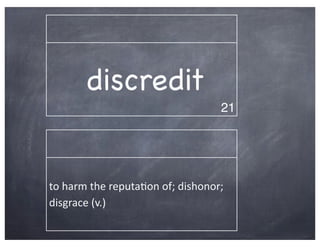
discredit
            21
discredit
                                                    21


to	
 Ā harm	
 Ā the	
 Ā reputa2on	
 Ā of;	
 Ā dishonor;	
 Ā 
disgrace	
 Ā (v.)
hackneyed
            22
hackneyed
                                                 22


cliched,	
 Ā worn	
 Ā out	
 Ā by	
 Ā overuse	
 Ā (adj.)
impetuous
            23
impetuous
                                              23


rash,	
 Ā impulsive,	
 Ā ac2ng	
 Ā without	
 Ā 
thinking	
 Ā (adj.)
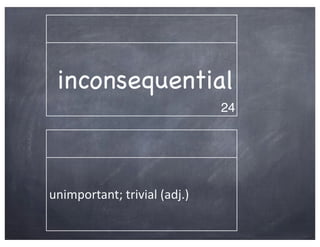
inconsequential
             24
inconsequential
                                    24


unimportant;	
 Ā trivial	
 Ā (adj.)
orator
         25
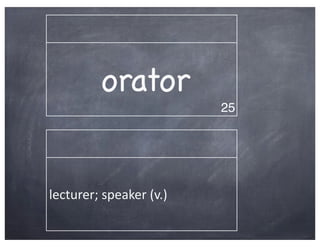
orator
                               25


lecturer;	
 Ā speaker	
 Ā (v.)
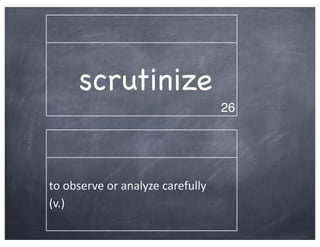
scrutinize
             26
scrutinize
                                                  26


to	
 Ā observe	
 Ā or	
 Ā analyze	
 Ā carefully	
 Ā 
(v.)
spurious
           27
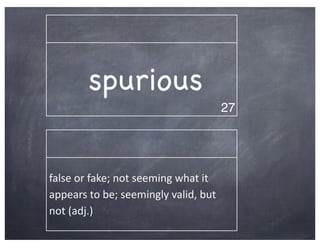
spurious
                                                           27


false	
 Ā or	
 Ā fake;	
 Ā not	
 Ā seeming	
 Ā what	
 Ā it	
 Ā 
appears	
 Ā to	
 Ā be;	
 Ā seemingly	
 Ā valid,	
 Ā but	
 Ā 
not	
 Ā (adj.)
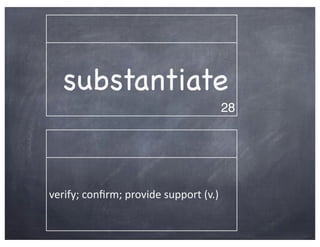
substantiate
           28
substantiate
                                                   28


verify;	
  confirm;	
 Ā provide	
 Ā support	
 Ā (v.)
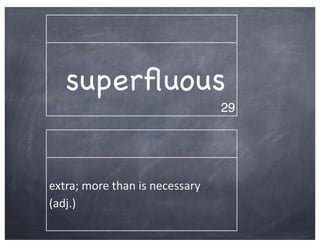
superfluous
         29
superfluous
                                                29


extra;	
 Ā more	
 Ā than	
 Ā is	
 Ā necessary	
 Ā 
(adj.)
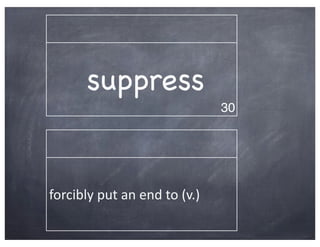
suppress
           30
suppress
                                             30


forcibly	
 Ā put	
 Ā an	
 Ā end	
 Ā to	
 Ā (v.)

Vocabulary fo aandbias

  • 1.
    VOCABULARY Language &Mass Communication
  • 2.
    1.denota'on 11.montage Ā  21.discredit Ā  2.connota'on 12.intertextuality 22.hackneyed 3.dic'on 13.superimposi'on 23.impetuous 4.colloquial 14.bias Ā  Ā  24.inconsequen'al Ā  Ā  5.impera've 15.bloviate 25.orator 6.logical Ā fallacy 16.censure 26.scru'nize 7.red Ā herring 17.circuitous 27.spurious 8.ad Ā hominem 18.condescending 28.substan'ate 9.allusion 19.demagogue 29.superfluous 10.sound Ā bite 20.digression 30.suppress
  • 3.
  • 4.
    denotation 1 the  literal  meaning  of  a  word;   the  dic2onary  defini2on  (n.)
  • 5.
  • 6.
    connotation 2 the Ā feeling Ā or Ā idea Ā that Ā the Ā word Ā  invokes Ā (n.)
  • 7.
  • 8.
    diction 3 the Ā choice Ā and Ā use Ā of Ā words Ā  (n.)
  • 9.
  • 10.
    colloquial 4 language Ā used Ā in Ā ordinary Ā or Ā  familiar Ā conversa2on; Ā not Ā formal Ā  (adj.)
  • 11.
  • 12.
    imperative 5 a Ā command Ā or Ā request Ā that Ā urges Ā  an Ā audience Ā to Ā act Ā a Ā certain Ā way Ā  (n.)
  • 13.
  • 14.
    logical fallacy 6 an Ā error Ā in Ā reasoning, Ā o?en Ā due Ā to Ā  misconcep2on; Ā some Ā are Ā meant Ā to Ā  appeal Ā to Ā emo2on Ā (n.)
  • 15.
  • 16.
    red herring 7 something Ā that Ā is Ā intended Ā to Ā be Ā  misleading Ā or Ā distrac2ng Ā (n.)
  • 17.
  • 18.
    ad hominem 8 an Ā argument Ā that Ā aBempts Ā to Ā counter Ā  another’s Ā claims Ā or Ā conclusions Ā by Ā aBacking Ā  the Ā person, Ā rather Ā than Ā addressing Ā the Ā  argument Ā itself Ā (n.)
  • 19.
  • 20.
    allusion 9 an Ā expression Ā designed Ā to Ā call Ā  something Ā to Ā mind Ā without Ā  men2oning Ā it Ā explicitly; Ā a Ā reference Ā  to Ā something Ā (n.)
  • 21.
  • 22.
    sound bite 10 a Ā short Ā extract Ā from Ā a Ā recorded Ā  interview, Ā chosen Ā for Ā its Ā  pungency Ā (n.)
  • 23.
  • 24.
    montage 11 They were mollified temporarily by the calm of the river, but George knew they could not keep running from ranch after ranch. piecing  together  separate   sec2ons  of  film  to  make  a   composite  whole  (n.)
  • 25.
  • 26.
    intertextuality 12 integra2ng Ā clips Ā or Ā other Ā texts Ā to Ā  shape Ā the Ā meaning Ā of Ā the Ā text Ā (n.)
  • 27.
  • 28.
    superimposition 13 During the long hours working in the field, the monotony would wear on them little by little. place  one  thing  (a  photo)  over   another,  typically  so  that  both  are   s2ll  evident  (n.)
  • 29.
  • 30.
    bias 14 prejudice Ā in Ā favor Ā or Ā against Ā one Ā  thing, Ā person, Ā or Ā group Ā  compared Ā with Ā another Ā (n.)
  • 31.
  • 32.
    bloviate 15 talk Ā at Ā length, Ā usually Ā in Ā a Ā  inflated Ā or Ā empty; Ā talk Ā  pompously Ā (v.)
  • 33.
  • 34.
    censure 16 express Ā severe Ā disapproval Ā of Ā  (v.)
  • 35.
  • 36.
    circuitous 17 indirect; Ā taking Ā the Ā longest Ā  route Ā (adj.)
  • 37.
  • 38.
    condescending 18 Each one of us should strive to be dynamic so that we are growing and looking at the world differently. possessing Ā a Ā feeling Ā of Ā superiority Ā  (adj.)
  • 39.
  • 40.
    demagogue 19 a Ā leader Ā who Ā seeks Ā support Ā by Ā  appealing Ā to Ā popular Ā desires Ā and Ā  prejudices Ā rather Ā than Ā by Ā using Ā a Ā  ra2onal Ā argument Ā  Ā (n.)
  • 41.
  • 42.
    digression 20 straying Ā from Ā the Ā main Ā point Ā (n.)
  • 43.
  • 44.
    discredit 21 to Ā harm Ā the Ā reputa2on Ā of; Ā dishonor; Ā  disgrace Ā (v.)
  • 45.
  • 46.
    hackneyed 22 cliched, Ā worn Ā out Ā by Ā overuse Ā (adj.)
  • 47.
  • 48.
    impetuous 23 rash, Ā impulsive, Ā ac2ng Ā without Ā  thinking Ā (adj.)
  • 49.
  • 50.
    inconsequential 24 unimportant; Ā trivial Ā (adj.)
  • 51.
  • 52.
    orator 25 lecturer; Ā speaker Ā (v.)
  • 53.
  • 54.
    scrutinize 26 to Ā observe Ā or Ā analyze Ā carefully Ā  (v.)
  • 55.
  • 56.
    spurious 27 false Ā or Ā fake; Ā not Ā seeming Ā what Ā it Ā  appears Ā to Ā be; Ā seemingly Ā valid, Ā but Ā  not Ā (adj.)
  • 57.
  • 58.
    substantiate 28 verify;  confirm;  provide  support  (v.)
  • 59.
  • 60.
    superfluous 29 extra; Ā more Ā than Ā is Ā necessary Ā  (adj.)
  • 61.
  • 62.
    suppress 30 forcibly Ā put Ā an Ā end Ā to Ā (v.)