Why Usability Should Never Come First And the importance of Front-End Design May, 2008 David Rondeau , Design Chair Traci Lepore,  Principal Interaction Designer
What are we going to talk about? Difference between User-Centered Design, Usability, and User Experience Relationship of “Value” and “Ease of use” Various types of customer data and how they impact design differently Understand the benefits of contextual data in a front-end design process
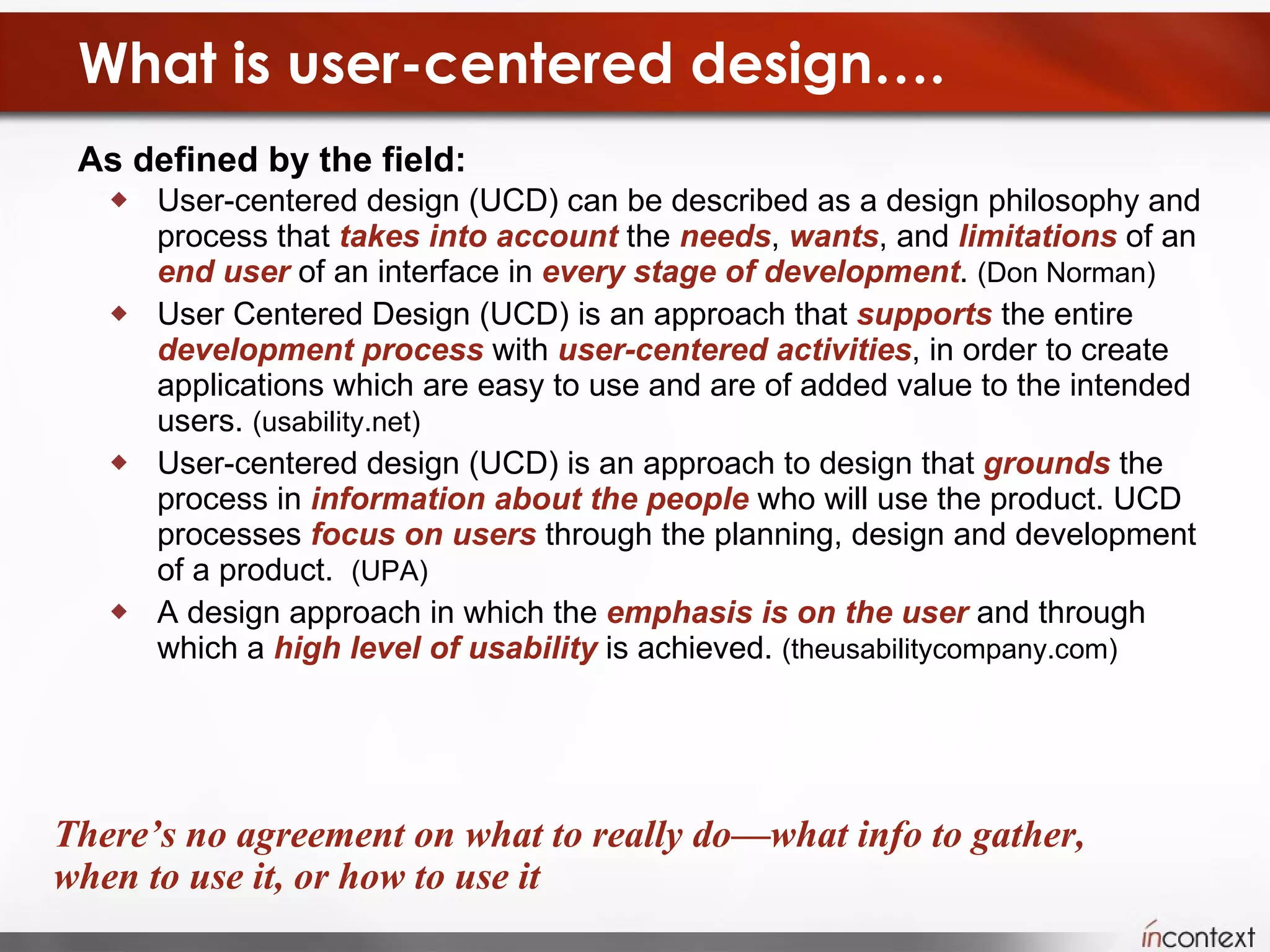
What is user-centered design…. As defined by the field:  User-centered design (UCD) can be described as a design philosophy and process that  takes into account  the  needs ,  wants , and  limitations  of an  end user  of an interface in  every stage of development .  (Don Norman) User Centered Design (UCD) is an approach that  supports  the entire  development   process  with  user-centered activities , in order to create applications which are easy to use and are of added value to the intended users.  (usability.net) User-centered design (UCD) is an approach to design that  grounds  the process in  information about the people  who will use the product. UCD processes  focus on users  through the planning, design and development of a product.  (UPA) A design approach in which the  emphasis is on the user  and through which a  high level of usability  is achieved.  (theusabilitycompany.com) There’s no agreement on what to really do—what info to gather, when to use it, or how to use it
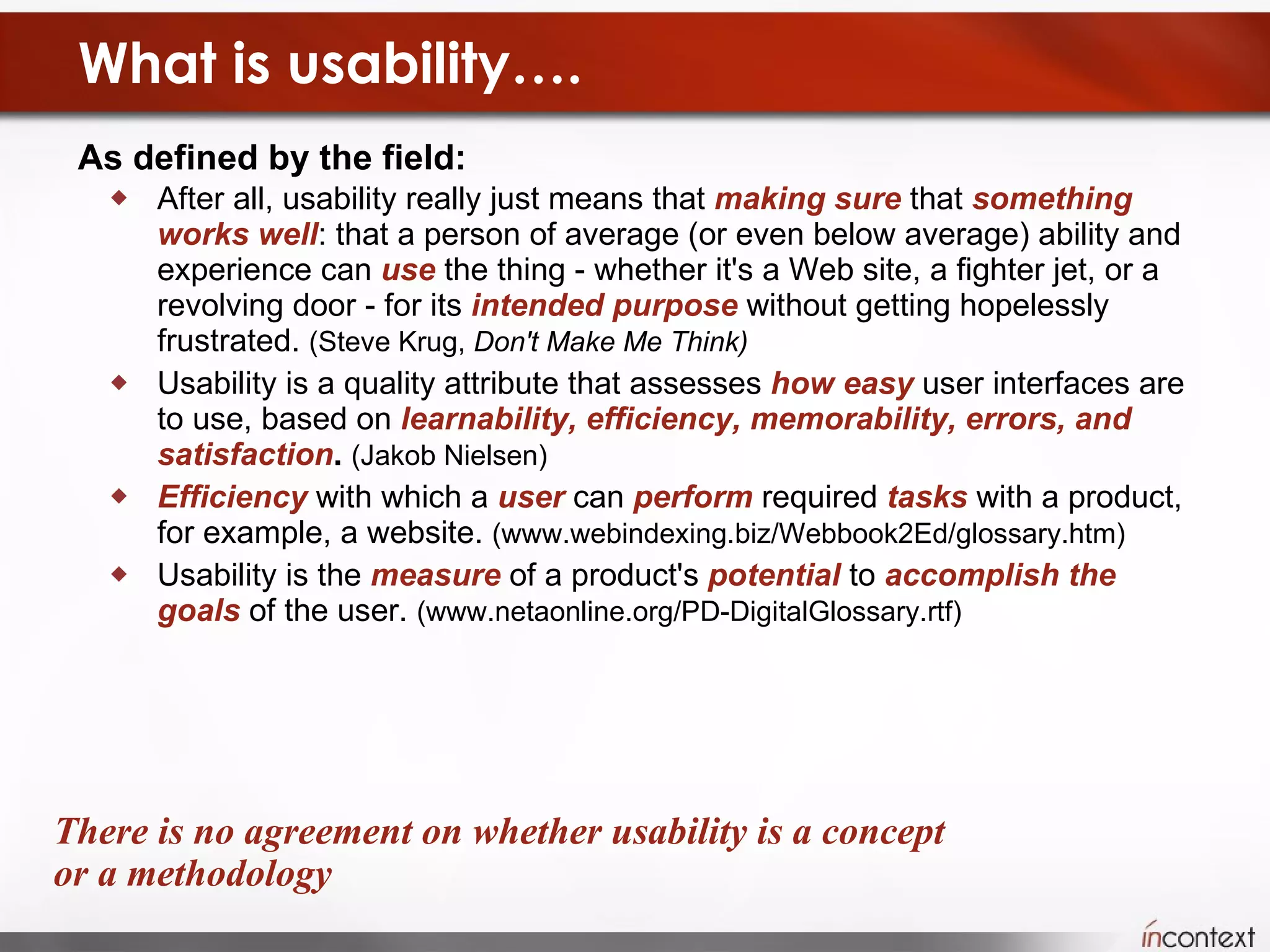
What is usability…. As defined by the field:   After all, usability really just means that  making sure  that  something   works   well : that a person of average (or even below average) ability and experience can  use  the thing - whether it's a Web site, a fighter jet, or a revolving door - for its  intended purpose  without getting hopelessly frustrated.  (Steve Krug,  Don't Make Me Think)   Usability is a quality attribute that assesses  how easy  user interfaces are to use, based on  learnability, efficiency, memorability, errors, and satisfaction .   (Jakob Nielsen) Efficiency  with which a  user  can  perform  required  tasks  with a product, for example, a website.  (www.webindexing.biz/Webbook2Ed/glossary.htm) Usability is the  measure  of a product's  potential  to  accomplish the goals  of the user.  (www.netaonline.org/PD-DigitalGlossary.rtf) There is no agreement on whether usability is a concept or a methodology
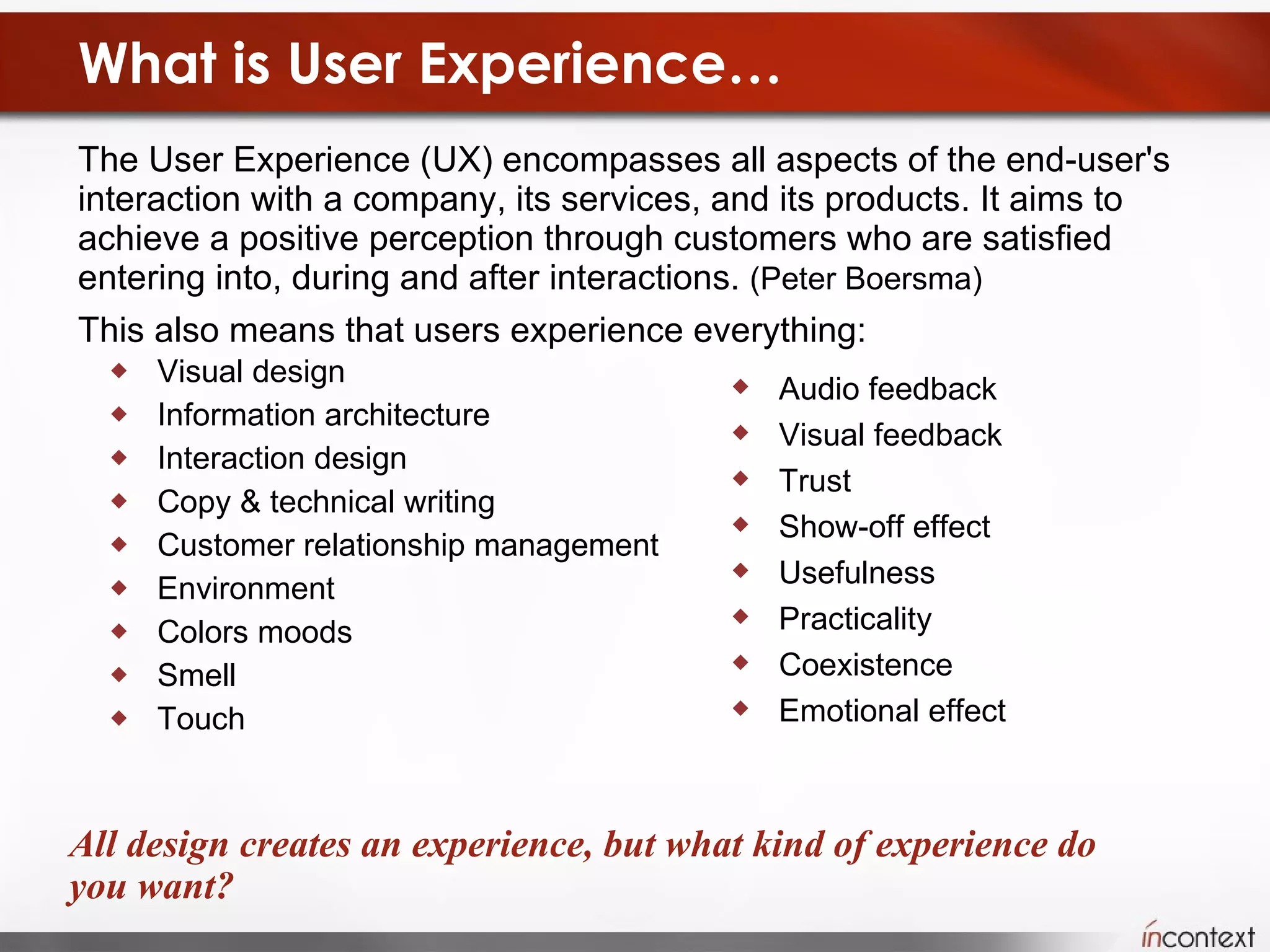
What is User Experience… The User Experience (UX) encompasses all aspects of the end-user's interaction with a company, its services, and its products. It aims to achieve a positive perception through customers who are satisfied entering into, during and after interactions.  (Peter Boersma) This also means that users experience everything:  Visual design  Information architecture  Interaction design  Copy & technical writing  Customer relationship management Environment Colors moods Smell Touch  All design creates an experience, but what kind of experience do you want? Audio feedback Visual feedback Trust Show-off effect Usefulness Practicality Coexistence Emotional effect
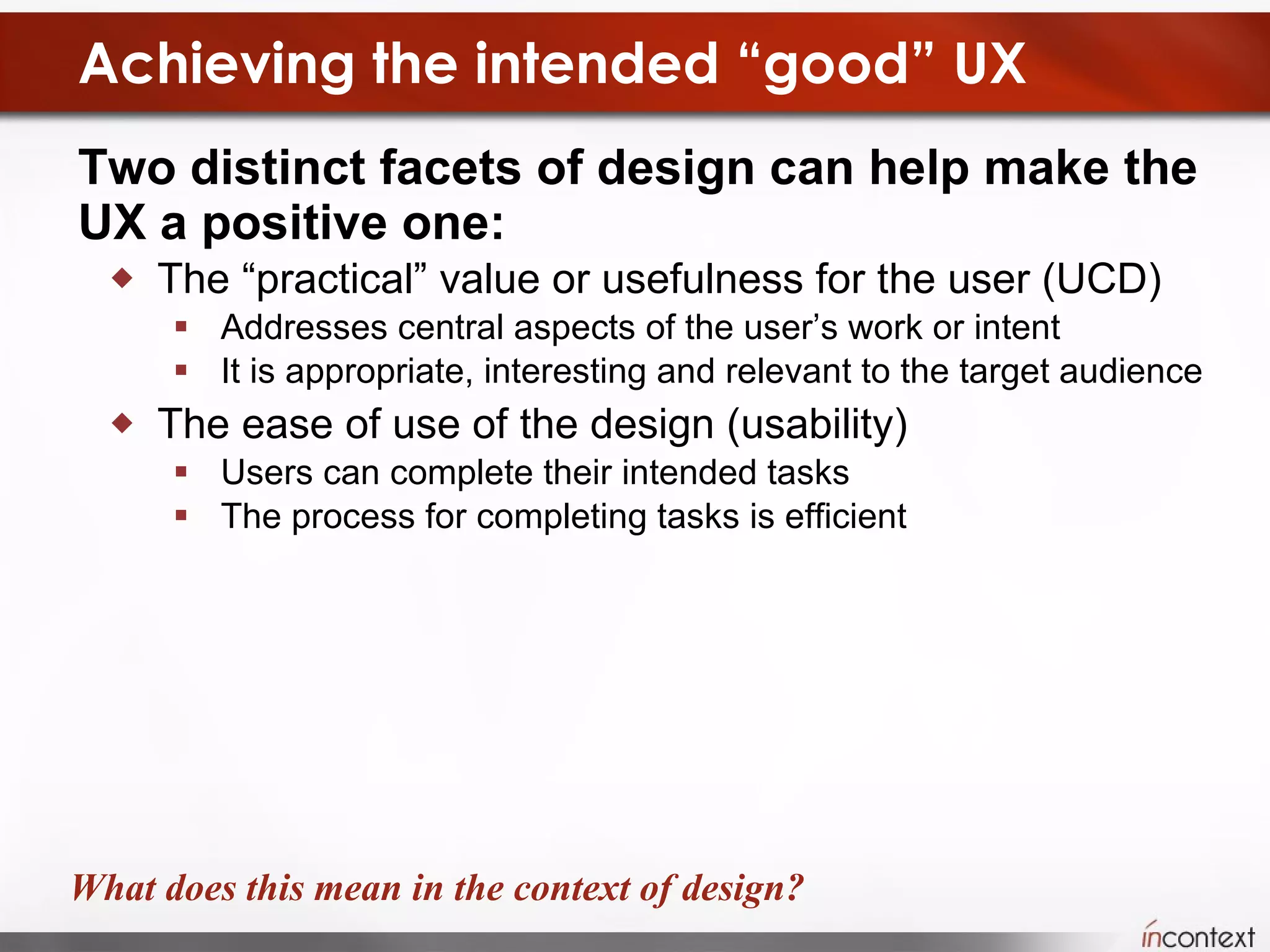
Achieving the intended “good” UX Two distinct facets of design can help make the UX a positive one:  The “practical” value or usefulness for the user (UCD) Addresses central aspects of the user’s work or intent It is appropriate, interesting and relevant to the target audience The ease of use of the design (usability) Users can complete their intended tasks The process for completing tasks is efficient What does this mean in the context of design?
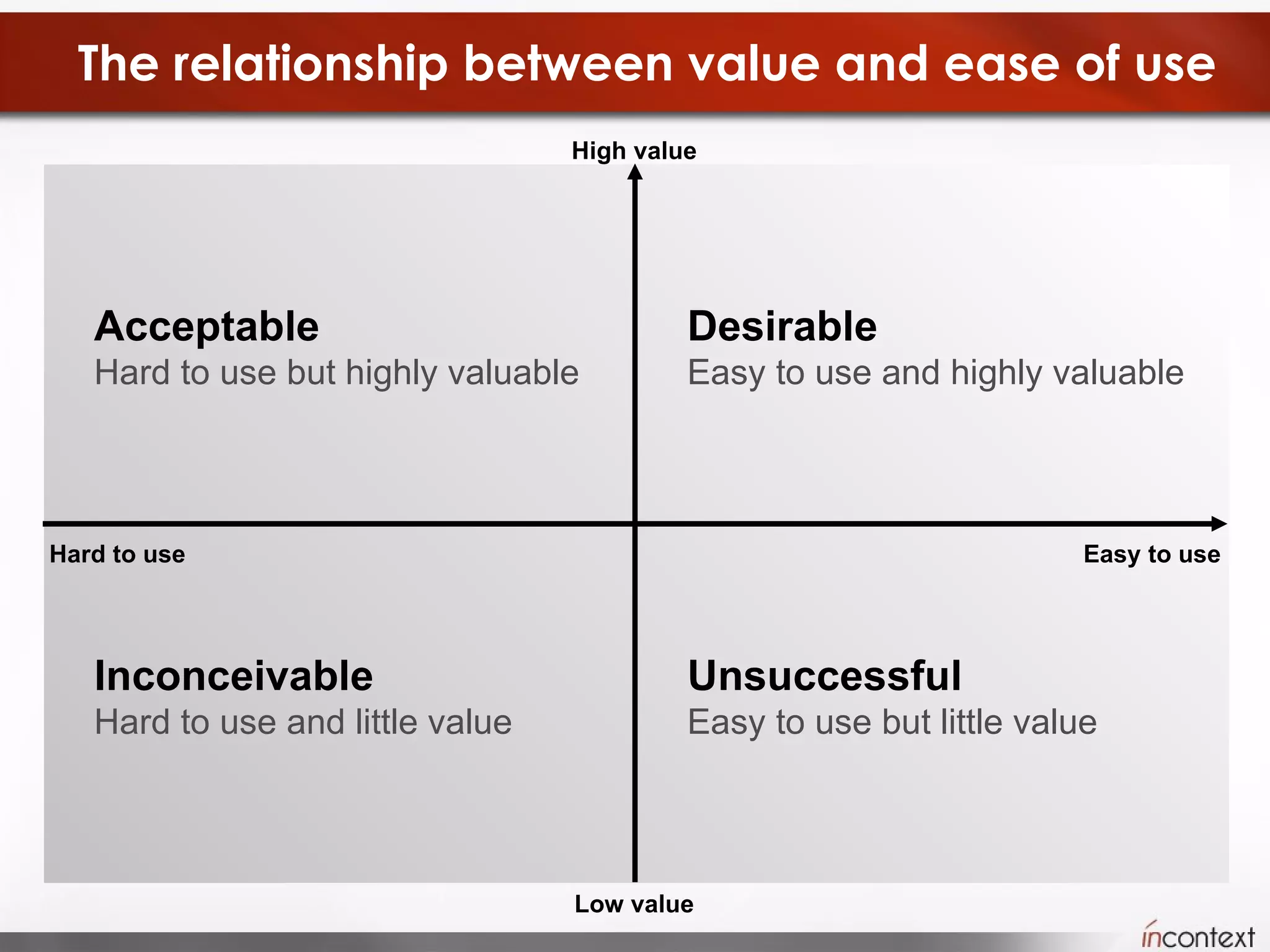
The relationship between value and ease of use Acceptable Hard to use but highly valuable Desirable Easy to use and highly valuable Inconceivable  Hard to use and little value Unsuccessful Easy to use but little value Hard to use Easy to use High value Low value
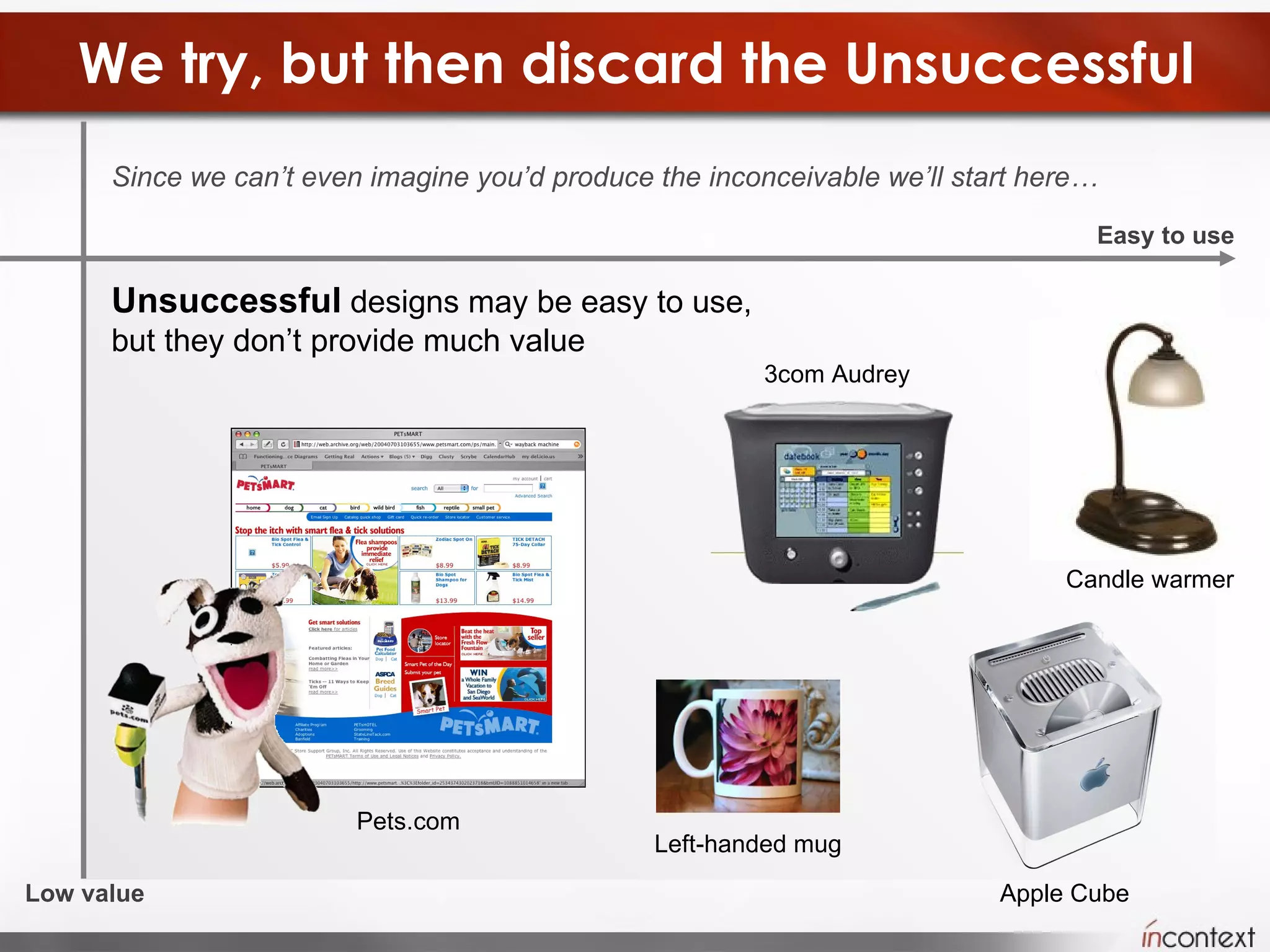
We try, but then discard the Unsuccessful Unsuccessful  designs may be easy to use, but they don’t provide much value Easy to use Low value Since we can’t even imagine you’d produce the inconceivable we’ll start here… 3com Audrey Pets.com Candle warmer Left-handed mug Apple Cube
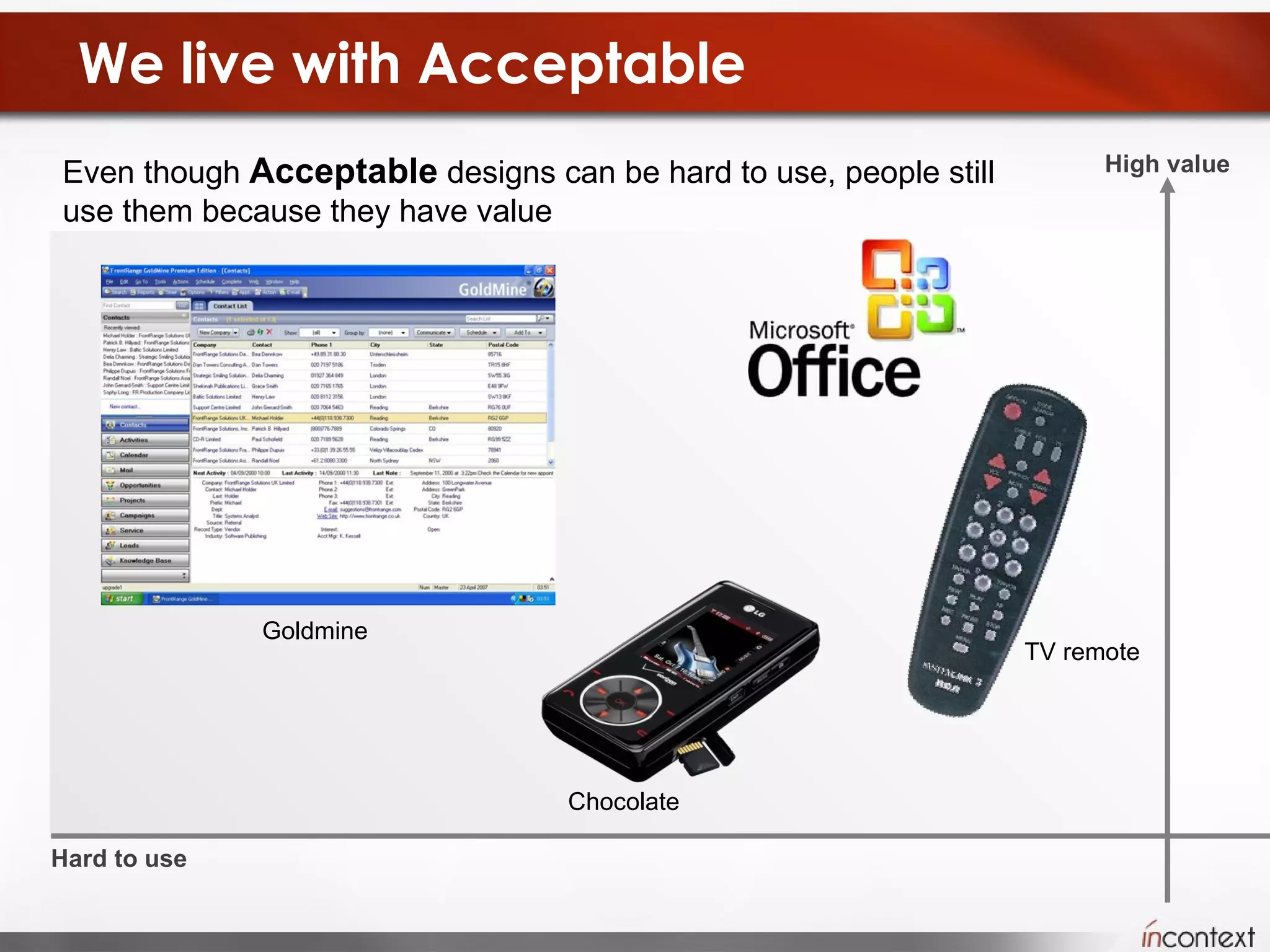
We live with Acceptable Even though  Acceptable  designs can be hard to use, people still use them because they have value Hard to use High value TV remote Goldmine Chocolate
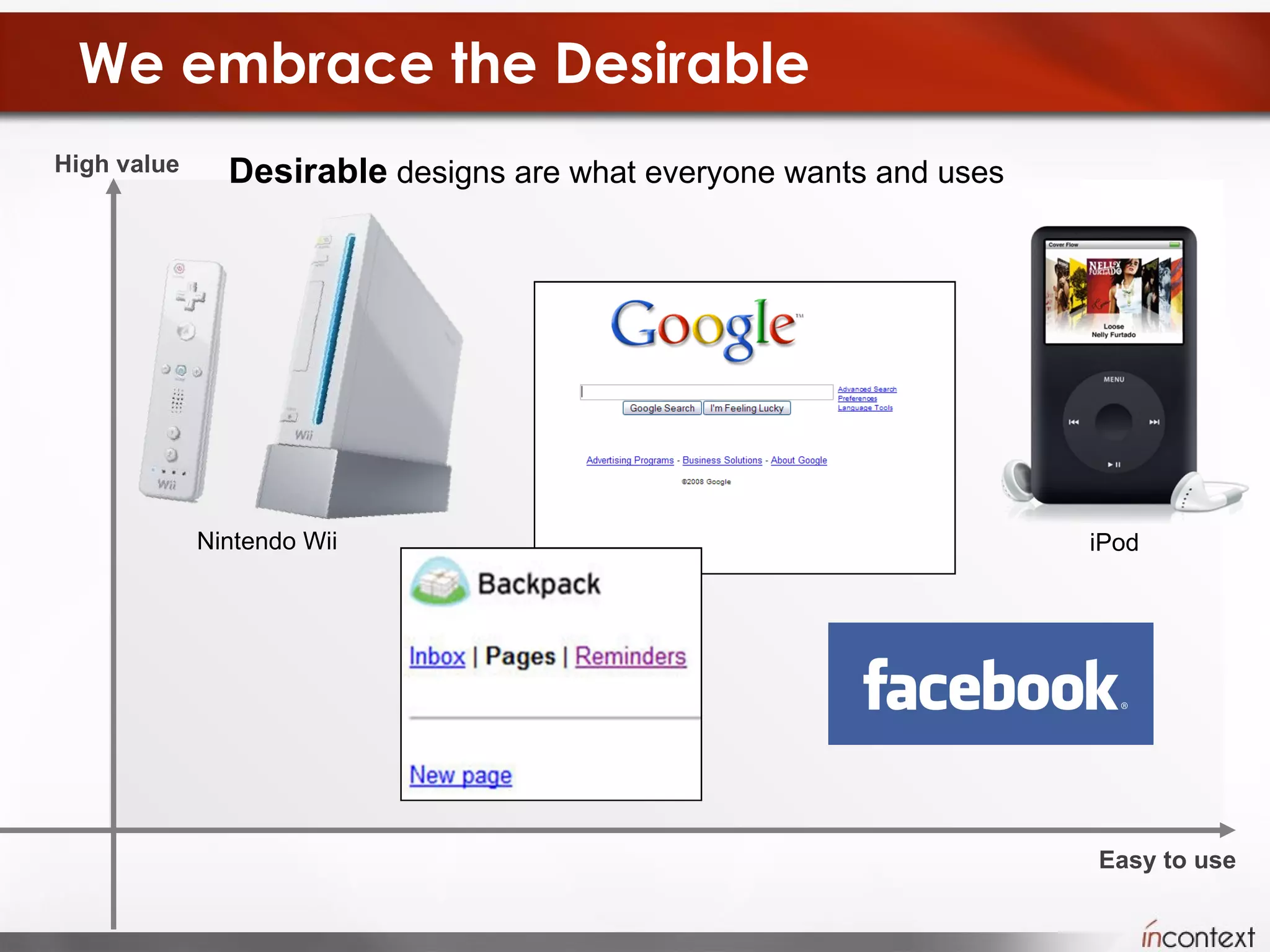
We embrace the Desirable Easy to use Desirable  designs are what everyone wants and uses High value Nintendo Wii iPod
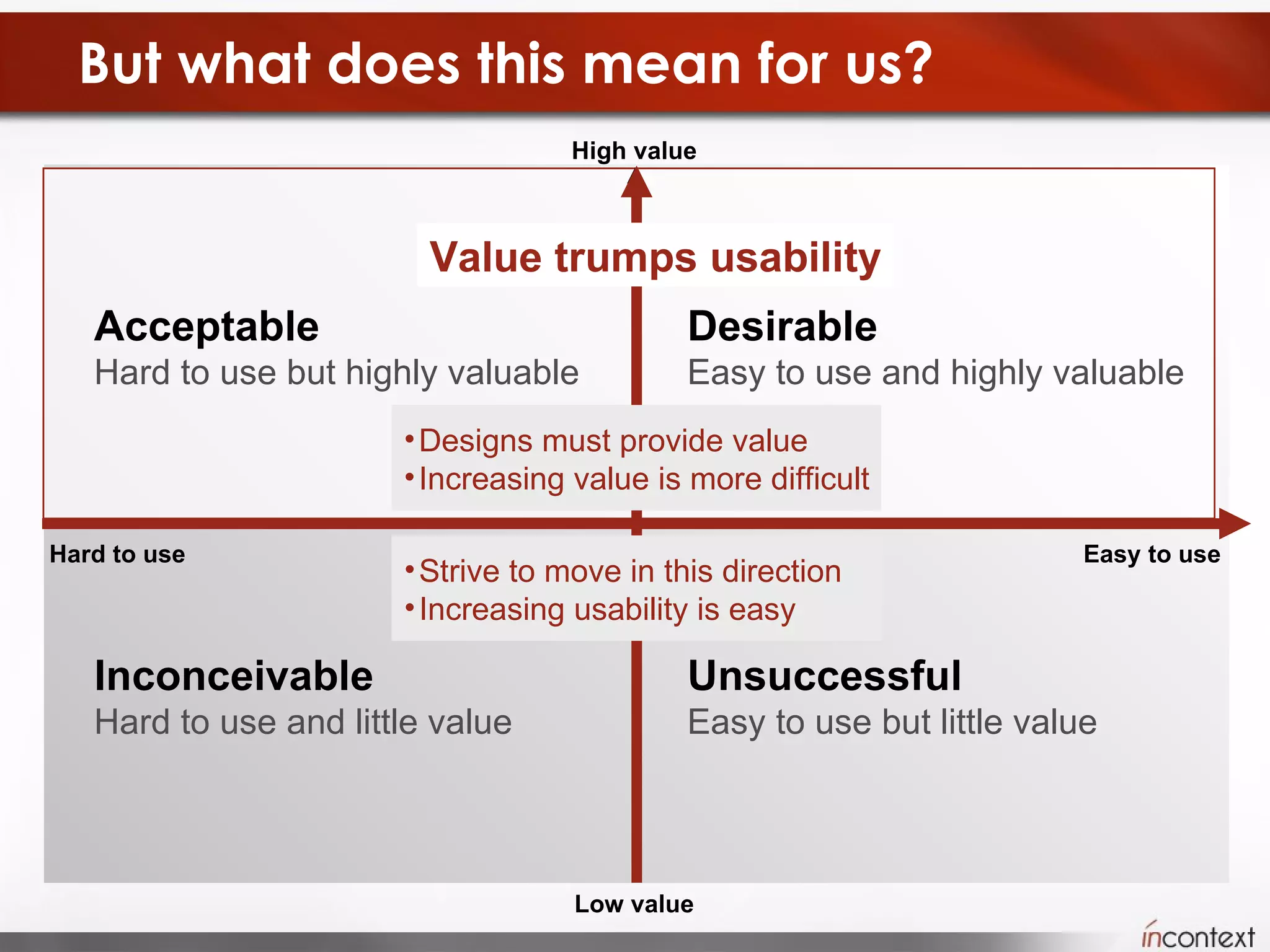
But what does this mean for us? Inconceivable  Hard to use and little value Unsuccessful Easy to use but little value Strive to move in this direction Increasing usability is easy Designs must provide value Increasing value is more difficult Acceptable Hard to use but highly valuable Desirable Easy to use and highly valuable Value trumps usability High value Low value Hard to use Easy to use
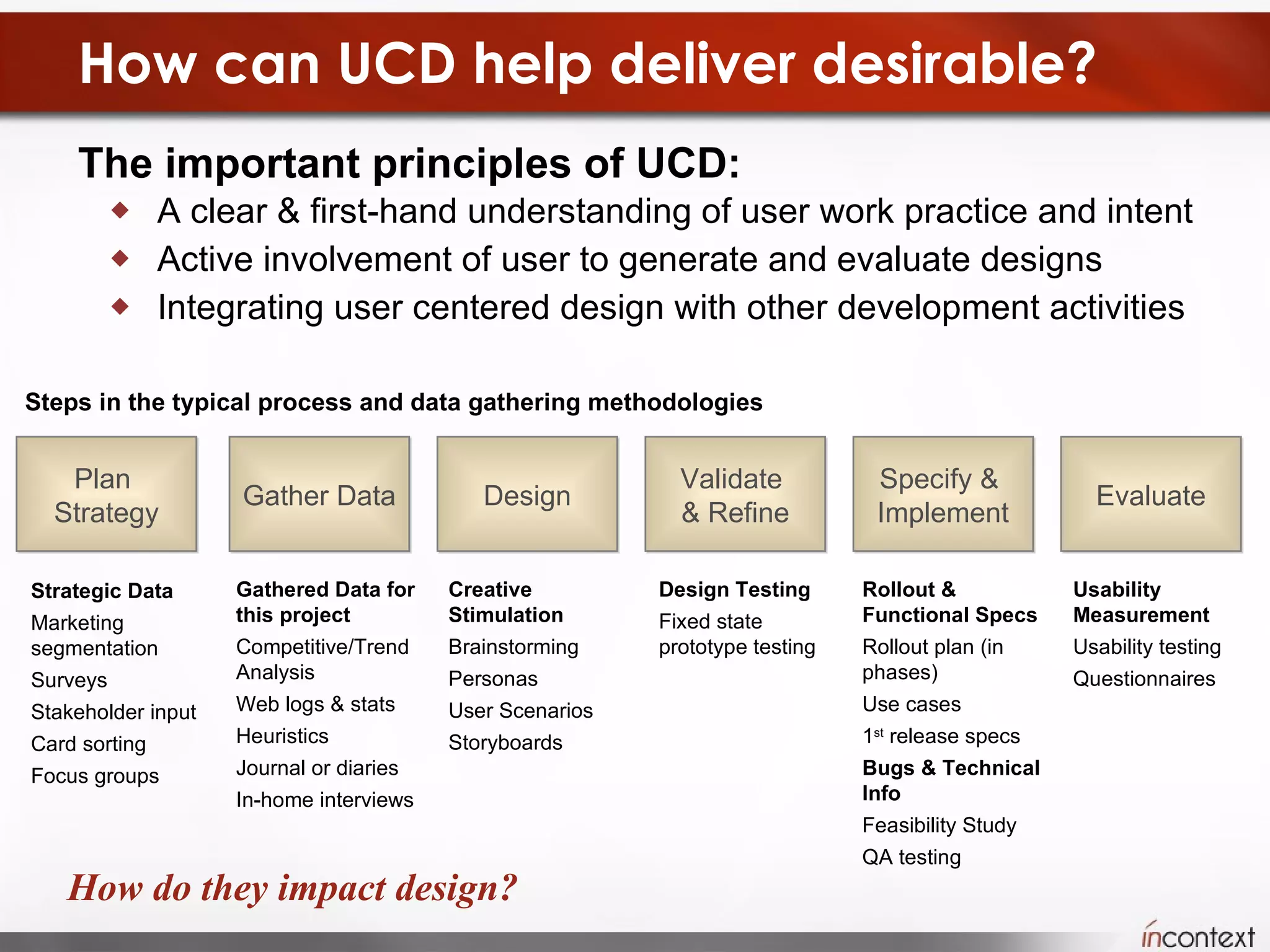
How can UCD help deliver desirable? The important principles of UCD:  A clear & first-hand understanding of user work practice and intent Active involvement of user to generate and evaluate designs  Integrating user centered design with other development activities  Plan  Strategy Gather Data Design Validate  & Refine Specify &  Implement Evaluate Strategic Data Marketing segmentation Surveys Stakeholder input Card sorting Focus groups Gathered Data for this project Competitive/Trend Analysis Web logs & stats Heuristics Journal or diaries In-home interviews Creative Stimulation Brainstorming Personas User Scenarios Storyboards Design Testing Fixed state prototype testing Rollout & Functional Specs Rollout plan (in phases) Use cases 1 st  release specs Bugs & Technical Info Feasibility Study QA testing Usability Measurement Usability testing Questionnaires  How do they impact design? Steps in the typical process and data gathering methodologies
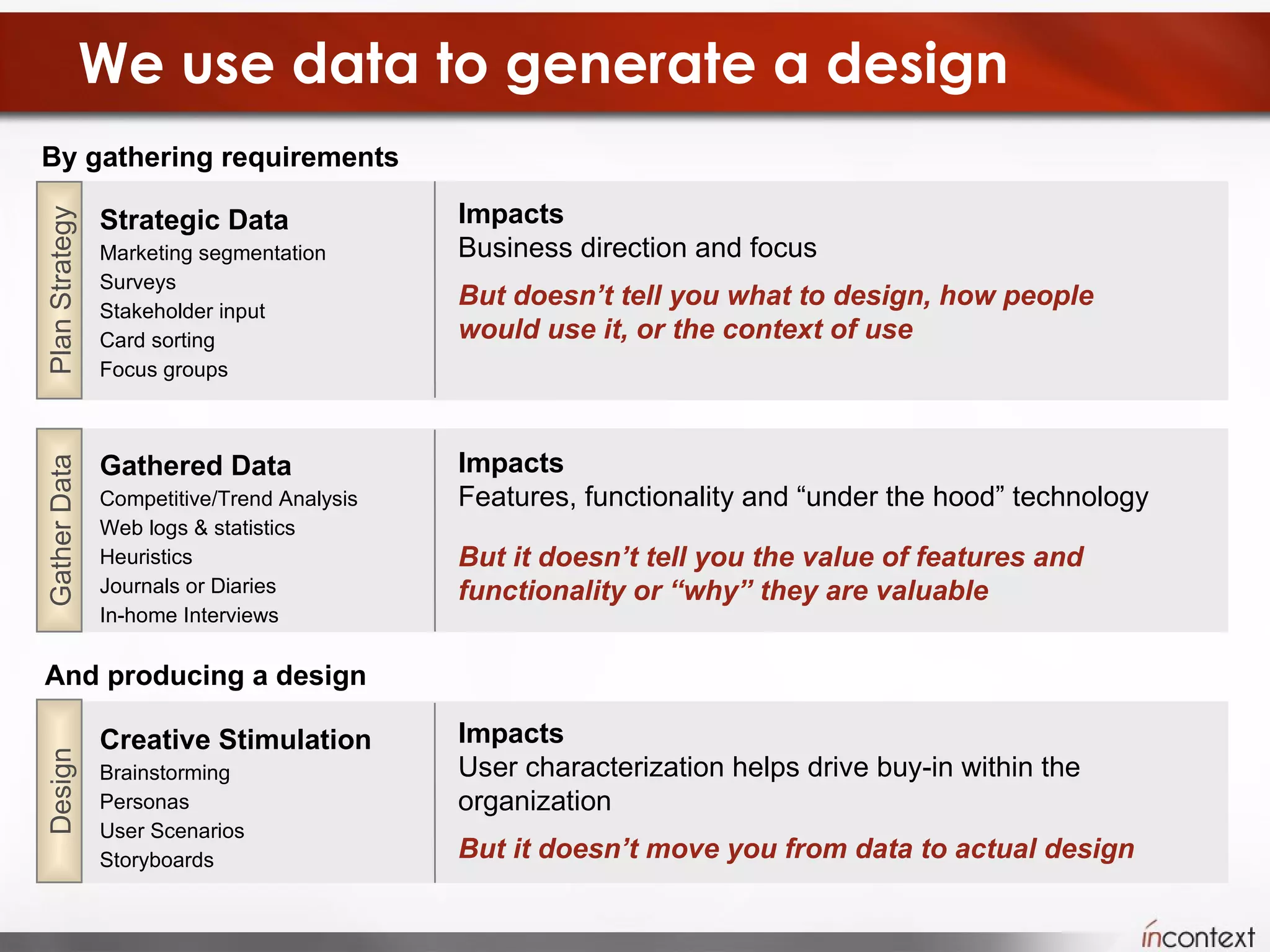
We use data to generate a design Gathered Data Competitive/Trend Analysis Web logs & statistics Heuristics  Journals or Diaries In-home Interviews Impacts Features, functionality and “under the hood” technology But it doesn’t tell you the value of features and functionality or “why” they are valuable Gather Data Creative Stimulation Brainstorming Personas User Scenarios Storyboards Impacts User characterization helps drive buy-in within the organization  But it doesn’t move you from data to actual design And producing a design Design Impacts Business direction and focus But doesn’t tell you what to design, how people  would use it, or the context of use By gathering requirements Plan Strategy Strategic Data Marketing segmentation Surveys Stakeholder input Card sorting Focus groups
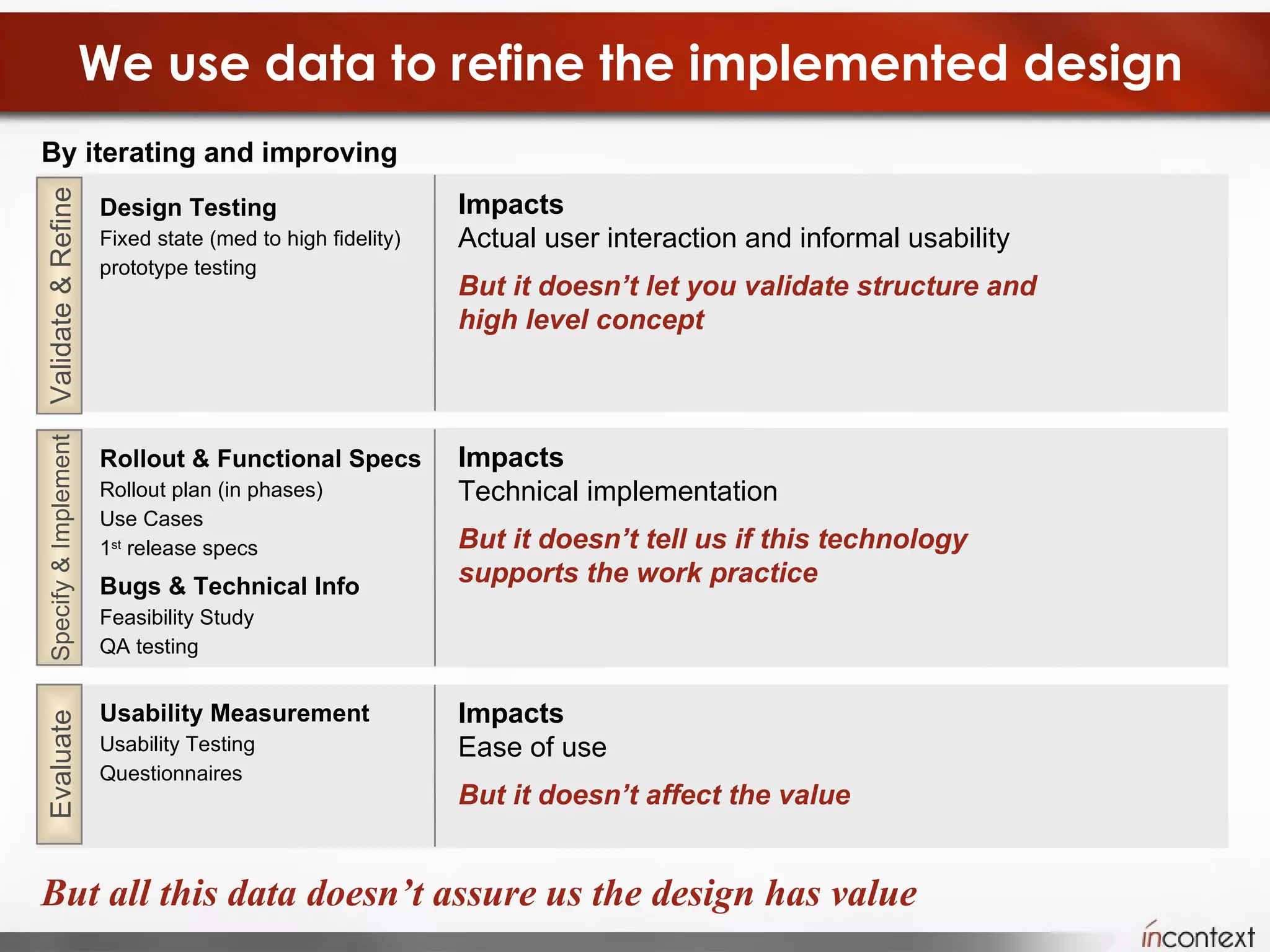
We use data to refine the implemented design Design Testing Fixed state (med to high fidelity) prototype testing Impacts Actual user interaction and informal usability But it doesn’t let you validate structure and  high level concept By iterating and improving But all this data doesn’t assure us the design has value Validate & Refine Rollout & Functional Specs Rollout plan (in phases) Use Cases 1 st  release specs Bugs & Technical Info Feasibility Study QA testing Impacts Technical implementation But it doesn’t tell us if this technology  supports the work practice Specify & Implement Usability Measurement Usability Testing Questionnaires Impacts Ease of use But it doesn’t affect the value Evaluate
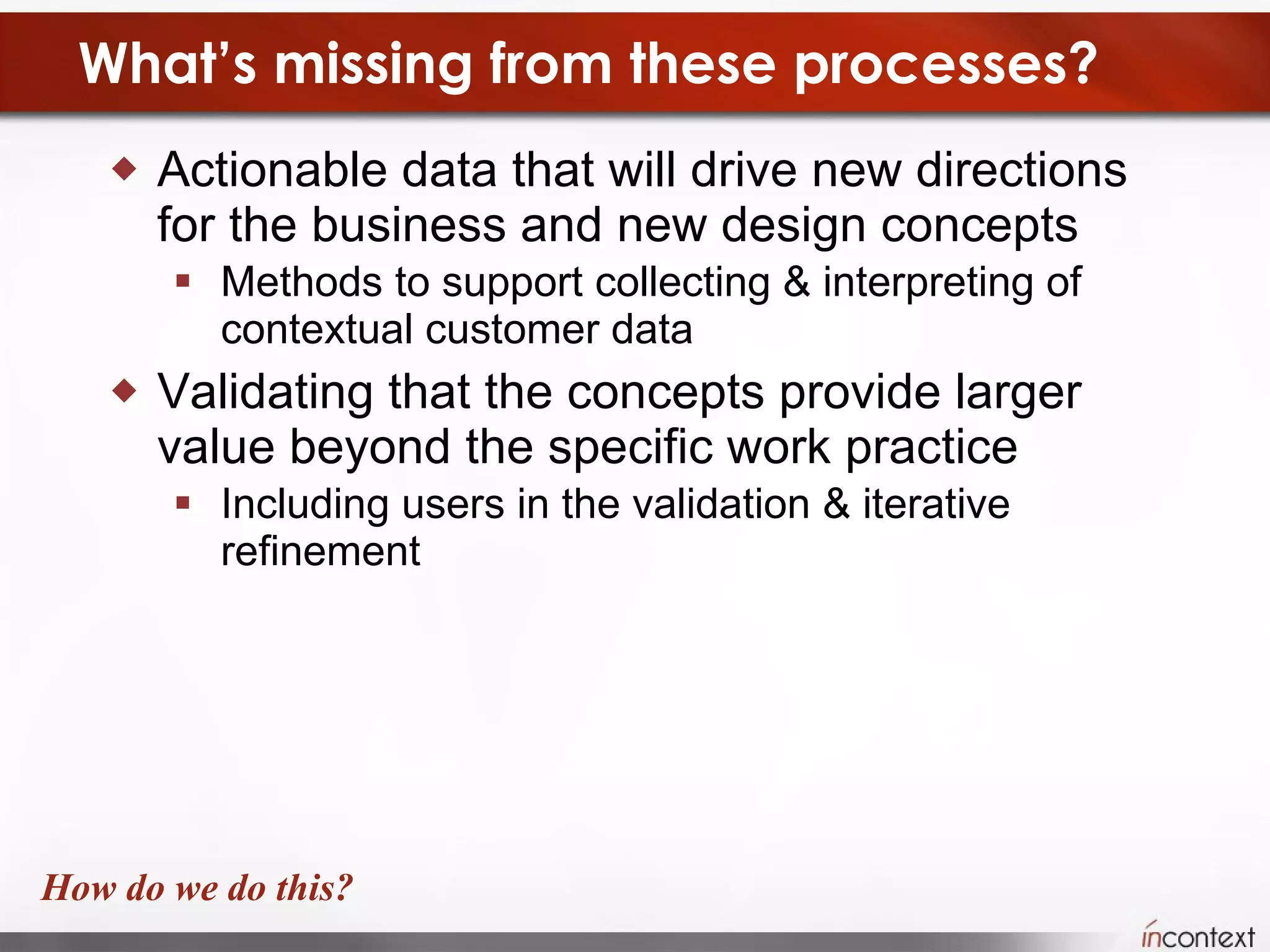
What’s missing from these processes? Actionable data that will drive new directions for the business and new design concepts  Methods to support collecting & interpreting of contextual customer data  Validating that the concepts provide larger value beyond the specific work practice  Including users in the validation & iterative refinement How do we do this?
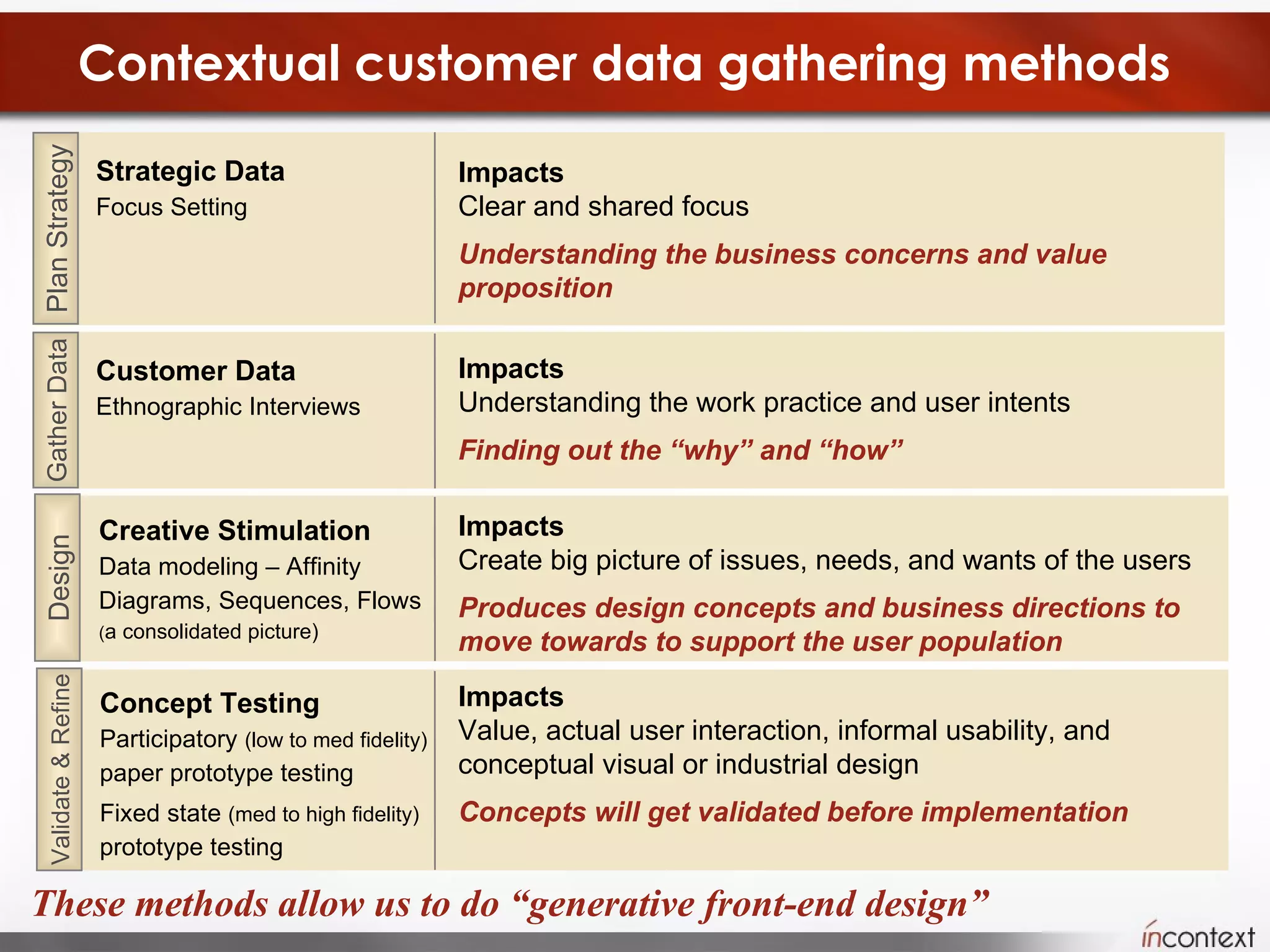
Contextual customer data gathering methods Strategic Data Focus Setting Plan Strategy Impacts Clear and shared focus Understanding the business concerns and value proposition These methods allow us to do “generative front-end design” Customer Data Ethnographic Interviews Gather Data Impacts Understanding the work practice and user intents Finding out the “why” and “how” Creative Stimulation Data modeling – Affinity  Diagrams, Sequences, Flows  ( a consolidated picture) Impacts Create big picture of issues, needs, and wants of the users Produces design concepts and business directions to move towards to support the user population Design Concept Testing Participatory  (low to med fidelity)  paper prototype testing Fixed state  (med to high fidelity)  prototype testing Impacts Value, actual user interaction, informal usability, and conceptual visual or industrial design Concepts will get validated before implementation  Validate & Refine
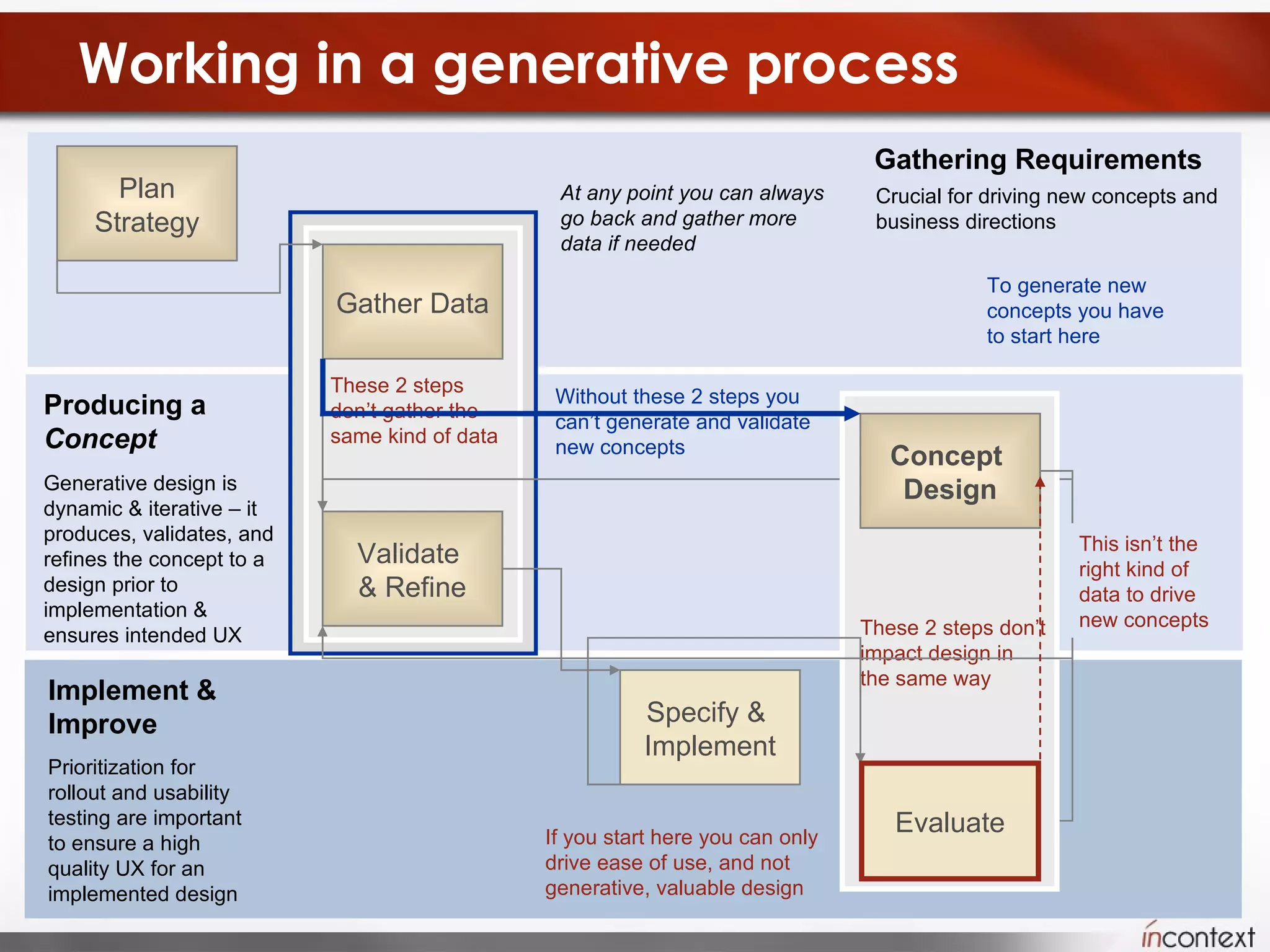
Working in a generative process Plan Strategy Gather Data Validate  & Refine Specify &  Implement To generate new concepts you have to start here If you start here you can only drive ease of use, and not generative, valuable design Without these 2 steps you can’t generate and validate new concepts Evaluate Concept  Design Prioritization for rollout and usability testing are important to ensure a high quality UX for an implemented design Implement & Improve Generative design is dynamic & iterative – it produces, validates, and refines the concept to a design prior to implementation & ensures intended UX Producing a  Concept Crucial for driving new concepts and business directions Gathering Requirements At any point you can always go back and gather more data if needed These 2 steps don’t gather the same kind of data These 2 steps don’t impact design in the same way This isn’t the right kind of data to drive new concepts
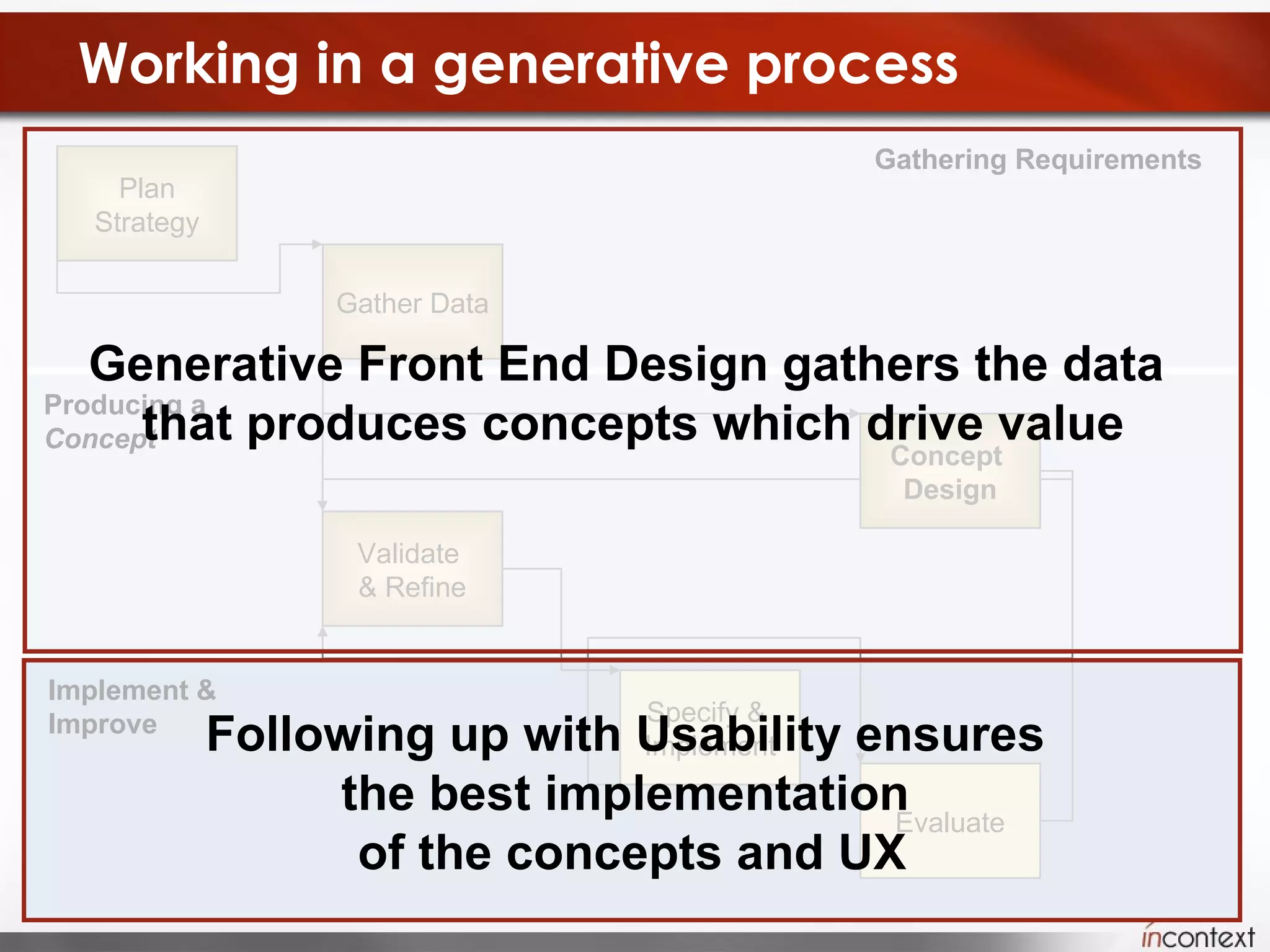
Working in a generative process Implement & Improve Producing a  Concept Gathering Requirements Plan Strategy Gather Data Validate  & Refine Specify &  Implement Evaluate Concept  Design Generative Front End Design gathers the data  that produces concepts which drive value Following up with Usability ensures  the best implementation  of the concepts and UX
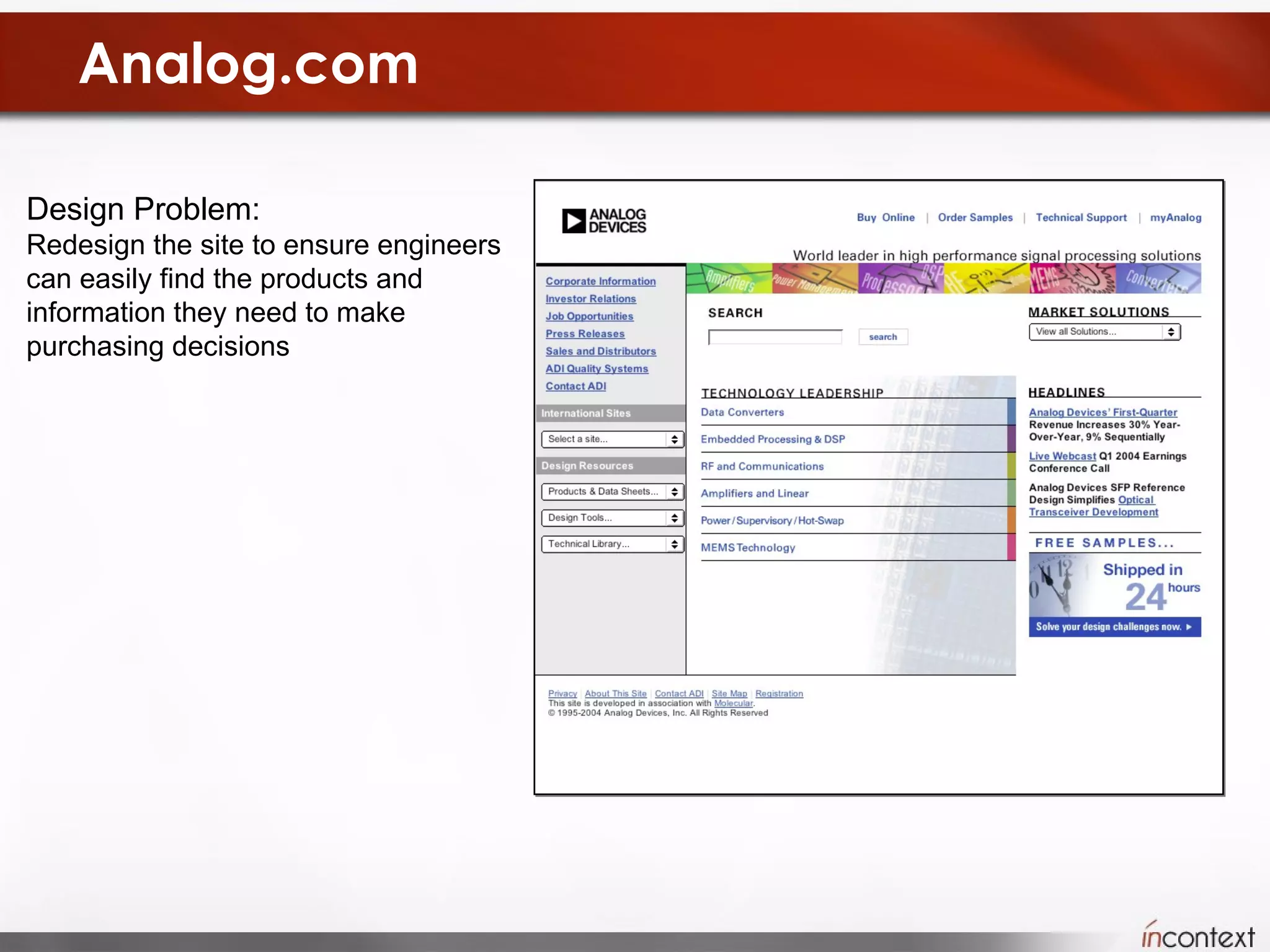
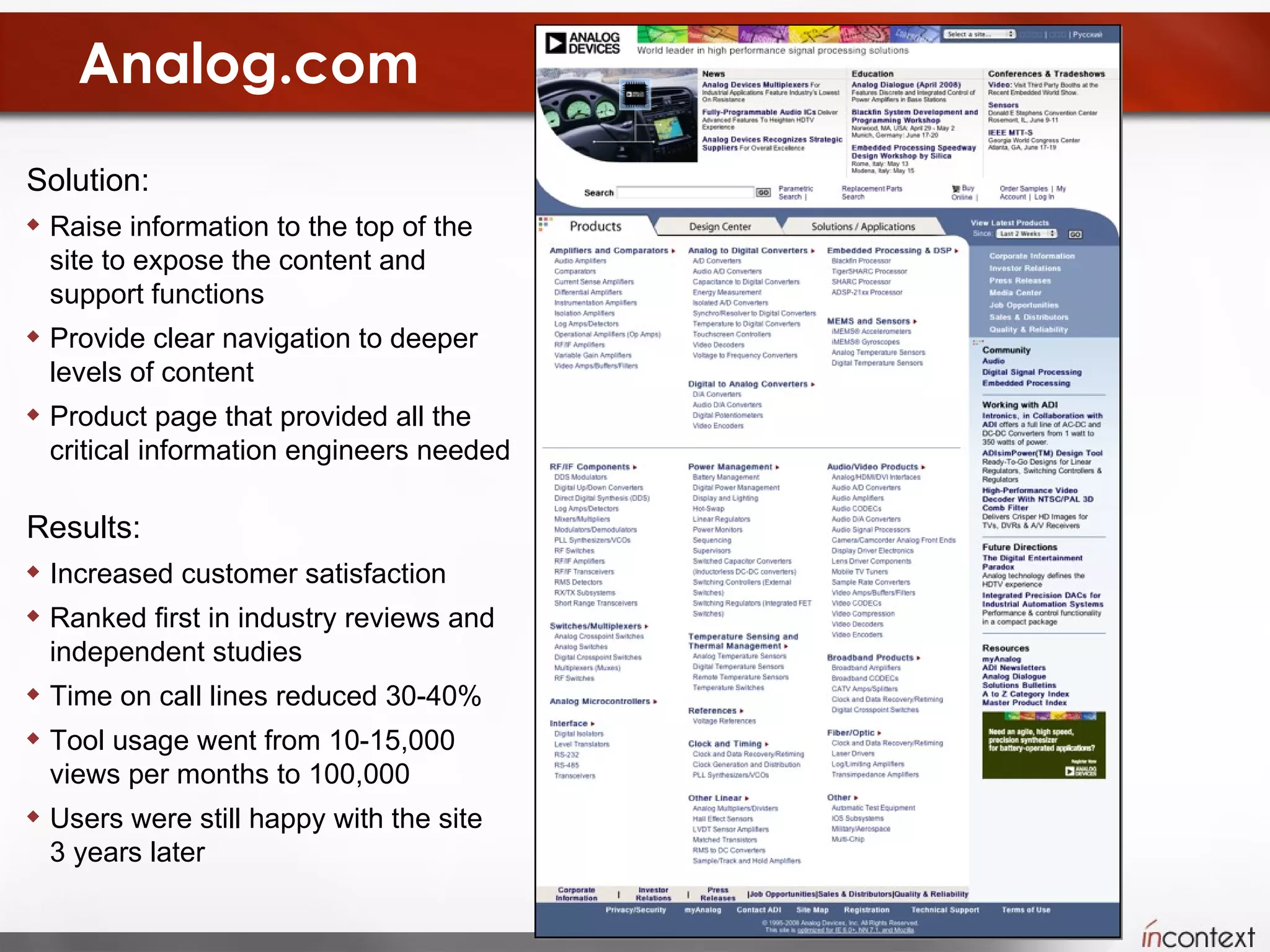
Analog.com Design Problem:   Redesign the site to ensure engineers can easily find the products and information they need to make purchasing decisions
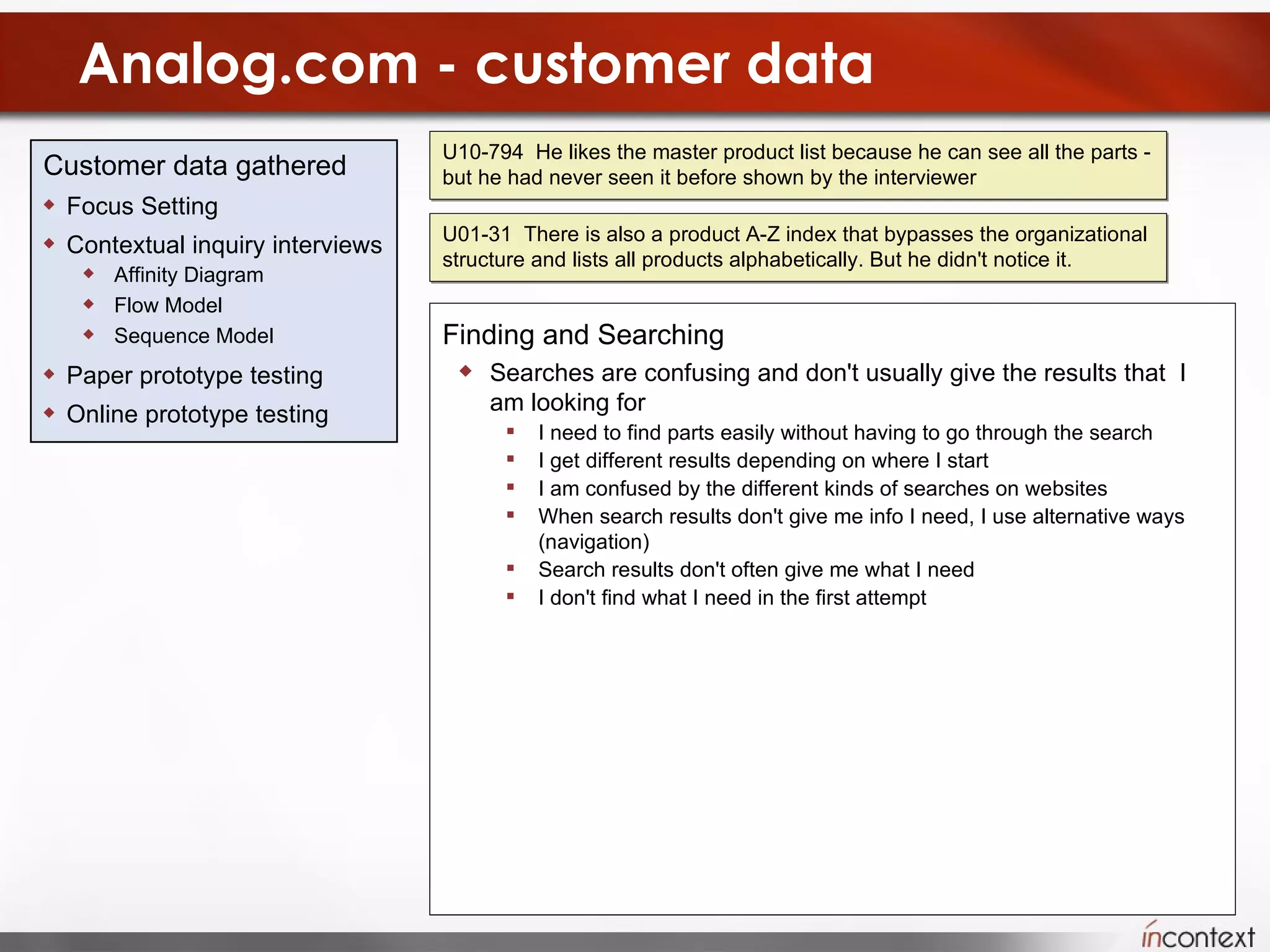
Analog.com - customer data Customer data gathered Focus Setting Contextual inquiry interviews Affinity Diagram Flow Model Sequence Model Paper prototype testing Online prototype testing Site structure and organization I don't know everything that is on the site I didn't know about the product lists that show all products Now that I know its here, I will use the site more I didn't know about design resources I don't know where you put the information It’s not clear to me where I should look for the information I need I don't know how or where to find a product If I don't see a  part in the selection guide, I assume it doesn't exist I don't know where to find application notes Categories need to make sense to the engineers Categorizing products by application doesn't work for me The product category tree reflects organizational structure, which doesn't help me I am using a product in a new or different way so its harder to find information The site structure gets in my way I can't find things in the collapsed menus I can't find things as information is nested too deeply I don't understand your terminology Finding and Searching Searches are confusing and don't usually give the results that  I am looking for I need to find parts easily without having to go through the search I get different results depending on where I start I am confused by the different kinds of searches on websites When search results don't give me info I need, I use alternative ways  (navigation) Search results don't often give me what I need I don't find what I need in the first attempt U01-31  There is also a product A-Z index that bypasses the organizational structure and lists all products alphabetically. But he didn't notice it. U10-794  He likes the master product list because he can see all the parts - but he had never seen it before shown by the interviewer
Analog.com Solution:  Raise information to the top of the site to expose the content and support functions Provide clear navigation to deeper levels of content Product page that provided all the critical information engineers needed Results:  Increased customer satisfaction Ranked first in industry reviews and independent studies Time on call lines reduced 30-40% Tool usage went from 10-15,000 views per months to 100,000 Users were still happy with the site  3 years later
Whew…we talked about a lot There is a clear distinction between UCD, Usability, and how they are related to creating a good UX Increasing value has more customer impact than increasing usability To provide value you need to generate new concepts Contextual customer data helps drive generative front-end design Remembering that all customer data is not equal; each type has its purpose And if you do all this you will also drive  Business value: it supports the business goals Practical value: it can be delivered by the organization Technical value: it is technically feasible
Why front end design is important If a UCD process is going to deliver value it needs to be at the front-end Gathering requirements using contextual data will drive new business directions and concepts Producing design concepts with contextual data and continued user participation will validate value Usability will provide the most benefit when it follows generative front-end design Evaluating usability of implemented designs ensures the highest quality implementation that will deliver a good UX
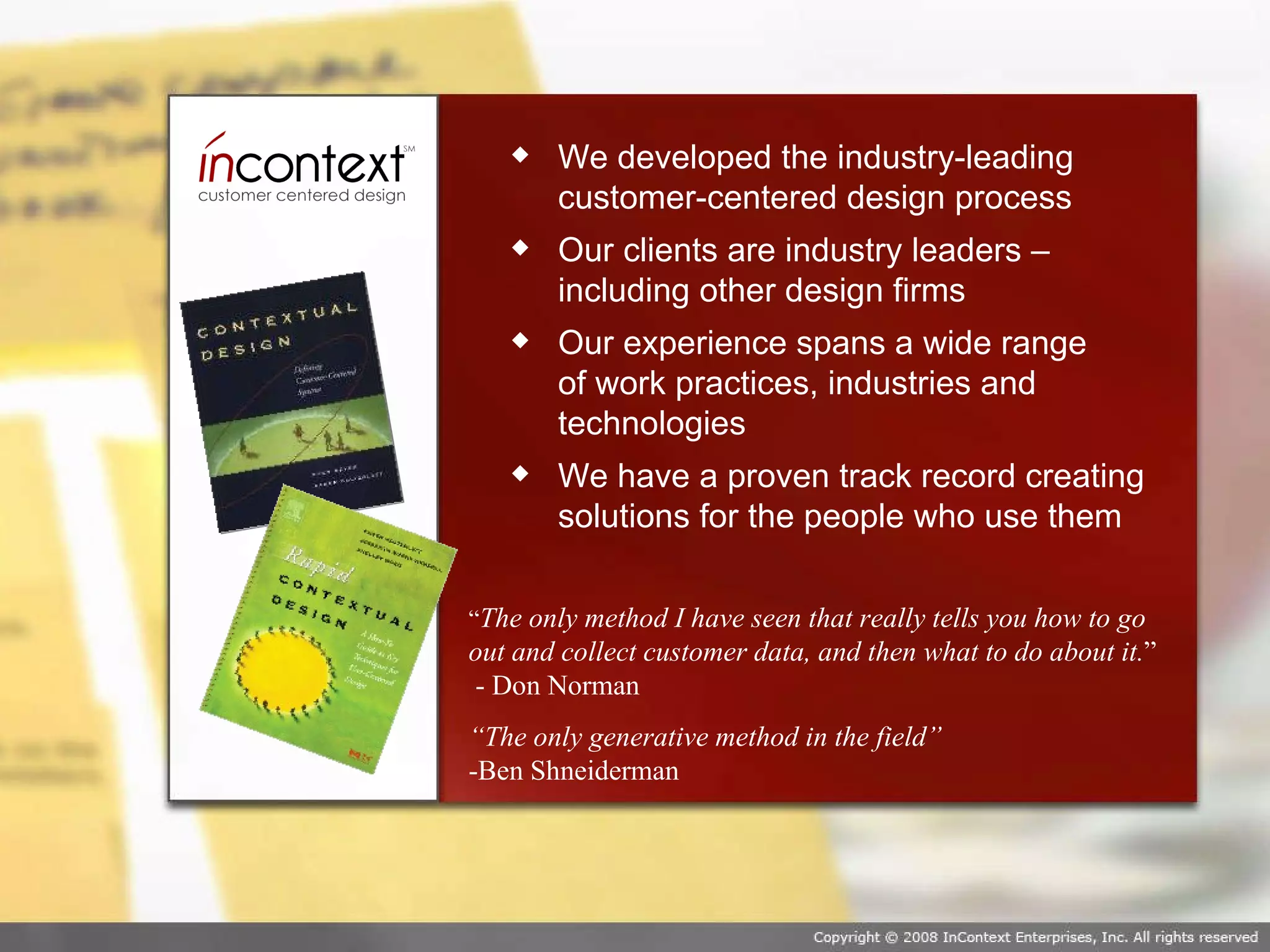
We developed the industry-leading customer-centered design process Our clients are industry leaders – including other design firms Our experience spans a wide range  of work practices, industries and technologies We have a proven track record creating solutions for the people who use them “ The only method I have seen that really tells you how to go out and collect customer data, and then what to do about it. ”  - Don Norman “ The only generative method in the field”  -Ben Shneiderman

Upa why usability shouldn't come first

  • 1.
    Why Usability ShouldNever Come First And the importance of Front-End Design May, 2008 David Rondeau , Design Chair Traci Lepore, Principal Interaction Designer
  • 2.
    What are wegoing to talk about? Difference between User-Centered Design, Usability, and User Experience Relationship of “Value” and “Ease of use” Various types of customer data and how they impact design differently Understand the benefits of contextual data in a front-end design process
  • 3.
    What is user-centereddesign…. As defined by the field: User-centered design (UCD) can be described as a design philosophy and process that takes into account the needs , wants , and limitations of an end user of an interface in every stage of development . (Don Norman) User Centered Design (UCD) is an approach that supports the entire development process with user-centered activities , in order to create applications which are easy to use and are of added value to the intended users. (usability.net) User-centered design (UCD) is an approach to design that grounds the process in information about the people who will use the product. UCD processes focus on users through the planning, design and development of a product. (UPA) A design approach in which the emphasis is on the user and through which a high level of usability is achieved. (theusabilitycompany.com) There’s no agreement on what to really do—what info to gather, when to use it, or how to use it
  • 4.
    What is usability….As defined by the field: After all, usability really just means that making sure that something works well : that a person of average (or even below average) ability and experience can use the thing - whether it's a Web site, a fighter jet, or a revolving door - for its intended purpose without getting hopelessly frustrated. (Steve Krug, Don't Make Me Think) Usability is a quality attribute that assesses how easy user interfaces are to use, based on learnability, efficiency, memorability, errors, and satisfaction . (Jakob Nielsen) Efficiency with which a user can perform required tasks with a product, for example, a website. (www.webindexing.biz/Webbook2Ed/glossary.htm) Usability is the measure of a product's potential to accomplish the goals of the user. (www.netaonline.org/PD-DigitalGlossary.rtf) There is no agreement on whether usability is a concept or a methodology
  • 5.
    What is UserExperience… The User Experience (UX) encompasses all aspects of the end-user's interaction with a company, its services, and its products. It aims to achieve a positive perception through customers who are satisfied entering into, during and after interactions. (Peter Boersma) This also means that users experience everything: Visual design Information architecture Interaction design Copy & technical writing Customer relationship management Environment Colors moods Smell Touch All design creates an experience, but what kind of experience do you want? Audio feedback Visual feedback Trust Show-off effect Usefulness Practicality Coexistence Emotional effect
  • 6.
    Achieving the intended“good” UX Two distinct facets of design can help make the UX a positive one: The “practical” value or usefulness for the user (UCD) Addresses central aspects of the user’s work or intent It is appropriate, interesting and relevant to the target audience The ease of use of the design (usability) Users can complete their intended tasks The process for completing tasks is efficient What does this mean in the context of design?
  • 7.
    The relationship betweenvalue and ease of use Acceptable Hard to use but highly valuable Desirable Easy to use and highly valuable Inconceivable Hard to use and little value Unsuccessful Easy to use but little value Hard to use Easy to use High value Low value
  • 8.
    We try, butthen discard the Unsuccessful Unsuccessful designs may be easy to use, but they don’t provide much value Easy to use Low value Since we can’t even imagine you’d produce the inconceivable we’ll start here… 3com Audrey Pets.com Candle warmer Left-handed mug Apple Cube
  • 9.
    We live withAcceptable Even though Acceptable designs can be hard to use, people still use them because they have value Hard to use High value TV remote Goldmine Chocolate
  • 10.
    We embrace theDesirable Easy to use Desirable designs are what everyone wants and uses High value Nintendo Wii iPod
  • 11.
    But what doesthis mean for us? Inconceivable Hard to use and little value Unsuccessful Easy to use but little value Strive to move in this direction Increasing usability is easy Designs must provide value Increasing value is more difficult Acceptable Hard to use but highly valuable Desirable Easy to use and highly valuable Value trumps usability High value Low value Hard to use Easy to use
  • 12.
    How can UCDhelp deliver desirable? The important principles of UCD: A clear & first-hand understanding of user work practice and intent Active involvement of user to generate and evaluate designs Integrating user centered design with other development activities Plan Strategy Gather Data Design Validate & Refine Specify & Implement Evaluate Strategic Data Marketing segmentation Surveys Stakeholder input Card sorting Focus groups Gathered Data for this project Competitive/Trend Analysis Web logs & stats Heuristics Journal or diaries In-home interviews Creative Stimulation Brainstorming Personas User Scenarios Storyboards Design Testing Fixed state prototype testing Rollout & Functional Specs Rollout plan (in phases) Use cases 1 st release specs Bugs & Technical Info Feasibility Study QA testing Usability Measurement Usability testing Questionnaires How do they impact design? Steps in the typical process and data gathering methodologies
  • 13.
    We use datato generate a design Gathered Data Competitive/Trend Analysis Web logs & statistics Heuristics Journals or Diaries In-home Interviews Impacts Features, functionality and “under the hood” technology But it doesn’t tell you the value of features and functionality or “why” they are valuable Gather Data Creative Stimulation Brainstorming Personas User Scenarios Storyboards Impacts User characterization helps drive buy-in within the organization But it doesn’t move you from data to actual design And producing a design Design Impacts Business direction and focus But doesn’t tell you what to design, how people would use it, or the context of use By gathering requirements Plan Strategy Strategic Data Marketing segmentation Surveys Stakeholder input Card sorting Focus groups
  • 14.
    We use datato refine the implemented design Design Testing Fixed state (med to high fidelity) prototype testing Impacts Actual user interaction and informal usability But it doesn’t let you validate structure and high level concept By iterating and improving But all this data doesn’t assure us the design has value Validate & Refine Rollout & Functional Specs Rollout plan (in phases) Use Cases 1 st release specs Bugs & Technical Info Feasibility Study QA testing Impacts Technical implementation But it doesn’t tell us if this technology supports the work practice Specify & Implement Usability Measurement Usability Testing Questionnaires Impacts Ease of use But it doesn’t affect the value Evaluate
  • 15.
    What’s missing fromthese processes? Actionable data that will drive new directions for the business and new design concepts Methods to support collecting & interpreting of contextual customer data Validating that the concepts provide larger value beyond the specific work practice Including users in the validation & iterative refinement How do we do this?
  • 16.
    Contextual customer datagathering methods Strategic Data Focus Setting Plan Strategy Impacts Clear and shared focus Understanding the business concerns and value proposition These methods allow us to do “generative front-end design” Customer Data Ethnographic Interviews Gather Data Impacts Understanding the work practice and user intents Finding out the “why” and “how” Creative Stimulation Data modeling – Affinity Diagrams, Sequences, Flows ( a consolidated picture) Impacts Create big picture of issues, needs, and wants of the users Produces design concepts and business directions to move towards to support the user population Design Concept Testing Participatory (low to med fidelity) paper prototype testing Fixed state (med to high fidelity) prototype testing Impacts Value, actual user interaction, informal usability, and conceptual visual or industrial design Concepts will get validated before implementation Validate & Refine
  • 17.
    Working in agenerative process Plan Strategy Gather Data Validate & Refine Specify & Implement To generate new concepts you have to start here If you start here you can only drive ease of use, and not generative, valuable design Without these 2 steps you can’t generate and validate new concepts Evaluate Concept Design Prioritization for rollout and usability testing are important to ensure a high quality UX for an implemented design Implement & Improve Generative design is dynamic & iterative – it produces, validates, and refines the concept to a design prior to implementation & ensures intended UX Producing a Concept Crucial for driving new concepts and business directions Gathering Requirements At any point you can always go back and gather more data if needed These 2 steps don’t gather the same kind of data These 2 steps don’t impact design in the same way This isn’t the right kind of data to drive new concepts
  • 18.
    Working in agenerative process Implement & Improve Producing a Concept Gathering Requirements Plan Strategy Gather Data Validate & Refine Specify & Implement Evaluate Concept Design Generative Front End Design gathers the data that produces concepts which drive value Following up with Usability ensures the best implementation of the concepts and UX
  • 19.
    Analog.com Design Problem: Redesign the site to ensure engineers can easily find the products and information they need to make purchasing decisions
  • 20.
    Analog.com - customerdata Customer data gathered Focus Setting Contextual inquiry interviews Affinity Diagram Flow Model Sequence Model Paper prototype testing Online prototype testing Site structure and organization I don't know everything that is on the site I didn't know about the product lists that show all products Now that I know its here, I will use the site more I didn't know about design resources I don't know where you put the information It’s not clear to me where I should look for the information I need I don't know how or where to find a product If I don't see a part in the selection guide, I assume it doesn't exist I don't know where to find application notes Categories need to make sense to the engineers Categorizing products by application doesn't work for me The product category tree reflects organizational structure, which doesn't help me I am using a product in a new or different way so its harder to find information The site structure gets in my way I can't find things in the collapsed menus I can't find things as information is nested too deeply I don't understand your terminology Finding and Searching Searches are confusing and don't usually give the results that I am looking for I need to find parts easily without having to go through the search I get different results depending on where I start I am confused by the different kinds of searches on websites When search results don't give me info I need, I use alternative ways (navigation) Search results don't often give me what I need I don't find what I need in the first attempt U01-31 There is also a product A-Z index that bypasses the organizational structure and lists all products alphabetically. But he didn't notice it. U10-794 He likes the master product list because he can see all the parts - but he had never seen it before shown by the interviewer
  • 21.
    Analog.com Solution: Raise information to the top of the site to expose the content and support functions Provide clear navigation to deeper levels of content Product page that provided all the critical information engineers needed Results: Increased customer satisfaction Ranked first in industry reviews and independent studies Time on call lines reduced 30-40% Tool usage went from 10-15,000 views per months to 100,000 Users were still happy with the site 3 years later
  • 22.
    Whew…we talked abouta lot There is a clear distinction between UCD, Usability, and how they are related to creating a good UX Increasing value has more customer impact than increasing usability To provide value you need to generate new concepts Contextual customer data helps drive generative front-end design Remembering that all customer data is not equal; each type has its purpose And if you do all this you will also drive Business value: it supports the business goals Practical value: it can be delivered by the organization Technical value: it is technically feasible
  • 23.
    Why front enddesign is important If a UCD process is going to deliver value it needs to be at the front-end Gathering requirements using contextual data will drive new business directions and concepts Producing design concepts with contextual data and continued user participation will validate value Usability will provide the most benefit when it follows generative front-end design Evaluating usability of implemented designs ensures the highest quality implementation that will deliver a good UX
  • 24.
    We developed theindustry-leading customer-centered design process Our clients are industry leaders – including other design firms Our experience spans a wide range of work practices, industries and technologies We have a proven track record creating solutions for the people who use them “ The only method I have seen that really tells you how to go out and collect customer data, and then what to do about it. ” - Don Norman “ The only generative method in the field” -Ben Shneiderman