Nadar Saraswathi College Of Arts And
Science,Theni.
REQUIREMENT ENGINEERING
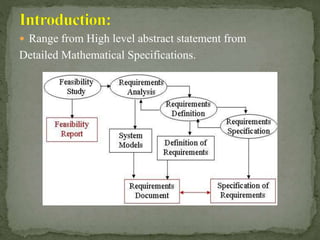
 Range from High level abstract statement from
Detailed Mathematical Specifications.
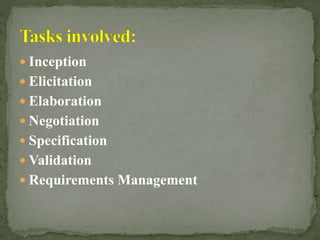
 Inception
 Elicitation
 Elaboration
 Negotiation
 Specification
 Validation
 Requirements Management
 During inception, the requirements asks a set of
questions to establish:
Basic understanding of the problem.
Nature of the solution that is desired.
 Requirements Engineers needs to Identify the
stakeholders, recognize multiple viewpoints,
work toward collaboration and initiate the
communication.
Eliciting requirements is difficult because of
 Problems of scope : identify the boundaries of
the system.
 Problems of understanding : domain , computing
environment.
 Problems of Volatility : requirements may change
over time.
 Takes the information obtained during inception and
elicitation.
 Focuses on developing a refined model of software
functions,features & Constraints.
 This is an analyzing phase.
 It defines the functional,informational and behavioral
constraints of the problem domain.
 Software engineer reconciles the conflicts
between what the customer wants and what can
be achieved.
 Requirements are ranked by the customer,
users and other stakeholders.
 Risks associated with each requirement are
identified.
 Final work product produced by the requirements
engineer.
 Form of SRS.
 Serves as a foundation.
 It formalizes the functional and behavioral
requirements of the proposed software in both the
graphical and textual format.
 Specification is examined to ensure that all the sw
requirements have been stated unambiguously.
 Errors have been detected and corrected.
 Members involved:
Software Engineers
Customers
Users
Other stakeholders.
 Project team performs a set of activities to
identify,control and track requirements and changes to
the requirements at any times as the project proceeds.
 Each requirement is assigned a unique identifier.
 Place the requirements into one or trace ability tables.
 Tables may be stored in a database that relate features,
sources, dependencies subsystems and interfaces to
the requirements.
Software engineering

Software engineering

  • 1.
    Nadar Saraswathi CollegeOf Arts And Science,Theni. REQUIREMENT ENGINEERING
  • 2.
     Range fromHigh level abstract statement from Detailed Mathematical Specifications.
  • 3.
     Inception  Elicitation Elaboration  Negotiation  Specification  Validation  Requirements Management
  • 4.
     During inception,the requirements asks a set of questions to establish: Basic understanding of the problem. Nature of the solution that is desired.  Requirements Engineers needs to Identify the stakeholders, recognize multiple viewpoints, work toward collaboration and initiate the communication.
  • 5.
    Eliciting requirements isdifficult because of  Problems of scope : identify the boundaries of the system.  Problems of understanding : domain , computing environment.  Problems of Volatility : requirements may change over time.
  • 6.
     Takes theinformation obtained during inception and elicitation.  Focuses on developing a refined model of software functions,features & Constraints.  This is an analyzing phase.  It defines the functional,informational and behavioral constraints of the problem domain.
  • 7.
     Software engineerreconciles the conflicts between what the customer wants and what can be achieved.  Requirements are ranked by the customer, users and other stakeholders.  Risks associated with each requirement are identified.
  • 8.
     Final workproduct produced by the requirements engineer.  Form of SRS.  Serves as a foundation.  It formalizes the functional and behavioral requirements of the proposed software in both the graphical and textual format.
  • 9.
     Specification isexamined to ensure that all the sw requirements have been stated unambiguously.  Errors have been detected and corrected.  Members involved: Software Engineers Customers Users Other stakeholders.
  • 10.
     Project teamperforms a set of activities to identify,control and track requirements and changes to the requirements at any times as the project proceeds.  Each requirement is assigned a unique identifier.  Place the requirements into one or trace ability tables.  Tables may be stored in a database that relate features, sources, dependencies subsystems and interfaces to the requirements.