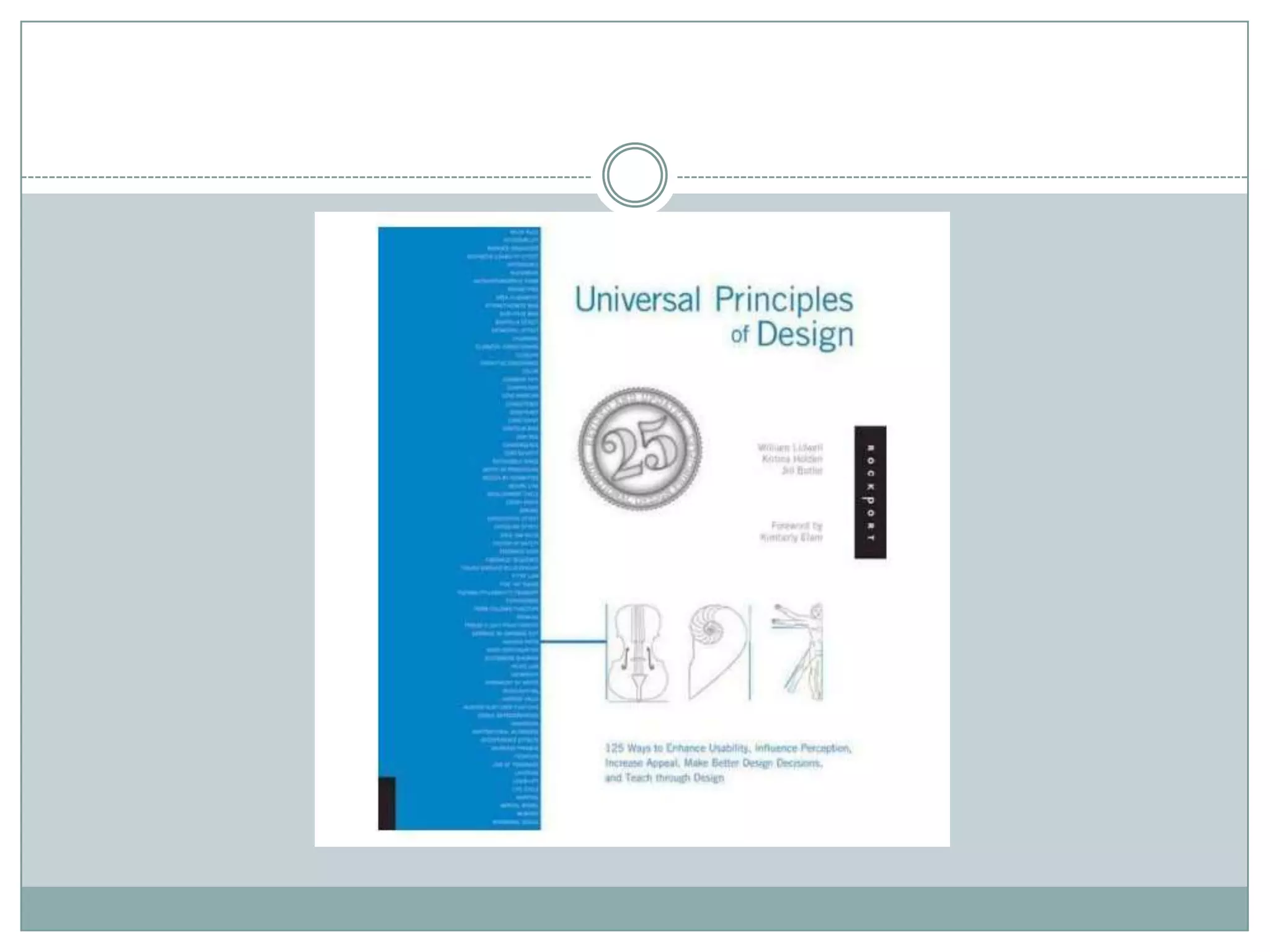
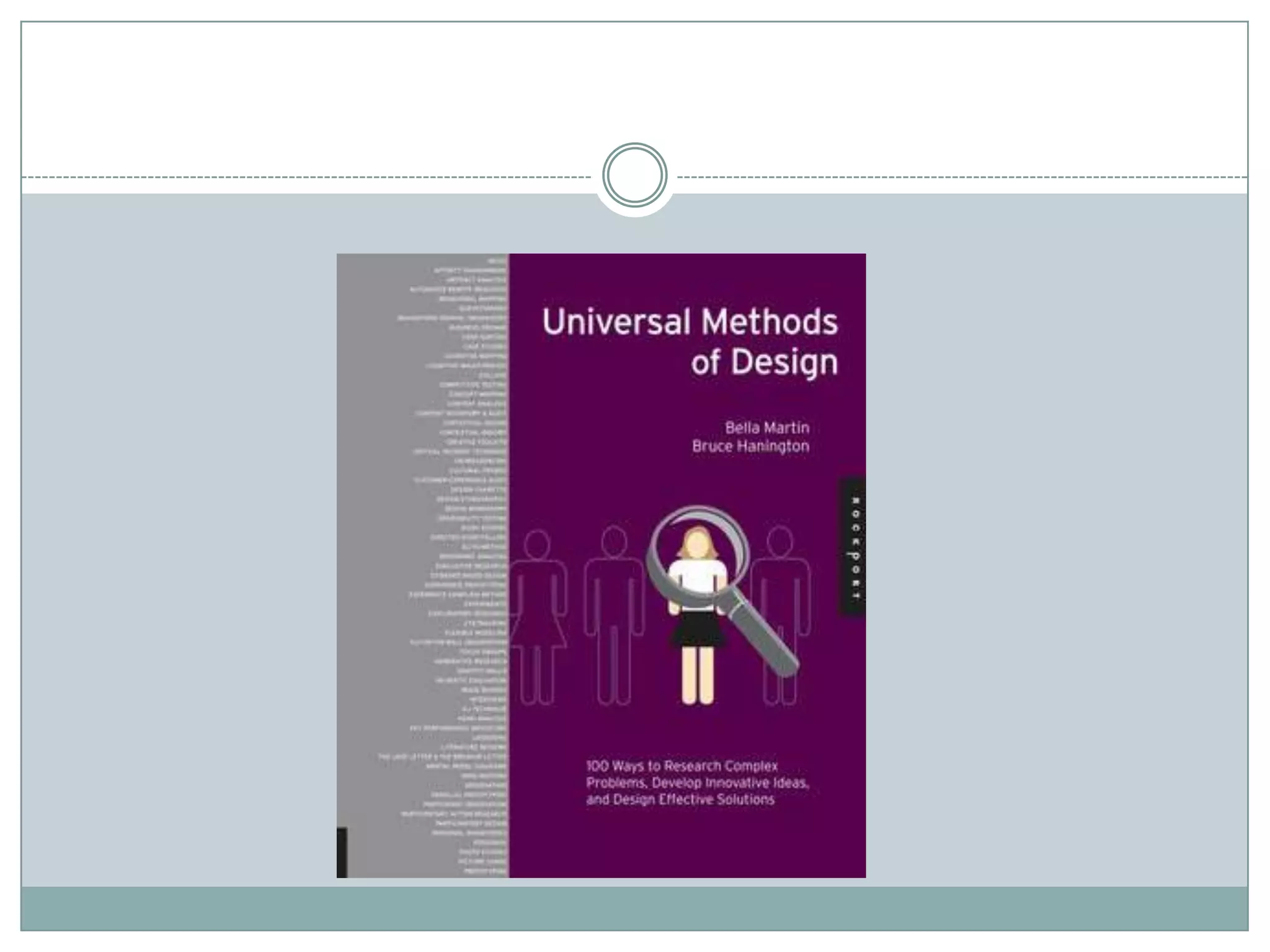
Universal Principles and Methods
of Design
Let’s start with Design Principles
Design principles are the fundamental goals that all
decisions can be measured against to keep the pieces of
a project moving toward an integrated whole. They
define and articulate the key characteristics of a project
to stakeholders, clients, colleagues, and team members.
As your team aggregates design principles to help
form decisions, keep a list of them as a reminder
to everyone.
If time allows, explain why each of these design
principles will be important to the design of the
product to help stakeholders and clients not
informed on design understand fully your design
decisions.
Example:
According to XYZ, applying a design principle
such as ABC has been proven to help people
find items more quickly/relate/enjoy/more
loyalty/etc. and will favor a site over your
LMNOP competition.
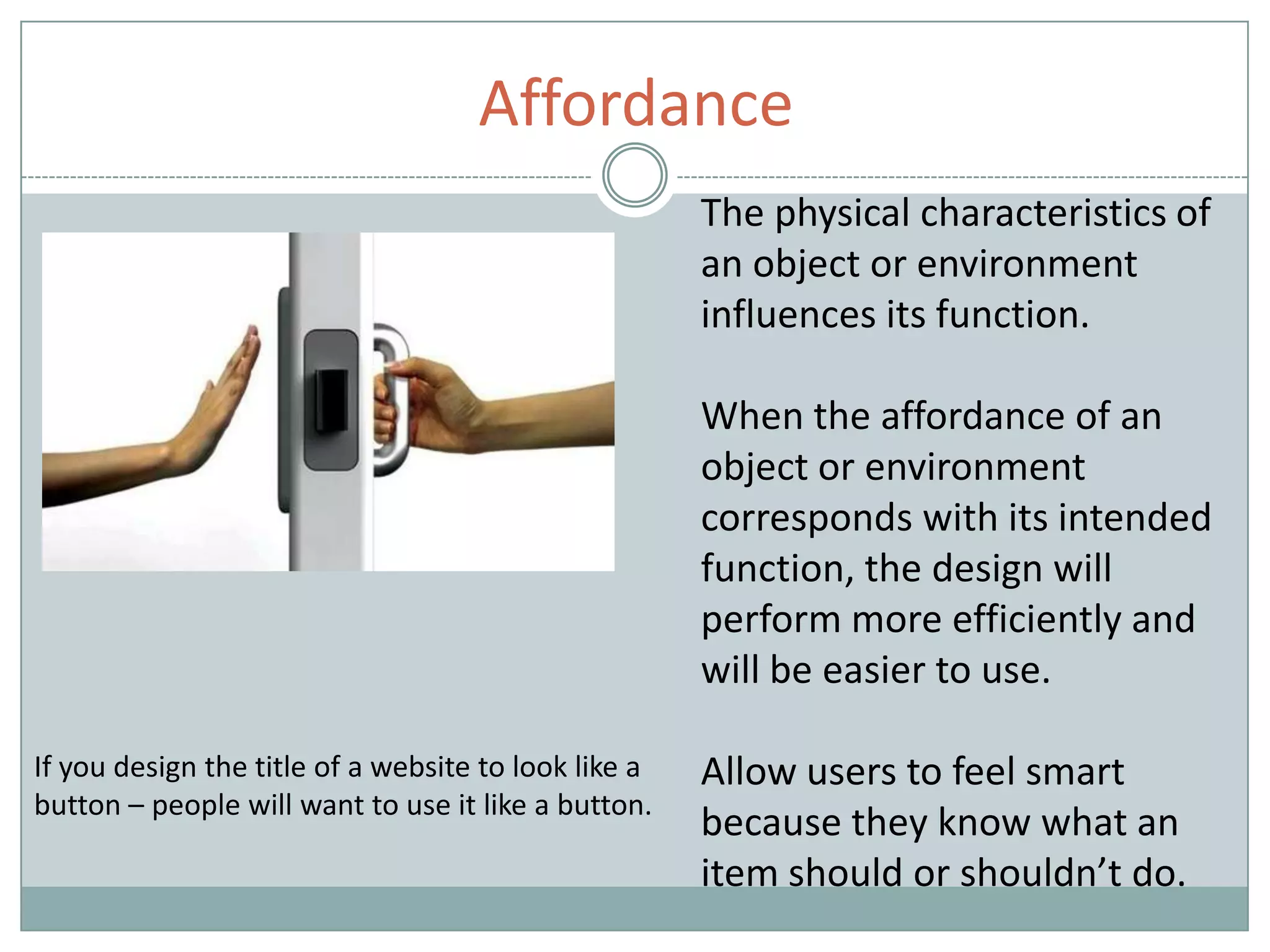
Affordance
The physical characteristics of
an object or environment
influences its function.
When the affordance of an
object or environment
corresponds with its intended
function, the design will
perform more efficiently and
will be easier to use.
Allow users to feel smart
because they know what an
item should or shouldn’t do.
If you design the title of a website to look like a
button – people will want to use it like a button.
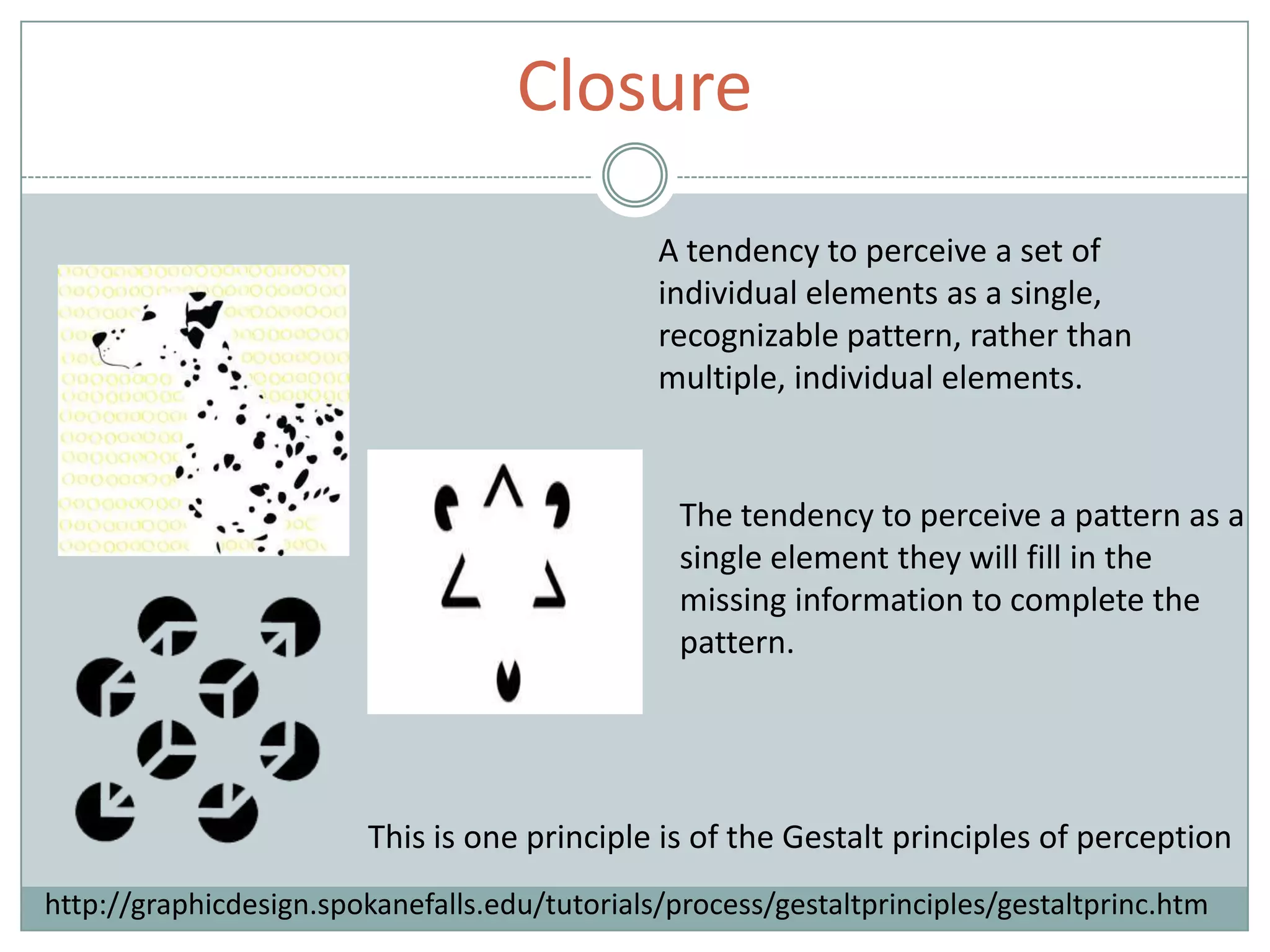
Closure
A tendency to perceive a set of
individual elements as a single,
recognizable pattern, rather than
multiple, individual elements.
The tendency to perceive a pattern as a
single element they will fill in the
missing information to complete the
pattern.
This is one principle is of the Gestalt principles of perception
http://graphicdesign.spokanefalls.edu/tutorials/process/gestaltprinciples/gestaltprinc.htm
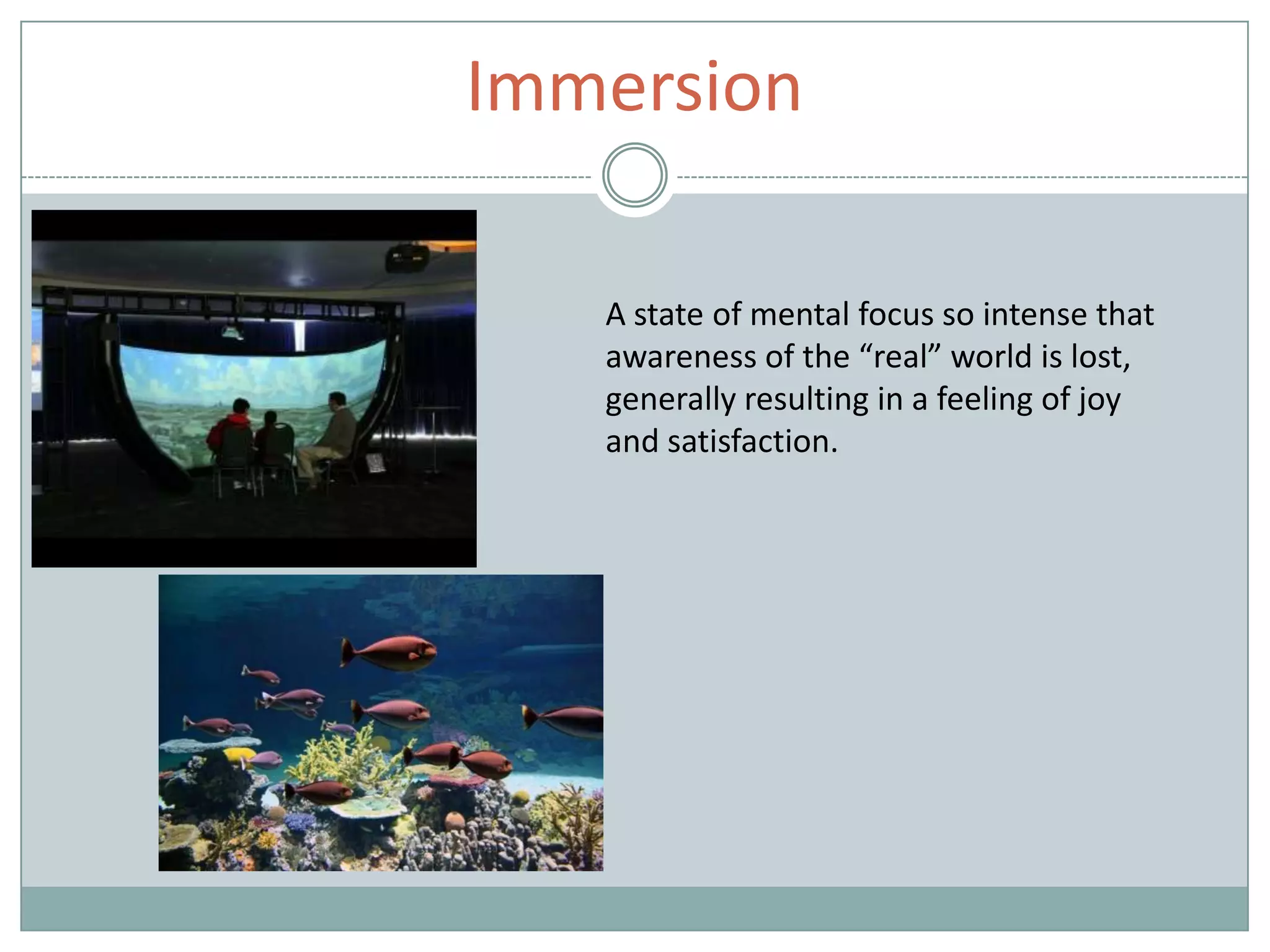
Immersion
A state of mental focus so intense that
awareness of the “real” world is lost,
generally resulting in a feeling of joy
and satisfaction.
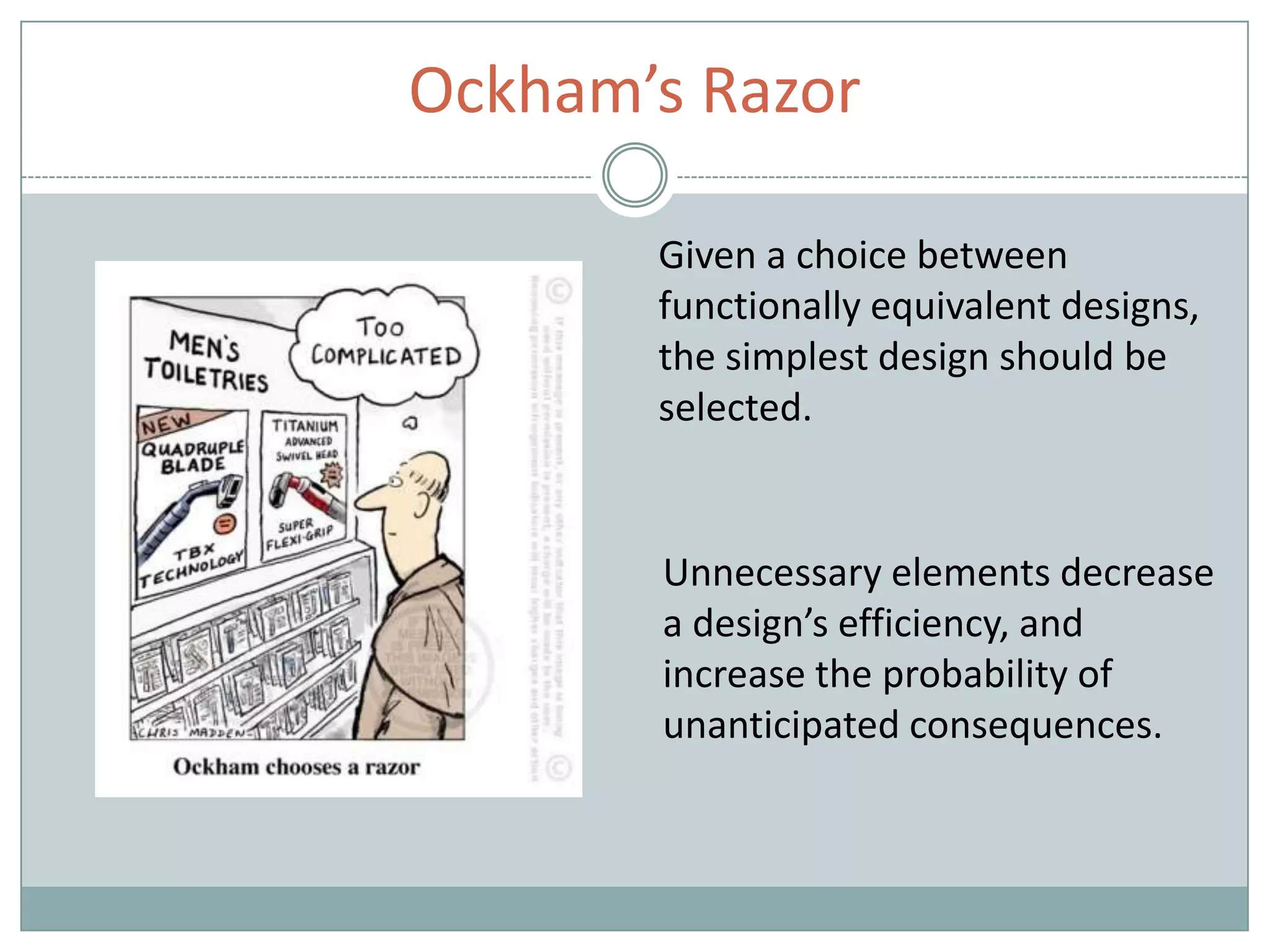
Ockham’s Razor
Given a choice between
functionally equivalent designs,
the simplest design should be
selected.
Unnecessary elements decrease
a design’s efficiency, and
increase the probability of
unanticipated consequences.
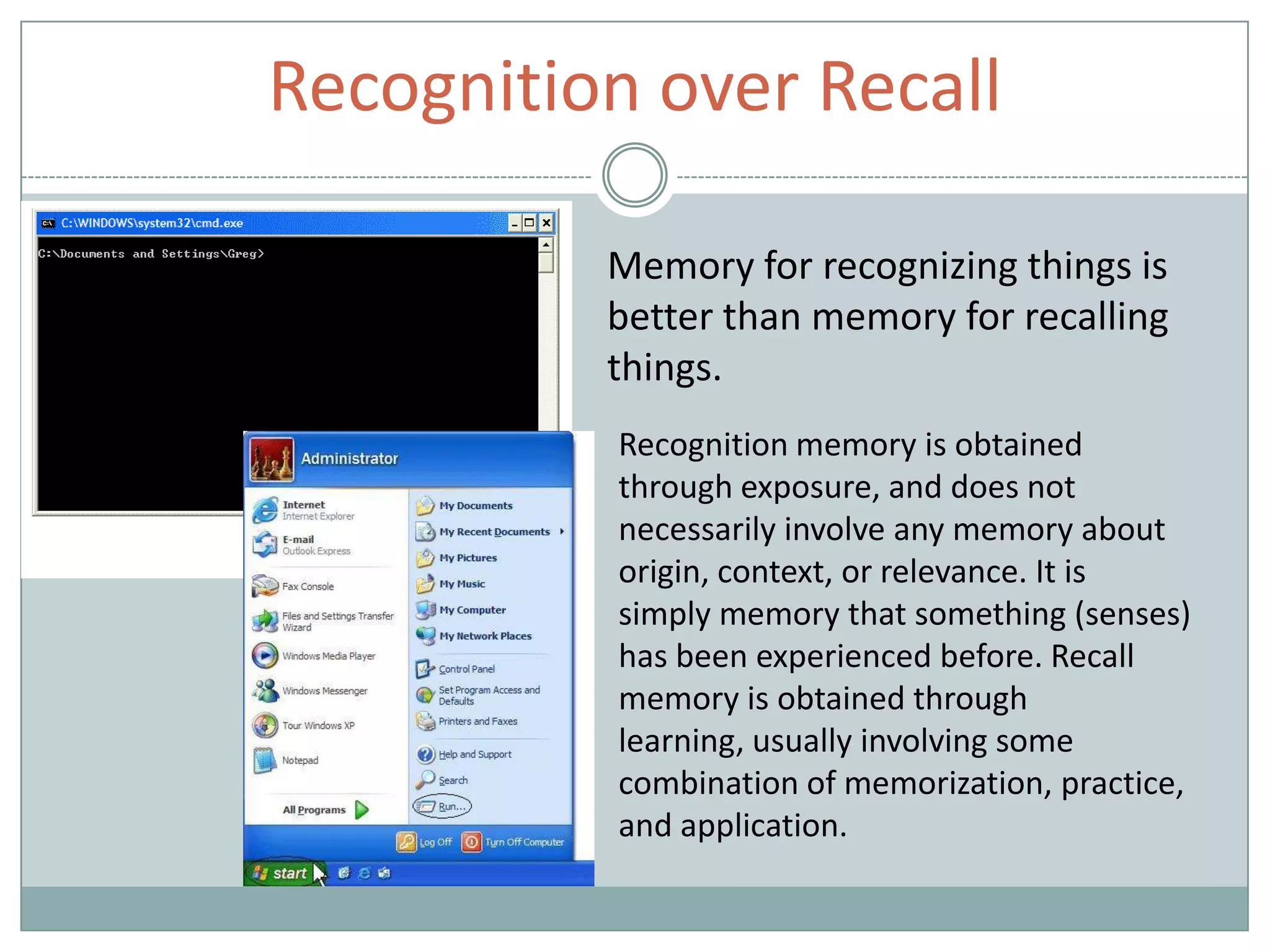
Recognition over Recall
Memory for recognizing things is
better than memory for recalling
things.
Recognition memory is obtained
through exposure, and does not
necessarily involve any memory about
origin, context, or relevance. It is
simply memory that something (senses)
has been experienced before. Recall
memory is obtained through
learning, usually involving some
combination of memorization, practice,
and application.
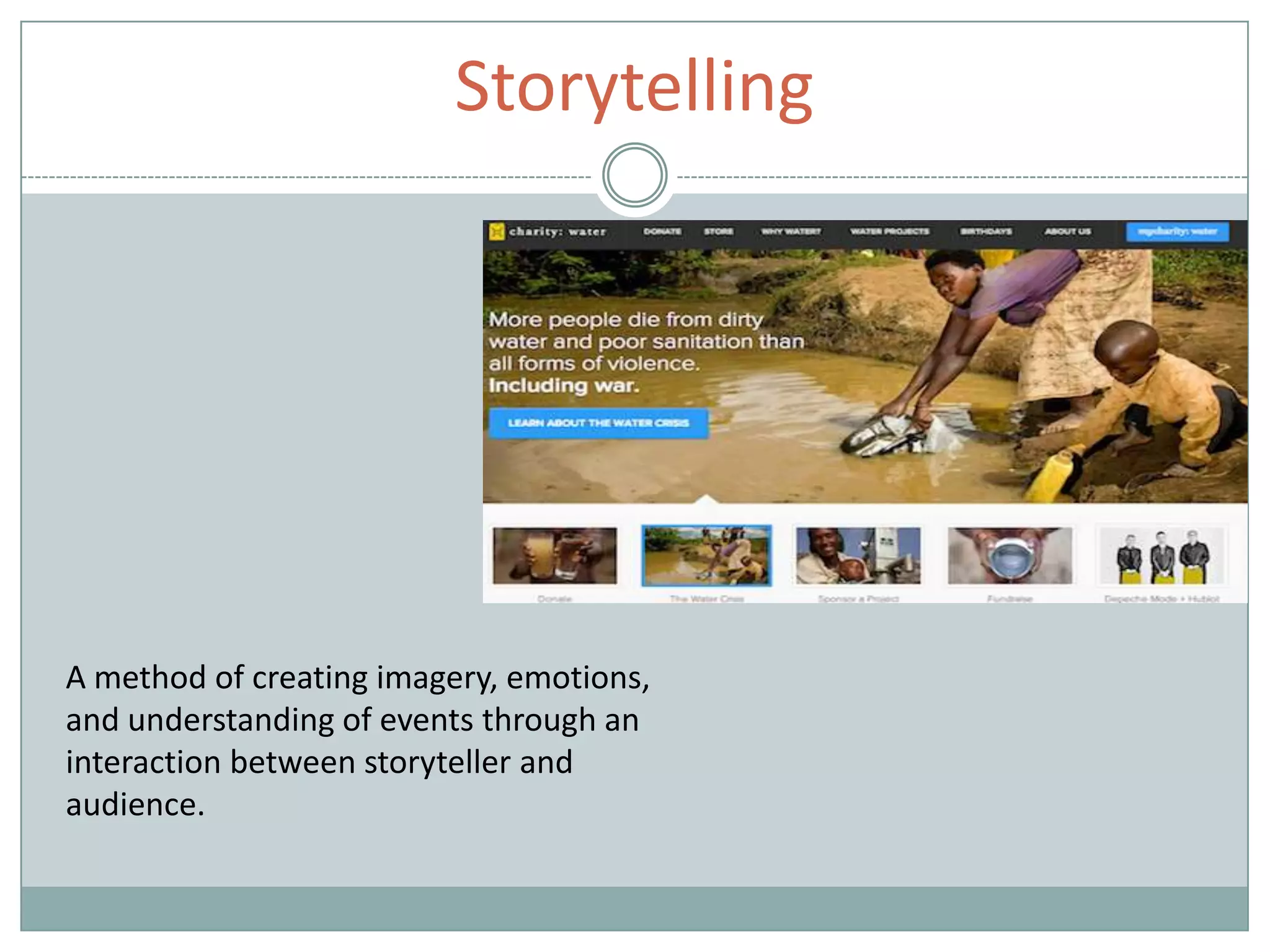
Storytelling
A method of creating imagery, emotions,
and understanding of events through an
interaction between storyteller and
audience.
 Setting – orient users with time and place.
 Characters – allow the user to identify with the product
through “characters”.
 Plot – ties the story together.
 Invisibility – existence of the medium should be
forgotten once the user is engaged.
 Mood – emotional tone of product.
 Movement – everything flows together.
Good storytelling generally requires fundamental
elements
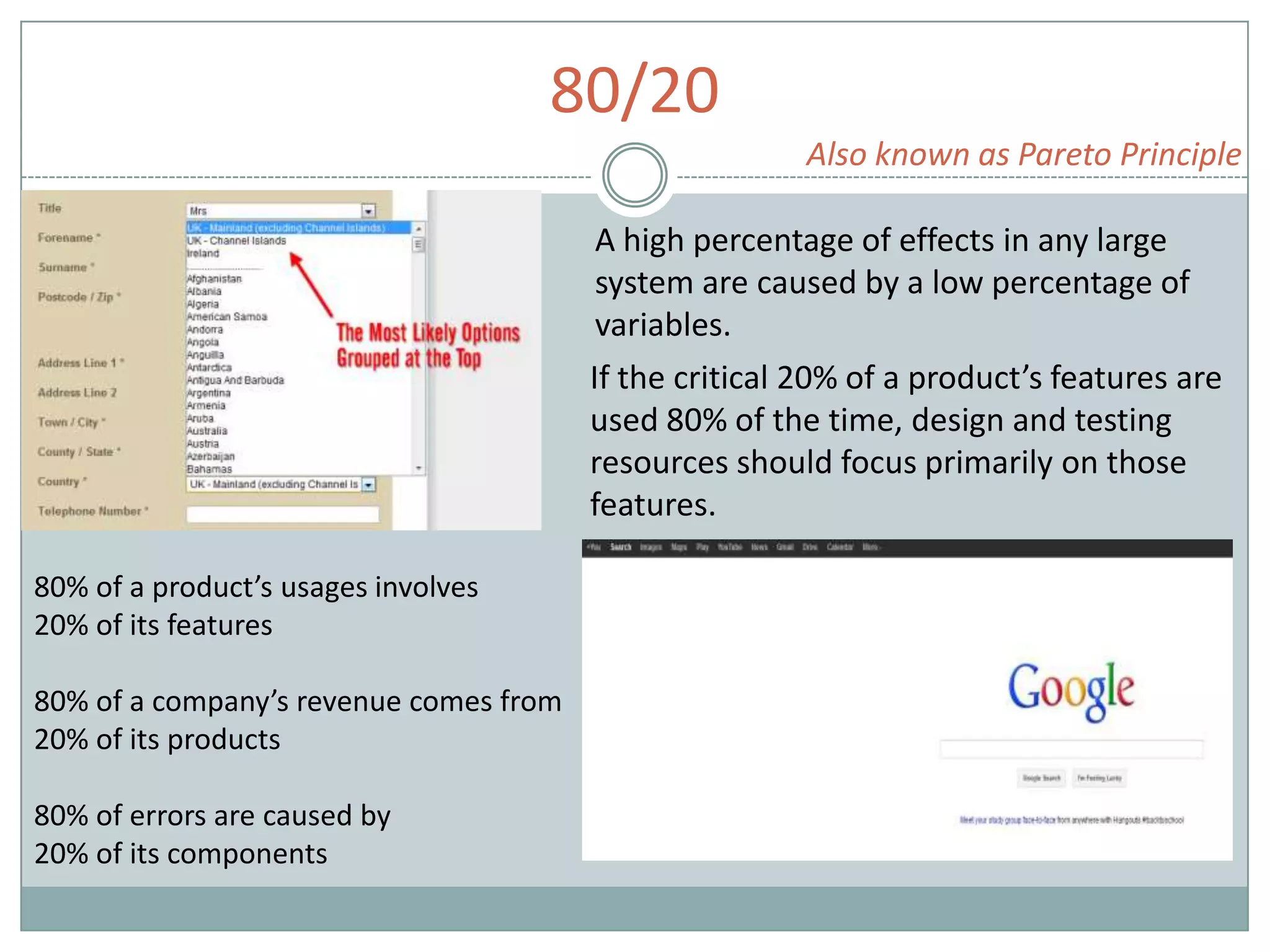
80/20
Also known as Pareto Principle
A high percentage of effects in any large
system are caused by a low percentage of
variables.
If the critical 20% of a product’s features are
used 80% of the time, design and testing
resources should focus primarily on those
features.
80% of a product’s usages involves
20% of its features
80% of a company’s revenue comes from
20% of its products
80% of errors are caused by
20% of its components
Design Methods
 Methods can help facilitate conversations to help us
better understand and empathize with people, and as a
result build more meaningful products.
 Methods can help designers have the right conversation
at the right time. Also, helps designers learn which
methods to use at the correct time during their research.
 Methods help the team members work together to
discover solutions to a problem.
 You can’t say you practice User Experience if you don’t
use methods to help guide your design decisions.
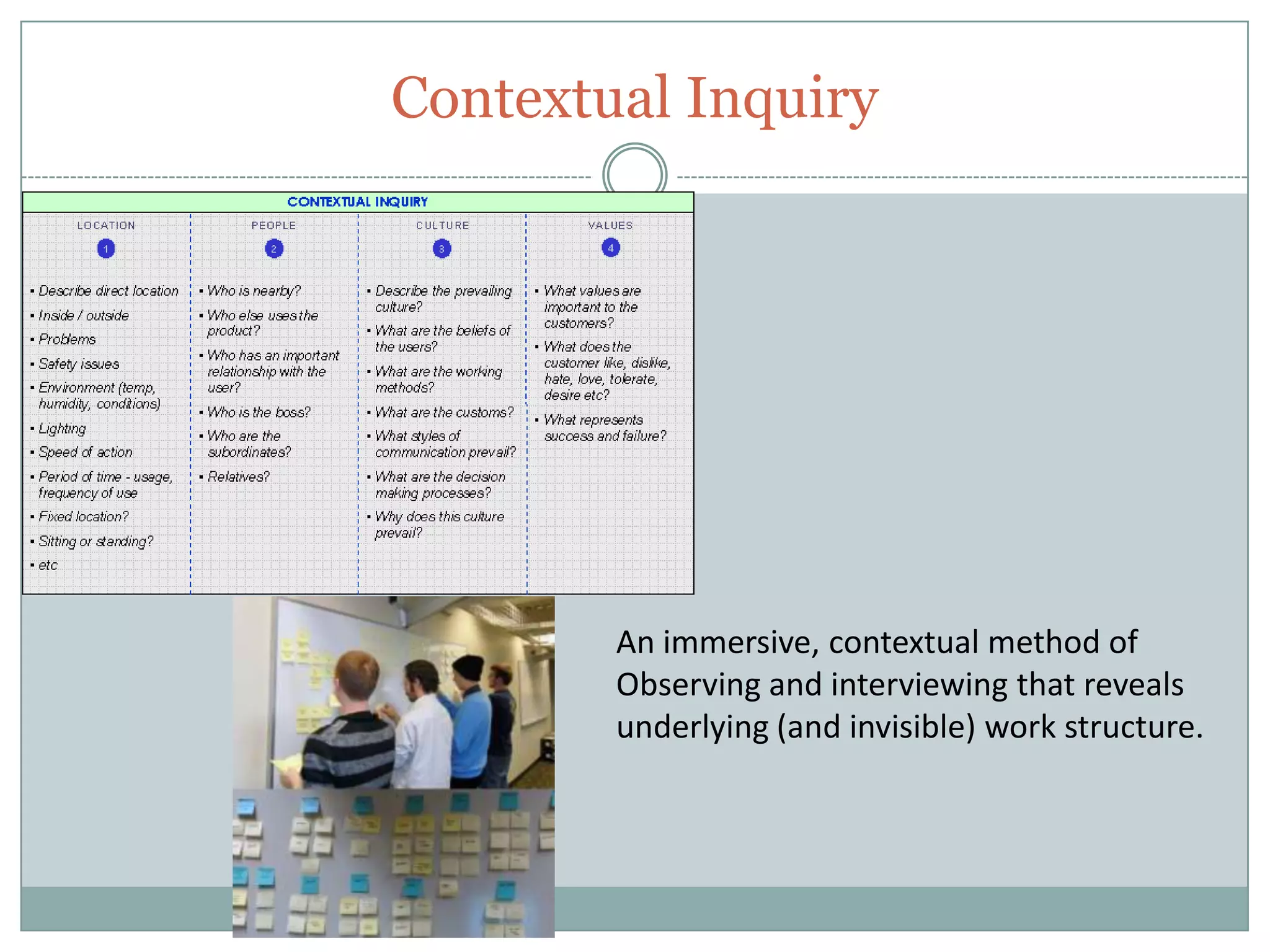
Contextual Inquiry
An immersive, contextual method of
Observing and interviewing that reveals
underlying (and invisible) work structure.
4 principles that define Contextual Inquiry:
 Context: spend time where work happens.
 Partnership: Master/Apprentice relationship model.
 Interpretation: From the data gathered the researcher
(you) Make a hypothesis (or interpretation) of the data
and what that means to the participant. This is then
followed by other methods for testing the
interpretation.
 Focus: Researcher must learn to expand the limits of
their focus to see the participant’s world.
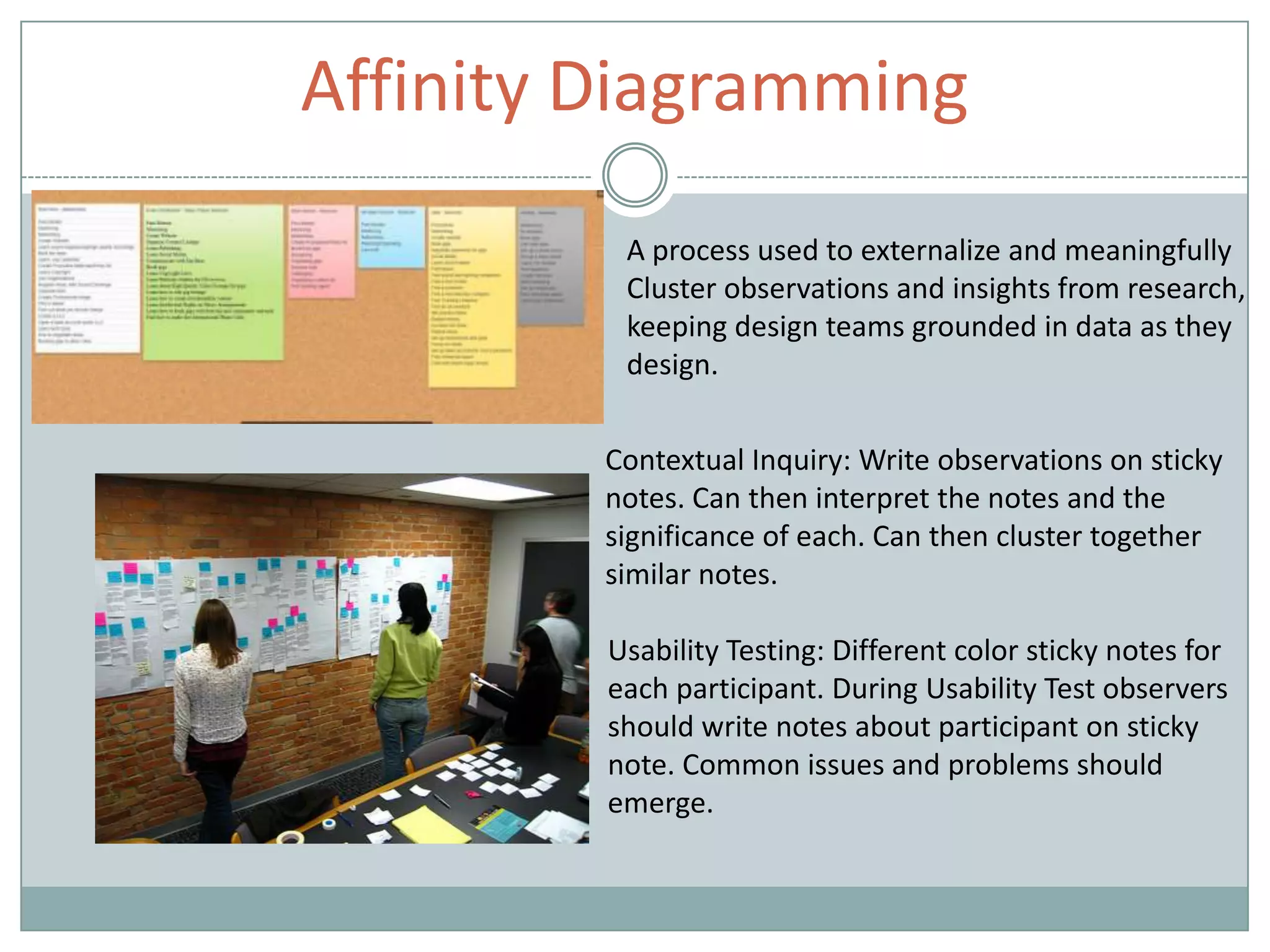
Affinity Diagramming
A process used to externalize and meaningfully
Cluster observations and insights from research,
keeping design teams grounded in data as they
design.
Contextual Inquiry: Write observations on sticky
notes. Can then interpret the notes and the
significance of each. Can then cluster together
similar notes.
Usability Testing: Different color sticky notes for
each participant. During Usability Test observers
should write notes about participant on sticky
note. Common issues and problems should
emerge.
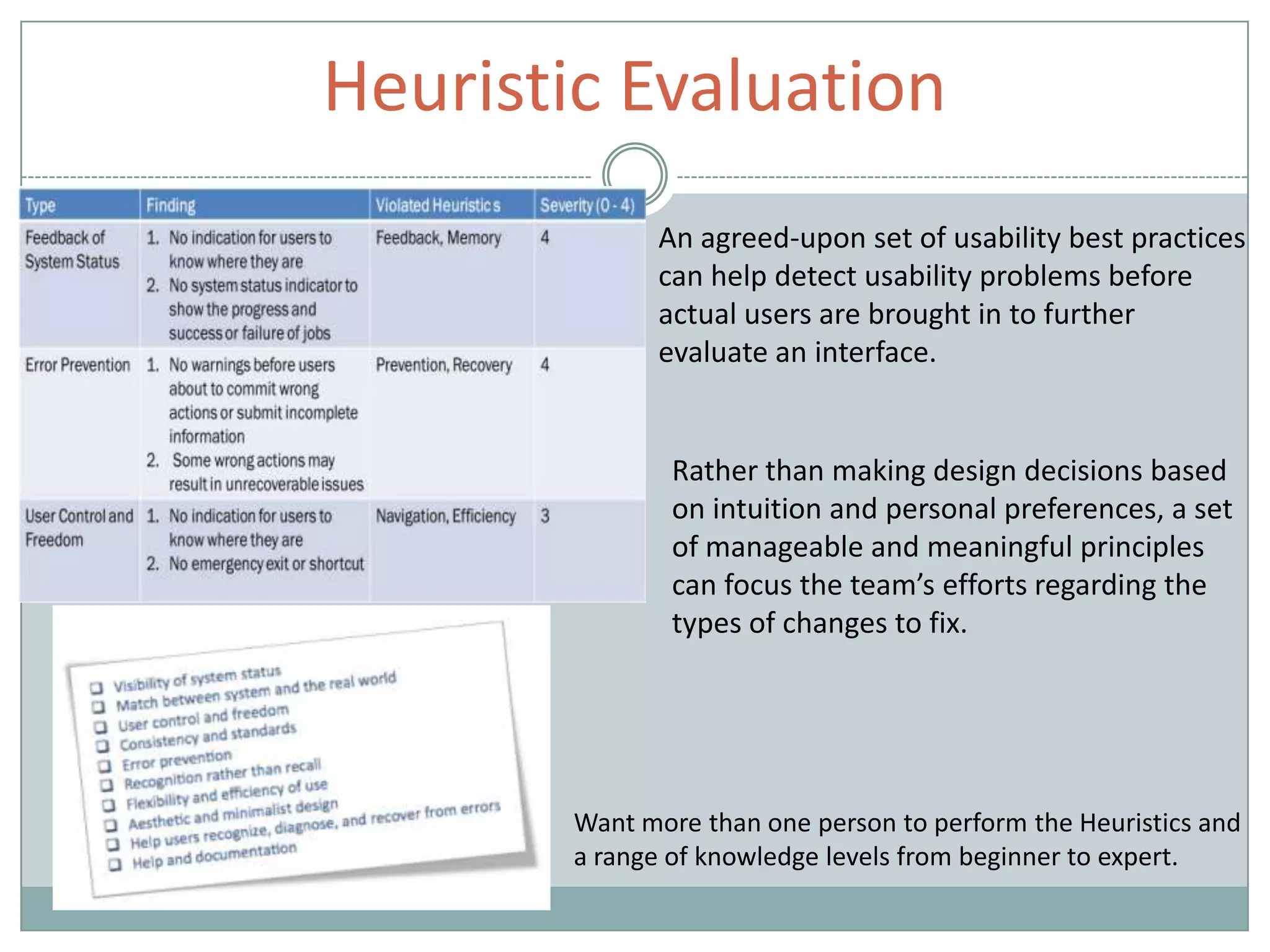
Heuristic Evaluation
Rather than making design decisions based
on intuition and personal preferences, a set
of manageable and meaningful principles
can focus the team’s efforts regarding the
types of changes to fix.
Want more than one person to perform the Heuristics and
a range of knowledge levels from beginner to expert.
An agreed-upon set of usability best practices
can help detect usability problems before
actual users are brought in to further
evaluate an interface.
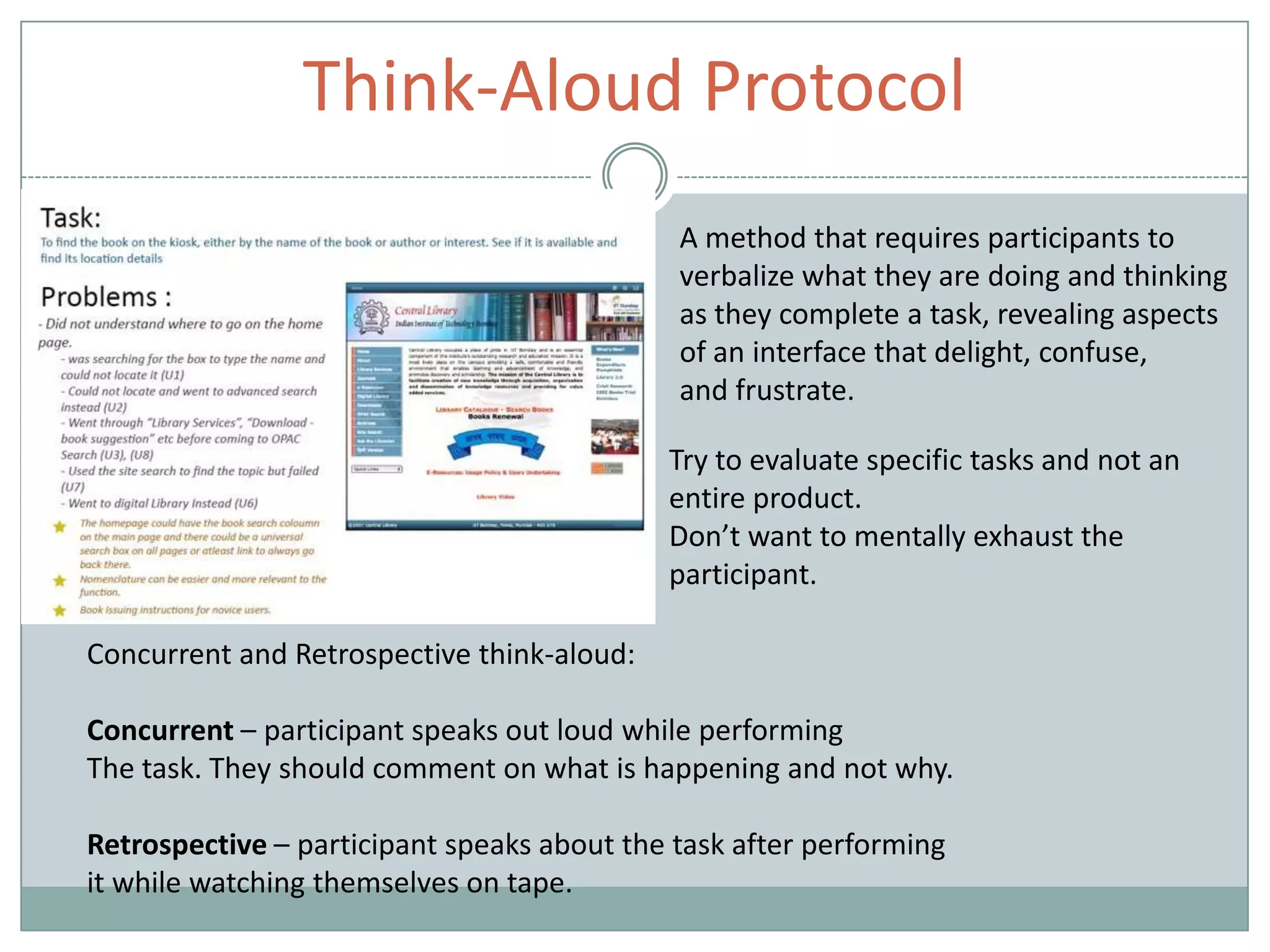
Think-Aloud Protocol
A method that requires participants to
verbalize what they are doing and thinking
as they complete a task, revealing aspects
of an interface that delight, confuse,
and frustrate.
Try to evaluate specific tasks and not an
entire product.
Don’t want to mentally exhaust the
participant.
Concurrent and Retrospective think-aloud:
Concurrent – participant speaks out loud while performing
The task. They should comment on what is happening and not why.
Retrospective – participant speaks about the task after performing
it while watching themselves on tape.
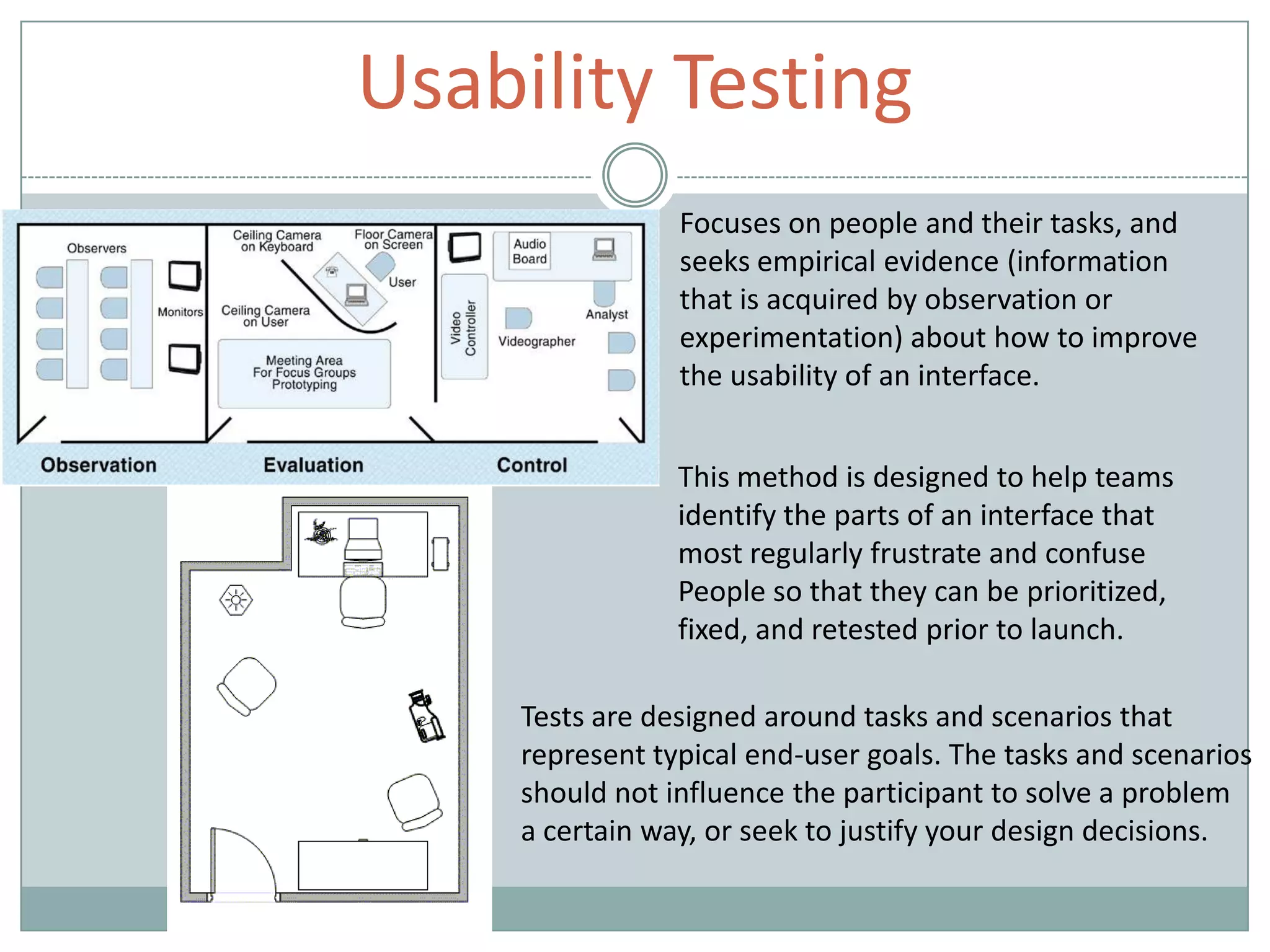
Usability Testing
Focuses on people and their tasks, and
seeks empirical evidence (information
that is acquired by observation or
experimentation) about how to improve
the usability of an interface.
This method is designed to help teams
identify the parts of an interface that
most regularly frustrate and confuse
People so that they can be prioritized,
fixed, and retested prior to launch.
Tests are designed around tasks and scenarios that
represent typical end-user goals. The tasks and scenarios
should not influence the participant to solve a problem
a certain way, or seek to justify your design decisions.
Some errors and highlights the observers and evaluators
should try to detect are:
 Can’t complete task in reasonable amount of time.
 Gives up or resigns from completing process.
 Expresses surprise or delight.
 Expresses frustration, confusion, or blames themselves.
 Makes a suggestion for the interface of flow of events.
 Understands the goal, but tries a different approach than
expected to complete the task.
Book Recommendations
Resources Used
 http://www2.ifm.eng.cam.ac.uk/dmg/tools/user/contextual.html
 http://www.questionablemethods.com/2011/11/heuristic-evaluation-no-users-required.html
 http://www-personal.umich.edu/~ianlin/professional.html
 http://www.behance.net/gallery/THINK-ALOUD-IIT-Bombay-Library-Information-
kiosks/3416091
 http://www.lib.washington.edu/usability/resources/guides/tests
 http://scholar.lib.vt.edu/ejournals/VALib/v45_n1/newins.html
 http://graphicdesign.spokanefalls.edu/tutorials/process/gestaltprinciples/gestaltprinc.htm

Universal Design Principles and Methods

  • 1.
    Universal Principles andMethods of Design
  • 2.
    Let’s start withDesign Principles
  • 3.
    Design principles arethe fundamental goals that all decisions can be measured against to keep the pieces of a project moving toward an integrated whole. They define and articulate the key characteristics of a project to stakeholders, clients, colleagues, and team members.
  • 4.
    As your teamaggregates design principles to help form decisions, keep a list of them as a reminder to everyone. If time allows, explain why each of these design principles will be important to the design of the product to help stakeholders and clients not informed on design understand fully your design decisions.
  • 5.
    Example: According to XYZ,applying a design principle such as ABC has been proven to help people find items more quickly/relate/enjoy/more loyalty/etc. and will favor a site over your LMNOP competition.
  • 6.
    Affordance The physical characteristicsof an object or environment influences its function. When the affordance of an object or environment corresponds with its intended function, the design will perform more efficiently and will be easier to use. Allow users to feel smart because they know what an item should or shouldn’t do. If you design the title of a website to look like a button – people will want to use it like a button.
  • 7.
    Closure A tendency toperceive a set of individual elements as a single, recognizable pattern, rather than multiple, individual elements. The tendency to perceive a pattern as a single element they will fill in the missing information to complete the pattern. This is one principle is of the Gestalt principles of perception http://graphicdesign.spokanefalls.edu/tutorials/process/gestaltprinciples/gestaltprinc.htm
  • 8.
    Immersion A state ofmental focus so intense that awareness of the “real” world is lost, generally resulting in a feeling of joy and satisfaction.
  • 9.
    Ockham’s Razor Given achoice between functionally equivalent designs, the simplest design should be selected. Unnecessary elements decrease a design’s efficiency, and increase the probability of unanticipated consequences.
  • 10.
    Recognition over Recall Memoryfor recognizing things is better than memory for recalling things. Recognition memory is obtained through exposure, and does not necessarily involve any memory about origin, context, or relevance. It is simply memory that something (senses) has been experienced before. Recall memory is obtained through learning, usually involving some combination of memorization, practice, and application.
  • 11.
    Storytelling A method ofcreating imagery, emotions, and understanding of events through an interaction between storyteller and audience.
  • 12.
     Setting –orient users with time and place.  Characters – allow the user to identify with the product through “characters”.  Plot – ties the story together.  Invisibility – existence of the medium should be forgotten once the user is engaged.  Mood – emotional tone of product.  Movement – everything flows together. Good storytelling generally requires fundamental elements
  • 13.
    80/20 Also known asPareto Principle A high percentage of effects in any large system are caused by a low percentage of variables. If the critical 20% of a product’s features are used 80% of the time, design and testing resources should focus primarily on those features. 80% of a product’s usages involves 20% of its features 80% of a company’s revenue comes from 20% of its products 80% of errors are caused by 20% of its components
  • 14.
    Design Methods  Methodscan help facilitate conversations to help us better understand and empathize with people, and as a result build more meaningful products.  Methods can help designers have the right conversation at the right time. Also, helps designers learn which methods to use at the correct time during their research.  Methods help the team members work together to discover solutions to a problem.  You can’t say you practice User Experience if you don’t use methods to help guide your design decisions.
  • 15.
    Contextual Inquiry An immersive,contextual method of Observing and interviewing that reveals underlying (and invisible) work structure.
  • 16.
    4 principles thatdefine Contextual Inquiry:  Context: spend time where work happens.  Partnership: Master/Apprentice relationship model.  Interpretation: From the data gathered the researcher (you) Make a hypothesis (or interpretation) of the data and what that means to the participant. This is then followed by other methods for testing the interpretation.  Focus: Researcher must learn to expand the limits of their focus to see the participant’s world.
  • 17.
    Affinity Diagramming A processused to externalize and meaningfully Cluster observations and insights from research, keeping design teams grounded in data as they design. Contextual Inquiry: Write observations on sticky notes. Can then interpret the notes and the significance of each. Can then cluster together similar notes. Usability Testing: Different color sticky notes for each participant. During Usability Test observers should write notes about participant on sticky note. Common issues and problems should emerge.
  • 18.
    Heuristic Evaluation Rather thanmaking design decisions based on intuition and personal preferences, a set of manageable and meaningful principles can focus the team’s efforts regarding the types of changes to fix. Want more than one person to perform the Heuristics and a range of knowledge levels from beginner to expert. An agreed-upon set of usability best practices can help detect usability problems before actual users are brought in to further evaluate an interface.
  • 19.
    Think-Aloud Protocol A methodthat requires participants to verbalize what they are doing and thinking as they complete a task, revealing aspects of an interface that delight, confuse, and frustrate. Try to evaluate specific tasks and not an entire product. Don’t want to mentally exhaust the participant. Concurrent and Retrospective think-aloud: Concurrent – participant speaks out loud while performing The task. They should comment on what is happening and not why. Retrospective – participant speaks about the task after performing it while watching themselves on tape.
  • 20.
    Usability Testing Focuses onpeople and their tasks, and seeks empirical evidence (information that is acquired by observation or experimentation) about how to improve the usability of an interface. This method is designed to help teams identify the parts of an interface that most regularly frustrate and confuse People so that they can be prioritized, fixed, and retested prior to launch. Tests are designed around tasks and scenarios that represent typical end-user goals. The tasks and scenarios should not influence the participant to solve a problem a certain way, or seek to justify your design decisions.
  • 21.
    Some errors andhighlights the observers and evaluators should try to detect are:  Can’t complete task in reasonable amount of time.  Gives up or resigns from completing process.  Expresses surprise or delight.  Expresses frustration, confusion, or blames themselves.  Makes a suggestion for the interface of flow of events.  Understands the goal, but tries a different approach than expected to complete the task.
  • 22.
  • 25.
    Resources Used  http://www2.ifm.eng.cam.ac.uk/dmg/tools/user/contextual.html http://www.questionablemethods.com/2011/11/heuristic-evaluation-no-users-required.html  http://www-personal.umich.edu/~ianlin/professional.html  http://www.behance.net/gallery/THINK-ALOUD-IIT-Bombay-Library-Information- kiosks/3416091  http://www.lib.washington.edu/usability/resources/guides/tests  http://scholar.lib.vt.edu/ejournals/VALib/v45_n1/newins.html  http://graphicdesign.spokanefalls.edu/tutorials/process/gestaltprinciples/gestaltprinc.htm