A
Dissertation Preliminary Presentation
on
‘ROBUSTNESS CHARACTERISTICS OF
CONTOLLER AND IMC BASED CONTROLLER’
GUIDED BY: PRESENTED BY:
Dr. S.N. SHARMA ANKIT GAURAV
(P19PS011)
2020-21
Department of Electrical Engineering
OVERVIEW
 Introduction.
 Effect of uncertainty.
 Robust control toolbox.
 Algorithm used for robust controller design.
 Robustness performance analysis of controller
 Internal model control (IMC).
 IMC Based Controller for delay free processes
 Tuning of IMC based PID controller.
 Relay Auto tuning method to find the controller parameter for a Smith predictor.
 IMC-Based PID Design for Time-delay Processes with smith predictor
 Procedure to find Controller Parameter.
 Advantage and Disadvantage.
 Conclusion and Future work.
 Reference.
2
Introduction
 Robust control theory was developed in 1960.
 In Control theory robustness characteristics explicitly deals with uncertainty.
 Control of unknown plants with unknown disturbance.
 Robust control theory is static, It is designed to work by assuming certain variables
but they are bounded .
 Controller design by robust principle must be stable in the presence of small
modelling errors.
 PID controllers are still widely used in industrial system despite the significant
development in Control theory.
 PID possess several feature like elimination of derivative kick set point weighting,
reverse or direct action, automatic and manual control modes.
 Tuning of controller is one of the difficult task but due to IMC based controllers
and invention of auto- tuning this work become little easy and fast.
3
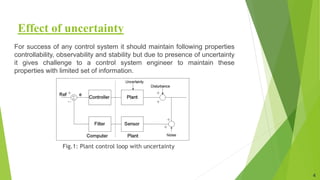
Effect of uncertainty
For success of any control system it should maintain following properties
controllability, observability and stability but due to presence of uncertainty
it gives challenge to a control system engineer to maintain these
properties with limited set of information.
Fig.1: Plant control loop with uncertainty
4
Following are the reason due to which
plant uncertainty will occur
 Variation in model parameters.
 Abandoned known dynamics such as high frequency dynamics.
 Due to change in operating conditions.
 Linear approximation of nonlinear characteristics of system.
 Error estimation from measured data.
5
Robust control toolbox
 Robust control Toolbox gives a systematic approach to design robust
multivariable feedback control system .
 Robust control toolbox provides following approach for robust controller design:
1) Modelling and quantifying plant uncertainty.
2) Performing robustness analysis .
3) Synthesizing robust multivariable controllers .
4) Reducing controller and plant model order.
Modelling and quantifying plant uncertainty
With the help of robust control toolbox we can able to track the typical nominal
behaviour of the plant. Apart from that we can also capture amount of uncertainty and
variability
6
Performing robustness analysis
To analyse the effect of model uncertainty on closed-loop stability, open-loop
stability and performance index.
The above work is achieved due to following tools provide by robust control
Toolbox:
• Worst case gain/ phase margins one loop at a time.
• Worst case stability margin taking loop interaction into account.
• Worst case gain between any two points in the closed loop system.
• Worst case sensitivity to external disturbances.
Synthesizing robust multivariable controllers
Robust Toolbox provides various algorithms related to controller synthesis .
Algorithms are applicable for single input single output and multiple input multiple
output control system.
Reducing the order of controller and plant model
As the order of system is increased its response become sluggish. H-infinity
synthesis algorithm produce high order controllers with appropriate states, So
robust control toolbox is used to reduce the order of plant or controller model
and conserve its essential dynamics.
7
Modeling of robust controller
 Design of robust controller is very difficult task due to following reasons
 Imperfect plant data
 Time varying plant
 High order dynamics
 Non-linearity of model
 Complexity
The above model design uncertainty which mostly occur at high frequency we can
handle by making balance between performance and robustness through gain
scheduling.
8
Algorithm used for robust controller design
 H-infinity method
 Lyapunov function
 Fuzzy control
 Kharitonov’s theorem
The above robust controller design are difficult to understand and tedious to
implement.
Kharitonov’s theorem
Kharitonov’s theorem deal with such type of uncertainty that occur in the system
due to parametric uncertainties. Previously it is known as stability of system under
parametric uncertainty but currently it is known as a stability of a dynamical
system.
9
Working principle of Kharitonov’s theorem
 According to kharitonov's theorem a system is said to be stable if four
polynomial which is also known as kharitonov’s polynomial are stable.
 Kharitonov's polynomial are :
 𝑎𝑜
+
+ 𝑎1
+
𝑠 + 𝑎2
−
𝑠2
+ 𝑎3
−
𝑠3
+ 𝑎4 𝑆4 =0
+
 𝑎𝑜
− + 𝑎1
−
𝑠 + 𝑎2
+
𝑠2 + 𝑎3
+
𝑠3 + 𝑎4 𝑆4 =0
−
 𝑎𝑜
+
+ 𝑎1
−
𝑠 + 𝑎2
−
𝑠2
+ 𝑎3
+
𝑠3
+ 𝑎4 𝑆4 =0
+
 𝑎𝑜
+ + 𝑎1
+
𝑠 + 𝑎2
−
𝑠2 + 𝑎3
−
𝑠3 + 𝑎4 𝑆4 =0
+
 Where 𝑎𝑜
−
and 𝑎𝑖
+
are the lower and upper bound for 𝑎𝑖
10
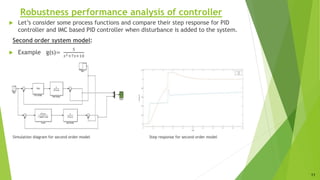
Robustness performance analysis of controller
 Let’s consider some process functions and compare their step response for PID
controller and IMC based PID controller when disturbance is added to the system.
Second order system model:
 Example g(s)=
5
𝑠2+7𝑠+10
Simulation diagram for second order model Step response for second order model
11
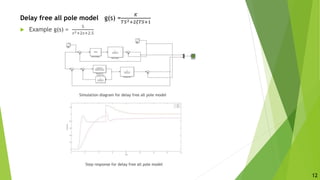
Delay free all pole model g(s) =
𝐾
𝑇𝑆2+2𝜉𝑇𝑆+1
 Example g(s) =
5
𝑠2+2𝑠+2.5
Simulation diagram for delay free all pole model
Step response for delay free all pole model
12
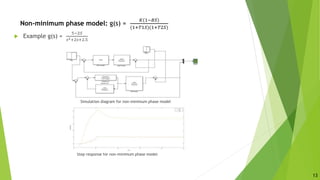
Non-minimum phase model: g(s) =
𝐾(1−𝐵𝑆)
(1+𝑇1𝑆)(1+𝑇2𝑆)
 Example g(s) =
5−2𝑆
𝑠2+2𝑠+2.5
Simulation diagram for non-minimum phase model
Step response for non-minimum phase model
13
Properties of Robust controller
 Rejection of noise and disturbance.
 High gain feedback.
 Attend it’s system stability under uncertainty.
 It work properly under a different set of assumptions.
 Robust controller ensure closed-loop stability.
 Robust controller ensure some level of performance in the
presence of plant parameter uncertainty
14
Internal model control (IMC)
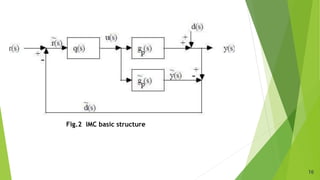
 IMC philosophy depend on internal model principle which states
that if any control system contains within it (internal or external),
some representation of the process to be controlled when a perfect
control is achieved.
 IMC based PID controller full fill most of the control objective
such as:
1. Set point reference tracking
2. Zero steady state errors
3. Low overshoot acceptable
4. Reduced settling time
5. Disturbance rejection
15
.
Fig.2 IMC basic structure
16
Design Procedure for IMC Based Controller for
delay free processes
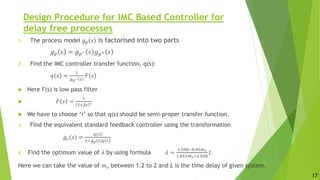
1. The process model 𝑔𝑝 𝑠 is factorised into two parts
𝑔𝑝 𝑠 = 𝑔𝑝− 𝑠 𝑔𝑝+ 𝑠
2. Find the IMC controller transfer function, q(s):
𝑞 𝑠 =
1
𝑔𝑝− 𝑠
𝐹 𝑠
 Here F(s) is low pass filter
 𝐹 𝑠 =
1
1+𝜆𝑠 𝑟
 We have to choose ‘r’ so that q(s) should be semi-proper transfer function.
3. Find the equivalent standard feedback controller using the transformation
𝑔𝑐(𝑠) =
)
𝑞(𝑠
1−𝑔𝑝(𝑠)𝑞(𝑠
4. Find the optimum value of 𝜆 by using formula 𝜆 =
1.508−0.45𝑚𝑠
1.451𝑚𝑠−1.508
𝐿
Here we can take the value of 𝑚𝑠 between 1.2 to 2 and L is the time delay of given system.
17
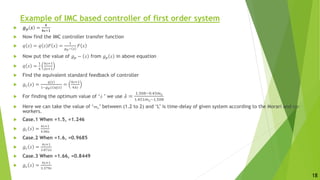
Example of IMC based controller of first order system
 𝒈𝒑 𝒔 =
𝟒
𝟒𝒔+𝟏
 Now find the IMC controller transfer function
 𝑞 𝑠 = 𝑞 𝑠 𝐹 𝑠 =
1
𝑔𝑝− 𝑠
𝐹 𝑠
 Now put the value of 𝑔𝑝 − 𝑠 from 𝑔𝑝 𝑠 in above equation
 𝑞 𝑠 =
1
4
4𝑠+1
𝜆𝑠+1
 Find the equivalent standard feedback of controller
 𝑔𝑐(𝑠) =
𝑞(𝑠)
1−𝑔𝑝(𝑠)𝑞(𝑠)
=
4𝑠+1
4𝜆𝑠
 For finding the optimum value of ‘𝜆 ’ we use 𝜆 =
1.508−0.45𝑚𝑠
1.451𝑚𝑠−1.508
 Here we can take the value of ‘𝑚𝑠’ between (1.2 to 2) and ‘L’ is time-delay of given system according to the Morari and co-
workers.
 Case.1 When =1.5, =1.246
 𝑔𝑐 𝑠 =
4𝑠+1
4.98𝑠
 Case.2 When =1.6, =0.9685
 𝑔𝑐 𝑠 =
4𝑠+1
3.872𝑠
 Case.3 When =1.66, =0.8449
 𝑔𝑐 𝑠 =
4𝑠+1
3.379𝑠
18
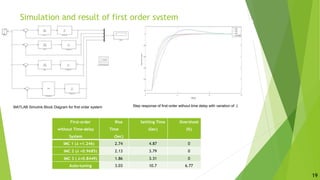
Simulation and result of first order system
19
MATLAB Simulink Block Diagram for first order system Step response of first-order without time delay with variation of 
First-order
without Time-delay
System
Rise
Time
(Sec)
Settling Time
(Sec)
Overshoot
(%)
IMC 1 (𝝀 =1.246) 2.74 4.87 0
IMC 2 (𝝀 =0.9685) 2.13 3.79 0
IMC 3 ( 𝝀=0.8449) 1.86 3.31 0
Auto-tuning 3.03 10.7 6.77
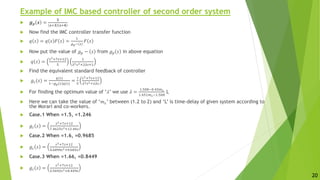
Example of IMC based controller of second order system
 𝒈𝒑 𝒔 =
𝟓
𝒔+𝟑 𝒔+𝟒
 Now find the IMC controller transfer function
 𝑞 𝑠 = 𝑞 𝑠 𝐹 𝑠 =
1
𝑔𝑝− 𝑠
𝐹 𝑠
 Now put the value of 𝑔𝑝 − 𝑠 from 𝑔𝑝 𝑠 in above equation
 𝑞 𝑠 =
𝑠2+7𝑠+12
5
1
𝜆2𝑠2+2𝜆𝑠+1
 Find the equivalent standard feedback of controller
 𝑔𝑐(𝑠) =
𝑞(𝑠)
1−𝑔𝑝(𝑠)𝑞(𝑠)
=
1
5
𝑠2+7𝑠+12
𝜆2𝑠2+2𝜆𝑠
 For finding the optimum value of ‘𝜆’ we use 𝜆 =
1.508−0.45𝑚𝑠
1.451𝑚𝑠−1.508
L
 Here we can take the value of ‘𝑚𝑠’ between (1.2 to 2) and ‘L’ is time-delay of given system according to
the Morari and co-workers.
 Case.1 When =1.5, =1.246
 𝑔𝑐 𝑠 =
𝑠2+7𝑠+12
7.4625𝑠2+12.46𝑠
 Case.2 When =1.6, =0.9685
 𝑔𝑐 𝑠 =
𝑠2+7𝑠+12
4.6899𝑠2+9.685𝑠
 Case.3 When =1.66, =0.8449
 𝑔𝑐 𝑠 =
𝑠2+7𝑠+12
3.5692𝑠2+8.449𝑠
20
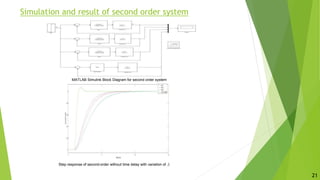
Simulation and result of second order system
21
MATLAB Simulink Block Diagram for second order system
Step response of second-order without time delay with variation of 
22
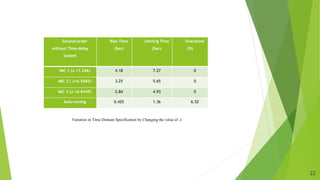
Second-order
without Time-delay
System
Rise Time
(Sec)
Settling Time
(Sec)
Overshoot
(%)
IMC 1 (𝝀 =1.246) 4.18 7.27 0
IMC 2 ( 𝝀=0.9685) 3.25 5.65 0
IMC 3 (𝝀 =0.8449) 2.84 4.93 0
Auto-tuning 0.425 1.36 6.52
Variation in Time Domain Specification by Changing the value of 
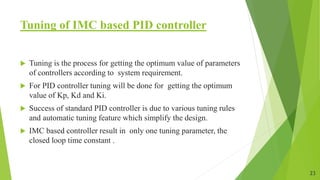
Tuning of IMC based PID controller
 Tuning is the process for getting the optimum value of parameters
of controllers according to system requirement.
 For PID controller tuning will be done for getting the optimum
value of Kp, Kd and Ki.
 Success of standard PID controller is due to various tuning rules
and automatic tuning feature which simplify the design.
 IMC based controller result in only one tuning parameter, the
closed loop time constant .
23
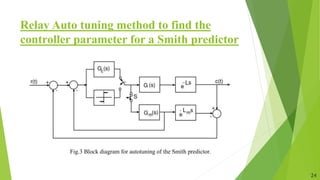
Relay Auto tuning method to find the
controller parameter for a Smith predictor
Fig.3 Block diagram for autotuning of the Smith predictor.
24
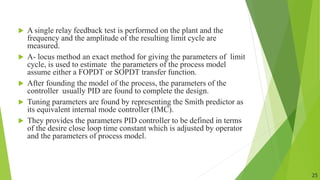
 A single relay feedback test is performed on the plant and the
frequency and the amplitude of the resulting limit cycle are
measured.
 A- locus method an exact method for giving the parameters of limit
cycle, is used to estimate the parameters of the process model
assume either a FOPDT or SOPDT transfer function.
 After founding the model of the process, the parameters of the
controller usually PID are found to complete the design.
 Tuning parameters are found by representing the Smith predictor as
its equivalent internal mode controller (IMC).
 They provides the parameters PID controller to be defined in terms
of the desire close loop time constant which is adjusted by operator
and the parameters of process model.
25
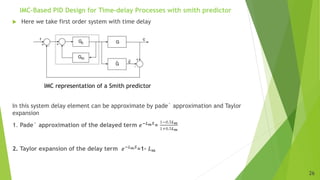
IMC-Based PID Design for Time-delay Processes with smith predictor
 Here we take first order system with time delay
In this system delay element can be approximate by pade` approximation and Taylor
expansion
1. Pade` approximation of the delayed term ⅇ−𝐿𝑚𝑆=
1−0.5𝐿𝑚
1+0.5𝐿𝑚
2. Taylor expansion of the delay term ⅇ−𝐿𝑚𝑆
=1- 𝐿𝑚
26
IMC representation of a Smith predictor
Procedure to find Controller Parameter
TSmith(s) = [Gc(s)Gm(s)e−Lm s] / [1 + Gc(s)Gm(s)]………(1)
The closed-loop transfer function of the IMC design, assuming
a perfect matching and d = 0.
TIMC(s) = GIMC(s)G(s)…………(2)
TIMC(s) = GIMC(s)Gm(s) e−Ls …….(3)
From Eq.(1) and Eq.(3)
G(s) = Gc(s)/[1 + Gc(s)Gm(s)]…….(4)
Gc(s) = GIMC(s) / [1 − GIMC(s)Gm(s)]……….(5)
27
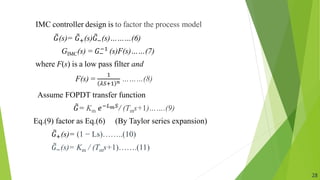
IMC controller design is to factor the process model
𝐺(s)= 𝐺+(s)𝐺−(s)………(6)
GIMC(s) = 𝐺−
−1 (s)F(s)……(7)
where F(s) is a low pass filter and
F(s) =
1
𝜆𝑆+1 𝑛 ………(8)
Assume FOPDT transfer function
𝐺= Km ⅇ−𝐿𝑚𝑆/ (Tms+1)…….(9)
Eq.(9) factor as Eq.(6) (By Taylor series expansion)
𝐺+(s)= (1 − Ls)……..(10)
𝐺−(s)= Km / (Tms+1)…….(11)
28
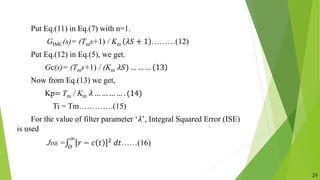
Put Eq.(11) in Eq.(7) with n=1.
GIMC(s)= (Tms+1) / Km 𝜆𝑆 + 1 ………(12)
Put Eq.(12) in Eq.(5), we get.
Gc(s)= (Tms+1) / (Km 𝜆𝑆) … … … 13
Now from Eq.(13) we get,
Kp= Tm / Km 𝜆 … … … … . (14)
Ti = Tm………….(15)
For the value of filter parameter ‘𝜆’, Integral Squared Error (ISE)
is used
JISE = 𝑂
∞
𝑟 − 𝑐 𝑡 2 𝑑𝑡……(16)
29
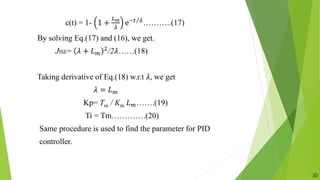
c(t) = 1- 1 +
𝐿𝑚
𝜆
ⅇ−𝑡 𝜆………..(17)
By solving Eq.(17) and (16), we get.
JISE= 𝜆 + 𝐿𝑚
2
/2𝜆……(18)
Taking derivative of Eq.(18) w.r.t 𝜆, we get
𝜆 = 𝐿𝑚
Kp= Tm / Km 𝐿𝑚…….(19)
Ti = Tm………….(20)
Same procedure is used to find the parameter for PID
controller.
30
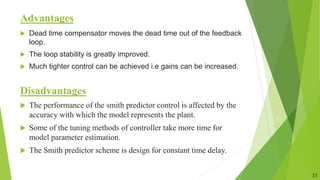
Advantages
 Dead time compensator moves the dead time out of the feedback
loop.
 The loop stability is greatly improved.
 Much tighter control can be achieved i.e gains can be increased.
Disadvantages
 The performance of the smith predictor control is affected by the
accuracy with which the model represents the plant.
 Some of the tuning methods of controller take more time for
model parameter estimation.
 The Smith predictor scheme is design for constant time delay.
31
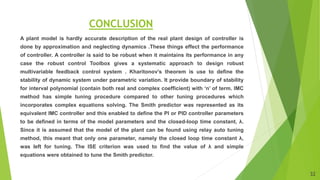
CONCLUSION
A plant model is hardly accurate description of the real plant design of controller is
done by approximation and neglecting dynamics .These things effect the performance
of controller. A controller is said to be robust when it maintains its performance in any
case the robust control Toolbox gives a systematic approach to design robust
multivariable feedback control system . Kharitonov’s theorem is use to define the
stability of dynamic system under parametric variation. It provide boundary of stability
for interval polynomial (contain both real and complex coefficient) with ‘n’ of term. IMC
method has simple tuning procedure compared to other tuning procedures which
incorporates complex equations solving. The Smith predictor was represented as its
equivalent IMC controller and this enabled to define the PI or PID controller parameters
to be defined in terms of the model parameters and the closed-loop time constant, λ.
Since it is assumed that the model of the plant can be found using relay auto tuning
method, this meant that only one parameter, namely the closed loop time constant λ,
was left for tuning. The ISE criterion was used to find the value of λ and simple
equations were obtained to tune the Smith predictor.
32
Future work
There is lot of work in this direction. There is trade-off between
Robustness and performance of a system. Various algorithms are
available but it is difficult to design a controller which possess both
character at a time. I will try to design a controller which work
satisfactorily during parametric variation and I will check the stability
of that system by using Kharitonov’s theorem. Different tuning method
which take less time to give better response. Apart from that IMC best
PID controller performance can be enhanced by developing proper
auto- tuning method. Also, I will try to design a Smith predictor which
work properly for variable time delay system.
33
References
 Seborg, D. E.; Edgar, T. F.; Mellichamp, D. A. Process Dynamics and Control, second ed.;
John Wiley & Sons: New York, 2004.
Graham C. Goodwin,Stefan F. Graebe, Mario E. Salgado Control System DesignValpara´ıso,
January 2000
Åström, K. J., & Hägglund, T. (1984). Automatic tuning of simple regulators with
specifications on phase and amplitude margins. Automatica, 20, 645–651.
 Åström, K. J., Hang, C. C., & Lim, B. C. (1994). A new Smith predictor for controlling a
process with an integrator and long dead-time. IEEE Transaction on Automatic Control,
39(2), 343–345.
 Kaya, I. (1999). Relay feedback identification and model based controller design. D.Phil.
Thesis, University of Sussex, UK.
Garcia C. E. & Morari M., (1982), “Internal model control. 1. A unifying review and some new
results”, Industrial & Engineering Chemistry Process Design and Development, 21(2),308-323.
 Garcia C. E. & Morari M., (1986), “Internal model control. 2. Design procedure for
multivariable systems”, Ind. Eng. Chem. Process Design Development, 24(2),472-84.
34
Thank You
35

Design of imc based controller for industrial purpose

  • 1.
    A Dissertation Preliminary Presentation on ‘ROBUSTNESSCHARACTERISTICS OF CONTOLLER AND IMC BASED CONTROLLER’ GUIDED BY: PRESENTED BY: Dr. S.N. SHARMA ANKIT GAURAV (P19PS011) 2020-21 Department of Electrical Engineering
  • 2.
    OVERVIEW  Introduction.  Effectof uncertainty.  Robust control toolbox.  Algorithm used for robust controller design.  Robustness performance analysis of controller  Internal model control (IMC).  IMC Based Controller for delay free processes  Tuning of IMC based PID controller.  Relay Auto tuning method to find the controller parameter for a Smith predictor.  IMC-Based PID Design for Time-delay Processes with smith predictor  Procedure to find Controller Parameter.  Advantage and Disadvantage.  Conclusion and Future work.  Reference. 2
  • 3.
    Introduction  Robust controltheory was developed in 1960.  In Control theory robustness characteristics explicitly deals with uncertainty.  Control of unknown plants with unknown disturbance.  Robust control theory is static, It is designed to work by assuming certain variables but they are bounded .  Controller design by robust principle must be stable in the presence of small modelling errors.  PID controllers are still widely used in industrial system despite the significant development in Control theory.  PID possess several feature like elimination of derivative kick set point weighting, reverse or direct action, automatic and manual control modes.  Tuning of controller is one of the difficult task but due to IMC based controllers and invention of auto- tuning this work become little easy and fast. 3
  • 4.
    Effect of uncertainty Forsuccess of any control system it should maintain following properties controllability, observability and stability but due to presence of uncertainty it gives challenge to a control system engineer to maintain these properties with limited set of information. Fig.1: Plant control loop with uncertainty 4
  • 5.
    Following are thereason due to which plant uncertainty will occur  Variation in model parameters.  Abandoned known dynamics such as high frequency dynamics.  Due to change in operating conditions.  Linear approximation of nonlinear characteristics of system.  Error estimation from measured data. 5
  • 6.
    Robust control toolbox Robust control Toolbox gives a systematic approach to design robust multivariable feedback control system .  Robust control toolbox provides following approach for robust controller design: 1) Modelling and quantifying plant uncertainty. 2) Performing robustness analysis . 3) Synthesizing robust multivariable controllers . 4) Reducing controller and plant model order. Modelling and quantifying plant uncertainty With the help of robust control toolbox we can able to track the typical nominal behaviour of the plant. Apart from that we can also capture amount of uncertainty and variability 6
  • 7.
    Performing robustness analysis Toanalyse the effect of model uncertainty on closed-loop stability, open-loop stability and performance index. The above work is achieved due to following tools provide by robust control Toolbox: • Worst case gain/ phase margins one loop at a time. • Worst case stability margin taking loop interaction into account. • Worst case gain between any two points in the closed loop system. • Worst case sensitivity to external disturbances. Synthesizing robust multivariable controllers Robust Toolbox provides various algorithms related to controller synthesis . Algorithms are applicable for single input single output and multiple input multiple output control system. Reducing the order of controller and plant model As the order of system is increased its response become sluggish. H-infinity synthesis algorithm produce high order controllers with appropriate states, So robust control toolbox is used to reduce the order of plant or controller model and conserve its essential dynamics. 7
  • 8.
    Modeling of robustcontroller  Design of robust controller is very difficult task due to following reasons  Imperfect plant data  Time varying plant  High order dynamics  Non-linearity of model  Complexity The above model design uncertainty which mostly occur at high frequency we can handle by making balance between performance and robustness through gain scheduling. 8
  • 9.
    Algorithm used forrobust controller design  H-infinity method  Lyapunov function  Fuzzy control  Kharitonov’s theorem The above robust controller design are difficult to understand and tedious to implement. Kharitonov’s theorem Kharitonov’s theorem deal with such type of uncertainty that occur in the system due to parametric uncertainties. Previously it is known as stability of system under parametric uncertainty but currently it is known as a stability of a dynamical system. 9
  • 10.
    Working principle ofKharitonov’s theorem  According to kharitonov's theorem a system is said to be stable if four polynomial which is also known as kharitonov’s polynomial are stable.  Kharitonov's polynomial are :  𝑎𝑜 + + 𝑎1 + 𝑠 + 𝑎2 − 𝑠2 + 𝑎3 − 𝑠3 + 𝑎4 𝑆4 =0 +  𝑎𝑜 − + 𝑎1 − 𝑠 + 𝑎2 + 𝑠2 + 𝑎3 + 𝑠3 + 𝑎4 𝑆4 =0 −  𝑎𝑜 + + 𝑎1 − 𝑠 + 𝑎2 − 𝑠2 + 𝑎3 + 𝑠3 + 𝑎4 𝑆4 =0 +  𝑎𝑜 + + 𝑎1 + 𝑠 + 𝑎2 − 𝑠2 + 𝑎3 − 𝑠3 + 𝑎4 𝑆4 =0 +  Where 𝑎𝑜 − and 𝑎𝑖 + are the lower and upper bound for 𝑎𝑖 10
  • 11.
    Robustness performance analysisof controller  Let’s consider some process functions and compare their step response for PID controller and IMC based PID controller when disturbance is added to the system. Second order system model:  Example g(s)= 5 𝑠2+7𝑠+10 Simulation diagram for second order model Step response for second order model 11
  • 12.
    Delay free allpole model g(s) = 𝐾 𝑇𝑆2+2𝜉𝑇𝑆+1  Example g(s) = 5 𝑠2+2𝑠+2.5 Simulation diagram for delay free all pole model Step response for delay free all pole model 12
  • 13.
    Non-minimum phase model:g(s) = 𝐾(1−𝐵𝑆) (1+𝑇1𝑆)(1+𝑇2𝑆)  Example g(s) = 5−2𝑆 𝑠2+2𝑠+2.5 Simulation diagram for non-minimum phase model Step response for non-minimum phase model 13
  • 14.
    Properties of Robustcontroller  Rejection of noise and disturbance.  High gain feedback.  Attend it’s system stability under uncertainty.  It work properly under a different set of assumptions.  Robust controller ensure closed-loop stability.  Robust controller ensure some level of performance in the presence of plant parameter uncertainty 14
  • 15.
    Internal model control(IMC)  IMC philosophy depend on internal model principle which states that if any control system contains within it (internal or external), some representation of the process to be controlled when a perfect control is achieved.  IMC based PID controller full fill most of the control objective such as: 1. Set point reference tracking 2. Zero steady state errors 3. Low overshoot acceptable 4. Reduced settling time 5. Disturbance rejection 15
  • 16.
    . Fig.2 IMC basicstructure 16
  • 17.
    Design Procedure forIMC Based Controller for delay free processes 1. The process model 𝑔𝑝 𝑠 is factorised into two parts 𝑔𝑝 𝑠 = 𝑔𝑝− 𝑠 𝑔𝑝+ 𝑠 2. Find the IMC controller transfer function, q(s): 𝑞 𝑠 = 1 𝑔𝑝− 𝑠 𝐹 𝑠  Here F(s) is low pass filter  𝐹 𝑠 = 1 1+𝜆𝑠 𝑟  We have to choose ‘r’ so that q(s) should be semi-proper transfer function. 3. Find the equivalent standard feedback controller using the transformation 𝑔𝑐(𝑠) = ) 𝑞(𝑠 1−𝑔𝑝(𝑠)𝑞(𝑠 4. Find the optimum value of 𝜆 by using formula 𝜆 = 1.508−0.45𝑚𝑠 1.451𝑚𝑠−1.508 𝐿 Here we can take the value of 𝑚𝑠 between 1.2 to 2 and L is the time delay of given system. 17
  • 18.
    Example of IMCbased controller of first order system  𝒈𝒑 𝒔 = 𝟒 𝟒𝒔+𝟏  Now find the IMC controller transfer function  𝑞 𝑠 = 𝑞 𝑠 𝐹 𝑠 = 1 𝑔𝑝− 𝑠 𝐹 𝑠  Now put the value of 𝑔𝑝 − 𝑠 from 𝑔𝑝 𝑠 in above equation  𝑞 𝑠 = 1 4 4𝑠+1 𝜆𝑠+1  Find the equivalent standard feedback of controller  𝑔𝑐(𝑠) = 𝑞(𝑠) 1−𝑔𝑝(𝑠)𝑞(𝑠) = 4𝑠+1 4𝜆𝑠  For finding the optimum value of ‘𝜆 ’ we use 𝜆 = 1.508−0.45𝑚𝑠 1.451𝑚𝑠−1.508  Here we can take the value of ‘𝑚𝑠’ between (1.2 to 2) and ‘L’ is time-delay of given system according to the Morari and co- workers.  Case.1 When =1.5, =1.246  𝑔𝑐 𝑠 = 4𝑠+1 4.98𝑠  Case.2 When =1.6, =0.9685  𝑔𝑐 𝑠 = 4𝑠+1 3.872𝑠  Case.3 When =1.66, =0.8449  𝑔𝑐 𝑠 = 4𝑠+1 3.379𝑠 18
  • 19.
    Simulation and resultof first order system 19 MATLAB Simulink Block Diagram for first order system Step response of first-order without time delay with variation of  First-order without Time-delay System Rise Time (Sec) Settling Time (Sec) Overshoot (%) IMC 1 (𝝀 =1.246) 2.74 4.87 0 IMC 2 (𝝀 =0.9685) 2.13 3.79 0 IMC 3 ( 𝝀=0.8449) 1.86 3.31 0 Auto-tuning 3.03 10.7 6.77
  • 20.
    Example of IMCbased controller of second order system  𝒈𝒑 𝒔 = 𝟓 𝒔+𝟑 𝒔+𝟒  Now find the IMC controller transfer function  𝑞 𝑠 = 𝑞 𝑠 𝐹 𝑠 = 1 𝑔𝑝− 𝑠 𝐹 𝑠  Now put the value of 𝑔𝑝 − 𝑠 from 𝑔𝑝 𝑠 in above equation  𝑞 𝑠 = 𝑠2+7𝑠+12 5 1 𝜆2𝑠2+2𝜆𝑠+1  Find the equivalent standard feedback of controller  𝑔𝑐(𝑠) = 𝑞(𝑠) 1−𝑔𝑝(𝑠)𝑞(𝑠) = 1 5 𝑠2+7𝑠+12 𝜆2𝑠2+2𝜆𝑠  For finding the optimum value of ‘𝜆’ we use 𝜆 = 1.508−0.45𝑚𝑠 1.451𝑚𝑠−1.508 L  Here we can take the value of ‘𝑚𝑠’ between (1.2 to 2) and ‘L’ is time-delay of given system according to the Morari and co-workers.  Case.1 When =1.5, =1.246  𝑔𝑐 𝑠 = 𝑠2+7𝑠+12 7.4625𝑠2+12.46𝑠  Case.2 When =1.6, =0.9685  𝑔𝑐 𝑠 = 𝑠2+7𝑠+12 4.6899𝑠2+9.685𝑠  Case.3 When =1.66, =0.8449  𝑔𝑐 𝑠 = 𝑠2+7𝑠+12 3.5692𝑠2+8.449𝑠 20
  • 21.
    Simulation and resultof second order system 21 MATLAB Simulink Block Diagram for second order system Step response of second-order without time delay with variation of 
  • 22.
    22 Second-order without Time-delay System Rise Time (Sec) SettlingTime (Sec) Overshoot (%) IMC 1 (𝝀 =1.246) 4.18 7.27 0 IMC 2 ( 𝝀=0.9685) 3.25 5.65 0 IMC 3 (𝝀 =0.8449) 2.84 4.93 0 Auto-tuning 0.425 1.36 6.52 Variation in Time Domain Specification by Changing the value of 
  • 23.
    Tuning of IMCbased PID controller  Tuning is the process for getting the optimum value of parameters of controllers according to system requirement.  For PID controller tuning will be done for getting the optimum value of Kp, Kd and Ki.  Success of standard PID controller is due to various tuning rules and automatic tuning feature which simplify the design.  IMC based controller result in only one tuning parameter, the closed loop time constant . 23
  • 24.
    Relay Auto tuningmethod to find the controller parameter for a Smith predictor Fig.3 Block diagram for autotuning of the Smith predictor. 24
  • 25.
     A singlerelay feedback test is performed on the plant and the frequency and the amplitude of the resulting limit cycle are measured.  A- locus method an exact method for giving the parameters of limit cycle, is used to estimate the parameters of the process model assume either a FOPDT or SOPDT transfer function.  After founding the model of the process, the parameters of the controller usually PID are found to complete the design.  Tuning parameters are found by representing the Smith predictor as its equivalent internal mode controller (IMC).  They provides the parameters PID controller to be defined in terms of the desire close loop time constant which is adjusted by operator and the parameters of process model. 25
  • 26.
    IMC-Based PID Designfor Time-delay Processes with smith predictor  Here we take first order system with time delay In this system delay element can be approximate by pade` approximation and Taylor expansion 1. Pade` approximation of the delayed term ⅇ−𝐿𝑚𝑆= 1−0.5𝐿𝑚 1+0.5𝐿𝑚 2. Taylor expansion of the delay term ⅇ−𝐿𝑚𝑆 =1- 𝐿𝑚 26 IMC representation of a Smith predictor
  • 27.
    Procedure to findController Parameter TSmith(s) = [Gc(s)Gm(s)e−Lm s] / [1 + Gc(s)Gm(s)]………(1) The closed-loop transfer function of the IMC design, assuming a perfect matching and d = 0. TIMC(s) = GIMC(s)G(s)…………(2) TIMC(s) = GIMC(s)Gm(s) e−Ls …….(3) From Eq.(1) and Eq.(3) G(s) = Gc(s)/[1 + Gc(s)Gm(s)]…….(4) Gc(s) = GIMC(s) / [1 − GIMC(s)Gm(s)]……….(5) 27
  • 28.
    IMC controller designis to factor the process model 𝐺(s)= 𝐺+(s)𝐺−(s)………(6) GIMC(s) = 𝐺− −1 (s)F(s)……(7) where F(s) is a low pass filter and F(s) = 1 𝜆𝑆+1 𝑛 ………(8) Assume FOPDT transfer function 𝐺= Km ⅇ−𝐿𝑚𝑆/ (Tms+1)…….(9) Eq.(9) factor as Eq.(6) (By Taylor series expansion) 𝐺+(s)= (1 − Ls)……..(10) 𝐺−(s)= Km / (Tms+1)…….(11) 28
  • 29.
    Put Eq.(11) inEq.(7) with n=1. GIMC(s)= (Tms+1) / Km 𝜆𝑆 + 1 ………(12) Put Eq.(12) in Eq.(5), we get. Gc(s)= (Tms+1) / (Km 𝜆𝑆) … … … 13 Now from Eq.(13) we get, Kp= Tm / Km 𝜆 … … … … . (14) Ti = Tm………….(15) For the value of filter parameter ‘𝜆’, Integral Squared Error (ISE) is used JISE = 𝑂 ∞ 𝑟 − 𝑐 𝑡 2 𝑑𝑡……(16) 29
  • 30.
    c(t) = 1-1 + 𝐿𝑚 𝜆 ⅇ−𝑡 𝜆………..(17) By solving Eq.(17) and (16), we get. JISE= 𝜆 + 𝐿𝑚 2 /2𝜆……(18) Taking derivative of Eq.(18) w.r.t 𝜆, we get 𝜆 = 𝐿𝑚 Kp= Tm / Km 𝐿𝑚…….(19) Ti = Tm………….(20) Same procedure is used to find the parameter for PID controller. 30
  • 31.
    Advantages  Dead timecompensator moves the dead time out of the feedback loop.  The loop stability is greatly improved.  Much tighter control can be achieved i.e gains can be increased. Disadvantages  The performance of the smith predictor control is affected by the accuracy with which the model represents the plant.  Some of the tuning methods of controller take more time for model parameter estimation.  The Smith predictor scheme is design for constant time delay. 31
  • 32.
    CONCLUSION A plant modelis hardly accurate description of the real plant design of controller is done by approximation and neglecting dynamics .These things effect the performance of controller. A controller is said to be robust when it maintains its performance in any case the robust control Toolbox gives a systematic approach to design robust multivariable feedback control system . Kharitonov’s theorem is use to define the stability of dynamic system under parametric variation. It provide boundary of stability for interval polynomial (contain both real and complex coefficient) with ‘n’ of term. IMC method has simple tuning procedure compared to other tuning procedures which incorporates complex equations solving. The Smith predictor was represented as its equivalent IMC controller and this enabled to define the PI or PID controller parameters to be defined in terms of the model parameters and the closed-loop time constant, λ. Since it is assumed that the model of the plant can be found using relay auto tuning method, this meant that only one parameter, namely the closed loop time constant λ, was left for tuning. The ISE criterion was used to find the value of λ and simple equations were obtained to tune the Smith predictor. 32
  • 33.
    Future work There islot of work in this direction. There is trade-off between Robustness and performance of a system. Various algorithms are available but it is difficult to design a controller which possess both character at a time. I will try to design a controller which work satisfactorily during parametric variation and I will check the stability of that system by using Kharitonov’s theorem. Different tuning method which take less time to give better response. Apart from that IMC best PID controller performance can be enhanced by developing proper auto- tuning method. Also, I will try to design a Smith predictor which work properly for variable time delay system. 33
  • 34.
    References  Seborg, D.E.; Edgar, T. F.; Mellichamp, D. A. Process Dynamics and Control, second ed.; John Wiley & Sons: New York, 2004. Graham C. Goodwin,Stefan F. Graebe, Mario E. Salgado Control System DesignValpara´ıso, January 2000 Åström, K. J., & Hägglund, T. (1984). Automatic tuning of simple regulators with specifications on phase and amplitude margins. Automatica, 20, 645–651.  Åström, K. J., Hang, C. C., & Lim, B. C. (1994). A new Smith predictor for controlling a process with an integrator and long dead-time. IEEE Transaction on Automatic Control, 39(2), 343–345.  Kaya, I. (1999). Relay feedback identification and model based controller design. D.Phil. Thesis, University of Sussex, UK. Garcia C. E. & Morari M., (1982), “Internal model control. 1. A unifying review and some new results”, Industrial & Engineering Chemistry Process Design and Development, 21(2),308-323.  Garcia C. E. & Morari M., (1986), “Internal model control. 2. Design procedure for multivariable systems”, Ind. Eng. Chem. Process Design Development, 24(2),472-84. 34
  • 35.