Sistem Informasi (IF-3171)
IF-ITB/MHW/06
1
Process Modeling
Sistem Informasi (IF-3171)
IF-ITB/MHW/06
2
Rules Governing DFD (1)
• Process :
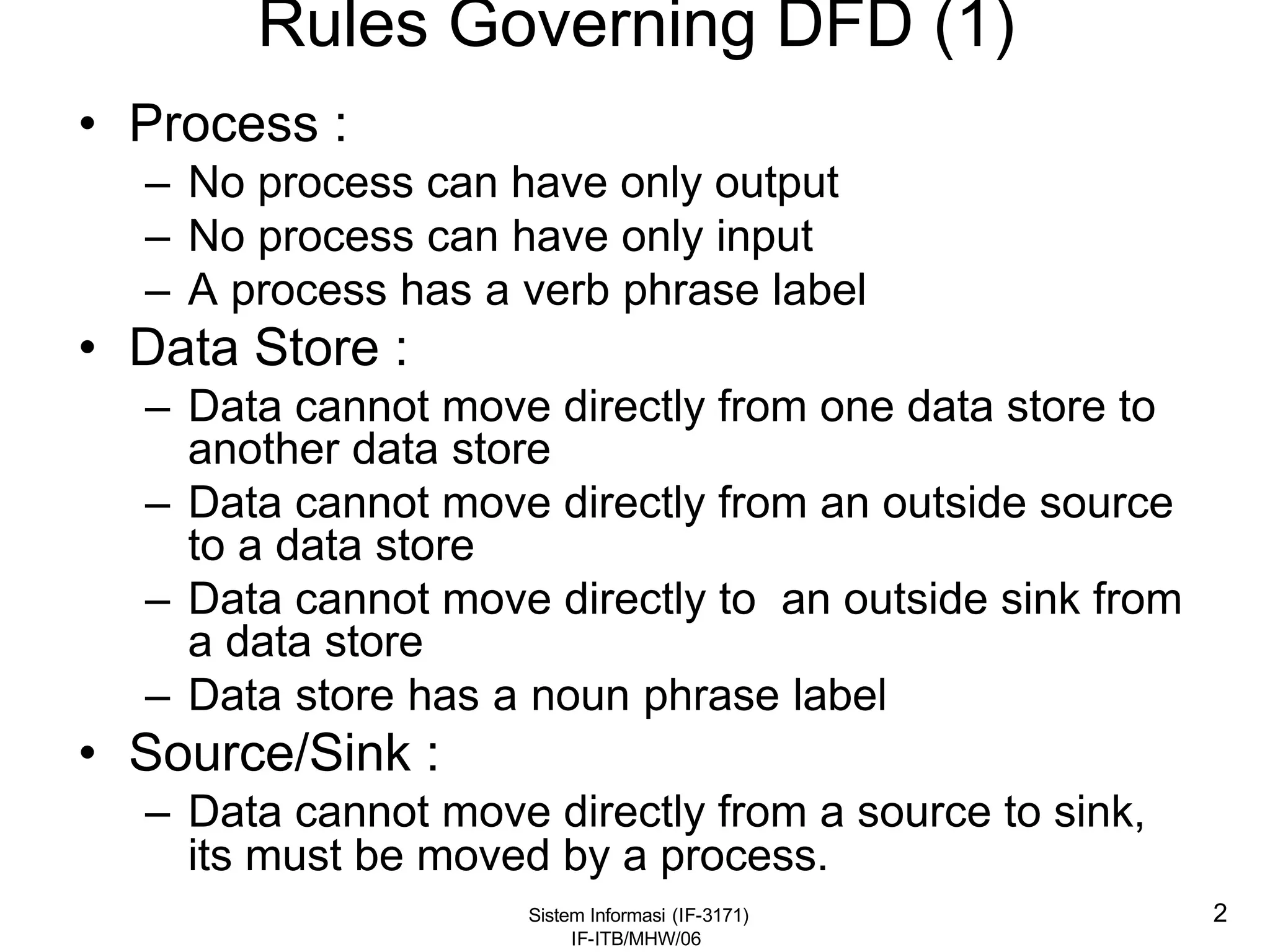
– No process can have only output
– No process can have only input
– A process has a verb phrase label
• Data Store :
– Data cannot move directly from one data store to
another data store
– Data cannot move directly from an outside source
to a data store
– Data cannot move directly to an outside sink from
a data store
– Data store has a noun phrase label
• Source/Sink :
– Data cannot move directly from a source to sink,
its must be moved by a process.
Sistem Informasi (IF-3171)
IF-ITB/MHW/06
3
Rules Governing DFD (2)
• Data Flow :
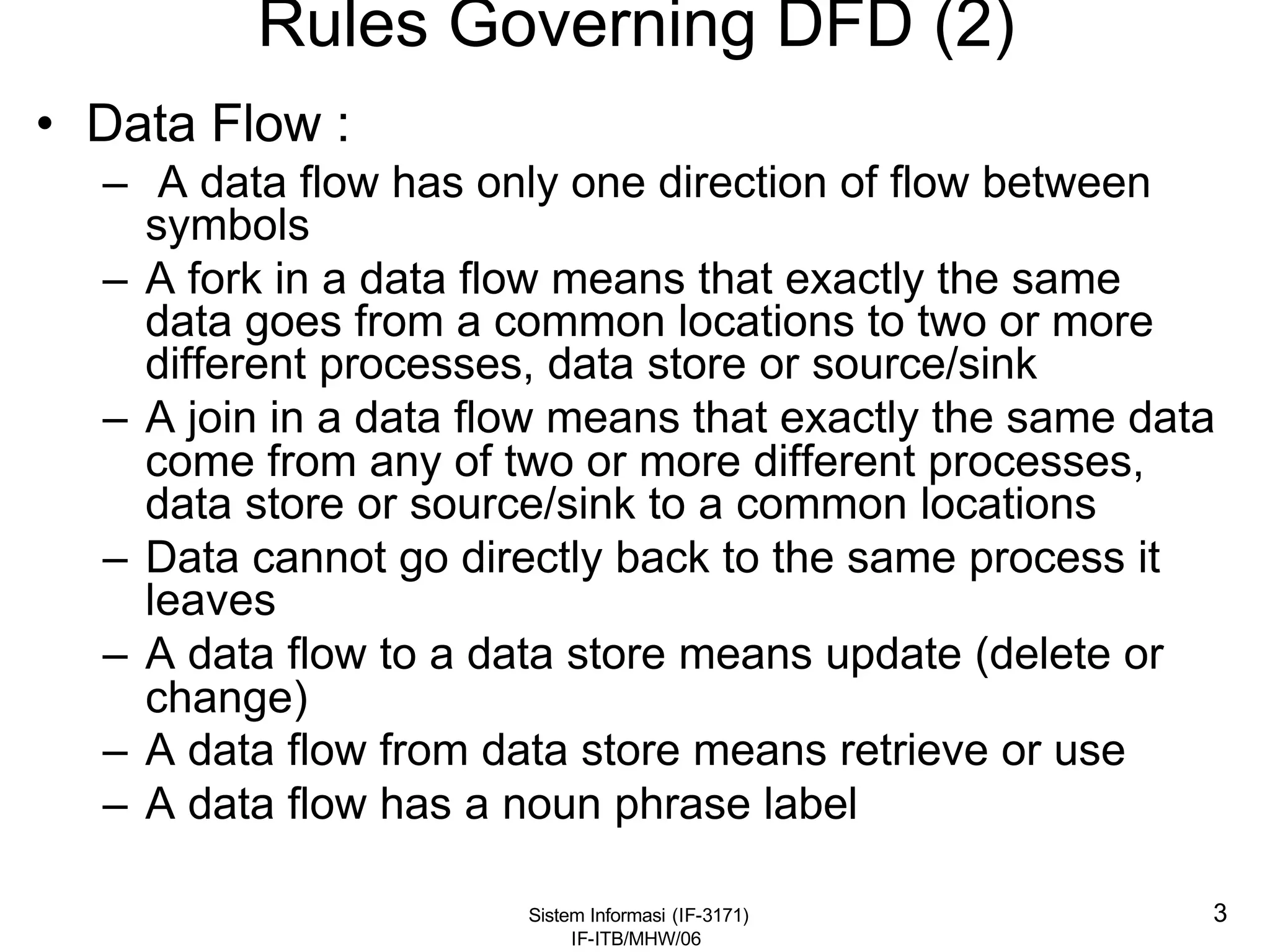
– A data flow has only one direction of flow between
symbols
– A fork in a data flow means that exactly the same
data goes from a common locations to two or more
different processes, data store or source/sink
– A join in a data flow means that exactly the same data
come from any of two or more different processes,
data store or source/sink to a common locations
– Data cannot go directly back to the same process it
leaves
– A data flow to a data store means update (delete or
change)
– A data flow from data store means retrieve or use
– A data flow has a noun phrase label
Sistem Informasi (IF-3171)
IF-ITB/MHW/06
4
Advanced Rule Governing DFD
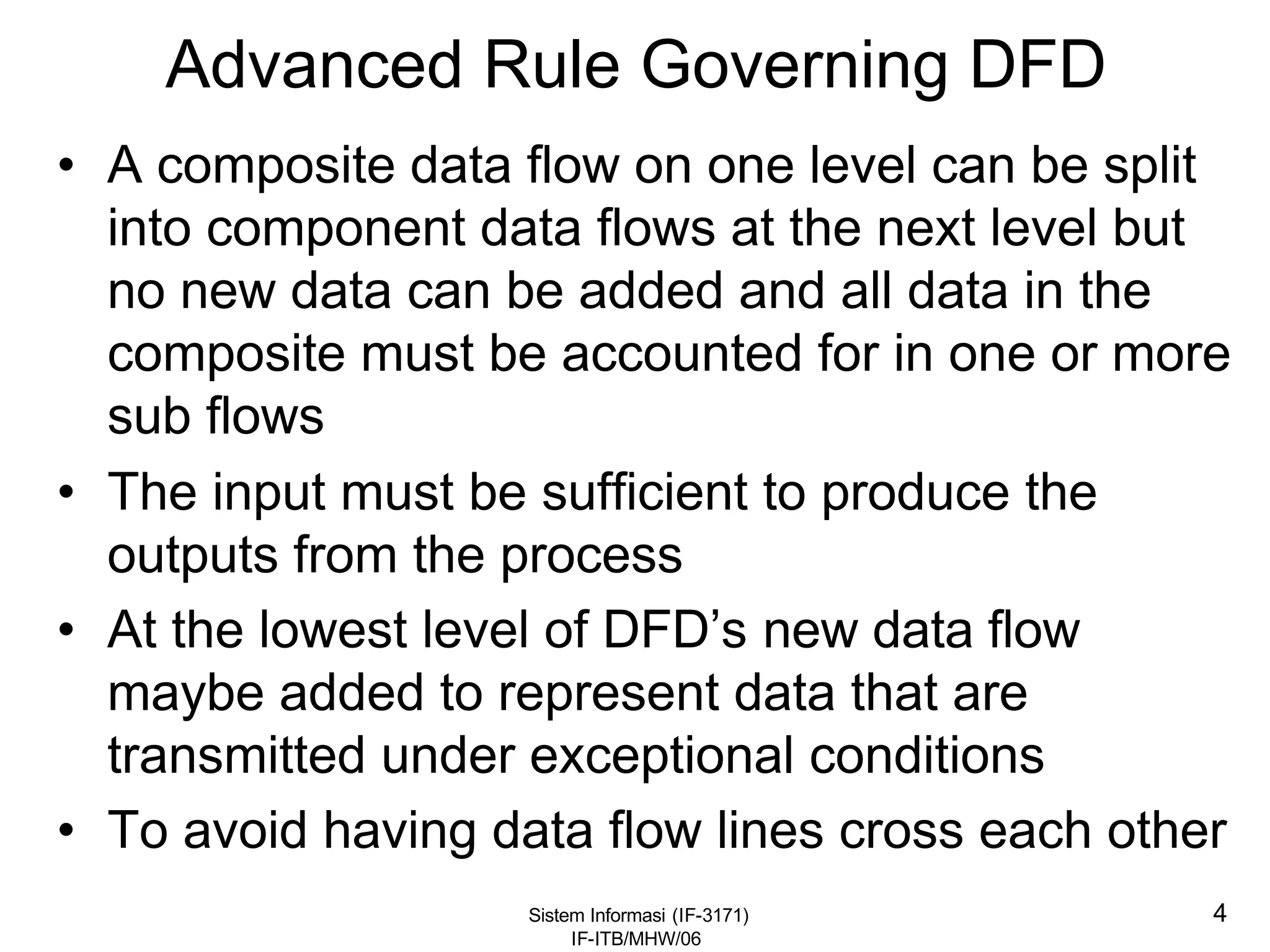
• A composite data flow on one level can be split
into component data flows at the next level but
no new data can be added and all data in the
composite must be accounted for in one or more
sub flows
• The input must be sufficient to produce the
outputs from the process
• At the lowest level of DFD’s new data flow
maybe added to represent data that are
transmitted under exceptional conditions
• To avoid having data flow lines cross each other
Sistem Informasi (IF-3171)
IF-ITB/MHW/06
5
Four Different Types of DFDs
1. Current physical
2. Current logical
3. New logical
4. New physical
Sistem Informasi (IF-3171)
IF-ITB/MHW/06
6
Guidelines for the drawing DFDs
• Completeness
• Consistency
• Timing
• Iterative development
Sistem Informasi (IF-3171)
IF-ITB/MHW/06
7
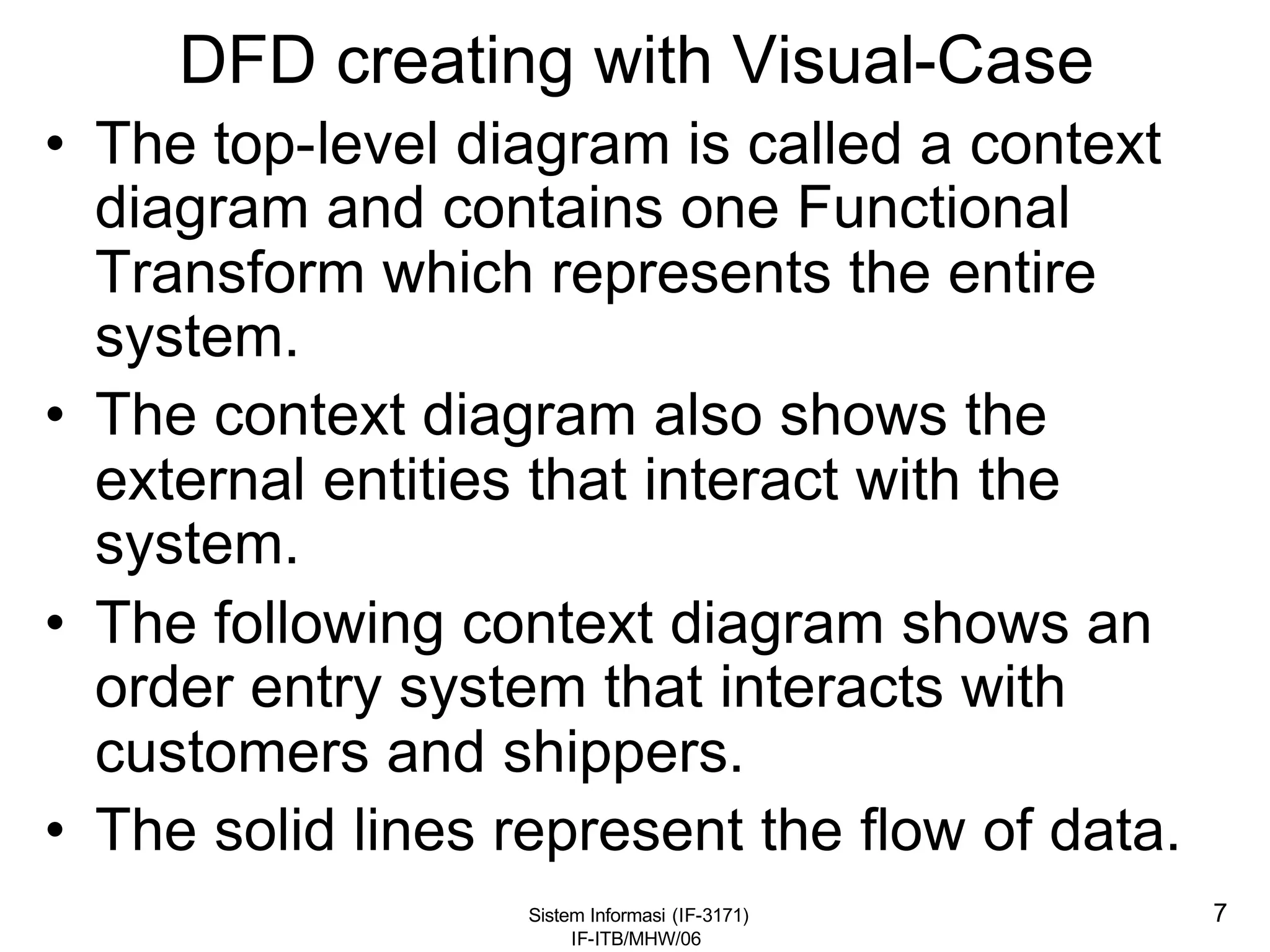
DFD creating with Visual-Case
• The top-level diagram is called a context
diagram and contains one Functional
Transform which represents the entire
system.
• The context diagram also shows the
external entities that interact with the
system.
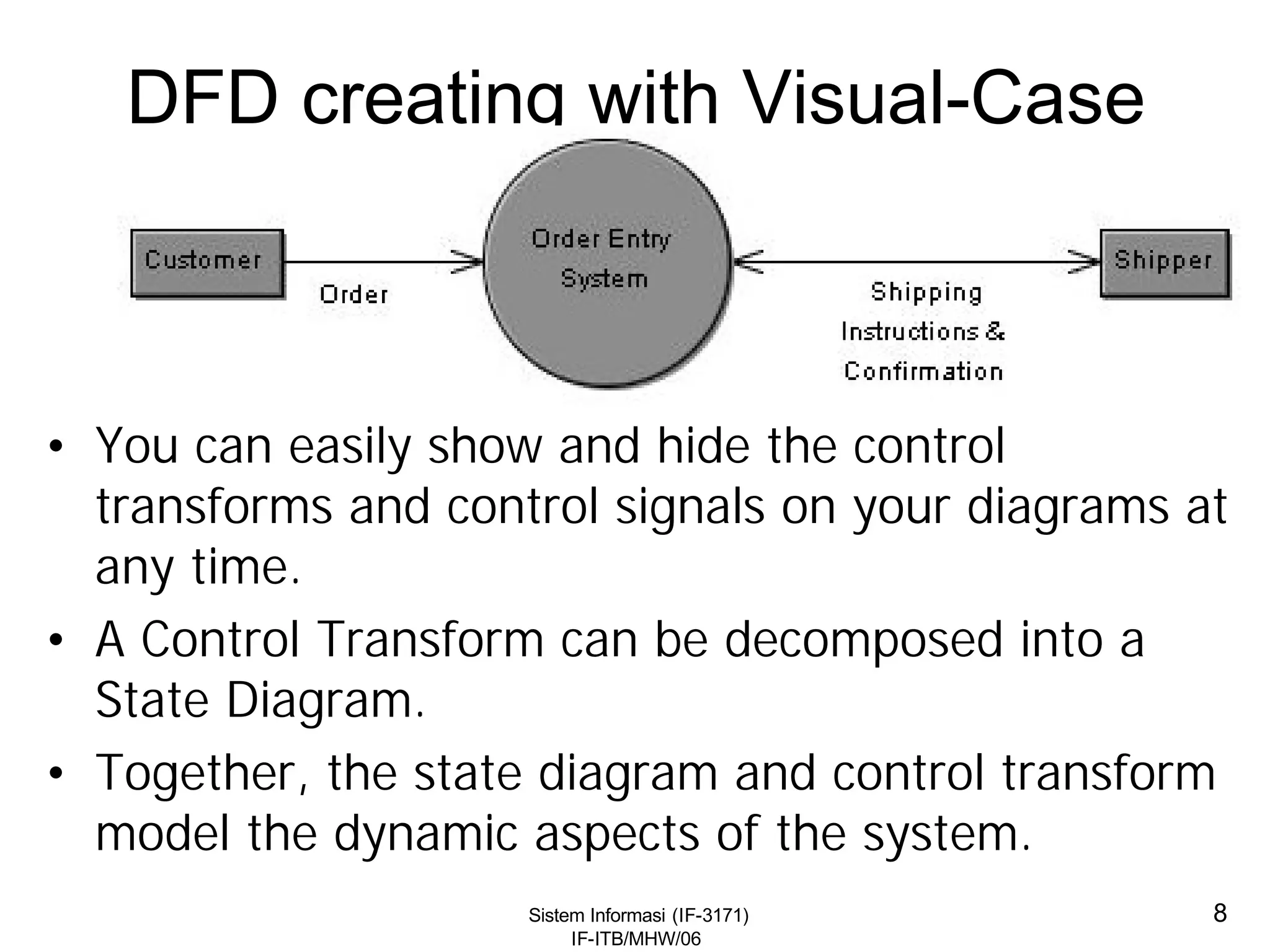
• The following context diagram shows an
order entry system that interacts with
customers and shippers.
• The solid lines represent the flow of data.
Sistem Informasi (IF-3171)
IF-ITB/MHW/06
8
DFD creating with Visual-Case
• You can easily show and hide the control
transforms and control signals on your diagrams at
any time.
• A Control Transform can be decomposed into a
State Diagram.
• Together, the state diagram and control transform
model the dynamic aspects of the system.
Sistem Informasi (IF-3171)
IF-ITB/MHW/06
9
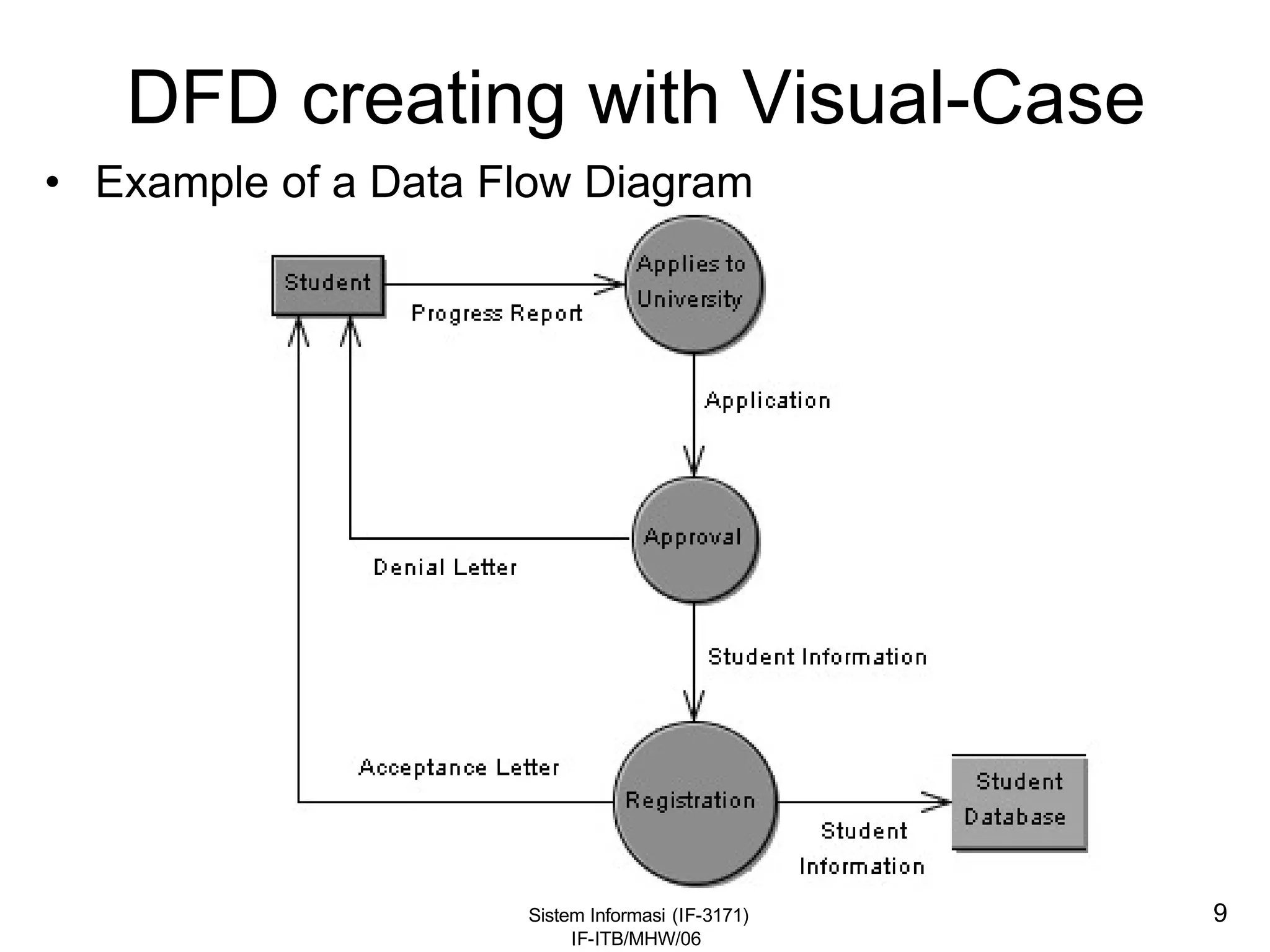
DFD creating with Visual-Case
• Example of a Data Flow Diagram
Sistem Informasi (IF-3171)
IF-ITB/MHW/06
10
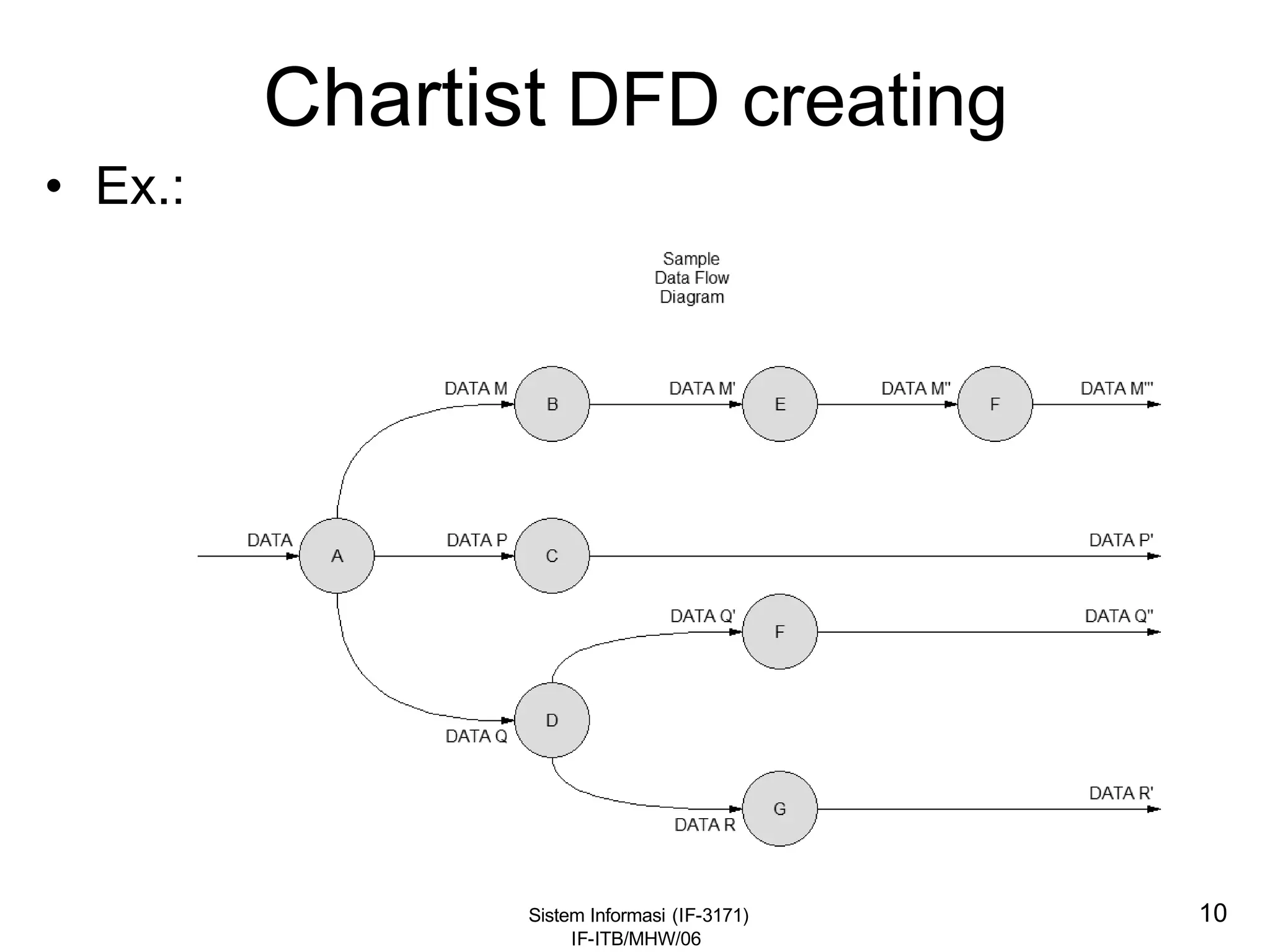
Chartist DFD creating
• Ex.:
Sistem Informasi (IF-3171)
IF-ITB/MHW/06
11
Logic Modeling
Sistem Informasi (IF-3171)
IF-ITB/MHW/06
12
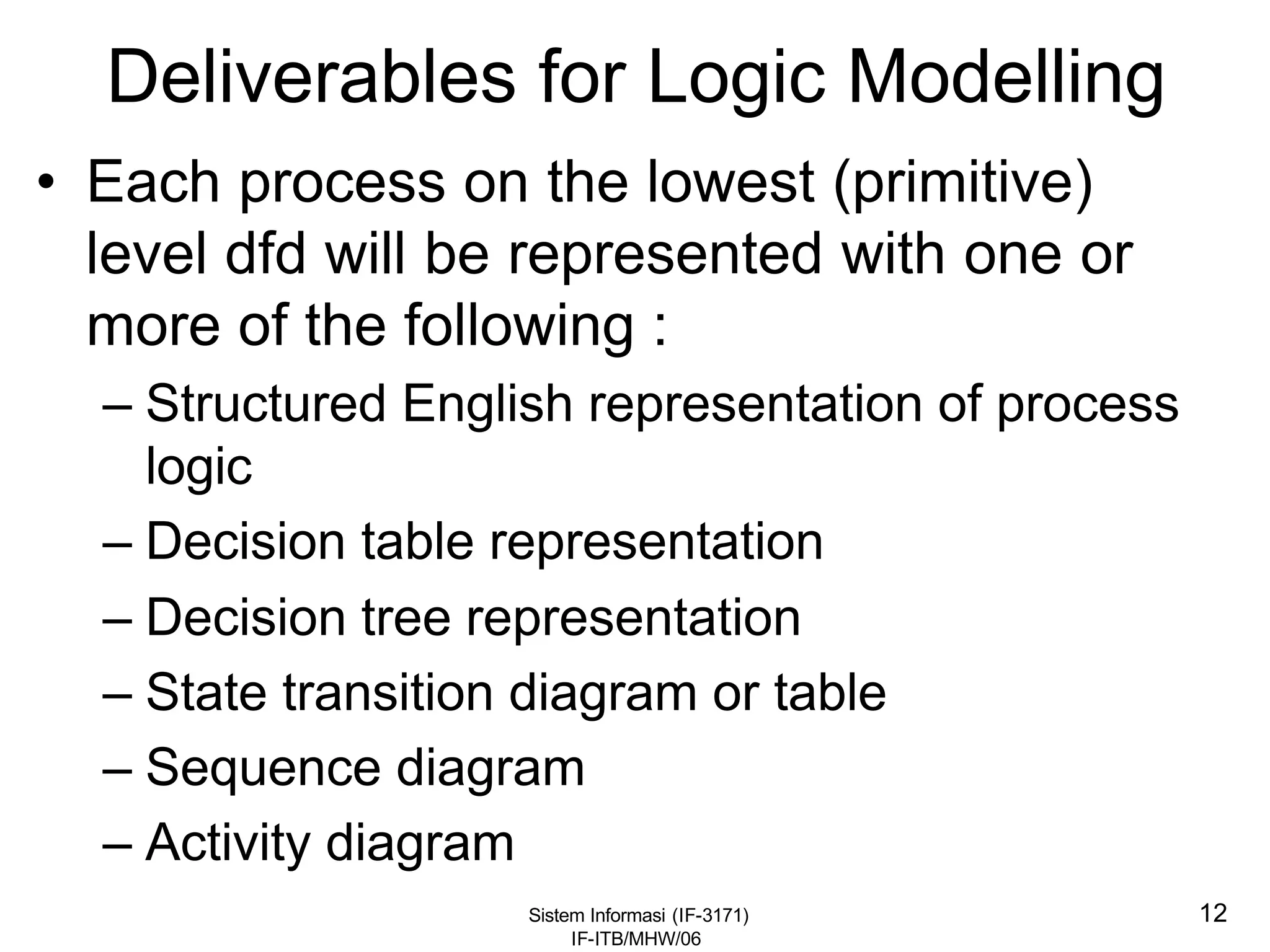
Deliverables for Logic Modelling
• Each process on the lowest (primitive)
level dfd will be represented with one or
more of the following :
– Structured English representation of process
logic
– Decision table representation
– Decision tree representation
– State transition diagram or table
– Sequence diagram
– Activity diagram
Sistem Informasi (IF-3171)
IF-ITB/MHW/06
13
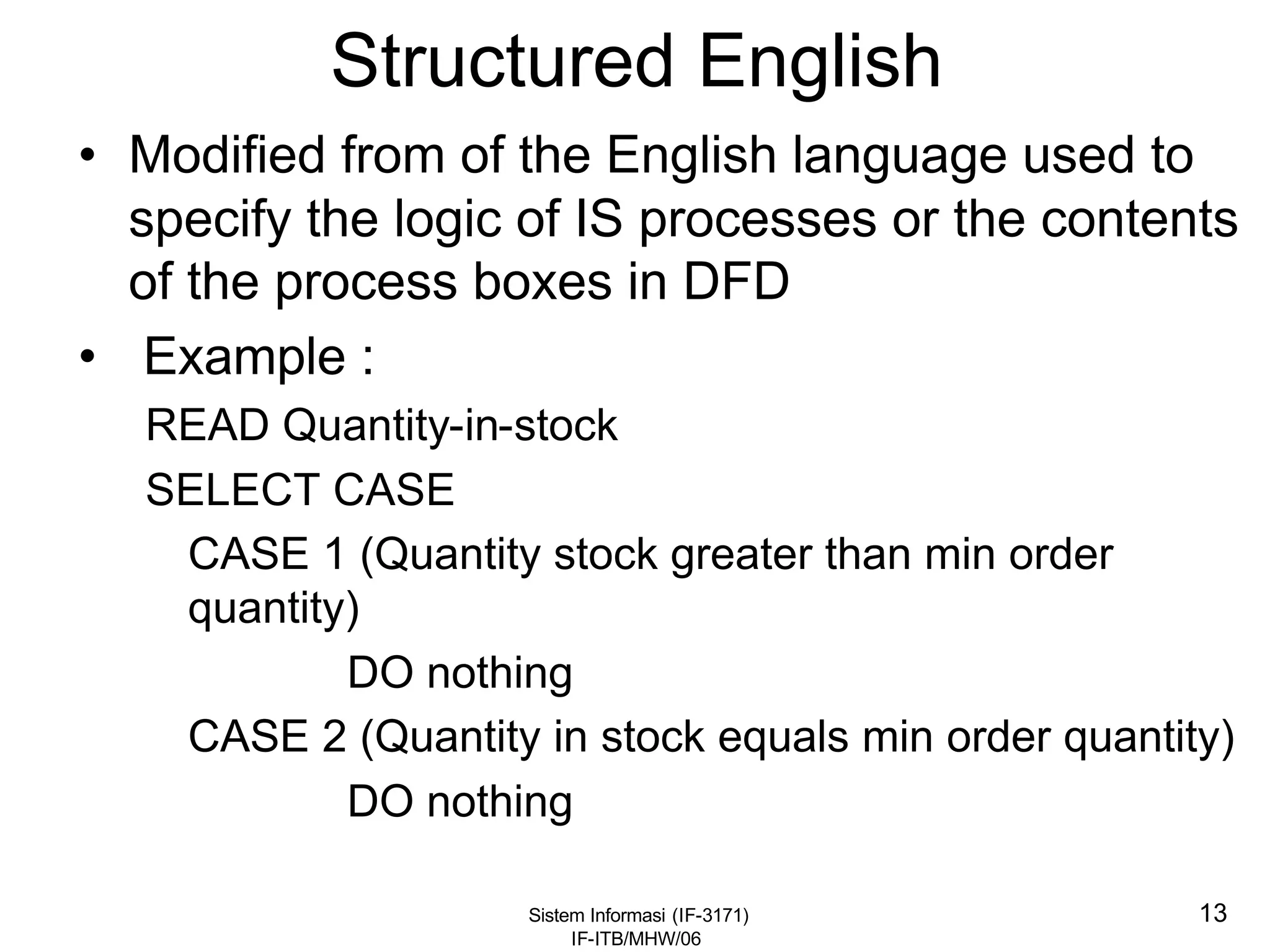
Structured English
• Modified from of the English language used to
specify the logic of IS processes or the contents
of the process boxes in DFD
• Example :
READ Quantity-in-stock
SELECT CASE
CASE 1 (Quantity stock greater than min order
quantity)
DO nothing
CASE 2 (Quantity in stock equals min order quantity)
DO nothing
Sistem Informasi (IF-3171)
IF-ITB/MHW/06
14
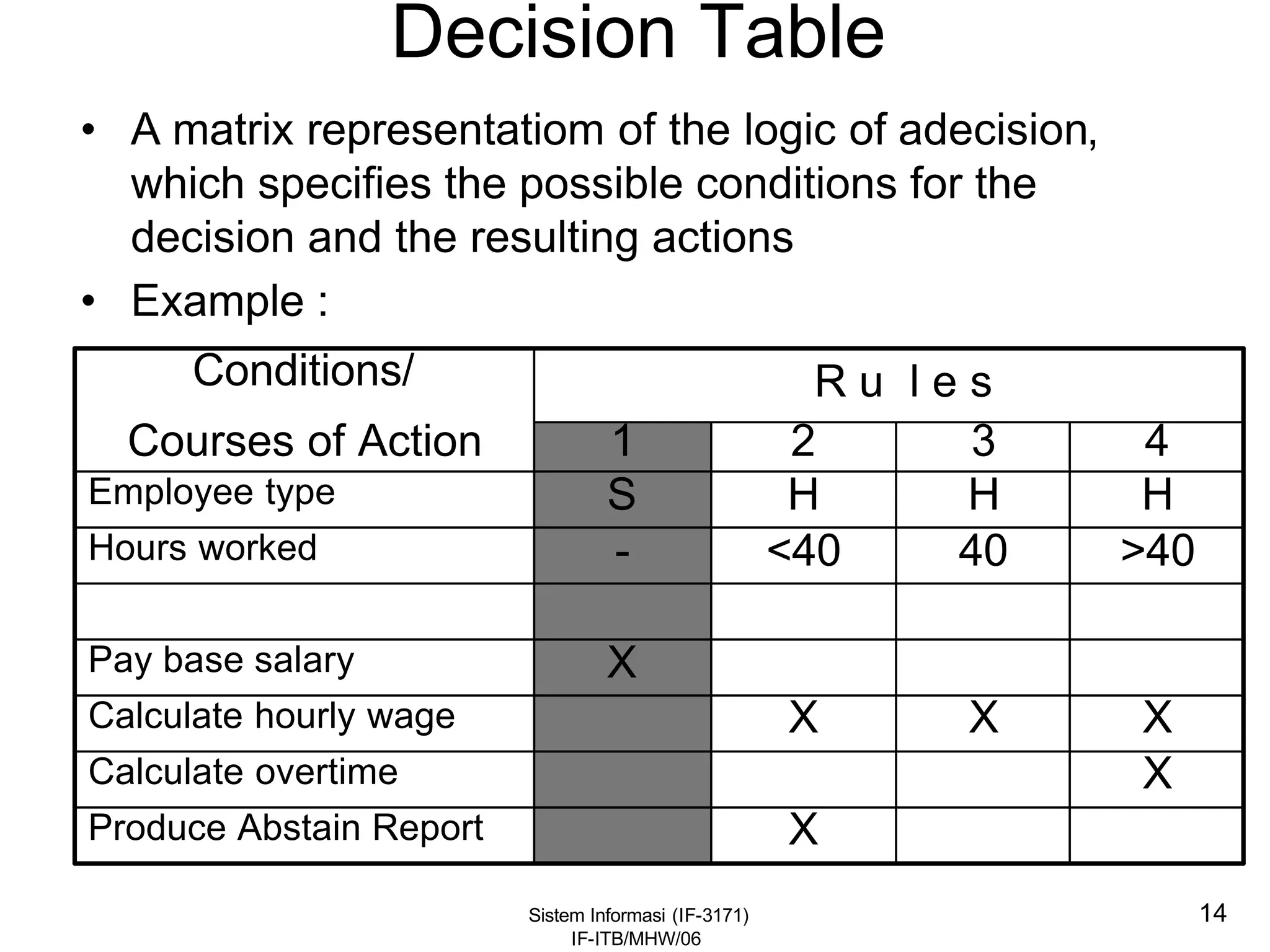
Decision Table
• A matrix representatiom of the logic of adecision,
which specifies the possible conditions for the
decision and the resulting actions
• Example :
XProduce Abstain Report
XCalculate overtime
XXXCalculate hourly wage
XPay base salary
>4040<40-Hours worked
HHHSEmployee type
4321Courses of Action
l e sR uConditions/
Sistem Informasi (IF-3171)
IF-ITB/MHW/06
15
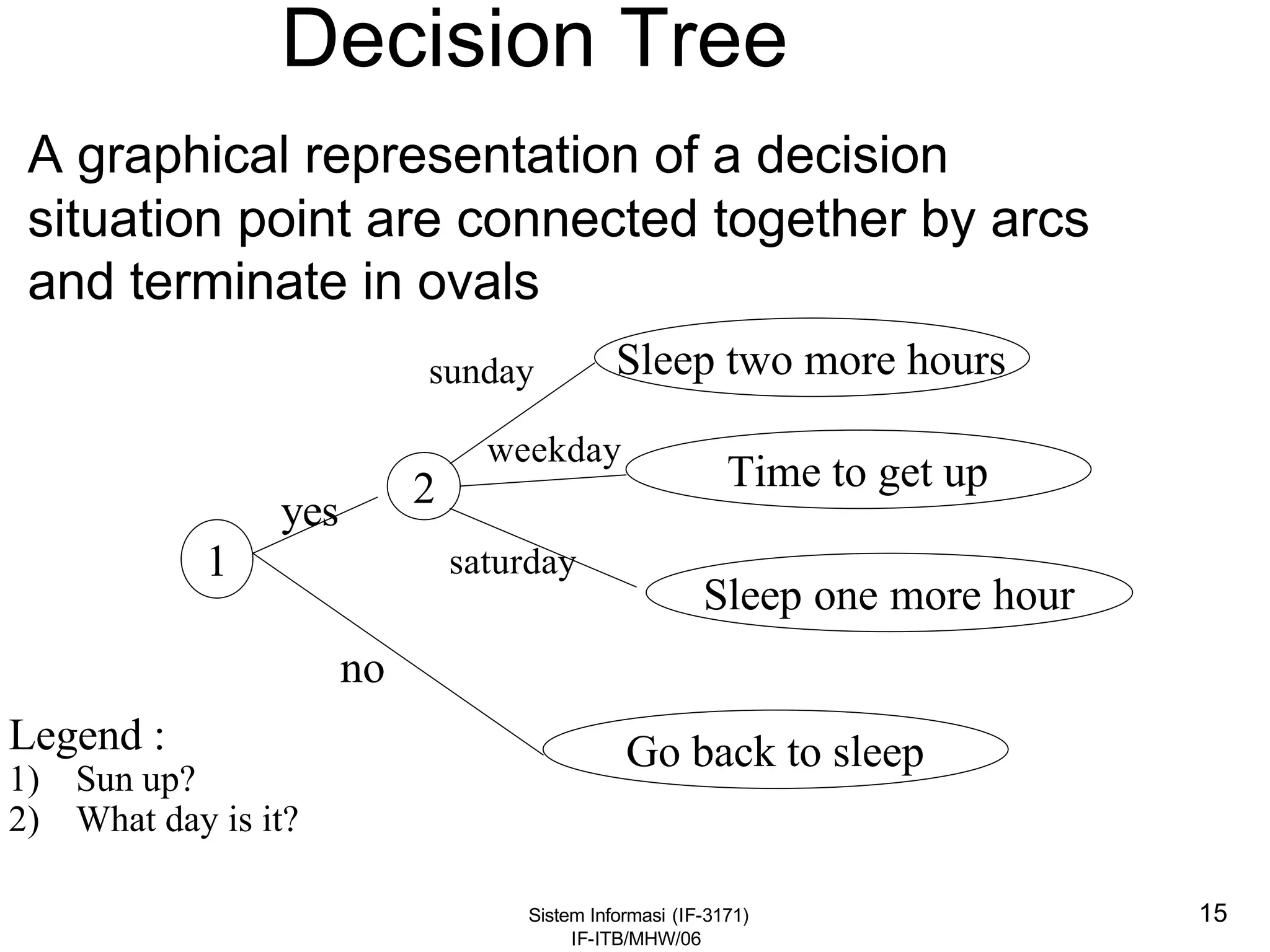
Decision Tree
• A graphical representation of a decision
situation point are connected together by arcs
and terminate in ovals
1
2
Sleep two more hours
Time to get up
sunday
weekday
saturday
yes
no
Sleep one more hour
Go back to sleepLegend :
1) Sun up?
2) What day is it?
Sistem Informasi (IF-3171)
IF-ITB/MHW/06
16
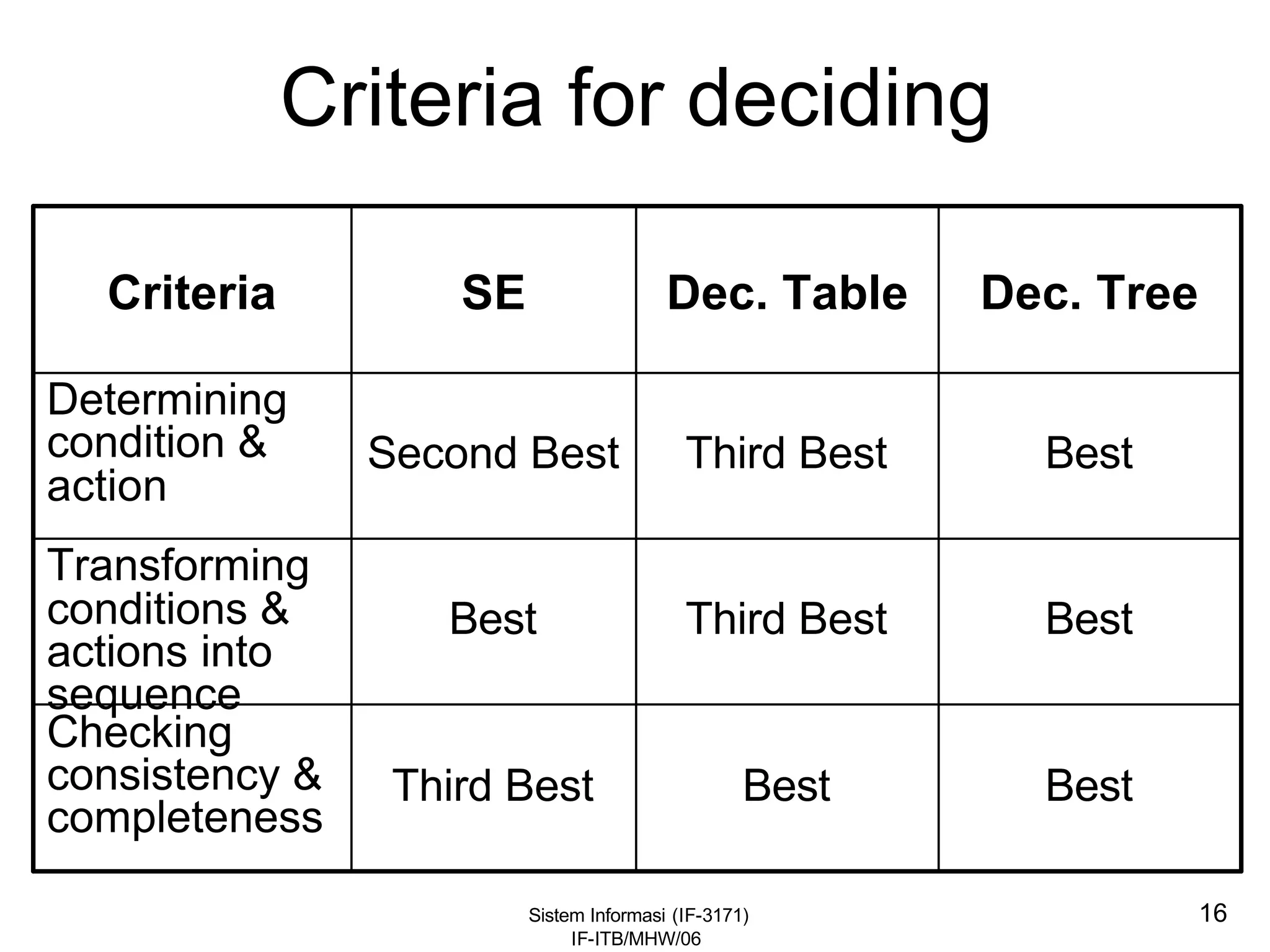
Criteria for deciding
BestBestThird Best
Checking
consistency &
completeness
BestThird BestBest
Transforming
conditions &
actions into
sequence
BestThird BestSecond Best
Determining
condition &
action
Dec. TreeDec. TableSECriteria
Sistem Informasi (IF-3171)
IF-ITB/MHW/06
17
Conceptual Data
Modeling
Sistem Informasi (IF-3171)
IF-ITB/MHW/06
18
Conceptual Data Modeling (CDM)
• CDM is a representation of organization data
• Typically do the cdm in parallel with other
requirement analysis & structuring steps during
system analysis ( req. determination, req.
structuring and alternative generation & selection)
• On the larger system development teams, a
subset of the project team concentrates on data
modeling while other team member focus attention
on process or logic modeling
• Develop/use from prior system dev. a cdm for the
current system and build a cdm that supports the
scope and req. the proposed or enhanced system
Sistem Informasi (IF-3171)
IF-ITB/MHW/06
19
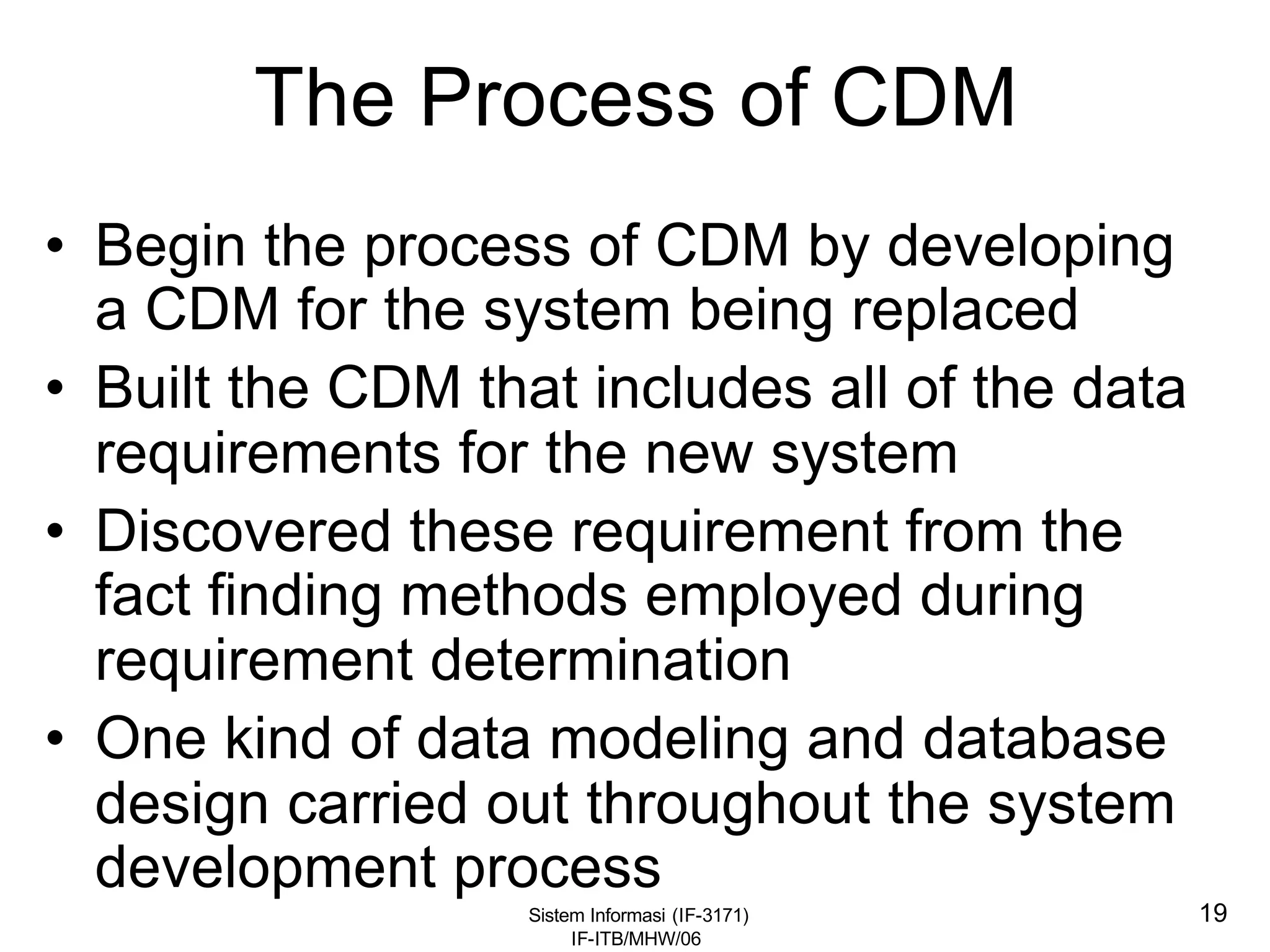
The Process of CDM
• Begin the process of CDM by developing
a CDM for the system being replaced
• Built the CDM that includes all of the data
requirements for the new system
• Discovered these requirement from the
fact finding methods employed during
requirement determination
• One kind of data modeling and database
design carried out throughout the system
development process
Sistem Informasi (IF-3171)
IF-ITB/MHW/06
20
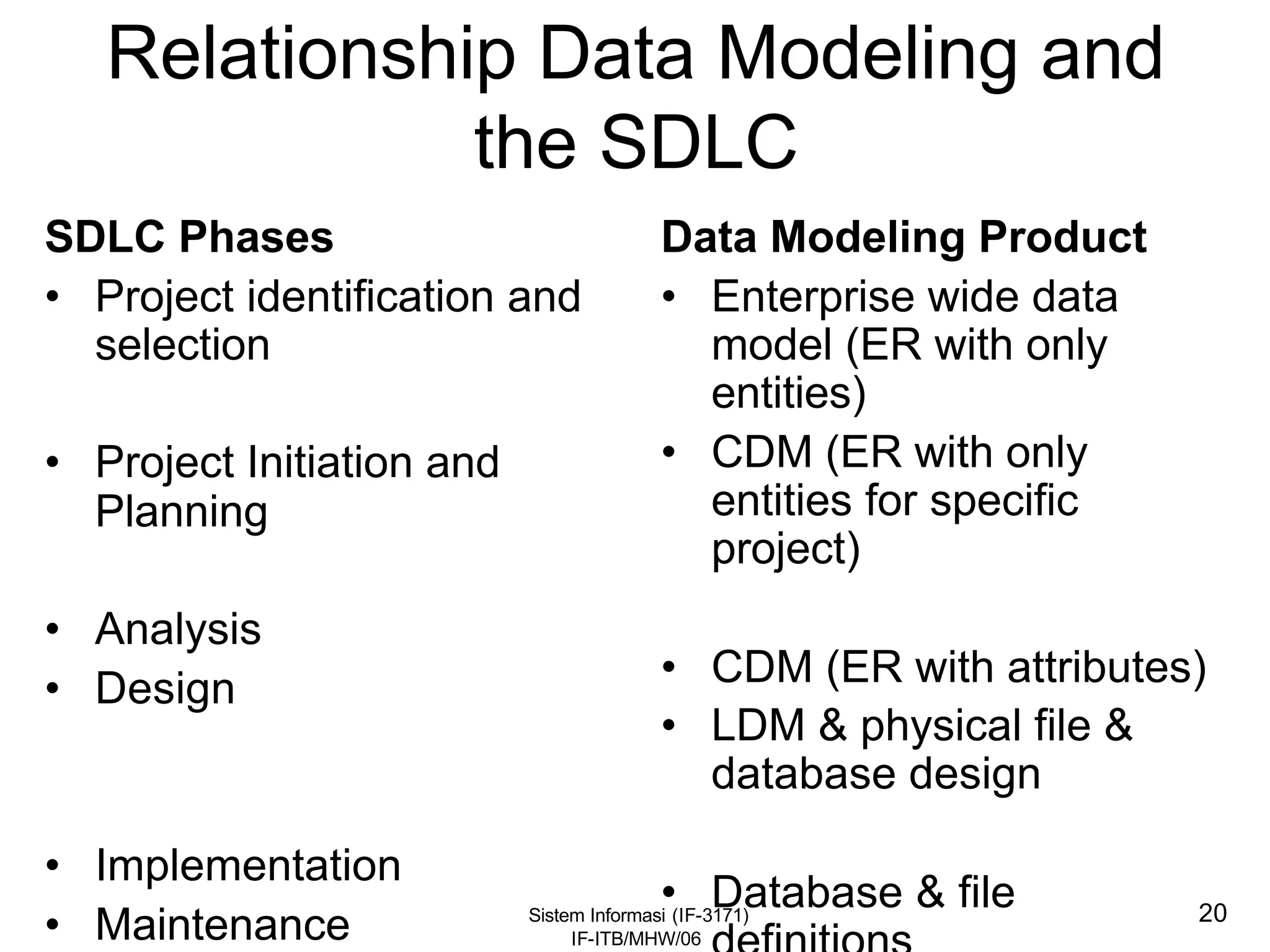
Relationship Data Modeling and
the SDLC
SDLC Phases
• Project identification and
selection
• Project Initiation and
Planning
• Analysis
• Design
• Implementation
• Maintenance
Data Modeling Product
• Enterprise wide data
model (ER with only
entities)
• CDM (ER with only
entities for specific
project)
• CDM (ER with attributes)
• LDM & physical file &
database design
• Database & file
definitions
• Data model evolution
Sistem Informasi (IF-3171)
IF-ITB/MHW/06
21
Requirement Determination
Question for DM
• What are subjects/objects of business? What type of people,
place, things, material, event etc.? (data entities & their
description)
• What unique characteristic distinguishes each object from other
objects of the same type? (primary key)
• What characteristics describe each object? (attributes and
secondary key)
• How do you use this data? ( security control and understanding
who really knows the meaning of data)
• Over what period of time are you interested in this data?do you
need historical trends, current, estimated or projections?
(cardinality & time dimension of data)
• Are all instances of each object the same? Are some object
summaries or combination of more detaild object? (supertypes,
subtypes & aggregations)
• What events occur that imply associations between various
objects? (relationships & their cardinality & degree)
• Is each activity or event always handled the same way or are
there special circumstances? (integrity rules, min/max
cardinality, time dimension of data)
Sistem Informasi (IF-3171)
IF-ITB/MHW/06
22
Introduction to E-R Modeling
Sistem Informasi (IF-3171)
IF-ITB/MHW/06
23
E-R Data Model
• ER Data Model
– is a detailed, logical representation of the
entities, associations, and data elements
for an organization or for a business area
• ER Diagram is a graphical
representation of an ER Model
Sistem Informasi (IF-3171)
IF-ITB/MHW/06
24
Entity
• Entities is a person, place, object, event, or concept in the
user environment about which the organization wishes to
maintain data.
• Entity type (class/set) is a collection of entities that share
common properties or characteristics
• Entity instance is a single occurrence of an entity type
• Naming and defining entity type guidelines :
– Singular noun
– Descriptive & specific to the organization
– Concise
– Event entity types (result of the event)
Sistem Informasi (IF-3171)
IF-ITB/MHW/06
25
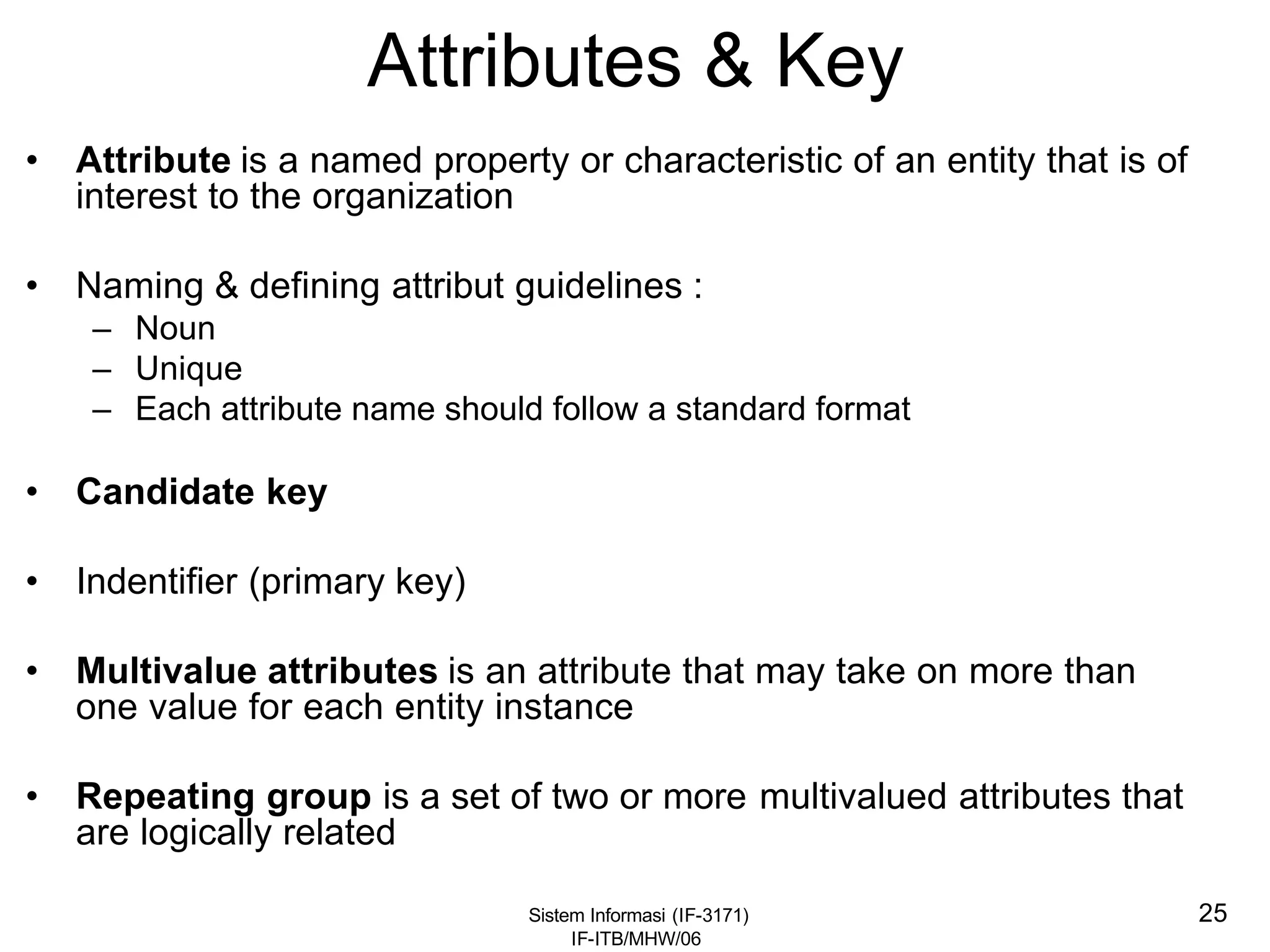
Attributes & Key
• Attribute is a named property or characteristic of an entity that is of
interest to the organization
• Naming & defining attribut guidelines :
– Noun
– Unique
– Each attribute name should follow a standard format
• Candidate key
• Indentifier (primary key)
• Multivalue attributes is an attribute that may take on more than
one value for each entity instance
• Repeating group is a set of two or more multivalued attributes that
are logically related
Sistem Informasi (IF-3171)
IF-ITB/MHW/06
26
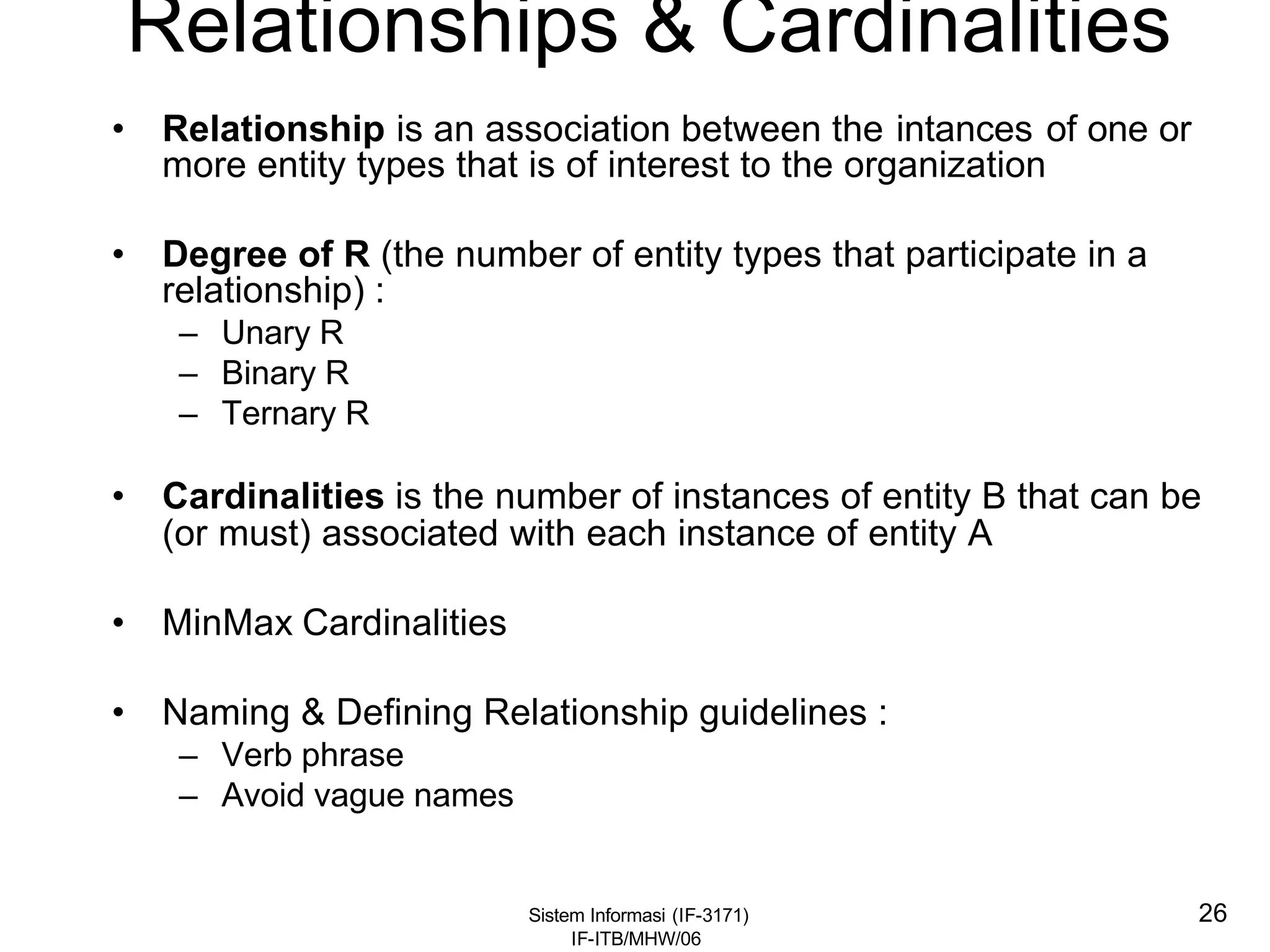
Relationships & Cardinalities
• Relationship is an association between the intances of one or
more entity types that is of interest to the organization
• Degree of R (the number of entity types that participate in a
relationship) :
– Unary R
– Binary R
– Ternary R
• Cardinalities is the number of instances of entity B that can be
(or must) associated with each instance of entity A
• MinMax Cardinalities
• Naming & Defining Relationship guidelines :
– Verb phrase
– Avoid vague names
Sistem Informasi (IF-3171)
IF-ITB/MHW/06
27
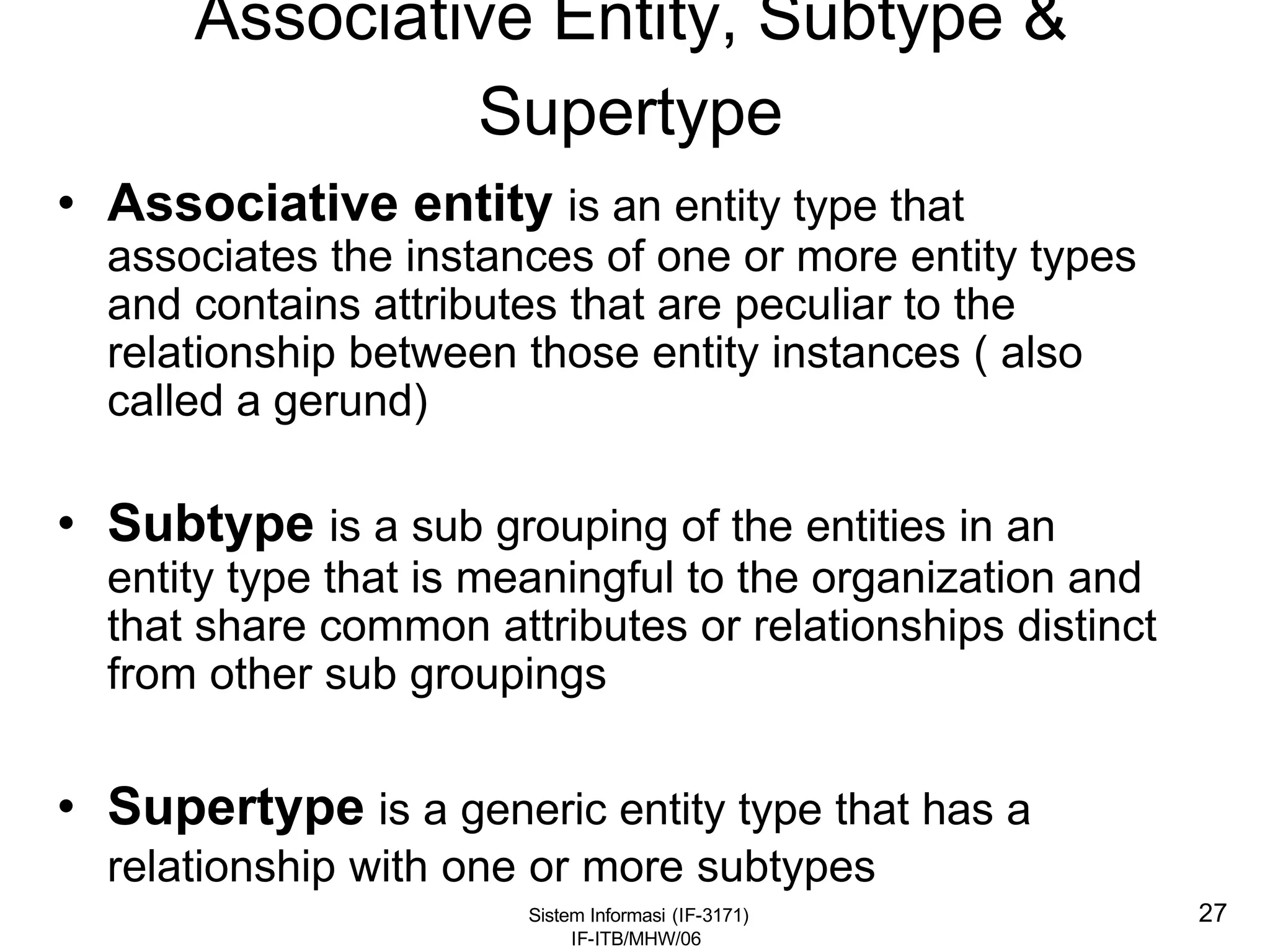
Associative Entity, Subtype &
Supertype
• Associative entity is an entity type that
associates the instances of one or more entity types
and contains attributes that are peculiar to the
relationship between those entity instances ( also
called a gerund)
• Subtype is a sub grouping of the entities in an
entity type that is meaningful to the organization and
that share common attributes or relationships distinct
from other sub groupings
• Supertype is a generic entity type that has a
relationship with one or more subtypes
Sistem Informasi (IF-3171)
IF-ITB/MHW/06
28
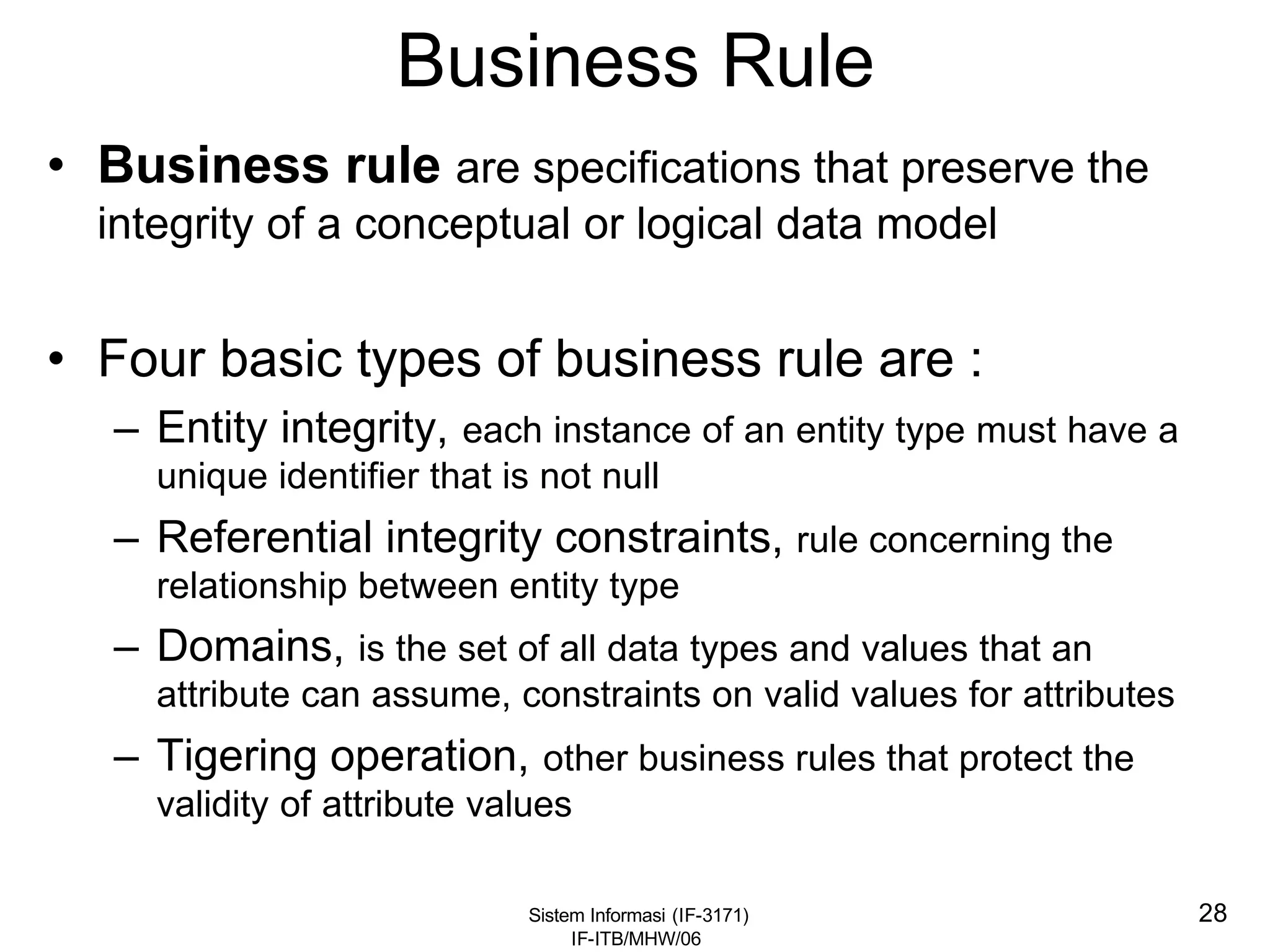
Business Rule
• Business rule are specifications that preserve the
integrity of a conceptual or logical data model
• Four basic types of business rule are :
– Entity integrity, each instance of an entity type must have a
unique identifier that is not null
– Referential integrity constraints, rule concerning the
relationship between entity type
– Domains, is the set of all data types and values that an
attribute can assume, constraints on valid values for attributes
– Tigering operation, other business rules that protect the
validity of attribute values
Sistem Informasi (IF-3171)
IF-ITB/MHW/06
29
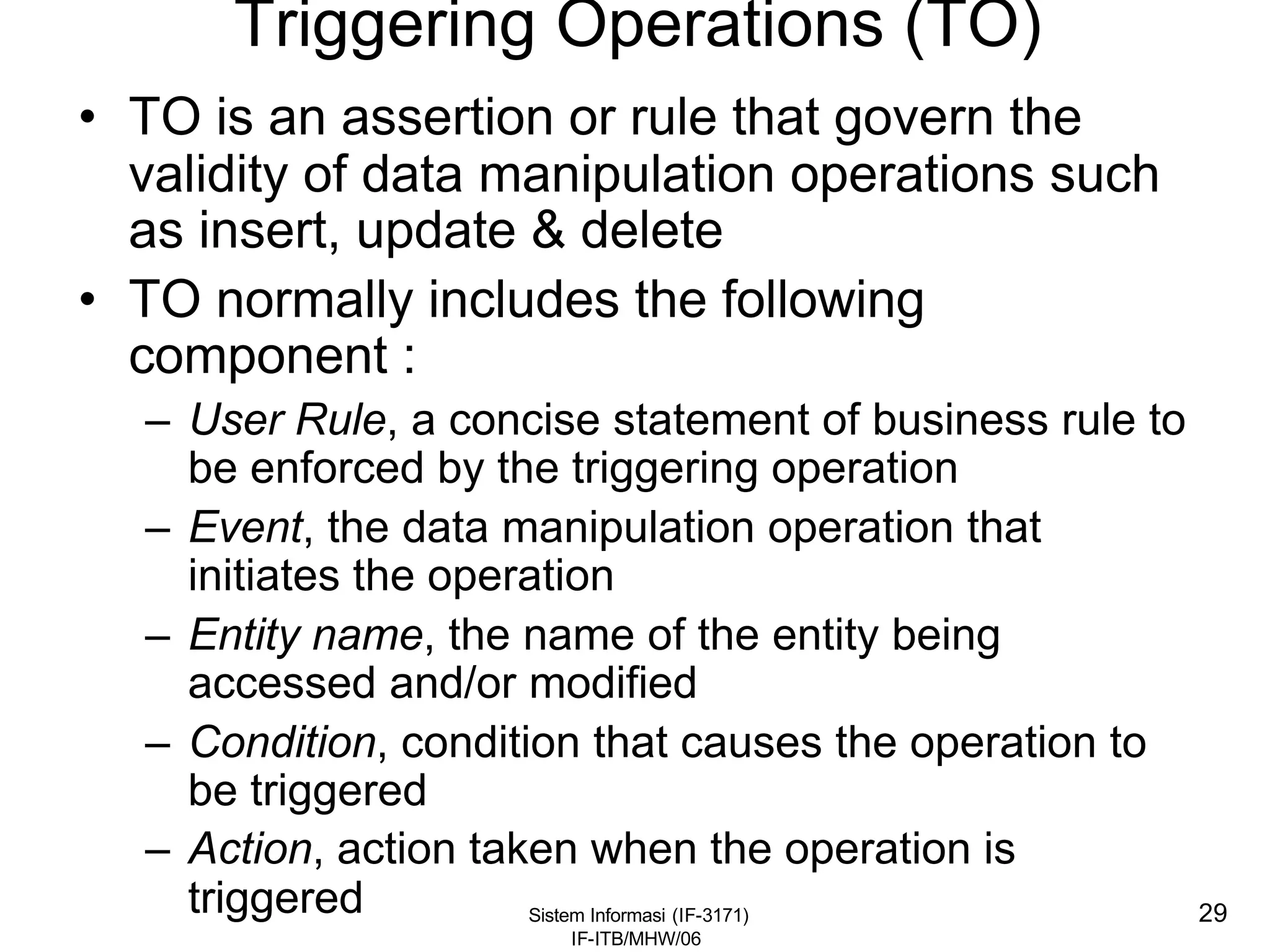
Triggering Operations (TO)
• TO is an assertion or rule that govern the
validity of data manipulation operations such
as insert, update & delete
• TO normally includes the following
component :
– User Rule, a concise statement of business rule to
be enforced by the triggering operation
– Event, the data manipulation operation that
initiates the operation
– Entity name, the name of the entity being
accessed and/or modified
– Condition, condition that causes the operation to
be triggered
– Action, action taken when the operation is
triggered
Sistem Informasi (IF-3171)
IF-ITB/MHW/06
30
Sistem Pengkodean
Sistem Informasi (IF-3171)
IF-ITB/MHW/06
31
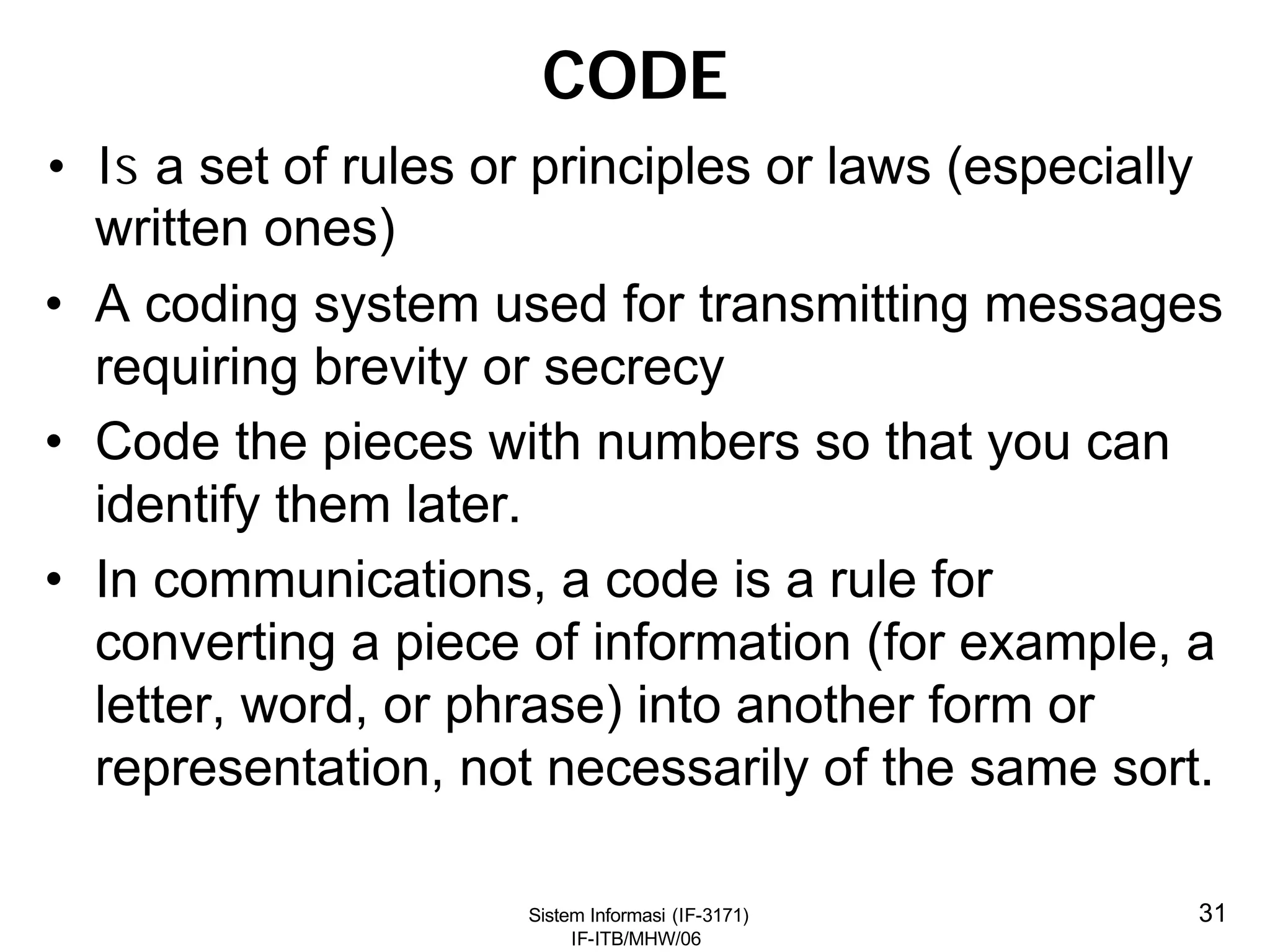
CODE
• Is a set of rules or principles or laws (especially
written ones)
• A coding system used for transmitting messages
requiring brevity or secrecy
• Code the pieces with numbers so that you can
identify them later.
• In communications, a code is a rule for
converting a piece of information (for example, a
letter, word, or phrase) into another form or
representation, not necessarily of the same sort.
Sistem Informasi (IF-3171)
IF-ITB/MHW/06
32
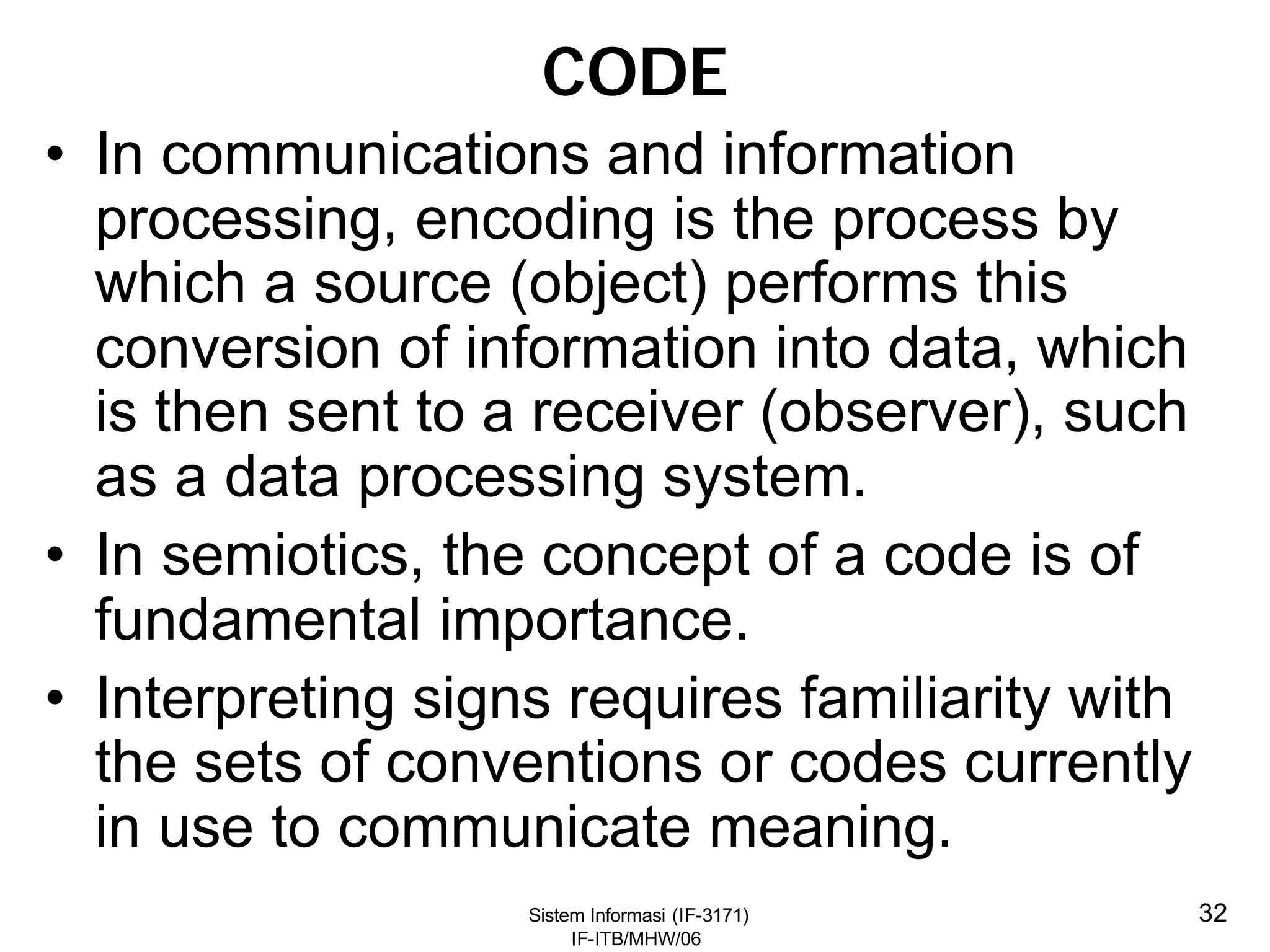
CODE
• In communications and information
processing, encoding is the process by
which a source (object) performs this
conversion of information into data, which
is then sent to a receiver (observer), such
as a data processing system.
• In semiotics, the concept of a code is of
fundamental importance.
• Interpreting signs requires familiarity with
the sets of conventions or codes currently
in use to communicate meaning.
Sistem Informasi (IF-3171)
IF-ITB/MHW/06
33
CODE
• Source code
– Is the code that a program consists of before the program
is being compiled.
– The form in which a computer program is written by the
programmer.
– A set of programming language instructions that must be
translated to machine instructions before the program can
run.
• Object code
– Machine-executable instructions, usually generated by a
compiler from source code written in a higher-level
language.
– Code in machine-readable form that can be executed by
your computer's CPU and operating system, usually linked
with libraries to create an executable file.
Sistem Informasi (IF-3171)
IF-ITB/MHW/06
34
CODE
• Universal product code
– The standard barcode symbology for retail food
packages in the United States.
– A classification for coding data onto products by a
series of thick and thin vertical lines.
• bar code
– The common term for Universal Product Code.
– An array of machine-readable rectangular bars and
spaces arranged in a specific way defined in
international standards to represent letters, numbers,
and other human-readable symbols.
Sistem Informasi (IF-3171)
IF-ITB/MHW/06
35
CODE
• Uniform commercial code
– The State Code which regulates the transfer of
and security interests in personal property.
– A set of standard rules, adopted by 49 states,
that governs commercial transactions.
• Genetic code
– The sequence of nucleotides, coded in triplets
(codons) along the mRNA, that determines the
sequence of amino acids in protein synthesis.
– The way in which genetic information is stored
in living organisms.
Sistem Informasi (IF-3171)
IF-ITB/MHW/06
36
Pengkodean
• Pengkodean dibangun dengan tujuan a.l :
– Memberikan identitas yang ringkas dan unik
– Memberikan arti khusus dalam proses
pengolahan
– Mereduksi volume data yang harus direkam
– Meningkatkan ketelilitian proses pengolahan
• Kode dapat dibangun dari kumpulan karakter :
– Numerik
– Alfabetik
– Alfanumerik
– Karakter khusus
Sistem Informasi (IF-3171)
IF-ITB/MHW/06
37
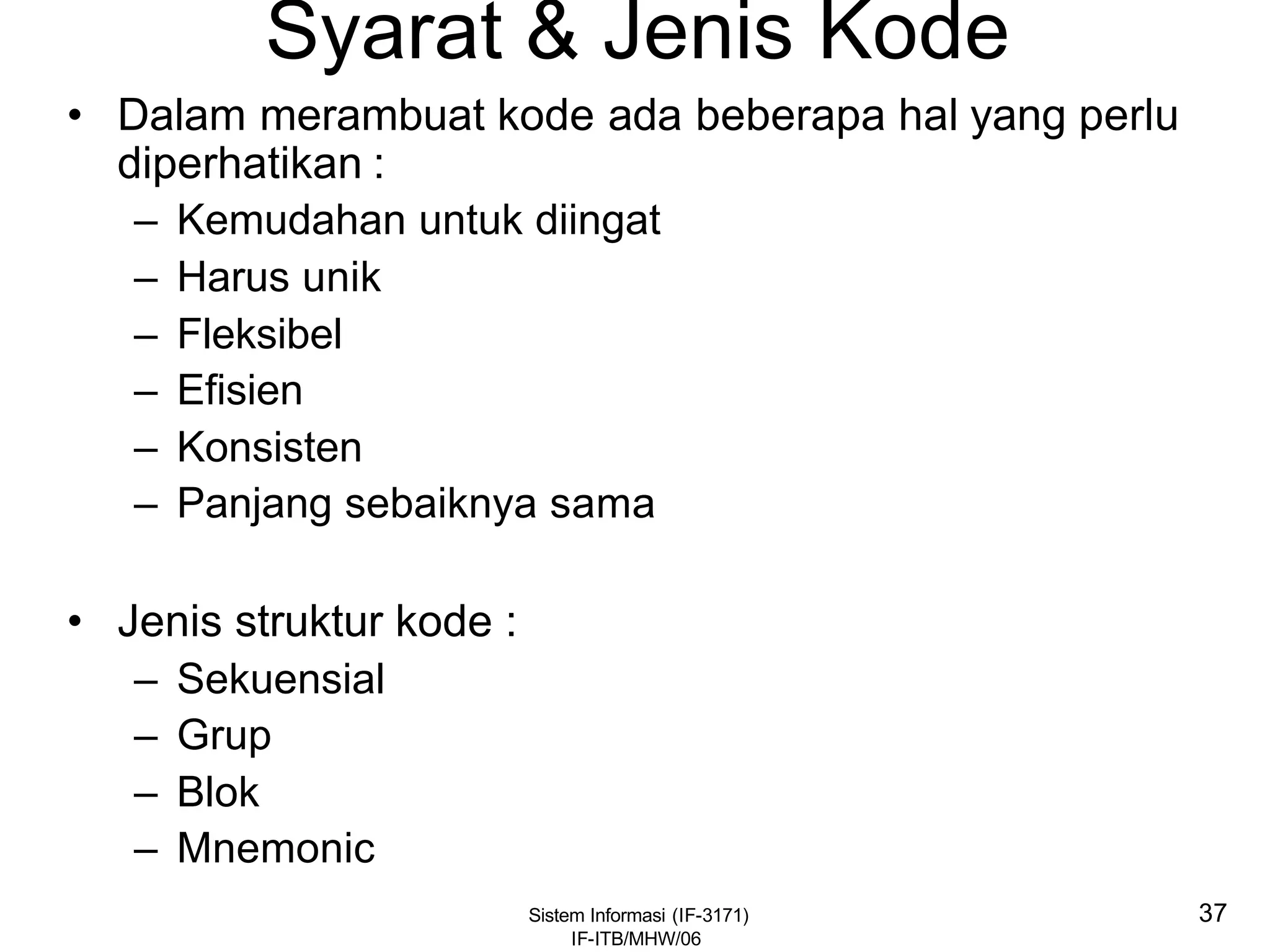
Syarat & Jenis Kode
• Dalam merambuat kode ada beberapa hal yang perlu
diperhatikan :
– Kemudahan untuk diingat
– Harus unik
– Fleksibel
– Efisien
– Konsisten
– Panjang sebaiknya sama
• Jenis struktur kode :
– Sekuensial
– Grup
– Blok
– Mnemonic
Sistem Informasi (IF-3171)
IF-ITB/MHW/06
38
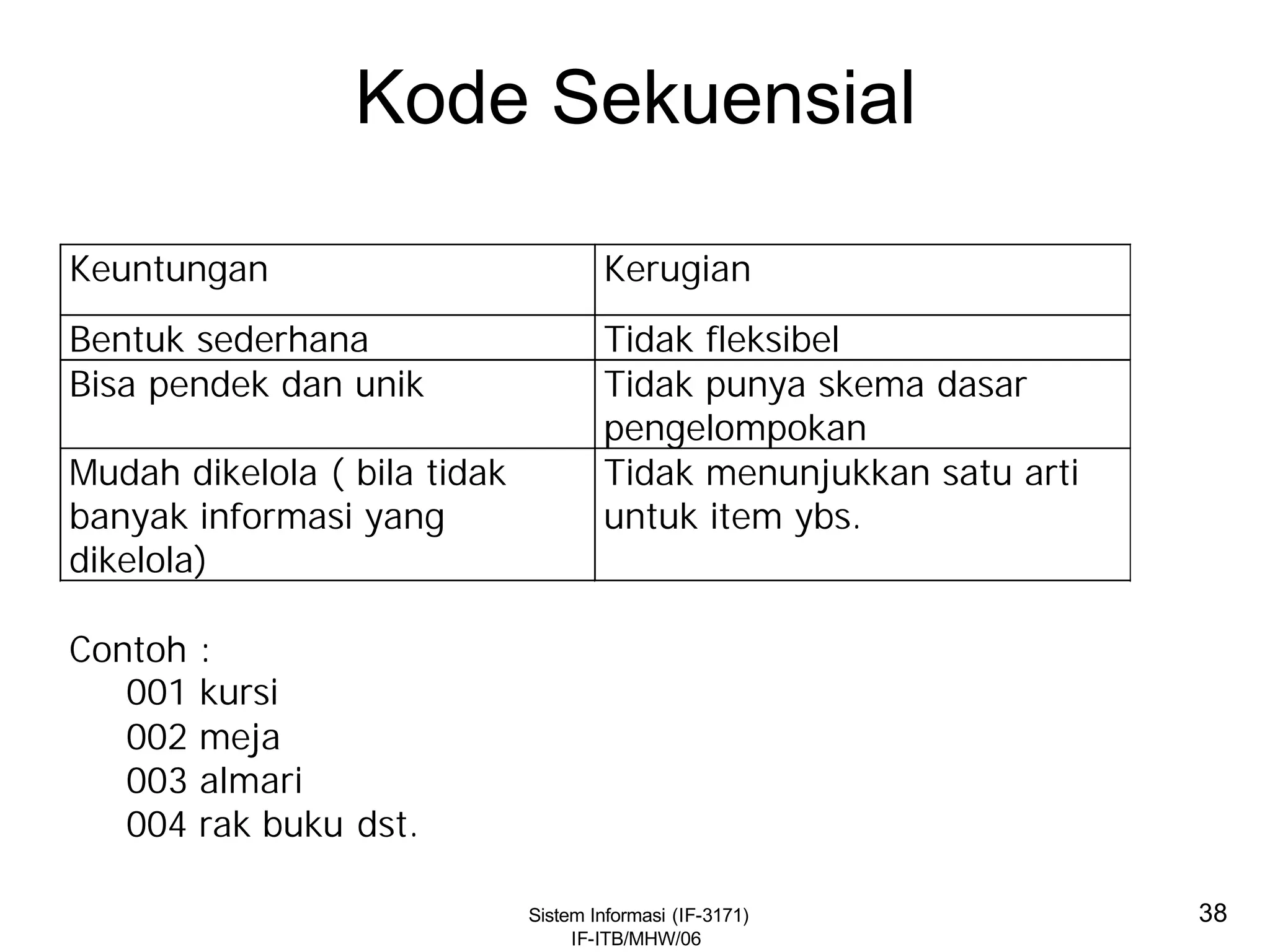
Kode Sekuensial
Keuntungan Kerugian
Bentuk sederhana Tidak fleksibel
Bisa pendek dan unik Tidak punya skema dasar
pengelompokan
Mudah dikelola ( bila tidak
banyak informasi yang
dikelola)
Tidak menunjukkan satu arti
untuk item ybs.
Contoh :
001 kursi
002 meja
003 almari
004 rak buku dst.
Sistem Informasi (IF-3171)
IF-ITB/MHW/06
39
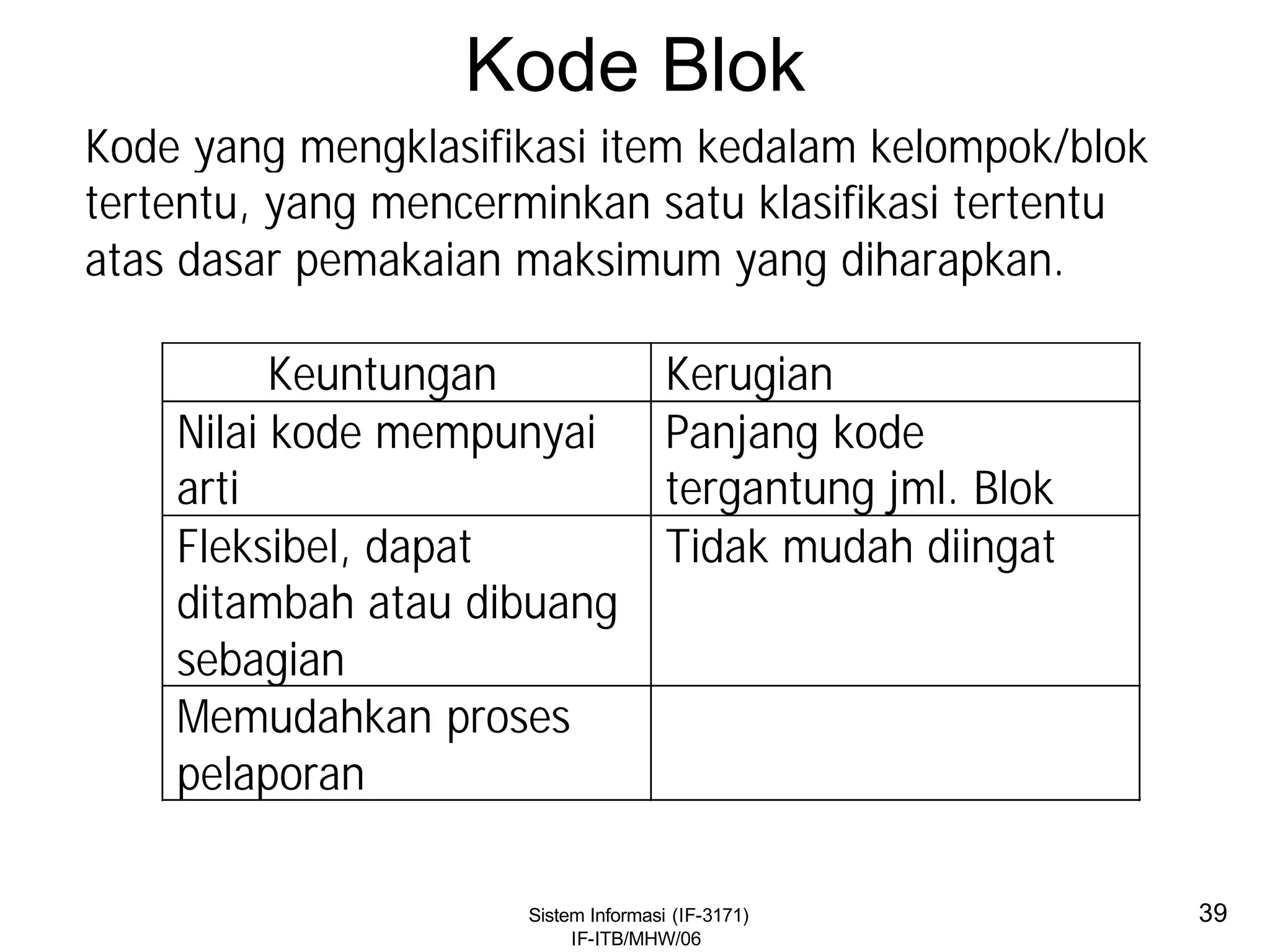
Kode Blok
Kode yang mengklasifikasi item kedalam kelompok/blok
tertentu, yang mencerminkan satu klasifikasi tertentu
atas dasar pemakaian maksimum yang diharapkan.
Keuntungan Kerugian
Nilai kode mempunyai
arti
Panjang kode
tergantung jml. Blok
Fleksibel, dapat
ditambah atau dibuang
sebagian
Tidak mudah diingat
Memudahkan proses
pelaporan
Sistem Informasi (IF-3171)
IF-ITB/MHW/06
40
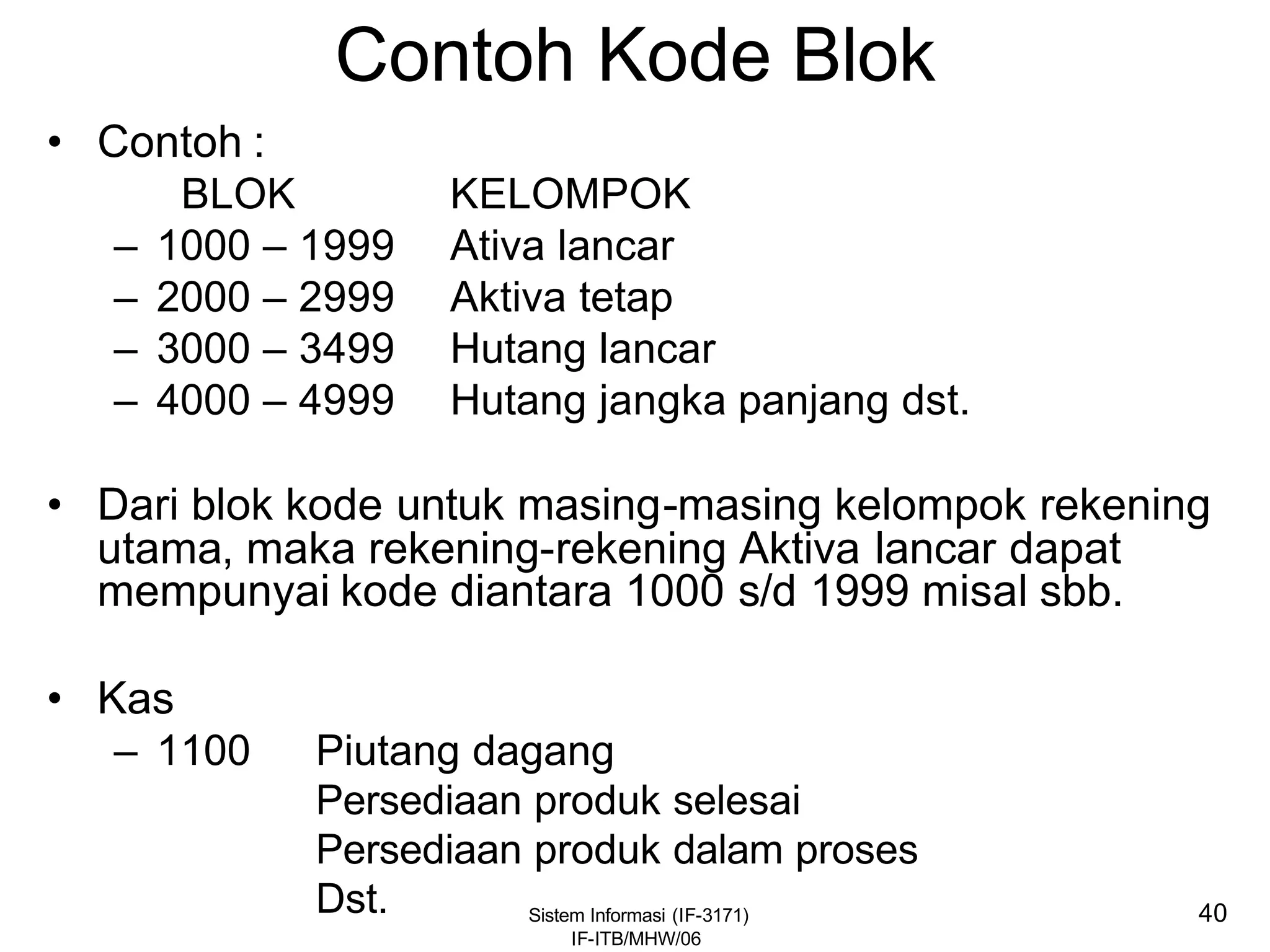
Contoh Kode Blok
• Contoh :
BLOK KELOMPOK
– 1000 – 1999 Ativa lancar
– 2000 – 2999 Aktiva tetap
– 3000 – 3499 Hutang lancar
– 4000 – 4999 Hutang jangka panjang dst.
• Dari blok kode untuk masing-masing kelompok rekening
utama, maka rekening-rekening Aktiva lancar dapat
mempunyai kode diantara 1000 s/d 1999 misal sbb.
• Kas
– 1100 Piutang dagang
Persediaan produk selesai
Persediaan produk dalam proses
Dst.
Sistem Informasi (IF-3171)
IF-ITB/MHW/06
41
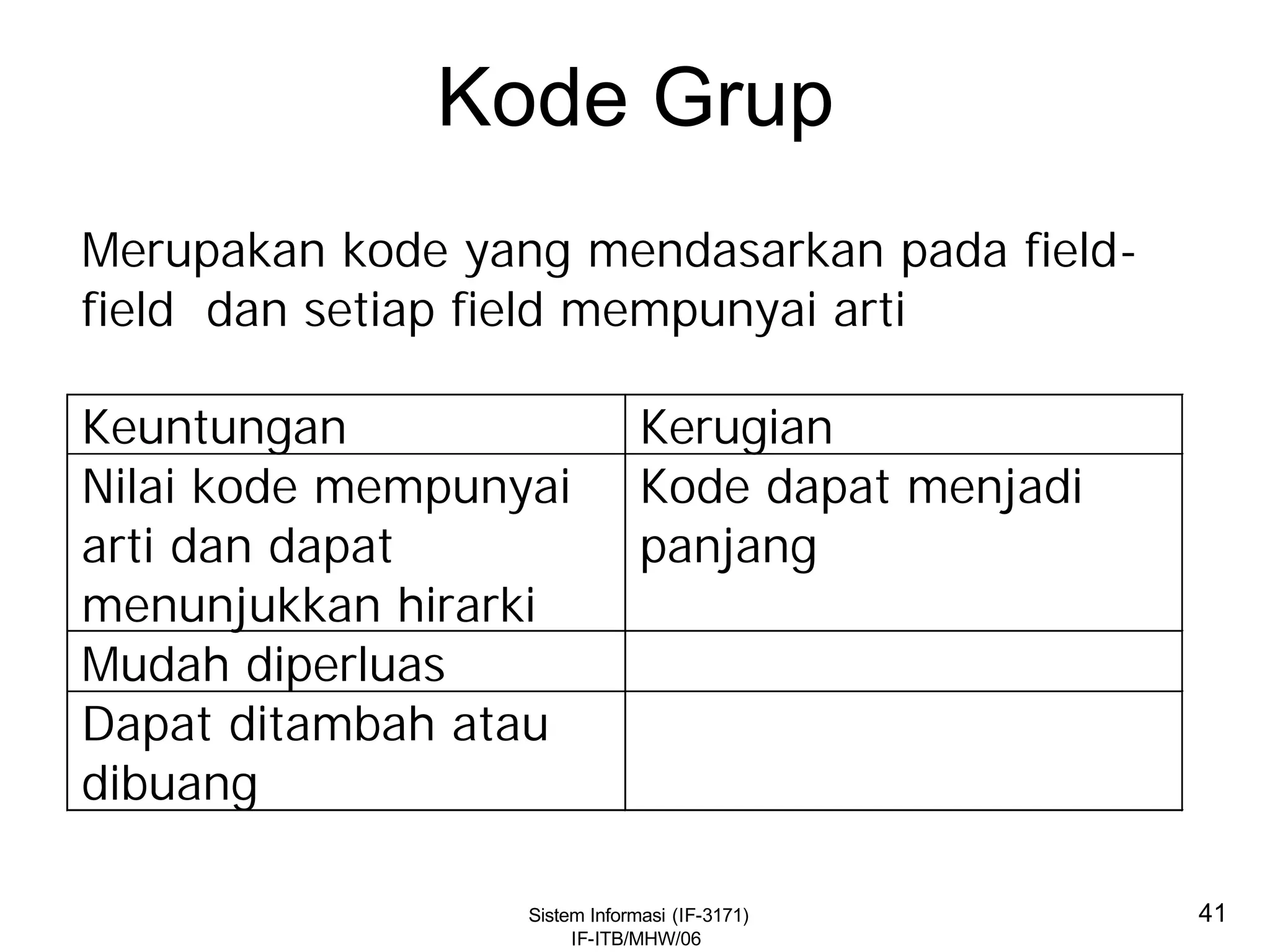
Kode Grup
Merupakan kode yang mendasarkan pada field-
field dan setiap field mempunyai arti
Keuntungan Kerugian
Nilai kode mempunyai
arti dan dapat
menunjukkan hirarki
Kode dapat menjadi
panjang
Mudah diperluas
Dapat ditambah atau
dibuang
Sistem Informasi (IF-3171)
IF-ITB/MHW/06
42
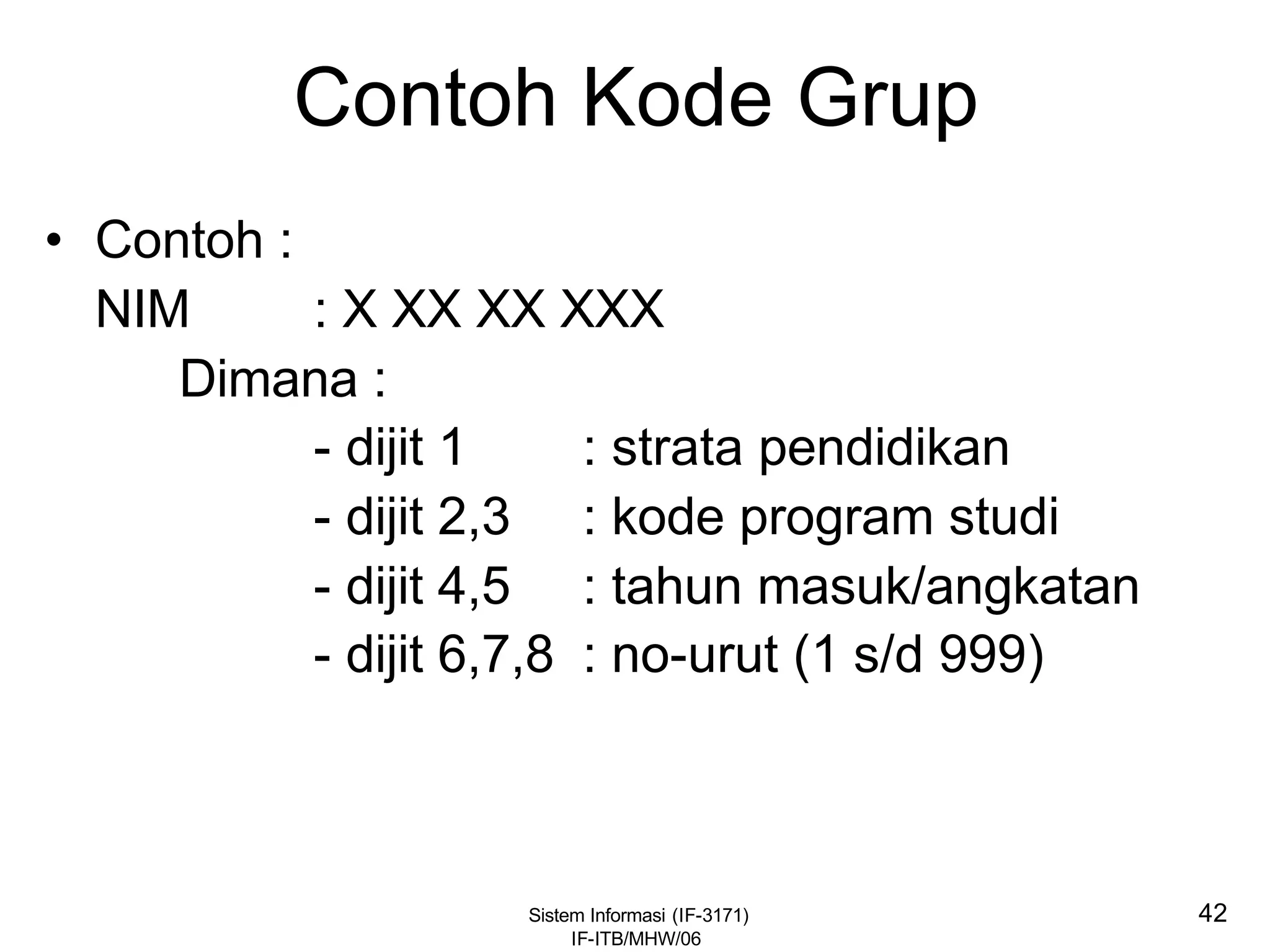
Contoh Kode Grup
• Contoh :
NIM : X XX XX XXX
Dimana :
- dijit 1 : strata pendidikan
- dijit 2,3 : kode program studi
- dijit 4,5 : tahun masuk/angkatan
- dijit 6,7,8 : no-urut (1 s/d 999)
Sistem Informasi (IF-3171)
IF-ITB/MHW/06
43
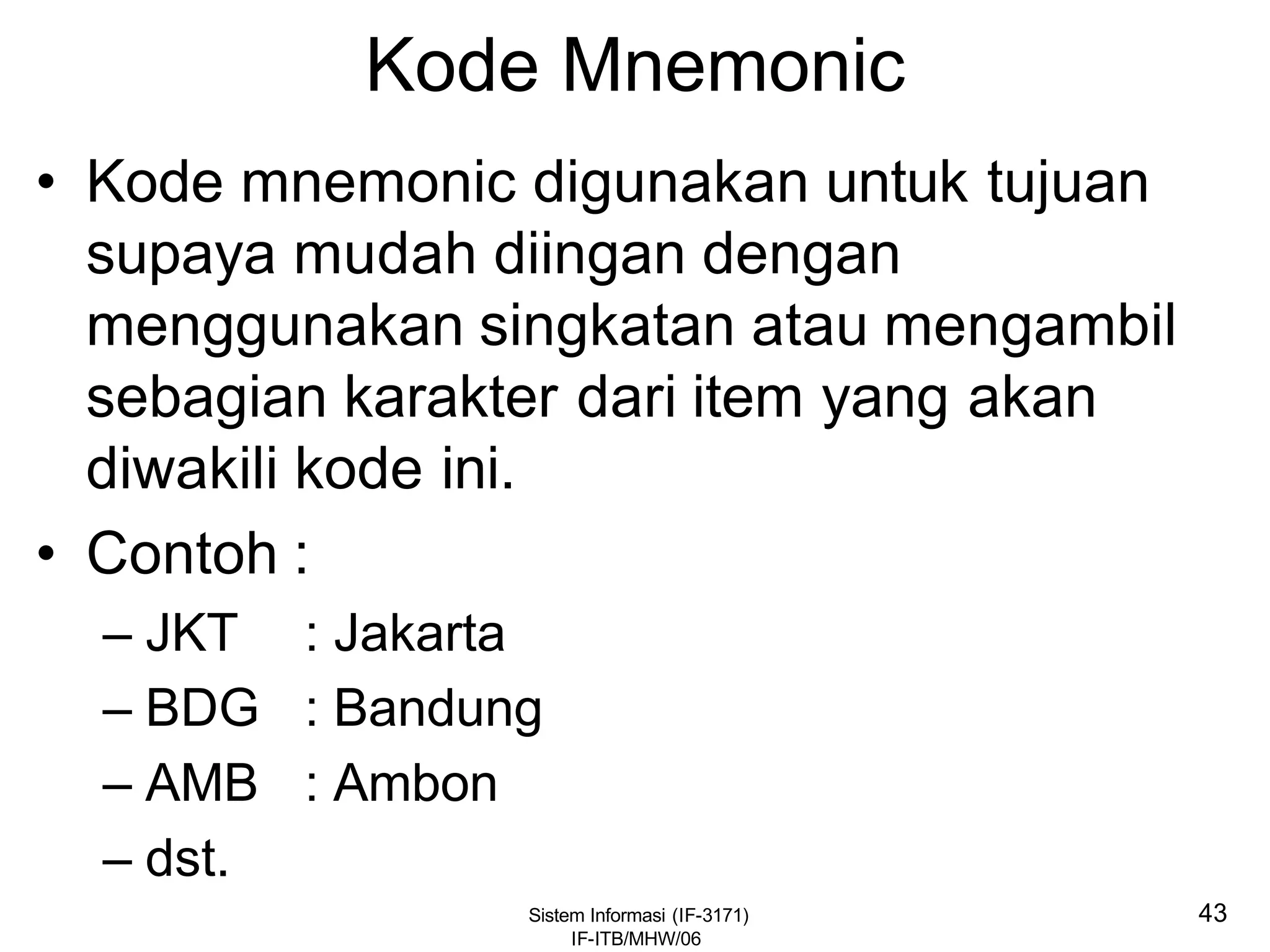
Kode Mnemonic
• Kode mnemonic digunakan untuk tujuan
supaya mudah diingan dengan
menggunakan singkatan atau mengambil
sebagian karakter dari item yang akan
diwakili kode ini.
• Contoh :
– JKT : Jakarta
– BDG : Bandung
– AMB : Ambon
– dst.

Design logic&sistem pengkodean

  • 1.
  • 2.
    Sistem Informasi (IF-3171) IF-ITB/MHW/06 2 RulesGoverning DFD (1) • Process : – No process can have only output – No process can have only input – A process has a verb phrase label • Data Store : – Data cannot move directly from one data store to another data store – Data cannot move directly from an outside source to a data store – Data cannot move directly to an outside sink from a data store – Data store has a noun phrase label • Source/Sink : – Data cannot move directly from a source to sink, its must be moved by a process.
  • 3.
    Sistem Informasi (IF-3171) IF-ITB/MHW/06 3 RulesGoverning DFD (2) • Data Flow : – A data flow has only one direction of flow between symbols – A fork in a data flow means that exactly the same data goes from a common locations to two or more different processes, data store or source/sink – A join in a data flow means that exactly the same data come from any of two or more different processes, data store or source/sink to a common locations – Data cannot go directly back to the same process it leaves – A data flow to a data store means update (delete or change) – A data flow from data store means retrieve or use – A data flow has a noun phrase label
  • 4.
    Sistem Informasi (IF-3171) IF-ITB/MHW/06 4 AdvancedRule Governing DFD • A composite data flow on one level can be split into component data flows at the next level but no new data can be added and all data in the composite must be accounted for in one or more sub flows • The input must be sufficient to produce the outputs from the process • At the lowest level of DFD’s new data flow maybe added to represent data that are transmitted under exceptional conditions • To avoid having data flow lines cross each other
  • 5.
    Sistem Informasi (IF-3171) IF-ITB/MHW/06 5 FourDifferent Types of DFDs 1. Current physical 2. Current logical 3. New logical 4. New physical
  • 6.
    Sistem Informasi (IF-3171) IF-ITB/MHW/06 6 Guidelinesfor the drawing DFDs • Completeness • Consistency • Timing • Iterative development
  • 7.
    Sistem Informasi (IF-3171) IF-ITB/MHW/06 7 DFDcreating with Visual-Case • The top-level diagram is called a context diagram and contains one Functional Transform which represents the entire system. • The context diagram also shows the external entities that interact with the system. • The following context diagram shows an order entry system that interacts with customers and shippers. • The solid lines represent the flow of data.
  • 8.
    Sistem Informasi (IF-3171) IF-ITB/MHW/06 8 DFDcreating with Visual-Case • You can easily show and hide the control transforms and control signals on your diagrams at any time. • A Control Transform can be decomposed into a State Diagram. • Together, the state diagram and control transform model the dynamic aspects of the system.
  • 9.
    Sistem Informasi (IF-3171) IF-ITB/MHW/06 9 DFDcreating with Visual-Case • Example of a Data Flow Diagram
  • 10.
  • 11.
  • 12.
    Sistem Informasi (IF-3171) IF-ITB/MHW/06 12 Deliverablesfor Logic Modelling • Each process on the lowest (primitive) level dfd will be represented with one or more of the following : – Structured English representation of process logic – Decision table representation – Decision tree representation – State transition diagram or table – Sequence diagram – Activity diagram
  • 13.
    Sistem Informasi (IF-3171) IF-ITB/MHW/06 13 StructuredEnglish • Modified from of the English language used to specify the logic of IS processes or the contents of the process boxes in DFD • Example : READ Quantity-in-stock SELECT CASE CASE 1 (Quantity stock greater than min order quantity) DO nothing CASE 2 (Quantity in stock equals min order quantity) DO nothing
  • 14.
    Sistem Informasi (IF-3171) IF-ITB/MHW/06 14 DecisionTable • A matrix representatiom of the logic of adecision, which specifies the possible conditions for the decision and the resulting actions • Example : XProduce Abstain Report XCalculate overtime XXXCalculate hourly wage XPay base salary >4040<40-Hours worked HHHSEmployee type 4321Courses of Action l e sR uConditions/
  • 15.
    Sistem Informasi (IF-3171) IF-ITB/MHW/06 15 DecisionTree • A graphical representation of a decision situation point are connected together by arcs and terminate in ovals 1 2 Sleep two more hours Time to get up sunday weekday saturday yes no Sleep one more hour Go back to sleepLegend : 1) Sun up? 2) What day is it?
  • 16.
    Sistem Informasi (IF-3171) IF-ITB/MHW/06 16 Criteriafor deciding BestBestThird Best Checking consistency & completeness BestThird BestBest Transforming conditions & actions into sequence BestThird BestSecond Best Determining condition & action Dec. TreeDec. TableSECriteria
  • 17.
  • 18.
    Sistem Informasi (IF-3171) IF-ITB/MHW/06 18 ConceptualData Modeling (CDM) • CDM is a representation of organization data • Typically do the cdm in parallel with other requirement analysis & structuring steps during system analysis ( req. determination, req. structuring and alternative generation & selection) • On the larger system development teams, a subset of the project team concentrates on data modeling while other team member focus attention on process or logic modeling • Develop/use from prior system dev. a cdm for the current system and build a cdm that supports the scope and req. the proposed or enhanced system
  • 19.
    Sistem Informasi (IF-3171) IF-ITB/MHW/06 19 TheProcess of CDM • Begin the process of CDM by developing a CDM for the system being replaced • Built the CDM that includes all of the data requirements for the new system • Discovered these requirement from the fact finding methods employed during requirement determination • One kind of data modeling and database design carried out throughout the system development process
  • 20.
    Sistem Informasi (IF-3171) IF-ITB/MHW/06 20 RelationshipData Modeling and the SDLC SDLC Phases • Project identification and selection • Project Initiation and Planning • Analysis • Design • Implementation • Maintenance Data Modeling Product • Enterprise wide data model (ER with only entities) • CDM (ER with only entities for specific project) • CDM (ER with attributes) • LDM & physical file & database design • Database & file definitions • Data model evolution
  • 21.
    Sistem Informasi (IF-3171) IF-ITB/MHW/06 21 RequirementDetermination Question for DM • What are subjects/objects of business? What type of people, place, things, material, event etc.? (data entities & their description) • What unique characteristic distinguishes each object from other objects of the same type? (primary key) • What characteristics describe each object? (attributes and secondary key) • How do you use this data? ( security control and understanding who really knows the meaning of data) • Over what period of time are you interested in this data?do you need historical trends, current, estimated or projections? (cardinality & time dimension of data) • Are all instances of each object the same? Are some object summaries or combination of more detaild object? (supertypes, subtypes & aggregations) • What events occur that imply associations between various objects? (relationships & their cardinality & degree) • Is each activity or event always handled the same way or are there special circumstances? (integrity rules, min/max cardinality, time dimension of data)
  • 22.
  • 23.
    Sistem Informasi (IF-3171) IF-ITB/MHW/06 23 E-RData Model • ER Data Model – is a detailed, logical representation of the entities, associations, and data elements for an organization or for a business area • ER Diagram is a graphical representation of an ER Model
  • 24.
    Sistem Informasi (IF-3171) IF-ITB/MHW/06 24 Entity •Entities is a person, place, object, event, or concept in the user environment about which the organization wishes to maintain data. • Entity type (class/set) is a collection of entities that share common properties or characteristics • Entity instance is a single occurrence of an entity type • Naming and defining entity type guidelines : – Singular noun – Descriptive & specific to the organization – Concise – Event entity types (result of the event)
  • 25.
    Sistem Informasi (IF-3171) IF-ITB/MHW/06 25 Attributes& Key • Attribute is a named property or characteristic of an entity that is of interest to the organization • Naming & defining attribut guidelines : – Noun – Unique – Each attribute name should follow a standard format • Candidate key • Indentifier (primary key) • Multivalue attributes is an attribute that may take on more than one value for each entity instance • Repeating group is a set of two or more multivalued attributes that are logically related
  • 26.
    Sistem Informasi (IF-3171) IF-ITB/MHW/06 26 Relationships& Cardinalities • Relationship is an association between the intances of one or more entity types that is of interest to the organization • Degree of R (the number of entity types that participate in a relationship) : – Unary R – Binary R – Ternary R • Cardinalities is the number of instances of entity B that can be (or must) associated with each instance of entity A • MinMax Cardinalities • Naming & Defining Relationship guidelines : – Verb phrase – Avoid vague names
  • 27.
    Sistem Informasi (IF-3171) IF-ITB/MHW/06 27 AssociativeEntity, Subtype & Supertype • Associative entity is an entity type that associates the instances of one or more entity types and contains attributes that are peculiar to the relationship between those entity instances ( also called a gerund) • Subtype is a sub grouping of the entities in an entity type that is meaningful to the organization and that share common attributes or relationships distinct from other sub groupings • Supertype is a generic entity type that has a relationship with one or more subtypes
  • 28.
    Sistem Informasi (IF-3171) IF-ITB/MHW/06 28 BusinessRule • Business rule are specifications that preserve the integrity of a conceptual or logical data model • Four basic types of business rule are : – Entity integrity, each instance of an entity type must have a unique identifier that is not null – Referential integrity constraints, rule concerning the relationship between entity type – Domains, is the set of all data types and values that an attribute can assume, constraints on valid values for attributes – Tigering operation, other business rules that protect the validity of attribute values
  • 29.
    Sistem Informasi (IF-3171) IF-ITB/MHW/06 29 TriggeringOperations (TO) • TO is an assertion or rule that govern the validity of data manipulation operations such as insert, update & delete • TO normally includes the following component : – User Rule, a concise statement of business rule to be enforced by the triggering operation – Event, the data manipulation operation that initiates the operation – Entity name, the name of the entity being accessed and/or modified – Condition, condition that causes the operation to be triggered – Action, action taken when the operation is triggered
  • 30.
  • 31.
    Sistem Informasi (IF-3171) IF-ITB/MHW/06 31 CODE •Is a set of rules or principles or laws (especially written ones) • A coding system used for transmitting messages requiring brevity or secrecy • Code the pieces with numbers so that you can identify them later. • In communications, a code is a rule for converting a piece of information (for example, a letter, word, or phrase) into another form or representation, not necessarily of the same sort.
  • 32.
    Sistem Informasi (IF-3171) IF-ITB/MHW/06 32 CODE •In communications and information processing, encoding is the process by which a source (object) performs this conversion of information into data, which is then sent to a receiver (observer), such as a data processing system. • In semiotics, the concept of a code is of fundamental importance. • Interpreting signs requires familiarity with the sets of conventions or codes currently in use to communicate meaning.
  • 33.
    Sistem Informasi (IF-3171) IF-ITB/MHW/06 33 CODE •Source code – Is the code that a program consists of before the program is being compiled. – The form in which a computer program is written by the programmer. – A set of programming language instructions that must be translated to machine instructions before the program can run. • Object code – Machine-executable instructions, usually generated by a compiler from source code written in a higher-level language. – Code in machine-readable form that can be executed by your computer's CPU and operating system, usually linked with libraries to create an executable file.
  • 34.
    Sistem Informasi (IF-3171) IF-ITB/MHW/06 34 CODE •Universal product code – The standard barcode symbology for retail food packages in the United States. – A classification for coding data onto products by a series of thick and thin vertical lines. • bar code – The common term for Universal Product Code. – An array of machine-readable rectangular bars and spaces arranged in a specific way defined in international standards to represent letters, numbers, and other human-readable symbols.
  • 35.
    Sistem Informasi (IF-3171) IF-ITB/MHW/06 35 CODE •Uniform commercial code – The State Code which regulates the transfer of and security interests in personal property. – A set of standard rules, adopted by 49 states, that governs commercial transactions. • Genetic code – The sequence of nucleotides, coded in triplets (codons) along the mRNA, that determines the sequence of amino acids in protein synthesis. – The way in which genetic information is stored in living organisms.
  • 36.
    Sistem Informasi (IF-3171) IF-ITB/MHW/06 36 Pengkodean •Pengkodean dibangun dengan tujuan a.l : – Memberikan identitas yang ringkas dan unik – Memberikan arti khusus dalam proses pengolahan – Mereduksi volume data yang harus direkam – Meningkatkan ketelilitian proses pengolahan • Kode dapat dibangun dari kumpulan karakter : – Numerik – Alfabetik – Alfanumerik – Karakter khusus
  • 37.
    Sistem Informasi (IF-3171) IF-ITB/MHW/06 37 Syarat& Jenis Kode • Dalam merambuat kode ada beberapa hal yang perlu diperhatikan : – Kemudahan untuk diingat – Harus unik – Fleksibel – Efisien – Konsisten – Panjang sebaiknya sama • Jenis struktur kode : – Sekuensial – Grup – Blok – Mnemonic
  • 38.
    Sistem Informasi (IF-3171) IF-ITB/MHW/06 38 KodeSekuensial Keuntungan Kerugian Bentuk sederhana Tidak fleksibel Bisa pendek dan unik Tidak punya skema dasar pengelompokan Mudah dikelola ( bila tidak banyak informasi yang dikelola) Tidak menunjukkan satu arti untuk item ybs. Contoh : 001 kursi 002 meja 003 almari 004 rak buku dst.
  • 39.
    Sistem Informasi (IF-3171) IF-ITB/MHW/06 39 KodeBlok Kode yang mengklasifikasi item kedalam kelompok/blok tertentu, yang mencerminkan satu klasifikasi tertentu atas dasar pemakaian maksimum yang diharapkan. Keuntungan Kerugian Nilai kode mempunyai arti Panjang kode tergantung jml. Blok Fleksibel, dapat ditambah atau dibuang sebagian Tidak mudah diingat Memudahkan proses pelaporan
  • 40.
    Sistem Informasi (IF-3171) IF-ITB/MHW/06 40 ContohKode Blok • Contoh : BLOK KELOMPOK – 1000 – 1999 Ativa lancar – 2000 – 2999 Aktiva tetap – 3000 – 3499 Hutang lancar – 4000 – 4999 Hutang jangka panjang dst. • Dari blok kode untuk masing-masing kelompok rekening utama, maka rekening-rekening Aktiva lancar dapat mempunyai kode diantara 1000 s/d 1999 misal sbb. • Kas – 1100 Piutang dagang Persediaan produk selesai Persediaan produk dalam proses Dst.
  • 41.
    Sistem Informasi (IF-3171) IF-ITB/MHW/06 41 KodeGrup Merupakan kode yang mendasarkan pada field- field dan setiap field mempunyai arti Keuntungan Kerugian Nilai kode mempunyai arti dan dapat menunjukkan hirarki Kode dapat menjadi panjang Mudah diperluas Dapat ditambah atau dibuang
  • 42.
    Sistem Informasi (IF-3171) IF-ITB/MHW/06 42 ContohKode Grup • Contoh : NIM : X XX XX XXX Dimana : - dijit 1 : strata pendidikan - dijit 2,3 : kode program studi - dijit 4,5 : tahun masuk/angkatan - dijit 6,7,8 : no-urut (1 s/d 999)
  • 43.
    Sistem Informasi (IF-3171) IF-ITB/MHW/06 43 KodeMnemonic • Kode mnemonic digunakan untuk tujuan supaya mudah diingan dengan menggunakan singkatan atau mengambil sebagian karakter dari item yang akan diwakili kode ini. • Contoh : – JKT : Jakarta – BDG : Bandung – AMB : Ambon – dst.