TestingTesting Perangkat LunakPerangkat Lunak
Oleh :
Oerip S. Santoso
12/17/03 Bayu Hendradjaya - http://www.if.itb.ac.id/~bayu 2
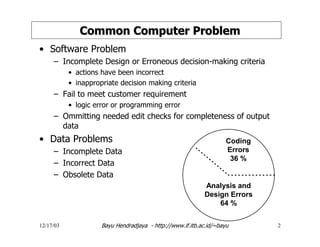
Common Computer ProblemCommon Computer Problem
• Software Problem
– Incomplete Design or Erroneous decision-making criteria
• actions have been incorrect
• inappropriate decision making criteria
– Fail to meet customer requirement
• logic error or programming error
– Ommitting needed edit checks for completeness of output
data
• Data Problems
– Incomplete Data
– Incorrect Data
– Obsolete Data
Coding
Errors
36 %
Analysis and
Design Errors
64 %
12/17/03 Bayu Hendradjaya - http://www.if.itb.ac.id/~bayu 3
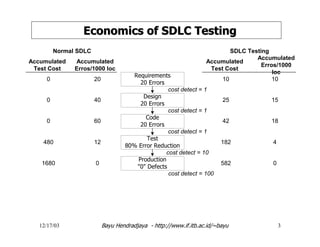
Economics of SDLC TestingEconomics of SDLC Testing
Requirements
20 Errors
Design
20 Errors
Code
20 Errors
Test
80% Error Reduction
Production
"0" Defects
cost detect = 1
cost detect = 1
cost detect = 1
cost detect = 10
cost detect = 100
SDLC Testing
Accumulated
Test Cost
Accumulated
Erros/1000
loc
10 10
25 15
42 18
182 4
582 0
Normal SDLC
Accumulated
Test Cost
Accumulated
Erros/1000 loc
0 20
0 40
0 60
480 12
1680 0
12/17/03 Bayu Hendradjaya - http://www.if.itb.ac.id/~bayu 4
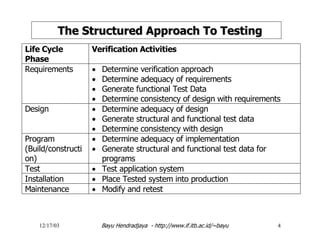
The Structured Approach To TestingThe Structured Approach To Testing
Life Cycle
Phase
Verification Activities
Requirements • Determine verification approach
• Determine adequacy of requirements
• Generate functional Test Data
• Determine consistency of design with requirements
Design • Determine adequacy of design
• Generate structural and functional test data
• Determine consistency with design
Program
(Build/constructi
on)
• Determine adequacy of implementation
• Generate structural and functional test data for
programs
Test • Test application system
Installation • Place Tested system into production
Maintenance • Modify and retest
12/17/03 Bayu Hendradjaya - http://www.if.itb.ac.id/~bayu 5
Testing in Life CycleTesting in Life Cycle
UNIT
INTEGRATION
SYSTEM
ACCEPTANCE
REGRESSIOIN
VERIFICATION
VALIDATION
SYSTEM TESTING/QUALITY CONTROL
Analyze Design Build Test Install Maintain
• Verification is the process of evaluating a system/component to
determine whether the products of a given development phase satisfy
the conditions imposed at the start of that phase (IEEE/ANSI)
• Validation is the process of evaluating a system/component during or at
the end of the development process to determine whether it satisfies
specified requirements (IEEE/ANSI)
12/17/03 Bayu Hendradjaya - http://www.if.itb.ac.id/~bayu 6
Basic Forms of TestingBasic Forms of Testing
• Full Testing
– starts no later than the requirement phase and continues through acceptance testing
• Partial Testing
– begins any time after functional design has been completed, with less than optimal
influence on requirements and functional design
• Endgame Testing
– is highly validation oriented, with no influence on requirements or functional design
• Audit-Level Testing
– is a barebones audit plans, procedures, and products for adequacy, correctness, and
compliance to standards.
costoftesting
Error-detection effectiveness
Audit Level
Endgame
Partial
Full
12/17/03 Bayu Hendradjaya - http://www.if.itb.ac.id/~bayu 7
Computer System Strategic RiskComputer System Strategic Risk
• A risk is a condition that can result in a loss
• A risk is related to the probability of a loss
• The risk is always exists, although the loss may not
occur
• Risk can not be eliminated, but the impact of the loss
can be reduced
• The most effective methods to reduce the impact of
the loss is testing
• Types of strategic risk
– Incorrect result, unauthorized transaction, lost of integrity of
file, processing can not be reconstructed, lost of continuity
of processing, degradation of services for user, security,
unreliable result, difficulties to use and operate,
unmaintainable program, not portable, not be able to
interconnect, unacceptable performance level
12/17/03 Bayu Hendradjaya - http://www.if.itb.ac.id/~bayu 8
Test StrategyTest Strategy
• A strategy must address the risks and present a process that
can reduce those risks
• Two component of Testing Strategy
–– Test FactorTest Factor - The risk or issue that needs to be addressed as part
of the test strategy.
• Correctness, authorization, file integrity, audit trail, continuity of
process, service levels, access control, compliance, reliability, ease of
use, maintainability, portable, coupling, performance, ease of operation
–– Test PhaseTest Phase - The phase of the SDLC in which testing will occur
• Note:
– The risk associated with testing will be called “Test Factors”
– Not all test factors will be applicable
– The test phase will vary based on the testing methodology used
12/17/03 Bayu Hendradjaya - http://www.if.itb.ac.id/~bayu 9
Developing Test StrategyDeveloping Test Strategy
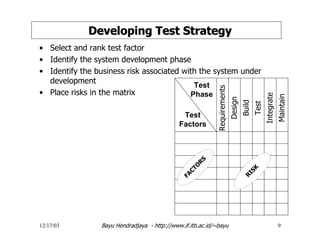
• Select and rank test factor
• Identify the system development phase
• Identify the business risk associated with the system under
development
• Place risks in the matrix
Requirements
Design
Build
Test
Integrate
Maintain
Test
Phase
Test
Factors
FACTO
R
S
R
ISK
12/17/03 Bayu Hendradjaya - http://www.if.itb.ac.id/~bayu 10
StrategicalStrategical/Tactical Testing Cube/Tactical Testing Cube
Requirements
Design
Build
Test
Integrate
Maintain
Test
Phase
Test
Factors
FACTO
R
S
R
ISK
Test
Tactics
Test Strategy
PLAN
S
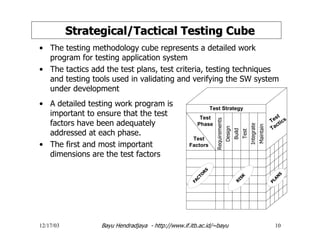
• The testing methodology cube represents a detailed work
program for testing application system
• The tactics add the test plans, test criteria, testing techniques
and testing tools used in validating and verifying the SW system
under development
• A detailed testing work program is
important to ensure that the test
factors have been adequately
addressed at each phase.
• The first and most important
dimensions are the test factors
12/17/03 Bayu Hendradjaya - http://www.if.itb.ac.id/~bayu 11
Developing Testing TacticsDeveloping Testing Tactics
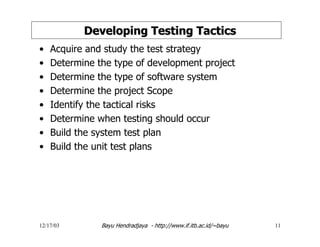
• Acquire and study the test strategy
• Determine the type of development project
• Determine the type of software system
• Determine the project Scope
• Identify the tactical risks
• Determine when testing should occur
• Build the system test plan
• Build the unit test plans
12/17/03 Bayu Hendradjaya - http://www.if.itb.ac.id/~bayu 12
Type of Development ProjectType of Development Project
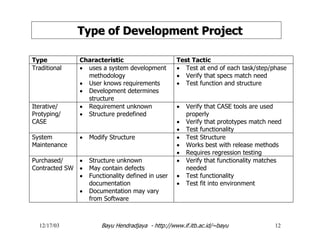
Type Characteristic Test Tactic
Traditional • uses a system development
methodology
• User knows requirements
• Development determines
structure
• Test at end of each task/step/phase
• Verify that specs match need
• Test function and structure
Iterative/
Protyping/
CASE
• Requirement unknown
• Structure predefined
• Verify that CASE tools are used
properly
• Verify that prototypes match need
• Test functionality
System
Maintenance
• Modify Structure • Test Structure
• Works best with release methods
• Requires regression testing
Purchased/
Contracted SW
• Structure unknown
• May contain defects
• Functionality defined in user
documentation
• Documentation may vary
from Software
• Verify that functionality matches
needed
• Test functionality
• Test fit into environment
12/17/03 Bayu Hendradjaya - http://www.if.itb.ac.id/~bayu 13
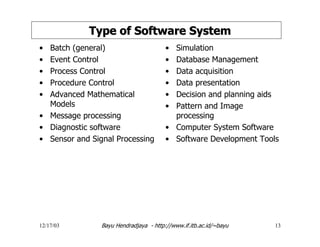
Type of Software SystemType of Software System
• Batch (general)
• Event Control
• Process Control
• Procedure Control
• Advanced Mathematical
Models
• Message processing
• Diagnostic software
• Sensor and Signal Processing
• Simulation
• Database Management
• Data acquisition
• Data presentation
• Decision and planning aids
• Pattern and Image
processing
• Computer System Software
• Software Development Tools

Introduction to testing2

  • 1.
    TestingTesting Perangkat LunakPerangkatLunak Oleh : Oerip S. Santoso
  • 2.
    12/17/03 Bayu Hendradjaya- http://www.if.itb.ac.id/~bayu 2 Common Computer ProblemCommon Computer Problem • Software Problem – Incomplete Design or Erroneous decision-making criteria • actions have been incorrect • inappropriate decision making criteria – Fail to meet customer requirement • logic error or programming error – Ommitting needed edit checks for completeness of output data • Data Problems – Incomplete Data – Incorrect Data – Obsolete Data Coding Errors 36 % Analysis and Design Errors 64 %
  • 3.
    12/17/03 Bayu Hendradjaya- http://www.if.itb.ac.id/~bayu 3 Economics of SDLC TestingEconomics of SDLC Testing Requirements 20 Errors Design 20 Errors Code 20 Errors Test 80% Error Reduction Production "0" Defects cost detect = 1 cost detect = 1 cost detect = 1 cost detect = 10 cost detect = 100 SDLC Testing Accumulated Test Cost Accumulated Erros/1000 loc 10 10 25 15 42 18 182 4 582 0 Normal SDLC Accumulated Test Cost Accumulated Erros/1000 loc 0 20 0 40 0 60 480 12 1680 0
  • 4.
    12/17/03 Bayu Hendradjaya- http://www.if.itb.ac.id/~bayu 4 The Structured Approach To TestingThe Structured Approach To Testing Life Cycle Phase Verification Activities Requirements • Determine verification approach • Determine adequacy of requirements • Generate functional Test Data • Determine consistency of design with requirements Design • Determine adequacy of design • Generate structural and functional test data • Determine consistency with design Program (Build/constructi on) • Determine adequacy of implementation • Generate structural and functional test data for programs Test • Test application system Installation • Place Tested system into production Maintenance • Modify and retest
  • 5.
    12/17/03 Bayu Hendradjaya- http://www.if.itb.ac.id/~bayu 5 Testing in Life CycleTesting in Life Cycle UNIT INTEGRATION SYSTEM ACCEPTANCE REGRESSIOIN VERIFICATION VALIDATION SYSTEM TESTING/QUALITY CONTROL Analyze Design Build Test Install Maintain • Verification is the process of evaluating a system/component to determine whether the products of a given development phase satisfy the conditions imposed at the start of that phase (IEEE/ANSI) • Validation is the process of evaluating a system/component during or at the end of the development process to determine whether it satisfies specified requirements (IEEE/ANSI)
  • 6.
    12/17/03 Bayu Hendradjaya- http://www.if.itb.ac.id/~bayu 6 Basic Forms of TestingBasic Forms of Testing • Full Testing – starts no later than the requirement phase and continues through acceptance testing • Partial Testing – begins any time after functional design has been completed, with less than optimal influence on requirements and functional design • Endgame Testing – is highly validation oriented, with no influence on requirements or functional design • Audit-Level Testing – is a barebones audit plans, procedures, and products for adequacy, correctness, and compliance to standards. costoftesting Error-detection effectiveness Audit Level Endgame Partial Full
  • 7.
    12/17/03 Bayu Hendradjaya- http://www.if.itb.ac.id/~bayu 7 Computer System Strategic RiskComputer System Strategic Risk • A risk is a condition that can result in a loss • A risk is related to the probability of a loss • The risk is always exists, although the loss may not occur • Risk can not be eliminated, but the impact of the loss can be reduced • The most effective methods to reduce the impact of the loss is testing • Types of strategic risk – Incorrect result, unauthorized transaction, lost of integrity of file, processing can not be reconstructed, lost of continuity of processing, degradation of services for user, security, unreliable result, difficulties to use and operate, unmaintainable program, not portable, not be able to interconnect, unacceptable performance level
  • 8.
    12/17/03 Bayu Hendradjaya- http://www.if.itb.ac.id/~bayu 8 Test StrategyTest Strategy • A strategy must address the risks and present a process that can reduce those risks • Two component of Testing Strategy –– Test FactorTest Factor - The risk or issue that needs to be addressed as part of the test strategy. • Correctness, authorization, file integrity, audit trail, continuity of process, service levels, access control, compliance, reliability, ease of use, maintainability, portable, coupling, performance, ease of operation –– Test PhaseTest Phase - The phase of the SDLC in which testing will occur • Note: – The risk associated with testing will be called “Test Factors” – Not all test factors will be applicable – The test phase will vary based on the testing methodology used
  • 9.
    12/17/03 Bayu Hendradjaya- http://www.if.itb.ac.id/~bayu 9 Developing Test StrategyDeveloping Test Strategy • Select and rank test factor • Identify the system development phase • Identify the business risk associated with the system under development • Place risks in the matrix Requirements Design Build Test Integrate Maintain Test Phase Test Factors FACTO R S R ISK
  • 10.
    12/17/03 Bayu Hendradjaya- http://www.if.itb.ac.id/~bayu 10 StrategicalStrategical/Tactical Testing Cube/Tactical Testing Cube Requirements Design Build Test Integrate Maintain Test Phase Test Factors FACTO R S R ISK Test Tactics Test Strategy PLAN S • The testing methodology cube represents a detailed work program for testing application system • The tactics add the test plans, test criteria, testing techniques and testing tools used in validating and verifying the SW system under development • A detailed testing work program is important to ensure that the test factors have been adequately addressed at each phase. • The first and most important dimensions are the test factors
  • 11.
    12/17/03 Bayu Hendradjaya- http://www.if.itb.ac.id/~bayu 11 Developing Testing TacticsDeveloping Testing Tactics • Acquire and study the test strategy • Determine the type of development project • Determine the type of software system • Determine the project Scope • Identify the tactical risks • Determine when testing should occur • Build the system test plan • Build the unit test plans
  • 12.
    12/17/03 Bayu Hendradjaya- http://www.if.itb.ac.id/~bayu 12 Type of Development ProjectType of Development Project Type Characteristic Test Tactic Traditional • uses a system development methodology • User knows requirements • Development determines structure • Test at end of each task/step/phase • Verify that specs match need • Test function and structure Iterative/ Protyping/ CASE • Requirement unknown • Structure predefined • Verify that CASE tools are used properly • Verify that prototypes match need • Test functionality System Maintenance • Modify Structure • Test Structure • Works best with release methods • Requires regression testing Purchased/ Contracted SW • Structure unknown • May contain defects • Functionality defined in user documentation • Documentation may vary from Software • Verify that functionality matches needed • Test functionality • Test fit into environment
  • 13.
    12/17/03 Bayu Hendradjaya- http://www.if.itb.ac.id/~bayu 13 Type of Software SystemType of Software System • Batch (general) • Event Control • Process Control • Procedure Control • Advanced Mathematical Models • Message processing • Diagnostic software • Sensor and Signal Processing • Simulation • Database Management • Data acquisition • Data presentation • Decision and planning aids • Pattern and Image processing • Computer System Software • Software Development Tools