Advancing a Circular
Economy
Dr Jihane Ball,
Director, Global Product Safety and Compliance
EH&S and Sustainability, The Dow Chemical Company
Content
 Some Perspective
 Dow’s SustainabilityJourney
 Dow’s 2025 Goals and Enabling the UN SDGs
 The Circularity Gap
 Circular Economy Policies and Business Models
 Capturing Opportunities and Navigating Challenges
 Key Considerations for Recycling and Interface Between Chemical, Product and Waste
Legislation
 Are you Keeping Pace with Change or Anticipating it?
Some Perspective…
 70% of buildings that will stand in 2030 are yet to be built in India.
 By 2025, the predicted urban population of China is 1 billion.
 Europeans need 2 – 3 planets worth of resources to sustain their current
lifestyles.
 In Europe, 2.7 billion tonnes of waste was generated in 2010 and only 40%
was reused, recycled, composted or digested.
 50% of all the clothes manufactured globally are never sold or worn.
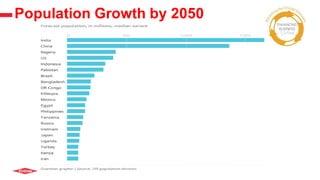
Population Growth by 2050
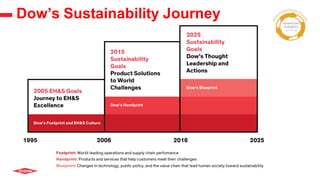
Dow’s Sustainability Journey
Dow’s 2025 Sustainability Goals
Redefining the Role of Business in Society
#DOW2025
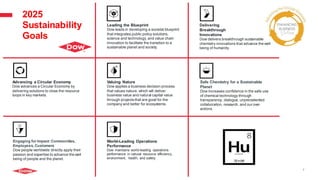
2025
Sustainability
Goals
Leading the Blueprint
Dow leads in developing a societal blueprint
that integrates public policy solutions,
science and technology, and value chain
innovation to facilitate the transition to a
sustainable planet and society.
Delivering
Breakthrough
Innovations
Dow delivers breakthrough sustainable
chemistry innovations that advance the well
being of humanity.
Advancing a Circular Economy
Dow advances a Circular Economy by
delivering solutions to close the resource
loops in key markets.
Valuing Nature
Dow applies a business decision process
that values nature, which will deliver
business value and natural capital value
through projectsthat are good for the
company and better for ecosystems.
Safe Chemistry for a Sustainable
Planet
Dow increases confidence in the safe use
of chemical technology through
transparency, dialogue, unprecedented
collaboration, research, and our own
actions.
Engaging for Impact: Communities,
Employees, Customers
Dow people worldwide directly apply their
passion and expertise to advance the well
being of people and the planet.
World-Leading Operations
Performance
Dow maintains world-leading operations
performance in natural resource efficiency,
environment, health, and safety.
7
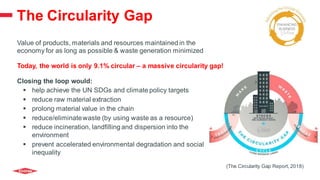
The Circularity Gap
Value of products, materials and resources maintained in the
economy for as long as possible & waste generation minimized
Today, the world is only 9.1% circular – a massive circularity gap!
Closing the loop would:
 help achieve the UN SDGs and climate policy targets
 reduce raw material extraction
 prolong material value in the chain
 reduce/eliminatewaste (by using waste as a resource)
 reduce incineration, landfilling and dispersion into the
environment
 prevent accelerated environmental degradation and social
inequality
(The Circularity Gap Report, 2018)
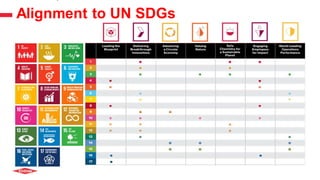
Alignment to UN SDGs
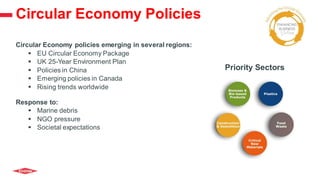
Circular Economy Policies
Circular Economy policies emerging in several regions:
 EU Circular Economy Package
 UK 25-Year Environment Plan
 Policies in China
 Emerging policies in Canada
 Rising trends worldwide
Response to:
 Marine debris
 NGO pressure
 Societal expectations
Priority Sectors
Circular Economy Business Models
1. Circular supplies
2. Resource recovery
3. Product life extension
4. Sharing platforms
5. Product as a service
Ref. “Circular Advantage” Accenture Strategy, 2014
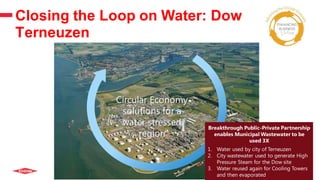
Circular Economy
solutions for a
water stressed
region
Breakthrough Public-Private Partnership
enables Municipal Wastewater to be
used 3X
1. Water used by city of Terneuzen
2. City wastewater used to generate High
Pressure Steam for the Dow site
3. Water reused again for Cooling Towers
and then evaporated
Closing the Loop on Water: Dow
Terneuzen
The Ellen MacArthur Foundation |
Renault
 Renault – a leader in the efficient use and reuse of materials
• Research projects to enhance the quality of recycled materials and reintroduce into the
supply chain
• Established closed loops by acquiring shares in dismantling and recycling companies
• Launched a repair service using second-hand parts (checked and guaranteed) from end of
life vehicles
• Has remanufactured mechanical parts since 1949 in a dedicated plant (current turnover >
€200 million)
 A vehicle requires a large quantity of high-value materials and is a product designed to last
and be repaired.
 An ideal product for remanufacturing and reengineering during its life cycle.
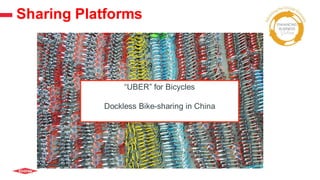
“UBER” for Bicycles
Dockless Bike-sharing in China
Sharing Platforms
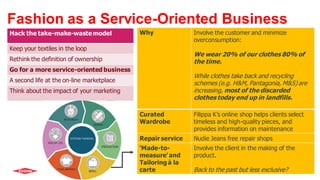
Hack the take-make-wastemodel
Keep your textiles in the loop
Rethink the definition of ownership
Go for a more service-oriented business
A second life at the on-line marketplace
Think about the impact of your marketing
Fashion as a Service-Oriented Business
Why Involve the customer and minimize
overconsumption:
We wear 20% of our clothes 80% of
the time.
While clothes take back and recycling
schemes (e.g. H&M, Pantagonia, M&S) are
increasing, most of the discarded
clothes today end up in landfills.
Curated
Wardrobe
Filippa K’s online shop helps clients select
timeless and high-quality pieces, and
provides information on maintenance
Repair service Nudie Jeans free repair shops
‘Made-to-
measure’ and
Tailoring à la
carte
Involve the client in the making of the
product.
Back to the past but less exclusive?
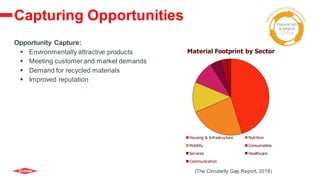
Capturing Opportunities
Opportunity Capture:
 Environmentally attractive products
 Meeting customerand market demands
 Demand for recycled materials
 Improved reputation
Material Footprint by Sector
Housing & Infrastructure Nutrition
Mobility Consumables
Services Healthcare
Communication
(The Circularity Gap Report, 2018)
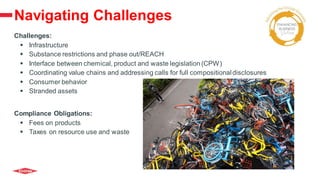
Navigating Challenges
Challenges:
 Infrastructure
 Substance restrictions and phase out/REACH
 Interface between chemical, product and waste legislation (CPW)
 Coordinating value chains and addressing calls for full compositionaldisclosures
 Consumer behavior
 Stranded assets
Compliance Obligations:
 Fees on products
 Taxes on resource use and waste
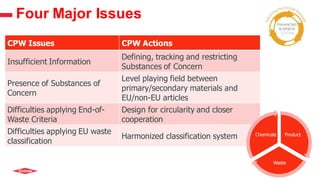
Four Major Issues
CPW Issues CPW Actions
Insufficient Information
Defining, tracking and restricting
Substances of Concern
Presence of Substances of
Concern
Level playing field between
primary/secondary materials and
EU/non-EU articles
Difficulties applying End-of-
Waste Criteria
Design for circularity and closer
cooperation
Difficulties applying EU waste
classification
Harmonized classification system Product
Waste
Chemicals
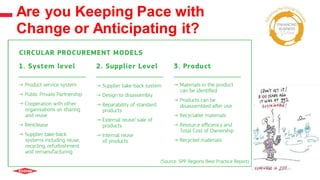
Are you Keeping Pace with
Change or Anticipating it?
The
Circular Economy
in the
Asia Pacific Region
www.circularecconomyasia.org

Advancing the Circular Economy

  • 1.
    Advancing a Circular Economy DrJihane Ball, Director, Global Product Safety and Compliance EH&S and Sustainability, The Dow Chemical Company
  • 2.
    Content  Some Perspective Dow’s SustainabilityJourney  Dow’s 2025 Goals and Enabling the UN SDGs  The Circularity Gap  Circular Economy Policies and Business Models  Capturing Opportunities and Navigating Challenges  Key Considerations for Recycling and Interface Between Chemical, Product and Waste Legislation  Are you Keeping Pace with Change or Anticipating it?
  • 3.
    Some Perspective…  70%of buildings that will stand in 2030 are yet to be built in India.  By 2025, the predicted urban population of China is 1 billion.  Europeans need 2 – 3 planets worth of resources to sustain their current lifestyles.  In Europe, 2.7 billion tonnes of waste was generated in 2010 and only 40% was reused, recycled, composted or digested.  50% of all the clothes manufactured globally are never sold or worn.
  • 4.
  • 5.
  • 6.
    Dow’s 2025 SustainabilityGoals Redefining the Role of Business in Society #DOW2025
  • 7.
    2025 Sustainability Goals Leading the Blueprint Dowleads in developing a societal blueprint that integrates public policy solutions, science and technology, and value chain innovation to facilitate the transition to a sustainable planet and society. Delivering Breakthrough Innovations Dow delivers breakthrough sustainable chemistry innovations that advance the well being of humanity. Advancing a Circular Economy Dow advances a Circular Economy by delivering solutions to close the resource loops in key markets. Valuing Nature Dow applies a business decision process that values nature, which will deliver business value and natural capital value through projectsthat are good for the company and better for ecosystems. Safe Chemistry for a Sustainable Planet Dow increases confidence in the safe use of chemical technology through transparency, dialogue, unprecedented collaboration, research, and our own actions. Engaging for Impact: Communities, Employees, Customers Dow people worldwide directly apply their passion and expertise to advance the well being of people and the planet. World-Leading Operations Performance Dow maintains world-leading operations performance in natural resource efficiency, environment, health, and safety. 7
  • 8.
    The Circularity Gap Valueof products, materials and resources maintained in the economy for as long as possible & waste generation minimized Today, the world is only 9.1% circular – a massive circularity gap! Closing the loop would:  help achieve the UN SDGs and climate policy targets  reduce raw material extraction  prolong material value in the chain  reduce/eliminatewaste (by using waste as a resource)  reduce incineration, landfilling and dispersion into the environment  prevent accelerated environmental degradation and social inequality (The Circularity Gap Report, 2018)
  • 9.
  • 10.
    Circular Economy Policies CircularEconomy policies emerging in several regions:  EU Circular Economy Package  UK 25-Year Environment Plan  Policies in China  Emerging policies in Canada  Rising trends worldwide Response to:  Marine debris  NGO pressure  Societal expectations Priority Sectors
  • 11.
    Circular Economy BusinessModels 1. Circular supplies 2. Resource recovery 3. Product life extension 4. Sharing platforms 5. Product as a service Ref. “Circular Advantage” Accenture Strategy, 2014
  • 12.
    Circular Economy solutions fora water stressed region Breakthrough Public-Private Partnership enables Municipal Wastewater to be used 3X 1. Water used by city of Terneuzen 2. City wastewater used to generate High Pressure Steam for the Dow site 3. Water reused again for Cooling Towers and then evaporated Closing the Loop on Water: Dow Terneuzen
  • 13.
    The Ellen MacArthurFoundation | Renault  Renault – a leader in the efficient use and reuse of materials • Research projects to enhance the quality of recycled materials and reintroduce into the supply chain • Established closed loops by acquiring shares in dismantling and recycling companies • Launched a repair service using second-hand parts (checked and guaranteed) from end of life vehicles • Has remanufactured mechanical parts since 1949 in a dedicated plant (current turnover > €200 million)  A vehicle requires a large quantity of high-value materials and is a product designed to last and be repaired.  An ideal product for remanufacturing and reengineering during its life cycle.
  • 14.
    “UBER” for Bicycles DocklessBike-sharing in China Sharing Platforms
  • 15.
    Hack the take-make-wastemodel Keepyour textiles in the loop Rethink the definition of ownership Go for a more service-oriented business A second life at the on-line marketplace Think about the impact of your marketing Fashion as a Service-Oriented Business Why Involve the customer and minimize overconsumption: We wear 20% of our clothes 80% of the time. While clothes take back and recycling schemes (e.g. H&M, Pantagonia, M&S) are increasing, most of the discarded clothes today end up in landfills. Curated Wardrobe Filippa K’s online shop helps clients select timeless and high-quality pieces, and provides information on maintenance Repair service Nudie Jeans free repair shops ‘Made-to- measure’ and Tailoring à la carte Involve the client in the making of the product. Back to the past but less exclusive?
  • 16.
    Capturing Opportunities Opportunity Capture: Environmentally attractive products  Meeting customerand market demands  Demand for recycled materials  Improved reputation Material Footprint by Sector Housing & Infrastructure Nutrition Mobility Consumables Services Healthcare Communication (The Circularity Gap Report, 2018)
  • 17.
    Navigating Challenges Challenges:  Infrastructure Substance restrictions and phase out/REACH  Interface between chemical, product and waste legislation (CPW)  Coordinating value chains and addressing calls for full compositionaldisclosures  Consumer behavior  Stranded assets Compliance Obligations:  Fees on products  Taxes on resource use and waste
  • 18.
    Four Major Issues CPWIssues CPW Actions Insufficient Information Defining, tracking and restricting Substances of Concern Presence of Substances of Concern Level playing field between primary/secondary materials and EU/non-EU articles Difficulties applying End-of- Waste Criteria Design for circularity and closer cooperation Difficulties applying EU waste classification Harmonized classification system Product Waste Chemicals
  • 19.
    Are you KeepingPace with Change or Anticipating it?
  • 20.
    The Circular Economy in the AsiaPacific Region www.circularecconomyasia.org