8. Confusion About Renewable
Energy
Gail Tverberg – Energy Economics and Analysis Modeling
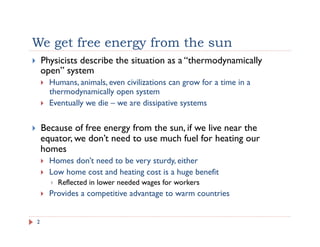
We get free energy from the sun
!  Physicists describe the situation as a “thermodynamically
open” system
!  Humans, animals, even civilizations can grow for a time in a
thermodynamically open system
!  Eventually we die – we are dissipative systems
!  Because of free energy from the sun, if we live near the
equator, we don’t need to use much fuel for heating our
homes
!  Homes don’t need to be very sturdy, either
!  Low home cost and heating cost is a huge benefit
!  Reflected in lower needed wages for workers
!  Provides a competitive advantage to warm countries
2
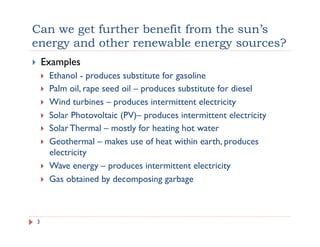
Can we get further benefit from the sun’s
energy and other renewable energy sources?
!  Examples
!  Ethanol - produces substitute for gasoline
!  Palm oil, rape seed oil – produces substitute for diesel
!  Wind turbines – produces intermittent electricity
!  Solar Photovoltaic (PV)– produces intermittent electricity
!  Solar Thermal – mostly for heating hot water
!  Geothermal – makes use of heat within earth, produces
electricity
!  Wave energy – produces intermittent electricity
!  Gas obtained by decomposing garbage
3
Politicians would like us to believe that
“renewable” energy provides huge benefits
!  “Fuel” for new renewables is free
!  But this doesn’t mean that the end product we use is free
!  Or even inexpensive
!  Or available in large quantity
!  Making “renewables” depends on existence of current system
!  Need coal, oil, and natural gas to make and transport devices
!  Need minerals of many kinds, including rare minerals
!  Need banking system, international trade
!  What is the basic problem we are trying to address?
!  (1) Is problem Cost of producing fossil fuels is rising too high, or is it
!  (2) Future supply shortage
4
Historic understanding of need for
renewables
!  Mostly based on “supply” concern
!  Oil (or fossil fuel supply in general) will decline in supply
!  Biofuels would supplement
!  Or electric cars would replace current vehicles
!  Assumption is that we have a very long time for change
!  High cost is not a concern
!  Another issue is climate change
!  Perhaps renewables would reduce CO2 emissions
!  Renewables might replace part of coal use
!  Might also help with other pollution issues
!  Additional political issue
!  Need for an “answer” to our problems
!  But without a very good understanding of nature of problem
5
Sources of Confusion
6
1. Is our problem a supply problem or a cost
problem?
!  If our problem is a cost problem, new renewables are only
helpful if they lower total costs
!  New renewables tend to be expensive—need subsidies
!  Not helpful to governments with financial problems
!  Or to poor citizens, who are already having difficulty with low wages
!  Most researchers have assumed our problem is a supply
problem
!  Expect supply of oil to decline, because of peak oil
!  Also expect prices of oil and other fossil fuels to rise
!  Expect that high cost renewables will become competitive
!  If this story is wrong—collapse comes in the near term from low oil
prices—then new renewables are not helpful
7
2. New renewables are only “add-ons” to our
existing system
!  We need oil, gas, and coal to make new renewables
!  Also to maintain the electric grid, roads, and pipelines
!  If we lose the use of the electric grid, wind and solar PV that
supply the electric grid will of be of little value
!  Electric grid is difficult to maintain
!  Renewable device is of value only as long as rest of system “works”
!  Easy to assume too long a lifetime for renewables
!  One potential benefit—even if electric grid system fails, a few
homeowners with their own solar PV panels might benefit
!  Usually homeowners buying solar PV are rich homeowners
!  Does it make sense to tax the poor, so government can subsidize
solar PV panels purchased by rich homeowners?
8
3. Quantity of “new renewables” is small
compared to fossil fuels
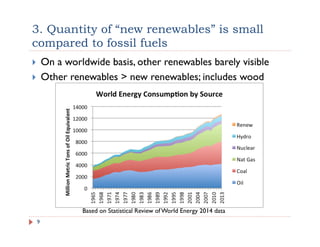
!  On a worldwide basis, other renewables barely visible
!  Other renewables > new renewables; includes wood
Based on Statistical Review of World Energy 2014 data
9
Quantity of new renewables is also very
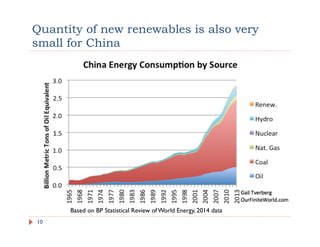
small for China
Based on BP Statistical Review of World Energy, 2014 data
10
Reasons “new renewable” quantities are low
!  Cost of producing new renewables tends to be high
!  May be high human labor cost—example, installing solar PV
!  Also, uses many kinds of materials
!  Some of these are expensive—rare earth minerals used in wind
turbines, for example
!  Fossil fuels are also used in making renewables
!  Debt financing needed for long periods
!  Interest expense is one of the costs as well
!  Citizens can’t afford high cost; hard to subsidize sufficiently
!  Fuel cost is often a low portion of total electricity costs
!  Coal, nuclear – fuel often 25% or less of total electricity cost
!  Eliminating fuel cost doesn’t necessarily lead to savings
11
4. New renewables tend to be hard to “scale
up”
!  Even if fuel is free, many materials used in creating renewables
are in limited supply
!  Land is needed for growing biofuels—competes with food supply
!  Over 40% of US corn is used to provide 5% of US oil consumption
!  Rare earth minerals are used in wind turbines, electric cars
!  Minerals of all types start with an initial limited supply of high
quality ores
!  These can be rapidly depleted
!  Need to move to lower quality ores
!  Very similar to fossil fuels with respect to diminishing returns
problem
!  “New renewables” represent an attempt to temporarily substitute
materials that are less far along with respect to diminishing returns
than fossil fuels
!  Not a permanent solution
12
5. It is difficult to calculate the true benefit
of intermittent renewables
!  Intermittent renewables: Wind, solar PV, wave energy
!  Advocates want to equate value of electricity produced by
intermittent renewables to retail value of electricity replaced
!  For example, if homeowners are paying $0.15 per kWh, want to
value electricity produced by solar PV panels at this price
!  Or give high feed-in tariff
!  Savings to electric company may only be the cost of the fuel
that would have been burned ($0.03 or $0.04 per kWh)
!  Usually, need just as much fossil fuel generating capacity as in the past
!  Also need as much or more grid capability
!  Really need to do a detailed cost-benefit analysis
!  If a lot of nearby hydro-electric capability, benefit may be greater
13
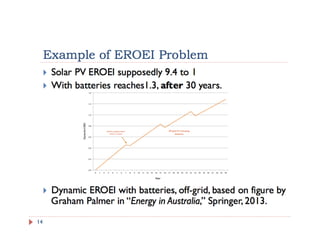
14
6. Renewables have pollution problems of
their own
15
!  Minerals used in making devices may present pollution
problems
!  Example: Extracting rare earth metals
!  Wind turbines present noise problems; kill bats and birds
!  Making these devices “moves forward” use of coal and
natural gas
!  We extract these fuels earlier, in the hope that eventually
energy usage will be reduced
!  Raises amount of debt outstanding, and indirectly cost of coal
and natural gas
!  Savings only take place if reduction in other uses takes place
7. If we are trying to save CO2, there are
less expensive ways of doing it
16
!  There seem to be many cheaper ways of reducing CO2
compared to using renewables. Examples:
!  Switching coal use to natural gas
!  Paying people to insulate their homes better
!  Perhaps even using nuclear energy
!  But other pollution issues may outweigh benefits of nuclear
8. A major function of oil and gas has been
to support governments financially
17
!  For oil companies, as much as 90% of what would
otherwise be profit must be paid in taxes
!  This is why governments of many countries own oil companies
!  If the price of oil drops, a major source of revenue to countries
disappears
!  Most renewables require large subsidies
!  Large subsidies are the opposite of paying high taxes
!  Subsidies for renewables contribute to tendency toward
financial collapse –it is governments that collapse
!  This is precisely the opposite effect of what people want
9. Renewables don’t do what we need them
to do
18
!  What we need is replacements for virtually all of our
types of energy
!  Need to match existing fuels exactly—gasoline, diesel, etc.
!  Need to be available in huge supply
!  Need to be available cheaply
!  Need to be non-polluting
!  Need to be available now
!  Renewables don’t even come close
!  Mostly renewables give politicians something to talk about
!  Make it look like they are really doing something favorable
!  And give researchers something to work on
10. Some renewables can be cost effective
19
!  Solar thermal can be cost effective for heating water
!  Especially in warm areas
!  Seems to be long-lived as well
!  Renewables that don’t require banking and the electric grid
have been available for many years, and may be available in the
future as well
!  Wood
!  Bamboo
!  Animal labor
!  Water power (with simple devices that don’t require fossil fuels)
!  Wind power to push boats, operate simple devices
Conclusion
20
!  We would like to have sustainable development
!  Renewables sound like they would be the way to sustainable
development
!  Unfortunately, in a finite world, development of any kind is not
sustainable
!  Sustainable development is an oxymoron – it can’t happen
!  Development must come to an end sometime
!  Just as the lives of plants and animals must come to an end
!  Also civilizations and economic growth must come to an end
!  Our civilization doesn’t end in a single day
!  But it may end in the lifetime of many of us

Confusion about Renewable Energy

  • 1.
    8. Confusion AboutRenewable Energy Gail Tverberg – Energy Economics and Analysis Modeling
  • 2.
    We get freeenergy from the sun !  Physicists describe the situation as a “thermodynamically open” system !  Humans, animals, even civilizations can grow for a time in a thermodynamically open system !  Eventually we die – we are dissipative systems !  Because of free energy from the sun, if we live near the equator, we don’t need to use much fuel for heating our homes !  Homes don’t need to be very sturdy, either !  Low home cost and heating cost is a huge benefit !  Reflected in lower needed wages for workers !  Provides a competitive advantage to warm countries 2
  • 3.
    Can we getfurther benefit from the sun’s energy and other renewable energy sources? !  Examples !  Ethanol - produces substitute for gasoline !  Palm oil, rape seed oil – produces substitute for diesel !  Wind turbines – produces intermittent electricity !  Solar Photovoltaic (PV)– produces intermittent electricity !  Solar Thermal – mostly for heating hot water !  Geothermal – makes use of heat within earth, produces electricity !  Wave energy – produces intermittent electricity !  Gas obtained by decomposing garbage 3
  • 4.
    Politicians would likeus to believe that “renewable” energy provides huge benefits !  “Fuel” for new renewables is free !  But this doesn’t mean that the end product we use is free !  Or even inexpensive !  Or available in large quantity !  Making “renewables” depends on existence of current system !  Need coal, oil, and natural gas to make and transport devices !  Need minerals of many kinds, including rare minerals !  Need banking system, international trade !  What is the basic problem we are trying to address? !  (1) Is problem Cost of producing fossil fuels is rising too high, or is it !  (2) Future supply shortage 4
  • 5.
    Historic understanding ofneed for renewables !  Mostly based on “supply” concern !  Oil (or fossil fuel supply in general) will decline in supply !  Biofuels would supplement !  Or electric cars would replace current vehicles !  Assumption is that we have a very long time for change !  High cost is not a concern !  Another issue is climate change !  Perhaps renewables would reduce CO2 emissions !  Renewables might replace part of coal use !  Might also help with other pollution issues !  Additional political issue !  Need for an “answer” to our problems !  But without a very good understanding of nature of problem 5
  • 6.
  • 7.
    1. Is ourproblem a supply problem or a cost problem? !  If our problem is a cost problem, new renewables are only helpful if they lower total costs !  New renewables tend to be expensive—need subsidies !  Not helpful to governments with financial problems !  Or to poor citizens, who are already having difficulty with low wages !  Most researchers have assumed our problem is a supply problem !  Expect supply of oil to decline, because of peak oil !  Also expect prices of oil and other fossil fuels to rise !  Expect that high cost renewables will become competitive !  If this story is wrong—collapse comes in the near term from low oil prices—then new renewables are not helpful 7
  • 8.
    2. New renewablesare only “add-ons” to our existing system !  We need oil, gas, and coal to make new renewables !  Also to maintain the electric grid, roads, and pipelines !  If we lose the use of the electric grid, wind and solar PV that supply the electric grid will of be of little value !  Electric grid is difficult to maintain !  Renewable device is of value only as long as rest of system “works” !  Easy to assume too long a lifetime for renewables !  One potential benefit—even if electric grid system fails, a few homeowners with their own solar PV panels might benefit !  Usually homeowners buying solar PV are rich homeowners !  Does it make sense to tax the poor, so government can subsidize solar PV panels purchased by rich homeowners? 8
  • 9.
    3. Quantity of“new renewables” is small compared to fossil fuels !  On a worldwide basis, other renewables barely visible !  Other renewables > new renewables; includes wood Based on Statistical Review of World Energy 2014 data 9
  • 10.
    Quantity of newrenewables is also very small for China Based on BP Statistical Review of World Energy, 2014 data 10
  • 11.
    Reasons “new renewable”quantities are low !  Cost of producing new renewables tends to be high !  May be high human labor cost—example, installing solar PV !  Also, uses many kinds of materials !  Some of these are expensive—rare earth minerals used in wind turbines, for example !  Fossil fuels are also used in making renewables !  Debt financing needed for long periods !  Interest expense is one of the costs as well !  Citizens can’t afford high cost; hard to subsidize sufficiently !  Fuel cost is often a low portion of total electricity costs !  Coal, nuclear – fuel often 25% or less of total electricity cost !  Eliminating fuel cost doesn’t necessarily lead to savings 11
  • 12.
    4. New renewablestend to be hard to “scale up” !  Even if fuel is free, many materials used in creating renewables are in limited supply !  Land is needed for growing biofuels—competes with food supply !  Over 40% of US corn is used to provide 5% of US oil consumption !  Rare earth minerals are used in wind turbines, electric cars !  Minerals of all types start with an initial limited supply of high quality ores !  These can be rapidly depleted !  Need to move to lower quality ores !  Very similar to fossil fuels with respect to diminishing returns problem !  “New renewables” represent an attempt to temporarily substitute materials that are less far along with respect to diminishing returns than fossil fuels !  Not a permanent solution 12
  • 13.
    5. It isdifficult to calculate the true benefit of intermittent renewables !  Intermittent renewables: Wind, solar PV, wave energy !  Advocates want to equate value of electricity produced by intermittent renewables to retail value of electricity replaced !  For example, if homeowners are paying $0.15 per kWh, want to value electricity produced by solar PV panels at this price !  Or give high feed-in tariff !  Savings to electric company may only be the cost of the fuel that would have been burned ($0.03 or $0.04 per kWh) !  Usually, need just as much fossil fuel generating capacity as in the past !  Also need as much or more grid capability !  Really need to do a detailed cost-benefit analysis !  If a lot of nearby hydro-electric capability, benefit may be greater 13
  • 14.
  • 15.
    6. Renewables havepollution problems of their own 15 !  Minerals used in making devices may present pollution problems !  Example: Extracting rare earth metals !  Wind turbines present noise problems; kill bats and birds !  Making these devices “moves forward” use of coal and natural gas !  We extract these fuels earlier, in the hope that eventually energy usage will be reduced !  Raises amount of debt outstanding, and indirectly cost of coal and natural gas !  Savings only take place if reduction in other uses takes place
  • 16.
    7. If weare trying to save CO2, there are less expensive ways of doing it 16 !  There seem to be many cheaper ways of reducing CO2 compared to using renewables. Examples: !  Switching coal use to natural gas !  Paying people to insulate their homes better !  Perhaps even using nuclear energy !  But other pollution issues may outweigh benefits of nuclear
  • 17.
    8. A majorfunction of oil and gas has been to support governments financially 17 !  For oil companies, as much as 90% of what would otherwise be profit must be paid in taxes !  This is why governments of many countries own oil companies !  If the price of oil drops, a major source of revenue to countries disappears !  Most renewables require large subsidies !  Large subsidies are the opposite of paying high taxes !  Subsidies for renewables contribute to tendency toward financial collapse –it is governments that collapse !  This is precisely the opposite effect of what people want
  • 18.
    9. Renewables don’tdo what we need them to do 18 !  What we need is replacements for virtually all of our types of energy !  Need to match existing fuels exactly—gasoline, diesel, etc. !  Need to be available in huge supply !  Need to be available cheaply !  Need to be non-polluting !  Need to be available now !  Renewables don’t even come close !  Mostly renewables give politicians something to talk about !  Make it look like they are really doing something favorable !  And give researchers something to work on
  • 19.
    10. Some renewablescan be cost effective 19 !  Solar thermal can be cost effective for heating water !  Especially in warm areas !  Seems to be long-lived as well !  Renewables that don’t require banking and the electric grid have been available for many years, and may be available in the future as well !  Wood !  Bamboo !  Animal labor !  Water power (with simple devices that don’t require fossil fuels) !  Wind power to push boats, operate simple devices
  • 20.
    Conclusion 20 !  We wouldlike to have sustainable development !  Renewables sound like they would be the way to sustainable development !  Unfortunately, in a finite world, development of any kind is not sustainable !  Sustainable development is an oxymoron – it can’t happen !  Development must come to an end sometime !  Just as the lives of plants and animals must come to an end !  Also civilizations and economic growth must come to an end !  Our civilization doesn’t end in a single day !  But it may end in the lifetime of many of us