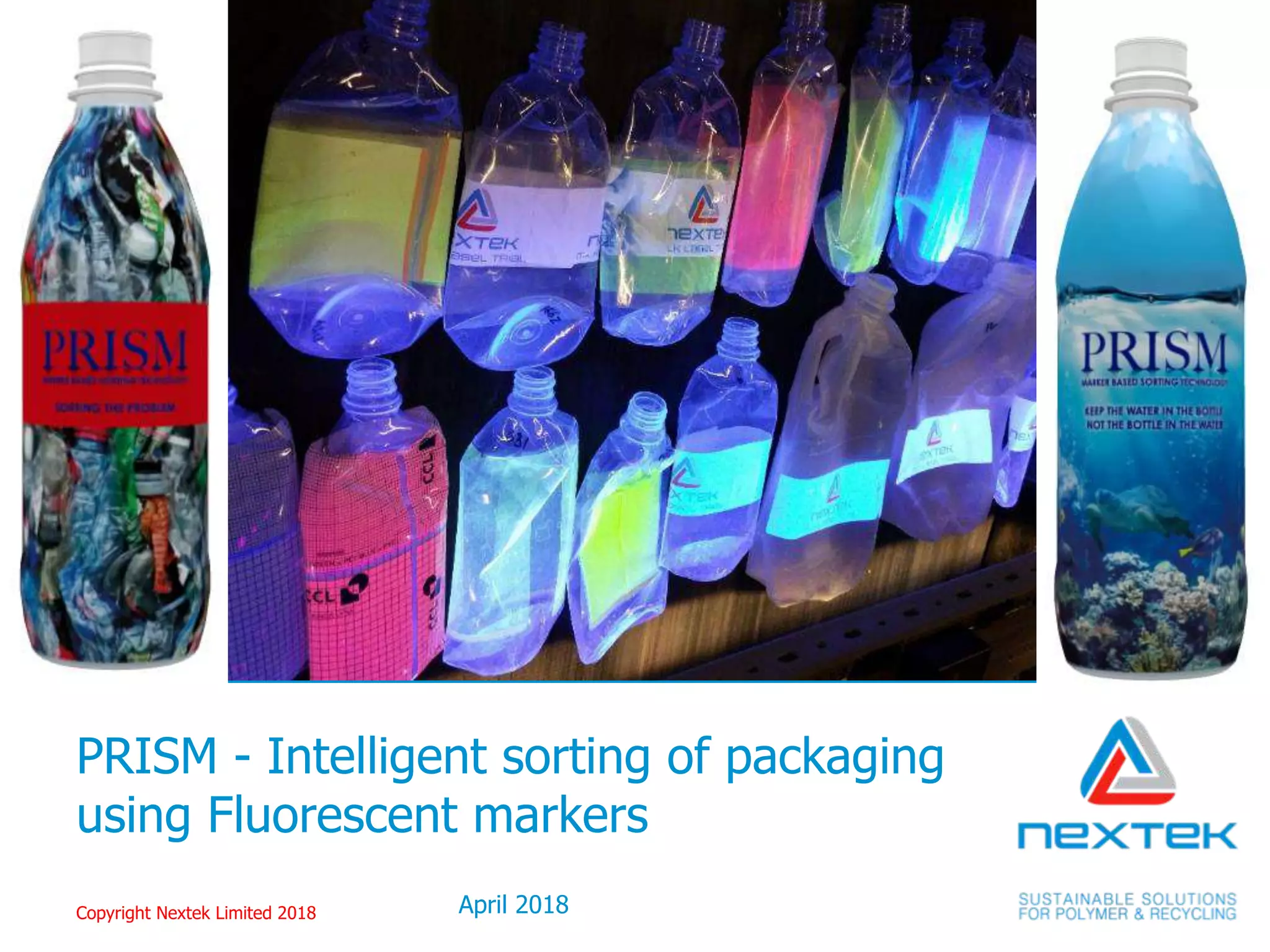
PRISM - Intelligent sorting of packaging
using Fluorescent markers
Nextek Ltd
April 2018Copyright Nextek Limited 2018
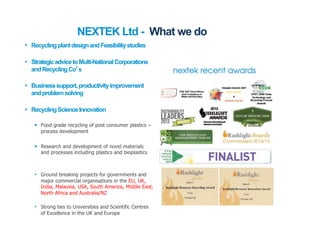
NEXTEK Ltd - What we do
• RecyclingplantdesignandFeasibilitystudies
• StrategicadvicetoMulti-NationalCorporations
andRecyclingCo s
• Businesssupport,productivityimprovement
andproblemsolving
• RecyclingScienceInnovation
• Food grade recycling of post consumer plastics –
process development
• Research and development of novel materials
and processes including plastics and bioplastics
• Ground breaking projects for governments and
major commercial organisations in the EU, UK,
India, Malaysia, USA, South America, Middle East,
North Africa and Australia/NZ
• Strong ties to Universities and Scientific Centres
of Excellence in the UK and Europe
2
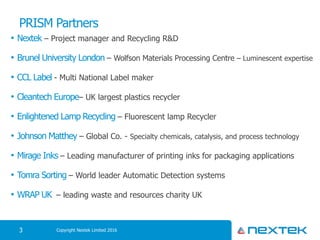
PRISM Partners
• Nextek – Project manager and Recycling R&D
• Brunel University London – Wolfson Materials Processing Centre – Luminescent expertise
• CCL Label - Multi National Label maker
• Cleantech Europe– UK largest plastics recycler
• Enlightened Lamp Recycling – Fluorescent lamp Recycler
• Johnson Matthey – Global Co. - Specialty chemicals, catalysis, and process technology
• Mirage Inks – Leading manufacturer of printing inks for packaging applications
• Tomra Sorting – World leader Automatic Detection systems
• WRAP UK – leading waste and resources charity UK
Copyright Nextek Limited 20163
Plastic Packaging Recycling using Intelligent Separation
technologies for Materials (PRISM) - Summary
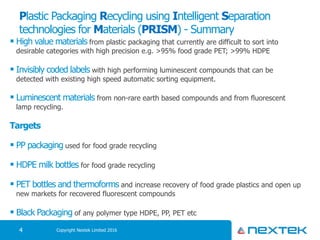
§ High value materials from plastic packaging that currently are difficult to sort into
desirable categories with high precision e.g. >95% food grade PET; >99% HDPE
§ Invisibly coded labels with high performing luminescent compounds that can be
detected with existing high speed automatic sorting equipment.
§ Luminescent materials from non-rare earth based compounds and from fluorescent
lamp recycling.
Targets
§ PP packaging used for food grade recycling
§ HDPE milk bottles for food grade recycling
§ PET bottles and thermoforms and increase recovery of food grade plastics and open up
new markets for recovered fluorescent compounds
§ Black Packaging of any polymer type HDPE, PP, PET etc
Copyright Nextek Limited 20164
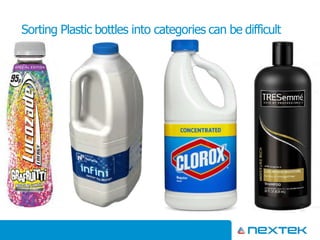
Sorting Plastic bottles into categories can be difficult
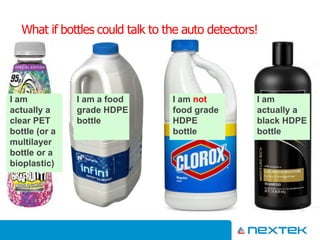
What if bottles could talk to the auto detectors!
I am
actually a
clear PET
bottle (or a
multilayer
bottle or a
bioplastic)
I am a food
grade HDPE
bottle
I am not
food grade
HDPE
bottle
I am
actually a
black HDPE
bottle
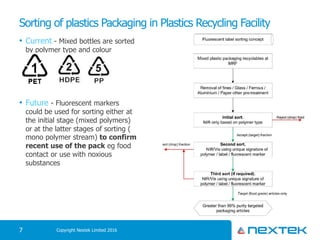
• Current - Mixed bottles are sorted
by polymer type and colour
• Future - Fluorescent markers
could be used for sorting either at
the initial stage (mixed polymers)
or at the latter stages of sorting (
mono polymer stream) to confirm
recent use of the pack eg food
contact or use with noxious
substances
Sorting of plastics Packaging in Plastics Recycling Facility
Copyright Nextek Limited 20167
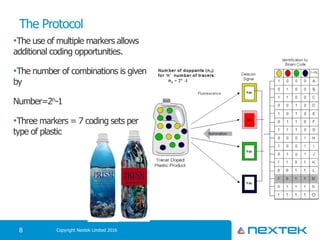
The Protocol
•The use of multiple markers allows
additional coding opportunities.
•The number of combinations is given
by
Number=2n-1
•Three markers = 7 coding sets per
type of plastic
8 Copyright Nextek Limited 2016
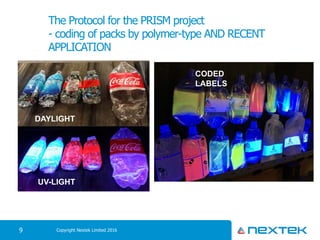
The Protocol for the PRISM project
- coding of packs by polymer-type AND RECENT
APPLICATION
Copyright Nextek Limited 20169
DAYLIGHT
UV-LIGHT
CODED
LABELS
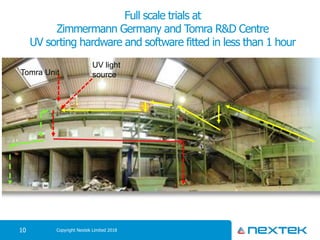
Full scale trials at
Zimmermann Germany and Tomra R&D Centre
UV sorting hardware and software fitted in less than 1 hour
Copyright Nextek Limited 201810
Tomra Unit
UV light
source
Sorting PET bottles with Fluorescent markers
11
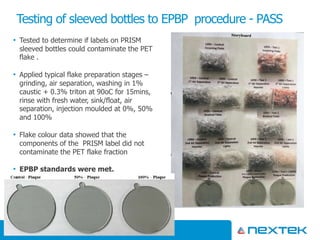
• Tested to determine if labels on PRISM
sleeved bottles could contaminate the PET
flake .
• Applied typical flake preparation stages –
grinding, air separation, washing in 1%
caustic + 0.3% triton at 90oC for 15mins,
rinse with fresh water, sink/float, air
separation, injection moulded at 0%, 50%
and 100%
• Flake colour data showed that the
components of the PRISM label did not
contaminate the PET flake fraction
• EPBP standards were met.
Testing of sleeved bottles to EPBP procedure - PASS
Copyright Nextek Limited 201812
Summary
•Packaging marked with intelligent labels or coatings can be uniquely identified
and sorted with high efficiency using high-speed, high - throughput commercial
equipment that is modified with UV lighting.
•This technology offers the potential to sort a range of targeted recycled
materials such as food grade PP, HDPE and PET packaging, as well as other
materials using a non-polymer specific process.
•Proven Sorting speeds 2.2 to 4.4 tonnes/hr/metre of belt width
Yields typically 98% to 90% after optimisation
Purity typically 95% or higher in a single pass
Purity typically >99% or higher in second pass
•PRISM technology is ready to be implemented using existing labelling
techniques and current sorting technology to validate Food Grade and to sort
difficult to recycle packaging.
Commercial interest: Four large brand owners and packaging companies
The
Circular Economy
in the
Asia Pacific Region
www.circularecconomyasia.org

NEXTEK PRISM Intelligent Sorting of Packaging Using Fluorescent Markers

  • 1.
    PRISM - Intelligentsorting of packaging using Fluorescent markers Nextek Ltd April 2018Copyright Nextek Limited 2018
  • 2.
    NEXTEK Ltd -What we do • RecyclingplantdesignandFeasibilitystudies • StrategicadvicetoMulti-NationalCorporations andRecyclingCo s • Businesssupport,productivityimprovement andproblemsolving • RecyclingScienceInnovation • Food grade recycling of post consumer plastics – process development • Research and development of novel materials and processes including plastics and bioplastics • Ground breaking projects for governments and major commercial organisations in the EU, UK, India, Malaysia, USA, South America, Middle East, North Africa and Australia/NZ • Strong ties to Universities and Scientific Centres of Excellence in the UK and Europe 2
  • 3.
    PRISM Partners • Nextek– Project manager and Recycling R&D • Brunel University London – Wolfson Materials Processing Centre – Luminescent expertise • CCL Label - Multi National Label maker • Cleantech Europe– UK largest plastics recycler • Enlightened Lamp Recycling – Fluorescent lamp Recycler • Johnson Matthey – Global Co. - Specialty chemicals, catalysis, and process technology • Mirage Inks – Leading manufacturer of printing inks for packaging applications • Tomra Sorting – World leader Automatic Detection systems • WRAP UK – leading waste and resources charity UK Copyright Nextek Limited 20163
  • 4.
    Plastic Packaging Recyclingusing Intelligent Separation technologies for Materials (PRISM) - Summary § High value materials from plastic packaging that currently are difficult to sort into desirable categories with high precision e.g. >95% food grade PET; >99% HDPE § Invisibly coded labels with high performing luminescent compounds that can be detected with existing high speed automatic sorting equipment. § Luminescent materials from non-rare earth based compounds and from fluorescent lamp recycling. Targets § PP packaging used for food grade recycling § HDPE milk bottles for food grade recycling § PET bottles and thermoforms and increase recovery of food grade plastics and open up new markets for recovered fluorescent compounds § Black Packaging of any polymer type HDPE, PP, PET etc Copyright Nextek Limited 20164
  • 5.
    Sorting Plastic bottlesinto categories can be difficult
  • 6.
    What if bottlescould talk to the auto detectors! I am actually a clear PET bottle (or a multilayer bottle or a bioplastic) I am a food grade HDPE bottle I am not food grade HDPE bottle I am actually a black HDPE bottle
  • 7.
    • Current -Mixed bottles are sorted by polymer type and colour • Future - Fluorescent markers could be used for sorting either at the initial stage (mixed polymers) or at the latter stages of sorting ( mono polymer stream) to confirm recent use of the pack eg food contact or use with noxious substances Sorting of plastics Packaging in Plastics Recycling Facility Copyright Nextek Limited 20167
  • 8.
    The Protocol •The useof multiple markers allows additional coding opportunities. •The number of combinations is given by Number=2n-1 •Three markers = 7 coding sets per type of plastic 8 Copyright Nextek Limited 2016
  • 9.
    The Protocol forthe PRISM project - coding of packs by polymer-type AND RECENT APPLICATION Copyright Nextek Limited 20169 DAYLIGHT UV-LIGHT CODED LABELS
  • 10.
    Full scale trialsat Zimmermann Germany and Tomra R&D Centre UV sorting hardware and software fitted in less than 1 hour Copyright Nextek Limited 201810 Tomra Unit UV light source
  • 11.
    Sorting PET bottleswith Fluorescent markers 11
  • 12.
    • Tested todetermine if labels on PRISM sleeved bottles could contaminate the PET flake . • Applied typical flake preparation stages – grinding, air separation, washing in 1% caustic + 0.3% triton at 90oC for 15mins, rinse with fresh water, sink/float, air separation, injection moulded at 0%, 50% and 100% • Flake colour data showed that the components of the PRISM label did not contaminate the PET flake fraction • EPBP standards were met. Testing of sleeved bottles to EPBP procedure - PASS Copyright Nextek Limited 201812
  • 13.
    Summary •Packaging marked withintelligent labels or coatings can be uniquely identified and sorted with high efficiency using high-speed, high - throughput commercial equipment that is modified with UV lighting. •This technology offers the potential to sort a range of targeted recycled materials such as food grade PP, HDPE and PET packaging, as well as other materials using a non-polymer specific process. •Proven Sorting speeds 2.2 to 4.4 tonnes/hr/metre of belt width Yields typically 98% to 90% after optimisation Purity typically 95% or higher in a single pass Purity typically >99% or higher in second pass •PRISM technology is ready to be implemented using existing labelling techniques and current sorting technology to validate Food Grade and to sort difficult to recycle packaging. Commercial interest: Four large brand owners and packaging companies
  • 14.
    The Circular Economy in the AsiaPacific Region www.circularecconomyasia.org