
Republic of the Philippines
      Region III – Central Luzon
    TARLAC STATE UNIVERSITY
             Tarlac City


 PRODUCT
ARCHITECTURE
 EDUARDO A. PANTIG JR.
      MaEd - TLE
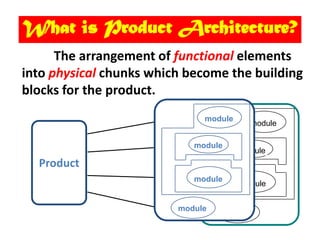
What is Product Architecture?
      The arrangement of functional elements
into physical chunks which become the building
blocks for the product.
                              module
                                              module

                            module
                                        module
  Product
                            module
                                        module


                         module
                                     module
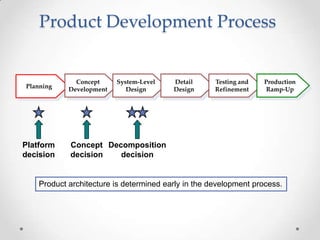
Product Development Process


              Concept     System-Level   Detail      Testing and   Production
Planning    Development      Design      Design      Refinement     Ramp-Up


Platform    Concept Decomposition
decision    decision   decision


    Product architecture is determined early in the development process.
Importance of Product
        Architecture

• Decided early and drives design
• Impacts manufacturing cost
• Impacts product evolution
Implications of Architecture

1.Product Change

   upgrade
   add-ons
   adaptation
   wear
   consumption
   flexibility in use
   reuse
Implications of Architecture


2. Product Variety

3. Component Standardization
Implications of Architecture


4. Product Performance

5. Manufacturability

6. Product Development Management
Modular Architecture
         and
Integral Architecture
Modular Product Architecture


• Each physical chunk implements one or a few
  functional elements in their entirety
• The interactions between chunks are well
  defined (i.e. the interfaces are well defined)
Integral Product Architecture

• Functional elements are implemented by multiple
  chunks, or a chunk may implement many
  functions.
• Interactions between chunks are poorly defined.
• Integral architecture generally increases
  performance and reduces costs for any specific
  product model.
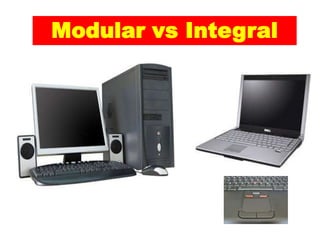
Modular vs Integral


 Two models of bicycle brake and shifting controls.
Modular vs Integral
Modular vs Integral
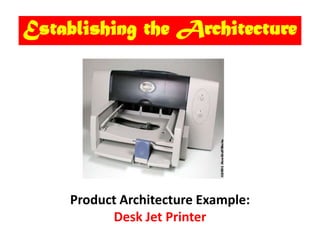
Establishing the Architecture


    Product Architecture Example:
          Desk Jet Printer
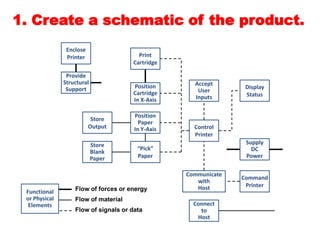
1. Create a schematic of the product.
                Enclose
                Printer                 Print
                                      Cartridge

                Provide
               Structural                            Accept
                Support               Position                    Display
                                      Cartridge       User
                                                     Inputs       Status
                                      In X-Axis

                                       Position
                           Store
                                         Paper
                          Output       In Y-Axis     Control
                                                     Printer
                            Store                                 Supply
                                        “Pick”                      DC
                            Blank
                            Paper       Paper                     Power

                                                   Communicate
                                                                 Command
                                                      with
                                                      Host        Printer
 Functional        Flow of forces or energy
 or Physical       Flow of material
  Elements                                           Connect
                   Flow of signals or data             to
                                                      Host
2. Cluster the elements of the schematic
               Enclosure
                Enclose
                Printer                Print
                                     Cartridge

                Provide                             User Interface Board
               Structural                          Accept
                Support              Position                       Display
                                     Cartridge      User
                                                   Inputs           Status
                Chassis              In X-Axis

                                     Position
                           Store
                                       Paper
                          Output     In Y-Axis     Control       Power Cord
                                                   Printer       and “Brick”
                            Store                                  Supply
                                      “Pick”                         DC
                            Blank
                            Paper     Paper                         Power

                     Paper Tray       Print
                                    Mechanism    Communicate
                                                                   Command
                                                    with
                                                    Host            Printer
                                                                 Host Driver
 Functional                                        Connect        Software
 or Physical     Chunks                              to
  Elements                                          Host
                                                 Logic Board
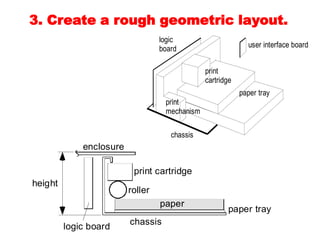
3. Create a rough geometric layout.
                                  logic
                                  board                      user interface board


                                               print
                                               cartridge
                                                           paper tray
                                   print
                                   mechanism

                                     chassis
             enclosure

                          print cartridge
height
                         roller
                                  paper
                                                      paper tray
                         chassis
         logic board
4. Identify the fundamental and incidental
   interactions.
   Enclosure                                    User Interface
                                                   Board

        Styling
                                         Thermal
                Vibration     Print     Distortion   Logic             Host Driver
  Paper Tray
                            Mechanism                Board              Software

                Thermal                                      RF
               Distortion       RF                      Interference
                             Shielding
                                                 Power Cord
    Chassis
                                                 and “Brick”
Thank
You!

Product Architecture

  • 1.
    Republic of thePhilippines Region III – Central Luzon TARLAC STATE UNIVERSITY Tarlac City PRODUCT ARCHITECTURE EDUARDO A. PANTIG JR. MaEd - TLE
  • 2.
    What is ProductArchitecture? The arrangement of functional elements into physical chunks which become the building blocks for the product. module module module module Product module module module module
  • 3.
    Product Development Process Concept System-Level Detail Testing and Production Planning Development Design Design Refinement Ramp-Up Platform Concept Decomposition decision decision decision Product architecture is determined early in the development process.
  • 4.
    Importance of Product Architecture • Decided early and drives design • Impacts manufacturing cost • Impacts product evolution
  • 5.
    Implications of Architecture 1.ProductChange  upgrade  add-ons  adaptation  wear  consumption  flexibility in use  reuse
  • 6.
    Implications of Architecture 2.Product Variety 3. Component Standardization
  • 7.
    Implications of Architecture 4.Product Performance 5. Manufacturability 6. Product Development Management
  • 8.
    Modular Architecture and Integral Architecture
  • 9.
    Modular Product Architecture •Each physical chunk implements one or a few functional elements in their entirety • The interactions between chunks are well defined (i.e. the interfaces are well defined)
  • 10.
    Integral Product Architecture •Functional elements are implemented by multiple chunks, or a chunk may implement many functions. • Interactions between chunks are poorly defined. • Integral architecture generally increases performance and reduces costs for any specific product model.
  • 11.
    Modular vs Integral Two models of bicycle brake and shifting controls.
  • 12.
  • 13.
  • 14.
    Establishing the Architecture Product Architecture Example: Desk Jet Printer
  • 15.
    1. Create aschematic of the product. Enclose Printer Print Cartridge Provide Structural Accept Support Position Display Cartridge User Inputs Status In X-Axis Position Store Paper Output In Y-Axis Control Printer Store Supply “Pick” DC Blank Paper Paper Power Communicate Command with Host Printer Functional Flow of forces or energy or Physical Flow of material Elements Connect Flow of signals or data to Host
  • 16.
    2. Cluster theelements of the schematic Enclosure Enclose Printer Print Cartridge Provide User Interface Board Structural Accept Support Position Display Cartridge User Inputs Status Chassis In X-Axis Position Store Paper Output In Y-Axis Control Power Cord Printer and “Brick” Store Supply “Pick” DC Blank Paper Paper Power Paper Tray Print Mechanism Communicate Command with Host Printer Host Driver Functional Connect Software or Physical Chunks to Elements Host Logic Board
  • 17.
    3. Create arough geometric layout. logic board user interface board print cartridge paper tray print mechanism chassis enclosure print cartridge height roller paper paper tray chassis logic board
  • 18.
    4. Identify thefundamental and incidental interactions. Enclosure User Interface Board Styling Thermal Vibration Print Distortion Logic Host Driver Paper Tray Mechanism Board Software Thermal RF Distortion RF Interference Shielding Power Cord Chassis and “Brick”
  • 19.

Editor's Notes

  • #3 This is where we “map” the functions from our functional analysis/functional decomposition to physical design elements
  • #5 We are looking at these topics early because they matter to the early stage of design. We also don’t want to lock ourselves out of the possibility of later product enhancements (adding a sunroof, adding a supercharger, etc)
  • #6 We are looking at these topics early because they matter to the early stage of design. We also don’t want to lock ourselves out of the possibility of later product enhancements (adding a sunroof, adding a supercharger, etc)
  • #7 We are looking at these topics early because they matter to the early stage of design. We also don’t want to lock ourselves out of the possibility of later product enhancements (adding a sunroof, adding a supercharger, etc)
  • #8 We are looking at these topics early because they matter to the early stage of design. We also don’t want to lock ourselves out of the possibility of later product enhancements (adding a sunroof, adding a supercharger, etc)
  • #9 We are looking at these topics early because they matter to the early stage of design. We also don’t want to lock ourselves out of the possibility of later product enhancements (adding a sunroof, adding a supercharger, etc)