Waste
or a
Resource
Revolution?
What is the Circular Economy?
A circular company
is future focused
tied to its ability to
operate and remain competitive
within the planetary boundaries
of finite resources
What are Secondary Raw
Materials?
'Secondary raw materials' are
recycled materials that can be
used in manufacturing processes
instead of or alongside virgin raw
materials.
The advantages of using
secondary raw materials:
❖ Increased security of
supply
❖ Reduced material and
energy use
❖ Reduced impacts on
the climate and the
environment
❖ Reduced manufacturing
costs.
Waste or a
Resource Revolution?
The stages of a production process, showing
energy input and waste outputs
Rethinking (Food) Waste
Barnana use imperfect bananas
which have scuffs, are a little too
ripe, or aren’t the perfect size -
usually rejected for export and turn
them into delicious snacks.
Rethinking (Food) Waste
ReGrained rescues the nutritious
grain that has traditionally
become waste during the
manufacturing of beer and makes
snacks, flour and other products.
Rethinking (Food) Waste
The coffee cherry (or fruit) is
considered waste after the bean
has been extracted. The Coffee
Cherry Co. turns the waste cherry
into food ingredients.
Rethinking (Food) Waste
Up to 44% of bread is never eaten.
Toast Ale uses bakery surplus bread
as a key ingredient to make beer.
The bread replaces ⅓ of the malted
barley typical used in brewing
Rethinking (Food) Waste
Treasure8 sources ugly, imperfect
and from post-production fruit and
vegetables food streams to
manufacture a range of food
products for pets and people.
A Resource Revolution
“This is one of the biggest
bottom-line opportunities in
history...It’s a Resource
Resolution…”
Secondary Raw Materials
Trading Platforms
Two options to keep resources in
use to maximise value:
1. Resource recovery collections
systems
2. Circular design, where products
are designed to maximise
resource value
Recycling
creates
between
6 ~ 30 times
more jobs
than landfill
(depending on country and
existing infrastructure)
For Malaysia it is forecast that by
2020 - 49,670 tonnes of MSW is
expected to be generated ever day.
Taking an average of 10 jobs created
per 1,000 tonnes, this number yields a
prospective 4,967 jobs
Here is our solution for
a scalable, nation-wide
Recyclable Resource Recovery
Collection System
for developing countries
The Recyclable Resources
Industry Association
Inspire Entrepreneurship
For Resource Recovery
Resource Recovery Agents
Licensing System
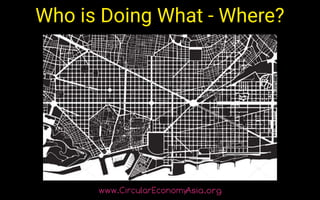
Who is Doing What - Where?
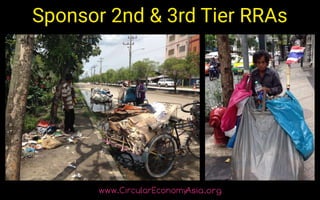
Sponsor 2nd & 3rd Tier RRAs
Training
Brand Identity
Micro & Standard Financing
Extended Producer Responsibility
Could Partially Finance a RRIA
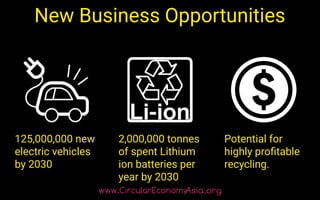
New Business Opportunities
125,000,000 new
electric vehicles
by 2030
2,000,000 tonnes
of spent Lithium
ion batteries per
year by 2030
Potential for
highly profitable
recycling.
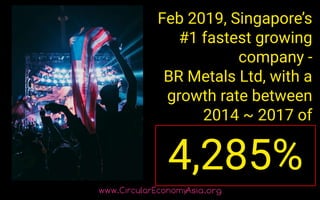
Feb 2019, Singapore’s
#1 fastest growing
company -
BR Metals Ltd, with a
growth rate between
2014 ~ 2017 of
4,285%
Secondary raw material collection
is not recycling.
A robust and functioning
RRRCS provides raw
materials for companies to
manufacture regardless of price
volatilityand resource scarcity
Circular Design
is key for easier
resource
extraction
The only
Plastics & Packaging
Agreement
that aims to establish a
sustainable & circular
plastics & packaging
industry in each
country in Asia
Not just set company
targets!
Your circular economy partner in
Asia:
- Education
- Training
- Consultancy
- ‘The Nine Steps Towards a
Circular Business’ Workshops
Circular Malaysia FB
Recycle Asia FB
Circular Asia YouTube
@CircularAsia
Contact:
adrienna@circulareconomyasia.org
CircularAsia FB group

Resource Revolution